Creating Powerful resumesA guide to writing your way into interviews….
ContentsBasics of Resume writingHow to create a powerful resumeTips to get your resume to the right places
Finerva academy Learning initiativesTraining on life skills70 years of combined team experience0% Theory, 100% practicality
Before we startWhat is a resume for?
A resume is for….It is only and only a key to get a call for a job interview. Period.Secondary objectivesSelf marketing toolJob skills showcaseValue addition
The ironyPotential recruiters have very little time to see your resume. Sometimes lesser than 20 secondsSo what do you do?
Build a powerful resume
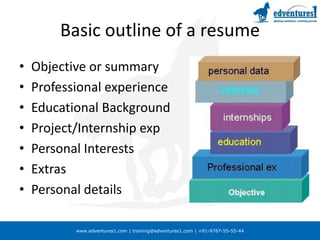
Basic outline of a resumeObjective or summary Professional experienceEducational BackgroundProject/Internship expPersonal InterestsExtrasPersonal details
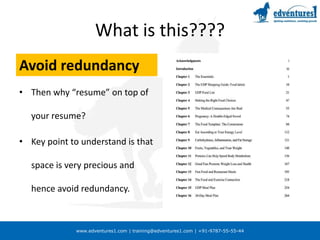
What is this????Avoid redundancyThen why “resume” on top of your resume?Key point to understand is that space is very precious and hence avoid redundancy.
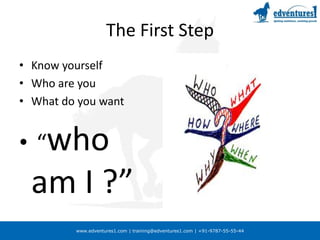
The First StepKnow yourselfWho are youWhat do you want “who am I ?”
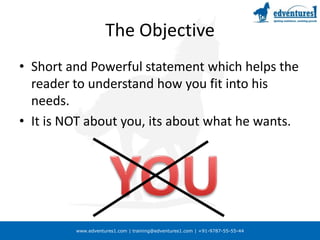
The ObjectiveShort and Powerful statement which helps the reader to understand how you fit into his needs.It is NOT about you, its about what he wants.YOU
Is this a good objective statement?An internship allowing me to utilize myknowledge and expertise in different areasWell-written but raises too many questionsFor example: What kind of internship? What knowledge? What kinds of expertise? Which areas?
Sample Objectives…For an entry level accounting position:	A position in the accounting field where excellent analytical and technical skills can help to improve the company's profitability.If you have two years experience:	A Data Entry position where skills in spreadsheet development and troubleshooting can improve efficiency and enhance profitability.
Sample Objectives…If you are changing areas of employment:	A position as Assistant Engineer where construction knowledge, high mechanical aptitude and commitment to safety can contribute to profitable operation.If you are a creative worker:	A Graphic Design position where advanced graphic and creative skills will produce a quality product for agency customers.
Readymade objectives…For practice, fill in the parts in bracketsTo utilize my [qualifications, strengths, or skills] as a [position title]A position as a [position title] for [company name] allowing me to develop my [qualifications, strengths, or skills] An opportunity to [professional goal] in a [type of organization, work environment, or field][position title] with emphasis in [areas of expertise]
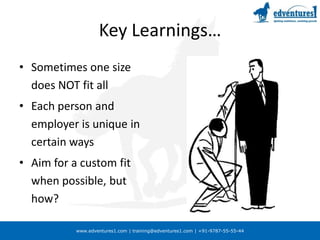
Key Learnings…Sometimes one size does NOT fit allEach person and employer is unique in certain waysAim for a custom fit when possible, but how?
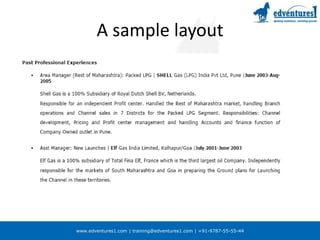
The Experience SectionGives a brief of your current and past professional experiences.Need not necessarily be full time/paid but should be real-time. Try to match past profiles to current opportunity.
A sample layout
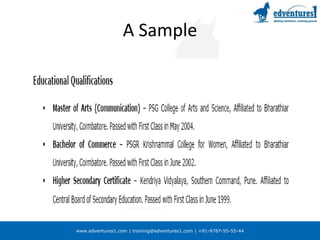
Education SectionEducational backgroundMost important section for freshersInfo about formal educationRelevancy to job
A Sample
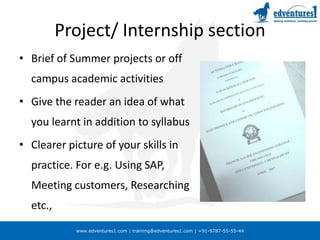
Project/ Internship sectionBrief of Summer projects or off campus academic activitiesGive the reader an idea of what you learnt in addition to syllabusClearer picture of your skills in practice. For e.g. Using SAP, Meeting customers, Researching etc.,
Draft layoutTitle of ProjectWhere (Company/Organisation)DurationWhat you did? (explain the project)What you learnt? (personal takeaways)
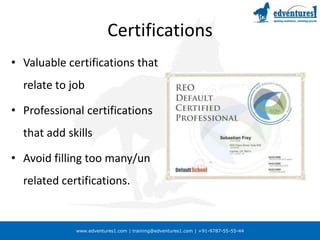
Certifications Valuable certifications that relate to jobProfessional certifications that add skillsAvoid filling too many/un related certifications.
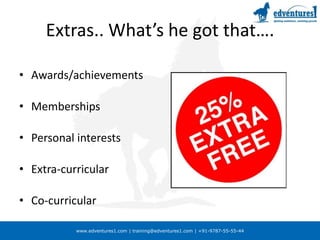
Extras.. What’s he got that….Awards/achievementsMembershipsPersonal interestsExtra-curricularCo-curricular
What goes and what does not…You should be a don in the activityThe awards/achievements should be real worth it.Be ready for rough questions
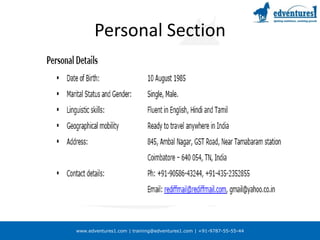
Personal Section
Do’s of resume…Use single font, two sizes at max.Use commonly available font familiesArial, Verdana, Times New, TrebuchetGive lots of white spaceUse powerful words, adjectives and buzz words.KISS – Keep it simple and sweet.
Don'ts Do not write resume on topDo not use colors or too much of bold.Do not write undertakingDo not write storiesDo not make reader search for information
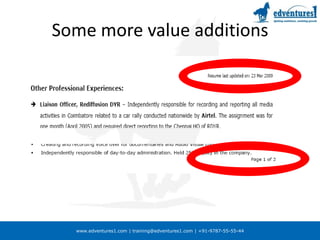
Some more value additions
Thank You!+91-97-87- 55- 55- 44training@edventures1.com

Creating powerful resumes

  • 1.
    Creating Powerful resumesAguide to writing your way into interviews….
  • 2.
    ContentsBasics of ResumewritingHow to create a powerful resumeTips to get your resume to the right places
  • 3.
    Finerva academy LearninginitiativesTraining on life skills70 years of combined team experience0% Theory, 100% practicality
  • 4.
    Before we startWhatis a resume for?
  • 5.
    A resume isfor….It is only and only a key to get a call for a job interview. Period.Secondary objectivesSelf marketing toolJob skills showcaseValue addition
  • 6.
    The ironyPotential recruitershave very little time to see your resume. Sometimes lesser than 20 secondsSo what do you do?
  • 7.
  • 8.
    Basic outline ofa resumeObjective or summary Professional experienceEducational BackgroundProject/Internship expPersonal InterestsExtrasPersonal details
  • 9.
    What is this????AvoidredundancyThen why “resume” on top of your resume?Key point to understand is that space is very precious and hence avoid redundancy.
  • 10.
    The First StepKnowyourselfWho are youWhat do you want “who am I ?”
  • 11.
    The ObjectiveShort andPowerful statement which helps the reader to understand how you fit into his needs.It is NOT about you, its about what he wants.YOU
  • 12.
    Is this agood objective statement?An internship allowing me to utilize myknowledge and expertise in different areasWell-written but raises too many questionsFor example: What kind of internship? What knowledge? What kinds of expertise? Which areas?
  • 13.
    Sample Objectives…For anentry level accounting position: A position in the accounting field where excellent analytical and technical skills can help to improve the company's profitability.If you have two years experience: A Data Entry position where skills in spreadsheet development and troubleshooting can improve efficiency and enhance profitability.
  • 14.
    Sample Objectives…If youare changing areas of employment: A position as Assistant Engineer where construction knowledge, high mechanical aptitude and commitment to safety can contribute to profitable operation.If you are a creative worker: A Graphic Design position where advanced graphic and creative skills will produce a quality product for agency customers.
  • 15.
    Readymade objectives…For practice,fill in the parts in bracketsTo utilize my [qualifications, strengths, or skills] as a [position title]A position as a [position title] for [company name] allowing me to develop my [qualifications, strengths, or skills] An opportunity to [professional goal] in a [type of organization, work environment, or field][position title] with emphasis in [areas of expertise]
  • 16.
    Key Learnings…Sometimes onesize does NOT fit allEach person and employer is unique in certain waysAim for a custom fit when possible, but how?
  • 17.
    The Experience SectionGivesa brief of your current and past professional experiences.Need not necessarily be full time/paid but should be real-time. Try to match past profiles to current opportunity.
  • 18.
  • 19.
    Education SectionEducational backgroundMostimportant section for freshersInfo about formal educationRelevancy to job
  • 20.
  • 21.
    Project/ Internship sectionBriefof Summer projects or off campus academic activitiesGive the reader an idea of what you learnt in addition to syllabusClearer picture of your skills in practice. For e.g. Using SAP, Meeting customers, Researching etc.,
  • 22.
    Draft layoutTitle ofProjectWhere (Company/Organisation)DurationWhat you did? (explain the project)What you learnt? (personal takeaways)
  • 23.
    Certifications Valuable certificationsthat relate to jobProfessional certifications that add skillsAvoid filling too many/un related certifications.
  • 24.
    Extras.. What’s hegot that….Awards/achievementsMembershipsPersonal interestsExtra-curricularCo-curricular
  • 25.
    What goes andwhat does not…You should be a don in the activityThe awards/achievements should be real worth it.Be ready for rough questions
  • 26.
  • 27.
    Do’s of resume…Usesingle font, two sizes at max.Use commonly available font familiesArial, Verdana, Times New, TrebuchetGive lots of white spaceUse powerful words, adjectives and buzz words.KISS – Keep it simple and sweet.
  • 28.
    Don'ts Do notwrite resume on topDo not use colors or too much of bold.Do not write undertakingDo not write storiesDo not make reader search for information
  • 29.
  • 31.
    Thank You!+91-97-87- 55-55- 44training@edventures1.com
  • 32.