How to prepare a GREAT resume
GRACE Training and Development Services
Overview
1. Introduction to Resume
2. Resume v CV
3. Preparing a GREAT Resume
1. Introduction to Resume
A resume is a short, concise
written document of your
education, work experience,
credentials, accomplishments
and is used to apply for jobs.
1.1 What is the purpose of resume?
The purpose of a resume is to provide a
summary of your skills, abilities and
accomplishments.
It is a quick advertisement of who you are.
It is a "snapshot" of you with the intent of
capturing and emphasizing interests and secure
you an interview.
It is not an autobiography.
1.2 Types of resume
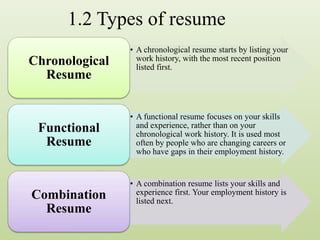
• A chronological resume starts by listing your
work history, with the most recent position
listed first.
Chronological
Resume
• A functional resume focuses on your skills
and experience, rather than on your
chronological work history. It is used most
often by people who are changing careers or
who have gaps in their employment history.
Functional
Resume
• A combination resume lists your skills and
experience first. Your employment history is
listed next.
Combination
Resume
Types of resume…2
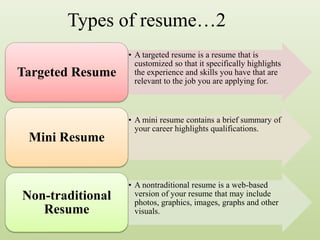
• A targeted resume is a resume that is
customized so that it specifically highlights
the experience and skills you have that are
relevant to the job you are applying for.
Targeted Resume
• A mini resume contains a brief summary of
your career highlights qualifications.
Mini Resume
• A nontraditional resume is a web-based
version of your resume that may include
photos, graphics, images, graphs and other
visuals.
Non-traditional
Resume
1.3 Features of a great resume
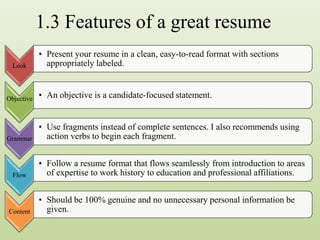
Look
• Present your resume in a clean, easy-to-read format with sections
appropriately labeled.
Objective • An objective is a candidate-focused statement.
Grammar
• Use fragments instead of complete sentences. I also recommends using
action verbs to begin each fragment.
Flow
• Follow a resume format that flows seamlessly from introduction to areas
of expertise to work history to education and professional affiliations.
Content
• Should be 100% genuine and no unnecessary personal information be
given.
2. Resume v CV
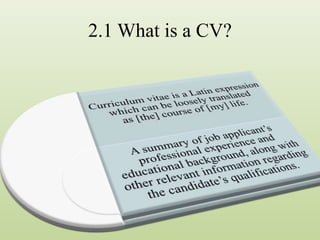
2.1 What is a CV?
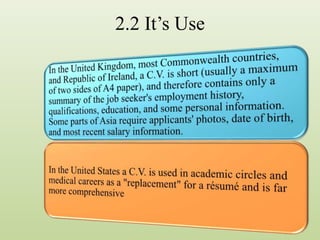
2.2 It’s Use
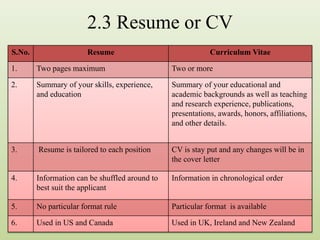
2.3 Resume or CV
S.No. Resume Curriculum Vitae
1. Two pages maximum Two or more
2. Summary of your skills, experience,
and education
Summary of your educational and
academic backgrounds as well as teaching
and research experience, publications,
presentations, awards, honors, affiliations,
and other details.
3. Resume is tailored to each position CV is stay put and any changes will be in
the cover letter
4. Information can be shuffled around to
best suit the applicant
Information in chronological order
5. No particular format rule Particular format is available
6. Used in US and Canada Used in UK, Ireland and New Zealand
3. Preparing a GREAT Resume
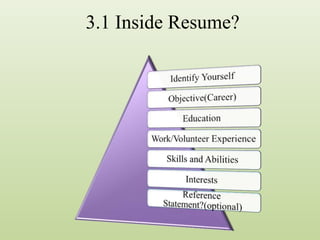
3.1 Inside Resume?
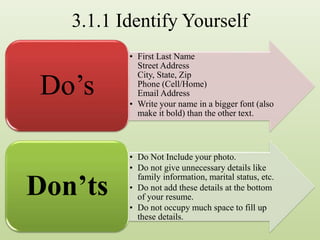
3.1.1 Identify Yourself
• First Last Name
Street Address
City, State, Zip
Phone (Cell/Home)
Email Address
• Write your name in a bigger font (also
make it bold) than the other text.
Do’s
• Do Not Include your photo.
• Do not give unnecessary details like
family information, marital status, etc.
• Do not add these details at the bottom
of your resume.
• Do not occupy much space to fill up
these details.
Don’ts
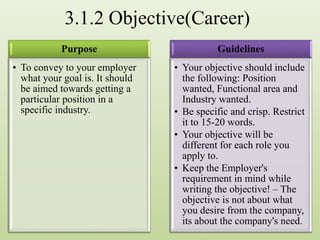
3.1.2 Objective(Career)
Purpose
• To convey to your employer
what your goal is. It should
be aimed towards getting a
particular position in a
specific industry.
Guidelines
• Your objective should include
the following: Position
wanted, Functional area and
Industry wanted.
• Be specific and crisp. Restrict
it to 15-20 words.
• Your objective will be
different for each role you
apply to.
• Keep the Employer's
requirement in mind while
writing the objective! – The
objective is not about what
you desire from the company,
its about the company's need.
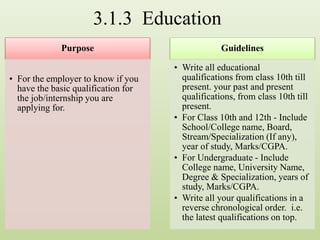
3.1.3 Education
Purpose
• For the employer to know if you
have the basic qualification for
the job/internship you are
applying for.
Guidelines
• Write all educational
qualifications from class 10th till
present. your past and present
qualifications, from class 10th till
present.
• For Class 10th and 12th - Include
School/College name, Board,
Stream/Specialization (If any),
year of study, Marks/CGPA.
• For Undergraduate - Include
College name, University Name,
Degree & Specialization, years of
study, Marks/CGPA.
• Write all your qualifications in a
reverse chronological order. i.e.
the latest qualifications on top.
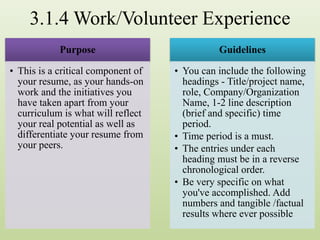
3.1.4 Work/Volunteer Experience
Purpose
• This is a critical component of
your resume, as your hands-on
work and the initiatives you
have taken apart from your
curriculum is what will reflect
your real potential as well as
differentiate your resume from
your peers.
Guidelines
• You can include the following
headings - Title/project name,
role, Company/Organization
Name, 1-2 line description
(brief and specific) time
period.
• Time period is a must.
• The entries under each
heading must be in a reverse
chronological order.
• Be very specific on what
you've accomplished. Add
numbers and tangible /factual
results where ever possible
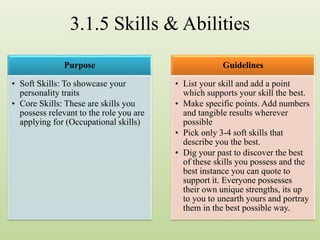
3.1.5 Skills & Abilities
Purpose
• Soft Skills: To showcase your
personality traits
• Core Skills: These are skills you
possess relevant to the role you are
applying for (Occupational skills)
Guidelines
• List your skill and add a point
which supports your skill the best.
• Make specific points. Add numbers
and tangible results wherever
possible
• Pick only 3-4 soft skills that
describe you the best.
• Dig your past to discover the best
of these skills you possess and the
best instance you can quote to
support it. Everyone possesses
their own unique strengths, its up
to you to unearth yours and portray
them in the best possible way.
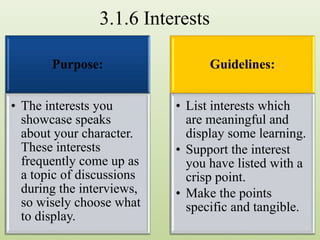
3.1.6 Interests
Purpose:
• The interests you
showcase speaks
about your character.
These interests
frequently come up as
a topic of discussions
during the interviews,
so wisely choose what
to display.
Guidelines:
• List interests which
are meaningful and
display some learning.
• Support the interest
you have listed with a
crisp point.
• Make the points
specific and tangible.
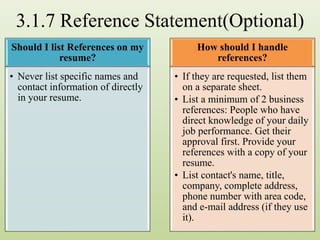
3.1.7 Reference Statement(Optional)
Should I list References on my
resume?
• Never list specific names and
contact information of directly
in your resume.
How should I handle
references?
• If they are requested, list them
on a separate sheet.
• List a minimum of 2 business
references: People who have
direct knowledge of your daily
job performance. Get their
approval first. Provide your
references with a copy of your
resume.
• List contact's name, title,
company, complete address,
phone number with area code,
and e-mail address (if they use
it).
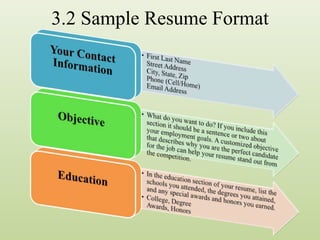
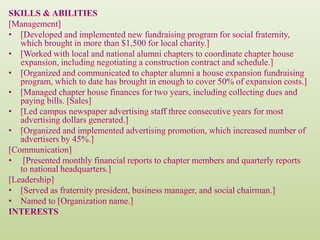
3.2 Sample Resume Format
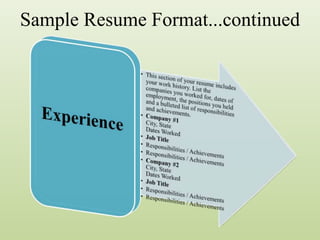
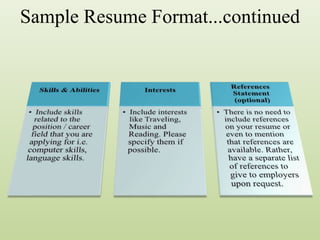
Sample Resume Format...continued
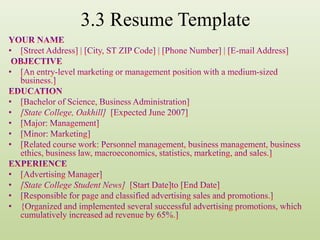
3.3 Resume Template
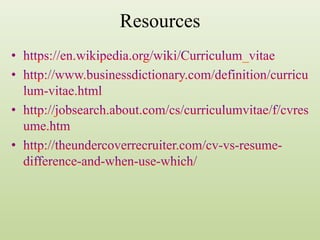
Resources
Be in Touch with us…

How to prepare a great resume

  • 1.
    How to preparea GREAT resume GRACE Training and Development Services
  • 2.
    Overview 1. Introduction toResume 2. Resume v CV 3. Preparing a GREAT Resume
  • 3.
    1. Introduction toResume A resume is a short, concise written document of your education, work experience, credentials, accomplishments and is used to apply for jobs.
  • 4.
    1.1 What isthe purpose of resume? The purpose of a resume is to provide a summary of your skills, abilities and accomplishments. It is a quick advertisement of who you are. It is a "snapshot" of you with the intent of capturing and emphasizing interests and secure you an interview. It is not an autobiography.
  • 5.
    1.2 Types ofresume • A chronological resume starts by listing your work history, with the most recent position listed first. Chronological Resume • A functional resume focuses on your skills and experience, rather than on your chronological work history. It is used most often by people who are changing careers or who have gaps in their employment history. Functional Resume • A combination resume lists your skills and experience first. Your employment history is listed next. Combination Resume
  • 6.
    Types of resume…2 •A targeted resume is a resume that is customized so that it specifically highlights the experience and skills you have that are relevant to the job you are applying for. Targeted Resume • A mini resume contains a brief summary of your career highlights qualifications. Mini Resume • A nontraditional resume is a web-based version of your resume that may include photos, graphics, images, graphs and other visuals. Non-traditional Resume
  • 7.
    1.3 Features ofa great resume Look • Present your resume in a clean, easy-to-read format with sections appropriately labeled. Objective • An objective is a candidate-focused statement. Grammar • Use fragments instead of complete sentences. I also recommends using action verbs to begin each fragment. Flow • Follow a resume format that flows seamlessly from introduction to areas of expertise to work history to education and professional affiliations. Content • Should be 100% genuine and no unnecessary personal information be given.
  • 8.
  • 9.
  • 10.
  • 11.
    2.3 Resume orCV S.No. Resume Curriculum Vitae 1. Two pages maximum Two or more 2. Summary of your skills, experience, and education Summary of your educational and academic backgrounds as well as teaching and research experience, publications, presentations, awards, honors, affiliations, and other details. 3. Resume is tailored to each position CV is stay put and any changes will be in the cover letter 4. Information can be shuffled around to best suit the applicant Information in chronological order 5. No particular format rule Particular format is available 6. Used in US and Canada Used in UK, Ireland and New Zealand
  • 12.
    3. Preparing aGREAT Resume
  • 13.
  • 14.
    3.1.1 Identify Yourself •First Last Name Street Address City, State, Zip Phone (Cell/Home) Email Address • Write your name in a bigger font (also make it bold) than the other text. Do’s • Do Not Include your photo. • Do not give unnecessary details like family information, marital status, etc. • Do not add these details at the bottom of your resume. • Do not occupy much space to fill up these details. Don’ts
  • 15.
    3.1.2 Objective(Career) Purpose • Toconvey to your employer what your goal is. It should be aimed towards getting a particular position in a specific industry. Guidelines • Your objective should include the following: Position wanted, Functional area and Industry wanted. • Be specific and crisp. Restrict it to 15-20 words. • Your objective will be different for each role you apply to. • Keep the Employer's requirement in mind while writing the objective! – The objective is not about what you desire from the company, its about the company's need.
  • 16.
    3.1.3 Education Purpose • Forthe employer to know if you have the basic qualification for the job/internship you are applying for. Guidelines • Write all educational qualifications from class 10th till present. your past and present qualifications, from class 10th till present. • For Class 10th and 12th - Include School/College name, Board, Stream/Specialization (If any), year of study, Marks/CGPA. • For Undergraduate - Include College name, University Name, Degree & Specialization, years of study, Marks/CGPA. • Write all your qualifications in a reverse chronological order. i.e. the latest qualifications on top.
  • 17.
    3.1.4 Work/Volunteer Experience Purpose •This is a critical component of your resume, as your hands-on work and the initiatives you have taken apart from your curriculum is what will reflect your real potential as well as differentiate your resume from your peers. Guidelines • You can include the following headings - Title/project name, role, Company/Organization Name, 1-2 line description (brief and specific) time period. • Time period is a must. • The entries under each heading must be in a reverse chronological order. • Be very specific on what you've accomplished. Add numbers and tangible /factual results where ever possible
  • 18.
    3.1.5 Skills &Abilities Purpose • Soft Skills: To showcase your personality traits • Core Skills: These are skills you possess relevant to the role you are applying for (Occupational skills) Guidelines • List your skill and add a point which supports your skill the best. • Make specific points. Add numbers and tangible results wherever possible • Pick only 3-4 soft skills that describe you the best. • Dig your past to discover the best of these skills you possess and the best instance you can quote to support it. Everyone possesses their own unique strengths, its up to you to unearth yours and portray them in the best possible way.
  • 19.
    3.1.6 Interests Purpose: • Theinterests you showcase speaks about your character. These interests frequently come up as a topic of discussions during the interviews, so wisely choose what to display. Guidelines: • List interests which are meaningful and display some learning. • Support the interest you have listed with a crisp point. • Make the points specific and tangible.
  • 20.
    3.1.7 Reference Statement(Optional) ShouldI list References on my resume? • Never list specific names and contact information of directly in your resume. How should I handle references? • If they are requested, list them on a separate sheet. • List a minimum of 2 business references: People who have direct knowledge of your daily job performance. Get their approval first. Provide your references with a copy of your resume. • List contact's name, title, company, complete address, phone number with area code, and e-mail address (if they use it).
  • 21.
  • 22.
  • 23.
  • 24.
  • 26.
  • 27.
    Be in Touchwith us…