

CV/Resume Writing


by Elisabeth Dols-De Rooij


areer Development
Communication
           =
      Realization

www.communication-realization.com
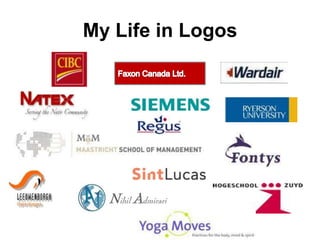
My Life in Logos
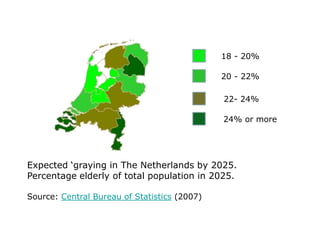
18 - 20%

                                              20 - 22%

                                              22- 24%

                                              24% or more


Expected ‘graying in The Netherlands by 2025.
Percentage elderly of total population in 2025.

Source: Central Bureau of Statistics (2007)
OPPORTUNITY OR THREAT?

“In Limburg,
 expected shrinking of
 total „professional‟ population is 35%.”
 Bertha Verhoeven-van Lierop,
 Director KvK Limburg
 (Feb. 2011)
HOW
SUSTAINABLE
IS
YOUR CAREER?
Training outline
 Discussion
 Planning Producing and Completing
  International CV
 Types of Resumes
 5 Basic Principles
 The International Resume
 Presenting a clear overview
 Lay out
 Principles & International etiquette
Training outline               continued


 How to match personal career objectives
  with prospective company objectives and
  positions
 ACTION: Writing Your Career objective
 Samples
 General Writing Tips
 Resume do’s & don’ts
 Personal Questions

               Final
Discussion
What is the function of a CV?

Which CVs are shortlisted by an employer?

Which approach do most employers take to find
potential new employees?

Why is networking so important in your career
search?
Resume
            =
    Curriculum Vitae

from Latin: Course of (One‟s) life
“No perception is more important than
 the first impression you make with
 your Resume and Cover Letter.”

 from Boveé/Thill, Business Communication Essentials:
 Pearson International Edition 2010
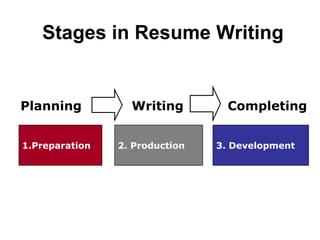
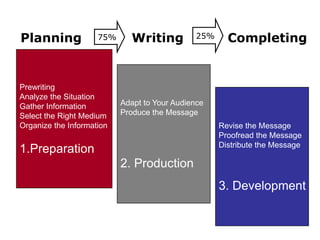
Stages in Resume Writing


Planning          Writing         Completing


1.Preparation   2. Production   3. Development
Planning             75%     Writing           25%     Completing


Prewriting
Analyze the Situation
Gather Information         Adapt to Your Audience
Select the Right Medium    Produce the Message
Organize the Information                             Revise the Message
                                                     Proofread the Message
                                                     Distribute the Message
1.Preparation
                           2. Production
                                                     3. Development
Types of Resumes

   Chronological Resume
   Functional Resume
   Combination Resume
   Targeted Resume
   Europass CV
1 Chronological Resume
  Personal details
  Career Objective
  First: Employment history;
   most recent job/position listed first
  Additional experience
  Second: Educational history
  Additional skills
  Hobbies
  References

 *   Employers typically prefer this type of Resume. Why?
     Because it is easy to see which jobs you have held and
     when.
2 Functional Resume

 Focuses on your skills and experience
    rather than chronological work history


*   Is used most often by persons who are changing careers
    or people who have gaps in their employment history.
3 Combination Resume

  First, list your skills and qualifications
  Your employment history is next


 *   You can highlight the skills you have relevant to the job
     and also provide the chronological work history
     that employers prefer.
4 Targeted Resume
  Customized:
     specifically highlights the experience and
     skills you have that are relevant to the job
   you are applying for
  Definitely takes more work!
  Well worth the effort!

 *   When applying for jobs that are a perfect match for
     your qualifications and experience.
5 Europass CV
  Template:
   provides a single framework for qualifications,
   skills and competences

  Suitable for:
  a controlled and structured environment


  Consider: the type of industry you want to be in
   Eg. Financial services
Europass CV

Downloads, examples , templates and
other information available online


http://europass.cedefop.europa.eu/euro
pass/home/hornav/Introduction.csp
Five basic principles for
  CV writing
 Concentrate on the essentials

 Be clear and concise

 Adapt your CV to suit the post you are applying for

 Take care of the presentation of your CV

 heck your CV and let 3 people proofread it!
The International Resume
    ▪ Personal Details
    Surname Name(s) ▪ Date of birth ▪
    Nationality/Citizenship

    Physical address: Street, Postal code, City, Country

    Contact information: Telephone number(s),
    E-mail address, Skype address

    URL of your personal website, page or e-portfolio

    Marital status ▪ Gender (optional) ▪ Driver’s License
▪ Introductory Statement

     You can choose to open with


      Career objective
      Qualifications summary or
      Career summary


                                   Template
▪ Career Objective

 States the goal which you would like to achieve;
 or the type of work you hope to attain
 Specific objective:
  matches with the position you are applying for

 General objective:
 when putting together a more general Resume for posting
 online or for distribution at a career fair.
▪ Qualifications summary

  Offers a brief view of your key qualifications
 The goal: letting the reader know within a few
  seconds what you can deliver
  Example:
  International Account Management
  Experienced international accountant and financial analyst with
  proven leadership, planning, negotiating, and intercultural
  communication skills.
  Demonstrated ability to improve process efficiency and reduce
  operating costs.
▪ Career summary

 Offers a brief recap of your career
 Goal: presenting increasing levels of
  responsibility and performance

  Useful for executives who have demonstrated
  the ability to manage increasingly larger, more
  complicated business operations
  Key consideration for hiring upper-level managers
▪ Employment history
 Align your past with the employer‟s future


     • List most recent experience first (200x – present)

     • Company name, City, Country
     • Position (Job title)

     • Professional experience includes
       military service, internships or any part-time jobs
       related to your career objective

     • Write two or more bullet statements about the work
       you performed on this job and what you learned or
       accomplished.
▪ Employment history                         continued

 Devote the most space to jobs that are related to your target position


        Prioritize the experience and mention the
        most relevant tasks.

        Call attention to the skills you have developed on the job
        and to your ability to handle increased responsibility

        DO Use numbers where appropriate to clearly
        describe your accomplishments (Quantify wherever possible)
        Example: “Led a team of nine sales reps.”

        DON‟T use vague qualitative terms
        such as “large” or “many”: Be specific!
▪ Additional experience
                   For example:
professional affiliations, network memberships,
associations, volunteer work or any other special
                accomplishments.

         Don’t waste Resume space with
       frivolous or superficial information:
▪ Education
          State most recent education first
               ● Period (200x – present)
   ● School/University name, Faculty, City, Country
            ● Level i.e. BA, Masters, MBA
 ● Study Profile i.e. Economics, International Business
          ● Major/minor fields of study (GPA)
● Degrees or certificates or expected date of completion
      ● Diploma (Year) or anticipated graduation
     ● Scholarships, awards, or academic honors


         Showcase your qualifications by listing courses
           that directly equip you for the job!
▪ Additional skills
              List other skills

Choose skills which are transferable to the job
       you are applying for such as

       ● Language skills/proficiency
        ● Computer program skills
▪ Personal Interests

    List your hobbies or your passion(s)
which could be relevant to your competences


           Remember Balance!
▪ References

 Available on request
Lay-out
• Be a classic (professional)
• Be consistent
• Be creative (personalize)
International Resume
        Principles
      Each country has different etiquette
       Format your Resume accordingly

 Examples:
• in Canada the Resume is usually formatted - no cover
   letter;
• in the United Kingdom a Resume = CV and cover letter
   always;
• in France the cover letter is generally hand written &
   photo attached
Employment is

A 2-way street
 Be Confident
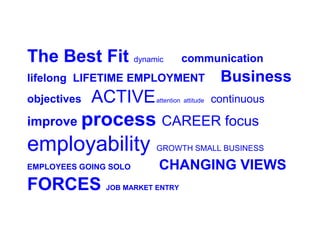
The Best Fit dynamic               communication
lifelong LIFETIME EMPLOYMENT                    Business
objectives   ACTIVE       attention attitude   continuous

improve process CAREER focus
employability             GROWTH SMALL BUSINESS

EMPLOYEES GOING SOLO       CHANGING VIEWS
FORCES         JOB MARKET ENTRY
► The Employer‟s
   perspective

◄ Your perspective
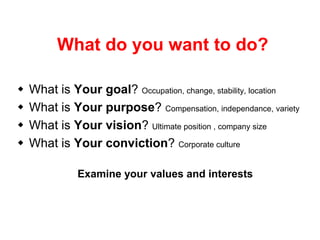
What do you want to do?

   What is Your goal? Occupation, change, stability, location
   What is Your purpose? Compensation, independance, variety
   What is Your vision? Ultimate position , company size
   What is Your conviction? Corporate culture

              Examine your values and interests
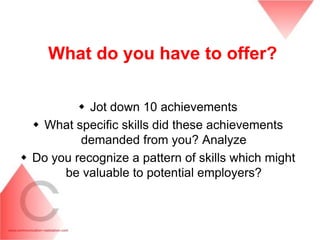
What do you have to offer?

           Jot down 10 achievements
   What specific skills did these achievements
          demanded from you? Analyze
 Do you recognize a pattern of skills which might
       be valuable to potential employers?
ACTION
           Writing your career objective


Pros:
        Tailormade for each job you apply
        Clear, concise, could save time

Cons:
        Self-serving, vague, dreadfully written, meaningless
Be specific but not limiting
"To manage people, interface with customers, and work with
 highly technical software or hardware applications."


      This objective could apply to many different jobs,
          yet the skills described are quite specific.
The bottom line
• Objectives should reflect the employer's perspective
  not the jobseeker's, and should tell what
  the jobseeker can contribute.

• An objective should demonstrate
  the value the candidate will add to the organization.
•   Objectives may help sharpen the focus of your Resume
    (especially if your experience is very diverse or
    if you are switching into a career not supported by the
    experience listed on your Resume)
Spotlighting Skills
     Trend:
     jobseekers replacing their objectives with a section called
     "Summary," "Skills Summary" "Qualifications" or
     "Profile“


     Advantages:
     + can be quite appealing to employers
     + + keywords used in such sections
         can be an important element
         when a Resume is electronically scanned
GENERAL WRITING TIPS
 • Use the active voice with verbs
    Indicates you are in charge:
    “Represented firm at international symposium.”

    Achievement statement:
    “Handled all client correspondence.”

 • Don‟t get caught in the passive voice trap
    Writing as if something happened to you:
    “Was sent to Argentina to represent the firm.“

 • Don‟t refer to yourself as a subject (first or third
   person) in a Resume
    “I helped prepare financial data for Accounts department…”
    “Applicant wrote outreach letters to prospective clients.”
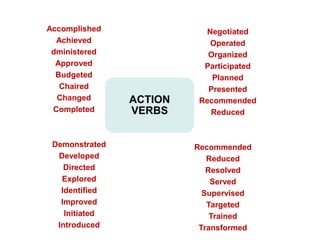
Accomplished                Negotiated
  Achieved                   Operated
 dministered                Organized
  Approved                 Participated
  Budgeted                   Planned
   Chaired                  Presented
  Changed       ACTION    Recommended
 Completed      VERBS        Reduced
 Coordinated
   Created
 Demonstrated            Recommended
  Developed                 Reduced
    Directed                Resolved
   Explored                  Served
   Identified              Supervised
   Improved                 Targeted
    Initiated                Trained
  Introduced              Transformed
GENERAL TIPS CONTINUED

• Be consistent in your spelling (UK or US)

• Use good language skills and good prose
  (language that resembles every day speech)

• Avoid repetition!
Resume
                Do‟s

Do stick to a basic, clear format which helps the
 reader to get information quickly and with minimal
 effort

Do make your Resume a document that focuses
 on your accomplishments and skills

Do discuss your two or three most relevant
 strengths
Resume
                    Do‟s

Do illustrate these with experience and achievement
 statements

Be aware that employers are interested in your eligibility
 to work legally and may ask for documentation

Do take time to learn about your rights and
 responsibilities in the work field of your interest
Resume
                       Don‟ts
Don’t include reasons for leaving your jobs or salary
 information.

Don’t portray yourself as a jack-of-all trades in the hope
 that something will strike the reader’s fancy.

Don’t include e-mail addresses or websites that have the
 potential to reveal controversial or inappropriate personal
 information.
             Avoid addresses such as
             queenofthenight@hotmail.com
Resume
                     Don‟ts

Don’t use your current work e-mail or phone number as
 contact information. This indicates that you are job
 searching in your employer’s time.

Don’t include personal information such as your social
 security number (B.S.N.)
Useful Links

• http://www.englishclub.com/business-
  english/resumes-vocab.htm


• http://www.cvtips.com/resumes-and-
  cvs/international-resume.html
Reconsider all skills involved

    • Prospecting: company research
  • Networking: initiating, leading, selling
   • Writing: Resume & Cover Letter
    • Listening: interpreting, analysing
 • Convincing: public speaking, expertise
           • Trusting: Your Self
“Our greatest glory is not in never falling,
but in getting up every time we do.”

Confucius
Chinese philosopher & reformer (551 BC - 479 BC)
THANK YOU
GOOD LUCK TO YOU!


                           Next
            Cover Letter Writing

CV / Resume writing / Career development

  • 1.
    CV/Resume Writing by ElisabethDols-De Rooij areer Development
  • 2.
    Communication = Realization www.communication-realization.com
  • 3.
  • 4.
    18 - 20% 20 - 22% 22- 24% 24% or more Expected ‘graying in The Netherlands by 2025. Percentage elderly of total population in 2025. Source: Central Bureau of Statistics (2007)
  • 5.
    OPPORTUNITY OR THREAT? “InLimburg, expected shrinking of total „professional‟ population is 35%.” Bertha Verhoeven-van Lierop, Director KvK Limburg (Feb. 2011)
  • 6.
  • 7.
    Training outline  Discussion Planning Producing and Completing International CV  Types of Resumes  5 Basic Principles  The International Resume  Presenting a clear overview  Lay out  Principles & International etiquette
  • 8.
    Training outline continued  How to match personal career objectives with prospective company objectives and positions  ACTION: Writing Your Career objective  Samples  General Writing Tips  Resume do’s & don’ts  Personal Questions Final
  • 9.
    Discussion What is thefunction of a CV? Which CVs are shortlisted by an employer? Which approach do most employers take to find potential new employees? Why is networking so important in your career search?
  • 10.
    Resume = Curriculum Vitae from Latin: Course of (One‟s) life
  • 11.
    “No perception ismore important than the first impression you make with your Resume and Cover Letter.” from Boveé/Thill, Business Communication Essentials: Pearson International Edition 2010
  • 12.
    Stages in ResumeWriting Planning Writing Completing 1.Preparation 2. Production 3. Development
  • 13.
    Planning 75% Writing 25% Completing Prewriting Analyze the Situation Gather Information Adapt to Your Audience Select the Right Medium Produce the Message Organize the Information Revise the Message Proofread the Message Distribute the Message 1.Preparation 2. Production 3. Development
  • 14.
    Types of Resumes  Chronological Resume  Functional Resume  Combination Resume  Targeted Resume  Europass CV
  • 15.
    1 Chronological Resume  Personal details  Career Objective  First: Employment history; most recent job/position listed first  Additional experience  Second: Educational history  Additional skills  Hobbies  References * Employers typically prefer this type of Resume. Why? Because it is easy to see which jobs you have held and when.
  • 16.
    2 Functional Resume Focuses on your skills and experience rather than chronological work history * Is used most often by persons who are changing careers or people who have gaps in their employment history.
  • 17.
    3 Combination Resume  First, list your skills and qualifications  Your employment history is next * You can highlight the skills you have relevant to the job and also provide the chronological work history that employers prefer.
  • 18.
    4 Targeted Resume  Customized: specifically highlights the experience and skills you have that are relevant to the job you are applying for  Definitely takes more work!  Well worth the effort! * When applying for jobs that are a perfect match for your qualifications and experience.
  • 19.
    5 Europass CV  Template: provides a single framework for qualifications, skills and competences  Suitable for: a controlled and structured environment  Consider: the type of industry you want to be in Eg. Financial services
  • 20.
    Europass CV Downloads, examples, templates and other information available online http://europass.cedefop.europa.eu/euro pass/home/hornav/Introduction.csp
  • 21.
    Five basic principlesfor CV writing  Concentrate on the essentials  Be clear and concise  Adapt your CV to suit the post you are applying for  Take care of the presentation of your CV heck your CV and let 3 people proofread it!
  • 22.
    The International Resume ▪ Personal Details Surname Name(s) ▪ Date of birth ▪ Nationality/Citizenship Physical address: Street, Postal code, City, Country Contact information: Telephone number(s), E-mail address, Skype address URL of your personal website, page or e-portfolio Marital status ▪ Gender (optional) ▪ Driver’s License
  • 23.
    ▪ Introductory Statement You can choose to open with  Career objective  Qualifications summary or  Career summary Template
  • 24.
    ▪ Career Objective States the goal which you would like to achieve; or the type of work you hope to attain  Specific objective: matches with the position you are applying for  General objective: when putting together a more general Resume for posting online or for distribution at a career fair.
  • 25.
    ▪ Qualifications summary Offers a brief view of your key qualifications  The goal: letting the reader know within a few seconds what you can deliver Example: International Account Management Experienced international accountant and financial analyst with proven leadership, planning, negotiating, and intercultural communication skills. Demonstrated ability to improve process efficiency and reduce operating costs.
  • 26.
    ▪ Career summary Offers a brief recap of your career  Goal: presenting increasing levels of responsibility and performance Useful for executives who have demonstrated the ability to manage increasingly larger, more complicated business operations Key consideration for hiring upper-level managers
  • 27.
    ▪ Employment history Align your past with the employer‟s future • List most recent experience first (200x – present) • Company name, City, Country • Position (Job title) • Professional experience includes military service, internships or any part-time jobs related to your career objective • Write two or more bullet statements about the work you performed on this job and what you learned or accomplished.
  • 28.
    ▪ Employment history continued Devote the most space to jobs that are related to your target position Prioritize the experience and mention the most relevant tasks. Call attention to the skills you have developed on the job and to your ability to handle increased responsibility DO Use numbers where appropriate to clearly describe your accomplishments (Quantify wherever possible) Example: “Led a team of nine sales reps.” DON‟T use vague qualitative terms such as “large” or “many”: Be specific!
  • 29.
    ▪ Additional experience For example: professional affiliations, network memberships, associations, volunteer work or any other special accomplishments. Don’t waste Resume space with frivolous or superficial information:
  • 30.
    ▪ Education State most recent education first ● Period (200x – present) ● School/University name, Faculty, City, Country ● Level i.e. BA, Masters, MBA ● Study Profile i.e. Economics, International Business ● Major/minor fields of study (GPA) ● Degrees or certificates or expected date of completion ● Diploma (Year) or anticipated graduation ● Scholarships, awards, or academic honors Showcase your qualifications by listing courses that directly equip you for the job!
  • 31.
    ▪ Additional skills List other skills Choose skills which are transferable to the job you are applying for such as ● Language skills/proficiency ● Computer program skills
  • 32.
    ▪ Personal Interests List your hobbies or your passion(s) which could be relevant to your competences Remember Balance!
  • 33.
  • 34.
    Lay-out • Be aclassic (professional) • Be consistent • Be creative (personalize)
  • 35.
    International Resume Principles Each country has different etiquette Format your Resume accordingly Examples: • in Canada the Resume is usually formatted - no cover letter; • in the United Kingdom a Resume = CV and cover letter always; • in France the cover letter is generally hand written & photo attached
  • 36.
    Employment is A 2-waystreet Be Confident
  • 37.
    The Best Fitdynamic communication lifelong LIFETIME EMPLOYMENT Business objectives ACTIVE attention attitude continuous improve process CAREER focus employability GROWTH SMALL BUSINESS EMPLOYEES GOING SOLO CHANGING VIEWS FORCES JOB MARKET ENTRY
  • 38.
    ► The Employer‟s perspective ◄ Your perspective
  • 39.
    What do youwant to do?  What is Your goal? Occupation, change, stability, location  What is Your purpose? Compensation, independance, variety  What is Your vision? Ultimate position , company size  What is Your conviction? Corporate culture Examine your values and interests
  • 40.
    What do youhave to offer?  Jot down 10 achievements  What specific skills did these achievements demanded from you? Analyze  Do you recognize a pattern of skills which might be valuable to potential employers?
  • 41.
    ACTION Writing your career objective Pros: Tailormade for each job you apply Clear, concise, could save time Cons: Self-serving, vague, dreadfully written, meaningless
  • 42.
    Be specific butnot limiting "To manage people, interface with customers, and work with highly technical software or hardware applications." This objective could apply to many different jobs, yet the skills described are quite specific.
  • 43.
    The bottom line •Objectives should reflect the employer's perspective not the jobseeker's, and should tell what the jobseeker can contribute. • An objective should demonstrate the value the candidate will add to the organization. • Objectives may help sharpen the focus of your Resume (especially if your experience is very diverse or if you are switching into a career not supported by the experience listed on your Resume)
  • 44.
    Spotlighting Skills Trend: jobseekers replacing their objectives with a section called "Summary," "Skills Summary" "Qualifications" or "Profile“ Advantages: + can be quite appealing to employers + + keywords used in such sections can be an important element when a Resume is electronically scanned
  • 45.
    GENERAL WRITING TIPS • Use the active voice with verbs Indicates you are in charge: “Represented firm at international symposium.” Achievement statement: “Handled all client correspondence.” • Don‟t get caught in the passive voice trap Writing as if something happened to you: “Was sent to Argentina to represent the firm.“ • Don‟t refer to yourself as a subject (first or third person) in a Resume “I helped prepare financial data for Accounts department…” “Applicant wrote outreach letters to prospective clients.”
  • 46.
    Accomplished Negotiated Achieved Operated dministered Organized Approved Participated Budgeted Planned Chaired Presented Changed ACTION Recommended Completed VERBS Reduced Coordinated Created Demonstrated Recommended Developed Reduced Directed Resolved Explored Served Identified Supervised Improved Targeted Initiated Trained Introduced Transformed
  • 47.
    GENERAL TIPS CONTINUED •Be consistent in your spelling (UK or US) • Use good language skills and good prose (language that resembles every day speech) • Avoid repetition!
  • 48.
    Resume Do‟s Do stick to a basic, clear format which helps the reader to get information quickly and with minimal effort Do make your Resume a document that focuses on your accomplishments and skills Do discuss your two or three most relevant strengths
  • 49.
    Resume Do‟s Do illustrate these with experience and achievement statements Be aware that employers are interested in your eligibility to work legally and may ask for documentation Do take time to learn about your rights and responsibilities in the work field of your interest
  • 50.
    Resume Don‟ts Don’t include reasons for leaving your jobs or salary information. Don’t portray yourself as a jack-of-all trades in the hope that something will strike the reader’s fancy. Don’t include e-mail addresses or websites that have the potential to reveal controversial or inappropriate personal information. Avoid addresses such as queenofthenight@hotmail.com
  • 51.
    Resume Don‟ts Don’t use your current work e-mail or phone number as contact information. This indicates that you are job searching in your employer’s time. Don’t include personal information such as your social security number (B.S.N.)
  • 52.
    Useful Links • http://www.englishclub.com/business- english/resumes-vocab.htm • http://www.cvtips.com/resumes-and- cvs/international-resume.html
  • 53.
    Reconsider all skillsinvolved • Prospecting: company research • Networking: initiating, leading, selling • Writing: Resume & Cover Letter • Listening: interpreting, analysing • Convincing: public speaking, expertise • Trusting: Your Self
  • 54.
    “Our greatest gloryis not in never falling, but in getting up every time we do.” Confucius Chinese philosopher & reformer (551 BC - 479 BC)
  • 55.
    THANK YOU GOOD LUCKTO YOU! Next Cover Letter Writing