Create your
Personal Research
Identifier/Profile
Dr. Md. Zahid Hossain Shoeb
University Librarian
Faculty Orientation and
Development Workshop
14-17 May, 2018
North South University
Research ID/Profile
• By creating a research ID & using these systems you can:
• Create a unique persistent digital identifier that you keep throughout your
career
• Create your own research profile & import work you have authored
• Create your personal research identifier-
• ORCID
• Google Scholar Profile
• ResearchGate Profile
• Scopus ID
• Mendeley Profile
• Publon
Why do I need a unique ID?
• Author name is not always adequate for identification
• Research community can link an author to research and professional
activity
• Makes your work discoverable, noticeable, more citations
• You may have published under different names
• You may have published from different institutions
• Change research direction or work in a different research teams
• Funders ask for a unique ID Publishers ask for a unique ID Institution
requires a unique ID
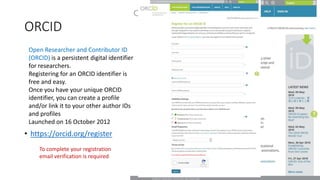
ORCID
• https://orcid.org/register
Open Researcher and Contributor ID
(ORCID) is a persistent digital identifier
for researchers.
Registering for an ORCID identifier is
free and easy.
Once you have your unique ORCID
identifier, you can create a profile
and/or link it to your other author IDs
and profiles
Launched on 16 October 2012
To complete your registration
email verification is required
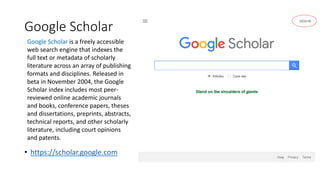
Google Scholar
• https://scholar.google.com
Google Scholar is a freely accessible
web search engine that indexes the
full text or metadata of scholarly
literature across an array of publishing
formats and disciplines. Released in
beta in November 2004, the Google
Scholar index includes most peer-
reviewed online academic journals
and books, conference papers, theses
and dissertations, preprints, abstracts,
technical reports, and other scholarly
literature, including court opinions
and patents.
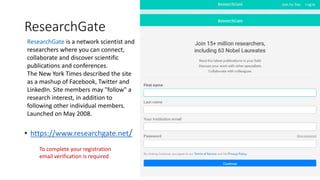
ResearchGate
• https://www.researchgate.net/
ResearchGate is a network scientist and
researchers where you can connect,
collaborate and discover scientific
publications and conferences.
The New York Times described the site
as a mashup of Facebook, Twitter and
LinkedIn. Site members may "follow" a
research interest, in addition to
following other individual members.
Launched on May 2008.
To complete your registration
email verification is required
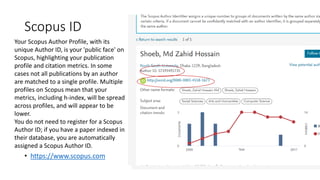
Scopus ID
• https://www.scopus.com
Your Scopus Author Profile, with its
unique Author ID, is your 'public face' on
Scopus, highlighting your publication
profile and citation metrics. In some
cases not all publications by an author
are matched to a single profile. Multiple
profiles on Scopus mean that your
metrics, including h-index, will be spread
across profiles, and will appear to be
lower.
You do not need to register for a Scopus
Author ID; if you have a paper indexed in
their database, you are automatically
assigned a Scopus Author ID.
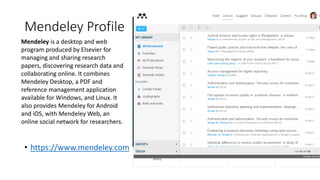
Mendeley Profile
• https://www.mendeley.com
Mendeley is a desktop and web
program produced by Elsevier for
managing and sharing research
papers, discovering research data and
collaborating online. It combines
Mendeley Desktop, a PDF and
reference management application
available for Windows, and Linux. It
also provides Mendeley for Android
and iOS, with Mendeley Web, an
online social network for researchers.
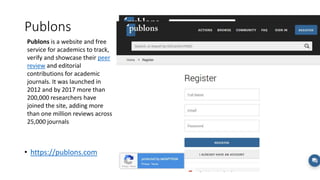
Publons
• https://publons.com
Publons is a website and free
service for academics to track,
verify and showcase their peer
review and editorial
contributions for academic
journals. It was launched in
2012 and by 2017 more than
200,000 researchers have
joined the site, adding more
than one million reviews across
25,000 journals
Thank You

Create your Personal Research Identifier/Profile

  • 1.
    Create your Personal Research Identifier/Profile Dr.Md. Zahid Hossain Shoeb University Librarian Faculty Orientation and Development Workshop 14-17 May, 2018 North South University
  • 2.
    Research ID/Profile • Bycreating a research ID & using these systems you can: • Create a unique persistent digital identifier that you keep throughout your career • Create your own research profile & import work you have authored • Create your personal research identifier- • ORCID • Google Scholar Profile • ResearchGate Profile • Scopus ID • Mendeley Profile • Publon
  • 3.
    Why do Ineed a unique ID? • Author name is not always adequate for identification • Research community can link an author to research and professional activity • Makes your work discoverable, noticeable, more citations • You may have published under different names • You may have published from different institutions • Change research direction or work in a different research teams • Funders ask for a unique ID Publishers ask for a unique ID Institution requires a unique ID
  • 4.
    ORCID • https://orcid.org/register Open Researcherand Contributor ID (ORCID) is a persistent digital identifier for researchers. Registering for an ORCID identifier is free and easy. Once you have your unique ORCID identifier, you can create a profile and/or link it to your other author IDs and profiles Launched on 16 October 2012 To complete your registration email verification is required
  • 5.
    Google Scholar • https://scholar.google.com GoogleScholar is a freely accessible web search engine that indexes the full text or metadata of scholarly literature across an array of publishing formats and disciplines. Released in beta in November 2004, the Google Scholar index includes most peer- reviewed online academic journals and books, conference papers, theses and dissertations, preprints, abstracts, technical reports, and other scholarly literature, including court opinions and patents.
  • 6.
    ResearchGate • https://www.researchgate.net/ ResearchGate isa network scientist and researchers where you can connect, collaborate and discover scientific publications and conferences. The New York Times described the site as a mashup of Facebook, Twitter and LinkedIn. Site members may "follow" a research interest, in addition to following other individual members. Launched on May 2008. To complete your registration email verification is required
  • 7.
    Scopus ID • https://www.scopus.com YourScopus Author Profile, with its unique Author ID, is your 'public face' on Scopus, highlighting your publication profile and citation metrics. In some cases not all publications by an author are matched to a single profile. Multiple profiles on Scopus mean that your metrics, including h-index, will be spread across profiles, and will appear to be lower. You do not need to register for a Scopus Author ID; if you have a paper indexed in their database, you are automatically assigned a Scopus Author ID.
  • 8.
    Mendeley Profile • https://www.mendeley.com Mendeleyis a desktop and web program produced by Elsevier for managing and sharing research papers, discovering research data and collaborating online. It combines Mendeley Desktop, a PDF and reference management application available for Windows, and Linux. It also provides Mendeley for Android and iOS, with Mendeley Web, an online social network for researchers.
  • 9.
    Publons • https://publons.com Publons isa website and free service for academics to track, verify and showcase their peer review and editorial contributions for academic journals. It was launched in 2012 and by 2017 more than 200,000 researchers have joined the site, adding more than one million reviews across 25,000 journals
  • 10.