IMPACT AND OTHER CITATIONIMPACT AND OTHER CITATION
MEASUREMENTSMEASUREMENTS
DR. ABBAS H. HASSIN ALASADIDR. ABBAS H. HASSIN ALASADI
COMPUTER INFORMATION SYSTEM DEPARTMENTCOMPUTER INFORMATION SYSTEM DEPARTMENT
INFORMATION TECHNOLOGY COLLEGE / BASRAINFORMATION TECHNOLOGY COLLEGE / BASRA
UNIVERSITYUNIVERSITY
20192019
What are we measuring?What are we measuring?
 Journal Quality
 Article reach
 Article impact/Influence
 Distribution
 Researcher Impact.
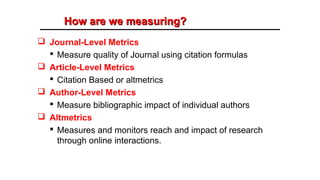
How are we measuring?How are we measuring?
 Journal-Level Metrics
 Measure quality of Journal using citation formulas
 Article-Level Metrics
 Citation Based or altmetrics
 Author-Level Metrics
 Measure bibliographic impact of individual authors
 Altmetrics
 Measures and monitors reach and impact of research
through online interactions.
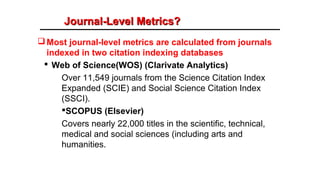
Journal-Level Metrics?Journal-Level Metrics?
Most journal-level metrics are calculated from journals
indexed in two citation indexing databases
 Web of Science(WOS) (Clarivate Analytics)
Over 11,549 journals from the Science Citation Index
Expanded (SCIE) and Social Science Citation Index
(SSCI).
SCOPUS (Elsevier)
Covers nearly 22,000 titles in the scientific, technical,
medical and social sciences (including arts and
humanities.
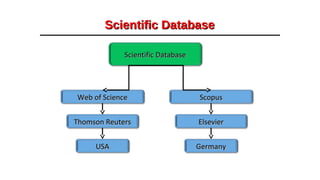
Scientific DatabaseScientific Database
Web of ScienceWeb of Science
Thomson ReutersThomson Reuters
USAUSA
ScopusScopus
ElsevierElsevier
GermanyGermany
Alternative Metrics (Altmatrics)Alternative Metrics (Altmatrics)
What are altmetrics?
 Attention to research outputs in non-traditional
sources, e.g. policy documents, news, blogs
and social media
 Indicators of research impact
 Help understand how research is being
received and used
 Complementary to traditional citation-based
analysis.
Alternative Metrics (Altmatrics)Alternative Metrics (Altmatrics)
What are altmetrics?
1. RESEARCH IS MORE ACCESSIBLE.
2. TRACK ATTENTION IN REAL-TIME.
3. RESEARCH IS MORE THAN THE ARTICLE.
4. DEMONSTRATING RESEARCH ENGAGEMENT.
5. LIMITATIONS.
Altmetrics …. contAltmetrics …. cont
Journal Impact Factor
Citation counts
H-index
Number of publications
Mentions in news reports
References in policy
Mentions in social media
Wikipedia citations
Reference manager
readers… etc.
ACADEMIC
ATTENTION
BROADER
ATTENTION
Alternative metrics
“altmetrics”
+Traditional
bibliometrics
What sources does Altmetric track?What sources does Altmetric track?
News outlets
•Over 1,300 sites
•Manually curated list
•Text mining
•Global coverage
Social media
and blogs
•Twitter, Facebook,
Google+, Sina Weibo
•Public posts only
•Manually curated list
Reference
managers
•Mendeley, CiteULike
•Reader counts
•Don’t count towards the
Altmetric score
Other sources
•Wikipedia
•YouTube
•Reddit
•F1000
•Pinterest
•Q&A
Post-
publication peer
review
•Publons
•PubPeer
Policy documents
•NICE Evidence
•Intergovernmental Panel
on Climate Change
•Many more…
Author ID ServicesAuthor ID Services
 Some web services where you can create a unique author
profile or ID number.
 This identifies you as a unique author, and helps distinguish
you from others with the same last name and initials.
 Example:
• Abbas H.Hassin
• Abbas Hassin
• Abbas H. Hassin Alasadi
• AHH
• Alasadi, Abbas H. Hassin
• Hassin, Abbas H.
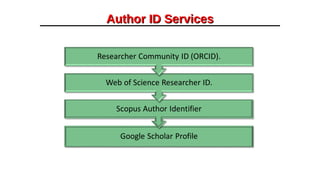
Author ID ServicesAuthor ID Services
Researcher Community ID
(ORCID)
 The Open Researcher Community ID (ORCID) is a persistent
digital identifier that distinguishes you from other and supports
you in your manuscript and grant submission activities.
 Benefits of the ORCID include:
• Allows you to gather all of your academic outputs in one place.
• Distinguishes you from other authors with the same name
• Integration with other researcher ID services you may already
use, such as researcher ID and Scopus author identifier
• ORCID is required by an increasing number of
funding agencies and publishers.
Researcher Community ID
(ORCID)
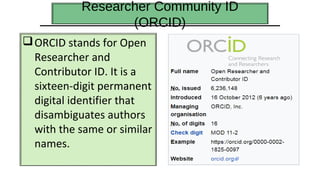
ORCID stands for Open
Researcher and
Contributor ID. It is a
sixteen-digit permanent
digital identifier that
disambiguates authors
with the same or similar
names.
Researcher Community ID
(ORCID)
How to use ORCID:
1.Claim your ORCID ID
2.Add works to your ORCID record. There are three ways to do this:
• Link your works from another system
• Import a BibTeX file of your works (either from a Google Scholar profile
or from a citation management tool)
• Manually type in information about your works
3.Connect your existing profiles to your ORCID.
• Connect your Web of Science Researcher ID to your ORCID>>
https://www.youtube.com/watch?v=Hn7lxnCPZp8
• Connect your Scopus Author Identifier to your ORCID
Example : https://orcid.org/0000-0002-6627-4456
Web of Science Researcher ID
 Article groups in Web of Science are likely authored by the same
person. But Web of Science doesn’t always get it right. Claim your
Web of Science publications by creating a ResearcherID.
 Benefits of a Researcher ID :
• Ensure publications included in Web of Knowledge are attributed
correctly
• Track or share your citation metrics (citations, H-index).
• ResearcherID can also hold records from other sources.
• It's ORCID compliant so you can sync data to your ORCID account.
Web of Science Researcher ID
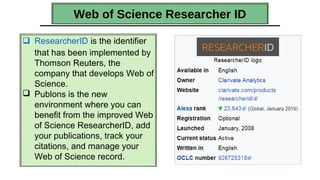
 ResearcherID is the identifier
that has been implemented by
Thomson Reuters, the
company that develops Web of
Science.
 Publons is the new
environment where you can
benefit from the improved Web
of Science ResearcherID, add
your publications, track your
citations, and manage your
Web of Science record.
Web of Science Researcher ID
How to use Researcher ID :
1.Register for your account on the homepage of the Web of Science database
.
2.Build your publication list
3.Display your Researcher ID badge on your website or blog.
Example : https://publons.com/researcher/1737882/abbas-h-hassin-alasadi/
Scopus Author Identifier
 Publications indexed in Scopus are assigned an Author Identifier
(new or existing). But Scopus doesn’t always get it right. Manage
your profile using the Scopus Author Feedback Wizard.
 Benefits of a Researcher ID :
• Ensure publications included in Scopus are attributed correctly.
• Track or share your citation metrics (citations, H-index, article level
altmetrics).
• It's ORCID compliant so you can sync data to your ORCID account.
Scopus Author Identifier
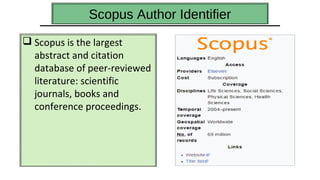
 Scopus is the largest
abstract and citation
database of peer-reviewed
literature: scientific
journals, books and
conference proceedings.
Scopus Author Identifier
How to use Scopus Author Identifier:
1.https://service.elsevier.com/app/answers/detail/a_id/11212/supporthub/s
copus/
Example : https://www.scopus.com/authid/detail.uri?authorId=6508189977
Google Scholar Profile
 Create an author profile and Google will identify publications indexed
in Google Scholar that are likely by you.
 Benefits of Google Scholar Profile :
• Ensure your publications are attributed correctly
• Track or share your citation metrics (citations, H-index, and i10-index).
• Note : Google's citation metrics are generally considered less reliable
than Scopus and Web of Science in that it’s not clear what is
included/excluded in indexing. However, for some disciplines Google
Scholar Citations may better represent your body of work.
Google Scholar Profile
 Learn how to create a
Google author profile.
 Harzing's Publish or
Perish is a software
program that helps
researchers clean up and
present their Google
Scholar profiles.
Popular Social Networks
Digital Object Identifier (DOI)

Author Identifier Tools

  • 1.
    IMPACT AND OTHERCITATIONIMPACT AND OTHER CITATION MEASUREMENTSMEASUREMENTS DR. ABBAS H. HASSIN ALASADIDR. ABBAS H. HASSIN ALASADI COMPUTER INFORMATION SYSTEM DEPARTMENTCOMPUTER INFORMATION SYSTEM DEPARTMENT INFORMATION TECHNOLOGY COLLEGE / BASRAINFORMATION TECHNOLOGY COLLEGE / BASRA UNIVERSITYUNIVERSITY 20192019
  • 2.
    What are wemeasuring?What are we measuring?  Journal Quality  Article reach  Article impact/Influence  Distribution  Researcher Impact.
  • 3.
    How are wemeasuring?How are we measuring?  Journal-Level Metrics  Measure quality of Journal using citation formulas  Article-Level Metrics  Citation Based or altmetrics  Author-Level Metrics  Measure bibliographic impact of individual authors  Altmetrics  Measures and monitors reach and impact of research through online interactions.
  • 4.
    Journal-Level Metrics?Journal-Level Metrics? Mostjournal-level metrics are calculated from journals indexed in two citation indexing databases  Web of Science(WOS) (Clarivate Analytics) Over 11,549 journals from the Science Citation Index Expanded (SCIE) and Social Science Citation Index (SSCI). SCOPUS (Elsevier) Covers nearly 22,000 titles in the scientific, technical, medical and social sciences (including arts and humanities.
  • 5.
    Scientific DatabaseScientific Database ScientificDatabaseScientific Database Web of ScienceWeb of Science Thomson ReutersThomson Reuters USAUSA ScopusScopus ElsevierElsevier GermanyGermany
  • 6.
    Alternative Metrics (Altmatrics)AlternativeMetrics (Altmatrics) What are altmetrics?  Attention to research outputs in non-traditional sources, e.g. policy documents, news, blogs and social media  Indicators of research impact  Help understand how research is being received and used  Complementary to traditional citation-based analysis.
  • 7.
    Alternative Metrics (Altmatrics)AlternativeMetrics (Altmatrics) What are altmetrics? 1. RESEARCH IS MORE ACCESSIBLE. 2. TRACK ATTENTION IN REAL-TIME. 3. RESEARCH IS MORE THAN THE ARTICLE. 4. DEMONSTRATING RESEARCH ENGAGEMENT. 5. LIMITATIONS.
  • 8.
    Altmetrics …. contAltmetrics…. cont Journal Impact Factor Citation counts H-index Number of publications Mentions in news reports References in policy Mentions in social media Wikipedia citations Reference manager readers… etc. ACADEMIC ATTENTION BROADER ATTENTION Alternative metrics “altmetrics” +Traditional bibliometrics
  • 9.
    What sources doesAltmetric track?What sources does Altmetric track? News outlets •Over 1,300 sites •Manually curated list •Text mining •Global coverage Social media and blogs •Twitter, Facebook, Google+, Sina Weibo •Public posts only •Manually curated list Reference managers •Mendeley, CiteULike •Reader counts •Don’t count towards the Altmetric score Other sources •Wikipedia •YouTube •Reddit •F1000 •Pinterest •Q&A Post- publication peer review •Publons •PubPeer Policy documents •NICE Evidence •Intergovernmental Panel on Climate Change •Many more…
  • 10.
    Author ID ServicesAuthorID Services  Some web services where you can create a unique author profile or ID number.  This identifies you as a unique author, and helps distinguish you from others with the same last name and initials.  Example: • Abbas H.Hassin • Abbas Hassin • Abbas H. Hassin Alasadi • AHH • Alasadi, Abbas H. Hassin • Hassin, Abbas H.
  • 11.
  • 12.
    Researcher Community ID (ORCID) The Open Researcher Community ID (ORCID) is a persistent digital identifier that distinguishes you from other and supports you in your manuscript and grant submission activities.  Benefits of the ORCID include: • Allows you to gather all of your academic outputs in one place. • Distinguishes you from other authors with the same name • Integration with other researcher ID services you may already use, such as researcher ID and Scopus author identifier • ORCID is required by an increasing number of funding agencies and publishers.
  • 13.
    Researcher Community ID (ORCID) ORCIDstands for Open Researcher and Contributor ID. It is a sixteen-digit permanent digital identifier that disambiguates authors with the same or similar names.
  • 14.
    Researcher Community ID (ORCID) Howto use ORCID: 1.Claim your ORCID ID 2.Add works to your ORCID record. There are three ways to do this: • Link your works from another system • Import a BibTeX file of your works (either from a Google Scholar profile or from a citation management tool) • Manually type in information about your works 3.Connect your existing profiles to your ORCID. • Connect your Web of Science Researcher ID to your ORCID>> https://www.youtube.com/watch?v=Hn7lxnCPZp8 • Connect your Scopus Author Identifier to your ORCID Example : https://orcid.org/0000-0002-6627-4456
  • 15.
    Web of ScienceResearcher ID  Article groups in Web of Science are likely authored by the same person. But Web of Science doesn’t always get it right. Claim your Web of Science publications by creating a ResearcherID.  Benefits of a Researcher ID : • Ensure publications included in Web of Knowledge are attributed correctly • Track or share your citation metrics (citations, H-index). • ResearcherID can also hold records from other sources. • It's ORCID compliant so you can sync data to your ORCID account.
  • 16.
    Web of ScienceResearcher ID  ResearcherID is the identifier that has been implemented by Thomson Reuters, the company that develops Web of Science.  Publons is the new environment where you can benefit from the improved Web of Science ResearcherID, add your publications, track your citations, and manage your Web of Science record.
  • 17.
    Web of ScienceResearcher ID How to use Researcher ID : 1.Register for your account on the homepage of the Web of Science database . 2.Build your publication list 3.Display your Researcher ID badge on your website or blog. Example : https://publons.com/researcher/1737882/abbas-h-hassin-alasadi/
  • 18.
    Scopus Author Identifier Publications indexed in Scopus are assigned an Author Identifier (new or existing). But Scopus doesn’t always get it right. Manage your profile using the Scopus Author Feedback Wizard.  Benefits of a Researcher ID : • Ensure publications included in Scopus are attributed correctly. • Track or share your citation metrics (citations, H-index, article level altmetrics). • It's ORCID compliant so you can sync data to your ORCID account.
  • 19.
    Scopus Author Identifier Scopus is the largest abstract and citation database of peer-reviewed literature: scientific journals, books and conference proceedings.
  • 20.
    Scopus Author Identifier Howto use Scopus Author Identifier: 1.https://service.elsevier.com/app/answers/detail/a_id/11212/supporthub/s copus/ Example : https://www.scopus.com/authid/detail.uri?authorId=6508189977
  • 21.
    Google Scholar Profile Create an author profile and Google will identify publications indexed in Google Scholar that are likely by you.  Benefits of Google Scholar Profile : • Ensure your publications are attributed correctly • Track or share your citation metrics (citations, H-index, and i10-index). • Note : Google's citation metrics are generally considered less reliable than Scopus and Web of Science in that it’s not clear what is included/excluded in indexing. However, for some disciplines Google Scholar Citations may better represent your body of work.
  • 22.
    Google Scholar Profile Learn how to create a Google author profile.  Harzing's Publish or Perish is a software program that helps researchers clean up and present their Google Scholar profiles.
  • 23.
  • 24.
  • 25.
  • 26.