Developing Information Literacy
Education Programme for the IUB 1st
Year Undergraduate Business Students
Presented by
Md. Zahid Hossain ShoebMd. Zahid Hossain Shoeb
Independent University, Bangladesh (IUB)
IFLA-ALP Workshop on
Information Literacy and Information Technology
16 November-11 December 2009
Victoria University of Wellington, New Zealand
Content
 Introduction
 Motivation
 ILE Mission
 Goals and Objectives Goals and Objectives
 Outcome
 Activities
 Resources and Responsibilities
 Assessment
2
Introduction
 Information Literacy Education in Bangladesh
- IL is not well known, not popular
- There are some common factors like other developing
countries
- Earlier four participants trained from IFLA-ALP- Earlier four participants trained from IFLA-ALP
- IUB Library always recognize, IWIL by IUB Library
 IUB Context
- 4 Schools, 19 undergraduate, 5 Graduate Programme
- Students come form higher or middle-higher class
- >4000 students, 256 faculties
3
Motivation
 Top Private University, social and local requirement, to
cope with local and global competition…
 Business Students Information seeking behaviour is
with anxiety, stressed, fast, shy, trial and error…
 Scenario #1: Library e-resource usage fallen down… Scenario #1: Library e-resource usage fallen down…
 Scenario #2: Few senior business students accused…
 Scenario #3: Examining citation analysis…
 To have skills for seeking, evaluating, and managing
information gathered from multiple sources…
 For problem based learning, intelligent decision, better
research, better product…
4
Institutional and ILE Mission (contd.)
 IUB mission, goal and strategies…
- Keywords: Higher education, international
standards, local environment, knowledge and
relevant skills, encourage and support useful
research, create knowledge, further learningresearch, create knowledge, further learning
opportunity, curriculum revised and adjusted,
relevance to national needs, global market
demand, free to set curriculum and method of
procedure.
5
Institutional and ILE Mission
 IUB Library mission and objectives…
-Keywords: dynamic and responsive, good
professional practice, foster quality,
effectiveness, variety of learning mode,
understand the objectives and information needs,understand the objectives and information needs,
provide technique of using library and
information services, promote as learning as
research tool etc…
 ILE Mission…
6
Goals and Objectives (contd.)
 IUB business students need should be
analysed
 Programme must be relevant to their
discipline and needsdiscipline and needs
 Variety of students, students do not have
enough knowledge, or some have
knowledge
 Not much content
7
Goals and Objectives
 Six goals are –
1. Defining and articulating the need for information
2. Finding needed information effectively and
locating the sources
3. Critically assessing the information3. Critically assessing the information
4. Managing and interpreting the information
5. Communication and presentation of information
6. Economic, legal and social issues for the use of
information
 Objectives are defined under each goal–…
8
Outcomes
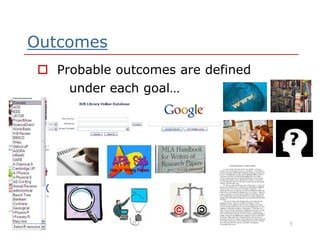
 Probable outcomes are defined
under each goal…
9
Activities
 IUB business students will learn how to
learn
 They need the ability, skill, competencies
 Skills must be taught, practiced, applied Skills must be taught, practiced, applied
and assessed
 Different activities adopted for IUB business
students…
10
Resources and Responsibilities
 ILE instructors, place, time, equipments
 Initially Library will provide, gradually more
resources will be provided centrally…
 Responsibilities go to Librarian, Faculties and
Business SchoolBusiness School
 Curriculum development, activities updating…
 Provide facilities, training, seminar, workshop,
discussion
 Teaching aids and Technology for flexible learning…
11
Assessment
 Assessment and evaluation is a part of continuing
programme of active learning
 Students must be assessed about their quantitative
and qualitative measurement
 variety of outcome measures, i.e. quizzes, essays, variety of outcome measures, i.e. quizzes, essays,
discussion, oral defence, direct observation, peer
and self review, tests, hands-on experience etc.
 Programme outcome should also be evaluated
12
Contact
 Details about the contact person for
IUB ILE programme
13
Developing information literacy education programme for the iub business students

Developing information literacy education programme for the iub business students

  • 1.
    Developing Information Literacy EducationProgramme for the IUB 1st Year Undergraduate Business Students Presented by Md. Zahid Hossain ShoebMd. Zahid Hossain Shoeb Independent University, Bangladesh (IUB) IFLA-ALP Workshop on Information Literacy and Information Technology 16 November-11 December 2009 Victoria University of Wellington, New Zealand
  • 2.
    Content  Introduction  Motivation ILE Mission  Goals and Objectives Goals and Objectives  Outcome  Activities  Resources and Responsibilities  Assessment 2
  • 3.
    Introduction  Information LiteracyEducation in Bangladesh - IL is not well known, not popular - There are some common factors like other developing countries - Earlier four participants trained from IFLA-ALP- Earlier four participants trained from IFLA-ALP - IUB Library always recognize, IWIL by IUB Library  IUB Context - 4 Schools, 19 undergraduate, 5 Graduate Programme - Students come form higher or middle-higher class - >4000 students, 256 faculties 3
  • 4.
    Motivation  Top PrivateUniversity, social and local requirement, to cope with local and global competition…  Business Students Information seeking behaviour is with anxiety, stressed, fast, shy, trial and error…  Scenario #1: Library e-resource usage fallen down… Scenario #1: Library e-resource usage fallen down…  Scenario #2: Few senior business students accused…  Scenario #3: Examining citation analysis…  To have skills for seeking, evaluating, and managing information gathered from multiple sources…  For problem based learning, intelligent decision, better research, better product… 4
  • 5.
    Institutional and ILEMission (contd.)  IUB mission, goal and strategies… - Keywords: Higher education, international standards, local environment, knowledge and relevant skills, encourage and support useful research, create knowledge, further learningresearch, create knowledge, further learning opportunity, curriculum revised and adjusted, relevance to national needs, global market demand, free to set curriculum and method of procedure. 5
  • 6.
    Institutional and ILEMission  IUB Library mission and objectives… -Keywords: dynamic and responsive, good professional practice, foster quality, effectiveness, variety of learning mode, understand the objectives and information needs,understand the objectives and information needs, provide technique of using library and information services, promote as learning as research tool etc…  ILE Mission… 6
  • 7.
    Goals and Objectives(contd.)  IUB business students need should be analysed  Programme must be relevant to their discipline and needsdiscipline and needs  Variety of students, students do not have enough knowledge, or some have knowledge  Not much content 7
  • 8.
    Goals and Objectives Six goals are – 1. Defining and articulating the need for information 2. Finding needed information effectively and locating the sources 3. Critically assessing the information3. Critically assessing the information 4. Managing and interpreting the information 5. Communication and presentation of information 6. Economic, legal and social issues for the use of information  Objectives are defined under each goal–… 8
  • 9.
    Outcomes  Probable outcomesare defined under each goal… 9
  • 10.
    Activities  IUB businessstudents will learn how to learn  They need the ability, skill, competencies  Skills must be taught, practiced, applied Skills must be taught, practiced, applied and assessed  Different activities adopted for IUB business students… 10
  • 11.
    Resources and Responsibilities ILE instructors, place, time, equipments  Initially Library will provide, gradually more resources will be provided centrally…  Responsibilities go to Librarian, Faculties and Business SchoolBusiness School  Curriculum development, activities updating…  Provide facilities, training, seminar, workshop, discussion  Teaching aids and Technology for flexible learning… 11
  • 12.
    Assessment  Assessment andevaluation is a part of continuing programme of active learning  Students must be assessed about their quantitative and qualitative measurement  variety of outcome measures, i.e. quizzes, essays, variety of outcome measures, i.e. quizzes, essays, discussion, oral defence, direct observation, peer and self review, tests, hands-on experience etc.  Programme outcome should also be evaluated 12
  • 13.
    Contact  Details aboutthe contact person for IUB ILE programme 13