Group Project Presentation
Crash Analysis for 1500 Pick-up Truck
Members:
Yuyang Song ( bb0036)
Amitkumar joshi (dx7098)
Varun Kumar Karuna (dx6518)
Mohammed Fasidduin Shareef (dx6684)
Department of Mechanical Engineering
Wayne State University
Submitted to Professors Tawfik Khalil and Cliff Chou
In partial fulfillment of the requirements of:
ME 8020: Crashworthiness and Occupant Protection in Transportation Systems
Task
• Use FE analysis to identify the crashworthiness characteristics of vehicle
• To perform the following simulations for 80-100 ms:
a) 30 mph barrier head-on impact - FMVSS 208 simulation and compare with
any available NHTSA tests
b) 35 mph barrier head-on impact- NCAP simulation and compare with any
available NHTSA tests and with simulation (a)
c) 30 mph into 30 degree oblique barrier impact on left side - FMVSS 208
simulation and compare with results from simulation (a)
d) 30 mph impact into center frontal pole, and compare with simulation (a)
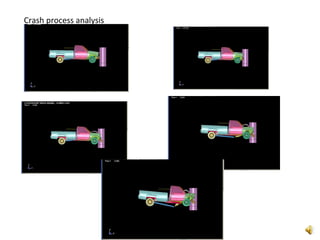
• In all cases, determine overall vehicle deformations every 15 ms, the crash pulse,
barrier force, structural deformation fore and aft engine and compare with
available crush space, and check for intrusion into occupant space
• Analyze all data and discuss its implication to occupant protection
08/04/13 KHALIL 2
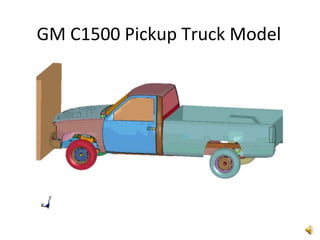
GM C1500 Pickup Truck Model
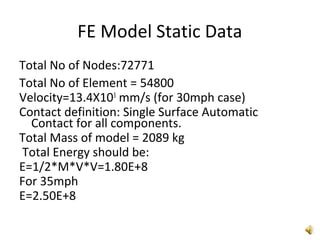
FE Model Static Data
Total No of Nodes:72771
Total No of Element = 54800
Velocity=13.4X10³
mm/s (for 30mph case)
Contact definition: Single Surface Automatic
Contact for all components.
Total Mass of model = 2089 kg
Total Energy should be:
E=1/2*M*V*V=1.80E+8
For 35mph
E=2.50E+8
 A rigid wall is created such that there is a complete contact of the wall and the
car. Car has the initial velocity of 30mph
 Single surface Contact has been defined for all the components of the car.
 Pre-processor – Hyper mesh 8.0
 Solver – LS-Dyna.
 Post-Processor - LS-pre Post.
 The basic aim of the analysis would be to see the effects of crash on the
passenger compartment.
 Simulation Time = 0.1 sec.
 Total Wall Clock time for run = 4Hr
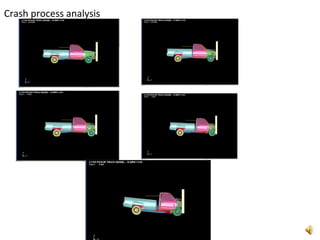
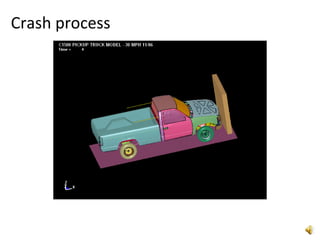
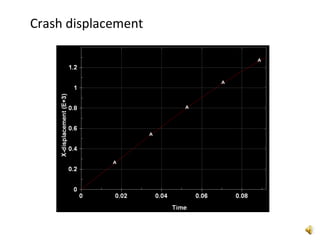
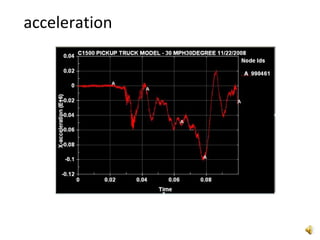
Case1 30mph front barrier impact
Barrier force
Crash displacement
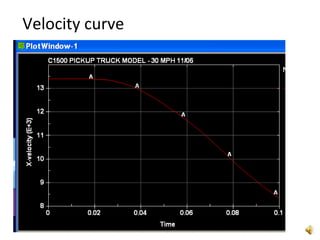
Velocity curve
Global Acceleration
Crash process analysis
Crash process
 A rigid wall is created such that there is a complete contact of the wall and the
car. Car has the initial velocity of 35mph
 Single surface Contact has been defined for all the components of the car.
 Pre-processor – Hyper mesh 8.0
 Solver – LS-Dyna.
 Post-Processor - LS-pre Post.
 The basic aim of the analysis would be to see the effects of crash on the
passenger compartment.
 Simulation Time = 0.1 sec.
 Total Wall Clock time for run = 4Hr
Case2 35mph front barrier impact
Barrier force
Crash displacement
Velocity curve
xacceleration
Crash process analysis
Crash Process
 A rigid wall is created such that there is a complete contact of the wall and the
car. Car has the initial velocity of 30mph,the wall is rotated to 30degree on the
left side of the bumper
 Single surface Contact has been defined for all the components of the car.
 Pre-processor – Hyper mesh 8.0
 Solver – LS-Dyna.
 Post-Processor - LS-pre Post.
 The basic aim of the analysis would be to see the effects of crash on the
passenger compartment.
 Simulation Time = 0.1 sec.
 Total Wall Clock time for run = 4Hr
Case3 30mph30degree offset impact
30mph 30degree Energy Balance
Barrier force
Crash displacement
Velocity curve
acceleration
Crash process analysis
Crash Movies
 A rigid wall is created such that there is a complete contact of the wall and the
car. The rigid wall has a cylinder shape, which has a radius of 350mm, length of
2000. Car has the initial velocity of 30mph,the rigid wall is put in the central
front of the bumper
 Single surface Contact has been defined for all the components of the car.
 Pre-processor – Hyper mesh 8.0
 Solver – LS-Dyna.
 Post-Processor - LS-pre Post.
 The basic aim of the analysis would be to see the effects of crash on the
passenger compartment.
 Simulation Time = 0.1 sec.
 Total Wall Clock time for run = 4Hr
Case4 30pmh central pole impact
Energy balance for pole impact
Barrier force
Velocity Curve
Crash Displacement
acceleration
Crash process analysis
Crash movie
Barrier force comparison
Displacement Comparison
velocity comparison
Summary of the project:
• The barrier force for the pole is the highest between these four
models, because the rigid wall is flat and the pole introduce stress
concentration
•The displacement for the 35mph is the highest, because of the
velocity, which gives more crash for the occupant
• Analysis has been completed and studied for different crash
analysis.
• Proper understanding of the crashworthiness of a vehicle and
individual components was thoroughly understood.
• FMVSS 208, NCAP, Pole were understood properly and used in
the simulations.
Improvements Recommended:
• For the comparison of the experiment and
simulation, physical parameter for the simulation
should be set based on the reality.
• The connection of different materials in the
model should be set correctly.
• The material properties should be properly
defined to the related components.
References
• Ying Yang, Guangyao ZhaoJianwei Di “Analysis of Vehicle’s Frontal Crash Based on
Structures’ Section Forces” the World of Car, 2001, 11: 12-13.
• Ahmed Elmarakbi, Khaled Sennah; Magdy Samaan, and Praveen Siriya, “Crashworthiness
of Motor Vehicle and Traffic Light Pole in Frontal Collisions” JOURNAL OF
TRANSPORTATION ENGINEERING © ASCE / SEPTEMBER 2006 / 733.
• Witteman, Willibrordus J , “Improved Vehicle Crashworthiness Design by
Control of the Energy Absorption for Different Collision Situations”
Eindhoven : Technische Universiteit Eindhoven, 1999.
• Dr. Khalil’s Class lectures and LS Dyna Manual.
Acknowledgement
We would like to thank Dr.Khalil and Dr. Cliff Chou for their
support and guidance in making this course informative and
interactive.
Special thanks should given to T.J. Flemings for the help on
the simulation.

Crash project take1

  • 1.
    Group Project Presentation CrashAnalysis for 1500 Pick-up Truck Members: Yuyang Song ( bb0036) Amitkumar joshi (dx7098) Varun Kumar Karuna (dx6518) Mohammed Fasidduin Shareef (dx6684) Department of Mechanical Engineering Wayne State University Submitted to Professors Tawfik Khalil and Cliff Chou In partial fulfillment of the requirements of: ME 8020: Crashworthiness and Occupant Protection in Transportation Systems
  • 2.
    Task • Use FEanalysis to identify the crashworthiness characteristics of vehicle • To perform the following simulations for 80-100 ms: a) 30 mph barrier head-on impact - FMVSS 208 simulation and compare with any available NHTSA tests b) 35 mph barrier head-on impact- NCAP simulation and compare with any available NHTSA tests and with simulation (a) c) 30 mph into 30 degree oblique barrier impact on left side - FMVSS 208 simulation and compare with results from simulation (a) d) 30 mph impact into center frontal pole, and compare with simulation (a) • In all cases, determine overall vehicle deformations every 15 ms, the crash pulse, barrier force, structural deformation fore and aft engine and compare with available crush space, and check for intrusion into occupant space • Analyze all data and discuss its implication to occupant protection 08/04/13 KHALIL 2
  • 3.
    GM C1500 PickupTruck Model
  • 4.
    FE Model StaticData Total No of Nodes:72771 Total No of Element = 54800 Velocity=13.4X103 mm/s (for 30mph case) Contact definition: Single Surface Automatic Contact for all components. Total Mass of model = 2089 kg Total Energy should be: E=1/2*M*V*V=1.80E+8 For 35mph E=2.50E+8
  • 5.
     A rigidwall is created such that there is a complete contact of the wall and the car. Car has the initial velocity of 30mph  Single surface Contact has been defined for all the components of the car.  Pre-processor – Hyper mesh 8.0  Solver – LS-Dyna.  Post-Processor - LS-pre Post.  The basic aim of the analysis would be to see the effects of crash on the passenger compartment.  Simulation Time = 0.1 sec.  Total Wall Clock time for run = 4Hr Case1 30mph front barrier impact
  • 7.
  • 8.
  • 9.
  • 10.
  • 11.
  • 12.
  • 13.
     A rigidwall is created such that there is a complete contact of the wall and the car. Car has the initial velocity of 35mph  Single surface Contact has been defined for all the components of the car.  Pre-processor – Hyper mesh 8.0  Solver – LS-Dyna.  Post-Processor - LS-pre Post.  The basic aim of the analysis would be to see the effects of crash on the passenger compartment.  Simulation Time = 0.1 sec.  Total Wall Clock time for run = 4Hr Case2 35mph front barrier impact
  • 15.
  • 16.
  • 17.
  • 18.
  • 19.
  • 20.
  • 21.
     A rigidwall is created such that there is a complete contact of the wall and the car. Car has the initial velocity of 30mph,the wall is rotated to 30degree on the left side of the bumper  Single surface Contact has been defined for all the components of the car.  Pre-processor – Hyper mesh 8.0  Solver – LS-Dyna.  Post-Processor - LS-pre Post.  The basic aim of the analysis would be to see the effects of crash on the passenger compartment.  Simulation Time = 0.1 sec.  Total Wall Clock time for run = 4Hr Case3 30mph30degree offset impact
  • 22.
  • 23.
  • 24.
  • 25.
  • 26.
  • 27.
  • 28.
  • 29.
     A rigidwall is created such that there is a complete contact of the wall and the car. The rigid wall has a cylinder shape, which has a radius of 350mm, length of 2000. Car has the initial velocity of 30mph,the rigid wall is put in the central front of the bumper  Single surface Contact has been defined for all the components of the car.  Pre-processor – Hyper mesh 8.0  Solver – LS-Dyna.  Post-Processor - LS-pre Post.  The basic aim of the analysis would be to see the effects of crash on the passenger compartment.  Simulation Time = 0.1 sec.  Total Wall Clock time for run = 4Hr Case4 30pmh central pole impact
  • 30.
    Energy balance forpole impact
  • 31.
  • 32.
  • 33.
  • 34.
  • 35.
  • 36.
  • 37.
  • 38.
  • 39.
  • 40.
    Summary of theproject: • The barrier force for the pole is the highest between these four models, because the rigid wall is flat and the pole introduce stress concentration •The displacement for the 35mph is the highest, because of the velocity, which gives more crash for the occupant • Analysis has been completed and studied for different crash analysis. • Proper understanding of the crashworthiness of a vehicle and individual components was thoroughly understood. • FMVSS 208, NCAP, Pole were understood properly and used in the simulations.
  • 41.
    Improvements Recommended: • Forthe comparison of the experiment and simulation, physical parameter for the simulation should be set based on the reality. • The connection of different materials in the model should be set correctly. • The material properties should be properly defined to the related components.
  • 42.
    References • Ying Yang,Guangyao ZhaoJianwei Di “Analysis of Vehicle’s Frontal Crash Based on Structures’ Section Forces” the World of Car, 2001, 11: 12-13. • Ahmed Elmarakbi, Khaled Sennah; Magdy Samaan, and Praveen Siriya, “Crashworthiness of Motor Vehicle and Traffic Light Pole in Frontal Collisions” JOURNAL OF TRANSPORTATION ENGINEERING © ASCE / SEPTEMBER 2006 / 733. • Witteman, Willibrordus J , “Improved Vehicle Crashworthiness Design by Control of the Energy Absorption for Different Collision Situations” Eindhoven : Technische Universiteit Eindhoven, 1999. • Dr. Khalil’s Class lectures and LS Dyna Manual.
  • 43.
    Acknowledgement We would liketo thank Dr.Khalil and Dr. Cliff Chou for their support and guidance in making this course informative and interactive. Special thanks should given to T.J. Flemings for the help on the simulation.