ME8020 CRASHWORTHINESS AND
OCCUPANT PROTECTION 1
FALL 2016
Project-1
Frontal Impact
GUIDANCE PROFESSOR : BIJAN KHATIB SHADHIDI
SUBMITTED BY : KUNAL DAVE (GC3775)
PRATIK SAXENA (GD8959)
FEDERAL MOTOR VEHICLE SAFTY STANDARD : 208
• FMVSS are U.S. federal regulations specifying design, construction,
performance, and durability requirements for motor vehicles and
regulated Automobile safety-related components, systems, and design
features.
• FMVSS are developed and enforced by the National Highway Traffic
Safety Administration (NHTSA)
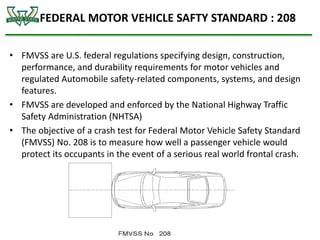
• The objective of a crash test for Federal Motor Vehicle Safety Standard
(FMVSS) No. 208 is to measure how well a passenger vehicle would
protect its occupants in the event of a serious real world frontal crash.
INSURANCE INSTITUTE FOR HIGHWAY SAFETY (IIHS)
• IIHS evaluates a vehicle's crashworthiness with the help of five tests:
moderate overlap front, small overlap front, side, roof strength and
head restraints & seats.
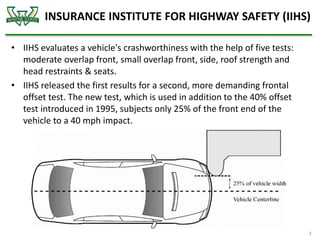
• IIHS released the first results for a second, more demanding frontal
offset test. The new test, which is used in addition to the 40% offset
test introduced in 1995, subjects only 25% of the front end of the
vehicle to a 40 mph impact.
3
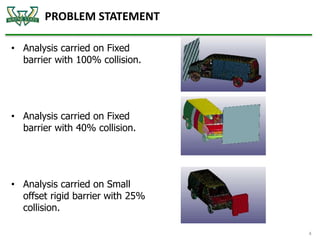
PROBLEM STATEMENT
• Analysis carried on Fixed
barrier with 100% collision.
• Analysis carried on Fixed
barrier with 40% collision.
• Analysis carried on Small
offset rigid barrier with 25%
collision.
4
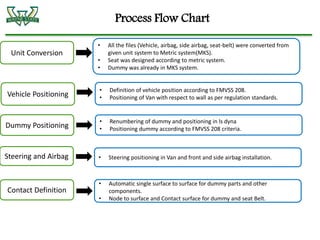
Process Flow Chart
Unit Conversion
• All the files (Vehicle, airbag, side airbag, seat-belt) were converted from
given unit system to Metric system(MKS).
• Seat was designed according to metric system.
• Dummy was already in MKS system.
Dummy Positioning
• Renumbering of dummy and positioning in ls dyna
• Positioning dummy according to FMVSS 208 criteria.
Steering and Airbag • Steering positioning in Van and front and side airbag installation.
Contact Definition
• Automatic single surface to surface for dummy parts and other
components.
• Node to surface and Contact surface for dummy and seat Belt.
Vehicle Positioning
• Definition of vehicle position according to FMVSS 208.
• Positioning of Van with respect to wall as per regulation standards.
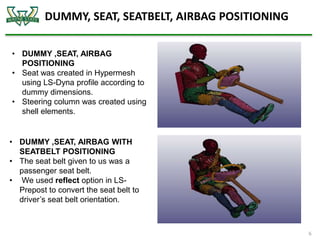
DUMMY, SEAT, SEATBELT, AIRBAG POSITIONING
6
• DUMMY ,SEAT, AIRBAG
POSITIONING
• Seat was created in Hypermesh
using LS-Dyna profile according to
dummy dimensions.
• Steering column was created using
shell elements.
• DUMMY ,SEAT, AIRBAG WITH
SEATBELT POSITIONING
• The seat belt given to us was a
passenger seat belt.
• We used reflect option in LS-
Prepost to convert the seat belt to
driver’s seat belt orientation.
DUMMY POSITIONING:
7
In Inches
FMVSS-208 RegulationFMVSS-208 Regulation
10.30 in
7.10 in
Dummy Positioned Dummy Positioned
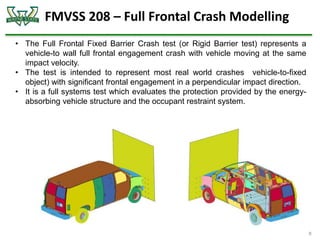
FMVSS 208 – Full Frontal Crash Modelling
8
• The Full Frontal Fixed Barrier Crash test (or Rigid Barrier test) represents a
vehicle-to wall full frontal engagement crash with vehicle moving at the same
impact velocity.
• The test is intended to represent most real world crashes vehicle-to-fixed
object) with significant frontal engagement in a perpendicular impact direction.
• It is a full systems test which evaluates the protection provided by the energy-
absorbing vehicle structure and the occupant restraint system.
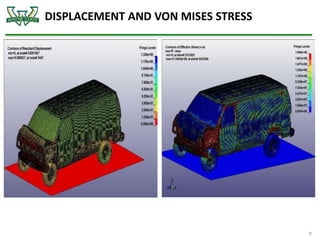
DISPLACEMENT AND VON MISES STRESS
9
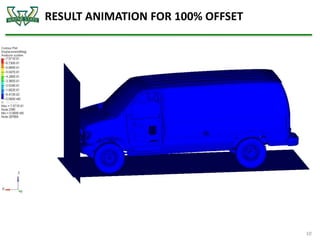
RESULT ANIMATION FOR 100% OFFSET
10
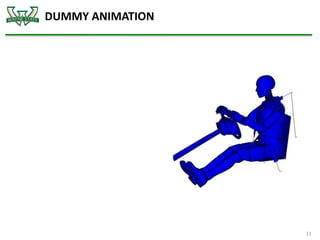
DUMMY ANIMATION
11
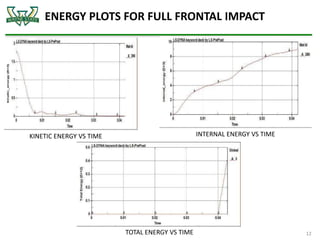
ENERGY PLOTS FOR FULL FRONTAL IMPACT
12
KINETIC ENERGY VS TIME INTERNAL ENERGY VS TIME
TOTAL ENERGY VS TIME
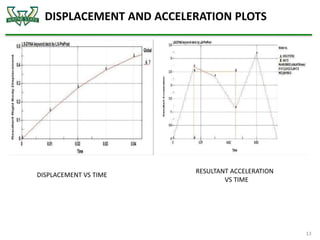
DISPLACEMENT AND ACCELERATION PLOTS
13
DISPLACEMENT VS TIME
RESULTANT ACCELERATION
VS TIME
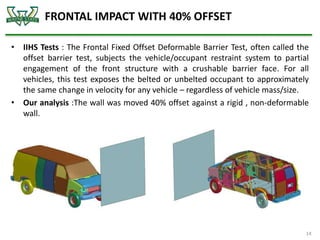
FRONTAL IMPACT WITH 40% OFFSET
14
• IIHS Tests : The Frontal Fixed Offset Deformable Barrier Test, often called the
offset barrier test, subjects the vehicle/occupant restraint system to partial
engagement of the front structure with a crushable barrier face. For all
vehicles, this test exposes the belted or unbelted occupant to approximately
the same change in velocity for any vehicle – regardless of vehicle mass/size.
• Our analysis :The wall was moved 40% offset against a rigid , non-deformable
wall.
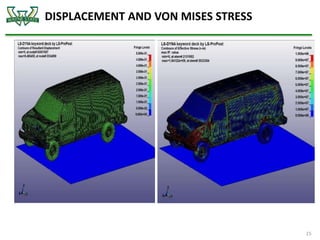
DISPLACEMENT AND VON MISES STRESS
15
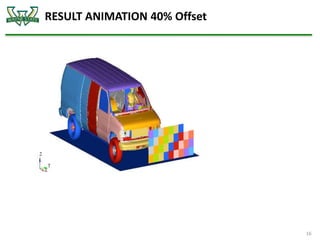
RESULT ANIMATION 40% Offset
16
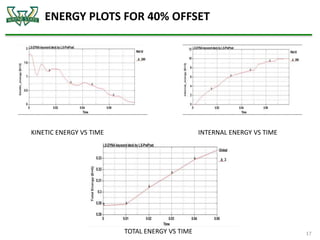
ENERGY PLOTS FOR 40% OFFSET
17
KINETIC ENERGY VS TIME INTERNAL ENERGY VS TIME
TOTAL ENERGY VS TIME
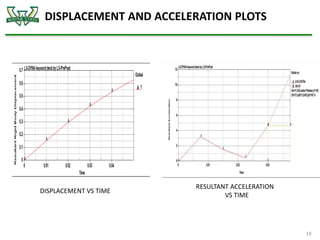
DISPLACEMENT AND ACCELERATION PLOTS
18
RESULTANT ACCELERATION
VS TIME
DISPLACEMENT VS TIME
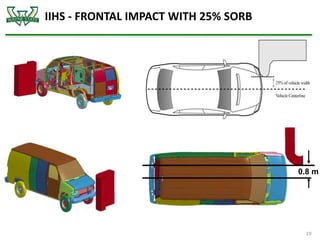
IIHS - FRONTAL IMPACT WITH 25% SORB
19
0.8 m
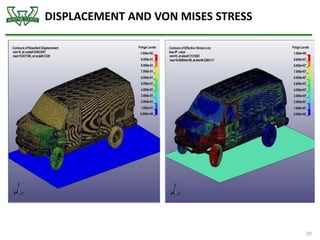
DISPLACEMENT AND VON MISES STRESS
20
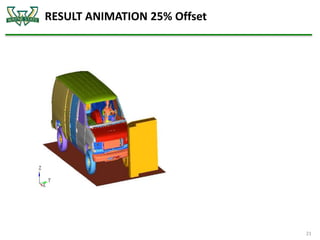
RESULT ANIMATION 25% Offset
21
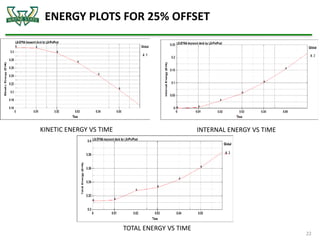
ENERGY PLOTS FOR 25% OFFSET
22
KINETIC ENERGY VS TIME INTERNAL ENERGY VS TIME
TOTAL ENERGY VS TIME
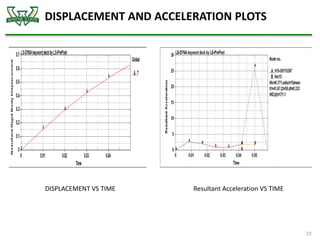
DISPLACEMENT AND ACCELERATION PLOTS
23
DISPLACEMENT VS TIME Resultant Acceleration VS TIME
What if Analysis
• Increased Reaction load will reduce the injury risk as it
wont allow our dummy to move forward or to lean on
steering wheel.
• Currently we have used hybrid airbag model instead of
this we can use Partial/ Molecular airbag.
• When we ran the simulation with and without seat belt
our HIC value reduced considerably.
• Changing the buckle location of the seatbelt will
restrained the dummy and hence will reduce the injury.
• We can control pressure and volume of the airbag.
24
Conclusion
• From the literature review and simulations we can
conclude that the Side impact is the most fatal type of
vehicle crashes.
• If we closely observe the Dummy after impact we can
see that the dummy would have severe injuries in head
and multiple fractures is Ribs, Pelvis and shoes resulting
into fatality.
• The side airbag, seatbelt plays a very important role in
keeping the driver safe.
25

Full Frontal Crash Test

  • 1.
    ME8020 CRASHWORTHINESS AND OCCUPANTPROTECTION 1 FALL 2016 Project-1 Frontal Impact GUIDANCE PROFESSOR : BIJAN KHATIB SHADHIDI SUBMITTED BY : KUNAL DAVE (GC3775) PRATIK SAXENA (GD8959)
  • 2.
    FEDERAL MOTOR VEHICLESAFTY STANDARD : 208 • FMVSS are U.S. federal regulations specifying design, construction, performance, and durability requirements for motor vehicles and regulated Automobile safety-related components, systems, and design features. • FMVSS are developed and enforced by the National Highway Traffic Safety Administration (NHTSA) • The objective of a crash test for Federal Motor Vehicle Safety Standard (FMVSS) No. 208 is to measure how well a passenger vehicle would protect its occupants in the event of a serious real world frontal crash.
  • 3.
    INSURANCE INSTITUTE FORHIGHWAY SAFETY (IIHS) • IIHS evaluates a vehicle's crashworthiness with the help of five tests: moderate overlap front, small overlap front, side, roof strength and head restraints & seats. • IIHS released the first results for a second, more demanding frontal offset test. The new test, which is used in addition to the 40% offset test introduced in 1995, subjects only 25% of the front end of the vehicle to a 40 mph impact. 3
  • 4.
    PROBLEM STATEMENT • Analysiscarried on Fixed barrier with 100% collision. • Analysis carried on Fixed barrier with 40% collision. • Analysis carried on Small offset rigid barrier with 25% collision. 4
  • 5.
    Process Flow Chart UnitConversion • All the files (Vehicle, airbag, side airbag, seat-belt) were converted from given unit system to Metric system(MKS). • Seat was designed according to metric system. • Dummy was already in MKS system. Dummy Positioning • Renumbering of dummy and positioning in ls dyna • Positioning dummy according to FMVSS 208 criteria. Steering and Airbag • Steering positioning in Van and front and side airbag installation. Contact Definition • Automatic single surface to surface for dummy parts and other components. • Node to surface and Contact surface for dummy and seat Belt. Vehicle Positioning • Definition of vehicle position according to FMVSS 208. • Positioning of Van with respect to wall as per regulation standards.
  • 6.
    DUMMY, SEAT, SEATBELT,AIRBAG POSITIONING 6 • DUMMY ,SEAT, AIRBAG POSITIONING • Seat was created in Hypermesh using LS-Dyna profile according to dummy dimensions. • Steering column was created using shell elements. • DUMMY ,SEAT, AIRBAG WITH SEATBELT POSITIONING • The seat belt given to us was a passenger seat belt. • We used reflect option in LS- Prepost to convert the seat belt to driver’s seat belt orientation.
  • 7.
    DUMMY POSITIONING: 7 In Inches FMVSS-208RegulationFMVSS-208 Regulation 10.30 in 7.10 in Dummy Positioned Dummy Positioned
  • 8.
    FMVSS 208 –Full Frontal Crash Modelling 8 • The Full Frontal Fixed Barrier Crash test (or Rigid Barrier test) represents a vehicle-to wall full frontal engagement crash with vehicle moving at the same impact velocity. • The test is intended to represent most real world crashes vehicle-to-fixed object) with significant frontal engagement in a perpendicular impact direction. • It is a full systems test which evaluates the protection provided by the energy- absorbing vehicle structure and the occupant restraint system.
  • 9.
    DISPLACEMENT AND VONMISES STRESS 9
  • 10.
    RESULT ANIMATION FOR100% OFFSET 10
  • 11.
  • 12.
    ENERGY PLOTS FORFULL FRONTAL IMPACT 12 KINETIC ENERGY VS TIME INTERNAL ENERGY VS TIME TOTAL ENERGY VS TIME
  • 13.
    DISPLACEMENT AND ACCELERATIONPLOTS 13 DISPLACEMENT VS TIME RESULTANT ACCELERATION VS TIME
  • 14.
    FRONTAL IMPACT WITH40% OFFSET 14 • IIHS Tests : The Frontal Fixed Offset Deformable Barrier Test, often called the offset barrier test, subjects the vehicle/occupant restraint system to partial engagement of the front structure with a crushable barrier face. For all vehicles, this test exposes the belted or unbelted occupant to approximately the same change in velocity for any vehicle – regardless of vehicle mass/size. • Our analysis :The wall was moved 40% offset against a rigid , non-deformable wall.
  • 15.
    DISPLACEMENT AND VONMISES STRESS 15
  • 16.
  • 17.
    ENERGY PLOTS FOR40% OFFSET 17 KINETIC ENERGY VS TIME INTERNAL ENERGY VS TIME TOTAL ENERGY VS TIME
  • 18.
    DISPLACEMENT AND ACCELERATIONPLOTS 18 RESULTANT ACCELERATION VS TIME DISPLACEMENT VS TIME
  • 19.
    IIHS - FRONTALIMPACT WITH 25% SORB 19 0.8 m
  • 20.
    DISPLACEMENT AND VONMISES STRESS 20
  • 21.
  • 22.
    ENERGY PLOTS FOR25% OFFSET 22 KINETIC ENERGY VS TIME INTERNAL ENERGY VS TIME TOTAL ENERGY VS TIME
  • 23.
    DISPLACEMENT AND ACCELERATIONPLOTS 23 DISPLACEMENT VS TIME Resultant Acceleration VS TIME
  • 24.
    What if Analysis •Increased Reaction load will reduce the injury risk as it wont allow our dummy to move forward or to lean on steering wheel. • Currently we have used hybrid airbag model instead of this we can use Partial/ Molecular airbag. • When we ran the simulation with and without seat belt our HIC value reduced considerably. • Changing the buckle location of the seatbelt will restrained the dummy and hence will reduce the injury. • We can control pressure and volume of the airbag. 24
  • 25.
    Conclusion • From theliterature review and simulations we can conclude that the Side impact is the most fatal type of vehicle crashes. • If we closely observe the Dummy after impact we can see that the dummy would have severe injuries in head and multiple fractures is Ribs, Pelvis and shoes resulting into fatality. • The side airbag, seatbelt plays a very important role in keeping the driver safe. 25