International Research Journal of Engineering and Technology (IRJET) e-ISSN: 2395-0056
Volume: 06 Issue: 04 | Apr 2019 www.irjet.net p-ISSN: 2395-0072
© 2019, IRJET | Impact Factor value: 7.211 | ISO 9001:2008 Certified Journal | Page 415
Static structural analysis of Formula Student Space Frame
Dr. A.J. Gujar1, Vinayak Vijay Ingavale2, Sourabh Milind Patil3, Suraj Sambhaji Panhalkar4,
Piyush Ravindra Gat5, Amit Sanjay Shinde6
1Professor, Dept. of Mechanical Engineering, D. Y. Patil College of Engineering & Technology, Kolhapur,
Maharashtra, India
2,3,4,5,6Under Graduate Students, Dept. of Mechanical Engineering, D. Y. Patil College of Engineering & Technology,
Kolhapur, Maharashtra, India
---------------------------------------------------------------------***----------------------------------------------------------------------
Abstract – The main objective of this paper is to give
detailed calculations and analysis of formula studentvehicle’s
roll cage. Realistic approach of material selection forrollcage
is shown followed by designing with the help of SolidWorks
2017. The front impact, rear impact, side impactandtorsional
analysis are carried out in ANSYS 18.1 for deformation and
maximum stress. The major challenge was to optimize the
design for light weight without compromising safety of the
driver. The design obeys the rules stated byFSAErulebook and
Formula Bharat Rulebook 2019.
Key Words: Roll cage,Material,Calculations,SolidWorks,
Static Structural, ANSYS.
1. INTRODUCTION
There are several options for manufacturingthe chassis/roll
cage; space frame, ladderframe,monocoque etc.Weoptedto
manufacture our roll cage in the form of space frame. Space
frame can be easily manufactured with conventional tooling
and any modifications/repairs can be easily done.
All the systems of a formula student vehicle are mounted on
the roll cage. As roll cage being important system absorbing
all the static and dynamic loads, the structure must
withstand the stresses generated without deformation. The
purpose of the paper is to design, calculate and analyse the
roll cage for deformation and stresses within permissible
limits of rules stated by FSAE. The mass of the roll cage
influences widely on the vehicle’s mass. So, the roll cage
plays vital role in vehicle dynamics requiring lower weight.
2. SELECTION OF MATERIAL
Materialselectionwasatoughjobbecausesignificantamount
of budget was involved. Also, it must sustain any loads or
forcesacting on it withoutdeforming.Rollcagematerialmust
have certain stiffness to absorb all the vibrations and high
temperatures produced by the engine. There’s plethora of
options for material to be used for roll cage. But most widely
used materials for roll cage were AISI 1018 & AISI 4130. The
AISI 1018 steel was selected to use for the rollcagebecauseit
was easy to procure, and the cost is comparatively low. Also,
AISI 1018 can withstand the stresses without deforming as
per our requirement.
Table -1: Properties of AISI 1018
Density (kg/m3) 7800
Young’s Modulus (MPa) 2.1x10⁵
Poisson’s Ratio
0.29
Yield Strength (MPa)
370
Ultimate Strength (MPa)
440
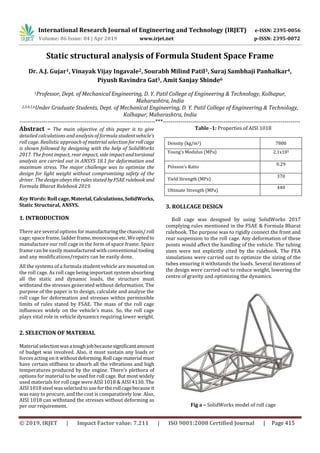
3. ROLLCAGE DESIGN
Roll cage was designed by using SolidWorks 2017
complying rules mentioned in the FSAE & Formula Bharat
rulebook. The purpose was to rigidly connect the front and
rear suspension to the roll cage. Any deformation of these
points would affect the handling of the vehicle. The tubing
sizes were not explicitly cited by the rulebook. The FEA
simulations were carried out to optimize the sizing of the
tubes ensuring it withstands the loads. Several iterations of
the design were carried out to reduce weight, lowering the
centre of gravity and optimizing the dynamics.
Fig a – SolidWorks model of roll cage
International Research Journal of Engineering and Technology (IRJET) e-ISSN: 2395-0056
Volume: 06 Issue: 04 | Apr 2019 www.irjet.net p-ISSN: 2395-0072
© 2019, IRJET | Impact Factor value: 7.211 | ISO 9001:2008 Certified Journal | Page 416
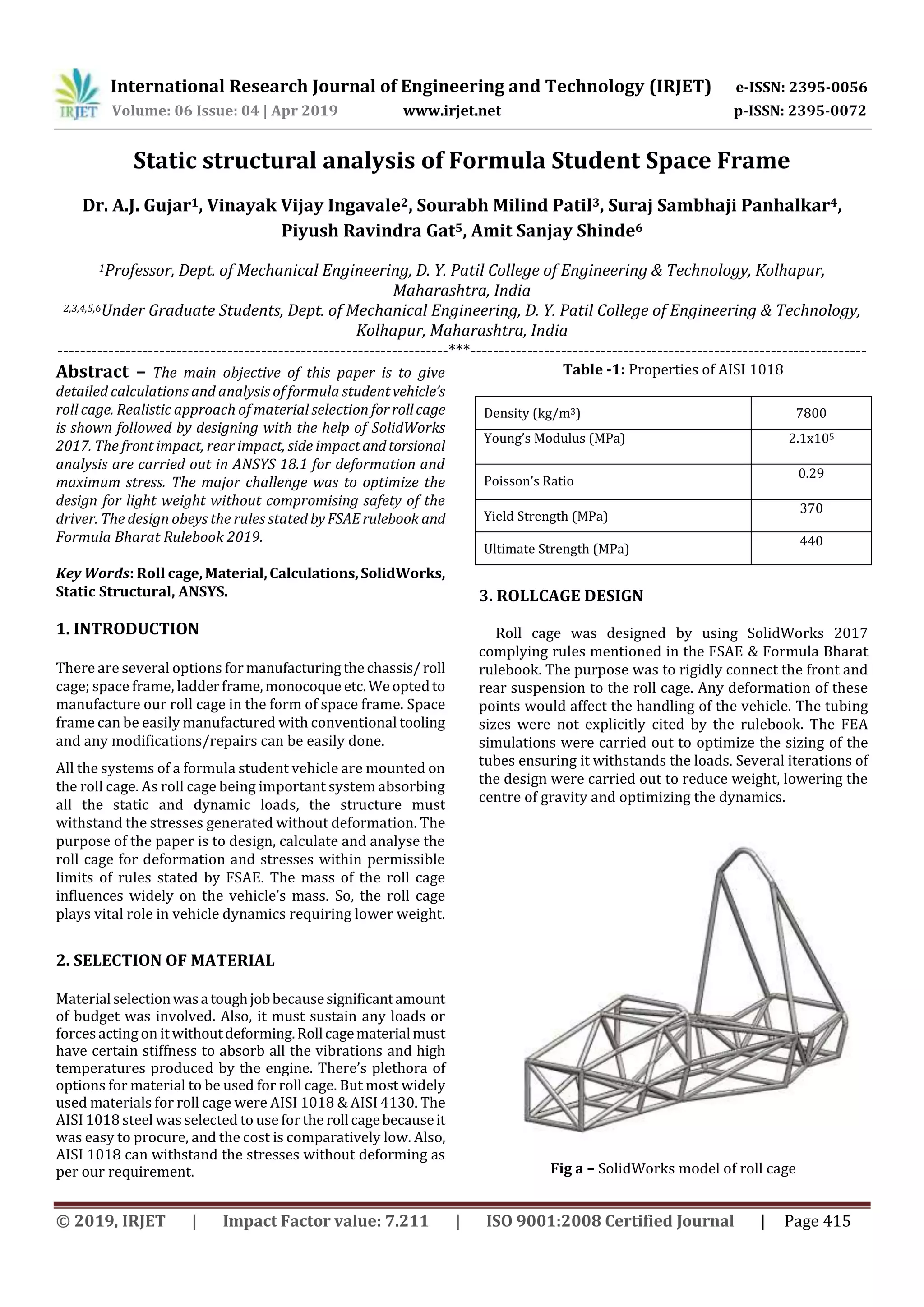
4. STATIC STRUCTURAL ANALYSIS
The forces are calculated from Work-Energy principle and
are being applied on the vehicle. These forces are applied in
order to check for deformation and max stresses are within
acceptable limits.
4.1 Front Impact
In the front impact test, it is considered that thevehiclemust
be collided with a stationary body. In order to simulate this
condition in ANSYS, force is applied on front portion of the
vehicle and suspension points are constrained in all
directions.
Mass of the Vehicle (M) = 320kg
Initial velocity of vehicle before impact (V1) = 28 m/s
Final velocity of vehicle after impact (V2) = 0 m/s
As per industrial standards: Impact time = 0.13 seconds
From Work-Energy principle,
Work done = Change in kinetic energies
W = (0.5 × M × V22 - 0.5 × M × V12)
│W│ = │- 0.5 × M × V12│
│W│ =│- 0.5 × 320 × 282│
│W│ = 125440 Nm
Now,
Work done (W)= Force (F) × Displacement (s)__________ (1)
Displacement (s) = Impact time × Vmax (V1)
Displacement (s) = 0.13 ×28 = 3.64 m
So, from (1) we get,
F = W/ s
F = 125440 / 3.64
F = 34461.53 N
Fig -4.1(a): Total Deformation
Fig -4.1(b): Maximum Combined Stress
4.2 Rear Impact
In rear impact test, the vehicle is assumed to be stationary
and other vehicle hits from rear. The force is applied on the
rear end of the vehicle constraining the suspension points.
Mass of the Vehicle (M) = 320kg
Initial velocity of vehicle before impact (V1) = 28 m/s
Final velocity of vehicle after impact (V2) = 0 m/s
International Research Journal of Engineering and Technology (IRJET) e-ISSN: 2395-0056
Volume: 06 Issue: 04 | Apr 2019 www.irjet.net p-ISSN: 2395-0072
© 2019, IRJET | Impact Factor value: 7.211 | ISO 9001:2008 Certified Journal | Page 417
As per industrial standards: Impact time = 0.13 seconds
From Work-Energy principle,
Work done = Change in kinetic energies
W = (0.5 × M × V22 - 0.5 × M × V12)
│W│ = │- 0.5 × M × V12│
│W│ =│- 0.5 × 320 × 282│
│W│ = 125440 Nm
Now,
Work done (W)= Force (F) × Displacement (s)__________ (1)
Displacement (s) = Impact time × Vmax (V1)
Displacement (s) = 0.13 ×28 = 3.64 m
So, from (1) we get,
F = W/ s
F = 125440 / 3.64
F = 34461.53 N
Fig -4.2(a): Total Deformation
Fig -4.2(b): Maximum Combined Stress
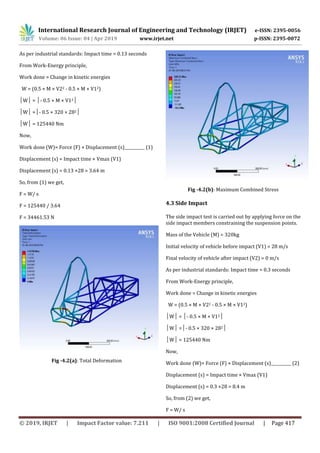
4.3 Side Impact
The side impact test is carried out by applying force on the
side impact members constraining the suspension points.
Mass of the Vehicle (M) = 320kg
Initial velocity of vehicle before impact (V1) = 28 m/s
Final velocity of vehicle after impact (V2) = 0 m/s
As per industrial standards: Impact time = 0.3 seconds
From Work-Energy principle,
Work done = Change in kinetic energies
W = (0.5 × M × V22 - 0.5 × M × V12)
│W│ = │- 0.5 × M × V12│
│W│ =│- 0.5 × 320 × 282│
│W│ = 125440 Nm
Now,
Work done (W)= Force (F) × Displacement (s)__________ (2)
Displacement (s) = Impact time × Vmax (V1)
Displacement (s) = 0.3 ×28 = 8.4 m
So, from (2) we get,
F = W/ s
International Research Journal of Engineering and Technology (IRJET) e-ISSN: 2395-0056
Volume: 06 Issue: 04 | Apr 2019 www.irjet.net p-ISSN: 2395-0072
© 2019, IRJET | Impact Factor value: 7.211 | ISO 9001:2008 Certified Journal | Page 418
F = 125440 / 8.4
F = 14933.33 N
Fig -4.3(a): Total Deformation
Fig -4.3(b): Maximum Combined Stress
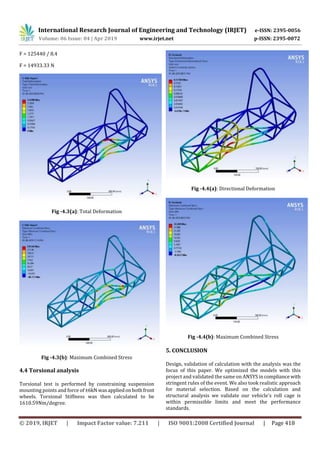
4.4 Torsional analysis
Torsional test is performed by constraining suspension
mounting points and force of±6kN wasappliedonbothfront
wheels. Torsional Stiffness was then calculated to be
1610.59Nm/degree.
Fig -4.4(a): Directional Deformation
Fig -4.4(b): Maximum Combined Stress
5. CONCLUSION
Design, validation of calculation with the analysis was the
focus of this paper. We optimized the models with this
project and validated the same on ANSYS incompliance with
stringent rules of the event. We also took realistic approach
for material selection. Based on the calculation and
structural analysis we validate our vehicle’s roll cage is
within permissible limits and meet the performance
standards.
International Research Journal of Engineering and Technology (IRJET) e-ISSN: 2395-0056
Volume: 06 Issue: 04 | Apr 2019 www.irjet.net p-ISSN: 2395-0072
© 2019, IRJET | Impact Factor value: 7.211 | ISO 9001:2008 Certified Journal | Page 419
REFERENCES
[1] Formula Bharat Rulebook 2019
[2] 2017-18 Formula SAE Rules
[3] “Race Car Vehicle Dynamics” William F. Milliken,
Douglas L. Milliken, 1997. Society of Automotive
Engineers.
[4] “Fundamentals of Vehicle Dynamics” SAE Inc.ThomasD
Gillespie.
[5] “Racing and Sports Car Chassis Design” Michael Costin
and David Phipps.
[6] “Design and crash analysis of a rollcage for formula SAE
race car”,IJRET, eISSN: 2319-1163, Volume:03Issue:07
[7] William B. Riley and Albert R. George, “Design, Analysis
and Testing of a Formula SAE Car Chassis”, Cornell
University, 2002-01-3300
[8] Abhijeet Das, “Design of Student Formula Race Car
Chassis”, IJSR, ISSN (Online):2319-7064,Volume4Issue
4, April 2015.

IRJET- Static Structural Analysis of Formula Student Space Frame

  • 1.
    International Research Journalof Engineering and Technology (IRJET) e-ISSN: 2395-0056 Volume: 06 Issue: 04 | Apr 2019 www.irjet.net p-ISSN: 2395-0072 © 2019, IRJET | Impact Factor value: 7.211 | ISO 9001:2008 Certified Journal | Page 415 Static structural analysis of Formula Student Space Frame Dr. A.J. Gujar1, Vinayak Vijay Ingavale2, Sourabh Milind Patil3, Suraj Sambhaji Panhalkar4, Piyush Ravindra Gat5, Amit Sanjay Shinde6 1Professor, Dept. of Mechanical Engineering, D. Y. Patil College of Engineering & Technology, Kolhapur, Maharashtra, India 2,3,4,5,6Under Graduate Students, Dept. of Mechanical Engineering, D. Y. Patil College of Engineering & Technology, Kolhapur, Maharashtra, India ---------------------------------------------------------------------***---------------------------------------------------------------------- Abstract – The main objective of this paper is to give detailed calculations and analysis of formula studentvehicle’s roll cage. Realistic approach of material selection forrollcage is shown followed by designing with the help of SolidWorks 2017. The front impact, rear impact, side impactandtorsional analysis are carried out in ANSYS 18.1 for deformation and maximum stress. The major challenge was to optimize the design for light weight without compromising safety of the driver. The design obeys the rules stated byFSAErulebook and Formula Bharat Rulebook 2019. Key Words: Roll cage,Material,Calculations,SolidWorks, Static Structural, ANSYS. 1. INTRODUCTION There are several options for manufacturingthe chassis/roll cage; space frame, ladderframe,monocoque etc.Weoptedto manufacture our roll cage in the form of space frame. Space frame can be easily manufactured with conventional tooling and any modifications/repairs can be easily done. All the systems of a formula student vehicle are mounted on the roll cage. As roll cage being important system absorbing all the static and dynamic loads, the structure must withstand the stresses generated without deformation. The purpose of the paper is to design, calculate and analyse the roll cage for deformation and stresses within permissible limits of rules stated by FSAE. The mass of the roll cage influences widely on the vehicle’s mass. So, the roll cage plays vital role in vehicle dynamics requiring lower weight. 2. SELECTION OF MATERIAL Materialselectionwasatoughjobbecausesignificantamount of budget was involved. Also, it must sustain any loads or forcesacting on it withoutdeforming.Rollcagematerialmust have certain stiffness to absorb all the vibrations and high temperatures produced by the engine. There’s plethora of options for material to be used for roll cage. But most widely used materials for roll cage were AISI 1018 & AISI 4130. The AISI 1018 steel was selected to use for the rollcagebecauseit was easy to procure, and the cost is comparatively low. Also, AISI 1018 can withstand the stresses without deforming as per our requirement. Table -1: Properties of AISI 1018 Density (kg/m3) 7800 Young’s Modulus (MPa) 2.1x10⁵ Poisson’s Ratio 0.29 Yield Strength (MPa) 370 Ultimate Strength (MPa) 440 3. ROLLCAGE DESIGN Roll cage was designed by using SolidWorks 2017 complying rules mentioned in the FSAE & Formula Bharat rulebook. The purpose was to rigidly connect the front and rear suspension to the roll cage. Any deformation of these points would affect the handling of the vehicle. The tubing sizes were not explicitly cited by the rulebook. The FEA simulations were carried out to optimize the sizing of the tubes ensuring it withstands the loads. Several iterations of the design were carried out to reduce weight, lowering the centre of gravity and optimizing the dynamics. Fig a – SolidWorks model of roll cage
  • 2.
    International Research Journalof Engineering and Technology (IRJET) e-ISSN: 2395-0056 Volume: 06 Issue: 04 | Apr 2019 www.irjet.net p-ISSN: 2395-0072 © 2019, IRJET | Impact Factor value: 7.211 | ISO 9001:2008 Certified Journal | Page 416 4. STATIC STRUCTURAL ANALYSIS The forces are calculated from Work-Energy principle and are being applied on the vehicle. These forces are applied in order to check for deformation and max stresses are within acceptable limits. 4.1 Front Impact In the front impact test, it is considered that thevehiclemust be collided with a stationary body. In order to simulate this condition in ANSYS, force is applied on front portion of the vehicle and suspension points are constrained in all directions. Mass of the Vehicle (M) = 320kg Initial velocity of vehicle before impact (V1) = 28 m/s Final velocity of vehicle after impact (V2) = 0 m/s As per industrial standards: Impact time = 0.13 seconds From Work-Energy principle, Work done = Change in kinetic energies W = (0.5 × M × V22 - 0.5 × M × V12) │W│ = │- 0.5 × M × V12│ │W│ =│- 0.5 × 320 × 282│ │W│ = 125440 Nm Now, Work done (W)= Force (F) × Displacement (s)__________ (1) Displacement (s) = Impact time × Vmax (V1) Displacement (s) = 0.13 ×28 = 3.64 m So, from (1) we get, F = W/ s F = 125440 / 3.64 F = 34461.53 N Fig -4.1(a): Total Deformation Fig -4.1(b): Maximum Combined Stress 4.2 Rear Impact In rear impact test, the vehicle is assumed to be stationary and other vehicle hits from rear. The force is applied on the rear end of the vehicle constraining the suspension points. Mass of the Vehicle (M) = 320kg Initial velocity of vehicle before impact (V1) = 28 m/s Final velocity of vehicle after impact (V2) = 0 m/s
  • 3.
    International Research Journalof Engineering and Technology (IRJET) e-ISSN: 2395-0056 Volume: 06 Issue: 04 | Apr 2019 www.irjet.net p-ISSN: 2395-0072 © 2019, IRJET | Impact Factor value: 7.211 | ISO 9001:2008 Certified Journal | Page 417 As per industrial standards: Impact time = 0.13 seconds From Work-Energy principle, Work done = Change in kinetic energies W = (0.5 × M × V22 - 0.5 × M × V12) │W│ = │- 0.5 × M × V12│ │W│ =│- 0.5 × 320 × 282│ │W│ = 125440 Nm Now, Work done (W)= Force (F) × Displacement (s)__________ (1) Displacement (s) = Impact time × Vmax (V1) Displacement (s) = 0.13 ×28 = 3.64 m So, from (1) we get, F = W/ s F = 125440 / 3.64 F = 34461.53 N Fig -4.2(a): Total Deformation Fig -4.2(b): Maximum Combined Stress 4.3 Side Impact The side impact test is carried out by applying force on the side impact members constraining the suspension points. Mass of the Vehicle (M) = 320kg Initial velocity of vehicle before impact (V1) = 28 m/s Final velocity of vehicle after impact (V2) = 0 m/s As per industrial standards: Impact time = 0.3 seconds From Work-Energy principle, Work done = Change in kinetic energies W = (0.5 × M × V22 - 0.5 × M × V12) │W│ = │- 0.5 × M × V12│ │W│ =│- 0.5 × 320 × 282│ │W│ = 125440 Nm Now, Work done (W)= Force (F) × Displacement (s)__________ (2) Displacement (s) = Impact time × Vmax (V1) Displacement (s) = 0.3 ×28 = 8.4 m So, from (2) we get, F = W/ s
  • 4.
    International Research Journalof Engineering and Technology (IRJET) e-ISSN: 2395-0056 Volume: 06 Issue: 04 | Apr 2019 www.irjet.net p-ISSN: 2395-0072 © 2019, IRJET | Impact Factor value: 7.211 | ISO 9001:2008 Certified Journal | Page 418 F = 125440 / 8.4 F = 14933.33 N Fig -4.3(a): Total Deformation Fig -4.3(b): Maximum Combined Stress 4.4 Torsional analysis Torsional test is performed by constraining suspension mounting points and force of±6kN wasappliedonbothfront wheels. Torsional Stiffness was then calculated to be 1610.59Nm/degree. Fig -4.4(a): Directional Deformation Fig -4.4(b): Maximum Combined Stress 5. CONCLUSION Design, validation of calculation with the analysis was the focus of this paper. We optimized the models with this project and validated the same on ANSYS incompliance with stringent rules of the event. We also took realistic approach for material selection. Based on the calculation and structural analysis we validate our vehicle’s roll cage is within permissible limits and meet the performance standards.
  • 5.
    International Research Journalof Engineering and Technology (IRJET) e-ISSN: 2395-0056 Volume: 06 Issue: 04 | Apr 2019 www.irjet.net p-ISSN: 2395-0072 © 2019, IRJET | Impact Factor value: 7.211 | ISO 9001:2008 Certified Journal | Page 419 REFERENCES [1] Formula Bharat Rulebook 2019 [2] 2017-18 Formula SAE Rules [3] “Race Car Vehicle Dynamics” William F. Milliken, Douglas L. Milliken, 1997. Society of Automotive Engineers. [4] “Fundamentals of Vehicle Dynamics” SAE Inc.ThomasD Gillespie. [5] “Racing and Sports Car Chassis Design” Michael Costin and David Phipps. [6] “Design and crash analysis of a rollcage for formula SAE race car”,IJRET, eISSN: 2319-1163, Volume:03Issue:07 [7] William B. Riley and Albert R. George, “Design, Analysis and Testing of a Formula SAE Car Chassis”, Cornell University, 2002-01-3300 [8] Abhijeet Das, “Design of Student Formula Race Car Chassis”, IJSR, ISSN (Online):2319-7064,Volume4Issue 4, April 2015.