AND NOW SOME C.R.A.P.
As funny as it is…
… making CRAP jokes, it really is a foundational premise of
design, and it’s deeply important (and thanks to our sense of
humor usually quite memorable). The letters, of course,
stand for:
Contrast
Repetition
Alignment
Proximity
You read about it
So I’m going to give these to you in my words,
along with a few quick examples, so you can
get a good sense of how it works.
Contrast
Basically stated, contrast means that things that are
similar look similar but things that are different look
clearly different. This keeps your reader from
becoming confused and creating relationships that
aren’t present.
It comes, of course, from literal contrast, the light-to-dark
or black-to-white of an image. In design it often ends
up being about color values.
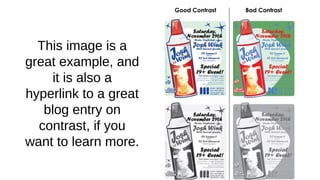
This image is a
great example, and
it is also a
hyperlink to a great
blog entry on
contrast, if you
want to learn more.
Repetition
Maybe the easiest of these four concepts to
define, repetition is, just as you’d guess,
repeating something– a color, a logo, a
typeface, a type style.
It unifies and organizes.
Alignment
Alignment is about positioning on a page.
Nothing should be put on haphazardly. There
should be a reason and a measurement that
guides where things are placed in relation to
each other.
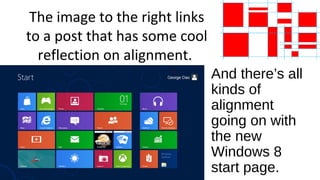
The image to the right links
to a post that has some cool
reflection on alignment.
And there’s all
kinds of
alignment
going on with
the new
Windows 8
start page.
Proximity
Proximity is very similar in theory to
alignment, but it’s more about grouping and
use of white space.
Basically: similar things are grouped together,
different things require space.
C.R.A.P.

C.R.A.P.

  • 1.
    AND NOW SOMEC.R.A.P.
  • 2.
    As funny asit is… … making CRAP jokes, it really is a foundational premise of design, and it’s deeply important (and thanks to our sense of humor usually quite memorable). The letters, of course, stand for: Contrast Repetition Alignment Proximity
  • 3.
    You read aboutit So I’m going to give these to you in my words, along with a few quick examples, so you can get a good sense of how it works.
  • 4.
    Contrast Basically stated, contrastmeans that things that are similar look similar but things that are different look clearly different. This keeps your reader from becoming confused and creating relationships that aren’t present. It comes, of course, from literal contrast, the light-to-dark or black-to-white of an image. In design it often ends up being about color values.
  • 5.
    This image isa great example, and it is also a hyperlink to a great blog entry on contrast, if you want to learn more.
  • 6.
    Repetition Maybe the easiestof these four concepts to define, repetition is, just as you’d guess, repeating something– a color, a logo, a typeface, a type style. It unifies and organizes.
  • 8.
    Alignment Alignment is aboutpositioning on a page. Nothing should be put on haphazardly. There should be a reason and a measurement that guides where things are placed in relation to each other.
  • 9.
    The image tothe right links to a post that has some cool reflection on alignment. And there’s all kinds of alignment going on with the new Windows 8 start page.
  • 10.
    Proximity Proximity is verysimilar in theory to alignment, but it’s more about grouping and use of white space. Basically: similar things are grouped together, different things require space.