CVJ/FM 360°
25-9-2016
12.54am
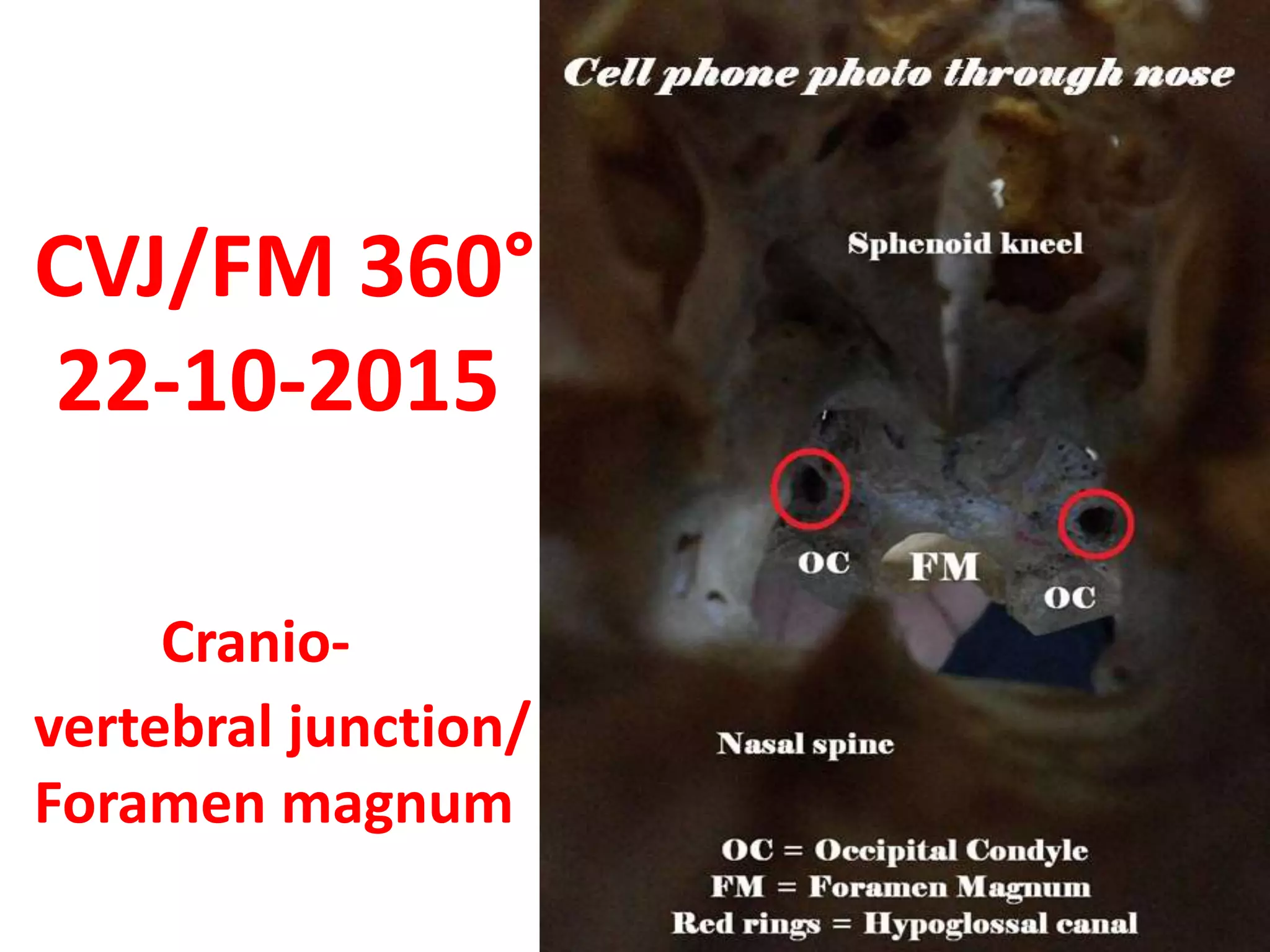
Cranio-
vertebral junction/
Foramen magnum
Great teachers – All this is their work .
I am just the reader of their books .
Prof. Paolo castelnuovo
Prof. Aldo Stamm Prof. Mario Sanna
Prof. Magnan
For Other powerpoint presentatioins
of
“ Skull base 360° ”
I will update continuosly with date tag at the end as I am
getting more & more information
click
www.skullbase360.in
- you have to login to slideshare.net with Facebook
account for downloading.
From Anteriorly
1. The HC divides the condylar region into the tubercular compartment
(superior) and the condylar compartment (inferior).
Tubercular compartment contains LPT lateral pharyngeal tubercle, PT
pharyngeal tubercle,
2. The SCG [Supracondylar groove] represents a reliable landmark for hypoglossal
canal (HC) identification (red arrow) (Morera et al. 2010 ) .
The tubercular compartment corresponds to the Jugular tubercle ( JT )
Line along the lateral pharyngeal tubercle [ LPT ] passes through
Jugular tubercle [ JT ] – so when you are drilling LPT in anterior skull
base you will land up on JT .
LPT lateral pharyngeal tubercle, OC
occipital condyle, PT pharyngeal
tubercle, SCG supracondylar groove
Jugular tubercle ( JT )
Line along the lateral pharyngeal tubercle [ LPT ] passes through Jugular tubercle [ JT
] – so when you are drilling LPT in anterior skull base you will land up on JT .
Red rings = hypoglossal canals , yellow
ring = pharyngeal tubercle [ PT ] , blue
rings = lateral pharyngeal tubercle [
LPT]
Line along the lateral pharyngeal tubercle [ LPT ] passes through Jugular
tubercle [ JT ] – so when you are drilling LPT in anterior skull base you will
land up on JT .
yellow ring = pharyngeal tubercle [ PT ] , blue rings = lateral pharyngeal
tubercle [ LPT] , green ring = Jugular tubercle
Just adding two triangles of petrous bone base around foramen magnum ,
your lower clivus / foramen magnum area completes -- just as simple as that
Lower clivus devided into
1. tubercular compartment [ Above red line ]
2. condylar compartment [ Below red line ]
Hypoglossal canal present at the junction of anterior 1/3rd & posterior 2/3rd
Lower clivus + petrous bone [ base ]
Petrous
bone
devided
into three
1/3rds
Lower clivus + petrous bone [ base ] + Zygomatic bone
Petrous bone devided
into three 1/3rds
Lateral skull base view – observe the
petrous apex
Lower clivus + petrous apex in anterior skull base
1. observe the petrous apex in both views
2. hypoglossal canal medial to parapharyngeal carotid & jugular fossa
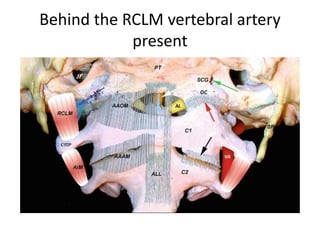
Behind the RCLM vertebral artery
present
The VA, at the level of the transverse process of the atlas, is
located on the medial side of the rectus capitis lateralis muscle [
RCLM ] .
First Longus capitis muscle seen
Next longus coli & rectus capitus
anterior seen
kinking or looping of the ICAp - when looping present para-pharyngeal carotid
comes to pre-styloid compartment – previously thought that para-pharyngeal
carotid never comes anterior to styloid mucles – which is UNTRUE
From Aldostamm - Fig. 42.10 - When there is loop of parapharyngeal
carotid , it goes nearer to the RCLM or anterior arch of atlas
Anterior view. The right longus capitis muscle has been
removed. 1, clivus; 2, anterior arch of the atlas; 3, atlantoaxial joint;
4, left longus capitis muscle; 5, longus colli muscle; 6, rectus capitis
anterior muscle; 7, carotid artery.
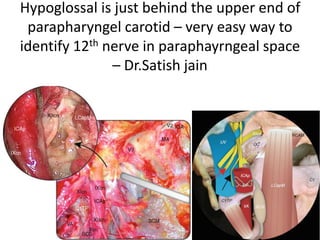
Hypoglossal is just behind the upper end of
parapharyngel carotid – very easy way to
identify 12th nerve in paraphayrngeal space
– Dr.Satish jain
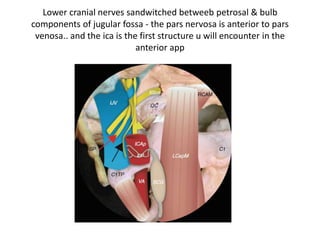
Lower cranial nerves sandwitched betweeb petrosal & bulb
components of jugular fossa - the pars nervosa is anterior to pars
venosa.. and the ica is the first structure u will encounter in the
anterior app
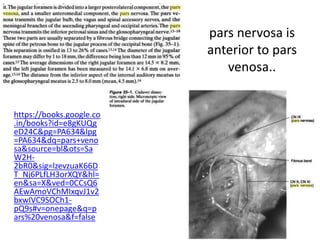
pars nervosa is
anterior to pars
venosa..
https://books.google.co
.in/books?id=e8gKUQg
eD24C&pg=PA634&lpg
=PA634&dq=pars+veno
sa&source=bl&ots=Sa
W2H-
2bR0&sig=lzevzuaK66D
T_Nj6PLfLH3orXQY&hl=
en&sa=X&ved=0CCsQ6
AEwAmoVChMIxqvJ1v2
bxwIVC9SOCh1-
pQ9s#v=onepage&q=p
ars%20venosa&f=false
Vetebral venous plexus
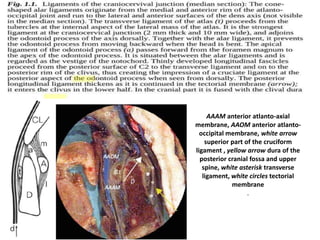
AAAM anterior atlanto-axial
membrane, AAOM anterior atlanto-
occipital membrane, white arrow
superior part of the cruciform
ligament , yellow arrow dura of the
posterior cranial fossa and upper
spine, white asterisk transverse
ligament, white circles tectorial
membrane
.
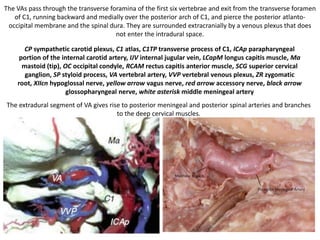
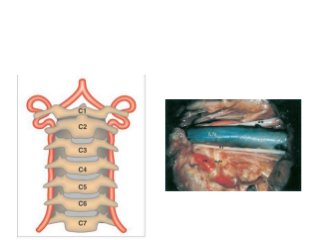
The VAs pass through the transverse foramina of the first six vertebrae and exit from the transverse foramen
of C1, running backward and medially over the posterior arch of C1, and pierce the posterior atlanto-
occipital membrane and the spinal dura. They are surrounded extracranially by a venous plexus that does
not enter the intradural space.
CP sympathetic carotid plexus, C1 atlas, C1TP transverse process of C1, ICAp parapharyngeal
portion of the internal carotid artery, IJV internal jugular vein, LCapM longus capitis muscle, Ma
mastoid (tip), OC occipital condyle, RCAM rectus capitis anterior muscle, SCG superior cervical
ganglion, SP styloid process, VA vertebral artery, VVP vertebral venous plexus, ZR zygomatic
root, XIIcn hypoglossal nerve, yellow arrow vagus nerve, red arrow accessory nerve, black arrow
glossopharyngeal nerve, white asterisk middle meningeal artery
The extradural segment of VA gives rise to posterior meningeal and posterior spinal arteries and branches
to the deep cervical muscles.
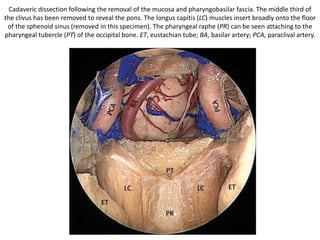
Cadaveric dissection following the removal of the mucosa and pharyngobasilar fascia. The middle third of
the clivus has been removed to reveal the pons. The longus capitis (LC) muscles insert broadly onto the floor
of the sphenoid sinus (removed in this specimen). The pharyngeal raphe (PR) can be seen attaching to the
pharyngeal tubercle (PT) of the occipital bone. ET, eustachian tube; BA, basilar artery; PCA, paraclival artery.
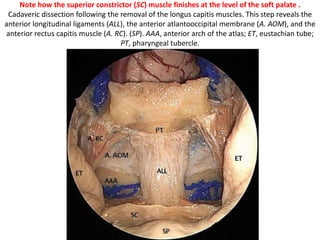
Note how the superior constrictor (SC) muscle finishes at the level of the soft palate .
Cadaveric dissection following the removal of the longus capitis muscles. This step reveals the
anterior longitudinal ligaments (ALL), the anterior atlantooccipital membrane (A. AOM), and the
anterior rectus capitis muscle (A. RC). (SP). AAA, anterior arch of the atlas; ET, eustachian tube;
PT, pharyngeal tubercle.
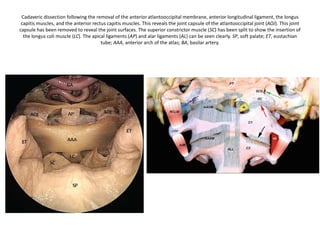
Cadaveric dissection following the removal of the anterior atlantooccipital membrane, anterior longitudinal ligament, the longus
capitis muscles, and the anterior rectus capitis muscles. This reveals the joint capsule of the atlantooccipital joint (AOJ). This joint
capsule has been removed to reveal the joint surfaces. The superior constrictor muscle (SC) has been split to show the insertion of
the longus coli muscle (LC). The apical ligaments (AP) and alar ligaments (AL) can be seen clearly. SP, soft palate; ET, eustachian
tube; AAA, anterior arch of the atlas; BA, basilar artery.
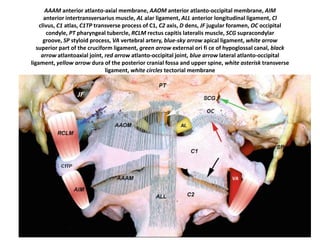
AAAM anterior atlanto-axial membrane, AAOM anterior atlanto-occipital membrane, AIM
anterior intertransversarius muscle, AL alar ligament, ALL anterior longitudinal ligament, Cl
clivus, C1 atlas, C1TP transverse process of C1, C2 axis, D dens, JF jugular foramen, OC occipital
condyle, PT pharyngeal tubercle, RCLM rectus capitis lateralis muscle, SCG supracondylar
groove, SP styloid process, VA vertebral artery, blue-sky arrow apical ligament, white arrow
superior part of the cruciform ligament, green arrow external ori fi ce of hypoglossal canal, black
arrow atlantoaxial joint, red arrow atlanto-occipital joint, blue arrow lateral atlanto-occipital
ligament, yellow arrow dura of the posterior cranial fossa and upper spine, white asterisk transverse
ligament, white circles tectorial membrane
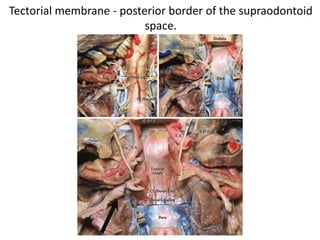
Tectorial membrane - posterior border of the supraodontoid
space.
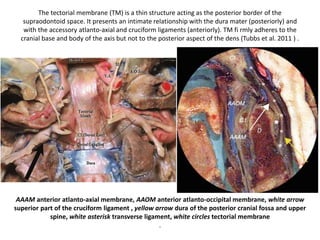
The tectorial membrane (TM) is a thin structure acting as the posterior border of the
supraodontoid space. It presents an intimate relationship with the dura mater (posteriorly) and
with the accessory atlanto-axial and cruciform ligaments (anteriorly). TM fi rmly adheres to the
cranial base and body of the axis but not to the posterior aspect of the dens (Tubbs et al. 2011 ) .
AAAM anterior atlanto-axial membrane, AAOM anterior atlanto-occipital membrane, white arrow
superior part of the cruciform ligament , yellow arrow dura of the posterior cranial fossa and upper
spine, white asterisk transverse ligament, white circles tectorial membrane
.
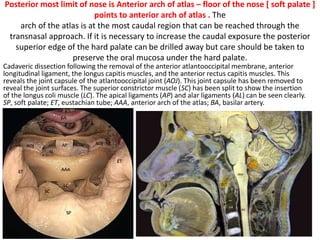
Posterior most limit of nose is Anterior arch of atlas – floor of the nose [ soft palate ]
points to anterior arch of atlas . The
arch of the atlas is at the most caudal region that can be reached through the
transnasal approach. If it is necessary to increase the caudal exposure the posterior
superior edge of the hard palate can be drilled away but care should be taken to
preserve the oral mucosa under the hard palate.
Cadaveric dissection following the removal of the anterior atlantooccipital membrane, anterior
longitudinal ligament, the longus capitis muscles, and the anterior rectus capitis muscles. This
reveals the joint capsule of the atlantooccipital joint (AOJ). This joint capsule has been removed to
reveal the joint surfaces. The superior constrictor muscle (SC) has been split to show the insertion
of the longus coli muscle (LC). The apical ligaments (AP) and alar ligaments (AL) can be seen clearly.
SP, soft palate; ET, eustachian tube; AAA, anterior arch of the atlas; BA, basilar artery.
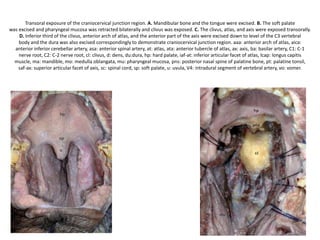
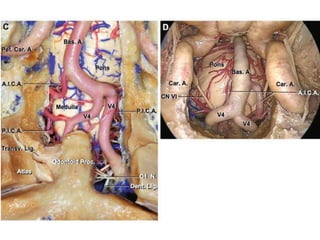
Transoral exposure of the craniocervical junction region. A. Mandibular bone and the tongue were excised. B. The soft palate
was excised and pharyngeal mucosa was retracted bilaterally and clivus was exposed. C. The clivus, atlas, and axis were exposed transorally.
D. Inferior third of the clivus, anterior arch of atlas, and the anterior part of the axis were excised down to level of the C3 vertebral
body and the dura was also excised correspondingly to demonstrate craniocervical junction region. aaa: anterior arch of atlas, aica:
anterior inferior cerebellar artery, asa: anterior spinal artery, at: atlas, ata: anterior tubercle of atlas, ax: axis, ba: basilar artery, C1: C-1
nerve root, C2: C-2 nerve root, cl: clivus, d: dens, du:dura, hp: hard palate, iaf-at: inferior articular facet of atlas, lcap: longus capitis
muscle, ma: mandible, mo: medulla oblangata, mu: pharyngeal mucosa, pns: posterior nasal spine of palatine bone, pt: palatine tonsil,
saf-ax: superior articular facet of axis, sc: spinal cord, sp: soft palate, u: uvula, V4: intradural segment of vertebral artery, vo: vomer.
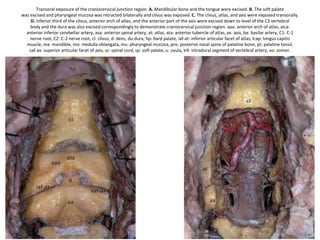
Transoral exposure of the craniocervical junction region. A. Mandibular bone and the tongue were excised. B. The soft palate
was excised and pharyngeal mucosa was retracted bilaterally and clivus was exposed. C. The clivus, atlas, and axis were exposed transorally.
D. Inferior third of the clivus, anterior arch of atlas, and the anterior part of the axis were excised down to level of the C3 vertebral
body and the dura was also excised correspondingly to demonstrate craniocervical junction region. aaa: anterior arch of atlas, aica:
anterior inferior cerebellar artery, asa: anterior spinal artery, at: atlas, ata: anterior tubercle of atlas, ax: axis, ba: basilar artery, C1: C-1
nerve root, C2: C-2 nerve root, cl: clivus, d: dens, du:dura, hp: hard palate, iaf-at: inferior articular facet of atlas, lcap: longus capitis
muscle, ma: mandible, mo: medulla oblangata, mu: pharyngeal mucosa, pns: posterior nasal spine of palatine bone, pt: palatine tonsil,
saf-ax: superior articular facet of axis, sc: spinal cord, sp: soft palate, u: uvula, V4: intradural segment of vertebral artery, vo: vomer.
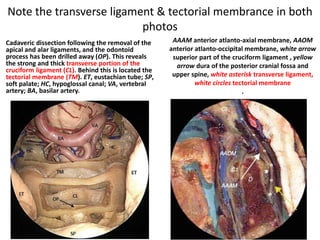
Note the transverse ligament & tectorial membrance in both
photos
Cadaveric dissection following the removal of the
apical and alar ligaments, and the odontoid
process has been drilled away (OP). This reveals
the strong and thick transverse portion of the
cruciform ligament (CL). Behind this is located the
tectorial membrane (TM). ET, eustachian tube; SP,
soft palate; HC, hypoglossal canal; VA, vertebral
artery; BA, basilar artery.
AAAM anterior atlanto-axial membrane, AAOM
anterior atlanto-occipital membrane, white arrow
superior part of the cruciform ligament , yellow
arrow dura of the posterior cranial fossa and
upper spine, white asterisk transverse ligament,
white circles tectorial membrane
.
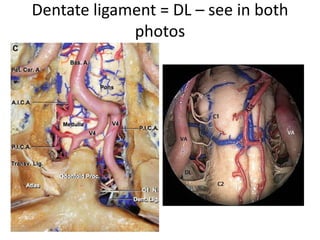
Dentate ligament = DL – see in both
photos
Intradural structures when
approached anteriorly
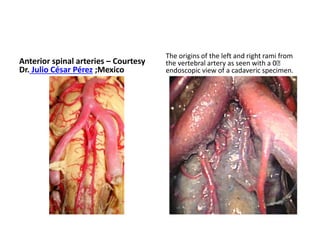
Anterior spinal arteries – Courtesy
Dr. Julio César Pérez ;Mexico
The origins of the left and right rami from
the vertebral artery as seen with a 0􀀤
endoscopic view of a cadaveric specimen.
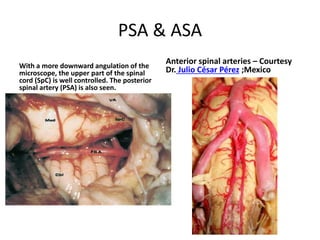
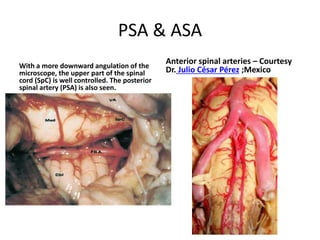
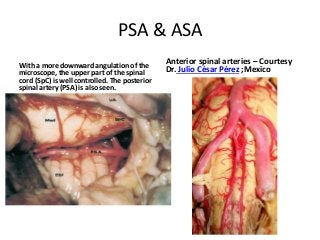
PSA & ASA
With a more downward angulation of the
microscope, the upper part of the spinal
cord (SpC) is well controlled. The posterior
spinal artery (PSA) is also seen.
Anterior spinal arteries – Courtesy
Dr. Julio César Pérez ;Mexico
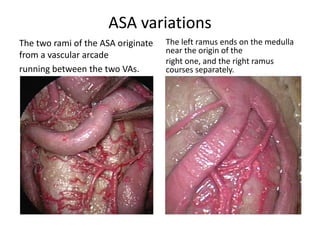
ASA variations
The two rami of the ASA originate
from a vascular arcade
running between the two VAs.
The left ramus ends on the medulla
near the origin of the
right one, and the right ramus
courses separately.
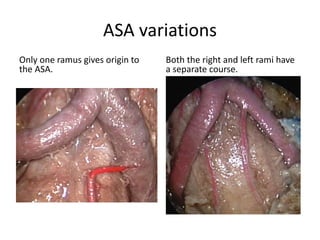
ASA variations
Only one ramus gives origin to
the ASA.
Both the right and left rami have
a separate course.
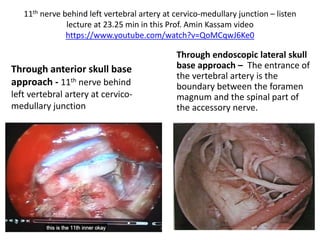
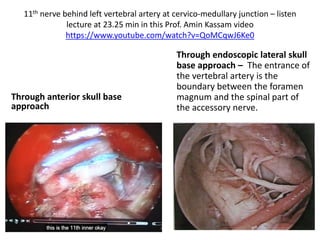
11th nerve behind left vertebral artery at cervico-medullary junction – listen
lecture at 23.25 min in this Prof. Amin Kassam video
https://www.youtube.com/watch?v=QoMCqwJ6Ke0
Through anterior skull base
approach - 11th nerve behind
left vertebral artery at cervico-
medullary junction
Through endoscopic lateral skull
base approach – The entrance of
the vertebral artery is the
boundary between the foramen
magnum and the spinal part of
the accessory nerve.
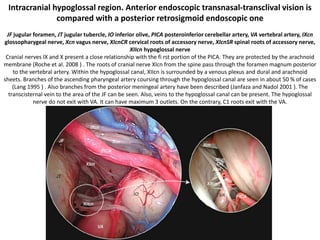
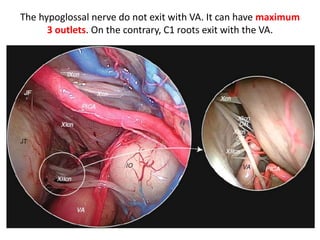
Intracranial hypoglossal region. Anterior endoscopic transnasal-transclival vision is
compared with a posterior retrosigmoid endoscopic one
JF jugular foramen, JT jugular tubercle, IO inferior olive, PICA posteroinferior cerebellar artery, VA vertebral artery, IXcn
glossopharygeal nerve, Xcn vagus nerve, XIcnCR cervical roots of accessory nerve, XIcnSR spinal roots of accessory nerve,
XIIcn hypoglossal nerve
Cranial nerves IX and X present a close relationship with the fi rst portion of the PICA. They are protected by the arachnoid
membrane (Roche et al. 2008 ) . The roots of cranial nerve XIcn from the spine pass through the foramen magnum posterior
to the vertebral artery. Within the hypoglossal canal, XIIcn is surrounded by a venous plexus and dural and arachnoid
sheets. Branches of the ascending pharyngeal artery coursing through the hypoglossal canal are seen in about 50 % of cases
(Lang 1995 ) . Also branches from the posterior meningeal artery have been described (Janfaza and Nadol 2001 ). The
transcisternal vein to the area of the JF can be seen. Also, veins to the hypoglossal canal can be present. The hypoglossal
nerve do not exit with VA. It can have maximum 3 outlets. On the contrary, C1 roots exit with the VA.
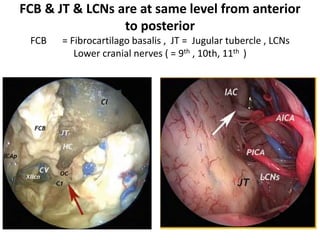
FCB & JT & LCNs are at same level from anterior
to posterior
FCB = Fibrocartilago basalis , JT = Jugular tubercle , LCNs
Lower cranial nerves ( = 9th , 10th, 11th )
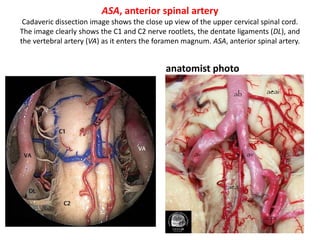
ASA, anterior spinal artery
Cadaveric dissection image shows the close up view of the upper cervical spinal cord.
The image clearly shows the C1 and C2 nerve rootlets, the dentate ligaments (DL), and
the vertebral artery (VA) as it enters the foramen magnum. ASA, anterior spinal artery.
anatomist photo
The hypoglossal nerve do not exit with VA. It can have maximum
3 outlets. On the contrary, C1 roots exit with the VA.
From Laterally
1. Far lateral or Transcondylar approach
2. ITFA with Transcondylar Transtubercular approach
(ITF-A + TC + TT approach)
3. Modified trans-cochlear approach type D (MTCD)
From Laterally
2. ITFA with Transcondylar Transtubercular approach
(ITF-A + TC + TT approach)
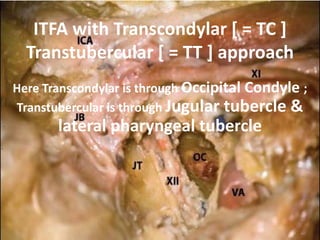
ITFA with Transcondylar [ = TC ]
Transtubercular [ = TT ] approach
Here Transcondylar is through Occipital Condyle ;
Transtubercular is through Jugular tubercle &
lateral pharyngeal tubercle
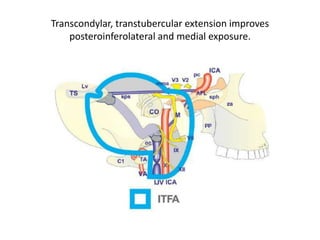
Transcondylar, transtubercular extension improves
posteroinferolateral and medial exposure.
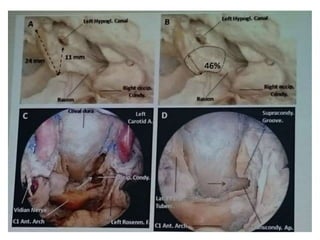
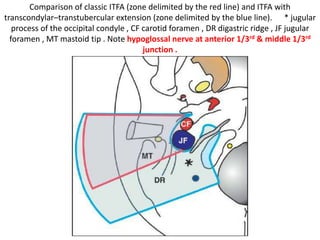
Comparison of classic ITFA (zone delimited by the red line) and ITFA with
transcondylar–transtubercular extension (zone delimited by the blue line). * jugular
process of the occipital condyle , CF carotid foramen , DR digastric ridge , JF jugular
foramen , MT mastoid tip . Note hypoglossal nerve at anterior 1/3rd & middle 1/3rd
junction .
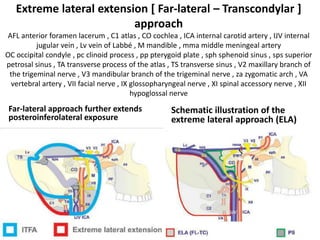
Extreme lateral extension [ Far-lateral – Transcondylar ]
approach
AFL anterior foramen lacerum , C1 atlas , CO cochlea , ICA internal carotid artery , IJV internal
jugular vein , Lv vein of Labbé , M mandible , mma middle meningeal artery
OC occipital condyle , pc clinoid process , pp pterygoid plate , sph sphenoid sinus , sps superior
petrosal sinus , TA transverse process of the atlas , TS transverse sinus , V2 maxillary branch of
the trigeminal nerve , V3 mandibular branch of the trigeminal nerve , za zygomatic arch , VA
vertebral artery , VII facial nerve , IX glossopharyngeal nerve , XI spinal accessory nerve , XII
hypoglossal nerve
Far-lateral approach further extends
posteroinferolateral exposure
Schematic illustration of the
extreme lateral approach (ELA)
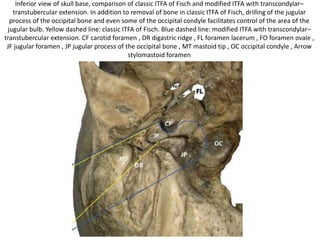
Inferior view of skull base, comparison of classic ITFA of Fisch and modified ITFA with transcondylar–
transtubercular extension. In addition to removal of bone in classic ITFA of Fisch, drilling of the jugular
process of the occipital bone and even some of the occipital condyle facilitates control of the area of the
jugular bulb. Yellow dashed line: classic ITFA of Fisch. Blue dashed line: modified ITFA with transcondylar–
transtubercular extension. CF carotid foramen , DR digastric ridge , FL foramen lacerum , FO foramen ovale ,
JF jugular foramen , JP jugular process of the occipital bone , MT mastoid tip , OC occipital condyle , Arrow
stylomastoid foramen
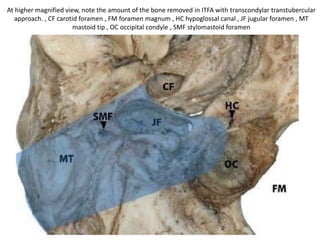
At higher magnified view, note the amount of the bone removed in ITFA with transcondylar transtubercular
approach. , CF carotid foramen , FM foramen magnum , HC hypoglossal canal , JF jugular foramen , MT
mastoid tip , OC occipital condyle , SMF stylomastoid foramen
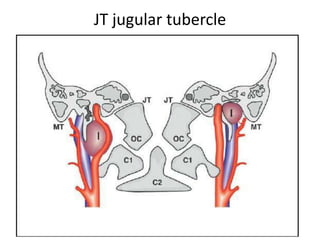
JT jugular tubercle
The jugular process and the portion of the occipital condyle have been drilled out. The left
occipital condyle is identified below the jugular bulb and posterior to the internal jugular
vein. * occipital condyle , ICA internal carotid artery , IJV internal jugular vein , JB jugular bulb ,
LSC lateral semicircular canal , P promontory , SS sigmoid sinus
Lower clivus + petrous bone [ base ]
Petrous
bone
devided
into three
1/3rds
Lower clivus + petrous bone [ base ] + Zygomatic bone
Petrous bone devided
into three 1/3rds
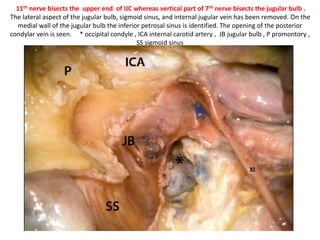
11th nerve bisects the upper end of IJC whereas vertical part of 7th nerve bisects the jugular bulb .
The lateral aspect of the jugular bulb, sigmoid sinus, and internal jugular vein has been removed. On the
medial wall of the jugular bulb the inferior petrosal sinus is identified. The opening of the posterior
condylar vein is seen. * occipital condyle , ICA internal carotid artery , JB jugular bulb , P promontory ,
SS sigmoid sinus
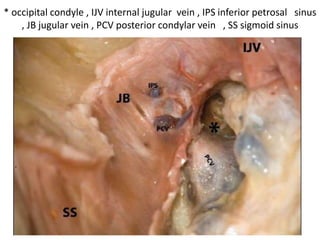
* occipital condyle , IJV internal jugular vein , IPS inferior petrosal sinus
, JB jugular vein , PCV posterior condylar vein , SS sigmoid sinus
The glossopharyngeal nerve has its
own dural porus, which is situated
0-3 mm upwards from the dural
porus of the tenth cranial nerve. The
vagus and the accessory nerve exit
the posterior fossa together in a
sleeve of dura through the jugular
foramen.
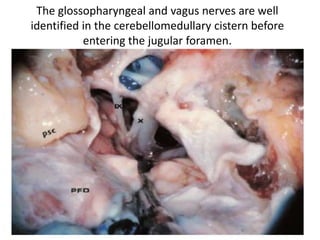
The glossopharyngeal and vagus nerves are well
identified in the cerebellomedullary cistern before
entering the jugular foramen.
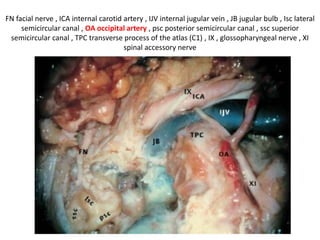
FN facial nerve , ICA internal carotid artery , IJV internal jugular vein , JB jugular bulb , Isc lateral
semicircular canal , OA occipital artery , psc posterior semicircular canal , ssc superior
semicircular canal , TPC transverse process of the atlas (C1) , IX , glossopharyngeal nerve , XI
spinal accessory nerve
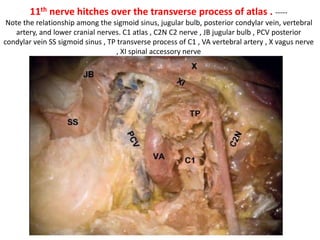
11th nerve hitches over the transverse process of atlas . -----
Note the relationship among the sigmoid sinus, jugular bulb, posterior condylar vein, vertebral
artery, and lower cranial nerves. C1 atlas , C2N C2 nerve , JB jugular bulb , PCV posterior
condylar vein SS sigmoid sinus , TP transverse process of C1 , VA vertebral artery , X vagus nerve
, XI spinal accessory nerve
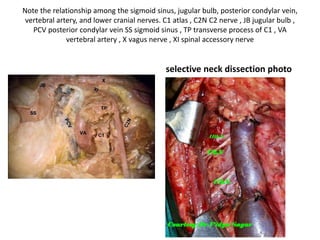
Note the relationship among the sigmoid sinus, jugular bulb, posterior condylar vein,
vertebral artery, and lower cranial nerves. C1 atlas , C2N C2 nerve , JB jugular bulb ,
PCV posterior condylar vein SS sigmoid sinus , TP transverse process of C1 , VA
vertebral artery , X vagus nerve , XI spinal accessory nerve
selective neck dissection photo
The posterior condylar vein crossing the occipital condyle is noted.
ICA internal carotid artery , JB jugular bulb , PCV posterior condylar vein
IX glossopharyngeal nerve , XI spinal accessory nerve
PCV=CV = condylar vein
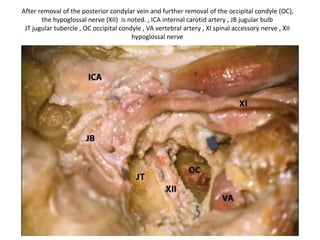
After removal of the posterior condylar vein and further removal of the occipital condyle (OC),
the hypoglossal nerve (XII) is noted. , ICA internal carotid artery , JB jugular bulb
JT jugular tubercle , OC occipital condyle , VA vertebral artery , XI spinal accessory nerve , XII
hypoglossal nerve
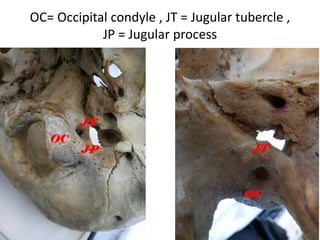
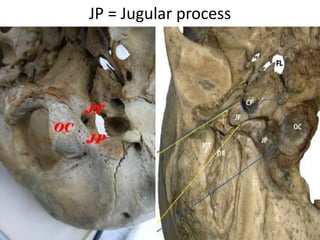
OC= Occipital condyle , JT = Jugular tubercle ,
JP = Jugular process
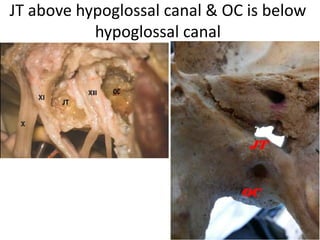
JT above hypoglossal canal & OC is below
hypoglossal canal
Intradural structures when
approached laterally by
ITF-A + TC + TT approach
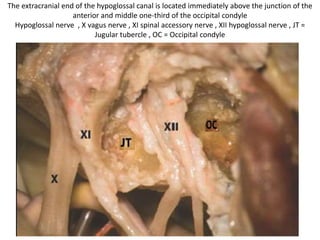
The extracranial end of the hypoglossal canal is located immediately above the junction of the
anterior and middle one-third of the occipital condyle
Hypoglossal nerve , X vagus nerve , XI spinal accessory nerve , XII hypoglossal nerve , JT =
Jugular tubercle , OC = Occipital condyle
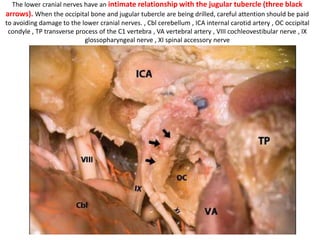
The lower cranial nerves have an intimate relationship with the jugular tubercle (three black
arrows). When the occipital bone and jugular tubercle are being drilled, careful attention should be paid
to avoiding damage to the lower cranial nerves. , Cbl cerebellum , ICA internal carotid artery , OC occipital
condyle , TP transverse process of the C1 vertebra , VA vertebral artery , VIII cochleovestibular nerve , IX
glossopharyngeal nerve , XI spinal accessory nerve
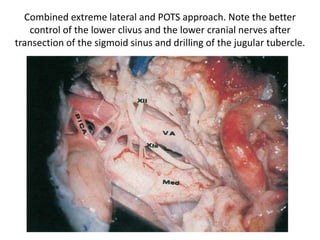
Combined extreme lateral and POTS approach. Note the better
control of the lower clivus and the lower cranial nerves after
transection of the sigmoid sinus and drilling of the jugular tubercle.
From Laterally
3. Modified trans-cochlear approach type D (MTCD)
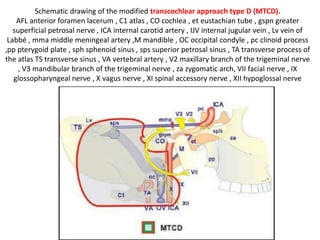
Schematic drawing of the modified transcochlear approach type D (MTCD).
AFL anterior foramen lacerum , C1 atlas , CO cochlea , et eustachian tube , gspn greater
superficial petrosal nerve , ICA internal carotid artery , IJV internal jugular vein , Lv vein of
Labbé , mma middle meningeal artery ,M mandible , OC occipital condyle , pc clinoid process
,pp pterygoid plate , sph sphenoid sinus , sps superior petrosal sinus , TA transverse process of
the atlas TS transverse sinus , VA vertebral artery , V2 maxillary branch of the trigeminal nerve
, V3 mandibular branch of the trigeminal nerve , za zygomatic arch, VII facial nerve , IX
glossopharyngeal nerve , X vagus nerve , XI spinal accessory nerve , XII hypoglossal nerve
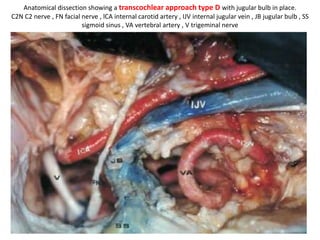
Anatomical dissection showing a transcochlear approach type D with jugular bulb in place.
C2N C2 nerve , FN facial nerve , lCA internal carotid artery , IJV internal jugular vein , JB jugular bulb , SS
sigmoid sinus , VA vertebral artery , V trigeminal nerve
From Laterally
Far lateral or Transcondylar approach
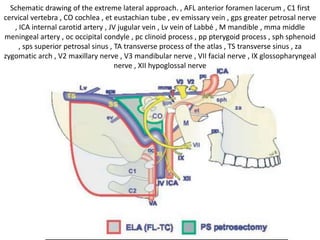
Schematic drawing of the extreme lateral approach. , AFL anterior foramen lacerum , C1 first
cervical vertebra , CO cochlea , et eustachian tube , ev emissary vein , gps greater petrosal nerve
, ICA internal carotid artery , JV jugular vein , Lv vein of Labbé , M mandible , mma middle
meningeal artery , oc occipital condyle , pc clinoid process , pp pterygoid process , sph sphenoid
, sps superior petrosal sinus , TA transverse process of the atlas , TS transverse sinus , za
zygomatic arch , V2 maxillary nerve , V3 mandibular nerve , VII facial nerve , IX glossopharyngeal
nerve , XII hypoglossal nerve
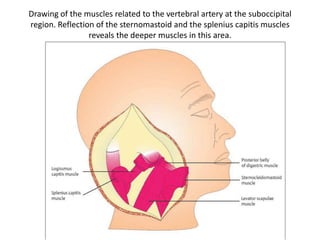
Drawing of the muscles related to the vertebral artery at the suboccipital
region. Reflection of the sternomastoid and the splenius capitis muscles
reveals the deeper muscles in this area.
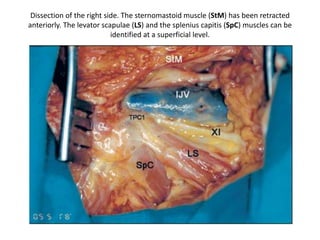
Dissection of the right side. The sternomastoid muscle (StM) has been retracted
anteriorly. The levator scapulae (LS) and the splenius capitis (SpC) muscles can be
identified at a superficial level.
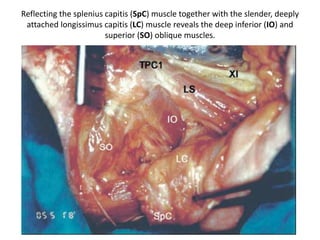
Reflecting the splenius capitis (SpC) muscle together with the slender, deeply
attached longissimus capitis (LC) muscle reveals the deep inferior (IO) and
superior (SO) oblique muscles.
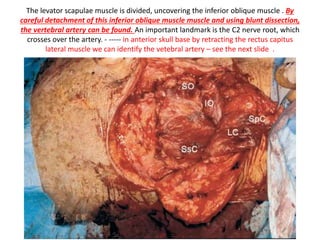
The levator scapulae muscle is divided, uncovering the inferior oblique muscle . By
careful detachment of this inferior oblique muscle muscle and using blunt dissection,
the vertebral artery can be found. An important landmark is the C2 nerve root, which
crosses over the artery. - ----- in anterior skull base by retracting the rectus capitus
lateral muscle we can identify the vetebral artery – see the next slide .
Between suprior oblique SO &
inferior oblique IO you will find the
vertebral artery – Dr.Satish jain
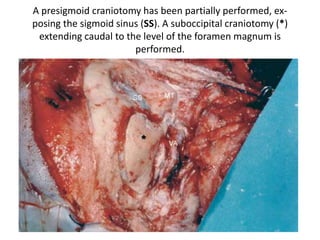
A presigmoid craniotomy has been partially performed, ex-
posing the sigmoid sinus (SS). A suboccipital craniotomy (*)
extending caudal to the level of the foramen magnum is
performed.
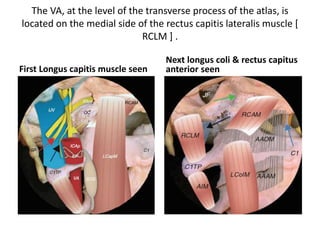
The VA, at the level of the transverse process of the atlas, is
located on the medial side of the rectus capitis lateralis muscle [
RCLM ] .
First Longus capitis muscle seen
Next longus coli & rectus capitus
anterior seen
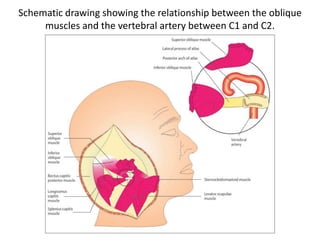
Schematic drawing showing the relationship between the oblique
muscles and the vertebral artery between C1 and C2.
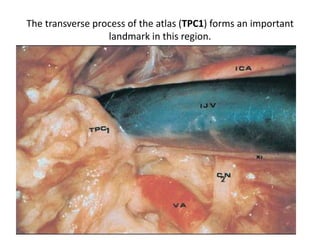
The transverse process of the atlas (TPC1) forms an important
landmark in this region.
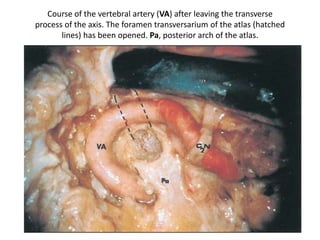
Course of the vertebral artery (VA) after leaving the transverse
process of the axis. The foramen transversarium of the atlas (hatched
lines) has been opened. Pa, posterior arch of the atlas.
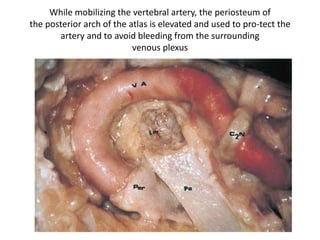
While mobilizing the vertebral artery, the periosteum of
the posterior arch of the atlas is elevated and used to pro-tect the
artery and to avoid bleeding from the surrounding
venous plexus
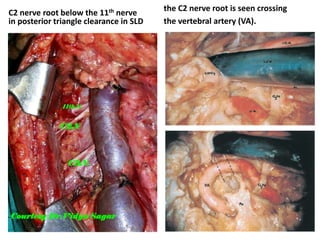
C2 nerve root below the 11th nerve
in posterior triangle clearance in SLD
the C2 nerve root is seen crossing
the vertebral artery (VA).
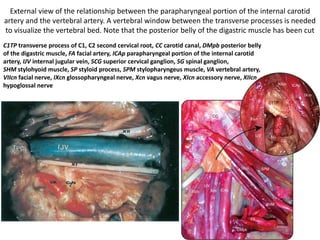
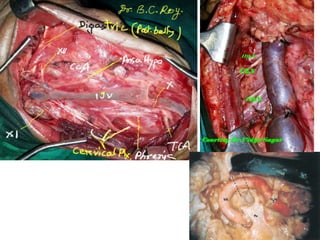
External view of the relationship between the parapharyngeal portion of the internal carotid
artery and the vertebral artery. A vertebral window between the transverse processes is needed
to visualize the vertebral bed. Note that the posterior belly of the digastric muscle has been cut
C1TP transverse process of C1, C2 second cervical root, CC carotid canal, DMpb posterior belly
of the digastric muscle, FA facial artery, ICAp parapharyngeal portion of the internal carotid
artery, IJV internal jugular vein, SCG superior cervical ganglion, SG spinal ganglion,
SHM stylohyoid muscle, SP styloid process, SPM stylopharyngeus muscle, VA vertebral artery,
VIIcn facial nerve, IXcn glossopharyngeal nerve, Xcn vagus nerve, XIcn accessory nerve, XIIcn
hypoglossal nerve
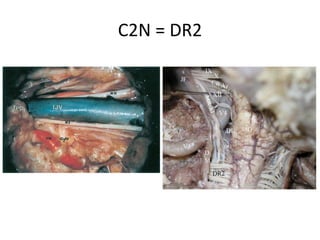
C2N = DR2
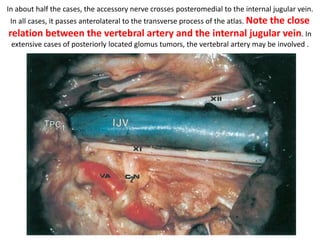
In about half the cases, the accessory nerve crosses posteromedial to the internal jugular vein.
In all cases, it passes anterolateral to the transverse process of the atlas. Note the close
relation between the vertebral artery and the internal jugular vein. In
extensive cases of posteriorly located glomus tumors, the vertebral artery may be involved .
At a higher magnification, the C2 nerve root is seen crossing
the vertebral artery (VA).
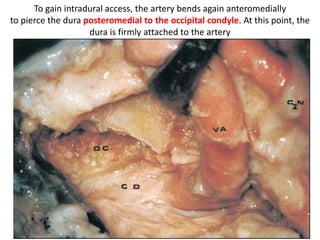
To gain intradural access, the artery bends again anteromedially
to pierce the dura posteromedial to the occipital condyle. At this point, the
dura is firmly attached to the artery
11th nerve behind left vertebral artery at cervico-medullary junction – listen
lecture at 23.25 min in this Prof. Amin Kassam video
https://www.youtube.com/watch?v=QoMCqwJ6Ke0
Through anterior skull base
approach
Through endoscopic lateral skull
base approach – The entrance of
the vertebral artery is the
boundary between the foramen
magnum and the spinal part of
the accessory nerve.
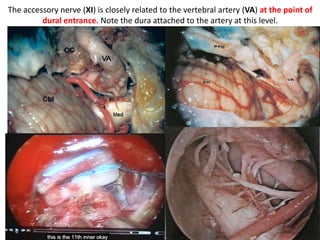
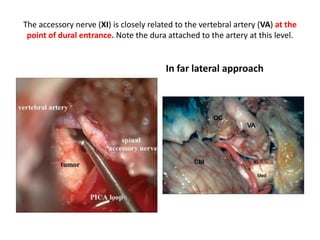
The accessory nerve (XI) is closely related to the vertebral artery (VA) at the point of
dural entrance. Note the dura attached to the artery at this level.
Endoscopic lateral skull base
approach
intra operative photograph
through operating
microscope during removal
of posterior fossa
arachnoid cyst -showing
medulla oblnagata-cervical
spinal cord -cerebellar
tonsils-vertebral artery-
hypoglossal nerve -
accessory nerve -1st
cervical nerve root -PICA
loope,after removal of cyst
wall
The accessory nerve (XI) is closely related to the vertebral artery (VA) at the
point of dural entrance. Note the dura attached to the artery at this level.
In far lateral approach
The segment of the vertebral artery located between the C1 transverse
process and the dural entrance gives rise to muscular branches and the
posterior meningeal artery, which can be safely coagulated. The PICA
ocasionally arises extradural and could be inadvertently injured.
The PICA
ocasionally arises
extradural and
could be
inadvertently
injured – see the
total material
regarding this
topic at
http://neuroc99.sl
d.cu/text/Microsu
rgicalPICA.htm
The PICA ocasionally arises extradural and could be inadvertently
injured – see the total material regarding this topic at
http://neuroc99.sld.cu/text/MicrosurgicalPICA.htm
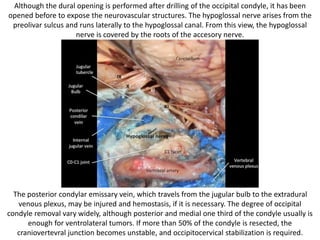
Although the dural opening is performed after drilling of the occipital condyle, it has been
opened before to expose the neurovascular structures. The hypoglossal nerve arises from the
preolivar sulcus and runs laterally to the hypoglossal canal. From this view, the hypoglossal
nerve is covered by the roots of the accesory nerve.
The posterior condylar emissary vein, which travels from the jugular bulb to the extradural
venous plexus, may be injured and hemostasis, if it is necessary. The degree of occipital
condyle removal vary widely, although posterior and medial one third of the condyle usually is
enough for ventrolateral tumors. If more than 50% of the condyle is resected, the
craniovertevral junction becomes unstable, and occipitocervical stabilization is required.
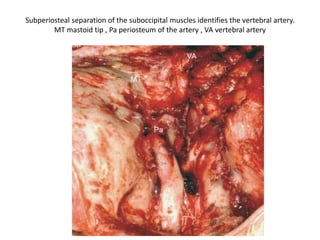
Subperiosteal separation of the suboccipital muscles identifies the vertebral artery.
MT mastoid tip , Pa periosteum of the artery , VA vertebral artery
How to cauterise/stop bleeding from
PCV ( posterior condylar vein ) &
peri-vertebral venous plexus - ????
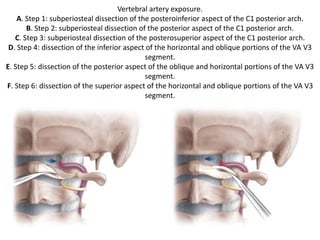
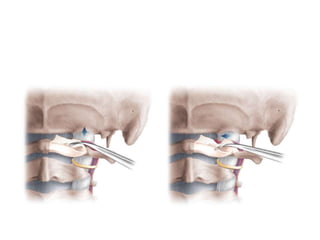
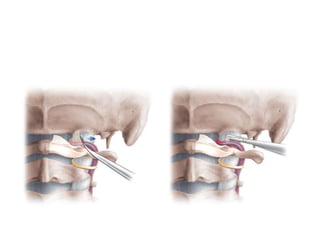
Vertebral artery exposure.
A. Step 1: subperiosteal dissection of the posteroinferior aspect of the C1 posterior arch.
B. Step 2: subperiosteal dissection of the posterior aspect of the C1 posterior arch.
C. Step 3: subperiosteal dissection of the posterosuperior aspect of the C1 posterior arch.
D. Step 4: dissection of the inferior aspect of the horizontal and oblique portions of the VA V3
segment.
E. Step 5: dissection of the posterior aspect of the oblique and horizontal portions of the VA V3
segment.
F. Step 6: dissection of the superior aspect of the horizontal and oblique portions of the VA V3
segment.
Intradural structures when
approached laterally
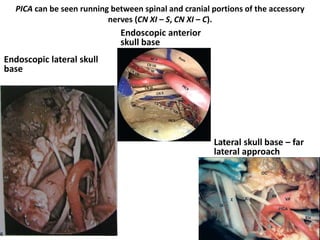
PICA can be seen running between spinal and cranial portions of the accessory
nerves (CN XI – S, CN XI – C).
Endoscopic lateral skull
base
Endoscopic anterior
skull base
Lateral skull base – far
lateral approach
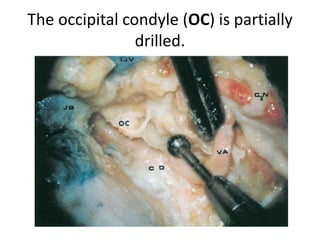
The occipital condyle (OC) is partially
drilled.
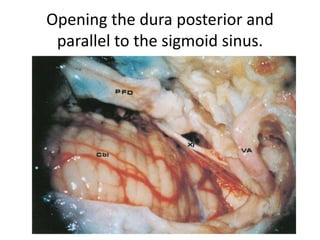
Opening the dura posterior and
parallel to the sigmoid sinus.
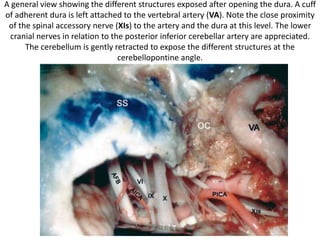
A general view showing the different structures exposed after opening the dura. A cuff
of adherent dura is left attached to the vertebral artery (VA). Note the close proximity
of the spinal accessory nerve (XIs) to the artery and the dura at this level. The lower
cranial nerves in relation to the posterior inferior cerebellar artery are appreciated.
The cerebellum is gently retracted to expose the different structures at the
cerebellopontine angle.
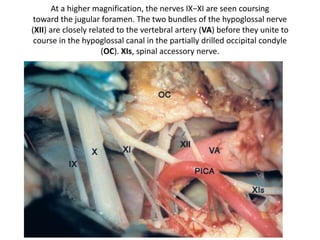
At a higher magnification, the nerves IX−XI are seen coursing
toward the jugular foramen. The two bundles of the hypoglossal nerve
(XII) are closely related to the vertebral artery (VA) before they unite to
course in the hypoglossal canal in the partially drilled occipital condyle
(OC). XIs, spinal accessory nerve.
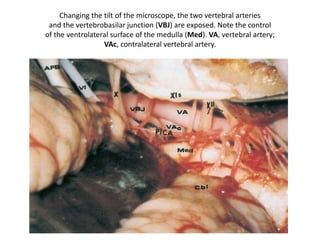
Changing the tilt of the microscope, the two vertebral arteries
and the vertebrobasilar junction (VBJ) are exposed. Note the control
of the ventrolateral surface of the medulla (Med). VA, vertebral artery;
VAc, contralateral vertebral artery.
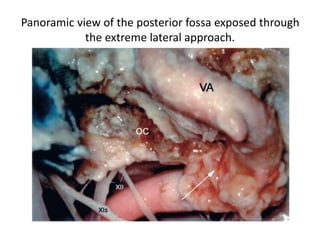
Panoramic view of the posterior fossa exposed through
the extreme lateral approach.
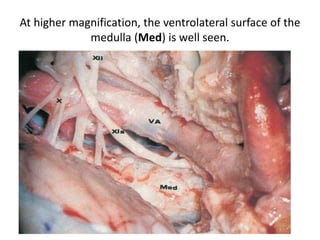
At higher magnification, the ventrolateral surface of the
medulla (Med) is well seen.
PSA & ASA
With a more downward angulation of the
microscope, the upper part of the spinal
cord (SpC) is well controlled. The posterior
spinal artery (PSA) is also seen.
Anterior spinal arteries – Courtesy
Dr. Julio César Pérez ;Mexico
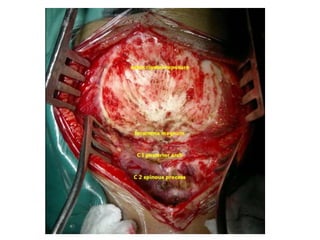
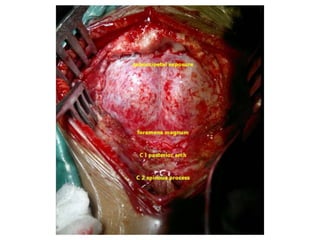
From Posteriorly
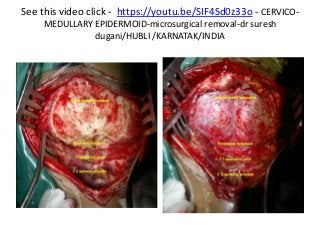
Suboccipital craniotomy
See this video click - https://youtu.be/SIF4Sd0z33o - CERVICO-
MEDULLARY EPIDERMOID-microsurgical removal-dr suresh
dugani/HUBLI /KARNATAK/INDIA
Vertebral artery
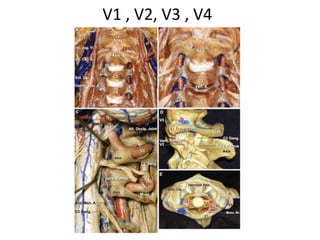
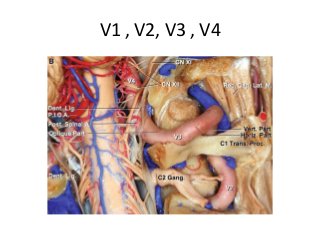
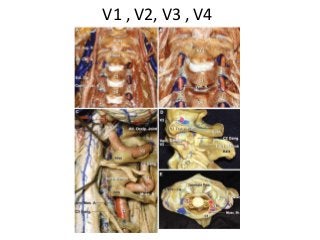
V1 , V2, V3 , V4
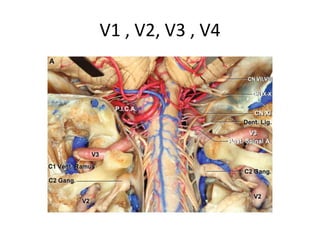
V1 , V2, V3 , V4
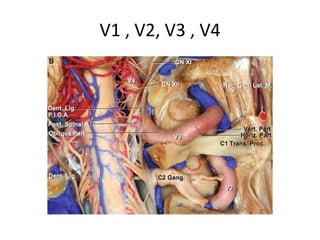
V1 , V2, V3 , V4
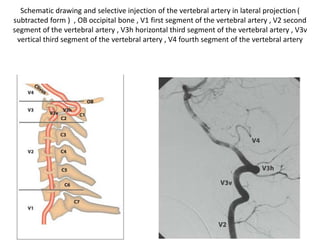
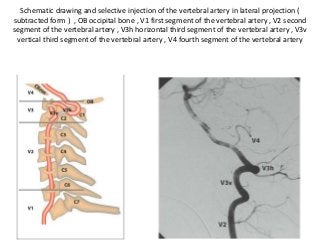
Schematic drawing and selective injection of the vertebral artery in lateral projection (
subtracted form ) , OB occipital bone , V1 first segment of the vertebral artery , V2 second
segment of the vertebral artery , V3h horizontal third segment of the vertebral artery , V3v
vertical third segment of the vertebral artery , V4 fourth segment of the vertebral artery
• V3 Segment
• The V3 segment extends from the transverse foramen of the axis to the dural penetration by the
• vertebral artery; it is further subdivided into two parts: a proximal vertical part (V3v) and a distal
• horizontal part (V3h). The V3 segment possesses four vascular loops (Figs. 3.36, 3.37, 3.40):
• • The inferomedial loop appears at the transverse foramen of the axis and directs the artery laterally
• and slightly posteriorly and upward.
• • The inferolateral loop directs the artery distinctly upward and slightly anterior, toward the
• transverse foramen of the atlas.
• • The superolateral loop is located at the point where the V3v turns into a horizontal position in the
• sulcus of the posterior arch of the atlas and becomes V3h (Figs. 3.38a, 3.39a, 3.40). The V3v and
• V3h parts each have two constant branches:
• – The muscular artery of V3v arises at the inferolateral arterial loop; it communicates with the
• branches of the ascending pharyngeal artery.
• – The radiculomuscular artery of V3v arises below the transverse foramen of the atlas, and gives
• rise to the medial branch (a radiculomedullary artery) vascularizing the C2 ganglion, the C2
• nerve and the spinal cord; and the lateral branch, a muscular branch for the suboccipital muscles.
• – The muscular artery of V3h vascularizes the muscles of the deep muscular layer and
• communicates with the branches of the occipital artery.
• – The posterior meningeal artery of V3h arises at the superomedial loop and vascularizes the
• neighboring portion of the posterior fossa dura, the falx cerebelli, and the posterior portion of the
• tentorium.
• • The superomedial loop surrounds the lateral mass of the atlas and brings the V3 to its dural foramen.
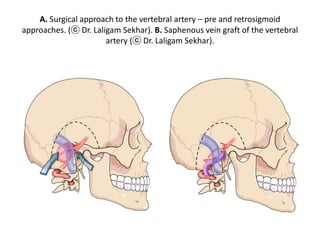
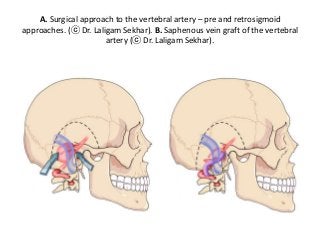
A. Surgical approach to the vertebral artery – pre and retrosigmoid
approaches. (ⓒ Dr. Laligam Sekhar). B. Saphenous vein graft of the vertebral
artery (ⓒ Dr. Laligam Sekhar).
For Other powerpoint presentatioins
of
“ Skull base 360° ”
I will update continuosly with date tag at the end as I am
getting more & more information
click
www.skullbase360.in
- you have to login to slideshare.net with Facebook
account for downloading.

Cranio vertebral junction / Foramen magnum 360°

  • 1.
  • 2.
    Great teachers –All this is their work . I am just the reader of their books . Prof. Paolo castelnuovo Prof. Aldo Stamm Prof. Mario Sanna Prof. Magnan
  • 3.
    For Other powerpointpresentatioins of “ Skull base 360° ” I will update continuosly with date tag at the end as I am getting more & more information click www.skullbase360.in - you have to login to slideshare.net with Facebook account for downloading.
  • 4.
  • 5.
    1. The HCdivides the condylar region into the tubercular compartment (superior) and the condylar compartment (inferior). Tubercular compartment contains LPT lateral pharyngeal tubercle, PT pharyngeal tubercle, 2. The SCG [Supracondylar groove] represents a reliable landmark for hypoglossal canal (HC) identification (red arrow) (Morera et al. 2010 ) .
  • 6.
    The tubercular compartmentcorresponds to the Jugular tubercle ( JT ) Line along the lateral pharyngeal tubercle [ LPT ] passes through Jugular tubercle [ JT ] – so when you are drilling LPT in anterior skull base you will land up on JT . LPT lateral pharyngeal tubercle, OC occipital condyle, PT pharyngeal tubercle, SCG supracondylar groove Jugular tubercle ( JT )
  • 7.
    Line along thelateral pharyngeal tubercle [ LPT ] passes through Jugular tubercle [ JT ] – so when you are drilling LPT in anterior skull base you will land up on JT . Red rings = hypoglossal canals , yellow ring = pharyngeal tubercle [ PT ] , blue rings = lateral pharyngeal tubercle [ LPT]
  • 8.
    Line along thelateral pharyngeal tubercle [ LPT ] passes through Jugular tubercle [ JT ] – so when you are drilling LPT in anterior skull base you will land up on JT . yellow ring = pharyngeal tubercle [ PT ] , blue rings = lateral pharyngeal tubercle [ LPT] , green ring = Jugular tubercle
  • 9.
    Just adding twotriangles of petrous bone base around foramen magnum , your lower clivus / foramen magnum area completes -- just as simple as that
  • 10.
    Lower clivus devidedinto 1. tubercular compartment [ Above red line ] 2. condylar compartment [ Below red line ] Hypoglossal canal present at the junction of anterior 1/3rd & posterior 2/3rd
  • 11.
    Lower clivus +petrous bone [ base ] Petrous bone devided into three 1/3rds
  • 12.
    Lower clivus +petrous bone [ base ] + Zygomatic bone Petrous bone devided into three 1/3rds
  • 13.
    Lateral skull baseview – observe the petrous apex
  • 14.
    Lower clivus +petrous apex in anterior skull base 1. observe the petrous apex in both views 2. hypoglossal canal medial to parapharyngeal carotid & jugular fossa
  • 15.
    Behind the RCLMvertebral artery present
  • 16.
    The VA, atthe level of the transverse process of the atlas, is located on the medial side of the rectus capitis lateralis muscle [ RCLM ] . First Longus capitis muscle seen Next longus coli & rectus capitus anterior seen
  • 17.
    kinking or loopingof the ICAp - when looping present para-pharyngeal carotid comes to pre-styloid compartment – previously thought that para-pharyngeal carotid never comes anterior to styloid mucles – which is UNTRUE
  • 18.
    From Aldostamm -Fig. 42.10 - When there is loop of parapharyngeal carotid , it goes nearer to the RCLM or anterior arch of atlas Anterior view. The right longus capitis muscle has been removed. 1, clivus; 2, anterior arch of the atlas; 3, atlantoaxial joint; 4, left longus capitis muscle; 5, longus colli muscle; 6, rectus capitis anterior muscle; 7, carotid artery.
  • 19.
    Hypoglossal is justbehind the upper end of parapharyngel carotid – very easy way to identify 12th nerve in paraphayrngeal space – Dr.Satish jain
  • 20.
    Lower cranial nervessandwitched betweeb petrosal & bulb components of jugular fossa - the pars nervosa is anterior to pars venosa.. and the ica is the first structure u will encounter in the anterior app
  • 21.
    pars nervosa is anteriorto pars venosa.. https://books.google.co .in/books?id=e8gKUQg eD24C&pg=PA634&lpg =PA634&dq=pars+veno sa&source=bl&ots=Sa W2H- 2bR0&sig=lzevzuaK66D T_Nj6PLfLH3orXQY&hl= en&sa=X&ved=0CCsQ6 AEwAmoVChMIxqvJ1v2 bxwIVC9SOCh1- pQ9s#v=onepage&q=p ars%20venosa&f=false
  • 22.
  • 23.
    AAAM anterior atlanto-axial membrane,AAOM anterior atlanto- occipital membrane, white arrow superior part of the cruciform ligament , yellow arrow dura of the posterior cranial fossa and upper spine, white asterisk transverse ligament, white circles tectorial membrane .
  • 25.
    The VAs passthrough the transverse foramina of the first six vertebrae and exit from the transverse foramen of C1, running backward and medially over the posterior arch of C1, and pierce the posterior atlanto- occipital membrane and the spinal dura. They are surrounded extracranially by a venous plexus that does not enter the intradural space. CP sympathetic carotid plexus, C1 atlas, C1TP transverse process of C1, ICAp parapharyngeal portion of the internal carotid artery, IJV internal jugular vein, LCapM longus capitis muscle, Ma mastoid (tip), OC occipital condyle, RCAM rectus capitis anterior muscle, SCG superior cervical ganglion, SP styloid process, VA vertebral artery, VVP vertebral venous plexus, ZR zygomatic root, XIIcn hypoglossal nerve, yellow arrow vagus nerve, red arrow accessory nerve, black arrow glossopharyngeal nerve, white asterisk middle meningeal artery The extradural segment of VA gives rise to posterior meningeal and posterior spinal arteries and branches to the deep cervical muscles.
  • 26.
    Cadaveric dissection followingthe removal of the mucosa and pharyngobasilar fascia. The middle third of the clivus has been removed to reveal the pons. The longus capitis (LC) muscles insert broadly onto the floor of the sphenoid sinus (removed in this specimen). The pharyngeal raphe (PR) can be seen attaching to the pharyngeal tubercle (PT) of the occipital bone. ET, eustachian tube; BA, basilar artery; PCA, paraclival artery.
  • 27.
    Note how thesuperior constrictor (SC) muscle finishes at the level of the soft palate . Cadaveric dissection following the removal of the longus capitis muscles. This step reveals the anterior longitudinal ligaments (ALL), the anterior atlantooccipital membrane (A. AOM), and the anterior rectus capitis muscle (A. RC). (SP). AAA, anterior arch of the atlas; ET, eustachian tube; PT, pharyngeal tubercle.
  • 28.
    Cadaveric dissection followingthe removal of the anterior atlantooccipital membrane, anterior longitudinal ligament, the longus capitis muscles, and the anterior rectus capitis muscles. This reveals the joint capsule of the atlantooccipital joint (AOJ). This joint capsule has been removed to reveal the joint surfaces. The superior constrictor muscle (SC) has been split to show the insertion of the longus coli muscle (LC). The apical ligaments (AP) and alar ligaments (AL) can be seen clearly. SP, soft palate; ET, eustachian tube; AAA, anterior arch of the atlas; BA, basilar artery.
  • 29.
    AAAM anterior atlanto-axialmembrane, AAOM anterior atlanto-occipital membrane, AIM anterior intertransversarius muscle, AL alar ligament, ALL anterior longitudinal ligament, Cl clivus, C1 atlas, C1TP transverse process of C1, C2 axis, D dens, JF jugular foramen, OC occipital condyle, PT pharyngeal tubercle, RCLM rectus capitis lateralis muscle, SCG supracondylar groove, SP styloid process, VA vertebral artery, blue-sky arrow apical ligament, white arrow superior part of the cruciform ligament, green arrow external ori fi ce of hypoglossal canal, black arrow atlantoaxial joint, red arrow atlanto-occipital joint, blue arrow lateral atlanto-occipital ligament, yellow arrow dura of the posterior cranial fossa and upper spine, white asterisk transverse ligament, white circles tectorial membrane
  • 31.
    Tectorial membrane -posterior border of the supraodontoid space.
  • 32.
    The tectorial membrane(TM) is a thin structure acting as the posterior border of the supraodontoid space. It presents an intimate relationship with the dura mater (posteriorly) and with the accessory atlanto-axial and cruciform ligaments (anteriorly). TM fi rmly adheres to the cranial base and body of the axis but not to the posterior aspect of the dens (Tubbs et al. 2011 ) . AAAM anterior atlanto-axial membrane, AAOM anterior atlanto-occipital membrane, white arrow superior part of the cruciform ligament , yellow arrow dura of the posterior cranial fossa and upper spine, white asterisk transverse ligament, white circles tectorial membrane .
  • 33.
    Posterior most limitof nose is Anterior arch of atlas – floor of the nose [ soft palate ] points to anterior arch of atlas . The arch of the atlas is at the most caudal region that can be reached through the transnasal approach. If it is necessary to increase the caudal exposure the posterior superior edge of the hard palate can be drilled away but care should be taken to preserve the oral mucosa under the hard palate. Cadaveric dissection following the removal of the anterior atlantooccipital membrane, anterior longitudinal ligament, the longus capitis muscles, and the anterior rectus capitis muscles. This reveals the joint capsule of the atlantooccipital joint (AOJ). This joint capsule has been removed to reveal the joint surfaces. The superior constrictor muscle (SC) has been split to show the insertion of the longus coli muscle (LC). The apical ligaments (AP) and alar ligaments (AL) can be seen clearly. SP, soft palate; ET, eustachian tube; AAA, anterior arch of the atlas; BA, basilar artery.
  • 34.
    Transoral exposure ofthe craniocervical junction region. A. Mandibular bone and the tongue were excised. B. The soft palate was excised and pharyngeal mucosa was retracted bilaterally and clivus was exposed. C. The clivus, atlas, and axis were exposed transorally. D. Inferior third of the clivus, anterior arch of atlas, and the anterior part of the axis were excised down to level of the C3 vertebral body and the dura was also excised correspondingly to demonstrate craniocervical junction region. aaa: anterior arch of atlas, aica: anterior inferior cerebellar artery, asa: anterior spinal artery, at: atlas, ata: anterior tubercle of atlas, ax: axis, ba: basilar artery, C1: C-1 nerve root, C2: C-2 nerve root, cl: clivus, d: dens, du:dura, hp: hard palate, iaf-at: inferior articular facet of atlas, lcap: longus capitis muscle, ma: mandible, mo: medulla oblangata, mu: pharyngeal mucosa, pns: posterior nasal spine of palatine bone, pt: palatine tonsil, saf-ax: superior articular facet of axis, sc: spinal cord, sp: soft palate, u: uvula, V4: intradural segment of vertebral artery, vo: vomer.
  • 35.
    Transoral exposure ofthe craniocervical junction region. A. Mandibular bone and the tongue were excised. B. The soft palate was excised and pharyngeal mucosa was retracted bilaterally and clivus was exposed. C. The clivus, atlas, and axis were exposed transorally. D. Inferior third of the clivus, anterior arch of atlas, and the anterior part of the axis were excised down to level of the C3 vertebral body and the dura was also excised correspondingly to demonstrate craniocervical junction region. aaa: anterior arch of atlas, aica: anterior inferior cerebellar artery, asa: anterior spinal artery, at: atlas, ata: anterior tubercle of atlas, ax: axis, ba: basilar artery, C1: C-1 nerve root, C2: C-2 nerve root, cl: clivus, d: dens, du:dura, hp: hard palate, iaf-at: inferior articular facet of atlas, lcap: longus capitis muscle, ma: mandible, mo: medulla oblangata, mu: pharyngeal mucosa, pns: posterior nasal spine of palatine bone, pt: palatine tonsil, saf-ax: superior articular facet of axis, sc: spinal cord, sp: soft palate, u: uvula, V4: intradural segment of vertebral artery, vo: vomer.
  • 36.
    Note the transverseligament & tectorial membrance in both photos Cadaveric dissection following the removal of the apical and alar ligaments, and the odontoid process has been drilled away (OP). This reveals the strong and thick transverse portion of the cruciform ligament (CL). Behind this is located the tectorial membrane (TM). ET, eustachian tube; SP, soft palate; HC, hypoglossal canal; VA, vertebral artery; BA, basilar artery. AAAM anterior atlanto-axial membrane, AAOM anterior atlanto-occipital membrane, white arrow superior part of the cruciform ligament , yellow arrow dura of the posterior cranial fossa and upper spine, white asterisk transverse ligament, white circles tectorial membrane .
  • 38.
    Dentate ligament =DL – see in both photos
  • 39.
  • 40.
    Anterior spinal arteries– Courtesy Dr. Julio César Pérez ;Mexico The origins of the left and right rami from the vertebral artery as seen with a 0􀀤 endoscopic view of a cadaveric specimen.
  • 41.
    PSA & ASA Witha more downward angulation of the microscope, the upper part of the spinal cord (SpC) is well controlled. The posterior spinal artery (PSA) is also seen. Anterior spinal arteries – Courtesy Dr. Julio César Pérez ;Mexico
  • 43.
    ASA variations The tworami of the ASA originate from a vascular arcade running between the two VAs. The left ramus ends on the medulla near the origin of the right one, and the right ramus courses separately.
  • 44.
    ASA variations Only oneramus gives origin to the ASA. Both the right and left rami have a separate course.
  • 45.
    11th nerve behindleft vertebral artery at cervico-medullary junction – listen lecture at 23.25 min in this Prof. Amin Kassam video https://www.youtube.com/watch?v=QoMCqwJ6Ke0 Through anterior skull base approach - 11th nerve behind left vertebral artery at cervico- medullary junction Through endoscopic lateral skull base approach – The entrance of the vertebral artery is the boundary between the foramen magnum and the spinal part of the accessory nerve.
  • 46.
    Intracranial hypoglossal region.Anterior endoscopic transnasal-transclival vision is compared with a posterior retrosigmoid endoscopic one JF jugular foramen, JT jugular tubercle, IO inferior olive, PICA posteroinferior cerebellar artery, VA vertebral artery, IXcn glossopharygeal nerve, Xcn vagus nerve, XIcnCR cervical roots of accessory nerve, XIcnSR spinal roots of accessory nerve, XIIcn hypoglossal nerve Cranial nerves IX and X present a close relationship with the fi rst portion of the PICA. They are protected by the arachnoid membrane (Roche et al. 2008 ) . The roots of cranial nerve XIcn from the spine pass through the foramen magnum posterior to the vertebral artery. Within the hypoglossal canal, XIIcn is surrounded by a venous plexus and dural and arachnoid sheets. Branches of the ascending pharyngeal artery coursing through the hypoglossal canal are seen in about 50 % of cases (Lang 1995 ) . Also branches from the posterior meningeal artery have been described (Janfaza and Nadol 2001 ). The transcisternal vein to the area of the JF can be seen. Also, veins to the hypoglossal canal can be present. The hypoglossal nerve do not exit with VA. It can have maximum 3 outlets. On the contrary, C1 roots exit with the VA.
  • 47.
    FCB & JT& LCNs are at same level from anterior to posterior FCB = Fibrocartilago basalis , JT = Jugular tubercle , LCNs Lower cranial nerves ( = 9th , 10th, 11th )
  • 48.
    ASA, anterior spinalartery Cadaveric dissection image shows the close up view of the upper cervical spinal cord. The image clearly shows the C1 and C2 nerve rootlets, the dentate ligaments (DL), and the vertebral artery (VA) as it enters the foramen magnum. ASA, anterior spinal artery. anatomist photo
  • 49.
    The hypoglossal nervedo not exit with VA. It can have maximum 3 outlets. On the contrary, C1 roots exit with the VA.
  • 50.
    From Laterally 1. Farlateral or Transcondylar approach 2. ITFA with Transcondylar Transtubercular approach (ITF-A + TC + TT approach) 3. Modified trans-cochlear approach type D (MTCD)
  • 51.
    From Laterally 2. ITFAwith Transcondylar Transtubercular approach (ITF-A + TC + TT approach)
  • 52.
    ITFA with Transcondylar[ = TC ] Transtubercular [ = TT ] approach Here Transcondylar is through Occipital Condyle ; Transtubercular is through Jugular tubercle & lateral pharyngeal tubercle
  • 53.
    Transcondylar, transtubercular extensionimproves posteroinferolateral and medial exposure.
  • 54.
    Comparison of classicITFA (zone delimited by the red line) and ITFA with transcondylar–transtubercular extension (zone delimited by the blue line). * jugular process of the occipital condyle , CF carotid foramen , DR digastric ridge , JF jugular foramen , MT mastoid tip . Note hypoglossal nerve at anterior 1/3rd & middle 1/3rd junction .
  • 55.
    Extreme lateral extension[ Far-lateral – Transcondylar ] approach AFL anterior foramen lacerum , C1 atlas , CO cochlea , ICA internal carotid artery , IJV internal jugular vein , Lv vein of Labbé , M mandible , mma middle meningeal artery OC occipital condyle , pc clinoid process , pp pterygoid plate , sph sphenoid sinus , sps superior petrosal sinus , TA transverse process of the atlas , TS transverse sinus , V2 maxillary branch of the trigeminal nerve , V3 mandibular branch of the trigeminal nerve , za zygomatic arch , VA vertebral artery , VII facial nerve , IX glossopharyngeal nerve , XI spinal accessory nerve , XII hypoglossal nerve Far-lateral approach further extends posteroinferolateral exposure Schematic illustration of the extreme lateral approach (ELA)
  • 56.
    Inferior view ofskull base, comparison of classic ITFA of Fisch and modified ITFA with transcondylar– transtubercular extension. In addition to removal of bone in classic ITFA of Fisch, drilling of the jugular process of the occipital bone and even some of the occipital condyle facilitates control of the area of the jugular bulb. Yellow dashed line: classic ITFA of Fisch. Blue dashed line: modified ITFA with transcondylar– transtubercular extension. CF carotid foramen , DR digastric ridge , FL foramen lacerum , FO foramen ovale , JF jugular foramen , JP jugular process of the occipital bone , MT mastoid tip , OC occipital condyle , Arrow stylomastoid foramen
  • 57.
    At higher magnifiedview, note the amount of the bone removed in ITFA with transcondylar transtubercular approach. , CF carotid foramen , FM foramen magnum , HC hypoglossal canal , JF jugular foramen , MT mastoid tip , OC occipital condyle , SMF stylomastoid foramen
  • 58.
  • 59.
    The jugular processand the portion of the occipital condyle have been drilled out. The left occipital condyle is identified below the jugular bulb and posterior to the internal jugular vein. * occipital condyle , ICA internal carotid artery , IJV internal jugular vein , JB jugular bulb , LSC lateral semicircular canal , P promontory , SS sigmoid sinus
  • 60.
    Lower clivus +petrous bone [ base ] Petrous bone devided into three 1/3rds
  • 61.
    Lower clivus +petrous bone [ base ] + Zygomatic bone Petrous bone devided into three 1/3rds
  • 62.
    11th nerve bisectsthe upper end of IJC whereas vertical part of 7th nerve bisects the jugular bulb . The lateral aspect of the jugular bulb, sigmoid sinus, and internal jugular vein has been removed. On the medial wall of the jugular bulb the inferior petrosal sinus is identified. The opening of the posterior condylar vein is seen. * occipital condyle , ICA internal carotid artery , JB jugular bulb , P promontory , SS sigmoid sinus
  • 63.
    * occipital condyle, IJV internal jugular vein , IPS inferior petrosal sinus , JB jugular vein , PCV posterior condylar vein , SS sigmoid sinus
  • 64.
    The glossopharyngeal nervehas its own dural porus, which is situated 0-3 mm upwards from the dural porus of the tenth cranial nerve. The vagus and the accessory nerve exit the posterior fossa together in a sleeve of dura through the jugular foramen.
  • 65.
    The glossopharyngeal andvagus nerves are well identified in the cerebellomedullary cistern before entering the jugular foramen.
  • 66.
    FN facial nerve, ICA internal carotid artery , IJV internal jugular vein , JB jugular bulb , Isc lateral semicircular canal , OA occipital artery , psc posterior semicircular canal , ssc superior semicircular canal , TPC transverse process of the atlas (C1) , IX , glossopharyngeal nerve , XI spinal accessory nerve
  • 67.
    11th nerve hitchesover the transverse process of atlas . ----- Note the relationship among the sigmoid sinus, jugular bulb, posterior condylar vein, vertebral artery, and lower cranial nerves. C1 atlas , C2N C2 nerve , JB jugular bulb , PCV posterior condylar vein SS sigmoid sinus , TP transverse process of C1 , VA vertebral artery , X vagus nerve , XI spinal accessory nerve
  • 68.
    Note the relationshipamong the sigmoid sinus, jugular bulb, posterior condylar vein, vertebral artery, and lower cranial nerves. C1 atlas , C2N C2 nerve , JB jugular bulb , PCV posterior condylar vein SS sigmoid sinus , TP transverse process of C1 , VA vertebral artery , X vagus nerve , XI spinal accessory nerve selective neck dissection photo
  • 69.
    The posterior condylarvein crossing the occipital condyle is noted. ICA internal carotid artery , JB jugular bulb , PCV posterior condylar vein IX glossopharyngeal nerve , XI spinal accessory nerve
  • 70.
  • 71.
    After removal ofthe posterior condylar vein and further removal of the occipital condyle (OC), the hypoglossal nerve (XII) is noted. , ICA internal carotid artery , JB jugular bulb JT jugular tubercle , OC occipital condyle , VA vertebral artery , XI spinal accessory nerve , XII hypoglossal nerve
  • 72.
    OC= Occipital condyle, JT = Jugular tubercle , JP = Jugular process
  • 73.
    JP = Jugularprocess
  • 74.
    JT above hypoglossalcanal & OC is below hypoglossal canal
  • 75.
    Intradural structures when approachedlaterally by ITF-A + TC + TT approach
  • 76.
    The extracranial endof the hypoglossal canal is located immediately above the junction of the anterior and middle one-third of the occipital condyle Hypoglossal nerve , X vagus nerve , XI spinal accessory nerve , XII hypoglossal nerve , JT = Jugular tubercle , OC = Occipital condyle
  • 77.
    The lower cranialnerves have an intimate relationship with the jugular tubercle (three black arrows). When the occipital bone and jugular tubercle are being drilled, careful attention should be paid to avoiding damage to the lower cranial nerves. , Cbl cerebellum , ICA internal carotid artery , OC occipital condyle , TP transverse process of the C1 vertebra , VA vertebral artery , VIII cochleovestibular nerve , IX glossopharyngeal nerve , XI spinal accessory nerve
  • 78.
    Combined extreme lateraland POTS approach. Note the better control of the lower clivus and the lower cranial nerves after transection of the sigmoid sinus and drilling of the jugular tubercle.
  • 79.
    From Laterally 3. Modifiedtrans-cochlear approach type D (MTCD)
  • 80.
    Schematic drawing ofthe modified transcochlear approach type D (MTCD). AFL anterior foramen lacerum , C1 atlas , CO cochlea , et eustachian tube , gspn greater superficial petrosal nerve , ICA internal carotid artery , IJV internal jugular vein , Lv vein of Labbé , mma middle meningeal artery ,M mandible , OC occipital condyle , pc clinoid process ,pp pterygoid plate , sph sphenoid sinus , sps superior petrosal sinus , TA transverse process of the atlas TS transverse sinus , VA vertebral artery , V2 maxillary branch of the trigeminal nerve , V3 mandibular branch of the trigeminal nerve , za zygomatic arch, VII facial nerve , IX glossopharyngeal nerve , X vagus nerve , XI spinal accessory nerve , XII hypoglossal nerve
  • 81.
    Anatomical dissection showinga transcochlear approach type D with jugular bulb in place. C2N C2 nerve , FN facial nerve , lCA internal carotid artery , IJV internal jugular vein , JB jugular bulb , SS sigmoid sinus , VA vertebral artery , V trigeminal nerve
  • 82.
    From Laterally Far lateralor Transcondylar approach
  • 83.
    Schematic drawing ofthe extreme lateral approach. , AFL anterior foramen lacerum , C1 first cervical vertebra , CO cochlea , et eustachian tube , ev emissary vein , gps greater petrosal nerve , ICA internal carotid artery , JV jugular vein , Lv vein of Labbé , M mandible , mma middle meningeal artery , oc occipital condyle , pc clinoid process , pp pterygoid process , sph sphenoid , sps superior petrosal sinus , TA transverse process of the atlas , TS transverse sinus , za zygomatic arch , V2 maxillary nerve , V3 mandibular nerve , VII facial nerve , IX glossopharyngeal nerve , XII hypoglossal nerve
  • 84.
    Drawing of themuscles related to the vertebral artery at the suboccipital region. Reflection of the sternomastoid and the splenius capitis muscles reveals the deeper muscles in this area.
  • 85.
    Dissection of theright side. The sternomastoid muscle (StM) has been retracted anteriorly. The levator scapulae (LS) and the splenius capitis (SpC) muscles can be identified at a superficial level.
  • 86.
    Reflecting the spleniuscapitis (SpC) muscle together with the slender, deeply attached longissimus capitis (LC) muscle reveals the deep inferior (IO) and superior (SO) oblique muscles.
  • 87.
    The levator scapulaemuscle is divided, uncovering the inferior oblique muscle . By careful detachment of this inferior oblique muscle muscle and using blunt dissection, the vertebral artery can be found. An important landmark is the C2 nerve root, which crosses over the artery. - ----- in anterior skull base by retracting the rectus capitus lateral muscle we can identify the vetebral artery – see the next slide .
  • 88.
    Between suprior obliqueSO & inferior oblique IO you will find the vertebral artery – Dr.Satish jain
  • 89.
    A presigmoid craniotomyhas been partially performed, ex- posing the sigmoid sinus (SS). A suboccipital craniotomy (*) extending caudal to the level of the foramen magnum is performed.
  • 90.
    The VA, atthe level of the transverse process of the atlas, is located on the medial side of the rectus capitis lateralis muscle [ RCLM ] . First Longus capitis muscle seen Next longus coli & rectus capitus anterior seen
  • 91.
    Schematic drawing showingthe relationship between the oblique muscles and the vertebral artery between C1 and C2.
  • 92.
    The transverse processof the atlas (TPC1) forms an important landmark in this region.
  • 93.
    Course of thevertebral artery (VA) after leaving the transverse process of the axis. The foramen transversarium of the atlas (hatched lines) has been opened. Pa, posterior arch of the atlas.
  • 94.
    While mobilizing thevertebral artery, the periosteum of the posterior arch of the atlas is elevated and used to pro-tect the artery and to avoid bleeding from the surrounding venous plexus
  • 95.
    C2 nerve rootbelow the 11th nerve in posterior triangle clearance in SLD the C2 nerve root is seen crossing the vertebral artery (VA).
  • 96.
    External view ofthe relationship between the parapharyngeal portion of the internal carotid artery and the vertebral artery. A vertebral window between the transverse processes is needed to visualize the vertebral bed. Note that the posterior belly of the digastric muscle has been cut C1TP transverse process of C1, C2 second cervical root, CC carotid canal, DMpb posterior belly of the digastric muscle, FA facial artery, ICAp parapharyngeal portion of the internal carotid artery, IJV internal jugular vein, SCG superior cervical ganglion, SG spinal ganglion, SHM stylohyoid muscle, SP styloid process, SPM stylopharyngeus muscle, VA vertebral artery, VIIcn facial nerve, IXcn glossopharyngeal nerve, Xcn vagus nerve, XIcn accessory nerve, XIIcn hypoglossal nerve
  • 97.
  • 98.
    In about halfthe cases, the accessory nerve crosses posteromedial to the internal jugular vein. In all cases, it passes anterolateral to the transverse process of the atlas. Note the close relation between the vertebral artery and the internal jugular vein. In extensive cases of posteriorly located glomus tumors, the vertebral artery may be involved .
  • 100.
    At a highermagnification, the C2 nerve root is seen crossing the vertebral artery (VA).
  • 101.
    To gain intraduralaccess, the artery bends again anteromedially to pierce the dura posteromedial to the occipital condyle. At this point, the dura is firmly attached to the artery
  • 102.
    11th nerve behindleft vertebral artery at cervico-medullary junction – listen lecture at 23.25 min in this Prof. Amin Kassam video https://www.youtube.com/watch?v=QoMCqwJ6Ke0 Through anterior skull base approach Through endoscopic lateral skull base approach – The entrance of the vertebral artery is the boundary between the foramen magnum and the spinal part of the accessory nerve.
  • 103.
    The accessory nerve(XI) is closely related to the vertebral artery (VA) at the point of dural entrance. Note the dura attached to the artery at this level. Endoscopic lateral skull base approach
  • 104.
    intra operative photograph throughoperating microscope during removal of posterior fossa arachnoid cyst -showing medulla oblnagata-cervical spinal cord -cerebellar tonsils-vertebral artery- hypoglossal nerve - accessory nerve -1st cervical nerve root -PICA loope,after removal of cyst wall
  • 105.
    The accessory nerve(XI) is closely related to the vertebral artery (VA) at the point of dural entrance. Note the dura attached to the artery at this level. In far lateral approach
  • 106.
    The segment ofthe vertebral artery located between the C1 transverse process and the dural entrance gives rise to muscular branches and the posterior meningeal artery, which can be safely coagulated. The PICA ocasionally arises extradural and could be inadvertently injured.
  • 107.
    The PICA ocasionally arises extraduraland could be inadvertently injured – see the total material regarding this topic at http://neuroc99.sl d.cu/text/Microsu rgicalPICA.htm
  • 108.
    The PICA ocasionallyarises extradural and could be inadvertently injured – see the total material regarding this topic at http://neuroc99.sld.cu/text/MicrosurgicalPICA.htm
  • 109.
    Although the duralopening is performed after drilling of the occipital condyle, it has been opened before to expose the neurovascular structures. The hypoglossal nerve arises from the preolivar sulcus and runs laterally to the hypoglossal canal. From this view, the hypoglossal nerve is covered by the roots of the accesory nerve. The posterior condylar emissary vein, which travels from the jugular bulb to the extradural venous plexus, may be injured and hemostasis, if it is necessary. The degree of occipital condyle removal vary widely, although posterior and medial one third of the condyle usually is enough for ventrolateral tumors. If more than 50% of the condyle is resected, the craniovertevral junction becomes unstable, and occipitocervical stabilization is required.
  • 110.
    Subperiosteal separation ofthe suboccipital muscles identifies the vertebral artery. MT mastoid tip , Pa periosteum of the artery , VA vertebral artery
  • 111.
    How to cauterise/stopbleeding from PCV ( posterior condylar vein ) & peri-vertebral venous plexus - ????
  • 112.
    Vertebral artery exposure. A.Step 1: subperiosteal dissection of the posteroinferior aspect of the C1 posterior arch. B. Step 2: subperiosteal dissection of the posterior aspect of the C1 posterior arch. C. Step 3: subperiosteal dissection of the posterosuperior aspect of the C1 posterior arch. D. Step 4: dissection of the inferior aspect of the horizontal and oblique portions of the VA V3 segment. E. Step 5: dissection of the posterior aspect of the oblique and horizontal portions of the VA V3 segment. F. Step 6: dissection of the superior aspect of the horizontal and oblique portions of the VA V3 segment.
  • 115.
  • 116.
    PICA can beseen running between spinal and cranial portions of the accessory nerves (CN XI – S, CN XI – C). Endoscopic lateral skull base Endoscopic anterior skull base Lateral skull base – far lateral approach
  • 117.
    The occipital condyle(OC) is partially drilled.
  • 118.
    Opening the duraposterior and parallel to the sigmoid sinus.
  • 119.
    A general viewshowing the different structures exposed after opening the dura. A cuff of adherent dura is left attached to the vertebral artery (VA). Note the close proximity of the spinal accessory nerve (XIs) to the artery and the dura at this level. The lower cranial nerves in relation to the posterior inferior cerebellar artery are appreciated. The cerebellum is gently retracted to expose the different structures at the cerebellopontine angle.
  • 120.
    At a highermagnification, the nerves IX−XI are seen coursing toward the jugular foramen. The two bundles of the hypoglossal nerve (XII) are closely related to the vertebral artery (VA) before they unite to course in the hypoglossal canal in the partially drilled occipital condyle (OC). XIs, spinal accessory nerve.
  • 121.
    Changing the tiltof the microscope, the two vertebral arteries and the vertebrobasilar junction (VBJ) are exposed. Note the control of the ventrolateral surface of the medulla (Med). VA, vertebral artery; VAc, contralateral vertebral artery.
  • 122.
    Panoramic view ofthe posterior fossa exposed through the extreme lateral approach.
  • 123.
    At higher magnification,the ventrolateral surface of the medulla (Med) is well seen.
  • 124.
    PSA & ASA Witha more downward angulation of the microscope, the upper part of the spinal cord (SpC) is well controlled. The posterior spinal artery (PSA) is also seen. Anterior spinal arteries – Courtesy Dr. Julio César Pérez ;Mexico
  • 125.
  • 126.
  • 127.
    See this videoclick - https://youtu.be/SIF4Sd0z33o - CERVICO- MEDULLARY EPIDERMOID-microsurgical removal-dr suresh dugani/HUBLI /KARNATAK/INDIA
  • 128.
  • 129.
    V1 , V2,V3 , V4
  • 130.
    V1 , V2,V3 , V4
  • 131.
    V1 , V2,V3 , V4
  • 132.
    Schematic drawing andselective injection of the vertebral artery in lateral projection ( subtracted form ) , OB occipital bone , V1 first segment of the vertebral artery , V2 second segment of the vertebral artery , V3h horizontal third segment of the vertebral artery , V3v vertical third segment of the vertebral artery , V4 fourth segment of the vertebral artery
  • 134.
    • V3 Segment •The V3 segment extends from the transverse foramen of the axis to the dural penetration by the • vertebral artery; it is further subdivided into two parts: a proximal vertical part (V3v) and a distal • horizontal part (V3h). The V3 segment possesses four vascular loops (Figs. 3.36, 3.37, 3.40): • • The inferomedial loop appears at the transverse foramen of the axis and directs the artery laterally • and slightly posteriorly and upward. • • The inferolateral loop directs the artery distinctly upward and slightly anterior, toward the • transverse foramen of the atlas. • • The superolateral loop is located at the point where the V3v turns into a horizontal position in the • sulcus of the posterior arch of the atlas and becomes V3h (Figs. 3.38a, 3.39a, 3.40). The V3v and • V3h parts each have two constant branches: • – The muscular artery of V3v arises at the inferolateral arterial loop; it communicates with the • branches of the ascending pharyngeal artery. • – The radiculomuscular artery of V3v arises below the transverse foramen of the atlas, and gives • rise to the medial branch (a radiculomedullary artery) vascularizing the C2 ganglion, the C2 • nerve and the spinal cord; and the lateral branch, a muscular branch for the suboccipital muscles. • – The muscular artery of V3h vascularizes the muscles of the deep muscular layer and • communicates with the branches of the occipital artery. • – The posterior meningeal artery of V3h arises at the superomedial loop and vascularizes the • neighboring portion of the posterior fossa dura, the falx cerebelli, and the posterior portion of the • tentorium. • • The superomedial loop surrounds the lateral mass of the atlas and brings the V3 to its dural foramen.
  • 135.
    A. Surgical approachto the vertebral artery – pre and retrosigmoid approaches. (ⓒ Dr. Laligam Sekhar). B. Saphenous vein graft of the vertebral artery (ⓒ Dr. Laligam Sekhar).
  • 136.
    For Other powerpointpresentatioins of “ Skull base 360° ” I will update continuosly with date tag at the end as I am getting more & more information click www.skullbase360.in - you have to login to slideshare.net with Facebook account for downloading.