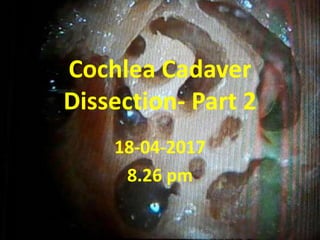
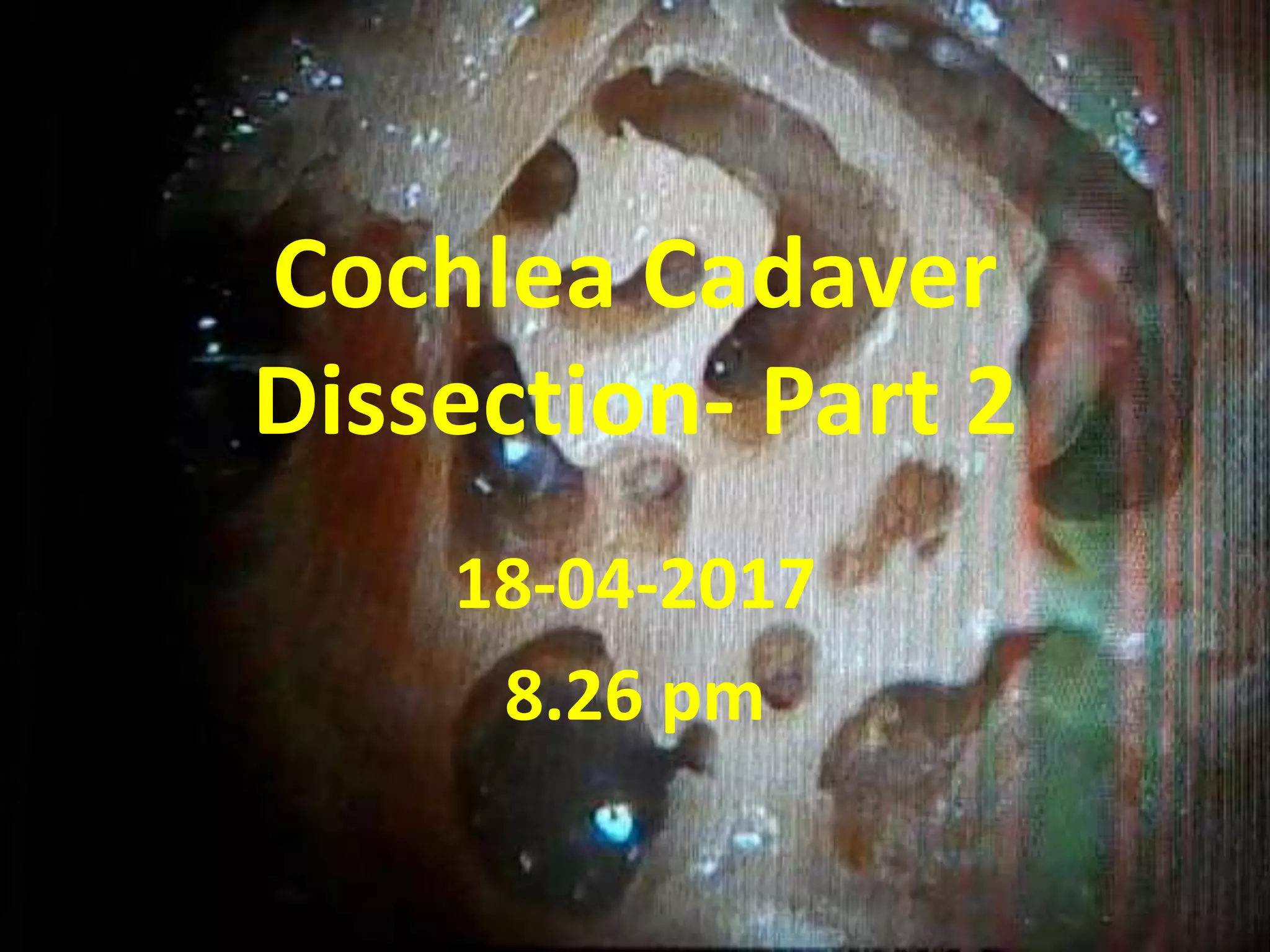
Cochlea Cadaver
Dissection- Part 2
18-04-2017
8.26 pm
Part-1 of this PPT
present at weblink
www.skullbase360.in
Middle cranial fossa
approach for
Cochlear implant
APICAL TURN / SUPERIOR TURN
cochleostomy in middle cranial
fossa approach
So the indication of middle cranial fossa superior
cochleostomy insertion is in infected cases after CWD
+ SP ( subtotal petrosectomy ) We can do redo by fat
risnced in rifampacin . But if you want to go by sterile
area middle cranial fossa superior cochleostomy &
reverse insertion & reverse programming
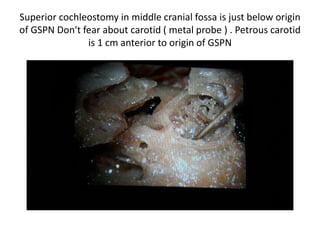
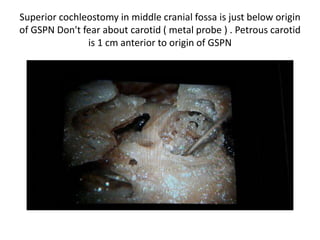
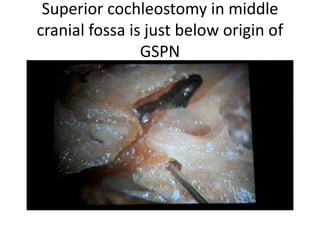
Superior cochleostomy in middle cranial fossa is just below origin
of GSPN Don't fear about carotid ( metal probe ) . Petrous carotid
is 1 cm anterior to origin of GSPN
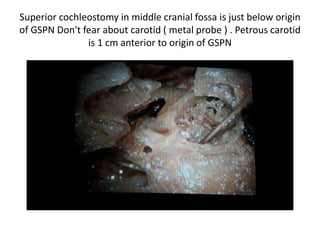
Superior cochleostomy in middle cranial fossa is just below origin
of GSPN Don't fear about carotid ( metal probe ) . Petrous carotid
is 1 cm anterior to origin of GSPN
Superior cochleostomy in middle cranial fossa is just below origin
of GSPN Don't fear about carotid ( metal probe ) . Petrous carotid
is 1 cm anterior to origin of GSPN
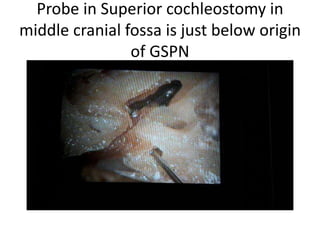
Probe in Superior cochleostomy in
middle cranial fossa is just below origin
of GSPN
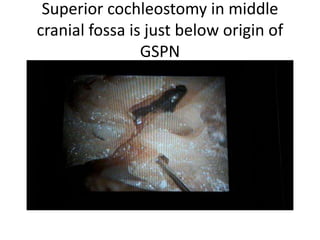
Superior cochleostomy in middle
cranial fossa is just below origin of
GSPN
Superior cochleostomy in middle
cranial fossa is just below origin of
GSPN
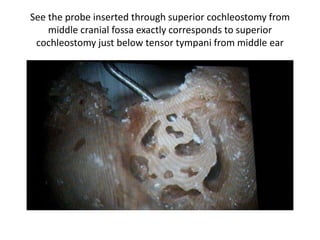
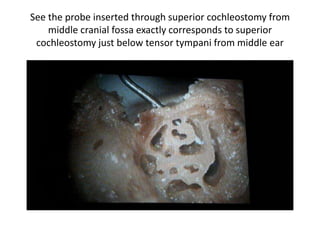
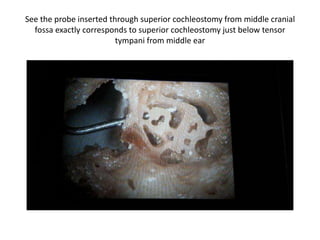
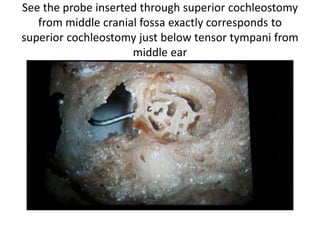
See the probe inserted through superior cochleostomy from
middle cranial fossa exactly corresponds to superior
cochleostomy just below tensor tympani from middle ear
See the probe inserted through superior cochleostomy from
middle cranial fossa exactly corresponds to superior
cochleostomy just below tensor tympani from middle ear
See the probe inserted through superior cochleostomy from middle cranial
fossa exactly corresponds to superior cochleostomy just below tensor
tympani from middle ear
See the probe inserted through superior cochleostomy
from middle cranial fossa exactly corresponds to
superior cochleostomy just below tensor tympani from
middle ear
Labyrinthine part of facial nerve
in middle cranial fossa
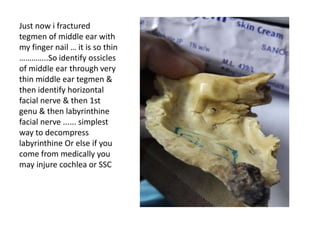
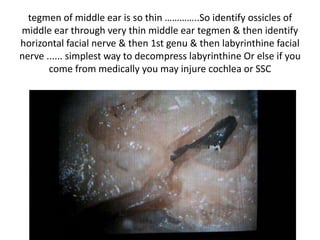
Just now i fractured
tegmen of middle ear with
my finger nail … it is so thin
…………..So identify ossicles
of middle ear through very
thin middle ear tegmen &
then identify horizontal
facial nerve & then 1st
genu & then labyrinthine
facial nerve ...... simplest
way to decompress
labyrinthine Or else if you
come from medically you
may injure cochlea or SSC
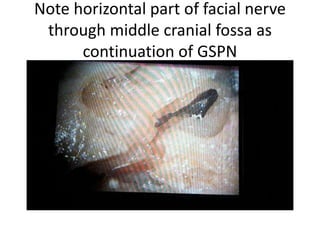
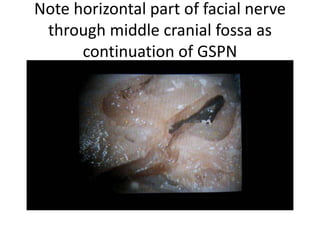
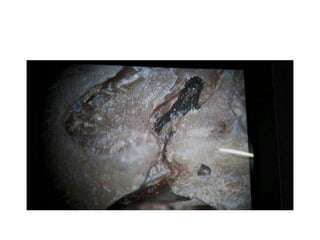
Note horizontal part of facial nerve
through middle cranial fossa as
continuation of GSPN
tegmen of middle ear is so thin …………..So identify ossicles of
middle ear through very thin middle ear tegmen & then identify
horizontal facial nerve & then 1st genu & then labyrinthine facial
nerve ...... simplest way to decompress labyrinthine Or else if you
come from medically you may injure cochlea or SSC
Note horizontal part of facial nerve
through middle cranial fossa as
continuation of GSPN
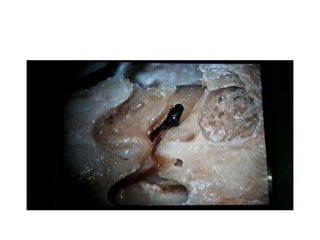
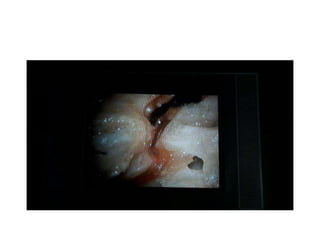
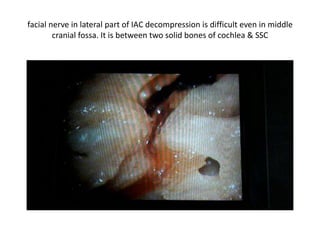
facial nerve in lateral part of IAC decompression is difficult even in middle
cranial fossa. It is between two solid bones of cochlea & SSC
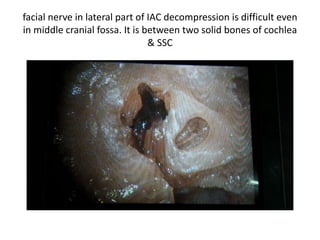
facial nerve in lateral part of IAC decompression is difficult even
in middle cranial fossa. It is between two solid bones of cochlea
& SSC
IAC [ Internal Auditory Canal ]
Drilling
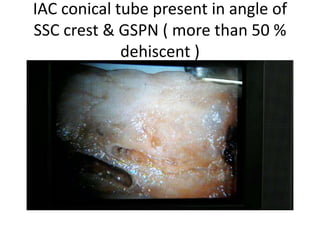
IAC conical tube present in angle of
SSC crest & GSPN ( more than 50 %
dehiscent )
IAC conical tube present in angle of
SSC crest & GSPN ( more than 50 %
dehiscent )
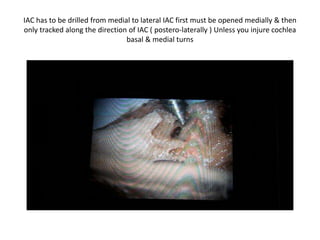
IAC has to be drilled from medial to lateral IAC first must be opened medially & then
only tracked along the direction of IAC ( postero-laterally ) Unless you injure cochlea
basal & medial turns
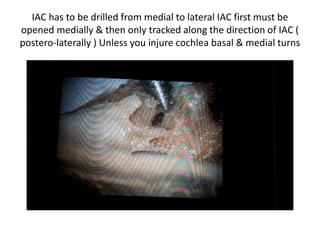
IAC has to be drilled from medial to lateral IAC first must be
opened medially & then only tracked along the direction of IAC (
postero-laterally ) Unless you injure cochlea basal & medial turns
KAWASE APPROACH
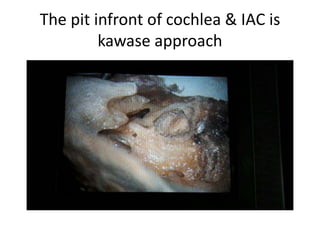
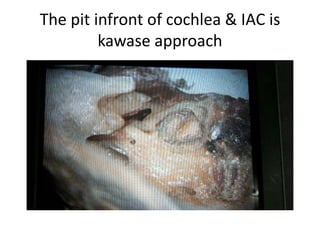
The pit infront of cochlea & IAC is
kawase approach
The pit infront of cochlea & IAC is
kawase approach
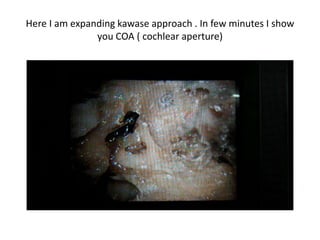
Here I am expanding kawase approach . In few minutes I show
you COA ( cochlear aperture)
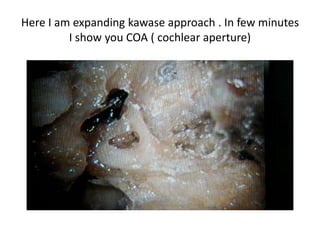
Here I am expanding kawase approach . In few minutes
I show you COA ( cochlear aperture)
Probing in middle turn
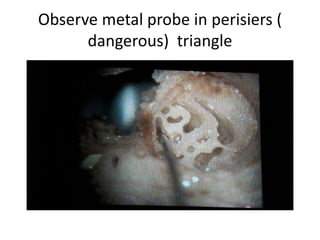
Observe metal probe in perisiers (
dangerous) triangle
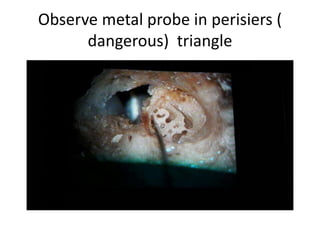
Observe metal probe in perisiers (
dangerous) triangle
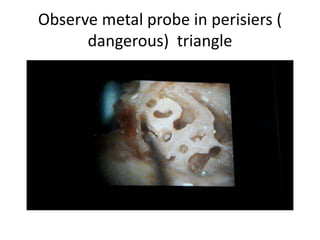
Observe metal probe in perisiers (
dangerous) triangle
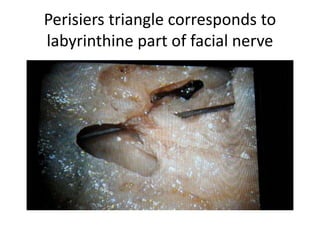
Perisiers triangle corresponds to
labyrinthine part of facial nerve
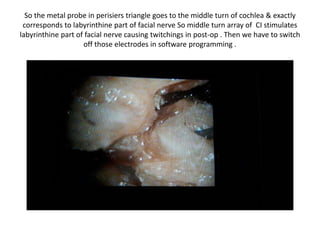
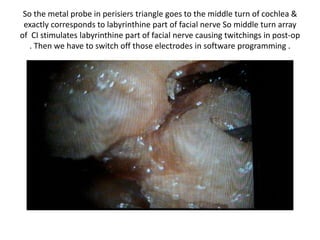
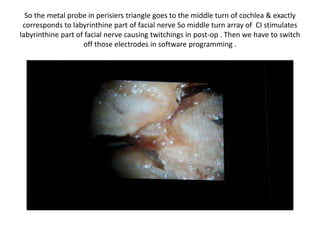
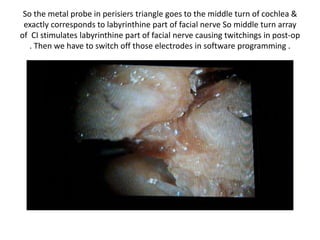
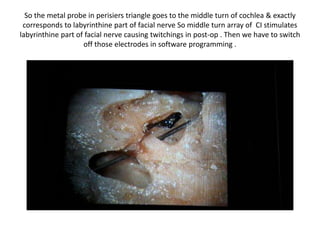
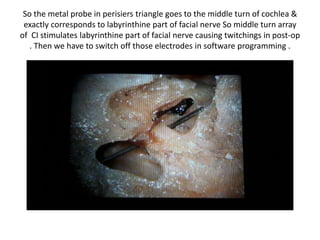
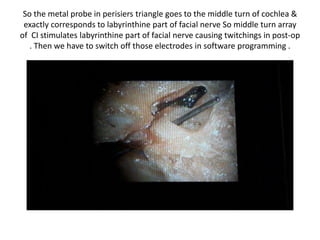
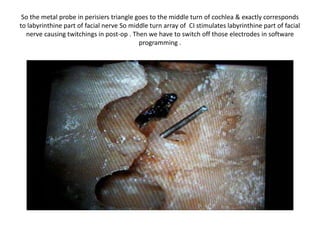
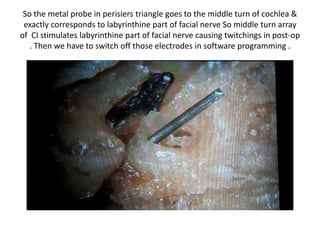
So the metal probe in perisiers triangle goes to the middle turn of cochlea & exactly
corresponds to labyrinthine part of facial nerve So middle turn array of CI stimulates
labyrinthine part of facial nerve causing twitchings in post-op . Then we have to switch
off those electrodes in software programming .
So the metal probe in perisiers triangle goes to the middle turn of cochlea &
exactly corresponds to labyrinthine part of facial nerve So middle turn array
of CI stimulates labyrinthine part of facial nerve causing twitchings in post-op
. Then we have to switch off those electrodes in software programming .
So the metal probe in perisiers triangle goes to the middle turn of cochlea & exactly
corresponds to labyrinthine part of facial nerve So middle turn array of CI stimulates
labyrinthine part of facial nerve causing twitchings in post-op . Then we have to switch
off those electrodes in software programming .
So the metal probe in perisiers triangle goes to the middle turn of cochlea &
exactly corresponds to labyrinthine part of facial nerve So middle turn array
of CI stimulates labyrinthine part of facial nerve causing twitchings in post-op
. Then we have to switch off those electrodes in software programming .
So the metal probe in perisiers triangle goes to the middle turn of cochlea & exactly
corresponds to labyrinthine part of facial nerve So middle turn array of CI stimulates
labyrinthine part of facial nerve causing twitchings in post-op . Then we have to switch
off those electrodes in software programming .
So the metal probe in perisiers triangle goes to the middle turn of cochlea &
exactly corresponds to labyrinthine part of facial nerve So middle turn array
of CI stimulates labyrinthine part of facial nerve causing twitchings in post-op
. Then we have to switch off those electrodes in software programming .
So the metal probe in perisiers triangle goes to the middle turn of cochlea &
exactly corresponds to labyrinthine part of facial nerve So middle turn array
of CI stimulates labyrinthine part of facial nerve causing twitchings in post-op
. Then we have to switch off those electrodes in software programming .
So the metal probe in perisiers triangle goes to the middle turn of cochlea & exactly corresponds
to labyrinthine part of facial nerve So middle turn array of CI stimulates labyrinthine part of facial
nerve causing twitchings in post-op . Then we have to switch off those electrodes in software
programming .
So the metal probe in perisiers triangle goes to the middle turn of cochlea &
exactly corresponds to labyrinthine part of facial nerve So middle turn array
of CI stimulates labyrinthine part of facial nerve causing twitchings in post-op
. Then we have to switch off those electrodes in software programming .
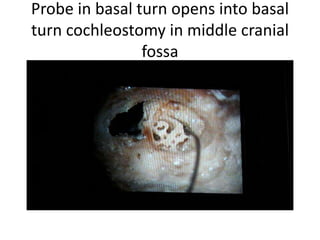
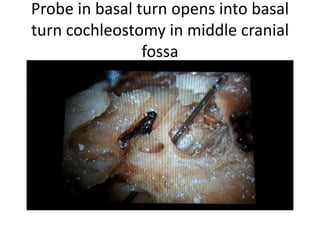
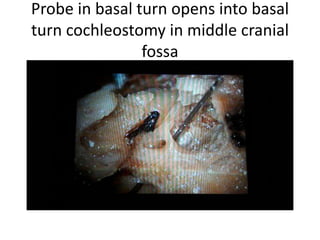
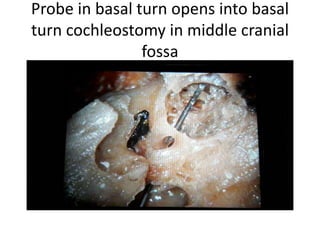
Probing in basal turn
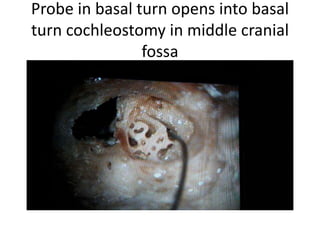
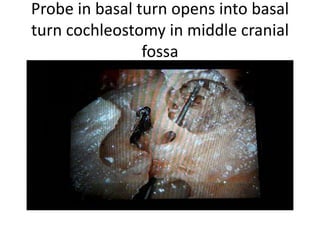
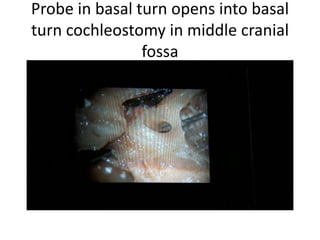
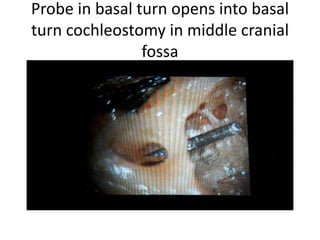
Probe in basal turn opens into basal
turn cochleostomy in middle cranial
fossa
Probe in basal turn opens into basal
turn cochleostomy in middle cranial
fossa
Probe in basal turn opens into basal
turn cochleostomy in middle cranial
fossa
Probe in basal turn opens into basal
turn cochleostomy in middle cranial
fossa
Probe in basal turn opens into basal
turn cochleostomy in middle cranial
fossa
Probe in basal turn opens into basal
turn cochleostomy in middle cranial
fossa
Probe in basal turn opens into basal
turn cochleostomy in middle cranial
fossa
Probe in basal turn opens into basal
turn cochleostomy in middle cranial
fossa
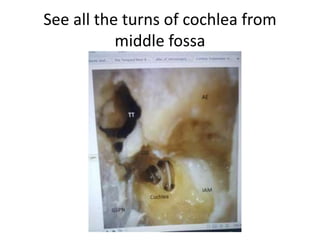
See all the turns of cochlea from
middle fossa
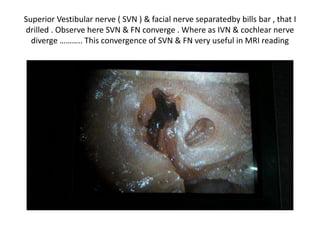
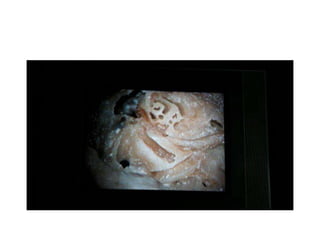
SVN & FN converge
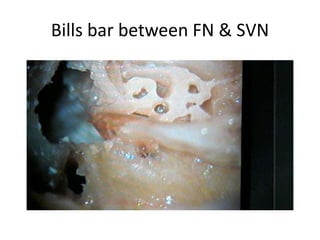
Superior Vestibular nerve ( SVN ) & facial nerve separatedby bills bar , that I
drilled . Observe here SVN & FN converge . Where as IVN & cochlear nerve
diverge ……….. This convergence of SVN & FN very useful in MRI reading
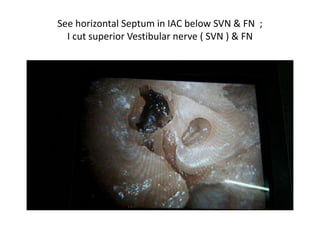
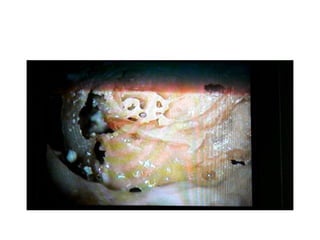
See horizontal Septum in IAC below SVN & FN ;
I cut superior Vestibular nerve ( SVN ) & FN
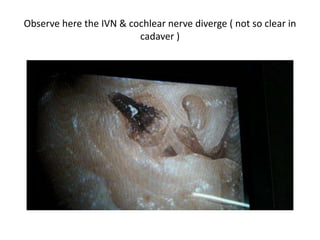
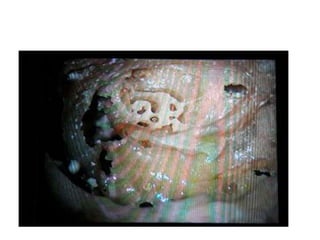
IVN & CN diverge
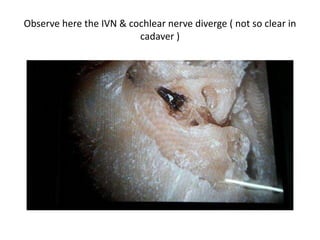
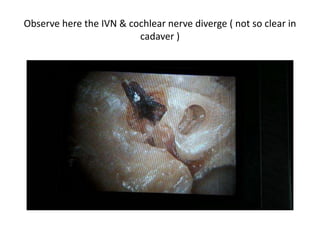
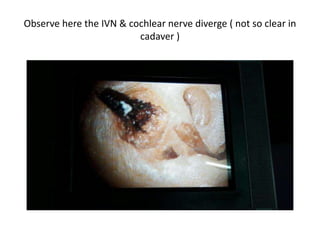
Observe here the IVN & cochlear nerve diverge ( not so clear in
cadaver )
Observe here the IVN & cochlear nerve diverge ( not so clear in
cadaver )
Observe here the IVN & cochlear nerve diverge ( not so clear in
cadaver )
Observe here the IVN & cochlear nerve diverge ( not so clear in
cadaver )
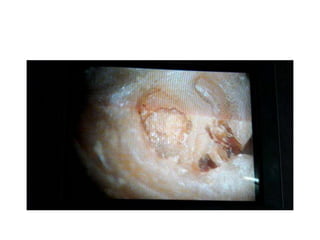
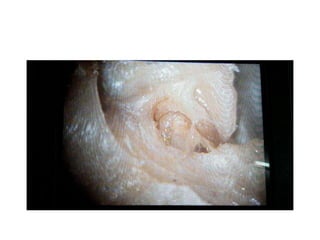
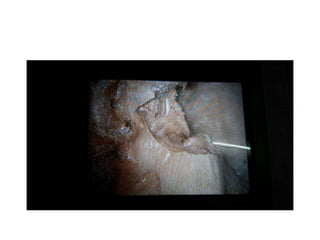
COA [ Cochlear aperture ]
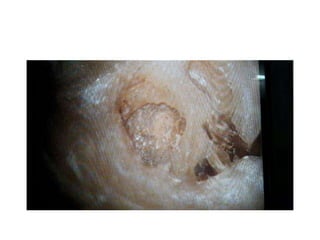
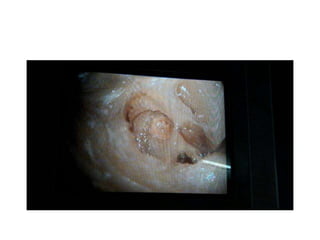
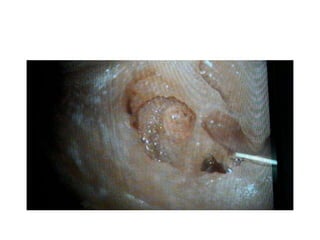
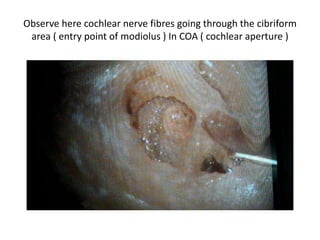
Observe here cochlear nerve fibres going through the cibriform
area ( entry point of modiolus ) In COA ( cochlear aperture )
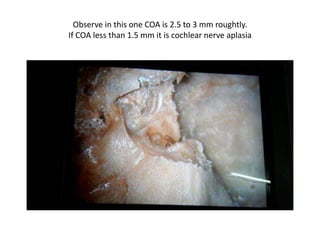
Observe in this one COA is 2.5 to 3 mm roughtly.
If COA less than 1.5 mm it is cochlear nerve aplasia
Cochlear implant
after
Translabyrinthine
approach
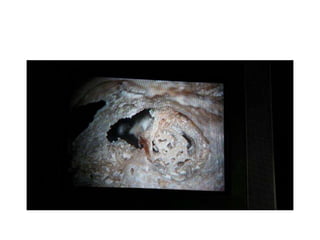
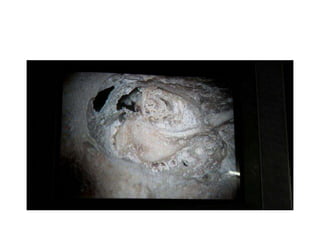
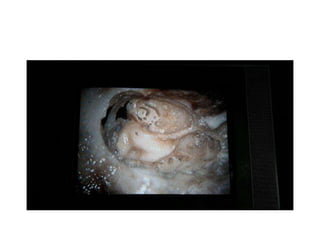
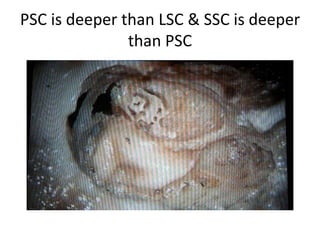
PSC is deeper than LSC & SSC is deeper
than PSC
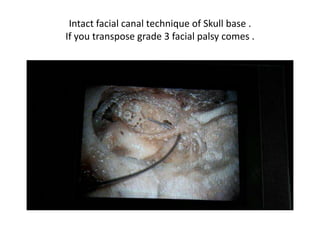
Intact facial canal technique of Skull base .
If you transpose grade 3 facial palsy comes .
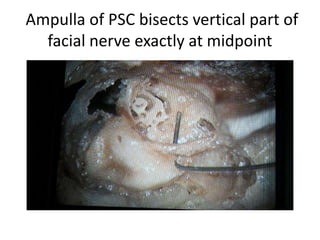
Ampulla of PSC bisects vertical part of
facial nerve exactly at midpoint
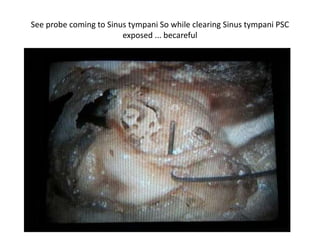
See probe coming to Sinus tympani So while clearing Sinus tympani PSC
exposed ... becareful
CI after LABYRINTHECTOMY
Only two is enough for CI – one is
cochlea & another cochlear nerve –
so even in vestibular schwannoma
excision by translabyrinthine
exposure we can do CI & patient
hears
Bills bar between FN & SVN
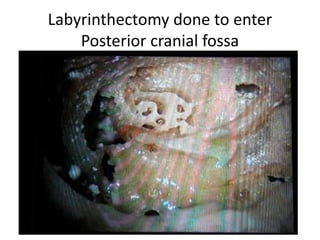
Labyrinthectomy done to enter
Posterior cranial fossa
VA [ Vestibular Aqueduct ]
https://drive.google.com/file/d/0B7F_FcpOJCfpS2lJa3NBNkVDeV
E/view?usp=sharing
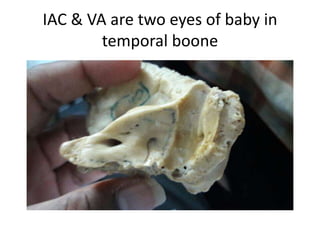
IAC & VA are two eyes of baby in
temporal boone
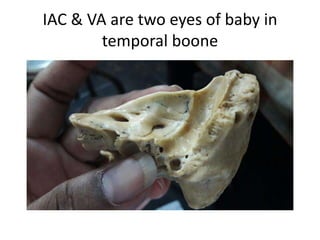
IAC & VA are two eyes of baby in
temporal boone
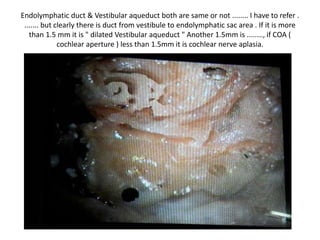
Endolymphatic duct & Vestibular aqueduct both are same or not ........ I have to refer .
....... but clearly there is duct from vestibule to endolymphatic sac area . If it is more
than 1.5 mm it is " dilated Vestibular aqueduct " Another 1.5mm is ........, if COA (
cochlear aperture ) less than 1.5mm it is cochlear nerve aplasia.
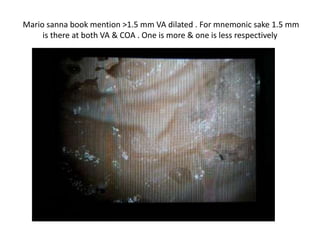
Mario sanna book mention >1.5 mm VA dilated . For mnemonic sake 1.5 mm
is there at both VA & COA . One is more & one is less respectively
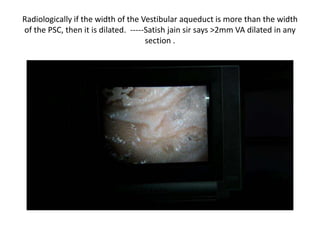
Radiologically if the width of the Vestibular aqueduct is more than the width
of the PSC, then it is dilated. -----Satish jain sir says >2mm VA dilated in any
section .
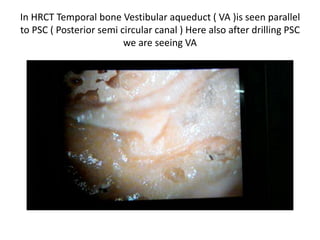
In HRCT Temporal bone Vestibular aqueduct ( VA )is seen parallel
to PSC ( Posterior semi circular canal ) Here also after drilling PSC
we are seeing VA
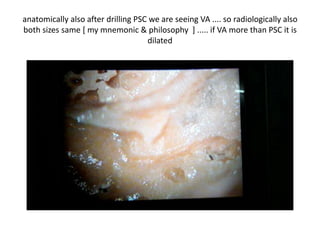
anatomically also after drilling PSC we are seeing VA .... so radiologically also
both sizes same [ my mnemonic & philosophy ] ..... if VA more than PSC it is
dilated
Abnormal cochleas dissection photos
added later in few days
Essence of abnormal cochleas
1. IP 2 is exactly like normal cochlea
2. IP 3 - wide cochleostomy & precurved electrode
3. cochlear hypoplasia -- outcomes depends on how many number
of electrodes inserted . Minimum 10 electrodes insertion should
be there to get better outcome
4. IP 1 - lateral wall electrode
5. common cavity - lateral wall electrode
6. CHARGE - still try CI , not working then ABI.
7. michel - ABI directly
In all abnormalities see cochlear nerve aplasia .... even absent in MRI ,
do EABR & keep CI
Part-1 of this PPT
present at weblink
www.skullbase360.in

Cochlea cadaver dissection - part 2

  • 1.
  • 2.
    Part-1 of thisPPT present at weblink www.skullbase360.in
  • 3.
    Middle cranial fossa approachfor Cochlear implant
  • 4.
    APICAL TURN /SUPERIOR TURN cochleostomy in middle cranial fossa approach So the indication of middle cranial fossa superior cochleostomy insertion is in infected cases after CWD + SP ( subtotal petrosectomy ) We can do redo by fat risnced in rifampacin . But if you want to go by sterile area middle cranial fossa superior cochleostomy & reverse insertion & reverse programming
  • 5.
    Superior cochleostomy inmiddle cranial fossa is just below origin of GSPN Don't fear about carotid ( metal probe ) . Petrous carotid is 1 cm anterior to origin of GSPN
  • 6.
    Superior cochleostomy inmiddle cranial fossa is just below origin of GSPN Don't fear about carotid ( metal probe ) . Petrous carotid is 1 cm anterior to origin of GSPN
  • 7.
    Superior cochleostomy inmiddle cranial fossa is just below origin of GSPN Don't fear about carotid ( metal probe ) . Petrous carotid is 1 cm anterior to origin of GSPN
  • 8.
    Probe in Superiorcochleostomy in middle cranial fossa is just below origin of GSPN
  • 9.
    Superior cochleostomy inmiddle cranial fossa is just below origin of GSPN
  • 10.
    Superior cochleostomy inmiddle cranial fossa is just below origin of GSPN
  • 11.
    See the probeinserted through superior cochleostomy from middle cranial fossa exactly corresponds to superior cochleostomy just below tensor tympani from middle ear
  • 12.
    See the probeinserted through superior cochleostomy from middle cranial fossa exactly corresponds to superior cochleostomy just below tensor tympani from middle ear
  • 13.
    See the probeinserted through superior cochleostomy from middle cranial fossa exactly corresponds to superior cochleostomy just below tensor tympani from middle ear
  • 14.
    See the probeinserted through superior cochleostomy from middle cranial fossa exactly corresponds to superior cochleostomy just below tensor tympani from middle ear
  • 15.
    Labyrinthine part offacial nerve in middle cranial fossa
  • 16.
    Just now ifractured tegmen of middle ear with my finger nail … it is so thin …………..So identify ossicles of middle ear through very thin middle ear tegmen & then identify horizontal facial nerve & then 1st genu & then labyrinthine facial nerve ...... simplest way to decompress labyrinthine Or else if you come from medically you may injure cochlea or SSC
  • 17.
    Note horizontal partof facial nerve through middle cranial fossa as continuation of GSPN
  • 18.
    tegmen of middleear is so thin …………..So identify ossicles of middle ear through very thin middle ear tegmen & then identify horizontal facial nerve & then 1st genu & then labyrinthine facial nerve ...... simplest way to decompress labyrinthine Or else if you come from medically you may injure cochlea or SSC
  • 19.
    Note horizontal partof facial nerve through middle cranial fossa as continuation of GSPN
  • 24.
    facial nerve inlateral part of IAC decompression is difficult even in middle cranial fossa. It is between two solid bones of cochlea & SSC
  • 25.
    facial nerve inlateral part of IAC decompression is difficult even in middle cranial fossa. It is between two solid bones of cochlea & SSC
  • 26.
    IAC [ InternalAuditory Canal ] Drilling
  • 27.
    IAC conical tubepresent in angle of SSC crest & GSPN ( more than 50 % dehiscent )
  • 28.
    IAC conical tubepresent in angle of SSC crest & GSPN ( more than 50 % dehiscent )
  • 29.
    IAC has tobe drilled from medial to lateral IAC first must be opened medially & then only tracked along the direction of IAC ( postero-laterally ) Unless you injure cochlea basal & medial turns
  • 30.
    IAC has tobe drilled from medial to lateral IAC first must be opened medially & then only tracked along the direction of IAC ( postero-laterally ) Unless you injure cochlea basal & medial turns
  • 31.
  • 32.
    The pit infrontof cochlea & IAC is kawase approach
  • 33.
    The pit infrontof cochlea & IAC is kawase approach
  • 34.
    Here I amexpanding kawase approach . In few minutes I show you COA ( cochlear aperture)
  • 35.
    Here I amexpanding kawase approach . In few minutes I show you COA ( cochlear aperture)
  • 36.
  • 37.
    Observe metal probein perisiers ( dangerous) triangle
  • 38.
    Observe metal probein perisiers ( dangerous) triangle
  • 39.
    Observe metal probein perisiers ( dangerous) triangle
  • 40.
    Perisiers triangle correspondsto labyrinthine part of facial nerve
  • 41.
    So the metalprobe in perisiers triangle goes to the middle turn of cochlea & exactly corresponds to labyrinthine part of facial nerve So middle turn array of CI stimulates labyrinthine part of facial nerve causing twitchings in post-op . Then we have to switch off those electrodes in software programming .
  • 42.
    So the metalprobe in perisiers triangle goes to the middle turn of cochlea & exactly corresponds to labyrinthine part of facial nerve So middle turn array of CI stimulates labyrinthine part of facial nerve causing twitchings in post-op . Then we have to switch off those electrodes in software programming .
  • 43.
    So the metalprobe in perisiers triangle goes to the middle turn of cochlea & exactly corresponds to labyrinthine part of facial nerve So middle turn array of CI stimulates labyrinthine part of facial nerve causing twitchings in post-op . Then we have to switch off those electrodes in software programming .
  • 44.
    So the metalprobe in perisiers triangle goes to the middle turn of cochlea & exactly corresponds to labyrinthine part of facial nerve So middle turn array of CI stimulates labyrinthine part of facial nerve causing twitchings in post-op . Then we have to switch off those electrodes in software programming .
  • 45.
    So the metalprobe in perisiers triangle goes to the middle turn of cochlea & exactly corresponds to labyrinthine part of facial nerve So middle turn array of CI stimulates labyrinthine part of facial nerve causing twitchings in post-op . Then we have to switch off those electrodes in software programming .
  • 46.
    So the metalprobe in perisiers triangle goes to the middle turn of cochlea & exactly corresponds to labyrinthine part of facial nerve So middle turn array of CI stimulates labyrinthine part of facial nerve causing twitchings in post-op . Then we have to switch off those electrodes in software programming .
  • 47.
    So the metalprobe in perisiers triangle goes to the middle turn of cochlea & exactly corresponds to labyrinthine part of facial nerve So middle turn array of CI stimulates labyrinthine part of facial nerve causing twitchings in post-op . Then we have to switch off those electrodes in software programming .
  • 48.
    So the metalprobe in perisiers triangle goes to the middle turn of cochlea & exactly corresponds to labyrinthine part of facial nerve So middle turn array of CI stimulates labyrinthine part of facial nerve causing twitchings in post-op . Then we have to switch off those electrodes in software programming .
  • 49.
    So the metalprobe in perisiers triangle goes to the middle turn of cochlea & exactly corresponds to labyrinthine part of facial nerve So middle turn array of CI stimulates labyrinthine part of facial nerve causing twitchings in post-op . Then we have to switch off those electrodes in software programming .
  • 50.
  • 51.
    Probe in basalturn opens into basal turn cochleostomy in middle cranial fossa
  • 52.
    Probe in basalturn opens into basal turn cochleostomy in middle cranial fossa
  • 53.
    Probe in basalturn opens into basal turn cochleostomy in middle cranial fossa
  • 54.
    Probe in basalturn opens into basal turn cochleostomy in middle cranial fossa
  • 55.
    Probe in basalturn opens into basal turn cochleostomy in middle cranial fossa
  • 56.
    Probe in basalturn opens into basal turn cochleostomy in middle cranial fossa
  • 57.
    Probe in basalturn opens into basal turn cochleostomy in middle cranial fossa
  • 58.
    Probe in basalturn opens into basal turn cochleostomy in middle cranial fossa
  • 59.
    See all theturns of cochlea from middle fossa
  • 60.
    SVN & FNconverge
  • 61.
    Superior Vestibular nerve( SVN ) & facial nerve separatedby bills bar , that I drilled . Observe here SVN & FN converge . Where as IVN & cochlear nerve diverge ……….. This convergence of SVN & FN very useful in MRI reading
  • 62.
    See horizontal Septumin IAC below SVN & FN ; I cut superior Vestibular nerve ( SVN ) & FN
  • 63.
    IVN & CNdiverge
  • 64.
    Observe here theIVN & cochlear nerve diverge ( not so clear in cadaver )
  • 65.
    Observe here theIVN & cochlear nerve diverge ( not so clear in cadaver )
  • 66.
    Observe here theIVN & cochlear nerve diverge ( not so clear in cadaver )
  • 67.
    Observe here theIVN & cochlear nerve diverge ( not so clear in cadaver )
  • 68.
    COA [ Cochlearaperture ]
  • 74.
    Observe here cochlearnerve fibres going through the cibriform area ( entry point of modiolus ) In COA ( cochlear aperture )
  • 77.
    Observe in thisone COA is 2.5 to 3 mm roughtly. If COA less than 1.5 mm it is cochlear nerve aplasia
  • 78.
  • 82.
    PSC is deeperthan LSC & SSC is deeper than PSC
  • 83.
    Intact facial canaltechnique of Skull base . If you transpose grade 3 facial palsy comes .
  • 84.
    Ampulla of PSCbisects vertical part of facial nerve exactly at midpoint
  • 85.
    See probe comingto Sinus tympani So while clearing Sinus tympani PSC exposed ... becareful
  • 86.
    CI after LABYRINTHECTOMY Onlytwo is enough for CI – one is cochlea & another cochlear nerve – so even in vestibular schwannoma excision by translabyrinthine exposure we can do CI & patient hears
  • 88.
  • 91.
    Labyrinthectomy done toenter Posterior cranial fossa
  • 92.
    VA [ VestibularAqueduct ]
  • 93.
  • 94.
    IAC & VAare two eyes of baby in temporal boone
  • 95.
    IAC & VAare two eyes of baby in temporal boone
  • 97.
    Endolymphatic duct &Vestibular aqueduct both are same or not ........ I have to refer . ....... but clearly there is duct from vestibule to endolymphatic sac area . If it is more than 1.5 mm it is " dilated Vestibular aqueduct " Another 1.5mm is ........, if COA ( cochlear aperture ) less than 1.5mm it is cochlear nerve aplasia.
  • 98.
    Mario sanna bookmention >1.5 mm VA dilated . For mnemonic sake 1.5 mm is there at both VA & COA . One is more & one is less respectively
  • 99.
    Radiologically if thewidth of the Vestibular aqueduct is more than the width of the PSC, then it is dilated. -----Satish jain sir says >2mm VA dilated in any section .
  • 100.
    In HRCT Temporalbone Vestibular aqueduct ( VA )is seen parallel to PSC ( Posterior semi circular canal ) Here also after drilling PSC we are seeing VA
  • 101.
    anatomically also afterdrilling PSC we are seeing VA .... so radiologically also both sizes same [ my mnemonic & philosophy ] ..... if VA more than PSC it is dilated
  • 103.
    Abnormal cochleas dissectionphotos added later in few days Essence of abnormal cochleas 1. IP 2 is exactly like normal cochlea 2. IP 3 - wide cochleostomy & precurved electrode 3. cochlear hypoplasia -- outcomes depends on how many number of electrodes inserted . Minimum 10 electrodes insertion should be there to get better outcome 4. IP 1 - lateral wall electrode 5. common cavity - lateral wall electrode 6. CHARGE - still try CI , not working then ABI. 7. michel - ABI directly In all abnormalities see cochlear nerve aplasia .... even absent in MRI , do EABR & keep CI
  • 104.
    Part-1 of thisPPT present at weblink www.skullbase360.in