
Leadership Analysis
Creating and Presenting Strategic Plans
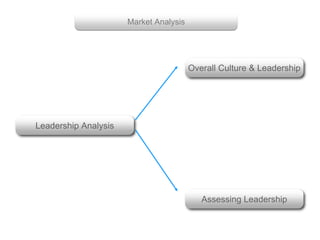
Market Analysis
Leadership Analysis
Overall Culture & Leadership
Assessing Leadership
Group with enough power
Getting them to work together
•Invisible but real and vital
•Firm atmosphere: loyalty or sabotage
•United to disunited
•Visitors and customers
Atmosphere
Group with enough power
Getting them to work together
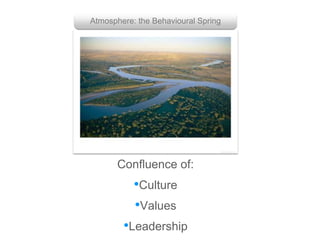
Confluence of:
•Leadership
•Culture
•Values
Atmosphere: the Behavioural Spring
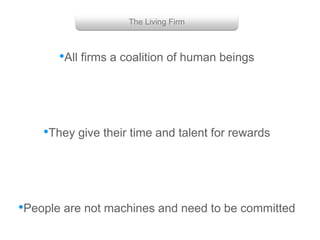
•All firms a coalition of human beings
•They give their time and talent for rewards
•People are not machines and need to be committed
The Living Firm
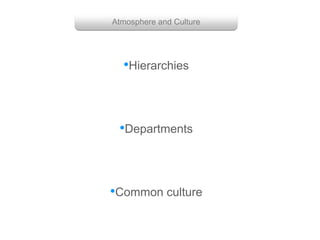
•Common culture
Atmosphere and Culture
•Hierarchies
•Departments
Group with enough power
Getting them to work together
Who are, or have been, the great leaders?
The Great Leaders
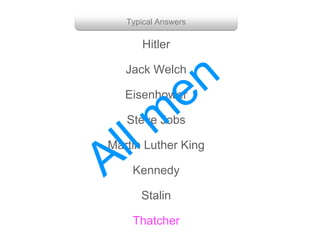
Typical Answers
Jack Welch
Hitler
Eisenhower
Steve Jobs
Martin Luther King
Kennedy
Stalin
Thatcher
Group with enough power
Getting them to work together
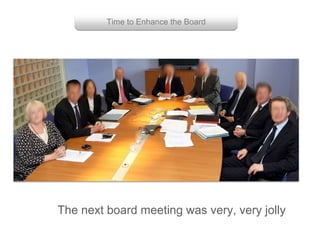
The next board meeting was very, very jolly
Time to Enhance the Board
Group with enough power
Getting them to work together
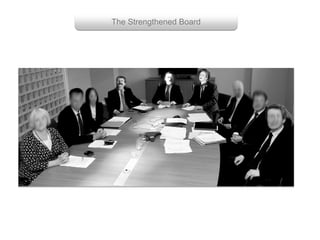
The Strengthened Board
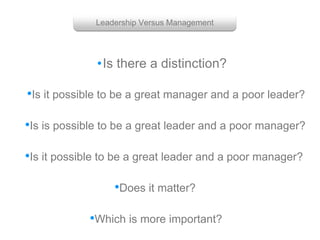
•Is there a distinction?
Leadership Versus Management
•Is is possible to be a great leader and a poor manager?
•Is it possible to be a great manager and a poor leader?
•Is it possible to be a great leader and a poor manager?
•Which is more important?
•Does it matter?
Group with enough power
Getting them to work together
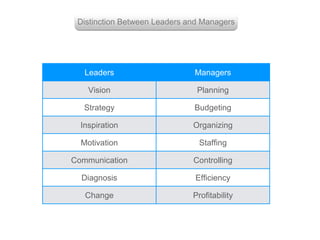
Leaders Managers
Vision Planning
Strategy Budgeting
Inspiration Organizing
Motivation Staffing
Communication Controlling
Diagnosis Efficiency
Change Profitability
Distinction Between Leaders and Managers
Management
+
+0
++
++
0
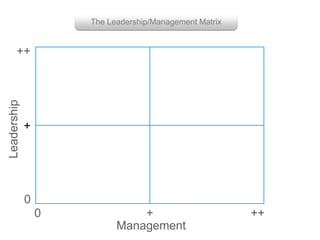
The Leadership/Management Matrix
0
++
0
+
Strong
Weak
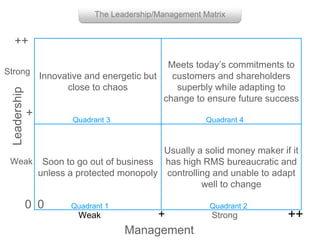
Innovative and energetic but
close to chaos
Meets today’s commitments to
customers and shareholders
superbly while adapting to
change to ensure future success
Soon to go out of business
unless a protected monopoly
Usually a solid money maker if it
has high RMS bureaucratic and
controlling and unable to adapt
well to change
Management
+ ++Weak Strong
Quadrant 4Quadrant 3
Quadrant 2Quadrant 1
The Leadership/Management Matrix
Management
+0 ++Weak Strong
Quadrant 2Quadrant 1
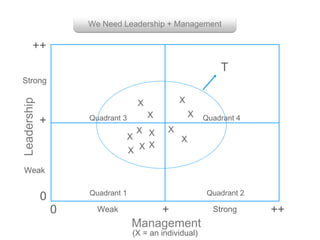
Quadrant 3 Quadrant 4X
XX
X
X
X
X
XX
X
X X
T
(X = an individual)
We Need Leadership + Management
+
++
0
Weak
Strong
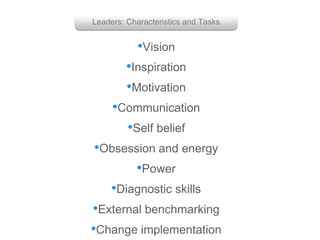
•Vision
•Obsession and energy
•Power
•Diagnostic skills
•Communication
•Inspiration
•Motivation
•Change implementation
•External benchmarking
•Self belief
Leaders: Characteristics and Tasks
Group with enough power
Getting them to work together
Collins, J., Level 5 Leadership: The Triumph of Humility and Fierce Resolve, Harvard
Business Review, The High Performance Organization, July-August 2005
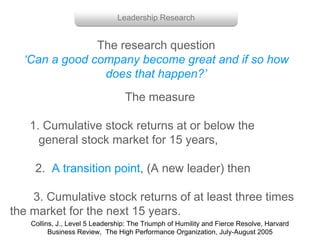
The research question
‘Can a good company become great and if so how
does that happen?’
The measure
1. Cumulative stock returns at or below the
general stock market for 15 years,
2. A transition point, (A new leader) then
3. Cumulative stock returns of at least three times
the market for the next 15 years.
Leadership Research
Group with enough power
Getting them to work together
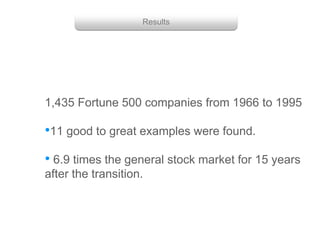
1,435 Fortune 500 companies from 1966 to 1995
•11 good to great examples were found.
• 6.9 times the general stock market for 15 years
after the transition.
Results
Group with enough power
Getting them to work together
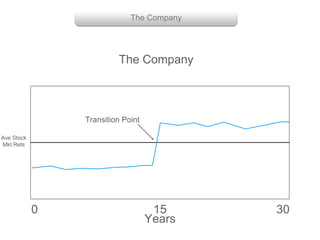
The Company
The Company
0
Ave Stock
Mkt Rets
3015
Years
Transition Point
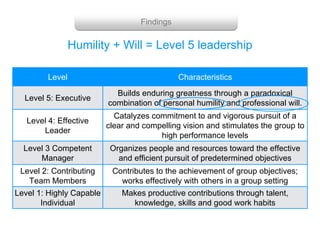
Humility + Will = Level 5 leadership
Findings
Level Characteristics
Level 5: Executive
Builds enduring greatness through a paradoxical
combination of personal humility and professional will.
Level 4: Effective
Leader
Catalyzes commitment to and vigorous pursuit of a
clear and compelling vision and stimulates the group to
high performance levels
Level 3 Competent
Manager
Organizes people and resources toward the effective
and efficient pursuit of predetermined objectives
Level 2: Contributing
Team Members
Contributes to the achievement of group objectives;
works effectively with others in a group setting
Level 1: Highly Capable
Individual
Makes productive contributions through talent,
knowledge, skills and good work habits
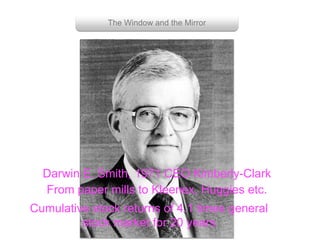
The Window and the Mirror
Darwin E. Smith, 1971 CEO Kimberly-Clark
From paper mills to Kleenex, Huggies etc.
Cumulative stock returns of 4.1 times general
stock market for 20 years
Group with enough power
Getting them to work together
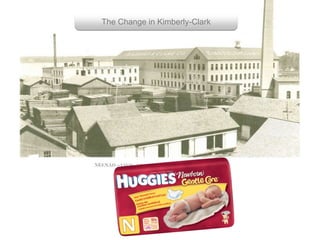
The Change in Kimberly-Clark
Group with enough power
Getting them to work together
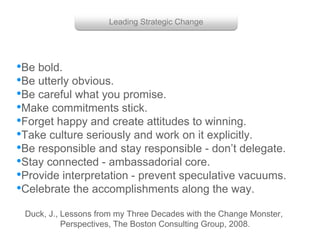
Duck, J., Lessons from my Three Decades with the Change Monster,
Perspectives, The Boston Consulting Group, 2008.
•Be bold.
•Be utterly obvious.
•Be careful what you promise.
•Make commitments stick.
•Forget happy and create attitudes to winning.
•Take culture seriously and work on it explicitly.
•Be responsible and stay responsible - don’t delegate.
•Stay connected - ambassadorial core.
•Provide interpretation - prevent speculative vacuums.
•Celebrate the accomplishments along the way.
Leading Strategic Change
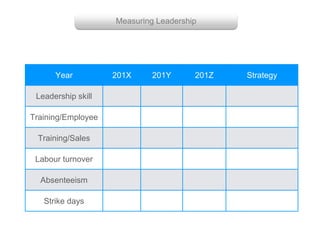
Year 201X 201Y 201Z Strategy
Leadership skill
Training/Employee
Training/Sales
Labour turnover
Absenteeism
Strike days
Measuring Leadership
The End

Cpsp leadership analysis

  • 1.
    Leadership Analysis Creating andPresenting Strategic Plans
  • 2.
    Market Analysis Leadership Analysis OverallCulture & Leadership Assessing Leadership
  • 3.
    Group with enoughpower Getting them to work together •Invisible but real and vital •Firm atmosphere: loyalty or sabotage •United to disunited •Visitors and customers Atmosphere
  • 4.
    Group with enoughpower Getting them to work together Confluence of: •Leadership •Culture •Values Atmosphere: the Behavioural Spring
  • 5.
    •All firms acoalition of human beings •They give their time and talent for rewards •People are not machines and need to be committed The Living Firm
  • 6.
    •Common culture Atmosphere andCulture •Hierarchies •Departments
  • 7.
    Group with enoughpower Getting them to work together Who are, or have been, the great leaders? The Great Leaders
  • 8.
    Typical Answers Jack Welch Hitler Eisenhower SteveJobs Martin Luther King Kennedy Stalin Thatcher
  • 9.
    Group with enoughpower Getting them to work together The next board meeting was very, very jolly Time to Enhance the Board
  • 10.
    Group with enoughpower Getting them to work together The Strengthened Board
  • 11.
    •Is there adistinction? Leadership Versus Management •Is is possible to be a great leader and a poor manager? •Is it possible to be a great manager and a poor leader? •Is it possible to be a great leader and a poor manager? •Which is more important? •Does it matter?
  • 12.
    Group with enoughpower Getting them to work together Leaders Managers Vision Planning Strategy Budgeting Inspiration Organizing Motivation Staffing Communication Controlling Diagnosis Efficiency Change Profitability Distinction Between Leaders and Managers
  • 13.
  • 14.
    0 ++ 0 + Strong Weak Innovative and energeticbut close to chaos Meets today’s commitments to customers and shareholders superbly while adapting to change to ensure future success Soon to go out of business unless a protected monopoly Usually a solid money maker if it has high RMS bureaucratic and controlling and unable to adapt well to change Management + ++Weak Strong Quadrant 4Quadrant 3 Quadrant 2Quadrant 1 The Leadership/Management Matrix
  • 15.
    Management +0 ++Weak Strong Quadrant2Quadrant 1 Quadrant 3 Quadrant 4X XX X X X X XX X X X T (X = an individual) We Need Leadership + Management + ++ 0 Weak Strong
  • 16.
    •Vision •Obsession and energy •Power •Diagnosticskills •Communication •Inspiration •Motivation •Change implementation •External benchmarking •Self belief Leaders: Characteristics and Tasks
  • 17.
    Group with enoughpower Getting them to work together Collins, J., Level 5 Leadership: The Triumph of Humility and Fierce Resolve, Harvard Business Review, The High Performance Organization, July-August 2005 The research question ‘Can a good company become great and if so how does that happen?’ The measure 1. Cumulative stock returns at or below the general stock market for 15 years, 2. A transition point, (A new leader) then 3. Cumulative stock returns of at least three times the market for the next 15 years. Leadership Research
  • 18.
    Group with enoughpower Getting them to work together 1,435 Fortune 500 companies from 1966 to 1995 •11 good to great examples were found. • 6.9 times the general stock market for 15 years after the transition. Results
  • 19.
    Group with enoughpower Getting them to work together The Company The Company 0 Ave Stock Mkt Rets 3015 Years Transition Point
  • 20.
    Humility + Will= Level 5 leadership Findings Level Characteristics Level 5: Executive Builds enduring greatness through a paradoxical combination of personal humility and professional will. Level 4: Effective Leader Catalyzes commitment to and vigorous pursuit of a clear and compelling vision and stimulates the group to high performance levels Level 3 Competent Manager Organizes people and resources toward the effective and efficient pursuit of predetermined objectives Level 2: Contributing Team Members Contributes to the achievement of group objectives; works effectively with others in a group setting Level 1: Highly Capable Individual Makes productive contributions through talent, knowledge, skills and good work habits
  • 21.
    The Window andthe Mirror Darwin E. Smith, 1971 CEO Kimberly-Clark From paper mills to Kleenex, Huggies etc. Cumulative stock returns of 4.1 times general stock market for 20 years
  • 22.
    Group with enoughpower Getting them to work together The Change in Kimberly-Clark
  • 23.
    Group with enoughpower Getting them to work together Duck, J., Lessons from my Three Decades with the Change Monster, Perspectives, The Boston Consulting Group, 2008. •Be bold. •Be utterly obvious. •Be careful what you promise. •Make commitments stick. •Forget happy and create attitudes to winning. •Take culture seriously and work on it explicitly. •Be responsible and stay responsible - don’t delegate. •Stay connected - ambassadorial core. •Provide interpretation - prevent speculative vacuums. •Celebrate the accomplishments along the way. Leading Strategic Change
  • 24.
    Year 201X 201Y201Z Strategy Leadership skill Training/Employee Training/Sales Labour turnover Absenteeism Strike days Measuring Leadership
  • 25.