Leadership in a (Permanent)
Crisis.
            Name:Nikhat Parkar
            MMS B
            Roll No:62
“When the economy recovers, things won’t return to
normal – and a different mode of leadership will be
required”.


            • BY RONALD HEIFETZ, ALEXANDER GRASHOW, AND MARTY LINSKY
Introduction.
 The task of leading during a sustain crisis-whether
  you are the CEO of a huge company or a manager
  heading up an impromptu company initiative- is
  treacherous.
 Crisis leadership has two distinct phases:-


        Emergency phase.

        Adaptive phase.
Crisis leadership-

1)Emergency phase-
  When your task is stabilize the situation and
  buy time.

2) Adaptive phase-
  When you tackle the underlying causes of the crisis
  and build the capacity to thrive in a new reality.
  In this process they change key rules of the
  game, reshape part of the organization, and
  redefine the work people do.
Hunker down- or press “Reset”

 The danger in current economic situation is that
    people in positions of authority will hunker you down.
   They will try to solve the problem with short term
    fixes.
   An organization that solely depends on its senior
    manages to dealth with the challenges of risk failure.
   That risk involves wrong conclusion.
   Tightened controls.
   Drawing on familiar expertise to help their
    organization weather the storm
   The whole organization is not to be changes but only
    adaptability should be there in the organization.
Adaptive leadership

 Instead of hunkering down, they seize the
    opportunity of moments like the current one to hit
    the organization’s reset button.
   Uses the turbulence of the present to build on and
    bring closure to the past.
   They change key rule of the game.
   Reshape parts of the organization.
   Redefine the work people do.
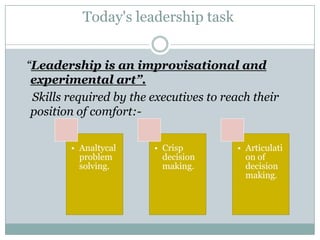
Today's leadership task


“Leadership is an improvisational and
 experimental art”.
 Skills required by the executives to reach their
 position of comfort:-

        • Analtycal     • Crisp         • Articulati
          problem         decision        on of
          solving.        making.         decision
                                          making.
Foster Adaptation.

 Executives faces three competing demand in
 today’s world:-
         They must execute to meet today’s
         challenges.
         They must adapt what and how
         things gets done in order to thrive
         in tomorrow’s world.
         They must develop “next practice”
         while excelling at today’s best
         practice.
Embrace disequilibrium
 Involve orchestrating the inevitable conflicts, chaos,
    confusions etc so that disturbance is productive rather
    than destructive.
   Paul levy, the CEO of Beth Israel Deaconess medical
    center, in Boston tries to adapt to industry changes.
   The game requires you to create a “culture of
    courageous conversation”.
   Keeping an org in a productive zone of disequilibrium
    is a delicate task , you must keep your hand on the
    thermostal.
   Depersonalize conflicts.
   If the heat is consistently too low, the people wont feel
    the need to ask uncomfortable questions.
   If the heat is too high, the organization risk a
    meltdown. People are likely to panic and quit.
Generate leadership
 Must use leadership to generate more leadership
  deep in the organisation because “stability is a
  liability, not an asset, in today’s world”.
 The future of the organization depends on the
  executives at lower level.
 Mobilizing everyone to generate solutions by
  increasing the information flow.
 Sharing the experience the people learn from
  innovative efforts.
Taking care of yourself

 The work of leadership demands not only critical
  adaptive responses within and surrounding your
  business, but also your own thinking and
  emotions.
 Appropriate displays emotions can be an effective
  tool for change, especially when balanced with
  poise.
 Being optimistic and realistic.
How GE Teaches Teams To
     Lead Change.
Introduction.
• Leadership, Innovation, and Growth (LIG) is a 4 day program
  conducted by General Electronic for it’s employee every year
  initiated by Jeffery Immelt

• Aim was on expanding business and creating new one’s than
  on making acquisitions

• LIG was successful because of following reasons

1. Managers were able to reach consensus on barriers to
   change and how to attack them
2. Participants were encouraged to break hard as well as soft
   barriers
3. Simultaneously working on long term and short term goals
   were addressed
Need for LIG


•   The growth playbook which is basically an annual report
    mainly consist of past data and actions

•   It no longer would help to look ahead. So there was a need
    for a program where in employees get a room to project
    ahead

•   It basically aimed to think about organic growth and
    opportunities, innovations, growth etc.

•   In short the purpose of LIG was to make innovation and
    growth as much of a religion at GE as six sigma had been
    under Jack Welch
The Structure

• Speakers at the sessions were a blend of external gurus and
  internal thought leaders

• Cases used at LIG are always work in progress and are about
  reality

• After listening to gurus participants disperse to rooms and
  critically discuss

• Around 20 hours are kept aside for the same

• 20 minutes are reserved on Day 4 for teams to present action
  plan to Immelt
The value of team training
• LIG’s team based approach addresses shortcomings
  inherent in individual focussed approach used by
  traditional management education program

• LIG was radical departure for GE, because it removed
  intact leadership teams from exigencies of their
  businesses

• It allowed them to discuss the white space in a candid,
  introspective fashion for whole 4 days
Barriers to change

• Reassessment of almost everything was done by the
  participants

• Power Gen whose products include gas turbines, steam and
  wind turbines realised that they will be soaring their profit

• But their discussions took back seat and they realised that
  people are becoming carbon conscious and hence old rules
  don’t apply

• Government policies and taxes may reduce their profits
Managing the present and the future

• Delegation of the responsibility to the subordinates

• Empower people encourage them to experiment and help
  them to develop new skills

• Individuals and collective roles are important for organic
  growth so they should make a note of where and how
  they spend time
A vocabulary of change

• Planting seeds was the vocabulary adopted which
  motivated people work for future fruits

• They came up with charts and boxes which made
  work more creative and interesting

•    One box holds the projects of incremental
    innovation

•   Other holds the projects which includes taking
    existing technologies of company to new markets
Link between the articles

• First article clearly states that the leaders have to act
  according to the change

• They should also take people into consideration while
  adopting the change

• This alignment and protection during crises creates a
  sense of comfort and attachment to the organisation

• While second article talks on the need for exploration
  and innovation
Path Goal theory would go best with the article

Since situation demands leaders to answer the questions
  raised by the people in panic situation

 Leadership style is effective on the basis of how
  successfully leaders support their subordinates’
  perceptions of:

• Goals that need to be achieved

• Rewards for successful performance

• Behaviors that lead to successful performance
Contd..


  The leader can affect the performance, satisfaction and
   motivation of a group by

  Offering rewards for achievement of goals

  Clarifying path for achievement of these goals

  Removing obstacles that hinder performance
Leadership behaviour
• Directive: the   leader   gives   specific   guidance   for
  performance

• Supportive: the leader is friendly and shows concern for
  subordinates

• Participative: the leader consults with the subordinates
  and considers their suggestions

• Achievement oriented: the leader sets high goals and
  expects his subordinates to achieve high level of
  performance.
Self leadership

• This idea was advocated by Charles Manz and Henry
  Sims.

• This process involves two fold strategy of
  1. leading oneself to perform naturally motivating tasks
  2. managing oneself to do work that is required but is not
  naturally rewarding

• Self – leadership requires an employee to apply the
  behavioral skills of self-observation, self-set goals, self-
  reward, and self-criticism.
Super Leadership

• A super leader is someone who leads others to lead
  themselves.

• Productive thinking is the corner stone of super
  leadership.

• It requires practicing    self-leadership   oneself   and
  modeling it for others.

• Super leadership has the potential to free up manager’s
  time, because employees are encouraged to manage
  themselves.
Benefits of super leadership

• High team performance and flexibility

• High follower development and self-confidence

• High team creativity and innovation

• High long-term performance

• High ability of the team to work independently in
  absence of leader

Final ppt no 3[1] 3

  • 1.
    Leadership in a(Permanent) Crisis. Name:Nikhat Parkar MMS B Roll No:62
  • 2.
    “When the economyrecovers, things won’t return to normal – and a different mode of leadership will be required”. • BY RONALD HEIFETZ, ALEXANDER GRASHOW, AND MARTY LINSKY
  • 3.
    Introduction.  The taskof leading during a sustain crisis-whether you are the CEO of a huge company or a manager heading up an impromptu company initiative- is treacherous.  Crisis leadership has two distinct phases:- Emergency phase. Adaptive phase.
  • 4.
    Crisis leadership- 1)Emergency phase- When your task is stabilize the situation and buy time. 2) Adaptive phase- When you tackle the underlying causes of the crisis and build the capacity to thrive in a new reality. In this process they change key rules of the game, reshape part of the organization, and redefine the work people do.
  • 5.
    Hunker down- orpress “Reset”  The danger in current economic situation is that people in positions of authority will hunker you down.  They will try to solve the problem with short term fixes.  An organization that solely depends on its senior manages to dealth with the challenges of risk failure.  That risk involves wrong conclusion.  Tightened controls.  Drawing on familiar expertise to help their organization weather the storm  The whole organization is not to be changes but only adaptability should be there in the organization.
  • 6.
    Adaptive leadership  Insteadof hunkering down, they seize the opportunity of moments like the current one to hit the organization’s reset button.  Uses the turbulence of the present to build on and bring closure to the past.  They change key rule of the game.  Reshape parts of the organization.  Redefine the work people do.
  • 7.
    Today's leadership task “Leadershipis an improvisational and experimental art”. Skills required by the executives to reach their position of comfort:- • Analtycal • Crisp • Articulati problem decision on of solving. making. decision making.
  • 8.
    Foster Adaptation.  Executivesfaces three competing demand in today’s world:- They must execute to meet today’s challenges. They must adapt what and how things gets done in order to thrive in tomorrow’s world. They must develop “next practice” while excelling at today’s best practice.
  • 9.
    Embrace disequilibrium  Involveorchestrating the inevitable conflicts, chaos, confusions etc so that disturbance is productive rather than destructive.  Paul levy, the CEO of Beth Israel Deaconess medical center, in Boston tries to adapt to industry changes.  The game requires you to create a “culture of courageous conversation”.  Keeping an org in a productive zone of disequilibrium is a delicate task , you must keep your hand on the thermostal.  Depersonalize conflicts.  If the heat is consistently too low, the people wont feel the need to ask uncomfortable questions.  If the heat is too high, the organization risk a meltdown. People are likely to panic and quit.
  • 10.
    Generate leadership  Mustuse leadership to generate more leadership deep in the organisation because “stability is a liability, not an asset, in today’s world”.  The future of the organization depends on the executives at lower level.  Mobilizing everyone to generate solutions by increasing the information flow.  Sharing the experience the people learn from innovative efforts.
  • 11.
    Taking care ofyourself  The work of leadership demands not only critical adaptive responses within and surrounding your business, but also your own thinking and emotions.  Appropriate displays emotions can be an effective tool for change, especially when balanced with poise.  Being optimistic and realistic.
  • 12.
    How GE TeachesTeams To Lead Change.
  • 13.
    Introduction. • Leadership, Innovation,and Growth (LIG) is a 4 day program conducted by General Electronic for it’s employee every year initiated by Jeffery Immelt • Aim was on expanding business and creating new one’s than on making acquisitions • LIG was successful because of following reasons 1. Managers were able to reach consensus on barriers to change and how to attack them 2. Participants were encouraged to break hard as well as soft barriers 3. Simultaneously working on long term and short term goals were addressed
  • 14.
    Need for LIG • The growth playbook which is basically an annual report mainly consist of past data and actions • It no longer would help to look ahead. So there was a need for a program where in employees get a room to project ahead • It basically aimed to think about organic growth and opportunities, innovations, growth etc. • In short the purpose of LIG was to make innovation and growth as much of a religion at GE as six sigma had been under Jack Welch
  • 15.
    The Structure • Speakersat the sessions were a blend of external gurus and internal thought leaders • Cases used at LIG are always work in progress and are about reality • After listening to gurus participants disperse to rooms and critically discuss • Around 20 hours are kept aside for the same • 20 minutes are reserved on Day 4 for teams to present action plan to Immelt
  • 16.
    The value ofteam training • LIG’s team based approach addresses shortcomings inherent in individual focussed approach used by traditional management education program • LIG was radical departure for GE, because it removed intact leadership teams from exigencies of their businesses • It allowed them to discuss the white space in a candid, introspective fashion for whole 4 days
  • 17.
    Barriers to change •Reassessment of almost everything was done by the participants • Power Gen whose products include gas turbines, steam and wind turbines realised that they will be soaring their profit • But their discussions took back seat and they realised that people are becoming carbon conscious and hence old rules don’t apply • Government policies and taxes may reduce their profits
  • 18.
    Managing the presentand the future • Delegation of the responsibility to the subordinates • Empower people encourage them to experiment and help them to develop new skills • Individuals and collective roles are important for organic growth so they should make a note of where and how they spend time
  • 19.
    A vocabulary ofchange • Planting seeds was the vocabulary adopted which motivated people work for future fruits • They came up with charts and boxes which made work more creative and interesting • One box holds the projects of incremental innovation • Other holds the projects which includes taking existing technologies of company to new markets
  • 20.
    Link between thearticles • First article clearly states that the leaders have to act according to the change • They should also take people into consideration while adopting the change • This alignment and protection during crises creates a sense of comfort and attachment to the organisation • While second article talks on the need for exploration and innovation
  • 21.
    Path Goal theorywould go best with the article Since situation demands leaders to answer the questions raised by the people in panic situation  Leadership style is effective on the basis of how successfully leaders support their subordinates’ perceptions of: • Goals that need to be achieved • Rewards for successful performance • Behaviors that lead to successful performance
  • 22.
    Contd..  Theleader can affect the performance, satisfaction and motivation of a group by  Offering rewards for achievement of goals  Clarifying path for achievement of these goals  Removing obstacles that hinder performance
  • 23.
    Leadership behaviour • Directive:the leader gives specific guidance for performance • Supportive: the leader is friendly and shows concern for subordinates • Participative: the leader consults with the subordinates and considers their suggestions • Achievement oriented: the leader sets high goals and expects his subordinates to achieve high level of performance.
  • 24.
    Self leadership • Thisidea was advocated by Charles Manz and Henry Sims. • This process involves two fold strategy of 1. leading oneself to perform naturally motivating tasks 2. managing oneself to do work that is required but is not naturally rewarding • Self – leadership requires an employee to apply the behavioral skills of self-observation, self-set goals, self- reward, and self-criticism.
  • 25.
    Super Leadership • Asuper leader is someone who leads others to lead themselves. • Productive thinking is the corner stone of super leadership. • It requires practicing self-leadership oneself and modeling it for others. • Super leadership has the potential to free up manager’s time, because employees are encouraged to manage themselves.
  • 26.
    Benefits of superleadership • High team performance and flexibility • High follower development and self-confidence • High team creativity and innovation • High long-term performance • High ability of the team to work independently in absence of leader