Leadership chapter 8
REVIEW 1. What is Management? man age men +
REVIEW What are the 4 Functions of Management? P O L C
PLANNING Blueprint  to reach objectives. What do we want to do? Where are we in relation to that goal? Which factors will help or hinder us in reaching the goal? What alternatives are available to us to reach the goal and which one is the best?
PLANNING VISION
“ Vision without  action  is hallucination” Andy Law
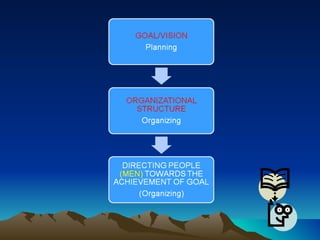
ORGANIZING determining what work or activities have to be done to accomplish the vision classifying the type of work needed and group work into manageable work units. assigning the work to individual  and delegate the appropriate authority designing a hierarchy of decision making relationship.
ORGANIZATION A whole consisting of unified parts acting in harmony to execute tasks to achieve goal both effectively  and efficiently.
“ People will be dramatically more effective, successful and fulfilled when they play to their strongest skills rather than attempting to improve their weaknesses. (strength revolution) Marcus Buckingham
 
Who will direct? What kind of a  man  he should be? A Leader or a Manager?
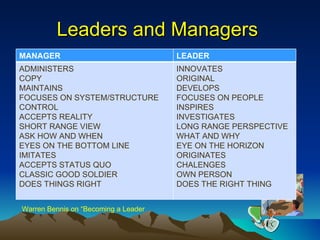
Leaders and Managers Warren Bennis on “Becoming a Leader MANAGER LEADER ADMINISTERS COPY MAINTAINS FOCUSES ON SYSTEM/STRUCTURE CONTROL ACCEPTS REALITY SHORT RANGE VIEW ASK HOW AND WHEN EYES ON THE BOTTOM LINE IMITATES ACCEPTS STATUS QUO CLASSIC GOOD SOLDIER DOES THINGS RIGHT INNOVATES ORIGINAL DEVELOPS FOCUSES ON PEOPLE INSPIRES INVESTIGATES LONG RANGE PERSPECTIVE WHAT AND WHY EYE ON THE HORIZON ORIGINATES CHALENGES OWN PERSON DOES THE RIGHT THING
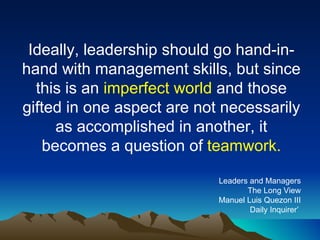
Ideally, leadership should go hand-in-hand with management skills, but since this is an  imperfect world  and those gifted in one aspect are not necessarily as accomplished in another, it becomes a question of  teamwork. Leaders and Managers The Long View Manuel Luis Quezon III Daily Inquirer’
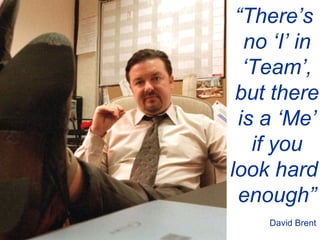
“ There’s  no ‘I’ in ‘ Team’, but there is a ‘Me’ if you look hard  enough” David Brent
why is  leadership so important?
“  The surplus society has a surplus of  similar companies, employing similar  people, with similar educational backgrounds,  working in similar jobs, coming up with  similar ideas, producing similar things,  with similar prices, warranties, and qualities.” Jonas Ridderstrale and Kjel Nordstrom Authors, Funky Business
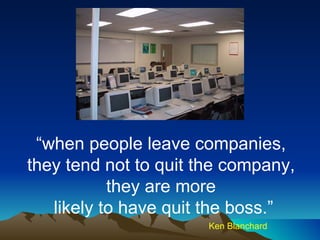
“ when people leave companies,  they tend not to quit the company,  they are more  likely to have quit the boss.” Ken Blanchard
“ The talented employee may join a company because of its charismatic leaders, its generous benefits, and its world-class training programs, but how long that employee stays and how productive he is while he is there is determined by his relationship with his  immediate supervisor "  Research from thousands of employees Marcus Buckingham ‘First Break All The Rules’
What does it takes to become a leader?
get that  ‘ vision  thing’
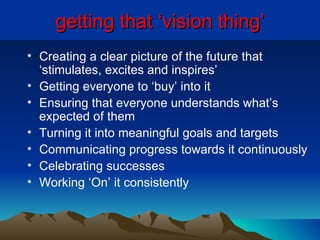
getting that ‘vision thing’ Creating a clear picture of the future that ‘stimulates, excites and inspires’ Getting everyone to ‘buy’ into it Ensuring that everyone understands what’s expected of them Turning it into meaningful goals and targets Communicating progress towards it continuously Celebrating successes Working ‘On’ it consistently
value  Your  values two
it’s not what you say… or how you say it!
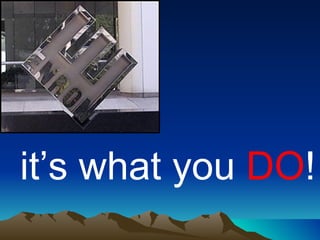
it’s what you  DO !
To reach  excellence  you must first be a leader of  good character
One of the ways to build trust is  to display  a  good sense of character  composed of Belief Values Skills Traits
Belief –  what we hold dear to us, convictions that you hold true regarding people, concepts or things.  Values-  are attitudes about the worth of people, concepts, or things.
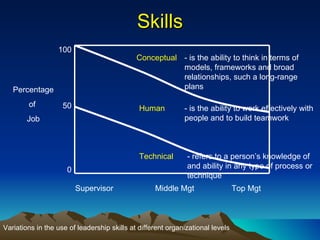
Skills Percentage of  Job 100 50 0 Supervisor Middle Mgt Top Mgt Variations in the use of leadership skills at different organizational levels Conceptual Human Technical - is the ability to think in terms of models, frameworks and broad relationships, such a long-range plans - is the ability to work effectively with people and to build teamwork - refers to a person’s knowledge of and ability in any type of process or technique
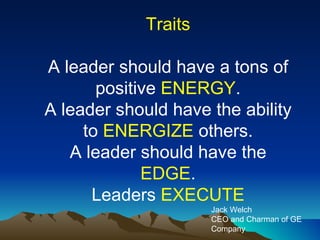
Traits A leader should have a tons of positive  ENERGY . A leader should have the ability to  ENERGIZE  others. A leader should have the  EDGE . Leaders  EXECUTE Jack Welch CEO and Charman of GE Company
To reach  excellence  you must first be a leader of  good character
turn your values into ‘preferred behaviours’
Leadership Behavior vs Leadership Traits  In the  leadership behavior  view, successful leadership depends more on appropriate behavior, skills, and actions, and less on personal traits Latent energy   (trait)  which provide latent potential vs  kinetic energy   (behaviors, skills, and actions)  which is the successful release and expressions of those traits Traits are fixed while behavior and skills can be learned and changed
be a role model “ Waste no more time arguing what a good man  should be. BE ONE” Marcus Aurelius
three get ‘engaged ’
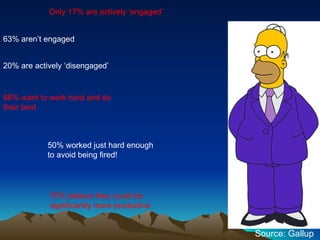
Only 17% are actively ‘engaged’ 63% aren’t engaged 20% are actively ‘disengaged’ 88% want to work hard and do  their best 50% worked just hard enough  to avoid being fired! 75% believe they could be  significantly more productive Source: Gallup
the benefits of an ‘engaged’ workforce
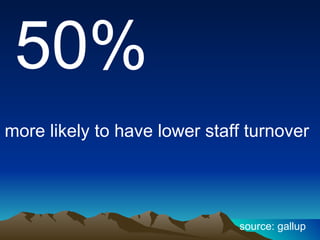
50% more likely to have lower staff turnover source: gallup
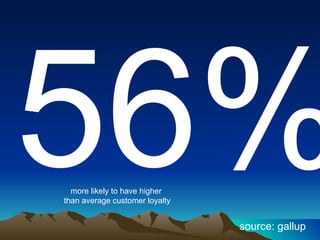
56% more likely to have higher  than average customer loyalty source: gallup
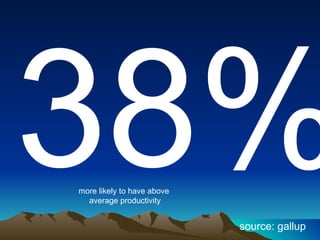
38% more likely to have above  average productivity source: gallup
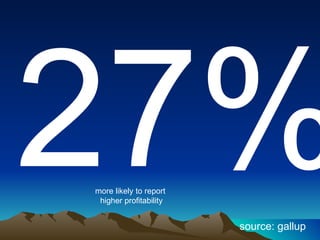
27% more likely to report  higher profitability source: gallup
“ Were fundamentally convinced that there is a connection between co-ownership, creativity, collaboration, and competitive advantage.”
You can liberate people and lead them, but you Can’t Make People Do Want They Don’t Want To Do.  As George Lois said, “Creativity is the defeat of habit by originality”. If you’re doing today what you did yesterday you are being boring.  Companies based on a strong idea grow with no idea where they’re going (That’s innovation, that’s adventure!). But companies based on no idea need to be told where to go and how to grow (that’s lawyers, that’s accountants, that’s consultants….. that’s not creative!)
God damn it, you will never get the purple heart hiding in a fox hole! FOLLOW ME Cpt. Henry P. Jim
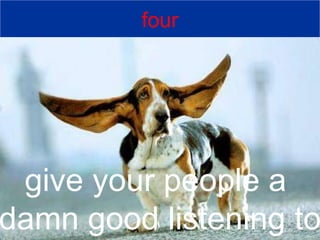
four give your people a  damn good listening to
ideas for action….
“ The best  engineers  sometimes come in  bodies that can’t  talk .” nolan bushnell, founder of atari
A lot of people have ideas, but there are few who decides to do something about them now, not tomorrow, not next week but today. The true entrepreneur is a doer not a dreamer. Nolan Bushnell Atari Video Games
set up feedback systems that  suit your team, not you ‘ beat the brainwashing’ – ask your newcomers to spot your business ‘stupidities’ ‘ kill a stupid rule” ‘ pizzas and problems’ resist recruiting ‘replicants’
be an  ‘ enemy of  the status quo ’ five
The only constant here on Earth is CHANGE.
Leadership Behavior 3 variables that affect determination of leadership behavior - leader - followers - situation Leadership is situational. There is no simple way to answer the question, “What makes a leader?” The key task for a leader is to recognize different situations and adapt to them on a conscious basis.
Knowledge of the “The Essence of Leader-Follower-Situation” framework is a Great advantage
Leadership types  According to the ways leaders approach to motivate subordinates According to the focal point of power According to leader use of consideration and structure According to the leader preference to matters  concerning people  or  production
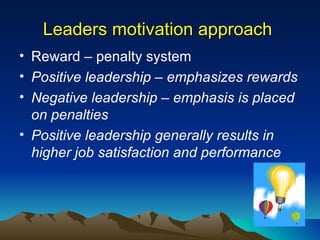
Leaders motivation approach  Reward – penalty system Positive leadership – emphasizes rewards Negative leadership – emphasis is placed on penalties Positive leadership generally results in higher job satisfaction and performance
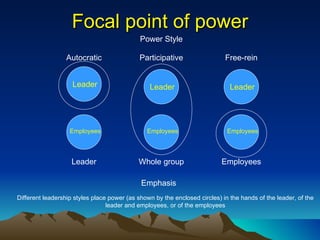
Focal point of power Power Style Autocratic Participative Free-rein Leader Leader Leader Employees Employees Employees Emphasis Leader Whole group Employees Different leadership styles place power (as shown by the enclosed circles) in the hands of the leader, of the leader and employees, or of the employees
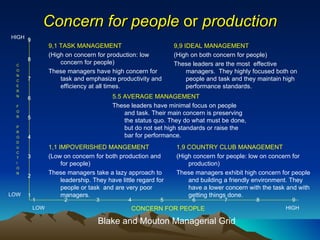
Concern for people  or  production 9,1 TASK MANAGEMENT (High on concern for production: low concern for people) These managers have high concern for task and emphasize productivity and efficiency at all times. 9,9 IDEAL MANAGEMENT (High on both concern for people) These leaders are the most  effective managers.  They highly focused both on people and task and they maintain high performance standards. 5.5 AVERAGE MANAGEMENT These leaders have minimal focus on people and task. Their main concern is preserving the status quo. They do what must be done, but do not set high standards or raise the bar for performance. 1,1 IMPOVERISHED MANGEMENT (Low on concern for both production and for people) These managers take a lazy approach to leadership. They have little regard for people or task  and are very poor managers. 1,9 COUNTRY CLUB MANAGEMENT (High concern for people: low on concern for production) These managers exhibit high concern for people and building a friendly environment. They have a lower concern with the task and with getting things done. C O N C E R N F O R P R O D U C T I O N CONCERN FOR PEOPLE Blake and Mouton Managerial Grid HIGH HIGH LOW LOW 9 8 7 6 5 4 3 2 1 1 2 3 4 5 6 7 8  9
Use of consideration and structure Employee – task orientation system Employee oriented leadership style – leaders secure somewhat higher performance and job satisfaction form employees; emphasis on human needs of employees Task oriented leadership style – leaders believe that they get results by keeping people constantly busy, ignoring personal issues and emotions, and urging them to produce
SITUATIONAL LEADERSHIP  AND   Contingency approach
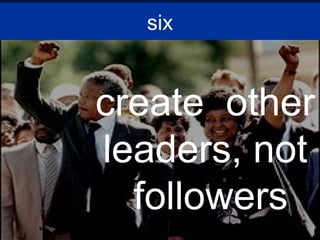
six create  other  leaders, not  followers
“ find great ideas,  exaggerate them, and spread them like hell  around the business  with the speed of light” Jan Carlzon, Head of Scandinavian Airlines
and finally….
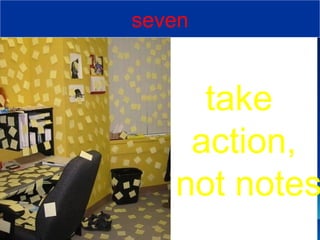
seven take  action, not notes
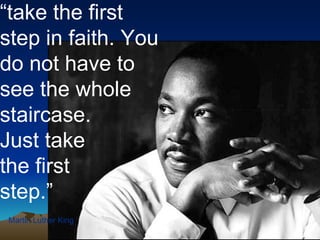
“ take the first  step in faith. You  do not have to  see the whole  staircase. Just take  the first  step.” Martin Luther King
we can  all be  leaders
don’t just stand there….. do something! dick dastardly

Leadership report

  • 1.
  • 2.
    REVIEW 1. Whatis Management? man age men +
  • 3.
    REVIEW What arethe 4 Functions of Management? P O L C
  • 4.
    PLANNING Blueprint to reach objectives. What do we want to do? Where are we in relation to that goal? Which factors will help or hinder us in reaching the goal? What alternatives are available to us to reach the goal and which one is the best?
  • 5.
  • 6.
    “ Vision without action is hallucination” Andy Law
  • 7.
    ORGANIZING determining whatwork or activities have to be done to accomplish the vision classifying the type of work needed and group work into manageable work units. assigning the work to individual and delegate the appropriate authority designing a hierarchy of decision making relationship.
  • 8.
    ORGANIZATION A wholeconsisting of unified parts acting in harmony to execute tasks to achieve goal both effectively and efficiently.
  • 9.
    “ People willbe dramatically more effective, successful and fulfilled when they play to their strongest skills rather than attempting to improve their weaknesses. (strength revolution) Marcus Buckingham
  • 10.
  • 11.
    Who will direct?What kind of a man he should be? A Leader or a Manager?
  • 12.
    Leaders and ManagersWarren Bennis on “Becoming a Leader MANAGER LEADER ADMINISTERS COPY MAINTAINS FOCUSES ON SYSTEM/STRUCTURE CONTROL ACCEPTS REALITY SHORT RANGE VIEW ASK HOW AND WHEN EYES ON THE BOTTOM LINE IMITATES ACCEPTS STATUS QUO CLASSIC GOOD SOLDIER DOES THINGS RIGHT INNOVATES ORIGINAL DEVELOPS FOCUSES ON PEOPLE INSPIRES INVESTIGATES LONG RANGE PERSPECTIVE WHAT AND WHY EYE ON THE HORIZON ORIGINATES CHALENGES OWN PERSON DOES THE RIGHT THING
  • 13.
    Ideally, leadership shouldgo hand-in-hand with management skills, but since this is an imperfect world and those gifted in one aspect are not necessarily as accomplished in another, it becomes a question of teamwork. Leaders and Managers The Long View Manuel Luis Quezon III Daily Inquirer’
  • 14.
    “ There’s no ‘I’ in ‘ Team’, but there is a ‘Me’ if you look hard enough” David Brent
  • 15.
    why is leadership so important?
  • 16.
    “ Thesurplus society has a surplus of similar companies, employing similar people, with similar educational backgrounds, working in similar jobs, coming up with similar ideas, producing similar things, with similar prices, warranties, and qualities.” Jonas Ridderstrale and Kjel Nordstrom Authors, Funky Business
  • 17.
    “ when peopleleave companies, they tend not to quit the company, they are more likely to have quit the boss.” Ken Blanchard
  • 18.
    “ The talentedemployee may join a company because of its charismatic leaders, its generous benefits, and its world-class training programs, but how long that employee stays and how productive he is while he is there is determined by his relationship with his immediate supervisor " Research from thousands of employees Marcus Buckingham ‘First Break All The Rules’
  • 19.
    What does ittakes to become a leader?
  • 20.
    get that ‘ vision thing’
  • 21.
    getting that ‘visionthing’ Creating a clear picture of the future that ‘stimulates, excites and inspires’ Getting everyone to ‘buy’ into it Ensuring that everyone understands what’s expected of them Turning it into meaningful goals and targets Communicating progress towards it continuously Celebrating successes Working ‘On’ it consistently
  • 22.
    value Your values two
  • 23.
    it’s not whatyou say… or how you say it!
  • 24.
  • 25.
    To reach excellence you must first be a leader of good character
  • 26.
    One of theways to build trust is to display a good sense of character composed of Belief Values Skills Traits
  • 27.
    Belief – what we hold dear to us, convictions that you hold true regarding people, concepts or things. Values- are attitudes about the worth of people, concepts, or things.
  • 28.
    Skills Percentage of Job 100 50 0 Supervisor Middle Mgt Top Mgt Variations in the use of leadership skills at different organizational levels Conceptual Human Technical - is the ability to think in terms of models, frameworks and broad relationships, such a long-range plans - is the ability to work effectively with people and to build teamwork - refers to a person’s knowledge of and ability in any type of process or technique
  • 29.
    Traits A leadershould have a tons of positive ENERGY . A leader should have the ability to ENERGIZE others. A leader should have the EDGE . Leaders EXECUTE Jack Welch CEO and Charman of GE Company
  • 30.
    To reach excellence you must first be a leader of good character
  • 31.
    turn your valuesinto ‘preferred behaviours’
  • 32.
    Leadership Behavior vsLeadership Traits In the leadership behavior view, successful leadership depends more on appropriate behavior, skills, and actions, and less on personal traits Latent energy (trait) which provide latent potential vs kinetic energy (behaviors, skills, and actions) which is the successful release and expressions of those traits Traits are fixed while behavior and skills can be learned and changed
  • 33.
    be a rolemodel “ Waste no more time arguing what a good man should be. BE ONE” Marcus Aurelius
  • 34.
  • 35.
    Only 17% areactively ‘engaged’ 63% aren’t engaged 20% are actively ‘disengaged’ 88% want to work hard and do their best 50% worked just hard enough to avoid being fired! 75% believe they could be significantly more productive Source: Gallup
  • 36.
    the benefits ofan ‘engaged’ workforce
  • 37.
    50% more likelyto have lower staff turnover source: gallup
  • 38.
    56% more likelyto have higher than average customer loyalty source: gallup
  • 39.
    38% more likelyto have above average productivity source: gallup
  • 40.
    27% more likelyto report higher profitability source: gallup
  • 41.
    “ Were fundamentallyconvinced that there is a connection between co-ownership, creativity, collaboration, and competitive advantage.”
  • 42.
    You can liberatepeople and lead them, but you Can’t Make People Do Want They Don’t Want To Do. As George Lois said, “Creativity is the defeat of habit by originality”. If you’re doing today what you did yesterday you are being boring. Companies based on a strong idea grow with no idea where they’re going (That’s innovation, that’s adventure!). But companies based on no idea need to be told where to go and how to grow (that’s lawyers, that’s accountants, that’s consultants….. that’s not creative!)
  • 43.
    God damn it,you will never get the purple heart hiding in a fox hole! FOLLOW ME Cpt. Henry P. Jim
  • 44.
    four give yourpeople a damn good listening to
  • 45.
  • 46.
    “ The best engineers sometimes come in bodies that can’t talk .” nolan bushnell, founder of atari
  • 47.
    A lot ofpeople have ideas, but there are few who decides to do something about them now, not tomorrow, not next week but today. The true entrepreneur is a doer not a dreamer. Nolan Bushnell Atari Video Games
  • 48.
    set up feedbacksystems that suit your team, not you ‘ beat the brainwashing’ – ask your newcomers to spot your business ‘stupidities’ ‘ kill a stupid rule” ‘ pizzas and problems’ resist recruiting ‘replicants’
  • 49.
    be an ‘ enemy of the status quo ’ five
  • 50.
    The only constanthere on Earth is CHANGE.
  • 51.
    Leadership Behavior 3variables that affect determination of leadership behavior - leader - followers - situation Leadership is situational. There is no simple way to answer the question, “What makes a leader?” The key task for a leader is to recognize different situations and adapt to them on a conscious basis.
  • 52.
    Knowledge of the“The Essence of Leader-Follower-Situation” framework is a Great advantage
  • 53.
    Leadership types According to the ways leaders approach to motivate subordinates According to the focal point of power According to leader use of consideration and structure According to the leader preference to matters concerning people or production
  • 54.
    Leaders motivation approach Reward – penalty system Positive leadership – emphasizes rewards Negative leadership – emphasis is placed on penalties Positive leadership generally results in higher job satisfaction and performance
  • 55.
    Focal point ofpower Power Style Autocratic Participative Free-rein Leader Leader Leader Employees Employees Employees Emphasis Leader Whole group Employees Different leadership styles place power (as shown by the enclosed circles) in the hands of the leader, of the leader and employees, or of the employees
  • 56.
    Concern for people or production 9,1 TASK MANAGEMENT (High on concern for production: low concern for people) These managers have high concern for task and emphasize productivity and efficiency at all times. 9,9 IDEAL MANAGEMENT (High on both concern for people) These leaders are the most effective managers. They highly focused both on people and task and they maintain high performance standards. 5.5 AVERAGE MANAGEMENT These leaders have minimal focus on people and task. Their main concern is preserving the status quo. They do what must be done, but do not set high standards or raise the bar for performance. 1,1 IMPOVERISHED MANGEMENT (Low on concern for both production and for people) These managers take a lazy approach to leadership. They have little regard for people or task and are very poor managers. 1,9 COUNTRY CLUB MANAGEMENT (High concern for people: low on concern for production) These managers exhibit high concern for people and building a friendly environment. They have a lower concern with the task and with getting things done. C O N C E R N F O R P R O D U C T I O N CONCERN FOR PEOPLE Blake and Mouton Managerial Grid HIGH HIGH LOW LOW 9 8 7 6 5 4 3 2 1 1 2 3 4 5 6 7 8 9
  • 57.
    Use of considerationand structure Employee – task orientation system Employee oriented leadership style – leaders secure somewhat higher performance and job satisfaction form employees; emphasis on human needs of employees Task oriented leadership style – leaders believe that they get results by keeping people constantly busy, ignoring personal issues and emotions, and urging them to produce
  • 58.
    SITUATIONAL LEADERSHIP AND Contingency approach
  • 59.
    six create other leaders, not followers
  • 60.
    “ find greatideas, exaggerate them, and spread them like hell around the business with the speed of light” Jan Carlzon, Head of Scandinavian Airlines
  • 61.
  • 62.
    seven take action, not notes
  • 63.
    “ take thefirst step in faith. You do not have to see the whole staircase. Just take the first step.” Martin Luther King
  • 64.
    we can all be leaders
  • 65.
    don’t just standthere….. do something! dick dastardly