Level 5 Award in Leadership and
Management Skills
Day 3
Bev Gilder
Objectives ….
• Review and assess the impact of the prevailing
leadership styles on your organisations values
and performance
• Understanding the use of leadership styles in a
range of situations
• Understand your leadership and management
style
• Understanding teams, how to build them and
how to ensure they are effective.
What is Leadership?
The capacity to establish direction, to influence
and align others towards a common aim, to
motivate and commit others to action, and to
encourage them to feel responsible for their
performance
CMI Checklist 041 October 2008
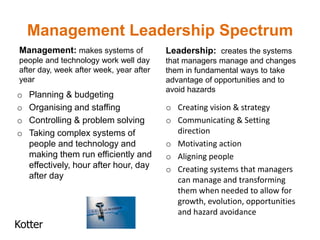
What is Management?
Management is about the day-to-day running of
a function and getting the right people in the
right place, with a focus upon implementation.
CMI Checklist 041 October 2008
Management Leadership Spectrum
Management: makes systems of
people and technology work well day
after day, week after week, year after
year
o Planning & budgeting
o Organising and staffing
o Controlling & problem solving
o Taking complex systems of
people and technology and
making them run efficiently and
effectively, hour after hour, day
after day
Leadership: creates the systems
that managers manage and changes
them in fundamental ways to take
advantage of opportunities and to
avoid hazards
o Creating vision & strategy
o Communicating & Setting
direction
o Motivating action
o Aligning people
o Creating systems that managers
can manage and transforming
them when needed to allow for
growth, evolution, opportunities
and hazard avoidance
Kotter
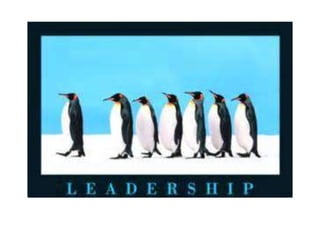
Leadership
Leaders are people who...
• Followers can trust, rely on and feel supported by
• Have a clear, exciting image of the future and can
lead the way through change
• Show commitment to, and generate enthusiasm for,
the organisation
• Are honest and open
• Spend time talking and listening to their people
• Give staff the room and the confidence to get their
job done
Exercise … in groups ..
• What are the key responsibilities of a
leadership role ?
• What skills do you need for these roles ?
• Think about communication, interpersonal
skills and your mind set.
Key Responsibilities of the
Leadership Role
• Taking responsibility
• Contributing to the overall
vision and goal
• Setting and providing guidance
on values
• Setting direction for significant
programmes or projects
• Stimulating innovation and
enterprise
• Anticipating, planning and
leading change
• Protecting the team and its
members
• Overcoming obstacles
• Delegating
• Setting objectives for teams
and individuals
• Communicating and motivating
• Supporting and developing
programmes, projects, teams
and individuals
• Modelling appropriate
behaviour
• Representing the team and
feeding back its experiences
and views
Leadership Styles
Overview of management theories-
Trait theories……
• What type of person makes a good leader
• Great leaders share a number of common personality
characteristics or "traits."
• Leadership an innate, instinctive quality
• Identified qualities that managers use e.g. integrity,
empathy, assertiveness and decision making.
• External behaviours are a result in what we think e.g
beliefs and values about the world and ourselves
• You’ve got it or you haven’t !!
Behavioural - What Does a Good
Leader Do?
• Focus on how leaders behave
• Do leaders dictate what needs to be done and
expect cooperation? Or do they involve their
teams in decision-making to encourage
acceptance and support?
• Kurt Lewin - Three types
- Autocratic.
- Democratic
- Laissez-faire
Contingency Theories – How Does the
situation influence great Leadership?
• Which leadership style is best in which
circumstance.
• People or task oriented ?
• Fiedler's Contingency Model.
• Hersey Blanchard – Situational leadership
Your Own Leadership Style
Activity
• Management and Leadership Styles
Questionnaire
• Any thoughts ……??
• Useful for your action planning ?
Leadership models !!......
Leadership Models
• Situational Leadership - Blanchard & Hersey
• Transformational Leadership - Bass & Avolio
• Primal Leadership – Golman and Boyaztis
• Leadership Continuum - Tannenbaum &
Schmidt
• Action Centred Leadership-John Adair
See www.businessballs.com
Adair’s Action Centred Leadership
Goleman and Boyatzis
• Visionary
• Coaching
• Affiliative
• Democratic
• Pace-setting
• Commanding
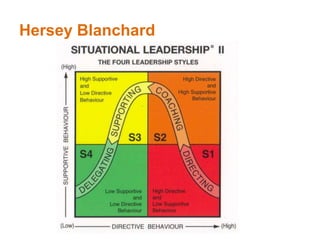
Hersey Blanchard
DIRECTIVE/ TELLER
Using your technical expertise
SELLING AND COACHING
Ideas and solutions
SUPPORTIVE AND PARTICIPATIVE
Tapping into peoples creativity
DELEGATING/ JOINT PROBLEM SOLVING
Allowing team to devise own ideas
Situational Leadership
Leadership - Continuum of Behaviour
Tannenbaum & Schmidt
Transformational Leadership
Group Activity –
Leadership in your Organisation
• Review the prevailing leadership styles in your
organisation, how do these relate to one of
the models discussed?
• How effective are the prevailing leadership
styles?
• What objective evidence is available to help
you make a judgement on their effectiveness?
Effective Team Working
Definition of a team
A team is a small number of people with
complementary skills who are committed to a
common purpose, performance goals and
approach for which they hold themselves
mutually accountable.
As defined by Katzenbach and Smith
Group Activity……..
What are 10 symptoms of poor teamwork ?
What do you see, hear and feel ?
Rank them 1-10 ( 1 = most important)
What can you do as team leader to resolve ?
Team effectiveness framework
• Goals
Clear, understood and communicated, SMART
• Roles
Understanding of individual’s tasks, responsibilities
and limits of authority
• Processes
Communication, decision making, problem solving
• Relationships
Feedback, integrity, trust, courtesy
Richard Beckhard (1972)
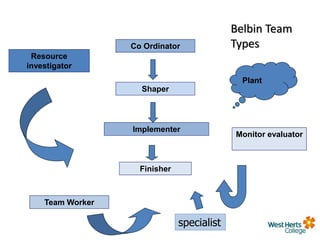
Team Roles
“a tendency to behave contribute and
interrelate with others in a particular way”
• Dr Meredith Belbin
http://www.youtube.com/watch?v=OOai178ZiiQ&featur
e=related
http://www.youtube.com/watch?v=9M0Al3Oi0-8
Belbin Self Perception Inventory
Team Problem solving exercise….
and review
Belbin Team
TypesCo Ordinator
Shaper
Implementer
Finisher
Resource
investigator
Monitor evaluator
Team Worker
Plant
specialist
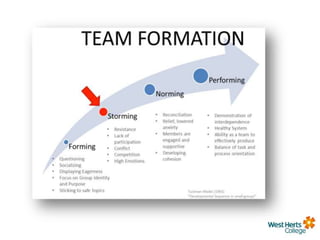
Tuckman - Stages of Team
Development
• Forming: testing and dependence
• Storming: inter-team conflict
• Norming: development of team cohesion
• Performing: high performance team!
• (Adjourning !)
http://www.youtube.com/watch?v=MNgzjYb02JM
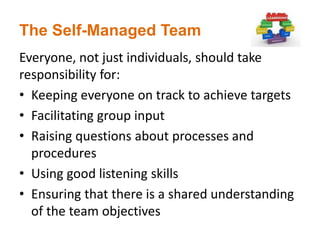
The Self-Managed Team
Everyone, not just individuals, should take
responsibility for:
• Keeping everyone on track to achieve targets
• Facilitating group input
• Raising questions about processes and
procedures
• Using good listening skills
• Ensuring that there is a shared understanding
of the team objectives
For Next Session
• Complete worksheet day 3 for yourself
• Complete Tuckman Team Assessment sheet.
• Will be about motivation, emotional
intelligence and employee engagement

L5 Award in L&M

  • 1.
    Level 5 Awardin Leadership and Management Skills Day 3 Bev Gilder
  • 2.
    Objectives …. • Reviewand assess the impact of the prevailing leadership styles on your organisations values and performance • Understanding the use of leadership styles in a range of situations • Understand your leadership and management style • Understanding teams, how to build them and how to ensure they are effective.
  • 3.
    What is Leadership? Thecapacity to establish direction, to influence and align others towards a common aim, to motivate and commit others to action, and to encourage them to feel responsible for their performance CMI Checklist 041 October 2008
  • 4.
    What is Management? Managementis about the day-to-day running of a function and getting the right people in the right place, with a focus upon implementation. CMI Checklist 041 October 2008
  • 5.
    Management Leadership Spectrum Management:makes systems of people and technology work well day after day, week after week, year after year o Planning & budgeting o Organising and staffing o Controlling & problem solving o Taking complex systems of people and technology and making them run efficiently and effectively, hour after hour, day after day Leadership: creates the systems that managers manage and changes them in fundamental ways to take advantage of opportunities and to avoid hazards o Creating vision & strategy o Communicating & Setting direction o Motivating action o Aligning people o Creating systems that managers can manage and transforming them when needed to allow for growth, evolution, opportunities and hazard avoidance Kotter
  • 6.
  • 8.
    Leaders are peoplewho... • Followers can trust, rely on and feel supported by • Have a clear, exciting image of the future and can lead the way through change • Show commitment to, and generate enthusiasm for, the organisation • Are honest and open • Spend time talking and listening to their people • Give staff the room and the confidence to get their job done
  • 9.
    Exercise … ingroups .. • What are the key responsibilities of a leadership role ? • What skills do you need for these roles ? • Think about communication, interpersonal skills and your mind set.
  • 10.
    Key Responsibilities ofthe Leadership Role • Taking responsibility • Contributing to the overall vision and goal • Setting and providing guidance on values • Setting direction for significant programmes or projects • Stimulating innovation and enterprise • Anticipating, planning and leading change • Protecting the team and its members • Overcoming obstacles • Delegating • Setting objectives for teams and individuals • Communicating and motivating • Supporting and developing programmes, projects, teams and individuals • Modelling appropriate behaviour • Representing the team and feeding back its experiences and views
  • 11.
  • 13.
    Overview of managementtheories- Trait theories…… • What type of person makes a good leader • Great leaders share a number of common personality characteristics or "traits." • Leadership an innate, instinctive quality • Identified qualities that managers use e.g. integrity, empathy, assertiveness and decision making. • External behaviours are a result in what we think e.g beliefs and values about the world and ourselves • You’ve got it or you haven’t !!
  • 14.
    Behavioural - WhatDoes a Good Leader Do? • Focus on how leaders behave • Do leaders dictate what needs to be done and expect cooperation? Or do they involve their teams in decision-making to encourage acceptance and support? • Kurt Lewin - Three types - Autocratic. - Democratic - Laissez-faire
  • 15.
    Contingency Theories –How Does the situation influence great Leadership? • Which leadership style is best in which circumstance. • People or task oriented ? • Fiedler's Contingency Model. • Hersey Blanchard – Situational leadership
  • 16.
    Your Own LeadershipStyle Activity • Management and Leadership Styles Questionnaire • Any thoughts ……?? • Useful for your action planning ?
  • 17.
  • 18.
    Leadership Models • SituationalLeadership - Blanchard & Hersey • Transformational Leadership - Bass & Avolio • Primal Leadership – Golman and Boyaztis • Leadership Continuum - Tannenbaum & Schmidt • Action Centred Leadership-John Adair See www.businessballs.com
  • 19.
  • 20.
    Goleman and Boyatzis •Visionary • Coaching • Affiliative • Democratic • Pace-setting • Commanding
  • 21.
  • 22.
    DIRECTIVE/ TELLER Using yourtechnical expertise SELLING AND COACHING Ideas and solutions SUPPORTIVE AND PARTICIPATIVE Tapping into peoples creativity DELEGATING/ JOINT PROBLEM SOLVING Allowing team to devise own ideas Situational Leadership
  • 23.
    Leadership - Continuumof Behaviour Tannenbaum & Schmidt
  • 24.
  • 25.
    Group Activity – Leadershipin your Organisation • Review the prevailing leadership styles in your organisation, how do these relate to one of the models discussed? • How effective are the prevailing leadership styles? • What objective evidence is available to help you make a judgement on their effectiveness?
  • 26.
  • 27.
    Definition of ateam A team is a small number of people with complementary skills who are committed to a common purpose, performance goals and approach for which they hold themselves mutually accountable. As defined by Katzenbach and Smith
  • 28.
    Group Activity…….. What are10 symptoms of poor teamwork ? What do you see, hear and feel ? Rank them 1-10 ( 1 = most important) What can you do as team leader to resolve ?
  • 29.
    Team effectiveness framework •Goals Clear, understood and communicated, SMART • Roles Understanding of individual’s tasks, responsibilities and limits of authority • Processes Communication, decision making, problem solving • Relationships Feedback, integrity, trust, courtesy Richard Beckhard (1972)
  • 30.
    Team Roles “a tendencyto behave contribute and interrelate with others in a particular way” • Dr Meredith Belbin http://www.youtube.com/watch?v=OOai178ZiiQ&featur e=related http://www.youtube.com/watch?v=9M0Al3Oi0-8
  • 31.
  • 32.
    Team Problem solvingexercise…. and review
  • 33.
  • 36.
    Tuckman - Stagesof Team Development • Forming: testing and dependence • Storming: inter-team conflict • Norming: development of team cohesion • Performing: high performance team! • (Adjourning !) http://www.youtube.com/watch?v=MNgzjYb02JM
  • 37.
    The Self-Managed Team Everyone,not just individuals, should take responsibility for: • Keeping everyone on track to achieve targets • Facilitating group input • Raising questions about processes and procedures • Using good listening skills • Ensuring that there is a shared understanding of the team objectives
  • 38.
    For Next Session •Complete worksheet day 3 for yourself • Complete Tuckman Team Assessment sheet. • Will be about motivation, emotional intelligence and employee engagement