COURSE:ME626
PRESENTATION ON:
COVARIANCE
BY:
MOHD BILAL NAIM SHAIKH
15MEIM030
M.TECH Ist year
WHAT IS COVARIANCE
• Degree to which the value of a dependent variable and an
associated independent variable moves in tandem.
• Measures the degree to which two variables are linearly associated.
• A large covariance can mean a strong relationship between variables
Consider two random variables ‘x’ and ‘y’ ,
x1 y1
x2 y2
x3 y3
. .
. .
. .
. .
xn yn
The extent to which two vary together can be measured by calculating covariance.
It is defined as: Cov(x,y)=E {[x-E(x)].[y-E(y)]}
Or Cov(x,y)= E(x.y)-E(x).E(y)
where E(x) & E(y) are expected values of x & y.
Y
X
INTERPRETING COVARIANCE
COVARIANCE BETWEEN TWO VARIABLES:
COV(X,Y) < 0
COV(X,Y) > 0
Zero covariance:
1. If two variables are independent,it means COV(X,Y) =0 .
2. However, zero covariance not necessarily mean that the variables are independent.
A nonlinear relationship can exist that still would result in a covariance value of zero.
Properties of Covariance:
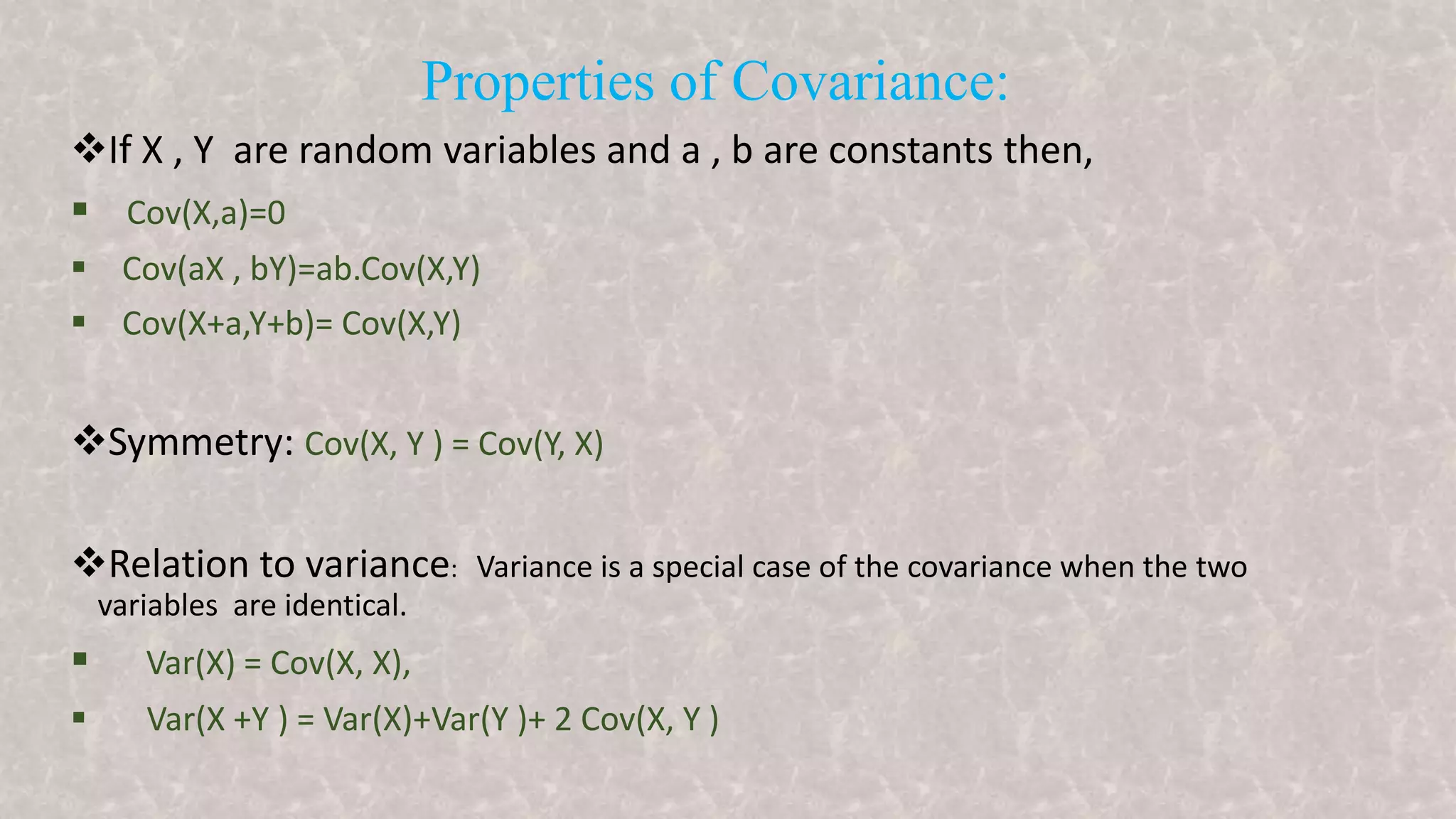
If X , Y are random variables and a , b are constants then,
 Cov(X,a)=0
 Cov(aX , bY)=ab.Cov(X,Y)
 Cov(X+a,Y+b)= Cov(X,Y)
Symmetry: Cov(X, Y ) = Cov(Y, X)
Relation to variance: Variance is a special case of the covariance when the two
variables are identical.
 Var(X) = Cov(X, X),
 Var(X +Y ) = Var(X)+Var(Y )+ 2 Cov(X, Y )
The Covariance Formula for sample:
Cov(X,Y) = Σ E((X-μ)E(Y-ν)) / n-1
where:
X is a random variable
E(X) = μ is the expected value (the mean) of the random variable X and
E(Y) = ν is the expected value (the mean) of the random variable Y
n = the number of items in the data sample
SOLVED EXAMPLE
Question: Calculate covariance for the following data set:
x: 2.1, 2.5, 3.6, 4.0
y: 8, 10, 12, 14
Solution : For given sample, n=4
Substitute the values into the formula and solve:
E(X) = μ = 11 and E(Y) = ν = 3.1
Cov(X,Y) = ΣE((X-μ)(Y-ν)) / n-1
= (2.1-3.1)(8-11)+(2.5-3.1)(10-11)+(3.6-3.1)(12-11)+(4.0-3.1)(14-11) /4-1
= (-1)(-3) + (-0.6)(-1)+(.5)(1)+(0.9)(3) / 3
= 3 + 0.6 + .5 + 2.7 / 3
= 2.267
The result is positive, meaning that the variables are positively related.
.
 A large covariance can mean a strong relationship
between variables. However, you can’t compare variances over data sets
with different scales (like pounds and inches)
 Covariance is affected by changes in the center (i.e. mean) or scale of the
variable i.e. a weak covariance in one data set may be a strong one in a
different data set with different scales.
 The main problem with covariance is that the wide range of results that it
takes on makes it hard to interpret .This wide range of values is cause by a
simple fact; The larger the X andY values, the larger the covariance
 It is not possible to determine the relative strength of the relationship from
COVARIANCE IN PROBABILITY

COVARIANCE IN PROBABILITY

  • 1.
    COURSE:ME626 PRESENTATION ON: COVARIANCE BY: MOHD BILALNAIM SHAIKH 15MEIM030 M.TECH Ist year
  • 2.
    WHAT IS COVARIANCE •Degree to which the value of a dependent variable and an associated independent variable moves in tandem. • Measures the degree to which two variables are linearly associated. • A large covariance can mean a strong relationship between variables
  • 3.
    Consider two randomvariables ‘x’ and ‘y’ , x1 y1 x2 y2 x3 y3 . . . . . . . . xn yn The extent to which two vary together can be measured by calculating covariance. It is defined as: Cov(x,y)=E {[x-E(x)].[y-E(y)]} Or Cov(x,y)= E(x.y)-E(x).E(y) where E(x) & E(y) are expected values of x & y. Y X
  • 4.
    INTERPRETING COVARIANCE COVARIANCE BETWEENTWO VARIABLES: COV(X,Y) < 0 COV(X,Y) > 0 Zero covariance: 1. If two variables are independent,it means COV(X,Y) =0 . 2. However, zero covariance not necessarily mean that the variables are independent. A nonlinear relationship can exist that still would result in a covariance value of zero.
  • 5.
    Properties of Covariance: IfX , Y are random variables and a , b are constants then,  Cov(X,a)=0  Cov(aX , bY)=ab.Cov(X,Y)  Cov(X+a,Y+b)= Cov(X,Y) Symmetry: Cov(X, Y ) = Cov(Y, X) Relation to variance: Variance is a special case of the covariance when the two variables are identical.  Var(X) = Cov(X, X),  Var(X +Y ) = Var(X)+Var(Y )+ 2 Cov(X, Y )
  • 6.
    The Covariance Formulafor sample: Cov(X,Y) = Σ E((X-μ)E(Y-ν)) / n-1 where: X is a random variable E(X) = μ is the expected value (the mean) of the random variable X and E(Y) = ν is the expected value (the mean) of the random variable Y n = the number of items in the data sample SOLVED EXAMPLE Question: Calculate covariance for the following data set: x: 2.1, 2.5, 3.6, 4.0 y: 8, 10, 12, 14 Solution : For given sample, n=4 Substitute the values into the formula and solve: E(X) = μ = 11 and E(Y) = ν = 3.1 Cov(X,Y) = ΣE((X-μ)(Y-ν)) / n-1 = (2.1-3.1)(8-11)+(2.5-3.1)(10-11)+(3.6-3.1)(12-11)+(4.0-3.1)(14-11) /4-1 = (-1)(-3) + (-0.6)(-1)+(.5)(1)+(0.9)(3) / 3 = 3 + 0.6 + .5 + 2.7 / 3 = 2.267 The result is positive, meaning that the variables are positively related.
  • 7.
    .  A largecovariance can mean a strong relationship between variables. However, you can’t compare variances over data sets with different scales (like pounds and inches)  Covariance is affected by changes in the center (i.e. mean) or scale of the variable i.e. a weak covariance in one data set may be a strong one in a different data set with different scales.  The main problem with covariance is that the wide range of results that it takes on makes it hard to interpret .This wide range of values is cause by a simple fact; The larger the X andY values, the larger the covariance  It is not possible to determine the relative strength of the relationship from