

ACTION RESEARCH
Aims of the session
• To share what is happening in ESF secondary
schools regarding Action Research
• To consider what Action Research could look
like across the Foundation
• To brainstorm possible projects at school or
Foundation level
Capability Frameworks
• T1.2 Develops self as
teacher;
• L1.1 Leads teaching
and learning
The What…
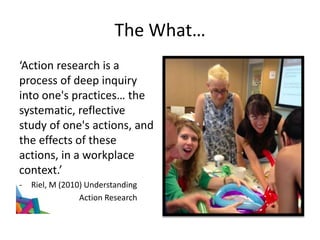
‘Action research is a
process of deep inquiry
into one's practices… the
systematic, reflective
study of one's actions, and
the effects of these
actions, in a workplace
context.’
- Riel, M (2010) Understanding
- Action Research
The What…
In ESF it is labelled many
ways:
• Action Research
• Teacher inquiry
• Rapid prototyping
And the Why…
To empower teachers to
innovate, collaborate and reflect through
school or Foundation-wide professional
learning communities that focus on
improving outcomes for all students.
- #ed.teach committee group
Over to you..
Why are you interested in Action Research?
What areas would you be interested in
investigating? Why?
Who would you like to research with?
The projects are useful to share at:
• staff professional development,
• inductions for new teachers and educational
assistants,
• parent workshops,
• workshops within and outside of the ESF
community to promote your school.
REVIEW OF SCHOOL INITIATIVES
KGV
• “Academic Practitioners” … all the vogue !
• Huge expertise in the school so let’s “own” the
research about our own organisation
• Link with HK Institute of Education
• Two projects this year:
• Online footprint (Ed)
• Data tracking (James Smith)
• Both are involving students, teachers, support
staff, outside research
Island School
“Varied, Personalised and I owned by you!”
Island School
Island Route
Academic Route
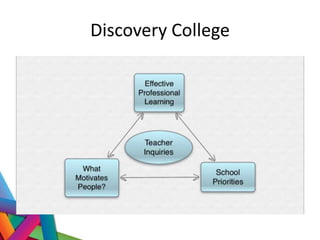
Discovery College
Maureen O’Rourke – EdPartnerships
Discovery College
Discovery College
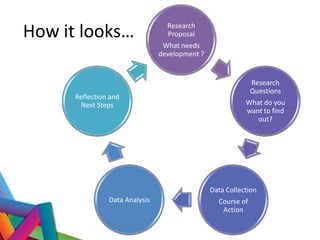
How it looks… Research
Proposal
What needs
development ?
Research
Questions
What do you
want to find
out?
Data Collection
Course of
Action
Data Analysis
Reflection and
Next Steps
WHAT IS THE OPPORTUNITY FOR
FOUNDATION-WIDE ACTION
RESEARCH?
PYP
• Learning centred around concept –
driven, inquiry led units
• Interdisciplinary
• Learner profile
Update from IBO about ATLs
Approaches to Learning
• Skills: Thinking /research/ communication/ social and self
management
Approaches to Teaching
• based on inquiry
• focused on conceptual understanding
• developed in local and global contexts
• focused on effective communication and collaboration
• differentiated to meet the needs of all learners
• informed by assessment, both formative and summative
What is the opportunity for
Foundation-wide Action Research?
• Concept based learning?
• Inquiry?
• Creativity?
• Other?
Designing your own action research
• Now you have time to design your own action
research project, that could be
personal, school based or Foundation–wide.
RESEARCH PURPOSE AND
RATIONALE
• Reflect on teaching and learning.
Where is there a common area
that needs development across
schools?
• What are you interested in
pursuing through action
research?
• Identify an area for improvement
in teaching and learning. Gather
information on the area and the
students involved.
• Who will you be working with-
the researchers and the study
group?
• What are the intended
outcomes/ solutions/ results?
RESEARCH QUESTION/S
• What do you want to find out?
Define the question/s and set
objectives.
• How will you collect the data-
what methodology?
• Is there anyone who needs to
know about the research Line
manager
• What resources do you need?
• How long will it take? Develop a
timeline of action.

Action research

  • 1.
  • 2.
    Aims of thesession • To share what is happening in ESF secondary schools regarding Action Research • To consider what Action Research could look like across the Foundation • To brainstorm possible projects at school or Foundation level
  • 3.
    Capability Frameworks • T1.2Develops self as teacher; • L1.1 Leads teaching and learning
  • 4.
    The What… ‘Action researchis a process of deep inquiry into one's practices… the systematic, reflective study of one's actions, and the effects of these actions, in a workplace context.’ - Riel, M (2010) Understanding - Action Research
  • 5.
    The What… In ESFit is labelled many ways: • Action Research • Teacher inquiry • Rapid prototyping
  • 6.
    And the Why… Toempower teachers to innovate, collaborate and reflect through school or Foundation-wide professional learning communities that focus on improving outcomes for all students. - #ed.teach committee group
  • 7.
    Over to you.. Whyare you interested in Action Research? What areas would you be interested in investigating? Why? Who would you like to research with?
  • 8.
    The projects areuseful to share at: • staff professional development, • inductions for new teachers and educational assistants, • parent workshops, • workshops within and outside of the ESF community to promote your school.
  • 9.
    REVIEW OF SCHOOLINITIATIVES
  • 11.
    KGV • “Academic Practitioners”… all the vogue ! • Huge expertise in the school so let’s “own” the research about our own organisation • Link with HK Institute of Education • Two projects this year: • Online footprint (Ed) • Data tracking (James Smith) • Both are involving students, teachers, support staff, outside research
  • 12.
  • 13.
  • 14.
  • 15.
    Maureen O’Rourke –EdPartnerships
  • 16.
  • 17.
  • 18.
    How it looks…Research Proposal What needs development ? Research Questions What do you want to find out? Data Collection Course of Action Data Analysis Reflection and Next Steps
  • 19.
    WHAT IS THEOPPORTUNITY FOR FOUNDATION-WIDE ACTION RESEARCH?
  • 20.
    PYP • Learning centredaround concept – driven, inquiry led units • Interdisciplinary • Learner profile
  • 21.
    Update from IBOabout ATLs Approaches to Learning • Skills: Thinking /research/ communication/ social and self management Approaches to Teaching • based on inquiry • focused on conceptual understanding • developed in local and global contexts • focused on effective communication and collaboration • differentiated to meet the needs of all learners • informed by assessment, both formative and summative
  • 22.
    What is theopportunity for Foundation-wide Action Research? • Concept based learning? • Inquiry? • Creativity? • Other?
  • 23.
    Designing your ownaction research • Now you have time to design your own action research project, that could be personal, school based or Foundation–wide.
  • 24.
    RESEARCH PURPOSE AND RATIONALE •Reflect on teaching and learning. Where is there a common area that needs development across schools? • What are you interested in pursuing through action research? • Identify an area for improvement in teaching and learning. Gather information on the area and the students involved. • Who will you be working with- the researchers and the study group? • What are the intended outcomes/ solutions/ results? RESEARCH QUESTION/S • What do you want to find out? Define the question/s and set objectives. • How will you collect the data- what methodology? • Is there anyone who needs to know about the research Line manager • What resources do you need? • How long will it take? Develop a timeline of action.