Presenters:
Brian Irwin, Head of Digital Capability
Dr Ian Glover, Senior Lecturer in Technology Enhanced Learning
Sheffield Hallam University
Discover how Sheffield Hallam University encouraged a more
consistent and deeper engagement with Technology Enhanced
Learning
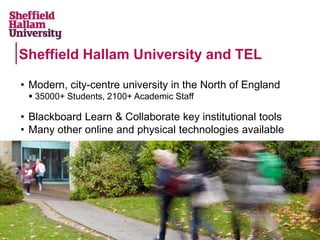
• Modern, city-centre university in the North of England
 35000+ Students, 2100+ Academic Staff
• Blackboard Learn & Collaborate key institutional tools
• Many other online and physical technologies available
Sheffield Hallam University and TEL
Context
• Build on 'Minimum Expectations of
e-Learning'
• Desire to transform student
experience through:
 More active learning
 More varied teaching approaches
 Better integration of technology
• National Changing the Learning
Landscape (CLL) initiative
provided an opportunity and
impetus
Project Approach
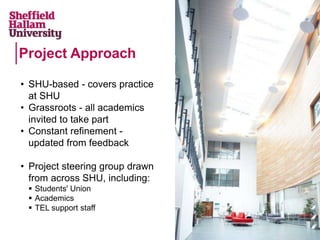
• SHU-based - covers practice
at SHU
• Grassroots - all academics
invited to take part
• Constant refinement -
updated from feedback
• Project steering group drawn
from across SHU, including:
 Students' Union
 Academics
 TEL support staff
• Survey -> Workshops -> Draft ‘menu’ and materials
• Follow-up staff and student workshops to generate
further information and refinements
Project Development
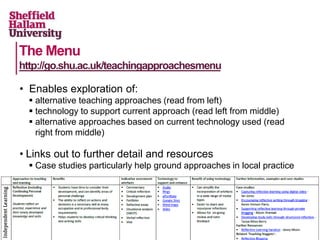
• Enables exploration of:
 alternative teaching approaches (read from left)
 technology to support current approach (read left from middle)
 alternative approaches based on current technology used (read
right from middle)
• Links out to further detail and resources
 Case studies particularly help ground approaches in local practice
The Menu
http://go.shu.ac.uk/teachingapproachesmenu
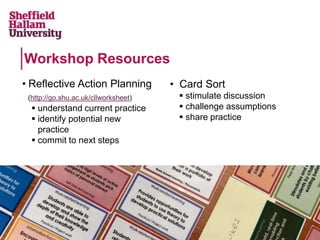
• Card Sort
 stimulate discussion
 challenge assumptions
 share practice
Workshop Resources
• Reflective Action Planning
(http://go.shu.ac.uk/cllworksheet)
 understand current practice
 identify potential new
practice
 commit to next steps
• Supporting Faculty TEL staff to
use in their work
• Workshops
 Open to all; or
 Tailored for specific groups
• Promotion through:
 Blogs
 Mail-outs
 Targeting influencers
 Presenting to course / subject
teams
 Faculty and SHU conferences
Internal Dissemination
• "...that combination of learning approach
+ TEL idea + outline of benefits + case
study is exactly what I’ve been looking
for. ... Probably one of the most useful
SHU documents I’ve come across in my
two years here."
- Lecturer in Sports Sciences, email
• Complete redesign of Information
Skills curriculum by library
• Integrated into curriculum
development materials
• Other universities interested in
translating materials to their contexts
Feedback and Impact
Lessons Learned
• Senior support vital to get the non-'innovators' involved
• Local focus helps people see value in project
• Avoid jargon to help get, and keep, people engaged
• Incorporate into formal course design and review processes
Contact
Brian Irwin: b.irwin@shu.ac.uk
Ian Glover: i.glover@shu.ac.uk
Blog: http://blogs.shu.ac.uk/shutel
Thank you for taking part in today’s session.
What it takes to drive successful technology adoption.
Thank you!
bbbb.blackboard.com/technology_adoption_series
Questions?
Email AskUs@blackboard.com
Download the free guide now!

Webinar Encouraging a Deeper Engagement with Technology Enhaced Learning

  • 1.
    Presenters: Brian Irwin, Headof Digital Capability Dr Ian Glover, Senior Lecturer in Technology Enhanced Learning Sheffield Hallam University Discover how Sheffield Hallam University encouraged a more consistent and deeper engagement with Technology Enhanced Learning
  • 2.
    • Modern, city-centreuniversity in the North of England  35000+ Students, 2100+ Academic Staff • Blackboard Learn & Collaborate key institutional tools • Many other online and physical technologies available Sheffield Hallam University and TEL
  • 3.
    Context • Build on'Minimum Expectations of e-Learning' • Desire to transform student experience through:  More active learning  More varied teaching approaches  Better integration of technology • National Changing the Learning Landscape (CLL) initiative provided an opportunity and impetus
  • 4.
    Project Approach • SHU-based- covers practice at SHU • Grassroots - all academics invited to take part • Constant refinement - updated from feedback • Project steering group drawn from across SHU, including:  Students' Union  Academics  TEL support staff
  • 5.
    • Survey ->Workshops -> Draft ‘menu’ and materials • Follow-up staff and student workshops to generate further information and refinements Project Development
  • 6.
    • Enables explorationof:  alternative teaching approaches (read from left)  technology to support current approach (read left from middle)  alternative approaches based on current technology used (read right from middle) • Links out to further detail and resources  Case studies particularly help ground approaches in local practice The Menu http://go.shu.ac.uk/teachingapproachesmenu
  • 7.
    • Card Sort stimulate discussion  challenge assumptions  share practice Workshop Resources • Reflective Action Planning (http://go.shu.ac.uk/cllworksheet)  understand current practice  identify potential new practice  commit to next steps
  • 8.
    • Supporting FacultyTEL staff to use in their work • Workshops  Open to all; or  Tailored for specific groups • Promotion through:  Blogs  Mail-outs  Targeting influencers  Presenting to course / subject teams  Faculty and SHU conferences Internal Dissemination
  • 9.
    • "...that combinationof learning approach + TEL idea + outline of benefits + case study is exactly what I’ve been looking for. ... Probably one of the most useful SHU documents I’ve come across in my two years here." - Lecturer in Sports Sciences, email • Complete redesign of Information Skills curriculum by library • Integrated into curriculum development materials • Other universities interested in translating materials to their contexts Feedback and Impact
  • 10.
    Lessons Learned • Seniorsupport vital to get the non-'innovators' involved • Local focus helps people see value in project • Avoid jargon to help get, and keep, people engaged • Incorporate into formal course design and review processes
  • 11.
    Contact Brian Irwin: b.irwin@shu.ac.uk IanGlover: i.glover@shu.ac.uk Blog: http://blogs.shu.ac.uk/shutel
  • 12.
    Thank you fortaking part in today’s session. What it takes to drive successful technology adoption. Thank you! bbbb.blackboard.com/technology_adoption_series Questions? Email AskUs@blackboard.com Download the free guide now!

Editor's Notes

  • #2 Title slide
  • #4 Want to shift from a primarily lecturer focused model to active and student focused. SHU results generally strong, but if not improving then falling back relatively Desire to build employability / soft skills as part of all courses, typical lectures and group tutorials limits this. Lots of factors contribute to continued reliance on familiar approaches: Don't know what else is possible - sharing practice seems limited Don't have time to make changes Don't have confidence to try out new things (which may not work) "It was good enough for me, so it it's good enough for them" Physical spaces and timetabling restrict creativity Students expect lectures at university Large range of technology is available but generally underused: Blackboard VLE often just a file repository - minimum expectations of elearning (2013) helped improve this, some faculties developed an expanded version. Blackboard Collaborate still 'under the radar' despite people asking for this type of product Clickers used in a few areas Interest developing in Google Apps, but few people using them PebblePad in a couple of areas for several years, recently made available to all MyKnowledgeMap, Augmented Reality, mobile here and there. (Mobile usually not making full use of capabilities, just a more convenient laptop) External services - social media, TedEd, video, non-powerpoint presentation tools, etc. - used by some. Pockets of outstanding practice - generally the same people or subject groups, though.
  • #5 Wanted to draw out the varied and highly effective practice happening across the institution and use this as the basis of a project to encourage staff to think about their current teaching and tech. use, identify changes and put them into practice. All staff encouraged to take part at every stage - calls for participation through blog, word of mouth, faculty contacts, email, etc. Involvement by key stakeholders in directing project, including students both through SU and directly (Holly and Nick & James).
  • #6 Survey - 3 Qs: What do you currently do, what works well, what not so well? No specific technology focus but encouraged to share anyway Information collated by me and Stuart, supplemented by what we were already aware of and some things that lecturers had expressed a desire in. 'Framework' drafted and taken to staff workshops > 100 participants (including many who don't usually engage with us) 'Framework' renamed to 'menu' - less formal and procedural sounding. Idea to encourage people to view the resource as something that you use to find something that you would like. Supporting materials developed - case studies, 'teaching nuggets', workshop activities, blog posts,etc. Another round of workshops (initially aimed at staff, but SU ran own version for students too after they saw the value of ours) to verify that the materials were appropriate and useful. Also helped identify other aspects that could be changed or added.
  • #11 Importance of process needs to be made clear by senior faculty and institutional staff - helps get time during away days, inclusion in course design / revalidation process, time out for staff to attend workshops, etc. That people might know some names on the menu can't be underestimated, makes it seem acheivable (they are working in the same or very similar environment with many of the same challenges) and can be another point of contact. Also encourages staff to contribute as it will help raise their own profile. Shows that we aren't demanding a complete overhaul of practice. We know (most!) of the technical and pedagogical jargon, but it puts lots of staff off - they don't want to learn a whole new, complicated vocabulary to get involved. Simplification helped staff engage and allowed us to get students involved too. Stripped the language back to the basics, e.g. don't use 'Pedagogy' in any of the materials.
  • #13 Penny to end session.