What’s your current process for
course design?
Type your answer in the chat room.
Course Design for Blended Learning
An ACS Blended Learning Webinar
Rebecca Frost Davis
September 14, 2012
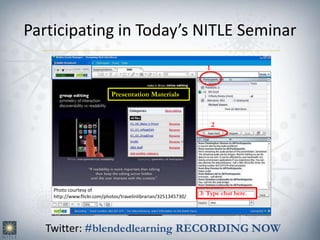
Participating in Today’s NITLE Seminar
Photo courtesy of
http://www.flickr.com/photos/travelinlibrarian/3251345730/
Twitter: #blendedlearning RECORDING NOW
Presentation Materials
1
2
3: Type chat here.
Recent & Upcoming NITLE Seminars
• Blended Learning in a Liberal Arts Setting, September 12
• Designing Online Resources to Enhance In-Class Interactions,
September 20, 4-5 pm EDT
– Integrating online & face-to-face for blended learning in
liberal arts context.
• FemTechNet: The First DOCC/A* Feminist MOOC, October 4,
4-5 pm EDT
– Distributed Online Collaborative Course: Join this
networked learning experiment.
• http://www.nitle.org/events/events_list.php
Seminar Goals
• Learn about course design process for blended
learning
• Discuss how blended learning fits the liberal
arts environment
• Examine case studies for best practices
• Practice course design process for blended
learning
Defining Blended Learning
• “computer-mediated instruction that is
combined with the interpersonal and
interactive pedagogy that distinguishes the
ACS institutions”. (from the ACS CFP for
blended learning grants)
• http://colleges.org/blended_learning/index.html
University of Central Florida
• “a portion of the traditional face-to-face
instruction is replaced by web-based online
learning” BlendKit Reader: Chapter 1
• Shortage of classroom space prompted move
online
• http://blended.online.ucf.edu/blendkit-
course-blendkit-reader-chapter-1/
Bryn Mawr College
• Courses in which students both participate in
face-to-face classes and work through
computer-based, interactive tutorials and
quizzes that provide customized learning and
instant feedback
EXAMPLES OF BLENDED LEARNING
Our Case Studies
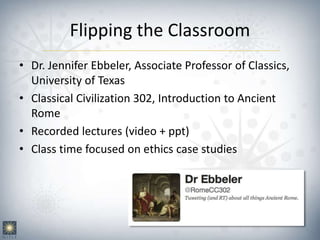
Flipping the Classroom
• Dr. Jennifer Ebbeler, Associate Professor of Classics,
University of Texas
• Classical Civilization 302, Introduction to Ancient
Rome
• Recorded lectures (video + ppt)
• Class time focused on ethics case studies
Blended Learning in a Liberal Arts Setting
• Bryn Mawr College, NGLC grant-funded program
• “Using Blended Learning in a Liberal Arts
Environment to Improve Developmental and
Gatekeeper STEM Course Completion, Persistence,
and College Completion”
• Computer-based, interactive tutorials and quizzes
that provide customized learning and instant
feedback, e.g., Open Learning Initiative modules
• http://nextgenlearning.blogs.brynmawr.edu/
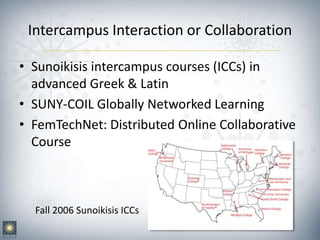
Intercampus Interaction or Collaboration
• Sunoikisis intercampus courses (ICCs) in
advanced Greek & Latin
• SUNY-COIL Globally Networked Learning
• FemTechNet: Distributed Online Collaborative
Course
Fall 2006 Sunoikisis ICCs
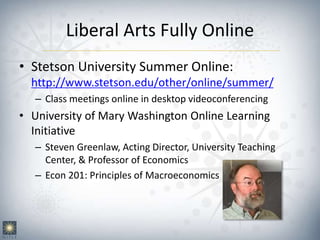
Liberal Arts Fully Online
• Stetson University Summer Online:
http://www.stetson.edu/other/online/summer/
– Class meetings online in desktop videoconferencing
• University of Mary Washington Online Learning
Initiative
– Steven Greenlaw, Acting Director, University Teaching
Center, & Professor of Economics
– Econ 201: Principles of Macroeconomics
What’s your current process for
course design?
Type your answer in the chat room.
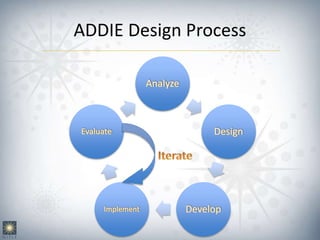
ADDIE Design Process
Backwards Design
1. Identify desired results
2. Determine Acceptable Evidence
3. Plan Learning Experiences
• Understanding by Design, Grant Wiggins and
Jay McTighe
– Cf. Mark Sample’s “Planning a Class with Backward
Design”
Design for Flexible Learning
• Networked Learning
• Connectivism: A Learning Theory for the
Digital Age.” elearnspace, December 12, 2004.
• Creation of a knowledge ecology where the
learner can find their own pathways.
• Networks of learners and content
DDIE Analysis: Why blend?
• Why do you want to do this?
• What are your pedagogical goals?
• What advantages do you expect that blending
will give you?
• Answer in the chat room.
Save Money or Resources
• Save money: fiscal motivations at institutional
level:
– compensate for limited classroom space (UCF)
– effective use of information technology to
improve student learning outcomes and reduce
the cost of higher education National Center for
Academic Transformation
• Student convenience
Improve Student Learning
• Department of Education, Evaluation of
Evidence-Based Practices in Online Learning :
A Meta-Analysis and Review of Online
Learning Studies
• Enhance student engagement, e.g., getting
the quiet ones engaged with online discussion
or addressing multiple learning styles
• Student performance analytics & intentional
learning (metacognition)
Melt Space-Time Restrictions
• Free up more time for more meaningful
interactions
• Expand the classroom
• Bring more real world examples in the
classroom
• Multiple and global perspectives
• Navigate successfully in a digital world
Liberal Arts Interaction as Goal
• “combined with the interpersonal and
interactive pedagogy that distinguishes the
ACS institutions”
• What kind of interaction do you want to
preserve?
• Can the blended elements also promote
interaction and active learning?
Mary Washington University
1. Define liberal arts values
2. Develop process to ensure values are
integrated
3. Faculty development: thinking about
teaching and learning
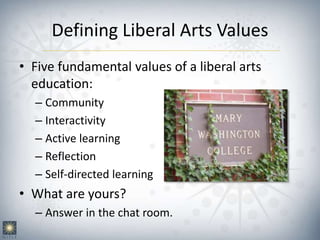
Defining Liberal Arts Values
• Five fundamental values of a liberal arts
education:
– Community
– Interactivity
– Active learning
– Reflection
– Self-directed learning
• What are yours?
– Answer in the chat room.
STEP 2: DESIGN
A DIE
Econ 201: Principles of Macroeconomics
• Online Course Proposal
– Course description
– Learning Objectives
– Online Learning Environment Description
– How will this course will meet the Mary
Washington liberal arts values?
– How do course learning goals connect to Mary
Washington liberal arts values?
DESIGN PRINCIPLES
A DIE
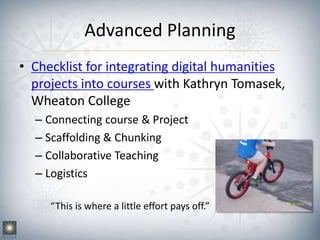
Advanced Planning
• Checklist for integrating digital humanities
projects into courses with Kathryn Tomasek,
Wheaton College
– Connecting course & Project
– Scaffolding & Chunking
– Collaborative Teaching
– Logistics
“This is where a little effort pays off.”
Flexibility
• Current academic structures from industrial
age
– Cathy Davidson and David Goldberg, Future of
Learning Institutions in a Digital Age
• What structures might blended learning help
you escape?
• What structures do you have to keep in mind?
Shifting Coverage of Content
• Making time for learning new platforms
• Making time for experiential or problem-
based learning
• Content determines timing
• Online learning modules: students determine
coverage
• Course work & time expectations?
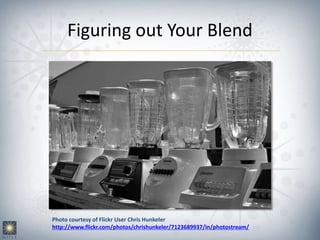
Figuring out Your Blend
Photo courtesy of Flickr User Chris Hunkeler
http://www.flickr.com/photos/chrishunkeler/7123689937/in/photostream/
Blend Options
• Asynchronous modules
• Synchronous online interaction
• Threaded discussion
• Digital project work
• Online elements for self-study
• Modules with built-in feedback
• Assessments
• And many more . . .
BlendKit
• Create ideal learning plan
• Analyze the elements that can be delivered online
without compromising effectiveness
• http://blended.online.ucf.edu/blendkit-course-diy-
project-tasks/
• BlendKit2012 MOOC
– Monday, September 24 to Monday, October 29, 2012
– http://blended.online.ucf.edu/blendkit-course/
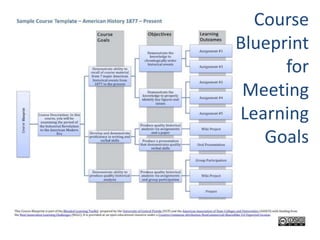
Course Blueprint
Course
Blueprint
for
Meeting
Learning
Goals
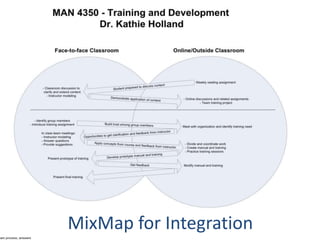
MixMap for Integration
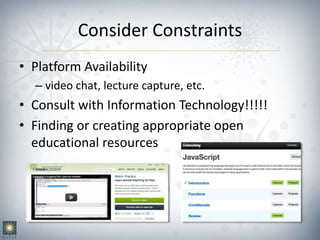
Consider Constraints
• Platform Availability
– video chat, lecture capture, etc.
• Consult with Information Technology!!!!!
• Finding or creating appropriate open
educational resources
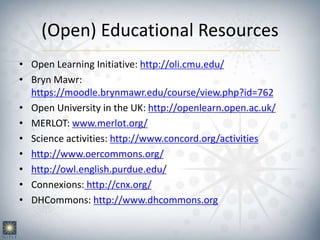
(Open) Educational Resources
• Open Learning Initiative: http://oli.cmu.edu/
• Bryn Mawr:
https://moodle.brynmawr.edu/course/view.php?id=762
• Open University in the UK: http://openlearn.open.ac.uk/
• MERLOT: www.merlot.org/
• Science activities: http://www.concord.org/activities
• http://www.oercommons.org/
• http://owl.english.purdue.edu/
• Connexions: http://cnx.org/
• DHCommons: http://www.dhcommons.org
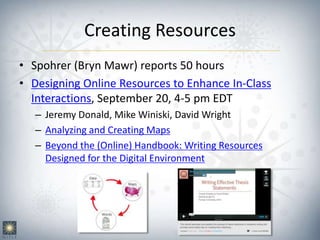
Creating Resources
• Spohrer (Bryn Mawr) reports 50 hours
• Designing Online Resources to Enhance In-Class
Interactions, September 20, 4-5 pm EDT
– Jeremy Donald, Mike Winiski, David Wright
– Analyzing and Creating Maps
– Beyond the (Online) Handbook: Writing Resources
Designed for the Digital Environment
ADD : Plan for Assessment & Iteration
• Talk to local assessment experts
• Figure out what you want to evaluate in
advance
• Make room for risk-taking
– Middlebury College’s pass-fail course evaluations
– Grants
– Work with center for teaching & learning
• Repeat and Tweak
ADD E: Implementation
• Transparency with students
• Avoid add-on model
• Ensure coherence between F2F & online
• Avoid direct conversion without recasting
• Technology to promote learning not spectacle
• Charles Henderson, Melissa Dancy, and Magdalena
Niewiadomska-Bugaj. “Use of Research-based Instructional
Strategies in Introductory Physics: Where Do Faculty Leave the
Innovation-decision Process?” Physical Review Special
Topics—Physics Education Research 8, no. 020104 (2012): 1–
15.

Course Design for Blended Learning

  • 1.
    What’s your currentprocess for course design? Type your answer in the chat room.
  • 2.
    Course Design forBlended Learning An ACS Blended Learning Webinar Rebecca Frost Davis September 14, 2012
  • 3.
    Participating in Today’sNITLE Seminar Photo courtesy of http://www.flickr.com/photos/travelinlibrarian/3251345730/ Twitter: #blendedlearning RECORDING NOW Presentation Materials 1 2 3: Type chat here.
  • 4.
    Recent & UpcomingNITLE Seminars • Blended Learning in a Liberal Arts Setting, September 12 • Designing Online Resources to Enhance In-Class Interactions, September 20, 4-5 pm EDT – Integrating online & face-to-face for blended learning in liberal arts context. • FemTechNet: The First DOCC/A* Feminist MOOC, October 4, 4-5 pm EDT – Distributed Online Collaborative Course: Join this networked learning experiment. • http://www.nitle.org/events/events_list.php
  • 5.
    Seminar Goals • Learnabout course design process for blended learning • Discuss how blended learning fits the liberal arts environment • Examine case studies for best practices • Practice course design process for blended learning
  • 6.
    Defining Blended Learning •“computer-mediated instruction that is combined with the interpersonal and interactive pedagogy that distinguishes the ACS institutions”. (from the ACS CFP for blended learning grants) • http://colleges.org/blended_learning/index.html
  • 7.
    University of CentralFlorida • “a portion of the traditional face-to-face instruction is replaced by web-based online learning” BlendKit Reader: Chapter 1 • Shortage of classroom space prompted move online • http://blended.online.ucf.edu/blendkit- course-blendkit-reader-chapter-1/
  • 8.
    Bryn Mawr College •Courses in which students both participate in face-to-face classes and work through computer-based, interactive tutorials and quizzes that provide customized learning and instant feedback
  • 9.
    EXAMPLES OF BLENDEDLEARNING Our Case Studies
  • 10.
    Flipping the Classroom •Dr. Jennifer Ebbeler, Associate Professor of Classics, University of Texas • Classical Civilization 302, Introduction to Ancient Rome • Recorded lectures (video + ppt) • Class time focused on ethics case studies
  • 11.
    Blended Learning ina Liberal Arts Setting • Bryn Mawr College, NGLC grant-funded program • “Using Blended Learning in a Liberal Arts Environment to Improve Developmental and Gatekeeper STEM Course Completion, Persistence, and College Completion” • Computer-based, interactive tutorials and quizzes that provide customized learning and instant feedback, e.g., Open Learning Initiative modules • http://nextgenlearning.blogs.brynmawr.edu/
  • 12.
    Intercampus Interaction orCollaboration • Sunoikisis intercampus courses (ICCs) in advanced Greek & Latin • SUNY-COIL Globally Networked Learning • FemTechNet: Distributed Online Collaborative Course Fall 2006 Sunoikisis ICCs
  • 13.
    Liberal Arts FullyOnline • Stetson University Summer Online: http://www.stetson.edu/other/online/summer/ – Class meetings online in desktop videoconferencing • University of Mary Washington Online Learning Initiative – Steven Greenlaw, Acting Director, University Teaching Center, & Professor of Economics – Econ 201: Principles of Macroeconomics
  • 14.
    What’s your currentprocess for course design? Type your answer in the chat room.
  • 15.
  • 16.
    Backwards Design 1. Identifydesired results 2. Determine Acceptable Evidence 3. Plan Learning Experiences • Understanding by Design, Grant Wiggins and Jay McTighe – Cf. Mark Sample’s “Planning a Class with Backward Design”
  • 17.
    Design for FlexibleLearning • Networked Learning • Connectivism: A Learning Theory for the Digital Age.” elearnspace, December 12, 2004. • Creation of a knowledge ecology where the learner can find their own pathways. • Networks of learners and content
  • 18.
    DDIE Analysis: Whyblend? • Why do you want to do this? • What are your pedagogical goals? • What advantages do you expect that blending will give you? • Answer in the chat room.
  • 19.
    Save Money orResources • Save money: fiscal motivations at institutional level: – compensate for limited classroom space (UCF) – effective use of information technology to improve student learning outcomes and reduce the cost of higher education National Center for Academic Transformation • Student convenience
  • 20.
    Improve Student Learning •Department of Education, Evaluation of Evidence-Based Practices in Online Learning : A Meta-Analysis and Review of Online Learning Studies • Enhance student engagement, e.g., getting the quiet ones engaged with online discussion or addressing multiple learning styles • Student performance analytics & intentional learning (metacognition)
  • 21.
    Melt Space-Time Restrictions •Free up more time for more meaningful interactions • Expand the classroom • Bring more real world examples in the classroom • Multiple and global perspectives • Navigate successfully in a digital world
  • 22.
    Liberal Arts Interactionas Goal • “combined with the interpersonal and interactive pedagogy that distinguishes the ACS institutions” • What kind of interaction do you want to preserve? • Can the blended elements also promote interaction and active learning?
  • 23.
    Mary Washington University 1.Define liberal arts values 2. Develop process to ensure values are integrated 3. Faculty development: thinking about teaching and learning
  • 24.
    Defining Liberal ArtsValues • Five fundamental values of a liberal arts education: – Community – Interactivity – Active learning – Reflection – Self-directed learning • What are yours? – Answer in the chat room.
  • 25.
  • 26.
    Econ 201: Principlesof Macroeconomics • Online Course Proposal – Course description – Learning Objectives – Online Learning Environment Description – How will this course will meet the Mary Washington liberal arts values? – How do course learning goals connect to Mary Washington liberal arts values?
  • 27.
  • 28.
    Advanced Planning • Checklistfor integrating digital humanities projects into courses with Kathryn Tomasek, Wheaton College – Connecting course & Project – Scaffolding & Chunking – Collaborative Teaching – Logistics “This is where a little effort pays off.”
  • 29.
    Flexibility • Current academicstructures from industrial age – Cathy Davidson and David Goldberg, Future of Learning Institutions in a Digital Age • What structures might blended learning help you escape? • What structures do you have to keep in mind?
  • 30.
    Shifting Coverage ofContent • Making time for learning new platforms • Making time for experiential or problem- based learning • Content determines timing • Online learning modules: students determine coverage • Course work & time expectations?
  • 31.
    Figuring out YourBlend Photo courtesy of Flickr User Chris Hunkeler http://www.flickr.com/photos/chrishunkeler/7123689937/in/photostream/
  • 32.
    Blend Options • Asynchronousmodules • Synchronous online interaction • Threaded discussion • Digital project work • Online elements for self-study • Modules with built-in feedback • Assessments • And many more . . .
  • 33.
    BlendKit • Create ideallearning plan • Analyze the elements that can be delivered online without compromising effectiveness • http://blended.online.ucf.edu/blendkit-course-diy- project-tasks/ • BlendKit2012 MOOC – Monday, September 24 to Monday, October 29, 2012 – http://blended.online.ucf.edu/blendkit-course/
  • 34.
  • 35.
  • 36.
    Consider Constraints • PlatformAvailability – video chat, lecture capture, etc. • Consult with Information Technology!!!!! • Finding or creating appropriate open educational resources
  • 37.
    (Open) Educational Resources •Open Learning Initiative: http://oli.cmu.edu/ • Bryn Mawr: https://moodle.brynmawr.edu/course/view.php?id=762 • Open University in the UK: http://openlearn.open.ac.uk/ • MERLOT: www.merlot.org/ • Science activities: http://www.concord.org/activities • http://www.oercommons.org/ • http://owl.english.purdue.edu/ • Connexions: http://cnx.org/ • DHCommons: http://www.dhcommons.org
  • 38.
    Creating Resources • Spohrer(Bryn Mawr) reports 50 hours • Designing Online Resources to Enhance In-Class Interactions, September 20, 4-5 pm EDT – Jeremy Donald, Mike Winiski, David Wright – Analyzing and Creating Maps – Beyond the (Online) Handbook: Writing Resources Designed for the Digital Environment
  • 39.
    ADD : Planfor Assessment & Iteration • Talk to local assessment experts • Figure out what you want to evaluate in advance • Make room for risk-taking – Middlebury College’s pass-fail course evaluations – Grants – Work with center for teaching & learning • Repeat and Tweak
  • 40.
    ADD E: Implementation •Transparency with students • Avoid add-on model • Ensure coherence between F2F & online • Avoid direct conversion without recasting • Technology to promote learning not spectacle • Charles Henderson, Melissa Dancy, and Magdalena Niewiadomska-Bugaj. “Use of Research-based Instructional Strategies in Introductory Physics: Where Do Faculty Leave the Innovation-decision Process?” Physical Review Special Topics—Physics Education Research 8, no. 020104 (2012): 1– 15.