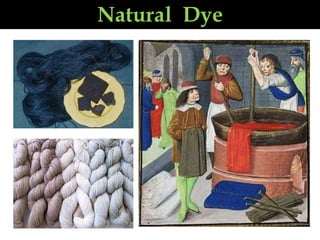
Natural Dye
Prepared By : Mazadul Hasan sheshir
ID: 2010000400008
13th Batch (session 2009-2013)
Department : Wet Processing Technology
Email: mazadulhasan@yahoo.com
Blog : www. Textilelab.blogspot.com (visit)
Southeast University
Department Of Textile Engineering
I/A 251,252 Tejgaon Dhaka Bangladesh
Prepared By :
©right
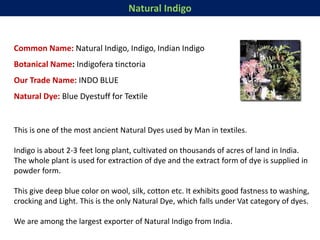
Natural Indigo
Common Name: Natural Indigo, Indigo, Indian Indigo
Botanical Name: Indigofera tinctoria
Our Trade Name: INDO BLUE
Natural Dye: Blue Dyestuff for Textile
This is one of the most ancient Natural Dyes used by Man in textiles.
Indigo is about 2-3 feet long plant, cultivated on thousands of acres of land in India.
The whole plant is used for extraction of dye and the extract form of dye is supplied in
powder form.
This give deep blue color on wool, silk, cotton etc. It exhibits good fastness to washing,
crocking and Light. This is the only Natural Dye, which falls under Vat category of dyes.
We are among the largest exporter of Natural Indigo from India.
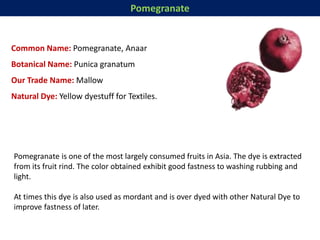
Pomegranate
Common Name: Pomegranate, Anaar
Botanical Name: Punica granatum
Our Trade Name: Mallow
Natural Dye: Yellow dyestuff for Textiles.
Pomegranate is one of the most largely consumed fruits in Asia. The dye is extracted
from its fruit rind. The color obtained exhibit good fastness to washing rubbing and
light.
At times this dye is also used as mordant and is over dyed with other Natural Dye to
improve fastness of later.
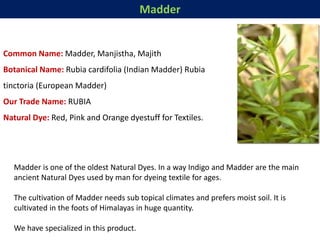
Madder
Common Name: Madder, Manjistha, Majith
Botanical Name: Rubia cardifolia (Indian Madder) Rubia
tinctoria (European Madder)
Our Trade Name: RUBIA
Natural Dye: Red, Pink and Orange dyestuff for Textiles.
Madder is one of the oldest Natural Dyes. In a way Indigo and Madder are the main
ancient Natural Dyes used by man for dyeing textile for ages.
The cultivation of Madder needs sub topical climates and prefers moist soil. It is
cultivated in the foots of Himalayas in huge quantity.
We have specialized in this product.
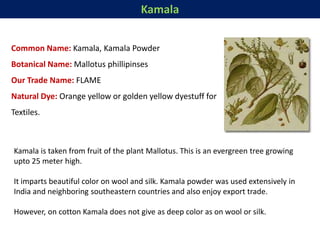
Kamala
Common Name: Kamala, Kamala Powder
Botanical Name: Mallotus phillipinses
Our Trade Name: FLAME
Natural Dye: Orange yellow or golden yellow dyestuff for
Textiles.
Kamala is taken from fruit of the plant Mallotus. This is an evergreen tree growing
upto 25 meter high.
It imparts beautiful color on wool and silk. Kamala powder was used extensively in
India and neighboring southeastern countries and also enjoy export trade.
However, on cotton Kamala does not give as deep color as on wool or silk.
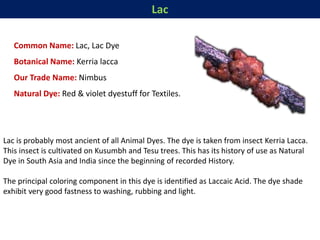
Lac
Common Name: Lac, Lac Dye
Botanical Name: Kerria lacca
Our Trade Name: Nimbus
Natural Dye: Red & violet dyestuff for Textiles.
Lac is probably most ancient of all Animal Dyes. The dye is taken from insect Kerria Lacca.
This insect is cultivated on Kusumbh and Tesu trees. This has its history of use as Natural
Dye in South Asia and India since the beginning of recorded History.
The principal coloring component in this dye is identified as Laccaic Acid. The dye shade
exhibit very good fastness to washing, rubbing and light.
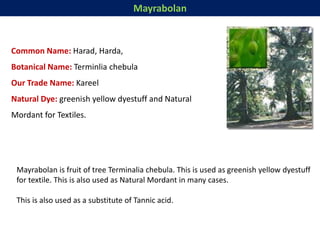
Mayrabolan
Common Name: Harad, Harda,
Botanical Name: Terminlia chebula
Our Trade Name: Kareel
Natural Dye: greenish yellow dyestuff and Natural
Mordant for Textiles.
Mayrabolan is fruit of tree Terminalia chebula. This is used as greenish yellow dyestuff
for textile. This is also used as Natural Mordant in many cases.
This is also used as a substitute of Tannic acid.
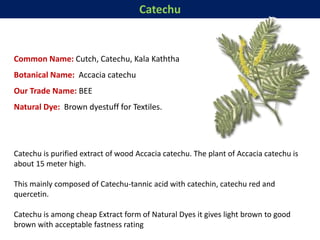
Catechu
Common Name: Cutch, Catechu, Kala Kaththa
Botanical Name: Accacia catechu
Our Trade Name: BEE
Natural Dye: Brown dyestuff for Textiles.
Catechu is purified extract of wood Accacia catechu. The plant of Accacia catechu is
about 15 meter high.
This mainly composed of Catechu-tannic acid with catechin, catechu red and
quercetin.
Catechu is among cheap Extract form of Natural Dyes it gives light brown to good
brown with acceptable fastness rating
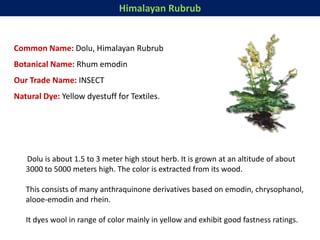
Himalayan Rubrub
Common Name: Dolu, Himalayan Rubrub
Botanical Name: Rhum emodin
Our Trade Name: INSECT
Natural Dye: Yellow dyestuff for Textiles.
Dolu is about 1.5 to 3 meter high stout herb. It is grown at an altitude of about
3000 to 5000 meters high. The color is extracted from its wood.
This consists of many anthraquinone derivatives based on emodin, chrysophanol,
alooe-emodin and rhein.
It dyes wool in range of color mainly in yellow and exhibit good fastness ratings.
www.ecology.at
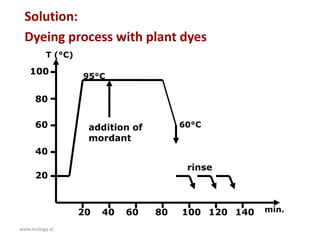
Solution:
Dyeing process with plant dyes
T (°C)
min.20 806040 140120100
20
80
60
40
100
addition of
mordant
60°C
rinse
95°C
www.ecology.at
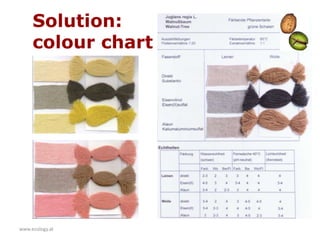
Solution:
colour chart
www.ecology.at
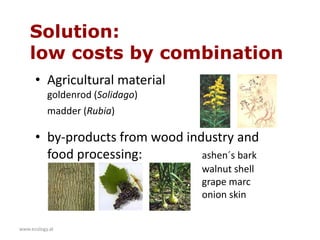
• Agricultural material
goldenrod (Solidago)
madder (Rubia)
• by-products from wood industry and
food processing: ashen´s bark
walnut shell
grape marc
onion skin
Solution:
low costs by combination
www.ecology.at
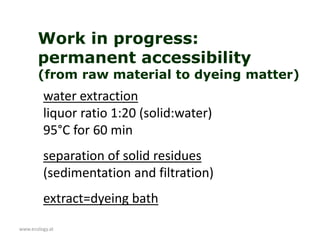
water extraction
liquor ratio 1:20 (solid:water)
95°C for 60 min
separation of solid residues
(sedimentation and filtration)
extract=dyeing bath
Work in progress:
permanent accessibility
(from raw material to dyeing matter)
1. Yarn Manufacturing Technology
Link : http://www.facebook.com/pages/Yarn-Manufacturing-Technology/485014954866808
2. Fabric Manufacturing Technology
Link : http://www.facebook.com/pages/Fabric-Manufacturing-Technology/459520217425605
3. Garments Manufacturing Technology
Link : http://www.facebook.com/pages/Garments-Manufacturing-
Technology/472364799463126
3. Wet processing Technology
Link : http://www.facebook.com/pages/Wet-Processing-Technology-Dyeing-/468645219825404
4. Fashion-Design-and-Technology
Link : http://www.facebook.com/pages/Fashion-Design-and-
Technology/587655294583875?ref=ts&fref=ts
My Facebook Textile related Pages
http://www.textilelab.blogspot.com (Visit My Blog for more Info )

Natural dye

  • 1.
  • 2.
    Prepared By :Mazadul Hasan sheshir ID: 2010000400008 13th Batch (session 2009-2013) Department : Wet Processing Technology Email: mazadulhasan@yahoo.com Blog : www. Textilelab.blogspot.com (visit) Southeast University Department Of Textile Engineering I/A 251,252 Tejgaon Dhaka Bangladesh Prepared By : ©right
  • 3.
    Natural Indigo Common Name:Natural Indigo, Indigo, Indian Indigo Botanical Name: Indigofera tinctoria Our Trade Name: INDO BLUE Natural Dye: Blue Dyestuff for Textile This is one of the most ancient Natural Dyes used by Man in textiles. Indigo is about 2-3 feet long plant, cultivated on thousands of acres of land in India. The whole plant is used for extraction of dye and the extract form of dye is supplied in powder form. This give deep blue color on wool, silk, cotton etc. It exhibits good fastness to washing, crocking and Light. This is the only Natural Dye, which falls under Vat category of dyes. We are among the largest exporter of Natural Indigo from India.
  • 4.
    Pomegranate Common Name: Pomegranate,Anaar Botanical Name: Punica granatum Our Trade Name: Mallow Natural Dye: Yellow dyestuff for Textiles. Pomegranate is one of the most largely consumed fruits in Asia. The dye is extracted from its fruit rind. The color obtained exhibit good fastness to washing rubbing and light. At times this dye is also used as mordant and is over dyed with other Natural Dye to improve fastness of later.
  • 5.
    Madder Common Name: Madder,Manjistha, Majith Botanical Name: Rubia cardifolia (Indian Madder) Rubia tinctoria (European Madder) Our Trade Name: RUBIA Natural Dye: Red, Pink and Orange dyestuff for Textiles. Madder is one of the oldest Natural Dyes. In a way Indigo and Madder are the main ancient Natural Dyes used by man for dyeing textile for ages. The cultivation of Madder needs sub topical climates and prefers moist soil. It is cultivated in the foots of Himalayas in huge quantity. We have specialized in this product.
  • 6.
    Kamala Common Name: Kamala,Kamala Powder Botanical Name: Mallotus phillipinses Our Trade Name: FLAME Natural Dye: Orange yellow or golden yellow dyestuff for Textiles. Kamala is taken from fruit of the plant Mallotus. This is an evergreen tree growing upto 25 meter high. It imparts beautiful color on wool and silk. Kamala powder was used extensively in India and neighboring southeastern countries and also enjoy export trade. However, on cotton Kamala does not give as deep color as on wool or silk.
  • 7.
    Lac Common Name: Lac,Lac Dye Botanical Name: Kerria lacca Our Trade Name: Nimbus Natural Dye: Red & violet dyestuff for Textiles. Lac is probably most ancient of all Animal Dyes. The dye is taken from insect Kerria Lacca. This insect is cultivated on Kusumbh and Tesu trees. This has its history of use as Natural Dye in South Asia and India since the beginning of recorded History. The principal coloring component in this dye is identified as Laccaic Acid. The dye shade exhibit very good fastness to washing, rubbing and light.
  • 8.
    Mayrabolan Common Name: Harad,Harda, Botanical Name: Terminlia chebula Our Trade Name: Kareel Natural Dye: greenish yellow dyestuff and Natural Mordant for Textiles. Mayrabolan is fruit of tree Terminalia chebula. This is used as greenish yellow dyestuff for textile. This is also used as Natural Mordant in many cases. This is also used as a substitute of Tannic acid.
  • 9.
    Catechu Common Name: Cutch,Catechu, Kala Kaththa Botanical Name: Accacia catechu Our Trade Name: BEE Natural Dye: Brown dyestuff for Textiles. Catechu is purified extract of wood Accacia catechu. The plant of Accacia catechu is about 15 meter high. This mainly composed of Catechu-tannic acid with catechin, catechu red and quercetin. Catechu is among cheap Extract form of Natural Dyes it gives light brown to good brown with acceptable fastness rating
  • 10.
    Himalayan Rubrub Common Name:Dolu, Himalayan Rubrub Botanical Name: Rhum emodin Our Trade Name: INSECT Natural Dye: Yellow dyestuff for Textiles. Dolu is about 1.5 to 3 meter high stout herb. It is grown at an altitude of about 3000 to 5000 meters high. The color is extracted from its wood. This consists of many anthraquinone derivatives based on emodin, chrysophanol, alooe-emodin and rhein. It dyes wool in range of color mainly in yellow and exhibit good fastness ratings.
  • 16.
    www.ecology.at Solution: Dyeing process withplant dyes T (°C) min.20 806040 140120100 20 80 60 40 100 addition of mordant 60°C rinse 95°C
  • 17.
  • 18.
    www.ecology.at • Agricultural material goldenrod(Solidago) madder (Rubia) • by-products from wood industry and food processing: ashen´s bark walnut shell grape marc onion skin Solution: low costs by combination
  • 19.
    www.ecology.at water extraction liquor ratio1:20 (solid:water) 95°C for 60 min separation of solid residues (sedimentation and filtration) extract=dyeing bath Work in progress: permanent accessibility (from raw material to dyeing matter)
  • 21.
    1. Yarn ManufacturingTechnology Link : http://www.facebook.com/pages/Yarn-Manufacturing-Technology/485014954866808 2. Fabric Manufacturing Technology Link : http://www.facebook.com/pages/Fabric-Manufacturing-Technology/459520217425605 3. Garments Manufacturing Technology Link : http://www.facebook.com/pages/Garments-Manufacturing- Technology/472364799463126 3. Wet processing Technology Link : http://www.facebook.com/pages/Wet-Processing-Technology-Dyeing-/468645219825404 4. Fashion-Design-and-Technology Link : http://www.facebook.com/pages/Fashion-Design-and- Technology/587655294583875?ref=ts&fref=ts My Facebook Textile related Pages http://www.textilelab.blogspot.com (Visit My Blog for more Info )