Fiber to Fabric
Dr. Ritu Madhan
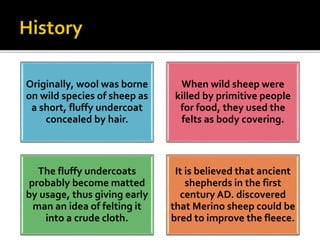
Originally, wool was borne
on wild species of sheep as
a short, fluffy undercoat
concealed by hair.
When wild sheep were
killed by primitive people
for food, they used the
felts as body covering.
The fluffy undercoats
probably become matted
by usage, thus giving early
man an idea of felting it
into a crude cloth.
It is believed that ancient
shepherds in the first
century AD. discovered
that Merino sheep could be
bred to improve the fleece.
Australia USSR
New
Zealand
Argentina
South
Africa
Uruguay
United
States
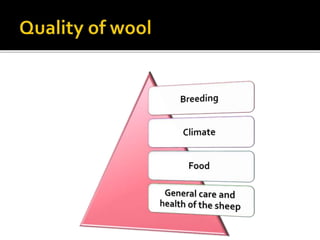
Colder
climate Harsher &
heavier fibers
Moisture in
atmosphere
Natural
grease
Insufficient /
poor quality
food
Growth
retardation /
poor fibers
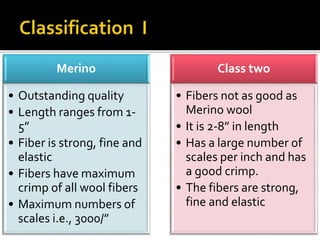
Merino
• Outstanding quality
• Length ranges from 1-
5”
• Fiber is strong, fine and
elastic
• Fibers have maximum
crimp of all wool fibers
• Maximum numbers of
scales i.e., 3000/”
Class two
• Fibers not as good as
Merino wool
• It is 2-8” in length
• Has a large number of
scales per inch and has
a good crimp.
• The fibers are strong,
fine and elastic
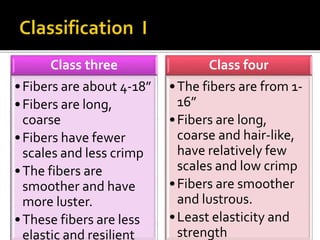
Class three
•Fibers are about 4-18”
•Fibers are long,
coarse
•Fibers have fewer
scales and less crimp
•The fibers are
smoother and have
more luster.
•These fibers are less
elastic and resilient
Class four
•The fibers are from 1-
16”
•Fibers are long,
coarse and hair-like,
have relatively few
scales and low crimp
•Fibers are smoother
and lustrous.
•Least elasticity and
strength
• When the sheep is 6 – 8
months old
Lambs
wool
• When the sheep is 12 – 14
months old
Hogget
wool
• When the sheep is 14 months
• Second shearing, contains
dirt and oil
Wether
wool
• When the sheep is slaughtered for their meat
Pulled wool
• When the sheep dies an accidental / natural death
• Quality is inferior
Dead wool
• From sheep exposed to severe weather / diet
conditions
Cotty wool
• Discolored parts of wool from any of the above,
inferior quality
Taglocks
Fleeces vary from 6-18
lbs (3-8 kg)in weight
and ultimately provide
about 3 lbs (1.5kg) of
scoured wool the fleece
is packed in sacks
Domestic wool reaches
the mill in loosely
packed bags and
imported wool reaches
the mill in the form of
bales.
Each fleece contains
different grades or
sorts, of wool and raw
stock must be carefully
graded according to
length, diameter and
quality of fiber.
The raw wool or newly
sheared fleece is called
grease wool because it
contains the natural oil
of the sheep.
When grease wool is
washed; it loses 20-80
of it original weight.
Sorting Garneting Scouring
Drying
Oiling
Done by skilled
workers on the basis
of touch and sight
Length, fineness,
elasticity & strength
Recycled wool fibers are
obtained separately by
reducing the used materials
to a fibrous mass by a
picking and shredding
process called garneting.
The fibers are then put
through a dilute solution of
H2SO4 or HCL acid, which
destroys any vegetable
matter
The quality and the cost of
recycled wool fibers depend
on the original stock from
which they are obtained.
A good quality of recycled
wool may cost as much as 5
times as a poor grade of
virgin wool.
The next step in preparing raw wool
for manufacturing is a thorough
washing in an alkaline solution, this
process is known as scouring.
The scouring machines contain
warm water, soap, and a mild
solution of soda ash or other alkali.
The machine is equipped with
automatic rakes which stir the
wool.
• Wool is not allowed to
become absolutely dry.
• Usually 12 -18 % moisture
is left in the wool to
condition it for
subsequent handling.
Drying
• As wool is unmanageable
after scouring the fiber is
usually treated with
various oils, to keep it
from becoming brittle and
to lubricate it for the
spinning operations.
Oiling
Dyeing Blending Carding
Combing
Drawing
Roving
• Can be done
at fiber
stage, yarn
stage or
fabric stage
Dyeing
• Different
grades of
wool or
different
fibers are
blended
Blending
• Disentangle-
ment and
removal of
short length
fibers
Carding
Combing
• Further
aligning
fibers
• Using only
superior
fibers
Drawing
• Doubling
and
redoubling
of slivers
Roving
• Imparting
slight twist
to
decrease
diameter
of slivers
Sliver Carding Roving
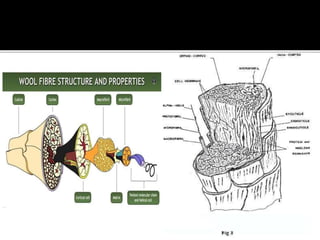
Fiber
Cuticle
Epi-cuticle
Exo-cuticle
Endo-cuticle
Cortex
Ortho-cortex
Para-cortex
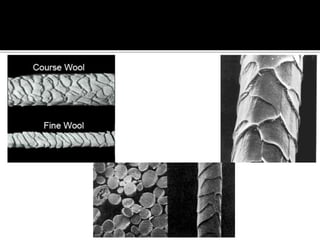
Scales on the surface
Serrated / rough surface
Root end is angular
Central canal – Medulla
Linear
molecule
Composed of
keratin
Made up of
amino acids
Helical
configuration
Irreversible shrinkage of the length ,
breadth and /or thickness of the material.
Wool felts because of the serrated surface
of its fibers which is formed by the
overlapping epithelial cells or scales.
Because of this serrated structure, less
friction will result if the fiber moves in a
root ward direction than if it moves in tip
ward direction
This difference in surface friction between
the two directions known as the directional
friction effect (DFE).
The root end of the fiber curls upon itself.
This movement caused by agitation and
moisture, is due to DFE of the wool fiber’s
surface.
Felting is increased by the action of heat,
moisture & pressure
• Poor
Luster
• Least in all
natural fibers
• Loses strength
when wet
Strength
• Good
Elasticity
• Good
Resilience
• Good
Drapability
• 1.31
Specific
Density
• Initially water repellent, but once
moisture seeps in, readily absorbs
moisture
• Absorbs 20% of its weight
Moisture
• Wool becomes harsh at 212°F (100°C)
and begins to decompose at slightly
higher temperatures. It will scorch at
400°F (204°C) and will eventually char.
However it is not easily combustible
Thermal
Alkalies
• Damaged
by strong
alkalies
Acids
• Damaged
by conc
H2SO4
• Not
affected
by others
Bleaches
• Harmful
for the
fabric
Biological
• Not
affected
by
mildew
• Affected
by larvae
of moth
& other
insects
Dirt and odors retained , needs frequent
laundering
Care to be taken , use neutral detergents, do
not wring, squeeze or pull fabrics out of water
Wash in cold water, flat dry the garment to avoid
stretching / shrinking

Wool

  • 1.
  • 2.
    Originally, wool wasborne on wild species of sheep as a short, fluffy undercoat concealed by hair. When wild sheep were killed by primitive people for food, they used the felts as body covering. The fluffy undercoats probably become matted by usage, thus giving early man an idea of felting it into a crude cloth. It is believed that ancient shepherds in the first century AD. discovered that Merino sheep could be bred to improve the fleece.
  • 3.
  • 5.
  • 6.
  • 7.
  • 8.
    Merino • Outstanding quality •Length ranges from 1- 5” • Fiber is strong, fine and elastic • Fibers have maximum crimp of all wool fibers • Maximum numbers of scales i.e., 3000/” Class two • Fibers not as good as Merino wool • It is 2-8” in length • Has a large number of scales per inch and has a good crimp. • The fibers are strong, fine and elastic
  • 9.
    Class three •Fibers areabout 4-18” •Fibers are long, coarse •Fibers have fewer scales and less crimp •The fibers are smoother and have more luster. •These fibers are less elastic and resilient Class four •The fibers are from 1- 16” •Fibers are long, coarse and hair-like, have relatively few scales and low crimp •Fibers are smoother and lustrous. •Least elasticity and strength
  • 10.
    • When thesheep is 6 – 8 months old Lambs wool • When the sheep is 12 – 14 months old Hogget wool • When the sheep is 14 months • Second shearing, contains dirt and oil Wether wool
  • 11.
    • When thesheep is slaughtered for their meat Pulled wool • When the sheep dies an accidental / natural death • Quality is inferior Dead wool • From sheep exposed to severe weather / diet conditions Cotty wool • Discolored parts of wool from any of the above, inferior quality Taglocks
  • 12.
    Fleeces vary from6-18 lbs (3-8 kg)in weight and ultimately provide about 3 lbs (1.5kg) of scoured wool the fleece is packed in sacks Domestic wool reaches the mill in loosely packed bags and imported wool reaches the mill in the form of bales. Each fleece contains different grades or sorts, of wool and raw stock must be carefully graded according to length, diameter and quality of fiber. The raw wool or newly sheared fleece is called grease wool because it contains the natural oil of the sheep. When grease wool is washed; it loses 20-80 of it original weight.
  • 13.
  • 14.
    Done by skilled workerson the basis of touch and sight Length, fineness, elasticity & strength
  • 15.
    Recycled wool fibersare obtained separately by reducing the used materials to a fibrous mass by a picking and shredding process called garneting. The fibers are then put through a dilute solution of H2SO4 or HCL acid, which destroys any vegetable matter The quality and the cost of recycled wool fibers depend on the original stock from which they are obtained. A good quality of recycled wool may cost as much as 5 times as a poor grade of virgin wool.
  • 16.
    The next stepin preparing raw wool for manufacturing is a thorough washing in an alkaline solution, this process is known as scouring. The scouring machines contain warm water, soap, and a mild solution of soda ash or other alkali. The machine is equipped with automatic rakes which stir the wool.
  • 17.
    • Wool isnot allowed to become absolutely dry. • Usually 12 -18 % moisture is left in the wool to condition it for subsequent handling. Drying • As wool is unmanageable after scouring the fiber is usually treated with various oils, to keep it from becoming brittle and to lubricate it for the spinning operations. Oiling
  • 18.
  • 19.
    • Can bedone at fiber stage, yarn stage or fabric stage Dyeing • Different grades of wool or different fibers are blended Blending • Disentangle- ment and removal of short length fibers Carding
  • 20.
    Combing • Further aligning fibers • Usingonly superior fibers Drawing • Doubling and redoubling of slivers Roving • Imparting slight twist to decrease diameter of slivers
  • 21.
  • 22.
  • 25.
    Scales on thesurface Serrated / rough surface Root end is angular Central canal – Medulla
  • 26.
    Linear molecule Composed of keratin Made upof amino acids Helical configuration
  • 27.
    Irreversible shrinkage ofthe length , breadth and /or thickness of the material. Wool felts because of the serrated surface of its fibers which is formed by the overlapping epithelial cells or scales. Because of this serrated structure, less friction will result if the fiber moves in a root ward direction than if it moves in tip ward direction
  • 28.
    This difference insurface friction between the two directions known as the directional friction effect (DFE). The root end of the fiber curls upon itself. This movement caused by agitation and moisture, is due to DFE of the wool fiber’s surface. Felting is increased by the action of heat, moisture & pressure
  • 29.
    • Poor Luster • Leastin all natural fibers • Loses strength when wet Strength • Good Elasticity • Good Resilience • Good Drapability • 1.31 Specific Density
  • 30.
    • Initially waterrepellent, but once moisture seeps in, readily absorbs moisture • Absorbs 20% of its weight Moisture • Wool becomes harsh at 212°F (100°C) and begins to decompose at slightly higher temperatures. It will scorch at 400°F (204°C) and will eventually char. However it is not easily combustible Thermal
  • 31.
    Alkalies • Damaged by strong alkalies Acids •Damaged by conc H2SO4 • Not affected by others Bleaches • Harmful for the fabric Biological • Not affected by mildew • Affected by larvae of moth & other insects
  • 32.
    Dirt and odorsretained , needs frequent laundering Care to be taken , use neutral detergents, do not wring, squeeze or pull fabrics out of water Wash in cold water, flat dry the garment to avoid stretching / shrinking