Cotton
Dr. Ritu Madhan
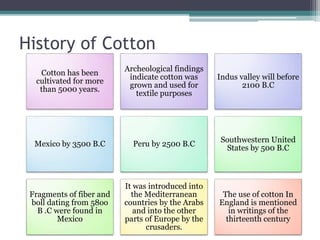
History of Cotton
Cotton has been
cultivated for more
than 5000 years.
Archeological findings
indicate cotton was
grown and used for
textile purposes
Indus valley will before
2100 B.C
Mexico by 3500 B.C Peru by 2500 B.C
Southwestern United
States by 500 B.C
Fragments of fiber and
boll dating from 58oo
B .C were found in
Mexico
It was introduced into
the Mediterranean
countries by the Arabs
and into the other
parts of Europe by the
crusaders.
The use of cotton In
England is mentioned
in writings of the
thirteenth century
Variations in cotton
Soil
Climate
Fertilizers
Pests
Quality of cotton
•Color (degree of whiteness)
•Length
•Fineness
•Strength
Kinds of cotton
American
upland
99% of
cotton
growth
Fiber length
from 7/8 to 1
¼ inches
American
pima
Upper Rio
Grande
valley of
Texas
The staple
length is
form 1 3/8
to 1 ½
inches
Egyptian
Fibers are
light brown,
fine and
strong
Length
varies from 1
¼ to 1 ½
inches
Asiatic
Produced in
India, china
and the near
east
Fibers are
coarse, less
than 1 inch
in length
Requirements for cultivation of cotton
200 days of continuous warm
weather
Enough moisture and sunlight
Frost is harmful for the growth
Soil should be well plowed and
pulverized
Cultivation of cotton
Carefully selected seeds are planted in rows in
the month of March or April
With ideal growing conditions the cotton seed
germinates in about seven-ten days.
The first two leaves are the cotyledons and they
absorb nutrients from the soil and sunlight and
help the plant to develop further.
In about two weeks they turn over the function
of photosynthesis to the true leaves. The plant
now grows quickly adding on new leaves.
Cultivation of cotton
In another
three weeks,
the blossoms
open. The
first day a
bloom opens
it is white or
a creamy
yellow color.
In the
afternoon, the
pollen is
released and
as it self-
pollinates.
Once
pollinated, the
flower begins
to turn pink,
becoming a
bright fuschia
in a few days.
Cultivation of
cotton
Cultivation of cotton
As the pink bloom dries down, the
young boll pushes its way up, forcing
the pink bloom to fall off as a tag. This
boll is considered to be the fruit as it
contains seeds.
Inside the boll, moist fibers grow and
push out from the newly formed seeds.
As the boll ripens, it turns brown.
DEVELOPMENT OF BOLL DEVELOPMENT OF BOLL
DEVELOPMENT OF FIBER
FROM THE IMMATURE BOLL
Cultivation of
cotton
The cotton
fibers continue
to mature, that
is there is
cellulose
deposition in
the secondary
cell wall.
As the cotton
fiber matures,
that is about
fort-five days
after the bolls
appear, the
cotton bolls
open slowly
along the boll
segment or
carpels and dry
out exposing
the cotton
segments
called locks.
The dried
carpels called
as the bur hold
the locks of
cotton in place
till it is fully
dried, fluffed
and ready for
picking.
An average
cotton boll
contains
500,000
fibers, and
each plant may
bear up to one
hundred bolls.
Cultivation of cotton
Mature fiber
Fully mature cotton Fibers from individual seed
Harvesting
Hand
• Labour intensive, therefore expensive.
• Best quality cotton
Machine
• Picker and stripper
• Picker
• Pulls fibers from open bolls
• Used on high yield farms
• Stripper
• Pulls bolls from the plant
• Used on low yield farms
Processing
Picked cotton is put in
the gin
Separation of lint from seeds and
removal of foreign matter such as dirt,
twigs, leaves, and parts of the boll
The seeds produce cotton
seed oil and cattle feed.
Lint is packed in bales – 500lbs
Bales
Planning for Utilization
Linters (fibers shorter than 1/8 of an inch) are not used for spinning
Uses of linters:
- Stuffing mattress, upholstery and pillows,
- Raw material in producing rayon and acetate
- Converted to non textile products like paper, cellophane, photographic films, finger
nail polish and methylcellulose that is used in make-up and chewing gum.
Grading : For determining the class of the fiber.
Fibers checked for staple length, fineness, maturity, color, the amount of foreign
matter and the ginning preparation.
Molecular structure
Structure of cellulose
Fiber properties
Microscopic properties:
Cotton fibers are composed of
• an outer skin or cuticle
• a primary wall
• a secondary wall
• a central core called lumen.
Immature fibers:
-thin walls and large lumen
Mature fibers:
-thick walls and small lumen that may not be continuous, because the cell wall
closes the lumen in some parts.
cuticle
Cross section of the fiber
Longitudnal / cross sectional view
The longitudinal view
• Ribbon-likeshape with twist (convolutions)
at irregular intervals
• The diameter is narrow at the tip.
The cross-sectional view
• Elliptical, kidney-shapedor nearly circular.
• Shows the cuticleand the two walls.
Convolution
Physical Properties
• Color
▫ white to tan
▫ the 1900s saw the development of naturally colored cottons that do not require either
dyeing or bleaching.
• Luster
▫ low in luster unless it has been given special finishes or treatments.
▫ convolutions of cotton that make the surface uneven.
▫ this scatters and breaks up the light rays reflected from the fiber surface.
• Specific gravity
▫ 1.54 (more than polyester and nylon)
▫ cotton fabrics feel heavier than fabrics made from nylons and polyester
Physical properties
• Strength:
▫ weaker than flax but stronger than rayon.
▫ strength of improves when it is wet.
• Elongation and elastic recovery:
▫ low elongation and elastic recovery.
• Resilience:
▫ fabrics wrinkle easily and do not recover quickly from wrinkling.
▫ in stretching and wrinkling, the hydrogen bonds are broken and then
reformed in new positions.
▫ can be improved by the application of durable press finish.
Chemical properties
• Absorbency and moisture regain:
▫ moisture regain is 7-8.5%.
▫ hydroxyl groups present in the fiber are responsible for attracting
water.
▫ comfortable in hot weather and suitable for materials where water
absorbency is most needed (towels).
▫ can be dyed easily.
• Heat and electrical conductivity:
▫ conducts electricity and thus does not build up static charge.
▫ comfortable to wear in summers.
Thermal properties
non thermoplastic and therefore does not melt on
application of heat.
exposure to dry heat above 300oC causes gradual
deterioration.
excessive high temperatures of ironing causes cotton
to scorch and turn yellow.
highly combustible. It burns upon exposure to the
flame and continues to burn after the flame has been
removed. Burning cotton smells like burning paper
and a fluffy grey ash residue remains.
Chemical reactivity
• Acids:
▫ cold and concentrated or hot and dilute mineral acids like sulfuric,
hydrochloric and nitric acid destroy cotton.
▫ organic acids like acetic, formic, and oxalic acid have no effect but fiber
may degrade if it is not completely removed from the surface.
• Alkalies:
▫ strong bases like sodium hydroxide, have no harmful effect.
▫ high concentrations used in mercerization causes fibers to swell and
become stronger.
▫ weak bases like borax and soap have no harmful effect.
▫ most soaps and detergents are alkaline in nature, and cause no harm to the
cotton fiber.
Chemical reactivity
• Oxidising agents:
▫ Chemicals like sodium hypochlorite can destroy cotton if the action
is uncontrolled.
▫ Hydrogen peroxide has no detrimental effect
• Organic solvents:
▫ Cotton is highly resistant to most organic solvents and to all those
used in normal care and stain removal.
▫ E.g. perchloroethylene, carbon tetra chloride (used for dry cleaning)
have no harmful effects.
Environmental properties
• Resistance to micro-organisms:
▫ Mildew grows on cotton fibers, especially if it is in damp conditions. Mildew
produces a stain, a disagreeable odour and will result in rotting and loss of strength.
▫ Moth and beetles may attack cotton, however silverfish attack cotton especially when
it is sized.
• Sunlight:
▫ Prolonged exposure to sunlight will cause cotton to yellow and will gradually result in
loss of strength. This damage is more when the cotton has moisture.
▫ Age does not seriously affect cotton, however it is important that it is properly stored
in dry and dark areas, so that it can retain its appearance and most of its strength.
Uses
The versatility coupled
with a reasonable cost
makes it a very popular
for many products.
the qualities of comfort,
dye-ability and easy
launderability have led
to its use in articles of
innerwear to denims
and to evening gowns.
home furnishings like
sheets, towels,
tablecloths, napkins,
draperies and
upholsteries
frequently blended with
various other fibers to
impart cotton-like
properties

Cotton

  • 1.
  • 2.
    History of Cotton Cottonhas been cultivated for more than 5000 years. Archeological findings indicate cotton was grown and used for textile purposes Indus valley will before 2100 B.C Mexico by 3500 B.C Peru by 2500 B.C Southwestern United States by 500 B.C Fragments of fiber and boll dating from 58oo B .C were found in Mexico It was introduced into the Mediterranean countries by the Arabs and into the other parts of Europe by the crusaders. The use of cotton In England is mentioned in writings of the thirteenth century
  • 3.
  • 4.
    Quality of cotton •Color(degree of whiteness) •Length •Fineness •Strength
  • 5.
    Kinds of cotton American upland 99%of cotton growth Fiber length from 7/8 to 1 ¼ inches American pima Upper Rio Grande valley of Texas The staple length is form 1 3/8 to 1 ½ inches Egyptian Fibers are light brown, fine and strong Length varies from 1 ¼ to 1 ½ inches Asiatic Produced in India, china and the near east Fibers are coarse, less than 1 inch in length
  • 6.
    Requirements for cultivationof cotton 200 days of continuous warm weather Enough moisture and sunlight Frost is harmful for the growth Soil should be well plowed and pulverized
  • 7.
    Cultivation of cotton Carefullyselected seeds are planted in rows in the month of March or April With ideal growing conditions the cotton seed germinates in about seven-ten days. The first two leaves are the cotyledons and they absorb nutrients from the soil and sunlight and help the plant to develop further. In about two weeks they turn over the function of photosynthesis to the true leaves. The plant now grows quickly adding on new leaves.
  • 8.
  • 10.
    In another three weeks, theblossoms open. The first day a bloom opens it is white or a creamy yellow color. In the afternoon, the pollen is released and as it self- pollinates. Once pollinated, the flower begins to turn pink, becoming a bright fuschia in a few days. Cultivation of cotton
  • 11.
  • 12.
    As the pinkbloom dries down, the young boll pushes its way up, forcing the pink bloom to fall off as a tag. This boll is considered to be the fruit as it contains seeds. Inside the boll, moist fibers grow and push out from the newly formed seeds. As the boll ripens, it turns brown. DEVELOPMENT OF BOLL DEVELOPMENT OF BOLL DEVELOPMENT OF FIBER FROM THE IMMATURE BOLL Cultivation of cotton
  • 13.
    The cotton fibers continue tomature, that is there is cellulose deposition in the secondary cell wall. As the cotton fiber matures, that is about fort-five days after the bolls appear, the cotton bolls open slowly along the boll segment or carpels and dry out exposing the cotton segments called locks. The dried carpels called as the bur hold the locks of cotton in place till it is fully dried, fluffed and ready for picking. An average cotton boll contains 500,000 fibers, and each plant may bear up to one hundred bolls. Cultivation of cotton
  • 14.
  • 15.
    Mature fiber Fully maturecotton Fibers from individual seed
  • 16.
    Harvesting Hand • Labour intensive,therefore expensive. • Best quality cotton Machine • Picker and stripper • Picker • Pulls fibers from open bolls • Used on high yield farms • Stripper • Pulls bolls from the plant • Used on low yield farms
  • 17.
    Processing Picked cotton isput in the gin Separation of lint from seeds and removal of foreign matter such as dirt, twigs, leaves, and parts of the boll The seeds produce cotton seed oil and cattle feed. Lint is packed in bales – 500lbs
  • 18.
  • 19.
    Planning for Utilization Linters(fibers shorter than 1/8 of an inch) are not used for spinning Uses of linters: - Stuffing mattress, upholstery and pillows, - Raw material in producing rayon and acetate - Converted to non textile products like paper, cellophane, photographic films, finger nail polish and methylcellulose that is used in make-up and chewing gum. Grading : For determining the class of the fiber. Fibers checked for staple length, fineness, maturity, color, the amount of foreign matter and the ginning preparation.
  • 20.
  • 21.
  • 22.
    Fiber properties Microscopic properties: Cottonfibers are composed of • an outer skin or cuticle • a primary wall • a secondary wall • a central core called lumen. Immature fibers: -thin walls and large lumen Mature fibers: -thick walls and small lumen that may not be continuous, because the cell wall closes the lumen in some parts. cuticle
  • 23.
  • 24.
    Longitudnal / crosssectional view The longitudinal view • Ribbon-likeshape with twist (convolutions) at irregular intervals • The diameter is narrow at the tip. The cross-sectional view • Elliptical, kidney-shapedor nearly circular. • Shows the cuticleand the two walls. Convolution
  • 25.
    Physical Properties • Color ▫white to tan ▫ the 1900s saw the development of naturally colored cottons that do not require either dyeing or bleaching. • Luster ▫ low in luster unless it has been given special finishes or treatments. ▫ convolutions of cotton that make the surface uneven. ▫ this scatters and breaks up the light rays reflected from the fiber surface. • Specific gravity ▫ 1.54 (more than polyester and nylon) ▫ cotton fabrics feel heavier than fabrics made from nylons and polyester
  • 27.
    Physical properties • Strength: ▫weaker than flax but stronger than rayon. ▫ strength of improves when it is wet. • Elongation and elastic recovery: ▫ low elongation and elastic recovery. • Resilience: ▫ fabrics wrinkle easily and do not recover quickly from wrinkling. ▫ in stretching and wrinkling, the hydrogen bonds are broken and then reformed in new positions. ▫ can be improved by the application of durable press finish.
  • 28.
    Chemical properties • Absorbencyand moisture regain: ▫ moisture regain is 7-8.5%. ▫ hydroxyl groups present in the fiber are responsible for attracting water. ▫ comfortable in hot weather and suitable for materials where water absorbency is most needed (towels). ▫ can be dyed easily. • Heat and electrical conductivity: ▫ conducts electricity and thus does not build up static charge. ▫ comfortable to wear in summers.
  • 29.
    Thermal properties non thermoplasticand therefore does not melt on application of heat. exposure to dry heat above 300oC causes gradual deterioration. excessive high temperatures of ironing causes cotton to scorch and turn yellow. highly combustible. It burns upon exposure to the flame and continues to burn after the flame has been removed. Burning cotton smells like burning paper and a fluffy grey ash residue remains.
  • 30.
    Chemical reactivity • Acids: ▫cold and concentrated or hot and dilute mineral acids like sulfuric, hydrochloric and nitric acid destroy cotton. ▫ organic acids like acetic, formic, and oxalic acid have no effect but fiber may degrade if it is not completely removed from the surface. • Alkalies: ▫ strong bases like sodium hydroxide, have no harmful effect. ▫ high concentrations used in mercerization causes fibers to swell and become stronger. ▫ weak bases like borax and soap have no harmful effect. ▫ most soaps and detergents are alkaline in nature, and cause no harm to the cotton fiber.
  • 31.
    Chemical reactivity • Oxidisingagents: ▫ Chemicals like sodium hypochlorite can destroy cotton if the action is uncontrolled. ▫ Hydrogen peroxide has no detrimental effect • Organic solvents: ▫ Cotton is highly resistant to most organic solvents and to all those used in normal care and stain removal. ▫ E.g. perchloroethylene, carbon tetra chloride (used for dry cleaning) have no harmful effects.
  • 32.
    Environmental properties • Resistanceto micro-organisms: ▫ Mildew grows on cotton fibers, especially if it is in damp conditions. Mildew produces a stain, a disagreeable odour and will result in rotting and loss of strength. ▫ Moth and beetles may attack cotton, however silverfish attack cotton especially when it is sized. • Sunlight: ▫ Prolonged exposure to sunlight will cause cotton to yellow and will gradually result in loss of strength. This damage is more when the cotton has moisture. ▫ Age does not seriously affect cotton, however it is important that it is properly stored in dry and dark areas, so that it can retain its appearance and most of its strength.
  • 33.
    Uses The versatility coupled witha reasonable cost makes it a very popular for many products. the qualities of comfort, dye-ability and easy launderability have led to its use in articles of innerwear to denims and to evening gowns. home furnishings like sheets, towels, tablecloths, napkins, draperies and upholsteries frequently blended with various other fibers to impart cotton-like properties