Woven fabric Cost
Estimation
Efforts by: Abhilasha Singh
Aditi Agrawal
Aditi Saha
Ahsaas Sharma
Ankit Dinkar
FP-Tech
Why is it important?
• Woven fabrics are used worldwide for many applications
like apparel, home furnishing, accessories, industrial and
medical textiles.
• Costing of woven fabrics for garment manufacturers is
one of the most important aspects of garment
production.
• About 65 - 70% cost of the garment is the cost of the
fabric and hence, it is very crucial to get the right cost of
the fabric from fabric manufacturers and suppliers.
• Garment manufacturers struggle to get the best possible
cost of the fabric.
What are the costs to consider?
1. Direct cost: Cost of raw material -- 66%. Cost of size and
chemicals - 4%. Production cost comprising of running the
machine, maintenance, power fuel, humidification and other
utilities -- 8 % and worker wages and salaries -- 8% losses
incurred due to shrinkage, wastage, grading, and also selling
commissions.
2. Indirect cost : Interest on investment, loan, working capital,
depreciation, etc. Above 7%, overheads and administrative
expenses like travelling, telephone, couriers, legal issues, taxes
comprising of 7%.
3. Profit: 10 - 20% depending on the order size. In some
companies, 70% of the fabric cost will comprise of direct cost,
but in corporate selling only 40% cost of the fabric is direct cost
and 60% is overheads.
Factors which affect the cost
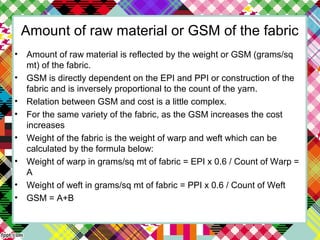
Type of raw material
• Raw material cost includes
cost of fibre or yarn.
• The cost of the fibre will
depend largely on its generic
type - cotton, linen, wool, etc,
and also its quality.
• The Yarn cost will depend on
the count of the yarn -- finer
the yarn, more expensive it
will be.
Raw Material
• Carded or combed: Combed yarns are more expensive
than carded yarns.
• Method of spinning-open-end or ring spun. Open end
yarns are cheaper as the cost of manufacturing is less. It
is used for coarser yarn count below 20s.
• Bright or dull -- Bright yarns are more expensive than
dull. Textured yarns are more expensive than flat
because of the additional process cost.
Amount of raw material or GSM of the fabric
• Amount of raw material is reflected by the weight or GSM (grams/sq
mt) of the fabric.
• GSM is directly dependent on the EPI and PPI or construction of the
fabric and is inversely proportional to the count of the yarn.
• Relation between GSM and cost is a little complex.
• For the same variety of the fabric, as the GSM increases the cost
increases
• Weight of the fabric is the weight of warp and weft which can be
calculated by the formula below:
• Weight of warp in grams/sq mt of fabric = EPI x 0.6 / Count of Warp =
A
• Weight of weft in grams/sq mt of fabric = PPI x 0.6 / Count of Weft
• GSM = A+B
Sizing and Chemicals Cost
• The sizing cost depends upon the count of the
yarns. The count becomes finer the size and
chemical cost increases as a rich solution, better
quality of size and chemicals is required for
better strength.
• One needs to add Rs 35/kg as additional cost
which includes steam, power or wages. For two
plied yarn no sizing is required.
Cost of weaving process
• It includes machine running
cost, maintenance, labour
cost, power & fuel, etc.
• The weaving cost is
affected by the beam size
-- if the beam is small in
length, the cost will be
more as beam gaiting and
knotting will add to the
cost.
Mill-made or powerloom made:
• The quality of mill-made fabrics is
better than power loom made fabrics
in terms of yarn quality; Therefore
the cost of fabric is higher.
• At times it can be as high as 25%..
eg, the cost of 40s Poplin 92 x 88
can vary between Rs 22/mt and Rs
34/mt.
• It depends on the type of loom
whether powerloom, rapier, air-jet,
dobby or jacquard and the weave
and construction.
• The weaving cost is expressed as
paisa /pick/inch/sq mt.
Mill-made or powerloom made:
• The cost of weaving is different for different weaves.
• The cost of weaving for rapier loom for plain weave 40"
width fabrics = 8 paisa/pick/inch/sq nmt which means
that for a 120 inch width fabric the cost will be 24
paisa/pick/mt.
• For twill weave, the cost = 12 paisa/pick/inch/sq mt.
• For satin weave, the cost = 12 paisa/pick/inch/sq mt.
• For dobby, the cost = 12 paisa/pick/inch/sq mt.
• For 2400 hook jacquard the cost = 40 paisa/pick/inch/sq
mt.
Wastage and shrinkage
• Wastage of 2 - 3% in warping and weaving and
shrinkage of 1 - 1.5% from loom to grey folding
stage is included in the weaving cost.
• About 92% of the fabric produced is sold as
fresh. The value loss is about 7% while running
cotton material but is only 3% in using polyester
yarn.
Dyeing costs
• Cost of dyeing depends upon:
• Length: A minimum of 2,000 mt of fabric is accepted, if the quantity of
the fabric is more say 15,000 mt or 20,000 mt, then the processing
charges will be lowered by Rs 1 - 2/mt.
• Width of the fabric: If the width of the fabric is doubled, the cost of
the processing is not doubled. This is because the overheads and
cost of running the material are dependent on the length and not the
width. Eg, the cost of dyeing 40" width poplin is Rs 10, but the cost of
dyeing 120" width fabric is Rs 22.
• Shade%: Lighter the shade lower the cost. The amount of dye
required is less as well as time required for dyeing is less. Eg, for
dyeing pastel shades if it takes 24 hours, it takes 36 hours for dyeing
black shades and burgundy colour.
Dyeing costs
• Class of dye and quality: Some
dyes are more expensive than the
other. The choice of dye depends on
the buyer, the fastness properties
and also on the shade selected.
• Colour: Within the same dye class
some colours are more expensive
than the other. For eg, turquoise and
reds are more expensive.
Dyeing costs
• Metamerism: Some colours change their shade in different lights. If
the shades are matched in two or three lights only then the cost is
less, but when the matching is required in all the six lights, natural
daylight (D-65), Tube light (TL-83), Horizon (yellow light as
produced during sun set), Incandescent, (Inca-A), Fluorescent
(CWF or cool white Fluorescent), Ultraviolet light (UL-30 or ultra
luma) or no metamerism is required, then better quality dyes are
required and the cost is more.
• Weight of the fabric: Lighter the fabric quicker is the dye pick-up
so dyeing time is saved. Capacity of the machine is expressed in
weight of the material for lighter weight fabrics, more length of the
material can be processed at one time, so dyeing cost is reduced.
Finishing cost
• If softeners are added in
the jigger after dyeing,
then the cost is Rs 10/kg
whereas if it is done on a
separate machine and
later stentering is done
then the cost is Rs 20/kg.
• The quality of fabric is
better in second case as
the cover is better and
there is no shrinkage
later.
Process Cost
Flame retardant
finish
15Rs/mt
Antistatic finish 5 Rs/mt
Anti stain 10Rs/mt
Anti wrinkle 5Rs/mt
Shrinkage and wastage
• It is important to note that
wastage and shrinkage are
integral part of costing.
Generally a minimum
shrinkage of 5 - 7% is
acceptable.
• Cost of the fabric = Cost of
grey fabric + dyeing charges
+ finishing charges +
shrinkage + wastage.
Below is a Table showing
shrinkage of different fabrics:
Fabric Shrinkage%
Poplin, Sheeting 3%
Cotton Voile, cambric 5%
Polyyester/Viscose
blend fiber-dyed
4.5-5%
Polyester viscose
piece-dyed
6%
100% grey polyester 20%
References
• http://www.indiantextilejournal.com/articles
/FAdetails.asp?id=1854
• www.raihantextile.blogspot.com/2013/02/c
alculation-of-weaving-cost-woven.html
• www.weavetex.blogspot.com
Thank You

Costing

  • 1.
    Woven fabric Cost Estimation Effortsby: Abhilasha Singh Aditi Agrawal Aditi Saha Ahsaas Sharma Ankit Dinkar FP-Tech
  • 2.
    Why is itimportant? • Woven fabrics are used worldwide for many applications like apparel, home furnishing, accessories, industrial and medical textiles. • Costing of woven fabrics for garment manufacturers is one of the most important aspects of garment production. • About 65 - 70% cost of the garment is the cost of the fabric and hence, it is very crucial to get the right cost of the fabric from fabric manufacturers and suppliers. • Garment manufacturers struggle to get the best possible cost of the fabric.
  • 3.
    What are thecosts to consider? 1. Direct cost: Cost of raw material -- 66%. Cost of size and chemicals - 4%. Production cost comprising of running the machine, maintenance, power fuel, humidification and other utilities -- 8 % and worker wages and salaries -- 8% losses incurred due to shrinkage, wastage, grading, and also selling commissions. 2. Indirect cost : Interest on investment, loan, working capital, depreciation, etc. Above 7%, overheads and administrative expenses like travelling, telephone, couriers, legal issues, taxes comprising of 7%. 3. Profit: 10 - 20% depending on the order size. In some companies, 70% of the fabric cost will comprise of direct cost, but in corporate selling only 40% cost of the fabric is direct cost and 60% is overheads.
  • 5.
    Factors which affectthe cost Type of raw material • Raw material cost includes cost of fibre or yarn. • The cost of the fibre will depend largely on its generic type - cotton, linen, wool, etc, and also its quality. • The Yarn cost will depend on the count of the yarn -- finer the yarn, more expensive it will be.
  • 6.
    Raw Material • Cardedor combed: Combed yarns are more expensive than carded yarns. • Method of spinning-open-end or ring spun. Open end yarns are cheaper as the cost of manufacturing is less. It is used for coarser yarn count below 20s. • Bright or dull -- Bright yarns are more expensive than dull. Textured yarns are more expensive than flat because of the additional process cost.
  • 7.
    Amount of rawmaterial or GSM of the fabric • Amount of raw material is reflected by the weight or GSM (grams/sq mt) of the fabric. • GSM is directly dependent on the EPI and PPI or construction of the fabric and is inversely proportional to the count of the yarn. • Relation between GSM and cost is a little complex. • For the same variety of the fabric, as the GSM increases the cost increases • Weight of the fabric is the weight of warp and weft which can be calculated by the formula below: • Weight of warp in grams/sq mt of fabric = EPI x 0.6 / Count of Warp = A • Weight of weft in grams/sq mt of fabric = PPI x 0.6 / Count of Weft • GSM = A+B
  • 8.
    Sizing and ChemicalsCost • The sizing cost depends upon the count of the yarns. The count becomes finer the size and chemical cost increases as a rich solution, better quality of size and chemicals is required for better strength. • One needs to add Rs 35/kg as additional cost which includes steam, power or wages. For two plied yarn no sizing is required.
  • 9.
    Cost of weavingprocess • It includes machine running cost, maintenance, labour cost, power & fuel, etc. • The weaving cost is affected by the beam size -- if the beam is small in length, the cost will be more as beam gaiting and knotting will add to the cost.
  • 10.
    Mill-made or powerloommade: • The quality of mill-made fabrics is better than power loom made fabrics in terms of yarn quality; Therefore the cost of fabric is higher. • At times it can be as high as 25%.. eg, the cost of 40s Poplin 92 x 88 can vary between Rs 22/mt and Rs 34/mt. • It depends on the type of loom whether powerloom, rapier, air-jet, dobby or jacquard and the weave and construction. • The weaving cost is expressed as paisa /pick/inch/sq mt.
  • 11.
    Mill-made or powerloommade: • The cost of weaving is different for different weaves. • The cost of weaving for rapier loom for plain weave 40" width fabrics = 8 paisa/pick/inch/sq nmt which means that for a 120 inch width fabric the cost will be 24 paisa/pick/mt. • For twill weave, the cost = 12 paisa/pick/inch/sq mt. • For satin weave, the cost = 12 paisa/pick/inch/sq mt. • For dobby, the cost = 12 paisa/pick/inch/sq mt. • For 2400 hook jacquard the cost = 40 paisa/pick/inch/sq mt.
  • 12.
    Wastage and shrinkage •Wastage of 2 - 3% in warping and weaving and shrinkage of 1 - 1.5% from loom to grey folding stage is included in the weaving cost. • About 92% of the fabric produced is sold as fresh. The value loss is about 7% while running cotton material but is only 3% in using polyester yarn.
  • 13.
    Dyeing costs • Costof dyeing depends upon: • Length: A minimum of 2,000 mt of fabric is accepted, if the quantity of the fabric is more say 15,000 mt or 20,000 mt, then the processing charges will be lowered by Rs 1 - 2/mt. • Width of the fabric: If the width of the fabric is doubled, the cost of the processing is not doubled. This is because the overheads and cost of running the material are dependent on the length and not the width. Eg, the cost of dyeing 40" width poplin is Rs 10, but the cost of dyeing 120" width fabric is Rs 22. • Shade%: Lighter the shade lower the cost. The amount of dye required is less as well as time required for dyeing is less. Eg, for dyeing pastel shades if it takes 24 hours, it takes 36 hours for dyeing black shades and burgundy colour.
  • 14.
    Dyeing costs • Classof dye and quality: Some dyes are more expensive than the other. The choice of dye depends on the buyer, the fastness properties and also on the shade selected. • Colour: Within the same dye class some colours are more expensive than the other. For eg, turquoise and reds are more expensive.
  • 15.
    Dyeing costs • Metamerism:Some colours change their shade in different lights. If the shades are matched in two or three lights only then the cost is less, but when the matching is required in all the six lights, natural daylight (D-65), Tube light (TL-83), Horizon (yellow light as produced during sun set), Incandescent, (Inca-A), Fluorescent (CWF or cool white Fluorescent), Ultraviolet light (UL-30 or ultra luma) or no metamerism is required, then better quality dyes are required and the cost is more. • Weight of the fabric: Lighter the fabric quicker is the dye pick-up so dyeing time is saved. Capacity of the machine is expressed in weight of the material for lighter weight fabrics, more length of the material can be processed at one time, so dyeing cost is reduced.
  • 16.
    Finishing cost • Ifsofteners are added in the jigger after dyeing, then the cost is Rs 10/kg whereas if it is done on a separate machine and later stentering is done then the cost is Rs 20/kg. • The quality of fabric is better in second case as the cover is better and there is no shrinkage later. Process Cost Flame retardant finish 15Rs/mt Antistatic finish 5 Rs/mt Anti stain 10Rs/mt Anti wrinkle 5Rs/mt
  • 17.
    Shrinkage and wastage •It is important to note that wastage and shrinkage are integral part of costing. Generally a minimum shrinkage of 5 - 7% is acceptable. • Cost of the fabric = Cost of grey fabric + dyeing charges + finishing charges + shrinkage + wastage. Below is a Table showing shrinkage of different fabrics: Fabric Shrinkage% Poplin, Sheeting 3% Cotton Voile, cambric 5% Polyyester/Viscose blend fiber-dyed 4.5-5% Polyester viscose piece-dyed 6% 100% grey polyester 20%
  • 18.
  • 19.