Costs and Cost Management
Project Cost Management includes the
  processes required to ensure that the project
  is completed within the approved budget.
Project cost management is primarily
  concerned with the cost of the resources
  needed to complete project activities.
• However, project cost management should
  also consider the effect of project decisions on
  the cost of using the project’s product.
For example, limiting the number of design
 reviews may reduce the cost of the project at
 the expense of an increase in the customer’s
 operating costs.
Life-cycle costing
 The broader view of project cost
 management is often called life-cycle costing.
Lifecycle costing together with Value
 Engineering techniques are used to reduce
 cost and time, improve quality and
 performance, and optimize the decision-
 making.
Project cost management
Project cost management will include
 additional processes and numerous general
 management techniques such as return on
 investment, discounted cash flow, payback
 analysis, and others.
 Project cost management should consider the
 information      needs    of    the    project
 stakeholders—different stakeholders may
 measure project costs in different ways and at
 different times.
Project Cost Management Process
All processes interact with each other and
 with the processes in the other knowledge
 areas as well.
Each process may involve effort from one or
 more individuals or groups of individuals,
 based on the needs of the project.
Each process generally occurs at least once in
 every project phase.
Project Cost Management Processs
Resource     Planning—determining      what
 resources (people, equipment, materials and
 what quantities of each should be used to
 perform project activities.
Cost        Estimating—developing         an
 approximation (estimate) of the costs of the
 resources needed to complete project
 activities.
Cost Budgeting—allocating the overall cost
 estimate to individual work activities.
Cost Control—controlling changes to the
 project budget.
Program Management
A coordinated portfolio of projects that
 change organizations to achieve benefits of
 strategic importance.
Program Management has evolved from the
 complexities of the more aspects of Project
 Management.
 Program Management engaged on relating
 design concepts to the business strategic
 vision of the future.
Project Management
Program management is the process of
 managing multiple on going projects. An
 example would be that of designing,
 manufacturing and providing support
 infrastructure for an automobile make.
Project Management focused on technical
 delivery
Managing Processes
• As a software project manager, you become
  the key player in a software project.
• You not only manager the day-to-day activities
  of the project but also ensure that the
  software product is delivered on time.
• What makes your role challenging is the
  performance of project-related activities
  within a specified budget and time constraint.
• At the same time, you need to keep the
  requirements and specifications of the
  customer in mind.
• To deliver expected results, you carry out
  three successive processes: studying the
• feasibility of the project, planning to meet the
  requirement, and executing the plan.
• These processes can be further broken down
  into activities, such as planning, staffing, and
  monitoring.
• These processes can be further broken down
  into activities, such as planning, staffing, and
  monitoring.
• You plan and organize the software
  development team to complete development
  within the stipulated time and budget.
• To do this, you form a team of people who
  have the required technical skills.
• Then, you ensure that all activities are carried
  out as planned by the relevant people.
The              primary          software
project management areas that you need to
concentrate on include:
•   Managing Resources
•   Managing Cost
•   Managing Risk
•   Managing Schedule
•   Managing the project plan
•   Managing quality
Managing Resources
• The primary input required to create software
  are resources.
• Resources for a software project may be of
  three kinds: human, hardware, "and software.
• Human resource management is about
  effectively identifying the people with the
  appropriate skills, assigning roles and
  responsibilities to these people, and
  establishing reporting relationships.
• On the other hand, hardware and software
  resource management relates to identifying
  and ensuring resources such as workstations,
  disk space on servers, software tools, and
  software licenses.
• To manage resources effectively, there are two
  areas that you require your attention. These
  include:
• Your responsibilities include analyzing
  customer requirements, determining the
  scope of the software project, allocating
  resources top the project, scheduling the
  project, and executing the project.
• These responsibilities can be considered in
  terms of the areas where management skills
  are required.
• Management of human resources also
  requires efficient team development.
• To manage human resources, you also need to
  implement a reward and recognition system.
  This helps in promoting and reinforcing
  positive performance.
Managing Cost
• The cost factor has a considerable influence
  on the execution of a software project.
• The budget of a software project is affected by
  factors, such as the current orientation of the
  organization toward software development,
  number of skilled personnel available,
  infrastructure, and computer hardware and
  software.
• The budget can also be influenced by timely
  availability of resources.
• If a particular resource is allocated to the
  project later than required, the costs involved
  could go up drastically.
• To manage costs for software projects, you
  need an accurate estimation of costs.
• To do that, there is a sequence of steps that
  you need to perform.
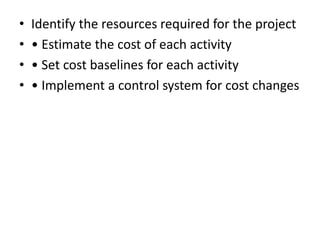
•   Identify the resources required for the project
•   • Estimate the cost of each activity
•   • Set cost baselines for each activity
•   • Implement a control system for cost changes
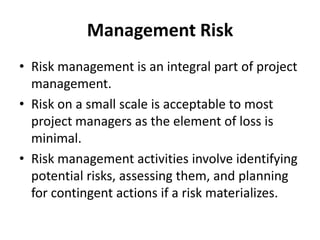
Management Risk
• Risk management is an integral part of project
  management.
• Risk on a small scale is acceptable to most
  project managers as the element of loss is
  minimal.
• Risk management activities involve identifying
  potential risks, assessing them, and planning
  for contingent actions if a risk materializes.

Cost management

  • 1.
    Costs and CostManagement Project Cost Management includes the processes required to ensure that the project is completed within the approved budget. Project cost management is primarily concerned with the cost of the resources needed to complete project activities. • However, project cost management should also consider the effect of project decisions on the cost of using the project’s product.
  • 2.
    For example, limitingthe number of design reviews may reduce the cost of the project at the expense of an increase in the customer’s operating costs.
  • 3.
    Life-cycle costing  Thebroader view of project cost management is often called life-cycle costing. Lifecycle costing together with Value Engineering techniques are used to reduce cost and time, improve quality and performance, and optimize the decision- making.
  • 4.
    Project cost management Projectcost management will include additional processes and numerous general management techniques such as return on investment, discounted cash flow, payback analysis, and others.  Project cost management should consider the information needs of the project stakeholders—different stakeholders may measure project costs in different ways and at different times.
  • 5.
    Project Cost ManagementProcess All processes interact with each other and with the processes in the other knowledge areas as well. Each process may involve effort from one or more individuals or groups of individuals, based on the needs of the project. Each process generally occurs at least once in every project phase.
  • 6.
    Project Cost ManagementProcesss Resource Planning—determining what resources (people, equipment, materials and what quantities of each should be used to perform project activities. Cost Estimating—developing an approximation (estimate) of the costs of the resources needed to complete project activities.
  • 7.
    Cost Budgeting—allocating theoverall cost estimate to individual work activities. Cost Control—controlling changes to the project budget.
  • 8.
    Program Management A coordinatedportfolio of projects that change organizations to achieve benefits of strategic importance. Program Management has evolved from the complexities of the more aspects of Project Management.  Program Management engaged on relating design concepts to the business strategic vision of the future.
  • 9.
    Project Management Program managementis the process of managing multiple on going projects. An example would be that of designing, manufacturing and providing support infrastructure for an automobile make. Project Management focused on technical delivery
  • 10.
    Managing Processes • Asa software project manager, you become the key player in a software project. • You not only manager the day-to-day activities of the project but also ensure that the software product is delivered on time. • What makes your role challenging is the performance of project-related activities within a specified budget and time constraint.
  • 11.
    • At thesame time, you need to keep the requirements and specifications of the customer in mind. • To deliver expected results, you carry out three successive processes: studying the • feasibility of the project, planning to meet the requirement, and executing the plan. • These processes can be further broken down into activities, such as planning, staffing, and monitoring.
  • 12.
    • These processescan be further broken down into activities, such as planning, staffing, and monitoring. • You plan and organize the software development team to complete development within the stipulated time and budget. • To do this, you form a team of people who have the required technical skills. • Then, you ensure that all activities are carried out as planned by the relevant people.
  • 13.
    The primary software project management areas that you need to concentrate on include: • Managing Resources • Managing Cost • Managing Risk • Managing Schedule • Managing the project plan • Managing quality
  • 14.
    Managing Resources • Theprimary input required to create software are resources. • Resources for a software project may be of three kinds: human, hardware, "and software. • Human resource management is about effectively identifying the people with the appropriate skills, assigning roles and responsibilities to these people, and establishing reporting relationships.
  • 15.
    • On theother hand, hardware and software resource management relates to identifying and ensuring resources such as workstations, disk space on servers, software tools, and software licenses. • To manage resources effectively, there are two areas that you require your attention. These include:
  • 16.
    • Your responsibilitiesinclude analyzing customer requirements, determining the scope of the software project, allocating resources top the project, scheduling the project, and executing the project. • These responsibilities can be considered in terms of the areas where management skills are required.
  • 17.
    • Management ofhuman resources also requires efficient team development. • To manage human resources, you also need to implement a reward and recognition system. This helps in promoting and reinforcing positive performance.
  • 18.
    Managing Cost • Thecost factor has a considerable influence on the execution of a software project. • The budget of a software project is affected by factors, such as the current orientation of the organization toward software development, number of skilled personnel available, infrastructure, and computer hardware and software.
  • 19.
    • The budgetcan also be influenced by timely availability of resources. • If a particular resource is allocated to the project later than required, the costs involved could go up drastically. • To manage costs for software projects, you need an accurate estimation of costs. • To do that, there is a sequence of steps that you need to perform.
  • 20.
    Identify the resources required for the project • • Estimate the cost of each activity • • Set cost baselines for each activity • • Implement a control system for cost changes
  • 21.
    Management Risk • Riskmanagement is an integral part of project management. • Risk on a small scale is acceptable to most project managers as the element of loss is minimal. • Risk management activities involve identifying potential risks, assessing them, and planning for contingent actions if a risk materializes.