Object Oriented
Software Engineering
Object Oriented
Software Engineering
Yoseph K, Instructor
yosefkrs@outlook.com
Office Hours: Monday - Saturday
1
CSSE341
CSSE341
Lecture Two
Software Project Management
´ In this lecture, we will focus on:
´ Project Planning
´ Project Size Estimation metrics and techniques
´ Scheduling and team structure
´ Risk Management
2
Project Planning
Project Planning
The overall goal of project planning is to establish a pragmatic
strategy for controlling, tracking, and monitoring a complex
technical project.
Or,
A Plan is the strategy for the successful completion of the
project. It's a description of the project steps that produce
increasing maturity of the products or processes produced by
the project.
Why?
So the end result gets done on time, with quality!
3
Why plan?
Why plan?
i. To achieve a specific goal
ii. To reduce the complexity risk of having unclear
role
iii. To increase quality of productivity
iv. To balance the triple constraints (Time, Scope, Cost)
4
Planning is essential to control
´ An effective way to exert control is to:
´ Know where you are
´ Know where you are supposed to be
´ Take corrective action if there is a difference between
the two
´ Note:
´ You have to have a plan to know where you are
supposed to be
´ If you have no plan, you have no control
5
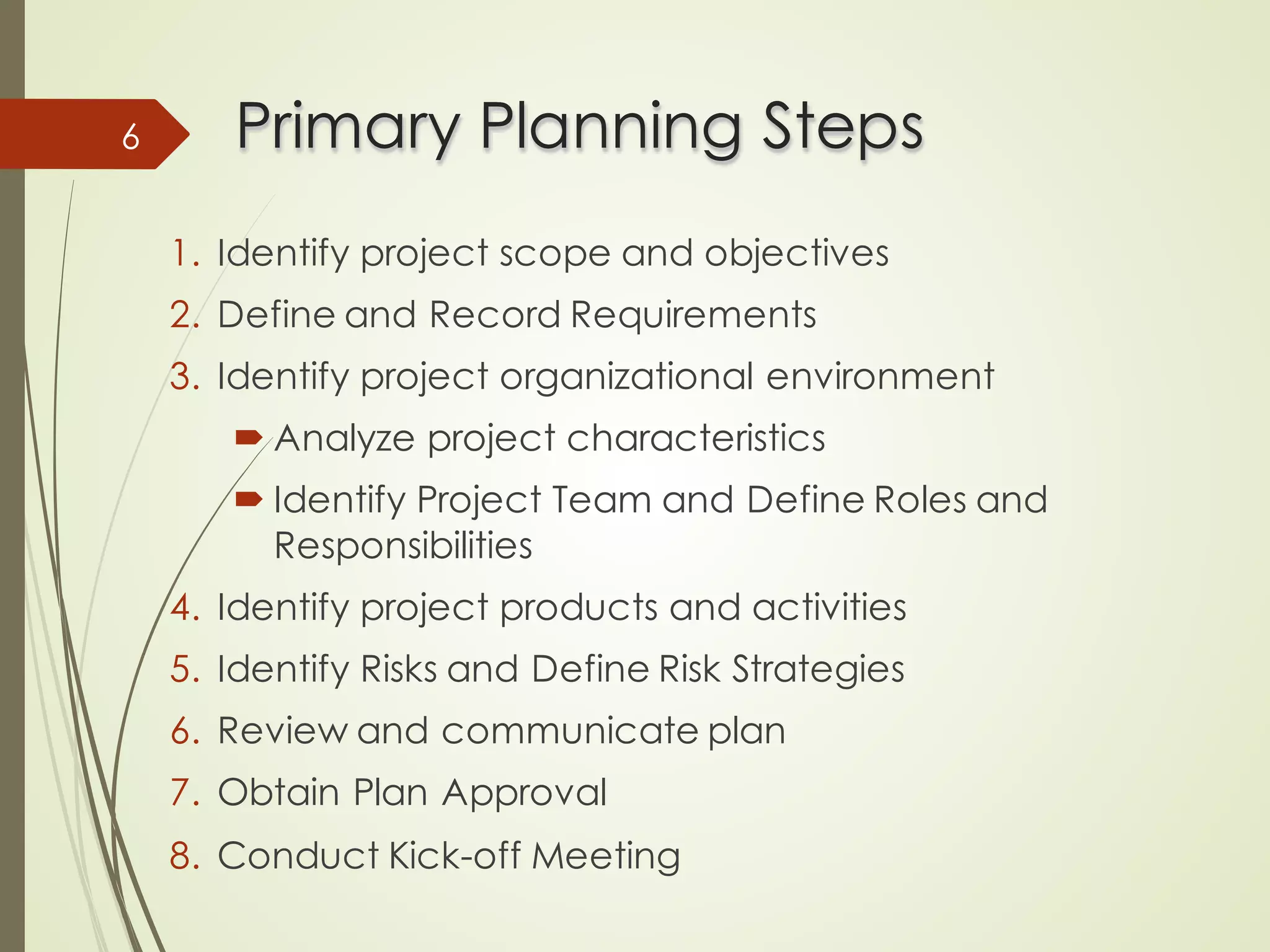
Primary Planning Steps
1. Identify project scope and objectives
2. Define and Record Requirements
3. Identify project organizational environment
´ Analyze project characteristics
´ Identify Project Team and Define Roles and
Responsibilities
4. Identify project products and activities
5. Identify Risks and Define Risk Strategies
6. Review and communicate plan
7. Obtain Plan Approval
8. Conduct Kick-off Meeting
6
Project Scope Management
´ Project scope management is one of the most critical
project management knowledge (skill) areas
´ Scope defines
´ All the work that is required to complete the project
successfully and
´ Only the work that is required, no more, no less
´ project scope management defines and controls what is
and is not part of the project work
7
Project Time Management
´ Project time management is the project management
knowledge area concerned with analyzing the logical and
temporal relationships among the activities needed to
complete the project .
´ In a conventional methodology, the project schedule acts
as the planning backbone for virtually all other project
activities
8
Planning, Estimating, Scheduling
´ What's the difference?
´ Plan: Identify activities. No specific start and end
dates.
´ Estimating: Determining the size & duration of
activities.
´ Schedule: Adds specific start and end dates,
relationships, and resources.
9
Decomposition is the process of breaking the project scope
and deliverables into smaller, more manageable
components. Decomposition is usually performed in a top-
down, hierarchical manner
Project Cost Management
´ Cost is a resource sacrificed or fore-gone to achieve a specific
objective or something given up in exchange
´ Project cost management includes the processes required to
ensure that the project is completed within an approved budget.
10
Cost Estimation Tools and Techniques
´ 3 basic tools and techniques for cost estimates:
´ Analogous or top-down: use the actual cost of a previous, similar
project as the basis for the new estimate
´ Bottom-up: estimate individual work items and sum them to get a total
estimate
´ Parametric: use project characteristics in a mathematical model to
estimate costs
11
Project Risk Management
Definitions:
Definitions:
´ Risk is the probability of incurring some net loss while
pursuing a goal.
´ Risk management is a systematic approach to
reducing the harm due to risks, making a project less
vulnerable to challenge or failure (e.g., cost or
schedule overruns, scope decrease, quality
reduction) and its resulting product more robust.
12
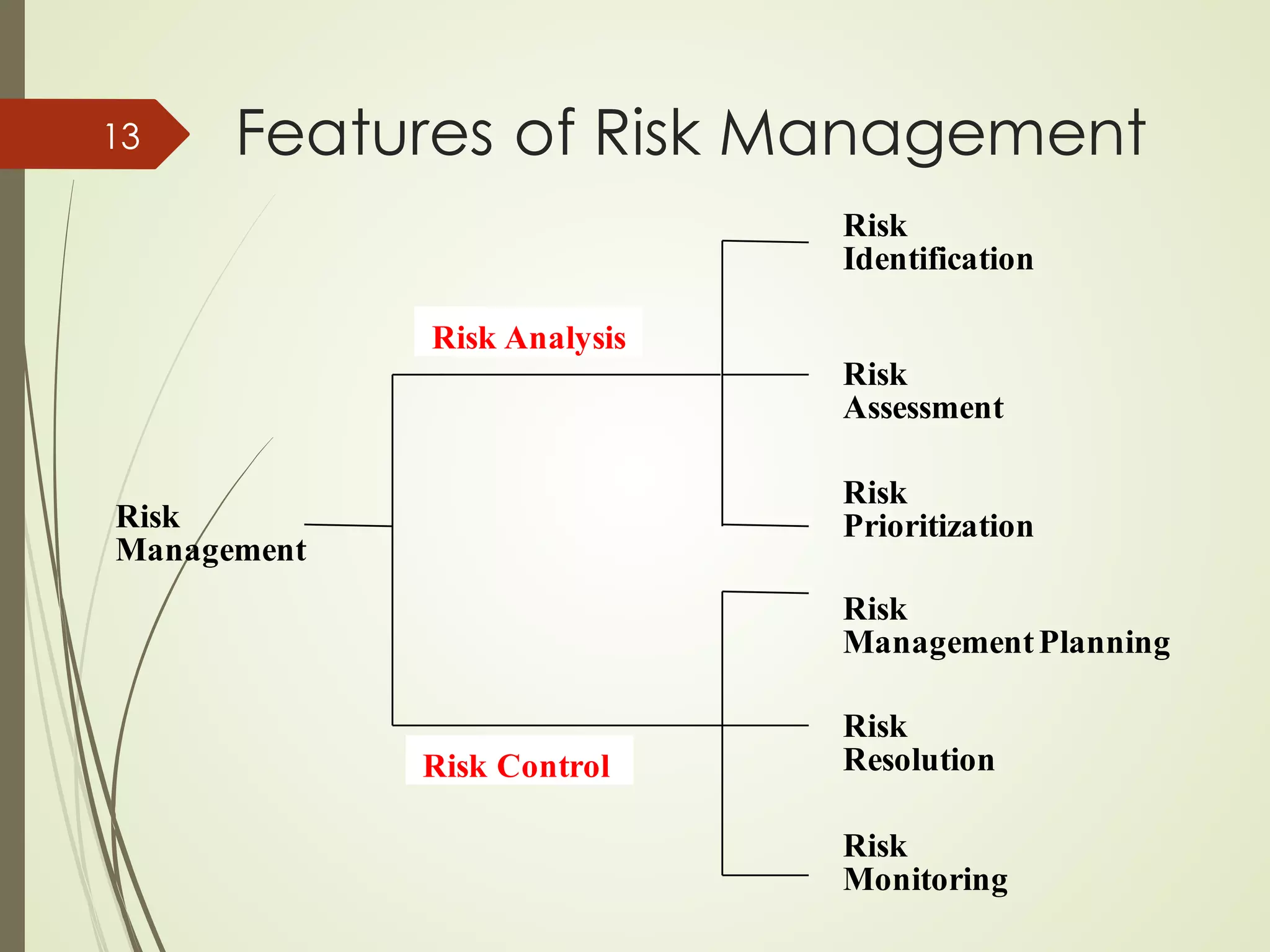
Features of Risk Management
13
Risk
Identification
Risk
Assessment
Risk
Prioritization
Risk
Management
Risk
ManagementPlanning
Risk
Resolution
Risk
Monitoring
Risk Analysis
Risk Control
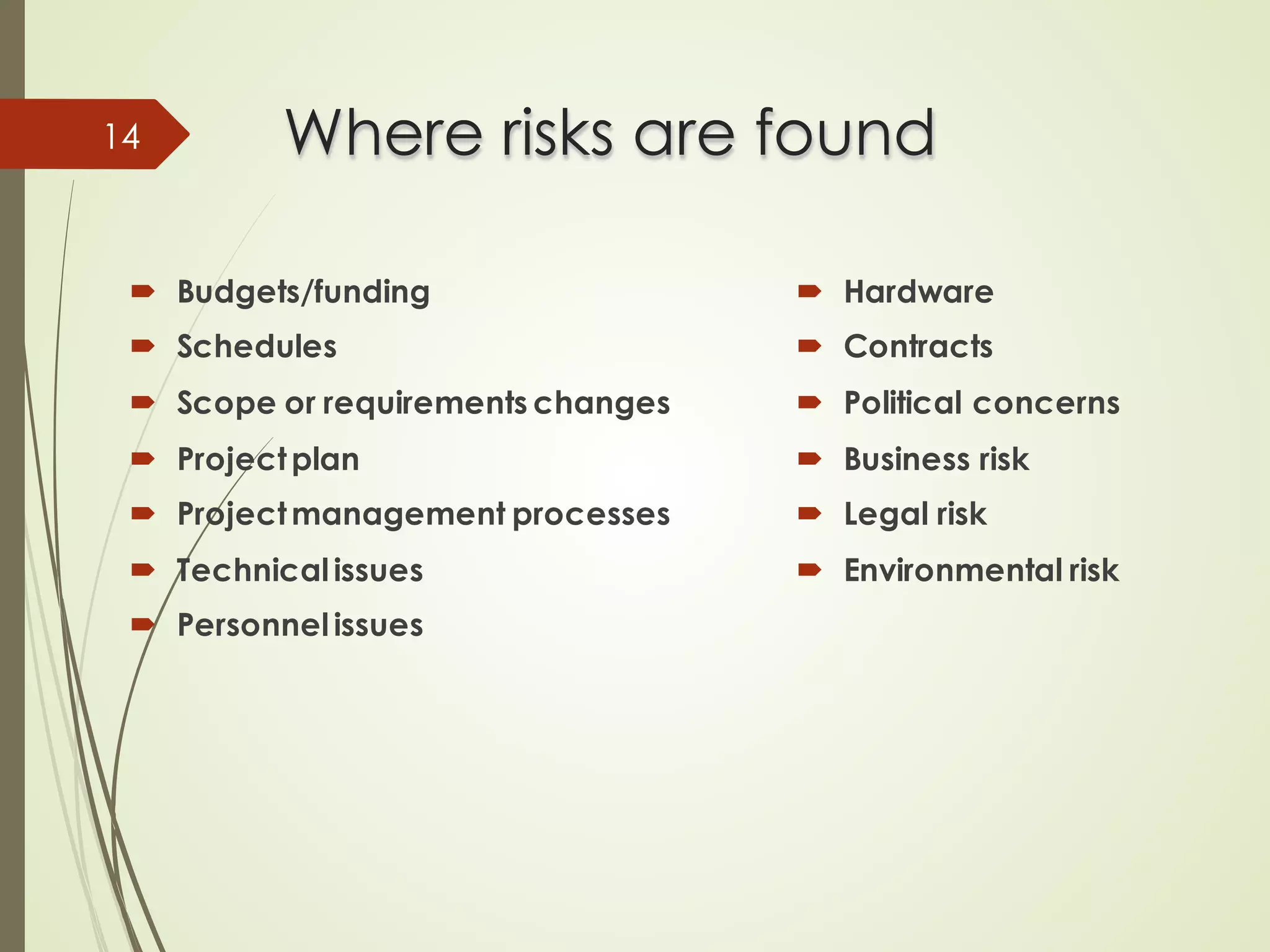
Where risks are found
´ Budgets/funding
´ Schedules
´ Scope or requirements changes
´ Projectplan
´ Projectmanagement processes
´ Technicalissues
´ Personnelissues
´ Hardware
´ Contracts
´ Political concerns
´ Business risk
´ Legal risk
´ Environmental risk
14
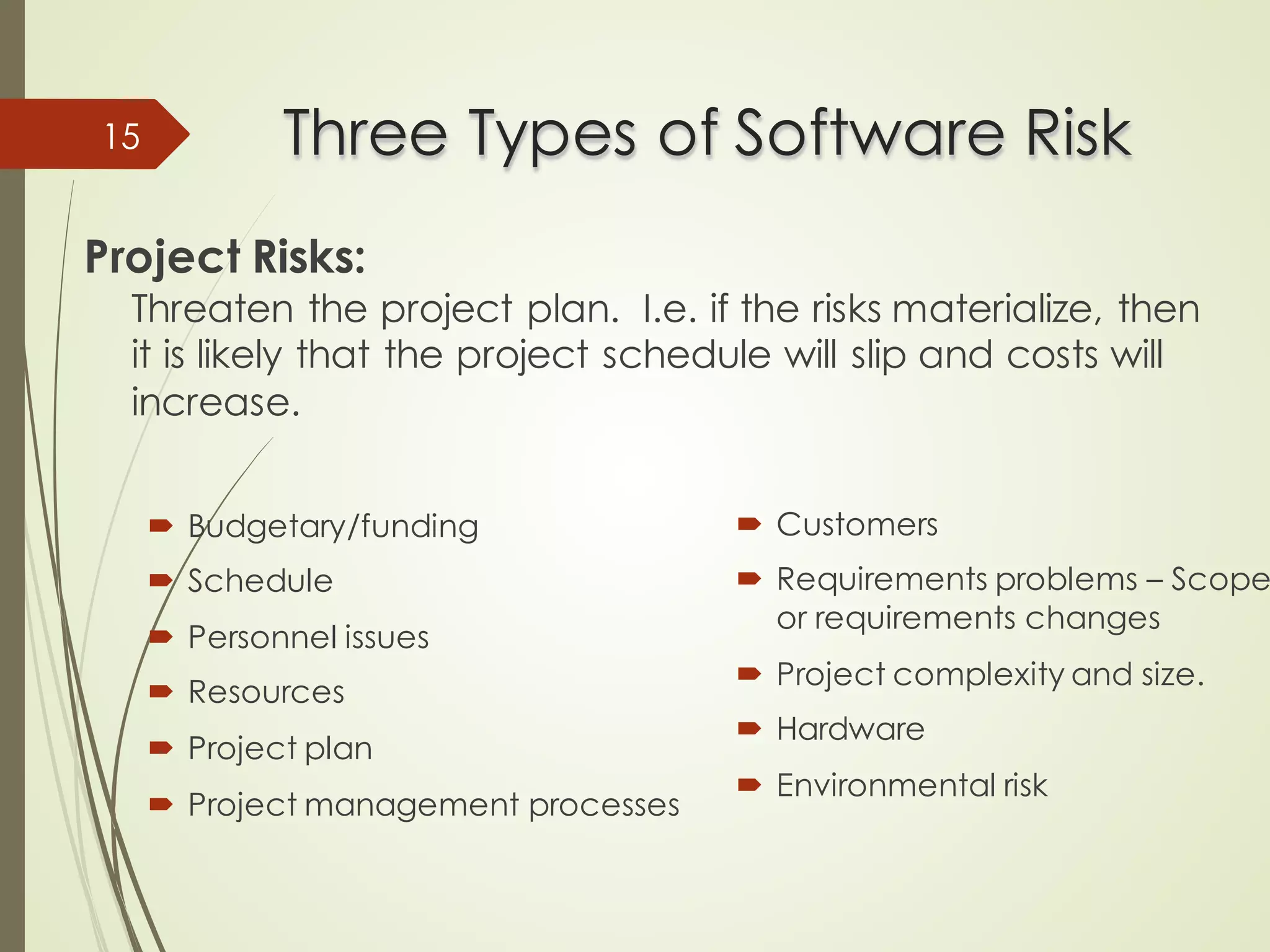
Three Types of Software Risk
Project Risks:
Threaten the project plan. I.e. if the risks materialize, then
it is likely that the project schedule will slip and costs will
increase.
´ Budgetary/funding
´ Schedule
´ Personnel issues
´ Resources
´ Project plan
´ Project management processes
15
´ Customers
´ Requirements problems – Scope
or requirements changes
´ Project complexity and size.
´ Hardware
´ Environmental risk
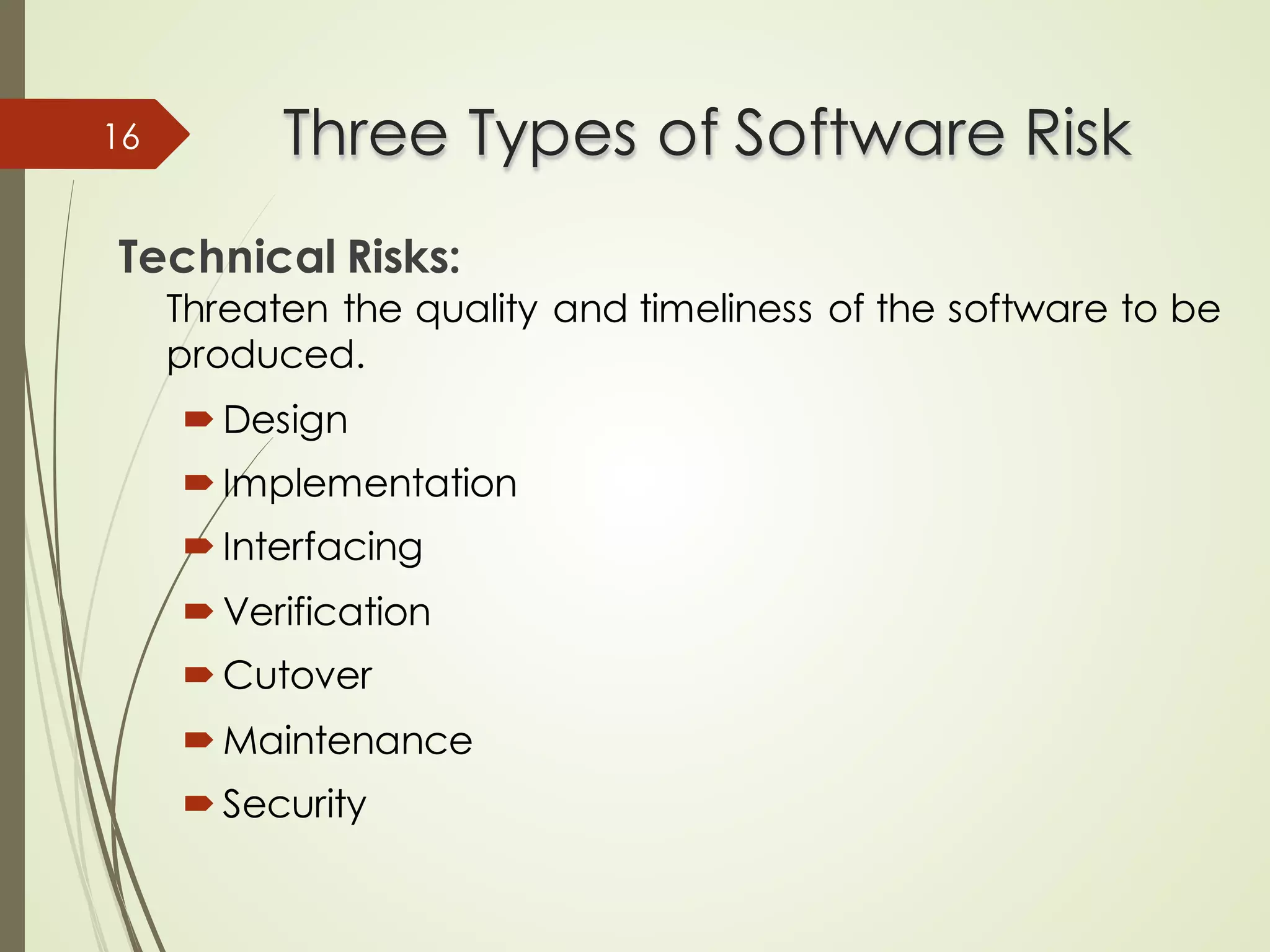
Three Types of Software Risk
Technical Risks:
Threaten the quality and timeliness of the software to be
produced.
´ Design
´ Implementation
´ Interfacing
´ Verification
´ Cutover
´ Maintenance
´ Security
16
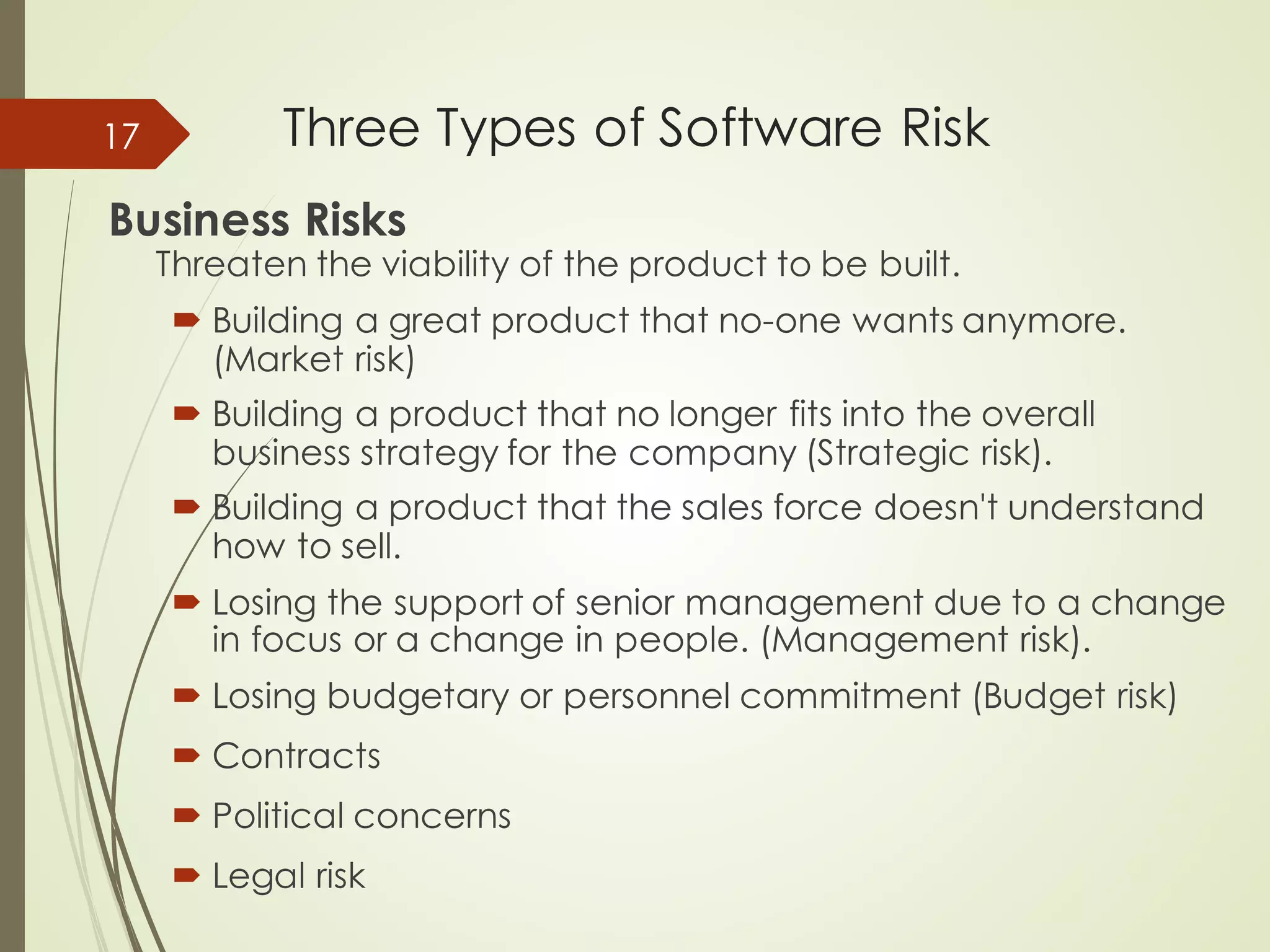
Three Types of Software Risk
Business Risks
Threaten the viability of the product to be built.
´ Building a great product that no-one wants anymore.
(Market risk)
´ Building a product that no longer fits into the overall
business strategy for the company (Strategic risk).
´ Building a product that the sales force doesn't understand
how to sell.
´ Losing the support of senior management due to a change
in focus or a change in people. (Management risk).
´ Losing budgetary or personnel commitment (Budget risk)
´ Contracts
´ Political concerns
´ Legal risk
17
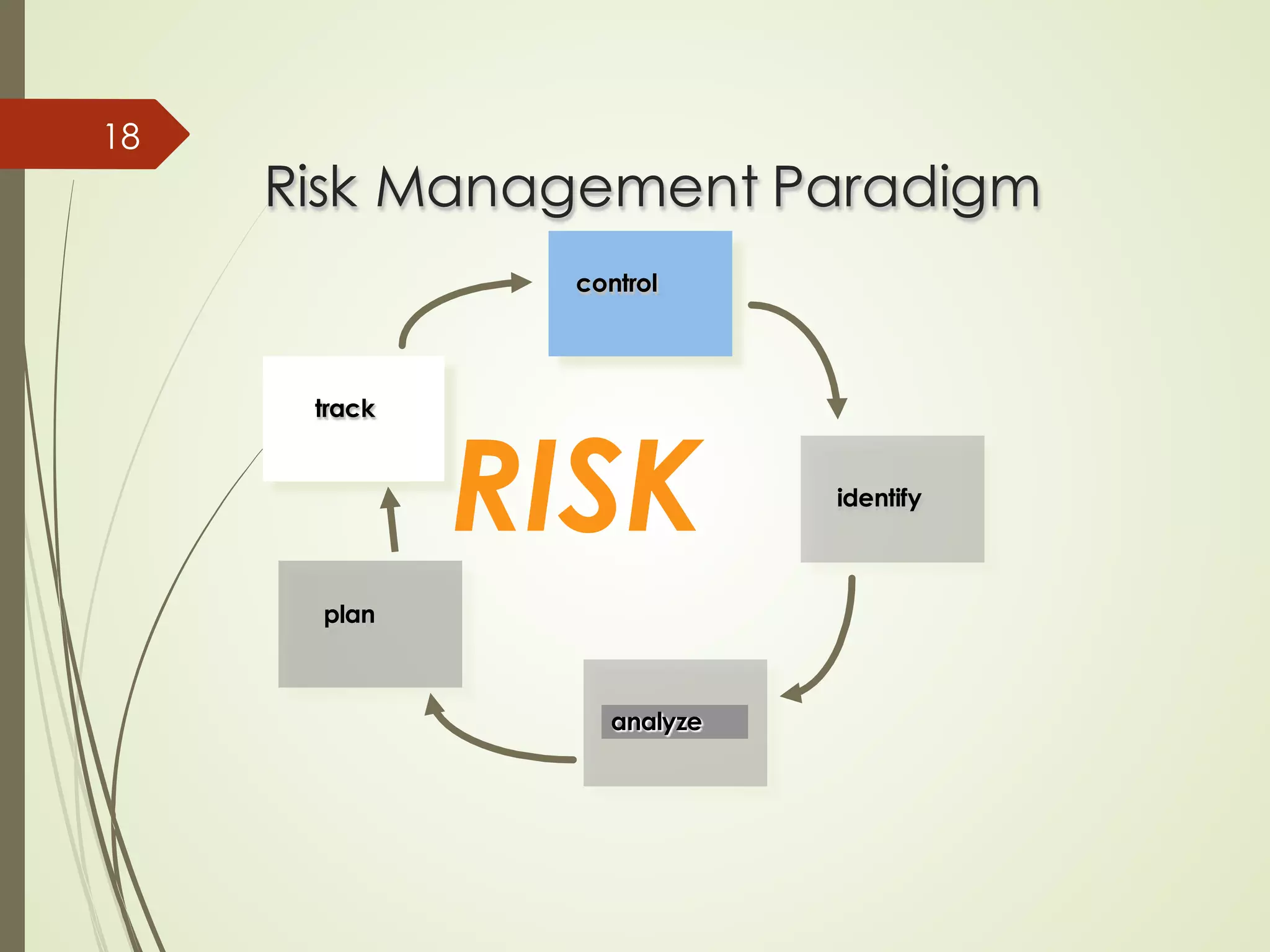
Risk Management Paradigm
18
RISK
control
control
identify
identify
analyze
analyze
plan
plan
track
track
Lecture Two Review Questions
Q1. Explain what project Planning is with example?
Q2. List at least four advantages of planning in software development?
Q3. Briefly explain the following:
´Project scope management
´Project time management
´Project cost management
Q4. What does decomposition indicates in time management?
Q5. Identify and evaluate the difference between the three cost
estimation tools and techniques?
Q6. Explain the difference between the three types of software
risks with example?
19

Lecture 2.pdf

  • 1.
    Object Oriented Software Engineering ObjectOriented Software Engineering Yoseph K, Instructor yosefkrs@outlook.com Office Hours: Monday - Saturday 1 CSSE341 CSSE341
  • 2.
    Lecture Two Software ProjectManagement ´ In this lecture, we will focus on: ´ Project Planning ´ Project Size Estimation metrics and techniques ´ Scheduling and team structure ´ Risk Management 2
  • 3.
    Project Planning Project Planning Theoverall goal of project planning is to establish a pragmatic strategy for controlling, tracking, and monitoring a complex technical project. Or, A Plan is the strategy for the successful completion of the project. It's a description of the project steps that produce increasing maturity of the products or processes produced by the project. Why? So the end result gets done on time, with quality! 3
  • 4.
    Why plan? Why plan? i.To achieve a specific goal ii. To reduce the complexity risk of having unclear role iii. To increase quality of productivity iv. To balance the triple constraints (Time, Scope, Cost) 4
  • 5.
    Planning is essentialto control Planning is essential to control ´ An effective way to exert control is to: ´ Know where you are ´ Know where you are supposed to be ´ Take corrective action if there is a difference between the two ´ Note: ´ You have to have a plan to know where you are supposed to be ´ If you have no plan, you have no control 5
  • 6.
    Primary Planning Steps PrimaryPlanning Steps 1. Identify project scope and objectives 2. Define and Record Requirements 3. Identify project organizational environment ´ Analyze project characteristics ´ Identify Project Team and Define Roles and Responsibilities 4. Identify project products and activities 5. Identify Risks and Define Risk Strategies 6. Review and communicate plan 7. Obtain Plan Approval 8. Conduct Kick-off Meeting 6
  • 7.
    Project Scope Management ProjectScope Management ´ Project scope management is one of the most critical project management knowledge (skill) areas ´ Scope defines ´ All the work that is required to complete the project successfully and ´ Only the work that is required, no more, no less ´ project scope management defines and controls what is and is not part of the project work 7
  • 8.
    Project Time Management ProjectTime Management ´ Project time management is the project management knowledge area concerned with analyzing the logical and temporal relationships among the activities needed to complete the project . ´ In a conventional methodology, the project schedule acts as the planning backbone for virtually all other project activities 8
  • 9.
    Planning, Estimating, Scheduling Planning,Estimating, Scheduling ´ What's the difference? ´ Plan: Identify activities. No specific start and end dates. ´ Estimating: Determining the size & duration of activities. ´ Schedule: Adds specific start and end dates, relationships, and resources. 9 Decomposition is the process of breaking the project scope and deliverables into smaller, more manageable components. Decomposition is usually performed in a top- down, hierarchical manner
  • 10.
    Project Cost Management ´Cost is a resource sacrificed or fore-gone to achieve a specific objective or something given up in exchange ´ Project cost management includes the processes required to ensure that the project is completed within an approved budget. 10
  • 11.
    Cost Estimation Toolsand Techniques ´ 3 basic tools and techniques for cost estimates: ´ Analogous or top-down: use the actual cost of a previous, similar project as the basis for the new estimate ´ Bottom-up: estimate individual work items and sum them to get a total estimate ´ Parametric: use project characteristics in a mathematical model to estimate costs 11
  • 12.
    Project Risk Management ProjectRisk Management Definitions: Definitions: ´ Risk is the probability of incurring some net loss while pursuing a goal. ´ Risk management is a systematic approach to reducing the harm due to risks, making a project less vulnerable to challenge or failure (e.g., cost or schedule overruns, scope decrease, quality reduction) and its resulting product more robust. 12
  • 13.
    Features of RiskManagement 13 Risk Identification Risk Assessment Risk Prioritization Risk Management Risk ManagementPlanning Risk Resolution Risk Monitoring Risk Analysis Risk Control
  • 14.
    Where risks arefound Where risks are found ´ Budgets/funding ´ Schedules ´ Scope or requirements changes ´ Projectplan ´ Projectmanagement processes ´ Technicalissues ´ Personnelissues ´ Hardware ´ Contracts ´ Political concerns ´ Business risk ´ Legal risk ´ Environmental risk 14
  • 15.
    Three Types ofSoftware Risk Three Types of Software Risk Project Risks: Threaten the project plan. I.e. if the risks materialize, then it is likely that the project schedule will slip and costs will increase. ´ Budgetary/funding ´ Schedule ´ Personnel issues ´ Resources ´ Project plan ´ Project management processes 15 ´ Customers ´ Requirements problems – Scope or requirements changes ´ Project complexity and size. ´ Hardware ´ Environmental risk
  • 16.
    Three Types ofSoftware Risk Three Types of Software Risk Technical Risks: Threaten the quality and timeliness of the software to be produced. ´ Design ´ Implementation ´ Interfacing ´ Verification ´ Cutover ´ Maintenance ´ Security 16
  • 17.
    Three Types ofSoftware Risk Business Risks Threaten the viability of the product to be built. ´ Building a great product that no-one wants anymore. (Market risk) ´ Building a product that no longer fits into the overall business strategy for the company (Strategic risk). ´ Building a product that the sales force doesn't understand how to sell. ´ Losing the support of senior management due to a change in focus or a change in people. (Management risk). ´ Losing budgetary or personnel commitment (Budget risk) ´ Contracts ´ Political concerns ´ Legal risk 17
  • 18.
    Risk Management Paradigm RiskManagement Paradigm 18 RISK control control identify identify analyze analyze plan plan track track
  • 19.
    Lecture Two ReviewQuestions Q1. Explain what project Planning is with example? Q2. List at least four advantages of planning in software development? Q3. Briefly explain the following: ´Project scope management ´Project time management ´Project cost management Q4. What does decomposition indicates in time management? Q5. Identify and evaluate the difference between the three cost estimation tools and techniques? Q6. Explain the difference between the three types of software risks with example? 19