Software Project Management
Today’s Topic: Project Control
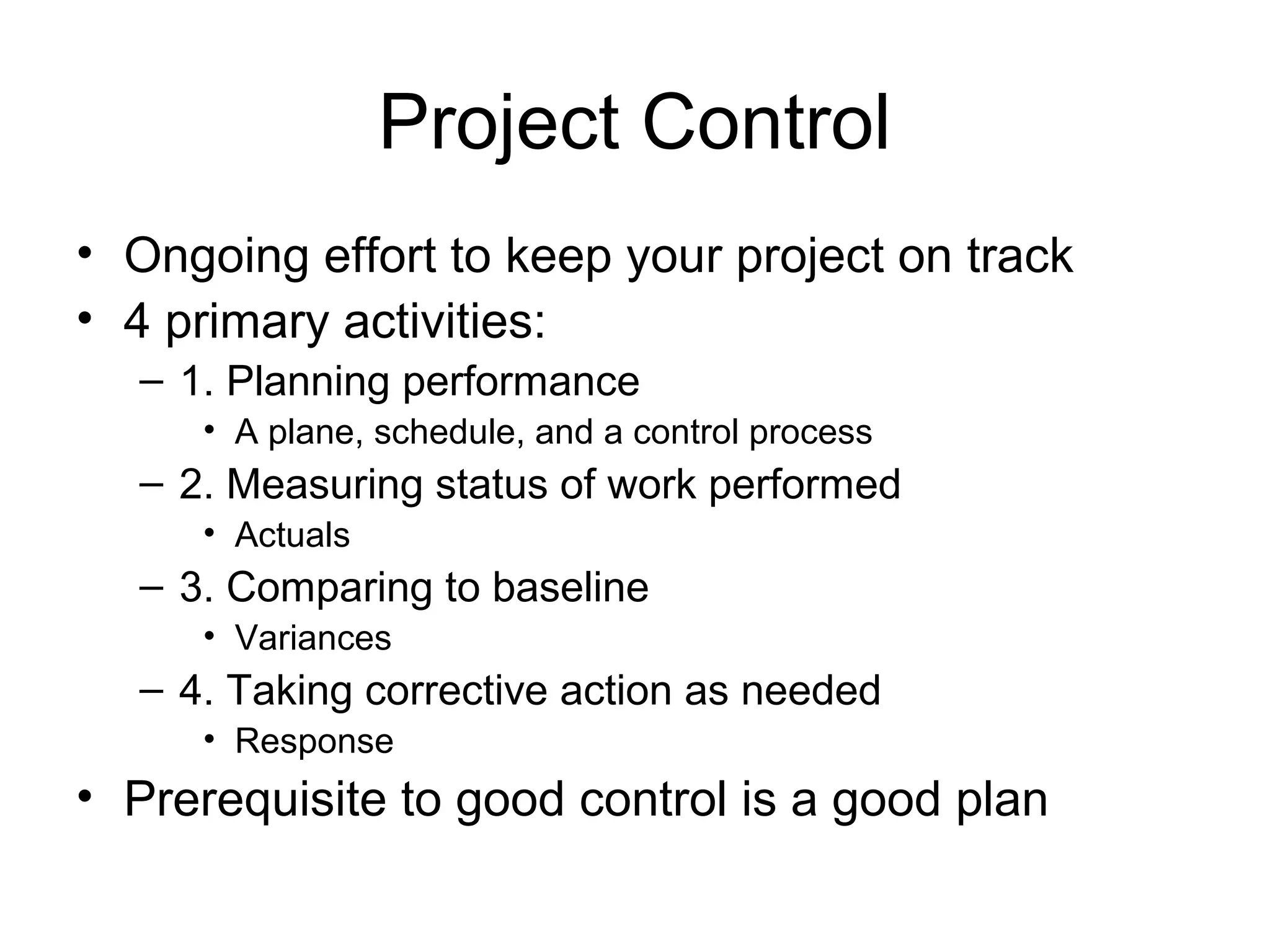
Project Control
• Ongoing effort to keep your project on track
• 4 primary activities:
– 1. Planning performance
• A plane, schedule, and a control process
– 2. Measuring status of work performed
• Actuals
– 3. Comparing to baseline
• Variances
– 4. Taking corrective action as needed
• Response
• Prerequisite to good control is a good plan
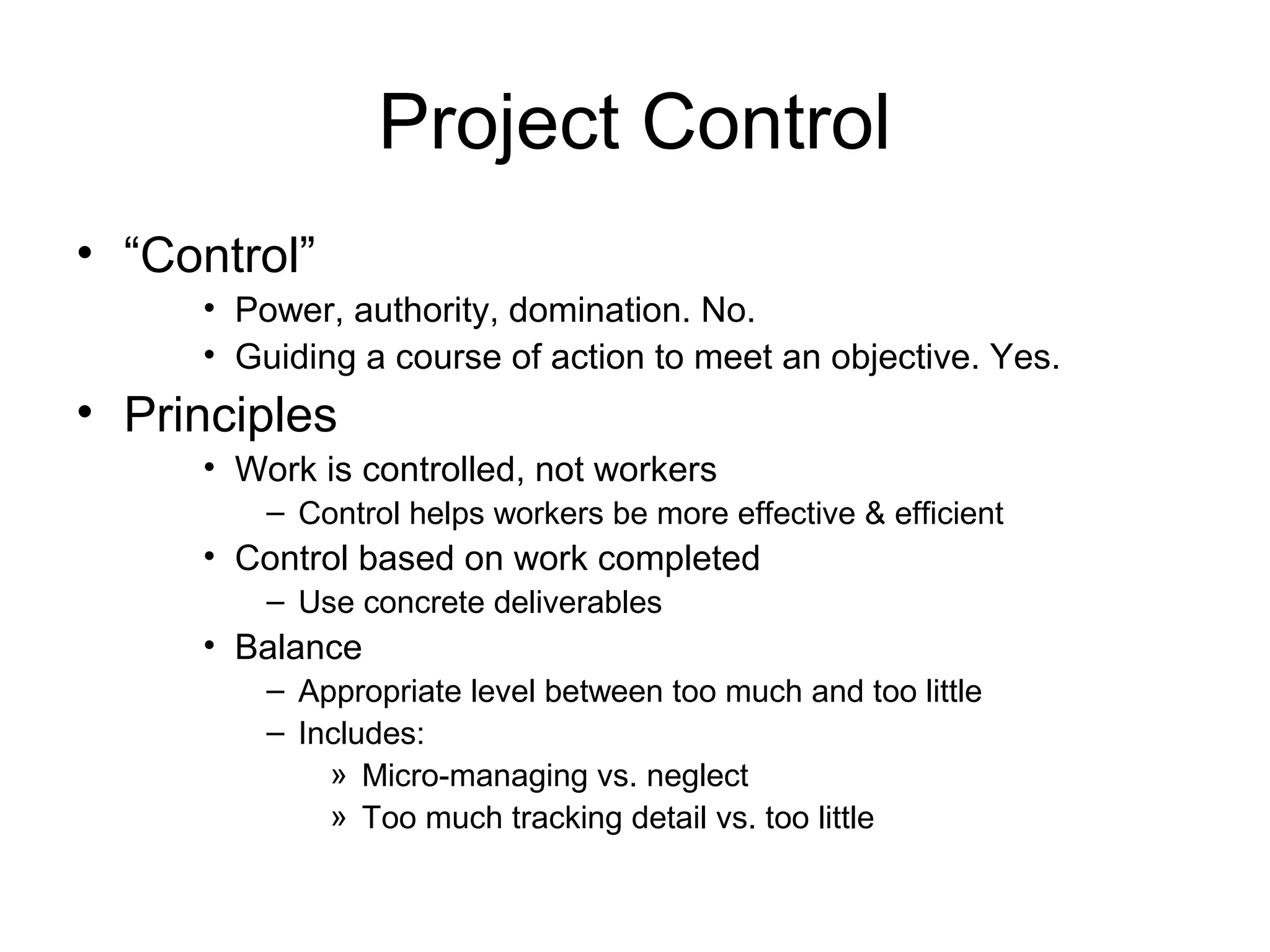
Project Control
• “Control”
• Power, authority, domination. No.
• Guiding a course of action to meet an objective. Yes.
• Principles
• Work is controlled, not workers
– Control helps workers be more effective & efficient
• Control based on work completed
– Use concrete deliverables
• Balance
– Appropriate level between too much and too little
– Includes:
» Micro-managing vs. neglect
» Too much tracking detail vs. too little
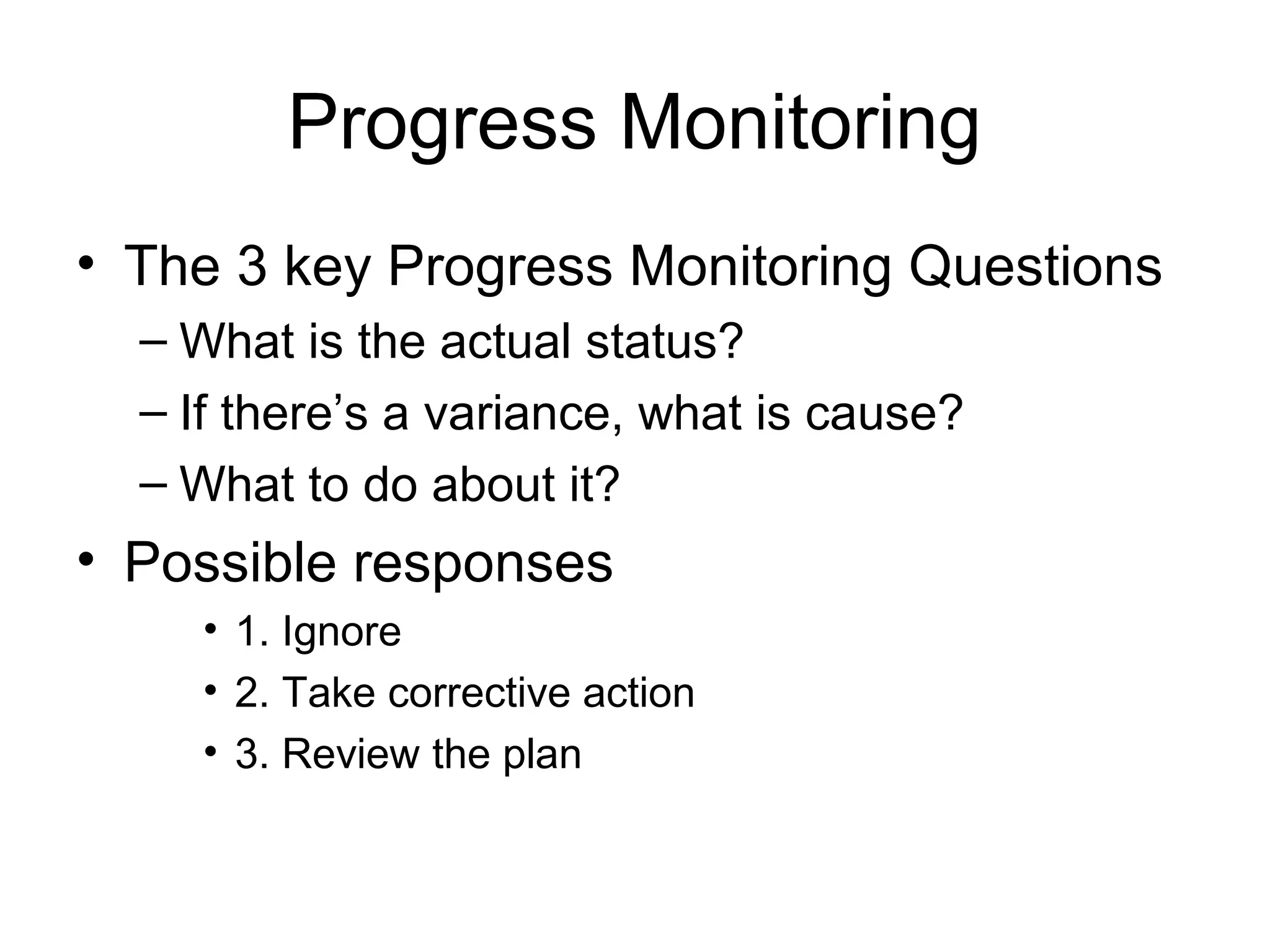
Progress Monitoring
• The 3 key Progress Monitoring Questions
– What is the actual status?
– If there’s a variance, what is cause?
– What to do about it?
• Possible responses
• 1. Ignore
• 2. Take corrective action
• 3. Review the plan
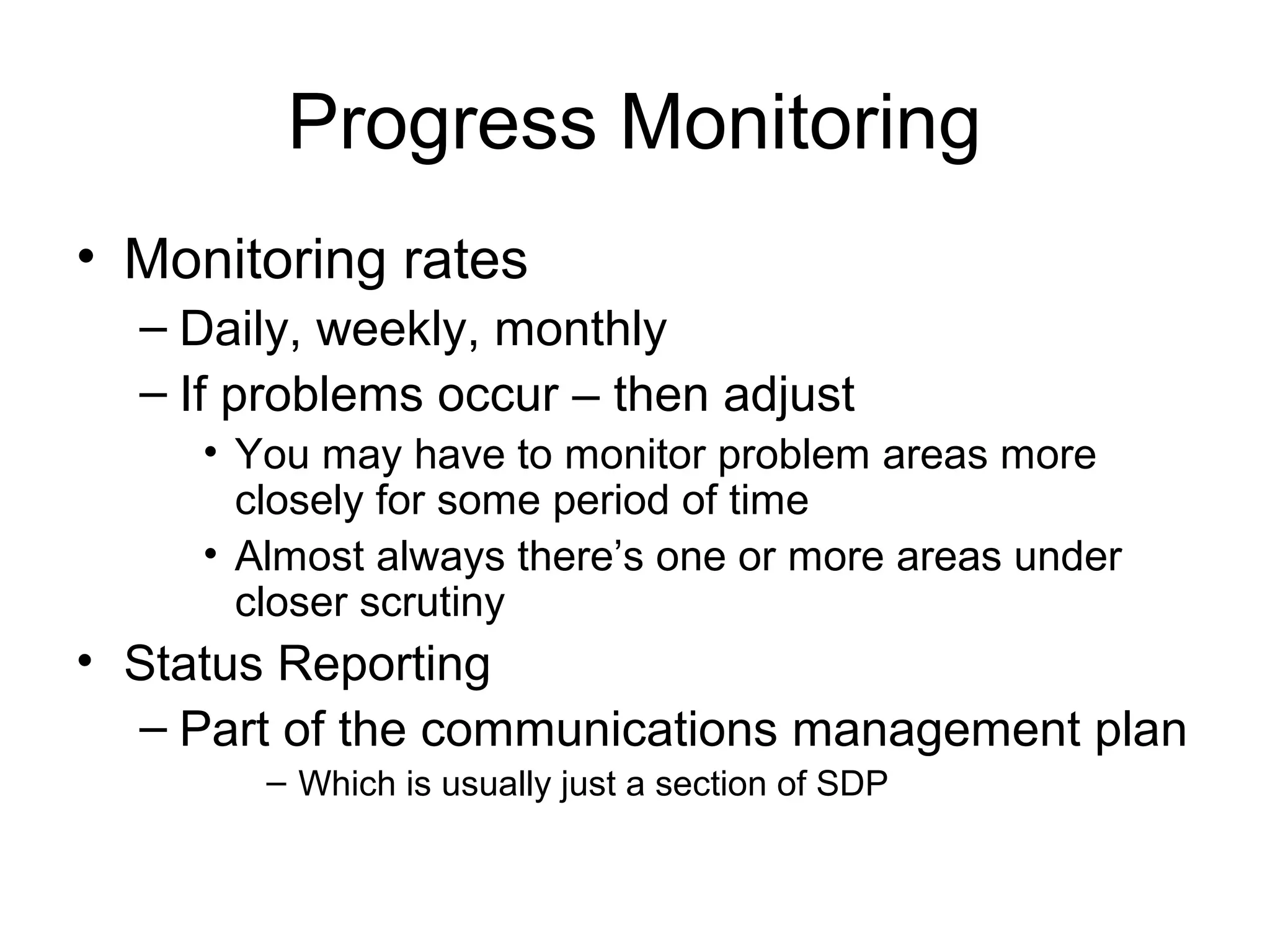
Progress Monitoring
• Monitoring rates
– Daily, weekly, monthly
– If problems occur – then adjust
• You may have to monitor problem areas more
closely for some period of time
• Almost always there’s one or more areas under
closer scrutiny
• Status Reporting
– Part of the communications management plan
– Which is usually just a section of SDP
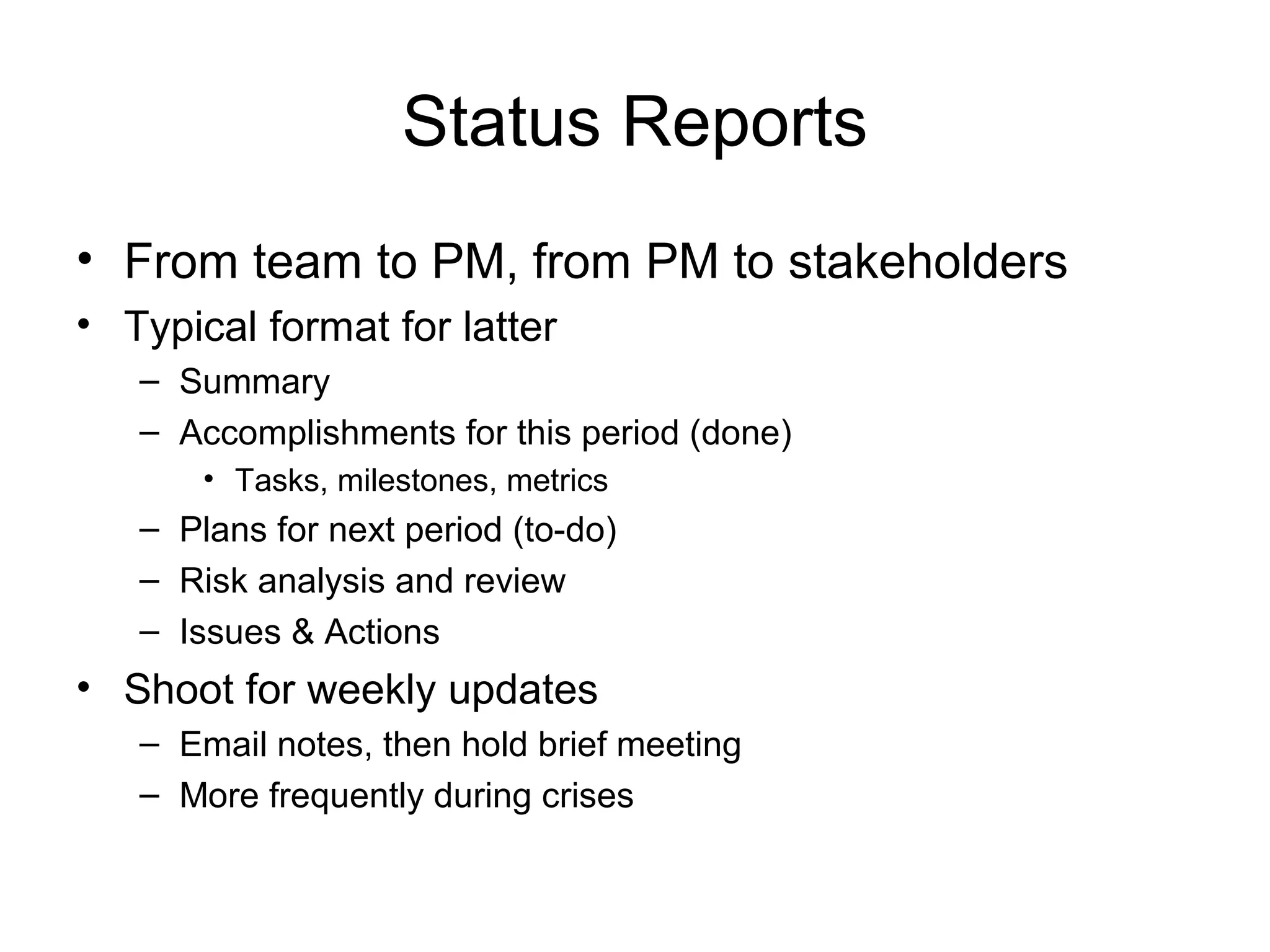
Status Reports
• From team to PM, from PM to stakeholders
• Typical format for latter
– Summary
– Accomplishments for this period (done)
• Tasks, milestones, metrics
– Plans for next period (to-do)
– Risk analysis and review
– Issues & Actions
• Shoot for weekly updates
– Email notes, then hold brief meeting
– More frequently during crises
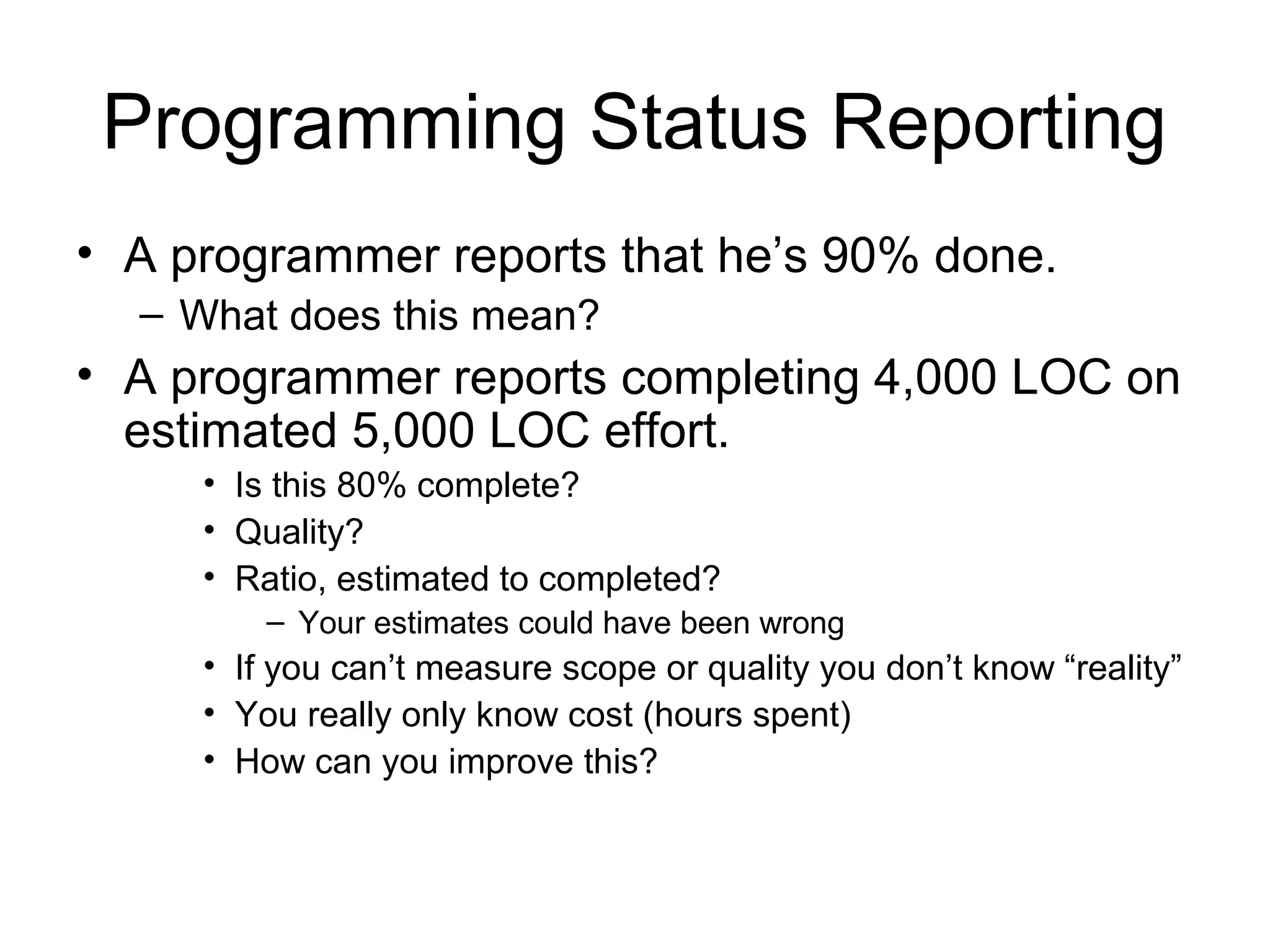
Programming Status Reporting
• A programmer reports that he’s 90% done.
– What does this mean?
• A programmer reports completing 4,000 LOC on
estimated 5,000 LOC effort.
• Is this 80% complete?
• Quality?
• Ratio, estimated to completed?
– Your estimates could have been wrong
• If you can’t measure scope or quality you don’t know “reality”
• You really only know cost (hours spent)
• How can you improve this?
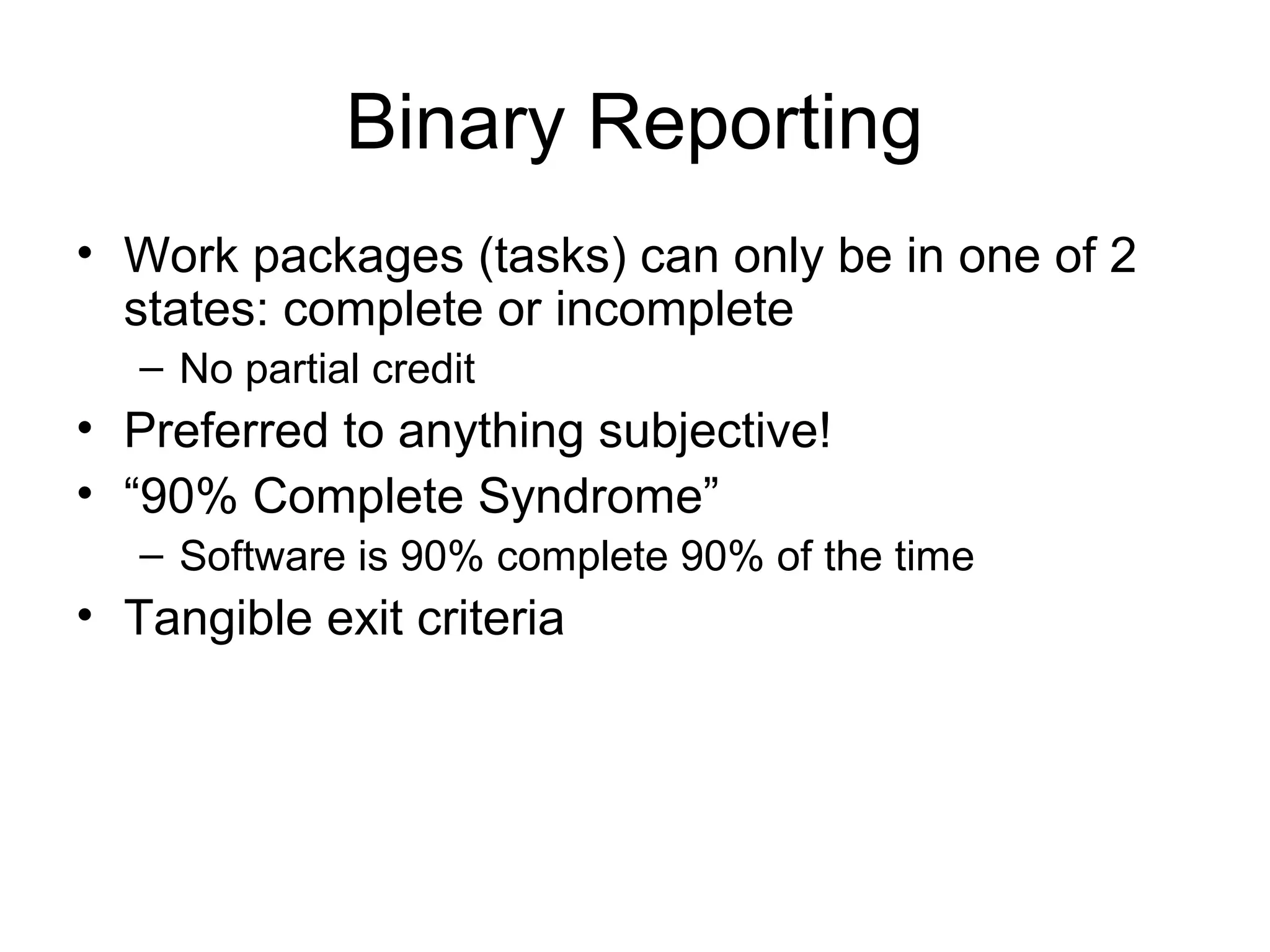
Binary Reporting
• Work packages (tasks) can only be in one of 2
states: complete or incomplete
– No partial credit
• Preferred to anything subjective!
• “90% Complete Syndrome”
– Software is 90% complete 90% of the time
• Tangible exit criteria
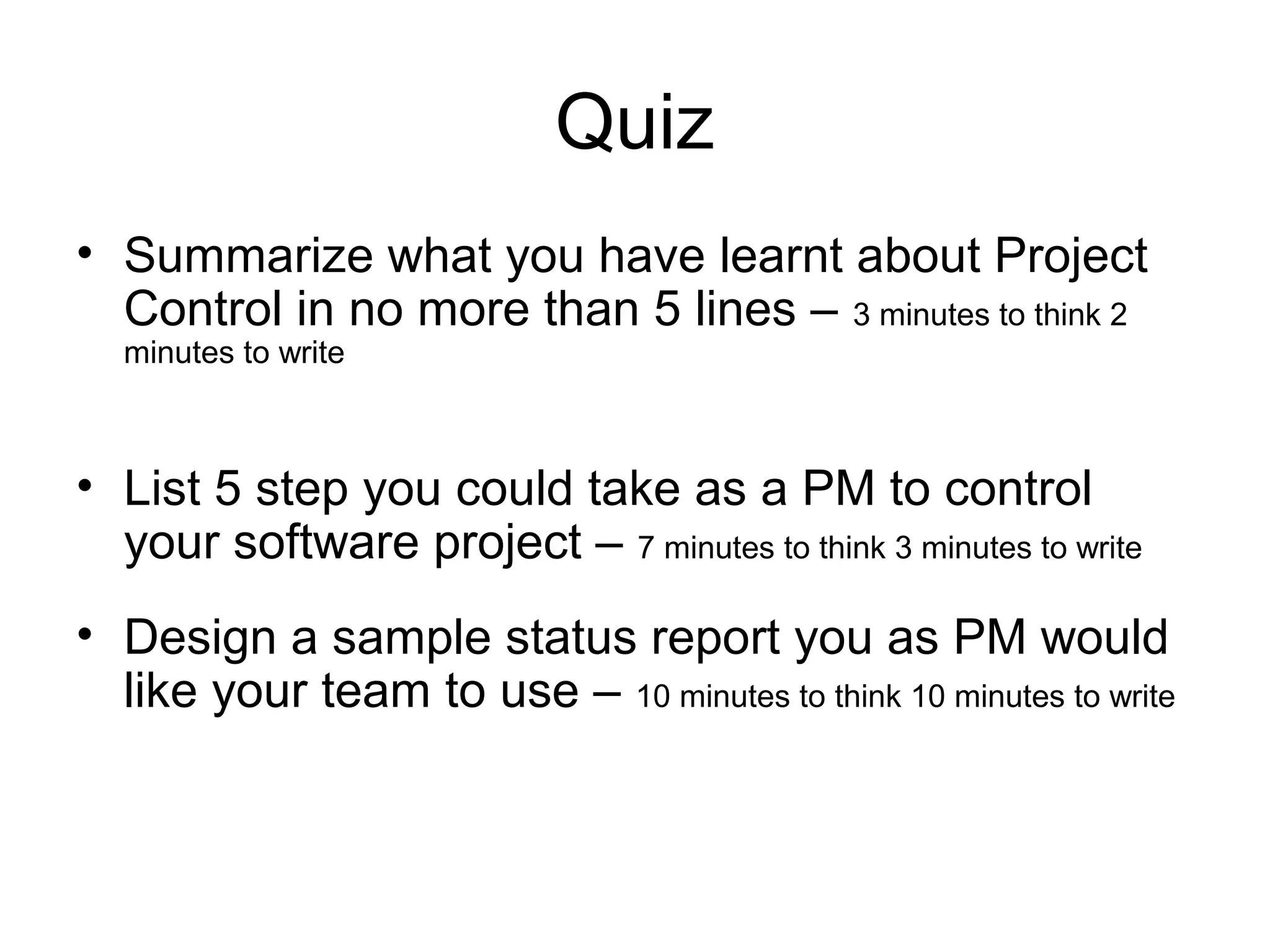
Quiz
• Summarize what you have learnt about Project
Control in no more than 5 lines – 3 minutes to think 2
minutes to write
• List 5 step you could take as a PM to control
your software project – 7 minutes to think 3 minutes to write
• Design a sample status report you as PM would
like your team to use – 10 minutes to think 10 minutes to write
Project Control - Software Project Management

Project Control - Software Project Management

  • 1.
  • 2.
    Project Control • Ongoingeffort to keep your project on track • 4 primary activities: – 1. Planning performance • A plane, schedule, and a control process – 2. Measuring status of work performed • Actuals – 3. Comparing to baseline • Variances – 4. Taking corrective action as needed • Response • Prerequisite to good control is a good plan
  • 3.
    Project Control • “Control” •Power, authority, domination. No. • Guiding a course of action to meet an objective. Yes. • Principles • Work is controlled, not workers – Control helps workers be more effective & efficient • Control based on work completed – Use concrete deliverables • Balance – Appropriate level between too much and too little – Includes: » Micro-managing vs. neglect » Too much tracking detail vs. too little
  • 4.
    Progress Monitoring • The3 key Progress Monitoring Questions – What is the actual status? – If there’s a variance, what is cause? – What to do about it? • Possible responses • 1. Ignore • 2. Take corrective action • 3. Review the plan
  • 5.
    Progress Monitoring • Monitoringrates – Daily, weekly, monthly – If problems occur – then adjust • You may have to monitor problem areas more closely for some period of time • Almost always there’s one or more areas under closer scrutiny • Status Reporting – Part of the communications management plan – Which is usually just a section of SDP
  • 6.
    Status Reports • Fromteam to PM, from PM to stakeholders • Typical format for latter – Summary – Accomplishments for this period (done) • Tasks, milestones, metrics – Plans for next period (to-do) – Risk analysis and review – Issues & Actions • Shoot for weekly updates – Email notes, then hold brief meeting – More frequently during crises
  • 7.
    Programming Status Reporting •A programmer reports that he’s 90% done. – What does this mean? • A programmer reports completing 4,000 LOC on estimated 5,000 LOC effort. • Is this 80% complete? • Quality? • Ratio, estimated to completed? – Your estimates could have been wrong • If you can’t measure scope or quality you don’t know “reality” • You really only know cost (hours spent) • How can you improve this?
  • 8.
    Binary Reporting • Workpackages (tasks) can only be in one of 2 states: complete or incomplete – No partial credit • Preferred to anything subjective! • “90% Complete Syndrome” – Software is 90% complete 90% of the time • Tangible exit criteria
  • 9.
    Quiz • Summarize whatyou have learnt about Project Control in no more than 5 lines – 3 minutes to think 2 minutes to write • List 5 step you could take as a PM to control your software project – 7 minutes to think 3 minutes to write • Design a sample status report you as PM would like your team to use – 10 minutes to think 10 minutes to write