Cont…
A cost benefit analysis is done to determine how
well, or how poorly, aplanned action will turnout.
The analysis relies on the addition of positive
factors and the subtraction of negative ones to
determine a netresult.
CBA has been established primarily as a tool for use
by governments in making their social and
economicdecisions.
Cont…
CBA measures costs and benefits to the community
of adopting a particular course of action e.g.
Community health services, adult education, etc.
When investment made commensurate with the
benefit derived, it can be said that operation is
positive and viable; but when benefits derived do
not compensate financial investments made, it can
be said that it is financially non-viable andnegative.
Cont…
Most Benefit Analysis is used todetermine:
Whether a solution/project is economicallyfeasible
Which of two or more projects provides the best
return oninvestment
Other issues:
Is the project worthwhilefinancially?
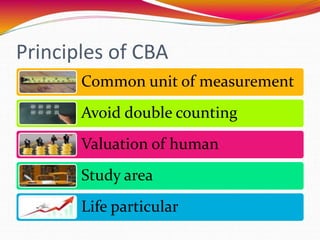
Principles of CBA
Common unit of measurement
Avoid double counting
Valuation of human
Study area
Life particular
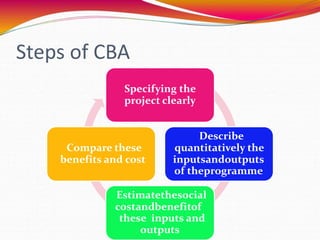
Steps of CBA
Specifying the
project clearly
Describe
quantitatively the
inputsandoutputs
of theprogramme
Estimatethesocial
costandbenefitof
these inputs and
outputs
Compare these
benefits and cost
1. Specifying the project clearly
The first step is to decide on the perspective from
which the study is tobe done.
When we have decided on the perspective on the
main elements of the projects such as, the study of
the location, timing, group involved, the connection
with other program, etc, should beconsidered.
2. Describeinputsandoutputs
For some projects it is easy to identify the input and
output.
For e.g. if we are planning a waste water treatment
project, thestaffs of that program will be able to
provide a full physical specification of the plant,
together with the inputs required to build it and
keep it running.
However, it is harder to predict the uncertainties
caused bythe factors which were never in
consideration before.
3. Estimatethesocialcostand
benefit
The next step is to put values on input & output
flows, i.e. to measure costs & benefits.
We could do this in any units but in many cases we
will be dealing with effects, especially on the benefit
side that are not directly registered onmarket.
4. Compare benefits & costs
Next step is to make comparison between cost incurred
andbenefit derived from theproject.
One of them is to subtract the total cost from the total
benefit toget netbenefit.
(Total cost –Total benefit = Netbenefit).
If the net benefit is positive then the cost benefit is positive
and ifthe net benefit is negative then the cost benefit is
negative.

costbenefitanalysis-201224093003 (1).pptx

  • 1.
    Cont… A cost benefitanalysis is done to determine how well, or how poorly, aplanned action will turnout. The analysis relies on the addition of positive factors and the subtraction of negative ones to determine a netresult. CBA has been established primarily as a tool for use by governments in making their social and economicdecisions.
  • 2.
    Cont… CBA measures costsand benefits to the community of adopting a particular course of action e.g. Community health services, adult education, etc. When investment made commensurate with the benefit derived, it can be said that operation is positive and viable; but when benefits derived do not compensate financial investments made, it can be said that it is financially non-viable andnegative.
  • 3.
    Cont… Most Benefit Analysisis used todetermine: Whether a solution/project is economicallyfeasible Which of two or more projects provides the best return oninvestment Other issues: Is the project worthwhilefinancially?
  • 4.
    Principles of CBA Commonunit of measurement Avoid double counting Valuation of human Study area Life particular
  • 5.
    Steps of CBA Specifyingthe project clearly Describe quantitatively the inputsandoutputs of theprogramme Estimatethesocial costandbenefitof these inputs and outputs Compare these benefits and cost
  • 6.
    1. Specifying theproject clearly The first step is to decide on the perspective from which the study is tobe done. When we have decided on the perspective on the main elements of the projects such as, the study of the location, timing, group involved, the connection with other program, etc, should beconsidered.
  • 7.
    2. Describeinputsandoutputs For someprojects it is easy to identify the input and output. For e.g. if we are planning a waste water treatment project, thestaffs of that program will be able to provide a full physical specification of the plant, together with the inputs required to build it and keep it running. However, it is harder to predict the uncertainties caused bythe factors which were never in consideration before.
  • 8.
    3. Estimatethesocialcostand benefit The nextstep is to put values on input & output flows, i.e. to measure costs & benefits. We could do this in any units but in many cases we will be dealing with effects, especially on the benefit side that are not directly registered onmarket.
  • 10.
    4. Compare benefits& costs Next step is to make comparison between cost incurred andbenefit derived from theproject. One of them is to subtract the total cost from the total benefit toget netbenefit. (Total cost –Total benefit = Netbenefit). If the net benefit is positive then the cost benefit is positive and ifthe net benefit is negative then the cost benefit is negative.