MPEP1305
ENVIRONMENT ECONOMICS
AND PROJECT APPRAISAL
Assignment I
COST - BENEFIT ANALYSIS
HRISHIKESH SATPUTE
Scholar No. - 2019MEP012
Master of Environmental Planning,
SPA, Bhopal
1
MPEP1305: ENVIRONMENT ECONOMICS & PROJECT APPRAISAL
COST BENEFIT ANALYSIS
KEYWORDS: Cost-Benefit Analysis; Social Cost-Benefit Analysis; Environment Cost-Benefit Analysis
INTRODUCTION
HISTORY
Cost-Benefit Analysis (CBA) has its roots in the water development projects of the U.S. Army Corps of Engineers.
The Corps of Engineers had its origins in the French engineers hired by George Washington in the American
Revolution. For years the solitary school of engineering in the United States was the Military Academy at West
Point, New York.
In 1879, Congress created the Mississippi River Commission to "prevent destructive floods." The Commission
included civilians but the president had to be an Army engineer and the Corps of Engineers always had veto power
over any decision by the Commission.
In 1936, Congress passed the Flood Control Act which contained the wording, "the Federal Government should
improve or participate in the improvement of navigable waters or their tributaries, including watersheds thereof,
for flood-control purposes if the benefits to whomsoever they may accrue are in excess of the estimated costs."
The phrase if the benefits to whomsoever they may accrue are in excess of the estimated costs established cost-
benefit analysis. Initially the Corps of Engineers developed ad hoc methods for estimating benefits and costs. It
wasn't until the 1950s that academic economists discovered that the Corps had developed a system for the
economic analysis of public investments. Economists have influenced and improved the Corps' methods since then
and cost-benefit analysis has been adapted to most areas of public decision-making.
After 1980s, Social Cost Benefit Analysis (SCBA) and Environmental Cost Benefit Analysis (ECBA) received attention.
BACKGROUND
CBA estimates and totals up the equivalent money value of the benefits and costs to the community of projects to
establish whether they are worthwhile. These projects may be dams and highways or can be training programs and
health care systems.
The idea of this economic accounting originated with Jules Dupuit, a French engineer whose 1848 article is still
worth reading. The British economist, Alfred Marshall, formulated some of the formal concepts that are at the
foundation of CBA. But the practical development of CBA came as a result of the impetus provided by the Federal
Navigation Act of 1936. This act required that the U.S. Corps of Engineers carry out projects for the improvement
of the waterway system when the total benefits of a project to whomsoever they accrue exceed the costs of that
project.
CONCEPTS
COST-BENEFIT ANALYSIS
Definition
Cost-benefit analysis is defined as any quantitative analysis performed to establish whether the present value of
benefits of a given project exceeds the present value of costs. Such analysis usually also produces both a net present
value (NPV) calculation and an economic rate of return (ERR) calculation (The World Bank, 2010).
According to me, CBA can be described as a technique for estimating all costs involved and probable profits to be
derived from an opportunity or project proposal.
2
Principle
In the CBA, there must be common unit of measurement and the valuation must represent Consumers or Producers.
The benefits are usually measured by Market choices. Gross benefit of an increase in consumption is an area under
Demand curve. In some instances, measurements will require the valuation of human life. CBA is confined to a
particular study area that serve as a decision criterion for a particular project.
Methods
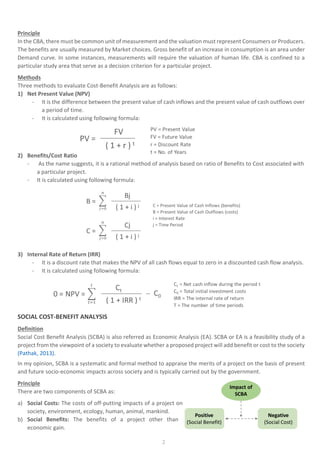
Three methods to evaluate Cost-Benefit Analysis are as follows:
1) Net Present Value (NPV)
- It is the difference between the present value of cash inflows and the present value of cash outflows over
a period of time.
- It is calculated using following formula:
2) Benefits/Cost Ratio
- As the name suggests, it is a rational method of analysis based on ratio of Benefits to Cost associated with
a particular project.
- It is calculated using following formula:
3) Internal Rate of Return (IRR)
- It is a discount rate that makes the NPV of all cash flows equal to zero in a discounted cash flow analysis.
- It is calculated using following formula:
SOCIAL COST-BENEFIT ANALYSIS
Definition
Social Cost Benefit Analysis (SCBA) is also referred as Economic Analysis (EA). SCBA or EA is a feasibility study of a
project from the viewpoint of a society to evaluate whether a proposed project will add benefit or cost to the society
(Pathak, 2013).
In my opinion, SCBA is a systematic and formal method to appraise the merits of a project on the basis of present
and future socio-economic impacts across society and is typically carried out by the government.
Principle
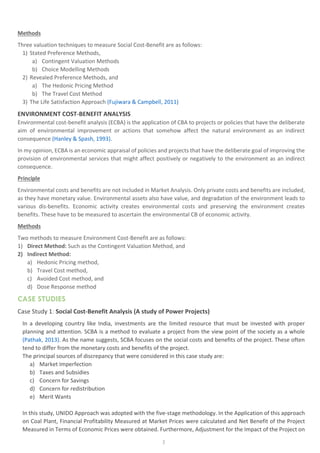
There are two components of SCBA as:
a) Social Costs: The costs of off-putting impacts of a project on
society, environment, ecology, human, animal, mankind.
b) Social Benefits: The benefits of a project other than
economic gain.
3
Methods
Three valuation techniques to measure Social Cost-Benefit are as follows:
1) Stated Preference Methods,
a) Contingent Valuation Methods
b) Choice Modelling Methods
2) Revealed Preference Methods, and
a) The Hedonic Pricing Method
b) The Travel Cost Method
3) The Life Satisfaction Approach (Fujiwara & Campbell, 2011)
ENVIRONMENT COST-BENEFIT ANALYSIS
Environmental cost-benefit analysis (ECBA) is the application of CBA to projects or policies that have the deliberate
aim of environmental improvement or actions that somehow affect the natural environment as an indirect
consequence (Hanley & Spash, 1993).
In my opinion, ECBA is an economic appraisal of policies and projects that have the deliberate goal of improving the
provision of environmental services that might affect positively or negatively to the environment as an indirect
consequence.
Principle
Environmental costs and benefits are not included in Market Analysis. Only private costs and benefits are included,
as they have monetary value. Environmental assets also have value, and degradation of the environment leads to
various dis-benefits. Economic activity creates environmental costs and preserving the environment creates
benefits. These have to be measured to ascertain the environmental CB of economic activity.
Methods
Two methods to measure Environment Cost-Benefit are as follows:
1) Direct Method: Such as the Contingent Valuation Method, and
2) Indirect Method:
a) Hedonic Pricing method,
b) Travel Cost method,
c) Avoided Cost method, and
d) Dose Response method
CASE STUDIES
Case Study 1: Social Cost-Benefit Analysis (A study of Power Projects)
In a developing country like India, investments are the limited resource that must be invested with proper
planning and attention. SCBA is a method to evaluate a project from the view point of the society as a whole
(Pathak, 2013). As the name suggests, SCBA focuses on the social costs and benefits of the project. These often
tend to differ from the monetary costs and benefits of the project.
The principal sources of discrepancy that were considered in this case study are:
a) Market Imperfection
b) Taxes and Subsidies
c) Concern for Savings
d) Concern for redistribution
e) Merit Wants
In this study, UNIDO Approach was adopted with the five-stage methodology. In the Application of this approach
on Coal Plant, Financial Profitability Measured at Market Prices were calculated and Net Benefit of the Project
Measured in Terms of Economic Prices were obtained. Furthermore, Adjustment for the Impact of the Project on
4
Savings and Investment, Income Distribution and Merit/Demerit Goods were calculated. Similar calculations were
done for Hydro Power Plant with systematic comparative assessment.
This study proved that SCBA is an important tool for analyzing a project to reflect its merits and demerits on the
society. SCBA differs avoids market price and adopts shadow price to value the inputs and outputs of a project.
After applying UNIDO approach on the coal and hydro plants respectively, it was observed that rejecting the
project on the basis of its financial viability is not justified as it is evident from above results that incorporation of
social cost benefit analysis mechanism yields positive results (NPV) for both the projects i.e. coal plant and hydro
plant. Thus, taking into account the social costs and social benefits associated with the project plays a key role in
project assessment as needs and wants of community at large can’t be ignored.
Case Study 2:
Environment Cost-Benefit Analysis: Renewable Energy
Fear and problems over global warming have led policy makers to accept the importance of reducing greenhouse
gas Emissions. Renewable Energy system become quite favorable now a day because of national and international
policies. In early stage of implementation, renewable energy technology is having unit cost of energy higher than
conventional plant. ECBA will give an idea about the acceptability of any renewable energy plant.
The type of parameter for ECBA analysis is depend upon the type of renewable technology. Few parameters are
location of plant, type of renewable energy, technology status, economical consideration of society, climate
condition, risk of natural disaster, etc. These parameters can then be categorized on the basis of cost inflow and
outflow.
After applying the aforementioned methods of ECBA, it was observed that most of the renewable energy projects
are less economical viable as the investment and risk is high. Even after this, most of the government agencies are
interested to increase the share of renewable energy. Overall Cost Benefit analysis of renewable energy show that
they are acceptable.
CONCLUSION
CBA is an effective tool and a rational technique for economic valuation where market information is either non-
existent or deficient is. Perhaps, it is can be applied in decision-making process and is theoretically a useful aid
towards planning decisions
SCBA should be a part of assessment for projects whose merit requirements are additional i.e. whose social value
exceeds the economic value. By determining the social costs and benefits of above said socially viable projects,
companies can eventually land up with low interest rate finance for the project.
The emphasis in the second case study was on ECBA. Accepting the demerits of ECBA that include environmental
damages and its long-term effects with natural resources depletion, etc. it is helpful in providing a basis for
comparing projects and determining if an investment is sound or not. The general conclusions were taken from the
assessment of costs and benefits in the case studies. Hence, such value judgements are made clear in the planning
process and thereby decision-making process.
5
REFERENCES
Fujiwara, D., & Campbell, R. (2011). Valuation Techniques for Social Cost-Benefit Analysis : Valuation
Techniques for Social Cost-Benefit Analysis :
Hanley, N., & Spash, C. L. (1993). Cost-benefit analysis and the environment. Cost-Benefit Analysis and the
Environment. https://doi.org/10.2307/2235480
Pathak, R. S. (2013). Social Cost-Benefit Analysis: A Study of Power Projects Rishi Shankar Pathak Summer
Intern, PMI-NTPC, Noida.
The World Bank. (2010). Cost-Benefit Analysis in World Bank Projects.
Clark, D. (2013). Cost-Benefit Analysis for Development. The Elgar Companion to Development Studies.
https://doi.org/10.4337/9781847202864.00027
Edison, J. C., & Edison, J. C. (2020). Economic analysis of projects. Infrastructure Development and
Construction Management, 84–108. https://doi.org/10.1201/9781003055624-4
Erik, D. (1998). Environmental / social cost-benefit analysis: The integration of ...
Panth, P. P. (2015). COST BENEFIT ANALYSIS OF Social, Private and Environmental, 1–32.
Nghia, T. D. (n.d.). Cost Benefit Analysis (CBA) and portfolio development for adaptation options.
Information, H., & Arbor, A. (n.d.). INFORMATION TO U SER S mvu 800-521-0600.
Michael, E. (2010). SITUATING COST-BENEFIT ANALYSIS FOR ENVIRONMENTAL JUSTICE Erik Michael
Wohlmuth , B . A . Thesis Prepared for the Degree of MASTER OF ARTS December 2010 APPROVED:
Robert M . Figueroa , Major Professor David M . Kaplan , Committee Member Irene J . Klaver .
Frank, E., Gallina, A., Baldacci, M., & Miolo, M. (2008). Cost-benefit analysis of different solutions for
sustainable irrigation in Fucino Plain (Italy). WIT Transactions on Ecology and the Environment, 112,
263–272. https://doi.org/10.2495/SI080261

Cost Benefit Analysis

  • 1.
    MPEP1305 ENVIRONMENT ECONOMICS AND PROJECTAPPRAISAL Assignment I COST - BENEFIT ANALYSIS HRISHIKESH SATPUTE Scholar No. - 2019MEP012 Master of Environmental Planning, SPA, Bhopal
  • 2.
    1 MPEP1305: ENVIRONMENT ECONOMICS& PROJECT APPRAISAL COST BENEFIT ANALYSIS KEYWORDS: Cost-Benefit Analysis; Social Cost-Benefit Analysis; Environment Cost-Benefit Analysis INTRODUCTION HISTORY Cost-Benefit Analysis (CBA) has its roots in the water development projects of the U.S. Army Corps of Engineers. The Corps of Engineers had its origins in the French engineers hired by George Washington in the American Revolution. For years the solitary school of engineering in the United States was the Military Academy at West Point, New York. In 1879, Congress created the Mississippi River Commission to "prevent destructive floods." The Commission included civilians but the president had to be an Army engineer and the Corps of Engineers always had veto power over any decision by the Commission. In 1936, Congress passed the Flood Control Act which contained the wording, "the Federal Government should improve or participate in the improvement of navigable waters or their tributaries, including watersheds thereof, for flood-control purposes if the benefits to whomsoever they may accrue are in excess of the estimated costs." The phrase if the benefits to whomsoever they may accrue are in excess of the estimated costs established cost- benefit analysis. Initially the Corps of Engineers developed ad hoc methods for estimating benefits and costs. It wasn't until the 1950s that academic economists discovered that the Corps had developed a system for the economic analysis of public investments. Economists have influenced and improved the Corps' methods since then and cost-benefit analysis has been adapted to most areas of public decision-making. After 1980s, Social Cost Benefit Analysis (SCBA) and Environmental Cost Benefit Analysis (ECBA) received attention. BACKGROUND CBA estimates and totals up the equivalent money value of the benefits and costs to the community of projects to establish whether they are worthwhile. These projects may be dams and highways or can be training programs and health care systems. The idea of this economic accounting originated with Jules Dupuit, a French engineer whose 1848 article is still worth reading. The British economist, Alfred Marshall, formulated some of the formal concepts that are at the foundation of CBA. But the practical development of CBA came as a result of the impetus provided by the Federal Navigation Act of 1936. This act required that the U.S. Corps of Engineers carry out projects for the improvement of the waterway system when the total benefits of a project to whomsoever they accrue exceed the costs of that project. CONCEPTS COST-BENEFIT ANALYSIS Definition Cost-benefit analysis is defined as any quantitative analysis performed to establish whether the present value of benefits of a given project exceeds the present value of costs. Such analysis usually also produces both a net present value (NPV) calculation and an economic rate of return (ERR) calculation (The World Bank, 2010). According to me, CBA can be described as a technique for estimating all costs involved and probable profits to be derived from an opportunity or project proposal.
  • 3.
    2 Principle In the CBA,there must be common unit of measurement and the valuation must represent Consumers or Producers. The benefits are usually measured by Market choices. Gross benefit of an increase in consumption is an area under Demand curve. In some instances, measurements will require the valuation of human life. CBA is confined to a particular study area that serve as a decision criterion for a particular project. Methods Three methods to evaluate Cost-Benefit Analysis are as follows: 1) Net Present Value (NPV) - It is the difference between the present value of cash inflows and the present value of cash outflows over a period of time. - It is calculated using following formula: 2) Benefits/Cost Ratio - As the name suggests, it is a rational method of analysis based on ratio of Benefits to Cost associated with a particular project. - It is calculated using following formula: 3) Internal Rate of Return (IRR) - It is a discount rate that makes the NPV of all cash flows equal to zero in a discounted cash flow analysis. - It is calculated using following formula: SOCIAL COST-BENEFIT ANALYSIS Definition Social Cost Benefit Analysis (SCBA) is also referred as Economic Analysis (EA). SCBA or EA is a feasibility study of a project from the viewpoint of a society to evaluate whether a proposed project will add benefit or cost to the society (Pathak, 2013). In my opinion, SCBA is a systematic and formal method to appraise the merits of a project on the basis of present and future socio-economic impacts across society and is typically carried out by the government. Principle There are two components of SCBA as: a) Social Costs: The costs of off-putting impacts of a project on society, environment, ecology, human, animal, mankind. b) Social Benefits: The benefits of a project other than economic gain.
  • 4.
    3 Methods Three valuation techniquesto measure Social Cost-Benefit are as follows: 1) Stated Preference Methods, a) Contingent Valuation Methods b) Choice Modelling Methods 2) Revealed Preference Methods, and a) The Hedonic Pricing Method b) The Travel Cost Method 3) The Life Satisfaction Approach (Fujiwara & Campbell, 2011) ENVIRONMENT COST-BENEFIT ANALYSIS Environmental cost-benefit analysis (ECBA) is the application of CBA to projects or policies that have the deliberate aim of environmental improvement or actions that somehow affect the natural environment as an indirect consequence (Hanley & Spash, 1993). In my opinion, ECBA is an economic appraisal of policies and projects that have the deliberate goal of improving the provision of environmental services that might affect positively or negatively to the environment as an indirect consequence. Principle Environmental costs and benefits are not included in Market Analysis. Only private costs and benefits are included, as they have monetary value. Environmental assets also have value, and degradation of the environment leads to various dis-benefits. Economic activity creates environmental costs and preserving the environment creates benefits. These have to be measured to ascertain the environmental CB of economic activity. Methods Two methods to measure Environment Cost-Benefit are as follows: 1) Direct Method: Such as the Contingent Valuation Method, and 2) Indirect Method: a) Hedonic Pricing method, b) Travel Cost method, c) Avoided Cost method, and d) Dose Response method CASE STUDIES Case Study 1: Social Cost-Benefit Analysis (A study of Power Projects) In a developing country like India, investments are the limited resource that must be invested with proper planning and attention. SCBA is a method to evaluate a project from the view point of the society as a whole (Pathak, 2013). As the name suggests, SCBA focuses on the social costs and benefits of the project. These often tend to differ from the monetary costs and benefits of the project. The principal sources of discrepancy that were considered in this case study are: a) Market Imperfection b) Taxes and Subsidies c) Concern for Savings d) Concern for redistribution e) Merit Wants In this study, UNIDO Approach was adopted with the five-stage methodology. In the Application of this approach on Coal Plant, Financial Profitability Measured at Market Prices were calculated and Net Benefit of the Project Measured in Terms of Economic Prices were obtained. Furthermore, Adjustment for the Impact of the Project on
  • 5.
    4 Savings and Investment,Income Distribution and Merit/Demerit Goods were calculated. Similar calculations were done for Hydro Power Plant with systematic comparative assessment. This study proved that SCBA is an important tool for analyzing a project to reflect its merits and demerits on the society. SCBA differs avoids market price and adopts shadow price to value the inputs and outputs of a project. After applying UNIDO approach on the coal and hydro plants respectively, it was observed that rejecting the project on the basis of its financial viability is not justified as it is evident from above results that incorporation of social cost benefit analysis mechanism yields positive results (NPV) for both the projects i.e. coal plant and hydro plant. Thus, taking into account the social costs and social benefits associated with the project plays a key role in project assessment as needs and wants of community at large can’t be ignored. Case Study 2: Environment Cost-Benefit Analysis: Renewable Energy Fear and problems over global warming have led policy makers to accept the importance of reducing greenhouse gas Emissions. Renewable Energy system become quite favorable now a day because of national and international policies. In early stage of implementation, renewable energy technology is having unit cost of energy higher than conventional plant. ECBA will give an idea about the acceptability of any renewable energy plant. The type of parameter for ECBA analysis is depend upon the type of renewable technology. Few parameters are location of plant, type of renewable energy, technology status, economical consideration of society, climate condition, risk of natural disaster, etc. These parameters can then be categorized on the basis of cost inflow and outflow. After applying the aforementioned methods of ECBA, it was observed that most of the renewable energy projects are less economical viable as the investment and risk is high. Even after this, most of the government agencies are interested to increase the share of renewable energy. Overall Cost Benefit analysis of renewable energy show that they are acceptable. CONCLUSION CBA is an effective tool and a rational technique for economic valuation where market information is either non- existent or deficient is. Perhaps, it is can be applied in decision-making process and is theoretically a useful aid towards planning decisions SCBA should be a part of assessment for projects whose merit requirements are additional i.e. whose social value exceeds the economic value. By determining the social costs and benefits of above said socially viable projects, companies can eventually land up with low interest rate finance for the project. The emphasis in the second case study was on ECBA. Accepting the demerits of ECBA that include environmental damages and its long-term effects with natural resources depletion, etc. it is helpful in providing a basis for comparing projects and determining if an investment is sound or not. The general conclusions were taken from the assessment of costs and benefits in the case studies. Hence, such value judgements are made clear in the planning process and thereby decision-making process.
  • 6.
    5 REFERENCES Fujiwara, D., &Campbell, R. (2011). Valuation Techniques for Social Cost-Benefit Analysis : Valuation Techniques for Social Cost-Benefit Analysis : Hanley, N., & Spash, C. L. (1993). Cost-benefit analysis and the environment. Cost-Benefit Analysis and the Environment. https://doi.org/10.2307/2235480 Pathak, R. S. (2013). Social Cost-Benefit Analysis: A Study of Power Projects Rishi Shankar Pathak Summer Intern, PMI-NTPC, Noida. The World Bank. (2010). Cost-Benefit Analysis in World Bank Projects. Clark, D. (2013). Cost-Benefit Analysis for Development. The Elgar Companion to Development Studies. https://doi.org/10.4337/9781847202864.00027 Edison, J. C., & Edison, J. C. (2020). Economic analysis of projects. Infrastructure Development and Construction Management, 84–108. https://doi.org/10.1201/9781003055624-4 Erik, D. (1998). Environmental / social cost-benefit analysis: The integration of ... Panth, P. P. (2015). COST BENEFIT ANALYSIS OF Social, Private and Environmental, 1–32. Nghia, T. D. (n.d.). Cost Benefit Analysis (CBA) and portfolio development for adaptation options. Information, H., & Arbor, A. (n.d.). INFORMATION TO U SER S mvu 800-521-0600. Michael, E. (2010). SITUATING COST-BENEFIT ANALYSIS FOR ENVIRONMENTAL JUSTICE Erik Michael Wohlmuth , B . A . Thesis Prepared for the Degree of MASTER OF ARTS December 2010 APPROVED: Robert M . Figueroa , Major Professor David M . Kaplan , Committee Member Irene J . Klaver . Frank, E., Gallina, A., Baldacci, M., & Miolo, M. (2008). Cost-benefit analysis of different solutions for sustainable irrigation in Fucino Plain (Italy). WIT Transactions on Ecology and the Environment, 112, 263–272. https://doi.org/10.2495/SI080261