


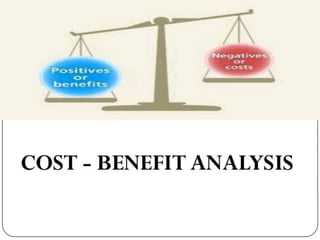

COST BENEFIT ANALYSIS
Ms. SAHELI C
LECTURER
IACN
CONCEPTS OF CBA
• Cost benefit analysis is a tool which adopt by modern
financial analysts; before undertaking any financial
operation or commercial activity.
• The ultimate aim of a business organization is to make
profits.
• Therefore any system in the organization must produce
more benefits as compared to its costs for the organization
to survive and prosper.
BENEFITS > COSTS
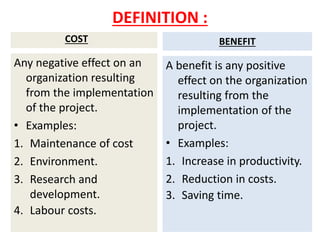
DEFINITION :
COST
Any negative effect on an
organization resulting
from the implementation
of the project.
• Examples:
1. Maintenance of cost
2. Environment.
3. Research and
development.
4. Labour costs.
BENEFIT
A benefit is any positive
effect on the organization
resulting from the
implementation of the
project.
• Examples:
1. Increase in productivity.
2. Reduction in costs.
3. Saving time.
DEFINITION:
➢ A cost benefit analysis is an economic evaluation
technique that measures all the positive (beneficial) and
negative (costly) consequences of an intervention or
programme in monetary terms.
➢ It is one of the techniques of budgetary control in order to
increase output and minimize inputs.
➢ Cost benefit of health services is advantageous for health
protection, health promotion, economic and social
development.
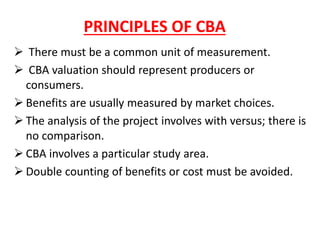
PRINCIPLES OF CBA
➢ There must be a common unit of measurement.
➢ CBA valuation should represent producers or
consumers.
➢ Benefits are usually measured by market choices.
➢ The analysis of the project involves with versus; there is
no comparison.
➢ CBA involves a particular study area.
➢ Double counting of benefits or cost must be avoided.
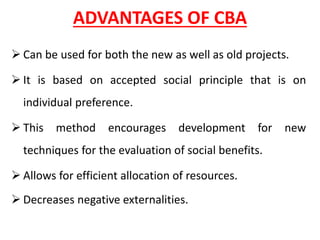
ADVANTAGES OF CBA
➢ Can be used for both the new as well as old projects.
➢ It is based on accepted social principle that is on
individual preference.
➢ This method encourages development for new
techniques for the evaluation of social benefits.
➢ Allows for efficient allocation of resources.
➢ Decreases negative externalities.
DISADVANTAGES OF CBA
➢ Can be hard to put values to social costs and benefits
➢ Can be difficult to include all externalities.
➢ Costs and benefits can be different for different
groups.
Cost benefit analysis converted

Cost benefit analysis converted

  • 1.
    COST BENEFIT ANALYSIS Ms.SAHELI C LECTURER IACN
  • 3.
    CONCEPTS OF CBA •Cost benefit analysis is a tool which adopt by modern financial analysts; before undertaking any financial operation or commercial activity. • The ultimate aim of a business organization is to make profits. • Therefore any system in the organization must produce more benefits as compared to its costs for the organization to survive and prosper. BENEFITS > COSTS
  • 4.
    DEFINITION : COST Any negativeeffect on an organization resulting from the implementation of the project. • Examples: 1. Maintenance of cost 2. Environment. 3. Research and development. 4. Labour costs. BENEFIT A benefit is any positive effect on the organization resulting from the implementation of the project. • Examples: 1. Increase in productivity. 2. Reduction in costs. 3. Saving time.
  • 6.
    DEFINITION: ➢ A costbenefit analysis is an economic evaluation technique that measures all the positive (beneficial) and negative (costly) consequences of an intervention or programme in monetary terms. ➢ It is one of the techniques of budgetary control in order to increase output and minimize inputs. ➢ Cost benefit of health services is advantageous for health protection, health promotion, economic and social development.
  • 7.
    PRINCIPLES OF CBA ➢There must be a common unit of measurement. ➢ CBA valuation should represent producers or consumers. ➢ Benefits are usually measured by market choices. ➢ The analysis of the project involves with versus; there is no comparison. ➢ CBA involves a particular study area. ➢ Double counting of benefits or cost must be avoided.
  • 10.
    ADVANTAGES OF CBA ➢Can be used for both the new as well as old projects. ➢ It is based on accepted social principle that is on individual preference. ➢ This method encourages development for new techniques for the evaluation of social benefits. ➢ Allows for efficient allocation of resources. ➢ Decreases negative externalities.
  • 11.
    DISADVANTAGES OF CBA ➢Can be hard to put values to social costs and benefits ➢ Can be difficult to include all externalities. ➢ Costs and benefits can be different for different groups.