Cost‐Benefit Analysis As Project Evaluation Tool

Workshop on Strengthening Capacity for Strategic Agricultural Policy 
     and Investment Planning and Implementation in Africa 
        Safari Park Hotel, Nairobi on 25th‐ 26th April 2012


               Paul Guthiga, ReSAKSS‐ECA
An Overview of CBA…1
Decision‐making at…
• An individual; intuition, or some analysis
• For a private entity (say company)
   – Profit motive hence… full financial appraisal of the
     project.
• For the Government; more difficult
   – Not just profitability but social cost and benefits of
     their choices.
   – Other considerations; equity, environmental

                            ss4                               2
An Overview of CBA…4

• CBA is a tool primarily used by governments in
  making their social and economic decisions.

• It also considers activities that are not normally
  priced by the market (externalities)

• Attempts to quantify and include in estimates of
  cost and benefits not just to individual and private
  entities but also to rest of community.


                           ss4                           3
An Overview of CBA…2
• Development interventions often involve huge costs
• These costs should be quantified and compared with the
  potential or actual benefits
• Can be done through use of a CBA which could be
  conducted ex ante and/or ex post
• CBA is not done on a before‐and‐after basis but on a
  ‘with’ and ‘without’ project basis (to avoid over/under‐
  estimation)
• Ultimate measure is the incremental net benefit of the
  project
An Overview of CBA…3

• Involves comparing costs and benefits from different
  time periods

• Money    values   across   time   periods   are   not
  immediately comparable; why?

• …because of inflation and returns in the market

• Hence the need to discount future costs and benefits
Theoretical foundations of CBA…1
• a) The preferences of individuals are to be taken as
  the source of value.
• b) Preferences are measured by a willingness to pay
  (WTP) for a benefit and a willingness to accept
  compensation (WTA compensation) for a cost.
• c) Individuals’ preferences can be aggregated so that
  social benefit = the sum of all individuals’ benefits
  and social cost is the sum of all individuals’ costs.
Theoretical foundations of CBA…2
• d)   If beneficiaries from a change can
  ‘hypothetically’ compensate the losers from a
  change, and have some net gains left over, then
  the basic test that benefits exceed costs is met.
• The theoretical concept (d) above is the Kaldor‐
  Hicks principle of potential compensation…
• …if the gainers from an action could compensate
  the losers, the action is an improvement
  regardless of whether compensation is actually
  paid.
Theoretical foundations of CBA…3

• Provided that compensation could occur then
 no one is actually worse off…

• the Pareto‐criterion for improvement in
 overall well‐being is met.
Limitations of CBA…1

• CBA fails to explicitly account for distribution of
  benefits in the society (equity)

• Attempts to integrate distributive issues in CBA by
  applying weighting factors to benefits or costs to
  reflect the income of individual affected

• The theoretical arguments for these weights are
  based on the declining marginal utility of income
Limitations of CBA…2
• Some CBA practitioners feel that inclusions of equity
  goals fall outside the realm of economics

• But…possibility to track the distribution of costs and
  benefits among the various segments of society.
Financial versus Economic CBA…1
• Financial CBA is carried out from the perspective of a 
  private point of view
• Key question; does a project have a sufficiently high 
  return on investment for a private entity to be worth 
  implementing. 
• A positive outcome of financial CBA means that a 
  project is profitable to an investor. 
• However, projects that may seem appealing to a 
  private investor…may be unattractive to a country as 
  a whole. 
• Hence the need for an economic CBA.
Financial versus Economic CBA…2
• All benefits and costs to society, or all impacts on real 
  national income, are taken into account in economic 
  CBA
• An economic CBA will have to be conducted only 
  when there are reasons to believe that the outcomes 
  will differ from financial CBA.
• When does this occur;
   – This is the case when taxes are levied/subsidies granted, 
   – External effects exist and/or 
   – prices are distorted (do not reflect their real scarcity). 
Financial versus Economic CBA…3
• To transform a financial CBA into  an  
  economic  CBA three groups of adjustments 
  have to be made:  
  – Step 1:  transfers (taxes, subsidies) are to be 
    removed;  
  – Step 2: all positive and negative external effects 
    have to be included; 
  – Step 3: market prices of goods and services have 
    to be replaced by economic prices;
Financial versus Economic CBA…4
• Financial CBA may give artificially positive outcomes;
  when subsidies are more important than taxation.
• Subsidization; e.g. cheap fertilizer to farmers.
• Makes farmers production costs to be lower than
  those of imported commodities, hence artificially high
  financial NPV/IRRs.
• Subsidies should be ignored in an economic analysis.
• The economic IRR will, all other things assumed equal,
  be lower than the financial IRR.
Financial versus Economic CBA…5

• Low profitability resulting in financial CBA may be
  caused by excessive taxation
• Tax payments are part of a project's costs, and
  therefore negatively affect the financial
  profitability.
• For instance, if in the financial CBA of a firm the
  import costs of US$ 0.5m for raw materials include
  a 25% import tariff..
• The corresponding cost to the nation in economic
  terms is just US$ 0.375m.
Financial versus Economic CBA…6
• Prices play an essential role in CBA, because the
  method requires that all effects are recorded in
  monetary terms
• Financial CBA applies actual, domestic market prices;
• Whether these are free‐market prices, or the result
  of government intervention is of no importance to
  private decision‐makers.
• In economic CBA, that question is elementary.
• Prices in economic CBA should give a comprehensive
  picture of the value to society (a measure of their
  scarcity).
Financial versus Economic CBA…7
• If market prices fail to do so, if they are distorted,
  and economic CBA prescribes that prices are
  replaced by economic (or accounting or shadow)
  prices.
• These prices are not observed in reality, but
  calculated on the basis of the concept of opportunity
  costs.
STEPS OF CARRYING OUT CBA
Steps…1
1. Identifying the resources being reallocated in a
   given project or activity as well as the gainers and
   the losers in that process (set the boundary of the
   analysis);
2. Identifying the economically relevant impacts of the
   project/activity implementation.
3. Group them into positive impacts (benefits) and
   negative impacts (costs).
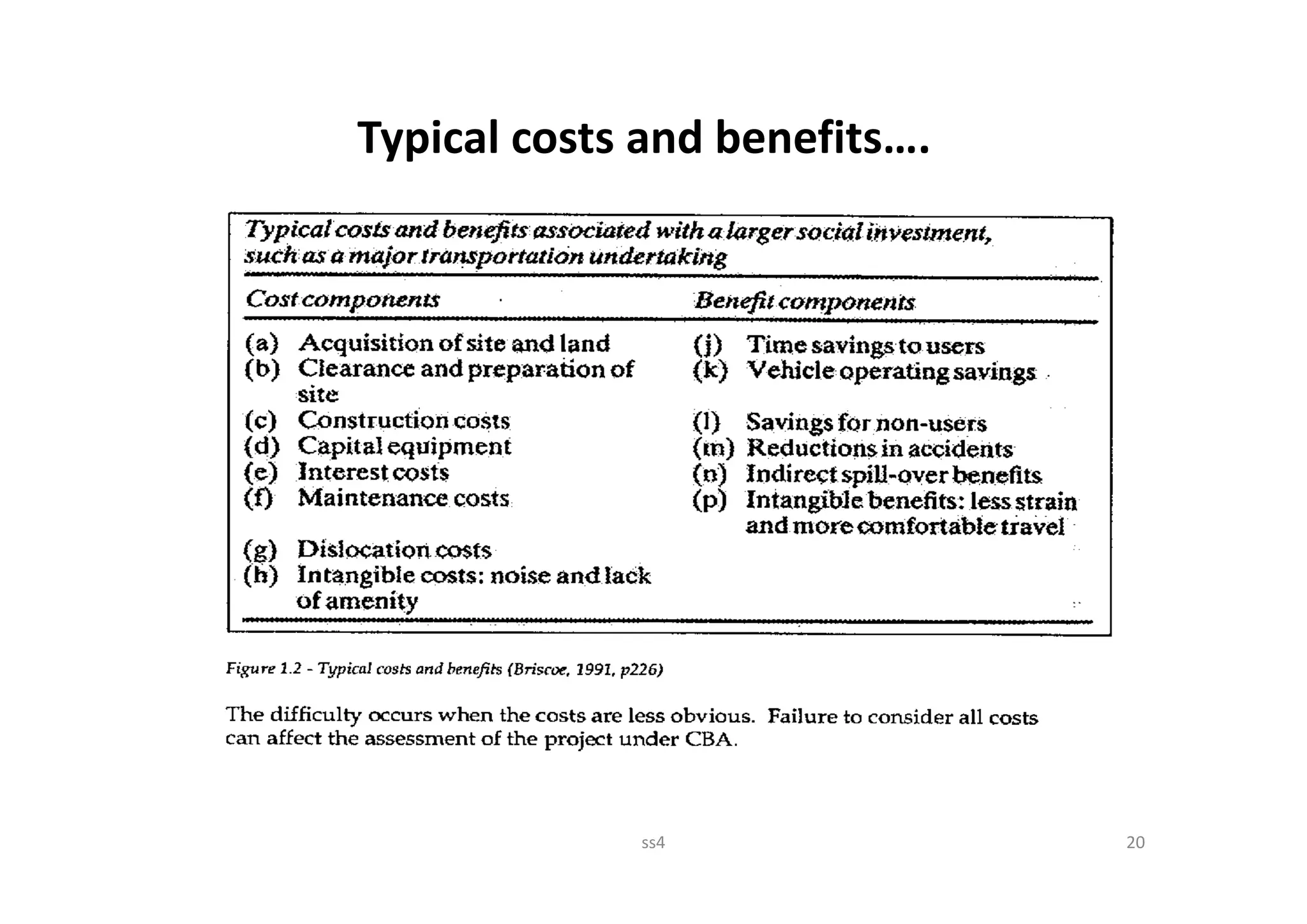
Typical costs and benefits….


             ss4               20
Steps…2

4. The identified impacts are physically 
   quantified and assigned a monetary value. 
5. The decision criteria are applied once the net 
   benefits are discounted. 
     The decision criteria include NPV; Internal Rate of Return 
     (IRR) or Benefit‐Cost ratio (B‐C ratio)
     Any course of action is judged acceptable if it confers a 
     net benefit (present value of benefits outweighs the 
     present value of costs) 
Steps…3

6. Finally, sensitivity analysis is carried out to capture 
   the different possible scenarios.
      How? By varying the discount rate, time frame or policy 
      scenarios.
Decision‐Criteria…1
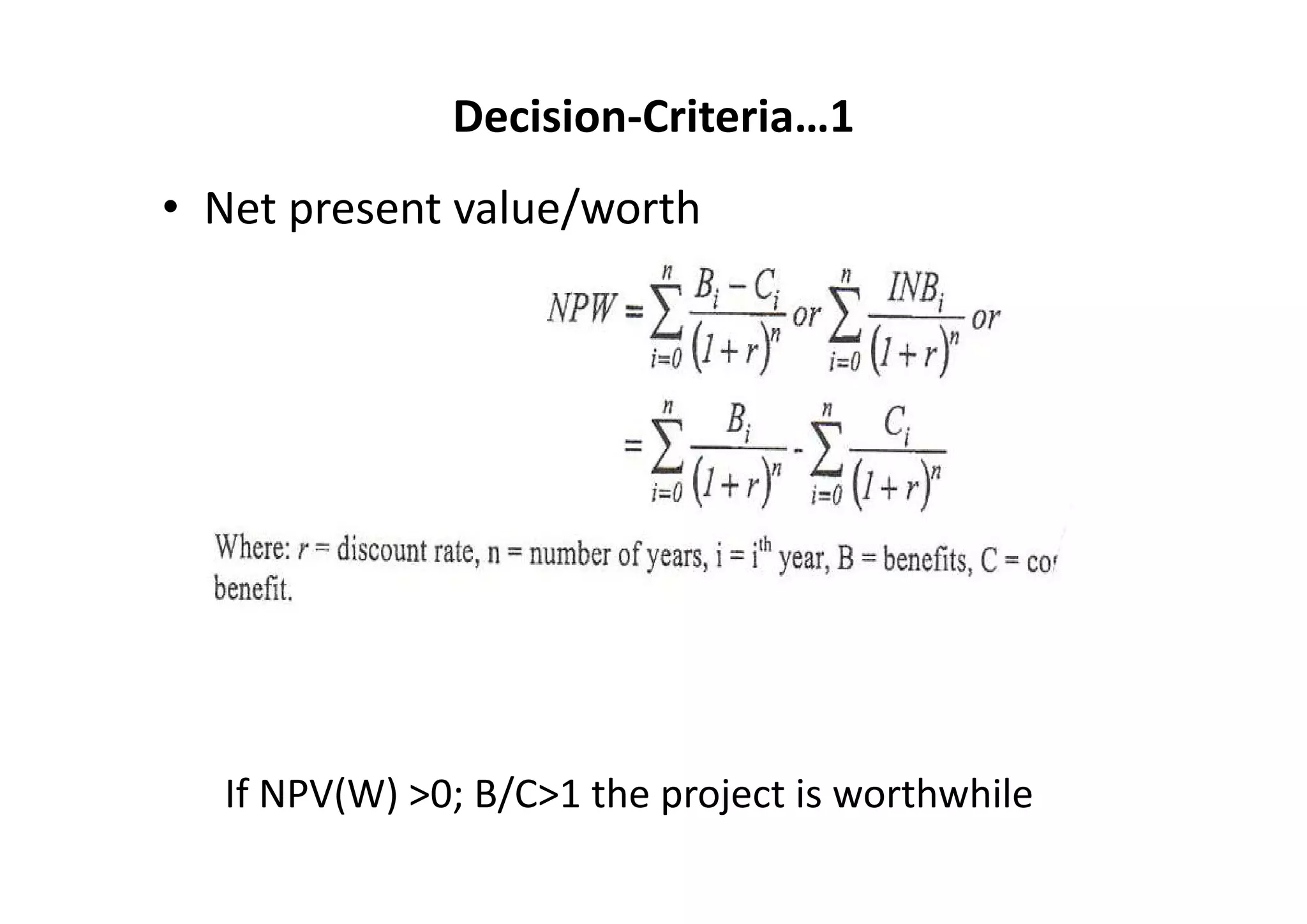
• Net present value/worth


  If NPV(W) >0; B/C>1 the project is worthwhile
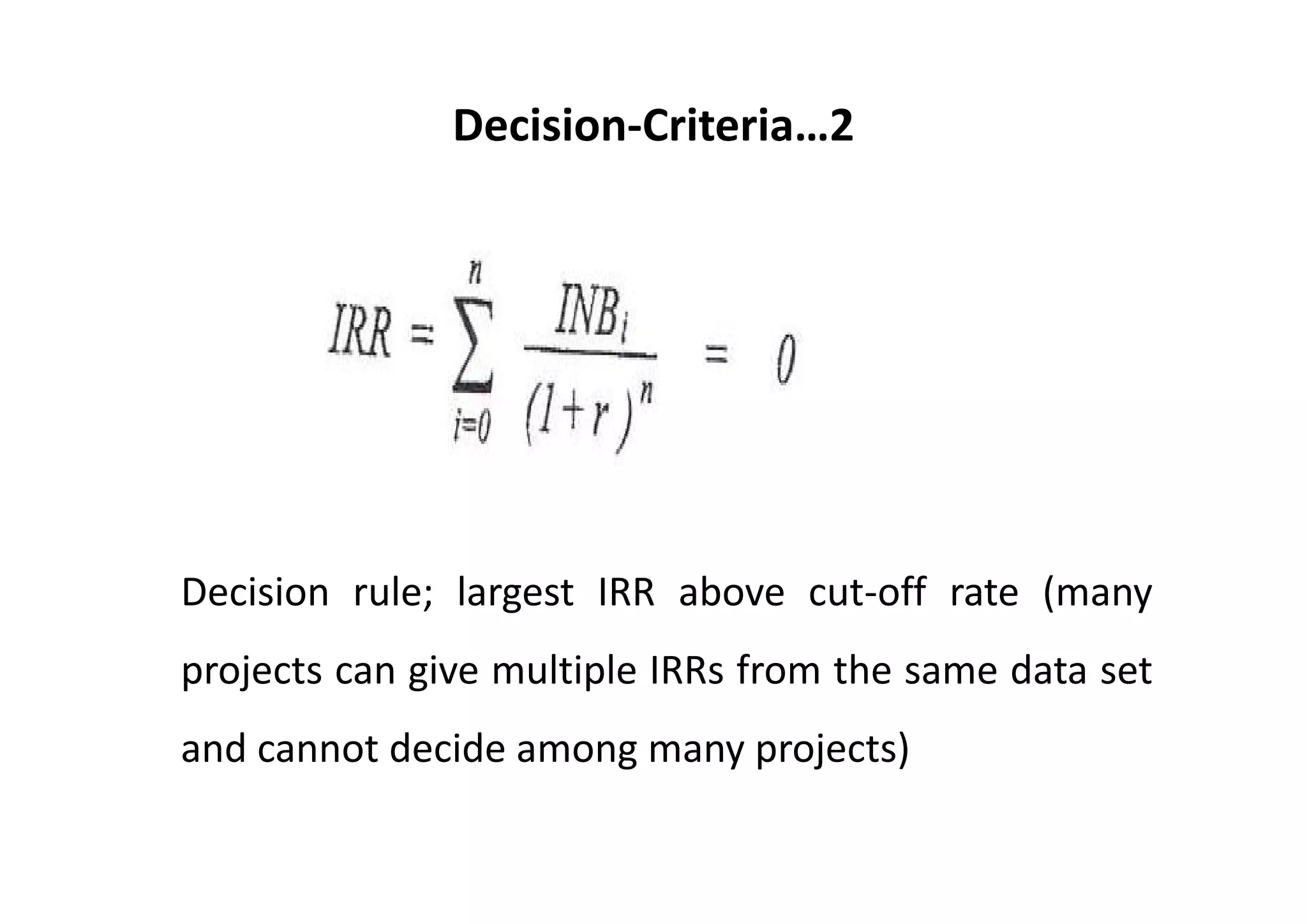
Decision‐Criteria…2


Decision rule; largest IRR above cut‐off rate (many
projects can give multiple IRRs from the same data set
and cannot decide among many projects)
Critical issues in CBA
Discount rate…1
•   The concepts of discounting and choice of a 
    discount rate are controversial in CBA
•   Discounting & discount rate has implications 
    for future benefits and costs
•   Decisions on implementation of long term 
    projects depend on the choice of discount 
    rate. 
•   Implication of discounting;
    – Benefits and costs long in future are weighed less; 
      higher the time bias. 
Discount rate…2
• From an economic perspective, discount rate is the
  rate at which society weighs future consumption
  against present consumption, or..
• Rate by which it attaches a social time preference to
  consumption by its members.
• From a financial perspective the discount rate
  is the prevailing interest rate..
• Which one would be higher and why?
Discount rate…3
• The process of discounting is defended by 
  economists as reflecting the way people value 
  things….
   – Positive rate of time preference (for both consumers 
     and producers) and…
   – Opportunity cost of capital (for producers) the future 
     is treated as less important than the present.  
• In practice the choice of the discount rate is the 
  onus of the researcher guided by various 
  considerations such as;
   – The discount rates applied for government agencies 
   – The length of the project time considered 
   – Opportunity cost of capital in the country/area
Time horizon

• An important consideration in CBA

• From private individual perspective…it is the most
  relevant time horizon is the part of their lifetime that
  they are likely to benefit from the project.

Cost benefit analysis

  • 1.
    Cost‐Benefit Analysis As Project Evaluation Tool Workshop on Strengthening Capacity for Strategic Agricultural Policy  and Investment Planning and Implementation in Africa  Safari Park Hotel, Nairobi on 25th‐ 26th April 2012 Paul Guthiga, ReSAKSS‐ECA
  • 2.
    An Overview of CBA…1 Decision‐making at… • Anindividual; intuition, or some analysis • For a private entity (say company) – Profit motive hence… full financial appraisal of the project. • For the Government; more difficult – Not just profitability but social cost and benefits of their choices. – Other considerations; equity, environmental ss4 2
  • 3.
    An Overview of CBA…4 • CBA isa tool primarily used by governments in making their social and economic decisions. • It also considers activities that are not normally priced by the market (externalities) • Attempts to quantify and include in estimates of cost and benefits not just to individual and private entities but also to rest of community. ss4 3
  • 4.
    An Overview of CBA…2 • Development interventionsoften involve huge costs • These costs should be quantified and compared with the potential or actual benefits • Can be done through use of a CBA which could be conducted ex ante and/or ex post • CBA is not done on a before‐and‐after basis but on a ‘with’ and ‘without’ project basis (to avoid over/under‐ estimation) • Ultimate measure is the incremental net benefit of the project
  • 5.
    An Overview of CBA…3 • Involves comparingcosts and benefits from different time periods • Money values across time periods are not immediately comparable; why? • …because of inflation and returns in the market • Hence the need to discount future costs and benefits
  • 6.
    Theoretical foundations of CBA…1 • a) Thepreferences of individuals are to be taken as the source of value. • b) Preferences are measured by a willingness to pay (WTP) for a benefit and a willingness to accept compensation (WTA compensation) for a cost. • c) Individuals’ preferences can be aggregated so that social benefit = the sum of all individuals’ benefits and social cost is the sum of all individuals’ costs.
  • 7.
    Theoretical foundations of CBA…2 • d) If beneficiaries from a change can ‘hypothetically’ compensate the losers from a change, and have some net gains left over, then the basic test that benefits exceed costs is met. • The theoretical concept (d) above is the Kaldor‐ Hicks principle of potential compensation… • …if the gainers from an action could compensate the losers, the action is an improvement regardless of whether compensation is actually paid.
  • 8.
    Theoretical foundations of CBA…3 • Provided thatcompensation could occur then no one is actually worse off… • the Pareto‐criterion for improvement in overall well‐being is met.
  • 9.
    Limitations of CBA…1 • CBA failsto explicitly account for distribution of benefits in the society (equity) • Attempts to integrate distributive issues in CBA by applying weighting factors to benefits or costs to reflect the income of individual affected • The theoretical arguments for these weights are based on the declining marginal utility of income
  • 10.
    Limitations of CBA…2 • Some CBApractitioners feel that inclusions of equity goals fall outside the realm of economics • But…possibility to track the distribution of costs and benefits among the various segments of society.
  • 11.
    Financial versus Economic CBA…1 • Financial CBA is carried out from the perspective of a  private point of view • Key question; does a project have a sufficiently high  return on investment for a private entity to be worth  implementing.  • A positive outcome of financial CBA means that a  project is profitable to an investor.  • However, projects that may seem appealing to a  private investor…may be unattractive to a country as  a whole.  • Hence the need for an economic CBA.
  • 12.
    Financial versus Economic CBA…2 • All benefits and costs to society, or all impacts on real  national income, are taken into account in economic  CBA • An economic CBA will have to be conducted only  when there are reasons to believe that the outcomes  will differ from financial CBA. • When does this occur; – This is the case when taxes are levied/subsidies granted,  – External effects exist and/or  – prices are distorted (do not reflect their real scarcity). 
  • 13.
    Financial versus Economic CBA…3 • To transform a financial CBA into  an   economic  CBA three groups of adjustments  have to be made:   – Step 1:  transfers (taxes, subsidies) are to be  removed;   – Step 2: all positive and negative external effects  have to be included;  – Step 3: market prices of goods and services have  to be replaced by economic prices;
  • 14.
    Financial versus Economic CBA…4 • Financial CBAmay give artificially positive outcomes; when subsidies are more important than taxation. • Subsidization; e.g. cheap fertilizer to farmers. • Makes farmers production costs to be lower than those of imported commodities, hence artificially high financial NPV/IRRs. • Subsidies should be ignored in an economic analysis. • The economic IRR will, all other things assumed equal, be lower than the financial IRR.
  • 15.
    Financial versus Economic CBA…5 • Low profitabilityresulting in financial CBA may be caused by excessive taxation • Tax payments are part of a project's costs, and therefore negatively affect the financial profitability. • For instance, if in the financial CBA of a firm the import costs of US$ 0.5m for raw materials include a 25% import tariff.. • The corresponding cost to the nation in economic terms is just US$ 0.375m.
  • 16.
    Financial versus Economic CBA…6 • Prices playan essential role in CBA, because the method requires that all effects are recorded in monetary terms • Financial CBA applies actual, domestic market prices; • Whether these are free‐market prices, or the result of government intervention is of no importance to private decision‐makers. • In economic CBA, that question is elementary. • Prices in economic CBA should give a comprehensive picture of the value to society (a measure of their scarcity).
  • 17.
    Financial versus Economic CBA…7 • If marketprices fail to do so, if they are distorted, and economic CBA prescribes that prices are replaced by economic (or accounting or shadow) prices. • These prices are not observed in reality, but calculated on the basis of the concept of opportunity costs.
  • 18.
  • 19.
    Steps…1 1. Identifying theresources being reallocated in a given project or activity as well as the gainers and the losers in that process (set the boundary of the analysis); 2. Identifying the economically relevant impacts of the project/activity implementation. 3. Group them into positive impacts (benefits) and negative impacts (costs).
  • 20.
  • 21.
    Steps…2 4. The identified impacts are physically  quantified and assigned a monetary value.  5. The decision criteria are applied once the net  benefits are discounted.  The decision criteria include NPV; Internal Rate of Return  (IRR) or Benefit‐Cost ratio (B‐C ratio) Any course of action is judged acceptable if it confers a  net benefit (present value of benefits outweighs the  present value of costs) 
  • 22.
    Steps…3 6. Finally, sensitivity analysis is carried out to capture  the different possible scenarios. How? By varying the discount rate, time frame or policy  scenarios.
  • 23.
    Decision‐Criteria…1 • Net present value/worth If NPV(W) >0; B/C>1 the project is worthwhile
  • 24.
    Decision‐Criteria…2 Decision rule; largestIRR above cut‐off rate (many projects can give multiple IRRs from the same data set and cannot decide among many projects)
  • 25.
  • 26.
    Discount rate…1 • The concepts of discounting and choice of a  discount rate are controversial in CBA • Discounting & discount rate has implications  for future benefits and costs • Decisions on implementation of long term  projects depend on the choice of discount  rate.  • Implication of discounting; – Benefits and costs long in future are weighed less;  higher the time bias. 
  • 27.
    Discount rate…2 • From aneconomic perspective, discount rate is the rate at which society weighs future consumption against present consumption, or.. • Rate by which it attaches a social time preference to consumption by its members. • From a financial perspective the discount rate is the prevailing interest rate.. • Which one would be higher and why?
  • 28.
    Discount rate…3 • The process of discounting is defended by  economists as reflecting the way people value  things…. – Positive rate of time preference (for both consumers  and producers) and… – Opportunity cost of capital (for producers) the future  is treated as less important than the present.   • In practice the choice of the discount rate is the  onus of the researcher guided by various  considerations such as; – The discount rates applied for government agencies  – The length of the project time considered  – Opportunity cost of capital in the country/area
  • 29.
    Time horizon • An importantconsideration in CBA • From private individual perspective…it is the most relevant time horizon is the part of their lifetime that they are likely to benefit from the project.