PRESENTED BY:-
SARTHAK GUPTA
AVI KAPOOR
MAYANK NARANG
HARSH
CHAUDHARY
INTRODUCTION
 A cost benefit analysis(CBA) is an economic evaluation
technique that measures all the positive (beneficial) and
negative (costly) consequences of an program in monetary
terms. The model is built by identifying the benefits of an
action as well as the associated costs, and subtracting the
costs from benefits
 Cost is value of money that has been used up to produce
something .
 Benefit are monetary values of desirable consequences of
economic policies and decisions.
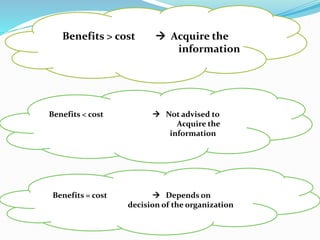
Benefits > cost  Acquire the
information
Benefits < cost  Not advised to
Acquire the
information
Benefits = cost  Depends on
decision of the organization
COST
BENEIT
ANALYSIS
QUANTITATIVE ASPECTS
QUALITATIVE ASPECTS
QUANTITATIVE ASPECTS
Quantitative aspects is related to cost of the information.
Various cost related in acquiring information are:
 Hardware Cost: This is normally a fixed or one time cost
over a relevant range.
 Operational Cost: This is basically a variable cost and
includes cost of personnel, system maintenance, supplies
and support facilities.
 System Analysis, Design and implementation cost:
This is also one time cost. This should include cost for
preparation of programs and purchase of software.
 Cost of space and Environmental Control Factors: this
cost may vary time to time. Examples: floor space, air-
conditioning, generator , security.
QUALITATIVE ASPECTS
Value of information is a very slippery concept as
information does not have any universal value.
Any assessment of the value of information is
therefore related to value of the decision-
making supported by such information.
Value of information may be defined as
difference b/w value of change in decision
pattern caused by information and cost of
information. A decision maker makes decision
on basis of information available to him.
CATEGORIES OF COST AND
BENEFITS
 Directcostandbenefits:areoftenassociatedwithanoperation.
Eg- Cost:costofrunningcomputersystem
Benefit:increasedoperationalabilityandefficiency
 Indirectcostandbenefits:arenotassociatedwithanoperation.
Eg- Cost:insuranceormaintenancecost
Benefit:timeliercustomerservice
 Tangiblecostandbenefits:areeasytomeasure.
Eg- Ex-Cost:costofacquiringhardware
Benefit:timetakentopreparereport
 Intangiblecostandbenefits:aredifficulttoidentifyandmeasure.
Eg-Ex-cost:costincurredtofixsystembreakdowninbank
Benefit:customersatisfaction
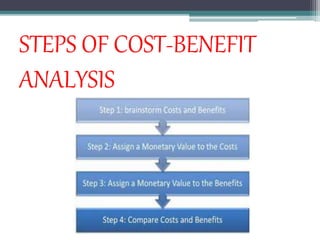
STEPS OF COST-BENEFIT
ANALYSIS
STEP1: BRAINSTORM COSTS AND
BENEFITS
First , take time to brainstorm the costs
associated to the project, and make a list of
these.
Then, do the same for all of the benefits of the
project.
When u come with the cost and benefits , think
about the lifetime of the project.
STEP2: ASSIGN A MONETARY VALUE TO
COSTS
Cost include: the costs of physical
resources (raw materials) as well as the
cost of the human effort involved in all
phases of project. Costs are often
relatively easy to estimate.
For example: what will any training cost?
People are learning a new system or
technology and how much will this cost ?
STEP3: ASSIGN A MONETARY VALUE
TO BENEFITS
It is often very difficult to predict revenues
accurately, especially for new
product/services. There are often intangible or
soft ,benefits that are important outcomes of
the project.
For instance, what is the impact on
environment, employee satisfaction or health
and safety?
What is monetary value of that impact?
STEP4: COMPARE COSTS
AND BENEFITS
Finally, compare values of your costs to
value of your benefits and use this
analysis to decide your course of action.
To do this, calculate your total costs and
your total benefits and compare 2 values
to determine whether your benefits
outweigh your cost.
Case Study
 A cost-benefit analysis of electronic medical records in
primary care
 Purpose: Electronic medical record systems improve
the quality of patient care and decrease medical errors,
but their financial effects have not been as well
documented. The purpose of this study was to
estimate the net financial benefit or cost of
implementing electronic medical record systems in
primary care.
 Methods: We performed a cost-benefit study to analyze
the financial effects of electronic medical record systems
in ambulatory primary care settings from the perspective
of the health care organization. Data were obtained from
studies at our institution and from the published
literature. The reference strategy for comparisons was
the traditional paper-based medical record. The primary
outcome measure was the net financial benefit or cost
per primary care physician for a 5-year period.
 Results: The estimated net benefit from using an
electronic medical record for a 5-year period was
$86,400 per provider. Benefits accrue primarily from
savings in drug expenditures, improved utilization of
radiology tests, better capture of charges, and
decreased billing errors. In one-way sensitivity
analyses, the model was most sensitive to the
proportion of patients whose care was capitated; the
net benefit varied from a low of $8400 to a high of
$140,100. A five-way sensitivity analysis with the most
pessimistic and optimistic assumptions showed results
ranging from a $2300 net cost to a $330,900 net
benefit.
 Conclusion: Implementation of an electronic medical
record system in primary care can result in a positive
financial return on investment to the health care
organization. The magnitude of the return is sensitive
to several key factors.
Cost Benefit analysis.pptx

Cost Benefit analysis.pptx

  • 1.
    PRESENTED BY:- SARTHAK GUPTA AVIKAPOOR MAYANK NARANG HARSH CHAUDHARY
  • 2.
    INTRODUCTION  A costbenefit analysis(CBA) is an economic evaluation technique that measures all the positive (beneficial) and negative (costly) consequences of an program in monetary terms. The model is built by identifying the benefits of an action as well as the associated costs, and subtracting the costs from benefits  Cost is value of money that has been used up to produce something .  Benefit are monetary values of desirable consequences of economic policies and decisions.
  • 3.
    Benefits > cost Acquire the information Benefits < cost  Not advised to Acquire the information Benefits = cost  Depends on decision of the organization
  • 4.
  • 5.
    QUANTITATIVE ASPECTS Quantitative aspectsis related to cost of the information. Various cost related in acquiring information are:  Hardware Cost: This is normally a fixed or one time cost over a relevant range.  Operational Cost: This is basically a variable cost and includes cost of personnel, system maintenance, supplies and support facilities.  System Analysis, Design and implementation cost: This is also one time cost. This should include cost for preparation of programs and purchase of software.  Cost of space and Environmental Control Factors: this cost may vary time to time. Examples: floor space, air- conditioning, generator , security.
  • 6.
    QUALITATIVE ASPECTS Value ofinformation is a very slippery concept as information does not have any universal value. Any assessment of the value of information is therefore related to value of the decision- making supported by such information. Value of information may be defined as difference b/w value of change in decision pattern caused by information and cost of information. A decision maker makes decision on basis of information available to him.
  • 7.
    CATEGORIES OF COSTAND BENEFITS  Directcostandbenefits:areoftenassociatedwithanoperation. Eg- Cost:costofrunningcomputersystem Benefit:increasedoperationalabilityandefficiency  Indirectcostandbenefits:arenotassociatedwithanoperation. Eg- Cost:insuranceormaintenancecost Benefit:timeliercustomerservice  Tangiblecostandbenefits:areeasytomeasure. Eg- Ex-Cost:costofacquiringhardware Benefit:timetakentopreparereport  Intangiblecostandbenefits:aredifficulttoidentifyandmeasure. Eg-Ex-cost:costincurredtofixsystembreakdowninbank Benefit:customersatisfaction
  • 8.
  • 9.
    STEP1: BRAINSTORM COSTSAND BENEFITS First , take time to brainstorm the costs associated to the project, and make a list of these. Then, do the same for all of the benefits of the project. When u come with the cost and benefits , think about the lifetime of the project.
  • 10.
    STEP2: ASSIGN AMONETARY VALUE TO COSTS Cost include: the costs of physical resources (raw materials) as well as the cost of the human effort involved in all phases of project. Costs are often relatively easy to estimate. For example: what will any training cost? People are learning a new system or technology and how much will this cost ?
  • 11.
    STEP3: ASSIGN AMONETARY VALUE TO BENEFITS It is often very difficult to predict revenues accurately, especially for new product/services. There are often intangible or soft ,benefits that are important outcomes of the project. For instance, what is the impact on environment, employee satisfaction or health and safety? What is monetary value of that impact?
  • 12.
    STEP4: COMPARE COSTS ANDBENEFITS Finally, compare values of your costs to value of your benefits and use this analysis to decide your course of action. To do this, calculate your total costs and your total benefits and compare 2 values to determine whether your benefits outweigh your cost.
  • 14.
    Case Study  Acost-benefit analysis of electronic medical records in primary care  Purpose: Electronic medical record systems improve the quality of patient care and decrease medical errors, but their financial effects have not been as well documented. The purpose of this study was to estimate the net financial benefit or cost of implementing electronic medical record systems in primary care.
  • 15.
     Methods: Weperformed a cost-benefit study to analyze the financial effects of electronic medical record systems in ambulatory primary care settings from the perspective of the health care organization. Data were obtained from studies at our institution and from the published literature. The reference strategy for comparisons was the traditional paper-based medical record. The primary outcome measure was the net financial benefit or cost per primary care physician for a 5-year period.
  • 16.
     Results: Theestimated net benefit from using an electronic medical record for a 5-year period was $86,400 per provider. Benefits accrue primarily from savings in drug expenditures, improved utilization of radiology tests, better capture of charges, and decreased billing errors. In one-way sensitivity analyses, the model was most sensitive to the proportion of patients whose care was capitated; the net benefit varied from a low of $8400 to a high of $140,100. A five-way sensitivity analysis with the most pessimistic and optimistic assumptions showed results ranging from a $2300 net cost to a $330,900 net benefit.
  • 17.
     Conclusion: Implementationof an electronic medical record system in primary care can result in a positive financial return on investment to the health care organization. The magnitude of the return is sensitive to several key factors.