 Health care reform is a general rubric used for
discussing major health policy creation or changes—
for the most part, governmental policy that affects
health care delivery in a given place.
ISSUES: health care reforms
 PUBLIC FINANCING LIMITATION
 ALLOCATION OF HEALTH EXPENDITURE
 ALTERNATIVE FINANCING
 PUBLIC SUPPORT FOR PRIVATE SERVICES
 THE PRIVATE HEALTH SECTOR
 ABUSE IN PRIVATE PRACTICE
 CORPORATE HOSPITALS
 REGULATORY DEFICIENCY
 HOUSEHOLD EXPENDITURE ON HEALTH
Health care reform typically
attempts to:
 Broaden the population that receives health care
coverage through either public sector insurance
programs or private sector insurance companies
 Expand the array of health care providers
consumers may choose among
 Improve the access to health care specialists
 Improve the quality of health care
 Give more care to citizens
 Decrease the cost of health care
Goal
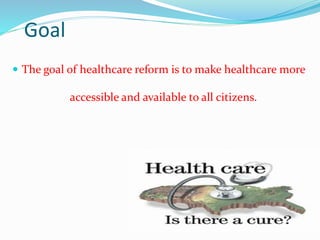
 The goal of healthcare reform is to make healthcare more
accessible and available to all citizens.
primary objectives
 The primary objectives of health care reform include:
Provide healthcare coverage for all.
Decrease the costs of health care services and coverage
Health care reforms in India
 The Ministry of Health and Family Welfare is the Indian
government ministry charged with health policy in
India. It is also responsible for all government programs
relating to family planning in India.
 The ministry is composed of three departments: 1
Department of Health
2 Department of Family Welfare
3 Department of AYUSH
Department of Health The Department of Health deals with health care, including
awareness campaigns, immunization campaigns, preventive
medicine, and public health. Bodies under the administrative
control of this department are:
 1) National AIDS Control Programme (AIDS)
 2) National Cancer Control Programme (cancer)
 3) National Filaria Control Programme (filariasis)
 4) National Iodine Deficiency Disorders Control Programme
(iodine deficiency)
 5) National Leprosy Eradication Programme (leprosy)
 National Mental Health Programme (mental health)
 7) National Programme for Control of Blindness (blindness)
 8) National Programme for Prevention and Control of Deafness
(deafness)
 9) National Tobacco Control Programme (tobacco control)
 10) National Vector Borne Disease Control Programme (NVBDCP)
(vector-born disease)
 11) Pilot Programme on Prevention and Control of Diabetes, CVD and
Stroke (diabetes, cardiovascular disease, stroke)
 2) Revised National TB Control Programme (tuberculosis)
 13) Universal Immunization Programme
 14) Medical Council of India
 15) Dental Council of India
 16) Pharmacy Council of India
 17) Indian Nursing Council
 18) All India Institute of Speech and Hearing (AIISH), Mysore 19) All India
Institute of Physical Medicine and Rehabilitation (AIIPMR), Mumbai

Department of Family Welfare
 The Department of Family Welfare (FW) is responsible for aspects relating to
family welfare, especially in reproductive health, maternal health, pediatrics,
information, education and communications; cooperation with NGOs and
international aid groups; and rural health services. The Department of Family
Welfare is responsible for:
 • 18 Population Research Centres (PRCs) at six universities and six other
institutions across 17 states
 • National Institute of Health and Family Welfare (NIHFW), South Delhi
 • Central Drug Research Institute (CDRI), Lucknow
 Indian Council of Medical Research (ICMR), New Delhi - founded in 1991, it is
one of the oldest medical research bodies in the world
Department of AYUSH
 The Department of Ayurveda, Yoga and Naturopathy,
Unani, Siddha and Homoeopathy (AYUSH) deals with
ayurveda (Indian traditional medicine), and other yoga,
naturopathy, unani, siddha, and homoeopathy, and other
alternative medicine systems.
 Central Council for Research in Ayurveda and Siddha
(CCRAS)
 2) Central Council for Research in Unani Medicine
(CCRUM)
 3) Central Council for Research in Homoeopathy
(CCRH)
 4) Central Council for Research in Yoga and
Naturopathy (CCRYN)
 5) Several educational institutions:
 6) National Institute of Ayurveda, Jaipur (NIA)
 7) National Institute of Siddha, Chennai (NIS) 8)
National Institute of Homoeopathy, Kolkata (NIH)
 9) National Institute of Naturopathy, Pune (NIN)
Healthcare in India
 India has a universal health care system run by the local (state or
territorial) governments.
 Government hospitals, some of which are among the best hospitals
in India, provide treatment at taxpayer expense.
 Most essential drugs are offered free of charge in these hospitals.
 However, the fact that the government sector is understaffed,
underfinanced and that these hospitals maintain very poor
standards of hygiene forces many people to visit private medical
practitioners
 The charges for basic in-hospital treatment and investigations are
much less compared to the private sector. The cost for these
subsidies comes from annual allocations from the central and state
government
 Primary health care is provided by city and district
hospitals and rural primary health centres (PHCs).
 These hospitals provide treatment free of cost.
Primary care is focused on immunization, prevention
of malnutrition, pregnancy, child birth, postnatal
care, and treatment of common illnesses.
 Patients who receive specialized care or have
complicated illnesses are referred to secondary (often
located in district and taluk headquarters) and
tertiary care hospitals (located in district and state
headquarters or those that are teaching hospitals).
present scenario n
future???????
 37 percent of Indian population is undernourished.
They have difficulty in meeting even basic needs. 55
percent of the population have a diet which is calorie
sufficient but nutrient deficient whereas eight percent
of the population is over-nourished
 arthritis, hypertension, diabetes, CVD, cancer patients
and elderly patients are major part of our disease
burden. Besides acute diseases, almost all of them
trace their origin to (a lack of) nutrition.
Healthy Boomers.
 64 percent of out-of-pocket expenditure in India
constitutes healthcare expenditure as compared to 18
percent globally
 They need to be properly directed towards
maintaining their health,
 All nations have a significant role of Health
Insurance in healthcare. In India, both the patient
and the payer is almost same. Here, a sharing
model between Health Insurance and patient can
be adopted. 70 to 75 percent of the burden can be
still borne by patient or medical consumer,
depending on the nature of disease.
 65 percent of Indian population lives in rural areas
while only two percent qualified medical doctors
are available in these areas. Indian healthcare today
is urban centric. It needs to be reformed through
medical infrastructure inclusive of doctors, nurses,
paramedicos, etc.
 Indian healthcare system should start from preventive
care through nutrition. Reforms must provide impetus
to lift the population which is at the bottom of the
pyramid.
 Overall, India needs to reform its healthcare system
through policies, medical infrastructure, education
and realization of right nutrition to lifestyle
management. Acute diseases over time will be at
reactive end of the reforms
helth care reform

helth care reform

  • 2.
     Health carereform is a general rubric used for discussing major health policy creation or changes— for the most part, governmental policy that affects health care delivery in a given place.
  • 3.
    ISSUES: health carereforms  PUBLIC FINANCING LIMITATION  ALLOCATION OF HEALTH EXPENDITURE  ALTERNATIVE FINANCING  PUBLIC SUPPORT FOR PRIVATE SERVICES  THE PRIVATE HEALTH SECTOR  ABUSE IN PRIVATE PRACTICE  CORPORATE HOSPITALS  REGULATORY DEFICIENCY  HOUSEHOLD EXPENDITURE ON HEALTH
  • 4.
    Health care reformtypically attempts to:  Broaden the population that receives health care coverage through either public sector insurance programs or private sector insurance companies  Expand the array of health care providers consumers may choose among  Improve the access to health care specialists  Improve the quality of health care  Give more care to citizens  Decrease the cost of health care
  • 5.
    Goal  The goalof healthcare reform is to make healthcare more accessible and available to all citizens.
  • 6.
    primary objectives  Theprimary objectives of health care reform include: Provide healthcare coverage for all. Decrease the costs of health care services and coverage
  • 7.
    Health care reformsin India  The Ministry of Health and Family Welfare is the Indian government ministry charged with health policy in India. It is also responsible for all government programs relating to family planning in India.  The ministry is composed of three departments: 1 Department of Health 2 Department of Family Welfare 3 Department of AYUSH
  • 8.
    Department of HealthThe Department of Health deals with health care, including awareness campaigns, immunization campaigns, preventive medicine, and public health. Bodies under the administrative control of this department are:  1) National AIDS Control Programme (AIDS)  2) National Cancer Control Programme (cancer)  3) National Filaria Control Programme (filariasis)  4) National Iodine Deficiency Disorders Control Programme (iodine deficiency)  5) National Leprosy Eradication Programme (leprosy)
  • 9.
     National MentalHealth Programme (mental health)  7) National Programme for Control of Blindness (blindness)  8) National Programme for Prevention and Control of Deafness (deafness)  9) National Tobacco Control Programme (tobacco control)  10) National Vector Borne Disease Control Programme (NVBDCP) (vector-born disease)  11) Pilot Programme on Prevention and Control of Diabetes, CVD and Stroke (diabetes, cardiovascular disease, stroke)  2) Revised National TB Control Programme (tuberculosis)  13) Universal Immunization Programme  14) Medical Council of India  15) Dental Council of India  16) Pharmacy Council of India  17) Indian Nursing Council  18) All India Institute of Speech and Hearing (AIISH), Mysore 19) All India Institute of Physical Medicine and Rehabilitation (AIIPMR), Mumbai 
  • 10.
    Department of FamilyWelfare  The Department of Family Welfare (FW) is responsible for aspects relating to family welfare, especially in reproductive health, maternal health, pediatrics, information, education and communications; cooperation with NGOs and international aid groups; and rural health services. The Department of Family Welfare is responsible for:  • 18 Population Research Centres (PRCs) at six universities and six other institutions across 17 states  • National Institute of Health and Family Welfare (NIHFW), South Delhi  • Central Drug Research Institute (CDRI), Lucknow  Indian Council of Medical Research (ICMR), New Delhi - founded in 1991, it is one of the oldest medical research bodies in the world
  • 11.
    Department of AYUSH The Department of Ayurveda, Yoga and Naturopathy, Unani, Siddha and Homoeopathy (AYUSH) deals with ayurveda (Indian traditional medicine), and other yoga, naturopathy, unani, siddha, and homoeopathy, and other alternative medicine systems.
  • 12.
     Central Councilfor Research in Ayurveda and Siddha (CCRAS)  2) Central Council for Research in Unani Medicine (CCRUM)  3) Central Council for Research in Homoeopathy (CCRH)  4) Central Council for Research in Yoga and Naturopathy (CCRYN)  5) Several educational institutions:  6) National Institute of Ayurveda, Jaipur (NIA)  7) National Institute of Siddha, Chennai (NIS) 8) National Institute of Homoeopathy, Kolkata (NIH)  9) National Institute of Naturopathy, Pune (NIN)
  • 13.
    Healthcare in India India has a universal health care system run by the local (state or territorial) governments.  Government hospitals, some of which are among the best hospitals in India, provide treatment at taxpayer expense.  Most essential drugs are offered free of charge in these hospitals.  However, the fact that the government sector is understaffed, underfinanced and that these hospitals maintain very poor standards of hygiene forces many people to visit private medical practitioners  The charges for basic in-hospital treatment and investigations are much less compared to the private sector. The cost for these subsidies comes from annual allocations from the central and state government
  • 14.
     Primary healthcare is provided by city and district hospitals and rural primary health centres (PHCs).  These hospitals provide treatment free of cost. Primary care is focused on immunization, prevention of malnutrition, pregnancy, child birth, postnatal care, and treatment of common illnesses.  Patients who receive specialized care or have complicated illnesses are referred to secondary (often located in district and taluk headquarters) and tertiary care hospitals (located in district and state headquarters or those that are teaching hospitals).
  • 15.
    present scenario n future??????? 37 percent of Indian population is undernourished. They have difficulty in meeting even basic needs. 55 percent of the population have a diet which is calorie sufficient but nutrient deficient whereas eight percent of the population is over-nourished
  • 16.
     arthritis, hypertension,diabetes, CVD, cancer patients and elderly patients are major part of our disease burden. Besides acute diseases, almost all of them trace their origin to (a lack of) nutrition.
  • 17.
    Healthy Boomers.  64percent of out-of-pocket expenditure in India constitutes healthcare expenditure as compared to 18 percent globally  They need to be properly directed towards maintaining their health,
  • 18.
     All nationshave a significant role of Health Insurance in healthcare. In India, both the patient and the payer is almost same. Here, a sharing model between Health Insurance and patient can be adopted. 70 to 75 percent of the burden can be still borne by patient or medical consumer, depending on the nature of disease.
  • 19.
     65 percentof Indian population lives in rural areas while only two percent qualified medical doctors are available in these areas. Indian healthcare today is urban centric. It needs to be reformed through medical infrastructure inclusive of doctors, nurses, paramedicos, etc.
  • 20.
     Indian healthcaresystem should start from preventive care through nutrition. Reforms must provide impetus to lift the population which is at the bottom of the pyramid.
  • 21.
     Overall, Indianeeds to reform its healthcare system through policies, medical infrastructure, education and realization of right nutrition to lifestyle management. Acute diseases over time will be at reactive end of the reforms