Presenter
Santoshi Paudel
MPH 2023
SPH and CM
1
Cost-Benefit analysis (CBA) is a way to
compare the costs and benefits of an
intervention, where both are expressed in
monetary units.
Costs: total costs to society of
implementing an intervention.
Benefits: all benefits to society should be
considered and measured such as: medical
costs averted, productivity gains, and the
monetized value of health improvements.
2
Cost Benefit Analysis
• CBA allows you to consider all costs and benefits over time, even
those beyond the length of the intervention.
• CBA is appropriate when a decision maker wants to know if a single
intervention policy or a number of intervention policies are worth
investing. (Are benefits greater than costs?)
• E.g. policy makers need to decide if it would be more beneficial to
tackle indoor air pollution in the district or to implement HIV
screening program?
3
Cost Benefit Analysis Contd…
• Used to evaluate investments in large-scale programs, such as
national strategies for vaccination or HIV treatment
• In conducting CBA, the preferred outcome is the one that maximizes
net benefits, or the amount by which benefits exceed costs.
• Any costs and benefits that can be monetized can be captured in the
analysis.
4
Cost Benefit Analysis Contd…
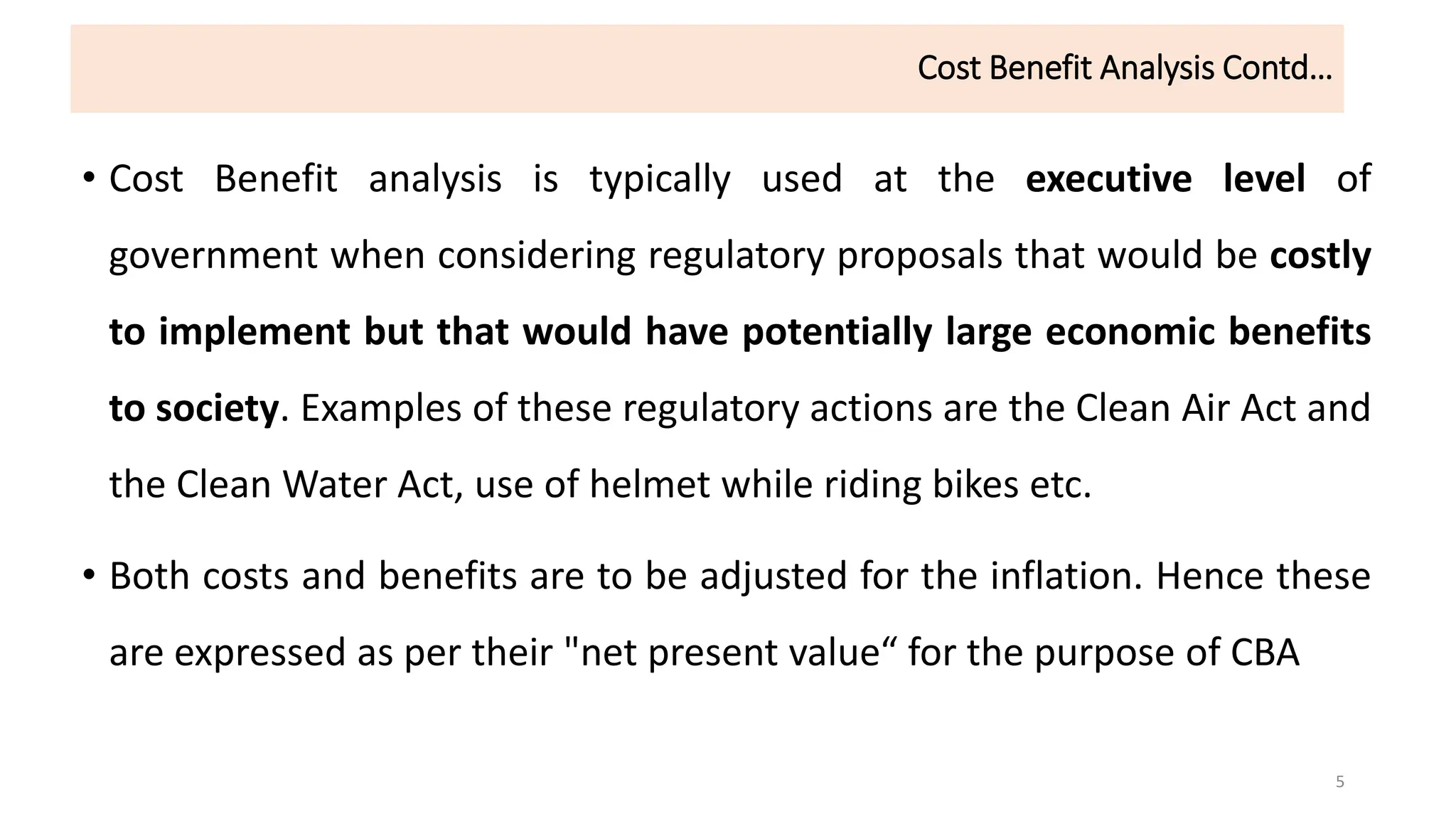
• Cost Benefit analysis is typically used at the executive level of
government when considering regulatory proposals that would be costly
to implement but that would have potentially large economic benefits
to society. Examples of these regulatory actions are the Clean Air Act and
the Clean Water Act, use of helmet while riding bikes etc.
• Both costs and benefits are to be adjusted for the inflation. Hence these
are expressed as per their "net present value“ for the purpose of CBA
5
Cost Benefit Analysis Contd…
• It is used to compare the present value of the costs and benefits of an
intervention using consistent monetary units over time.
• Discounting adjusts the value of future benefits or costs to their present value,
accounting for these factors and allowing for a fair comparison of costs and
benefits across different time periods.
• Moreover, in general, people prefer consumption in the present over the
future.
• The formula for the discount factor is: 1 / (1+r)t
Where r= discount rate
t= number of years in the future when the cost or benefit is expected to occur
6
Discounting
Steps in cost-benefit analysis
i. Identification of two or more alternatives/interventions
ii. Identification of perspectives
iii. Determination of costs
iv. Identifying, measuring and valuing consequences/benefits
• For cost-benefit analysis, the outcomes for both the alternatives
should be measures in terms of monetary unit.
• Three general approaches to the monetary valuation of health
outcomes:
Human capital approach
Revealed preferences
Stated preferences of Willingness to Pay (WTP)
7
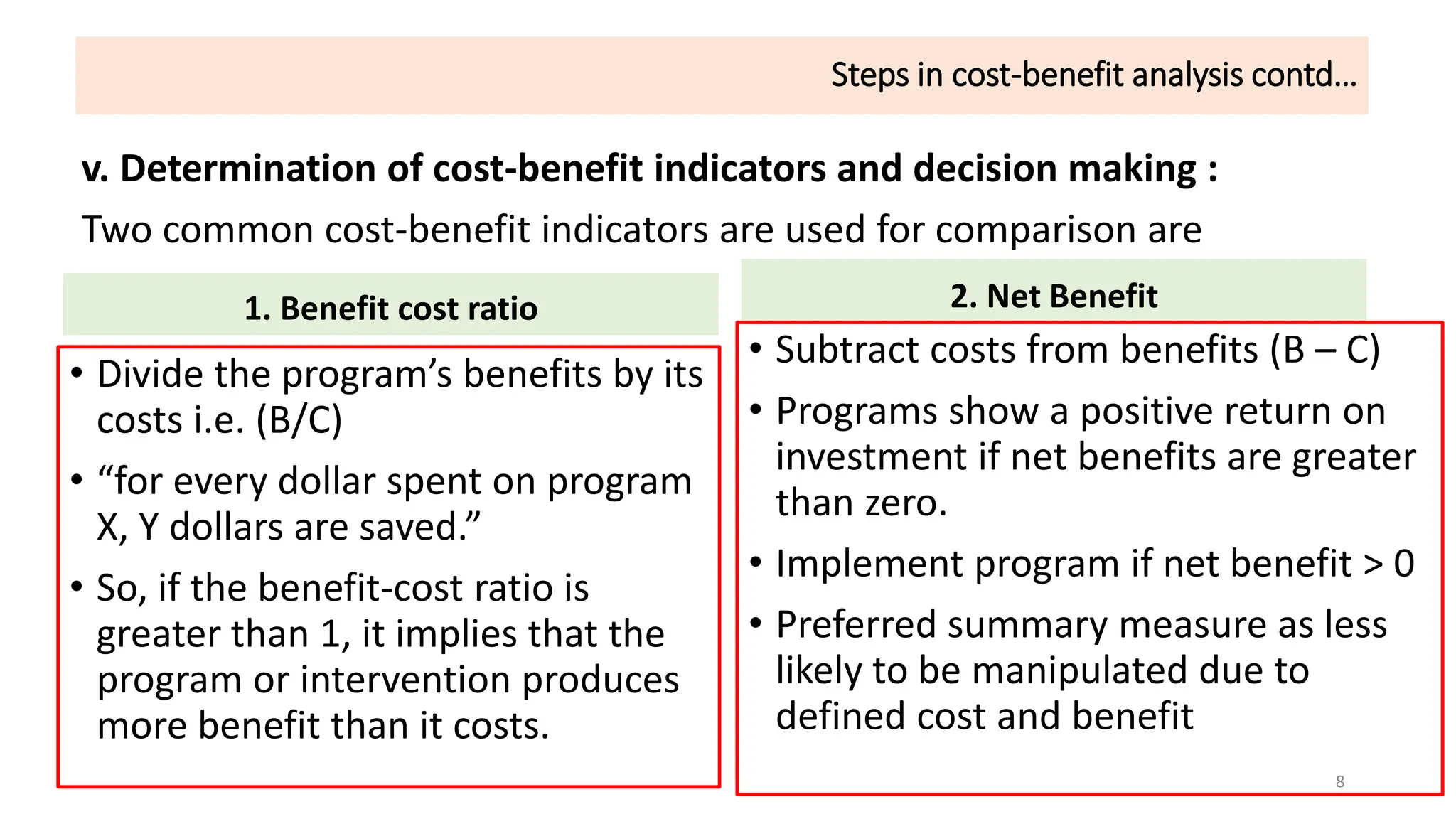
1. Benefit cost ratio
• Divide the program’s benefits by its
costs i.e. (B/C)
• “for every dollar spent on program
X, Y dollars are saved.”
• So, if the benefit-cost ratio is
greater than 1, it implies that the
program or intervention produces
more benefit than it costs.
2. Net Benefit
• Subtract costs from benefits (B – C)
• Programs show a positive return on
investment if net benefits are greater
than zero.
• Implement program if net benefit > 0
• Preferred summary measure as less
likely to be manipulated due to
defined cost and benefit
8
v. Determination of cost-benefit indicators and decision making :
Two common cost-benefit indicators are used for comparison are
Steps in cost-benefit analysis contd…
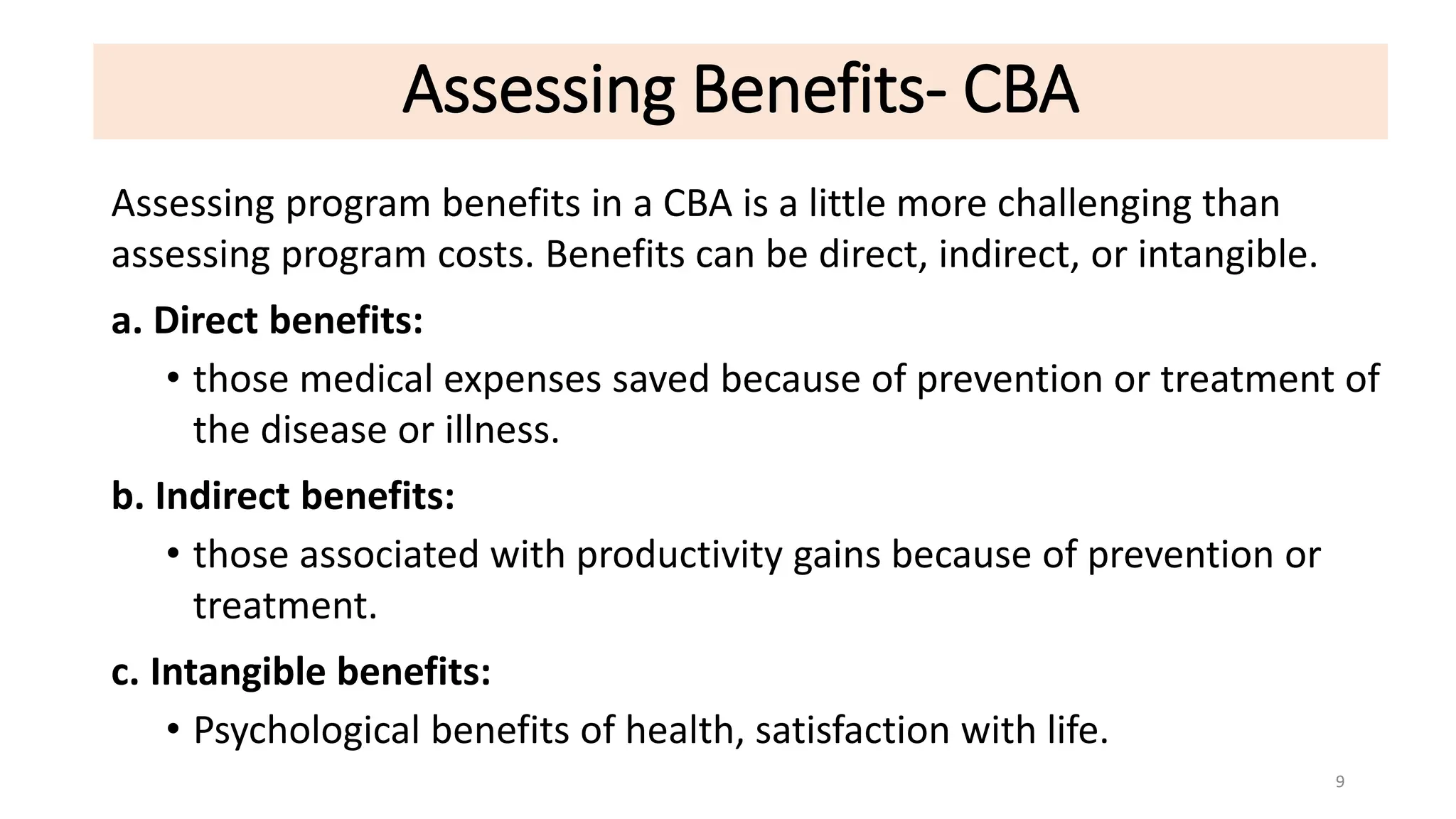
Assessing Benefits- CBA
Assessing program benefits in a CBA is a little more challenging than
assessing program costs. Benefits can be direct, indirect, or intangible.
a. Direct benefits:
• those medical expenses saved because of prevention or treatment of
the disease or illness.
b. Indirect benefits:
• those associated with productivity gains because of prevention or
treatment.
c. Intangible benefits:
• Psychological benefits of health, satisfaction with life.
9
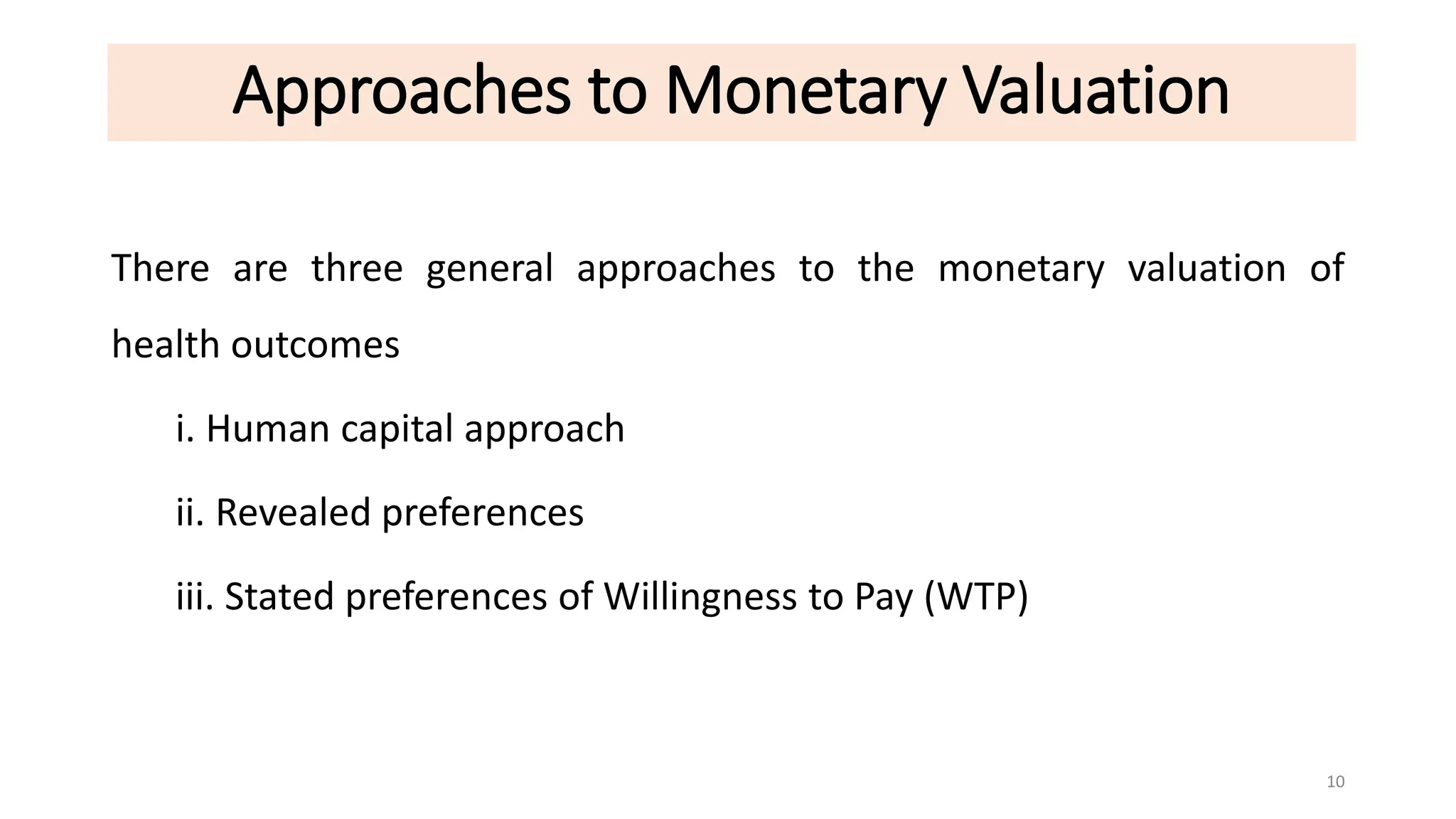
Approaches to Monetary Valuation
There are three general approaches to the monetary valuation of
health outcomes
i. Human capital approach
ii. Revealed preferences
iii. Stated preferences of Willingness to Pay (WTP)
10
i. Human Capital Approach
• Quantify the loss of a person’s marginal productivity as a result of
mortality and morbidity i.e. the marginal loss in economic output that
results from a person not being able to work.
• It is based on assumption that each individual contributes to a
society’s productivity.
• The monetary value of lost productivity due to ill health is calculated
by:
multiplying the duration of illness by the amount that person
would be earning (i.e market price of their labour) during that
time if they were not ill.
11
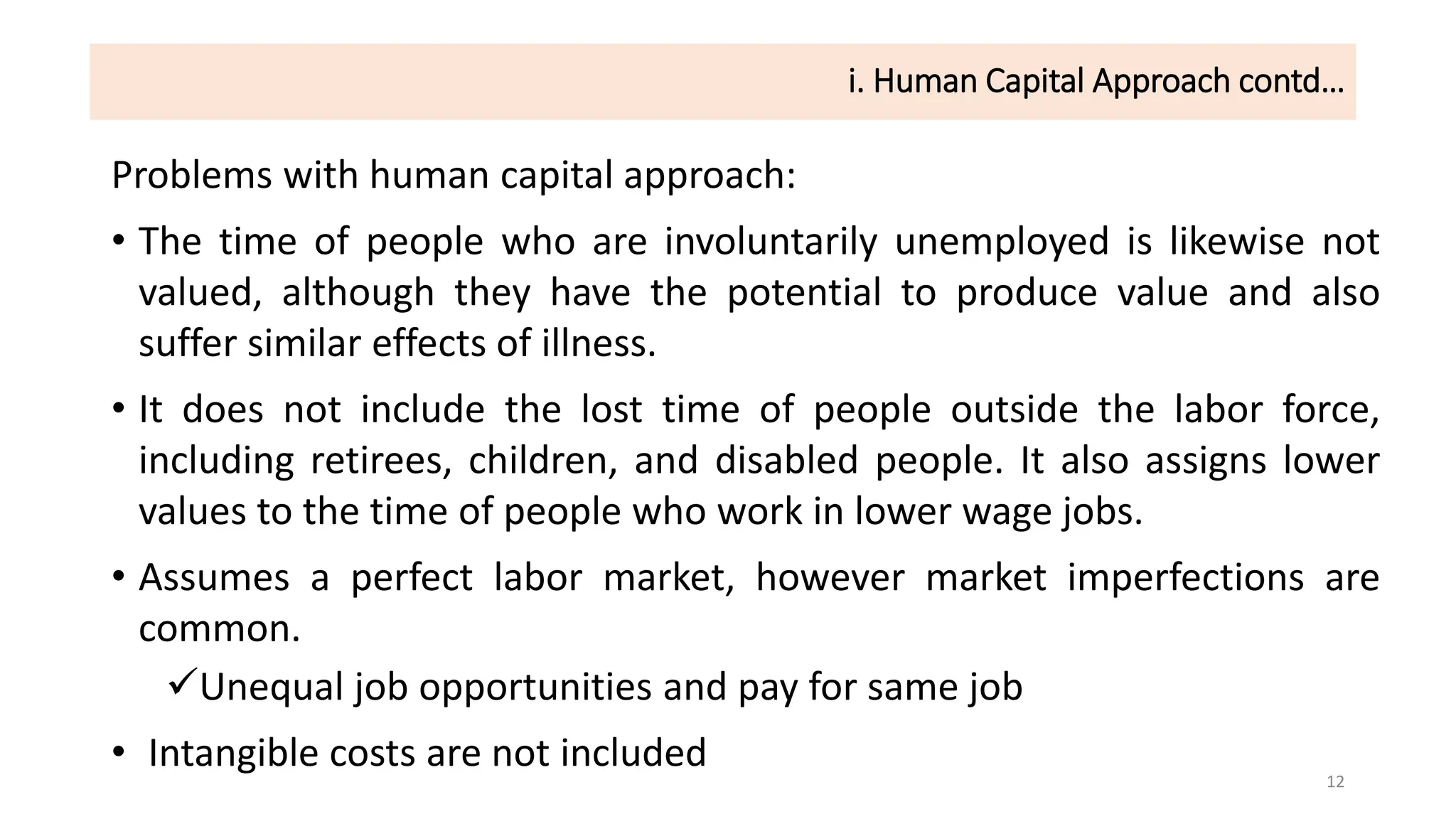
Problems with human capital approach:
• The time of people who are involuntarily unemployed is likewise not
valued, although they have the potential to produce value and also
suffer similar effects of illness.
• It does not include the lost time of people outside the labor force,
including retirees, children, and disabled people. It also assigns lower
values to the time of people who work in lower wage jobs.
• Assumes a perfect labor market, however market imperfections are
common.
Unequal job opportunities and pay for same job
• Intangible costs are not included
12
i. Human Capital Approach contd…
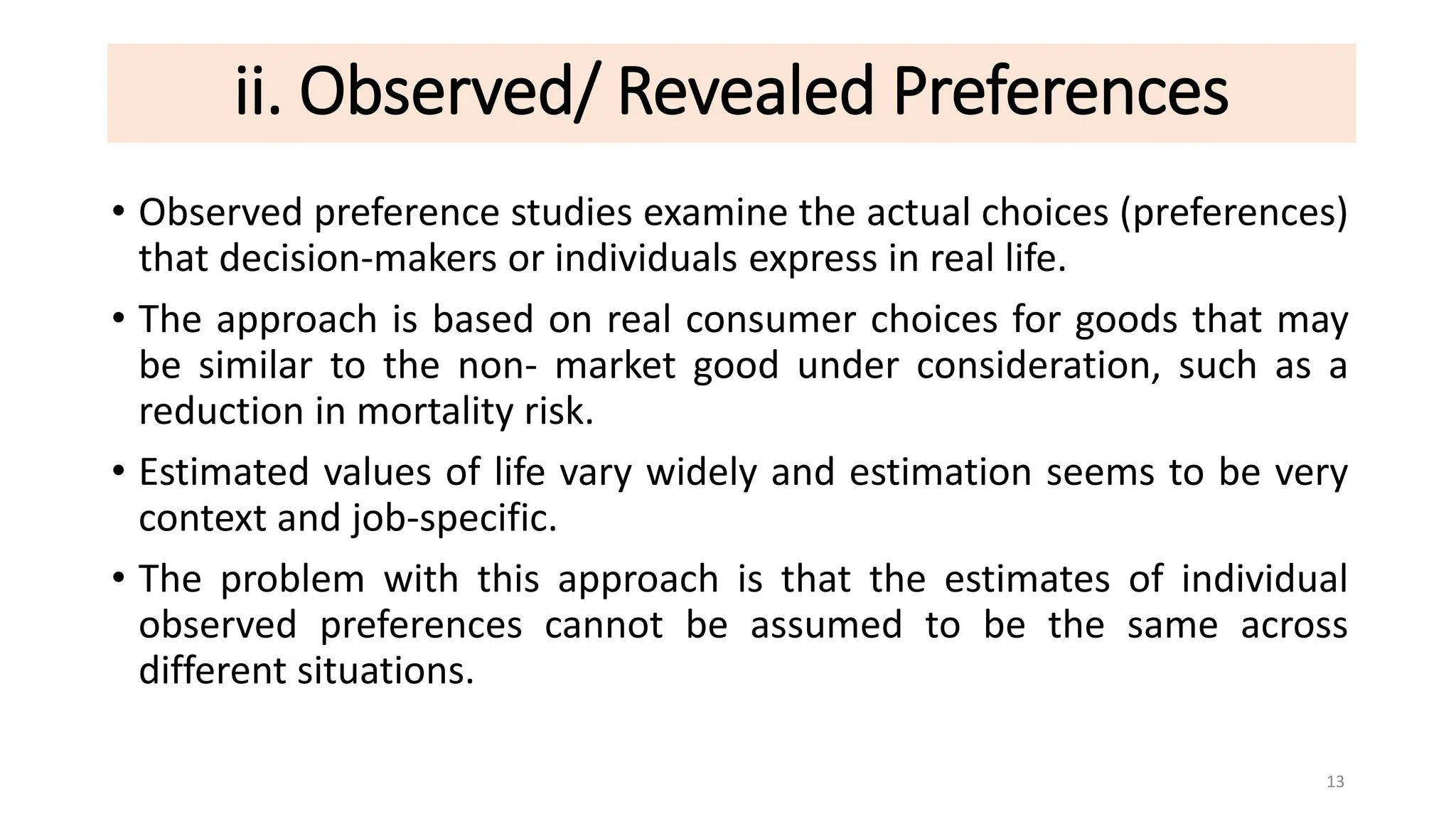
ii. Observed/ Revealed Preferences
• Observed preference studies examine the actual choices (preferences)
that decision-makers or individuals express in real life.
• The approach is based on real consumer choices for goods that may
be similar to the non- market good under consideration, such as a
reduction in mortality risk.
• Estimated values of life vary widely and estimation seems to be very
context and job-specific.
• The problem with this approach is that the estimates of individual
observed preferences cannot be assumed to be the same across
different situations.
13
iii. Stated preferences of Willingness to Pay
(WTP)
• This approach uses surveys to elicit the maximum amount individuals
are willing to pay (WTP) to receive something or to avoid something
• Give respondents hypothetical scenarios and ask the maximum they
would pay, or amount they would take for the program not to occur.
• Values depend on the hypothetical market described to the
respondent (contingent valuation).
14
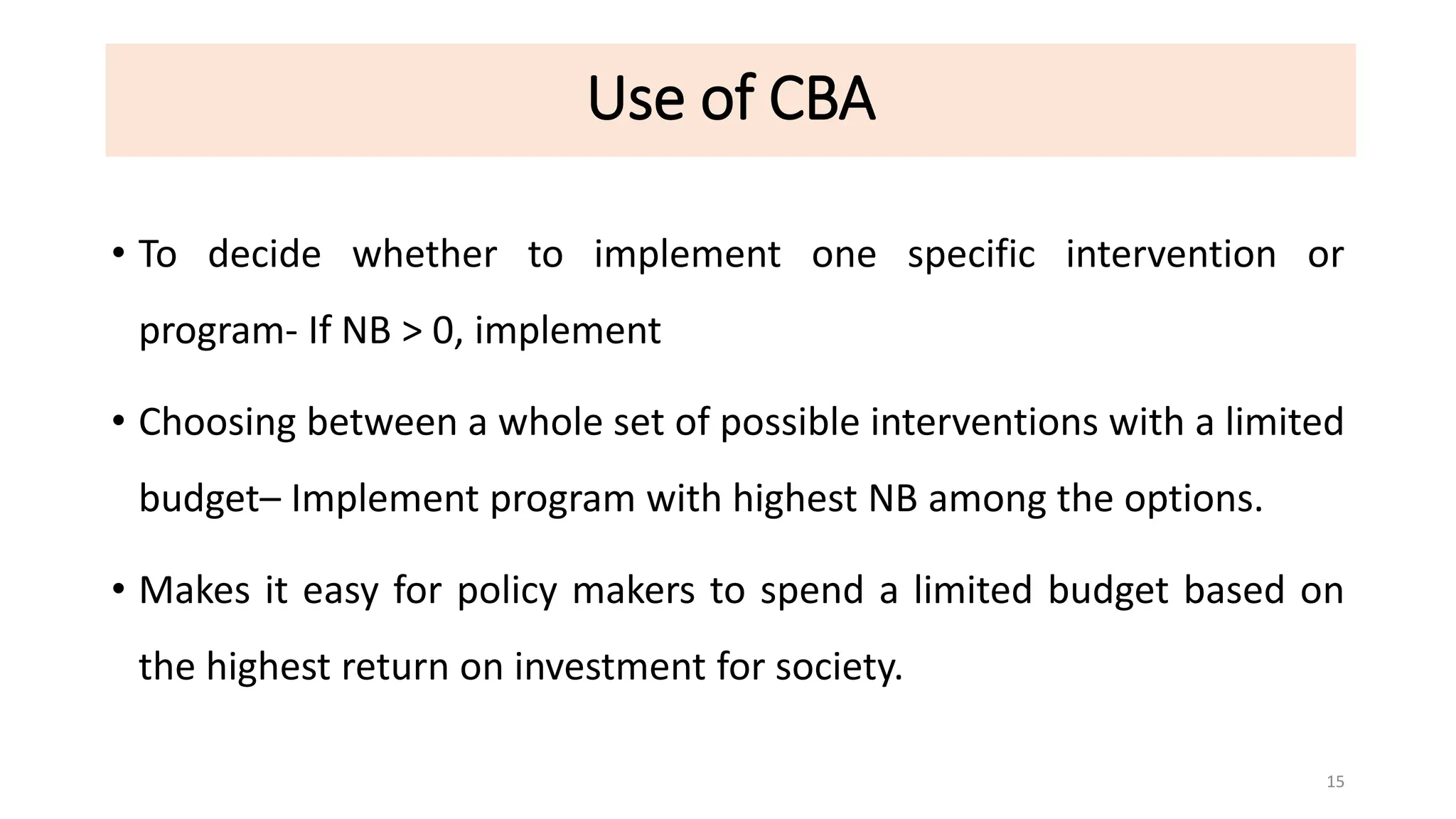
Use of CBA
• To decide whether to implement one specific intervention or
program- If NB > 0, implement
• Choosing between a whole set of possible interventions with a limited
budget– Implement program with highest NB among the options.
• Makes it easy for policy makers to spend a limited budget based on
the highest return on investment for society.
15
Criticisms of CBA
• Costs are easier to quantify than health benefits, making it harder to
demonstrate the value of the intervention.
• Failing to discount future health benefits may lead to delay investing
in a public health intervention
• Time taking process may not be appropriate for life saving
interventions
16
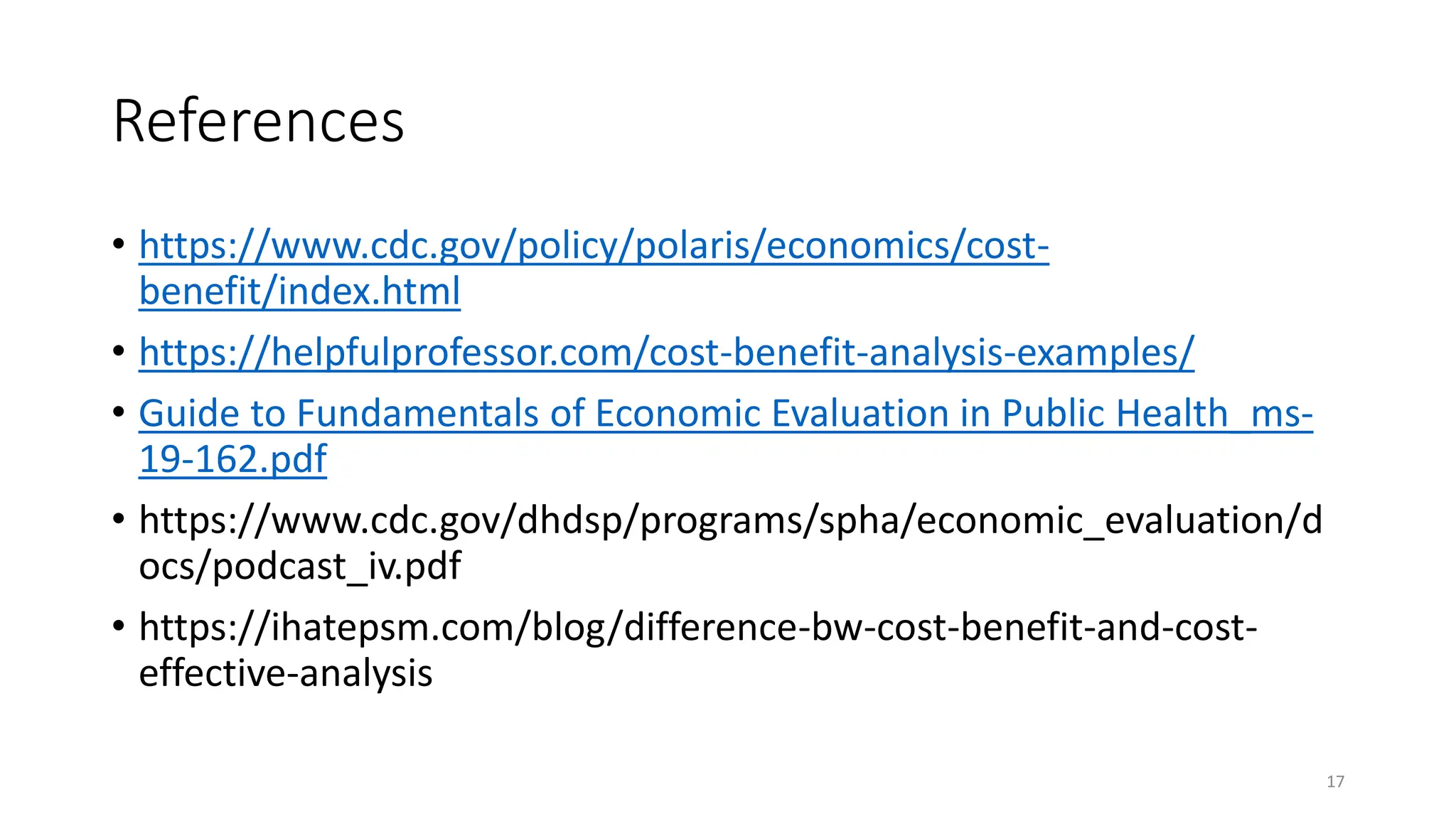
References
• https://www.cdc.gov/policy/polaris/economics/cost-
benefit/index.html
• https://helpfulprofessor.com/cost-benefit-analysis-examples/
• Guide to Fundamentals of Economic Evaluation in Public Health_ms-
19-162.pdf
• https://www.cdc.gov/dhdsp/programs/spha/economic_evaluation/d
ocs/podcast_iv.pdf
• https://ihatepsm.com/blog/difference-bw-cost-benefit-and-cost-
effective-analysis
17
18

Cost Benefit Analysis_Economic EValuation.pptx

  • 1.
  • 2.
    Cost-Benefit analysis (CBA)is a way to compare the costs and benefits of an intervention, where both are expressed in monetary units. Costs: total costs to society of implementing an intervention. Benefits: all benefits to society should be considered and measured such as: medical costs averted, productivity gains, and the monetized value of health improvements. 2 Cost Benefit Analysis
  • 3.
    • CBA allowsyou to consider all costs and benefits over time, even those beyond the length of the intervention. • CBA is appropriate when a decision maker wants to know if a single intervention policy or a number of intervention policies are worth investing. (Are benefits greater than costs?) • E.g. policy makers need to decide if it would be more beneficial to tackle indoor air pollution in the district or to implement HIV screening program? 3 Cost Benefit Analysis Contd…
  • 4.
    • Used toevaluate investments in large-scale programs, such as national strategies for vaccination or HIV treatment • In conducting CBA, the preferred outcome is the one that maximizes net benefits, or the amount by which benefits exceed costs. • Any costs and benefits that can be monetized can be captured in the analysis. 4 Cost Benefit Analysis Contd…
  • 5.
    • Cost Benefitanalysis is typically used at the executive level of government when considering regulatory proposals that would be costly to implement but that would have potentially large economic benefits to society. Examples of these regulatory actions are the Clean Air Act and the Clean Water Act, use of helmet while riding bikes etc. • Both costs and benefits are to be adjusted for the inflation. Hence these are expressed as per their "net present value“ for the purpose of CBA 5 Cost Benefit Analysis Contd…
  • 6.
    • It isused to compare the present value of the costs and benefits of an intervention using consistent monetary units over time. • Discounting adjusts the value of future benefits or costs to their present value, accounting for these factors and allowing for a fair comparison of costs and benefits across different time periods. • Moreover, in general, people prefer consumption in the present over the future. • The formula for the discount factor is: 1 / (1+r)t Where r= discount rate t= number of years in the future when the cost or benefit is expected to occur 6 Discounting
  • 7.
    Steps in cost-benefitanalysis i. Identification of two or more alternatives/interventions ii. Identification of perspectives iii. Determination of costs iv. Identifying, measuring and valuing consequences/benefits • For cost-benefit analysis, the outcomes for both the alternatives should be measures in terms of monetary unit. • Three general approaches to the monetary valuation of health outcomes: Human capital approach Revealed preferences Stated preferences of Willingness to Pay (WTP) 7
  • 8.
    1. Benefit costratio • Divide the program’s benefits by its costs i.e. (B/C) • “for every dollar spent on program X, Y dollars are saved.” • So, if the benefit-cost ratio is greater than 1, it implies that the program or intervention produces more benefit than it costs. 2. Net Benefit • Subtract costs from benefits (B – C) • Programs show a positive return on investment if net benefits are greater than zero. • Implement program if net benefit > 0 • Preferred summary measure as less likely to be manipulated due to defined cost and benefit 8 v. Determination of cost-benefit indicators and decision making : Two common cost-benefit indicators are used for comparison are Steps in cost-benefit analysis contd…
  • 9.
    Assessing Benefits- CBA Assessingprogram benefits in a CBA is a little more challenging than assessing program costs. Benefits can be direct, indirect, or intangible. a. Direct benefits: • those medical expenses saved because of prevention or treatment of the disease or illness. b. Indirect benefits: • those associated with productivity gains because of prevention or treatment. c. Intangible benefits: • Psychological benefits of health, satisfaction with life. 9
  • 10.
    Approaches to MonetaryValuation There are three general approaches to the monetary valuation of health outcomes i. Human capital approach ii. Revealed preferences iii. Stated preferences of Willingness to Pay (WTP) 10
  • 11.
    i. Human CapitalApproach • Quantify the loss of a person’s marginal productivity as a result of mortality and morbidity i.e. the marginal loss in economic output that results from a person not being able to work. • It is based on assumption that each individual contributes to a society’s productivity. • The monetary value of lost productivity due to ill health is calculated by: multiplying the duration of illness by the amount that person would be earning (i.e market price of their labour) during that time if they were not ill. 11
  • 12.
    Problems with humancapital approach: • The time of people who are involuntarily unemployed is likewise not valued, although they have the potential to produce value and also suffer similar effects of illness. • It does not include the lost time of people outside the labor force, including retirees, children, and disabled people. It also assigns lower values to the time of people who work in lower wage jobs. • Assumes a perfect labor market, however market imperfections are common. Unequal job opportunities and pay for same job • Intangible costs are not included 12 i. Human Capital Approach contd…
  • 13.
    ii. Observed/ RevealedPreferences • Observed preference studies examine the actual choices (preferences) that decision-makers or individuals express in real life. • The approach is based on real consumer choices for goods that may be similar to the non- market good under consideration, such as a reduction in mortality risk. • Estimated values of life vary widely and estimation seems to be very context and job-specific. • The problem with this approach is that the estimates of individual observed preferences cannot be assumed to be the same across different situations. 13
  • 14.
    iii. Stated preferencesof Willingness to Pay (WTP) • This approach uses surveys to elicit the maximum amount individuals are willing to pay (WTP) to receive something or to avoid something • Give respondents hypothetical scenarios and ask the maximum they would pay, or amount they would take for the program not to occur. • Values depend on the hypothetical market described to the respondent (contingent valuation). 14
  • 15.
    Use of CBA •To decide whether to implement one specific intervention or program- If NB > 0, implement • Choosing between a whole set of possible interventions with a limited budget– Implement program with highest NB among the options. • Makes it easy for policy makers to spend a limited budget based on the highest return on investment for society. 15
  • 16.
    Criticisms of CBA •Costs are easier to quantify than health benefits, making it harder to demonstrate the value of the intervention. • Failing to discount future health benefits may lead to delay investing in a public health intervention • Time taking process may not be appropriate for life saving interventions 16
  • 17.
    References • https://www.cdc.gov/policy/polaris/economics/cost- benefit/index.html • https://helpfulprofessor.com/cost-benefit-analysis-examples/ •Guide to Fundamentals of Economic Evaluation in Public Health_ms- 19-162.pdf • https://www.cdc.gov/dhdsp/programs/spha/economic_evaluation/d ocs/podcast_iv.pdf • https://ihatepsm.com/blog/difference-bw-cost-benefit-and-cost- effective-analysis 17
  • 18.

Editor's Notes

  • #5 CBA often takes the broader perspective of a government or society because it can include a broader range of impact of an intervention.
  • #16 NB= Total benefit-total cost