2.9 ADVANCED TECHNIQUES:
SOCIAL COST-BENEFIT ANALYSIS
(ECONOMIC ANALYSIS)
ECONOMIC ANALYSIS
• Impact of the project on the national economy
• Used to provide information on
The impact of project on key economic variables
Foreign exchange earning
Taxation Revenue
Employment
Income distribution
• The impact of government policies on the incentives
to invest
LEVELS OF PROJECT ANALYSIS
Perspective What is measured Indicator
Financial Analysis Owners or
Lenders
Change in private
income
NPV, FRR
Economic
Analysis
National
Economy
Change in national
income
ENPV, ERR
Distributional
Analysis
All groups
affected by the
project
Distribution of
change in national
income
Proportion of
ENPV going to
target group
FINANCIAL & ECONOMIC ANALYSIS
Item Financial Economic
Focus Net Financial Result of a Project Contribution to the dev’t objectives
return to the society
Purpose Indication of incentive to implement Determine if Gov’t or private
investment justified on economic
efficiency
Prices Prevailing/expected market price Social or Shadow prices
Taxes Cost of production Transfer payment &not economic cost
Subsidy Source of revenue/ increase in ind’l
benefits
Transfer payment & not economic cost
Interest
& loan
repayme
nt
Financial cost decreases capital Transfer payment not an economic
cost (unless it is external loan)
Interest
rate
Market borrowing rate Opportunity cost of capital
RATIONALE FOR SCBA
a. Market Imperfections-
• Market prices which form the basis for computing the
monetary costs & benefits from the point of view of the
project sponsor ,reflect social values only under
conditions of perfect competition, which are rarely, if
ever realized by developing countries. When
imperfections exist, market prices do not reflect social
values.
• The common market imperfections found in developing
countries are rationing, prescription of minimum
wages & foreign exchange regulations.
b. Externalities-
• A project may have beneficial or negative external
effects. It may be emphasized that externalities are
relevant in SCBA because in such analysis all costs &
benefits, irrespective to whom they accrue & whether
they are paid or not are relevant.
c. Taxes & Subsidies-
• From the private point of view taxes are definite
monetary costs & subsidies are definite monetary gains.
• From the social point of view however taxes & subsidies
are generally regarded as transfer payments & hence
considered irrelevant.
d. Concern for savings—
• From a social point of view the division of benefits
between consumption & saving is relevant.
• The concern of the society for savings & investment is
duly reflected in SCBA wherein a higher valuation is
placed on savings & a lower valuation is put on
consumption.
e. Concern for redistribution—
• In SCBA a rupee of benefit going to an economically
poor section is considered more valuable than a rupee
of benefit going to an affluent section.
f. Merit Wants—
• Goals & preferences not expressed in the market place
but believed by policy makers to be in the larger
interest ,may be referred to as merit wants.
• While merit wants are not relevant from the private
point of view, they are important from the social point
of view.
APPROACHES & TECHNIQUES FOR SCBA
• Towards the end of the 60’s and in the early 70’s two principal
approaches for SCBA emerged:
• UNIDO APPROACH
• THE LITTLE –MIRRLESS APPROACH
STEP1. CALCULATION OF THE FINANCIAL PROFITABILITY OF THE PROJECT
MEASURED AT MARKET PRICES
• The measurement of financial profitability of the project in the first stage is similar to
the financial evaluation discussed at greater length in the previous section.
STEP 2. OBTAINING THE NET ECONOMIC BENEFIT BASED ON SHADOW PRICING
This step is concerned with the determination of the NB of the project in terms of
economic (efficiency) prices, also referred to as Shadow prices.
2.1 Shadow pricing (Basic issues)
• Before we deal with shadow pricing of specific resources, certain basic concepts and
issues must be discussed:
• One of the important aspects of shadow pricing is the determination of the
Numeraire,
• What is numeraire? the unit of account in which the value of inputs or
outputs is expressed.
To define the numeraire, the following questions have to be answered
• What unit of currency, domestic or foreign, should be used to express benefits
and costs?
• Should costs and benefits be measured in current values or constant values?
• With reference to which point-present or future –should cost and benefits be
evaluated?
• What use- consumption or investment- will be made of the income from the
project?
• Should the income of the project be measured in terms of consumption or
investment?
• With reference to which group should the income of the project be measured?
• The specification of the UNIDO numeraire in terms of the above questions is
• “Net present consumption in the hands of people at the base level of
consumption in the private sector in terms of constant price in domestic
accounting birr.”
CHOICE OF NUMERAIRE
• A key issue in shadow pricing is whether the good is tradable or not.
What are Tradable goods & services?
• goods and services that are potentially importable or exportable actually.
How do you measure the value of these?
• For tradable good, the international price (border price) is a measure of
its opportunity cost to the country.
• Therefore the shadow price is the border price, translated in domestic
currency at market exchange rate.
But , Why? This is because,
– For a tradable good,
– it is possible to substitute import for domestic production and vice
versa; similarly
– it is possible to substitute export for domestic consumption and vice
versa.
– Hence the international price, also referred to as the border price,
represents the real value of the good in terms of economic
efficiency.
CONCEPT OF TRADABILITY
• The UNIDO approach suggests three sources of shadow pricing, depending
on the impact of the project on national economy.
A project, as it uses and produces resources, may for any given input or output
• Increase or decrease the total consumption in the economy
• Decrease or increase production in the economy
• Decrease imports or increase imports and
• Increase exports or decrease exports
Therefore Remember!!
• If the impact of the project is on consumption in the economy, the basis of
shadow pricing is consumer WTP
• If the impact of the project is on production in the economy, the basis of
shadow pricing is the cost of production
• If the impact of the project is on international trade- increase in exports,
decrease in imports, increase in imports, increase in imports, or decrease in
exports-the basis of shadow pricing is the foreign exchange value.
SOURCES OF SHADOW PRICING
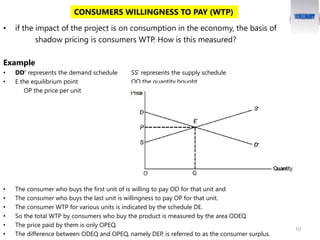
• if the impact of the project is on consumption in the economy, the basis of
shadow pricing is consumers WTP. How is this measured?
Example
• DD’ represents the demand schedule SS’ represents the supply schedule
• E the equilibrium point OQ the quantity bought
OP the price per unit
• The consumer who buys the first unit of is willing to pay OD for that unit and
• The consumer who buys the last unit is willingness to pay OP for that unit.
• The consumer WTP for various units is indicated by the schedule DE.
• So the total WTP by consumers who buy the product is measured by the area ODEQ.
• The price paid by them is only OPEQ.
• The difference between ODEQ and OPEQ, namely DEP, is referred to as the consumer surplus.
10
CONSUMERS WILLINGNESS TO PAY (WTP)
Tradable inputs and outputs
• From consumption point of view
Increase in consumption=> implies increase in imports or decrease in
exports
• From production point of view
Increase in production leads to exports increase or decrease in imports
• The shadow price is the border price, adjusted/translated in domestic
currency at market exchange rate.
Non-tradable inputs and outputs
Non tradable goods and services are goods and services that do not fall into
the international trade actually or potentially.
1. If its import price(CIF) > Cost of domestic production => implies the
good/service is cheaper locally
2. If its export price (FOB) < Cost of domestic production => the good to be
exported is too expensive
• Cost insurance and freight Free in board
SHADOW PRICING OF SPECIFIC RESOURCES (INPUTS &
OUTPUTS)
Valuation on the output side
If the impact of the project is to increase consumption the measure of the value
will be the consumer WTP
If the impact of the project is to increase production the measure is the cost of
production.
Valuation on the input side
If impact of the project is to reduce the resources available for other firms measure
will be the willingness of the others users to pay for the same resource
If the impact is to meet additional inputs (requirements) from own production,
measure of value would be the cost of production
If the impact is to substitute other production of the same non tradable, the
measure of value is the savings in the cost of production. (Value added)
• When a project hires labor
1. When a project takes labor away from other employments, the shadow price of
labor is equal to what other users of labor are willing to pay.
2. The shadow price associated with inducing additional production of workers
consists of the marginal product of labor in previous employment plus
certain other costs.
i.e. may also involve the import of resources –the wages they command plus
premium remittance
Valuation on the output side Valuation on the input side
LABOR INPUTS( for your further reading)
• When a project hires labor
1. When a project takes labor away from other employments, the shadow price of
labor is equal to what other users of labor are willing to pay.
2. The shadow price associated with inducing additional production of workers
consists of the marginal product of labor in previous employment plus certain
other costs.
i.e. may also involve the import of resources –the wages they command plus
premium remittance
3. This may induce the production of new workers –need to consider MPL (for
unemployed MPL=0 reservation wage.
Governments NGOS what wage level is acceptable to them; consider leisure time
spent; increased consumption of food plus impact on savings in the economy.=>
leading to shadow wage rate of unskilled labor.
For your further reading
Externalities
• Since SCBA seeks to consider all costs & benefits, to whomsoever they may accrue,
external effects also need to be taken into account.
• The valuation of external effects is rather difficult because they are often intangible
in nature & there is no market price which can be used as starting point.
Capital inputs
• The opportunity cost of capital depends on how the capital required for the
product is generated.
• To the extent that it comes from additional savings, its opportunity cost is
measured by the consumption rate of interest;
• to the extent that it comes from the denial of capital to alternative projects.
• In practice, the consumption rate of interest may be used as the discount rate.
• Capital assets are purchased (tradable & non-tradable) follow the same procedure
• opportunity cost of capital, First rate of return by denying other projects
• Consumption rate of investment from own savings-sacrifices of present
consumption –data requirement is immense
For your further reading
Foreign exchange
• The UNIDO method uses domestic currency as the numeraire.
• So the foreign exchange impact of the project must be identified & valued.
• The UNIDO method determines the shadow price of foreign exchange on the basis
of marginal social value as revealed by the consumer willingness to pay for the
goods that are allowed to be imported at the margin.
• The shadow price of a foreign currency
• E.g. commodities 1, 2, 3 & 4 are imported at margins, where
• F1=0.3, F2=0.4, F3=0.2, F4=0.1
• Q1=0.6, Q2=1.5, Q3=0.25, Q4=3
• P1=16, P2=8, P3=40, P4=5
• What is the shadow price of foreign exchange?
• (0.3*0.6*16) +(0.4*1.5*8)+ (0.2*0.25*40) + (0.1*3*5)=11.180 ETB
• But offical 1$=10ETB,
• E.g. Bridge project
1. Presently, a ferry service, operated privately, is being used to cross a river. The
ferry operator charges 3 Birr/person. It costs him 2 Birr per person. 50000
persons use the ferry service. This means that the number of people crossing the
river by ferry service throughout the year is 50000. The government is
considering construction of a bridge over the river. It is estimated that after the
bridge is constructed 250,000 persons will cross the river on the bridge. The
bridge is expected to cost 3 million initially and its annual maintenance cost
would be 10,000 birr. It has an indefinitely long life. Once the bridge is
constructed the ferry operator is expected to close down the ferry service and
sell the ferry boats for 100,000.
Qs. Define the social costs and benefits of constructing the bridge, assuming
that the monetary figures given in the problem represent economic values.
E.g. Bridge project
• River valley Project: The government of Ethiopia is considering a multi-purpose river valley project
which would involve construction of dam, a reservoir, a power house, and several irrigation canals. The
project would supply water for irrigation, generate electricity and provide a measure of protection
against flood. The following information has been gathered by the project control board. The project will
require the following during the construction stage
• Indigenous power equipment costing 200 million birr.
• Imported power equipment costing 10 million USD.
• 20,000 tonnes of steel produced indigenously and made available to the project at 59000 birr a ton.
• 350,000 tonnes of cement produced indigenously and made available to the project at 3250 birr a
tonne.
• Other construction materials (sand, bricks, etc) costing 100 million birr.
• 25 million mandays of unskilled labour for which the project control board has decided to pay a daily
wage rate of 200 birr.
• Skilled labour costing 100 million birr.
• Once commissioned, the operating and maintenance cost of the project would be 35 million birr per
year.
The annual benefits expected from the project would be as follows
• 120,000 hectares of land will be irrigated.
• 120 million units of electricity will be generated for domestic use.
• Flood damages to the extent of 10 million birr will e saved annually.
.
• The following additional information is available.
• Power equipment produced indigenously is a tradable item whose FOB value is
15 million USD.
• A gift of 10 million dollars, available from a foreign agency, can be used for acquiring imported
equipment. This gift, however, is not project-tied. Hence, if it is not assigned to the project, it can be
used for some other purpose.
• The shadow price per dollar is 58 birr, though the official price is 48 birr.
• Steel is a tradable item whose FOB value is 400 USD per tonne.
• Cement is not a tradable item. One-half of the cement required for the project will come from additional
domestic production which has a cost of 3000 birr per tonne; one-half of the cement required for the
project will come from diversion from other consumers who are willing to pay, on average, 3600 birr per
tonne.
• Other construction materials are non-tradable items. The requirement of the project will be met by way
of additional production. The cost of this production will be 80 million birr.
• The shadow price of unskilled labour is 120 birr per day.
• The compensation paid to skilled labour reflects what others are willing to pay for their services.
• The operating and maintenance cost of 35 million birr reflects economic value as well.
• The water levy by the project control board would be 400 birr per hectare. However, the value of
additional output per hectare, attributable to the water supplied by the project, will be 3000 birr a year.
• The electricity tariff charged by the project control board would be 40 cents per unit. The consumer
willingness to pay, however, would be, on average, 50 percent more than the tariff charged.
• The project control board is not able to collect anything for the protection provided against floods.
Required: Define the cost & benefits from the private
(project control boards) & the economic point of view.
Nature Private angle (Birr in
millions)
Economic angle(Birr in
millions)
Costs
Indigenous power equipment One shot
Imported power equipment One shot
Steel One shot
Cement One shot
Other construction material One shot
Unskilled labour One shot
Skilled labour One shot
Operating & maintenance cost Annual
Benefits
Irrigation Annual
Electricity Annual
Flood relief Annual
THE UNIDO METHOD OF PROJECT
APPRAISAL INVOLVES FIVE STAGES
1. Calculation of the financial profitability of the
project measured at market prices
2. Obtaining the net benefit of the project on savings
& investment
3. Adjustments for the impact of the project on
savings & investment
4. Adjustments for the impact of the project on
income distribution
5. Adjustments for the impact of the project on merit
goods & demerits goods whose social values differ
from their economic values.
STAGE 3 MEASUREMENT OF THE IMPACT OF
DISTRIBUTION(Additional reading)
• Stage 3 and 4 are concerned with measuring the value of a project in terms of its
contribution to savings and income redistribution.
• To facilitate such assessments, we must first measure the income gained or lost by
individual groups within the society.
• For income distribution analysis, the society may be divided into various groups.
The UNIDO approach seeks to identify income gains and losses by the following
• Project ,Other private business, Government ,Workers ,Consumers, External sector
Measure of gain and loss
The gain or the loss to an individual group (within the society as a result of the
project) is equal to =Shadow Price-Market Price
• For a physical resource =the difference between the shadow price and the market
price of each input or output
• For financial transactions =the difference between the price paid and the value
received in the case of financial transactions.( price paid- value received )
STAGE 4 SAVINGS IMPACTS & ITS VALUE
• LDC are faced with shortage of capital
• Savings< Consumption MPS-marginal propensity to save of group
4.1 Impact on savings
• E.g. 1. As a result of a project the income gained by the two groups is 100,000 &
500,000, MPS1=0.05, MPS2=0.1. What is the savings impact of the project?
• Saving impact of the project=
(100,000* 0.05) + (500,000 *0.1)= 5000+50000=55,000 ETB.
4.2 Value of savings
• How do you arrive at shadow price of savings?
• the social value of one birr of savings
• the present value of a stream of additional consumption when this 1 birr is
invested.
• It is a function of several factors
– Productivity of capital
– Social discount rate which reflects the social capital
– Reinvestment rate of additional income
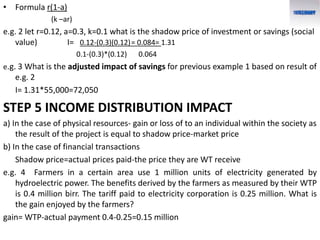
• Formula r(1-a)
(k –ar)
e.g. 2 let r=0.12, a=0.3, k=0.1 what is the shadow price of investment or savings (social
value) I= 0.12-(0.3)(0.12)= 0.084= 1.31
0.1-(0.3)*(0.12) 0.064
e.g. 3 What is the adjusted impact of savings for previous example 1 based on result of
e.g. 2
I= 1.31*55,000=72,050
STEP 5 INCOME DISTRIBUTION IMPACT
a) In the case of physical resources- gain or loss of to an individual within the society as
the result of the project is equal to shadow price-market price
b) In the case of financial transactions
Shadow price=actual prices paid-the price they are WT receive
e.g. 4 Farmers in a certain area use 1 million units of electricity generated by
hydroelectric power. The benefits derived by the farmers as measured by their WTP
is 0.4 million birr. The tariff paid to electricity corporation is 0.25 million. What is
the gain enjoyed by the farmers?
gain= WTP-actual payment 0.4-0.25=0.15 million
e.g. 5 A mining project requires 1,000 laborers. These laborers are willing to receive a
wage rate of 4 Birr per day. The wage rate paid to the workers is however 10 birr
per day. What is the gain of these workers?
• Gain= actually paid- willingness to receive
• 1000(10-4)= 6000 birr/day
STEP 6. ADJUSTMENT FOR MERIT AND DEMERIT
GOODS
• Necessary to show differences b/n social value and economic value of a project.
• E.g. Petroleum production
• Decision maker give higher social value than economic value b.c it entails
independence from external supplier
• Social value > economic value
• E.g. Alcohol production, Tobacco industry
UNIDO LITTLE & MIRLESS
Measures C/B using domestic prices Measures international prices (Border price)
In terms of consumption Uncommitted social income
Focus on efficiency, savings & redistribution at
diff stages
View these together
Calculating shadow price foreign exchange rate
& unskilled labour
Calculating shadow price foreign exchange rate &
unskilled labour
Considering factor of equity Considering factor of equity
Inputs & outputs are classified as
Tradable inputs & outputs (CIF-Imports, FOB-
exports
 Non-tradable- use CF( Conversion factor)
CF=SP/MP
Calculate Economic rate of return (IRR)
Effective rate of protection( ERP)
Domestic resource cost
Labour

2.9 skill economic analysis

  • 1.
    2.9 ADVANCED TECHNIQUES: SOCIALCOST-BENEFIT ANALYSIS (ECONOMIC ANALYSIS)
  • 2.
    ECONOMIC ANALYSIS • Impactof the project on the national economy • Used to provide information on The impact of project on key economic variables Foreign exchange earning Taxation Revenue Employment Income distribution • The impact of government policies on the incentives to invest
  • 3.
    LEVELS OF PROJECTANALYSIS Perspective What is measured Indicator Financial Analysis Owners or Lenders Change in private income NPV, FRR Economic Analysis National Economy Change in national income ENPV, ERR Distributional Analysis All groups affected by the project Distribution of change in national income Proportion of ENPV going to target group
  • 4.
    FINANCIAL & ECONOMICANALYSIS Item Financial Economic Focus Net Financial Result of a Project Contribution to the dev’t objectives return to the society Purpose Indication of incentive to implement Determine if Gov’t or private investment justified on economic efficiency Prices Prevailing/expected market price Social or Shadow prices Taxes Cost of production Transfer payment &not economic cost Subsidy Source of revenue/ increase in ind’l benefits Transfer payment & not economic cost Interest & loan repayme nt Financial cost decreases capital Transfer payment not an economic cost (unless it is external loan) Interest rate Market borrowing rate Opportunity cost of capital
  • 5.
    RATIONALE FOR SCBA a.Market Imperfections- • Market prices which form the basis for computing the monetary costs & benefits from the point of view of the project sponsor ,reflect social values only under conditions of perfect competition, which are rarely, if ever realized by developing countries. When imperfections exist, market prices do not reflect social values. • The common market imperfections found in developing countries are rationing, prescription of minimum wages & foreign exchange regulations. b. Externalities- • A project may have beneficial or negative external effects. It may be emphasized that externalities are relevant in SCBA because in such analysis all costs & benefits, irrespective to whom they accrue & whether they are paid or not are relevant. c. Taxes & Subsidies- • From the private point of view taxes are definite monetary costs & subsidies are definite monetary gains. • From the social point of view however taxes & subsidies are generally regarded as transfer payments & hence considered irrelevant. d. Concern for savings— • From a social point of view the division of benefits between consumption & saving is relevant. • The concern of the society for savings & investment is duly reflected in SCBA wherein a higher valuation is placed on savings & a lower valuation is put on consumption. e. Concern for redistribution— • In SCBA a rupee of benefit going to an economically poor section is considered more valuable than a rupee of benefit going to an affluent section. f. Merit Wants— • Goals & preferences not expressed in the market place but believed by policy makers to be in the larger interest ,may be referred to as merit wants. • While merit wants are not relevant from the private point of view, they are important from the social point of view.
  • 6.
    APPROACHES & TECHNIQUESFOR SCBA • Towards the end of the 60’s and in the early 70’s two principal approaches for SCBA emerged: • UNIDO APPROACH • THE LITTLE –MIRRLESS APPROACH STEP1. CALCULATION OF THE FINANCIAL PROFITABILITY OF THE PROJECT MEASURED AT MARKET PRICES • The measurement of financial profitability of the project in the first stage is similar to the financial evaluation discussed at greater length in the previous section. STEP 2. OBTAINING THE NET ECONOMIC BENEFIT BASED ON SHADOW PRICING This step is concerned with the determination of the NB of the project in terms of economic (efficiency) prices, also referred to as Shadow prices. 2.1 Shadow pricing (Basic issues) • Before we deal with shadow pricing of specific resources, certain basic concepts and issues must be discussed:
  • 7.
    • One ofthe important aspects of shadow pricing is the determination of the Numeraire, • What is numeraire? the unit of account in which the value of inputs or outputs is expressed. To define the numeraire, the following questions have to be answered • What unit of currency, domestic or foreign, should be used to express benefits and costs? • Should costs and benefits be measured in current values or constant values? • With reference to which point-present or future –should cost and benefits be evaluated? • What use- consumption or investment- will be made of the income from the project? • Should the income of the project be measured in terms of consumption or investment? • With reference to which group should the income of the project be measured? • The specification of the UNIDO numeraire in terms of the above questions is • “Net present consumption in the hands of people at the base level of consumption in the private sector in terms of constant price in domestic accounting birr.” CHOICE OF NUMERAIRE
  • 8.
    • A keyissue in shadow pricing is whether the good is tradable or not. What are Tradable goods & services? • goods and services that are potentially importable or exportable actually. How do you measure the value of these? • For tradable good, the international price (border price) is a measure of its opportunity cost to the country. • Therefore the shadow price is the border price, translated in domestic currency at market exchange rate. But , Why? This is because, – For a tradable good, – it is possible to substitute import for domestic production and vice versa; similarly – it is possible to substitute export for domestic consumption and vice versa. – Hence the international price, also referred to as the border price, represents the real value of the good in terms of economic efficiency. CONCEPT OF TRADABILITY
  • 9.
    • The UNIDOapproach suggests three sources of shadow pricing, depending on the impact of the project on national economy. A project, as it uses and produces resources, may for any given input or output • Increase or decrease the total consumption in the economy • Decrease or increase production in the economy • Decrease imports or increase imports and • Increase exports or decrease exports Therefore Remember!! • If the impact of the project is on consumption in the economy, the basis of shadow pricing is consumer WTP • If the impact of the project is on production in the economy, the basis of shadow pricing is the cost of production • If the impact of the project is on international trade- increase in exports, decrease in imports, increase in imports, increase in imports, or decrease in exports-the basis of shadow pricing is the foreign exchange value. SOURCES OF SHADOW PRICING
  • 10.
    • if theimpact of the project is on consumption in the economy, the basis of shadow pricing is consumers WTP. How is this measured? Example • DD’ represents the demand schedule SS’ represents the supply schedule • E the equilibrium point OQ the quantity bought OP the price per unit • The consumer who buys the first unit of is willing to pay OD for that unit and • The consumer who buys the last unit is willingness to pay OP for that unit. • The consumer WTP for various units is indicated by the schedule DE. • So the total WTP by consumers who buy the product is measured by the area ODEQ. • The price paid by them is only OPEQ. • The difference between ODEQ and OPEQ, namely DEP, is referred to as the consumer surplus. 10 CONSUMERS WILLINGNESS TO PAY (WTP)
  • 11.
    Tradable inputs andoutputs • From consumption point of view Increase in consumption=> implies increase in imports or decrease in exports • From production point of view Increase in production leads to exports increase or decrease in imports • The shadow price is the border price, adjusted/translated in domestic currency at market exchange rate. Non-tradable inputs and outputs Non tradable goods and services are goods and services that do not fall into the international trade actually or potentially. 1. If its import price(CIF) > Cost of domestic production => implies the good/service is cheaper locally 2. If its export price (FOB) < Cost of domestic production => the good to be exported is too expensive • Cost insurance and freight Free in board SHADOW PRICING OF SPECIFIC RESOURCES (INPUTS & OUTPUTS)
  • 12.
    Valuation on theoutput side If the impact of the project is to increase consumption the measure of the value will be the consumer WTP If the impact of the project is to increase production the measure is the cost of production. Valuation on the input side If impact of the project is to reduce the resources available for other firms measure will be the willingness of the others users to pay for the same resource If the impact is to meet additional inputs (requirements) from own production, measure of value would be the cost of production If the impact is to substitute other production of the same non tradable, the measure of value is the savings in the cost of production. (Value added) • When a project hires labor 1. When a project takes labor away from other employments, the shadow price of labor is equal to what other users of labor are willing to pay. 2. The shadow price associated with inducing additional production of workers consists of the marginal product of labor in previous employment plus certain other costs. i.e. may also involve the import of resources –the wages they command plus premium remittance Valuation on the output side Valuation on the input side
  • 13.
    LABOR INPUTS( foryour further reading) • When a project hires labor 1. When a project takes labor away from other employments, the shadow price of labor is equal to what other users of labor are willing to pay. 2. The shadow price associated with inducing additional production of workers consists of the marginal product of labor in previous employment plus certain other costs. i.e. may also involve the import of resources –the wages they command plus premium remittance 3. This may induce the production of new workers –need to consider MPL (for unemployed MPL=0 reservation wage. Governments NGOS what wage level is acceptable to them; consider leisure time spent; increased consumption of food plus impact on savings in the economy.=> leading to shadow wage rate of unskilled labor.
  • 14.
    For your furtherreading Externalities • Since SCBA seeks to consider all costs & benefits, to whomsoever they may accrue, external effects also need to be taken into account. • The valuation of external effects is rather difficult because they are often intangible in nature & there is no market price which can be used as starting point. Capital inputs • The opportunity cost of capital depends on how the capital required for the product is generated. • To the extent that it comes from additional savings, its opportunity cost is measured by the consumption rate of interest; • to the extent that it comes from the denial of capital to alternative projects. • In practice, the consumption rate of interest may be used as the discount rate. • Capital assets are purchased (tradable & non-tradable) follow the same procedure • opportunity cost of capital, First rate of return by denying other projects • Consumption rate of investment from own savings-sacrifices of present consumption –data requirement is immense
  • 15.
    For your furtherreading Foreign exchange • The UNIDO method uses domestic currency as the numeraire. • So the foreign exchange impact of the project must be identified & valued. • The UNIDO method determines the shadow price of foreign exchange on the basis of marginal social value as revealed by the consumer willingness to pay for the goods that are allowed to be imported at the margin. • The shadow price of a foreign currency • E.g. commodities 1, 2, 3 & 4 are imported at margins, where • F1=0.3, F2=0.4, F3=0.2, F4=0.1 • Q1=0.6, Q2=1.5, Q3=0.25, Q4=3 • P1=16, P2=8, P3=40, P4=5 • What is the shadow price of foreign exchange? • (0.3*0.6*16) +(0.4*1.5*8)+ (0.2*0.25*40) + (0.1*3*5)=11.180 ETB • But offical 1$=10ETB,
  • 16.
    • E.g. Bridgeproject 1. Presently, a ferry service, operated privately, is being used to cross a river. The ferry operator charges 3 Birr/person. It costs him 2 Birr per person. 50000 persons use the ferry service. This means that the number of people crossing the river by ferry service throughout the year is 50000. The government is considering construction of a bridge over the river. It is estimated that after the bridge is constructed 250,000 persons will cross the river on the bridge. The bridge is expected to cost 3 million initially and its annual maintenance cost would be 10,000 birr. It has an indefinitely long life. Once the bridge is constructed the ferry operator is expected to close down the ferry service and sell the ferry boats for 100,000. Qs. Define the social costs and benefits of constructing the bridge, assuming that the monetary figures given in the problem represent economic values. E.g. Bridge project
  • 18.
    • River valleyProject: The government of Ethiopia is considering a multi-purpose river valley project which would involve construction of dam, a reservoir, a power house, and several irrigation canals. The project would supply water for irrigation, generate electricity and provide a measure of protection against flood. The following information has been gathered by the project control board. The project will require the following during the construction stage • Indigenous power equipment costing 200 million birr. • Imported power equipment costing 10 million USD. • 20,000 tonnes of steel produced indigenously and made available to the project at 59000 birr a ton. • 350,000 tonnes of cement produced indigenously and made available to the project at 3250 birr a tonne. • Other construction materials (sand, bricks, etc) costing 100 million birr. • 25 million mandays of unskilled labour for which the project control board has decided to pay a daily wage rate of 200 birr. • Skilled labour costing 100 million birr. • Once commissioned, the operating and maintenance cost of the project would be 35 million birr per year. The annual benefits expected from the project would be as follows • 120,000 hectares of land will be irrigated. • 120 million units of electricity will be generated for domestic use. • Flood damages to the extent of 10 million birr will e saved annually. .
  • 19.
    • The followingadditional information is available. • Power equipment produced indigenously is a tradable item whose FOB value is 15 million USD. • A gift of 10 million dollars, available from a foreign agency, can be used for acquiring imported equipment. This gift, however, is not project-tied. Hence, if it is not assigned to the project, it can be used for some other purpose. • The shadow price per dollar is 58 birr, though the official price is 48 birr. • Steel is a tradable item whose FOB value is 400 USD per tonne. • Cement is not a tradable item. One-half of the cement required for the project will come from additional domestic production which has a cost of 3000 birr per tonne; one-half of the cement required for the project will come from diversion from other consumers who are willing to pay, on average, 3600 birr per tonne. • Other construction materials are non-tradable items. The requirement of the project will be met by way of additional production. The cost of this production will be 80 million birr. • The shadow price of unskilled labour is 120 birr per day. • The compensation paid to skilled labour reflects what others are willing to pay for their services. • The operating and maintenance cost of 35 million birr reflects economic value as well. • The water levy by the project control board would be 400 birr per hectare. However, the value of additional output per hectare, attributable to the water supplied by the project, will be 3000 birr a year. • The electricity tariff charged by the project control board would be 40 cents per unit. The consumer willingness to pay, however, would be, on average, 50 percent more than the tariff charged. • The project control board is not able to collect anything for the protection provided against floods.
  • 20.
    Required: Define thecost & benefits from the private (project control boards) & the economic point of view. Nature Private angle (Birr in millions) Economic angle(Birr in millions) Costs Indigenous power equipment One shot Imported power equipment One shot Steel One shot Cement One shot Other construction material One shot Unskilled labour One shot Skilled labour One shot Operating & maintenance cost Annual Benefits Irrigation Annual Electricity Annual Flood relief Annual
  • 21.
    THE UNIDO METHODOF PROJECT APPRAISAL INVOLVES FIVE STAGES 1. Calculation of the financial profitability of the project measured at market prices 2. Obtaining the net benefit of the project on savings & investment 3. Adjustments for the impact of the project on savings & investment 4. Adjustments for the impact of the project on income distribution 5. Adjustments for the impact of the project on merit goods & demerits goods whose social values differ from their economic values.
  • 22.
    STAGE 3 MEASUREMENTOF THE IMPACT OF DISTRIBUTION(Additional reading) • Stage 3 and 4 are concerned with measuring the value of a project in terms of its contribution to savings and income redistribution. • To facilitate such assessments, we must first measure the income gained or lost by individual groups within the society. • For income distribution analysis, the society may be divided into various groups. The UNIDO approach seeks to identify income gains and losses by the following • Project ,Other private business, Government ,Workers ,Consumers, External sector Measure of gain and loss The gain or the loss to an individual group (within the society as a result of the project) is equal to =Shadow Price-Market Price • For a physical resource =the difference between the shadow price and the market price of each input or output • For financial transactions =the difference between the price paid and the value received in the case of financial transactions.( price paid- value received )
  • 23.
    STAGE 4 SAVINGSIMPACTS & ITS VALUE • LDC are faced with shortage of capital • Savings< Consumption MPS-marginal propensity to save of group 4.1 Impact on savings • E.g. 1. As a result of a project the income gained by the two groups is 100,000 & 500,000, MPS1=0.05, MPS2=0.1. What is the savings impact of the project? • Saving impact of the project= (100,000* 0.05) + (500,000 *0.1)= 5000+50000=55,000 ETB. 4.2 Value of savings • How do you arrive at shadow price of savings? • the social value of one birr of savings • the present value of a stream of additional consumption when this 1 birr is invested. • It is a function of several factors – Productivity of capital – Social discount rate which reflects the social capital – Reinvestment rate of additional income
  • 24.
    • Formula r(1-a) (k–ar) e.g. 2 let r=0.12, a=0.3, k=0.1 what is the shadow price of investment or savings (social value) I= 0.12-(0.3)(0.12)= 0.084= 1.31 0.1-(0.3)*(0.12) 0.064 e.g. 3 What is the adjusted impact of savings for previous example 1 based on result of e.g. 2 I= 1.31*55,000=72,050 STEP 5 INCOME DISTRIBUTION IMPACT a) In the case of physical resources- gain or loss of to an individual within the society as the result of the project is equal to shadow price-market price b) In the case of financial transactions Shadow price=actual prices paid-the price they are WT receive e.g. 4 Farmers in a certain area use 1 million units of electricity generated by hydroelectric power. The benefits derived by the farmers as measured by their WTP is 0.4 million birr. The tariff paid to electricity corporation is 0.25 million. What is the gain enjoyed by the farmers? gain= WTP-actual payment 0.4-0.25=0.15 million
  • 25.
    e.g. 5 Amining project requires 1,000 laborers. These laborers are willing to receive a wage rate of 4 Birr per day. The wage rate paid to the workers is however 10 birr per day. What is the gain of these workers? • Gain= actually paid- willingness to receive • 1000(10-4)= 6000 birr/day STEP 6. ADJUSTMENT FOR MERIT AND DEMERIT GOODS • Necessary to show differences b/n social value and economic value of a project. • E.g. Petroleum production • Decision maker give higher social value than economic value b.c it entails independence from external supplier • Social value > economic value • E.g. Alcohol production, Tobacco industry
  • 26.
    UNIDO LITTLE &MIRLESS Measures C/B using domestic prices Measures international prices (Border price) In terms of consumption Uncommitted social income Focus on efficiency, savings & redistribution at diff stages View these together Calculating shadow price foreign exchange rate & unskilled labour Calculating shadow price foreign exchange rate & unskilled labour Considering factor of equity Considering factor of equity Inputs & outputs are classified as Tradable inputs & outputs (CIF-Imports, FOB- exports  Non-tradable- use CF( Conversion factor) CF=SP/MP Calculate Economic rate of return (IRR) Effective rate of protection( ERP) Domestic resource cost Labour