
Presenter : Yash Lodha
Topic name : corticosteroids.
• Corticosteroids are a class of steroid hormones that are produced in
the adrenal cortex of vertebrates, as well as the synthetic analogues of these
hormones. Two main classes of
corticosteroids, glucocorticoids and mineralocorticoids, are involved in a wide
range of physiological processes, including stress response, immune
response, and regulation
of inflammation, carbohydrate metabolism, protein catabolism,
blood electrolyte levels, and behavior.
• Some common naturally occurring steroid hormones are cortisol
• (C21H30O5), corticosterone (C21H30O4), cortisone (C21H28O5)
and aldosterone (C21H28O5). (Note that cortisone and aldosterone
are isomers.) The main corticosteroids produced by the adrenal cortex are
cortisol and aldosterone.
Classes :
•Glucocorticoids such as cortisol affect carbohydrate, fat, and protein metabolism, and
have anti-inflammatory, immunosuppressive, anti-proliferative,
and vasoconstrictive effects. Anti-inflammatory effects are mediated by blocking the
action of inflammatory mediators (transrepression) and inducing anti-inflammatory
mediators (transactivation).Immunosuppressive effects are mediated by
suppressing delayed hypersensitivity reactions by direct action on T-lymphocytes. Anti-
proliferative effects are mediated by inhibition of DNA synthesis and epidermal
cell turnover.Vasoconstrictive effects are mediated by inhibiting the action of
inflammatory mediators such as histidine.
•Mineralocorticoids such as aldosterone are primarily involved in the regulation
of electrolyte and water balance by modulating ion transport in the epithelial cells of
the renal tubules of the kidney.
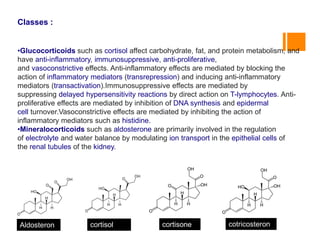
cortisol
Aldosteron
e
cortisone cotricosteron
Pharmacology :
Corticosteroids act as agonists of the glucocorticoid receptor and/or
the mineralocorticoid receptor.
In addition to their corticosteroid activity, some corticosteroids may have
some progestogenic activity and may produce sex-related side effects.
Pharmacogenetics
Asthma
Patients' response to inhaled corticosteroids has some basis in genetic
variations. Two genes of interest are CHRH1 (corticotropin-releasing
hormone receptor 1) and TBX21 (transcription factor T-bet). Both genes
display some degree of polymorphic variation in humans, which may explain
how some patients respond better to inhaled corticosteroid therapy than
others.However, not all asthma patients respond to corticosteroids and large
sub groups of asthma patients are corticosteroid resistant.
Adverse effects :
Use of corticosteroids has numerous side-effects, some of which may be severe:
• Severe amebic colitis: Fulminant amebic colitis is associated with high case
fatality and can occur in patients infected with the parasite Entamoeba
histolytica after exposure to corticosteroid medications.
• Neuropsychiatric: steroid psychosis, and anxiety,depression. Therapeutic doses
may cause a feeling of artificial well-being ("steroid euphoria"). The neuropsychiatric
effects are partly mediated by sensitization of the body to the actions of adrenaline.
Therapeutically, the bulk of corticosteroid dose is given in the morning to mimic the
body's diurnal rhythm; if given at night, the feeling of being energized will interfere
with sleep. An extensive review is provided by Flores and GU mina.
• Cardiovascular: Corticosteroids can cause sodium retention through a direct
action on the kidney, in a manner analogous to the mineralocorticoid aldosterone.
This can result in fluid retention and hypertension.
• Metabolic: Corticosteroids cause a movement of body fat to the face and torso,
resulting in "moon face", "buffalo hump", and "pot belly" or "beer belly", and cause
movement of body fat away from the limbs. This has been termed corticosteroid-
induced lipodystrophy. Due to the diversion of amino-acids to glucose, they are
considered anti-anabolic, and long term therapy can cause muscle wasting.
• Endocrine: By increasing the production of glucose from amino-acid breakdown
and opposing the action of insulin, corticosteroids can cause hyperglycemia, insulin
resistance and diabetes mellitus.
• Skeletal: Steroid-induced osteoporosis may be a side-effect of long-term
corticosteroid use.
• Use of inhaled corticosteroids among children with asthma may result in decreased
height.
• Gastro-intestinal: While cases of colitis have been reported, corticosteroids are
often prescribed when the colitis, although due to suppression of the immune
response to pathogens, should be considered only after ruling out infection or
microbe/fungal overgrowth in the gastrointestinal tract. While the evidence for
corticosteroids causing peptic ulceration is relatively poor except for high doses
taken for over a month, the majority of doctors as of 2010 still believe this is the case,
and would consider protective prophylactic measures.
• Eyes: chronic use may predispose to cataract and glaucoma.
• Vulnerability to infection: By suppressing immune reactions (which is one of the main
reasons for their use in allergies), steroids may cause infections to flare up,
notably candidiasis.
• Pregnancy: Corticosteroids have a low but significant teratogenicity effect, causing
a few birth defects per 1,000 pregnant women treated. Corticosteroids are
therefore contraindicated in pregnancy.
• Habituation: Topical steroid addiction (TSA) or red burning skin has been reported
in long-term users of topical steroids (users who applied topical steroids to their skin
over a period of weeks, months, or years). TSA is characterised by uncontrollable,
spreading dermatitis and worsening skin inflammation which requires a stronger
topical steroid to get the same result as the first prescription. When topical steroid
medication is lost, the skin experiences redness, burning, itching, hot skin, swelling,
and/or oozing for a length of time. This is also called 'red skin syndrome' or 'topical
steroid withdrawal' (TSW). After the withdrawal period is over the atopic dermatitis
can cease or is less severe than it was before.
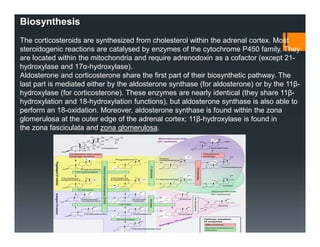
Biosynthesis
The corticosteroids are synthesized from cholesterol within the adrenal cortex. Most
steroidogenic reactions are catalysed by enzymes of the cytochrome P450 family. They
are located within the mitochondria and require adrenodoxin as a cofactor (except 21-
hydroxylase and 17α-hydroxylase).
Aldosterone and corticosterone share the first part of their biosynthetic pathway. The
last part is mediated either by the aldosterone synthase (for aldosterone) or by the 11β-
hydroxylase (for corticosterone). These enzymes are nearly identical (they share 11β-
hydroxylation and 18-hydroxylation functions), but aldosterone synthase is also able to
perform an 18-oxidation. Moreover, aldosterone synthase is found within the zona
glomerulosa at the outer edge of the adrenal cortex; 11β-hydroxylase is found in
the zona fasciculata and zona glomerulosa.
• By chemical structure
• In general, corticosteroids are grouped into four classes, based on chemical structure.
Allergic reactions to one member of a class typically indicate an intolerance of all
members of the class. This is known as the "Coopman classification".The highlighted
steroids are often used in the screening of allergies to topical steroids.
• Group A – Hydrocortisone typeHydrocortisone, Hydrocortisone acetate, Cortisone
acetate, tixocortol pivalate, prednisolone, methylprednisolone, prednisone
• Group B – Acetonides (and related substances)
Amcinonide, budesonide, desonide, fluocinolone acetonide, fluocinonide, halcinonide,
and triamcinolone acetonide.
• Group C – Betamethasone
typeBeclometasone, betamethasone, dexamethasone, fluocortolone, halometasone,
and mometasone.
• Group D – Esters
• Group D1 – Halogenated (less labile)
• Alclometasone propionate, betamethasone propionate, betamethasone vale
rate, clobetasol propionate, clobetasone butyrate, fluprednidene acetate,
and mometasone furoate.
• Group D2 – Labile prodrug esters
• Ciclesonide, cortisone acetate, hydrocortisone aceponate, hydrocortisone
acetate, hydrocortisone buteprate, hydrocortisone butyrate, hydrocortisone
valerate, prednicarbate, and tixocortol pivalate.
• By route of administration
• Topical steroids
• Main article: Topical steroid
• For use topically on the skin, eye, and mucous membranes.
• Topical corticosteroids are divided in potency classes I to IV in most countries (A to D
in Japan). Seven categories are used in the United States to determine the level of
potency of any given topical corticosteroid.
• Inhaled steroids
• For nasal mucosa, sinuses, bronchi, and lungs. This group includes:
• Flunisolide
• Fluticasone furoate
• Fluticasone propionate
• Triamcinolone acetonide
• Beclomethasone dipropionate
• Budesonide
• Mometasone furoate
Ciclesonide
.
• There also exist certain combination preparations such as Advair Diskus in the United
States, containing fluticasone propionate and salmeterol (a long-acting
bronchodilator), and Symbicort, containing budesonide and formoterol fumarate
dihydrate (another long-acting bronchodilator).They are both approved for use in
children over 12 years old.
• Oral forms
• Such as prednisone, prednisolone, methylprednisolone, or dexamethasone.
• Systemic forms
• Available in injectables for intravenous and parenteral routes
BENEFITS OF CORTICOSTEROIDS
• There are some definite advantages to using corticosteroid treatment for inflammatory
musculoskeletal conditions. These include:
• Near-instant pain relief
• Rapid reduction in inflammation
• Permanent cure, sometimes, in the case of a localized injury
• A high success rate
• When symptoms are disabling — for example, if your Achilles tendonitis hurts too
badly to walk, or your tennis elbow is so severe you can’t write, type, use the phone,
or hold a fork — a cortisone injection may bring relief from an intolerable level of pain
and swelling, long enough to make you comfortable while your body heals.
• However, there is a downside. This form of medication can’t be used indefinitely
to manage pain and swelling in chronic or recurring conditions. If symptoms
return after a few weeks, a second shot may not be safe. To avoid damaging side
effects, orthopedists usually limit the administration of these injectables to 3 to 4 shots
per year.
THANKYOU !!!

Corticosteroids

  • 1.
    Presenter : YashLodha Topic name : corticosteroids.
  • 3.
    • Corticosteroids area class of steroid hormones that are produced in the adrenal cortex of vertebrates, as well as the synthetic analogues of these hormones. Two main classes of corticosteroids, glucocorticoids and mineralocorticoids, are involved in a wide range of physiological processes, including stress response, immune response, and regulation of inflammation, carbohydrate metabolism, protein catabolism, blood electrolyte levels, and behavior. • Some common naturally occurring steroid hormones are cortisol • (C21H30O5), corticosterone (C21H30O4), cortisone (C21H28O5) and aldosterone (C21H28O5). (Note that cortisone and aldosterone are isomers.) The main corticosteroids produced by the adrenal cortex are cortisol and aldosterone.
  • 4.
    Classes : •Glucocorticoids suchas cortisol affect carbohydrate, fat, and protein metabolism, and have anti-inflammatory, immunosuppressive, anti-proliferative, and vasoconstrictive effects. Anti-inflammatory effects are mediated by blocking the action of inflammatory mediators (transrepression) and inducing anti-inflammatory mediators (transactivation).Immunosuppressive effects are mediated by suppressing delayed hypersensitivity reactions by direct action on T-lymphocytes. Anti- proliferative effects are mediated by inhibition of DNA synthesis and epidermal cell turnover.Vasoconstrictive effects are mediated by inhibiting the action of inflammatory mediators such as histidine. •Mineralocorticoids such as aldosterone are primarily involved in the regulation of electrolyte and water balance by modulating ion transport in the epithelial cells of the renal tubules of the kidney. cortisol Aldosteron e cortisone cotricosteron
  • 5.
    Pharmacology : Corticosteroids actas agonists of the glucocorticoid receptor and/or the mineralocorticoid receptor. In addition to their corticosteroid activity, some corticosteroids may have some progestogenic activity and may produce sex-related side effects. Pharmacogenetics Asthma Patients' response to inhaled corticosteroids has some basis in genetic variations. Two genes of interest are CHRH1 (corticotropin-releasing hormone receptor 1) and TBX21 (transcription factor T-bet). Both genes display some degree of polymorphic variation in humans, which may explain how some patients respond better to inhaled corticosteroid therapy than others.However, not all asthma patients respond to corticosteroids and large sub groups of asthma patients are corticosteroid resistant.
  • 6.
    Adverse effects : Useof corticosteroids has numerous side-effects, some of which may be severe: • Severe amebic colitis: Fulminant amebic colitis is associated with high case fatality and can occur in patients infected with the parasite Entamoeba histolytica after exposure to corticosteroid medications. • Neuropsychiatric: steroid psychosis, and anxiety,depression. Therapeutic doses may cause a feeling of artificial well-being ("steroid euphoria"). The neuropsychiatric effects are partly mediated by sensitization of the body to the actions of adrenaline. Therapeutically, the bulk of corticosteroid dose is given in the morning to mimic the body's diurnal rhythm; if given at night, the feeling of being energized will interfere with sleep. An extensive review is provided by Flores and GU mina. • Cardiovascular: Corticosteroids can cause sodium retention through a direct action on the kidney, in a manner analogous to the mineralocorticoid aldosterone. This can result in fluid retention and hypertension. • Metabolic: Corticosteroids cause a movement of body fat to the face and torso, resulting in "moon face", "buffalo hump", and "pot belly" or "beer belly", and cause movement of body fat away from the limbs. This has been termed corticosteroid- induced lipodystrophy. Due to the diversion of amino-acids to glucose, they are considered anti-anabolic, and long term therapy can cause muscle wasting.
  • 7.
    • Endocrine: Byincreasing the production of glucose from amino-acid breakdown and opposing the action of insulin, corticosteroids can cause hyperglycemia, insulin resistance and diabetes mellitus. • Skeletal: Steroid-induced osteoporosis may be a side-effect of long-term corticosteroid use. • Use of inhaled corticosteroids among children with asthma may result in decreased height. • Gastro-intestinal: While cases of colitis have been reported, corticosteroids are often prescribed when the colitis, although due to suppression of the immune response to pathogens, should be considered only after ruling out infection or microbe/fungal overgrowth in the gastrointestinal tract. While the evidence for corticosteroids causing peptic ulceration is relatively poor except for high doses taken for over a month, the majority of doctors as of 2010 still believe this is the case, and would consider protective prophylactic measures.
  • 8.
    • Eyes: chronicuse may predispose to cataract and glaucoma. • Vulnerability to infection: By suppressing immune reactions (which is one of the main reasons for their use in allergies), steroids may cause infections to flare up, notably candidiasis. • Pregnancy: Corticosteroids have a low but significant teratogenicity effect, causing a few birth defects per 1,000 pregnant women treated. Corticosteroids are therefore contraindicated in pregnancy. • Habituation: Topical steroid addiction (TSA) or red burning skin has been reported in long-term users of topical steroids (users who applied topical steroids to their skin over a period of weeks, months, or years). TSA is characterised by uncontrollable, spreading dermatitis and worsening skin inflammation which requires a stronger topical steroid to get the same result as the first prescription. When topical steroid medication is lost, the skin experiences redness, burning, itching, hot skin, swelling, and/or oozing for a length of time. This is also called 'red skin syndrome' or 'topical steroid withdrawal' (TSW). After the withdrawal period is over the atopic dermatitis can cease or is less severe than it was before.
  • 9.
    Biosynthesis The corticosteroids aresynthesized from cholesterol within the adrenal cortex. Most steroidogenic reactions are catalysed by enzymes of the cytochrome P450 family. They are located within the mitochondria and require adrenodoxin as a cofactor (except 21- hydroxylase and 17α-hydroxylase). Aldosterone and corticosterone share the first part of their biosynthetic pathway. The last part is mediated either by the aldosterone synthase (for aldosterone) or by the 11β- hydroxylase (for corticosterone). These enzymes are nearly identical (they share 11β- hydroxylation and 18-hydroxylation functions), but aldosterone synthase is also able to perform an 18-oxidation. Moreover, aldosterone synthase is found within the zona glomerulosa at the outer edge of the adrenal cortex; 11β-hydroxylase is found in the zona fasciculata and zona glomerulosa.
  • 10.
    • By chemicalstructure • In general, corticosteroids are grouped into four classes, based on chemical structure. Allergic reactions to one member of a class typically indicate an intolerance of all members of the class. This is known as the "Coopman classification".The highlighted steroids are often used in the screening of allergies to topical steroids. • Group A – Hydrocortisone typeHydrocortisone, Hydrocortisone acetate, Cortisone acetate, tixocortol pivalate, prednisolone, methylprednisolone, prednisone • Group B – Acetonides (and related substances) Amcinonide, budesonide, desonide, fluocinolone acetonide, fluocinonide, halcinonide, and triamcinolone acetonide. • Group C – Betamethasone typeBeclometasone, betamethasone, dexamethasone, fluocortolone, halometasone, and mometasone. • Group D – Esters • Group D1 – Halogenated (less labile) • Alclometasone propionate, betamethasone propionate, betamethasone vale rate, clobetasol propionate, clobetasone butyrate, fluprednidene acetate, and mometasone furoate.
  • 11.
    • Group D2– Labile prodrug esters • Ciclesonide, cortisone acetate, hydrocortisone aceponate, hydrocortisone acetate, hydrocortisone buteprate, hydrocortisone butyrate, hydrocortisone valerate, prednicarbate, and tixocortol pivalate. • By route of administration • Topical steroids • Main article: Topical steroid • For use topically on the skin, eye, and mucous membranes. • Topical corticosteroids are divided in potency classes I to IV in most countries (A to D in Japan). Seven categories are used in the United States to determine the level of potency of any given topical corticosteroid. • Inhaled steroids • For nasal mucosa, sinuses, bronchi, and lungs. This group includes: • Flunisolide • Fluticasone furoate • Fluticasone propionate • Triamcinolone acetonide • Beclomethasone dipropionate • Budesonide • Mometasone furoate Ciclesonide .
  • 12.
    • There alsoexist certain combination preparations such as Advair Diskus in the United States, containing fluticasone propionate and salmeterol (a long-acting bronchodilator), and Symbicort, containing budesonide and formoterol fumarate dihydrate (another long-acting bronchodilator).They are both approved for use in children over 12 years old. • Oral forms • Such as prednisone, prednisolone, methylprednisolone, or dexamethasone. • Systemic forms • Available in injectables for intravenous and parenteral routes
  • 13.
    BENEFITS OF CORTICOSTEROIDS •There are some definite advantages to using corticosteroid treatment for inflammatory musculoskeletal conditions. These include: • Near-instant pain relief • Rapid reduction in inflammation • Permanent cure, sometimes, in the case of a localized injury • A high success rate • When symptoms are disabling — for example, if your Achilles tendonitis hurts too badly to walk, or your tennis elbow is so severe you can’t write, type, use the phone, or hold a fork — a cortisone injection may bring relief from an intolerable level of pain and swelling, long enough to make you comfortable while your body heals. • However, there is a downside. This form of medication can’t be used indefinitely to manage pain and swelling in chronic or recurring conditions. If symptoms return after a few weeks, a second shot may not be safe. To avoid damaging side effects, orthopedists usually limit the administration of these injectables to 3 to 4 shots per year.
  • 14.