CORROSION AND PREVENTION
Dr Md Mayeedul Islam (MMI)
Professor
Department of Chemistry
RUET
BooK references
1. Herbert H. Uhlig, R. Wniston Revie, Corrosion and
Corrosion Control
2. Raj Narayan, An Introduction to Metallic Corrosion and its
Prevention
3. Mars G. Fontana, Corrosion Engineering
4. S. N. Banerjee, An Introduction to Science of Corrosion and
Its Inhibition
5/2/2023 2
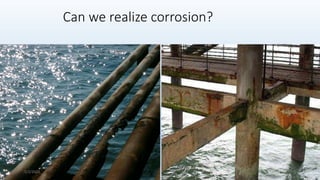
Can we realize corrosion?
5/2/2023 3
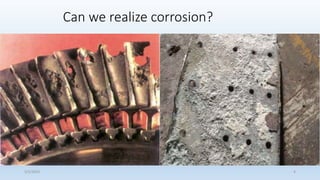
Can we realize corrosion?
5/2/2023 4
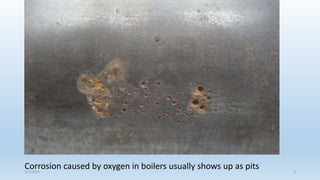
Corrosion caused by oxygen in boilers usually shows up as pits
5/2/2023 5
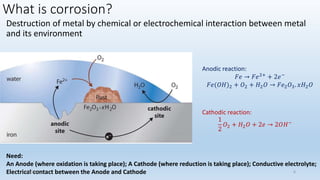
What is corrosion?
Destruction of metal by chemical or electrochemical interaction between metal
and its environment
Need:
An Anode (where oxidation is taking place); A Cathode (where reduction is taking place); Conductive electrolyte;
Electrical contact between the Anode and Cathode
Anodic reaction:
𝐹𝑒 → 𝐹𝑒2+ + 2𝑒−
𝐹𝑒(𝑂𝐻)2 + 𝑂2 + 𝐻2𝑂 → 𝐹𝑒2𝑂3. 𝑥𝐻2𝑂
Cathodic reaction:
1
2
𝑂2 + 𝐻2𝑂 + 2𝑒 → 2𝑂𝐻−
5/2/2023 6
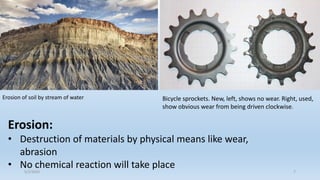
Bicycle sprockets. New, left, shows no wear. Right, used,
show obvious wear from being driven clockwise.
Erosion of soil by stream of water
Erosion:
• Destruction of materials by physical means like wear,
abrasion
• No chemical reaction will take place
5/2/2023 7
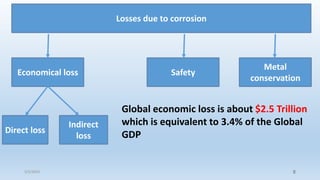
Metal
conservation
Losses due to corrosion
Economical loss Safety
Direct loss
Indirect
loss
Global economic loss is about $2.5 Trillion
which is equivalent to 3.4% of the Global
GDP
5/2/2023 8
Economical Loss: Direct loss:
• Cost of replacing corroded structures and machineries
or their components
• Repainting of structures where prevention of rusting is
the prime objective
• Cost of using corrosion resistant metals and alloys
• Cost of galvanizing and nickel plating of steel
• Cost of adding corrosion inhibitors to water
The total direct cost of corrosion is estimated at $276 billion per year
5/2/2023 9
Economical Loss: Indirect loss
1. Plant shutdown: $800/hr in lost production in oil refinery. The replacement of
a corroded boiler or condenser tube in a modern power station capable of
producing 500 MW could result in losses in excess of £20,000/h.
2. Loss of product: Losses of oil, gas, or water occur through a corroded pipe
system
3. Loss of efficiency: Heat transfer is decreased by accumulated corrosion
product; pumping capacity is decreased by the clogging of pipeline with rust.
This may cost $40 million/year in US
4. Contamination of product: Cu detrimental in soap industry; lead is prohibited
in food and beverages and soft water piping's.
5. Overdesign: This factor is common in the design of reaction vessels, boiler
tubes, buried pipelines, water tanks, and marine structures. A line of 8-inch
diameter pipe 225 miles long was specified to have a wall thickness of 0.322
inch to allow corrosion from the soil side. With adequate corrosion
protection, a wall thickness of only 0.225 inch could have been used, saving
3,700 tons of steel, as well as the increasing the internal capacity by 5%.
5/2/2023 10
Safety
The loss of health or life through explosion or
unpredictable failure of chemical equipment, or
wreckage of airplanes, trains, or automobiles through
sudden failure by corrosion of critical parts. These losses
are more difficult to asses, and are beyond the
interpretation in terms of dollars.
5/2/2023 11
Metal conservation
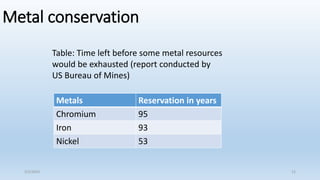
Metals Reservation in years
Chromium 95
Iron 93
Nickel 53
Table: Time left before some metal resources
would be exhausted (report conducted by
US Bureau of Mines)
5/2/2023 12
What would be expected from Corrosion Engineer.
Ensuring maximum life of new equipment.
Preservation of existing equipment.
Protecting or improving the quality of a product in order to maintain
or improve a competitive position.
Avoiding costly interruptions of production.
Reducing or eliminating losses of valuable products by spillage or
leaks.
Refitting of equipment withdrawn from service because of corrosion.
Reducing hazards to life and property that might be associated with
corrosion:
√ Explosions of pressure vessels or piping systems.
√ release of poisonous or explosive gases or vapors.
5/2/2023 13
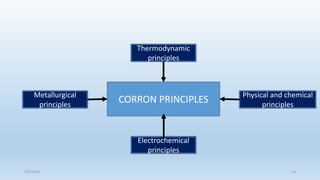
CORRON PRINCIPLES
Thermodynamic
principles
Metallurgical
principles
Physical and chemical
principles
Electrochemical
principles
5/2/2023 14
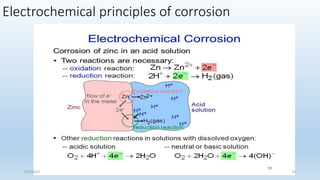
Electrochemical principles of corrosion
5/2/2023 15
Types of Electrochemical Cell
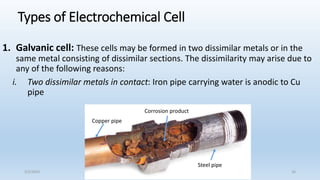
1. Galvanic cell: These cells may be formed in two dissimilar metals or in the
same metal consisting of dissimilar sections. The dissimilarity may arise due to
any of the following reasons:
i. Two dissimilar metals in contact: Iron pipe carrying water is anodic to Cu
pipe
Copper pipe
Steel pipe
Corrosion product
5/2/2023 16
ii. Different heat treatment: Tempered steel is anodic to annealed
steel.
iii. Scratches or abrasion: Scratched area will be anodic to the
remaining part.
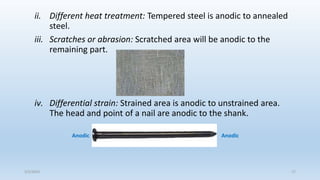
iv. Differential strain: Strained area is anodic to unstrained area.
The head and point of a nail are anodic to the shank.
Anodic Anodic
5/2/2023 17
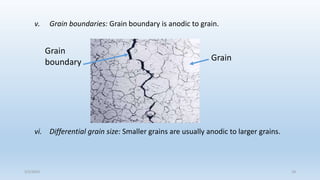
v. Grain boundaries: Grain boundary is anodic to grain.
vi. Differential grain size: Smaller grains are usually anodic to larger grains.
Grain
Grain
boundary
5/2/2023 18
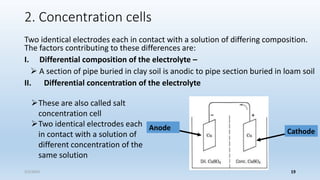
2. Concentration cells
Two identical electrodes each in contact with a solution of differing composition.
The factors contributing to these differences are:
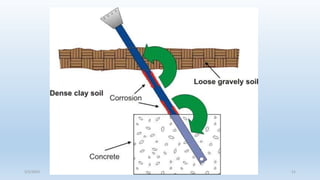
I. Differential composition of the electrolyte –
 A section of pipe buried in clay soil is anodic to pipe section buried in loam soil
II. Differential concentration of the electrolyte
Anode Cathode
These are also called salt
concentration cell
Two identical electrodes each
in contact with a solution of
different concentration of the
same solution
5/2/2023 19
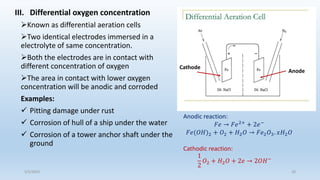
III. Differential oxygen concentration
Known as differential aeration cells
Two identical electrodes immersed in a
electrolyte of same concentration.
Both the electrodes are in contact with
different concentration of oxygen
The area in contact with lower oxygen
concentration will be anodic and corroded
Examples:
 Pitting damage under rust
 Corrosion of hull of a ship under the water
 Corrosion of a tower anchor shaft under the
ground
Cathode
Anode
Anodic reaction:
𝐹𝑒 → 𝐹𝑒2+ + 2𝑒−
𝐹𝑒(𝑂𝐻)2 + 𝑂2 + 𝐻2𝑂 → 𝐹𝑒2𝑂3. 𝑥𝐻2𝑂
Cathodic reaction:
1
2
𝑂2 + 𝐻2𝑂 + 2𝑒 → 2𝑂𝐻−
5/2/2023 20
5/2/2023 21
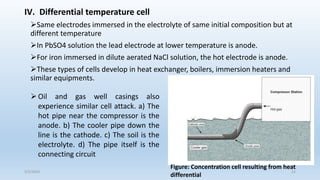
IV. Differential temperature cell
Same electrodes immersed in the electrolyte of same initial composition but at
different temperature
In PbSO4 solution the lead electrode at lower temperature is anode.
For iron immersed in dilute aerated NaCl solution, the hot electrode is anode.
These types of cells develop in heat exchanger, boilers, immersion heaters and
similar equipments.
Figure: Concentration cell resulting from heat
differential
Oil and gas well casings also
experience similar cell attack. a) The
hot pipe near the compressor is the
anode. b) The cooler pipe down the
line is the cathode. c) The soil is the
electrolyte. d) The pipe itself is the
connecting circuit
5/2/2023 22
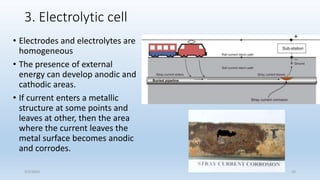
3. Electrolytic cell
• Electrodes and electrolytes are
homogeneous
• The presence of external
energy can develop anodic and
cathodic areas.
• If current enters a metallic
structure at some points and
leaves at other, then the area
where the current leaves the
metal surface becomes anodic
and corrodes.
5/2/2023 23
Thermodynamic principle of corrosion
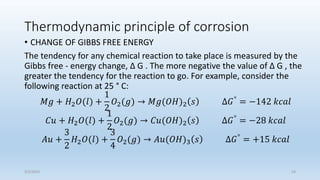
• CHANGE OF GIBBS FREE ENERGY
The tendency for any chemical reaction to take place is measured by the
Gibbs free - energy change, Δ G . The more negative the value of Δ G , the
greater the tendency for the reaction to go. For example, consider the
following reaction at 25 ° C:
𝑀𝑔 + 𝐻2𝑂(𝑙) +
1
2
𝑂2(𝑔) → 𝑀𝑔(𝑂𝐻)2 𝑠 ∆𝐺°
= −142 𝑘𝑐𝑎𝑙
𝐶𝑢 + 𝐻2𝑂(𝑙) +
1
2
𝑂2(𝑔) → 𝐶𝑢(𝑂𝐻)2 𝑠 ∆𝐺°
= −28 𝑘𝑐𝑎𝑙
𝐴𝑢 +
3
2
𝐻2𝑂(𝑙) +
3
4
𝑂2(𝑔) → 𝐴𝑢(𝑂𝐻)3 𝑠 ∆𝐺° = +15 𝑘𝑐𝑎𝑙
5/2/2023 24
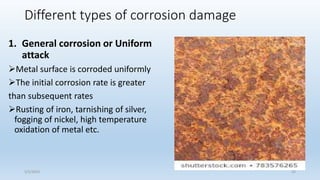
Different types of corrosion damage
1. General corrosion or Uniform
attack
Metal surface is corroded uniformly
The initial corrosion rate is greater
than subsequent rates
Rusting of iron, tarnishing of silver,
fogging of nickel, high temperature
oxidation of metal etc.
5/2/2023 25
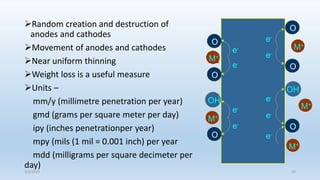
Random creation and destruction of
anodes and cathodes
Movement of anodes and cathodes
Near uniform thinning
Weight loss is a useful measure
Units –
mm/y (millimetre penetration per year)
gmd (grams per square meter per day)
ipy (inches penetrationper year)
mpy (mils (1 mil = 0.001 inch) per year
mdd (milligrams per square decimeter per
day)
5/2/2023 26
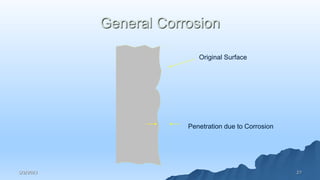
General Corrosion
Original Surface
Penetration due to Corrosion
5/2/2023 27
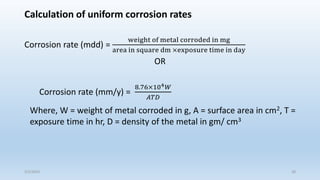
Calculation of uniform corrosion rates
Corrosion rate (mdd) =
weight of metal corroded in mg
area in square dm ×exposure time in day
OR
Corrosion rate (mm/y) =
8.76×10⁴𝑊
𝐴𝑇𝐷
Where, W = weight of metal corroded in g, A = surface area in cm2, T =
exposure time in hr, D = density of the metal in gm/ cm3
5/2/2023 28
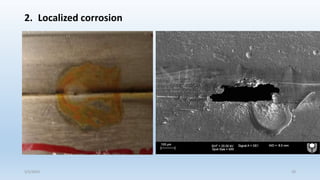
2. Localized corrosion
5/2/2023 29
Generates on the same surface
Small area of the surface acts as anode compare to large cathode
Localized corrosions are the following types
I. Pitting corrosion
II.Crevice corrosion
III.Film forming or under deposit corrosion
IV. Micro-bialy induced corrosion (MIC)
5/2/2023 30
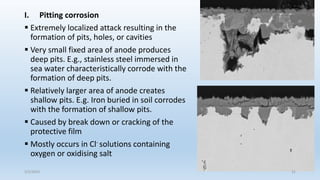
I. Pitting corrosion
 Extremely localized attack resulting in the
formation of pits, holes, or cavities
 Very small fixed area of anode produces
deep pits. E.g., stainless steel immersed in
sea water characteristically corrode with the
formation of deep pits.
 Relatively larger area of anode creates
shallow pits. E.g. Iron buried in soil corrodes
with the formation of shallow pits.
 Caused by break down or cracking of the
protective film
 Mostly occurs in Cl- solutions containing
oxygen or oxidising salt
5/2/2023 31
• Causes of pitting corrosion
Metal surfaces are not homogeneous
External environment is not homogeneous
Film are not perfectly uniform
Crystallographic directions are not equal in the reactivity
 The depth of pitting is expressed by the term Pitting factor. It is the
ratio of deepest metal penetration to average metal penetration as
determined by weight loss of the specimen.
5/2/2023 32
II. Crevice corrosion
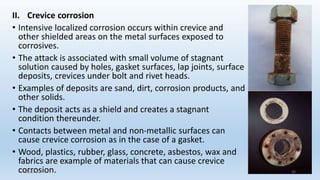
• Intensive localized corrosion occurs within crevice and
other shielded areas on the metal surfaces exposed to
corrosives.
• The attack is associated with small volume of stagnant
solution caused by holes, gasket surfaces, lap joints, surface
deposits, crevices under bolt and rivet heads.
• Examples of deposits are sand, dirt, corrosion products, and
other solids.
• The deposit acts as a shield and creates a stagnant
condition thereunder.
• Contacts between metal and non-metallic surfaces can
cause crevice corrosion as in the case of a gasket.
• Wood, plastics, rubber, glass, concrete, asbestos, wax and
fabrics are example of materials that can cause crevice
corrosion.
5/2/2023 33
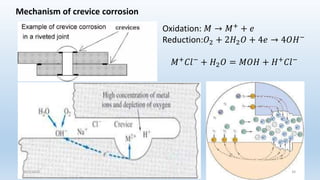
Mechanism of crevice corrosion
Oxidation: 𝑀 → 𝑀+
+ 𝑒
Reduction:𝑂2 + 2𝐻2𝑂 + 4𝑒 → 4𝑂𝐻−
𝑀+𝐶𝑙− + 𝐻2𝑂 = 𝑀𝑂𝐻 + 𝐻+𝐶𝑙−
5/2/2023 34
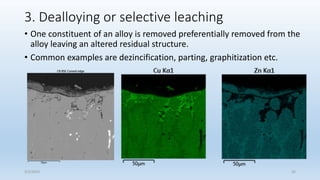
3. Dealloying or selective leaching
• One constituent of an alloy is removed preferentially removed from the
alloy leaving an altered residual structure.
• Common examples are dezincification, parting, graphitization etc.
5/2/2023 35
4. Stress corrosion cracking
• If a metal is subject to a constant tensile stress and exposed to a specific
corrosive environment, cracks immediately or after a given time, which is
called stress corrosion cracking
• It is the cracking induced from the combined influence of tensile stress and
a corrosive environment.
• The stress may be residual stress in the metal as from cold working, or
heat-treatment or may be externally applied stress.
• Practically all structural metals, e.g., steels, brass, SS, duralumin, nickel
alloys and others are subjected to SCC in some environment.
5/2/2023 36
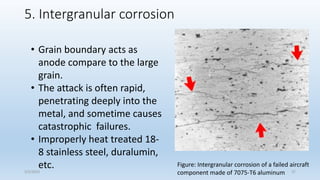
5. Intergranular corrosion
Figure: Intergranular corrosion of a failed aircraft
component made of 7075-T6 aluminum
• Grain boundary acts as
anode compare to the large
grain.
• The attack is often rapid,
penetrating deeply into the
metal, and sometime causes
catastrophic failures.
• Improperly heat treated 18-
8 stainless steel, duralumin,
etc.
5/2/2023 37
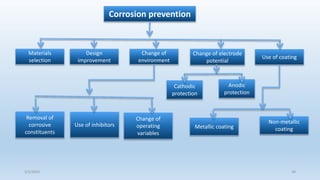
Corrosion prevention
Materials
selection
Design
improvement
Change of
environment
Change of electrode
potential
Use of coating
Removal of
corrosive
constituents
Use of inhibitors
Change of
operating
variables
Cathodic
protection
Anodic
protection
Metallic coating
Non-metallic
coating
5/2/2023 38
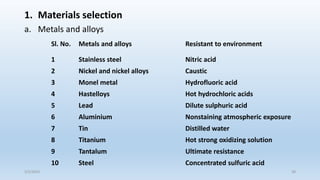
1. Materials selection
a. Metals and alloys
Sl. No. Metals and alloys Resistant to environment
1 Stainless steel Nitric acid
2 Nickel and nickel alloys Caustic
3 Monel metal Hydrofluoric acid
4 Hastelloys Hot hydrochloric acids
5 Lead Dilute sulphuric acid
6 Aluminium Nonstaining atmospheric exposure
7 Tin Distilled water
8 Titanium Hot strong oxidizing solution
9 Tantalum Ultimate resistance
10 Steel Concentrated sulfuric acid
5/2/2023 39
b. Metal purification
Pure metals are more corrosion resistance than impure one. But, they are usually expensive
and are soft and weak.
Good example is aluminum (99.5% pure)
Arc-melted zirconium is more corrosion resistant than induction-melted zirconium as the
later is impure.
c. Nonmetallics
Five classes of nonmetallic materials are rubber, plastics, ceramics, carbon and graphite and
wood.
Rubber and plastics are more resistant to chloride ions and hydrochloric acids, less
resistance to strong sulfuric acids, nitric acids, solvents and have relatively low temperature
limitations.
Ceramics have excellent corrosion resistant and very high temperature resistance, but
brittle.
Carbon shows good corrosion resistant and electricity and heat conductivity, but fragile.
Wood is attacked by aggressive environments.
5/2/2023 40
2. Design
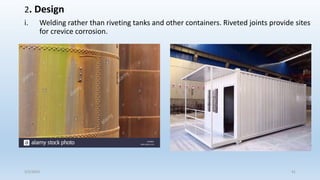
i. Welding rather than riveting tanks and other containers. Riveted joints provide sites
for crevice corrosion.
5/2/2023 41
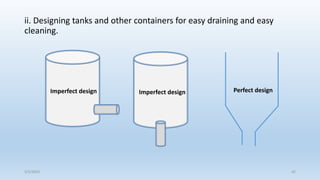
ii. Designing tanks and other containers for easy draining and easy
cleaning.
5/2/2023 42
Imperfect design Imperfect design Perfect design
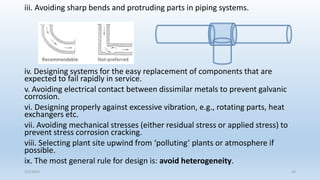
iii. Avoiding sharp bends and protruding parts in piping systems.
iv. Designing systems for the easy replacement of components that are
expected to fail rapidly in service.
v. Avoiding electrical contact between dissimilar metals to prevent galvanic
corrosion.
vi. Designing properly against excessive vibration, e.g., rotating parts, heat
exchangers etc.
vii. Avoiding mechanical stresses (either residual stress or applied stress) to
prevent stress corrosion cracking.
viii. Selecting plant site upwind from ‘polluting’ plants or atmosphere if
possible.
ix. The most general rule for design is: avoid heterogeneity.
5/2/2023 43
3. Change of Environment/Alteration of Environment
A. Removal of corrosive constituents from the environment
i. Removal of moisture from air by dehumidification, e.g., using silica gel in small
closed spaces
ii. Lowering of relative humidity of air by increasing the temperature 6 to 7 °C above
ambient in storage area
iii. Removal of oxygen from water by (a) saturation with inert gas, e.g., nitrogen, (b)
evacuation, (c) addition of oxygen scavengers, e.g, hydrazine or sodium sulphite
iv. Removal of acid from water by neutralization, e.g., by addition of lime
v. Removal of chloride ions from the environment to prevent pitting and stress
corrosion cracking
vi. Removal of solid particles from the environment by filtration
vii. Removal of salts from water by ion exchange
5/2/2023 44
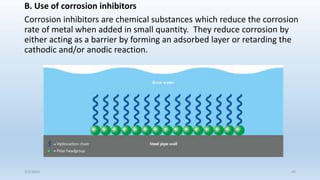
B. Use of corrosion inhibitors
Corrosion inhibitors are chemical substances which reduce the corrosion
rate of metal when added in small quantity. They reduce corrosion by
either acting as a barrier by forming an adsorbed layer or retarding the
cathodic and/or anodic reaction.
5/2/2023 45
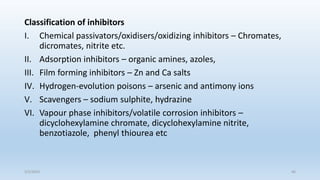
Classification of inhibitors
I. Chemical passivators/oxidisers/oxidizing inhibitors – Chromates,
dicromates, nitrite etc.
II. Adsorption inhibitors – organic amines, azoles,
III. Film forming inhibitors – Zn and Ca salts
IV. Hydrogen-evolution poisons – arsenic and antimony ions
V. Scavengers – sodium sulphite, hydrazine
VI. Vapour phase inhibitors/volatile corrosion inhibitors –
dicyclohexylamine chromate, dicyclohexylamine nitrite,
benzotiazole, phenyl thiourea etc
5/2/2023 46
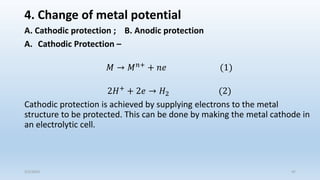
4. Change of metal potential
A. Cathodic protection ; B. Anodic protection
A. Cathodic Protection –
𝑀 → 𝑀𝑛+
+ 𝑛𝑒 (1)
2𝐻+ + 2𝑒 → 𝐻2 (2)
Cathodic protection is achieved by supplying electrons to the metal
structure to be protected. This can be done by making the metal cathode in
an electrolytic cell.
5/2/2023 47
5/2/2023 48
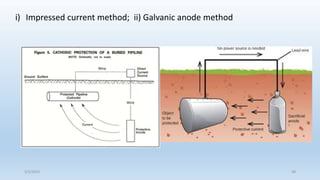
i) Impressed current method; ii) Galvanic anode method
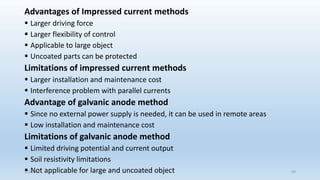
Advantages of Impressed current methods
 Larger driving force
 Larger flexibility of control
 Applicable to large object
 Uncoated parts can be protected
Limitations of impressed current methods
 Larger installation and maintenance cost
 Interference problem with parallel currents
Advantage of galvanic anode method
 Since no external power supply is needed, it can be used in remote areas
 Low installation and maintenance cost
Limitations of galvanic anode method
 Limited driving potential and current output
 Soil resistivity limitations
 Not applicable for large and uncoated object
5/2/2023 49
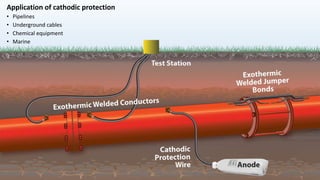
Application of cathodic protection
• Pipelines
• Underground cables
• Chemical equipment
• Marine
5/2/2023 50
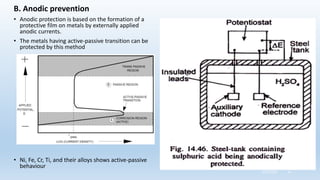
B. Anodic prevention
• Anodic protection is based on the formation of a
protective film on metals by externally applied
anodic currents.
• The metals having active-passive transition can be
protected by this method
• Ni, Fe, Cr, Ti, and their alloys shows active-passive
behaviour
5/2/2023 51
• Advantage of anodic prevention
• Applicable in extremely corrosive environment
• Low current requirement
• Cost independent of size of the article
• Relatively high throwing power
• Operating condition can be precisely established in the laboratory
• Limitations of anodic prevention
• Applicable for metals and alloys having active-passive transition
• Can not be applied in medium containing aggressive anions like chloride ion
• If protection breaks down at any point, it is very difficult to re-established
Application
• Carbon steel and stainless-steel equipment in contact with oleum, sulphuric
acid, phosphoric acid, aqueous ammonia, sodium hydroxide etc
• Chromium in contact with hydrofluoric acid
5/2/2023 52
5. Coating
a. Metallic coating
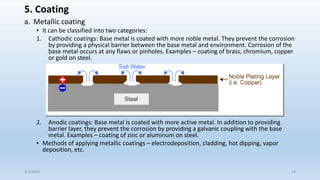
• It can be classified into two categories:
1. Cathodic coatings: Base metal is coated with more noble metal. They prevent the corrosion
by providing a physical barrier between the base metal and environment. Corrosion of the
base metal occurs at any flaws or pinholes. Examples – coating of brass, chromium, copper
or gold on steel.
2. Anodic coatings: Base metal is coated with more active metal. In addition to providing
barrier layer, they prevent the corrosion by providing a galvanic coupling with the base
metal. Examples – coating of zinc or aluminum on steel.
• Methods of applying metallic coatings – electrodeposition, cladding, hot dipping, vapor
deposition, etc.
5/2/2023 53
Metallic coating processes
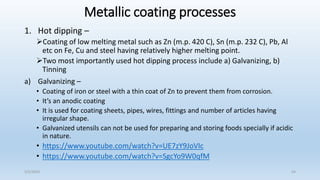
1. Hot dipping –
Coating of low melting metal such as Zn (m.p. 420 C), Sn (m.p. 232 C), Pb, Al
etc on Fe, Cu and steel having relatively higher melting point.
Two most importantly used hot dipping process include a) Galvanizing, b)
Tinning
a) Galvanizing –
• Coating of iron or steel with a thin coat of Zn to prevent them from corrosion.
• It’s an anodic coating
• It is used for coating sheets, pipes, wires, fittings and number of articles having
irregular shape.
• Galvanized utensils can not be used for preparing and storing foods specially if acidic
in nature.
• https://www.youtube.com/watch?v=UE7zY9JoVIc
• https://www.youtube.com/watch?v=SgcYo9W0qfM
5/2/2023 54
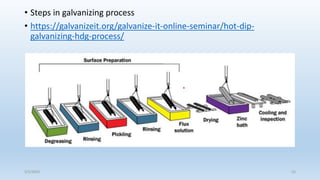
• Steps in galvanizing process
• https://galvanizeit.org/galvanize-it-online-seminar/hot-dip-
galvanizing-hdg-process/
5/2/2023 55
b) Tinning –
 it is the coating of tin over the surface of steel, Cu or brass.
It is a cathodic coating
The process is almost similar to galvanizing
The process is applied on the articles which are used for can and containers
for storing ghee, foods stuffs, oils and food packaging.
Rubber insulated Cu wire first is tinned in order to protect it from the attack
of sulfur.
https://www.youtube.com/watch?v=-K8Xb2tUWbY
5/2/2023 56
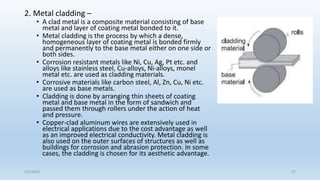
2. Metal cladding –
• A clad metal is a composite material consisting of base
metal and layer of coating metal bonded to it.
• Metal cladding is the process by which a dense,
homogeneous layer of coating metal is bonded firmly
and permanently to the base metal either on one side or
both sides.
• Corrosion resistant metals like Ni, Cu, Ag, Pt etc. and
alloys like stainless steel, Cu-alloys, Ni-alloys, monel
metal etc. are used as cladding materials.
• Corrosive materials like carbon steel, Al, Zn, Cu, Ni etc.
are used as base metals.
• Cladding is done by arranging thin sheets of coating
metal and base metal in the form of sandwich and
passed them through rollers under the action of heat
and pressure.
• Copper-clad aluminum wires are extensively used in
electrical applications due to the cost advantage as well
as an improved electrical conductivity. Metal cladding is
also used on the outer surfaces of structures as well as
buildings for corrosion and abrasion protection. In some
cases, the cladding is chosen for its aesthetic advantage.
5/2/2023 57
3. Impregnated coating or cementation –
• The coating material is applied to the base metal by heating the base metal in
intimate contact with the coating metals which has to be in powder form.
• The base metal is steel and the coating metals are Zn, Cr or Al.
• When the coating metal is Zn, the process is called sherardizing, Cr is called
chromizing and Al is called colorizing.
• Difference between galvanizing and sherardizing?
• https://www.redsteelmh.com/sherardizing-vs-
galvanizing/#:~:text=Galvanizing%20steel%20requires%20a%20zinc,in
%20a%20molten%20hot%20bath.&text=While%20Sherardizing%20pr
oduces%20a%20more,the%20Sherardizing%20is%20occurring%20in.
5/2/2023 58
4. Vapor deposition –
• Metal vapour are condensed in the form of metallic film on a metal or non-
metal surface. The vapour deposition is carried out in three steps –
i. Generation of metal vapor
ii. Diffusion of vapor on the base metal
iii. Condensation of vapors on the surface of base metal
• Vapor deposition is carried out by various methods like
a. Thermal evaporation
b. Sputtering
5. Electroplating/electrodeposition –
6. Anodization
5/2/2023 59
5/2/2023 60
b. Non-metallic coatings
• Inorganic coatings – vitreous enamel, oxide coating by anodizing, cement coating
etc.
• Organic coatings – paint, varnish, lacquers, enamel etc.
• Paints –
• Definition, properties, pigment volume concentration, constituent of
paints and their functions, methods of Application of paint, paint
failure, paint removal
• Varnish –
• Definition, classification, constituents,

Corrosion_complete_lecture.pptx

  • 1.
    CORROSION AND PREVENTION DrMd Mayeedul Islam (MMI) Professor Department of Chemistry RUET
  • 2.
    BooK references 1. HerbertH. Uhlig, R. Wniston Revie, Corrosion and Corrosion Control 2. Raj Narayan, An Introduction to Metallic Corrosion and its Prevention 3. Mars G. Fontana, Corrosion Engineering 4. S. N. Banerjee, An Introduction to Science of Corrosion and Its Inhibition 5/2/2023 2
  • 3.
    Can we realizecorrosion? 5/2/2023 3
  • 4.
    Can we realizecorrosion? 5/2/2023 4
  • 5.
    Corrosion caused byoxygen in boilers usually shows up as pits 5/2/2023 5
  • 6.
    What is corrosion? Destructionof metal by chemical or electrochemical interaction between metal and its environment Need: An Anode (where oxidation is taking place); A Cathode (where reduction is taking place); Conductive electrolyte; Electrical contact between the Anode and Cathode Anodic reaction: 𝐹𝑒 → 𝐹𝑒2+ + 2𝑒− 𝐹𝑒(𝑂𝐻)2 + 𝑂2 + 𝐻2𝑂 → 𝐹𝑒2𝑂3. 𝑥𝐻2𝑂 Cathodic reaction: 1 2 𝑂2 + 𝐻2𝑂 + 2𝑒 → 2𝑂𝐻− 5/2/2023 6
  • 7.
    Bicycle sprockets. New,left, shows no wear. Right, used, show obvious wear from being driven clockwise. Erosion of soil by stream of water Erosion: • Destruction of materials by physical means like wear, abrasion • No chemical reaction will take place 5/2/2023 7
  • 8.
    Metal conservation Losses due tocorrosion Economical loss Safety Direct loss Indirect loss Global economic loss is about $2.5 Trillion which is equivalent to 3.4% of the Global GDP 5/2/2023 8
  • 9.
    Economical Loss: Directloss: • Cost of replacing corroded structures and machineries or their components • Repainting of structures where prevention of rusting is the prime objective • Cost of using corrosion resistant metals and alloys • Cost of galvanizing and nickel plating of steel • Cost of adding corrosion inhibitors to water The total direct cost of corrosion is estimated at $276 billion per year 5/2/2023 9
  • 10.
    Economical Loss: Indirectloss 1. Plant shutdown: $800/hr in lost production in oil refinery. The replacement of a corroded boiler or condenser tube in a modern power station capable of producing 500 MW could result in losses in excess of £20,000/h. 2. Loss of product: Losses of oil, gas, or water occur through a corroded pipe system 3. Loss of efficiency: Heat transfer is decreased by accumulated corrosion product; pumping capacity is decreased by the clogging of pipeline with rust. This may cost $40 million/year in US 4. Contamination of product: Cu detrimental in soap industry; lead is prohibited in food and beverages and soft water piping's. 5. Overdesign: This factor is common in the design of reaction vessels, boiler tubes, buried pipelines, water tanks, and marine structures. A line of 8-inch diameter pipe 225 miles long was specified to have a wall thickness of 0.322 inch to allow corrosion from the soil side. With adequate corrosion protection, a wall thickness of only 0.225 inch could have been used, saving 3,700 tons of steel, as well as the increasing the internal capacity by 5%. 5/2/2023 10
  • 11.
    Safety The loss ofhealth or life through explosion or unpredictable failure of chemical equipment, or wreckage of airplanes, trains, or automobiles through sudden failure by corrosion of critical parts. These losses are more difficult to asses, and are beyond the interpretation in terms of dollars. 5/2/2023 11
  • 12.
    Metal conservation Metals Reservationin years Chromium 95 Iron 93 Nickel 53 Table: Time left before some metal resources would be exhausted (report conducted by US Bureau of Mines) 5/2/2023 12
  • 13.
    What would beexpected from Corrosion Engineer. Ensuring maximum life of new equipment. Preservation of existing equipment. Protecting or improving the quality of a product in order to maintain or improve a competitive position. Avoiding costly interruptions of production. Reducing or eliminating losses of valuable products by spillage or leaks. Refitting of equipment withdrawn from service because of corrosion. Reducing hazards to life and property that might be associated with corrosion: √ Explosions of pressure vessels or piping systems. √ release of poisonous or explosive gases or vapors. 5/2/2023 13
  • 14.
    CORRON PRINCIPLES Thermodynamic principles Metallurgical principles Physical andchemical principles Electrochemical principles 5/2/2023 14
  • 15.
    Electrochemical principles ofcorrosion 5/2/2023 15
  • 16.
    Types of ElectrochemicalCell 1. Galvanic cell: These cells may be formed in two dissimilar metals or in the same metal consisting of dissimilar sections. The dissimilarity may arise due to any of the following reasons: i. Two dissimilar metals in contact: Iron pipe carrying water is anodic to Cu pipe Copper pipe Steel pipe Corrosion product 5/2/2023 16
  • 17.
    ii. Different heattreatment: Tempered steel is anodic to annealed steel. iii. Scratches or abrasion: Scratched area will be anodic to the remaining part. iv. Differential strain: Strained area is anodic to unstrained area. The head and point of a nail are anodic to the shank. Anodic Anodic 5/2/2023 17
  • 18.
    v. Grain boundaries:Grain boundary is anodic to grain. vi. Differential grain size: Smaller grains are usually anodic to larger grains. Grain Grain boundary 5/2/2023 18
  • 19.
    2. Concentration cells Twoidentical electrodes each in contact with a solution of differing composition. The factors contributing to these differences are: I. Differential composition of the electrolyte –  A section of pipe buried in clay soil is anodic to pipe section buried in loam soil II. Differential concentration of the electrolyte Anode Cathode These are also called salt concentration cell Two identical electrodes each in contact with a solution of different concentration of the same solution 5/2/2023 19
  • 20.
    III. Differential oxygenconcentration Known as differential aeration cells Two identical electrodes immersed in a electrolyte of same concentration. Both the electrodes are in contact with different concentration of oxygen The area in contact with lower oxygen concentration will be anodic and corroded Examples:  Pitting damage under rust  Corrosion of hull of a ship under the water  Corrosion of a tower anchor shaft under the ground Cathode Anode Anodic reaction: 𝐹𝑒 → 𝐹𝑒2+ + 2𝑒− 𝐹𝑒(𝑂𝐻)2 + 𝑂2 + 𝐻2𝑂 → 𝐹𝑒2𝑂3. 𝑥𝐻2𝑂 Cathodic reaction: 1 2 𝑂2 + 𝐻2𝑂 + 2𝑒 → 2𝑂𝐻− 5/2/2023 20
  • 21.
  • 22.
    IV. Differential temperaturecell Same electrodes immersed in the electrolyte of same initial composition but at different temperature In PbSO4 solution the lead electrode at lower temperature is anode. For iron immersed in dilute aerated NaCl solution, the hot electrode is anode. These types of cells develop in heat exchanger, boilers, immersion heaters and similar equipments. Figure: Concentration cell resulting from heat differential Oil and gas well casings also experience similar cell attack. a) The hot pipe near the compressor is the anode. b) The cooler pipe down the line is the cathode. c) The soil is the electrolyte. d) The pipe itself is the connecting circuit 5/2/2023 22
  • 23.
    3. Electrolytic cell •Electrodes and electrolytes are homogeneous • The presence of external energy can develop anodic and cathodic areas. • If current enters a metallic structure at some points and leaves at other, then the area where the current leaves the metal surface becomes anodic and corrodes. 5/2/2023 23
  • 24.
    Thermodynamic principle ofcorrosion • CHANGE OF GIBBS FREE ENERGY The tendency for any chemical reaction to take place is measured by the Gibbs free - energy change, Δ G . The more negative the value of Δ G , the greater the tendency for the reaction to go. For example, consider the following reaction at 25 ° C: 𝑀𝑔 + 𝐻2𝑂(𝑙) + 1 2 𝑂2(𝑔) → 𝑀𝑔(𝑂𝐻)2 𝑠 ∆𝐺° = −142 𝑘𝑐𝑎𝑙 𝐶𝑢 + 𝐻2𝑂(𝑙) + 1 2 𝑂2(𝑔) → 𝐶𝑢(𝑂𝐻)2 𝑠 ∆𝐺° = −28 𝑘𝑐𝑎𝑙 𝐴𝑢 + 3 2 𝐻2𝑂(𝑙) + 3 4 𝑂2(𝑔) → 𝐴𝑢(𝑂𝐻)3 𝑠 ∆𝐺° = +15 𝑘𝑐𝑎𝑙 5/2/2023 24
  • 25.
    Different types ofcorrosion damage 1. General corrosion or Uniform attack Metal surface is corroded uniformly The initial corrosion rate is greater than subsequent rates Rusting of iron, tarnishing of silver, fogging of nickel, high temperature oxidation of metal etc. 5/2/2023 25
  • 26.
    Random creation anddestruction of anodes and cathodes Movement of anodes and cathodes Near uniform thinning Weight loss is a useful measure Units – mm/y (millimetre penetration per year) gmd (grams per square meter per day) ipy (inches penetrationper year) mpy (mils (1 mil = 0.001 inch) per year mdd (milligrams per square decimeter per day) 5/2/2023 26
  • 27.
  • 28.
    Calculation of uniformcorrosion rates Corrosion rate (mdd) = weight of metal corroded in mg area in square dm ×exposure time in day OR Corrosion rate (mm/y) = 8.76×10⁴𝑊 𝐴𝑇𝐷 Where, W = weight of metal corroded in g, A = surface area in cm2, T = exposure time in hr, D = density of the metal in gm/ cm3 5/2/2023 28
  • 29.
  • 30.
    Generates on thesame surface Small area of the surface acts as anode compare to large cathode Localized corrosions are the following types I. Pitting corrosion II.Crevice corrosion III.Film forming or under deposit corrosion IV. Micro-bialy induced corrosion (MIC) 5/2/2023 30
  • 31.
    I. Pitting corrosion Extremely localized attack resulting in the formation of pits, holes, or cavities  Very small fixed area of anode produces deep pits. E.g., stainless steel immersed in sea water characteristically corrode with the formation of deep pits.  Relatively larger area of anode creates shallow pits. E.g. Iron buried in soil corrodes with the formation of shallow pits.  Caused by break down or cracking of the protective film  Mostly occurs in Cl- solutions containing oxygen or oxidising salt 5/2/2023 31
  • 32.
    • Causes ofpitting corrosion Metal surfaces are not homogeneous External environment is not homogeneous Film are not perfectly uniform Crystallographic directions are not equal in the reactivity  The depth of pitting is expressed by the term Pitting factor. It is the ratio of deepest metal penetration to average metal penetration as determined by weight loss of the specimen. 5/2/2023 32
  • 33.
    II. Crevice corrosion •Intensive localized corrosion occurs within crevice and other shielded areas on the metal surfaces exposed to corrosives. • The attack is associated with small volume of stagnant solution caused by holes, gasket surfaces, lap joints, surface deposits, crevices under bolt and rivet heads. • Examples of deposits are sand, dirt, corrosion products, and other solids. • The deposit acts as a shield and creates a stagnant condition thereunder. • Contacts between metal and non-metallic surfaces can cause crevice corrosion as in the case of a gasket. • Wood, plastics, rubber, glass, concrete, asbestos, wax and fabrics are example of materials that can cause crevice corrosion. 5/2/2023 33
  • 34.
    Mechanism of crevicecorrosion Oxidation: 𝑀 → 𝑀+ + 𝑒 Reduction:𝑂2 + 2𝐻2𝑂 + 4𝑒 → 4𝑂𝐻− 𝑀+𝐶𝑙− + 𝐻2𝑂 = 𝑀𝑂𝐻 + 𝐻+𝐶𝑙− 5/2/2023 34
  • 35.
    3. Dealloying orselective leaching • One constituent of an alloy is removed preferentially removed from the alloy leaving an altered residual structure. • Common examples are dezincification, parting, graphitization etc. 5/2/2023 35
  • 36.
    4. Stress corrosioncracking • If a metal is subject to a constant tensile stress and exposed to a specific corrosive environment, cracks immediately or after a given time, which is called stress corrosion cracking • It is the cracking induced from the combined influence of tensile stress and a corrosive environment. • The stress may be residual stress in the metal as from cold working, or heat-treatment or may be externally applied stress. • Practically all structural metals, e.g., steels, brass, SS, duralumin, nickel alloys and others are subjected to SCC in some environment. 5/2/2023 36
  • 37.
    5. Intergranular corrosion Figure:Intergranular corrosion of a failed aircraft component made of 7075-T6 aluminum • Grain boundary acts as anode compare to the large grain. • The attack is often rapid, penetrating deeply into the metal, and sometime causes catastrophic failures. • Improperly heat treated 18- 8 stainless steel, duralumin, etc. 5/2/2023 37
  • 38.
    Corrosion prevention Materials selection Design improvement Change of environment Changeof electrode potential Use of coating Removal of corrosive constituents Use of inhibitors Change of operating variables Cathodic protection Anodic protection Metallic coating Non-metallic coating 5/2/2023 38
  • 39.
    1. Materials selection a.Metals and alloys Sl. No. Metals and alloys Resistant to environment 1 Stainless steel Nitric acid 2 Nickel and nickel alloys Caustic 3 Monel metal Hydrofluoric acid 4 Hastelloys Hot hydrochloric acids 5 Lead Dilute sulphuric acid 6 Aluminium Nonstaining atmospheric exposure 7 Tin Distilled water 8 Titanium Hot strong oxidizing solution 9 Tantalum Ultimate resistance 10 Steel Concentrated sulfuric acid 5/2/2023 39
  • 40.
    b. Metal purification Puremetals are more corrosion resistance than impure one. But, they are usually expensive and are soft and weak. Good example is aluminum (99.5% pure) Arc-melted zirconium is more corrosion resistant than induction-melted zirconium as the later is impure. c. Nonmetallics Five classes of nonmetallic materials are rubber, plastics, ceramics, carbon and graphite and wood. Rubber and plastics are more resistant to chloride ions and hydrochloric acids, less resistance to strong sulfuric acids, nitric acids, solvents and have relatively low temperature limitations. Ceramics have excellent corrosion resistant and very high temperature resistance, but brittle. Carbon shows good corrosion resistant and electricity and heat conductivity, but fragile. Wood is attacked by aggressive environments. 5/2/2023 40
  • 41.
    2. Design i. Weldingrather than riveting tanks and other containers. Riveted joints provide sites for crevice corrosion. 5/2/2023 41
  • 42.
    ii. Designing tanksand other containers for easy draining and easy cleaning. 5/2/2023 42 Imperfect design Imperfect design Perfect design
  • 43.
    iii. Avoiding sharpbends and protruding parts in piping systems. iv. Designing systems for the easy replacement of components that are expected to fail rapidly in service. v. Avoiding electrical contact between dissimilar metals to prevent galvanic corrosion. vi. Designing properly against excessive vibration, e.g., rotating parts, heat exchangers etc. vii. Avoiding mechanical stresses (either residual stress or applied stress) to prevent stress corrosion cracking. viii. Selecting plant site upwind from ‘polluting’ plants or atmosphere if possible. ix. The most general rule for design is: avoid heterogeneity. 5/2/2023 43
  • 44.
    3. Change ofEnvironment/Alteration of Environment A. Removal of corrosive constituents from the environment i. Removal of moisture from air by dehumidification, e.g., using silica gel in small closed spaces ii. Lowering of relative humidity of air by increasing the temperature 6 to 7 °C above ambient in storage area iii. Removal of oxygen from water by (a) saturation with inert gas, e.g., nitrogen, (b) evacuation, (c) addition of oxygen scavengers, e.g, hydrazine or sodium sulphite iv. Removal of acid from water by neutralization, e.g., by addition of lime v. Removal of chloride ions from the environment to prevent pitting and stress corrosion cracking vi. Removal of solid particles from the environment by filtration vii. Removal of salts from water by ion exchange 5/2/2023 44
  • 45.
    B. Use ofcorrosion inhibitors Corrosion inhibitors are chemical substances which reduce the corrosion rate of metal when added in small quantity. They reduce corrosion by either acting as a barrier by forming an adsorbed layer or retarding the cathodic and/or anodic reaction. 5/2/2023 45
  • 46.
    Classification of inhibitors I.Chemical passivators/oxidisers/oxidizing inhibitors – Chromates, dicromates, nitrite etc. II. Adsorption inhibitors – organic amines, azoles, III. Film forming inhibitors – Zn and Ca salts IV. Hydrogen-evolution poisons – arsenic and antimony ions V. Scavengers – sodium sulphite, hydrazine VI. Vapour phase inhibitors/volatile corrosion inhibitors – dicyclohexylamine chromate, dicyclohexylamine nitrite, benzotiazole, phenyl thiourea etc 5/2/2023 46
  • 47.
    4. Change ofmetal potential A. Cathodic protection ; B. Anodic protection A. Cathodic Protection – 𝑀 → 𝑀𝑛+ + 𝑛𝑒 (1) 2𝐻+ + 2𝑒 → 𝐻2 (2) Cathodic protection is achieved by supplying electrons to the metal structure to be protected. This can be done by making the metal cathode in an electrolytic cell. 5/2/2023 47
  • 48.
    5/2/2023 48 i) Impressedcurrent method; ii) Galvanic anode method
  • 49.
    Advantages of Impressedcurrent methods  Larger driving force  Larger flexibility of control  Applicable to large object  Uncoated parts can be protected Limitations of impressed current methods  Larger installation and maintenance cost  Interference problem with parallel currents Advantage of galvanic anode method  Since no external power supply is needed, it can be used in remote areas  Low installation and maintenance cost Limitations of galvanic anode method  Limited driving potential and current output  Soil resistivity limitations  Not applicable for large and uncoated object 5/2/2023 49
  • 50.
    Application of cathodicprotection • Pipelines • Underground cables • Chemical equipment • Marine 5/2/2023 50
  • 51.
    B. Anodic prevention •Anodic protection is based on the formation of a protective film on metals by externally applied anodic currents. • The metals having active-passive transition can be protected by this method • Ni, Fe, Cr, Ti, and their alloys shows active-passive behaviour 5/2/2023 51
  • 52.
    • Advantage ofanodic prevention • Applicable in extremely corrosive environment • Low current requirement • Cost independent of size of the article • Relatively high throwing power • Operating condition can be precisely established in the laboratory • Limitations of anodic prevention • Applicable for metals and alloys having active-passive transition • Can not be applied in medium containing aggressive anions like chloride ion • If protection breaks down at any point, it is very difficult to re-established Application • Carbon steel and stainless-steel equipment in contact with oleum, sulphuric acid, phosphoric acid, aqueous ammonia, sodium hydroxide etc • Chromium in contact with hydrofluoric acid 5/2/2023 52
  • 53.
    5. Coating a. Metalliccoating • It can be classified into two categories: 1. Cathodic coatings: Base metal is coated with more noble metal. They prevent the corrosion by providing a physical barrier between the base metal and environment. Corrosion of the base metal occurs at any flaws or pinholes. Examples – coating of brass, chromium, copper or gold on steel. 2. Anodic coatings: Base metal is coated with more active metal. In addition to providing barrier layer, they prevent the corrosion by providing a galvanic coupling with the base metal. Examples – coating of zinc or aluminum on steel. • Methods of applying metallic coatings – electrodeposition, cladding, hot dipping, vapor deposition, etc. 5/2/2023 53
  • 54.
    Metallic coating processes 1.Hot dipping – Coating of low melting metal such as Zn (m.p. 420 C), Sn (m.p. 232 C), Pb, Al etc on Fe, Cu and steel having relatively higher melting point. Two most importantly used hot dipping process include a) Galvanizing, b) Tinning a) Galvanizing – • Coating of iron or steel with a thin coat of Zn to prevent them from corrosion. • It’s an anodic coating • It is used for coating sheets, pipes, wires, fittings and number of articles having irregular shape. • Galvanized utensils can not be used for preparing and storing foods specially if acidic in nature. • https://www.youtube.com/watch?v=UE7zY9JoVIc • https://www.youtube.com/watch?v=SgcYo9W0qfM 5/2/2023 54
  • 55.
    • Steps ingalvanizing process • https://galvanizeit.org/galvanize-it-online-seminar/hot-dip- galvanizing-hdg-process/ 5/2/2023 55
  • 56.
    b) Tinning – it is the coating of tin over the surface of steel, Cu or brass. It is a cathodic coating The process is almost similar to galvanizing The process is applied on the articles which are used for can and containers for storing ghee, foods stuffs, oils and food packaging. Rubber insulated Cu wire first is tinned in order to protect it from the attack of sulfur. https://www.youtube.com/watch?v=-K8Xb2tUWbY 5/2/2023 56
  • 57.
    2. Metal cladding– • A clad metal is a composite material consisting of base metal and layer of coating metal bonded to it. • Metal cladding is the process by which a dense, homogeneous layer of coating metal is bonded firmly and permanently to the base metal either on one side or both sides. • Corrosion resistant metals like Ni, Cu, Ag, Pt etc. and alloys like stainless steel, Cu-alloys, Ni-alloys, monel metal etc. are used as cladding materials. • Corrosive materials like carbon steel, Al, Zn, Cu, Ni etc. are used as base metals. • Cladding is done by arranging thin sheets of coating metal and base metal in the form of sandwich and passed them through rollers under the action of heat and pressure. • Copper-clad aluminum wires are extensively used in electrical applications due to the cost advantage as well as an improved electrical conductivity. Metal cladding is also used on the outer surfaces of structures as well as buildings for corrosion and abrasion protection. In some cases, the cladding is chosen for its aesthetic advantage. 5/2/2023 57
  • 58.
    3. Impregnated coatingor cementation – • The coating material is applied to the base metal by heating the base metal in intimate contact with the coating metals which has to be in powder form. • The base metal is steel and the coating metals are Zn, Cr or Al. • When the coating metal is Zn, the process is called sherardizing, Cr is called chromizing and Al is called colorizing. • Difference between galvanizing and sherardizing? • https://www.redsteelmh.com/sherardizing-vs- galvanizing/#:~:text=Galvanizing%20steel%20requires%20a%20zinc,in %20a%20molten%20hot%20bath.&text=While%20Sherardizing%20pr oduces%20a%20more,the%20Sherardizing%20is%20occurring%20in. 5/2/2023 58
  • 59.
    4. Vapor deposition– • Metal vapour are condensed in the form of metallic film on a metal or non- metal surface. The vapour deposition is carried out in three steps – i. Generation of metal vapor ii. Diffusion of vapor on the base metal iii. Condensation of vapors on the surface of base metal • Vapor deposition is carried out by various methods like a. Thermal evaporation b. Sputtering 5. Electroplating/electrodeposition – 6. Anodization 5/2/2023 59
  • 60.
    5/2/2023 60 b. Non-metalliccoatings • Inorganic coatings – vitreous enamel, oxide coating by anodizing, cement coating etc. • Organic coatings – paint, varnish, lacquers, enamel etc. • Paints – • Definition, properties, pigment volume concentration, constituent of paints and their functions, methods of Application of paint, paint failure, paint removal • Varnish – • Definition, classification, constituents,