Corporate Governance Corporate governance is  a relationship among stakeholders that is used to determine and control the strategic direction and performance of organizations concerned with identifying ways to ensure that strategic decisions are made effectively used in corporations to establish order between the firm’s owners and its top-level managers
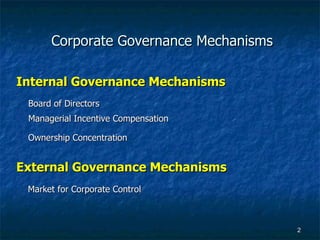
Corporate Governance Mechanisms Board of Directors Internal Governance Mechanisms Managerial Incentive Compensation Ownership Concentration External Governance Mechanisms Market for Corporate Control
Separation of Ownership and Managerial Control Basis of the modern corporation shareholders purchase stock, becoming  residual claimants shareholders reduce risk by holding diversified portfolios professional managers are contracted to provide decision-making Modern public corporation form leads to efficient specialization of tasks risk bearing by shareholders strategy development and decision-making by managers
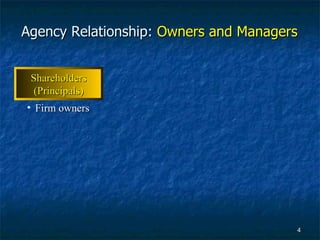
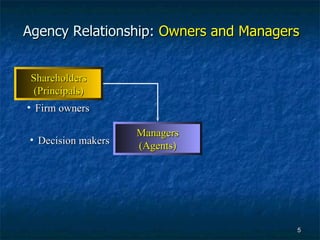
Agency Relationship:  Owners and Managers Firm owners Shareholders (Principals)
Agency Relationship:  Owners and Managers Decision makers Firm owners Managers (Agents) Shareholders (Principals)
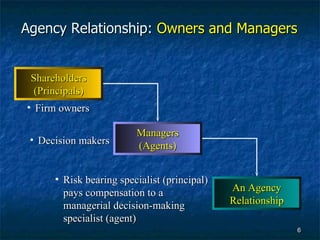
Agency Relationship:  Owners and Managers Risk bearing specialist (principal) pays compensation to a managerial decision-making specialist (agent) Decision makers Firm owners An Agency Relationship Managers (Agents) Shareholders (Principals)
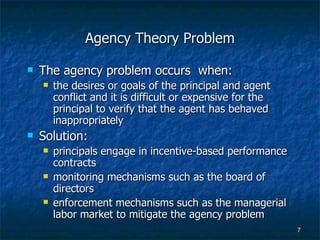
Agency Theory Problem The agency problem occurs  when: the desires or goals of the principal and agent conflict and it is difficult or expensive for the principal to verify that the agent has behaved inappropriately Solution: principals engage in incentive-based performance contracts monitoring mechanisms such as the board of directors enforcement mechanisms such as the managerial labor market to mitigate the agency problem
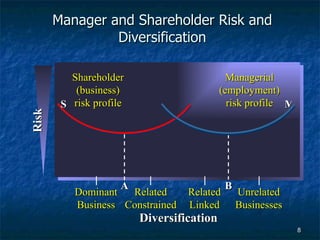
Manager and Shareholder Risk and Diversification Risk Diversification Dominant Business Unrelated Businesses Related Constrained Related Linked Managerial (employment) risk profile Shareholder (business) risk profile B S A M
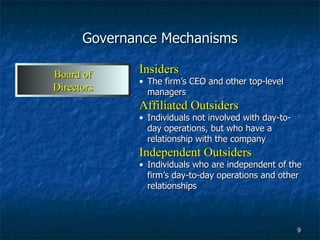
Governance Mechanisms Insiders The firm’s CEO and other top-level managers Affiliated Outsiders Individuals not involved with day-to-day operations, but who have a relationship with the company Independent Outsiders Individuals who are independent of the firm’s day-to-day operations and other relationships Board of Directors
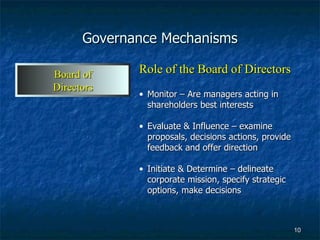
Governance Mechanisms Role of the Board of Directors Monitor – Are managers acting in shareholders best interests Evaluate & Influence – examine proposals, decisions actions, provide feedback and offer direction   Initiate & Determine – delineate corporate mission, specify strategic options, make decisions Board of Directors
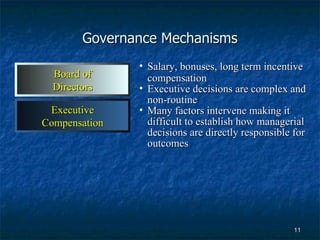
Governance Mechanisms Salary, bonuses, long term incentive compensation Executive decisions are complex and non-routine Many factors intervene making it difficult to establish how managerial decisions are directly responsible for outcomes Board of Directors Executive Compensation
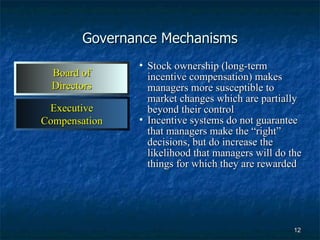
Governance Mechanisms Stock ownership (long-term incentive compensation) makes managers more susceptible to market changes which are partially beyond their control Incentive systems do not guarantee that managers make the “right” decisions, but do increase the likelihood that managers will do the things for which they are rewarded Board of Directors Executive Compensation
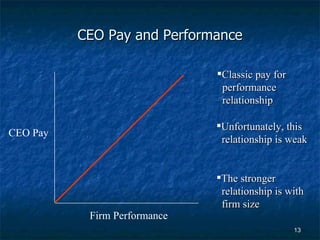
CEO Pay and Performance Firm Performance CEO Pay Classic pay for  performance  relationship Unfortunately, this  relationship is weak The stronger  relationship is with  firm size
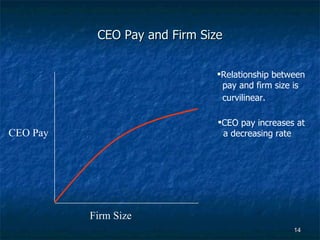
CEO Pay and Firm Size Firm Size CEO Pay Relationship between  pay and firm size is  curvilinear.   CEO pay increases at  a decreasing rate
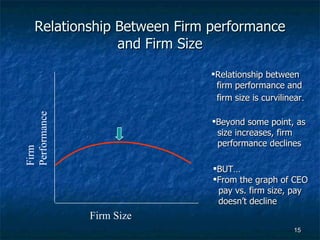
Relationship Between Firm performance and Firm Size Firm Size Firm Performance Relationship between  firm performance and  firm size is curvilinear .  Beyond some point, as  size increases, firm  performance declines BUT… From the graph of CEO  pay vs. firm size, pay  doesn’t decline
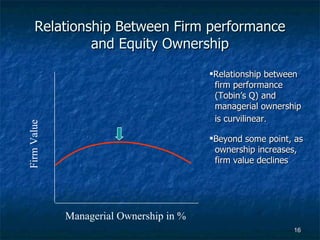
Relationship Between Firm performance and Equity Ownership Managerial Ownership in % Firm Value Relationship between  firm performance  (Tobin’s Q) and  managerial ownership is curvilinear .  Beyond some point, as  ownership increases,  firm value declines
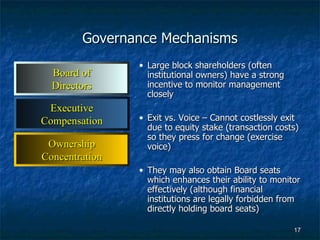
Governance Mechanisms Large block shareholders (often institutional owners) have a strong incentive to monitor management closely Exit vs. Voice – Cannot costlessly exit due to equity stake (transaction costs) so they press for change (exercise voice) They may also obtain Board seats which enhances their ability to monitor effectively (although financial institutions are legally forbidden from directly holding board seats) Ownership Concentration Executive Compensation Board of Directors
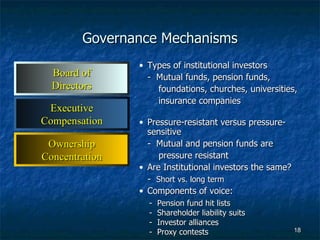
Governance Mechanisms Types of institutional investors  -  Mutual funds, pension funds, foundations, churches, universities, insurance companies  Pressure-resistant versus pressure-sensitive -  Mutual and pension funds are  pressure resistant Are Institutional investors the same? -  Short vs. long term   Components of voice: -  Pension fund hit lists -  Shareholder liability suits -  Investor alliances -  Proxy contests   Ownership Concentration Executive Compensation Board of Directors
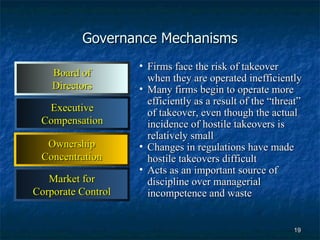
Governance Mechanisms Firms face the risk of takeover when they are operated inefficiently Many firms begin to operate more efficiently as a result of the “threat” of takeover, even though the actual incidence of hostile takeovers is relatively small Changes in regulations have made hostile takeovers difficult Acts as an important source of discipline over managerial incompetence and waste Ownership Concentration Board of Directors Executive Compensation Market for Corporate Control
Managerial Defense Tactics Designed to fend off the takeover attempt Increase the costs of making the acquisitions Causes incumbent management to become entrenched while reducing the chances of introducing a new management team May require asset restructuring Institutional investors oppose the use of defense tactics
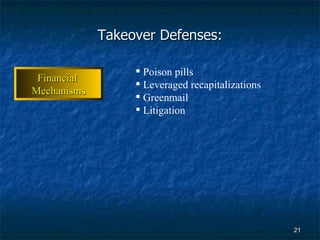
Takeover Defenses: Poison pills  Leveraged recapitalizations Greenmail Litigation   Financial  Mechanisms
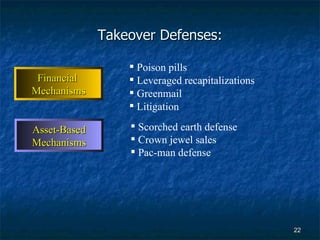
Takeover Defenses: Scorched earth defense  Crown jewel sales  Pac-man defense Poison pills  Leveraged recapitalizations Greenmail Litigation   Asset-Based Mechanisms Financial  Mechanisms
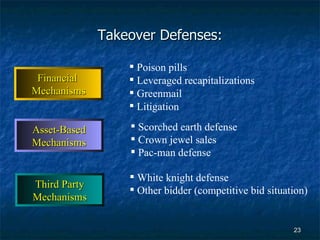
Takeover Defenses: Scorched earth defense  Crown jewel sales  Pac-man defense Poison pills  Leveraged recapitalizations Greenmail Litigation   White knight defense Other bidder (competitive bid situation) Asset-Based Mechanisms Financial  Mechanisms Third Party Mechanisms

Corporate Governance

  • 1.
    Corporate Governance Corporategovernance is a relationship among stakeholders that is used to determine and control the strategic direction and performance of organizations concerned with identifying ways to ensure that strategic decisions are made effectively used in corporations to establish order between the firm’s owners and its top-level managers
  • 2.
    Corporate Governance MechanismsBoard of Directors Internal Governance Mechanisms Managerial Incentive Compensation Ownership Concentration External Governance Mechanisms Market for Corporate Control
  • 3.
    Separation of Ownershipand Managerial Control Basis of the modern corporation shareholders purchase stock, becoming residual claimants shareholders reduce risk by holding diversified portfolios professional managers are contracted to provide decision-making Modern public corporation form leads to efficient specialization of tasks risk bearing by shareholders strategy development and decision-making by managers
  • 4.
    Agency Relationship: Owners and Managers Firm owners Shareholders (Principals)
  • 5.
    Agency Relationship: Owners and Managers Decision makers Firm owners Managers (Agents) Shareholders (Principals)
  • 6.
    Agency Relationship: Owners and Managers Risk bearing specialist (principal) pays compensation to a managerial decision-making specialist (agent) Decision makers Firm owners An Agency Relationship Managers (Agents) Shareholders (Principals)
  • 7.
    Agency Theory ProblemThe agency problem occurs when: the desires or goals of the principal and agent conflict and it is difficult or expensive for the principal to verify that the agent has behaved inappropriately Solution: principals engage in incentive-based performance contracts monitoring mechanisms such as the board of directors enforcement mechanisms such as the managerial labor market to mitigate the agency problem
  • 8.
    Manager and ShareholderRisk and Diversification Risk Diversification Dominant Business Unrelated Businesses Related Constrained Related Linked Managerial (employment) risk profile Shareholder (business) risk profile B S A M
  • 9.
    Governance Mechanisms InsidersThe firm’s CEO and other top-level managers Affiliated Outsiders Individuals not involved with day-to-day operations, but who have a relationship with the company Independent Outsiders Individuals who are independent of the firm’s day-to-day operations and other relationships Board of Directors
  • 10.
    Governance Mechanisms Roleof the Board of Directors Monitor – Are managers acting in shareholders best interests Evaluate & Influence – examine proposals, decisions actions, provide feedback and offer direction Initiate & Determine – delineate corporate mission, specify strategic options, make decisions Board of Directors
  • 11.
    Governance Mechanisms Salary,bonuses, long term incentive compensation Executive decisions are complex and non-routine Many factors intervene making it difficult to establish how managerial decisions are directly responsible for outcomes Board of Directors Executive Compensation
  • 12.
    Governance Mechanisms Stockownership (long-term incentive compensation) makes managers more susceptible to market changes which are partially beyond their control Incentive systems do not guarantee that managers make the “right” decisions, but do increase the likelihood that managers will do the things for which they are rewarded Board of Directors Executive Compensation
  • 13.
    CEO Pay andPerformance Firm Performance CEO Pay Classic pay for performance relationship Unfortunately, this relationship is weak The stronger relationship is with firm size
  • 14.
    CEO Pay andFirm Size Firm Size CEO Pay Relationship between pay and firm size is curvilinear. CEO pay increases at a decreasing rate
  • 15.
    Relationship Between Firmperformance and Firm Size Firm Size Firm Performance Relationship between firm performance and firm size is curvilinear . Beyond some point, as size increases, firm performance declines BUT… From the graph of CEO pay vs. firm size, pay doesn’t decline
  • 16.
    Relationship Between Firmperformance and Equity Ownership Managerial Ownership in % Firm Value Relationship between firm performance (Tobin’s Q) and managerial ownership is curvilinear . Beyond some point, as ownership increases, firm value declines
  • 17.
    Governance Mechanisms Largeblock shareholders (often institutional owners) have a strong incentive to monitor management closely Exit vs. Voice – Cannot costlessly exit due to equity stake (transaction costs) so they press for change (exercise voice) They may also obtain Board seats which enhances their ability to monitor effectively (although financial institutions are legally forbidden from directly holding board seats) Ownership Concentration Executive Compensation Board of Directors
  • 18.
    Governance Mechanisms Typesof institutional investors - Mutual funds, pension funds, foundations, churches, universities, insurance companies Pressure-resistant versus pressure-sensitive - Mutual and pension funds are pressure resistant Are Institutional investors the same? - Short vs. long term Components of voice: - Pension fund hit lists - Shareholder liability suits - Investor alliances - Proxy contests Ownership Concentration Executive Compensation Board of Directors
  • 19.
    Governance Mechanisms Firmsface the risk of takeover when they are operated inefficiently Many firms begin to operate more efficiently as a result of the “threat” of takeover, even though the actual incidence of hostile takeovers is relatively small Changes in regulations have made hostile takeovers difficult Acts as an important source of discipline over managerial incompetence and waste Ownership Concentration Board of Directors Executive Compensation Market for Corporate Control
  • 20.
    Managerial Defense TacticsDesigned to fend off the takeover attempt Increase the costs of making the acquisitions Causes incumbent management to become entrenched while reducing the chances of introducing a new management team May require asset restructuring Institutional investors oppose the use of defense tactics
  • 21.
    Takeover Defenses: Poisonpills Leveraged recapitalizations Greenmail Litigation Financial Mechanisms
  • 22.
    Takeover Defenses: Scorchedearth defense Crown jewel sales Pac-man defense Poison pills Leveraged recapitalizations Greenmail Litigation Asset-Based Mechanisms Financial Mechanisms
  • 23.
    Takeover Defenses: Scorchedearth defense Crown jewel sales Pac-man defense Poison pills Leveraged recapitalizations Greenmail Litigation White knight defense Other bidder (competitive bid situation) Asset-Based Mechanisms Financial Mechanisms Third Party Mechanisms

Editor's Notes

  • #5 How to increase product diversification and how to intensify effort to innovate without increased agency problems? Firms undertake a variety of actions to reduce risk through diversification, including entering diverse lines of business, joining alliances, taking on temporary partners, and outsource risky projects, including R&D. The challenge, as explained in the book, is that shareholders do not directly benefit from risk-reducing diversification strategies when they can replicate this diversification on their own. Diversification, therefore, is often seen as managers’ opportunistic pursuit of their own self-interests at the expense of the shareholders who can, if they so desire, diversify their individual portfolios simply by buying shares in other companies. While this view reflects the influence of agency theory, recently such views have been challenged by stewardship theory (Donaldson, 1990a; Donaldson & Davis, 1991), a framework presuming that managers are actually seeking to maximize organizational performance. For instance, one reason for diversifying would be to enhance company profit and growth prospects by reducing dependence on static or declining products, markets, and even industries. In the parlance of the I/O model discussed in Chapter 1, such motive might lead companies to increase diversification into technologies or industries where profit rates are increasing most and to those where the competitive dynamism is relatively more stable. Managers might also opt to diversify for earnings stability and economies of scale. In short, diversification strategies might represent opportunism, but it might also reflect management rational and genuine response to financial adversity and/or the need for improved financial performance for their company.
  • #10 Continued from previous page Interestingly, over the past decade the world’s leading private equity firms consistently have delivered internal rates of return twice as large as the S&P 500’s. They’ve achieved this is by adding value to the underlying operations (Rogers, Holland, & Haas, 2002). For example, private equity firms: a) clearly define their investment thesis and its time frame to fruition; b) hire managers who act like owners; c) focus on a few measures of success that all employees understand d) make capital work hard or otherwise re-deploy under-performing assets quickly e) make the center an active shareholder. Can institutional owners understand and act like managers of private equity firms?
  • #11 Continued from previous page Interestingly, over the past decade the world’s leading private equity firms consistently have delivered internal rates of return twice as large as the S&P 500’s. They’ve achieved this is by adding value to the underlying operations (Rogers, Holland, & Haas, 2002). For example, private equity firms: a) clearly define their investment thesis and its time frame to fruition; b) hire managers who act like owners; c) focus on a few measures of success that all employees understand d) make capital work hard or otherwise re-deploy under-performing assets quickly e) make the center an active shareholder. Can institutional owners understand and act like managers of private equity firms?
  • #12 Continued from previous page Recently, Phan and his colleagues (2002) explained the relationships between corporate governance and innovation—R&D expenditures, patents, and new products—in 86 publicly listed pharmaceutical firms. Consistent with agency theory, they found that the presence of large block private and institutional shareholders—controlling for firm size and performance—positively influenced innovation. They demonstrated that CEO duality was positively related to R&D expenditures, and that boards with more insiders were positively associated with the number of new products. In short, in the highly turbulent pharmaceutical industry, where risky decisions have to be made under substantial uncertainty, active ownership, unitary command structures, and strategically involved boards provide superior explanatory power for the governance—innovation link. Table 11.3 The Best and Worst Boards of Directors In 2002 http://www.businessweek.com/pdfs/boards.pdf Business Week’s special report on corporate governance: The best and the worst boards http://www.businessweek.com/1997/49/b3556001.htm