What is CorporateWhat is Corporate
Governance?Governance?
Alison Dillon KibirigeAlison Dillon Kibirige
Corporate GovernanceCorporate Governance
 Contemporary corporate governanceContemporary corporate governance
started in 1992 with the Cadbury report instarted in 1992 with the Cadbury report in
the UKthe UK
 Cadbury was the result of several highCadbury was the result of several high
profile company collapsesprofile company collapses
 is concerned primarily with protectingis concerned primarily with protecting
weak and widely dispersed shareholdersweak and widely dispersed shareholders
against self-interested Directors andagainst self-interested Directors and
managersmanagers
Corporate Governance PartiesCorporate Governance Parties
 Shareholders – those that own theShareholders – those that own the
companycompany
 Directors – Guardians of the Company’sDirectors – Guardians of the Company’s
assets for the Shareholdersassets for the Shareholders
 Managers who use the Company’s assetsManagers who use the Company’s assets
Corporate GovernanceCorporate Governance
 Primarily concerned with public listedPrimarily concerned with public listed
companies i.e. those listed on a Stockcompanies i.e. those listed on a Stock
ExchangeExchange
 Focused on preventing corporate collapsesFocused on preventing corporate collapses
such as Enron, Polly Peck and the Maxwellsuch as Enron, Polly Peck and the Maxwell
companiescompanies
Corporate GovernanceCorporate Governance
 What relevance does it have to AfricaWhat relevance does it have to Africa
where there are few public listedwhere there are few public listed
companiescompanies
 Most companies are non-listed, privateMost companies are non-listed, private
family owned businesses where thefamily owned businesses where the
shareholders and the managers are oftenshareholders and the managers are often
the same peoplethe same people
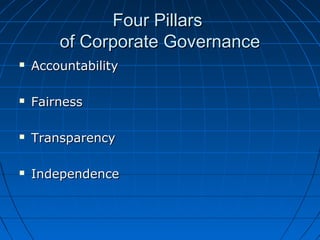
Four PillarsFour Pillars
of Corporate Governanceof Corporate Governance
 AccountabilityAccountability
 FairnessFairness
 TransparencyTransparency
 IndependenceIndependence
AccountabilityAccountability
 Ensure that management isEnsure that management is
accountable to the Boardaccountable to the Board
 Ensure that the Board is accountableEnsure that the Board is accountable
to shareholdersto shareholders
FairnessFairness
 Protect Shareholders rightsProtect Shareholders rights
 Treat all shareholders including minorities,Treat all shareholders including minorities,
equitablyequitably
 Provide effective redress for violationsProvide effective redress for violations
TransparencyTransparency
Ensure timely, accurate disclosure on allEnsure timely, accurate disclosure on all
material matters, including the financialmaterial matters, including the financial
situation, performance, ownership andsituation, performance, ownership and
corporate governancecorporate governance
IndependenceIndependence
 Procedures and structures are in place soProcedures and structures are in place so
as to minimise, or avoid completelyas to minimise, or avoid completely
conflicts of interestconflicts of interest
 Independent Directors and Advisers i.e.Independent Directors and Advisers i.e.
free from the influence of othersfree from the influence of others
Corporate Governance in AfricaCorporate Governance in Africa
 In 1994, The King Report in South AfricaIn 1994, The King Report in South Africa
also included within its Code of Corporatealso included within its Code of Corporate
Governance requirements on sustainabilityGovernance requirements on sustainability
and ethical standardsand ethical standards
 This was due to the context of aThis was due to the context of a
developing country and business ethics indeveloping country and business ethics in
AfricaAfrica
SustainabilitySustainability
 No generally accepted definitionNo generally accepted definition
 Most commonly used is from theMost commonly used is from the
Brundtland Report for the WorldBrundtland Report for the World
Commission on Environment andCommission on Environment and
Development 1987 which defines it as:Development 1987 which defines it as:
SustainabilitySustainability
‘‘development that meets the needsdevelopment that meets the needs
of the present without compromisingof the present without compromising
the ability of future generationsthe ability of future generations
to meet their own needs’to meet their own needs’
StakeholdersStakeholders
 Sustainability recognizes stakeholderSustainability recognizes stakeholder
rights i.e. the rights of interested partiesrights i.e. the rights of interested parties
e.g. employees, the community, suppliers,e.g. employees, the community, suppliers,
customers etc.customers etc.
 Encourage co-operation between theEncourage co-operation between the
company and its stakeholders in creatingcompany and its stakeholders in creating
wealth, jobs and economic stabilitywealth, jobs and economic stability
Business EthicsBusiness Ethics
 Established values and principles aEstablished values and principles a
company uses to inform and conduct itscompany uses to inform and conduct its
activitiesactivities
 Should permeate a company’s culture andShould permeate a company’s culture and
drive its strategy, business goals, policiesdrive its strategy, business goals, policies
and activitiesand activities
 Usually found in a code of ethicsUsually found in a code of ethics
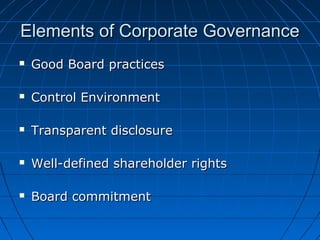
Elements of Corporate GovernanceElements of Corporate Governance
 Good Board practicesGood Board practices
 Control EnvironmentControl Environment
 Transparent disclosureTransparent disclosure
 Well-defined shareholder rightsWell-defined shareholder rights
 Board commitmentBoard commitment
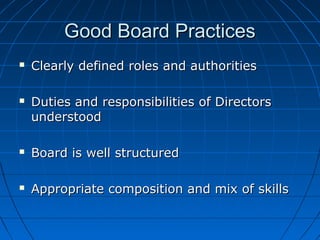
Good Board PracticesGood Board Practices
 Clearly defined roles and authoritiesClearly defined roles and authorities
 Duties and responsibilities of DirectorsDuties and responsibilities of Directors
understoodunderstood
 Board is well structuredBoard is well structured
 Appropriate composition and mix of skillsAppropriate composition and mix of skills
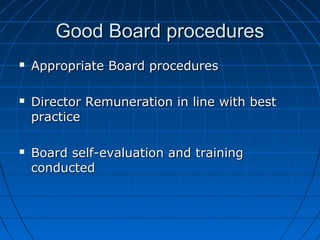
Good Board proceduresGood Board procedures
 Appropriate Board proceduresAppropriate Board procedures
 Director Remuneration in line with bestDirector Remuneration in line with best
practicepractice
 Board self-evaluation and trainingBoard self-evaluation and training
conductedconducted
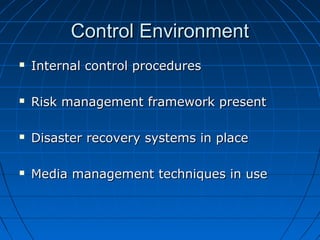
Control EnvironmentControl Environment
 Internal control proceduresInternal control procedures
 Risk management framework presentRisk management framework present
 Disaster recovery systems in placeDisaster recovery systems in place
 Media management techniques in useMedia management techniques in use
Control EnvironmentControl Environment
 Business continuity procedures in placeBusiness continuity procedures in place
 Independent external auditor conductsIndependent external auditor conducts
auditsaudits
 Independent audit committee establishedIndependent audit committee established
Control EnvironmentControl Environment
 Internal Audit FunctionInternal Audit Function
 Management Information systemsManagement Information systems
establishedestablished
 Compliance Function establishedCompliance Function established
Transparent DisclosureTransparent Disclosure
 Financial Information disclosedFinancial Information disclosed
 Non-Financial Information disclosedNon-Financial Information disclosed
 Financials prepared according toFinancials prepared according to
International Financial ReportingInternational Financial Reporting
Standards (IFRS)Standards (IFRS)
Transparent DisclosureTransparent Disclosure
 Companies Registry filings up to dateCompanies Registry filings up to date
 High-Quality annual report publishedHigh-Quality annual report published
 Web-based disclosureWeb-based disclosure
Well-Defined Shareholder RightsWell-Defined Shareholder Rights
 Minority shareholder rights formalisedMinority shareholder rights formalised
 Well-organised shareholder meetingsWell-organised shareholder meetings
conductedconducted
 Policy on related party transactionsPolicy on related party transactions
Well-Defined Shareholder RightsWell-Defined Shareholder Rights
 Policy on extraordinary transactionsPolicy on extraordinary transactions
 Clearly defined and explicit dividend policyClearly defined and explicit dividend policy
Board CommitmentBoard Commitment
 The Board discusses corporate governanceThe Board discusses corporate governance
issues and has created a corporateissues and has created a corporate
governance committeegovernance committee
 The company has a corporate governanceThe company has a corporate governance
championchampion
 A corporate governance improvement planA corporate governance improvement plan
has been createdhas been created
 Appropriate resources are committed toAppropriate resources are committed to
corporate governance initiativescorporate governance initiatives
Board CommitmentBoard Commitment
 Policies and procedures have beenPolicies and procedures have been
formalised and distributed to relevant staffformalised and distributed to relevant staff
 A corporate governance code has beenA corporate governance code has been
developeddeveloped
 A code of ethics has been developedA code of ethics has been developed
 The company is recognised as a corporateThe company is recognised as a corporate
governance leadergovernance leader
Other EntitiesOther Entities
 Corporate Governance applies to all typesCorporate Governance applies to all types
of organisations not just companies in theof organisations not just companies in the
private sector but also in the not for profitprivate sector but also in the not for profit
and public sectorsand public sectors
 Examples are NGOs, schools, hospitals,Examples are NGOs, schools, hospitals,
pension funds, state-owned enterprisespension funds, state-owned enterprises
Country PerspectiveCountry Perspective
 Corporate Governance is by way ofCorporate Governance is by way of
legislation or best practice Codelegislation or best practice Code
 US adopted legislation in 2002 - SarbanesUS adopted legislation in 2002 - Sarbanes
Oxley ActOxley Act
 Most other developed and emergingMost other developed and emerging
market countries have adopted bestmarket countries have adopted best
practice Codes e.g. Combined Code in thepractice Codes e.g. Combined Code in the
UK, Cromme Code in Germany and theUK, Cromme Code in Germany and the
King II Code in South AfricaKing II Code in South Africa
Country perspective - CodesCountry perspective - Codes
 These Codes are voluntary and areThese Codes are voluntary and are
enforced by shareholdersenforced by shareholders
 Most of them operate on a ‘comply orMost of them operate on a ‘comply or
explain’ approachexplain’ approach
 The Media also play a part in highlightingThe Media also play a part in highlighting
good or bad practicesgood or bad practices
Country PerspectiveCountry Perspective
 Countries in Africa have tended to adopt aCountries in Africa have tended to adopt a
hybrid approach whereby they havehybrid approach whereby they have
followed the ‘comply and explain’followed the ‘comply and explain’
approach but have enshrined some of theapproach but have enshrined some of the
principles in law to assist in enforceabilityprinciples in law to assist in enforceability
 The reason is the weakness of theThe reason is the weakness of the
shareholder base and of the mediashareholder base and of the media
Why Corporate Governance?Why Corporate Governance?
 Better access to external financeBetter access to external finance
 Lower costs of capital – interest rates onLower costs of capital – interest rates on
loansloans
 Improved company performance –Improved company performance –
sustainabilitysustainability
 Higher firm valuation and shareHigher firm valuation and share
performanceperformance
 Reduced risk of corporate crisis andReduced risk of corporate crisis and
scandalsscandals
Why Corporate Governance?Why Corporate Governance?
In 2002, L Klapper and I Love from the WorldIn 2002, L Klapper and I Love from the World
Bank found evidence that improving a company’sBank found evidence that improving a company’s
corporate governance has proportionately greatercorporate governance has proportionately greater
impact in countries with weak legalimpact in countries with weak legal
environments.environments.
They have suggested that companies can partiallyThey have suggested that companies can partially
compensate for ineffective laws and enforcementcompensate for ineffective laws and enforcement
by establishing good corporate governance at theby establishing good corporate governance at the
company level and providing credible investorcompany level and providing credible investor
protectionprotection
Convince your EditorConvince your Editor

What+is+corporate+governance+presentation alison+day+one (1)

  • 1.
    What is CorporateWhatis Corporate Governance?Governance? Alison Dillon KibirigeAlison Dillon Kibirige
  • 2.
    Corporate GovernanceCorporate Governance Contemporary corporate governanceContemporary corporate governance started in 1992 with the Cadbury report instarted in 1992 with the Cadbury report in the UKthe UK  Cadbury was the result of several highCadbury was the result of several high profile company collapsesprofile company collapses  is concerned primarily with protectingis concerned primarily with protecting weak and widely dispersed shareholdersweak and widely dispersed shareholders against self-interested Directors andagainst self-interested Directors and managersmanagers
  • 3.
    Corporate Governance PartiesCorporateGovernance Parties  Shareholders – those that own theShareholders – those that own the companycompany  Directors – Guardians of the Company’sDirectors – Guardians of the Company’s assets for the Shareholdersassets for the Shareholders  Managers who use the Company’s assetsManagers who use the Company’s assets
  • 4.
    Corporate GovernanceCorporate Governance Primarily concerned with public listedPrimarily concerned with public listed companies i.e. those listed on a Stockcompanies i.e. those listed on a Stock ExchangeExchange  Focused on preventing corporate collapsesFocused on preventing corporate collapses such as Enron, Polly Peck and the Maxwellsuch as Enron, Polly Peck and the Maxwell companiescompanies
  • 5.
    Corporate GovernanceCorporate Governance What relevance does it have to AfricaWhat relevance does it have to Africa where there are few public listedwhere there are few public listed companiescompanies  Most companies are non-listed, privateMost companies are non-listed, private family owned businesses where thefamily owned businesses where the shareholders and the managers are oftenshareholders and the managers are often the same peoplethe same people
  • 6.
    Four PillarsFour Pillars ofCorporate Governanceof Corporate Governance  AccountabilityAccountability  FairnessFairness  TransparencyTransparency  IndependenceIndependence
  • 7.
    AccountabilityAccountability  Ensure thatmanagement isEnsure that management is accountable to the Boardaccountable to the Board  Ensure that the Board is accountableEnsure that the Board is accountable to shareholdersto shareholders
  • 8.
    FairnessFairness  Protect ShareholdersrightsProtect Shareholders rights  Treat all shareholders including minorities,Treat all shareholders including minorities, equitablyequitably  Provide effective redress for violationsProvide effective redress for violations
  • 9.
    TransparencyTransparency Ensure timely, accuratedisclosure on allEnsure timely, accurate disclosure on all material matters, including the financialmaterial matters, including the financial situation, performance, ownership andsituation, performance, ownership and corporate governancecorporate governance
  • 10.
    IndependenceIndependence  Procedures andstructures are in place soProcedures and structures are in place so as to minimise, or avoid completelyas to minimise, or avoid completely conflicts of interestconflicts of interest  Independent Directors and Advisers i.e.Independent Directors and Advisers i.e. free from the influence of othersfree from the influence of others
  • 11.
    Corporate Governance inAfricaCorporate Governance in Africa  In 1994, The King Report in South AfricaIn 1994, The King Report in South Africa also included within its Code of Corporatealso included within its Code of Corporate Governance requirements on sustainabilityGovernance requirements on sustainability and ethical standardsand ethical standards  This was due to the context of aThis was due to the context of a developing country and business ethics indeveloping country and business ethics in AfricaAfrica
  • 12.
    SustainabilitySustainability  No generallyaccepted definitionNo generally accepted definition  Most commonly used is from theMost commonly used is from the Brundtland Report for the WorldBrundtland Report for the World Commission on Environment andCommission on Environment and Development 1987 which defines it as:Development 1987 which defines it as:
  • 13.
    SustainabilitySustainability ‘‘development that meetsthe needsdevelopment that meets the needs of the present without compromisingof the present without compromising the ability of future generationsthe ability of future generations to meet their own needs’to meet their own needs’
  • 14.
    StakeholdersStakeholders  Sustainability recognizesstakeholderSustainability recognizes stakeholder rights i.e. the rights of interested partiesrights i.e. the rights of interested parties e.g. employees, the community, suppliers,e.g. employees, the community, suppliers, customers etc.customers etc.  Encourage co-operation between theEncourage co-operation between the company and its stakeholders in creatingcompany and its stakeholders in creating wealth, jobs and economic stabilitywealth, jobs and economic stability
  • 15.
    Business EthicsBusiness Ethics Established values and principles aEstablished values and principles a company uses to inform and conduct itscompany uses to inform and conduct its activitiesactivities  Should permeate a company’s culture andShould permeate a company’s culture and drive its strategy, business goals, policiesdrive its strategy, business goals, policies and activitiesand activities  Usually found in a code of ethicsUsually found in a code of ethics
  • 16.
    Elements of CorporateGovernanceElements of Corporate Governance  Good Board practicesGood Board practices  Control EnvironmentControl Environment  Transparent disclosureTransparent disclosure  Well-defined shareholder rightsWell-defined shareholder rights  Board commitmentBoard commitment
  • 17.
    Good Board PracticesGoodBoard Practices  Clearly defined roles and authoritiesClearly defined roles and authorities  Duties and responsibilities of DirectorsDuties and responsibilities of Directors understoodunderstood  Board is well structuredBoard is well structured  Appropriate composition and mix of skillsAppropriate composition and mix of skills
  • 18.
    Good Board proceduresGoodBoard procedures  Appropriate Board proceduresAppropriate Board procedures  Director Remuneration in line with bestDirector Remuneration in line with best practicepractice  Board self-evaluation and trainingBoard self-evaluation and training conductedconducted
  • 19.
    Control EnvironmentControl Environment Internal control proceduresInternal control procedures  Risk management framework presentRisk management framework present  Disaster recovery systems in placeDisaster recovery systems in place  Media management techniques in useMedia management techniques in use
  • 20.
    Control EnvironmentControl Environment Business continuity procedures in placeBusiness continuity procedures in place  Independent external auditor conductsIndependent external auditor conducts auditsaudits  Independent audit committee establishedIndependent audit committee established
  • 21.
    Control EnvironmentControl Environment Internal Audit FunctionInternal Audit Function  Management Information systemsManagement Information systems establishedestablished  Compliance Function establishedCompliance Function established
  • 22.
    Transparent DisclosureTransparent Disclosure Financial Information disclosedFinancial Information disclosed  Non-Financial Information disclosedNon-Financial Information disclosed  Financials prepared according toFinancials prepared according to International Financial ReportingInternational Financial Reporting Standards (IFRS)Standards (IFRS)
  • 23.
    Transparent DisclosureTransparent Disclosure Companies Registry filings up to dateCompanies Registry filings up to date  High-Quality annual report publishedHigh-Quality annual report published  Web-based disclosureWeb-based disclosure
  • 24.
    Well-Defined Shareholder RightsWell-DefinedShareholder Rights  Minority shareholder rights formalisedMinority shareholder rights formalised  Well-organised shareholder meetingsWell-organised shareholder meetings conductedconducted  Policy on related party transactionsPolicy on related party transactions
  • 25.
    Well-Defined Shareholder RightsWell-DefinedShareholder Rights  Policy on extraordinary transactionsPolicy on extraordinary transactions  Clearly defined and explicit dividend policyClearly defined and explicit dividend policy
  • 26.
    Board CommitmentBoard Commitment The Board discusses corporate governanceThe Board discusses corporate governance issues and has created a corporateissues and has created a corporate governance committeegovernance committee  The company has a corporate governanceThe company has a corporate governance championchampion  A corporate governance improvement planA corporate governance improvement plan has been createdhas been created  Appropriate resources are committed toAppropriate resources are committed to corporate governance initiativescorporate governance initiatives
  • 27.
    Board CommitmentBoard Commitment Policies and procedures have beenPolicies and procedures have been formalised and distributed to relevant staffformalised and distributed to relevant staff  A corporate governance code has beenA corporate governance code has been developeddeveloped  A code of ethics has been developedA code of ethics has been developed  The company is recognised as a corporateThe company is recognised as a corporate governance leadergovernance leader
  • 28.
    Other EntitiesOther Entities Corporate Governance applies to all typesCorporate Governance applies to all types of organisations not just companies in theof organisations not just companies in the private sector but also in the not for profitprivate sector but also in the not for profit and public sectorsand public sectors  Examples are NGOs, schools, hospitals,Examples are NGOs, schools, hospitals, pension funds, state-owned enterprisespension funds, state-owned enterprises
  • 29.
    Country PerspectiveCountry Perspective Corporate Governance is by way ofCorporate Governance is by way of legislation or best practice Codelegislation or best practice Code  US adopted legislation in 2002 - SarbanesUS adopted legislation in 2002 - Sarbanes Oxley ActOxley Act  Most other developed and emergingMost other developed and emerging market countries have adopted bestmarket countries have adopted best practice Codes e.g. Combined Code in thepractice Codes e.g. Combined Code in the UK, Cromme Code in Germany and theUK, Cromme Code in Germany and the King II Code in South AfricaKing II Code in South Africa
  • 30.
    Country perspective -CodesCountry perspective - Codes  These Codes are voluntary and areThese Codes are voluntary and are enforced by shareholdersenforced by shareholders  Most of them operate on a ‘comply orMost of them operate on a ‘comply or explain’ approachexplain’ approach  The Media also play a part in highlightingThe Media also play a part in highlighting good or bad practicesgood or bad practices
  • 31.
    Country PerspectiveCountry Perspective Countries in Africa have tended to adopt aCountries in Africa have tended to adopt a hybrid approach whereby they havehybrid approach whereby they have followed the ‘comply and explain’followed the ‘comply and explain’ approach but have enshrined some of theapproach but have enshrined some of the principles in law to assist in enforceabilityprinciples in law to assist in enforceability  The reason is the weakness of theThe reason is the weakness of the shareholder base and of the mediashareholder base and of the media
  • 32.
    Why Corporate Governance?WhyCorporate Governance?  Better access to external financeBetter access to external finance  Lower costs of capital – interest rates onLower costs of capital – interest rates on loansloans  Improved company performance –Improved company performance – sustainabilitysustainability  Higher firm valuation and shareHigher firm valuation and share performanceperformance  Reduced risk of corporate crisis andReduced risk of corporate crisis and scandalsscandals
  • 33.
    Why Corporate Governance?WhyCorporate Governance? In 2002, L Klapper and I Love from the WorldIn 2002, L Klapper and I Love from the World Bank found evidence that improving a company’sBank found evidence that improving a company’s corporate governance has proportionately greatercorporate governance has proportionately greater impact in countries with weak legalimpact in countries with weak legal environments.environments. They have suggested that companies can partiallyThey have suggested that companies can partially compensate for ineffective laws and enforcementcompensate for ineffective laws and enforcement by establishing good corporate governance at theby establishing good corporate governance at the company level and providing credible investorcompany level and providing credible investor protectionprotection
  • 34.