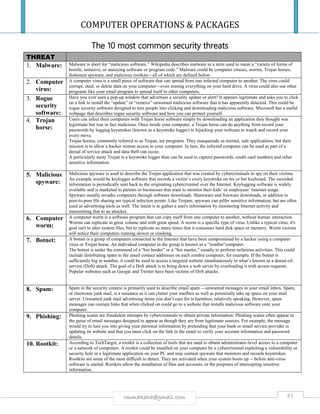
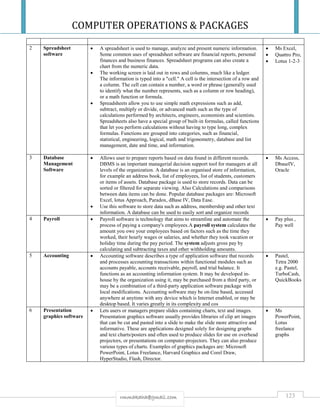
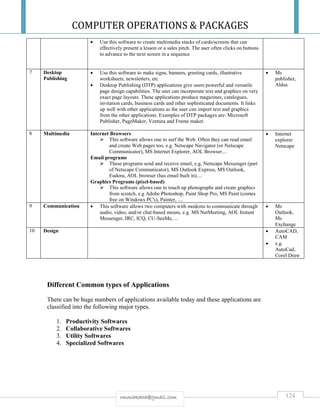
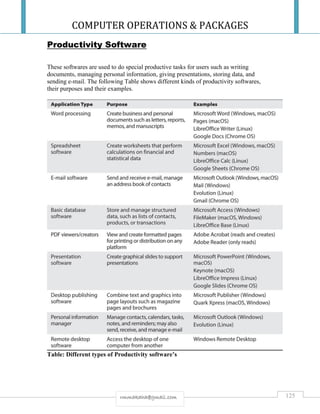
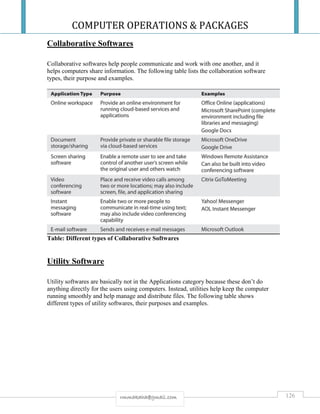
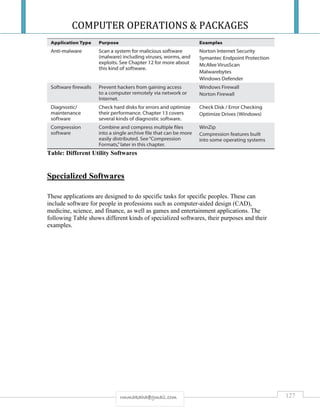
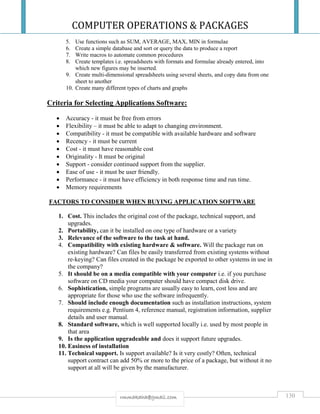
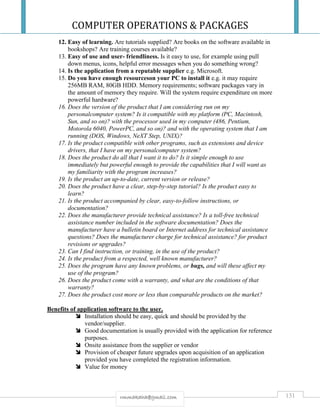
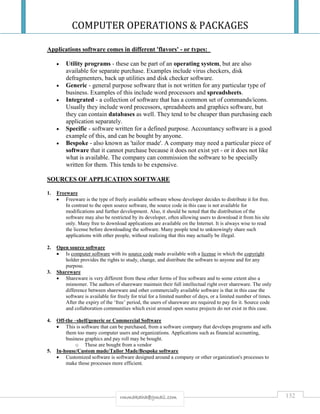
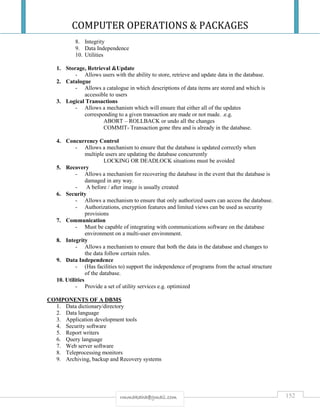
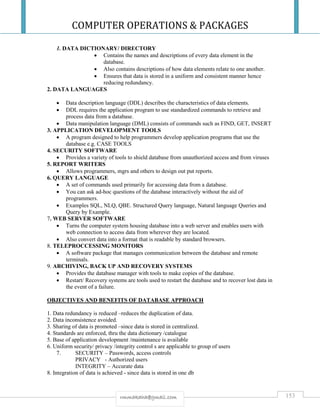
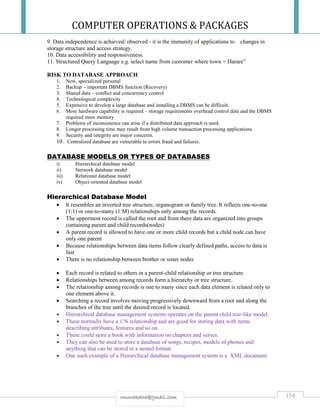
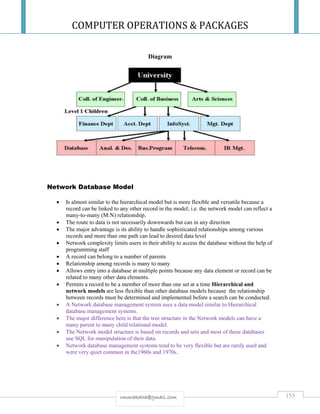
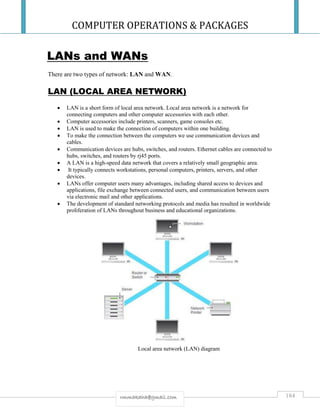
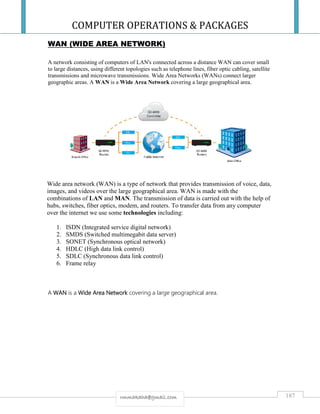
rmmakaha@gmail.com
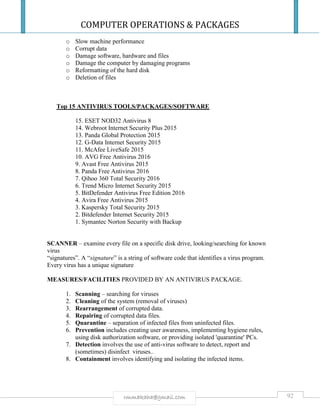
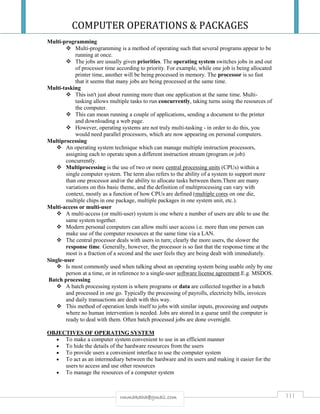
COMPUTER OPERATIONS &
PACKAGES
rmmakaha@gmail.com
COMPUTER OPERATIONS & PACKAGES
2rmmakaha@gmail.com
INTRODUCTION
DEFINE A COMPUTER
 An electronic machine that works under the control of stored programs to accept,
process & output data/information for use by the operator.
 A device that accepts data, processes the data in accordance with a stored program,
generates results, and usually consists of input, output, storage, and arithmetic, logic,
and control units.
 A functional unit that can perform substantial computation, including numerous
arithmetic operations or logic operations, without human intervention during a run.
 It is an electronic device/machine that accepts data(raw facts & figures) as input and
processes (works on it) to produce information(data converted to meaningful form) as
output.
Characteristics of Computer
1. SPEED: In general, no human being can compete to solving the complex computation,
faster than computer. Computers work at an incredible speed. A powerful computer is
capable of performing about 3-4 million simple instructions per second.
2. ACCURACY: Since Computer is programmed, so whatever input we give it gives result
with accurately. In addition to being fast, computers are also accurate. Errors that may occur
can almost always be attributed to human error (inaccurate data, poorly designed system or
faulty instructions/programs written by the programmer)
3. STORAGE: Computer can store mass storage of data with appropriate format. Today’s
computers can store large volumes of data. A piece of information once recorded (or stored)
in the computer, can never be forgotten and can be retrieved almost instantaneously.
4. DILIGENCE: Computer can work for hours without any break and creating error. Unlike
human beings, computers are highly consistent. They do not suffer from human traits of
boredom and tiredness resulting in lack of concentration. Computers, therefore, are better
than human beings in performing voluminous and repetitive jobs.
5. VERSATILITY: We can use computer to perform completely different type of work at the
same time. Computers are versatile machines and are capable of performing any task as long
as it can be broken down into a series of logical steps. The presence of computers can be seen
in almost every sphere – Railway/Air reservation, Banks, Hotels, Weather forecasting and
many more.
6. POWER OF REMEMBERING: It can remember data for us.
7. NO IQ: Computer does not work without instruction.
8. NO FEELING: Computer does not have emotions, knowledge, experience, and feeling.
COMPUTER OPERATIONS & PACKAGES
3rmmakaha@gmail.com
A computer performs a number of functions:
1. Input (Data)
o The computer accepts data from outside for processing. Input is the raw
information entered into a computer from the input devices.
2. Processing
o The computer performs operations on the data that it holds internally.
Processing is the operation of data as per given instruction. It is totally
internal process of the computer system.
3. Output
o The computer produces information for external use. Output is the
processed data given by computer after data processing. Output is also
called as Result. We can save these results in the storage devices for the
future use.
4. Storage
o The computer stores data before, during and after processing.
5. Communication
o The computer can send or receive data to or from other computers when it
is connected on a network
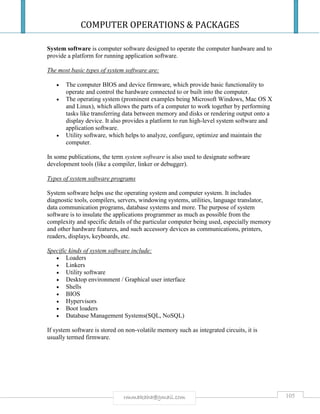
A computer is a programmable machine designed to perform arithmetic and logical operations
automatically and sequentially on the input given by the user and gives the desired output after
processing. Computer components are divided into two major categories namely hardware and
software. Hardware is the machine itself and its connected devices such as monitor, keyboard,
mouse etc. Software are the set of programs that make use of hardware for performing various
functions.
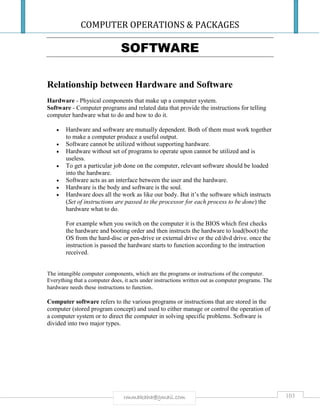
Hardware- refers to the tangible, physical and mechanical components of a computer.
Software- refers to the intangible computer components, which are the programs or instructions
of the computer. Everything that a computer does, it acts under instructions written out as
computer programs. The hardware needs these instructions to function
Computer program:
 A set of instructions, written in a specific programming language, which a computer
follows in processing data, performing an operation, or solving a logical problem. See
also software.
 A computer program is a set of statements or instructions to be used directly or indirectly
in a computer in order to bring about a certain result.
NB: Software alone is useless, so is the hardware. The two are inseparable.
Peripheral Devices- These are devices that are external (not part of the computer) but can be
connected to a computer. They are not essential for the functioning of the computer but can be
connected to the computer for specific reasons. Examples are scanners, modems, printers,
speakers, digital cameras, etc.
COMPUTER OPERATIONS & PACKAGES
4rmmakaha@gmail.com
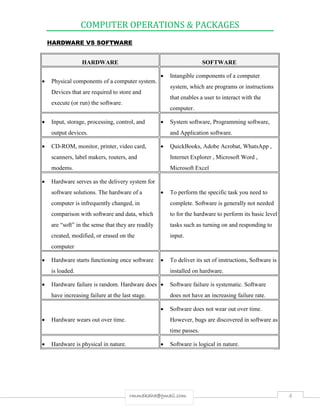
HARDWARE VS SOFTWARE
HARDWARE SOFTWARE
 Physical components of a computer system.
Devices that are required to store and
execute (or run) the software.
 Intangible components of a computer
system, which are programs or instructions
that enables a user to interact with the
computer.
 Input, storage, processing, control, and
output devices.
 System software, Programming software,
and Application software.
 CD-ROM, monitor, printer, video card,
scanners, label makers, routers, and
modems.
 QuickBooks, Adobe Acrobat, WhatsApp ,
Internet Explorer , Microsoft Word ,
Microsoft Excel
 Hardware serves as the delivery system for
software solutions. The hardware of a
computer is infrequently changed, in
comparison with software and data, which
are “soft” in the sense that they are readily
created, modified, or erased on the
computer
 To perform the specific task you need to
complete. Software is generally not needed
to for the hardware to perform its basic level
tasks such as turning on and responding to
input.
 Hardware starts functioning once software
is loaded.
 To deliver its set of instructions, Software is
installed on hardware.
 Hardware failure is random. Hardware does
have increasing failure at the last stage.
 Software failure is systematic. Software
does not have an increasing failure rate.
 Hardware wears out over time.
 Software does not wear out over time.
However, bugs are discovered in software as
time passes.
 Hardware is physical in nature.  Software is logical in nature.
COMPUTER OPERATIONS & PACKAGES
5rmmakaha@gmail.com
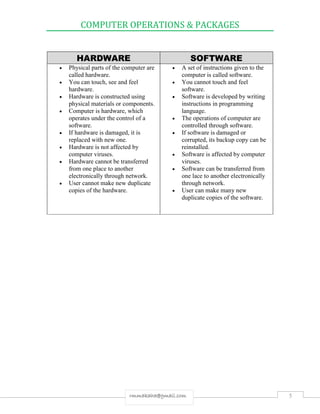
HARDWARE SOFTWARE
 Physical parts of the computer are
called hardware.
 You can touch, see and feel
hardware.
 Hardware is constructed using
physical materials or components.
 Computer is hardware, which
operates under the control of a
software.
 If hardware is damaged, it is
replaced with new one.
 Hardware is not affected by
computer viruses.
 Hardware cannot be transferred
from one place to another
electronically through network.
 User cannot make new duplicate
copies of the hardware.
 A set of instructions given to the
computer is called software.
 You cannot touch and feel
software.
 Software is developed by writing
instructions in programming
language.
 The operations of computer are
controlled through software.
 If software is damaged or
corrupted, its backup copy can be
reinstalled.
 Software is affected by computer
viruses.
 Software can be transferred from
one lace to another electronically
through network.
 User can make many new
duplicate copies of the software.
COMPUTER OPERATIONS & PACKAGES
6rmmakaha@gmail.com
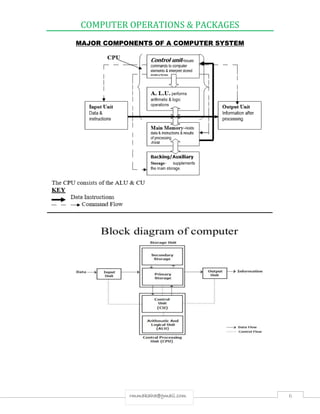
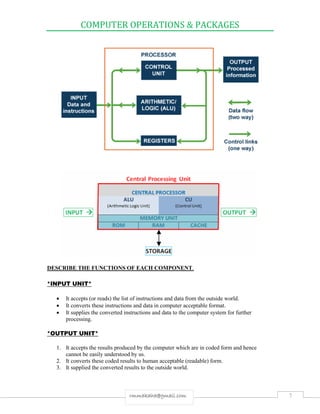
MAJOR COMPONENTS OF A COMPUTER SYSTEM
COMPUTER OPERATIONS & PACKAGES
7rmmakaha@gmail.com
DESCRIBE THE FUNCTIONS OF EACH COMPONENT.
*INPUT UNIT*
 It accepts (or reads) the list of instructions and data from the outside world.
 It converts these instructions and data in computer acceptable format.
 It supplies the converted instructions and data to the computer system for further
processing.
*OUTPUT UNIT*
1. It accepts the results produced by the computer which are in coded form and hence
cannot be easily understood by us.
2. It converts these coded results to human acceptable (readable) form.
3. It supplied the converted results to the outside world.
COMPUTER OPERATIONS & PACKAGES
8rmmakaha@gmail.com
*REGISTERS*.
 The registers are the memory of the processor.
 All the data transfer is done through the registers in the processor to accelerate the
process.
*STORAGE UNIT*
1. All the data to be processed and the instruction required for processing (received from
input devices).
2. Intermediate results of processing.
3. Final results of processing before these results are released to an output device.
*CENTRAL PROCESSING UNIT (CPU)*
The CPU processes instructions it receives in the process of decoding data. In processing this
data, the CPU performs four basic steps:
1. Fetch Each instruction is stored in memory and has its own address. The processor takes
this address number from the program counter, which is responsible for tracking which
instructions the CPU should execute next.
2. Decode All programs to be executed are translated to into Assembly instructions.
Assembly code must be decoded into binary instructions, which are understandable to
your CPU. This step is called decoding.
3. Execute While executing instructions the CPU can do one of three things: Do
calculations with its ALU, move data from one memory location to another, or jump to a
different address.
4. Store The CPU must give feedback after executing an instruction and the output data is
written to the memory.
*ARITHMETIC AND LOGIC UNIT* (ALU)
An arithmetic logic unit (ALU) is a major component of the central processing unit of a computer
system. It does all processes related to arithmetic and logic operations that need to be done on
instruction words. In some microprocessor architectures, the ALU is divided into the arithmetic
unit (AU) and the logic unit (LU).
_ALUs routinely perform the following operations_
 *Logical Operations*: These include AND, OR, NOT, XOR, NOR, NAND, etc.
 *Bit-Shifting Operations*: This pertains to shifting the positions of the bits by a certain
number of places to the right or left, which is considered a multiplication operation.
COMPUTER OPERATIONS & PACKAGES
9rmmakaha@gmail.com
 *Arithmetic Operations*: This refers to bit addition and subtraction. Although
multiplication and division are sometimes used, these operations are more expensive to
make. Addition can be used to substitute for multiplication and subtraction for division.
*CONTROL UNIT*
A control unit (CU) handles all processor control signals. It directs all input and output flow,
fetches code for instructions from microprograms and directs other units and models by providing
control and timing signals. A CU component is considered the processor brain because it issues
orders to just about everything and ensures correct instruction execution.
_CU functions are as follows_:
 Controls sequential instruction execution
 Interprets instructions
 Guides data flow through different computer areas
 Regulates and controls processor timing
 Sends and receives control signals from other computer devices
 Handles multiple tasks, such as fetching, decoding, execution handling and storing results
_CUs are designed in two ways_:
 *Hardwired control*: Design is based on a fixed architecture. The CU is made up of flip-flops,
logic gates, digital circuits and encoder and decoder circuits that are wired in a specific and fixed
way. When instruction set changes are required, wiring and circuit changes must be made. This is
preferred in a reduced instruction set computing (RISC) architecture, which only has a small
number of instructions.
 *Microprogram control*: Microprograms are stored in a special control memory and are based
on flowcharts. They are replaceable and ideal because of their simplicity.
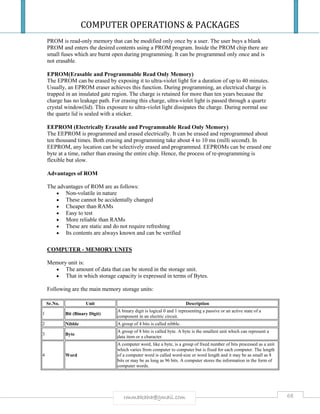
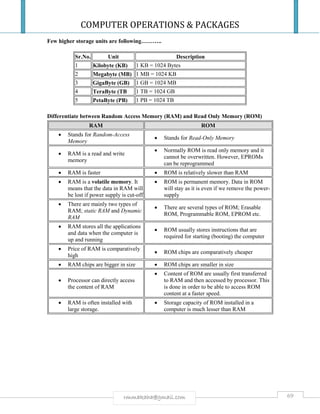
MAIN MEMORY VS SECONDARY MEMORY (RAM VS ROM)
MAIN MEMORY AUXILIARY OR BACKUP STORAGE
 Stores programs and data while
computer is running for current use
 Store data or programs for later use
 Main memory is fast and limited in
capacity
 Slow and capacity vary
 Cannot retain information when the
computer is switched off - Volatile
 Non volatile
 Memory directly connected to the CPU
- not portable
 Portable- can be transported from one
machine to another.
 Primary storage  Secondary storage
 PROVIDES FAST ACCESS  ACCESS IS SLOW
 Temporary  Permanent
 Computer cannot do or work without  Can do or work without
COMPUTER OPERATIONS & PACKAGES
10rmmakaha@gmail.com
PRIMARY MEMORY SECONDARY MEMORY
 The memory devices used for primary
memory are semiconductor memories
 The secondary memory devices are
magnetic and optical memories.
 The primary memory is categorized as
volatile and non-volatile memories, RAM is
the volatile memory and ROM is the non-
volatile memory
 The secondary memory is always non
volatile
 The primary memory is composed of
programs and data that are presently being
used by the micro processor
 The secondary memory is enough capable
to store huge amount of information
 The primary memories are more effective
and fast to interact with the micro processor
 The secondary memories are somewhat
slow in interacting with the microprocessor,
when compared with the primary memory.
 Primary memory is known as main memory  Secondary memory is known as additional
memory or back memory
 These memories are also called as internal
memory
 These memories are also called as external
memory
 Primary memory is temporary  The secondary memory is permanent
 Commonly used primary memory (main
memory) available in the range of 512 MB
to 8 GB RAMs.
 Generally secondary memories range
between 80 GB to 4 TB Hard Disc Drives.
 The primary memory devices are connected
to the computer through “slots”
 The secondary memory devices are
connected to the computer through Cables
COMPUTER OPERATIONS & PACKAGES
11rmmakaha@gmail.com
DATA PROCESSING
 Data processing refers to the transformation of raw data into meaningful output.
 Data can be done manually using a pen and paper, mechanically using simple devices e.g.
typewriter or electronically using modern data processing tools e.g. computers
 Used specifically, data processing may refer to a discrete step in the information
processing cycle in which data is acquired, entered, validated, processed, stored, and
output, either in response to queries or in the form of routine reports; the processing is the
step that organizes the information in order to form the desired output.
 Used in a more general sense, data processing may also refer to the act of recording or
otherwise handling one or more sets of data, and is often performed with the use of
computers. The word data is commonly used to mean “information” and often suggests
large amounts of information in a standardized format. Data may consist of letters,
numbers, equations, dates, images, and other material, but does not usually include entire
words.
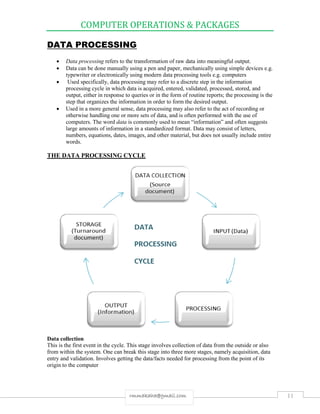
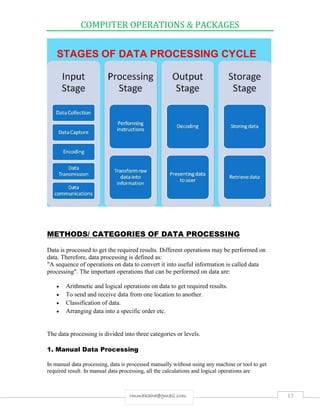
THE DATA PROCESSING CYCLE
Data collection
This is the first event in the cycle. This stage involves collection of data from the outside or also
from within the system. One can break this stage into three more stages, namely acquisition, data
entry and validation. Involves getting the data/facts needed for processing from the point of its
origin to the computer
COMPUTER OPERATIONS & PACKAGES
12rmmakaha@gmail.com
Input
after the data has been acquired from the source, it is entered into the current system, upon which
the data is validated, so that correct results are given at the end of the cycle. The input devices are
many. The commonly used input devices are computer keyboard, bar code readers, scanners,
output from another system, etc. Data Input- the collected data is converted into machine-
readable form by an input device, and send into the machine
Processing
In this stage the computer processes the minutest details entered. This processing makes the data
entered usable. If the computer was not to process the data, it would not be of any use and it
would also be a big mess of data. For example, if the spreadsheet was not to process the data, then
the data in the spreadsheet would only be a mess of numbers. The spreadsheet is a program which
gives the data out back to the user in the usable form. The system used for processing, along with
the data entered will decide the kind of output, which the user will get. Processing is the
transformation of the input data to a more meaningful form (information) in the CPU
Output
if you have to look at the diagram of data/ information processing cycle, the step after processing
is the output stage. The processed information is now transmitted to the user. This stage can also
be further divided. After processing the data, there can be further interactive queries asked or
routine reports can be given. There are different forms in which the output can be given to the
user. There can be print report, which may be given to the user. The output can also be given in
the form of audio, video as well. In some cases, the results may only be displayed on the
computer monitor. Output is the production of the required information, which may be input in
future.
Storage
After the data has been processed, along with the output to the user, the data is also stored.
Different computer storage devices can be used for the same. Some of the commonly used data
storage methods are disk storage, tertiary storage, etc. Storing the data also serves another
purpose. You will not have to repeat the entire cycle again. Often the storage is done in both
digital as well as hard copy format. At the same time, backup of the digital format is also
maintained, which can be retrieved in case of system crash.
COMPUTER OPERATIONS & PACKAGES
13rmmakaha@gmail.com
METHODS/ CATEGORIES OF DATA PROCESSING
Data is processed to get the required results. Different operations may be performed on
data. Therefore, data processing is defined as:
"A sequence of operations on data to convert it into useful information is called data
processing". The important operations that can be performed on data are:
 Arithmetic and logical operations on data to get required results.
 To send and receive data from one location to another.
 Classification of data.
 Arranging data into a specific order etc.
The data processing is divided into three categories or levels.
1. Manual Data Processing
In manual data processing, data is processed manually without using any machine or tool to get
required result. In manual data processing, all the calculations and logical operations are
COMPUTER OPERATIONS & PACKAGES
14rmmakaha@gmail.com
manually performed on the data. Similarly, data is manually transferred from one place to
another. This method of data processing is very slow and errors may occur in the output.
In Zimbabwe, data is still processed manually in many small business firms as well as
government offices & institutions.
In manual data processing data is processed manually. No machine or tool is used.
All the calculations on data are performed manually. This is a slow method and errors may occur.
This is an old method. It was used before the invention of calculators. But data is still processed
manually in many small shops.
Example: A book seller (a small book shop) records his daily transactions manually. He prepares
bills by pen, paper and carbon paper (no doubt, brain is the main data processor in this case). At
the end of day he will use carbon copies made on a particular date to know how many books he
sold and how much income he got.
Manual Data Processing
In manual data processing, data is processed manually without using any machine or
tool to get required results. In manual data processing, all the calculations and logical
operations are performed manually on the data. Similarly, data is transferred manually
from one place to another. This method of data processing is very slow and errors may
occur in the output. Mostly, is processed manually in many small business firms as well
as government offices & institutions. In an educational institute, for example, marks
sheets, fee receipts, and other financial calculations (or transactions) are performed by
hand. This method is avoided as far as possible because of the very high probability of
error, labor intensive and very time consuming. This type of data processing forms the
very primitive stage when technology was not available or it was not affordable. With the
advancement in technology the dependency on manual methods has drastically
decreased.
2. Mechanical Data Processing
In mechanical data processing, data is processed by using different tools like calculators or other
mechanical devices. This method of data processing is faster and more accurate than manual data
processing.
COMPUTER OPERATIONS & PACKAGES
15rmmakaha@gmail.com
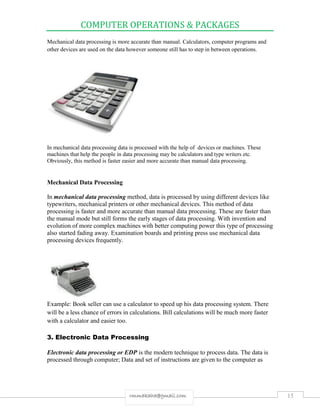
Mechanical data processing is more accurate than manual. Calculators, computer programs and
other devices are used on the data however someone still has to step in between operations.
In mechanical data processing data is processed with the help of devices or machines. These
machines that help the people in data processing may be calculators and type writers etc.
Obviously, this method is faster easier and more accurate than manual data processing.
Mechanical Data Processing
In mechanical data processing method, data is processed by using different devices like
typewriters, mechanical printers or other mechanical devices. This method of data
processing is faster and more accurate than manual data processing. These are faster than
the manual mode but still forms the early stages of data processing. With invention and
evolution of more complex machines with better computing power this type of processing
also started fading away. Examination boards and printing press use mechanical data
processing devices frequently.
Example: Book seller can use a calculator to speed up his data processing system. There
will be a less chance of errors in calculations. Bill calculations will be much more faster
with a calculator and easier too.
3. Electronic Data Processing
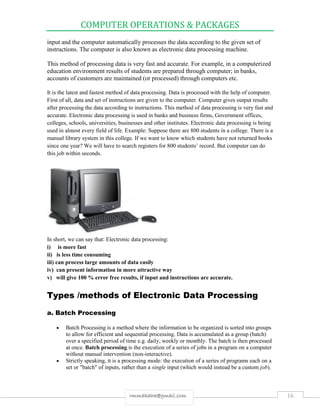
Electronic data processing or EDP is the modern technique to process data. The data is
processed through computer; Data and set of instructions are given to the computer as
COMPUTER OPERATIONS & PACKAGES
16rmmakaha@gmail.com
input and the computer automatically processes the data according to the given set of
instructions. The computer is also known as electronic data processing machine.
This method of processing data is very fast and accurate. For example, in a computerized
education environment results of students are prepared through computer; in banks,
accounts of customers are maintained (or processed) through computers etc.
It is the latest and fastest method of data processing. Data is processed with the help of computer.
First of all, data and set of instructions are given to the computer. Computer gives output results
after processing the data according to instructions. This method of data processing is very fast and
accurate. Electronic data processing is used in banks and business firms, Government offices,
colleges, schools, universities, businesses and other institutes. Electronic data processing is being
used in almost every field of life. Example: Suppose there are 800 students in a college. There is a
manual library system in this college. If we want to know which students have not returned books
since one year? We will have to search registers for 800 students’ record. But computer can do
this job within seconds.
In short, we can say that: Electronic data processing:
i) is more fast
ii) is less time consuming
iii) can process large amounts of data easily
iv) can present information in more attractive way
v) will give 100 % error free results, if input and instructions are accurate.
Types /methods of Electronic Data Processing
a. Batch Processing
 Batch Processing is a method where the information to be organized is sorted into groups
to allow for efficient and sequential processing. Data is accumulated as a group (batch)
over a specified period of time e.g. daily, weekly or monthly. The batch is then processed
at once. Batch processing is the execution of a series of jobs in a program on a computer
without manual intervention (non-interactive).
 Strictly speaking, it is a processing mode: the execution of a series of programs each on a
set or "batch" of inputs, rather than a single input (which would instead be a custom job).
COMPUTER OPERATIONS & PACKAGES
17rmmakaha@gmail.com
 However, this distinction has largely been lost, and the series of steps in a batch process
are often called a "job" or "batch job".
 For example in payroll processing system, employees details concerning the number of
hours worked, rate of pay, and other details are collected for a period of time say, one
month.
 These details are then used to process the payment for the duration worked. Most printing
systems use the batch processing to print documents.
Examples of batch systems
1. Payroll system
 Batch systems are ideal for making payrolls. The salaries of employees can be printed at
the end of month by the batch systems. So the statements can be made easy by using
batch systems.
2. Bank statements
 At the end of month the bank makes statements for each account holder. So these bank
statements can be made easily by batch systems at the end of month.
Batch processing has these benefits:
 It can shift the time of job processing to when the computing resources are less busy.
 It avoids idling the computing resources with minute-by-minute manual intervention and
supervision.
 By keeping high overall rate of utilization, it amortizes the computer, especially an
expensive one.
 It allows the system to use different priorities for interactive and non-interactive work.
 Rather than running one program multiple times to process one transaction each time,
batch processes will run the program only once for many transactions, reducing system
overhead.
 Repeated jobs are done fast in batch systems without user interaction.
 You don’t need special hardware and system support to input data in batch systems.
 Best for large organizations but small organizations can also benefit from it.
 Batch systems can work offline so it makes less stress on processor.
 Processor consumes good time while processing that mean it knows which job to process
next. In real time systems we don’t have expectation time of how long the job is and what
is estimated time to complete it. But in batch systems the processor knows how long the
job is as it is queued.
 Sharing of batch system for multiple users.
 The idle time batch system is very less.
 You can assign specific time for the batch jobs so when the computer is idle it starts
processing the batch jobs i.e. at night or any free time.
 The batch systems can manage large repeated work easily.
COMPUTER OPERATIONS & PACKAGES
18rmmakaha@gmail.com
Disadvantages
 Users are unable to terminate a process during execution, and have to wait until
execution completes.
 Computer operators must be trained for using batch systems.
 It is difficult to debug batch systems.
 Batch systems are sometime costly.
 If some job takes too much time i.e. if error occurs in job then other jobs will wait
for unknown time.
b. Online Processing
 Online Processing is a method that utilizes Internet connections and equipment directly
attached to a computer.
 In online data processing data is processed immediately it is received.
 Data is processed immediately it is received to produce the desired information.
 The computer is connected directly to the data input unit via a communication link.
 The data input may be a network terminal or online input devices attached to the
computer.
 It is used mainly for information recording and research.
 This allows for the data stored in one place and being used at altogether different place.
 Cloud computing can be considered as a example which uses this type of processing.
 All the computer peripherals and other equipment (communication equipment) are under
the direct control of the central processor.
 As soon as the input transactions are available, they are processed to produce the desired
information.
 The user interacts with the system at any time of processing either on a network terminal
or an o-line input/ output device attached to the computer
 Applications: Banking, stock exchange, Supermarkets for stock control
Advantages of online processing systems:-
 Easy to use to do shopping online
 These systems have quick response time
 It is easy to use just form filling and your job get processed automatically by web and
database servers
 Online banks nowadays use online processing systems for money transactions
 Usage of credit cards is also handled by these systems
COMPUTER OPERATIONS & PACKAGES
19rmmakaha@gmail.com
 You can access anything worldwide online and purchase it on the spot by bank wire
transfer, credit cards, and online banks. All these systems are handled by online
processing
Disadvantages of online processing systems:-
 There occurs millions of requests to banks at a time which is difficult to handle
 During purchases if servers hang out for few seconds then transactions get interrupted, so
not good for big websites and organization and high traffic sites
 All user data like credit card details, email addresses are kept on database servers so if
website get hacked or data loosed then it creates problem. For example LinkedIn website
which get hacked and email and password get accessed by hackers and then displayed
credential details of users on internet by hackers
 If any hardware failure occurs in online processing systems then visitors of website get
in trouble and online transaction get stopped and effected
 Electricity problem is another issue i.e. if electric supply get off so backup of generators
and hardware devices in better
 Online processing involves lot of staff to maintain inventory
 There should be make some relation with banks so if any transaction problem occurs then
banks handle it correctly
 Transferring products to people physically is also another problem
 Some issue also get involved during creation of new accounts by visitors
c. Real-Time Processing
 Computer processes the incoming data as soon as it occurs, updates the transaction file
and gives an immediate response that would affect the events as they happen.
 Real-Time Processing is a technique that has the ability to respond almost immediately to
various signals in order to acquire and process information.
 This is different from online in that for the latter an immediate response may not be
required
 These involve high maintenance and upfront cost attributed to very advanced technology
and computing power. Time saved is maximum in this case as the output is seen in real
time.
 For example in banking transactions.
 The main purpose of a real-time processing is to provide accurate, up-to-date information
hence better services based on a true (real) situation.
 An example of a real time processing is making a reservation for airline seats.
 A customer may request for an airline booking information through a remote terminal
and the requested information will be given out within no time by the reservation system.
 If a booking is made, the system immediately updates the reservation file to avoid double
booking and sends the response back to the customer immediately.
Example of real time processing
 Airline reservation systems
 Theatre (cinema) booking
 Hotel reservations
COMPUTER OPERATIONS & PACKAGES
20rmmakaha@gmail.com
 Banking systems
 Police enquiry systems
 Chemical processing plants
 Hospitals to monitor the progress of a patient
 Missile control systems
Advantages
 Provides up-to-date information
 The information is readily available for instant decision-making
 Provides better services to users/customers.
 Fast &reliable
 Reduces circulation of hardcopies.
Disadvantages
 Require complex OSs & are very expensive
 Not easy to develop
 Real time systems usually use 2 or more processors to share the workloads, which is
expensive.
 Require large communication equipment.
d. Distributed Processing
 Distributed data processing refers to dividing (distributing) processing tasks to two or
more computer that are located on physically separate sites but connected by data
transmission media.
 For example, a distributed database will have different tables of the same database
residing on separate computers and processed there as need arises.
 This distribution of processing power increases efficiency and speed of processing.
 Distributed Processing is commonly utilized by remote workstations connected to one big
central workstation or server.
 An example is in the banking industry where customers’ accounts are operated on servers
in the branches but all the branch accounts can be administered centrally from the main
server as if they resided on it.
 ATMs are good examples of this data processing method.
 All the end machines run on a fixed software located at a particular place and makes use
of exactly same information and sets of instruction.
 In this case, we say that the distributed database is transparent to the user because the
distribution is hidden from the user’s point of view.
The Differentiate between CPU bound jobs and I/O bound jobs.
 CPU bound jobs require more of the CPU time to process these jobs. Most of the work
the I/O devices perform is on the Input; and Output; hence, they require very little CPU
time.
 Most companies are now shifting from the use of geographically distributed personal
computers. This method of data processing is known as Distributed Data Processing
(DDP)
COMPUTER OPERATIONS & PACKAGES
21rmmakaha@gmail.com
Three computing resources that can be distributed.
o CPU (Processors) time
o Files
o Application software
o Data/information/messages
o Computer processing power
o Memory (computer storage)
o Input/output devices, e.g. printers
o Communication devices/communication port
Examples of industries and business organizations that extensively use distributed
processing systems.
 Banks
 Computerized retails stores, e.g. supermarkets
 Learning institutions with many departmental offices
 Bureaus or communication cyber cafes
 Airline reservation systems
Benefits and the risks that might be associated with the distributed data
Processing system.
 The load on the host computer is greatly reduced
 The use of low cost minicomputers minimizes the cost in data processing
 Delays in data processing are reduced
 Provides better services to the customers
 There is less risk in case of system breakdown
 The design & implementation of the system is less complex due to decentralization
 The level of expertise required is less.
Risks
 Data duplication is very common
 Programming problems occur with microcomputers & minicomputers
 Security threats, i.e. the data & information sent one the network from one place to
 another can be tapped, or listened to by unauthorized parties
 More training is needed for the users involved
 It is expensive due to the extra cost of communication equipment.
COMPUTER OPERATIONS & PACKAGES
22rmmakaha@gmail.com
e. Multiprogramming
 Multiprogramming, also referred to as multitasking refers to a type of processing
where more than one program are executed apparently at the same time by a
single central processing unit.
f. Time sharing
 In a time sharing processing, many terminals connected to a central computer are
given access to the central processing unit apparently at the same time. However
in actual sense, each user is allocated a time slice of the CPU in sequence. The
amount of time allocated to each user is controlled by a multi-user operating
system. If a user’s task is not completed during the allocated time slice, he/she is
allocated another time slice later in a round robin
g. Multiprocessing
 Refers to the processing of more than one task at the same time on different
processors of the same computer. This is possible in computers such as
mainframes and network servers.
 In such systems a computer may contain more than one independent central
processing unit which works together in a coordinated way.
 At a given time, the processors may execute instructions from two or more
different programs or from different parts of one program simultaneously.
 This coordination is made possible by a multi-processing operating system that
enables different processors to operate together and share the same memoryThe
users of the distributed database will be completely unaware of the distribution
and will interact with the database as if all of it was in their computer.
2. Write notes on
DATA PROCESSING METHODS
a) Manual data processing
b) Mechanical data processing
c) Electronic data processing
d) Automatic data processing
e) Online data processing
f) Distributed data processing
g) Centralized data processing
h) Transaction processing
i) Decentralized data processing
j) Time sharing data processing
k) Batch or offline data processing
COMPUTER OPERATIONS & PACKAGES
23rmmakaha@gmail.com
ATTRIBUTES OF GOOD INFORMATION
Quality
Required
Commentary
Relevant The information obtained and used should be needed for decision-making. it
doesn't matter how interesting it is. Businesses are often criticised for producing
too much information simply because their information systems can "do it". A
good way of ensuring relevance is to closely define the objectives of any
information reports. Another way to improve relevance is to produce information
that focuses on "exceptions" - e.g. problems, high or low values, where limits have
been exceeded.
Up-to-date Information needs to be timely if it is to be actioned. For example, the manager of
a large retail business needs daily information on how stores are performing,
which products are selling well (or not) so that immediate action can be taken. To
improve the speed with which information is produced, businesses usually need to
look at upgrading or replacing their information systems.
Accurate As far as possible, information should be free from errors (e.g. the figures add up;
data is allocated to the correct categories). The users of information should be
informed whenever assumptions or estimates have been used. Accruate
information is usually a function of accurate data collection. If information needs
to be extremely accurate, then more time needs to be allocated for it to be checked.
However, businesses need to guard against trying to produce "perfect" information
- it is often more important for the information to be up-to-date than perfect.
Meet the
needs of the
User
Users of information have different needs. The managing director doesn't have
time to trawl through thick printouts of each week's production or sales listings -
he or she wants a summary of the key facts. The quality control supervisor will
want detailed information about quality testing results rather than a brief one-line
summary of how things are going. It is a good idea to encourage users to help
develop the style and format of information reporting that they require.
Easy to use
and
understand
Information should be clearly presented (e.g. use summaries, charts) and not too
long. It also needs to be communicated using an appropriate medium (e.g. email,
printed report, presentation. Businesses should also consider developing
"templates" which are used consistently throughout the organisation - so that users
get used to seeing information in a similar style.
Worth the
cost
Often forgotten. Information costs money. Data is costly to collect, analyse and
report. Information takes time to read and assimilate. All users should question
whether the information they recieve/have requested is worthwhile
Reliable Information should come from authoritative sources. It is good practice to quote
the source used - whether it be internal or external sources. If estimates or
assumptions have been applied, these should be clearly stated and explained.
1) Valid
2) Fit for use
3) Accessible
4) Cost effective
5) Understandable
6) Time
COMPUTER OPERATIONS & PACKAGES
24rmmakaha@gmail.com
DATA
 Relationship between Data and Information
 Data is raw information
 a collection of facts from which conclusions may be drawn; "statistical
data"
INFORMATION
 Data that has been processed to add or create meaning and hopefully
knowledge for the person who receives it. Information is the output of
information systems.
 Organized data which is understood to have significance and meaning
MAKE NOTES ON:
 Verification
o The act of reviewing, inspecting, testing, checking, auditing, or otherwise
establishing and documenting whether items, processes, services, or
documents conform to specified requirements.
o An effort to test the accuracy of the questionnaire response data. The concern
is uniquely with data accuracy and deals with neither the reliability nor the
validity of measures.
 Validation
o The process of evaluating software at the end of the software development
process to ensure compliance with software requirements. The techniques for
validation are testing, inspection and reviewing.
o Determination of the correctness of the products of software development
with respect to the user needs and requirements.
COMPUTER OPERATIONS & PACKAGES
25rmmakaha@gmail.com
COMPUTER DEPARTMENT & FUNCTIONS IN A
COMPANY
Information technology within an organisation provides a range of services to support the main
business. Typically, computer equipment, software and technical support so that employees can
do their jobs more efficiently. In medium to large organizations this can done through a separate
IT department, and in smaller firms, by one or a handful of people, depending on the size of the
business.
More specifically, IT services include:
1. Developing and maintaining custom computer software
2. Establishing and administering the organization’s network
3. The purchase, installation, maintenance, and upgrading of hardware and software
4. Provision of technical support, usually via a help desk
5. Provision of training in the use of equipment and software
6. Developing, administering and maintaining the organization’s website.
IT Network Responsibilities
 The IT department oversees the installation and maintenance of computer network
systems within a company.
 This may only require a single IT employee, or in the case of larger organizations, a team
of people working to ensure that the network runs smoothly.
 The IT department must evaluate and install the proper hardware and software necessary
to keep the network functioning properly.
 As this involves working within a budget allocated to the department for network devices
and software, the IT department must make sure that the equipment it invests in will
optimally serves the needs of the company without going over budget.
 Networks can be simple or extremely complex depending upon their size and
composition. In addition to staying current on trends within business technology, IT
employees may require college degrees in a computer field to adequately handle the
issues that arise in maintaining such a network.
Network Contingencies
 Should a network system go down, the repercussions can be costly -- not just to the
company and its operations, but outside entities that require products or services from the
company.
 These outside entities could be affected and lose faith in the company's ability to provide
them with what they need.
 The IT department must put a crisis plan in place that can be implemented should the
system go down. It must be designed to put the network back up quickly or allow it to
switch over to an alternate system until the necessary repairs are completed.
 Through the maintenance and planning of a network system, the IT department must
forge professional relationships with outside vendors and industry experts.
COMPUTER OPERATIONS & PACKAGES
26rmmakaha@gmail.com
 This helps the department employees perform their duties more efficiently as well as stay
current on the latest technology that might be beneficial to the company for which they
work.
Application Development
 Quite often, companies see the main role of the IT department as creating the applications
that serve its core business needs.
 The right applications allow a business to be innovative, more productive, efficient, and
to move ahead of its competitors.
 In many ways, this makes the IT department crucial in driving a business forward.
 The work necessary to create the applications that can set a business apart from the others
requires an IT department with programmers, analysts, interface designers, database
administrators, testers, and other professionals.
Communication
 Most people are aware that the IT department is responsible for the success of computer
operations and other information technologies within a business.
 However, as many new forms of electronic communication have become staples of the
modern office, IT departments have been taking on a greater role in the technical side of
company communication.
 This includes point to point phone calls, conference calls, and video and web
conferences, as well as less direct forms of electronic communication like network drives,
email systems, and secure servers.
 The IT department must fully understand how these systems work and interact with each
other, and is responsible for ensuring that these systems remain operational at all times.
Company Website
 The IT department is at least partially responsible for creating and maintaining the
company's website.
 While the content and design of the site may be handled by another department – often
marketing – IT typically creates the code and works with other departments to test the
site for usability.
Technical Support
 The IT department provides this service for all the users who need access to the
company's computer systems.
 This might entail installing new software or hardware, repairing hardware that has
become faulty, training employees in the use of new software, and troubleshooting
problems with the system or with an individual's computer.
 It's apparent that not all the IT department does is apparent - it creates and maintains
many systems that go unseen or get taken for granted by employees, creates emergency
response plans to protect the business from unforeseen problems, and constantly works to
improve the entire company’s ability to function efficiently and effectively.
COMPUTER OPERATIONS & PACKAGES
27rmmakaha@gmail.com
IT workplaces tend to consist of a mix of permanent and contract specialists. Contract staff are
often employed for projects while permanent staff support the everyday needs of the organisation.
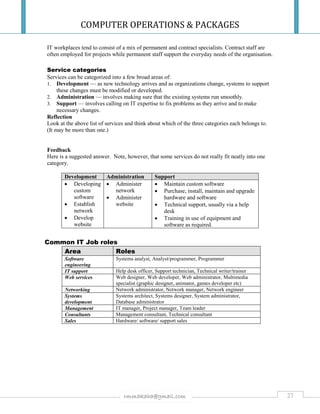
Service categories
Services can be categorized into a few broad areas of:
1. Development — as new technology arrives and as organizations change, systems to support
these changes must be modified or developed.
2. Administration — involves making sure that the existing systems run smoothly.
3. Support — involves calling on IT expertise to fix problems as they arrive and to make
necessary changes.
Reflection
Look at the above list of services and think about which of the three categories each belongs to.
(It may be more than one.)
Feedback
Here is a suggested answer. Note, however, that some services do not really fit neatly into one
category.
Development Administration Support
 Developing
custom
software
 Establish
network
 Develop
website
 Administer
network
 Administer
website
 Maintain custom software
 Purchase, install, maintain and upgrade
hardware and software
 Technical support, usually via a help
desk
 Training in use of equipment and
software as required.
Common IT Job roles
Area Roles
Software
engineering
Systems analyst, Analyst/programmer, Programmer
IT support Help desk officer, Support technician, Technical writer/trainer
Web services Web designer, Web developer, Web administrator, Multimedia
specialist (graphic designer, animator, games developer etc)
Networking Network administrator, Network manager, Network engineer
Systems
development
Systems architect, Systems designer, System administrator,
Database administrator
Management IT manager, Project manager, Team leader
Consultants Management consultant, Technical consultant
Sales Hardware/ software/ support sales
COMPUTER OPERATIONS & PACKAGES
28rmmakaha@gmail.com
DUTIES & RESPONSIBILITIES OF COMPUTER PERSONNEL
DATABASE ADMINISTRATOR (DBA)
 This employee is responsible for the organization's data and maintains the data
structure.
 The database administrator has control over all the data; therefore, detective
controls and supervision of duties must be observed closely.
 This is usually a role filled by a senior information systems employee because
these employees have control over the physical data definition, implementing data
definition controls and defining and initiating backup and recovery.
 undertake daily administration, including monitoring system performance,
ensuring successful backups, and developing/implementing disaster recovery
plans
 manage data to give users the ability to access, relate and report information in
different ways
 develop standards to guide the use and acquisition of software and to protect
valuable information
 modify existing databases or instruct programmers and analysts on the required
changes
 test programs or databases, correct errors and make necessary modifications
 train users and answer questions
COMPUTER SUPPORT SPECIALISTS
 Provide technical assistance, support, and advice to customers and other users.
 This occupational group includes technical support specialists and help-desk
technicians.
 These troubleshooters interpret problems and provide technical support for hardware,
software, and systems.
 They answer telephone calls, analyze problems by using automated diagnostic
programs, and resolve recurring difficulties.
 Support specialists may work either within a company that uses computer systems or
directly for a computer hardware or software vendor.
 Increasingly, these specialists work for help-desk or support services firms, for which
they provide computer support to clients on a contract basis.
COMPUTER OPERATIONS & PACKAGES
29rmmakaha@gmail.com
Technical support specialists
 They Answer telephone calls from their organizations’ computer users and may run
automatic diagnostics programs to resolve problems.
 Working on monitors, keyboards, printers, and mice, they install, modify, clean, and repair
computer hardware and software.
 They also may write training manuals and train computer users in how to use new computer
hardware and software.
 In addition, technical support specialists oversee the daily performance of their company’s
computer systems and evaluate software programs with regard to their usefulness.
Help-desk technicians
 Accepts problem calls from users and registers each call on a help desk database
 Solves the problem for the user over the phone if possible. The assistance is usually limited to
simple problem solving related to the operating system, software and basic peripheral devices
 If the problem cannot be solved over the phone, the help desk mobilises the relevant it staff
member, usually by email or in the help desk database, to assist the user.
 Assist computer users with the inevitable hardware and software questions that are not
addressed in a product’s instruction manual.
 Help-desk technicians field telephone calls and e-mail messages from customers who are
seeking guidance on technical problems.
 In responding to these requests for guidance, help-desk technicians must listen carefully to
the customer, ask questions to diagnose the nature of the problem, and then patiently walk the
customer through the problem-solving steps.
 Help-desk technicians deal directly with customer issues, and companies’ value them as a
source of feedback on their products.
 These technicians are consulted for information about what gives customers the most trouble,
as well as other customer concerns.
 Most computer support specialists start out at the help desk.
Network support
 Assist users in rectifying network-related problems such as security access, Internet access,
network failure, printer failure
 Assist the network administrator in managing user accounts, installing software on the
network, backing up and retrieving files and maintaining network security
 Maintain the help desk database by recording problem resolution on problem calls attended
to.
COMPUTER OPERATIONS & PACKAGES
30rmmakaha@gmail.com
Software support
 Monitor the state of custom software systems
 Troubleshoot when the software fails to work properly
 Keeping records of hardware and software purchased, including the purchase of consumable
items
 Ensuring equipment is well maintained and serviced where required.
NETWORK ADMINISTRATORS / SYSTEMS ADMINISTRATORS
Closely related jobs:
 Network Technician,
 Network Engineer,
 Website Administrator,
 Systems Administrator,
 Telecommunications Engineer
 Network administrators provide operational support for and management of computer
networks to ensure they run efficiently. The IT networks can range from internet and private
networks to large communications networks.
 Design, install, and support an organization’s local-area network (LAN), wide-area
network (WAN), network segment, Internet, or intranet system.
 They provide day-to-day onsite administrative support for software users in a variety
of work environments, including professional offices, small businesses, government,
and large corporations.
 They maintain network hardware and software, analyze problems, and monitor the
network to ensure its availability to system users.
 These employees are responsible for maintenance and configuration of network
equipment, such as routers, switches, firewalls, wireless access points, and so on.
 These workers gather data to identify customer needs and then use the information to
identify, interpret, and evaluate system and network requirements. Administrators
also may plan, coordinate, and implement network security measures.
 install, configure and maintain PCs, networking equipment and network operating systems
 monitor and configure networks to optimize performance and resolve faults
 undertake recovery action in the event of a system failure
 establish and control system access and security levels
 provide training and support for system software
 Implement and co-ordinate housekeeping procedures, including system back-ups, setting up
user accounts, monitoring file access etc.
 plan and implement maintenance and upgrades for system software and hardware
 maintain peripheral devices connected to the printer such as printers and scanners
COMPUTER OPERATIONS & PACKAGES
31rmmakaha@gmail.com
SYSTEMS ADMINISTRATORS
 Are the information technology employees responsible for the efficient use of
networks by organizations?
 This employee is responsible for the operation and maintenance of the LAN and
associated components such as mid-range or mainframe systems. Although small
organizations might have only one systems administrator, larger organizations have
many.
 They ensure that the design of an organization’s computer site allows all of the
components, including computers, the network, and software, to fit together and work
properly.
 Furthermore, they monitor and adjust the performance of existing networks and
continually survey the current computer site to determine future network needs.
 Administrators also troubleshoot problems reported by users and by automated
network monitoring Systems and make recommendations for enhancements in the
implementation of future servers and networks.
SYSTEM ANALYST AND DESIGNERS
Job Titles
 Network Designer
 Systems Analyst
 Solutions Architect
 Senior Systems Engineer
 Senior Solutions Architect
 Systems Architect
 Principal Solutions Architect
 Analyzing problems in software development and guiding the rectification of faults in
programs
 Analyzing software requirements and defining program parameters and specifications
 Undertaking analysis of current software products and determining approaches which will
improve their user interface, performance and integrity
 Leading team members and third parties in client organizations in the integration of
technological methodologies and components of projects
 Ensuring and being accountable for the technical integrity of the design in accordance with
the client’s requirements
 Ensuring that programs meet marketing/user requirements by testing and monitoring initial
field use and problems
 Guiding the preparation of software manuals and guides
 Improving the interface between systems users, the operating system and applications
software
 Conducting user requirements analysis to match customer needs to company products and
services
 Assisting the sales force with pre-sales activity such as proposal preparation, systems
demonstrations and presentations, particularly in relation to larger and more important clients.
COMPUTER OPERATIONS & PACKAGES
32rmmakaha@gmail.com
 These employees are involved in the system development lifecycle (SDLC) process. They are
responsible for determining the needs of users and developing requirements and
specifications for the design of needed software programs
COMPUTER SECURITY SPECIALISTS
 May plan, coordinate, and implement the organization’s information security.
 These workers may be called upon to educate users about computer security,
 Install security software,
 Monitor the network for security breaches,
 Respond to cyber-attacks
 Gather data and evidence to be used in prosecuting cybercrime.
 The responsibilities of computer security specialists has increased in recent years as there has
been a large increase in the number of cyber-attacks on data and networks.
 This and other growing specialty occupations reflect an increasing emphasis on client-server
applications, the expansion of Internet and intranet applications, and the demand for more
end-user support.
IT SECURITY
 They’re in charge of keeping organizations safe from malicious digital attacks.
 This includes implementing and running security software,
 Scanning for abnormalities
 Upgrading systems
 Keeping their company informed of the risks involved in daily activities.
 This job requires a lot of problem solving, crisis management, and effective communication
between team members and higher-ups.
COMPUTER PROGRAMMERS
 Computer programmers write, test, and maintain the programs that computers follow when
performing specific functions.
 The main task of computer programmers is problem solving and development of systems
solutions using the appropriate methodologies and techniques.
 A programmer uses programming languages, such as C++, PHP, or Java to communicate
with computer to perform a set of instructions.
 In addition to writing new programs, computer programmers update and maintain existing
programs.
 They test programs to ensure efficiency, accuracy, and to identify programming errors
 Write, test, and maintain the detailed instructions, called programs that computers
must follow to perform their functions.
 Programmers also conceive, design, and test logical structures for solving problems
by computer.
COMPUTER OPERATIONS & PACKAGES
33rmmakaha@gmail.com
 Programmers write programs according to the specifications determined primarily by
computer software engineers and systems analysts.
 After the design process is complete, it is the job of the programmer to convert that
design into a logical series of instructions that the computer can follow.
 The programmer codes these instructions in a conventional programming language
such as COBOL; an artificial intelligence language such as prolog; or one of the most
advanced object-oriented languages, such as Java, C++, or actor. Different
programming languages are used depending on the purpose of the program.
 Work with field experts to create custom software
 Analyze technical data, designs, and prototypes
 Prepare and present reports on project specifications, activities, and status
 Write computer software, programs, or code
 Document reliability of technical specifications
 Work with software providers to increase proficiencies while working within applications
 Work cross-departmental on development and support
 Prepare software documentation for end users
DATA PREPARATION STAFF
 Are those people responsible for the translation of data into machine readable form?
COMPUTER SCIENTISTS
 Work as theorists, researchers, or inventors.
 Their jobs are distinguished by the higher level of theoretical expertise and innovation they
apply to complex problems and the creation or application of new technology.
 Those employed by academic institutions work in areas ranging from complexity theory to
hardware to programming-language design.
 Some work on multidisciplinary projects, such as developing and advancing uses of virtual
reality, extending human-computer interaction, or designing robots.
 Their counterparts in private industry work in areas such as applying theory; developing
specialized languages or information technologies; or designing programming tools,
knowledge-based systems, or even computer games.
DATA ENTRY AND INFORMATION PROCESSING WORKERS
 Help ensure the smooth and efficient handling of information and entering all data.
 By keying in text, entering data into a computer, operating a variety of office machines, and
performing other clerical duties, these workers help organizations keep up with the rapid
changes that are characteristic of today’s “Information Age.”
COMPUTER OPERATIONS & PACKAGES
34rmmakaha@gmail.com
 Although most data-entry activities are now outsourced, in the not-too-distant past, these
activities were performed in-house at an information processing facility (IPF).
 If this role is still used, key verification is one of the primary means of control.
 In addition to the job titles discussed—such as word processors, typists, and data entry
keyers—data entry and information processing workers are known by various other titles,
including electronic data processors, keypunch technicians, and transcribers.
 Bar codes, scanning, and web entry forms have also reduced the demand for these services.
DATA ENTRY KEYERS
 Usually input lists of items, numbers, or other data into computers or complete forms that
appear on a computer screen.
 They also may manipulate existing data, edit current information, or proofread new entries
into a database for accuracy.
 Some examples of data sources include customers’ personal information, medical records,
and membership lists.
 Usually, this information is used internally by a company and may be reformatted before
other departments or customers utilize it.
DATA CONTROL
 This section receives and distributes all incoming data for appropriate processing; they set up
batch reporting for all agencies and submit schedules for processing to Computer Operations.
 After processing has occurred, they check and distribute reports to all customers.
 This area interacts with agency customers and other Information Technology areas to resolve
processing problems.
 This area maintains all tape media including updating the tape inventory system and it also
has responsibility for offsite tape storage.
 Updating the Information Technology web page using HTML and other software tools is
done by Data control.
 Data control is also responsible for all data preparation prior to centralized processing.
 Assisting the paper peripheral area and reception area are also functions of this section.
COMPUTER OPERATOR
 A computer operator is the person who keeps the large computers running.
 This person’s job is to oversee the mainframe computers and data centers in organizations.
 Responsible for the operation of all enterprise, operating systems and personal computers that
are utilized to service the customer base.
 This area receives all hardware service calls, assists in terminal and communication
equipment installation and software/hardware trouble diagnosis.
 Processing of all batch production work as well as all paper peripheral processing are also
functions of Computer Operators
COMPUTER OPERATIONS & PACKAGES
35rmmakaha@gmail.com
 Some of their duties include keeping the operating systems up to date, ensuring available
memory and disk storage, and overseeing the physical environment of the computer.
 Since mainframe computers increasingly have been replaced with servers, storage
management systems, and other platforms, computer operators’ jobs have grown broader and
include working with these specialized systems.
COMPUTER LIBRARIAN
 Responsible for all types of media, including tapes, cartridges, CDs, DVDs, and so on.
 Librarians must track, store, and recall media as needed.
 They also must document when the data was stored and retrieved, and who accessed it.
 If data moves off-site, librarians track when it was sent and when it arrived.
 They may also be asked to assist in an audit to verify what type of media is still being held at
a vendor's site.
WEB DEVELOPER
 They’re the ones who are responsible for building websites and the infrastructures behind
them—
 Web developers may also be known as “web producers,” “multimedia architects,” and
“internet engineers”, making their titles as diverse as their work portfolios.
 They create web pages, web applications and web content,
 They also need proficiency in Web languages, like HTML and JavaScript.
Writing well designed, testable, efficient code by using best software development practices
 Write well designed, testable, efficient code by using best software development practices
 Create website layout/user interface by using standard HTML/CSS practices
 Integrate data from various back-end services and databases
 Gather and refine specifications and requirements based on technical needs
 Create and maintain software documentation
 Be responsible for maintaining, expanding, and scaling our site
 Stay plugged into emerging technologies/industry trends and apply them into operations and
activities
 Cooperate with web designers to match visual design intent
Research – important area
1. FIND OUT THE DUTIES AND RESPONSIBILITIES OF THE FOLLOWING
a) Computer programmer
b) System analyst
c) System administrator
d) Computer librarian
e) Data preparation staff
f) Network administrator
g) Data control staff
h) IT manager
i) Data processing manager
j) Computer operators
k) Data capturing clerk
COMPUTER OPERATIONS & PACKAGES
1rmmakaha@gmail.com
Social and Economic implications of the
use of computers
 The economic reasons for using computerized systems can be summarized as
increased productivity compared with manual systems. The results from the
ability of computer systems are:
1. Communicate and process data repetitively, accurately and rapidly.
2. Store data in relatively little space
3. Make backup copies of data rapidly and reliably
4. Search for information rapidly and reliably
5. Produce output in a variety of formats
 An organisation may be able to improve its economic position by:
1. Using less space for bulky paper documents
2. Reducing the risk of losing vital information
3. Operating ‘just-in-time’ (JIT) ordering strategy with automated
reordering
4. Making sales system available to customers through a website
Changing Employment
 The success of a new computer-based system may be limited by factors such as:
1. Poor communication with users during analysis and design stages
2. Delays in development during the organization’s requirement change
3. Lack of compatibility with organization’s existing hardware and
software
4. Incorrectly designed business procedures
 The loss of skills is known as de-skilling.
 Semi-skilled still requires training to be able to do a certain job.
 Having finished a course by learning the skills necessary for another once hence
has re-skilled.
Computerizing existing jobs
 A ‘new technology’ agreement was struck between the worker’s trade union and
management because there was a mutual recognition that computerization and
changes in employment were necessary for the company to stay in business in a
fiercely competitive industry.
 New system was more efficient of the company. However, the company now only
needed one full-time post and one part-time post in the payroll department.
COMPUTER OPERATIONS & PACKAGES
2rmmakaha@gmail.com
 Two people who remained needed to go on training courses in order to be able to
use the new system.
 The worker’s higher level of training has made them more highly qualified and
the company must increase their pay rates.
 Computers have relieved them of many tedious, repetitive tasks requiring a high
level of concentration and accuracy
Off-shore outsourcing
 Computer technology has enabled some jobs to be relocated anywhere in the
world, especially now that VOIP technology has made international telephony so
cheap.
 Advantages of call centres:
COMPUTER OPERATIONS & PACKAGES
3rmmakaha@gmail.com
Training methods
 A worker who works with a computer system needs to be trained properly when
using a new system or an upgraded version of a familiar system.
 The worker may need training not only in how to use the system’s hardware and
software but also in the business processes to be used within it.
 Nowadays training courses is a specially written computer program, usually in the
form of a multimedia presentation on CD-ROM or DVD-ROM.
Privacy and integrity of data
 One of the great benefits of using computers is that large quantities of stored data
are easily accessible, both locally and over networks.
COMPUTER OPERATIONS & PACKAGES
4rmmakaha@gmail.com
 As the use of computers has become more widespread, keeping stored data
private has become increasingly important.
 Maintaining the privacy (or ‘confidentially’) of data involves trying to prevent:
o Unauthorized access to data, also known as ‘hacking’
o Accidental disclosure through inappropriate procedures, such as leaving a
computer scan at a reception desk visible to visitors or placing unshredded
documents in a waste bin
o Deliberate disclosure through a malicious act by worker
 Integrity of data refers to their completeness and correctness during processing,
storage, copying and transmission. Maintaining data integrity involves trying to
prevent unwanted changes to data, known as corruption caused by:
o A computer hardware, software or network error
o A virus
o Unauthorized access
o Incorrect or malicious action of an authorized user
 The computer could be safeguarded by physical security such as: not leaving it
unattended at any time; locking the room which it is kept in; keycard system;
monitoring the room with CCTV as a deterrent; locking the computer to a security
cable; equipping the computer with a key-operated power switch.
 Hacking into a LAN from an unattended workstation or via the Internet becomes
a possibility.
 There is also a risk of corruption of data during its transmission between
computers.
 This hardware and software is known as a firewall, blocks unwanted network
communication with your computer.
Security and reliability of data
 Security data – maintaining the privacy and integrity of data, together with
protecting data against loss when failure of a storage device occurs, stolen or
destroyed by natural disaster or data maliciously deleted.
o To help maintain privacy and reduce the risk of data corruption or loss
being caused by people, file systems allow different access rights or
permissions to files, directories or drives to be given to different users and
groups of users.
o Storing backup copies anywhere near to a computer means the backups
could be under theft or destruction by fire or natural disaster.
o Backup copies are left on the premises; they should be locked in a fire-
proof safe.
o Another possibility is an ‘online backup.
COMPUTER OPERATIONS & PACKAGES
5rmmakaha@gmail.com
o Large companies store backups in separate, secure buildings well away
from their offices,
o Backup copies or files are often compressed to reduce strong
requirements, although compression slows down the process of creating
and restoring backup data required.
o The security of data affects their reliability, or how available they are,
often expressed in a percentage.
COMPUTER APPLICATIONS
a) Business- for administration, payroll and accounting.
b) Government- keeping database records.
c) Education- Record keeping, accounting and training in the classroom.
d) Health- Record keeping, life-support systems.
e) Sport- fitness monitoring.
f) Art and Design- desktop Publishing, technical graphics, Computer Aided
Design.
g) Homes- PCs for home accounts, games, e-mail, online shopping, home
education etc.
h) Banks- Record keeping and updating, on-line Automated Teller Machines
(ATMs).
i) Supermarkets- Electronic point Of Sale Machines (EPOS) – tills.
BENEFITS OF COMPUTERS
With the advent of new technology, various processes have been very dependent with
automation. As the years go by, more and more inventions are introduced in the market
and in the society all for one purpose - convenience. Let us tackle for instance two of the
most influential aspects of this modern world; the societal and the entrepreneurial feature.
These two have been greatly influenced by the advancements that are continuously taking
place. With that said, a number of essential advantages are becoming more evident in
these two facets. To further draw a clearer picture on the benefits of computers on each of
the mentioned aspect, here are brief descriptions of each.
Business
Multitasking - The modern multimedia options enable entrepreneurs to work various tasks all at
the same time. Workers in the offices can use the DVD-ROM while installing Printer Cartridges
and running a scan thus making workload easier and more convenient. With such, the need for an
outsourcing company would not be essential because all the tasks can be addressed by majority of
the manpower available.
COMPUTER OPERATIONS & PACKAGES
6rmmakaha@gmail.com
Cost-effective - These computers have allowed companies to cut costs on payroll and individual
office equipment. Because of the efficient and fast outputs coupled with less expenditures on
operations, revenues are then maximized. Good examples for this benefit are the email messaging
that lessens postage costs and video conferencing that decreases travel allowances for employees.
Increased access to the market - Because of the Internet, businesses have opened their doors to
various opportunities all around the globe. For those selling goods, then customers can readily
purchase them over the Web thus resulting to an increase in the sales of the firm. Also,
advertising strategies are well utilized because by just simply posting a good multimedia scheme
over the Web, firms can readily maximize their marketing plans.
Organization- Different types of software are utilized to store a wide array of documents that
must be kept confidential for years. With the help of computers, storage and retrieval of files are
easily done with just a click of the mouse.
Those are the benefits that businesses are enjoying from the various innovations in computers
now. Further, here are the societal advantages.
Education edge- Nowadays, PC's enable students to search from a wide range of online
resources. Hence, they can save time on looking for the best Internet source that can answer each
of the queries. Instead of spending so much time looking for books, then this could answer the
worries for students who want to hasten their tasks. Also, a new trend in education is online
teaching. Through the Web, people can freely enroll in a specific course provided that you get to
pay the fees on the specified date. This scheme can be very helpful for individuals who want to
get a degree yet are to busy to get into the usual classroom setting.
Communication benefit- Social networking sites, chat, and video conferencing sites are
accessible because of computers. People across the globe can now talk to their loved ones in real
time with the help of these gadgets. What is good about this communication option is that it is
more cost effective than the usual telephone. By embracing such, people can now deliver
messages and create a copy of that using quality printer cartridge in just a second.
Job opportunities- These gadgets open up a wide array of workload for people. That is, experts
are needed in software and hardware maintenance and checks. With the increasing demand for
these professionals, unemployment is then lessened at a considerable percentage.
Home Entertainment- During weekends, you may utilize your personal computer to watch films
using its DVD-ROM. Aside from this, you may as well play games all throughout the day. You
can simply install a variety of files that you can use for the whole day of indoor fun. From the
latest TV shows to the more modern games, you can have them in your CPU just minutes.
Those are few of the numerous benefits of personal computers in our everyday lives. Knowing
each of those points will certainly allow you to see the importance of those gadgets in almost all
processes that are taking place every day.
With this obvious dependence, it is also but essential to ensure that each of the systems are
working properly. This is because a single defect inside the CPU could mean serious impairment.
Hence, the specialists in repairs and maintenance can be tapped for their expertise.
COMPUTER OPERATIONS & PACKAGES
7rmmakaha@gmail.com
ADDITIONAL
Multitasking
 Multitasking is one of the major advantage of computer. Person can perform multiple task,
multiple operation, calculate numerical problems within few seconds. Computer can
perform trillion of instructions per second.
Speed
 Now computer is not just a calculating device. Now a day’s computer has very important
role in human life. One of the main advantages of computer is its incredible speed, which
helps human to complete their task in few seconds. All the operations can be performed
very fast just because of its speed elsewise it takes a long time to perform the task.
Cost/ Stores huge amount of data
 It is a low cost solution. Person can save huge data within a low budget. Centralized
database of storing information is the major advantage that can reduce cost.
Accuracy
 One of the root advantage of computer is that can perform not only calculations but also
with accuracy.
Data Security
 Protecting digital data is known as data security. Computer provide security from
destructive forces and from unwanted action from unauthorized users like cyberattack or
access attack.
LIMITATIONS
 They are expensive.
 If you have little knowledge of them, it is easy to get in a lot of trouble and quite literally
destroy your computer.
 Depending on the OS and software/hardware installed, they can be difficult to maintain.
 If you have the internet and don't have an Anti-Virus program, or at least an Anti-Spyware
program, surfing the web can ruin your day.
 Nothing lasts forever.
 Thinking ability. Stops us from thinking about solving problems.
 Computers break down. When they don't work it stops companies and people working.
 Addiction. Playing games or social networks can lead to an addiction.
 Conversation. People are spending less time communicating with the people face to face.
 Lack of exercise. Children and adults spend to much time sat at a computer or on a laptop.
 Virus. Many virus can cause computers to stop working and lose valuable data because of
them.
 Scams, People around the world trying to get money from you.
 Harmful to the environment. Compute equipment needs to be deposed of properly.
 Lack of work for people. Computers have reduce the need for people to do the same job as a
computer can do the job of several people.
Computer disadvantages are as follows; Violation of Privacy, it is crucial that personal
and confidential records stored in computers be protected properly. Impact on Labor
Force, although computers have improved productivity and created an entire industry
with hundreds of thousands of new jobs, the skills of hundreds of thousands employees
are replaced by computers. Health Risks, prolonged or improper computer use can lead to
COMPUTER OPERATIONS & PACKAGES
8rmmakaha@gmail.com
head injuries or disorders. Computer users can protect themselves from health risks
through proper workplace design, good posture while at the computer, and appropriately
spaced work breaks. Impact on the Environment, Computer manufacturing processes and
computer waste are depleting natural resources and polluting the environment.
Virus and hacking attacks
 Virus is a worm and hacking is simply an unauthorized access over computer for some
illicit purpose. Virus is being transferred from email attachment, viewing an infected
website advertisement, through removable device like USB etc. once virus is transferred
in host computer it can infect file, overwrite the file etc.
For example: Huge portion of internet was going down including Twitter, Netflix, Reddit
and CNN in October 2016 because the largest DDoS attack was launched on service
provider DYN using IoT Botnet.
Online Cyber Crimes
 Online cyber-crime means computer and network may have used in order to commit
crime. Cyberstalking and Identity theft are the points which comes under online cyber-
crimes. For example: one may get the access of the access to your shopping account like
amazon account now that person will be able to know your personal details like debit
card or credit card number which can be than misused.
Reduction in employment opportunity
 Mainly past generation was not used of the computer or they have the knowledge of
computer they faced a big problem when computer came in field. As we have seen in
banking sector senior bank employees faced this problem when computer came to the
banking sector.
COMPUTER OPERATIONS & PACKAGES
9rmmakaha@gmail.com
CLASSIFICATION OF COMPUTERS
Computers differ based on their data processing abilities. They are classified according to
purpose, data handling and functionality.
 According to purpose, computers are either general purpose or specific purpose.
 General purpose computers are designed to perform a range of tasks. They have
the ability to store numerous programs, but lack in speed and efficiency.
 Specific purpose computers are designed to handle a specific problem or to
perform a specific task. A set of instructions is built into the machine.
 According to data handling, computers are analog, digital or hybrid.
 ANALOG COMPUTERS work on the principle of measuring, in which the
measurements obtained are translated into data. Modern analog computers
usually employ electrical parameters, such as voltages, resistances or currents, to
represent the quantities being manipulated. Such computers do not deal directly
with the numbers. They measure continuous physical magnitudes.
 DIGITAL COMPUTERS are those that operate with information, numerical or
otherwise, represented in a digital form. Such computers process data into a
digital value (in 0s and 1s). They give the results with more accuracy and at a
faster rate. Hybrid computers incorporate the measuring feature of an analog
computer and counting feature of a digital computer. For computational
purposes, these computers use analog components and for storage, digital
memories are used.
 According to functionality, computers are classified as :
 Analog Computer
An analog computer is a form of computer that uses continuous physical
phenomena such as electrical, mechanical, or hydraulic quantities to model the
problem being solved
 Digital Computer
A computer that performs calculations and logical operations with quantities
represented as digits, usually in the binary number system
 Hybrid Computer (Analog + Digital)
A combination of computers those are capable of inputting and outputting in both
digital and analog signals. A hybrid computer system setup offers a cost effective
method of performing complex simulations.
COMPUTER OPERATIONS & PACKAGES
10rmmakaha@gmail.com
TYPES OF COMPUTERS
Classification on the basis of Size
Major classes or categories of computers
SUPERCOMPUTERS
 Describes a category of extremely powerful computers specifically designed for high-speed
numeric computation.
 The computers can process hundreds of millions of instructions per second.
 High capacity computers capable of executing instructions faster than main frame & are
extremely expensive.
 The speed of executing these instructions generates extreme heat, and therefore the computers
require special cooling system to operate.
 An immensely powerful computer.
 It performs at the highest operational rate of the time, millions of times faster than a regular
desktop PC.
 These machines have the super ability to deal with the most complicated calculations,
especially in science and engineering.
 They can handle enormous databases and perform a vast amount of computation.
 Tasks like weather forecasting simulating nuclear weapons explosions or reconstructing
billions of the universe’s history are just a few areas of the supercomputers’ usage.
 Uses include weather forecasting, scientific and mathematical research, and design of high-
speed aircraft and space exploration.
 A supercomputer has thousands of processors, hundreds of RAM gigabytes, and hard drives
that allows for up to thousands of gigabytes of storage space.
 Moreover, a supercomputer has multiple central processing units (CPUs), which enable it to
process faster circuit switching and accomplish more tasks at once.
 Apart from being able to work faster, a supercomputer has the unique feature of operating
differently.
 Instead of the serial processing system that common computer uses, a super computer uses
the parallel processing.
 This means that, it splits problems into pieces and works on these pieces at once.
 The most powerful supercomputers are in fact multiple computers connected to perform
parallel processing.
 As for the software, most of the supercomputers run quite ordinary operating systems, just
like desktop PCs. The most common one is the open-source Linux.
 A good number of applications for these machines are written in traditional scientific
programming languages such as Fortran, as well as popular, more modern languages C and C++.
A supercomputer is the fastest computer in the world that can process a
significant amount of data very quickly. The computing Performance of a "supercomputer" is
measured very high as compared to a general purpose computer. The computing Performance of a
supercomputer is measured in FLOPS (that is floating-point operations per second) instead of
MIPS. The supercomputer consists of tens of thousands of processors which can perform
billions and trillions of calculations per second, or you can say that supercomputers can deliver up
to nearly a hundred quadrillions of FLOPS.
COMPUTER OPERATIONS & PACKAGES
11rmmakaha@gmail.com
They have evolved from grid to cluster system of massively parallel computing. Cluster system
computing means that machine uses multiple processors in one system instead of arrays of
separate computers in a network.
These computers are most massive concerning size. A most powerful supercomputer can occupy
few feet to hundreds of feet. The supercomputer price is very high, and they can vary from 2 lakh
dollar to over 100 million dollars.
Supercomputers were introduced in the 1960s and developed by Seymour Cray with the Atlas at
the University of Manchester. The Cray designed CDC 1604 which was the first supercomputer
in the world, and it replaces vacuum tube with transistors.
The fastest supercomputer in the world was the Sunway TaihuLight, in the city of Wixu in
China which is developed by China’s National Research center of Parallel Computer Engineering
& Technology (NRCPC), maintains its number 1 ranking for the first time, with a High-
Performance Linpack(HPL) mark of 93.01 petaflops.
Characteristics of Supercomputer
• They can support more than a hundred users at a time.
• These machines are capable of handling the massive amount of calculations that are beyond the
human capabilities, i.e., the human is unable to solve such extensive calculations.
• Many individuals can access supercomputers at the same time.
• These are the most expensive computers that can ever be made.
Features of Supercomputer
• They have more than 1 CPU (Central Processing Unit) which contains instructions so that it can
interpret instructions and execute arithmetic and logical operations.
• The supercomputer can support extremely high computation speed of CPUs.
• They can operate on pairs of lists of numbers instead of pairs of numbers.
• They were used initially in applications related to national security, nuclear weapon design, and
cryptography. But nowadays they are also employed by the aerospace, automotive and petroleum
industries.
COMPUTER OPERATIONS & PACKAGES
12rmmakaha@gmail.com
Uses of Supercomputer
• Supercomputers are not used for everyday tasks because of their superiority.
• Supercomputer handles those applications, which required the real-time processing. The uses
are as follows:
• They're used for scientific simulations and research such as weather forecasting, meteorology,
nuclear energy research, physics, and chemistry, as well as for extremely complex animated
graphics. They are also used to interpret new diseases and predict illness behavior and treatment.
• The military uses supercomputers for testing new aircrafts, tanks, and weapons. They also use
them to understand the effect on soldiers and wars. These machines are also used for encrypting
the data.
• Scientists use them to test the impact of nuclear weapon detonation.
• Hollywood uses supercomputers for the creation of animations.
• In entertainment, supercomputers are used for online gaming.
Supercomputers help in stabilizing the game performance when a lot of users are playing the
game.
Difference between mainframe and supercomputers
Besides raw speed, one big difference between a supercomputer and a mainframe is that a
mainframe serves many people at once or runs several programs concurrently, whereas a
supercomputer funnels its power into executing a few programs at high speeds. Mainframes are
mostly used for large data storage and manipulation tasks, not for computationally-intensive
tasks.
Mainframe Computers Supercomputers
It is a large computer which is used as a large server
and for intensive business applications.
It is an extremely fast compute capable of
performing hundreds of millions of instructions per
second.
Its components are: multiple input/output devices,
magnetic disk, tape storage and many banks of
internal storage.
A supercomputer usually includes more than one
CPU.
Ex: IBM ES/9000 Ex: cray Supercomputer
It can typically run a variant of linux as an operating
system.
It can run many types of operating system.
It can do millions of instructions per second. It can do floating point operations per second.
It is used for bulk data processing like consumer
statistics, ERP and financial transaction processing.
It is used for nuclear weapon development,
weather forecasting, host processes for a local
computer.
COMPUTER OPERATIONS & PACKAGES
13rmmakaha@gmail.com
MAINFRAMES
 Are large, powerful computers that are physically larger than micros and minis and usually
have one or more central processors with faster instruction processing speeds?
 They typically process hundreds of millions of instructions per second.
 Mainframes have large primary storage capacities.
 Many mainframe models have the ability to service hundreds of users at once.
 Mainframe systems can be used by a large number of users. This means that, in a large
organization, individual employees can sit at their desk using a personal computer, but they can
send requests to the mainframe computer for processing large amounts of data. As for the actual
hardware components inside a mainframe computer, they are similar in type to what personal
computers use: motherboard, central processing unit and memory. The individual components are
just a lot more powerful and a lot more expensive.
 Some commercial organizations require large amounts of data to be processed in the list
possible time.
 Mainframes are a type of computer that generally are known for their large size, amount of
storage, processing power and high level of reliability.
 They are primarily used by large organizations for mission-critical applications requiring high
volumes of data processing.
 In general, there are a few characteristics of mainframes that are common among all
mainframe vendors: Nearly all mainframes have the ability to run (or host) multiple operating
systems.
 Mainframes can add or hot swap system capacity without disruption.
 Mainframes are designed to handle very high volume input and output (I/O) and emphasize
throughput computing.
 A single mainframe can replace dozens or even hundreds of smaller servers.
 Uses of mainframes include: data warehousing, commercial airline ticketing & reservations,
government record keeping & financial servicing
 Application categories: Host computers, Database servers, and Transaction processors.
 Mainframe computers now play a central role in the daily operations of many of the world’s
largest Fortune 1000 companies.
 Though other forms of computing are used extensively in various business capacities, the
mainframe occupies a coveted place in today’s e-business environment.
 In banking, finance, health care, insurance, public utilities, government, and a host of other
public and private enterprises, the mainframe computer continues to form the foundation of
modern business.
 The main difference between mainframes and supercomputers is their typical application
domain – mainframes excel in reliable volume computing in domains requiring integer operations
(e.g, financial, indexing, comparisons, etc).
 Supercomputers are design to excel in their ability to perform floating point operations –
addition, subtraction, and multiplication with enough digits of precision to model continuous
phenomena such as weather.
 Despite the continual change in IT, mainframe computers considered by many to be the most
stable, secure, and compatible of all computing platforms.
 The latest models can handle the most advanced and demanding customer workloads, yet
continue to run applications that were written in earlier decades.
 For those who think there is no use for the ‘big iron’ now, they would really be surprised. The
truth is that we are all mainframe users in one way or another.
COMPUTER OPERATIONS & PACKAGES
14rmmakaha@gmail.com
The Definition and meaning of mainframe has shifted from its original reference to the main
housing, or frame, that contained the central processing unit (CPU) of the computer. In those
days, all computers were big-like the size of a garage and the frame for the CPU might have been
as big as a walk-in closet. Now mainframe refers to the kind of large computer that runs an entire
corporation.
While "large" can still mean as big as a room, most of today's "mainframes" are much smaller,
although they're still quite a bit bigger than a personal computer or even a minicomputer. A
mainframe has an enormous storage space on disk and tape (like thousands of kilobytes,
measured in gigabytes), and an enormous amount of main memory. Theoretically, it works a lot
faster than the fastest personal computer. A mainframe also costs big bucks, from half a million
or so on up.
In today’s world where all the business, transactions, communications are real time. So to
perform all this task, a powerful computer require on the server side, which processes the
instructions and provides the output in seconds. According to the usage of computers in today’s
world, we can categories computer in Supercomputer, Mainframe Computer, and Mini Computer
and microcomputer categories. A mainframe computer is the fastest computer after
supercomputer to execute complex and lengthy calculations. A mainframe computer is more
powerful than Mini and Microcomputer, but less powerful than Supercomputer. A mainframe
computer is used in the large organization.
A mainframe computer is a combination of memory (RAM) and many processors.
It acts as a central processing unit for many workstations and terminals connected with it. A
mainframe computer is used to process the large and huge amount of data in petabytes. It can
control thousands of user ’s. Name ‘Mainframe’ means that a frame for holding a number of
processors and main memory. Mainframe computer plays a significant role in e-business where
hundreds to thousands of people connect to a server to precede their request in a real time.
Similarly, In banking, government, education system mainframe computer play a valuable role.
COMPUTER OPERATIONS & PACKAGES
15rmmakaha@gmail.com
Mainframes are tended by special technicians who feed them the programs they run and who
scramble around trying to fix them whenever they stop working, which is often. All mainframes
are multi-tasking, multi-user machines, meaning they are designed so many different people can
work on many different problems, all at the same time.
Mainframe computer initially created in early 1950’s.Initially, the size was too big because of the
vacuum tube. But after the invention of transistors main frame computer size get reduced.
Mainframes serve most often as information stores and processors.
An army of smaller computers is connected to the mainframe. These smaller computers are not in
the same room; they may be connected through phone lines across the world. Ordinary people in
the company never touch the mainframe itself. Instead, they interact with the computer using a
terminal, which is more or less a keyboard and a monitor connected to the mainframe with wires,
or by modem over the phone lines. People use the smaller computers and get information from
and send information to the mainframe.
IBM manufactured many mainframe computers for commercial, scientific and engineering use
with different serial numbers. IBM manufactured 700 and 7000 series models with use of vacuum
tube and transistors. In 1964, System/360 was manufactured for both commercial and scientific
users. S/360 was the first computer to offer microcode. Microcode functionality makes the system
modifiable without changing the computer. Now the customer can create their own application
according to requirement. In 2000, Z-Series was introduced by IBM. Z-series computers are very
powerful to process the instruction.
The difference between a minicomputer and a mainframe is arbitrary, and different people may
use either term for the same machine. Even if you don't work for a large company, you might
have contact with a mainframe: when you connect to an online information service or a
commercial e-mail service from your personal computer, you are often connecting to a
mainframe.
In the '60s the mainframe vendors were called "IBM and the seven dwarfs": Burroughs, Univac,
NCR, Control Data, Honeywell, GE, and RCA. They turned into IBM and the BUNCH after
Honeywell ate GE's computer division and Univac ate RCA's.
Components of Mainframe computer
Mainframe computer provide reliable and secure process execution. Mainframe computer has
some components to perform task.
 CPU: CPU contains the processors, memory, control circuits, and interfaces for channels. A
channel is an independent path between I/O devices and memory. This path is used for data
movements and for controlling the computer components.
 Controllers: Channels are used to connect devices with control units. Channel is also known
as a bus. In Mainframe computer, the different control unit (internal circuit and logic) is used
for different -different devices like tape, disk. Control unit is further connected with storage
unit.
 Cluster controller: Cluster controller is a device to connect channel terminal to host system.
Cluster controls have two types
Channel-attached cluster controllers and link-attached cluster controllers.
COMPUTER OPERATIONS & PACKAGES
16rmmakaha@gmail.com
Cluster controllers provide advanced features like IBM Token Ring attachment interfaces,
management, and monitoring.
 I/O channels: During I/O connectivity, we used some term like IOCDS, ESCON, FICON,
CHIPD’s having unique definitions and purpose.
 ICODS: ICODS stands for I/O control data set. It is a control file in I/O layer to translate
physical I/O address into device address.
 ESCON (Enterprise Systems Connection): is a first IBM and vendor product for
connecting more than one mainframe computer and with locally attached workstations. It is
Fiber Optic channel to transfer the data with the maximum speed of 17 MByte/ s. We can
extend the local to mainframe network up to 60 km. It has some limitations regarding speed
and network area. To make it better IBM next version was FICON. FICON (fiber connector)
is used to increase the transfer speed of ESCON channel. One Ficon connector is equal to
eight ESCON connector.
 Multiprocessors: Multiprocessors indicate that number of processors. Multiple processors in
mainframe computer used some Prefix Storage Area to process the data (For error handling
and interrupt handling).Using special instruction set processor can communicate with another
processor using special instruction set.
The advantage of mainframe computer
Mainframe computer has many advantages as well as disadvantages. From the last 50 years,
there was a great revolution in mainframe computer in all field like size, processing speed, data
transfer speed, security, and flexibility.
• Mainframe computer provides a great security against the attack of viruses, warm, spyware,
malware. Encryption technique like file encryption, dataset and file encryption, network
encryption, clustering encryption empower security.
• Mainframe computers are compatible with all types of software and hardware. Because different
user connects with servers along with different hardware and software on their system. They can
easily communicate with server-side without any interrupt.
• Mainframe computer deals with thousands of users to execute their instructions simultaneously.
And can store
• without disturbing process on the computer, we can add storage, processors or memory and
extend its capability.
With some advantages, it has some disadvantage
• A mainframe computer is expensive. It is not easy to purchase a mainframe as a comparison to
the microcomputer. The microcomputer is handled by the single user, but mainframe handled
many users. Installation is not easy.
COMPUTER OPERATIONS & PACKAGES
17rmmakaha@gmail.com
MINICOMPUTERS
 A minicomputer is a type of computer that possesses most of the features and capabilities of a
large computer but is smaller in physical size.
 A minicomputer fills the space between the mainframe and microcomputer, and is smaller
than the former but larger than the latter.
 Minicomputers are mainly used as small or mid-range servers operating business and
scientific applications.
 However, the use of the term minicomputer has diminished and has merged with servers.
 A minicomputer may also be called a mid-range computer.
 Are larger and more powerful than most microcomputers but are smaller and less powerful
than most mainframe computer systems.
 They were primarily designed for business applications and services that require the
performance and efficiency of mainframe computers.
 Minicomputers are generally used as mid-range servers, where they can operate mid-sized
software applications and support numerous users simultaneously.
 Minicomputers may contain one or more processors, support multiprocessing and tasking,
and are generally resilient to high workloads.
 Although they are smaller than mainframe or supercomputers, minicomputers are more
powerful than personal computers and workstations.
 Serve in industrial process-control manufacturing plant computers and play a major role in
CAM.
 Also take the form of powerful technical workstations for CAD applications.
 Often used as front-end processors/computers to help mainframe computers control data
communications networks with large numbers of data entry terminals.
 Also used as powerful Network servers to help manage large interconnected LANs that tie
together many workstations
 Downsizing is a term that was commonly used in the early nineties when smaller computers,
capable of much of the functions of mainframes, began capturing the computer market.
 Minicomputers are suitable for mid-sized companies that require the computing power of
mainframes to be efficient and at the same time be cost effective.
 Users of mini-computers would be smaller banks & financial institutions, supermarket chains
and departmental stores.
 Application categories: Network servers, and Application systems
Minicomputer can support multi-users at a time or you can say that minicomputer is a
multiprocessing system. Also, the power of processing of minicomputers is not larger than the
power of mainframe and supercomputers. These minicomputers can do time-sharing, batch
processing, and online processing.
Size of Minicomputer
The size of minicomputers can range from 12 inches in width to less than 7. This small size is
especially attractive to students because they can use it anywhere they want.
COMPUTER OPERATIONS & PACKAGES
18rmmakaha@gmail.com
History of Minicomputer
The term minicomputer was come to know in the 1960s and through that time only the small
computers are made by making the use of transistors and core memory technologies. The first
minicomputer which was developed was known as Digital Equipment Corporation, which was
made by using transistors and it costs from the US $16000.
Popular Minicomputers
K-202, Texas Instrument TI-990, SDS-92, IBM Midrange computers
Uses of minicomputer
Each person using a minicomputer has their own terminal attached by wires or via a modem to
the computer proper. (A terminal isn't a computer-it's basically just a keyboard and a monitor)
The minicomputer spends a little bit of time on one person's task, then moves on to the next, and
so on, juggling the work based on which jobs it thinks are most important. If you're the only one
using a minicomputer, this can be one fast machine.
But once many users (people) are "on" the system, the thing begins to slow down-you may type
something and then wait for a minute or more before you see a response on the screen.
Minicomputers used to be the only option for companies. Now, many firms are turning to
networks of personal computers to accomplish the same thing faster and cheaper.
They were used for three primary purposes:
Process control
Minicomputers are primarily used by the companies for the manufacturing control of the process.
Process Control has two primary functions- data acquisition and feedback.
Ex:- factories make use of minicomputers to control the manufacturing process. If any problem
appears in any part of the process, then it recognizes the change and made required adjustments.
Data management
Minicomputers that we use for the data management can do any task regarding data like it can
take, restore or generate data.
Communication
Minicomputers act as an interface between the human operator and a larger processor. The user
can run operations such as error checking with the help of minicomputer and then can use the
device for making adjustments also.
The other uses are as follows:
• They are also used for scientific computations.
• Used for business-transaction processing.
• Used for database management.
• Used for file handling
• Used for engineering computations.
COMPUTER OPERATIONS & PACKAGES
19rmmakaha@gmail.com
Characteristics of a minicomputer
• Its size is smaller than a mainframe or supercomputer.
• It is less expensive than mainframe or supercomputer.
• It is less powerful than mainframe or supercomputer and more powerful than microcomputers
and workstations.
• It can do several tasks at once.
• It can be used by many people at one time.
• It is used by small enterprises.
Applications of minicomputer
1 Minicomputer was used in business accounting.
2 A network of minicomputers can be created which allows a large library with its different-2
branches to build its own internal network and this network is more powerful than those handled
by large-scale computer installations.
3 It is used by the various sub-departments of the companies so that they can unload the task of
mainframe computers.
4 The areas where minicomputers have been traditionally applied in information handling are:
• Circulation
• Cataloguing
• Series control
• Management
• Acquisitions
• Communications
• Information retrieval
Advantages of minicomputer
• They are easy to use.
• They can fit anywhere.
• They are small and very portable.
• They are easy to carry.
• As compared to their size, they are fast.
• They hold a charge for a long time.
• They did not require a carefully controlled operational environment.
• They are more reliable.
Disadvantages of minicomputer
• Some minicomputers don’t have USB ports.
• Minicomputers do not have any CD/DVD drive.
• The user may not be familiar with the operating system.
• The keyboard can be small for fast typists.
• In this, generally, there is not much storage on board.
• It can be too small to do certain projects.
COMPUTER OPERATIONS & PACKAGES
20rmmakaha@gmail.com
MICROCOMPUTERS
 We refer to a microcomputer as a personal computer or PC.
 Microcomputers categorized by size include: Desktops, Laptops for example.
 Most microcomputers are single user computers.
 The late nineties have seen a huge influx of microcomputers whose sole aim was to
provide affordable computing power to the general public.
 They are now used as Network servers. The demand for microcomputers and the
changes in microchip technology have produced cheaper computers that are
affordable to students and the general public.
 Can support CAD.
 Users of microcomputers range from students, who use them for word processing, to
a salesperson. Who depend on the microcomputer for information?
 Application categories: PCs, Network servers.
 Network servers are powerful microcomputers that controls & coordinates
communication & resource sharing in LANs of interconnected PCs & other devices.
Micro Computer is a small computer. Your personal computers are equivalent to the
microcomputer. Mainframe and Mini Computer is ancestor of microcomputer. Integrated Circuit
fabrication technology reduces the size of Mainframe and Minicomputer.
Technically, a microcomputer is a computer in which the CPU (central processing unit, the brains
of the computer) is contained on one single chip, a microprocessor, input/output devices and
storage (memory) unit. All these components are important for a proper working of
microcomputer.
COMPUTER OPERATIONS & PACKAGES
21rmmakaha@gmail.com
Types of Micro Computer
Most workstations are also types of micro computer, for the same reason, although some personal
computer is as fast as the fastest workstation. And a computer used by more than one person (a
multi-user computer) is still a microcomputer as long as it has a microprocessor for its CPU.
Notebook
Notebook is the smallest microcomputer, which can be ultra-mobile3 inches thick with less than 3
pounds lightweight and smaller than a briefcase, allow for easy setup in a room. A notebook can
be effectively connected to the Internet ISP via a cable or Wi-Fi.
Laptop
Laptop microcomputer is bigger than the notebook computer powered by a battery and designed
for low power consumption, which can be smaller than a briefcase. Although laptops and desktop
computers have same capabilities. A laptop also has a thin display screen with attached keyboard
and a touchpad used for navigation.
Desktop
Desktops are personal computers and bigger than notebooks and laptops. These microcomputers
consist ofthe system unit, keyboard and monitor. Desktop microcomputers are cheaper than
laptops or notebooks. Unlike a notebook, which isultra-mobile, a desktopmicrocomputeris stay at
one location. The desktop microcomputers are more reliable than notebooks and laptops and easy
to repair.
COMPUTER OPERATIONS & PACKAGES
22rmmakaha@gmail.com
Components of Microcomputer
All Microcomputer are based on same principle like having CPU for processing data ,memory for
storing data and input output devices , but many types microcomputers are available in market
.This difference in microcomputer is due to the use of various types of data bus and address bus.
Data bus and address bus is used for data and address supply. Capacity is measure in form of bits
like 32 bit data bus or 64 bit data bus.
Microprocessor: Microprocessor has two parts arithmetic logical unit and control unit. All these
units help to system to perform calculations, execution of command and handling the control of
devices.
Arithmetic logical Unit: Arithmetic logical unit is calculation unit in microcomputer. It is also
known logical unit. It performs addition, subtraction, multiplication, complement or many more
operations. To perform this calculations ALU unit used registers, multiplexer, adder, half adder or
flags. Flags like carry flag, zero flag, status flag, overflow flag etc.
Control unit: Control unit controls the execution and sequence of instructions. CU receive
instruction from devices ,convert the instruction into a specific format to access the location of
data in memory and give the control to ALU for performing action on specific instructions.
Control unit control the buses, registers, mux and circuits.
Memory unit: Memory unit control inflow and outflow of data in memory by using many
memory management techniques like FIFO, LIFO, OPR, LRU etc
.
In microcomputer we have two types of memory 1) Volatile and 2) Non-volatile.
Volatile: Memory that stores data for short time of period till the light is switch on.
Non-Volatile: Memory that stores data permanently.
RAM (Random Access Memory): RAM is also known as Physical memory. RAM is volatile
memory .It is faster than hard disk.RAM is placed between CPU and Hard-disk. To process any
data, first it loaded into RAM from hard-disk and then CPU access it.
ROM (Read Only Memory) : Read Only Memory has permanent data storage. Once the data
has written on it, content will not lost if power turned on or power turned off. Boot record is
written on it.
When we switch on system, the boot record loaded from ROM and when system turned off, it
stores on ROM.
Input /output devices: Through buses peripheral devices communicate with CPU. Control buses
used clock signal to activate the devices. Address buses used by processor to fetch the opcode or
operand for process. Data bus is used for read and writes operation on data.
COMPUTER OPERATIONS & PACKAGES
23rmmakaha@gmail.com
The main differences among the above computer types are in:
 Processing speed,
 Memory capacity
 Number and capabilities or peripheral devices that can be attached to the
computer
 Usage.
FACTORS TO CONSIDER WHEN YOU WANT TO PURCHASE OR BUYA
COMPUTER
1. COST; how much can I afford to pay for a computer? Prices of personal
computers range from a few hundred to thousands of dollars. Faster and more
feature-rich PCs are usually more expensive.
2. AREA OF USE; where will my new PC be used? If you will be using it only in
your home or office, a desktop computer will be suitable. However, if you will need
to take it with you, you should consider purchasing a laptop (notebook) computer.
3. APPLICATIONS PACKAGES; Which application packages will I run on my
computer? Make a list of applications for which you plan to use your PC. For
example, will you use your PC to prepare letters and reports? Analyze numeric and
financial data? Prepare visual presentations? Access the Internet? Listen to music?
Create and work with graphics?
4. DURATION; How long will I keep this computer?Try to estimate the length of
time (years) you will use your computerbefore BUYING the next one. If you expect
use your PC for several years or if you think you may later want to add new
applications, CONSIDER one that is expandable, so you can add new components,
such as a modem, printer, or add-on boards. Make sure the PC has expansion slots so
you can connect these devices to your PC.
5. MANUFACTURER AND SELLER REPUTATION. Check out the
manufacturers and seller’s reputations.Talk with friends, co-workers, classmates,
teachers, and others about their PCs. Ask about the performance of their PCs and get
recommendations from persons you trust. Eventually you may need to have your PC
serviced. Ideally, the vendor has a service department that can repair your PC. If not,
you may need to locate a third-party to provide this service. Reputable computer
manufactures include:
1. Hewlett-Packard 2. Apple 3. Sun Microsystems 4. Dell 5. Panasonic 6.Sony
7.Toshiba 8. Shuttle 9. IBM 10. Samsung Electronics 11. Hitachi 12. Fujitsu
Siemens
6. WARRANTIES & GUARANTEES
7. PC ARCHITECTURE. PC architecture refers to the design and construction of the
PC and its system unit, and not all architectures are the same. For example, the
architecture of an Apple Macintosh differs from that of an IBM or compatible PC.
Therefore, software written for an Apple Macintosh PC may not run on an IBM or
COMPUTER OPERATIONS & PACKAGES
24rmmakaha@gmail.com
IBM-compatible PC. Although some users prefer a Macintosh PC, more software is
available for IBM and IBM-compatible PCs.
8. MICROPROCESSOR SPEED. Selecting the right microprocessor is extremely
important. Processing speed, measured in megahertz (MHz) or gigahertz (GHz), is
probably the first consideration. The higher the number of MHz or GHz, the faster
the processor will manipulate data. If speed is important, consider choosing a
microprocessor with a speed of 2 GHz or more. PCs containing microprocessors with
speeds up to 10 GHz and higher are available.
9. MAIN MEMORY (RAM). Main memory (RAM) is needed for the temporary
storage of programs and data while the data is being processed. Some application
software requires a considerable amount of RAM to function properly, and newer
software versions usually require more RAM than older versions. Typical PCs now
come with 2 gigabytes (GB), 5GB, or more of RAM. Make certain the PC has
sufficient RAM to run the software you will be using.
10. SECONDARY STORAGE (ROM). What type(s) and amounts of secondary
storage are you likely to need? Typical computers come with a floppy disk drive, cd
drive, USB port/ drive and a hard disk drive already installed. A hard disk drive
contains one or more rigid storage platters and provides for the permanent storage of
considerably more data. However, the disk itself cannot be removed from the drive.
The STORAGE CAPACITY of a hard disk is an important consideration because it
is used to store all system and application software. Typical hard disk capacities are
100, 200, 500GB or 2TB and more. Be certain the PC you are considering has
sufficient secondary capacity for your needs
CD-ROM or DVD drives provide high storage capacities. Most software publishers
store their programs on CD-ROM or DVDs because of the high capacity and because
DVD/CD-ROMs operate faster than floppy disks.
If you will use your PC to play movies, your purchase should include a DVD (digital
video disk) drive. If you will work with large files, consider purchasing a computer
that includes a DVD/CD-RW drive. A DVD/CD-RW disk is a reusable high-capacity
disk that allows you to store huge amounts of data and to erase data no longer
needed.
11. PORTS.The number of ports (slots) available inside the system unit determines the
number of add-on boards that can be installed inside the system unit. For example,
you cannot connect a printer to your computer unless youcomputerr is equipped with
an appropriate port (slot). Be sure the PC contains the necessary slots for the add-on
boards and peripheral devices you will be using with your computer.
12. INPUT DEVICES.Typical input devices are a keyboard and a mouse, although other
kinds of input devices are available. Most keyboards and mice operate similarly.
However, there are slight differences in how each "feels" to the user. Before buying a
PC, you may want to test the keyboard and mouse for comfort and ease of use. Some
sellers will allow you to exchange the keyboard or mouse that comes with the
computerfor a different one.
COMPUTER OPERATIONS & PACKAGES
25rmmakaha@gmail.com
13. OUTPUT DEVICES. Output devices produce output in either soft copy or hard
copy form. Most PCs come with a monitor (for soft copy output), but you may have
to purchase a hard copy device, such as a printer, separately.
14. MONITORS. There are wide differences among PC monitors, with resolution being
perhaps the most important variable.
Resolution refers to the clarity of the text and images being displayed. Before making
a purchase, carefully evaluate the monitor’s resolution. Many vendors allow you to
choose from monitors with varying resolutions. A resolution of 1,024 by 1,024 is
considered high-resolution, in which text and images display exceptionally clearly.
High-resolution monitors are typically more expensive.
Monitor size is another important consideration. Viewing areas range from 15
diagonal inches to 21 inches and higher. Larger monitors are usually more expensive,
but may be worth the extra cost. For example, an individual with weak vision may
prefer a larger monitor. If your desktop space is limited, consider purchasing a flat-
panel monitor, which occupies less space. Flat-panels are more expensive than
standard monitors, however.
COMPUTER OPERATIONS & PACKAGES
26rmmakaha@gmail.com
PERIPHERALS, INPUT, OUTPUT AND DATA
STORAGE
PERIPHERAL
 A peripheral device connects to a computer system to add functionality. Examples are a
mouse, keyboard, monitor, printer and scanner.
 A peripheral or peripheral device is "an ancillary device used to put information into and
get information out of the computer
Definition
A computer peripheral is a device that is connected to a computer but is not part of the core
computer architecture. The core elements of a computer are the central processing unit, power
supply, motherboard and the computer case that contains those three components. Technically
speaking, everything else is considered a peripheral device. However, this is a somewhat narrow
view, since various other elements are required for a computer to actually function, such as a hard
drive and random-access memory (or RAM). A printer is known as a peripheral device.
Most people use the term peripheral more loosely to refer to a device external to the computer
case. You connect the device to the computer to expand the functionality of the system. For
example, consider a printer. Once the printer is connected to a computer, you can print out
documents. Another way to look at peripheral devices is that they are dependent on the computer
system. For example, most printers can't do much on their own, and they only become functional
when connected to a computer system.
Types of Peripheral Devices
There are many different peripheral devices, but they fall into three general categories:
1. Input devices, such as a mouse and a keyboard
an input device sends data or instructions to the computer, such as a mouse,
keyboard, graphics tablet, image scanner, barcode reader, game controller, light
pen, light gun, microphone, digital camera, webcam, dance pad, and read-only
memory);
2. Output devices, such as a monitor and a printer
an output device provides output from the computer, such as a computer monitor,
projector, printer, headphones, and computer speaker); and
COMPUTER OPERATIONS & PACKAGES
27rmmakaha@gmail.com
3. Storage devices, such as a hard drive or flash drive
An input/output device performs both input and output functions, such as a
computer data storage device (including a disk drive, USB flash drive, memory
card, and tape drive).
Many modern electronic devices, such as digital watches, smartphones, and tablet computers,
have interfaces that allow them to be used as computer peripheral devices.
Some devices fall into more than one category. Consider a CD-ROM drive; you can use it to read
data or music (input), and you can use it to write data to a CD (output).
Peripheral devices can be external or internal. For example, a printer is an external device that
you connect using a cable, while an optical disc drive is typically located inside the computer
case. Internal peripheral devices are also referred to as integrated peripherals. When most people
refer to peripherals, they typically mean external ones.
The concept of what exactly is 'peripheral' is therefore somewhat fluid. For a desktop computer, a
keyboard and a monitor are considered peripherals - you can easily connect and disconnect them
and replace them if needed. For a laptop computer, these components are built into the computer
system and can't be easily removed.
The term 'peripheral' also does not mean it is not essential for the function of the computer. Some
devices, such as a printer, can be disconnected and the computer will keep on working just fine.
However, remove the monitor of a desktop computer and it becomes pretty much useless.
COMPUTER OPERATIONS & PACKAGES
28rmmakaha@gmail.com
INPUT DEVICES:
 Graphics Tablets
 Cameras
 Video Capture Hardware
 Trackballs
 Barcode reader
 Digital camera
 Gamepad
 Joystick
 Keyboard
 Microphone
 MIDI keyboard
 Mouse (pointing device)
 Scanner
 Webcam
 Touchpads
 Pen Input
 Microphone
 Electronic Whiteboard
 OMR
 OCR
 u) Punch card reader
 v)MICR (Magnetic Ink character
reader)
 w) Magnetic Tape Drive
OUTPUT DEVICES:
 Monitor (LED, LCD, CRT etc)
 Printers (all types)
 Plotters
 Projector
 LCD Projection Panels
 Computer Output Microfilm (COM)
 Speaker(s)
 Head Phone
 Visual Display Unit
 Film Recorder
 Microfiche
BOTH INPUT–OUTPUT
DEVICES:
 Modem
 Network cards/ Network adapter
 Touch Screen
 Headsets (Headset consists of Speakers and
Microphone. Speaker act Output Device
and Microphone act as Input device)
 Facsimile (FAX) (It has scanner to scan the
document and also have printer to Print
the document)
 Audio Cards / Sound Card
 CD-R/RW, DVD, and Blu-ray drive
 Digital camera
 Floppy diskette drive
 Hard drives
 SD Card
 USB thumb drives
STORAGE DEVICES
MAGNETIC STORAGE DEVICES
 Floppy diskette
 Hard drive
 Super Disk
 Tape cassette
 Zip diskette
OPTICAL STORAGE DEVICES
 Blu-Ray disc
 CD-ROM disc
 CD-R and CD-RW disc
 DVD-R, DVD+R, DVD-RW, and
DVD+RW disc
FLASH MEMORY DEVICES
 Jump drive or flash drive
 Memory card
 Memory stick
 SSD
ONLINE AND CLOUD
 Network storage
 Google drive
 SkyDrive now OneDrive
 iCloud
 email storage
 mediafire.com
PAPER STORAGE
 OMR
 Punch card
COMPUTER OPERATIONS & PACKAGES
29rmmakaha@gmail.com
INPUT DEVICES
These are some devices that feed data into the computer for processing. Some examples
include:-
1. KEYBOARD
2. MOUSE
3. TRACKBALL
4. LIGHT PEN
5. TOUCH SCREEN
6. MODEM
7. SCANNER
8. MICROPHONE
9. BAR CODE READER
10. DIGITAL CAMERA
11. VIDEO DIGITISER
12. MAGNETIC INK CHARACTER RECOGNITION (MICR)
13. MAGNETC STRIPS OR STRIPES READER
14. KEY TO DISK
15. GRAPHICS TABLET
16. OCR
17. OMR
18. VOICE RECOGNITION SYSTEM
Storage devices can be used as input devices
Following are few of the important input devices which are used in a computer:
KEYBOARD
Keyboard is the most common and very popular input device which helps in inputting data to the
computer. The layout of the keyboard is like that of traditional typewriter, although there are
some additional keys provided for performing additional functions.
Keyboards are of two sizes 84 keys or 101/102 keys, but now keyboards with 104 keys or 108
keys are also available for Windows and Internet.
The keys on the keyboard are as follows:
Sr.No Keys Description
1 Typing Keys
These keys include the letter keys (A-Z) and digit keys (0-9)
which generally give same layout as that of typewriters.
2 Numeric Keypad
It is used to enter numeric data or cursor movement. Generally,
it consists of a set of 17 keys that are laid out in the same
configuration used by most adding machines and calculators.
COMPUTER OPERATIONS & PACKAGES
30rmmakaha@gmail.com
3 Function Keys
The twelve function keys are present on the keyboard which are
arranged in a row at the top of the keyboard. Each function key
has unique meaning and is used for some specific purpose.
4 Control keys
These keys provide cursor and screen control. It includes four
directional arrow keys. Control keys also include Home, End,
Insert, Delete, Page Up, Page Down, Control(Ctrl),
Alternate(Alt), Escape(Esc).
5
Special Purpose
Keys
Keyboard also contains some special purpose keys such as
Enter, Shift, Caps Lock, Num Lock, Space bar, Tab, and Print
Screen.
MOUSE
Mouse is most popular pointing device. It is a very famous cursor-control device having a small
palm size box with a round ball at its base which senses the movement of mouse and sends
corresponding signals to CPU when the mouse buttons are pressed.
Generally it has two buttons called left and right button and a wheel is present between the
buttons. Mouse can be used to control the position of cursor on screen, but it cannot be used to
enter text into the computer.
Advantages
 Easy to use
 Not very expensive
 Moves the cursor faster than the arrow keys of keyboard.
COMPUTER OPERATIONS & PACKAGES
31rmmakaha@gmail.com
JOYSTICK
Joystick is also a pointing device which is used to move cursor position on a monitor screen. It is
a stick having a spherical ball at its both lower and upper ends. The lower spherical ball moves in
a socket. The joystick can be moved in all four directions.
The function of joystick is similar to that of a mouse. It is mainly used in Computer Aided
Designing(CAD) and playing computer games.
LIGHT PEN
Light pen is a pointing device which is similar to a pen. It is used to select a displayed menu item
or draw pictures on the monitor screen. It consists of a photocell and an optical system placed in a
small tube. When the tip of a light pen is moved over the monitor screen and pen button is
pressed, its photocell sensing element detects the screen location and sends the corresponding
signal to the CPU.
TRACK BALL
Track ball is an input device that is mostly used in notebook or laptop computer, instead of a
mouse. This is a ball which is half inserted and by moving fingers on ball, pointer can be moved.
Since the whole device is not moved, a track ball requires less space than a mouse. A track ball
comes in various shapes like a ball, a button and a square.
COMPUTER OPERATIONS & PACKAGES
32rmmakaha@gmail.com
 A trackball is a pointing device consisting of a ball held by a socket containing sensors to
detect a rotation of the ball about two axes—like an upside-down mouse with an exposed
protruding ball. The user rolls the ball with the thumb, fingers, or the palm of the hand to
move a pointer.
 Compared with a mouse, a trackball has no limits on effective travel; at times, a mouse can
reach an edge of its working area while the operator still wishes to move the screen pointer
farther. With a trackball, the operator just continues rolling, whereas a mouse would have to
be lifted and re-positioned. Some trackballs have notably low friction, as well as being made
of dense material such as glass, so they can be spun to make them coast. The trackball's
buttons may be situated to that of a mouse or to a unique style that suits the user.
 Large trackballs are common on CAD workstations for easy precision. Before the advent of
the touchpad, small trackballs were common on portable computers, where there may be no
desk space on which to run a mouse. Some small thumb balls clip onto the side of the
keyboard and have integral buttons with the same function as mouse buttons.
SCANNER
Scanner is an input device which works more like a photocopy machine. It is used when some
information is available on a paper and it is to be transferred to the hard disc of the computer for
further manipulation. Scanner captures images from the source which are then converted into the
digital form that can be stored on the disc. These images can be edited before they are printed.
DIGITIZER
Digitizer is an input device which converts analog information into digital form. Digitizer can
convert a signal from the television or camera into a series of numbers that could be stored in a
computer. They can be used by the computer to create a picture of whatever the camera had been
pointed at. Digitizer is also known as Tablet or Graphics Tablet because it converts graphics and
COMPUTER OPERATIONS & PACKAGES
33rmmakaha@gmail.com
pictorial data into binary inputs. A graphic tablet as digitizer is used for doing fine works of
drawing and image manipulation applications.
MICROPHONE
Microphone is an input device to input sound that is then stored in digital form. The microphone
is used for various applications like adding sound to a multimedia presentation or for mixing
music.
MAGNETIC INK CARD READER(MICR)
MICR input device is generally used in banks because of a large number of cheques to be
processed every day. The bank's code number and cheque number are printed on the cheques with
a special type of ink that contains particles of magnetic material that are machine readable. This
reading process is called Magnetic Ink Character Recognition (MICR). The main advantage of
MICR is that it is fast and less error prone.
COMPUTER OPERATIONS & PACKAGES
34rmmakaha@gmail.com
OPTICAL CHARACTER READER(OCR)
OCR is an input device used to read a printed text. OCR scans text optically character by
character, converts them into a machine readable code and stores the text on the system memory.
BAR CODE READERS
Bar Code Reader is a device used for reading bar coded data (data in form of light and dark lines).
Bar coded data is generally used in labeling goods, numbering the books etc. It may be a hand
held scanner or may be embedded in a stationary scanner. Bar Code Reader scans a bar code
image, converts it into an alphanumeric value which is then fed to the computer to which bar code
reader is connected.
A barcode reader, also called a price scanner or point-of-sale ( POS ) scanner, is a hand-held or
stationary input device used to capture and read information contained in a bar code . A barcode
reader consists of a scanner , a decoder (either built-in or external), and a cable used to connect
the reader with a computer. Because a barcode reader merely captures and translates the barcode
into numbers and/or letters, the data must be sent to a computer so that a software application can
make sense of the data. Barcode scanners can be connected to a computer through a serial port ,
keyboard port , or an interface device called a wedge . A barcode reader works by directing a
beam of light across the bar code and measuring the amount of light that is reflected back. (The
dark bars on a barcode reflect less light than the white spaces between them.) The scanner
converts the light energy into electrical energy, which is then converted into data by the decoder
and forwarded to a computer.
COMPUTER OPERATIONS & PACKAGES
35rmmakaha@gmail.com
OPTICAL MARK READER (OMR)
OMR is a special type of optical scanner used to recognize the type of mark made by pen or
pencil. It is used where one out of a few alternatives is to be selected and marked. It is specially
used for checking the answer sheets of examinations having multiple choice questions.
Short for Optical Mark Reading or Optical Mark Recognition, OMR is the process of
gathering information from human beings by recognizing marks on a document. OMR is
accomplished by using a hardware device (scanner) that detects a reflection or limited light
transmittance on or through piece of paper.
OMR allows for the processing of hundreds or thousands of physical documents per hour. For
example, students may recall taking tests or surveys where they filled in bubbles on paper (shown
right) with pencil. Once the form had been completed, a teacher or teacher's assistant would feed
the cards into a system that grades or gathers information from them.
STYLUS
 In computing, a stylus is a pen-shaped instrument used with graphics tablets or devices
that utilize touchscreen input. It is used to write or draw on a screen, similar to how you
would on a sheet of paper. Unlike a pen, styluses have a plastic or felt tip depending on
its purpose and functionality. The picture example shows the Palm Z22 Stylus.
Which devices use a stylus?
 Originally, the stylus was not commonly found or used with devices other than graphics
tablets and PDAs. However, with the rising popularity of touch screens on mobile
devices, many individuals like to use a stylus as a replacement for their finger. The
reasoning varies, but it's usually for more accurate navigation or to keep oils from their
fingers off of their device's screen.
COMPUTER OPERATIONS & PACKAGES
36rmmakaha@gmail.com
PUNCH CARD
 Early method of data storage used with early computers. Punch cards also known as
Hollerith cards and IBM cards are paper cards containing several punched holes that
were punched by hand or machine to represent data. These cards allowed companies to
store and access information by entering the card into the computer. The picture is an
example of a punch card.
 Punch cards are known to be used as early as 1725 for controlling textile looms. The
cards were later used to store and search for information in 1832 by Semen Korsakov.
Later in 1890, Herman Hollerith developed a method for machines to record and store
information on punch cards to be used for the US census. He later formed the company
we know as IBM.
 Punch cards were the primary method of storing and retrieving data in the early 1900s,
and began being replaced by other methods in the 1960s and today are rarely used.
TOUCHSCREEN
 A touchscreen is a monitor or other flat surface with a sensitive panel directly on the
screen that registers the touch of a finger as an input. Instead of being touch-sensitive,
some touchscreens use beams across the screen to create a grid that senses the presence
of a finger.
 A touchscreen allows the user to interact with a device without a mouse or keyboard and
is used with smartphones, tablets, computer screens, and information kiosks.
How do you use the touchscreen?
 Note: Not all touchscreens act the same, and any of the below actions may react
differently on your device.
 Tap - A gentle touch or tap of the screen with a finger once to open an app or select an
object.
 Double-tap - Depending on where you are a double-tap can have different functions. For
example, in a browser double-tapping the screen zooms into where you double-tapped.
Double-tapping text in a text editor selects a word or section of words.
 Touch and hold - Gently touching and holding your finger over an object selects or
highlights the object. For example, you could touch and hold an icon and then drag it
somewhere else on the screen or highlight text.
COMPUTER OPERATIONS & PACKAGES
37rmmakaha@gmail.com
 Drag - After you have touched and held anything on the screen while keeping the your
finger on the screen drag that object or highlight in any direction and then lift your finger
off of the screen to drop it in place or stop highlighting.
 Swipe - Swiping your finger across the screen scrolls the screen in that direction. For
example, pressing the finger at the bottom of the screen and quickly moving it up
(swiping) scrolls the screen down.
 Pinch - Placing two fingers on the screen and then pinching them together zooms out and
pinching your fingers together and then moving them away from each other zooms into
where you started.
WEBCAM
 A webcam is a hardware camera connected to a computer that allows anyone connected
to the Internet to view either still pictures or motion video of a user or other object. The
picture of the Logitech Webcam C270 is a good example of what a webcam may look.
Today, most webcams are either embedded into the display with laptop computers or
connected to the USB or FireWire port on the computer.
 Note: Unlike a digital camera and digital camcorder, a webcam does not have any built-in
storage. Instead, it is always connected to a computer and uses the computer hard drive as
its storage.
DIGITAL CAMERA
 A digital camera is a camera that stores the pictures and video it takes in electronic
format instead of to film. The picture is of a Casio QV-R62, a 6.0 Mega Pixel digital
camera and example of a typical digital camera.
COMPUTER OPERATIONS & PACKAGES
38rmmakaha@gmail.com
 Note: A camera that is always connected to your computer with no storage could also be
referred to as a digital camera. However, it is more appropriate to refer to this camera as a
webcam.
Digital camera advantages
 Below are key advantages that make digital cameras a popular choice when compared to
film cameras.
 LCD screen
 The LCD screen can show photos and videos after they have been taken, which allows
you to delete the photo if you do not like the results or show other people.
 Storage
 A digital camera can store hundreds of pictures instead of only up to 36 pictures.
 Picture development
 Digital camera pictures can be developed, but you can pick and choose what pictures to
develop instead of having to develop a full role of film with pictures you don't want.
 Size
 Because a digital camera does not need a place for film a digital camera (not an SLR) is
much smaller and can easily be carried in your pocket or purse.
BIOMETRICS
 When referring to computers and security, biometrics is the identification of a person by
the measurement of their biological features. For example, a user identifying themselves
to a computer or building by their finger print or voice is considered a biometrics
identification. When compared to a password, this type of system is much more difficult
to fake since it is unique to the person. Below is a listing of all known biometric devices.
 Other common methods of a biometrics scan are a person's face, hand, iris, and retina.
Types of biometric devices
 Face scanner - Biometric face scanners identify a person by taking measurements of a
person face. For example, the distance between the persons chin, eyes, nose, and mouth.
These types of scanners can be very secure assuming they are smart enough to distinguish
between a picture of a person and a real person.
 Hand scanner - Like your finger print, the palm of your hand is also unique to you. A
biometric hand scanner will identify the person by the palm of their hand.
 Finger scanner - Like the picture shown on this page a biometric finger scanner
identifies the person by their finger print. These can be a secure method of identifying a
person, however, cheap and less sophisticated finger print scanners can be duped a
number of ways. For example, in the show Myth Busters they were able to fake a finger
print using a Gummy Bear candy treat.
 Retina or iris scanner - A biometric retina or iris scanner identifies a person by scanning
the iris or retina of their eyes. These scanners are more secure biometric authentication
schemes when compared to the other devices because there is no known way to duplicate
the retina or iris.
COMPUTER OPERATIONS & PACKAGES
39rmmakaha@gmail.com
 Voice scanner - Finally, a voice analysis scanner will mathematically break down a
person's voice to identify them. These scanners can help improve security but with some
less sophisticated scanners can be bypassed using a tape recording.
PADDLE
o More commonly known as a game paddle or gamepad, a paddle is an input
device commonly used with games that may contain various buttons used to steer
and utilize different options in a game. All console game systems utilize a paddle
or gamepad for control. The picture shows an example of a game paddle used
with the Atari 2600.
o The term paddle may also be used to describe various handheld devices that are
capable of controlling a function on a computer or electronic device.
TOUCHPAD
 Alternatively referred to as a glide pad, glide point, pressure sensitive tablet, or
trackpad, a touchpad is an inputdevice on laptops and some keyboards to move a cursor
with your finger. It can be used in place of an external mouse.
 A touchpad is operated by using your finger and dragging it across the flat surface of the
touchpad. As you move your finger on the surface, the mouse cursor moves in that same
direction. Like most computer mice, the touchpad also has two buttons below the touch
surface that allows you to left-click or right-click.
COMPUTER OPERATIONS & PACKAGES
40rmmakaha@gmail.com
MICR
 Short for Magnetic-Ink Character Recognition, MICR is a font capable of recognition
using magnetically charged ink. Computers equipped with the right hardware and
software can print or read the character printed in such ink.
 MICR font is commonly used to print checks, deposit slips, mortgage coupons, etc. There
are several MICR fonts, the MICR E-13B font is used in the Canada, Panama, Puerto
Rico, UK, and the United States. The MICR CRC-7 was created according to the ISO
standards and is a font used in France, Mexico, Spain, and most other Spanish speaking
countries.
MAGNETIC CARD READER
 A magnetic card reader is a device that can retrieve stored information from a magnetic
card either by holding the card next to the device or swiping the card through a slot in the
device. The picture is an example of a magnetic card reader and a good example of the
type of card reader you would see at most retail stores.
COMPUTER OPERATIONS & PACKAGES
41rmmakaha@gmail.com
LIGHT GUN
 A light gun is a pointing input device that detects light using a photodiode in the gun
barrel. When the player of the game pulls the trigger on the gun, the screen is blanked out
for a fraction of a second, which allows the photodiode to determine where the gun is
pointed. Light guns were most widely used with early console gaming systems such as
the NES Zapper light gun, as shown in the picture. Using this gun the player could play
games where they were required to point the gun at the screen and shoot targets, such as
ducks in the popular Duck Hunt game.
GRAPHICS TABLET
 Alternatively referred to as a drawing tablet and pen tablet, a graphics tablet is a
hardware input device that enables an artist to draw or sketch digitally using a pen or
stylus. They are helpful because they provide a more natural and precise feel than a
standard computer mouse. The picture to the right shows an example of a Pen Graphics
Tablet from Wacom.
 Similar to an artist drawing with a pencil and paper, a user draws on the graphics tablet
with a stylus. The computer will convert the drawing strokes into digital form, displaying
them on the computer screen.
 The graphics tablet can also be used to capture users' signatures. This use is similar to the
signature pads found at many retail stores, where you would write your signature after
using a credit card to make a purchase.
COMPUTER OPERATIONS & PACKAGES
42rmmakaha@gmail.com
TEXT INPUT DEVICES
 Chorded keyboard ,GKOS keyboard ,Keyer ,Telegraph key (~20 WPMMorse
code)
 Vibroplex (30–80 WPM Morse) ,Keyboard, Typing ,Computer keyboard
 Handwriting recognition ,Optical character recognition ,Speech recognition
POINTING DEVICES
 pen, Light,Cyberglove ,Touch screen ,Head pointer ,Eye gaze/eye tracking
 Computer mouse ,Trackball ,Touchpad ,Pointing stick ,Graphics tablet (or
digitizing tablet) ,Stylus
GAMING DEVICES
 paddle, Power Pad, Joystick ,Gamepad (or joypad)
IMAGE, VIDEO INPUT
DEVICES
 Digital camcorder ,Webcam, Digital recorder, Image
 3D scanner ,Digital camera
AUDIO INPUT DEVICES
 Microphone (see also speech recognition) ,Digital audio recorder ,Digital
Dictaphone
OUTPUT DEVICES
 3D Printer
 Braille embosser
 Braille reader
 Flat panel
 GPS
 Headphones
 Computer Output Microfilm (COM)
 Monitor
 Plotter
 Printer (Dot matrix printer, Inkjet printer, and Laser printer)
 Projector
 Sound card
 Speakers
 Speech-generating device (SGD)
 TV
 Video card
 Buzzers
 Motors
 Switched outputs
 Lights
 Mechanical devices, eg a robot arm
Keep in mind that drives such as a CD-ROM, DVD, Floppy diskette drive, and USB Flash drive
may be capable of receiving information from the computer, but they are not output devices.
These are considered storage devices.
1.
COMPUTER OPERATIONS & PACKAGES
43rmmakaha@gmail.com
3D PRINTER
 Created by Charles Hull in 1984, the 3D printer is a printing device that creates a
physical object from a digital model using materials such as metal alloys, polymers, or
plastics.
 An object's design typically begins in a computer aided design (CAD) software system,
where its blueprint is created. The blueprint is then sent from the CAD system to the
printer in a file format known as a Stereo lithography (STL), which is typically used in
CAD systems to design 3D objects. The printer then reads the blueprint in cross-sections
and begin the process of recreating the object just as it appears in the computer aided
design. In the picture below is an example of a 3D printer called the FlashForge.
Application of 3D printers
3D printers are used in many disciplines--aerospace engineering, dentistry, archaeology,
biotechnology, and information systems are a few examples of industries that utilize them. As an
example, a 3D printer might be used in the field of archaeology to physically reconstruct ancient
artifacts that have been damaged over time, thus eliminating the
2. SPEAKER
Allows a user to hear sounds and music from the computer provided the system has
installed a sound card.
3. MODEM
An Input/ Output electronic device with circuits which changes data to be transmitted
from its machine form (digital form) into a form suitable for transmission over the
telephone line (analogue form). At the receiving end it converts data vice-versa. It is
only necessary when one needs to communicate information over a long distance and
when connected to the internet.
4. HEADPHONES
Headphones give sound output from the computer. They are similar to speakers,
except they are worn on the ears so only one person can hear the output at a time
COMPUTER OPERATIONS & PACKAGES
44rmmakaha@gmail.com
5. SOUND CARD
 Alternatively referred to as an audio output device, sound board, or audio card. A
sound card is an expansion card or IC for producing sound on a computer that can be
heard through speakers or headphones. Although the computer does not need a sound
device to function, they are included on every machine in one form or another, either in
an expansion slot (sound card) or on the motherboard (onboard).
Sound card connections
The picture is an example of a sound card audio ports or audio jacks on the back of your
computer, associated colors, and the connector symbols.
 Digital Out (White or Yellow; words: "Digital" or "Digital Out") - Used with surround
sound or loudspeakers.
 Sound in or line in (Blue; Arrow pointing into waves) - Connection for external audio
sources, e.g. tape recorder, record player, or CD player.
 Microphone or Mic (Pink; Microphone) - The connection for a microphone or
headphones.
 Sound out or line out (Green; Arrow pointing out of waves) - The primary sound
connection for your speakers or headphones. This sound card also has a second (black)
and third (orange) sound out connector.
 Firewire (Not pictured) - Used with some high-quality sound cards for digital video
cameras and other devices.
 MIDI or joystick (15 pin yellow connector) - Used with earlier sound cards to connect
MIDI keyboard or joystick.
Tip: Usually the cables connecting to the devices are also color-coded and will match or be close
to the colors the cables connect into. For example, the end of the speakers cable may have a green
line or be completely green.
Uses of a computer sound card
 Games
 Audio CDs and listening to music
 Watch movies
 Audio conferencing
 Creating and playing Midi
COMPUTER OPERATIONS & PACKAGES
45rmmakaha@gmail.com
 Educational software
 Business presentations
 Record dictations
 Voice recognition
6. PLOTTERS
A plotter is a computer hardware device much like a printer that is used for printing
vector graphics. Instead of toner, plotters use a pen, pencil, marker, or another
writing tool to draw multiple, continuous lines onto paper rather than a series of dots
like a traditional printer. Though once widely used for computer-aided design, these
devices have more or less been phased out by wide-format printers. Plotters are used
to produce a hard copy of schematics and other similar applications.
A plotter can be used to produce high quality, accurate, A3 size or bigger drawings.
They are usually used for Computer Aided Design (CAD) and Computer Aided
Manufacture (CAM) applications such as printing out plans for houses or car parts.
Plotters:
How it works:  A drum plotter prints by moving a pen sideways
over the surface of a sheet of paper.
 One high precision motor moves the pen from side
to side.
 Another high precision motor moves the paper
backwards and forwards.
 An electromagnet lifts and drops different coloured
ink pens onto the paper to draw lines.
 A flat-bed plotter uses two high precision motors, one to move the
 pen in the X direction and one to move it in the Y direction.
 The paper does not move.
Suitable uses:  Plotters are restricted to line drawing and can only create a solid
region of colour by drawing a number of close, regular lines.
 Plotters are often used in science and engineering applications for
drawing building plans, printed circuit boards and machine parts.
COMPUTER OPERATIONS & PACKAGES
46rmmakaha@gmail.com
Advantages:  They are accurate and can produce far larger printouts than
standard printers.
Disadvantages:  Slow and relatively expensive compared to printers.
 They cannot print raster (photographic) images.
 They can only fill solid blocks of colour using closely hatched lines.
7. SPEAKER
A speaker gives you sound output from your computer. Some speakers are built
into the computer and some are separate
8. BRAILLE READER
 A braille reader, also called a braille display, is an electronic device that allows a blind
person to read the text displayed on a computer monitor. The computer sends the text to
the output device, where it is converted to Braille and "displayed" by raising rounded
pins through a flat surface on the machine.
 Braille readers come in various forms, including large units (about the size of a computer
keyboard) and smaller units, designed to work with laptops and tablet computers. There
are also Braille reader apps for smartphones and tablets that work in conjunction with a
Bluetooth-connected Braille output device.
9. VIDEO CARD
Alternatively known as a display adapter, graphics card, video adapter, video board, or video
controller, a video card is an IC or internal board that creates a picture on a display.
COMPUTER OPERATIONS & PACKAGES
47rmmakaha@gmail.com
Video card ports
The picture above is an example of a video card with three connections, or video ports, on the
back.
 VGA connector
 S-Video connector
 DVI connector
In the past, VGA or SVGA was the most popular connection used with computer monitors.
Today, most flat panel displays use the DVI connector or HDMI connector (not pictured above).
Video card expansion slots
 In the picture above, the video card is inserted into the AGP expansion slot on the
computer motherboard. Over the development of computers, there have been several
types of expansion slots used for video cards. Today, the most common expansion slot
for video cards is PCIe, which replaced AGP, which replaced PCI, which replaced ISA.
10. GPS
 Short for Global Positioning System, GPS is a network of satellites that helps users
determine a location on Earth. The thought of GPS was conceived after the launch of
Sputnik in 1957. In 1964, the TRANSIT system became operational on U.S. Polaris
submarines and allowed for accurate positioning updates. Later this became available
for commercial use in 1967. The picture shows an example of the GARMIN nuvi
350, a GPS used to find locations while driving.
 On September 1, 1983 Soviet jets shot down a civilian Korean Air Lines Flight 007
flying from New York to Seoul and kill all 269 passengers and crew. As a result of
this mistake, President Ronald Regan orders the U.S. military to make Global
Positioning System (GPS) available for civilian use.
 Today, with the right equipment or software, anyone can establish a connection to
these satellites to establish his or her location within 50 to 100 feet.
COMPUTER OPERATIONS & PACKAGES
48rmmakaha@gmail.com
11. PROJECTOR
 A projector is an output device that can take images generated by a computer and reproduce
them on a large, flat (usually lightly colored) surface. For example, projectors are used in
meetings to help ensure that all participants can view the information being presented. T
12. VDU (Visual Display Unit)
 The VDU is output device. It displays images and text in colour or black and white as it.
It displays results of processing. It is also called a monitor.
 The VDU serves as a graphical interface between the user and the computer. it allows the
user to see what he or she is doing in a comprehensive manner.
Flat-panel display
 Sometimes abbreviated as FPD, a flat-panel display is a thin screen display found on all
portable computers and is the new standard for desktop computers. Unlike (CRT)
monitors, flat-panel displays use liquid-crystal display (LCD) or light-emitting diode
(LED) technology to make them much lighter and thinner compared to a traditional
monitor. The picture shows an example of an ASUS flat-panel display.
COMPUTER OPERATIONS & PACKAGES
49rmmakaha@gmail.com
13. PRINTERS
 It produces output on paper i.e. hard copy or on other print-key media. The 2 types of printers
are impact and non-impact.
Impact printers
 The printing device being a series of pins have a direct impact on the paper.
 The pins form characters on the paper by pressing a printing element and an inked ribbon
against paper.
 An example of such a printer is the Dot Matrix.
 The printers are reasonably fast, inexpensive and can produce both text and graphics.
 They also accommodate various paper sizes but are however noisy.
Non-impact printers
 These are quieter printers and examples include LaserJet and inkjet printers.
 The Laser printers are a more popular choice for business use.
 They use a printing technique similar to that used in a photocopying machine.
 A laser beam is used to form an image onto the paper using toner.
 The print quality is high. Lasers are fast, and quiet.
 They print graphics but are more expensive.
 The ink-jet printers are mainly colour printers which mix ink depending on the image colour
and spray it onto the paper.
 The toner has the 4 basic colours.
 They are slow, expensive and have a high print quality.
COMPUTER OPERATIONS & PACKAGES
50rmmakaha@gmail.com
What is the difference between impact and non-impact printers?
DIFFERENCES BETWEEN IMPACT AND NON-IMPACT PRINTERS
IMPACT PRINTERS NON-IMPACT PRINTERS
1
 It produces print on paper by striking
mechanism.
 It produces print on paper with a non-
striking mechanism
2
 It uses pins, hammers or wheel to strike
against an inked ribbon to print on a
paper..
 It uses laser, spray of special ink, or heat
and pressure to print on paper.
3
 Normally impact printers use continuous
paper sheet.
 Non-Impact printers normally use
individual paper sheets.
4
 Impact printers are normally less
expensive.
 Non-Impact printers are more expensive.
5
 Print quality of impact printers is lower
than those of non-impact printers..
 Print quality of Non-Impact printers is
higher than those of impact printers.
6
 Impact printers use special inked
ribbons to produce print on paper when
print head strikes.
 Non-Impact printers use toner or cartridge
for printing on paper.
7
 Impact printers are low speed printers.
They consume a lot of time to print a
document.
 Non-Impact printers are very fast, they can
print many pages per minute.
8
 Impact printers are very noisy because
they strike print head.
 Non-Impact printers do not make a noise
because they do not use striking mechanism
in which print head strikes on ribbon and
paper etc.
9
 Examples of Impact printers are Dot
matrix and daisy wheel printers.
 Examples of Non-Impact printers are laser
printers and inkjet printers.
10
 Impact printers use old printing
technologies.
 Non-impact printers use latest printing
technologies.
Give two advantages of non-impact printers over impact printers.
 Have high print quality
 They are fast and do not make noise
 They are reliable because they have less moving parts
 See above [non impact section]
COMPUTER OPERATIONS & PACKAGES
51rmmakaha@gmail.com
Give three examples of impact printers &three examples of non-impact printers.
Impact printers Non impact printers
Dot matrix Laser
Daisy wheel printers Inkjet
Line printers LED
Chain printers Thermal
Magnetic
Electrostatic
Xerographic
NON-IMPACT PRINTERS
1 - LASER PRINTERS:
How it works:  These print individual pages and work in a
similar way to photocopiers.
 A drum is charged to match the image and
powdered ink (toner) sticks to the
surface. The toner is then transferred to the
paper and fixed by heat and pressure.
 A school or business printer would have a
typical speed of 10 to 20 pages per minute
(ppm).
Suitable uses:  Common wherever fast, high quality printing is required.
Disadvantages:  Non-colour laser printers are more expensive than ink-jet printers
(but the difference is narrowing).
 Colour laser printers are considerably more expensive. (but their speed
and high quality output means they are becoming more popular).
Advantages:  They are quiet and fast and produce high quality printouts.
 Running cost are low because although toner cartridges are expensive
to replace, they last a long time.
A type of printer that utilizes a laser beam to produce an image on a drum. The light of the laser
alters the electrical charge on the drum wherever it hits. The drum is then rolled through a
reservoir of toner, which is picked up by the charged portions of the drum. Finally, the toner is
transferred to the paper through a combination of heat and pressure
COMPUTER OPERATIONS & PACKAGES
52rmmakaha@gmail.com
2 - INK-JET PRINTERS:
How it works:  The print head contains tiny nozzles
through which different coloured inks can
be sprayed onto the paper to form the
characters or the graphic images.
 The ink is forced out by heat or by tiny
piezoelectric crystals which change shape
when an electric current is applied across
them.
Suitable uses:  A popular choice for home use where small amounts of printing are
done and photographic quality colour printing is needed.
Disadvantages:  The ink cartridges can be expensive so running costs can be high.
 The printing speed is slow compared to a laser printer.
Advantages:  These printers are relatively inexpensive and produce high quality
black and white or photographic quality borderless colour printing.
A type of printer that works by spraying ionized ink at a sheet of paper. Magnetized plates in the
ink's path direct the ink onto the paper in the desired shapes. Ink-jet printers are capable of
producing high quality print approaching that produced by laser printers
3. Thermal transfer printers- A type of printer that applies heat to a ribbon and the image or
barcode is then transferred to labels or tags. This technology produces a higher quality, longer
lasting image on the tag or label.
Advantages
-1 to 2 years media shelf life
-Media is not heat sensitive
-Medium to high image quality
-Wide range of available types
-Recommended for industrial use
Disadvantages
-Special ribbons required
-Average operational cost
-Cannot print on multiple-copy paper
-Single-pass ribbons only
4. Direct thermal printers - A type of printer that applies heat directly to specially treated paper,
labels or tags to form the image or barcode.
Advantages
-No ribbon required
-Low operational cost
Disadvantages
-Short media shelf life
-Very heat sensitive media
-Limited image quality
-Limited number of available types
COMPUTER OPERATIONS & PACKAGES
53rmmakaha@gmail.com
-Not recommended for use in industrial, outdoor, or harsh environments
-Cannot print on multiple-copy paper
IMPACT PRINTERS
1 - DOT MATRIX PRINTERS:
How it works:
The print head
travels from side to
side across the paper
and is made up of
numerous pins
which are pushed out
to form the shape of each character
The pins hit an ink ribbon against the paper
so the characters are printed out.
The paper is usually continuous with holes
down each side and perforations so the pages
can be easily separated by tearing.
Because the pins make an impact against the
paper the characters can be printed through
several layers of self-carbonating paper to
produce duplicate copies.
Suitable uses:  Limited to situations where duplicate copies are needed and the quality
is not too important.
 Typical uses might be in warehouses where duplicate copies of orders
need to produced quickly and cheaply.
Disadvantages
:
 The printing quality is low - these printers produce low to medium
quality black and white printing and can only print low resolution
graphics.
 Because of the impact of the pins against the paper, these printers can be
quite noisy.
Advantages:  The purchase cost is low and the running costs are very low.
 They can print fairly quickly, particularly if you remember that
multiple copies are being printed in one print run.
 They are robust and can operate in harsh environments.
 If several sheets of self-carbonating paper are placed into the printer
then the impact will produce duplicate copies.
A type of printer that produces characters and illustrations by striking pins against an ink ribbon
to print closely spaced dots in the appropriate shape.
COMPUTER OPERATIONS & PACKAGES
54rmmakaha@gmail.com
Advantages
-Can print to multi-page forms-
-Moderately priced
-Multi-pass ribbons (saves money)
Disadvantages
-Noisy operation
-Low-quality output
-Slow print speed
-Multi-pass ribbons (decrease in quality with each pass)
2. DAISY WHEEL PRINTERS
Head is lying on a wheel and pins corresponding to characters are like petals of Daisy (flower
name) that is why it is called Daisy Wheel Printer. These printers are generally used for word-
processing in offices which require a few letters to be sent here and there with very nice quality.
Advantages
 More reliable than DMP
 Better quality
 The fonts of character can be easily changed
Disadvantages
 Slower than DMP
 Noisy
 More expensive than DMP
COMPUTER OPERATIONS & PACKAGES
55rmmakaha@gmail.com
3. LINE PRINTERS
Line printers are the printers which print one line at a time.
These are of further two types
 Drum Printer
 Chain Printer
4. DRUM PRINTER
This printer is like a drum in shape so it is called drum printer. The surface of drum is divided
into number of tracks. Total tracks are equal to size of paper i.e. for a paper width of 132
characters, drum will have 132 tracks. A character set is embossed on track. The different
character sets available in the market are 48 character set, 64 and 96 characters set. One rotation
of drum prints one line. Drum printers are fast in speed and can print 300 to 2000 lines per
minute.
Advantages
 Very high speed
Disadvantages
 Very expensive
 Characters fonts cannot be changed
5. CHAIN PRINTER
In this printer, chain of character sets are used so it is called Chain Printer. A standard character
set may have 48, 64, or 96 characters.
Advantages
 Character fonts can easily be changed.
 Different languages can be used with the same printer.
Disadvantages
 Noisy
COMPUTER OPERATIONS & PACKAGES
56rmmakaha@gmail.com
Features or factors to consider when you want
to buy a printer
1. Print quality, for example the print from dot matrix printers varies with the number of pins
and even the best are inferior to laser printers.
2. Character formation, whether made from dots as in matrix printer, or full characters as with
daisywheel or laser printer
3. Multi-part, i.e. whether several copies can be printed at once, as with an impact printer.
4. Fonts or type style; early computer users were satisfied with any quality whatsoever, but the
advances into areas such as word processing and desk top publishing have stimulated a
demand for varying typefaces or fonts within the same document
5. Letter quality, whether the quality is equivalent or superior to that of a good typewriter and
so acceptable for the word processing of mail. Some printers have a choice of two print
modes, draft quality and letter quality.
6. Speed, in terms of characters per second.
7. Graphics capabilities.
8. Flexibility, for example is it suitable for one task only, such as good letter quality but not
graphics, as with daisywheel printers, or good graphics but slow speed and indifferent letter
quality, as with some dot matrix printers.
9. Sheet feeding, in terms of single sheets, friction feed or sprocket feed.
10. Capital cost or what it costs to buy.
11. Running cost or what it costs in ribbons, print toner, special stationery & maintenance.
12. Compatibility with standard packages; many programs support a range of printers by
generating the correct control characters for fonts, features like italics and underline, and for
graphics.
13. Robustness; some very cheap printers are ideal at home but would not last very long in an
office.
14. Reputation of the manufacturer as a supplier of printers.
You have been delegated the task of selecting a new printer from a range of different options
currently on the market. The machine has to serve a small network of microcomputers in your
office. Software used includes a word processing package, database, spreadsheet, and presentation
packages. Assuming that cost is not a major constraint, list 10 features of the printers, which you
would investigate in your evaluation.
COMPUTER OPERATIONS & PACKAGES
57rmmakaha@gmail.com
INPUT/ OUTPUT DEVICES (IO Devices)
Alternatively referred to as an IO device, an input/output device is any hardware used by a
human operator or other systems to communicate with a computer. As the name suggests,
input/output devices are capable of sending data (input) to a computer and receiving data from a
computer (output).
Examples of input/output devices
1. CD-R/RW, DVD, and Blu-ray drive
2. Digital camera
3. Floppy diskette drive
4. Hard drives
5. Modem
6. Network adapter
7. SD Card
8. Touch screen
9. USB thumb drives
10. Headsets (Headset consists of Speakers and Microphone. Speaker act Output Device and
Microphone act as Input device)
11. Facsimile (FAX) (It has scanner to scan the document and also have printer to Print the
document)
STORAGE DEVICES
Alternatively referred to as digital storage, storage, storage media, or storage medium, a
storage device is any hardware capable of holding information either temporarily or
permanently.
There are two types of storage devices used with computers: a primary storage device, such as
RAM, and a secondary storage device, like a hard drive. Secondary storage can be removable,
internal, or external storage.
Without a storage device, your computer would not be able to save any settings or information
and would be considered a dumb terminal.
COMPUTER OPERATIONS & PACKAGES
58rmmakaha@gmail.com
Examples of computer storage
MAGNETIC STORAGE DEVICES
Today, magnetic storage is one of the most common types of storage used with computers and is
the technology that many computer hard drives use.
 Floppy diskette
 Hard drive
 SuperDisk
 Tape cassette
 Zip diskette
OPTICAL STORAGE DEVICES
Another common storage is optical storage, which uses lasers and lights as its method of reading
and writing data.
 Blu-Ray disc
 CD-ROM disc
 CD-R and CD-RW disc
 DVD-R, DVD+R, DVD-RW, and DVD+RW disc
COMPUTER OPERATIONS & PACKAGES
59rmmakaha@gmail.com
FLASH MEMORY DEVICES
Flash memory has started to replace magnetic media as it becomes cheaper as it is the more
efficient and reliable solution.
 Jump drive or flash drive
 Memory card
 Memory stick
 SSD
ONLINE AND CLOUD
Storing data online and in cloud storage is becoming popular as people need to access their data
from more than one device.
 Network storage
 Google drive
 SkyDrive now OneDrive
 iCloud
 email storage
 mediafire.com
COMPUTER OPERATIONS & PACKAGES
60rmmakaha@gmail.com
PAPER STORAGE
Early computers had no method of using any of the above technologies for storing information
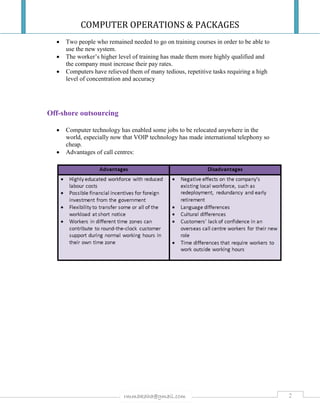
and had to rely on paper. Today, these forms of storage are rarely used or found.
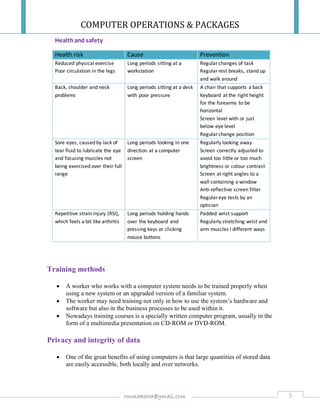
 OMR
 Punch card
When saving anything on a computer, it may ask you for a storage location, which is the area in
which you would like to save the information. By default, most information is saved to your
computer hard drive. If you want to move the information to another computer, save it to a
removable storage device such as a flash drive.
These are devices that store information permanently. They are also known as Auxiliary
storage devices or Secondary storage devices. They include:-
a) THE HARD DISK
A fixed device for storing information within the computer system unit. The disk is not
moveable and is also referred to as the C: drive. The amount of disk space a computer
has determines the power of a computer. It provides fast access known as Random access
and has high-speed storage.
b) FLOPPY DISKETTE
An external form of storage used for back up. Information can be deleted and rewritten
and re-saved. The storage device is common for microcomputers. The disks are either
High density or double density disks because data is stored more densely/ compactly than
on regular density disks. Common size of disk is 31
/2inches.
ADVANTAGES OF FLOPPY DISKETTES
1. They are cheaper than Hard disks and CD-ROMS
2. They are portable hence used to transfer data or information from one computer to
another
3. They offer direct access and they are faster than magnetic tapes
DISADVANTAGES OF FLOPPY DISKETTES
1. They are prone to viruses
2. They are difficult to handle
COMPUTER OPERATIONS & PACKAGES
61rmmakaha@gmail.com
3. They can easily be corrupted
4. They have a relatively short life span
5. They hold relatively small amounts of data
6. They are not always 100% reliable
CARE AND HANDLING OF A FLOPPY DISKETTE
1. Don’t put the diskette near any magnetic field.
2. Don’t put the diskette near any electronic motor.
3. Don’t expose the diskette to direct sunshine or heat.
4. Store the diskette in a cool dry dust-free environment.
5. Don’t spill liquid onto the diskette.
6. Don’t use any diskette which has had liquids spilled on it.
7. Don’t bend or fold a diskette.
8. Don’t staple labels onto the diskette.
9. Use a soft pencil or felt-tip pen when writing on diskette labels, as the pressure of a
ballpoint may leave indentations on the magnetic surface.
10. Don’t touch the magnetic surface (the black plastic like plate) of the disk, as your
fingerprints may hinder the drive in reading from and writing to the disk .
c) CATRIDGE TAPE
Data is recorded in the form of magnetized spots on an iron oxide coating of a plastic
tape. Gaps are used to separate individual data records. The tape is similar to audiotapes.
Access of information from the tape is in sequential form and thus slow.
d) CD-ROM (Compact Disk Read Only Memory)
Beams of laser light are used to write on optical disks by magnetic means. After writing,
the disk can only be read from and not written to. Access to information is direct and very
fast.
e) WORM (Write Once, Read Many)
WORM Disks allow microcomputers with the proper drive known as a CD Rewriters (or
a burner) to record own data on a blank CD. Once the recording is done, the disk can only
be read from and cannot be rewritten.
Erasable optical disks are also available and are known as EPROM. The major advantage
of optical disks is their storage capacity. The information on one optical requires multiple
floppies.
f) DVD (Digital Versatile Disks)
A form of optical disks similar to CD ROMS but has much more storage
capacities of up to 3.9GB. They support audio and video as well as
data on the same disk.
g) ZIP DISKS
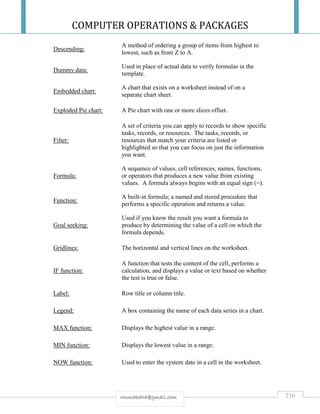
These are high capacity removable diskettes. They have gained favor for back-up
purposes. Some zip disks use magnetic technology and others use laser. They have a
capacity of about 100MB.
Storage devices differ in terms of capacity, cost and access methods. For any device to be
used there is a need for the device drive on the computer e.g. A floppy disk drive.
COMPUTER OPERATIONS & PACKAGES
62rmmakaha@gmail.com
Flash memory / solid state memory
Flash memory is a non-volatile, solid state storage device.(i.e. keeps its data without power and
has no moving parts).
Flash memory is increasingly being used in a wide range of devices. Some examples include:
 Small, lightweight USB memory sticks, available for many Gigabytes.
 Memory cards for digital cameras.
 Main internal storage for tablet computers (SSD)
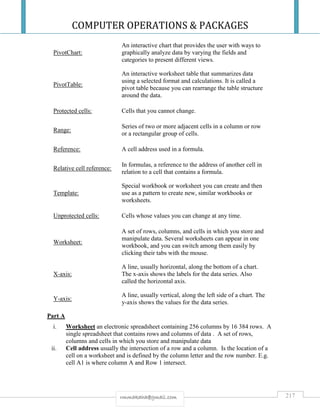
 Digital audio players.
 Mobile phones.
 Video game hardware.
 Flash memory offers very fast access to data and programs. However, retrieving data from an
external flash memory device such as a USB stick would be slower than an internal hard disk
because the speed of access is restricted by the USB link or connection.
 With the development of tablet computers, flash memory is used as the main form of internal
storage because there is no room for a traditional hard disk. These disks are called SSD (solid
state storage). In this case, access to the data stored in flash memory would be much faster
than from a hard disk because there are no moving parts involved.
 Currently, the down side to using flash memory as the main storage method is that it has a
limited number of read/write cycles which limits its useful life span.
 Flash memory, when packaged in a "memory card", is very resilient to damage, unlike many
other storage devices. It can withstand extremes of temperature, being immersed in water or
being accidentally dropped.
PROPERTIES OF FLASH MEMORY DEVICES
PROPERTY NOTES
Type of storage Solid state
Data access Direct access
Cost of storage
More expensive per byte of storage than hard disk, magnetic tape,
CDs and DVDs
Capacity 2 gigabytes upwards.
Speed
As an external storage device, it is slower than an internal hard disk. It
is faster than magnetic tape, CDs and DVDs.
If it is used as internal storage, it then becomes faster than an internal
hard disk.
Portability
Very portable as it is designed to be fitted into small electronic
devices.
Durability
Very durable. Resistant to pressure, temperature extremes and
accidental damage.
It has a limited number of read/write cycles which limits its useful life
The part of a USB stick which is inserted into the USB port can be
snapped off or damaged rendering the device unusable.
Reliability Usually very reliable.
COMPUTER OPERATIONS & PACKAGES
63rmmakaha@gmail.com
DISK CARE
1) Do not expose them to sun or a hot environment.
2) Keep them away from moisture or water.
3) Keep them away from magnetic fields i.e. Phones, tops of some monitors, magnetized
items etc..
4) Do not touch the actual tape.
5) Keep them away from dust.
6) Do not place heavy objects on them.
7) Write on a floppy disk label only with a felt-tip pen, or write before sticking the label
8) Avoid using rubber bands, paper clips and erasers on floppy disks
HARDWARE CARE
1) Make sure there is enough space for the machines to breathe. (Fresh air is necessary to
make the fan keep the electronics cool).
2) Do not block air vents with books.
3) Keep the computer dry.
4) House the machine in a dust free environment e.g. 1ST
floor carpeted-room (Carpets suck
dust) and, use a vacuum cleaner to clean the carpet. (Dust is the biggest killer of hard
drives).
5) Do not expose the machine to extreme temperatures.
6) Properly shut down the machine before turn-off.
7) Pull the plug out of socket when there is thunder and lightning.
8) Do not move the system when the computer is on. The hard drive can be damaged.
9) Use of UPS- Uninterruptible Power Supply in case of power failures,
10) Use of Surge Protectors against too high voltages.
TYPES OF MEMORY
COMPUTER – MEMORY
A memory is just like a human brain. It is used to store data and instructions. Computer memory
is the storage space in computer where data is to be processed and instructions required for
processing are stored. The memory is divided into large number of small parts called cells. Each
location or cell has a unique address which varies from zero to memory size minus one. For
example if computer has 64k words, then this memory unit has 64 * 1024=65536 memory
locations. The address of these locations varies from 0 to 65535.
Memory is primarily of three types
 Cache Memory
 Primary Memory/Main Memory
 Secondary Memory
CACHE MEMORY
Cache memory is a very high speed semiconductor memory which can speed up CPU. It acts as a
buffer between the CPU and main memory. It is used to hold those parts of data and program
COMPUTER OPERATIONS & PACKAGES
64rmmakaha@gmail.com
which are most frequently used by CPU. The parts of data and programs are transferred from disk
to cache memory by operating system, from where CPU can access them.
Advantages
The advantages of cache memory are as follows:
 Cache memory is faster than main memory.
 It consumes less access time as compared to main memory.
 It stores the program that can be executed within a short period of time.
 It stores data for temporary use.
Disadvantages
The disadvantages of cache memory are as follows:
 Cache memory has limited capacity.
 It is very expensive.
PRIMARY MEMORY (MAIN MEMORY)
Primary memory holds only those data and instructions on which computer is currently working.
It has limited capacity and data is lost when power is switched off. It is generally made up of
semiconductor device. These memories are not as fast as registers. The data and instruction
required to be processed reside in main memory. It is divided into two subcategories RAM and
ROM.
Characteristics of Main Memory
 These are semiconductor memories
 It is known as main memory.
 Usually volatile memory.
 Data is lost in case power is switched off.
 It is working memory of the computer.
COMPUTER OPERATIONS & PACKAGES
65rmmakaha@gmail.com
 Faster than secondary memories.
 A computer cannot run without primary memory.
SECONDARY MEMORY
This type of memory is also known as external memory or non-volatile. It is slower than main
memory. These are used for storing data/Information permanently. CPU directly does not access
these memories instead they are accessed via input-output routines. Contents of secondary
memories are first transferred to main memory, and then CPU can access it. For example : disk,
CD-ROM, DVD etc.
Characteristic of Secondary Memory
 These are magnetic and optical memories
 It is known as backup memory.
 It is non-volatile memory.
 Data is permanently stored even if power is switched off.
 It is used for storage of data in a computer.
 Computer may run without secondary memory.
 Slower than primary memories.
RANDOM ACCESS MEMORY
RAM(Random Access Memory) is the internal memory of the CPU for storing data, program and
program result. It is read/write memory which stores data until the machine is working. As soon
as the machine is switched off, data is erased.
Access time in RAM is independent of the address that is, each storage location inside the
memory is as easy to reach as other locations and takes the same amount of time. Data in the
RAM can be accessed randomly but it is very expensive.
RAM is volatile, i.e. data stored in it is lost when we switch off the computer or if there is a
power failure. Hence a backup uninterruptible power system(UPS) is often used with computers.
RAM is small, both in terms of its physical size and in the amount of data it can hold.
RAM is of two types
 Static RAM (SRAM)
 Dynamic RAM (DRAM)
COMPUTER OPERATIONS & PACKAGES
66rmmakaha@gmail.com
Static RAM (SRAM)
The word static indicates that the memory retains its contents as long as power is being supplied.
However, data is lost when the power gets down due to volatile nature. SRAM chips use a matrix
of 6-transistors and no capacitors. Transistors do not require power to prevent leakage, so SRAM
need not have to be refreshed on a regular basis.
Because of the extra space in the matrix, SRAM uses more chips than DRAM for the same
amount of storage space, thus making the manufacturing costs higher. So SRAM is used as cache
memory and has very fast access.
Characteristic of the Static RAM
 It has long life
 There is no need to refresh
 Faster
 Used as cache memory
 Large size
 Expensive
 High power consumption
Dynamic RAM (DRAM)
DRAM, unlike SRAM, must be continually refreshed in order to maintain the data. This is done
by placing the memory on a refresh circuit that rewrites the data several hundred times per
second. DRAM is used for most system memory because it is cheap and small. All DRAMs are
made up of memory cells which are composed of one capacitor and one transistor.
Characteristics of the Dynamic RAM
 It has short data lifetime
 Need to be refreshed continuously
 Slower as compared to SRAM
 Used as RAM
 Lesser in size
 Less expensive
COMPUTER OPERATIONS & PACKAGES
67rmmakaha@gmail.com
 Less power consumption
READ ONLY MEMORY
ROM stands for Read Only Memory. The memory from which we can only read but cannot write
on it. This type of memory is non-volatile. The information is stored permanently in such
memories during manufacture. A ROM, stores such instructions that are required to start a
computer. This operation is referred to as bootstrap. ROM chips are not only used in the computer
but also in other electronic items like washing machine and microwave oven.
Following are the various types of ROM
MROM (Masked ROM)
The very first ROMs were hard-wired devices that contained a pre-programmed set of data or
instructions. These kind of ROMs are known as masked ROMs which are inexpensive.
PROM (Programmable Read only Memory)
COMPUTER OPERATIONS & PACKAGES
68rmmakaha@gmail.com
PROM is read-only memory that can be modified only once by a user. The user buys a blank
PROM and enters the desired contents using a PROM program. Inside the PROM chip there are
small fuses which are burnt open during programming. It can be programmed only once and is
not erasable.
EPROM(Erasable and Programmable Read Only Memory)
The EPROM can be erased by exposing it to ultra-violet light for a duration of up to 40 minutes.
Usually, an EPROM eraser achieves this function. During programming, an electrical charge is
trapped in an insulated gate region. The charge is retained for more than ten years because the
charge has no leakage path. For erasing this charge, ultra-violet light is passed through a quartz
crystal window(lid). This exposure to ultra-violet light dissipates the charge. During normal use
the quartz lid is sealed with a sticker.
EEPROM (Electrically Erasable and Programmable Read Only Memory)
The EEPROM is programmed and erased electrically. It can be erased and reprogrammed about
ten thousand times. Both erasing and programming take about 4 to 10 ms (milli second). In
EEPROM, any location can be selectively erased and programmed. EEPROMs can be erased one
byte at a time, rather than erasing the entire chip. Hence, the process of re-programming is
flexible but slow.
Advantages of ROM
The advantages of ROM are as follows:
 Non-volatile in nature
 These cannot be accidentally changed
 Cheaper than RAMs
 Easy to test
 More reliable than RAMs
 These are static and do not require refreshing
 Its contents are always known and can be verified
COMPUTER - MEMORY UNITS
Memory unit is:
 The amount of data that can be stored in the storage unit.
 That in which storage capacity is expressed in terms of Bytes.
Following are the main memory storage units:
Sr.No. Unit Description
1 Bit (Binary Digit)
A binary digit is logical 0 and 1 representing a passive or an active state of a
component in an electric circuit.
2 Nibble A group of 4 bits is called nibble.
3 Byte
A group of 8 bits is called byte. A byte is the smallest unit which can represent a
data item or a character.
4 Word
A computer word, like a byte, is a group of fixed number of bits processed as a unit
which varies from computer to computer but is fixed for each computer. The length
of a computer word is called word-size or word length and it may be as small as 8
bits or may be as long as 96 bits. A computer stores the information in the form of
computer words.
COMPUTER OPERATIONS & PACKAGES
69rmmakaha@gmail.com
Few higher storage units are following………..
Sr.No. Unit Description
1 Kilobyte (KB) 1 KB = 1024 Bytes
2 Megabyte (MB) 1 MB = 1024 KB
3 GigaByte (GB) 1 GB = 1024 MB
4 TeraByte (TB 1 TB = 1024 GB
5 PetaByte (PB) 1 PB = 1024 TB
Differentiate between Random Access Memory (RAM) and Read Only Memory (ROM)
RAM ROM
 Stands for Random-Access
Memory
 Stands for Read-Only Memory
 RAM is a read and write
memory
 Normally ROM is read only memory and it
cannot be overwritten. However, EPROMs
can be reprogrammed
 RAM is faster  ROM is relatively slower than RAM
 RAM is a volatile memory. It
means that the data in RAM will
be lost if power supply is cut-off
 ROM is permanent memory. Data in ROM
will stay as it is even if we remove the power-
supply
 There are mainly two types of
RAM; static RAM and Dynamic
RAM
 There are several types of ROM; Erasable
ROM, Programmable ROM, EPROM etc.
 RAM stores all the applications
and data when the computer is
up and running
 ROM usually stores instructions that are
required for starting (booting) the computer
 Price of RAM is comparatively
high
 ROM chips are comparatively cheaper
 RAM chips are bigger in size  ROM chips are smaller in size
 Processor can directly access
the content of RAM
 Content of ROM are usually first transferred
to RAM and then accessed by processor. This
is done in order to be able to access ROM
content at a faster speed.
 RAM is often installed with
large storage.
 Storage capacity of ROM installed in a
computer is much lesser than RAM
COMPUTER OPERATIONS & PACKAGES
70rmmakaha@gmail.com
NECESSARY CONDITIONS FOR AN IDEAL
COMPUTER ROOM ENVIRONMENT.
1. Cleanliness [books, manuals not encouraged] because they bring dust & caught fire easily.
2. Air conditioners, which control the room and dehumidates it.
3. It should be dust free; dust is the biggest “killer” of hard drives.
4. No carpets, they caught fire more easily.
5. You are not allowed to eat, smoke or drink in the computer room.
6. No magnetic material should be in the computer room.
7. The computer room should be located in such a way that computers are not exposed to direct
sunlight or hot environments, use curtains if otherwise.
8. The computer room should be fitted with burglar bars, alarm systems, or guarded 24hours to
ensure security.
9. The computer room should have surge protectors or suppressors to guard against electrical
faults and high voltages.
10. The computer room should have UPS [uninterrupted power supply] in case of power failures,
which may be fatal.
11. Computer room should be well ventilated, to allow for air circulation,
12. Foreign media, such as floppy diskettes, flash disks should not be allowed in order to
minimize virus spread.
13. Always switch off machines if not in use.
14. Avoid overloading circuits.
15. All cabling and wiring should not be exposed; it should be covered and should not criss cross
the room.
16. Leave enough space between computers and the walls.
17. Do not use chalk the computer room , dry wipe markers are encouraged.
Server Computer Room Requirements
Setting up a server room is a big project. Aside from assembling all the necessary electronics, the room
itself has to meet certain requirements in order to house that expensive equipment safely. Setting up a well-
designed server room will help to protect both your physical investment and your company's data.
Temperature
 Computer equipment doesn't do well if it gets too hot. Overheating can seriously damage delicate
components beyond repair. Your server room should be air conditioned and without access to sunlight.
Ideally, you want to keep the ambient temperature of the room no higher than 72 degrees Fahrenheit.
Environmental Threats
 Dust can also cause problems for computers. Clean your server room on a regular basis. Wipe down
equipment with a clean, dry cloth, or use a compressed air canister to blow dust out of the way. Install
air filters to keep as much dust out of the room as possible. Though dust is easy to spot, the bigger
threat to your computers is actually invisible. Static electricity can be the end of a computer. Lay down
a static pad in front of any doors to help prevent static discharge. Additionally, place a sign on the door
to tell people that no magnets are allowed within the server room. Strong magnets can wreak havoc on
computer equipment.
COMPUTER OPERATIONS & PACKAGES
71rmmakaha@gmail.com
Employee Access
 Server rooms are filled with valuable and expensive equipment. Many offices choose to limit server
room access only to IT employees. Install a door lock or key pad that only select staff members have
access to. You may want to implement an entry log, just in case equipment begins to go missing.
Organization
 Keeping your server room well organized will not only help you to keep it clean, but it will also make
life much easier for the IT team. Use sturdy server racks to maximize your space. Keep cables neat and
tidy. Use zip ties to bundle them together when appropriate. Clearly label all equipment as needed.
Fire Safety
 Electrical fires can pose a real danger to your staff and your equipment. Install a clean agent (water-
free) fire suppression system in your server room. In most places, server rooms are required by law to
follow fire code. Contact your local fire department to find out about any requirements specific to your
area or to setup a free safety inspection.
General Requirements for ICT Rooms
The following is a list of issues which should be taken into account when allocating space for ICT
Installations.
1. The sizes of the various types of rooms are determined on the basis of the institution’s space
requirements for installing essential equipment such as network electronics, servers, backup robots,
telephone exchanges, cooling systems, electrical distribution panels, generic cabling systems, and so on.
2. All ICT rooms should be planned for a minimum of 15 years’ potential growth, i.e. unoccupied space
should be set aside in the ICT rooms or adjacent rooms on the same floor plan. In addition, spare space
should be pre-fitted with pipes for future room cooling/ice water units. The rooms should be given a
suitable, secure location in the building complex, i.e.:
a. In a basement (above the groundwater line – flooding must be avoided), on a lower
ground floor or in a central area. Drains with non-return valves shall be fitted in basement
rooms.
b. Windows should be avoided since these may provide access to intruders (alternatively,
windows may be fitted with bullet-proof glass).
c. The rooms should be located close to the building’s main conduit paths (vertical cable
shafts with risers or racks for cable routing and horizontal cable racks) cf. UFS 102
“Requirements for Generic Cabling Systems”.
d. Solar heating (through roofs or outside walls) should be avoided as it may necessitate
additional cooling system capacity and higher operational costs. Ice water machines on
roofs should be located in shaded areas behind lift houses if possible, thereby reducing
the solar heating of the units themselves as well as heat radiated from roofing felt close to
coolant intakes.
e. Walls, roofs and floors must be of sufficiently solid construction to prevent unauthorized
access and to bear the requisite loads. Rooms requiring high load levels (up to 1,500
kg/m²) should be located at basement level, rather than on upper floors which would
involve reinforcement of the building’s load-bearing structure (and increased costs). Note
that the requirements for soundproofing and fire protection do not automatically mean
COMPUTER OPERATIONS & PACKAGES
72rmmakaha@gmail.com
that a room will be sufficiently robust to prevent unauthorized access. For these purposes,
reinforced concrete, reinforced Leca walls or a combination of plywood/plasterboard and
steel sheet should be considered.
f. f. If free air cooling is to be used to cool small rooms, those rooms should be located
close to outside walls to provide the simplest possible access to external air.
External air should also be extracted from the shady side of the building. (The principles of free air cooling
are presented in Figure 1 “Principles for free air cooling” in UFS 108 “Ventilation and Cooling
Requirements for ICT Rooms”. Free cooling refers to a system in which cold outdoor air, for example in
winter, partly or completely replaces compressor-based cooling, cf. UFS 108 “Ventilation and Cooling
Requirements for ICT Rooms”. It should be noted that free air cooling is not compatible with the use of
hypoxic air venting as a form of fire prevention.
3. Because of fan noise from operating equipment the rooms should be located at a safe distance from
permanent workplaces, classrooms, laboratories, and so on. In general, the sound level in server rooms may
be high and experience shows that intensity levels exceeding 70 dB have been recorded. The maximum
sound intensity threshold level for classrooms is 30 dB. This means that walls abutting to classrooms
should have soundproofing with an attenuation corresponding to 50 dB Penetrations for cable or pipe entry
are not permitted in walls with a requirement for 50 dB soundproofing. Supply of 230 V power by way of
concealed wiring can be problematical. Ceilings in server rooms should also be fitted with sound-absorbing
materials, provided that those materials satisfy the requirements for dust-proofing and can be fitted in such
a way that they do not loosen if a fire extinguishing system is set off.
4. ICT rooms and conduit paths for IT cables should be located at a safe distance from installations which
emit electrical fields (water, heating and sanitation motors, transformers, lift motors, large electrical
distribution grids, and so on). The threshold value for low frequency magnetic fields in ICT rooms is
determined by the requirements of the EMC product standards for IT equipment (ITE) and is defined as 1
A/m ≈ 1.25μT in EN 55024(CISPR 24). Reference should also be made to UFS 102 “Requirements for
Generic Cabling Systems”.
5. Computer rooms must, irrespective of size, number of floors, and so on, be categorized as Fire Class 1-
3. The fire classification is determined on the basis of the potential consequences of a fire in the structure.
The consequences depend on the building’s scope of use (risk classification), size and floor plan. The fire
resistance of the elements of a building is determined on the basis of the building’s fire classification.
Constructional elements may have a load-bearing or separating function, or a combination of the two. The
fire resistance of building separating elements is designated by the letters R, E or I, and a figure specifying
fire resistance in minutes. The fire resistance of structural elements with load-bearing function is designated
by the letter R and those with separating function by the letters E and I. The letter R signifies load-bearing
capacity, E signifies integrity and I signifies insulation.
A structural element which only has a load-bearing function, such as a column or beam, may have fire
resistance classification R30, while an element with only a separating function may be classified as EI30. A
structural element which has both load-bearing and separating function may be classified as REI30.
All structural elements which abut onto an institution’s ICT rooms shall be constructed as a separate fire
cell and shall at all times satisfy the current regulations pursuant to the Planning and Building Act.
a. The fire resistance of load-bearing structural elements depends on their fire classification:
i. Fire Class 1: R30 [B30]
ii. Fire Class 2: R60 [B60]
iii. Fire Class 3: R90 [A90], non-combustible materials.
b. The fire resistance of separating structural elements (floors, walls and ceilings) depends on their fire
classification:
i. Fire Class 1: EI30 [B30]
ii. Fire Class 2: EI60 [B60]
iii. Fire Class 3: EI60 A2-s1-d0 [A60], non-combustible materials.
COMPUTER OPERATIONS & PACKAGES
73rmmakaha@gmail.com
6. The minimum ceiling height shall be 2,600 mm from the upper surface of a completed floor (ordinary
floor or raised floor) to the underside of any ceiling-mounted installations (cable racks, sprinkler heads,
light fittings, air ducts, etc.). The only exception is for wire racks for patch cables. There shall be at least
400 mm clearance from the tops of cable racks to the underside of any ceiling-mounted installations. In
practice there may be problems fitting out server rooms with a minimum ceiling height of 2,600 mm and
the overall height must be assessed based on the number of racks, ventilation ducts and so on. For
separation requirements between power supply cables and telephony/data cables, refer to UFS 102
“Requirements for Generic Cabling Systems”.
7. Doors shall be provided which permit the installation of essential equipment. Tape robots are often
larger than the following minimum specifications:
a. Server rooms: Double door, 1200×2400 mm (W×H), without sill. The design of the door and floor must
allow the transport of euro pallets.
b. ER/TR: 900×2100 mm (B×H)
Doors in separating structural elements must be of the same fire classification as the walls,
i.e.:
a. Fire Class 1: EI2 30-Sa [B30]
b. Fire Class 2: EI2 60-Sa [B60]
c. Fire Class 3: EI2 60-Sa – non-combustible [A60].
Hydraulic door closers are recommended but only obligatory in stairwells.
8. The design of transport areas (height and width of doors, corridors and lifts, strength of floors, etc.) must
be such that equipment can be transported between ICT rooms using euro pallets and hand pallet trucks.
The height shall be approximately 2,400 mm.
9. In all ICT rooms, walls, ceilings, floors and floors beneath raised floors shall be treated with anti-dust
agents and have smooth, washable surfaces. Floor coverings shall have anti-static or conductive properties
and shall be earthed to prevent the accumulation of static charges.
The resistance between any point in the floor covering and earth shall be from 1 to 10 MΩ,
cf. NEK EN 50174-1:2009.
10. All ICT rooms shall be fitted with good work lighting. Light fittings shall be installed so as to
illuminate the outsides and insides of racks as well as between racks. Some light fittings should function as
emergency lighting in the event of failure of the normal power supply.
Requirements for light intensity:
a. Horizontal plane: 500-800 lux.
b. Vertical plane: 200 lux.
11. With respect to EMC, all cable penetrations shall be limited to a small area of a wall.
Separation requirements are as specified in NEK EN 50174-2, cf. UFS 102 “Requirements for Generic
Cabling Systems”. External and internal conduit paths (cable racks) shall be electrically isolated from each
other. (cf. UFS 107 “Power Supply Requirements for ICT
Rooms”).
12. In ICT rooms classified as server rooms, ERs and TRs, separate conduit paths (racks) shall be
constructed for electrical power supply, generic cabling and patch cords. Separation requirements are as
specified in NEK EN 50174-2, cf. UFS 102 “Requirements for Generic Cabling Systems”. In larger server
rooms it is often standard practice to lay telephony/data cables on racks beneath the ceiling and power
cables on racks beneath the raised floor (as this provides good separation). Routing of cables must be
assessed in connection with the transport of cooling air and the routing of pipes to the room cooling units. It
is important that installations beneath raised floors do not block the circulation of cooling air.
COMPUTER OPERATIONS & PACKAGES
74rmmakaha@gmail.com
13. Raised floors are recommended in larger server rooms to facilitate the distribution of cooling air,
electrical power, telephony/data cables and water for room cooling units. The heights of floors are designed
on the basis of the requirements for the supply of air, electrical cables and pipes. Separation requirements
are as specified in NEK EN 50174-2, cf. UFS 102
“Requirements for Generic Cabling Systems”. The recommended minimum height is 400 mm (the actual
height must be calculated on the basis of cooling requirements or the circulation of cooling air, cf. UFS 108
“Ventilation and Cooling Requirements for ICT
Rooms”. When constructing a raised floor, the sub-floor should be lowered so that the raised floor is at the
same height as the floors in adjacent rooms, such as corridors. Ramps for access should be avoided as these
hinder the transport of equipment on euro pallets using a hand pallet truck. Raised floors should be
designed with the necessary quality to withstand the weight of equipment which is to be installed or
transported. In important ICT rooms the load may approach 1,500 kg/m². Normally, floors in teaching or
office buildings are designed for loads of 300 kg/m².
It should be noted that it is possible to establish fully-functional computer rooms without using raised
floors, i.e. by using cooling racks and chambers for collecting warm air, cf.
Figure 5.10 in UFS 108 “Ventilation and cooling requirements for ICT Rooms”. This may be particularly
applicable if a traditional raised floor cannot be used because of limited ceiling height at the location.
14. All types of water penetration must be avoided. Pressurized water pipes present the greatest risk. The
use of water is only permitted in connection with cooling installations.
Floor drains may be fitted but will present a risk of flooding in the event of backing up, and
if the U-bend dries out. If drains are used, they shall be fitted with non-return valves.
Humidity sensors should be installed in floors close to cooling units (to detect any condensation or water
leakage) and near any “forbidden through pipes” and drains.
Humidity sensors should transmit signals to the building management system. Note that local fire
authorities may require water sprinkler installations in ICT rooms if these do not constitute separate fire
cells or are not fitted with some other automatic fire extinguishing system (it is expected that ICT rooms
will normally be locked and not used by the public).
15. Any through-going water pipes and pipes serving cooling units should be insulated to prevent
condensation and the risk of introducing extrinsic earth potential, cf. UFS 107
“Power Supply Requirements for ICT Rooms”. If extrinsic installations cannot be avoided or insulated,
they should have the same earth potential as the remaining ICT installations.
16. All operating computer equipment, distribution networks and backbone cables shall be installed in
racks with access from the front. The following recommendations apply to racks:
a. Clearance at front: 1500 mm
b. Clearance at back: 1000 mm
c. Rack dimensions in server rooms and similar rooms: 800×1000 mm (W×D)
d. Rack dimensions in ER, TR, bays and similar rooms: 800×800 mm (W×D).
The amount of clearance is dictated by NEK EN 50174 which states that the “smallest clearance at all
surfaces on racks and cabinets where access is required shall be 1.2 m”. In small rooms (bays) it may be
appropriate to install racks against walls. Before a decision is made one should ensure that all installation
and future expansion can be carried out by access from the front of the rack. In general, the use of bays is
not recommended.
Greater depth may be necessary and it is therefore important to check the depth of equipment which is to be
installed before selecting racks. The use of open racks as opposed to racks with sidewalls and doors (at
front and back) must be assessed according to need, i.e. the type of equipment to be installed and the
regulation of cooling air circulation. The distance between racks should also be assessed in connection with
ventilation via raised floors.
Note that 800 mm wide server racks may present a challenge with regard to undesirable warm air flowing
from the warm to the cold side of the interior of the racks (short-circuiting the desired air flow). This air
COMPUTER OPERATIONS & PACKAGES
75rmmakaha@gmail.com
flow can be difficult to block. In a rack of 600 mm width there is less room for air to pass along the side of
the servers and the problem of undesirable warm air is therefore reduced.
17. Cooling units and electrical distribution panels can be installed against walls. There must be sufficient
clearance to enable normal servicing and the removal and insertion of defective and new units. With regard
to EMC the distance between electrical distribution panel and active or passive ICT equipment should be at
least 1,000 mm. If in doubt, the EMC requirements of the equipment should be checked. It is important to
make allowance for future expansions by reserving space for new cooling units, larger electrical
distribution grids and the laying of cooling pipes and outlets.
18. A large server room may be divided into smaller rooms to achieve better security (cooling, fire
protection, etc.).
19. UPS units use valve-regulated batteries which emit gases (hydrogen and oxygen) when the internal
pressure exceeds a certain level. When hydrogen and oxygen issue into the battery room, an explosive
mixture may arise if the hydrogen concentration in the air exceeds 4% by volume. Battery rooms shall be
ventilated so that the hydrogen concentration is always below this level. Battery rooms shall be designed
according to the requirements of NEK EN
50272, “Safety requirements for secondary batteries and battery installations – Part 2:
Stationary batteries”. Cf. UFS 108 “Ventilation and Cooling Requirements for ICT Rooms”.
The normal operating temperature for batteries is 20 °C, compared with computer equipment which
requires 20-25°C. An increase in temperature of 10°C halves the lifetime of a battery. A shared room for
batteries and computer equipment will not be economical owing to the need for increased cooling capacity.
Moreover, a shared room will require ventilation which would be unfavourable with regard to fire
extinguishing (hypoxic air venting and gas-based extinguishing systems call for airtight rooms). In larger
battery rooms the use of explosion-proof (EX rated) 230 V equipment should be considered.
20. Only authorized personnel shall have access to the various rooms. Traffic in and out should be logged.
It is recommended to provide an access control system which serves all the rooms. Should strict security be
required, the need for burglar alarm and video surveillance systems (inside and outside the rooms) should
be considered.
21. ICT rooms containing active equipment shall never be used as storerooms. Only rooms designated as
storerooms shall be used for storing ICT equipment. Inflammable materials should not be stored in rooms
abutting to ICT rooms. Automatic sprinkler systems should also be installed in adjacent rooms and can
normally be part of the building’s sprinkler system.
22. All ICT rooms should be airtight, i.e. any ventilation must be facilitated using regulated ventilation
systems. The use of automatic fire extinguishing systems demands airtight rooms. All cable penetrations
shall be fireproofed using approved products and the installation shall be documented. Cf. UFS 108
“Ventilation and Cooling Requirements for ICT Rooms” and UFS 104 “Fire Prevention Requirements for
ICT Rooms”.
23. Fire extinguisher systems will be particularly relevant in cases where passive measures are
unsatisfactory, such as in buildings with high fire energy, in buildings with shafts and channels which are
difficult to access and in buildings with large, non-sectionalized floor spaces. For example, a sprinkler
system is required if the largest gross area of nonsectionalised floor is greater than 1,800 m² (on condition
that fire alarms are installed). A sprinkler system is also required if an open fire cell extends over three
floor levels and the combined gross area is greater than 800 m².
Large buildings are often equipped with sprinklers because this provides greater flexibility with regard to
the floor plan.
In rooms or areas which are not suited to the use of sprinkler systems, other types of extinguishing systems
must be used.
COMPUTER OPERATIONS & PACKAGES
76rmmakaha@gmail.com
DATA SECURITY/PROTECTION
 Refers to keeping data safe from various hazards or dangers like natural hazards,
deliberate corruption or destruction of software & hardware by malicious or terrorist
acts, illegal access to data by hackers [people who break into the system] &
accidental destruction of data by hardware or software failure [operator error].
MEASURES TO ENSURE DATA SECURITY
1. Data Encryption/Decryption- Data is coded before transmission over a WAN &
decrypted only if you have the key & code to decrypt the data on the receiving end.
The process of transforming a message in ordinary language i.e. plain text to produce
what is called cipher text which is then send along a communication line/link. The
receiving computer uses another transformation to decode the message.
Decryption
 The process of converting encrypted content back into its original form, often the
process of converting cipher text to plaintext. Decryption is the opposite of
encryption.
Encryption
 Any procedure used in cryptography to convert plaintext into cipher text in order
to prevent anyone except the intended recipient from reading that data. There are
many types of data encryption, and they are the basis of network security.
Common types include Data Encryption Standard and public-key encryption.
Cipher text
 Data that has been transformed by encryption so that its semantic information
content (ie, its meaning) is no longer intelligible or directly available.
2. Firewall
 A firewall is a software program designed to prevent unauthorized access to a PC
or network through a connection to the Internet. It works by monitoring all data
sent to and from the PC and comparing the data with a set of user-defined security
criteria. Any data that does not meet that criteria is blocked. Firewalls also
process encrypted data. They verify the validity of the user. User would require
access to the firewall before they can transmit data. Latest firewalls also have the
ability to detect virus software in packets of data that is sent through the network.
Firewalls disallow data transmission if it detects strains of virus on the data being
transmitted.
3) Usernames & Passwords
 Passwords restrict only authorized personnel/users to have access to the data or
computer rooms [cards]. Passwords bring in an aspect of accountability, if a file is
deleted, the person with the password will be reported as the culprit through
logging. Passwords can be forgotten. Widely used by companies to protect their
equipment & data
COMPUTER OPERATIONS & PACKAGES
77rmmakaha@gmail.com
4) Authorized entry to computer installations
 Most installations have card readers, voice recognition systems or keypads on the
doors that prohibit entry to unauthorized personnel.
5) Backing-up files on external disks periodically.
6) Keeping backup copies of files in a different location and making about 3 generations
of backup.
7) Saving work frequently
8) Avoiding viruses.
9) Restricting access to the computer room. Access could be only through codes, voice
recognition etc.
10) Installing fire alarms.
11) Lining computer rooms with fire resistant material.
12) Placing the computer room in upper floors of a building to avoid burglaries.
13) Having a security guard 24 hours a day.
Summary - Keeping data secure
Measures that can be taken to keep data safe include:
 Making regular back-ups of files. (Back up copies should be stored safely in
fireproof safes or in another building.)
 Protecting yourself against viruses by running anti-virus software.
 Using a system of passwords so that access to data is restricted.
 Safe storage of important files stored on removable disks - eg locked away in a
fireproof and waterproof safe.
 Allowing only authorized staff into certain computer areas, eg by controlling
entry to these areas by means of ID cards or magnetic swipe cards.
 Always logging off or turning terminals off and if possible locking them.
 Avoiding accidentally deletion of files by write-protecting disks.
 Using data encryption techniques to code data so that it makes no apparent sense
 BACK UP
 Copying or saving data to a different location. One can restore the backup
copy if data is lost or damaged.
 To create a copy of a disk’s contents on another location for safe keeping.
Since hard drives are not infallible, it is recommended that you backup its
contents regularly.
DISASTER PLANNING
 Many companies have comprehensive emergency plans so that even after suffering a
severe:
 Bomb
 Fire damage
 Natural disaster, the company can be up and running within a day or
two.
COMPUTER OPERATIONS & PACKAGES
78rmmakaha@gmail.com
 A disaster recovery service/programme provides for example
 Office space
 Computer facilities
 Phones
 Desks, at an emergency BACKUP site.
 A completely up to date copy of the company Database may be permanently
maintained at this site with all transactions being transmitted to this remote site
updating the database, copying etc.
 The data should be backed up/stored to one or more media to ensure recovery in
case of disaster.
 The back up procedures and media should be tested periodically to assess their
effectiveness.
Disaster plan
 The documented policies and procedures intended to either prevent damage,
minimize damage, or recover from damage to record materials.
Disaster recovery plan
 The document that defines the resources, actions, tasks and data required to
manage the business recovery process in the event of a business interruption. The
plan is designed to assist in restoring the business process within the stated
disaster recovery goals.
 Part of an overall contingency plan. The plan for a process whereby an enterprise
would restore any loss of data in the event of fire, vandalism, natural disaster, or
system failure.
MAJOR THREATS TO INFORMATION SYSTEMS/COMPUTERS
Key threats to data security
 Data can be lost or damaged during a system crash - especially one affecting the
hard disk.
 Data can become corrupt as a result of faulty disks or disk drives, or power
failures.
 Data can be lost by accidentally deleting or overwriting files.
 Data can be lost or become corrupted by computer viruses.
 Data can be hacked into by unauthorized users and deleted or altered.
 Data can be destroyed by terrorist activities, war, bombs and fire.
 Data can be deleted or altered by unpleasant employees wishing to make money
or seek revenge on their employers.
COMPUTER OPERATIONS & PACKAGES
79rmmakaha@gmail.com
Explain 5 major threats to information systems; for each threat describe its impact
and preventative measure you would adopt to prevent it. [15].
THREAT IMPACT CONTROL
Hardware
failure
 You are grounded
 You cannot access the system
 Data is incorrectly/
incompletely processed
 Have spares in the warehouse.
 Do regular servicing
 Have a disaster plan
 Run hardware diagnostics frequently
Electrical faults  Loss of data
 Disk crushes
 Damage to hardware
 Have standby generators
 Install UPS [uninterrupted power supply]
 Install Surge suppressors/ protectors
Software
failures
 Operations are grounded  Buy software from reputable vendors.
 Do regular back ups
 Software diagnostics
Natural
disasters/
physical threats
 Absolute destruction  Relocate backups to other areas free from
disasters
Viruses  Deletion & corruption of files
 Reformatting of documents
 System may fail to work
 Install a reliable anti-virus software
 Never download unknown e-mail
attachments
 Scan unknown diskettes
Hackers,
Computer
crime
 Security is breached
 Security is bypassed
 Destruction of files
 Data is stolen
 Change passwords regularly
 Employ a security guard
 Install a firewall
 Prevent unauthorized access to computer
facilities.
War and Terrorist activity
Human error
As use of internet and related telecommunications technologies and systems has become
pervasive ,use of these networks now creates a new vulnerability for organizations or
companies .These networks can be infiltrated or subverted a number of ways .As a result
,organizations or companies will faced threats that affect and vulnerable to information
system security . Threats to information system can come from a variety of places inside
and external to an organizations or companies .In order to secure system and information
,each company or organization should analyze the types of threats that will be faced and
how the threats affect information system security .Examples of threats such as
unauthorized access (hacker and cracker ) ,computer viruses ,theft ,sabotage ,vandalism
and accidents
COMPUTER OPERATIONS & PACKAGES
80rmmakaha@gmail.com
The Threats of Information System Security
Unauthorized
Access
(Hacker and
Cracker)
One of the most common security risks in relation to computerized
information systems is the danger of unauthorized access to confidential
data .The main concern comes from unwanted intruders, or hackers, who
use the latest technology and their skills to break into supposedly secure
computers or to disable them .A person who gains access to information
system for malicious reason is often termed of cracker rather than a
hacker.
 Spoofing and Sniffing
 Denial of Service Attacks
(DOS)
Computer
Viruses
Computer virus is a kind of nasty software written deliberately to enter a
computer without the user’s permission or knowledge ,with an ability to
duplicate itself ,thus continuing to spread .Some viruses do little but
duplicate others can cause severe harm or adversely affect program and
performance of the system .Virus program may still cause crashes and
data loss .In many cases ,the damages caused by computer virus might be
accidental ,arising merely as the result of poor programming .Type of
viruses ,for example ,worms and Trojan horses .
 Worms
 Trojan horses
Theft The loss of important hardware, software or data can have significant
effects on an organization’s effectiveness .Theft can be divided into three
basic categories: physical theft, data theft, and identity theft.
 Physical Theft
 Data Theft
 Identity Theft
Sabotage With regard to information systems , damage may be on purpose or
accidental and carried out an individual basis or as an act of industrial
sabotage .Insiders have knowledge that provide them with capability to
cause maximum interruption to an agency by sabotaging information
systems .Examples include destroying hardware and infrastructure
,changing data ,entering incorrect data ,deleting software ,planting logic
bombs ,deleting data ,planting a virus .
 Individual Sabotage
 Industrial Sabotage
 Unintentional Sabotage
Vandalism Deliberate damage cause to hardware, software and data is considered a
serious threat to information system security .The threat from vandalism
lies in the fact that the organization is temporarily denied access to
someone of its resources .Even relatively minor damage to parts of a
system can have a significant effect on the organization as a whole.
Accidents Major of damage caused to information systems or corporate data arises
as a result of human error .Accidental misuse or damage will be affected
over time by the attitude and disposition of the staff in addition to the
environment .Human errors have a greater impact on information system
security than do manmade threats caused by purposeful attacks .But most
accidents that are serious threats to the security of information systems
can be mitigated.
 Inaccurate data entry
 Attempts to carry out
tasks beyond the ability of
the employee
COMPUTER OPERATIONS & PACKAGES
81rmmakaha@gmail.com
The 10 most common security threats
THREAT
1. Malware: Malware is short for “malicious software.” Wikipedia describes malware as a term used to mean a “variety of forms of
hostile, intrusive, or annoying software or program code.” Malware could be computer viruses, worms, Trojan horses,
dishonest spyware, and malicious rootkits—all of which are defined below.
2. Computer
virus:
A computer virus is a small piece of software that can spread from one infected computer to another. The virus could
corrupt, steal, or delete data on your computer—even erasing everything on your hard drive. A virus could also use other
programs like your email program to spread itself to other computers.
3. Rogue
security
software:
Have you ever seen a pop-up window that advertises a security update or alert? It appears legitimate and asks you to click
on a link to install the “update” or “remove” unwanted malicious software that it has apparently detected. This could be
rogue security software designed to lure people into clicking and downloading malicious software. Microsoft has a useful
webpage that describes rogue security software and how you can protect yourself.
4. Trojan
horse:
Users can infect their computers with Trojan horse software simply by downloading an application they thought was
legitimate but was in fact malicious. Once inside your computer, a Trojan horse can do anything from record your
passwords by logging keystrokes (known as a keystroke logger) to hijacking your webcam to watch and record your
every move.
Trojan horses, commonly referred to as Trojan, are programs. They masquerade as normal, safe applications, but their
mission is to allow a hacker remote access to your computer. In turn, the infected computer can be used as part of a
denial of service attack and data theft can occur.
A particularly nasty Trojan is a keystroke logger than can be used to capture passwords, credit card numbers and other
sensitive information.
5. Malicious
spyware:
Malicious spyware is used to describe the Trojan application that was created by cybercriminals to spy on their victims.
An example would be keylogger software that records a victim’s every keystroke on his or her keyboard. The recorded
information is periodically sent back to the originating cybercriminal over the Internet. Keylogging software is widely
available and is marketed to parents or businesses that want to monitor their kids’ or employees’ Internet usage.
Spyware usually invades computers through software downloads. Shareware and freeware downloads, in addition to
peer-to-peer file sharing are typical infection points. Like Trojans, spyware can pilfer sensitive information, but are often
used as advertising tools as well. The intent is to gather a user's information by monitoring Internet activity and
transmitting that to an attacker.
6. Computer
worm:
A computer worm is a software program that can copy itself from one computer to another, without human interaction.
Worms can replicate in great volume and with great speed. A worm is a specific type of virus. Unlike a typical virus, it's
goal isn't to alter system files, but to replicate so many times that it consumes hard disk space or memory. Worm victims
will notice their computers running slower or crashing.
7. Botnet: A botnet is a group of computers connected to the Internet that have been compromised by a hacker using a computer
virus or Trojan horse. An individual computer in the group is known as a “zombie“computer.
The botnet is under the command of a “bot herder” or a “bot master,” usually to perform nefarious activities. This could
include distributing spam to the email contact addresses on each zombie computer, for example. If the botnet is
sufficiently big in number, it could be used to access a targeted website simultaneously in what’s known as a denial-of-
service (DoS) attack. The goal of a DoS attack is to bring down a web server by overloading it with access requests.
Popular websites such as Google and Twitter have been victims of DoS attacks.
8. Spam: Spam in the security context is primarily used to describe email spam —unwanted messages in your email inbox. Spam,
or electronic junk mail, is a nuisance as it can clutter your mailbox as well as potentially take up space on your mail
server. Unwanted junk mail advertising items you don’t care for is harmless, relatively speaking. However, spam
messages can contain links that when clicked on could go to a website that installs malicious software onto your
computer.
9. Phishing: Phishing scams are fraudulent attempts by cybercriminals to obtain private information. Phishing scams often appear in
the guise of email messages designed to appear as though they are from legitimate sources. For example, the message
would try to lure you into giving your personal information by pretending that your bank or email service provider is
updating its website and that you must click on the link in the email to verify your account information and password
details.
10. Rootkit: According to TechTarget, a rootkit is a collection of tools that are used to obtain administrator-level access to a computer
or a network of computers. A rootkit could be installed on your computer by a cybercriminal exploiting a vulnerability or
security hole in a legitimate application on your PC and may contain spyware that monitors and records keystrokes.
Rootkits are some of the most difficult to detect. They are activated when your system boots up -- before anti-virus
software is started. Rootkits allow the installation of files and accounts, or the purposes of intercepting sensitive
information.
COMPUTER OPERATIONS & PACKAGES
82rmmakaha@gmail.com
Definitions of computer abuse on the Web:
 The willful or negligent unauthorized activity that affects the availability,
confidentiality, or integrity of computer resources. Computer abuse includes
fraud, embezzlement, theft, malicious damage, unauthorized use, denial of
service, and misappropriation

Definitions of hacking on the Web:
 Unauthorized use, or attempts to circumvent or bypass the security mechanisms of
an information system or network. Hacking means illegally accessing other
people's computer systems for destroying, disrupting or carrying out illegal
activities on the network or computer systems.
DATA INTEGRITY/RELIABILITY
 Refers to the correctness AND The accuracy of data after being transmitted or
processed
 Data in the computer system may become incorrect, corrupted or of poor quality
in many different ways & at any stage during data processing.
 Consequences of system failure:
 Loss of business due downtime
 Delays
 Air traffic control system could well have catastrophic results
COMPUTER CRIME/FRAUD
 Computer crimes are criminal activities, which involve the use of information
technology to gain an illegal or an unauthorized access to a computer system with
intent of damaging, deleting or altering computer data. Computer crimes also
include the activities such as electronic frauds, misuse of devices, identity theft
and data as well as system interference. Computer crimes may not necessarily
involve damage to physical property. They rather include the manipulation of
confidential data and critical information. Computer crimes involve activities of
software theft, wherein the privacy of the users is hampered. These criminal
activities involve the breach of human and information privacy, as also the theft
and illegal alteration of system critical information. The different types of
computer crimes have necessitated the introduction and use of newer and more
effective security measures.
COMPUTER OPERATIONS & PACKAGES
83rmmakaha@gmail.com
 Computer Fraud/Crime
 Criminal actions accomplished through the use of computer systems,
especially with the intent to defraud, destroy, damage, or make
unauthorized use of computer resources.
 E.g. improper transfer of funds from one account to another
TYPES OF COMPUTER CRIME/FRAUD
a) Intellectual Crime – cracking into a computer system for the purpose of transferring
or obtaining funds is a typical e.g.
b) Destruction of property – destroying a computer property
c) Theft – Software piracy which is unauthorized copying of software. Hardware &
software being taken away without the knowledge/consent of its owners.
d) Fraud achieved by the manipulation of computer records.
e) * Spamming wherever outlawed completely or where regulations controlling it are
violated.
f) * Deliberate circumvention of computersecurity systems.
g) * Unauthorized access to or modification of programs (see software cracking and
hacking) & data.
h) * Intellectual property theft, including software piracy.
i) * Industrial espionage by means of access to or theft of computer materials.
j) * Identity theft where this is accomplished by use of fraudulent computer
transactions.
k) * Writing or spreading computerviruses or worms.
l) * Salami slicing is the practice of stealing money repeatedly in extremely small
quantities.
m) *DNSDenial-of-service attack, where company websites are flooded with service
requests and their website is overloaded and either slowed or crashes completely.
n) * Making and digitally distributing child pornography
Types of Computer Crime
Hacking: The activity of breaking into a computer system to gain an unauthorized access
is known as hacking. The act of defeating the security capabilities of a computer system
in order to obtain an illegal access to the information stored on the computer system is
called hacking. The unauthorized revelation of passwords with intent to gain an
unauthorized access to the private communication of an organization of a user is one of
the widely known computer crimes. Another highly dangerous computer crime is the
hacking of IP addresses in order to transact with a false identity, thus remaining
anonymous while carrying out the criminal activities.
Phishing: Phishing is the act of attempting to acquire sensitive information like
usernames, passwords and credit card details by disguising as a trustworthy source.
Phishing is carried out through emails or by luring the users to enter personal information
through fake websites. Criminals often use websites that have a look and feel of some
popular website, which makes the users feel safe to enter their details there.
COMPUTER OPERATIONS & PACKAGES
84rmmakaha@gmail.com
Computer Viruses: Computer viruses are computer programs that can replicate
themselves and harm the computer systems on a network without the knowledge of the
system users. Viruses spread to other computers through network file system, through the
network, Internet or by the means of removable devices like USB drives and CDs.
Computer viruses are after all, forms of malicious codes written with an aim to harm a
computer system and destroy information. Writing computer viruses is a criminal activity
as virus infections can crash computer systems, thereby destroying great amounts of
critical data.
Cyberstalking: The use of communication technology, mainly the Internet, to torture
other individuals is known as cyberstalking. False accusations, transmission of threats
and damage to data and equipment fall under the class of cyberstalking activities.
Cyberstalkers often target the users by means of chat rooms, online forums and social
networking websites to gather user information and harass the users on the basis of the
information gathered. Obscene emails, abusive phone calls and other such serious effects
of cyberstalking have made it a type of computer crime.
Identity Theft: This is one of the most serious frauds as it involves stealing money and
obtaining other benefits through the use of a false identity. It is the act of pretending to be
someone else by using someone else's identity as one's own. Financial identity theft
involves the use of a false identity to obtain goods and services and a commercial identity
theft is the using of someone else’s business name or credit card details for commercial
purposes. Identity cloning is the use of another user's information to pose as a false user.
Illegal migration, terrorism and blackmail are often made possible by means of identity
theft.
The different types of computer crimes involve an illegal exploitation of the computer
and communication technology for criminal activities. While the advancing technology
has served as a boon to mankind, the destructively directed human intellects are all set to
turn technology into a curse. However, crimes are sure to end, as it is truth that always
triumphs!
1. Intellectual crime – cracking into a computer system with the sole aim of
transferring or stealing funds, e.g. Salami slicing which is the activity of
obtaining or stealing money repeatedly in extremely small quantities over a period
of time
2. Destruction of property
3. Software piracy
4. Deliberate circumvention of computer security systems or unauthorized access to
or modification of computer programs and data; i.e. hacking which attempts to
bypass the security mechanism of a computer system or network
5. Theft of computer hardware and software or taking away software without the
owner’s consent
6. Making and distributing pornography
COMPUTER OPERATIONS & PACKAGES
85rmmakaha@gmail.com
MEASURES TO COUNTER OR COMBAT COMPUTER CRIME [COMPUTER
SECURITY]
 Careful vetting of employees
 Separation of duties
 Use of passwords
 Security manager software-to monitor attempts to access the system
whether successful or not.
 Educating staff
 Prevention of unauthorized access to the computer operations room
 Data Encryption/Decryption
1. Establish strong passwords
Implementing strong passwords is the easiest thing you can do to strengthen your
security.
Cloutier shares his tip for crafting a hard-to-crack password: use a combination of
capital and lower-case letters, numbers and symbols and make it 8 to 12
characters long.
You should definitely avoid using: any personal data (such as your
birthdate), common words spelled backwards and sequences of characters or
numbers, or those that are close together on the keyboard.
Use their convenient password checker to see how strong yours is.
As for how often you should change your password, Cloutier says that the
industry standard is "every 90 days," but don't hesitate to do it more frequently if
your data is highly-sensitive.
Another key: make sure every individual has their own username and password
for any login system, from desktops to your CMS. "Never just use one shared
password," says Cloutier.
And finally, "Never write it down!" he adds.
2. Put up a strong firewall
In order to have a properly protected network, "firewalls are a must," Cloutier
says.
A firewall protects your network by controlling internet traffic coming into and
flowing out of your business. They're pretty standard across the board -- Cloutier
recommends any of the major brands.
3. Install antivirus protection
Antivirus and anti-malware software are essentials in your arsenal of online
security weapons, as well.
COMPUTER OPERATIONS & PACKAGES
86rmmakaha@gmail.com
"They're the last line of defense" should an unwanted attack get through to your
network, Cloutier explains.
4. Update your programs regularly
Making sure your computer is "properly patched and updated" is a necessary step
towards being fully protected; there's little point in installing all this great
software if you're not going to maintain it right.
"Your security applications are only as good as their most recent update,"
Watchinski explains. "While applications are not 100 percent fool-proof, it is
important to regularly update these tools to help keep your users safe."
Frequently updating your programs keeps you up-to-date on any recent issues or
holes that programmers have fixed.
5. Secure your laptops
Because of their portable nature, laptops are at a higher risk of being lost or stolen
than average company desktops. It's important to take some extra steps to make
certain your sensitive data is protected.
Encryption software changes the way information looks on the harddrive so that,
without the correct password, it can't be read.
6. Secure your mobile phones
Cloutier points out that smartphones hold so much data these days that you should
consider them almost as valuable as company computers -- and they're much
more easily lost or stolen. As such, securing them is another must.
The must-haves for mobile phones:
 Encryption software
 Password-protection (Cloutier also suggests enabling a specific "lock-out"
period, wherein after a short amount of time not being used, the phone locks
itself)
 Remote wiping enabled
7. Backup regularly
Scheduling regular backups to an external hard drive, or in the cloud, is a painless
way to ensure that all your data is stored safely.
The general rule of thumb for backups: servers should have a complete backup
weekly, and incremental backups every night; personal computers should also be
backed up completely every week, but you can do incremental backups every few
days if you like ("however long you could live without your data," Cloutier
explains).
Getting your data compromised is a painful experience -- having it all backed up
so you don't completely lose it will make it much less so.
8. Be careful with e-mail, IM and surfing the Web
It's not uncommon for a unsuspecting employee to click on a link or download an
attachment that they believe is harmless -- only to discover they've been infected
with a nasty virus, or worse.
9. Educate your employees
Teaching your employees about safe online habits and proactive defense is
crucial.
COMPUTER OPERATIONS & PACKAGES
87rmmakaha@gmail.com
"Educating them about what they are doing and why it is dangerous is a more
effective strategy than expecting your IT security staff to constantly react to end
users’ bad decisions," Watchinski says.
It's not easy: "One of the most difficult things to do is protect end users against
themselves," he adds. But ultimately, prevention is the best approach to handling
your data security.
Make sure your employees understand how important your company's data is, and
all the measures they can take to protect it.
10. Data encryption
Encryption scrambles data, and is used to protect information that is being held on
a computer, stored on external media such as DVDs or transmitted over a
network.
11. Intrusion detection
These products monitor system and network activity to spot potential security
breaches. If a detection system suspects an attack, it can generate an alarm, such
as an email alert, based upon the type of activity it has identified.
COMPUTER VIRUS
What is it?
 An executable computer program written intentionally to alter the way a
computer operates without permission, to do harm to the computer.
Types of Computer Viruses
 Macro Viruses – are programmed as macros and embedded into a file or
document and when the document is opened the virus is activated. A macro is a
list of commands or actions that are found under key names of headings. Macro
viruses typically infect global settings files such as Word templates so that
subsequently edited documents are contaminated with the infective macros
 Boot Sector Viruses – A virus which attaches itself to the first part of the hard
disk that is read by the computer upon bootup. These are normally spread by
floppy disks. They only affect the computer’s boot sector such that the next time
you try to start the computer it fails to boot
 Time Bomb – is designed to cause damage to a computer at a specified date and
time, e.g. Friday 13th
, March 6th
 Logic Bomb – checks for particular conditions or states of the system which
when satisfied triggers the perpetration of an unauthorized and usually destructive
act. It lies dormant for most of the time and is triggered by an event
 Memory resident virus – resides in a computer’s volatile memory (RAM).
 Polymorphic viruses – a virus that not only replicates itself by creating multiple
files of itself, but it also its digital signature every time it replicates. This makes it
difficult for less sophisticated antivirus software to detect
COMPUTER OPERATIONS & PACKAGES
88rmmakaha@gmail.com
 Program viruses e.g. cascade, pacman 1508, override.
 Boot viruses e.g. pasta, pentagon, Michelangelo
 Internet Viruses e.g. Trojan horse, Stealth
DEFINITION2.
A virus is a computer program designed to enter your computer and tamper with your
files without your knowledge. Once the program containing the virus is open, the
activated virus can not only infect other programs and documents on your computer, it
can duplicate and transmit itself to other computers that are connected to yours, just like
a physical virus can move from one human host to another.
Virusesbegan in the late 1980s as personal computers and electronic bulletin boards
became more common. Back then, operating systems, word processing programs and
other programs were stored on floppy disks. Hidden Viruseswere programmed onto these
disks; as the disks were transferred from person to person, the virus spread.
WHO CREATES VIRUSES?
Where do Viruses come from? Every virus is created by an author with a different
motive—but all virus builders feel their actions are justified. For some, a killer virus is
the ultimate technical challenge, like climbing a mountain. For others, creating Viruses is
a form of self-expression. Some disgruntled employees, consumers or citizens turn to
virus building as revenge for perceived injustices. And though it’s a frightening thought,
some Virusesare built and aimed by legitimate (but disreputable) businesses to weaken
competitors. Other virus authors want to make their mark in Internet history; these writers
get a thrill out of seeing their virus cause damage enough to attract news headlines both
online and on the evening news.
What Viruses Do? /Signs & symptoms of an infected computer.
 Reduced memory or disk space
 Files are overwritten or damaged
 Hard drive may be erased
 Data is modified /corrupted.
 Change files & date stamp
 Drive lights blink without reason
 Longer times are experienced when loading programs
 Slower system operation.
 Deletion of data files
 The computer completely fails to work
 Erasure or deletion of executable files
 Formatting of the hard disks
 Filling up of disk space
 Programs suddenly take longer to load.
 The size of a program changes.
 The disk runs out of free space when it seems to have plenty.
COMPUTER OPERATIONS & PACKAGES
89rmmakaha@gmail.com
 The CHKDSK command does not show the correct amount of bytes available.
 Bit errors frequently occur while running Windows.
 The disk drive is active when it should not be.
 The hard drive is inaccessible when booting from a floppy drive.
 Unrecognized files appear.
 File names change.
 The keyboard makes a clicking noise.
 The screen becomes distorted.
 Text on screen does unusual things.
 CMOS settings, AUTOEXEC.BAT, or CONFIG.SYS files change unexpectedly
(Symantec).
A large part of detection is anti-virus software. Like a doctor, anti-virus
software often uses the above listed symptoms to identify and eradicate an
infection.
What are the symptoms of an infected computer?
It’s not always easy to tell if your computer has been compromised. More than ever
before, the authors of viruses, worms, Trojans and spyware are going to great lengths to
hide their code and conceal what their programs are doing on an infected computer.
That’s why it’s essential to follow the advice given in this guide: in particular, install
Internet security software, make sure you apply security patches to your operating system
and applications and backup your data regularly.
It’s very difficult to provide a list of characteristic symptoms of a compromised computer
because the same symptoms can also be caused by hardware and/or software problems.
Here are just a few examples:
 Your computer behaves strangely, i.e. in a way that you haven’t seen before.
 You see unexpected messages or images.
 You hear unexpected sounds, played at random.
 Programs start unexpectedly.
 Your personal firewall tells you that an application has tried to connect to the
Internet (and it’s not a program that you ran).
 Your friends tell you that they have received e-mail messages from your address
and you haven’t sent them anything.
 Your computer ‘freezes’ frequently, or programs start running slowly.
 You get lots of system error messages.
 The operating system will not load when you start your computer.
 You notice that files or folders have been deleted or changed.
 You notice hard disk access (shown by one of the small flashing lights) when
you’re not aware of any programs running.
 Your web browser behaves erratically, e.g. you can’t close a browser window.
COMPUTER OPERATIONS & PACKAGES
90rmmakaha@gmail.com
How computers are infected with Viruses?
 Use of infected floppy diskettes on uninfected computers. Floppy disks or
other media that users can exchange.
 Downloading unknown files, when your computer is connected to the Internet.
 Opening an E-mail attachment. Email attachments.
 Accepting unknown program installations from the internet
 Use of network files/direct connection/through networks.
 Software piracy [buying software from unauthorized agents]. Pirated software.
 Booting a PC from an infected medium.
 Executing an infected program.
 Opening an infected file.
 Shareware.
 Viruses may be sent by opening email attachments,
 clicking on spam,
 visiting corrupt websites and links online,
 Opening spreadsheets or even the original method—infected disks.
 But the Internet is now the superhighway for virus transmission.
Sharing of storage media
 Through e-mail attachments
 Networks – if your computer is connected to a home network or if your work
computer is part of network, you may find yourself with an infection through no
fault of your own. There isn’t much you can do to stop these kinds of infections,
short of having your network administrator ensure that everyone’s antivirus
software is up to date so that the invading bug can be removed as quickly as
possible.
 Internet downloads including software piracy
 Rogue Websites. It is depressing to know that you may become infected with
spyware or a virus by doing nothing more than simply visiting a website, but it
istrue. Many adult websites, gambling websites and other less than trustworthy
websites will attempt to automatically access your computer when you visit them.
They often install adware bugs that will cause a flurry of pop ups to appear on
your screen. This adware will often allow for other programs with even more
nefarious purposes to be installed and before you know it, your computer will be
swamped. To stop these rogue websites, adjust the settings on your antivirus
software and firewall so that no outside connections can be made and no
programs can be installed without your express permission.
CHARACTERISTICS and ATTRIBUTES OF COMPUTER VIRUSES
The demonstrated characteristics of computer viruses include several remarkable items,
including size, versatility, propagation, effectiveness, functionality, and persistence.
1) Size.The sizes of the program code required for computer viruses has been
demonstrated to be surprisingly small. This has facilitated the ability of these
COMPUTER OPERATIONS & PACKAGES
91rmmakaha@gmail.com
programs to attach themselves to other applications and escape notice for long periods
of time.
2) Versatility.computer viruses have appeared with the ability to generically attack a
wide variety of applications. Many do not even require information about the
program they are infecting.
3) Propagation. Once a computer virus has infected a program, while this program is
running, the virus is able to spread to other programs and files accessible to the
computer system. The ability to propagate is essential to a virus program.
4) Effectiveness. Many of thecomputer viruses that have received widespread publicity
have had far-reaching and catastrophic effects on their victims. These have included
total loss of data, programs, and even the operating systems.
5) Functionality. A wide variety of functions has been demonstrated in virus programs.
Some virus programs merely spread themselves to applications without otherwise
attacking data files, program functions, or operating systems activities. Other virus
programs are programmed to damage or delete files and systems. The effectiveness of
these programs is enhanced through the use of several phases of operation, in which
the virus propagates through a system or lies dormant until triggered by a specified
event. This allows the virus program increased time to spread before the victim
system's user becomes aware of its presence.
6) Persistence. Even after the virus program has been detected, recovery of data,
programs, and even system operation has been difficult and time consuming. In many
cases, especially in networked operations, eradication of viruses has been complicated
by the ability of the virus program to repeatedly spread and reoccur through the
networked system from a single infected copy.
Attributes of computer viruses
o Auto replicating [self replicating].
o Attaches itself to a program or file
o It infects as it travels
o Reproduces itself
o Distribute itself
o Copies itself
o Duplicate copies of itself
o It spreads
o It is software
o It can destroy
o It hides
DESTRUCTIVE EFFECTS OF COMPUTER VIRUSES
o Cause damage to data
o Extract data from machines for spying or theft
COMPUTER OPERATIONS & PACKAGES
92rmmakaha@gmail.com
o Slow machine performance
o Corrupt data
o Damage software, hardware and files
o Damage the computer by damaging programs
o Reformatting of the hard disk
o Deletion of files
Top 15 ANTIVIRUS TOOLS/PACKAGES/SOFTWARE
15. ESET NOD32 Antivirus 8
14. Webroot Internet Security Plus 2015
13. Panda Global Protection 2015
12. G-Data Internet Security 2015
11. McAfee LiveSafe 2015
10. AVG Free Antivirus 2016
9. Avast Free Antivirus 2015
8. Panda Free Antivirus 2016
7. Qihoo 360 Total Security 2016
6. Trend Micro Internet Security 2015
5. BitDefender Antivirus Free Edition 2016
4. Avira Free Antivirus 2015
3. Kaspersky Total Security 2015
2. Bitdefender Internet Security 2015
1. Symantec Norton Security with Backup
SCANNER – examine every file on a specific disk drive, looking/searching for known
virus
“signatures”. A “signature” is a string of software code that identifies a virus program.
Every virus has a unique signature
MEASURES/FACILITIES PROVIDED BY AN ANTIVIRUS PACKAGE.
1. Scanning – searching for viruses
2. Cleaning of the system (removal of viruses)
3. Rearrangement of corrupted data.
4. Repairing of corrupted data files.
5. Quarantine – separation of infected files from uninfected files.
6. Prevention includes creating user awareness, implementing hygiene rules,
using disk authorization software, or providing isolated 'quarantine' PCs.
7. Detection involves the use of anti-virus software to detect, report and
(sometimes) disinfect viruses..
8. Containment involves identifying and isolating the infected items.
COMPUTER OPERATIONS & PACKAGES
93rmmakaha@gmail.com
9. Recovery involves disinfecting or removing infected items, and recovering or
replacing corrupted data.
PRECAUTIONS/SAFETY GUIDES AGAINST VIRUSES
 Install a reliable antiviral package
 Avoid Software piracy thus buy software from authorized dealers.
 Never download unknown files from the internet
 Boot the system from virus free disks
 Using write protect tabs on floppy disks
 Scan every floppy diskette for viruses before use. Unknown floppy
diskettes should not be used
 Avoid using foreign storage media
 Use genuine software
 Avoid opening e-mails from suspicious or unknown sources
 Write protect disks
 Install antivirus software, e.g. Avira, Eset Nod32, AVG, Norton, Dr.
Solomon’s Toolkit
 Install a reliable anti virus program – From the first moment you turn your computer
on, you should have a trusted anti virus program by your side. Even if you have a
machine that isn’t hooked up to the Internet, a reliable anti virus program is a low cost
and common sense addition to any machine. There are even free anti virus programs you
can download that work almost as well as industry giants like Norton and McAfee.
 Install anti-spyware and anti-malware programs – As good as the best anti virus
programs are, they sometimes need a little bit of help. Thankfully, many of the top anti-
spyware programs are completely free. Spybot Search and Destroy and CCleaner are just
two free programs that can help prevent computer viruses from doing any damage on
your machine. As helpful as these programs are, however, you must update them and run
them on a regular basis for them to do any good.
 Avoid suspicious websites – A good virus protection program will alert you when you
visit a website that attempts to install or run a program on your computer. Many less than
reputable adult websites do this, so if you get a warning, don’t go back, you may end up
with a bug you can’t get rid of.
 Never Open Email Attachments Without Scanning Them First – The most common
way viruses are spread throughout the Internet is still via email. Some attachments, like
pictures, now display in emails and don’t require an attachment to be manually opened,
but other documents do. Make sure you use an email client that scans all email
attachments before you are allowed to open them. This will help prevent computer
viruses from getting a foothold on your machine.
 Set up Automatic Scans – Many of the top anti virus programs, as well as the best anti-
spyware programs, now have settings that will let them automatically run during down
times or in the middle of the night. Of course, your computer must be on for this to
happen, but having daily scans run when nothing else is going on is a great way to
prevent even the latest computer viruses from sticking around too long.
COMPUTER OPERATIONS & PACKAGES
94rmmakaha@gmail.com
 Watch Your Downloads – Part of the fun of the Internet is downloading music, movies
and other items. However, since these downloads are so massive, it can be easy to sneak
a virus along for the ride. Only download these files from trusted sites that you can count
on, or, at the very least, scan them before you open them.
 Updates, Updates, Updates – There is a reason why Windows has a feature called
Critical Updates. There is an entire branch of Microsoft dedicated to staying one step
ahead of the hackers out there so when they manage to fix a possible security loophole,
you need to download the patch right away. Help Microsoft help you prevent computer
viruses from causing too much trouble.
 Know What To Look For – Even if you are just a casual computer user, you should
have an idea of how your machine operates, what normal pop up windows look like and
what popular viruses are out there, that way, when your computer begins exhibiting tell
tale signs, you’ll know. You can help prevent computer viruses by staying updated and
educated.
 Stay Away From Cracked Software – It is so secret that you can download illegal,
cracked versions of some programs online. As tempting as it may be, these files are
almost always infested with advanced and difficult to detect bugs. Play it safe and get
your software from the source.
 Install a Firewall – A firewall is a program that screens incoming Internet and network
traffic. Along with your virus program, it can help prevent unauthorized access to your
computer.
 Be prepared to Lock Down – If you hear of a virus that is spreading like wildfire
through the Internet, make an extra effort to be careful. Don’t open any suspicious emails
or accept any downloads for a week or two until your virus protection program has been
updated and you are, once again, safe.
COMPUTER OPERATIONS & PACKAGES
95rmmakaha@gmail.com
COMPUTER LANGUAGES
(a) Machine Language
 A computer language made up of binary digits (0s and 1s)
 The most fundamental way to program a computer, using instructions made up entirely of
strings of 0sand 1s.
 The language is far from English and any mathematical notation.
 Machine language is not portable and is machine dependent meaning it cannot be moved
from one machine to the other.
 Errors are very difficult to remove and programs are difficult to write using machine
language.
(b) Low Level Language
 Low level means the language can better communicate with the system.
 LLL are closer to machine code
 They use mnemonics i.e. ADD to add SUB to subtract etc
 Easier for a programmer to write a program in LLL than machine language.
 Programs have to be translated from source code into machine language
(c) High Level Language
 A programming language that utilizes macroinstructions and statements that closely
resembles human language or mathematical notation to describe the problem to be solved or
the procedure to be used.
 Programs are much easier to write / read because the are next English
 [English like statements].
 A programming language where each instruction corresponds to several machine code
instructions. A compiler or interpreter must translate instructions in this language before they
can be processed.
MACHINE LANGUAGE
ADVANTAGES DISADVANTAGES
 A very powerful language
 No translation is needed
 Much harder to code for programmers
because it’s a series of 1s & 0s.
 Not portable
 Machine Dependent
 Errors are difficult to remove
LOW LEVEL LANGUAGE
ADVANTAGES DISADVANTAGES
 Easier to use than machine language  Machine dependent
 Harder to code than HLL
 Not portable
HIGH LEVEL LANGUAGE
ADVANTAGES DISADVANTAGES
 It is a portable language
 Programs are much easier to read/
write coz it’s close to English
language.
 Programs are problem oriented.
 Slower in execution
 Programs tend to be wordy hence
they take long to compile.
 Requires more memory.
COMPUTER OPERATIONS & PACKAGES
96rmmakaha@gmail.com
 Errors are removed before translation
to Machine code [during compiling].
LANGUAGE TRANSLATOR PROGRAMS
 A Translator is a program that translates a source program/code into an equivalent object
code [machine code] before the program is executed by the computer.
 Compiler
 Translates a complete program written in HLL into machine code before it is
executed.
 Produces a translated document.
 E.g. COBOL compiler.
 Assembler
 Translates a source program written in assembly language into machine code.
 Interpreter
 A computer program that translates one statement at a time [source code] and generates
the machine code for that statement only & executes it there & there before moving to the
next line/statement.
 Interpreter translates line per line and does not produce a translated document.
 E.g. Pascal Interpreter, BASIC Interpreter.
Compare & contrast Interpreter & Compiler
1) Compiler- fast execution of program.
2) Interpreter- Slowed down execution of program.
3) Compiler- compiler time overhead.
4) Interpreter- No compiler time overhead
5) Compiler- Standalone executables
6) Interpreter- Dependency on interpreter
7) Compiler- Compiler is complex [time, space]
8) Interpreter- Relative simplicity of interpreter
List the advantages & disadvantages of interpreters & compilers.
1. A compiled program will always run faster than an interpreted one
2. Object code generated by compilers may be saved on disk & run as many times as required
without being compiled.
3. A compiler gives more helpful error messages.
4. Compiler gives the line number where the error has occurred.
5. An interpreter will find the error at the first instance whereas the compiler will list all errors
after compiling.
6. A compiler will check the syntax of the entire program whereas the interpreter only checks the
syntax of statements that are executed during that particular run of a program.
7. Interpreters are very convenient for program development, since making modifications does
not mean the whole program has to be reloaded & recompiled which takes considerable time.
8. Interpreter is cheaper than compiler & is simpler to use
9. Many interpreters will allow a program to run up to a point where an error occurs, let the
programmer fix the error & then continue to run the program from that point.
10. With an interpreter debugging is easier since the code is executed line by line.
11. Line by line interpretation can be slow
12. Interpreter can test your code as you write it
COMPUTER OPERATIONS & PACKAGES
97rmmakaha@gmail.com
Translation process
13. With an Interpreter there is no need to create object code & link programs.
Language Processors and Translator Programs
 These are programs that are used to convert high and low level language programs into
machine code, i.e. into a form directly understood by the computer. There are three main
types of translator programs:
• Human programmers write programs in a language that is easy to understand for them
• They use language translators to convert that program into machine language – a
language that is easy to understand for the processor
a) Assemblers
They translate programs written in assembly language into machine code
b) Interpreters
Convert HLL programs into machine by translating one program statement at a
time before it can be executed. No object code is stored, e.g. QBASIC
Interpreter translates the HLL program one statement at time. It reads a single
statement, translates it into machine language and passes that machine language
code to the processor and then translates the next statement, and so on …
c) Compilers
Like interpreters they also translate HLL programs into machine code. They
however differ from interpreters in that a whole program is translated at a time.
The object code which is created can either be executed immediately or saved for
later execution.
Compiler translates the program written in a HLL in one go. The translated code
is then used by the processor whenever the program needs to be run
Development Software/Programming Languages
It allows the user to create software for various applications. All software programmes (systems
and application) are written in coding schemes called programming languages. The primary
function of a programming language is to provide instructions to the computer system so that it
can perform a processing activity to achieve an objective or solve a problem. Programme code is
the set of instructions that signal the CPU to perform circuit-switching operations. Programming
languages have four categories:
 Low-level languages
 High-level languages
 Fourth generation languages
 Fifth generation languages
Source code
(Human
readable)
Object code
(Machine
readable)
COMPUTER OPERATIONS & PACKAGES
98rmmakaha@gmail.com
Low Level Languages
 Low level computer languages are machine codes or close to it.
 Computer cannot understand instructions given in high level languages or in English. It
can only understand and execute instructions given in the form of machine language i.e.
language of 0 and 1.
 There are two types of low level languages. The lowest-level language is Machine
Language, which hides no details of the machine; not even the bit patterns used to form
instructions are abstracted.
 Low-level languages have the advantage that the programmer is able to tune the code to
be smaller or more efficient, and that more system-dependent features are sometimes
available. They have the disadvantage that they are often (usually?) harder to program
with than HLLs.
First generation languages (abbreviated as 1GL)
 The most elementary and first type of computer, which was invented, was machine
language. Machine language was machine dependent.
 A program written in machine language cannot be run on another type of computer
without significant alterations. Machine language is sometimes also referred as the binary
language i-e, the language of 0 and 1 where 0 stands for the absence of electric pulse and
stands for the presence of electric pulse. Very few computer programs are actually
written in machine language.
 It is the lowest and most elementary level of programming language and was the first
type of programming language to be developed. Machine language is basically the only
language which computer can understand.
 In fact, a manufacturer designs a computer to obey just one language, its machine code,
which is represented inside the computer by a string of binary digits (bits) 0 and 1. The
symbol 0 stands for the absence of electrical pulse and 1 for the presence of an electrical
pulse. Since a computer is capable of recognizing electric signals, therefore, it
understands machine language.
 Represent the very early, primitive computer languages that consisted entirely of 1's and
0's - the actual language that the computer understands (machine language).
 The main benefit of programming in machine code is that the code a user writes can run
very fast and efficiently, since it is directly executed by the CPU. However, machine
code is a lot more difficult to learn than higher generational programming languages, and
it is far more difficult to edit if errors occur.
Advantages of Machine Language
i) It makes fast and efficient use of the computer.
ii) It requires no translator to translate the code i.e. directly understood by the
computer
Disadvantages of Machine Language:
i) All operation codes have to be remembered
ii) All memory addresses have to be remembered.
iii) It is hard to amend or find errors in a program written in the machine
language
iv) These languages are machine dependent i.e. a particular machine
language can be used on only one type of computer
COMPUTER OPERATIONS & PACKAGES
99rmmakaha@gmail.com
Second generation languages (2GL) – Assembly Language
 As computer became more popular, it became quite apparent that machine language
programming was simply too slow tedious for most programmers. Assembly languages
are also called as low level language instead of using the string of members programmers
began using English like abbreviation to represent the elementary operation.
 The language provided an opportunity to the programmers to use English like words that
were called MNEMONICS.
 It was developed to overcome some of the many inconveniences of machine language.
This is another low level but a very important language in which operation codes and
operands are given in the form of alphanumeric symbols instead of 0’s and l’s.
 These alphanumeric symbols will be known as mnemonic codes and can have maximum
up to 5 letter combination e.g. ADD for addition, SUB for subtraction, START,LABEL
etc. Because of this feature it is also known as ‘Symbolic Programming Language’. This
language is also very difficult and needs a lot of practice to master it because very small
 English support is given to this language. The language mainly helps in compiler
orientations. The instructions of the Assembly language will also be converted to
machine codes by language translator to be executed by the computer.
 It represents a step up from the first generation languages. Allow for the use of symbolic
names instead of just numbers. Second generation languages are known as assembly
languages. Code written in an assembly language is converted into machine language
(1GL).
 Assembly language consists of letters of the alphabet. This makes programming much
easier than trying to program a series of zeros and ones. As an added programming assist,
assembly language makes use of mnemonics, or memory aids, which are easier for the
human programmer to recall than are numerical codes.
Advantages of Assembly Language
i) It is easier to understand and use as compared to machine language.
ii) It is easy to locate and correct errors.
iii) It is modified easily
Disadvantages of Assembly Language
i) Like machine language it is also machine dependent.
ii) Since it is machine dependent therefore programmer Should have the knowledge
of the hardware also.
High Level Languages
 The assembly languages started using English like words but still it was difficult to learn
these languages. High level languages are the computer language in which it is much
easier to write a program than the low level language.
 High level computer languages give formats close to English language and the purpose
of developing high level languages is to enable people to write programs easily and in
their own native language environment (English). High-level languages are basically
symbolic languages that use English words and/or mathematical symbols rather than
mnemonic codes. Each instruction in the high level language is translated into many
machine language instructions thus showing one-to-many translation
Advantages of High Level Language
 User-friendly
 Similar to English with vocabulary of words and symbols
 They require less time to write.
COMPUTER OPERATIONS & PACKAGES
100rmmakaha@gmail.com
 They are easier to maintain.
 Problem oriented rather than 'machine' based.
 Program written in a high-level language can be translated into many machine
language and therefore can run on any computer for which there exists an
appropriate translator.
 It is independent of the machine on which it is used i.e. Programs developed in
high level language can be run on any Computer
 Easier to learn and understand than an assembler language as instructions
(statements) that resemble human language or the standard notation of
mathematics.
 Have less-rigid rules, forms, and syntaxes, so the potential for error is reduced.
 Are machine-independent programs therefore programs written in a high-level
language do not have to be reprogrammed when a new computer is installed.
 Programmers do not have to learn a new language for each computer they
program.
 Instructions are much easier to remember and use that assembly language
instructions
 Fewer instructions are required to write a program than when using assembly
language.
 A program can usually be developed much more quickly using a high level
language than an assembly language.
 A program written in a high level language on one type of computer can usually
be converted to operate on another type of computer quite easily. Because of this
high level language programs are described as being portable.

Disadvantages of High Level Language
 A high-level language has to be translated into the machine language by a
translator and thus a price in computer time is paid.
 The object code generated by a translator might be inefficient Compared to an
equivalent assembly language program
 Types of computer languages - as we human beings communicate with each
others in different language such as Urdu, French, Punjabi and Arabic etc.
Similarly to communicate with the computers we have to use specific languages
and for this purpose hundreds of languages have been developed
 Less efficient than assembler language programs and require a greater amount of
computer time for translation into machine instructions.
 High level language programs normally take up more space and execute more
slowly than equivalent assembly language programs
Types of High Level Languages
Many languages have been developed for achieving different variety of tasks, some are fairly
specialized others are quite general purpose.
These are categorized according to their use as
a) Algebraic Formula-Type Processing. These languages are oriented towards the
computational procedures for solving mathematical and statistical problem
Examples are
 BASIC (Beginners All Purpose Symbolic Instruction Code).
 FORTRAN (Formula Translation).
 PL/I (Programming Language, Version 1).
 ALGOL (Algorithmic Language).
COMPUTER OPERATIONS & PACKAGES
101rmmakaha@gmail.com
 APL (A Programming Language).
b) Business Data Processing:
 These languages emphasize their capabilities for maintaining data processing procedures
and files handling problems. Examples are:
 COBOL (Common Business Oriented Language).
 RPG (Report Program Generator
b) String and List Processing: These are used for string manipulation including search for
patterns, inserting and deleting characters. Examples are:
 LISP (List Processing).
 Prolog (Program in Logic).
Object Oriented Programming Language
In OOP, the computer program is divided into objects. Examples are:
 C++
 Java
e) Visual programming language: these are designed for building Windows-based applications
Examples are:
 Visual Basic
 Visual Java
 Visual C
Third generation languages (3GL)
With the languages introduced by the third generation of computer programming, words and
commands (instead of just symbols and numbers) were being used. These languages therefore,
had syntax that was much easier to understand.
 Third generation languages are known as "high level languages" and include C, C++, Java,
and JavaScript, among others.
Fourth generation languages (4GL)
 The syntax used in 4GL is very close to human language, an improvement from the
pervious generation of languages. 4GL languages are typically used to access databases
and include SQL and ColdFusion, among others.
VERY HIGH LEVEL LANGUAGES (VHLL)
Fifth generation languages (5GL)
Fifth generation languages are currently being used for neural networks. A nueral network is a
form of artificial intelligence that attempts to imitate how the human mind works.
 5GL is an abbreviation for fifth-generation language. Fifth-generation programming
languages emerged along with the research in Artificial Intelligence (AI). Most
constraint-based and logic programming languages and some declarative languages are
fifth-generation languages. Fifth-generation languages are designed to make
the computer solve the problem for you as oppose to using an algorithm written by a
programmer.
 The idea of fifth generation languages was popular in 1990s. Japan put much research
and money into their fifth-generation computer systems project. Prolog, Mercury, and
OPS5 are the best known fifth-generation languages.
COMPUTER OPERATIONS & PACKAGES
102rmmakaha@gmail.com
 These are used to create programs for artificial intelligence and expert system and are
sometimes called natural languages because they use English syntax. Allow
programmers to communicate with the computer using normal sentences.
COMPUTER OPERATIONS & PACKAGES
103rmmakaha@gmail.com
SOFTWARE
Relationship between Hardware and Software
Hardware - Physical components that make up a computer system.
Software - Computer programs and related data that provide the instructions for telling
computer hardware what to do and how to do it.
 Hardware and software are mutually dependent. Both of them must work together
to make a computer produce a useful output.
 Software cannot be utilized without supporting hardware.
 Hardware without set of programs to operate upon cannot be utilized and is
useless.
 To get a particular job done on the computer, relevant software should be loaded
into the hardware.
 Software acts as an interface between the user and the hardware.
 Hardware is the body and software is the soul.
 Hardware does all the work as like our body. But it’s the software which instructs
(Set of instructions are passed to the processor for each process to be done) the
hardware what to do.
For example when you switch on the computer it is the BIOS which first checks
the hardware and booting order and then instructs the hardware to load(boot) the
OS from the hard-disc or pen-drive or external drive or the cd/dvd drive. once the
instruction is passed the hardware starts to function according to the instruction
received.
The intangible computer components, which are the programs or instructions of the computer.
Everything that a computer does, it acts under instructions written out as computer programs. The
hardware needs these instructions to function.
Computer software refers to the various programs or instructions that are stored in the
computer (stored program concept) and used to either manage or control the operation of
a computer system or to direct the computer in solving specific problems. Software is
divided into two major types.
COMPUTER OPERATIONS & PACKAGES
104rmmakaha@gmail.com
SOFTWARE HIERARCHY
System Software Application Software
 System software controls how the
computer system works and it enables
the user to access the system hardware
and application software.
 Applications software does not control the
system; instead it allows the user to perform
everyday tasks such as creating a document
or webpage.
 Close to system  Close to user
 Difficult to design  Easy to design
 Less interactive  More interactive
 Fast in speed  Slow in speed
 Generally written in low-level language  Generally written in high-level language
 Smaller in size  Bigger in size and requires large storage
space
 Difficult to manipulate  Easy to manipulate and use
 Difficult to understand  Easy to understand
1. SYSTEM SOFTWARE
The system software is collection of programs designed to operate, control, and extend
the processing capabilities of the computer itself. System software are generally prepared
by computer manufactures. These software products comprise of programs written in
low-level languages which interact with the hardware at a very basic level. System
software serves as the interface between hardware and the end users.
Some examples of system software are Operating System, Compilers, Interpreter,
Assemblers etc.
COMPUTER OPERATIONS & PACKAGES
105rmmakaha@gmail.com
System software is computer software designed to operate the computer hardware and to
provide a platform for running application software.
The most basic types of system software are:
 The computer BIOS and device firmware, which provide basic functionality to
operate and control the hardware connected to or built into the computer.
 The operating system (prominent examples being Microsoft Windows, Mac OS X
and Linux), which allows the parts of a computer to work together by performing
tasks like transferring data between memory and disks or rendering output onto a
display device. It also provides a platform to run high-level system software and
application software.
 Utility software, which helps to analyze, configure, optimize and maintain the
computer.
In some publications, the term system software is also used to designate software
development tools (like a compiler, linker or debugger).
Types of system software programs
System software helps use the operating system and computer system. It includes
diagnostic tools, compilers, servers, windowing systems, utilities, language translator,
data communication programs, database systems and more. The purpose of system
software is to insulate the applications programmer as much as possible from the
complexity and specific details of the particular computer being used, especially memory
and other hardware features, and such accessory devices as communications, printers,
readers, displays, keyboards, etc.
Specific kinds of system software include:
 Loaders
 Linkers
 Utility software
 Desktop environment / Graphical user interface
 Shells
 BIOS
 Hypervisors
 Boot loaders
 Database Management Systems(SQL, NoSQL)
If system software is stored on non-volatile memory such as integrated circuits, it is
usually termed firmware.
COMPUTER OPERATIONS & PACKAGES
106rmmakaha@gmail.com
3 functional categories of system software
System management programs
 Programs that manage the hardware, software, and data resources
of the computer system during its execution of the various
information processing jobs of users.
 The most important system management programs are operating
systems and operating environments, followed by
telecommunications monitors & Database Management Systems.
System support programs
 Programs that support the operations and management of a
computer system by providing a variety of support services.
 Major support programs are system utilities, performance
monitors, & security monitors.
System development programs
 Programs that help users develop information system
programs and procedures and prepare user programs for
computer processing.
Major development programs are language translators, programming tools and CASE
[computer-aided software engineering] packages
Features of system software are as follows:
 Close to system
 Fast in speed
 Difficult to design
 Difficult to understand
 Less interactive
 Smaller in size
 Difficult to manipulate
 Generally written in low-level language
3. APPLICATION SOFTWARE
o Applications software comprises programs designed for an end user, such as word
processors, database systems, and spreadsheet programs.
o Programs that specify the information processing activities required for the
completion of specific tasks of computer users. E.g. Electronic Spreadsheet and
word processing programs or inventory or payroll programs.
 Software that is designed and written for a specific personal, organizational, or
processing task, such as graphics software.
COMPUTER OPERATIONS & PACKAGES
107rmmakaha@gmail.com
 These programs accomplish the specialized tasks of the user, while operating
system software allows the computer to work. A computer-aided dispatch system
is application software, as is each word processing program.
Features of application software are as follows:
 Close to user
 Easy to design
 More interactive
 Slow in speed
 Generally written in high-level language
 Easy to understand
 Easy to manipulate and use
 Bigger in size and requires large storage space
FREEWARE
 Public domain software that is freely available in magazines and on the
internet at no charge to users though manuals may be offered at a cost.
Freeware may or may not have copyrights and may or may not have
distribution restrictions.
SHAREWARE
 Refers to software that is widely distributed in much the same way as
freeware BUT is always copyrighted and includes a software license that
requires its users to pay for the privilege of using the software beyond a
certain trial period. If you decide to use it, you are expected to pay for the
license. There is usually a disabling system in the program after a certain
period of time i.e. a month.
OPERATING SYSTEM
It is a program with following features:
 An operating system is a program that acts as an interface between the software
and the computer hardware.
 It is an integrated set of specialized programs that are used to manage overall
resources and operations of the computer.
 It is specialized software that controls and monitors the execution of all other
programs that reside in the computer, including application programs and other
system software.
Examples include
 AmigaOS
COMPUTER OPERATIONS & PACKAGES
108rmmakaha@gmail.com
 Android
 HP-UX
 iOS
 IRIX
 Linux
 MAC OS 8
 MAC OS 9
 MAC OS 10
 MAC OS X
 MS-DOS
 Unix
 Vector Linux
 Windows 2000
 Windows 2003
 Windows 3.X
 Windows 7
 Windows 8
 Windows 95
 Windows 98
 Windows 10
 Windows CE
 Windows ME
 Windows NT
 Windows Vista
 Windows XP
 Xenix
 Windows 10
TYPES OF OPERATING SYSTEMS / OPERATING SYSTEM TYPES
As computers have progressed and developed, so have the operating systems. Below is a basic list
of the types of operating systems and a few examples of operating systems that fall into each of
the types. Many computer operating systems will fall into more than one of the below types.
1. GUI
Short for Graphical User Interface, a GUI operating system contains graphics and icons and is
commonly navigated by using a computer mouse. Examples of GUI operating systems are:
 System 7.x
Windows 98
Windows CE
2. MULTI-USER
A multi-user operating system allows for multiple users to use the same computer at the same
time and different times. Examples of operating systems that would fall into this category are:
 Linux
Unix
Windows 2000
COMPUTER OPERATIONS & PACKAGES
109rmmakaha@gmail.com
A multi-user operating system extends the basic concept of multi-tasking with facilities that
identify processes and resources, such as disk space, belonging to multiple users, and the
system permits multiple users to interact with the system at the same time.
3. MULTIPROCESSING
An operating system capable of supporting and utilizing more than one computer processor.
Examples of operating systems that would fall into this category are:
 Linux
Unix
Windows XP
4. MULTITASKING
An operating system that is capable of allowing multiple software processes to run at the same
time. Examples of operating systems that would fall into this category are:
 Linux
Unix
Windows 8
It is characterized in preemptive and co-operative types. In preemptive multitasking, the
operating system slices the CPU time and dedicates a slot to each of the programs. Unix-like
operating systems, e.g., Solaris, Linux, as well as AmigaOS support preemptive multitasking.
Cooperative multitasking is achieved by relying on each process to provide time to the other
processes in a defined manner. 16-bit versions of Microsoft Windows used cooperative multi-
tasking. 32-bit versions of both Windows NT and Win9x, used preemptive multi-tasking.
5. MULTITHREADING
Operating systems that allow different parts of a software program to run concurrently. Examples
of operating systems that would fall into this category are:
 Linux
Unix
Windows XP
6. Single-task
A single-tasking system can only run one program at a time, while a multi-tasking operating
system allows more than one program to be running in concurrency. This is achieved by
time-sharing, dividing the available processor time between multiple processes that are each
interrupted repeatedly in time slices by a task-scheduling subsystem of the operating system.
7. Single-user
Single-user operating systems have no facilities to distinguish users, but may allow multiple
programs to run in tandem.
8. Time-sharing
Time-sharing operating systems schedule tasks for efficient use of the system and may also
include accounting software for cost allocation of processor time, mass storage, printing, and
other resources to multiple users.
9. Distributed
A distributed operating system manages a group of distinct computers and makes them
appear to be a single computer. The development of networked computers that could be
linked and communicate with each other gave rise to distributed computing. Distributed
computations are carried out on more than one machine. When computers in a group work in
cooperation, they form a distributed system.
10. Templated
COMPUTER OPERATIONS & PACKAGES
110rmmakaha@gmail.com
In an OS, distributed and cloud computing context, templating refers to creating a single
virtual machine image as a guest operating system, then saving it as a tool for multiple
running virtual machines. The technique is used both in virtualization and cloud computing
management, and is common in large server warehouses.
11. Embedded
Embedded operating systems are designed to be used in embedded computer systems. They
are designed to operate on small machines like PDAs with less autonomy. They are able to
operate with a limited number of resources. They are very compact and extremely efficient by
design. Windows CE and Minix 3 are some examples of embedded operating systems.
12. Real-time
A real-time operating system is an operating system that guarantees to process events or data
by a specific moment in time. A real-time operating system may be single- or multi-tasking,
but when multitasking, it uses specialized scheduling algorithms so that a deterministic nature
of behavior is achieved. An event-driven system switches between tasks based on their
priorities or external events while time-sharing operating systems switch tasks based on clock
interrupts
13. Library
A library operating system is one in which the services that a typical operating system
provides, such as networking, are provided in the form of libraries. These libraries are
composed with the application and configuration code to construct unikernels – which are
specialized, single address space, machine images that can be deployed to cloud or embedded
environments.
MODES OF OPERATION/ OPERATING SYSTEM TECHNIQUES
CLASSIFICATION OF OPERATING SYSTEMS
1. Multi-user: Allows two or more users to run programs at the same time. Some operating
systems permit hundreds or even thousands of concurrent users.
2. Multiprocessing : Supports running a program on more than one CPU.
3. Multitasking : Allows more than one program to run concurrently.
4. Multithreading : Allows different parts of a single program to run concurrently.
5. Real time: Responds to input instantly. General-purpose operating systems, such as DOS and
UNIX, are not real-time.
Computers can operate in many different ways requiring different and complex operating
systems.
Real time processing
 When the computer has to react within a guaranteed time to an input, a real time
operating system is used. For example, the engine management system within a car
uses a real time operating system in order to react to all the things going on within the
engine. A real time operating system does not necessarily have to be fast. It simply
has to be quick enough to respond to inputs in a predictable way. Embedded
computers often contain an RTOS as many are used to control something.
 Computers operating in real time are often dedicated to the control of systems such
as industrial processes, planes and space flights. Another example of real time
processing is computer games. For example, when an action is selected in a game, the
data is fed back to the computer and the systems updated.
COMPUTER OPERATIONS & PACKAGES
111rmmakaha@gmail.com
Multi-programming
 Multi-programming is a method of operating such that several programs appear to be
running at once.
 The jobs are usually given priorities. The operating system switches jobs in and out
of processor time according to priority. For example, while one job is being allocated
printer time, another will be being processed in memory. The processor is so fast
that it seems that many jobs are being processed at the same time.
Multi-tasking
 This isn't just about running more than one application at the same time. Multi-
tasking allows multiple tasks to run concurrently, taking turns using the resources of
the computer.
 This can mean running a couple of applications, sending a document to the printer
and downloading a web page.
 However, operating systems are not truly multi-tasking - in order to do this, you
would need parallel processors, which are now appearing on personal computers.
Multiprocessing
 An operating system technique which can manage multiple instruction processors,
assigning each to operate upon a different instruction stream (program or job)
concurrently.
 Multiprocessing is the use of two or more central processing units (CPUs) within a
single computer system. The term also refers to the ability of a system to support more
than one processor and/or the ability to allocate tasks between them.There are many
variations on this basic theme, and the definition of multiprocessing can vary with
context, mostly as a function of how CPUs are defined (multiple cores on one die,
multiple chips in one package, multiple packages in one system unit, etc.).
Multi-access or multi-user
 A multi-access (or multi-user) system is one where a number of users are able to use the
same system together.
 Modern personal computers can allow multi user access i.e. more than one person can
make use of the computer resources at the same time via a LAN.
 The central processor deals with users in turn; clearly the more users, the slower the
response time. Generally, however, the processor is so fast that the response time at the
most is a fraction of a second and the user feels they are being dealt with immediately.
Single-user
 Is most commonly used when talking about an operating system being usable only by one
person at a time, or in reference to a single-user software license agreement.E.g. MSDOS.
Batch processing
 A batch processing system is where programs or data are collected together in a batch
and processed in one go. Typically the processing of payrolls, electricity bills, invoices
and daily transactions are dealt with this way.
 This method of operation lends itself to jobs with similar inputs, processing and outputs
where no human intervention is needed. Jobs are stored in a queue until the computer is
ready to deal with them. Often batch processed jobs are done overnight.
OBJECTIVES OF OPERATING SYSTEM
 To make a computer system convenient to use in an efficient manner
 To hide the details of the hardware resources from the users
 To provide users a convenient interface to use the computer system
 To act as an intermediary between the hardware and its users and making it easier for the
users to access and use other resources
 To manage the resources of a computer system
COMPUTER OPERATIONS & PACKAGES
112rmmakaha@gmail.com
 To keep track of who is using which resource, granting resource requests, according for
resource using and mediating conflicting requests from different programs and users
 To provide efficient and fair sharing of resources among users and programs
CHARACTERISTICS OF OPERATING SYSTEM
 Memory Management -- keeps tracks of primary memory i.e. what part of it is in use by
whom, what part is not in use etc. and allocates the memory when a process or program
requests it.
 Processor Management -- allocates the processor (CPU) to a process and deallocates
processor when it is no longer required.
 Device Management -- keeps track of all devices. This is also called I/O controller that
decides which process gets the device, when, and for how much time.
 File Management -- allocates and de-allocates the resources and decides who gets the
resources.
 Security -- prevents unauthorized access to programs and data by means of passwords
and similar other techniques.
 Job accounting -- keeps track of time and resources used by various jobs and/or users.
 Control over system performance -- records delays between request for a service and
from the system.
 Interaction with the operators -- The interaction may take place via the console of the
computer in the form of instructions. Operating System acknowledges the same, does the
corresponding action and informs the operation by a display screen.
 Error-detecting aids -- Production of dumps, traces, error messages and other
debugging and error-detecting methods.
 Coordination between other software and users -- Coordination and assignment of
compilers, interpreters, assemblers and other software to the various users of the
computer systems.
MAJOR OPERATING SYSTEMS
MS-DOS (Microsoft Disk Operating System)
 It has been widely used especially before 1995 when the new Windows 95 took over.
COMPUTER OPERATIONS & PACKAGES
113rmmakaha@gmail.com
 It is a single user operating system – only one user can be using the system at a given
time.
 It is a single tasking operating system – It allows for the processing of only one task at a
time
 Use of short prompt commands – the user interfaces with the computer system through
the use of commands that are fed into the computer usually after the prompt sign (>) e.g.
C:>cls (Command to clear the screen)
 Instructions are put in only through the keyboard
 Once a file is deleted it can never be recalled
 The operating system is not user-friendly
Windows
 Windows based operating system is more advanced than the MS-DOS based operating
system.
 It features graphical user interfaces (GUIs) – User can feed commands into the computer
through the selection of relevant icons, bars, buttons, boxes or other forms of images
(mostly resembling the intended device or operation).
 True multitasking – the operating system allows for numerous tasks to be done at the
same time.
 Networking – the operating system is multi-usable – many users can use it at the same
time. It is capable of holding a number of computer systems networked together.
 Multimedia Presentations- the operating system allows for the presentation of
information in a variety of media including text, graphic displays, voice and other audio,
photographs and video.
 Virtual Memory – It allows for the use of storage devices as extension of the main
memory thus giving the appearance of a larger main memory than actually exists.
 Deleted files go to the recycle bin
 Makes use of easier input methods, e.g. mouse, joystick
 Windows operating system has MS-DOS option
 Examples of Windows Operating Systems packages, Windows NT (new technology) and
Windows 95.
 In computer terms, a window is one section of a computer’s multiple section display
screen that can have a different display.
OS/2
 It is called the Operating System /2
 It is an operating system developed by IBM and was introduced in 1994 with the OS/2
Warp version as the latest one.
 It provides graphical user interfaces (GUIs), multitasking, virtual memory and
telecommunications.
UNIX
 Originally developed by AT&T but now being offered by many other vendors.
 It is a multitasking, multi-user and net-work managing operating system
 Because of its portability, it can be used on mainframes, midrange computers and
microcomputers.
 It is a popular choice for network servers.
The Macintosh System/Mac OS
COMPUTER OPERATIONS & PACKAGES
114rmmakaha@gmail.com
 It is an operating system for Apple from Macintosh microcomputers
 It is a popular GUI as well as multitasking and virtual memory operating system.
Types /EXAMPLES of operating systems
There are several types of operating system, defined according to whether they can
simultaneously manage information measuring 16 bits, 32 bits, 64 bits or more.
OPERATING SYSTEM PROGRAMMING SINGLE USER MULTI USER SINGLE TASK MULTI TASK
1. MS DOS 16 bits X X
2. Windows3.1 16/32 bits X not pre-emptive
3.Windows95/98/Me 32 bits X cooperative
4.WindowsNT/2000 32 bits X pre-emptive
5.WindowsXP 32/64 bits X pre-emptive
6.Unix / Linux 32/64 bits X pre-emptive
7.MAC/OS X 32 bits X pre-emptive
8.VMS 32 bits X pre-emptive
9.Windows Vista 32/64 bits X pre-emptive
10.Windows 7, 8, 10 32/64 bits X pre-emptive
BOOTING (also known as "booting up") is a bootstrapping process that starts operating
systems when the user turns on a computer system. A boot sequence is the initial set of
operations that the computer performs when power is switched on. The bootloader
typically loads the main operating system for the computer.
FACTORS ONE SHOULD CONSIDER WHEN
 Making comparisons of the microcomputer operating systems
available in the organization
 Making microcomputer operating system acquisition decision.
 Is the OS a single or multitasking operating system? Many microcomputer
OS are single tasking, meaning they allow only one person to run one program
at a time. Multitasking and multi-user OS permit more than one program to
run and more than one person to use the system at one time. Multitasking OS
may allow a user to receive a fax message at the same time one is searching a
database.
 Is it a task switching operating system? A task switching OS lets one load
more than one program at a time and allows switching between the programs.
The task that one is working with is the foreground task and the suspended
tasks are background tasks.
COMPUTER OPERATIONS & PACKAGES
115rmmakaha@gmail.com
 What utilities are available with the OS? Some of the most commonly used
utilities on microcomputer OS are delete, copy contents of one diskette to
another, format a diskette, delete files stored in a diskette, and compress data.
 Is the OS hardware dependent? An OS may be limited to running on
specific hardware or may have versions that allow it to run on different types
of computer systems.
 What user interface is offered by the operating system? Graphical User
Interface and Command Driven User Interface are examples of user
interfaces. See Interface section.
ROLES (functions) OF THE OPERATING SYSTEM– see
characteristics above
The operating system has various roles:
1. MANAGEMENT OF THE PROCESSOR:
The operating system is responsible for managing allocation of the processor between
the different programs using a scheduling algorithm. The type of scheduler is totally
dependent on the operating system, according to the desired objective.
The OS is responsible for managing the allocation of processor time to the different
programs that will be using the computer. The processor can only execute one
instruction at a time and in a multi-user system, conflicts are bound to arise when
several user programs request usage of the processor at the same time. The OS
therefore allocates processor time to all users either in a round robin fashion or using
a system of priorities.
2. MANAGEMENT OF THE RANDOM ACCESS MEMORY:
The operating system is responsible for managing the memory space allocated to
each application and, where relevant, to each user. If there is insufficient physical
memory, the operating system can create a memory zone on the hard drive, known as
"virtual memory". The virtual memory lets you run applications requiring more
memory than there is available RAM on the system. However, this memory is a great
deal slower.
The OS is responsible for managing the memory space allocated to each application.
If there is insufficient physical memory the OS can create a memory zone on the hard
drive known as virtual memory which lets you run applications requiring more
memory than is available on the system.
The operating system is responsible for the following activities in connections with
memory management.
Keep track of which parts of memory are currently being used and by whom.
Decide which processes to load when memory space becomes available.
Allocate and deallocate memory space as needed
3. MANAGEMENT OF INPUT/OUTPUT:
COMPUTER OPERATIONS & PACKAGES
116rmmakaha@gmail.com
The operating system allows unification and control of access of programmes to
material resources via drivers (also known as peripheral administrators or
input/output administrators).
4. MANAGEMENT OF EXECUTION OF APPLICATIONS:
The operating system is responsible for smooth execution of applications by
allocating the resources required for them to operate. This means an application that
is not responding correctly can be "killed".
5. MANAGEMENT OF AUTHORISATIONS:
The operating system is responsible for security relating to execution of programmes
by guaranteeing that the resources are used only by programs and users with the
relevantauthorizations.
6. FILE MANAGEMENT:
The operating system manages reading and writing in the file system and the user and
application file access authorizations.
The OS manages reading from and writing to files and also controls the creation,
manipulation and access to files.
The operating system is responsible for the following activities in connections with
file management:
 File creation and deletion
 Directory creation and deletion
 Support of primitives for manipulating files and directories
 Mapping files onto secondary storage
 File backup on stable (nonvolatile) storage media
7. INFORMATION MANAGEMENT:
The operating system provides a certain number of indicators that can be used to
diagnose the correct operation of the machine.
8. ERROR DETECTION
The OS is responsible for detecting and any hardware or software malfunctioning and
reporting them to the user
9. USER/SYSTEM INTERFACE
The OS acts as an interface between the computer and the user, hiding all the
complexities of the computer from the user and making the computer more user
friendly
10. PREPARATION OF A SYSTEM LOG
The OS compiles a report on the events that take place in a computer from the time a
user logs on to a computer, what he/she does up to the time he/she logs off
COMPUTER OPERATIONS & PACKAGES
117rmmakaha@gmail.com
Additional Functions of the operating system:
 Controls and coordinates the computer system
 Scheduling and loading of jobs to provide continuous processing. So that no
parts of the computer system are idle for any significant period of time.
 It is a platform for application programs
 Provides user interface
 Acts as an interface between hardware and application programs
 Provides error correctional routines
 Control over selection and operation of input-output devices & file handling.
 Records details of processing for control analysis
 File management, control the creation, deletion, saving and access of files
 Memory management, allocates memory to various jobs or tasks
 Multiprogramming, multiprocessing, multitasking, timesharing, housekeeping &
handling errors.
 Resource management manages processor time, memory space, disk space and
peripheral devices.
 Reports errors when they occur.
 Task management. Manage the accomplishment of the computing tasks of end
users. It may involve multitasking capability where several computing tasks can
occur at the same time.
 Minimizes the amount of human intervention required during processing.
COMPUTER INTERFACE
 Is part of the operating system that allows you to communicate with it or the
computer so that you can load programs, access files, and accomplish other tasks?
 When a person interacts with a computer he uses a User Interface, which can be a
screen, keyboard, mouse, scanners or other input devices.
 The interaction between the computer and the user or the control of the flow of
data between a computer and its peripherals.
 Basically the interface can be
 Command driven- include operating systems and database languages
that provide users with flashes of text and in which users would
generally type in their command to perform an action.
 Menu driven
 GUI- point and click
 WIMP interface
COMPUTER OPERATIONS & PACKAGES
118rmmakaha@gmail.com
1. Command line interfaces (MS-DOS BASED OPERATING SYSTEM)
 A command line interface allows the user to interact with the computer by typing
in commands. The computer displays a prompt, the user keys in the command
and presses enter or return.
 A COMMAND-LINE INTERFACE (CLI) is a mechanism for interacting with
a computer operating system or software by typing commands to perform specific
tasks. This text-only interface contrasts with the use of a mouse pointer with a
graphical user interface (GUI) to click on options, or menus on a text user
interface (TUI) to select options.
Features of a command line interface include:
In the early days of personal computers, all PCs used command-line interfaces.
 Commands - usually abbreviated - must be typed correctly and in the right order
or the command will not work.
 Experienced users who know the commands can work very quickly without
having to find their way around menus.
 An advantage of command driven programs is that they do not need the memory
and processing power of the latest computer and will often run on lower spec
machines.
 Command driven programs do not need to run in Windows.
 A command line interface can run many programs, for example a batch file could
launch half a dozen programs to do its task.
 An inexperienced user can sometimes find a command driven program difficult
to use because of the number of commands that have to be learnt.
An example of a common command-driven interface is MS-DOS, the original operating
system for all Microsoft-compatible PCs. The MS-DOS command to display all files on
drive a would be: dir c:.
2. Graphical user interfaces (WINDOWS BASED OPERATING SYSTEM)
 Graphical user interface is sometimes shortened to GUI.
 The user chooses an option usually by pointing a mouse at an icon representing
that option. A GRAPHICAL USER INTERFACE (GUI) is a type of user
interface item that allows people to interact with programs in more ways than
typing such as computers; hand-held devices such as MP3 Players, Portable
Media Players or Gaming devices; household appliances and office equipment
COMPUTER OPERATIONS & PACKAGES
119rmmakaha@gmail.com
with images rather than text commands. A GUI offers graphical icons, and visual
indicators, as opposed to text-based interfaces, typed command labels or text
navigation to fully represent the information and actions available to a user.
Features of GUIs include:
 They are much easier to use for beginners.
 They enable you to easily exchange information between software using cut and
paste or 'drag and drop'.
 They use alot of memory and processing power. It can be slower to use than a
CLI if you are an expert user.
 They can be irritating to experienced users when simple tasks require a number of
operations.
When discussing user interfaces, it is important to note that Windows XP, OS/X and
Linux are all graphical user interfaces.
A good user interface should:
 Be attractive and pleasing to the eye
 Allow the user to try out different options easily
 Be easy to use
 Use suitable colours for key areas
 Use words that are easy to understand aimed at the type of user
 Have online help
It also should consider the needs of the users. For example, young children are likely to
prefer pictures to words and people with disabilities may benefit from particular input or
output devices
3. WIMP interface
 Windows, Icons, Menus and Pointer - a method by which a user can interact with
a computer without having to learn lots of special words - it provides a much
more intuitive 'view' of the computer and its facilities than non-WIMP operating
systems provide
 "Windows, /images/, Menus and Pointer", or "Windows, /images/, Mouse and
Pull-down menus" This is a graphical interface which makes access to computers
much more straightforward and intuitive than the main alternative, the command-
COMPUTER OPERATIONS & PACKAGES
120rmmakaha@gmail.com
line interface. The WIMP interface has been used on Apple Macintosh computers
since they were invented, and are coming into use on PCs through Microsoft
Windows and on Unix and other workstations through the X Window system.
4. Menu driven interfaces
The user is offered a simple menu from which to choose an option. One menu often
leads to a further menu. Part of the screen may have an instruction followed by a
numbered list of options to choose from:
A full screen menu takes up most of the screen.
A menu bar is the set of options at the top of the screen. When an option is chosen a pull
down menu may be offered.
Features of menu driven interfaces include:
 They are easy to use as the user does not have to remember sets of commands.
 They are user friendly - you can often guess your way around the options.
 They can be irritating if there are too many levels of menus to move around - with
a command line interface you can go to the option required immediately.
USER INTERFACE
 A user interface is part of the systems software.
 People need a way of interacting with machines such as computers, notebooks, mobile
phones, cash machines (ATMs) etc.
 A user interface is the software that enables a user to provide instructions to, interact with
and control a computer or device e.g. a mobile phone.
 The user interface is often part of the operating system.
A user interface is a point of interaction between a computer and humans; it includes any
number of modalities of interaction (such as graphics, sound, position, movement...)
where data is transferred between the user and the computer system.
COMPUTER OPERATIONS & PACKAGES
121rmmakaha@gmail.com
MS DOS VS WINDOWS
TOPIC COMMAND LINE (CLI) or DOS GUI or Windows OS
Ease
Due to a higher degree of memorization and
familiarity needed for operation and navigation,
new users find operating a command line interface
more difficult than a GUI.
Because a GUI is much more visually
intuitive, new users almost always pick up
this interface faster than a CLI.
Control
Users have more control over both the file and
operating systems in a command line interface. For
example, users can copy a specific file from one
location to another with a one-line command.
Although a GUI offers ample access to the
file and operating system, advanced tasks
may still need to utilize the command line.
Multitasking
Although many command line environments are
capable of multitasking, they do not offer the same
ease and ability to view multiple things at once on
one screen.
GUI users have windows that enable a user to
view, control, manipulate, and toggle through
multiple programs and folders at same time.
Speed
Command line users only need to utilize their
keyboards to navigate the interface. Additionally,
they often only need to execute a few lines to
perform a task.
Using both a mouse and keyboard to navigate
and control your operating or file system is
going to be much slower than someone who
is working in a command line.
Resources
A computer that is only using the command line
takes a lot less of the computer's system resources
than a GUI.
A GUI requires more system resources
because of the elements that require loading,
such as icons and fonts. Video, mouse, and
other drivers need to be loaded, taking up
additional system resources.
Scripting
A command line interface enables a user to script a
sequence of commands to perform a task or execute
a program.
Although A GUI enables a user to create
shortcuts, tasks, or other similar actions, it
doesn't even come close in comparison to
what is available through a command line.
Remote
access
When accessing another computer or device over a
network, a user can only manipulate the device or
its files with a command line interface.
Although remote graphical access is possible.
Not all computers and network equipment
has this ability.
Diversity
After you've learned how to navigate and use a
command line, it's not going to change as much as a
new GUI. Although new commands may be
introduced, the original commands always remain
the same.
Each GUI has a different design and structure
when it comes to performing different tasks.
Even different iterations of the same GUI,
such as Windows, can have hundreds of
different changes between each version.
Strain
The command line allows the user to keep their
hands on the keyboard, almost never touching the
mouse. Moving back and forth between a keyboard
and mouse can cause additional strain and may help
contribute to Carpal Tunnel Syndrome.
Although shortcut keys can help reduce the
amount of times you have move from the
keyboard to the mouse, you will still be
moving much more between devices in a
GUI.
Note: Although it appears that using the command line wins this comparison, it is beneficial for user know how both methods work as
they excel in different areas.
COMPUTER OPERATIONS & PACKAGES
122rmmakaha@gmail.com
APPLICATION PACKAGES/SOFTWARE
 Are programs that are or were developed to solve specific user problems?
 Software application packages can be custom built or they can be bought off the
shelf.
 Application software consists of programs designed to perform specific tasks for
users. Application software can be used as a productivity/business tool; to assist
with graphics and multimedia projects; to support home, personal, and
educational activities; and to facilitate communications. Specific application
software products, called software packages, are available from software
vendors. Although application software also is available as shareware, freeware,
and public-domain software, these usually have fewer capabilities than retail
software packages.
Typical software applications that you might use are:
 Word processors, for example, Microsoft Word or the free Open Office Writer
 Spreadsheet software, for example, Microsoft Excel or Open Office Calc
 Graphics software, for example, Microsoft Paint, Adobe Photoshop, Corel Paint shop
Pro
 Web design software, for example, Adobe Dreamweaver
What is the difference between systems software and applications software?
System software controls how the computer system works and it enables the user to
access the system hardware and application software. Applications software does not
control the system; instead it allows the user to perform everyday tasks such as creating a
document or webpage.
# APPLICATION
SOFTWARE
DESCRIPTION EXAMPLES
1 Word processing
software
 A word processor is used to produce documents such as letters, memos and
reports. The latest versions of word processing software contain many
features and can also be used for "desktop publishing" to create newsletters,
brochures, business cards, signs and more. The latest word processing
software will allow you to easily type into columns, add pictures and charts
to your page, create custom borders, and experiment with a variety of
typefaces (fonts) in a wide range of sizes. You can even combine different
fonts on the same page.
 Word processing software offers many exciting formatting and editing
features to make your work easier. You can easily check the spelling of a
word or the entire document. The built in thesaurus will help you find an
alternate word to use. Blocks of text can be easily moved, copied or erased.
 Use this kind of tool to create worksheets, type letters, type papers, etc., e.g.
MS Word, WordPerfect,....
 Ms word,
Word
perfect,
Word star,
 Ms works
word
processor
,WordPro
COMPUTER OPERATIONS & PACKAGES
123rmmakaha@gmail.com
2 Spreadsheet
software
 A spreadsheet is used to manage, analyze and present numeric information.
Some common uses of spreadsheet software are financial reports, personal
finances and business finances. Spreadsheet programs can also create a
chart from the numeric data.
 The working screen is laid out in rows and columns, much like a ledger.
The information is typed into a "cell." A cell is the intersection of a row and
a column. The cell can contain a number, a word or phrase (generally used
to identify what the number represents, such as a column or row heading),
or a math function or formula.
 Spreadsheets allow you to use simple math expressions such as add,
subtract, multiply or divide, or advanced math such as the type of
calculations performed by architects, engineers, economists and scientists.
Spreadsheets also have a special group of built-in formulas, called functions
that let you perform calculations without having to type long, complex
formulas. Functions are grouped into categories, such as financial,
statistical, engineering, logical, math and trigonometry, database and list
management, date and time, and information.
 Ms Excel,
 Quattro Pro,
 Lotus 1-2-3
3 Database
Management
Software
 Allows user to prepare reports based on data found in different records.
DBMS is an important managerial decision support tool for managers at all
levels of the organization. A database is an organised store of information,
for example an address book, list of employees, list of students, customers
or items of assets. Database package is used to store records. Data can be
sorted or filtered for separate viewing. Also Calculations and comparisons
between data items can be done. Popular database packages are: Microsoft
Excel, lotus Approach, Paradox, dBase IV, Data Ease.
 Use this software to store data such as address, membership and other text
information. A database can be used to easily sort and organize records
 Ms Access,
DbaseIV,
Oracle
4 Payroll  Payroll software is technology that aims to streamline and automate the
process of paying a company's employees.A payroll system calculates the
amount you owe your employees based on factors such as the time they
worked, their hourly wages or salaries, and whether they took vacation or
holiday time during the pay period. The system adjusts gross pay by
calculating and subtracting taxes and other withholding amounts.
 Pay plus ,
Pay well
5 Accounting  Accounting software describes a type of application software that records
and processes accounting transactions within functional modules such as
accounts payable, accounts receivable, payroll, and trial balance. It
functions as an accounting information system. It may be developed in-
house by the organization using it, may be purchased from a third party, or
may be a combination of a third-party application software package with
local modifications. Accounting software may be on-line based, accessed
anywhere at anytime with any device which is Internet enabled, or may be
desktop based. It varies greatly in its complexity and cos
 Pastel,
Tetra 2000
e.g. Pastel,
TurboCash,
QuickBooks
6 Presentation
graphics software
 Lets users or managers prepare slides containing charts, text and images.
Presentation graphics software usually provides libraries of clip art images
that can be cut and pasted into a slide to make the slide more attractive and
informative. These are applications designed solely for designing graphs
and text charts/posters and often used to produce slides for use on overhead
projectors, or presentations on computer-projectors. They can also produce
various types of charts. Examples of graphics packages are: Microsoft
PowerPoint, Lotus Freelance, Harvard Graphics and Corel Draw,
HyperStudio, Flash, Director.
 Ms
PowerPoint,
Lotus
freelance
graphs
COMPUTER OPERATIONS & PACKAGES
124rmmakaha@gmail.com
 Use this software to create multimedia stacks of cards/screens that can
effectively present a lesson or a sales pitch. The user often clicks on buttons
to advance to the next screen in a sequence
7 Desktop
Publishing
 Use this software to make signs, banners, greeting cards, illustrative
worksheets, newsletters, etc
 Desktop Publishing (DTP) applications give users powerful and versatile
page design capabilities. The user can incorporate text and graphics on very
exact page layouts. These applications produce magazines, catalogues,
invitation cards, business cards and other sophisticated documents. It links
up well with other applications as the user can import text and graphics
from the other applications. Examples of DTP packages are: Microsoft
Publisher, PageMaker, Ventura and Frame maker.
 Ms
publisher,
Aldus
8 Multimedia Internet Browsers
 This software allows one to surf the Web. Often they can read email
and create Web pages too, e.g. Netscape Navigator (or Netscape
Communicator), MS Internet Explorer, AOL Browser....
Email programs
 These programs send and receive email, e.g. Netscape Messenger (part
of Netscape Communicator), MS Outlook Express, MS Outlook,
Eudora, AOL browser (has email built in)....
Graphics Programs (pixel-based)
 This software allows one to touch up photographs and create graphics
from scratch, e.g Adobe Photoshop, Paint Shop Pro, MS Paint (comes
free on Windows PC's), Painter, ....
 Internet
explorer
Netscape
9 Communication  This software allows two computers with modems to communicate through
audio, video, and/or chat-based means, e.g. MS NetMeeting, AOL Instant
Messenger, IRC, ICQ, CU-SeeMe, ...
 Ms
Outlook,
Ms
Exchange
10 Design  AutoCAD,
CAM
 e.g.
AutoCad,
Corel Draw
Different Common types of Applications
There can be huge numbers of applications available today and these applications are
classified into the following major types.
1. Productivity Softwares
2. Collaborative Softwares
3. Utility Softwares
4. Specialized Softwares
COMPUTER OPERATIONS & PACKAGES
125rmmakaha@gmail.com
Productivity Software
These softwares are used to do special productive tasks for users such as writing
documents, managing personal information, giving presentations, storing data, and
sending e-mail. The following Table shows different kinds of productivity softwares,
their purposes and their examples.
Table: Different types of Productivity software’s
COMPUTER OPERATIONS & PACKAGES
126rmmakaha@gmail.com
Collaborative Softwares
Collaborative softwares help people communicate and work with one another, and it
helps computers share information. The following table lists the collaboration software
types, their purpose and examples.
Table: Different types of Collaborative Softwares
Utility Software
Utility softwares are basically not in the Applications category because these don’t do
anything directly for the users using computers. Instead, utilities help keep the computer
running smoothly and help manage and distribute files. The following table shows
different types of utility softwares, their purposes and examples.
COMPUTER OPERATIONS & PACKAGES
127rmmakaha@gmail.com
Table: Different Utility Softwares
Specialized Softwares
These applications are designed to do specific tasks for specific peoples. These can
include software for people in professions such as computer-aided design (CAD),
medicine, science, and finance, as well as games and entertainment applications. The
following Table shows different kinds of specialized softwares, their purposes and their
examples.
COMPUTER OPERATIONS & PACKAGES
128rmmakaha@gmail.com
Table: Different types of Specialized softwares
This was all about the application platforms and application types and their uses with
examples. I hope that you have enjoyed the reading.
Advantages of using a word processor (e.g. MS Word) rather than a manual
typewriter
 Ability to correct mistakes
 Ability to view documents on screen before printing
 Ability to incorporate diagrams
 Ability to move parts of text to other sections of the document.
 Ability to save or store documents for future reference or use.
 Ability to alter or change document layout.
 Ability to print a lot of copies [ no retyping]
 Ability to insert tables
COMPUTER OPERATIONS & PACKAGES
129rmmakaha@gmail.com
 Ability to format document [font, paragraphs, bullets etc] Spelling and grammar
checker
 Import files
 Mail merge
 WYSIWYG capability
 Creation of templates
 Automatic creation of index and table of contents
a) Explain what is meant by the term ‘word processing package’.
 Is a program or set of programs used to enter, edit, format, store and
print documents. A document may be anything from a single memo to
a complete book.
 An application package that involves the use of computers to
manipulate text data in order to produce office communications in the
form of documents.
 Any of many popular application programs designed for composing,
revising, printing, and filing written documents.
 Word Processing is the efficient and effective production of written
communications at the lowest possible cost through the combined use
of systems management procedures, automated technology, and
accomplished personnel. The equipment used in word processing
applications includes but is not limited to the following: dictation and
transcription equipment, automatic repetitive typewriters, visual
display text editing typewriters, keyboard terminals, etc.
b) Give any 2 examples of a word processing package’.
 Ms Word
 Word Star
 Word Perfect
 Ms Works Word
c) Briefly describe any 5 important features of a word processor.
1) Spelling and grammar checker
2) Import files
3) Mail merge
4) WYSIWYG capability
5) Creation of templates
6) Automatic creation of index and table of contents
d) List any 10 facilities that spreadsheets offer.
1. Format cells, rows and columns, specifying for example, the alignment of text,
number of decimal points, height and width of a cell.
2. Copy cell contents to other locations
3. Determine the effect of several different hypothetical changes of data
4. Insert, move or delete rows and columns
COMPUTER OPERATIONS & PACKAGES
130rmmakaha@gmail.com
5. Use functions such as SUM, AVERAGE, MAX, MIN in formulae
6. Create a simple database and sort or query the data to produce a report
7. Write macros to automate common procedures
8. Create templates i.e. spreadsheets with formats and formulae already entered, into
which new figures may be inserted.
9. Create multi-dimensional spreadsheets using several sheets, and copy data from one
sheet to another
10. Create many different types of charts and graphs
Criteria for Selecting Applications Software:
 Accuracy - it must be free from errors
 Flexibility – it must be able to adapt to changing environment.
 Compatibility - it must be compatible with available hardware and software
 Recency - it must be current
 Cost - it must have reasonable cost
 Originality - It must be original
 Support - consider continued support from the supplier.
 Ease of use - it must be user friendly.
 Performance - it must have efficiency in both response time and run time.
 Memory requirements
FACTORS TO CONSIDER WHEN BUYING APPLICATION SOFTWARE
1. Cost. This includes the original cost of the package, technical support, and
upgrades.
2. Portability, can it be installed on one type of hardware or a variety
3. Relevance of the software to the task at hand.
4. Compatibility with existing hardware & software. Will the package run on
existing hardware? Can files be easily transferred from existing systems without
re-keying? Can files created in the package be exported to other systems in use in
the company?
5. It should be on a media compatible with your computer i.e. if you purchase
software on CD media your computer should have compact disk drive.
6. Sophistication, simple programs are usually easy to learn, cost less and are
appropriate for those who use the software infrequently.
7. Should include enough documentation such as installation instructions, system
requirements e.g. Pentium 4, reference manual, registration information, supplier
details and user manual.
8. Standard software, which is well supported locally i.e. used by most people in
that area
9. Is the application upgradeable and does it support future upgrades.
10. Easiness of installation
11. Technical support. Is support available? Is it very costly? Often, technical
support contract can add 50% or more to the price of a package, but without it no
support at all will be given by the manufacturer.
COMPUTER OPERATIONS & PACKAGES
131rmmakaha@gmail.com
12. Easy of learning. Are tutorials supplied? Are books on the software available in
bookshops? Are training courses available?
13. Easy of use and user- friendliness. Is it easy to use, for example using pull
down menus, icons, helpful error messages when you do something wrong?
14. Is the application from a reputable supplier e.g. Microsoft.
15. Do you have enough resourceson your PC to install it e.g. it may require
256MB RAM, 80GB HDD. Memory requirements; software packages vary in
the amount of memory they require. Will the system require expenditure on more
powerful hardware?
16. Does the version of the product that I am considering run on my
personalcomputer system? Is it compatible with my platform (PC, Macintosh,
Sun, and so on)? with the processor used in my computer (486, Pentium,
Motorola 6040, PowerPC, and so on)? and with the operating system that I am
running (DOS, Windows, NeXT Step, UNIX)?
17. Is the product compatible with other programs, such as extensions and device
drivers, that I have on my personalcomputer system?
18. Does the product do all that I want it to do? Is it simple enough to use
immediately but powerful enough to provide the capabilities that I will want as
my familiarity with the program increases?
19. Is the product an up-to-date, current version or release?
20. Does the product have a clear, step-by-step tutorial? Is the product easy to
learn?
21. Is the product accompanied by clear, easy-to-follow instructions, or
documentation?
22. Does the manufacturer provide technical assistance? Is a toll-free technical
assistance number included in the software documentation? Does the
manufacturer have a bulletin board or Internet address for technical assistance
questions? Does the manufacturer charge for technical assistance? for product
revisions or upgrades?
23. Can I find instruction, or training, in the use of the product?
24. Is the product from a respected, well known manufacturer?
25. Does the program have any known problems, or bugs, and will these affect my
use of the program?
26. Does the product come with a warranty, and what are the conditions of that
warranty?
27. Does the product cost more or less than comparable products on the market?
Benefits of application software to the user.
 Installation should be easy, quick and should be provided by the
vendor/supplier.
 Good documentation is usually provided with the application for reference
purposes.
 Onsite assistance from the supplier or vendor
 Provision of cheaper future upgrades upon acquisition of an application
provided you have completed the registration information.
 Value for money
COMPUTER OPERATIONS & PACKAGES
132rmmakaha@gmail.com
Applications software comes in different 'flavors' - or types:
 Utility programs - these can be part of an operating system, but are also
available for separate purchase. Examples include virus checkers, disk
defragmenters, back up utilities and disk checker software.
 Generic - general purpose software that is not written for any particular type of
business. Examples of this include word processors and spreadsheets.
 Integrated - a collection of software that has a common set of commands/icons.
Usually they include word processors, spreadsheets and graphics software, but
they can contain databases as well. They tend to be cheaper than purchasing each
application separately.
 Specific - software written for a defined purpose. Accountancy software is a good
example of this, and can be bought by anyone.
 Bespoke - also known as 'tailor made'. A company may need a particular piece of
software that it cannot purchase because it does not exist yet - or it does not like
what is available. The company can commission the software to be specially
written for them. This tends to be expensive.
SOURCES OF APPLICATION SOFTWARE
1. Freeware
 Freeware is the type of freely available software whose developer decides to distribute it for free.
In contrast to the open source software, the source code in this case is not available for
modifications and further development. Also, it should be noted that the distribution of the
software may also be restricted by its developer, often allowing users to download it from his site
only. Many free to download applications are available on the Internet. It is always wise to read
the license before downloading the software. Many people tend to unknowingly share such
applications with other people, without realizing that this may actually be illegal.
2. Open source software
 Is computer software with its source code made available with a license in which the copyright
holder provides the rights to study, change, and distribute the software to anyone and for any
purpose.
3. Shareware
 Shareware is very different from these other forms of free software and to some extent also a
misnomer. The authors of shareware maintain their full intellectual right over shareware. The only
difference between shareware and other commercially available software is that in this case the
software is available for freely for trial for a limited number of days, or a limited number of times.
After the expiry of the ‘free’ period, the users of shareware are required to pay for it. Source code
and collaboration communities which exist around open source projects do not exist in this case.
4. Off-the –shelf/generic or Commercial Software
 This is software that can be purchased, from a software company that develops programs and sells
them too many computer users and organizations. Applications such as financial accounting,
business graphics and pay roll may be bought.
o These are bought from a vendor
5. In-house/Custom made/Tailor Made/Bespoke software
 Customized software is software designed around a company or other organization's processes to
make those processes more efficient.
COMPUTER OPERATIONS & PACKAGES
133rmmakaha@gmail.com
 It is distinct from market software [commercial or generic], which approaches problems in a
general way so that the product can be sold to more than one customer.
 Has been written by the vendor specifically for a user’s needs. Also known as in-house packages,
tailor-made packages.
6. Outsourcing
This involves contracting out software development to a software house - better known as
outsourcing, especially where off-the-shelf packages are not available.
Advantages
o Software houses employ professionals and this may benefit the organisation
o Transfer of skills to the existing professionals in an organisation
o Organisation can get support from the contractor.
Disadvantages
o There could be breach of confidentiality.
o Contractor may go bankrupt and cease trading leaving the user with no support.
o Contractor might not have sufficient experience or understanding of the problem; thus the
solution might not be satisfactory.
o It takes time for the contractor to understand the user's business and operations, which
makes the approach expensive.
CLASSIFICATION OF SOFTWARE APPLICATIONS
1. Commercial / generic Packages/Off the shelf software
 Commercial software is computer software sold for profit; such software
represented, until recently, the vast majority of all software used.
 These are bought from a vendor.
 Also known as off the shelf packages e.g. MS Office, Pastel.
 Also known as work enhancement applications
 Generic or Off the shelf software has the advantage of cost effectiveness
due to larger market & the ability to incorporate available technology in
the shortest possible time.
These increase the productivity & efficiency in the work place i.e.
o Word Processing packages
o Spreadsheet packages
o Database /Information retrieval Packages
o Graphics packages
o Data communications Software
 Off-the –shelf/generic or Commercial Software
This is software that can be purchased, from a software company that develops
programs and sells them to many computer users and organizations. Applications
such as financial accounting, business graphics and pay roll may be bought.
COMPUTER OPERATIONS & PACKAGES
134rmmakaha@gmail.com
Advantages
o Cheaper - the software company is able to spread the software development
cost over a large number of customers, hence reducing the cost any one
customer must pay.
o Less risky - the software is in existence, hence you can analyse the features
and performance of the package.
o The program is a well-tried and tested product with few errors.
o Less time - Off-the -shelf software is often installed quickly and easily.
o The package is well documented
o The packages require little maintenance
o There is continued support from the supplier through upgrades.
o It is cheaper than custom-written software. The development costs of the
package may be millions of pounds, but the customer may be able to buy it for
a few hundred pounds, since sales are made to thousands of other customers.
o It is immediately available and already thoroughly tested so is unlikely to have
major bugs in it
o Documentation is usually available in the form of reference manuals, user
guides and tutorials
o Training courses may be available form third party trainers.
o Technical support is usually available from the manufacturers via a Web site
or telephone line [at a price].
o Other users of the package can be consulted as to its suitability before
purchase.
o Upgrades are usually available every year or two
Disadvantages
o The package may not do exactly what you want it to do;
o It may not run on the firm’s existing hardware
o It may not interface with other software already in use in the
organization.
o The organization might need to pay for the features that are not
required and never used.
o The package may be for general needs and therefore not ideal for the
user.
o The user has no direct control over the package,
2. Homemade / Customized packages/ Tailor-made Software
 Customized software is software designed around a company or other
organization's processes to make those processes more efficient.
COMPUTER OPERATIONS & PACKAGES
135rmmakaha@gmail.com
 It is distinct from market software [commercial or generic], which
approaches problems in a general way so that the product can be sold to more
than one customer.
 Has been written by the vendor specifically for a user’s needs. Also known as
in-house packages, tailor-made packages.
 E.g. most payroll packages, billing software, product design applications
 Is that application that has been written for a specific user’s needs by a
software vendor?
 It is non-standard software.
 In-house/Custom made/Tailor Made/Bespoke software
This approach requires a development team from within the organisation. The
team is usually comprised of programmers and analysts. The team members
should be of high calibre, highly trained and reliable.
Advantages
o Internal professionals understand operations better and therefore can
produce an accurate solution.
o The Software usually meets user requirements.
o Management are in total control of the development process
o More flexibility - there is more flexibility in making modifications.
o Problem specificity - in-house developed software can give an
organisation software programmes that are easily tailored to a unique
problem or task.
Disadvantages
 Time and costs of developing the program may be greater than other
options
 In-house staff may lack the expertise needed for the project
 Reliability of the resultant software is highly questionable.
 In some cases the developers may attempt to gain fraudulently from the
system

Disadvantages
1. Being customized, the non-standard software may not be used by any other
organization.
2. It has huge support costs after implementation.
3. Dependency syndrome with the supplier. There is heavy reliance on the
developers of the software for its continued existence & maintenance
4. Future support may be difficult if the supplying company goes under, shuts down,
or liquidate or if its development staff leaves.
5. May not be upgradeable and may not run if moved to a new hardware platform.
6. You are tied to a supplier of which you may not be willing to have a maintenance
contract with.
7. Written or Custom-built software performs a defined function and is expensive
to build.
COMPUTER OPERATIONS & PACKAGES
136rmmakaha@gmail.com
8. Custom built is expensive to maintain
9. Custom built software has reduced lifespan due to high speed of technological
advancement in the field of computers.
UTILITY SOFTWARE
Utility software (also known as service program, service routine, tool, or utility routine)
is computer software designed to help manage and tune the computer hardware, operating
system or application software by performing a single task or a small range of tasks.
Some utility software has been integrated into most major operating systems.
Examples
 Disk storage utilities
o Disk defragmenters can detect computer files whose contents are broken
across several locations on the hard disk, and move the fragments to one
location to increase efficiency.
o Disk checkers can scan the contents of a hard disk to find files or areas
that are corrupted in some way, or were not correctly saved, and eliminate
them for a more efficiently operating hard drive.
o Disk cleaners can find files that are unnecessary to computer operation, or
take up considerable amounts of space. Disk cleaner helps the user to
decide what to delete when their hard disk is full.
o Disk space analyzers for the visualization of disk space usage by getting
the size for each folder (including subfolders) & files in folder or drive.
showing the distribution of the used space.
o Disk partitioners can divide an individual drive into multiple logical
drives, each with its own filesystem which can be mounted by the
operating system and treated as an individual drive.
o Backup utilities can make a copy of all information stored on a disk, and
restore either the entire disk (e.g. in an event of disk failure) or selected
files (e.g. in an event of accidental deletion).
o Disk compression utilities can transparently compress/uncompress the
contents of a disk, increasing the capacity of the disk.
o File managers provide a convenient method of performing routine data
management tasks, such as deleting, renaming, cataloging, uncataloging,
moving, copying, merging, generating and modifying data sets.
o Archive utilities output a stream or a single file when provided with a
directory or a set of files. Archive utilities, unlike archive suites, usually
do not include compression or encryption capabilities. Some archive
utilities may even have a separate un-archive utility for the reverse
operation.
 System profilers provide detailed information about the software installed and
hardware attached to the computer.
 Anti-virus utilities scan for computer viruses.
 Text and Hex Editors directly modify the text or data of a file. These files could
be data or an actual program.
COMPUTER OPERATIONS & PACKAGES
137rmmakaha@gmail.com
 Data compression utilities output a shorter stream or a smaller file when
provided with a stream or file.
 Cryptographic utilities encrypt and decrypt streams and files.
 Launcher applications provide a convenient access point for application
software.
 Registry cleaners clean and optimize the Windows registry by removing old
registry keys that are no longer in use.
 Network managers check the computer's network, log events and check data
transfer.
 Command line interface (CLI) and Graphical user interface (GUI) Allows the
user to contact and make changes to the operating system.
INTEGRATED SOFTWARE
 Integrated software is software for personal computers that combines the most
commonly used functions of many productivity software programs into one
application.
 The integrated software genre has been largely overshadowed by fully functional
office suites, most notably Microsoft Office, but at one time was considered the
"killer application" type responsible for the rise and dominance of the IBM PC in
the desktop business computing world.
 In the early days of the PC before GUIs became common, user interfaces were
text-only and were operated mostly by function key and modifier key sequences.
Every program used a different set of keystrokes, making it difficult for a user to
master more than one or two programs. Programs were loaded from floppy disk,
making it very slow and inconvenient to switch between programs and difficult or
impossible to exchange data between them (to transfer the results from a
spreadsheet to a word processor document for example). In response to these
limitations, vendors created multifunction "integrated" packages, eliminating the
need to switch between programs and presenting the user with a more consistent
interface.
 The potential for greater ease-of-use made integrated software attractive to home
markets as well as business, and packages such as the original AppleWorks for
the Apple II and Jane for the Commodore 128 were developed in the 1980s to run
on most popular home computers of the day.
 Context MBA was an early example of the genre, and featured spreadsheet,
database, chart-making, word processing and terminal emulation functions.
However, because it was written in Pascal for portability, it ran slowly on the
relatively underpowered systems of the day. Lotus 1-2-3, which followed it, had
fewer functions but was written in assembler, providing it with a speed advantage
that allowed it to become the predominant business application for personal
computers.[2]
COMPUTER OPERATIONS & PACKAGES
138rmmakaha@gmail.com
 The integrated software market of today is exemplified by entry-level programs
such as Microsoft Works which are often bundled with personal computers as
"starter" productivity suites.
SOFTWARE SUITES/BUNDLED SOFTWARE
 A software suite or application suite is a collection of computer programs, usually
application software and programming software of related functionality, often
sharing a more-or-less common user interface and some ability to smoothly
exchange data with each other.
 Sometimes software makers introduce "suites" that are little more than
repackaged versions of older programs offered at a lower price.
 The solution might be "software suites" or "bundled software." A "suite" is a
collection of the full-featured versions of each software application - word
processing, spreadsheet, database management, graphics, communications and
sometimes organizers.
 These applications are from the same software manufacturer and are packaged
together in a large box and sold at prices that are much lower than if they were
purchased individually - usually less than half of the original collective price! The
software applications contained in a suite or bundle are the same applications a
professional user might purchase individually. No corners have been cut, and
additional features may have been added such as a "common interface" that
allows any of the programs to be accessed from the same "main menu," a
consistent screen layout used by each of the programs, and the ability to easily
exchange data from one program to another.
INTEGRATED SOFTWARE/BUNDLED SOFTWARE / SOFTWARE SUITE
 SOFTWARE that contains several applications rolled into one. Integrated
software usually includes word processing, spreadsheet, database, graphics
and communication capabilities. Two popular Integrated software packages
are Microsoft Works and ClarisWorks:
 In integrated software, you will be able to work on a spreadsheet to perform
calculations, store addresses and phone numbers in a database and be able to link
information from the spreadsheet & the database when you work with the word
processor in the integrated package.
 Object Linking Embedding [OLE] is a standard that, Allows applications to be
linked together.
 OLE-DB allows applications to import virtually any form of data into the
database.
Integrated software
 A group of applications designed to work together and share data easily.
Software that combines the features of several different applications in a single
COMPUTER OPERATIONS & PACKAGES
139rmmakaha@gmail.com
program (e.g. word processing, database, spreadsheet, graphics, and
communications)..
Advantages of integrated applications
 Easy to use
 Generally costs much less
 Require or needs less RAM
 Ability to pass data from one module to another.
 Takes up much less hard disk space
 Better organization of information. Data is stored in the database, calculations in
an electronic spreadsheet & images in a graphical application package
The advantages of bundled software suites are
 Low cost compared to buying each application separately
 Option to install all of the programs at the same time or only the programs you
want to use
 Consistent interface from one application to another
 The ability to share information between applications
 Future upgrades can update each application all at the same time
 Ideal for personal use, professional use, large or small business
 Each application is the full-featured version
The disadvantages are
 High initial cost
 All applications are from the same manufacturer - you might prefer a word
processor from one company, a spreadsheet from a different manufacturer, etc.
 May be purchasing more software than you actually need
 Installation of the entire suite of applications takes up a large amount of storage
space on your internal hard disk
 Several large manuals to study if you plan to master each application, or the
package might not include printed manuals in order to keep the cost low
Disadvantages
 Limited portability. The same applications must exist on every computer that you
wish to open the document.
 Offer fewer features and less versatility than stand alone versions or software.
 Functional limitation. Its rigid you cannot change it to suit your specific needs.
EXAMPLES OF INTEGRATED SOFTWARE
 Microsoft Office 97
 Microsoft Works
 Claris Works
 Lotus SmartSuite 97
COMPUTER OPERATIONS & PACKAGES
140rmmakaha@gmail.com
 Microsoft Office 2003,2007,2010 & 2013
OPEN SOURCE SOFTWARE
 Open source is a type of software which is freely available and its source code is
available for further development, modification. Generally all open source
software have a community of developers who provide support, documentation
and even binary versions of the software to people who may be interested in it.
These additional services, though, may not be free monetarily.
 There are several ongoing open source software projects. The open source nature
of these projects means that there will be several people working on modifying
and improving the software from around the world. Some such examples include
the Web browser Mozilla Firefox, content management software like Drupal,
Joomla etc.
SOFTWARE COPYRIGHT
The Copyright, Designs and Patents Act
Copyright is a legal concept, giving the creator of an original work exclusive rights to
control its distribution for a certain time period.
Copying computer software is therefore a breach of copyright and a criminal offence. The
Act covers stealing software, using illegally copied software and manuals, and running
purchased software on more machines than the license allows.
The legal penalties for breaking the copyright law include unlimited fines and up to two
years in prison.
All the software that you use should be fully licensed. When you purchase software you
usually are licensed to use it on just one computer. It is illegal to make copies of the
software to use on other computers, even if they are your own.
Software licences can be:
 Single user - licensed for installation on one computer
 Multi-user - the license allows you to install the software on a named number of
computers
 Site-licence - the licence lets you install the software onto an unlimited number of
computers, as long as they are on one distinct site such as a school
Software protection
Software companies try to prevent illegal copying of their disks using the following
methods:
COMPUTER OPERATIONS & PACKAGES
141rmmakaha@gmail.com
 Copy protection - the disk (or CD-Rom) may be formatted in a special way so it
cannot easily be copied.
 Restricting the number of installations - each installation is recorded on an
installation disk and only a certain number are allowed.
 A registration key - a unique series of letters and numbers that is asked for when
running the program. The software will not run if the registration key is not typed
in correctly and online multiplayer games will not to run if another user is online
who has used the same key.
 A phone or Internet activation code - this requires the user to call a number or
go online to register the product. They then receive a unique computer-specific
serial number.
 Encryption - data can be scrambled up and cannot be read without the correct
software.
 A Dongle - a piece of hardware that must be plugged into the computer to run the
software. Each one contains a unique electronic serial number and as they are
expensive to produce they are mostly used to protect high-end software packages.
 Details of the user are built into the software - when the software is run it
displays the original users name. This does not prevent the copying but it makes is
obvious that the copy is illegal.
 A Keyfile - a small file with a unique code that is placed in the same directory as
the program. If the code is not valid then the software will not run.
SOFTWARE PIRACY
 Unauthorized copying of software.
 Unauthorized use or reproduction of copyrighted patented material.
 unauthorized copying of software
 The production of illegal copies of software.
 By far, the biggest legal problem affecting the computer industry today is
software piracy, which is the illegal copying or use of programs. Piracy is a huge
problem mainly because it is so easy to do. In most cases, it is no more difficult
to steal a program than it is to tape a music CD that you have borrowed from a
friend. Software pirates give up the right to receive upgrades and technical
support, but they gain the use of the program without paying for it.
Implications of Software piracy
 Loss of business to software companies.
 Lack of technical support, no connection with supplier upgrades.
 Software incompatibility, may require a key, which you might not have, as a
result you can’t install it.
 Virus Spread
 Lawsuits for copyright, which may be very costly in terms of reputation and
money.
 Piracy harms all software publishers, Regardless of their size. Software
publishers spend years developing software for the public to use. A portion
of every dollar spent in purchasing original software is channeled back into
research and development so that better, more advanced software products
COMPUTER OPERATIONS & PACKAGES
142rmmakaha@gmail.com
can be produced. When you purchase pirated software, your money goes
directly into the pockets of software pirates instead.
 Software piracy also harms the local and national economies. Fewer
legitimate software sales result in lost tax revenue and decreased
employment. Software piracy greatly hinders the development of local
software communities. If software publishers cannot sell their products in
the legitimate market, they have no incentive to continue developing
programs. Many software publishers simply won’t enter markets where the
piracy rates are too high, because they will not be able to recover their
development costs.
 Software piracy harms everyone in the software community including
you, the end user. How?
1) Piracy results in higher prices for duly licensed users,
2) Piracy reduces levels of support, and
3) Delays in the funding and development of new products, causing the
overall selection and quality of software to suffer.
THE DIFFERENT TYPES OF SOFTWARE PIRACY
There are five basic forms of software piracy, and all are damaging both to the software
publisher and to you, the end user. The five basic types of piracy are:
 Soft lifting. This form of piracy occurs when extra copies of a program are made
within an organization for employees to use. It also includes "Disk swapping" among
friends and associates.
 Hard-Disk Loading. Some computer dealers load unauthorized copies of software
onto the hard disks of the computers they offer for sale, as an incentive for an end
user to purchase a computer from that particular dealer.
 Counterfeiting. This is the illegal duplication and sale of copyrighted software, often
in a form designed to make the product appear legitimate. Software counterfeiting can
be very sophisticated, including significant efforts to replicate packaging, logos, and
anti-counterfeiting techniques such as holograms. It can also be unsophisticated,
consisting of inferior or hand-written labels, with disks folded into a plastic bag and
sold on street corners. A recent trend in counterfeiting is the emergence of
compilation CD-ROMs, where numerous unauthorized software publishers’ programs
appear on one CD-ROM. In any form, software counterfeiting is very damaging to
both the software developer and legitimate end users.
 Online. This form of piracy occurs when copyrighted software is downloaded to
users connected through a modem to an electronic bulletin board or the Internet
without the express permission of the copyright owner. This should not be confused
with sharing public domain software or providing “shareware.” Shareware is software
that may or may not be copyrighted but is generally offered for little or no charge by
the author for nearly unrestricted use, including copying or sharing with others.
Microsoft distributes promotional products, free software, updates, or enhancements
over bulletin boards or online services, which may or may not be licensed for use
solely with licensed Microsoft products. You should check the EULA accompanying
the product to determine how it can be used.
COMPUTER OPERATIONS & PACKAGES
143rmmakaha@gmail.com
 License Misuse. This form of piracy occurs when copyrighted software is distributed
outside the restricted legitimate channels it was designed for or the product is used in
ways not allowed in the license agreement. Examples of license misuse include:
(1) Academic product misuse
This form of license misuse occurs when a product that is manufactured,
licensed, and specifically marked for distribution to educational institutions
and students at reduced prices is diverted into normal commercial channels of
distribution. Typically this product will contain a sticker indicating that it is
academic product and for use only by educational institutions.
(2) Not for Resale (NFR) product misuse.
Again, this form of license misuse occurs when a product that has been clearly
marked "Not for Resale," and is typically distributed as a promotional or
sample product and is not licensed for normal commercial distribution and
use, is diverted into normal commercial channels of distribution.
(3) Original equipment manufacturer (OEM) stand-alone product. This form
of license misuse occurs when OEM version software has been unbundled from
its designated computer system and distributed as a separate, “stand-alone”
product. Microsoft’s agreement with computer manufacturers prohibits them from
distributing Microsoft products in this fashion, i.e. without accompanying
computer hardware.
Microsoft products on the retail shelf should never include a line on the front
cover of the User’s Guide that states, “For Distribution Only With New Computer
Hardware.”
(3) “Microsoft Easy Fulfillment” (MEF) product misuse. This form of license
misuse occurs when a “Microsoft Easy Fulfillment” (MEF) product is diverted
into normal commercial channels of distribution. The MEF product may be
distributed only to end users who have a Select or Open (MOLP) license and
who order the product in accordance with their license terms. The MEF
product has a sticker on the jewel case identifying the product as “Microsoft
Easy Fulfillment.”
(4) Volume licensing misuse. Volume Licensing enables organizations to acquire
the rights to copy and use specific Microsoft software products with
agreements tailored to the number of products needed at the particular
organization. These volume programs offer a broad range of products and
licensing options and reduce administrative overhead and software
management costs.
Microsoft offers two types of volume license:
a. Select provides savings for medium and large organizations with significant
volume requirements through forecasting software needs over a two-year
period.
b. Open provides savings for small and medium organizations for licenses of as
few as 20 units of a particular software product, with a simple ordering
process.
Misuse under volume licensing occurs when organization copies software
purchased through the volume program on more computers than specified in their
COMPUTER OPERATIONS & PACKAGES
144rmmakaha@gmail.com
license agreement. Other violations occur when an organization allows concurrent
use of software products (which currently is offered only as an option under the
Select and Open programs) without the purchase of the option that allows for this
concurrent use.
User licenses show users rights to use pieces of software.
INTRODUCTION TO DATABASE SYSTEMS
A DATABASE is a shared and integrated collection of logically related records or files
consolidated into a common pool that provides data for one or more uses.
 Is a collection of files?
 An organized collection of interrelated files.
 Is a collection of related files that provides a way of finding information quickly
and easily from a chosen reference point?
 Is an integrated collection of logically related records or files?
 A database consolidates records previously stored in separate files into a common
pool of data records that provides data for many applications.
 Examples of databases are MS Access, MS Works Database, and DBaseIV,
Oracle, SQL
Building Blocks of a Database System
BIT  BYTE  FIELD  RECORD  FILE  DATABASE
 A byte is also known as a character
 A field is also known as a word
 A file is also called a table or relation
 File-Is a collection of related records.
 Record-Is a collection of fields. It is a collection of fields arranged in a
predefined order.
 Field-Is a collection of single items. It is an implementation of the data
attribute. It is the smallest unit of data to be stored in a database.
 Primary key-Is a field whose value identifies one & only one record in a
file.
 Secondary key-An alternative index for identifying an entity. Its value
can identify single entity occurrences of all entity occurrences. A subset of
all entity occurrences.
COMPUTER OPERATIONS & PACKAGES
145rmmakaha@gmail.com
 Foreign key-Are pointers or links to occurrences of a different file. A
foreign key in one file must be a primary key in another file.
 Descriptors-Are any other fields that describe business entities.
Traditional/Conventional/Flat Filing Systems
 This is programming with files. Each user defines and implements the files
needed for a specific application so that each application has its own separate data
files and software programs
 Although both users will be interested in the same data, each maintains separate
files and programs to manipulate these files and this results in data redundancy
and a lot other problems associated with it.
Advantages of the Database Approach
 Control over data redundancy
 Increased data consistency/Reduced data confusion
 Increased data integrity – concerned with validity and accuracy of data
 Reduction in wastage of storage space
 Program/Data independence
 Increased productivity of application development
 Improved data security
 Data sharing
Disadvantages
 Database systems are complex, difficult and time consuming to design
 There is greater impact of failure
 Extensive conversion costs involved
 Initial training is required for all users
 Concurrence problems - where more than one user access and attempt to update
the same record at the same time - there is file edit locking to prevent this.
 Ownership problems - sometimes some individuals tend to own the data and thus
refuse access by other individuals or departments in the organisation.
 Resources problem - with database extra resources are needed e.g. more
workstations and other devices. Substantial hardware and software startup costs
are involved
Security problems - there is increased exposure to unauthorised entry into the data.
However, this could be reduced by the use of regularly changed passwords and by
physically denying access to unauthorised users.
COMPUTER OPERATIONS & PACKAGES
146rmmakaha@gmail.com
DATABASE TERMINOLOGY
 Entity - a real world object or event or anything that is capable of independence
existence and about which we can collect information e.g. person, building,
transaction, election
 Attribute – a characteristic or property of an entity e.g. name
 Primary key – an attribute that uniquely identifies an entity or record. A field
that uniquely identifies a record in a table. In a students table, for instance, a key
built from last name + first name might not give you a unique identifier (two or
more Jane Does in the school, for example). To uniquely identify each student,
you might add a special Student ID field to be used as the primary key.
 Foreign key - A key used in one table to represent the value of a primary key in a
related table. While primary keys must contain unique values, foreign keys may
have duplicates. For instance, if we use student ID as the primary key in a
Students table (each student has a unique ID), we could use student ID as a
foreign key in a Courses table: as each student may do more than one course, the
student ID field in the Courses table (often shortened to Courses.student ID) will
hold duplicate values.
 Normalization - The process of structuring data to minimise duplication and
inconsistencies. The process usually involves breaking down a single table into
two or more tables and defining relationships between those tables. The process
of breaking up a table into multiple tables, each of which has a single theme,
thereby reducing data redundancy; 2) The technique that reduces or eliminates the
possibility that a database is subject to modification anomalies
 Query - A view of your data showing information from one or more tables. For
example, you could query a Students database asking "Show me the first and last
names of the students who take both history and geography and have Alice
Hernandez as their advisor". Such a query displays information from the Students
table (firstname, lastname), Courses table (course description) and Advisor table
(advisor name), using the keys (student ID, course ID, advisor ID) to find
matching information. Literally, a question you ask about data in the database in
the form of a command, written in a query language, defining sort order and
selection, that is used to generate an ad hoc list of records; 2) The output subset of
data produced in response to a query.
 SQL - Structured Query Language (pronounced sequel or ess-queue-ell). A
computer language designed to organize and simplify the process of getting
information out of a database in a usable form, and also used to reorganize data
within databases.
 Relation - A single store of related information. A table consists of records, and
each record is made up of a number of fields. You can think of the phone book as
a table: It contains a record for each telephone subscriber, and each subscriber’s
details are contained in three fields – name, address and telephone.
 DBMS - Database management system. A program which lets you manage
information in databases. Microsoft Access is a DBMS, although the term is often
shortened to ‘database’. So, the same term is used to apply to the program you use
to organize your data and the actual data structure you create with that program.
COMPUTER OPERATIONS & PACKAGES
147rmmakaha@gmail.com
 Domain - A collection or range of all the possible values a field can contain.
Although a field’s domain is typically finite, it may be infinite as well.
 Derived attribute - Synonymous with computed attribute, for which the value is
calculated from those contained in other fields. Usually, computed fields’ values
are calculated from other fields’ values that occur in the same record
 Metadata - Data about data and the data’s structure within a database. Technical
metadata reflects the description of the structure, content, keys, and indexes of
data and their source of origin, while business metadata reflects definitions about
measures (facts) using calculations
 OLAP - (Online Analytical Processing)The OLAP Council defines online
analytical processing as, "A category of software technology that enables
analysis, managers and executives to gain insight into data through fast,
consistent, interactive access to wide variety of possible views of information that
have been transformed from raw data to reflect the real dimensionality of the
enterprise as understood by the user."
 Record - Synonymous with row and tuple. An instance of data in a table, a record
is a collection of all the facts related to one physical or conceptual entity; often
referring to a single object or person, usually represented as a row of data in a
table, and sometimes referred to as a tuple in some, particularly older, database
management systems.
 Schema - The database’s metadata -- the structure of an entire database, which
specifies, among other things, the tables, their fields, and their domains. In some
database systems, the linking or join fields are also specified as part of the schema
2) The description of a single table. Also called a Logical Schema.
 Concatenated key – a key formed by joining two or more attributes
 Relationship a link or association between any two entities in a database
 ERD - An entity-relationship (ER) diagram is a specialized graphic that illustrates
the interrelationships between entities in a database. ER diagrams often use
symbols to represent three different types of information. Boxes are commonly
used to represent entities. Diamonds are normally used to represent relationships
and ovals are used to represent attributes.
TYPES OF DATABASE RELATIONSHIPS
One-to-One
o Exactly one record in one table is related by a common linking field to exactly one
record in another table, implying that each value of the linking field appears no
more than once in each of the tables. Both tables can have only one record on either
side of the relationship. Each primary key value relates to only one (or no) record
in the related table. They're like spouses—you may or may not be married, but if
you are, both you and your spouse have only one spouse. Most one-to-one
relationships are forced by business rules and don't flow naturally from the data. In
the absence of such a rule, you can usually combine both tables into one table
without breaking any normalization rules.
COMPUTER OPERATIONS & PACKAGES
148rmmakaha@gmail.com
One-to-Many
o Exactly one record in one table is related by a common linking field to one or more
records in another table, implying that each value of the linking field is unique in
the first table, but not necessarily so in the second. The primary key table contains
only one record that relates to none, one, or many records in the related table. This
relationship is similar to the one between you and a parent. You have only one
mother, but your mother may have several children.
Many-to-Many
 One or more records in one table may be related to one or more records in a
second table by a common value or linking (join) field. This implies that each
value of the linking field may appear any number of times in either or both tables.
Each record in both tables can relate to any number of records (or no records) in
the other table. For instance, if you have several siblings, so do your siblings
(have many siblings). Many-to-many relationships require a third table, known as
an associate or linking table, because relational systems can't directly
accommodate the relationship.
The Database Administrator
This is a person responsible for planning, designing and maintaining the organisation's
database. This person relates to the management, system analysts, programmers and other
stakeholders in the organisation. He needs to have adequate managerial and technical
abilities to suit the job. He therefore must have a sound knowledge of the structure of the
database and the DBMS.
Responsibilities of the Database Administrator (DBA)
 Ensures that the database meets the needs of the organisation.
 Ensures facilities for the recovery of data
 Ensures the functioning of report generation systems form the DBMS
 The DBA is also responsible for the documentation of the DBMS through the
designing and availing of the data dictionary and manuals for the users giving
such direction as the general use of the database, access to information, deletion
of records from the system and the general validation and verification of data.
 The design of the database
 After the initial design, the DBA must monitor the performance of the database,
and if problems surface (such as a particular report taking an unacceptably long
time to produce), appropriate changes must be made to the database structure.
 Keeping users informed of changes in the database structure that will affect them;
for example, if the size or format of a particular field is altered or additional fields
added
 Maintenance of the data dictionary for the database, and responsibility for
establishing conventions for naming tables, columns, indexes & so on.
COMPUTER OPERATIONS & PACKAGES
149rmmakaha@gmail.com
 Implementing access privileges for all users of the database; that is, specifying
which items can be accessed and / or changed by each user.
 Allocating passwords to each user.
 Providing training to users in how to access and use the database.
 Manage the organizations
 -data resources
 -database plans
 -design
 -operations
 -training
 -user support
 -security & Maintenance
 Maintain data consistency and security
 Approve access to data stored
 Approve access procedures
 ABILITY to delete, add, modify –existing data must be tightly controlled.
Database Management System (DBMS)
The DBMS is an application program that provides an interface between the operating
system and the user in order to make access to the data as simple as possible. It has
several other functions as well, and these are described below.
1. Data storage, retrieval and update. The DBMS must allow users to store
retrieve and update information as easily as possible, without having to be aware
of the internal structure of the database.
2. Creation and maintenance of the data dictionary
3. Managing the facilities for sharing the database. The DBMS has to ensure that
problems do not arise when two people simultaneously access a record and try to
update it
4. Back up and recovery. The DBMS must provide the ability to recover the
database in the event of system failure.
5. Security. The DBMS must handle password allocation and checking, and the
‘view’ of the database that a given user is allowed.
The data dictionary
The data dictionary is a ‘database about the database’. A data dictionary, as defined in
the IBM Dictionary of Computing, is a "centralized repository of information about data
such as meaning, relationships to other data, origin, usage, and format."[1]
The term may
have one of several closely related meanings pertaining to databases and database
management systems (DBMS):
 a document describing a database or collection of databases
 an integral component of a DBMS that is required to determine its structure
 a piece of middleware that extends or supplants the native data dictionary of a
DBMS
COMPUTER OPERATIONS & PACKAGES
150rmmakaha@gmail.com
It will contain information such as:
1. What tables and columns are included in the present structure?
2. The names of the current tables and columns
3. The characteristics of each item of data, such as its length and data type;
4. Any restrictions on the value of certain columns
5. The meaning of any data fields that are not self-evident; for example, a field such
as ‘course type’;
6. The relationships between items of data
7. Which programs access which items of data, and whether they merely read the
data or change it?
Advantages and any disadvantages of databases
# ADVANTAGES # DISADVANTAGES
1 Supports data sharing 1 Limitations of databases arise from increased
technological complexity
2 Ensures increased data security 2 Developing a large database and installing a
DBMS can be difficult and expensive.
3 Ensures data independence 3 More hardware capability is required, since
storage requirements for the organization of
data, overhead control data, and the DBMS is
greater
4 Data integrity is guaranteed. The functions
in the DBMS can be used to enforce the
integrity rules with minimum programming in
the application programs.
4 Problems of data inconsistency can arise if a
distributed database approach is used.
5 Reduces or minimizes data redundancy 5 Longer processing times may result from high
volume transaction processing applications
since extra layer software [the DBMS] exists
between application programs and the
Operating system.
6 Consistence of data is ensured 6 Security and integrity of data are major
concerns.
7 Support data integration. Since related data
is stored in one single database, enforcing data
integrity is much easier
Centralized databases are vulnerable to errors,
fraud and failures.
8 Related data can be shared across programs
since the data is stored in a centralized manner
9 Enforcing of standards in the organization
and structure of data files is required and also
easy in a Database System, since it is one
single set of programs, which is always
interacting with data files
10 The application programmer need not build the
functions for handling issues like concurrent
access, security, data integrity, etc. The
programmer only needs to implement the
application business rules. This brings in
application development ease.
COMPUTER OPERATIONS & PACKAGES
151rmmakaha@gmail.com
Q* Limitations of file Processing Systems that the DBM system address
i. Data duplication - Same kind of information is stored in several files
ii. Lack of Data integration – Independent files make it difficult to provide end users with
info for ad-hoc requests that require accessing data stored in different files
iii. Data dependence – In a file processing system, the organization of files, their physical
location on storage hardware and application software used to access those files depend
on each other.
Changes in format and structure o data and records in file require changes to all the
programs
Q* what is a DBMS (Data base Management System)
Is a collection of software programs that:
i. Stores data , in a uniform and consistent way
ii. Organizes the data, into records in a uniform and consistent way
iii. Allows access to the data, in a uniform and consistent way
 A collection of software programs that stores organizes and allows access to the
data in a uniform and consistent way
 Is a collection of programs that enables users to create and maintain a database?
 A general purpose software system that facilitates the process of defining
constructing and manipulating databases for various applications.
Database Environment
i. Database
ii. Database users
iii. DBM System
iv. Data Dictionary
v. Database Administrator
vi. User/system interface
Database Users
i. Casual users
ii. Naïve users – parametric users
iii. Sophisticated end users
I. Occasionally use it, and if they do a HLL such as AQL may be used.
II. Those who use Standard queries and updates only e.g. bank cashiers, data entry
clerks’ e.t.c.
III. Know the whole range of facilities on a database environment.
Q a. Explain the 3 Major disadvantages of a file system (6)
b. Give and explain any 7 functions of a DBMSystem
FUNCTIONS OF A Database Management SYSTEM
1. Storage, Retrieval &Update
2. Catalogue
3. Logical transactions
4. Concurrency control
5. Recovery
6. Security
7. Communications
COMPUTER OPERATIONS & PACKAGES
152rmmakaha@gmail.com
8. Integrity
9. Data Independence
10. Utilities
1. Storage, Retrieval &Update
- Allows users with the ability to store, retrieve and update data in the database.
2. Catalogue
- Allows a catalogue in which descriptions of data items are stored and which is
accessible to users
3. Logical Transactions
- Allows a mechanism which will ensure that either all of the updates
corresponding to a given transaction are made or not made. .e.g.
ABORT – ROLLBACK or undo all the changes
COMMIT- Transaction gone thru and is already in the database.
4. Concurrency Control
- Allows a mechanism to ensure that the database is updated correctly when
multiple users are updating the database concurrently
LOCKING OR DEADLOCK situations must be avoided
5. Recovery
- Allows a mechanism for recovering the database in the event that the database is
damaged in any way.
- A before / after image is usually created
6. Security
- Allows a mechanism to ensure that only authorized users can access the database.
- Authorizations, encryption features and limited views can be used as security
provisions
7. Communication
- Must be capable of integrating with communications software on the database
environment on a multi-user environment.
8. Integrity
- Allows a mechanism to ensure that both the data in the database and changes to
the data follow certain rules.
9. Data Independence
- (Has facilities to) support the independence of programs from the actual structure
of the database.
10. Utilities
- Provide a set of utility services e.g. optimized
COMPONENTS OF A DBMS
1. Data dictionary/directory
2. Data language
3. Application development tools
4. Security software
5. Report writers
6. Query language
7. Web server software
8. Teleprocessing monitors
9. Archiving, backup and Recovery systems
COMPUTER OPERATIONS & PACKAGES
153rmmakaha@gmail.com
1. DATA DICTIONARY/ DIRECTORY
 Contains the names and descriptions of every data element in the
database.
 Also contains descriptions of how data elements relate to one another.
 Ensures that data is stored in a uniform and consistent manner hence
reducing redundancy.
2. DATA LANGUAGES
 Data description language (DDL) describes the characteristics of data elements.
 DDL requires the application program to use standardized commands to retrieve and
process data from a database.
 Data manipulation language (DML) consists of commands such as FIND, GET, INSERT
3. APPLICATION DEVELOPMENT TOOLS
 A program designed to help programmers develop application programs that use the
database e.g. CASE TOOLS
4. SECURITY SOFTWARE
 Provides a variety of tools to shield database from unauthorized access and from viruses
5. REPORT WRITERS
 Allows programmers, mgrs and others to design out put reports.
6. QUERY LANGUAGE
 A set of commands used primarily for accessing data from a database.
 You can ask ad-hoc questions of the database interactively without the aid of
programmers.
 Examples SQL, NLQ, QBE. Structured Query language, Natural language Queries and
Query by Example.
7. WEB SERVER SOFTWARE
 Turns the computer system housing database into a web server and enables users with
web connection to access data from wherever they are located.
 Also convert data into a format that is readable by standard browsers.
8. TELEPROCCESSING MONITORS
 A software package that manages communication between the database and remote
terminals.
9. ARCHIVING, BACK UP AND RECOVERY SYSTEMS
 Provides the database manager with tools to make copies of the database.
 Restart/ Recovery systems are tools used to restart the database and to recover lost data in
the event of a failure.
OBJECTIVES AND BENEFITS OF DATABASE APPROACH
1. Data redundancy is reduced –reduces the duplication of data.
2. Data inconsistence avoided.
3. Sharing of data is promoted –since data is stored in centralized.
4. Standards are enforced, thru the data dictionary /catalogue
5. Base of application development /maintenance is available
6. Uniform security/ privacy /integrity control s are applicable to group of users
7. SECURITY – Passwords, access controls
PRIVACY - Authorized users
INTEGRITY – Accurate data
8. Integration of data is achieved - since data is stored in one db
COMPUTER OPERATIONS & PACKAGES
154rmmakaha@gmail.com
9. Data independence is achieved/ observed - it is the immunity of applications to changes in
storage structure and access strategy.
10. Data accessibility and responsiveness.
11. Structured Query Language e.g. select name from customer where town = Harare”
RISK TO DATABASE APPROACH
1. New, specialized personal
2. Backup – important DBMS function (Recovery)
3. Shared data – conflict and concurrency control
4. Technological complexity
5. Expensive to develop a large database and installing a DBMS can be difficult.
6. More hardware capability is required – storage requirements overhead control data and the DBMS
required more memory
7. Problems of inconsistence can arise if a distributed data approach is used.
8. Longer processing time may result from high volume transaction processing applications.
9. Security and integrity are major concerns.
10. Centralized database are vulnerable to errors fraud and failures.
DATABASE MODELS OR TYPES OF DATABASES
i) Hierarchical database model
ii) Network database model
iii) Relational database model
iv) Object-oriented database model
Hierarchical Database Model
 It resembles an inverted tree structure, organogram or family tree. It reflects one-to-one
(1:1) or one-to-many (1:M) relationships only among the records.
 The uppermost record is called the root and from there data are organized into groups
containing parent and child records(nodes)
 A parent record is allowed to have one or more child records but a child node can have
only one parent
 Because relationships between data items follow clearly defined paths, access to data is
fast
 There is no relationship between brother or sister nodes
 Each record is related to others in a parent-child relationship or tree structure.
 Relationships between among records form a hierarchy or tree structure.
 The relationship among records is one to many since each data element is related only to
one element above it.
 Searching a record involves moving progressively downward from a root and along the
branches of the tree until the desired record is located.
 Hierarchical database management systems operates on the parent child tree-like model.
 These normally have a 1:N relationship and are good for storing data with items
describing attributes, features and so on.
 These could store a book with information on chapters and verses.
 They can also be used to store a database of songs, recipes, models of phones and
anything that can be stored in a nested format.
 One such example of a Hierarchical database management system is a XML document.
COMPUTER OPERATIONS & PACKAGES
155rmmakaha@gmail.com
Diagram
Network Database Model
 Is almost similar to the hierarchical model but is more flexible and versatile because a
record can be linked to any other record in the model; i.e. the network model can reflect a
many-to-many (M:N) relationship.
 The route to data is not necessarily downwards but can in any direction
 The major advantage is its ability to handle sophisticated relationships among various
records and more than one path can lead to desired data level
 Network complexity limits users in their ability to access the database without the help of
programming staff
 A record can belong to a number of parents
 Relationship among records is many to many
 Allows entry into a database at multiple points because any data element or record can be
related to many other data elements.
 Permits a record to be a member of more than one set at a time Hierarchical and
network models are less flexible than other database models because the relationship
between records must be determined and implemented before a search can be conducted.
 A Network database management system uses a data model similar to Hierarchical
database management systems.
 The major difference here is that the tree structure in the Network models can have a
many parent to many child relational model.
 The Network model structure is based on records and sets and most of these databases
use SQL for manipulation of their data.
 Network database management systems tend to be very flexible but are rarely used and
were very quiet common in the1960s and 1970s.
COMPUTER OPERATIONS & PACKAGES
156rmmakaha@gmail.com
Diagram
Relational Database Model
 Data elements are viewed as being stored in the form of tables(relations)
 There are no pointers or links to talk about but the data is organized into two
dimensional tables which are known as relations
 Each table is composed of unique rows or records which are also known as tuples
and each cell in the relation must be single valued
 Relationships are either 1:1 or 1:M and in the case where M:N relationships exist
junction tables are created All data elements within the database are viewed as
being stored in the form of tables
 Database Packages based on this structure link records in different or various
tables to provide information to users as long as the share common data elements.
 Data is organized in 2-dimensional tables.
 Relational DBMS are the most widely used database management systems today.
They are relatively easy to use.
 The relational model relies on normalizing data within rows and columns in
tables.
 The data can be related to other data in the same table or other tables which has to
be correctly managed by joining one or more tables.
 Data in this type of model is stored is fixed predefined structures and are usually
manipulated using Structured Query Language (SQL).
 Relational database management systems include Oracle, SQL Server, IBM DB2,
MySQL & others.
COMPUTER OPERATIONS & PACKAGES
157rmmakaha@gmail.com
Diagram
Object Oriented Model
 Each object is bound together with its own data and a set of instructions that
describe the behaviour and attributes of the object
 The objects use messages to interact with one another e.g. the object building in a
database can have the attributes: type, size, colour etc
 This model uses objects and messages to accommodate new types of data and
provide for advanced data handling
 Each object in an object-oriented database model is bound together with its own
data and a set of instructions that describe the behavior and attributes of the
objects.
 Objects use messages to interact with one another.
 Every object is described by a set of attributes.
 E.g. the object building in a database or architectural drawing may have the
attributes TYPE, SIZE, COLOUR just as in any.
 Every object must have a set of procedures or routines or a set of methods.
 E.G methods for an architectural drawing might include instructions to display,
rotate, or explode the drawing on a screen.
 Object-oriented DBMS borrow from the model of the Object-oriented
programming paradigm. In this database model, the Object and its data or
attributes are seen as one and accessed through pointers rather than stored in
relational table models.
COMPUTER OPERATIONS & PACKAGES
158rmmakaha@gmail.com
 Object-oriented database models consist of diverse structures and is quite
extensible. This data model was designed to work closely with programs built
with Object-oriented programming languages thereby almost making the data and
the program operate as one.
 There is little commercial implementation of this database model as it is still
developing.
 Examples of Object-oriented DBMS include; IBM DB4 and DTS/S1.
Diagram
COMPUTER OPERATIONS & PACKAGES
159rmmakaha@gmail.com
FILE CONCEPTS
The purpose of a computer file is to hold data required for providing information. A
computer file is a collection of related records. Records consist of fields and the fields are
made up of characters. A character is the smallest element of a file. A character may be a
letter of the alphabet, a digit or of a special form (symbols). Logical files show what data
items are contained and what processing may be done while physical files are viewed in
terms of how data is stored on storage media.
Types of Files
a) Master Files
They hold permanent data for use in applications such as stock control and
credit control. Usually much of the data items in these files do not change
frequently or with each transaction, e.g. name, address or date of birth.
b) Transaction files
These are also called movement files. They hold temporary records of values.
They are used to update the master file and are overwritten after the updating
of the master file. Examples of Transaction files:
 A customer order file or records, each of which has data on a particular
order.
 A time sheet data file that contains records, each of which has data on
the number of hours worked by a particular employee.
 A stock transaction file that contains records of stock additions or
removals – one record for each movement.
c) Look up files
They are reference files from which such information as prices list and mailing
list can be obtained.
d) Archive files
These are files that are used to store information that has not been in use in the
recent past and would not be in use in the near future – so are used to store
historical data.
e) Backup files
These are copies of transaction files and master files held for security purposes
f) Transition files
Derived from a transaction file by the addition or deletion or ammendment of
data. It is produced as a temporary file during data processing often by the
COMPUTER OPERATIONS & PACKAGES
160rmmakaha@gmail.com
addition of master file information to a transaction file prior to updating or
output. Examples of transition files:
 An employee time sheet transaction file which has had employee
names added (from an employee master file) and re-sorted into
department order
 A customer order transaction file to which the price of each item
ordered has been taken from a (computerised) catalogue and added
Master file is the main information source in any type of
organization.
File processing is the update of the master file [actual
records] through manual or computerized methods.
FILE ORGANIZATION METHODS & ACCESS
 File Organization-Is the arrangement of data records on storage media
 It determines the manner in which individual records can be accessed or
retrieved
Definitions of cycle time on the Web:
 The time usually expressed in seconds for a controller to complete one on/off
cycle.
Definitions of access time on the Web:
 The average time interval between a storage peripheral (usually a disk drive or
semiconductor memory) receiving a request to read or write a certain location and
returning the value read or completing the write.
The amount of time it takes a computer to locate an area of memory for data
storage or retrieval.
 The time required to retrieve data from a storage device and transmit it to a
specified location.
Definitions of random access on the Web:
 Storage systems where data may be stored and accessed in any order, independent
of the ordinal position of the data when it was originally recorded. This is the
opposite of linear (3) access, or linear recording media such as magnetic tape,
which necessarily preserves the sequential relation of the data as it is recorded,
and depends on this sequential relation for accurate playback. See non-linear
recording.
 Able to read any location directly; without having to read sequentially to the
location.
Definitions of sequential access on the Web:
COMPUTER OPERATIONS & PACKAGES
161rmmakaha@gmail.com
 Data must be read in the order it appears. This method applies to tape, and to a
lesser degree to disks.
Reading data from a file whose records are organized on the basis of their
successive physical positions. To reach a specific record, all records previous to
that record must be read, in order. Magnetic computer tapes are sequential access
storage device.
 Refers to reading or writing data records in sequential order, that is, one record
after the other. To read record 10, for example, you would first need to read
records 1 through 9. This differs from random access, in which you can read and
write records in any order.
TYPES OF QUERIES
i. DIRECT QUERY
ii. INVERTED QUERY
i. DIRECT QUERY
 Is one where the user can identify the entity in which he is interested?
 He may want to know some of the particular of attributes of that entity.
 e.g. Where a sales man wants to know the amount and location of a particular product in
the organization.
 He is able to identify the product by name or product number and this identification is
used as the key for making the query which is also the primary record key.
 The basic purpose of the direct query is to know the attribute values of already identified
entities
ii. INVERTED ENTITIES
 is one where the user does not know the identification of entities in which he is interested
 he wants to identify the entities by some criteria or attribute values
 e.g. the purchase department requiring a list of items for wh9ch the stock level is below
the desired level
 in this case user does not know the identity of items already but want to know it
 only specify a criterion as the basis of the query
 Obviously the primary key cannot be used for retrieval, it is not available
 Some attribute like stock level has to be used for the retrieval of records
MODELS OF FILE ORGANISATION
i. serial file organization
ii. sequential file organization
iii. indexed sequential file organization
iv. direct file organization
v. inverted file organization
COMPUTER OPERATIONS & PACKAGES
162rmmakaha@gmail.com
i. SERIAL FILE ORGANISATION
 Is one where records are not stored in any particular order
 They are stored in the order in which they are received
 New records are added at the end of the files
 This method of file organization is used when
- the usage of the records is not clearly known
- as a means of recording transaction as they happen
- as dump files reflecting the physical layout of a file
- as a prelude to organizing the file in another order i.e. transactions may be
punched and stored on a serial file, the file may be subsequently be stored into a
desired sequence
- gives maximum utilization of space
- no room is left for inserting other records
- does not cater for direct access to records
- used on magnetic tapes
- popular on output files, archive files, security files
i. SEQUENTIAL FILE ORGANISATION
- records are arranged in a pre-determined sequence determined by the primary
key
- appropriate for files which are store on tape or disk
- nor generally used for online system that demand fast response
- mainly used for batch processing applications
- suitable when there is for little file enquiry
- can be used for variable length records as well as fixed length records
- waste space as some space is left of reserved for other records to be inserted in
order to preserve the order or organization
 UPDATING
 Updating on tape is carried out in batch mode by reading the whole file and
rewriting it after necessary modification on to a new file.
 On disk can be carried out without rewriting the whole file.
 RETRIEVAL
 Retrieval of a record from a sequential file on tape media can be made only in the
sequential mode by reading all the records in sequence till the desired record is
reached.
 Retrieval of a record from a sequential file on direct access media (DISK) can be
made by using sequential reach skip search, binary search.
 HIT RATE
 In a batch processing run: The proportion of the number of records processed
during a run to the total number of records on the file is called a hit rate.
 The higher the volatility and the lower the frequency of updating,, the higher the
hit rate.
 PROCESSING OF SEQUENTIAL FILES
 Tapes provides for only serial access
 Disks can be accessed in a serial order or random order.
COMPUTER OPERATIONS & PACKAGES
163rmmakaha@gmail.com
iii) INDEXED SEQUENTIAL FILES
 Records are stored in sequence but in addition an index is provided to enable individual
records to be located directly after reading the index.
 Records are pointed to by indexes.
 Used with disks only not with magnetic tapes.
 Wastes space.
 The index may be ignored and the data is read sequentially
 The file may be accessed sequentially but using the index to skip over unwanted records
=selective sequential access
 Index may be read into memory and used to obtain data randomly.
 Records can be accessed sequentially OR randomly.
iv) DIRECT FILE ORGANISATION
 Files are stored or haphazardly and an address key is used as reference.
 Records are physically located at an address that is calculated from its primary
key field.
 The calculation of the address from the key field is called hashing.
 Records are scattered on the storage disk instead of being arranged next to one
another or linked via a pointer field.
 Records can rapidly be retrieved and accessed directly
 Used on magnetic disks (e.g. floppies, hard disk) and optical disks.
 Costly in terms of device used and space.
v) INVERTED FILE ORGANISATION
 special case of indexed sequential organization
 an index is maintained for every attribute in the record
 the main file itself may not be stored if direct queries are not to be handled
 the entire file data is, in any case, stored in the indexes
 Useful for handling inverted queries.
vi) MULTI-RING FILE ORGANISATION
 useful for handling inverted query when sets of records have same attribute value
 Each set of records with same attribute values is linked into a ring.
 A ring of records is a chain where the last in the chain points to the first.
 One of the records is anchored to the index so that it provides an entry point into
the ring.
 The index of the attribute is read first to retrieve records with a particular
attribute value.
 All records with that attribute value can be located.
COMPUTER OPERATIONS & PACKAGES
164rmmakaha@gmail.com
DATA TRANSMISSION
Definition Data Transmission:
 When we enter data into the computer via keyboard, each keyed element is encoded by the
electronics within the keyboard into an equivalent binary coded pattern, using one of the
standard coding schemes that are used for the interchange of information.
 To represent all characters of the keyboard, a unique pattern of 7 or 8 bits in size is used.
The use of 7 bits means that 128 different elements can be represented, while 8 bits can
represent 256 elements. A similar procedure is followed at the receiver that decodes every
received binary pattern into the corresponding character.
 The most widely used codes that have been adopted for this function are the Extended
Binary Coded Decimal (EBCDIC) and the American Standard Code for Information
Interchange codes (ASCII). Both coding schemes cater to all the normal alphabetic,
numeric, and punctuation characters, collectively referred to as printable characters and a
range of additional control characters, known as non-printable characters.
 Data transmission refers to the movement of data in form of bits between two or more
digital devices.
 This transfer of data takes place via some form of transmission media (for example, coaxial
cable, fiber optics etc.)
Types of Data Transmission
Parallel transmission
 Within a computing or communication device, the distances between different subunits are too
short. Thus, it is normal practice to transfer data between subunits using a separate wire to carry
each bit of data. There are multiple wires connecting each sub-unit and data is exchanged using
a parallel transfer mode. This mode of operation results in minimal delays in transferring each
word.
o In parallel transmission, all the bits of data are transmitted simultaneously on separate
communication lines.
o In order to transmit n bits, n wires or lines are used. Thus each bit has its own line.
• All n bits of one group are transmitted with each clock pulse from one device
to another i.e. multiple bits are sent with each clock pulse.
• Parallel transmission is used for short distance communication.
COMPUTER OPERATIONS & PACKAGES
165rmmakaha@gmail.com
• As shown in the fig, eight separate wires are used to transmit 8 bit data from
sender to receiver.
Advantage of parallel transmission
 It is speedy way of transmitting data as multiple bits are transmitted simultaneously with a
single clock pulse.
Disadvantage of parallel transmission
 It is costly method of data transmission as it requires n lines to transmit n bits at the same time.
Serial Transmission
 When transferring data between two physically separate devices, especially if the separation is
more than a few kilometers, for reasons of cost, it is more economical to use a single pair of
lines. Data is transmitted as a single bit at a time using a fixed time interval for each bit. This
mode of transmission is known as bit-serial transmission.
• In serial transmission, the various bits of data are transmitted serially one after
the other.
• It requires only one communication line rather than n lines to transmit data
from sender to receiver.
• Thus all the bits of data are transmitted on single line in serial fashion.
• In serial transmission, only single bit is sent with each clock pulse.
• As shown in fig., suppose an 8-bit data 11001010 is to be sent from source to
destination. Then least significant bit (LSB) i,e. 0 will be transmitted first
followed by other bits. The most significant bit (MSB) i.e. 1 will be transmitted
in the end via single communication line.
• The internal circuitry of computer transmits data in parallel fashion. So in
order to change this parallel data into serial data, conversion devices are used.
• These conversion devices convert the parallel data into serial data at the sender
side so that it can be transmitted over single line.
• On receiver side, serial data received is again converted to parallel form so that
the interval circuitry of computer can accept it
COMPUTER OPERATIONS & PACKAGES
166rmmakaha@gmail.com
• Serial transmission is used for long distance communication.
Advantage of Serial transmission
 Use of single communication line reduces the transmission line cost by the factor of n as
compared to parallel transmission.
Disadvantages of Serial transmission
 Use of conversion devices at source and destination end may lead to increase in overall
transmission cost.
 This method is slower as compared to parallel transmission as bits are transmitted serially one
after the other.
Types of Serial Transmission
 There are two types of serial transmission-synchronous and asynchronous both these
transmissions use 'Bit synchronization'
 Bit Synchronization is a function that is required to determine when the beginning and end
of the data transmission occurs.
 Bit synchronization helps the receiving computer to know when data begin and end during
a transmission. Therefore bit synchronization provides timing control.
Asynchronous Transmission
 Asynchronous transmission sends only one character at a time where a character is either
a letter of the alphabet or number or control character i.e. it sends one byte of data at a time.
 Bit synchronization between two devices is made possible using start bit and stop bit.
 Start bit indicates the beginning of data i.e. alerts the receiver to the arrival of new group
of bits. A start bit usually 0 is added to the beginning of each byte.
 Stop bit indicates the end of data i.e. to let the receiver know that byte is finished, one or
more additional bits are appended to the end of the byte. These bits, usually 1s are called
stop bits.
COMPUTER OPERATIONS & PACKAGES
167rmmakaha@gmail.com
 Addition of start and stop increase the number of data bits. Hence more bandwidth is
consumed in asynchronous transmission.
 There is idle time between the transmissions of different data bytes. This idle time is
also known as Gap
 The gap or idle time can be of varying intervals. This mechanism is called
Asynchronous, because at byte level sender and receiver need not to be synchronized.
But within each byte, receiver must be synchronized with the incoming bit stream.
Application of Asynchronous Transmission
1. Asynchronous transmission is well suited for keyboard type-terminals and paper tape devices.
The advantage of this method is that it does not require any local storage at the terminal or the
computer as transmission takes place character by character.
2. Asynchronous transmission is best suited to Internet traffic in which information is transmitted
in short bursts. This type of transmission is used by modems.
Advantages of Asynchronous transmission
o This method of data transmission is cheaper in cost as compared to synchronous
e.g. If lines are short, asynchronous transmission is better, because line cost would
be low and idle time will not be expensive.
o In this approach each individual character is complete in itself, therefore if
character is corrupted during transmission, its successor and predecessor character
will not be affected.
o It is possible to transmit signals from sources having different bit rates.
o The transmission can start as soon as data byte to be transmitted becomes available.
o Moreover, this mode of data transmission in easy to implement.
Disadvantages of asynchronous transmission
COMPUTER OPERATIONS & PACKAGES
168rmmakaha@gmail.com
 This method is less efficient and slower than synchronous transmission due to the overhead
of extra bits and insertion of gaps into bit stream.
 Successful transmission inevitably depends on the recognition of the start bits. These bits
can be missed or corrupted.
Synchronous Transmission
 Synchronous transmission does not use start and stop bits.
 In this method bit stream is combined into longer frames that may contain multiple bytes.
 There is no gap between the various bytes in the data stream.
 In the absence of start & stop bits, bit synchronization is established between sender &
receiver by 'timing' the transmission of each bit.
 Since the various bytes are placed on the link without any gap, it is the responsibility
of receiver to separate the bit stream into bytes so as to reconstruct the original
information.
 In order to receive the data error free, the receiver and sender operates at the same
clock frequency.
Application of Synchronous transmission
o Synchronous transmission is used for high speed communication between computers.
Advantage of Synchronous transmission
 This method is faster as compared to asynchronous as there are no extra bits (start
bit & stop bit) and also there is no gap between the individual data bytes.
Disadvantages of Synchronous transmission
 It is costly as compared to asynchronous method. It requires local buffer storage at
the two ends of line to assemble blocks and it also requires accurately synchronized
clocks at both ends. This lead to increase in the cost.
 The sender and receiver have to operate at the same clock frequency. This requires
proper synchronization which makes the system complicated.
Comparison between Serial and Parallel transmission
COMPUTER OPERATIONS & PACKAGES
169rmmakaha@gmail.com
Comparison between Asynchronous and Synchronous.
COMPUTER OPERATIONS & PACKAGES
170rmmakaha@gmail.com
DATA TRANSMISSION MODES
1. SIMPLEX
Data in a Simplex transmission is always one way. Simplex transmission are not often used
because it is not possible to send back error or control signals to the transmit end.
It's like a one-way street. An example of simplex is television, or Radio.
2. HALF DUPLEX
A half-duplex transmission can send and receive in one direction, but not at the same time.
It's like a one-lane bridge where two-way traffic must give way in order to cross. Only one
end transmits at a time, the other end receives. In addition, it is possible to perform error
detection and request the sender to retransmit information that arrived corrupted. In some
aspects, you can think of Internet surfing as being half-duplex, as a user issues a request for
a web document, then that document is downloaded and displayed before the user issues
another request.
Another example of half-duplex is talkback radio, and CB Radio (Citizens Band). You
might have seen movies where a truck driver (drivers of very big trucks) communicates to
each other, and when they want the other person to speak they say "over". This is because
only one person can talk at a time
COMPUTER OPERATIONS & PACKAGES
171rmmakaha@gmail.com
3. FULL DUPLEX
Data can travel in both directions simultaneously. There is no need to switch from transmit
to receive mode like in half duplex. It like a two lane bridge on a two-lane highway. Have
you ever watched these television talk shows where the host has a number of people on the
show, and they all try to talk at once. Well, that's full duplex!
Of course, in the world of data communications, full duplex allows both way
communications simultaneously. An example can be a consumer, which uses a cable
connection not only, receives TV channels, but also the same cable to support their phone
and Internet surfing. All these activities can occur simultaneously.
COMPUTER OPERATIONS & PACKAGES
172rmmakaha@gmail.com
DATA COMMUNICATIONS AND
NETWORK BASICS
NETWORKS
 A computer network, often simply referred to as a network, is a collection of computers
and other hardware components interconnected by communication channels that allow
sharing of resources and information Where at least one process in one device is able to
send/receive data to/from at least one process residing in a remote device, then the two
devices are said to be in a network. Simply, more than one computer interconnected
through a communication medium for information interchange is called a computer
network.
 Networks may be classified according to a wide variety of characteristics, such as the
medium used to transport the data, communications protocol used, scale, topology, and
organizational scope.
 Communications protocols define the rules and data formats for exchanging information
in a computer network, and provide the basis for network programming. Well-known
communications protocols include Ethernet, a hardware and link layer standard that is
ubiquitous in local area networks, and the Internet protocol suite, which defines a set of
protocols for internetworking, i.e. for data communication between multiple networks, as
well as host-to-host data transfer, and application-specific data transmission formats.
 Computer networking is sometimes considered a sub-discipline of electrical engineering,
telecommunications, computer science, information technology or computer engineering,
since it relies upon the theoretical and practical application of these disciplines.
Properties
Computer networks:
1. Facilitate communications
Using a network, people can communicate efficiently and easily via email, instant
messaging, chat rooms, telephone, video telephone calls, and video conferencing.
2. Permit sharing of files, data, and other types of information
In a network environment, authorized users may access data and information stored on
other computers on the network. The capability of providing access to data and
information on shared storage devices is an important feature of many networks.
3. Share network and computing resources
In a networked environment, each computer on a network may access and use resources
provided by devices on the network, such as printing a document on a shared network
printer. Distributed computing uses computing resources across a network to accomplish
tasks.
4. May be insecure
COMPUTER OPERATIONS & PACKAGES
173rmmakaha@gmail.com
A computer network may be used by computer hackers to deploy computer viruses or
computer worms on devices connected to the network, or to prevent these devices from
normally accessing the network (denial of service).
5. May interfere with other technologies
Power line communication strongly disturbs certain forms of radio communication, e.g.,
amateur radio. It may also interfere with last mile access technologies such as ADSL and
VDSL.
6. May be difficult to set up
A complex computer network may be difficult to set up. It may also be very costly to set
up an effective computer network in a large organization or company.
NETWORK TOPOLOGIES
A network topology is the arrangement of elements (such as data links or nodes) in a network. It
is the physical arrangement of terminals in a local area network. The choice of topology is
dependent upon
 type and number of equipment being used
 planned applications and rate of data transfers
 required response times
 cost
Definitions of hub on the Web:
 A common connection point for devices in a network. Hubs are commonly used to
connect segments of a LAN. A hub contains multiple ports. When a packet arrives at one
port, it is copied to the other ports so that all segments of the LAN can see all packets. A
passive hub serves simply as a conduit for the data, enabling it to go from one device (or
segment) to another. ...
 Node – a terminal point in a communications network.
 Workstation – A computer terminal or micro- or minicomputer system designed to
support the work of one person.
MESH TOPOLOGY
 Mesh topology work on the concept of routes.
 In Mesh topology, message sent to the destination can take any possible shortest, easiest route
to reach its destination.
 It works by sending data along the fastest route from one device to another as all devices are
either directly or indirectly connected creating many pathways for data to travel
 Internet employs the Mesh topology and the message finds its route for its destination. Router
works in find the routes for the messages and in reaching them to their destinations.
 It is the topology in which every devices connects to every other device is called a full Mesh
topology unlike in the partial mesh in which every device is indirectly connected to the other
devices.
COMPUTER OPERATIONS & PACKAGES
174rmmakaha@gmail.com
 In Other topologies like star and bus, messages are usually broadcasted to every computer,
especially in bus topology.
 Similarly in the Ring topology message can travel in only one direction i.e clockwise or
anticlockwise.
Advantages of Mesh Topology
1. Each connection can carry its own data load.
2. It is robust.
3. Extremely fault tolerant
4. Provides security and privacy.
5. Multiple routes for data to travel if one device fails
6. Data can be transmitted from different devices simultaneously. This topology can
withstand high traffic.
7. Even if one of the components fails there is always an alternative present. So data transfer
doesn’t get affected.
8. Expansion and modification in topology can be done without disrupting other nodes.
Disadvantages of Mesh Topology
1. Cabling cost is more. Very expensive
2. Installation and configuration are difficult if the connectivity increases
3. Bulk wiring is required (unless wireless)
4. Expensive
5. Difficult to implement
6. Difficult to administer
7. Difficult to troubleshoot problems like cable faults
8. There are high chances of redundancy in many of the network connections.
9. Overall cost of this network is way too high as compared to other network topologies.
10. Set-up and maintenance of this topology is very difficult. Even administration of the
network is tough.
COMPUTER OPERATIONS & PACKAGES
175rmmakaha@gmail.com
STAR TOPOLOGY
 Is a network in which nodes are connected to a central component as its hub?
 The central component can be a switching device like a switch or PABX [private automatic
branch exchange], a computer [minicomputer to which workstations or PCs are connected] or
just a wiring center that is a common termination point for the nodes, called a hub.
 A HUB is a component that serves as a common termination point for multiple nodes and that
can relay [store & forward] signals along the appropriate paths.
 All computers are connected to a central device, which provides more resilience for the
network.
 It is the most prevalent topology in use today.
COMPUTER OPERATIONS & PACKAGES
176rmmakaha@gmail.com
Advantages of star topology
 It is easy to add or remove nodes/workstation
 Because each node has its own link to the central node, the star is more reliable than other
topologies.
 When one system goes down, it does not bring the rest of the network down.
 Easy to install
 Easy to add devices to network
 One break does not bring whole network down
 Easier to troubleshoot
 Widely used
 Centralized management
 Full utilization of resources i.e. printer, sharing of processor
 Direct connection of terminals to the main processor, means that if one terminal breaks down
it won’t affect other terminals.
Disadvantages of star topology
 All traffic between two nodes passes through the central node. If the central component
breaks down, the whole network is down.
 The number of ports of the central component limits the number of connected nodes.
 Costs are usually higher than with bus or ring networks
 If you have only one central device and it fails, it brings the network down
 A star topology requires a lot of cabling since all data path connections must be to the central
node.
 There is no direct communication between or among workstations
 Sharing of processor delays in the processing of jobs.
BUS/LINEAR TOPOLOGY
 Describes a network in which each node is connected to a common line.
 This is also sometimes called a horizontal, multidrop or multi point network.
COMPUTER OPERATIONS & PACKAGES
177rmmakaha@gmail.com
 Though it is preferable to use the last terms for connections with a
mainframe/minicomputer as in the following diagram.
 In a bus messages travel in both directions and do not go through the individual nodes but
every node can hear each message as it goes past.
 When the signal/message reaches an end of the bus, a terminator absorbs it, to keep it
from traveling back again along the bus line, to avoid interference with other messages
already in the line.
 The data/signals/messages are transmitted in packets along the bus.
 Each packet is send with a receiver identification code that is an address of destination
and all computers on the network are permanently on the alert for any messages coming
to them.
Advantages of Bus Network/topology
 When a node breaks down, the network does not break down.
 A bus uses relatively less cables compared to other topologies
 Direct communication due to direct connection.
 Fast processing since there is no Host computer
 Once a cable has been laid down any new equipment can easily be connected to the
network by a simple tapping into the cable.
 Easy to install
 Costs are usually low
 Easy to add systems to network
 Great for small networks
Disadvantages of Bus Network/topology
 In a bus topology it is not always easy to add a node. [E.g. installation of extra tap in
thick Ethernet].
 Diagnosis/trouble shooting can be difficult.
 Expensive to run [several processors] – Detectors.
 Communication between components of the network traveling in opposite direction along
the bus can collide causing loss of transmitted information.
 Because of this collision a detection system has to be present to control the re-
transmission of lost information thereby making it a more expensive option
 Out-of-date technology
 If cable breaks, whole network is down
 Can be difficult to troubleshoot
 Unmanageable in a large network
 If a malicious user were on this network and utilized a packet capture program, he could
see every conversation that occurred between machines.
COMPUTER OPERATIONS & PACKAGES
178rmmakaha@gmail.com
RING NETWORK
 A ring network has nodes connected in a circular way.
 Each node has two neighboring nodes
 Data flow is unidirectional.
 A message is forwarded in one direction until it reaches the destination with intermediate
nodes acting as relay [store & forward] units.
 The destination node copies the message and passes the message again to the ring.
 This message then continues to circulate around the ring back to the source.
 A network topology in the form of a closed loop or circle. Each node in the network is
connected to the next, and messages move in one direction around the system. When a
message arrives at a node, the node examines the address information in the message. If the
address matches the node's address, the message is accepted; otherwise the node regenerates
the signal and places the message back on the network for the next node in the system. ...
ADVANTAGES of ring network
 The message return provides the source with a form of acknowledgement. The node
removes its own message from the ring.
 Little cabling needed compared to Star.
 Each node acts as relay unit.
 Packet collisions do not occur because information is traveling in one direction.
 Relatively cheap to install.
COMPUTER OPERATIONS & PACKAGES
179rmmakaha@gmail.com
 Efficient and accurate means of communication.
 There is no dependency on the host computer or file server as each node controls
transmission to and from itself.
 When the load on the network increases, its performance is better than that of Bus
topology.
 There is no need for network server to control the connectivity between workstations.
 Additional components do not affect the performance of network.
 Each computer has equal access to resource.
 Token ring technology reduces the need of server or central hub to manage the
workstations.
 The message return provides the source with a form of acknowledgement. The node
removes its own message from the ring.
 Little cabling needed compared to Star.
 Each node acts as relay unit.
 Packet collisions do not occur because information is traveling in one direction.
 Relatively cheap to install.
 Efficient and accurate means of communication.
 There is no dependency on the host computer or file server as each node controls
transmission to and from itself.
DISADVANTAGES of Ring Topology
 If one node is disrupted then the whole network goes down.
 Only one machine can transmit on the network at a time.
 The failure of one machine will cause the entire network to fail.
 Adding or removing nodes disrupts the network.
 If one of the nodes breaks down, the whole network will be down.
 If the network cable breaks the whole network is affected
 Adding or removing nodes disrupts the network.
 If one of the nodes breaks down, the whole network will be down.
 If the network cable breaks the whole network is affected
TREE TOPOLOGY
 Also known as Hierarchical Topology, this is the most common form of network
topology in use presently.
 This topology imitates as extended Star topology and inherits properties of bus topology.
 This topology divides the network in to multiple levels/layers of network.
 Mainly in LANs, a network is bifurcated into three types of network devices.
 The lowermost is access-layer where computers are attached.
 The middle layer is known as distribution layer, which works as mediator between upper
layer and lower layer.
 The highest layer is known as core layer, and is central point of the network, i.e. root of
the tree from which all nodes fork.
 All neighboring hosts have point-to-point connection between them.
 Similar to the Bus topology, if the root goes down, then the entire network suffers even
though it is not the single point of failure.
COMPUTER OPERATIONS & PACKAGES
180rmmakaha@gmail.com
 Every connection serves as point of failure, failing of which divides the network into
unreachable segment.
Advantages of a Tree Topology
 Point-to-point wiring for individual segments.
 Supported by several hardware and software venders.
 Extension of bus and star topologies.
 Expansion of nodes is possible and easy.
 Easily managed and maintained.
 Error detection is easily done.
Disadvantages of a Tree Topology
 Overall length of each segment is limited by the type of cabling used.
 If the backbone line breaks, the entire segment goes down.
 More difficult to configure and wire than other topologies.
 Heavily cabled.
 Costly.
COMPUTER OPERATIONS & PACKAGES
181rmmakaha@gmail.com
 If more nodes are added maintenance is difficult.
 Central hub fails, network fails.
Tree Topology
HYBRID TOPOLOGY
 A network structure whose design contains more than one topology is said to be hybrid
topology.
 Hybrid topology inherits merits and demerits of all the incorporating topologies.
 The diagram below represents an arbitrarily hybrid topology.
 The combining topologies may contain attributes of Star, Ring, Bus, and Daisy-chain
topologies.
 Most WANs are connected by means of Dual-Ring topology and networks connected to
them are mostly Star topology networks.
 Internet is the best example of largest Hybrid topology
COMPUTER OPERATIONS & PACKAGES
182rmmakaha@gmail.com
Advantages of Hybrid Topology
1. Reliable as Error detecting and troubleshooting is easy.
2. Effective.
3. Scalable as size can be increased easily.
4. Flexible.
Disadvantages of Hybrid Topology
1. Complex in design.
2. Costly.
COMPUTER OPERATIONS & PACKAGES
183rmmakaha@gmail.com
Wireless Network Topology
 Wireless network topology is a logical topology.
 It shows how the computers connect and interact each other when there is no physical
connection, no cables connecting the computers.
 The computers communicate each other directly, using the wireless devices. Wireless
networks can have infrastructure or ad hoc topology.
 The infrastructure wireless network topology is a hub and spoke topology.
 It is also named “one to many” topology.
 There is a single central wireless access point (WAP) in the infrastructure wireless network
topology.
 The ad hoc wireless network topology is a “many to many” topology.
 There is no central access point, every computer of the network communicates directly with
other computer in the ad hoc wireless network topology.
COMPUTER OPERATIONS & PACKAGES
184rmmakaha@gmail.com
LANs and WANs
There are two types of network: LAN and WAN.
LAN (LOCAL AREA NETWORK)
 LAN is a short form of local area network. Local area network is a network for
connecting computers and other computer accessories with each other.
 Computer accessories include printers, scanners, game consoles etc.
 LAN is used to make the connection of computers within one building.
 To make the connection between the computers we use communication devices and
cables.
 Communication devices are hubs, switches, and routers. Ethernet cables are connected to
hubs, switches, and routers by rj45 ports.
 A LAN is a high-speed data network that covers a relatively small geographic area.
 It typically connects workstations, personal computers, printers, servers, and other
devices.
 LANs offer computer users many advantages, including shared access to devices and
applications, file exchange between connected users, and communication between users
via electronic mail and other applications.
 The development of standard networking protocols and media has resulted in worldwide
proliferation of LANs throughout business and educational organizations.
Local area network (LAN) diagram
COMPUTER OPERATIONS & PACKAGES
185rmmakaha@gmail.com
What is a virtual local area network (VLAN?)
In a virtual area network, different switches of LAN are logically connected to each other to make
the single switch. This type of network is used to logically differentiate and limit the different
level of computers. For example, there are different departments in the office like the accounting
department, support department, and administrative department. All the computers of these
departments are logically connected to the same switch but one department computer cannot
access another department computer. So same department computers can communicate with each
other but different department computers cannot communicate with each other.
Advantages of local area network (LAN)
Sharing of resources:
All the resources are attached to one network and if any computer needs any resources then it can
be shared with the required computer. Types of resources are the DVD drive, printers, scanners,
modems and hard drives. So there is no need to purchase separate resources for each computer
and it saves money.
Client and server relationship:
All the data from attached computers can be stored in one server. If any computer (Client) needs
data then that computer user can simply log in and access the data from the server. For example
movies and songs can be stored on the server and can be accessed by any authorized user (Client
computer).
Sharing of the internet:
In offices and net cafes, we can see that one internet connection is shared between all computers.
This is also the type of LAN technology in which main internet cable is attached to one server
and distributed amoung attached computers by the operating system.
Software program sharing:
Software programs can also be shared on the LAN. You can use single licensed software and any
user can use it in the network. It is expensive to buy a license for each user in the network so
sharing software program is easy and cost-effective.
Securing of data:
Keeping data on the server is more secure. And if you want to change or remove any data you can
do it easily on one server computer and other computers can access updated data. You can also
give access or revoke access to specific users so that only authorized users can access the data in
the network.
COMPUTER OPERATIONS & PACKAGES
186rmmakaha@gmail.com
Communication is easy, fast, and time-saving:
In LAN computers can exchange data and messages in the easy and fast way. It also saves time
and makes our work fast. Every user can share messages and data with any other user on LAN.
The user can log in from any computer on the network and access the same data placed on the
server.
Computer identification:
Each computer is given a MAC address and is temporarily stored in the switch or router during
communication. All computers on the LAN are identified by MAC addresses which are used to
send and receive messages and data. Note that MAC address is stored in the network adapter that
is attached in the motherboard of each computer. In old computers, network adapters were not
built in with motherboards but in modern computers, they come built-in with motherboards.
Disadvantages of local area network (LAN)
Data security problem:
If the server computer is not set up correctly and there is a leak in security then unauthorized
users can access the data also. So there should be privacy policy and rules set up correctly on the
server.
Limitation of distance:
Local area networks are usually made within a building or nearby building and cannot extend to
the wider area.
Server crashes may affect all computers:
If any file on the server is corrupted or hard drive fails then all the attached computers face
problems in functioning properly.
Setting up a LAN is expensive:
It is expensive to set up LAN because there is special software required to make a server. Also,
communication devices like hubs, switches, routers, cables are costly. The special administrator is
required to maintain and troubleshoot LAN for a large office.
COMPUTER OPERATIONS & PACKAGES
187rmmakaha@gmail.com
WAN (WIDE AREA NETWORK)
A network consisting of computers of LAN's connected across a distance WAN can cover small
to large distances, using different topologies such as telephone lines, fiber optic cabling, satellite
transmissions and microwave transmissions. Wide Area Networks (WANs) connect larger
geographic areas. A WAN is a Wide Area Network covering a large geographical area.
Wide area network (WAN) is a type of network that provides transmission of voice, data,
images, and videos over the large geographical area. WAN is made with the
combinations of LAN and MAN. The transmission of data is carried out with the help of
hubs, switches, fiber optics, modem, and routers. To transfer data from any computer
over the internet we use some technologies including:
1. ISDN (Integrated service digital network)
2. SMDS (Switched multimegabit data server)
3. SONET (Synchronous optical network)
4. HDLC (High data link control)
5. SDLC (Synchronous data link control)
6. Frame relay
A WAN is a Wide Area Network covering a large geographical area.
COMPUTER OPERATIONS & PACKAGES
188rmmakaha@gmail.com
COMPUTER OPERATIONS & PACKAGES
189rmmakaha@gmail.com
Wide
area network (WAN) diagram
Advantages of a wide area network (WAN)
Covers large geographical area:
Wan covers a large geographical area of 1000 km or more If your office is in different
cities or countries then you can connect your office branches through wan. ISP (Internet
service provider) can give you leased lines by which you can connect different branch
offices together.
Centralized data:
Your company doesn’t need to buy email, files, and backup servers, they can all reside on
head office. All office branches can share the data through the head office server. You
can get back up, support, and other useful data from the head office and all data are
synchronized with all other office branches.
Get updated files and data:
Software companies work over the live server to exchange updated files. So all the coders
and office staff get updated version of files within seconds.
A lot of application to exchange messages:
COMPUTER OPERATIONS & PACKAGES
190rmmakaha@gmail.com
With IOT (Internet of things) and new LAN technologies, messages are being transmitted
fast. A lot of web applications are available like Facebook messenger, WhatsApp, Skype
by which you can communicate with friends via text, voice and video chat.
Sharing of software and resources:
Like LAN we can share software applications and other resources like a hard drive, RAM
with other users on the internet. In web hosting, we share computer resources among
many websites.
Global business:
Now everyone with computer skills can do business on the internet and expand his
business globally. There are many types of business like a shopping cart, sale, and
purchase of stocks etc.
High bandwidth:
If you get leased lines for your company then it gives high bandwidth than normal
broadband connection. You can get a high data transfer rate that can increase your
company productivity.
Distribute workload and decrease travel charges:
Another benefit of wide area network is that you can distribute your work to other
locations. For example, you have an office in the U.S then you can hire people from any
other country and communicate with them easily over WAN. It also reduces your travel
charges as you can monitor the activities of your team online.
Disadvantages of a wide area network (WAN)
Security problems:
WAN has more security problem as compare to MAN and LAN. WAN has many
technologies combined with each other which can create a security gap.
Needs firewall and antivirus software:
As data transferred on the internet can be accessed and changed by hackers so firewall
needs to be enabled in the computer. Some people can also inject a virus into the
computer so antivirus software needs to be installed. Other security software also needs
to be installed on different points in WAN.
The setup cost is high:
Setting up WAN for the first time in office costs higher money. It may involve
purchasing routers, switches, and extra security software.
Troubleshooting problems:
As WAN covers a lot of areas so fixing the problem in it is difficult. Most of WAN wires
go into the sea and wires get broken sometimes. It involves a lot of resources to fix lines
COMPUTER OPERATIONS & PACKAGES
191rmmakaha@gmail.com
under the sea. In ISP (Internet service provider) head office many of internet lines,
routers are mixed up in rooms and fixing issues on the internet requires a full-time staff.
Server down and disconnection issue:
In some areas, ISP faces problems due to electricity supply or bad lines structure.
Customers often face connectivity issues or slow Internet speed issues. The solution to
this is to purchase a dedicated line from ISP.
Examples of wide area network (WAN)
Some examples of WAN are below:
 Internet
 U.S defense department
 Most big banks
 Airline companies
 Stock brokerages
 Railway reservations counter
 Large telecommunications companies like Airtel store IT department
 Satellite systems
 Cable companies
 Network providers
ADVANTAGES AND DISADVANTAGES OF NETWORKS
ADVANTAGES OF GROUP WORKING & SHARING RESOURCES OVER A
NETWORK.
ADVANTAGES OF INSTALLING A NETWORK
1. Speed. Networks provide a very rapid method for sharing and transferring files.
Without a network, copying them to floppy disks, then carrying or sending the
disks from one computer to another shares files. This method of transferring files
(referred to as sneaker-net) is very time-consuming.
2. Cost. Networkable versions of many popular software programs are available at
considerable savings when compared to buying individually licensed copies.
Besides monetary savings, sharing a program on a network allows for easier
upgrading of the program. The changes have to be done only once, on the file
server, instead of on all the individual workstations. Low cost. Single device
shared by several machines reduce the need to buy many peripheral devices.
Resource sharing also serves money. An installation can have several low-cost
work stations accessing a single file-server. That puts a lot of processing power
on the user’s desk without the expense of large mainframe systems.
COMPUTER OPERATIONS & PACKAGES
192rmmakaha@gmail.com
3. Security. Files and programs on a network can be designated as "copy inhibit,"
so that you do not have to worry about illegal copying of programs. Also,
passwords can be established for specific directories to restrict access to
authorized users. Security is good - users cannot see other users' files unlike on
stand-alone machines.
4. Centralized Software Management. One of the greatest benefits of installing a
network at a school is the fact that all of the software can be loaded on one
computer (the file server). This eliminates that need to spend time and energy
installing updates and tracking files on independent computers throughout the
building. Site licenses are likely to be cheaper than buying several stand-alone
licenses.
5. Resource Sharing. Sharing resources is another area in which a network exceeds
stand-alone computers. Some organizations cannot afford enough laser printers,
fax machines, modems, scanners, and CD-ROM players for each computer.
However, if these or similar peripherals are added to a network, they can be
shared by many users. Resource sharing is the primary benefit of networking. It
allows users on different machines to share modems, printers, tape drives and
disk space, for example, users can send network messages requesting to use a
central printer, allowing everyone to share that resource. Users realize the benefit
of sharing information. Data files can be shared between machines on the
network, allowing users to see invoices, results of surveys, company newsletters,
and other information.
6. Electronic Mail. The presence of a network provides the hardware necessary to
install an e-mail system. E-mail aids in personal and professional communication
for all school personnel, and it facilitates the dissemination of general information
to the entire school staff. Electronic mail on a LAN can enable students to
communicate with teachers and peers at their own school. If the LAN is
connected to the Internet, students can communicate with others throughout the
world.
7. Flexible Access. Networks allow data & information access from any computer
in the campus.
8. Workgroup Computing. Workgroup software (such as Microsoft BackOffice)
allows many users to work on a document or project concurrently. For example,
educators located at various schools within a county could simultaneously
contribute their ideas about new curriculum standards to the same document and
spreadsheets.
9. It turns isolated computers into integrated systems, providing an environment
where resources are shared and capacity problems reduced.
COMPUTER OPERATIONS & PACKAGES
193rmmakaha@gmail.com
10. It allows growth. If more computing resources become a need, a new computer
can be installed, added to the network, and immediately accessed by other
machines and users.
11. High reliability. If applications share data, the data can be replicated across
several machines. If one machine goes down, another can take its place and
provide the data to the applications.
12. A file server is easy to back up as all the data is stored in one place
DISADVANTAGES
Disadvantages of Installing a Network
1. Expensive to Install. Although a network will generally save money over time,
the initial costs of installation can be prohibitive. Cables, network cards, and
software are expensive, and the installation may require the services of a
technician. Purchasing the network cabling and file servers can be expensive.
2. Requires Administrative Time. Proper maintenance of a network requires
considerable time and expertise. Many organizations have installed a network,
only to find that they did not budget for the necessary administrative support.
Increased administration. There will be need for a systems administrator to tune
the network, monitor the network, administer database files, and ensure network
integrity (ensure the network runs smoothly)
3. File Server May Fail. Although a file server is no more susceptible to failure
than any other computer, when the files server "goes down," the entire network
may come to a halt. When this happens, the entire school may lose access to
necessary programs and files.
4. Cables May Break. Some of the configurations are designed to minimize the
inconvenience of a broken cable; with other configurations, one broken cable can
stop the entire network.
5. Security concerns. Some user can gain unauthorized access to private data. There
is a danger of hacking, particularly with wide area networks. Security procedures
are needed to prevent such abuse. Of all the disadvantages, the greatest drawback
is security concerns; therefore, network security is a priority in the development
of network applications.
6. Network failure. As applications increase their use of a network, network failures
become catastrophic.
7. Virus attack. A networked system is vulnerable to destructive network messages.
For example, a message that sparks damaging activity (like erasing files) may
enter the system via the network.Viruses can spread to other computers
throughout a computer network.
COMPUTER OPERATIONS & PACKAGES
194rmmakaha@gmail.com
8. Managing a large network is complicated, requires training and a network
manager usually needs to be employed.
9. If the file server breaks down the files on the file server become inaccessible. E-
mail might still work if it is on a separate server. The computers can still be used
as stand alones.
NETWORK SECURITY
The field of network security in general and of TCP/IP security in particular is too wide
to be dealt with we take the most common security exposures and measures to counteract
them. Because many, if not all, security solutions are based on cryptographic algorithms.
Security Issues
This section gives an overview of some of the most common attacks on computer
security, and it presents viable solutions to those exposures and lists actual
implementations.
Common Attacks
For thousands of years, people have been guarding the gates to where they store their
treasures and assets. Failure to do so usually resulted in being robbed, neglected by
society or even killed. Though things are usually not as dramatic anymore, they can still
become very bad. Modern day I/T managers have realized that it is equally important to
protect their communications networks against intruders and saboteurs from both inside
and outside. We do not have to be overly paranoid to find some good reasons why this is
the case:
 Tapping the wire: to get access to clear text data and passwords
 Impersonation: to get unauthorized access to data or to create unauthorized e-
mails, orders, etc.
 Denial-of-service: to render network resources non-functional
 Replay of messages: to get access to and change information in transit
 Guessing of passwords: to get access to information and services that would
normally be denied.
 Guessing of keys: to get access to encrypted data and passwords (brute-force
attack, chosen cipher text attack, chosen plaintext attack)
 Viruses, Trojan horses and logic bombs: to destroy data
Though these attacks are not exclusively specific to TCP/IP networks, they should be
considered potential threats to anyone who is going to base his/her network on TCP/IP,
which is what the majority of enterprises, organizations and small businesses around the
world are doing today. Hackers (more precisely, crackers) do likewise and hence find
easy prey.
Observing the Basics
Before even thinking about implementing advanced security techniques such as
COMPUTER OPERATIONS & PACKAGES
195rmmakaha@gmail.com
the ones mentioned in the following sections, you should make sure that basic
security rules are in place:
 Passwords: Make sure that passwords are enforced to be of a minimum length
(typically six to eight characters), to contain at least one numeric character, to be
different from the user ID to which they belong, and to be changed at least once
every two months.
 User IDs: Make sure that every user has a password and that users are locked out
after several logon attempts with wrong passwords (typically five attempts). Keep the
passwords to superuser accounts (root, supervisor, administrator,etc.) among a very
limited circle of trusted system, network and security administrators.
 System defaults: Make sure that default user IDs are either disabled or have
passwords that adhere to the minimum requirements stated above. Likewise, make
sure that only those services are enabled that are required for a system to fulfill its
designated role.
 Physical access: Make sure that access to the locations where your systems and users
physically reside is controlled appropriately. Information security begins at the
receptionist, not at the corporate firewall.
 Help desk: Make sure that callers are properly identified by help desk representatives
or system administrators before they give out "forgotten" passwords or user IDs.
Social engineering is often the first step to attack a computer network.
Solutions to Security Issues
Therefore, a combination of several such solutions should be considered in order to
guarantee a certain level of safety and security.
 Encryption: to protect data and passwords
 Authentication and authorization: to prevent improper access
 Integrity checking and message authentication codes (MACs): to protect against
the improper alteration of messages
 Non-repudiation: to make sure that an action cannot be denied by the person who
performed it
 Digital signatures and certificates: to ascertain a party's identity
 One-time passwords and two-way random number handshakes: to mutually
authenticate parties of a conversation
 Frequent key refresh, strong keys and prevention of deriving future keys: to
protect against breaking of keys (crypto-analysis)
 Address concealment: to protect against denial-of-service attacks
 Content inspection: to check application-level data for malicious content before
delivering it into the secure network
COMPUTER OPERATIONS & PACKAGES
196rmmakaha@gmail.com
INTERNET SERVICES
What is the Internet?
 The Internet is the network of networks being a worldwide collection of
computers that communicate with one another over cables, satellites and optical
fibers. It is literally the whole hardware mass. The Internet is the network used to
transport information.
Internet, by definition is a network of networks that interact with each other through
exchange of data packets. The Internet hosts an enormous information base and
carries numerous information resources and services..
 When we refer to the Internet we are usually talking about the World Wide Web
(WWW) which is the most used feature of the Internet.
 The WWW stores millions of web pages on web servers. These pages can
contain text, pictures, movies, animation and sound. Web pages are written in a
language or code called HTML (Hypertext Markup Language). A set of web
pages is called a website.
 Each web page has its own unique address or URL. The URL will have the
format "http" and a domain (such as ."co.uk"). What goes in between is arbitrary,
but often has the term "www "such as in "http://www.name.co.uk". but it
doesn’t have to (e.g. http://news.bbc.co.uk).
 Most sites have a page that links the user to the other main areas of the site. This
is called the homepage.
 Web pages are connected by hypertext links. When a link is clicked you will be
taken to another page which could be on another server in any part of the world.
 When you move around web pages you are said to be surfing the net. For this you
need a program to read the pages (called a browser), such as Firefox or Internet
Explorer.
 To search for a particular item or topic on the net you use a search engine. There
are many different kinds of search engine, each using slightly different ways of
searching and indexing web content. Google, MSN and Alta Vista are all examples
of search engines, while Yahoo and Excite are web directories (a bit like the
Yellow Pages phone book) which have a search function built in.
 The World Wide Web Is software that runs on the internet which includes all
documentation that is shared and accessed on the internet.
 A Web page is a document designed to be accessed and read over the WWW. It
must have an address in a recognized format.
COMPUTER OPERATIONS & PACKAGES
197rmmakaha@gmail.com
DEFINITION OF TERMS
ISPs (Internet Service Providers)
 An ISP is a company that provides access to the Internet to individuals or
companies. ISPs provide local dial-up access from your personal computer to
their computer network and their network connects you to the Internet.
 An institution (usually a private company) that provides access to the Internet in
some form, usually for money.
 A business that delivers access to the Internet.
 Are the companies who provide you with access to the internet. Commonly used
ISPs in Zimbabwe are:
1. PowerTel
2. ZOL
3. Africom
4. Ecoweb
5. Telecel
6. Comone
7. BSAT
8. Brodacom
9. Mweb
Most offer the same basic package of Internet access, email addresses, web space for
your own pages and local rate call charges.
Browser or web browser
 A web browser is a software application that enables a user to display and
interact with HTML documents hosted by web servers or held in a file system.
Popular browsers available for personal computers include Microsoft Internet
Explorer, Mozilla Firefox, Opera, and Safari. A browser is the most commonly
used kind of user agent. The largest networked collection of linked documents is
known as the World Wide Web.
 Is a program that allows you to view the pages on the Web? The most widely
used are
1. Internet Explorer
2. Mozilla Firefox
3. Google chrome
4. Opera
5. Safari
All browsers will have a number of similar features to help you use the Web:
 Forward and back buttons to move between pages
 A history folder which stores details of recently visited web pages
 A stop button if a page is taking too long to load
 Favorites and bookmark options to store often visited pages
 Options to cut, copy, save and print the information viewed
Search engines
 Internet search engines help users find web pages on a given subject. The search
engines maintain databases of web sites and use programs (often referred to as
"spiders" or "robots") to collect information, which is then indexed by the search
engine. Similar services are provided by "directories," which maintain ordered lists of
websites, eg Yahoo!
COMPUTER OPERATIONS & PACKAGES
198rmmakaha@gmail.com
 Examples of search engines are: Google, MSN, Bing, Yahoo, AltaVista
Internet address
 The numbering system used in TCP/IP internetwork communications to specify a
particular network or a particular host on that network with which to communicate.
Internet addresses are commonly denoted in dotted decimal form.
Examples of internet addresses
1. www.facebook.com
2. www.google.com
3. www.yahoo.com
4. www.gmail.com
5. www.herald.co.zw
 An IP address (Internet Protocol address) is a unique number, a kind of telephone
number, used by machines (usually computers) to refer to each other when sending
information through the Internet. This allows machines passing the information
onwards on behalf of the sender to know where to send it next, and for the machine
receiving the information to know that it is the intended destination.
List of Internet Terminology
ARPANET: The acronym stands for Advanced Research Projects Agency Network. ARPA of
the United States Department of Defense developed ARPANET, which became the world's first
packet switching network. Internet is the successor of ARPANET.
Internet Service Provider: A company, which provides users with an access to the Internet, is
known as an Internet service provider or Internet access provider. ISP, as it is called, offers email
accounts and other services like remote storage of files for its customers.
OSI Model: The Open System Interconnection Model is used to describe a layered
communication and network protocol design of a network. It is composed of seven layers, each of
which performs certain functions and provides the layers above it with some services. Go through
an elaborate description of the OSI model.
Internet Protocol Suite: It is a set of communication protocols, which are used for the Internet.
Transmission Control Protocol (TCP) and Internet Protocol (IP) were the two pioneering
protocols to be introduced in the Internet protocol standard. The Internet protocol suite is
composed of a set of layers wherein; each layer provides a service to the upper layers in the set.
The upper layers deal with abstract data while the lower layer protocols translate data into
physically transmittable forms.
PPP: Point-to-Point protocol (PPP) is a data link protocol that facilitates the establishment of a
direct connection between two nodes on a network. Here is a brief introduction to the Point-to-
Point-protocol.
IP Address: It is a way of numerically identifying an entity on a computer network. The original
addressing system known as IPv4, used 32 bit addresses. With the growth of the Internet, IPv6
came to be used wherein the addresses are composed of 128 bits. You might want to know how to
find your IP address.
COMPUTER OPERATIONS & PACKAGES
199rmmakaha@gmail.com
MAC Address: Media Access Control address (MAC) is the physical hexadecimal address
assigned to each device on a network.
Domain Name System: DNS, as it is called, refers to the hierarchical naming system used for
computers, resources and services on the Internet. It translates the computer hostnames to IP
addresses. By way of the implementation of DNS, the domain name 'www.buzzle.com' translates
to its IP address, say, 208.70.178.150. With the help of DNS, domain names can be assigned to
Internet users.
Cyberspace: This term coined by William Gibson, is used to refer to the computer networks
connected to each other and the content they host. It is often used to refer to the Internet.
WWW: It is a collection of interlinked documents that are accessible over the Internet. It consists
of millions of web pages that contain text, images, voice and videos. Sir Tim Berners-Lee, a
British scientist working at CERN, created the World Wide Web.
W3C: It is the acronym used for the World Wide Web Consortium, which develops standards for
the web community.
Website: A website is a set of web pages consisting of text, audio and video. Web servers host
websites.
URL: It specifies the location of a resource on the Internet. It consists of the basic address and
path.
Web Page: Web pages are resources of information. They are generally created in the HTML
format and provide the web users with navigational abilities through hyperlinks to other web
pages on the web.
Home Page: The term home page is used to refer to the page that is the default page of any
website. It is the main page of a complex website.
Proxy Server: Client machines on a network connect to the proxy server, which forwards the
client requests to other servers and returns responses to the clients.
Web Server: A web server is a computer program that accepts HTTP requests from web clients
and provides them with HTTP responses.
Web Browser: A web browser is a software application that facilitates user interaction with the
text, audio, video and other information that is located on the web.
Cache: Web browsers maintain a cache of recently visited web pages. Some of them use an
external proxy web cache, which is a server program through which web requests pass. This
enables the browsers to cache frequently visited pages. Even search engines make available
already indexed web pages through their caches.
HTTP: Hypertext Transfer Protocol, abbreviated as HTTP, is a communications protocol used
for the transfer of information over the Internet. A client makes an HTTP request using a web
browser to which an HTTP response is sent from the server.
COMPUTER OPERATIONS & PACKAGES
200rmmakaha@gmail.com
Web Cookie: Also known as an HTTP cookie, it is piece of text that is exchanged between the
web client and the web server. It is sent by the web server to the web client and returned
unchanged by the client each time it accesses the server. You might want to know how do
websites use cookies?
Session: It is an exchange of information between a computer and its user. It is established for a
certain period of time after which it ends.
Hyperlink: A reference in a document to another section of the document or to another document
is termed as a hyperlink. Hyperlinks are used to redirect the user from one section of a page
content to another.
Web 2.0: It is used to describe the changes in the www technology and web design. The term
deals with the idea of the development of interactivity and connectivity of the web content.
Internet security: It is one of the major concerns today. As the Internet acts as a communication
platform that can be accessed by millions of users around the world, it becomes necessary that
proper measures be implemented. Issues like Internet safety that deal with the content that is
made accessible over the Internet are equally important. Internet privacy relates to safeguarding
the privacy of the web users and the sensitive information on the web from hackers and stalkers.
Internet - A communication Platform
Internet serves as one of the most efficient means of communication. Computers from different
parts of the world can be connected to each other to exchange information, thanks to the Internet.
Emails and chats are excellent means of communication over the Internet. Blogs and online
forums give the Internet users a platform to reach out to the masses. Here is a list of the basic
Internet terms associated with the Internet as a communication platform.
Email: It is a store-and-forward method of writing, sending and receiving written messages.
Electronic mail is an Internet e-mail system that uses network-based protocols to exchange
messages between network subsystems.
Email Address: It identifies the network location to which an email can be delivered. An email
address is a combination of the user name of the mail user and the host name of the mailing
system. It is of the form, 'username@domain-name'. An email alias is a forwarding email address.
It simply forwards emails to specific email addresses.
Spamming: The act of sending unsolicited bulk messages over an email system is known as
spamming. It is an undesirable use of the electronic messaging systems.
Phishing: It is a fraudulent activity of acquiring the sensitive information by the use of a fake
identity during electronic communication. It is implemented by means of emails and instant
messages wherein a user is lured to enter his/her details, which are actually captured by a
fraudulent website.
Hacking: Hacking is the activity of programmatically gaining access to a computer application
that is otherwise inaccessible. The act of gaining an unauthorized access to a computer is known
as hacking. Hacking of passwords that leads to breach of email privacy is a threat to
communication over the Internet. Internet crime refers to all the criminal activities that are carried
over the Internet.
COMPUTER OPERATIONS & PACKAGES
201rmmakaha@gmail.com
Email Scams: With the increase in the use of email systems, its security needs also rose.
Fraudulent users started tampering with the email systems to breach security.
Email Virus: It is a computer code that is transmitted through an email in the form of an
attachment. The email attachment causes the destruction of some of the files on the receiver
computer's hard disk and is programmatically emailed to the contacts in the address book of the
receiver.
Email Client: It is also known as a mail user agent (MUA). An email client is a front-end
computer program or an agent that acts as a client for the email server.
Mail Server: It can also be called Mail Transfer Agent (MTA) and is responsible for receiving
incoming email from local users and forwarding outgoing mails for delivery. A mail server
application forms the heart of a messaging system that performs all the functions to keep the
mails moving over the network.
SMTP: Short for Simple Mail Transfer Protocol, SMTP is the standard for the transmission of
electronic mails. The electronic mail server software uses SMTP to send and receive mail
messages. ESMTP, that is known as extended or enhanced SMTP refers to the protocol
extensions made to SMTP and is widely used today.
POP3: Short for Post Office Protocol, POP3 is an application layer Internet standard protocol. It
is used to retrieve mails from a remote server. Here is a brief introduction to POP3.
IMAP: Internet Message Access Protocol, as it is called, is another Internet standard protocol
used for retrieval of emails.
Internet Chat: It is a real-time Internet chat or synchronous conferencing that is used for group
communication as well as one-to-one communication over the Internet. Jarkko Oikarinen, a Ph.D.
from the University of Oulu is the developer of the first Internet chat network. He developed the
client and server programs for Internet Relay Chat in August 1988.
Social Networking: Social networking is about building online communities of like-minded
people. Serving as an excellent platform for sharing of information, social networking is a rage
today.
ADSL: Asymmetric Digital Subscriber Line, abbreviated as ADSL, is used for the transmission
of digital information using high bandwidths on existing phone lines. ADSL technology is
characterized by high download and low upload rates.
Dial-up: It is the means to connect to the Internet using the copper phone lines and a modem.
Dial-up connections are capable of sending information from the client's end at very slow speeds
of about 56kbps.
Modem: It is a device that modulates analog carrier signals to encode digital information and
demodulates carrier signals to decode information. A cable modem provides access to data
signals sent over the cable television infrastructure. Modems are commonly used for facilitating
Internet access.
Communication Bandwidth: It refers to the data that can be transferred between two points in a
given period of time. It is expressed in terms of bits per second. It is commonly known as the bit
COMPUTER OPERATIONS & PACKAGES
202rmmakaha@gmail.com
rate.
Blogs: Blogs are the expressions of the common masses about social or political issues or simply
anything. Blogs can often be in the form of creative write-ups by writers in different parts of the
world.
Internet Forums: It is a bulletin board that serves as a platform for group discussion. Registered
users are free to contribute to the issues raised in forums thus making them open discussion
platforms.
Usenet: Usenet can be considered as a worldwide bulletin board. Usenet newsgroups serve as a
repository of messages posted from users around the world.
Advantages of the Internet:
 Easy communication with other people around the world;
 Valuable learning resource because internet skills will be needed for jobs in the
future;
 Enables more people to work from home;
 A vast amount of information can be accessed;
 Up-to-date information can be accessed on-line without the need to await
publication;
 Publishing documents on the internet saves paper;
 A valuable resource for companies to advertise and conduct business.
 Online shopping
 Distance education
These are far too broad and extending to all realms in life. For instance:-
1) Access to a wide range of information from any location worldwide where there is
internet access. i.e. airlines, resorts, books, authors.
2) Research on any topic i.e. a professor, current affairs.
3) Online Shopping i.e. for cars, specific dress.
4) Online ordering and carrying out other business transactions e.g.. Ordering a cheque
book, advertising a product.
5) Online conferencing – communicating across international boundaries.
6) Ability to access e-mail from any location worldwide.
7) Reading newspapers online.
Advantages
1. Global Audience
2. Faster Communication
3. Information Resources
4. Entertainment
COMPUTER OPERATIONS & PACKAGES
203rmmakaha@gmail.com
5. Social Networking
6. Online Services.
7. e-commerce
8. Operates 24 hours, 7 days a week
9. Relatively Inexpensive
10. Product Advertising
11. Distribute Product Catalogs
12. Online Surveys
13. Announcements
14. Provide Technical Support
15. Create Online Discussion Forums
16. Obtain Customer Feedback
17. Immediate Distribution of Information
18. Easy Integration with Internal Information Systems
19. Powerful Content Publishing Tools
20. Multimedia
The capability to incorporate multimedia into Web pages is a major advantage of
using World Wide Web to publish information. For example, many Web sites use
sounds and video clips to make the content easier and more interesting to browse.
Disadvantages
Theft of Personal Information
If you use the Internet for online banking, social networking or other services, you may
risk a theft to your personal information such as name, address, credit card number etc.
Unscrupulous people can access this information through unsecured connections or by
planting software and then use your personal details for their benefit. Needless to say, this
may land you in serious trouble.
Spamming
Spamming refers to sending unwanted e-mails in bulk, which provide no purpose and
needlessly obstruct the entire system. Such illegal activities can be very frustrating for
you as it makes your Internet slower and less reliable.
Virus Threat
Internet users are often plagued by virus attacks on their systems. Virus programs are
inconspicuous and may get activated if you click a seemingly harmless link. Computers
connected to the Internet are very prone to targeted virus attacks and may end up
crashing.
Pornography
Pornography is perhaps the biggest disadvantage of the Internet. Internet allows you to
access and download millions of pornographic photos, videos and other X-rated stuff.
Such unrestricted access to porn can be detrimental for children and teenagers. It can
even play a havoc in marital and social lives of adults.
COMPUTER OPERATIONS & PACKAGES
204rmmakaha@gmail.com
Social Disconnect
Thanks to the Internet, people now only meet on social networks. More and more people
are getting engulfed in virtual world and drifting apart from their friends and family.
Even children prefer to play online games rather than going out and mingling with other
kids. This may hamper a healthy social development in children
Disadvantages of the Internet:
 Much of the information isn’t checked and may be incorrect or irrelevant;
 A large amount of undesirable material, such as pornography, is readily available;
 Messages sent across the internet can be easily intercepted and are open to abuse
by others;
 Large telephone bills can easily be run up;
 Too much time spent on the internet could result in a lack of face-to-face
interaction with others and a loss of social skills;
 Going on-line runs the risk of hackers or viruses being able to damage your
computer.
The Web uses three standards namely:
1 URLs (Uniform Resource Locators) – which are web page addresses
2 HTTP (Hypertext Transfer Protocol) – the language used to design web pages
3 HTML (Hypertext Markup Language)
To send e-mail access the Internet, both the sender and receiver need:
WHAT IS NEEDED FOR INTERNET AND E-MAIL SERVICES
1) A computer connected to a network,
2) The windows operating system installed
3) The communication and or browser software such as Ms-Exchange or Ms-
Outlook, Internet explorer, Netscape navigator
4) A modem
5) Telephone line
6) Subscription to an ISP (Internet Service Provider).
What do you need to get connected?
To connect to the internet you need:
1) A computer
2) A telephone line
COMPUTER OPERATIONS & PACKAGES
205rmmakaha@gmail.com
3) A modem - the type of modem you need to use is dependant on the type of
connection you have. Some of the choices are:
An analogue modem and an ordinary phone line. This type of modem
links your computer to the phone and converts computer signals to
analogue phone line signals - and back again. Typical analogue modem
speeds are 56Kbps (bps stands for bits per second) which means they can
receive about 6000 characters per second. This is the slowest and oldest
type of connection and becoming less common with the introduction of
broadband.
An ISDN line and terminal adaptor. This digital connection is slightly
faster than an analogue connection.
An ADSL or cable telephone line and broadband modem. Broadband
modems are much faster than the other two options and their use is
increasing.
4) An account with an ISP (Internet Service Provider)
5) Browser software
ISPs are the companies who provide you with access to the internet. Commonly used
ISPs include Freeserve, AOL, Virgin, Tesco, BT and many more. Most offer the same
basic package of Internet access, email addresses, web space for your own pages and
local rate call charges.
A browser is a program that allows you to view the pages on the Web. The most widely
used are Internet Explorer and Firefox.
All browsers will have a number of similar features to help you use the Web:
 Forward and back buttons to move between pages
 A history folder which stores details of recently visited web pages
 A stop button if a page is taking too long to load
 Favorites and bookmark options to store often visited pages
 Options to cut, copy, save and print the information viewed
Electronic mail
Electronic mail or email is a means of sending messages, text, and computer files
between computers via the telephone network. Because the telephone network covers the
whole world, email enables you to communicate world wide.
Email and web mail
Email
To set up email you need:
 A computer
 An internet connection via an analogue modem (ordinary phone line) or terminal
adaptor (ISDN) or broadband modem (ADSL and cable)
 An account with an ISP (Internet Service Provider)
 Email software
COMPUTER OPERATIONS & PACKAGES
206rmmakaha@gmail.com
Your Internet Service Provider will give you an email account, a password and a mailbox
such as yourname@hostname.co.uk. You can also set up an email account with a
mailbox and passwords with non-ISPs such as Google and Hotmail.
With a dial-up connection, you have to pay the cost of your internet phone calls (local
rate), and in most cases a subscription to your provider (though some are free). A
broadband connection is 'always on', with only a flat-rate subscription. Very few people
pay by the minute nowadays and the majority of people pay a monthly fee for broadband
access.
Anti-virus scanning is becoming standard on email accounts and many email providers
now offer an anti spam (electronic junk mail) service.
Web mail
Web mail, as its name suggests, is web-based email. To use web mail, you do not need
any email software - just a computer connected to the internet via any one of the
connection types listed above, and a browser.
Users simply sign up to the web mail service of a web portal such as MSN or Yahoo.
They are given a unique user name and a personal mailbox on the portal's email server,
and they can then send and receive messages via a special web page.
A basic web mail account is usually free, although this will have a very limited amount of
storage.
The advantage of web mail is that users can receive and send mail from any computer in
the world with internet access. If you have a dial-up connection you can download your
emails and then read them offline to avoid staying on-line for long periods.
Some ISPs will enable their regular email customers to access their mailbox via web mail
as well as through the email software on their PC.
Features of email
 Automatic reply to messages
 Auto forward and redirection of messages
 Facility to send copies of a message to many people
 Automatic filing and retrieval of messages
 Addresses can be stored in an address book and retrieved instantly
 Notification if message cannot be delivered
 Automatically date and time stamped
 Signatures can be attached
 Files, graphics or sound can be sent as attachments, often in compressed formats
 Web mail and mobile email can be used to receive and send messages while on
the move.
Using email
 Broadband email
- Your connection is always on - so simply write and address your message and
hit 'send' to send your mail and 'receive' to download any incoming messages
from your email provider's server.
 Web mail
- Connect to the internet (if using a dial-up account) and open your browser.
- navigate to your web mail provider's portal and enter your user-name and
password.
COMPUTER OPERATIONS & PACKAGES
207rmmakaha@gmail.com
- all incoming mail will now be visible, and you can also compose and send mail,
and download attachments to your computer.
- When you're done, log out and close your connection.
 Dial-up email
- Prepare your message offline as typing your message online will increase phone
charges.
- Connect to the internet and log on to your email account.
- Send your message and download any incoming mail sitting on your service
provider's computer.
- Log off and close your connection.
Email is evolving...
 Many mobile phones already allow messages to be sent to the recipient's email
inbox while the sender is on the move. The latest generation of mobile phones
enables users to send and receive wireless email in exactly the same way as a
static computer.
 Email can be sent and received via digital TV, specially adapted phones, public
kiosk terminals and the latest generation of games console.
 A spreading network of wireless 'hotspots' in public places allows people to send
and receive email via laptop computers.
 A new range of in-car phones will enable motorists to check their email on the
road
Benefits and concerns of using email
Email benefits
 Fast delivery of your message
 Available 365 days, 24 hours per day - and, with web mail, wherever you are in
the world as long as you have access to the internet.
 Cheap: when using broadband, individual mail transfers are effectively free.
When going online from a dial-up account, calls are charged at local rates and (for
conventional email) need only last a few seconds.
 Facility to send the same message to more than one person
Email concerns
 It can only be sent to people who themselves have access to the internet.
 Viruses are easily spread via email attachments - anti virus measures must be in
place to avoid this and are now offered by many e-mail providers.
 Phishing - sending an e-mail to a user falsely claiming to be a legitimate
company to scam the user into providing information such as personal
information and bank account numbers on a bogus website. The details will then
be used for identity theft.
 No guarantee the mail will be read until the user logs on and checks their mail.
 Spam! Or Junk mail
COMPUTER OPERATIONS & PACKAGES
208rmmakaha@gmail.com
HEALTH AND SAFETY
HEALTH PROBLEMS ASSOCIATED WITH COMPUTER USE AND POSSIBLE
SOLUTIONS
Are Computers a Health Hazard?
The first thing to know is that the risks are not likely to affect you unless you are a
"habitual" computer user. In other words, you're sitting at the computer pretty much all
day, every day. Oh yeah... that's all of us! That's not to say that the occasional computer
user won't have problems. Everyone's level of sensitivity is unique.
The buzz started in the 80's and culminated in the 1992 Health and Safety DSE (Display
Screen Equipment) regulations. Then came Carpal-Tunnel Syndrome followed by
ergonomics. The hype has subsided, since we all know the computer isn't going to kill us
- but we have learned a lot over the past 20 years about potential health risks and more
importantly, we've learned ways to avoid being at risk when we're using computers.
Let's look at some of the most common medical problems and what you can do to avoid
them.
1. Eye Strain:
 Position your terminal at right angles to the window if possible; avoid facing
directly into bright light (coming at you from behind your computer screen).
 Install an anti-glare screen.
 Adjust the brightness controls on the screen until they are comfortable to your
eyes.
2. Carpal Tunnel Syndrome:
 Adjust your chair or table height to have your elbow angle at 90-100 degrees.
 Position your keyboard so that you don't have to bend your hands uncomfortably
upward to reach the keys; place a raised wrist rest on the table in front of the
keyboard if necessary.
 Clinch your fists, hold for one second, then stretch your fingers out wide and hold
for 5 seconds.
 Organize your workday, if possible, to intersperse other tasks with your computer
work so that you're not sitting at the computer for several hours without a break.
Variety is key.
 Hold the mouse loosely and click lightly.
3. Neck and Back Strain:
 Check your posture - sit up straight. Thanks Mom.
 The monitor screen surface should be approximately 18-24 inches away from
your torso.
 Preferably chairs should be on wheels, have backrest tilt adjustment, and have
arms.
 Be sure you have enough desktop space for work papers and other equipment.
4. Conjunctivitis (itchy, bloodshot eyes) and Dermatitis:
 Be sure the screen doesn't flicker or wave - this could indicate that service or
adjustment is needed.
COMPUTER OPERATIONS & PACKAGES
209rmmakaha@gmail.com
 Look away from the screen periodically.
 Don't forget to blink - your eyes need the moisture.
5. The vision disorder
Due to excessive computer use has been identified as Computer Vision Syndrome.
Symptoms are dry eyes, headaches, blurred vision, eyestrain, and shoulder back pain.
 To alleviate the problem it is suggested that computer users take
regular breaks, blink their eyes frequently, occasionally close
their eyes for a few minutes and every fifteen minutes or so look
away from the computer to stare at an object in the distance.
6. For the back pain and other muscular related problems,
It is suggested that people get up every hour, stretch and move around for about five
minutes. They should also do an activity which moves each foot and leg.
 A computer user should be seated at least two feet away from the
screen with the screen below eye level. Their chair should be
comfortable and they should sit up straight in the chair with feet
firmly on the floor. They should not cross their legs.
7. Posture-related injuries
Back and neck pain, headaches, and shoulder and arm pain are common computer-related
injuries. Such muscle and joint problems can be caused or made worse by poor
workstation design, bad posture and sitting for extended periods of time.
Although sitting requires less muscular effort, it still causes fatigue and requires parts of
the body to be held steady for long periods of time. This reduces circulation to the
muscles, bones, tendons and ligaments and can result in stiffness and pain. If a
workstation is not set up properly, these steady positions can put even greater stress on
muscles and joints.
Prevention tips – muscle and joint injuries
Suggestions to reduce the risk of muscle and joint problems include:
 Use an adjustable desk designed for use with computers; position the monitor so
that it is either at eye level or slightly lower.
 Position your keyboard at a height that allows your elbows to rest comfortably at
your side. Forearms should be roughly parallel with the floor and level with your
keyboard.
 Adjust your chair so that your feet rest flat on the floor.
 Use a footstool (if your feet do not rest on the floor when the chair is adjusted for
good arm position).
 Switch to an ergonomic chair, which helps your spine to naturally hold its curve
while sitting.
 Use an ergonomic keyboard to offer your hands and wrists a more natural holding
position.
 Take frequent short breaks and go for a walk or perform stretching exercises at
your desk. Stand often.
8. Overuse injuries of the upper limbs
Muscles and tendons can become painful with repetitive movements and awkward
postures. This is known as ‘overuse injury’ and these typically occur in the elbow, wrist
COMPUTER OPERATIONS & PACKAGES
210rmmakaha@gmail.com
or hand of computer users. Symptoms of overuse injuries in the upper limbs include pain,
swelling, stiffness of the joints, weakness and numbness.
Prevention tips – overuse injuries
Suggestions to reduce the risk of overuse injuries include:
 Keep your mouse at the same height as your correctly positioned keyboard.
 Position the mouse as close as possible to the side of the keyboard.
 Use your whole arm, not just your wrist, when using the mouse.
 Type lightly and gently.
 Mix your tasks to avoid long, uninterrupted stretches of typing.
 Remove the hands from the keyboard when not actively typing, to allow the arms
to relax.
9. Eyestrain
Focusing your eyes at the same distance point for extended periods of time causes
fatigue. The human eye structurally prefers to look at objects further than six metres
away, so any work performed close-up puts extra demands on the eye muscles.
The illuminated computer screen can also contribute to eye fatigue. While there is no
evidence that eye fatigue is associated with damage to the eyesight, computer users may
experience symptoms such as blurred vision, temporary inability to focus on faraway
objects and headaches.
Prevention tips – eyestrain
Suggestions to reduce the risk of eyestrain include:
 Make sure your primary light source (such as a window) is not shining into your
face or directly onto the monitor.
 Tilt the monitor slightly to eliminate reflections or glare.
 Make sure your computer screen is not too close to your face.
 Position the screen so that it is either at eye level or slightly lower.
 Reduce the contrast and brightness of your screen by adjusting the controls on the
monitor.
 Frequently look away from the screen and focus on faraway objects.
 Have regular eye examinations to check that blurring, headaches and other
associated problems are not caused by any underlying disorders.
Pain in the buttocks
Pain in the buttocks radiating down the thigh can be caused by a chair seat that is too long
and causing pressure behind the knees or from inadequate lumbar support.
Pain in the shoulders
 Pain in the shoulders can be caused by having arms on the chair that cannot be
adjusted this causes the user to sit with the arms sticking out.
 Sitting at the desk with one elbow supported on the desk and the other held lower
or twisting the torso to look at the monitor will also cause pain.
Pain in the knees
 Pain in the knees can be caused by the fact that when the chair has been adjusted
to the correct height to allow the fingers to be horizontal to the keys, the feet are
left unsupported, the solution is to purchase a footrest the small step type called
COMPUTER OPERATIONS & PACKAGES
211rmmakaha@gmail.com
(twin plus in the Lyreco catalogue are best because they do not take up much
space under the desk, they can be adjusted according to the height of the person
using them.)
If transcription is carried out it is better to have a large surface area on the footrest
and the ability to keep this level to support the footswitch.
 Pain in the knees can also be caused by a seat that is too long resulting in pressure
behind the knees.
Eye strain
 Eyestrain can be caused by glare from the monitor or from overhead lights.
Ideally the desk should be placed between lights and not directly under them. If
this is not possible you may be able to switch the overhead light off and use an
angle poise lamp.
 Glare from windows without blinds or with incorrectly fitted blinds.
 Where there are casement window at the top and blinds cannot be used there is
often glare from the sun on the screen. Some vertical blinds are not efficient and
additional blackout roller blinds would improve efficiency and keep the room
cool. If blinds cannot be fitted it may be possible to fit a tinted transparent
film to the window.
Other solutions:
 See the Optician about middle distance correction
 Ask about a slight tinted coating to your glasses
 Contact IT if there is any flicker on your screen
 If your monitor is old and small (14inch CGA, VGA) it will have poor resolution
and should be replaced with a 17inch SVGA or XGA.
 Clean your screen
 Adjust your contrast or brightness
 Make sure that you are not too far away from the screen (correct viewing distance
is 18-20 inches)
WORD PROCESSING TERMINOLOGY
Spelling checker
 A companion application that you use with a word-processing application to
check for misspelled words.
 A word processing function which searches for and corrects misspellings by
comparing a document's words with those in a built-in spelling dictionary.
 spell-checker: an electronic dictionary in a word processor that can be used to
catch misspelled words
 In computing terms, a spell checker or spelling checker is a design feature or a
software program designed to verify the spelling of words in a document, helping
a user to ensure correct spelling. A spell checker may be implemented as a stand-
alone application capable of operating on an block of text; however, spelling
checkers are more often implemented as a feature of a larger document-related
application, such as a word processor or an email client.
Macros
 In the context of programming by demonstration, this usually refers to any
procedure created by recording the user's actions as they are carried out. Unlike
COMPUTER OPERATIONS & PACKAGES
212rmmakaha@gmail.com
the conventional computer-science definition, the use here does not necessarily
have any implications about how the procedure is executed (whether it is
expanded in-line using textual substitution or called as a function).
 A macro in computer science is an abstraction, whereby a certain textual pattern is
replaced according to a defined set of rules. The interpreter or compiler
automatically replaces the pattern when it is encountered. In compiled languages,
macro-expansion always happens at compile-time. The tool which performs the
expansion is sometimes called a macro-expander. ...
Header
Text that appears at the top of every page of a document when it is printed.
Footer
 Located at the bottom of the page, it usually contains information about the page
author or the sponsor. You may also find copyright information and the date the
page was last updated.
 Text that appears at the bottom of every page in a document.
Mail merge
 The process by which information (e.g. names and addresses) from a database or
other list and inserted into a standard document or letter to produce multiple
personalized copies.
 A mass-mail facility that takes names, addresses, and (sometimes) pertinent facts
about recipients and merges the information into a form letter or another such
basic document.
 The transfer of data from one computer file to address and/or personalize mailing
items in another.
JUSTIFICATION
HARD RETURN
SPREADSHEET TERMINOLOGY
Microsoft Excel is a spreadsheet program written and distributed by Microsoft for
computers using the Microsoft Windows operating system and for Apple Macintosh
computers. It features an intuitive interface and capable calculation and graphing tools
which, along with aggressive marketing, have made Excel one of the most popular
microcomputer applications to date. ...
Workbook
 A spreadsheet document that contains one or more worksheets, a Microsoft Excel
document.
 A collection of related worksheets contained within a single file. (in spreadsheet
applications).
 The workbook is the main document used in software programs like Excel. A
workbook consists of individual worksheets, like an accountant's workbook, each
of which can contain data. Basically, a workbook is a very sophisticated ledger.
Worksheet
COMPUTER OPERATIONS & PACKAGES
213rmmakaha@gmail.com
 A single spreadsheet that contains rows and columns of data. In Excel, a
worksheet will have a little white tab at the bottom of the screen. A worksheet is
treated like a database table.
 An electronic spreadsheet containing 256 columns by 16,384 rows. (in
spreadsheet applications).
 A work area comprised of rows and columns, also known as a spreadsheet.
x-axis label
 A label describing the x-axis of a chart. (in spreadsheet applications
Cell An intersection of a row and column, the smallest element in which you can
enter data.
Column A vertical selection of cells identified by one or more letters, starting with A at
the left side of the spreadsheet.
Row A horizontal selection of cells identified by a number, starting with 1 at the top
of thespreadsheet.
Formula An equation that performs an operation on cell data and displays the result. For
example, to add the contents of cells A1 and A2, and display the results in A3,
cell A3 would contain =A1+A2, a simple formula.
FunctionA pre-defined formula that allows you to quickly perform a more difficult
operation on cell data, such as finding the average of a range of numbers.
Functions always take arguments, or additional information that enables the
computation to occur. For example, the argument to the AVG, or average,
function is the range of cells to be averaged: =AVG(A1..C10) averages all cells
between A1 (in the upper left) and C10 (in the lower right).
Cell reference
 The column number and the row letter of a cell.
 The address or name of a specific cell. Cell references may be used in formulas
and are relative or absolute. (Spreadsheet application).
 A cell name used in a formula.
Cell pointer
 A highlighted rectangle around a cell that indicates the active cell. (Spreadsheet
application)
Relative cell reference
 Used to indicate a relative position in a worksheet. This allows you to copy and
move formulas from one area to another of the same dimensions. Excel, for
example, automatically changes the column and row numbers to reflect the new
position. (in spreadsheet applications).
 Cell references in formulas that change when Excel copies them to another
location.
Absolute cell reference on the Web:
 A cell reference in which a dollar sign ($) precedes both the column and row
portions of the cell reference.
Mixed cell reference
 Cell reference in which either the column or the row is never adjusted if the
formula containing it is copied to another location.
COMPUTER OPERATIONS & PACKAGES
214rmmakaha@gmail.com
Cell address
 Usually the intersection of a cell's row and column.
 Unique location identified by intersecting column and row coordinates.
(Spreadsheet application)
What if analysis
 The process of playing with numbers to see how they interact in a spreadsheet.
Freeze panes
 Freezing panes prevents the data in the panes from scrolling as you move to
different areas in the worksheet.
Goal seek on the Web:
 Goal Seek is a tool that is used to find the value needed in one cell to attain a
result you want in another cell.
Formula
 A set of instructions that you enter in a cell to perform numeric
calculations (adding, multiplying, averaging, etc.); for example, +A1+B1.
(in spreadsheet applications)
 Instructs the spreadsheet to perform a calculation using the contents of a
specific cell or range of cells
Filter
 A program that processes individual, personal preferences in an attempt to deliver
relevant information to a particular end user.
Solver
 Solver is a tool used to perform what-if analyses to determine the effect of
changing values in tow or more cells on another cell.
Recalculation
 The act of calculating again (usually to eliminate errors or to include additional
data); "recalculation yielded a much larger value"
Absolute cell reference:
A cell address in a formula that does not change when
copied to another cell. An absolute reference has the
form $A$1.
Active cell:
The selected cell in a worksheet. The active cell is
surrounded by a heavy border and is identified by the cell
address.
Argument:
The information that a function uses to produce a new
value or perform an action. For example, a new value is
displayed when the SUM function adds the argument
(A6:A12). An argument consists of numbers, references,
text, operators, or error values.
Ascending:
A method of ordering a group of items from lowest to
highest, such as from A to Z.
COMPUTER OPERATIONS & PACKAGES
215rmmakaha@gmail.com
AutoFilter:
Displays all records that meet the criteria as a subset of
the database.
AutoFormat:
A feature used to format a range of cells with a
predefined set of attributes.
AVERAGE function:
Sums the numbers in the specified range and then divides
the sum by the number of non-zero cells in the range.
Cell reference:
An unique address given to a cell; the coordinates of the
intersection of a column and a row.
Cell: Basic unit of a worksheet into which you enter data.
Chart:
A graphic representation of worksheet data. Values from
worksheet cells are displayed as bars, lines, or other
shapes. Common chart types are pie, bar, line, and area.
Column heading:
The lettered gray area at the top of each column that
identifies the letter of the column, such as column B.
Comment:
A note that explains, identifies, or comments on the
information in a specific cell or range of cells.
Condition:
Made up of two values and a relational operator, is true
or false for each cell in the range.
Conditional formatting:
Allows you to apply formatting that appears only when
the value in a cell meets conditions that you specify.
Criteria:
The conditions that control which records to display in a
query; the words or values used to determine the data that
appears in a data list.
Currency style format:
Displays a dollar sign to the left of the number, inserts a
comma every three positions to the left of the decimal
point, and displays numbers to the nearest cent
(hundredths place).
Data table:
Range of cells that shows the answers generated by
formulas in which different values have been substituted.
Data validation:
Restricts the values that may be entered into a cell by the
worksheet user.
Debugging: Process of finding and correcting errors in the worksheet.
COMPUTER OPERATIONS & PACKAGES
216rmmakaha@gmail.com
Descending:
A method of ordering a group of items from highest to
lowest, such as from Z to A.
Dummy data:
Used in place of actual data to verify formulas in the
template.
Embedded chart:
A chart that exists on a worksheet instead of on a
separate chart sheet.
Exploded Pie chart: A Pie chart with one or more slices offset.
Filter:
A set of criteria you can apply to records to show specific
tasks, records, or resources. The tasks, records, or
resources that match your criteria are listed or
highlighted so that you can focus on just the information
you want.
Formula:
A sequence of values, cell references, names, functions,
or operators that produces a new value from existing
values. A formula always begins with an equal sign (=).
Function:
A built-in formula; a named and stored procedure that
performs a specific operation and returns a value.
Goal seeking:
Used if you know the result you want a formula to
produce by determining the value of a cell on which the
formula depends.
Gridlines: The horizontal and vertical lines on the worksheet.
IF function:
A function that tests the content of the cell, performs a
calculation, and displays a value or text based on whether
the test is true or false.
Label: Row title or column title.
Legend: A box containing the name of each data series in a chart.
MAX function: Displays the highest value in a range.
MIN function: Displays the lowest value in a range.
NOW function: Used to enter the system date in a cell in the worksheet.
COMPUTER OPERATIONS & PACKAGES
217rmmakaha@gmail.com
PivotChart:
An interactive chart that provides the user with ways to
graphically analyze data by varying the fields and
categories to present different views.
PivotTable:
An interactive worksheet table that summarizes data
using a selected format and calculations. It is called a
pivot table because you can rearrange the table structure
around the data.
Protected cells: Cells that you cannot change.
Range:
Series of two or more adjacent cells in a column or row
or a rectangular group of cells.
Reference: A cell address used in a formula.
Relative cell reference:
In formulas, a reference to the address of another cell in
relation to a cell that contains a formula.
Template:
Special workbook or worksheet you can create and then
use as a pattern to create new, similar workbooks or
worksheets.
Unprotected cells: Cells whose values you can change at any time.
Worksheet:
A set of rows, columns, and cells in which you store and
manipulate data. Several worksheets can appear in one
workbook, and you can switch among them easily by
clicking their tabs with the mouse.
X-axis:
A line, usually horizontal, along the bottom of a chart.
The x-axis shows the labels for the data series. Also
called the horizontal axis.
Y-axis:
A line, usually vertical, along the left side of a chart. The
y-axis shows the values for the data series.
Part A
i. Worksheet an electronic spreadsheet containing 256 columns by 16 384 rows. A
single spreadsheet that contains rows and columns of data . A set of rows,
columns and cells in which you store and manipulate data
ii. Cell address usually the intersection of a row and a column. Is the location of a
cell on a worksheet and is defined by the column letter and the row number. E.g.
cell A1 is where column A and Row 1 intersect.
COMPUTER OPERATIONS & PACKAGES
218rmmakaha@gmail.com
iii. Formula a set of instruction that you enter in a cell to perform numeric
calculations = A1+B1
iv. Cell Pointer (cursor) A highlighted rectangle around a cell that indicates the
active cell.
v. Cell an intersection of a row and column, the smallest element in which you can
enter data.
Part B
i. Footer text that appears at the bottom of every page in a document
ii. Text that appears at the top of every page of a document when it is printed.
iii. Spell Checker F1 word processing function which searches for and correct
misspellings by comparing a document’s words with those in built-in spelling
dictionary.
iv. Font is a style and size of type e.g Times New Roman, 12 point is a set of all
the characters available in one typeface and size, including uppercase and
lowercase letters, punctuation, and numerals.
v. Alignment the position of lines in a paragraph in relation to the document’s left
and right margins i.e. whether they are left-aligned, centered, right-aligned or
justified.
a) State the functions of the Control Unit & Arithmetic Logic Unit. [5].
Control unit functions A.L.U functions
Manages input-output to & from the
main memory
Performs arithmetic operations
Interprets instructions in sequence Performs logical operations
Issue commands to all elements of
the computer
Performs computations on data.
Directs sequence of operations Is where binary data is acted
upon?
Directs traffic in the computer [make
decisions]
Stores intermediate and final
results of arithmetic operations
Interprets coded instructions
Initiates proper commands to other
parts of the computer.
Performs the functions of fetch,
decode, execute, and store.
Practical QUESTION
a. Name any 2 word processing packages.
b. What is page break in word processing and why is it used/
c. How do you save a file on a floppy disk using the word processor you have
COMPUTER OPERATIONS & PACKAGES
219rmmakaha@gmail.com
studied?
d. How do you underline a block of previously typed text using the word processor
you have studied?
e. Explain the difference between
i. SAVE & SAVE AS
ii. COPY & CUT
iii. DELETE & BACK SPACE
iv. PORTRAIT & LANDSCAPE
v. TOGGLE CASE & UPPERCASE
f. Briefly outline the procedures for performing the following functions in a
windows environment.
i. Creating a folder
ii. Opening a folder
iii. Searching folders or files
iv. Renaming a file or folder
v. Creating a shortcut for a file or
folder
vi. Copy file from one folder to
another
vii. Move a file from one folder to
another
viii. Deleting a file or folder
ix. Arrange icons on the desktop
x. Change screen saver
xi. Click
xii. Right click
xiii. Double click
xiv. Drag
xv. Loading windows
xvi. Shutting down a computer
xvii. Emptying recycle bin
xviii.
g. Briefly outline the procedures for performing the following functions using a
spreadsheet of your choice
i. Expanding a cell
ii. Adding a list of figures in the range A10 to D10
iii. Insert a full border around a document
iv. Adding and Renaming Worksheets
v. Resizing Rows and Columns
COMPUTER OPERATIONS & PACKAGES
220rmmakaha@gmail.com
h.Briefly outline the procedures for performing the following functions using a
word processor of your choice
1. Opening a Microsoft
word program for
typing
2. Saving a document
3. Retrieving a
document
4. Setting landscape or
portrait orientation
5. Print preview
6. Formatting text into
italics
7. Setting left and right
margins
8. Inserting a header or
a footer
9. Open a document
which has been
saved before
10. Insert a picture
11. Insert a table
12. Printing a word
document
13. Exit MS Word
14. Save a document
15. Copy a document or
a word
16. Double line spacing
17. Insert a header
18. Insert page number
19. Save a document
onto a floppy disk
20. Mail merge
21. JUSTIFYING TEXT
22. Inserting bullets
23. Indenting text
24. Moving a block of
text
25. Copying a block of
text
26. Creating a table
27. Adding rows to a
table
28. Adding columns to a
table
29. Deleting rows of a
table
30. Deleting columns of
a table
31. Shading a table
32. Merging cells of a
table
33. Splitting cells
34. Changing text
direction
35. Inserting drop caps
36. Having 2 columns on
a word document
37. Bordering and
shading a paragraph
38. Change case of a
word
39. Locking a word file
with a password
Question 26
(a) Discuss any 4 possible uses of spreadsheets in a business organization. [8 marks]
(b) Explain the following terms as used in spreadsheets
I. Cell
II. Range. [2 marks each]
(c) Explain the following terms as used in a word processing
I. Soft return
II. Hard return
III. Thesaurus
IV. Widow
V. Orphan. [2 marks each]
Question 24
(a) Define an electronic spreadsheet. [3 marks]
(b) List 5 facilities provided by a spreadsheet. [5 marks]
(c) What is word processing? [2 marks]
(d) Explain the following word processing terms
I. Justification
II. Hard return
III. Soft return
IV. Header
V. Orientation. [2 marks each]
COMPUTER OPERATIONS & PACKAGES
221rmmakaha@gmail.com
Question 15
Briefly explain the following terms as used in a spreadsheet
(a) Active cell
(b) Cell
(c) Legend
(d) What if analysis
(e) Label
(f) FUNCTION
(g) GRAPH
(h) Formula
(i) Cell address
(j) Worksheet
(k) Cell reference
(l) Relative cell reference
(m)Cell pointer
(n) Absolute cell reference
(o) Mixed cell reference
(p) Work book
(q) Goal seek
(r) Range
(s) Protected cells
(t) Freeze panes
(u) Embedded chart
(v) Row & column
[1 mark each]
Question 16
Briefly explain the following terms as used in a Word processing
(a) Orphan
(b) Header
(c) Footer
(d) TEMPLATE
(e) Spellchecker
(f) FONT
(g) TAB STOPS
(h) Mail merge
(i) Font type
(j) Justification
(k) Word wrap
(l) Bold
(m)Borders
(n) Bullets
(o) Hard return
(p) STATUS BAR
(q) Indentation
(r) Soft return
(s) Widow/Orphan Control
(t) Widow
(u) Thesaurus
(v) Format bar
(w)Standard bar
(x) Center alignment
[1 mark each]
Question 6
(a) Define a word processor & give an example [2 marks]
(b) List down at least 5 facilities provided by a word processor [5 marks]
(c) Give a suitable term/ phrase that best describes the following statements in word
processing.
i) The automatic movement of typed text to the new line, without
pressing the enter key.
ii) Different “handwritings” in a computer.
iii) Line spacing. [1 mark each]
(d) Define a spreadsheet and give an example [2 marks]
(e) Give the difference between a spreadsheet & a worksheet [2 marks]
(f) Give a suitable word/ phrase that best describes the following spreadsheet terms
I. Cell [2 marks]
II. Hard copy [2 marks]
COMPUTER OPERATIONS & PACKAGES
222rmmakaha@gmail.com
III. Creating a permanent copy of a worksheet on a computer. [2 marks]
QUESTION 31
(a) Define the term Operating System. [3 marks]
(b) State any 4 functions of an operating system. [4 marks]
(c) State any 3 examples of an Operating system (exclude the Windows family).
[3 marks]
(d) Define the following Windows Operating Systems based terms:
I. Desktop
II. Icon
III. Taskbar
IV. Window
V. Cascade window [2marks each]
Question 6
Expand the following abbreviations.
a) GIGO
b) WYSIW
YG
c) LED
d) LCD
e) MS DOS
f) OCR
g) MICR
h) CD
ROM
i) ASCII
j) COM
k) WIMP
l) GUI
m) WIMP
n) CRT
o) DBMS
p) POP 3
q) HTML
r) URL
s) TCP-IP
t) CAD
u) RAM
v) ROM
w) DSS
x) LAN
y) 4GL
z) UPS
aa) PABX
bb) DRAM
cc) SRAM
dd) EFT
ee) WAN
ff) PC
gg) MIS
hh) EBCDIC
ii) MHz
jj) OMR
kk) SDLC
ll) HTTP
mm) C
PU
nn) DBA
oo) EPROM
pp) VDU
qq) ALU
rr) DOS
ss) FORTR
AN
tt) COBOL
uu) ISP
vv) CPU
ww) W
WW
xx) DVD
yy) VOIP
zz) ISDN
aaa) U
RL
bbb) P
ROM[20
marks]
Question 7
Explain the following terms in detail, giving examples where applicable.
a) Computer peripherals
b) Program
c) BLUETOOTH
d) Computer
e) Hardware
f) Software
g) Operating system
h) Application software
i) Utility software
j) Machine language.
k) Random access memory. [20 marks]
COMPUTER OPERATIONS & PACKAGES
223
Question 8
Explain the following terms as used in word processing or spreadsheet
a) Menu
b) Footer
c) Soft return
d) Edit
e) Cell
f) Label
g) Chart
h) Mail merge
i) Print preview
j) Work sheet. [2 marks each]
Questions
(a) Discuss any 4 possible uses of spreadsheets in a business organization. [8 marks]
(b) Explain the following terms as used in spreadsheets
I. Cell
o The intersection of a row and a column on a spreadsheet in which data
can be entered.
II. Range.
o Series of two or more adjacent cells in a column or row or a
rectangular group of cells.
III. [2 marks each]
(c) Explain the following terms as used in a word processing
VI. Soft return
o A soft return is entered automatically by a word processor's word wrap
feature when the text reaches the end of the line. It is contrasted with a
hard return which is used primarily to begin a new paragraph. A little
known feature of Microsoft Word and OpenOffice. ...
VII. Hard return
o Made by pressing the return or enter key on the keyboard. A hard
return, or carriage return, creates a line break and identifies the end of
a paragraph.
VIII. Thesaurus
o Provides a listing of words and their synonym/related words.
o Guide to use of terms, showing relationships between them, for the
purpose of providing standardized, controlled vocabulary for
information storage and retrieval
IX. Widow
o In typesetting, a widow occurs when the majority of a paragraph
appears on one page with the last line of that paragraph flowing to the
top of the following page. ...
COMPUTER OPERATIONS & PACKAGES
224
o The last line of a paragraph at the top of a page of text.
X. Orphan.
o In typesetting, an orphan is the first line of a paragraph appearing on
its own at the bottom of a page with the remaining portion of the
paragraph appearing on the following page. The first line of the
paragraph was "left behind" by the remaining portion of text. ...
o Line of type on its own at the bottom of a page.
[2 marks each]
Question 24
(a) Define an electronic spreadsheet. [3 marks]
(b) List 5 facilities provided by a spreadsheet. [5 marks]
(c) What is word processing? [2 marks]
(d) Explain the following word processing terms
VI. Justification
a. In typesetting, justification (can also be referred to as 'full justification') is
the typographic alignment setting of text or images within a column or
"measure" to align along both the left and right margin. Text set this way
is said to be "justified".
b. The alignment of text in a paragraph so that the margins are all straight on
the right side, or the left side, or both. E.g. this text is left justified.
VII. Hard return
VIII. Soft return
IX. Header
o Text that appears at the top of every page of a document when it is
printed.
X. Orientation.
o Whether page is vertically or horizontally aligned. For example we have portrait
and landscape orientation.
o Portrait orientation. The mode in which content is viewed where the width is
shorter than the height. Portrait orientation mimics the way most reading material
is printed, eg, letters, newspapers, books. ...
o Landscape orientation. The mode in which content is viewed where the width is
longer than the height. Landscape is the traditional orientation for computer
viewing and is appropriate when viewing spreadsheets, video games, and movies.
[2 marks each]
Question 15
Briefly explain the following terms as used in a spreadsheet
(a) Active cell
(b) Cell
(c) Legend
(d) What if analysis
(e) Label
(f) FUNCTION
(g) GRAPH
(h) Formula
(i) Cell address
(j) Worksheet
(k) Cell reference
(l) Relative cell reference
COMPUTER OPERATIONS & PACKAGES
225
(m)Cell pointer
(n) Absolute cell reference
(o) Mixed cell reference
(p) Work book
(q) Goal seek
(r) Range
(s) Protected cells
(t) Freeze panes
(u) Embedded chart
(v) Row & column
[1 mark each]
Question 16
Briefly explain the following terms as used in a Word processing
(a) Orphan
(b) Header
(c) Footer
(d) TEMPLATE
(e) Spellchecker
(f) FONT
(g) TAB STOPS
(h) Mail merge
(i) Font type
(j) Justification
(k) Word wrap
(l) Bold
(m)Borders
(n) Bullets
(o) Hard return
(p) STATUS BAR
(q) Indentation
(r) Soft return
(s) Widow/Orphan Control
(t) Widow
(u) Thesaurus
(v) Format bar
(w)Standard bar
(x) Center alignment
(y) Hyphenation – is used to eliminate
gaps in justified text or to maintain
even line lengths in narrow columns.
You can hyphenate manually or
automatically.
[1 mark each]
Question 6
(g) Define a word processor & give an example [2 marks]
(h) List down at least 5 facilities provided by a word processor [5 marks]
(i) Give a suitable term/ phrase that best describes the following statements in word
processing.
i) The automatic movement of typed text to the new line, without
pressing the enter key.
ii) Different “handwritings” in a computer.
iii) Line spacing. [1 mark each]
(j) Define a spreadsheet and give an example [2 marks]
(k) Give the difference between a spreadsheet & a worksheet [2 marks]
(l) Give a suitable word/ phrase that best describes the following spreadsheet terms
IV. Cell [2 marks]
V. Hard copy [2 marks]
VI. Creating a permanent copy of a worksheet on a computer. [2 marks]
QUESTION 31
(e) Define the term Operating System. [3 marks]
COMPUTER OPERATIONS & PACKAGES
226
(f) State any 4 functions of an operating system. [4 marks]
(g) State any 3 examples of an Operating system (exclude the Windows family).
[3 marks]
(h) Define the following Windows Operating Systems based terms:
I. Desktop
o The main workspace in a graphical user interface such as Windows or
Macintosh Systems. Users open and work with files and programs on
the desktop, and can store files and shortcuts there as well. The user
can also customize the look of the desktop with images or wallpaper
and custom icons.
o Is the background screen on the computer? It consists of pictures,
called icons that show cabinets, files, folders, and various types of
documents.
II. Icon
o A picture or graphical representation of an object on a display screen
to which a user can point to with a device, such as a mouse, to select a
particular operation or perform a certain action.
III. Taskbar
o The bar usually found at the bottom of a Windows screen. The taskbar
shows which software programs are open. It also contains the Start
button.
o A windows 95/98 screen elements, displayed on the desktops which
includes the start button and lists the programs currently running on
the computer.
IV. FOLDER
o Folder, a virtual container within a digital file system, in which groups
of files and other folders can be kept and organized.
V. WIMP
o WIMP (Windows Interface Manipulation Program, also refers to
Windows, Icons, Menus and Pointing device - the prehistorical GUI of
the 1970's) is a program for creating full-screen visual animations
synchronized with sound in real time. As the only visual input WIMP
utilizes graphical user interface (GUI) of Windows operation system.
Whatever applications windows, icons, images, texts, etc. you have open
on your desktop - they become an inspiration source for WIMP and you.
Animations are generated by simple 2- and 3-D effects and filters and
their superimpositions. As such WIMP can be used as a VJ tool, a
screensaver, a cool grafix generator or as a piece of conceptual art.
VI. RECYCLE BIN
o In the Microsoft Windowsoperating systems, the Recycle Bin is a holding
area for files and folders that are held before final deletion from a storage
device.
VII. GUI
o A graphical user interface (GUI) is a type of user interface item that
allows people to interact with programs in more ways than typing such as
computers; hand-held devices such as MP3 Players, Portable Media
COMPUTER OPERATIONS & PACKAGES
227
Players or Gaming devices; household appliances and office equipment
with images rather than text commands. A GUI offers graphical icons, and
visual indicators, as opposed to text-based interfaces, typed command
labels or text navigation to fully represent the information and actions
available to a user. The actions are usually performed through direct
manipulation of the graphical elements.[1]
VIII. Window
o In computing, a window is a visual area, usually rectangular in shape,
containing some kind of user interface, displaying the output of and
allowing input for one of a number of simultaneously running
computer processes. ...
IX. Cascade window
o An arrangement of Windows so each window is neatly stacked with
only the title bar of each window is showing.
o Arrange (open windows) on a computer desktop so that they overlap
each other, with the title bars visible
[2marks each]
Question 7
Explain the following terms in detail, giving examples where applicable.
a) Computer peripherals
b) Program
c) BLUETOOTH
a. Bluetooth® is the codename for a technology specification for low-cost,
short-range radio links between mobile PCs, mobile phones and other
portable devices, and connectivity to the Internet. ...
b. Bluetooth is the name given to a radio technology making transmission of
signals over short distances between telephones, computers and other
devices, like household appliances, without the use of wires.
d) Computer
e) Hardware
f) Software
g) Operating system
h) Application software
i) Utility software
j) Machine language.
k) Random access memory. [20 marks]
Question 8
Explain the following terms as used in word processing or spreadsheet
k) Menu
a. A list of options, each of which performs a desired action such as choosing
a command or applying a particular format to a part of a document. Menus
are commonly used in graphical interfaces.
l) Footer
COMPUTER OPERATIONS & PACKAGES
228
m) Soft return
n) Edit
o To review a piece of writing, marking and correcting grammatical, spelling,
and factual errors. The editing process also often includes shortening or
lengthening articles to fit available space, writing headlines and subheads.
o) Cell
p) Label
q) Chart
r) Mail merge
s) Print preview
t) Work sheet. [2 marks each]
COMPUTER OPERATIONS & PACKAGES
229rmmakaha@gmail.com
ABBREVIATIONS
1) ALU Arithmetic Logic Unit
2) ARC net Attached Resource Computer Network
3) ASCII American Standard Code for Information Interchange
4) B2B Business-To-Business
5) BCD Binary Coded Decimal
6) BIOS Basic Input/Output System
7) BIS Business Information System
8) BIT Binary Digit
9) BLOG Web Log
10) BSYNC Binary Synchronous Communications (protocol)
11) C C Programming Language
12) CAD Computer Aided Design
13) CAL Computer Aided Learning
14) CASE Computer Aided Software Engineering
15) CDMA Code Division Multiple Access
16) CD-R Compact Disk - Recordable
17) CD-ROM Compact Disk - Read Only Memory
18) CD-RW Compact Disk - Rewritable
19) COBOL Common Business-oriented Language (See HLL)
20) CODEC Coder/Decoder + Compression/Decompression
21) COE Common Operating Environment
22) CPU Central Processing Unit
23) CRC Cyclic Redundancy Check
24) CRT Cathode Ray Tube
25) CSMA/CA Carrier Sense Multiple Access/with Collision Avoidance
26) CSMA/CD Carrier Sense Multiple Access/with Collision Detection
27) CSMS Customer Support Management System
28) DSS Decision Support System
29) DTE Data Terminal Equipment + Dumb Terminal Emulator
30) DVD Digital Video Disk
31) DVD-A Digital Video Disk-Audio
32) DVD-AR Digital Video Disk-Audio Recording
33) DVD-R Digital Video Disk-Recordable
34) DVD-RAM Digital Versatile Disc-RAM
35) DVD-ROM Digital Versatile Disc-ROM
36) DVD-SR Digital Video Disk-Stream Recording
37) DVD-VR Digital Video Disk-Video Recording
38) DVR Digital Video/Voice Recorder
39) EBCDIC Extended Binary Coded Decimal Interchange Code [IBM]
40) EEPROM Electrically Erasable Programmable Read-Only Memory
41) EFTS Electronic Funds Transfer System
42) E-MAIL Electronic Mail
43) EPROM Electrically Programmable Read Only Memory +
i. Erasable Programmable Read Only Memory
COMPUTER OPERATIONS & PACKAGES
230rmmakaha@gmail.com
44) FTP File Transfer Protocol [Internet]
45) FDDI Fiber Digital Device Interface +
i. Fiber Distributed Data Interface
46) FDISK Fixed Disk
47) FDM Frequency Division Multiplexing
48) FDMA Frequency Division Multiple Access
49) FDX Full Duplex
50) FEC Forward Error Correction
51) FM Frequency Modulation
52) FORTRAN Formula Translator (Programming Language)(See HLL)
53) FTP File Transfer Protocol
54) GHZ Gigahertz
55) GIGO Garbage In, Garbage Out
56) GIS Geographic Information System
57) GSM Global System for Mobile-Communications (network)
58) GUI Graphical User Interface
59) HDD Hard Disk Drive
60) HDLC High-Level Data Link Control
61) HLL HIGH LEVEL LANGUAGE
62) HDTV High Definition Television
63) HTML HyperText Markup Language
64) HTTP HyperText Transfer Protocol
65) Hz Hertz
66) IP Internet Protocol
67) IQL Interactive Query Language
68) ISDN Integrated Services Digital Network
69) IT Information Technology
70) LAN Local Area Network
71) LCD Liquid Crystal Display
72) LED Light Emitting Diode
73) LPT Line Printer Terminal
74) LPT1FirstParallelPrinterPort
75) LPT2SecondParallelPrinterPort
76) LPT3 ThirdParallelPrinterPort
77) MBps Megabytes Per Second
78) Mbps Megabits Per Second
79) MBR Master Boot Record
80) MHz Megahertz
81) MICR Magnetic Ink Character Recognition
82) MIDI Musical Instrument Digital Interface
83) MIS Management Information System
84) MODEM Modulator/Demodulator
85) MP3 MPEG Audio Layer 3
86) MSAV Microsoft Anti Virus [Microsoft]
87) MS-DOS Microsoft - Disk Operating System [Microsoft]
88) PDF Package Definition File + Portable Document Format +
COMPUTER OPERATIONS & PACKAGES
231rmmakaha@gmail.com
i. Portable Document File + Processor Defined Function +
ii. Program Development Facility
89) .PDF Printer Description (file name extension)[Borland, Lotus]
90) P2P Peer To Peer + People To People
91) USB Universal Serial Bus
92) WYSBYGI What You See Before You Get It
93) WYSIWYG What You See Is What You Get
COMPUTER OPERATIONS & PACKAGES
232rmmakaha@gmail.com
Basic Computer Terminology
Computer has turned from being just a technological gadget to personal PC to a super
technological personal gadget. There is nothing in the world that does not depend on
computers. You need to understand the basic computer terms and meanings in order to
stay up-to-date with the world. If you do not know the basic computer terms and
definition, you look like a lost soul in the most happening world of technology. You need
to book a movie ticket, so you need Internet access. You have to submit a presentation for
your company's project, you need a computer to bail you out. Its out of date to use a
video cassette for your recordings. Cassettes are like an ancient relic, its CD's and DVDs
that are in vogue today. And to top it all, USB flash drives have created a niche in the
minds of tech-savvy people. So before you float your mind in the floating point numbers
or scratch your head when learning the queries in databases, let us begin with some
simple basic computer terms for beginners.
Basic Computer Terms and Definitions
Computer
A computer is a computing device that is similar to an automated abacus that can execute
a program, that is, a sequence of automatic instructions.
Program
A program is a is an executable software that runs on a computer. It contains compiled
codes that run directly from the computer's operating system.
Operating System
The operating system (OS) is the software that communicates with the computer
hardware on the primary level. No software can be run on the computer without the
operating system. It serves as a user interface and helps allocating memory, processes
tasks, accesses disks and peripheral.
Command
A command is a series of step by step instructions that helps the computer perform a
specific action.
CPU
The central processing unit or CPU, also known as the microprocessor or processor is the
brain of the computer. It helps execute instructions in a software program and helps
retrieve instructions form the computer's memory, comprehending and executing
instructions and helping direct the input and output of the computer.
Desktop
The computer monitor or the screen of the computer against which, the operating system
and access application programs, files and documents are displayed is called the desktop.
COMPUTER OPERATIONS & PACKAGES
233rmmakaha@gmail.com
File
The file is a unit for information storage that includes word-processor, spreadsheet,
pictures, music, etc. Each file is differentiated with the help of a unique file name.
Folder
The folder is a unique system that helps in organizing the files, topics, programs and
projects on the computer. The similar applications in a folder will be grouped together
when an application program is loaded. It is similar to organizing files on a shelf in your
cabinet.
Hard Drive
The hard drive is the region where the information is stored and helps the computer to
permanently retain and store the data.
Hardware
The computer system that comprises of a computer, that is, monitor, keyboard, mouse,
printer, computer unit, scanner, etc. is known as the hardware. When the CPU is opened,
the components that make a CPU are also the hardware. You can read and learn more on
computer hardware basic information.
Hyperlink
An hyperlink is a program that helps one move from one web page to another. The text is
underlined and the cursor that moves over this text document, takes the shape of a hand.
This means there is a hyperlink added to the text and you can click on it to move over to
another page or document.
Internet
The Internet is a world wide network that helps connect millions of users around the
world to share and exchange data, information, opinions, etc. The Internet is not similar
to World Wide Web (WWW). The WWW is a service that is provided on the Internet for
the users.
Monitor
The computer monitor is defined as the computer screen or display unit. The monitor
helps in displaying the user interface and programs. It is a way for the user to interact
with the computer, using the keyboard and mouse.
Mouse
Do not be baffled, a computer mouse is a hand held device that helps the user move
across the flat surface and help control the pointer on the screen. It is a very accessible
device, as it helps one move faster across the screen and perform many tasks quickly.
Keyboard
The computer keyboard is the peripheral unit of the computer that helps in typing in the
words and numbers along with the symbols and thus communicate with computer. In
other words, it is the way, how you can feed in information that needs to processed into
COMPUTER OPERATIONS & PACKAGES
234rmmakaha@gmail.com
your computer. You can read more on computer keyboard shortcuts.
RAM
Random Access Memory or RAM is the temporary storage space in the computer that
helps place information so that is can execute the program and instructions given. Once a
program is closed, the data is removed from RAM. The amount of RAM helps in
determining the number of programs that can be run.
Browser
The web browser is an application that helps render the source code of World Wide Web
or web pages that can be used by the user. The information is rendered in understandable
form for the user by the browser. The Microsoft Internet Explorer is an example of the
browser.
Peripherals
The peripherals are the input devices that are connected to the machines. The keyboard,
mouse and printer are computer peripherals. Some peripherals are important for the
working of the machine and some are added components, without which one can work on
the computer.
Networks
The network is a physical or logical construction that connects different computers
together and helps them communicate. The computer networking is carried out through
cabling or through wireless networking. The best example is the Internet that helps sites
to connect on different computers.
Software
The instructions that are provided to the computer with step-by-step actions that help
executing a specific task is a software. A computer cannot function without a software.
These were a few basic computer terms for kids that can be helpful for a beginner to
understand the computer parts list. Computers have become a part and parcel of our daily
lives, without which we cannot function. Man has become so dependent on the computer
that a minor computer glitch can send life into a tizzy. One needs to learn using a
computer, as much as he needs to learn how to read and write. Today, people breath
software and eat hardware (hypothetically speaking). You do not want to be left out in
this rat race of technically sound world. So begin by learning and teaching your kids
these basic computer terms for beginners.
QUIZ
A B C D
1
You have completed the document and
want to make certain that you have not
COMPUTER OPERATIONS & PACKAGES
235rmmakaha@gmail.com
made spelling or grammar errors.
Which button do you select?
2
Text is selected and you want to remove
the selection from the active document and
place it on the clipboard.
Which button do you select?
3
You have made a change to the active
document and want to make certain that
those changes are saved.
Which button do you select?
4
A phrase will appear several times in the
document. To save time you have selected
the phrase and want to copy it.
Which button do you select?
5
The document had been checked for
spelling errors, it has been saved, and now
you are ready to print.
Which button do you select?
6
A document which has been saved into a
folder on your computer is to be opened so
changes can be made.
Which button do you select?
7
The document had been checked for
spelling and has been saved. Before
sending it to the printer you want to see
how it will look.
Which button do you select?
COMPUTER OPERATIONS & PACKAGES
236rmmakaha@gmail.com
A B C D
1
Instead of striking the underline key
fifteen times, you plan to draw a single
line by clicking and dragging.
Which button do you select?
2
You have drawn a line, and now want
to change the color of the selected
line.
Which button do you select?
3
The last line you drew had an
arrowhead at the wrong end. You want
to change the arrowhead to the other
end of the line.
Which button do you select?
4
You created an object in a document
and you want to tilt it at an angle.
Which button do you select?
5
You have drawn a rectangle around a
section of a flyer and want to change it
to a dashed line.
Which button do you select?
6
The heading of a flyer is just plain text
and you would rather create special
effects with text.
Which button do you select?
7
You are going to draw a perfect circle
on your document by holding down
the shift key, clicking and dragging.
Which button do you select?
A B C D
1
You wish to call attention to a
statement in your document by making
the text bold.
Which button do you select?
2
A flyer is to be prepared inviting
parents to a performance. You want
the headline to be centered on the
COMPUTER OPERATIONS & PACKAGES
237rmmakaha@gmail.com
page.
Which button do you select?
3
You want to make sure that your
instructions are clear and plan to place
them in a bulleted list.
Which button do you select?
4
To call attention to a block of text, you
want place a block of color behind the
text to highlight it.
Which button do you select?
5
Another way to call attention to a
block of text is to place a border
around it.
Which button do you select?
6
A quoted block of text has been
indented. You wish to continue the
document but you need to undo the
indent.
Which button do you select?
7
You have made a birthday certificate
and you want the student's name to be
displayed in color.
Which button do you select?

Computer Operations & Packages

  • 1.
  • 2.
    COMPUTER OPERATIONS &PACKAGES 2rmmakaha@gmail.com INTRODUCTION DEFINE A COMPUTER  An electronic machine that works under the control of stored programs to accept, process & output data/information for use by the operator.  A device that accepts data, processes the data in accordance with a stored program, generates results, and usually consists of input, output, storage, and arithmetic, logic, and control units.  A functional unit that can perform substantial computation, including numerous arithmetic operations or logic operations, without human intervention during a run.  It is an electronic device/machine that accepts data(raw facts & figures) as input and processes (works on it) to produce information(data converted to meaningful form) as output. Characteristics of Computer 1. SPEED: In general, no human being can compete to solving the complex computation, faster than computer. Computers work at an incredible speed. A powerful computer is capable of performing about 3-4 million simple instructions per second. 2. ACCURACY: Since Computer is programmed, so whatever input we give it gives result with accurately. In addition to being fast, computers are also accurate. Errors that may occur can almost always be attributed to human error (inaccurate data, poorly designed system or faulty instructions/programs written by the programmer) 3. STORAGE: Computer can store mass storage of data with appropriate format. Today’s computers can store large volumes of data. A piece of information once recorded (or stored) in the computer, can never be forgotten and can be retrieved almost instantaneously. 4. DILIGENCE: Computer can work for hours without any break and creating error. Unlike human beings, computers are highly consistent. They do not suffer from human traits of boredom and tiredness resulting in lack of concentration. Computers, therefore, are better than human beings in performing voluminous and repetitive jobs. 5. VERSATILITY: We can use computer to perform completely different type of work at the same time. Computers are versatile machines and are capable of performing any task as long as it can be broken down into a series of logical steps. The presence of computers can be seen in almost every sphere – Railway/Air reservation, Banks, Hotels, Weather forecasting and many more. 6. POWER OF REMEMBERING: It can remember data for us. 7. NO IQ: Computer does not work without instruction. 8. NO FEELING: Computer does not have emotions, knowledge, experience, and feeling.
  • 3.
    COMPUTER OPERATIONS &PACKAGES 3rmmakaha@gmail.com A computer performs a number of functions: 1. Input (Data) o The computer accepts data from outside for processing. Input is the raw information entered into a computer from the input devices. 2. Processing o The computer performs operations on the data that it holds internally. Processing is the operation of data as per given instruction. It is totally internal process of the computer system. 3. Output o The computer produces information for external use. Output is the processed data given by computer after data processing. Output is also called as Result. We can save these results in the storage devices for the future use. 4. Storage o The computer stores data before, during and after processing. 5. Communication o The computer can send or receive data to or from other computers when it is connected on a network A computer is a programmable machine designed to perform arithmetic and logical operations automatically and sequentially on the input given by the user and gives the desired output after processing. Computer components are divided into two major categories namely hardware and software. Hardware is the machine itself and its connected devices such as monitor, keyboard, mouse etc. Software are the set of programs that make use of hardware for performing various functions. Hardware- refers to the tangible, physical and mechanical components of a computer. Software- refers to the intangible computer components, which are the programs or instructions of the computer. Everything that a computer does, it acts under instructions written out as computer programs. The hardware needs these instructions to function Computer program:  A set of instructions, written in a specific programming language, which a computer follows in processing data, performing an operation, or solving a logical problem. See also software.  A computer program is a set of statements or instructions to be used directly or indirectly in a computer in order to bring about a certain result. NB: Software alone is useless, so is the hardware. The two are inseparable. Peripheral Devices- These are devices that are external (not part of the computer) but can be connected to a computer. They are not essential for the functioning of the computer but can be connected to the computer for specific reasons. Examples are scanners, modems, printers, speakers, digital cameras, etc.
  • 4.
    COMPUTER OPERATIONS &PACKAGES 4rmmakaha@gmail.com HARDWARE VS SOFTWARE HARDWARE SOFTWARE  Physical components of a computer system. Devices that are required to store and execute (or run) the software.  Intangible components of a computer system, which are programs or instructions that enables a user to interact with the computer.  Input, storage, processing, control, and output devices.  System software, Programming software, and Application software.  CD-ROM, monitor, printer, video card, scanners, label makers, routers, and modems.  QuickBooks, Adobe Acrobat, WhatsApp , Internet Explorer , Microsoft Word , Microsoft Excel  Hardware serves as the delivery system for software solutions. The hardware of a computer is infrequently changed, in comparison with software and data, which are “soft” in the sense that they are readily created, modified, or erased on the computer  To perform the specific task you need to complete. Software is generally not needed to for the hardware to perform its basic level tasks such as turning on and responding to input.  Hardware starts functioning once software is loaded.  To deliver its set of instructions, Software is installed on hardware.  Hardware failure is random. Hardware does have increasing failure at the last stage.  Software failure is systematic. Software does not have an increasing failure rate.  Hardware wears out over time.  Software does not wear out over time. However, bugs are discovered in software as time passes.  Hardware is physical in nature.  Software is logical in nature.
  • 5.
    COMPUTER OPERATIONS &PACKAGES 5rmmakaha@gmail.com HARDWARE SOFTWARE  Physical parts of the computer are called hardware.  You can touch, see and feel hardware.  Hardware is constructed using physical materials or components.  Computer is hardware, which operates under the control of a software.  If hardware is damaged, it is replaced with new one.  Hardware is not affected by computer viruses.  Hardware cannot be transferred from one place to another electronically through network.  User cannot make new duplicate copies of the hardware.  A set of instructions given to the computer is called software.  You cannot touch and feel software.  Software is developed by writing instructions in programming language.  The operations of computer are controlled through software.  If software is damaged or corrupted, its backup copy can be reinstalled.  Software is affected by computer viruses.  Software can be transferred from one lace to another electronically through network.  User can make many new duplicate copies of the software.
  • 6.
    COMPUTER OPERATIONS &PACKAGES 6rmmakaha@gmail.com MAJOR COMPONENTS OF A COMPUTER SYSTEM
  • 7.
    COMPUTER OPERATIONS &PACKAGES 7rmmakaha@gmail.com DESCRIBE THE FUNCTIONS OF EACH COMPONENT. *INPUT UNIT*  It accepts (or reads) the list of instructions and data from the outside world.  It converts these instructions and data in computer acceptable format.  It supplies the converted instructions and data to the computer system for further processing. *OUTPUT UNIT* 1. It accepts the results produced by the computer which are in coded form and hence cannot be easily understood by us. 2. It converts these coded results to human acceptable (readable) form. 3. It supplied the converted results to the outside world.
  • 8.
    COMPUTER OPERATIONS &PACKAGES 8rmmakaha@gmail.com *REGISTERS*.  The registers are the memory of the processor.  All the data transfer is done through the registers in the processor to accelerate the process. *STORAGE UNIT* 1. All the data to be processed and the instruction required for processing (received from input devices). 2. Intermediate results of processing. 3. Final results of processing before these results are released to an output device. *CENTRAL PROCESSING UNIT (CPU)* The CPU processes instructions it receives in the process of decoding data. In processing this data, the CPU performs four basic steps: 1. Fetch Each instruction is stored in memory and has its own address. The processor takes this address number from the program counter, which is responsible for tracking which instructions the CPU should execute next. 2. Decode All programs to be executed are translated to into Assembly instructions. Assembly code must be decoded into binary instructions, which are understandable to your CPU. This step is called decoding. 3. Execute While executing instructions the CPU can do one of three things: Do calculations with its ALU, move data from one memory location to another, or jump to a different address. 4. Store The CPU must give feedback after executing an instruction and the output data is written to the memory. *ARITHMETIC AND LOGIC UNIT* (ALU) An arithmetic logic unit (ALU) is a major component of the central processing unit of a computer system. It does all processes related to arithmetic and logic operations that need to be done on instruction words. In some microprocessor architectures, the ALU is divided into the arithmetic unit (AU) and the logic unit (LU). _ALUs routinely perform the following operations_  *Logical Operations*: These include AND, OR, NOT, XOR, NOR, NAND, etc.  *Bit-Shifting Operations*: This pertains to shifting the positions of the bits by a certain number of places to the right or left, which is considered a multiplication operation.
  • 9.
    COMPUTER OPERATIONS &PACKAGES 9rmmakaha@gmail.com  *Arithmetic Operations*: This refers to bit addition and subtraction. Although multiplication and division are sometimes used, these operations are more expensive to make. Addition can be used to substitute for multiplication and subtraction for division. *CONTROL UNIT* A control unit (CU) handles all processor control signals. It directs all input and output flow, fetches code for instructions from microprograms and directs other units and models by providing control and timing signals. A CU component is considered the processor brain because it issues orders to just about everything and ensures correct instruction execution. _CU functions are as follows_:  Controls sequential instruction execution  Interprets instructions  Guides data flow through different computer areas  Regulates and controls processor timing  Sends and receives control signals from other computer devices  Handles multiple tasks, such as fetching, decoding, execution handling and storing results _CUs are designed in two ways_:  *Hardwired control*: Design is based on a fixed architecture. The CU is made up of flip-flops, logic gates, digital circuits and encoder and decoder circuits that are wired in a specific and fixed way. When instruction set changes are required, wiring and circuit changes must be made. This is preferred in a reduced instruction set computing (RISC) architecture, which only has a small number of instructions.  *Microprogram control*: Microprograms are stored in a special control memory and are based on flowcharts. They are replaceable and ideal because of their simplicity. MAIN MEMORY VS SECONDARY MEMORY (RAM VS ROM) MAIN MEMORY AUXILIARY OR BACKUP STORAGE  Stores programs and data while computer is running for current use  Store data or programs for later use  Main memory is fast and limited in capacity  Slow and capacity vary  Cannot retain information when the computer is switched off - Volatile  Non volatile  Memory directly connected to the CPU - not portable  Portable- can be transported from one machine to another.  Primary storage  Secondary storage  PROVIDES FAST ACCESS  ACCESS IS SLOW  Temporary  Permanent  Computer cannot do or work without  Can do or work without
  • 10.
    COMPUTER OPERATIONS &PACKAGES 10rmmakaha@gmail.com PRIMARY MEMORY SECONDARY MEMORY  The memory devices used for primary memory are semiconductor memories  The secondary memory devices are magnetic and optical memories.  The primary memory is categorized as volatile and non-volatile memories, RAM is the volatile memory and ROM is the non- volatile memory  The secondary memory is always non volatile  The primary memory is composed of programs and data that are presently being used by the micro processor  The secondary memory is enough capable to store huge amount of information  The primary memories are more effective and fast to interact with the micro processor  The secondary memories are somewhat slow in interacting with the microprocessor, when compared with the primary memory.  Primary memory is known as main memory  Secondary memory is known as additional memory or back memory  These memories are also called as internal memory  These memories are also called as external memory  Primary memory is temporary  The secondary memory is permanent  Commonly used primary memory (main memory) available in the range of 512 MB to 8 GB RAMs.  Generally secondary memories range between 80 GB to 4 TB Hard Disc Drives.  The primary memory devices are connected to the computer through “slots”  The secondary memory devices are connected to the computer through Cables
  • 11.
    COMPUTER OPERATIONS &PACKAGES 11rmmakaha@gmail.com DATA PROCESSING  Data processing refers to the transformation of raw data into meaningful output.  Data can be done manually using a pen and paper, mechanically using simple devices e.g. typewriter or electronically using modern data processing tools e.g. computers  Used specifically, data processing may refer to a discrete step in the information processing cycle in which data is acquired, entered, validated, processed, stored, and output, either in response to queries or in the form of routine reports; the processing is the step that organizes the information in order to form the desired output.  Used in a more general sense, data processing may also refer to the act of recording or otherwise handling one or more sets of data, and is often performed with the use of computers. The word data is commonly used to mean “information” and often suggests large amounts of information in a standardized format. Data may consist of letters, numbers, equations, dates, images, and other material, but does not usually include entire words. THE DATA PROCESSING CYCLE Data collection This is the first event in the cycle. This stage involves collection of data from the outside or also from within the system. One can break this stage into three more stages, namely acquisition, data entry and validation. Involves getting the data/facts needed for processing from the point of its origin to the computer
  • 12.
    COMPUTER OPERATIONS &PACKAGES 12rmmakaha@gmail.com Input after the data has been acquired from the source, it is entered into the current system, upon which the data is validated, so that correct results are given at the end of the cycle. The input devices are many. The commonly used input devices are computer keyboard, bar code readers, scanners, output from another system, etc. Data Input- the collected data is converted into machine- readable form by an input device, and send into the machine Processing In this stage the computer processes the minutest details entered. This processing makes the data entered usable. If the computer was not to process the data, it would not be of any use and it would also be a big mess of data. For example, if the spreadsheet was not to process the data, then the data in the spreadsheet would only be a mess of numbers. The spreadsheet is a program which gives the data out back to the user in the usable form. The system used for processing, along with the data entered will decide the kind of output, which the user will get. Processing is the transformation of the input data to a more meaningful form (information) in the CPU Output if you have to look at the diagram of data/ information processing cycle, the step after processing is the output stage. The processed information is now transmitted to the user. This stage can also be further divided. After processing the data, there can be further interactive queries asked or routine reports can be given. There are different forms in which the output can be given to the user. There can be print report, which may be given to the user. The output can also be given in the form of audio, video as well. In some cases, the results may only be displayed on the computer monitor. Output is the production of the required information, which may be input in future. Storage After the data has been processed, along with the output to the user, the data is also stored. Different computer storage devices can be used for the same. Some of the commonly used data storage methods are disk storage, tertiary storage, etc. Storing the data also serves another purpose. You will not have to repeat the entire cycle again. Often the storage is done in both digital as well as hard copy format. At the same time, backup of the digital format is also maintained, which can be retrieved in case of system crash.
  • 13.
    COMPUTER OPERATIONS &PACKAGES 13rmmakaha@gmail.com METHODS/ CATEGORIES OF DATA PROCESSING Data is processed to get the required results. Different operations may be performed on data. Therefore, data processing is defined as: "A sequence of operations on data to convert it into useful information is called data processing". The important operations that can be performed on data are:  Arithmetic and logical operations on data to get required results.  To send and receive data from one location to another.  Classification of data.  Arranging data into a specific order etc. The data processing is divided into three categories or levels. 1. Manual Data Processing In manual data processing, data is processed manually without using any machine or tool to get required result. In manual data processing, all the calculations and logical operations are
  • 14.
    COMPUTER OPERATIONS &PACKAGES 14rmmakaha@gmail.com manually performed on the data. Similarly, data is manually transferred from one place to another. This method of data processing is very slow and errors may occur in the output. In Zimbabwe, data is still processed manually in many small business firms as well as government offices & institutions. In manual data processing data is processed manually. No machine or tool is used. All the calculations on data are performed manually. This is a slow method and errors may occur. This is an old method. It was used before the invention of calculators. But data is still processed manually in many small shops. Example: A book seller (a small book shop) records his daily transactions manually. He prepares bills by pen, paper and carbon paper (no doubt, brain is the main data processor in this case). At the end of day he will use carbon copies made on a particular date to know how many books he sold and how much income he got. Manual Data Processing In manual data processing, data is processed manually without using any machine or tool to get required results. In manual data processing, all the calculations and logical operations are performed manually on the data. Similarly, data is transferred manually from one place to another. This method of data processing is very slow and errors may occur in the output. Mostly, is processed manually in many small business firms as well as government offices & institutions. In an educational institute, for example, marks sheets, fee receipts, and other financial calculations (or transactions) are performed by hand. This method is avoided as far as possible because of the very high probability of error, labor intensive and very time consuming. This type of data processing forms the very primitive stage when technology was not available or it was not affordable. With the advancement in technology the dependency on manual methods has drastically decreased. 2. Mechanical Data Processing In mechanical data processing, data is processed by using different tools like calculators or other mechanical devices. This method of data processing is faster and more accurate than manual data processing.
  • 15.
    COMPUTER OPERATIONS &PACKAGES 15rmmakaha@gmail.com Mechanical data processing is more accurate than manual. Calculators, computer programs and other devices are used on the data however someone still has to step in between operations. In mechanical data processing data is processed with the help of devices or machines. These machines that help the people in data processing may be calculators and type writers etc. Obviously, this method is faster easier and more accurate than manual data processing. Mechanical Data Processing In mechanical data processing method, data is processed by using different devices like typewriters, mechanical printers or other mechanical devices. This method of data processing is faster and more accurate than manual data processing. These are faster than the manual mode but still forms the early stages of data processing. With invention and evolution of more complex machines with better computing power this type of processing also started fading away. Examination boards and printing press use mechanical data processing devices frequently. Example: Book seller can use a calculator to speed up his data processing system. There will be a less chance of errors in calculations. Bill calculations will be much more faster with a calculator and easier too. 3. Electronic Data Processing Electronic data processing or EDP is the modern technique to process data. The data is processed through computer; Data and set of instructions are given to the computer as
  • 16.
    COMPUTER OPERATIONS &PACKAGES 16rmmakaha@gmail.com input and the computer automatically processes the data according to the given set of instructions. The computer is also known as electronic data processing machine. This method of processing data is very fast and accurate. For example, in a computerized education environment results of students are prepared through computer; in banks, accounts of customers are maintained (or processed) through computers etc. It is the latest and fastest method of data processing. Data is processed with the help of computer. First of all, data and set of instructions are given to the computer. Computer gives output results after processing the data according to instructions. This method of data processing is very fast and accurate. Electronic data processing is used in banks and business firms, Government offices, colleges, schools, universities, businesses and other institutes. Electronic data processing is being used in almost every field of life. Example: Suppose there are 800 students in a college. There is a manual library system in this college. If we want to know which students have not returned books since one year? We will have to search registers for 800 students’ record. But computer can do this job within seconds. In short, we can say that: Electronic data processing: i) is more fast ii) is less time consuming iii) can process large amounts of data easily iv) can present information in more attractive way v) will give 100 % error free results, if input and instructions are accurate. Types /methods of Electronic Data Processing a. Batch Processing  Batch Processing is a method where the information to be organized is sorted into groups to allow for efficient and sequential processing. Data is accumulated as a group (batch) over a specified period of time e.g. daily, weekly or monthly. The batch is then processed at once. Batch processing is the execution of a series of jobs in a program on a computer without manual intervention (non-interactive).  Strictly speaking, it is a processing mode: the execution of a series of programs each on a set or "batch" of inputs, rather than a single input (which would instead be a custom job).
  • 17.
    COMPUTER OPERATIONS &PACKAGES 17rmmakaha@gmail.com  However, this distinction has largely been lost, and the series of steps in a batch process are often called a "job" or "batch job".  For example in payroll processing system, employees details concerning the number of hours worked, rate of pay, and other details are collected for a period of time say, one month.  These details are then used to process the payment for the duration worked. Most printing systems use the batch processing to print documents. Examples of batch systems 1. Payroll system  Batch systems are ideal for making payrolls. The salaries of employees can be printed at the end of month by the batch systems. So the statements can be made easy by using batch systems. 2. Bank statements  At the end of month the bank makes statements for each account holder. So these bank statements can be made easily by batch systems at the end of month. Batch processing has these benefits:  It can shift the time of job processing to when the computing resources are less busy.  It avoids idling the computing resources with minute-by-minute manual intervention and supervision.  By keeping high overall rate of utilization, it amortizes the computer, especially an expensive one.  It allows the system to use different priorities for interactive and non-interactive work.  Rather than running one program multiple times to process one transaction each time, batch processes will run the program only once for many transactions, reducing system overhead.  Repeated jobs are done fast in batch systems without user interaction.  You don’t need special hardware and system support to input data in batch systems.  Best for large organizations but small organizations can also benefit from it.  Batch systems can work offline so it makes less stress on processor.  Processor consumes good time while processing that mean it knows which job to process next. In real time systems we don’t have expectation time of how long the job is and what is estimated time to complete it. But in batch systems the processor knows how long the job is as it is queued.  Sharing of batch system for multiple users.  The idle time batch system is very less.  You can assign specific time for the batch jobs so when the computer is idle it starts processing the batch jobs i.e. at night or any free time.  The batch systems can manage large repeated work easily.
  • 18.
    COMPUTER OPERATIONS &PACKAGES 18rmmakaha@gmail.com Disadvantages  Users are unable to terminate a process during execution, and have to wait until execution completes.  Computer operators must be trained for using batch systems.  It is difficult to debug batch systems.  Batch systems are sometime costly.  If some job takes too much time i.e. if error occurs in job then other jobs will wait for unknown time. b. Online Processing  Online Processing is a method that utilizes Internet connections and equipment directly attached to a computer.  In online data processing data is processed immediately it is received.  Data is processed immediately it is received to produce the desired information.  The computer is connected directly to the data input unit via a communication link.  The data input may be a network terminal or online input devices attached to the computer.  It is used mainly for information recording and research.  This allows for the data stored in one place and being used at altogether different place.  Cloud computing can be considered as a example which uses this type of processing.  All the computer peripherals and other equipment (communication equipment) are under the direct control of the central processor.  As soon as the input transactions are available, they are processed to produce the desired information.  The user interacts with the system at any time of processing either on a network terminal or an o-line input/ output device attached to the computer  Applications: Banking, stock exchange, Supermarkets for stock control Advantages of online processing systems:-  Easy to use to do shopping online  These systems have quick response time  It is easy to use just form filling and your job get processed automatically by web and database servers  Online banks nowadays use online processing systems for money transactions  Usage of credit cards is also handled by these systems
  • 19.
    COMPUTER OPERATIONS &PACKAGES 19rmmakaha@gmail.com  You can access anything worldwide online and purchase it on the spot by bank wire transfer, credit cards, and online banks. All these systems are handled by online processing Disadvantages of online processing systems:-  There occurs millions of requests to banks at a time which is difficult to handle  During purchases if servers hang out for few seconds then transactions get interrupted, so not good for big websites and organization and high traffic sites  All user data like credit card details, email addresses are kept on database servers so if website get hacked or data loosed then it creates problem. For example LinkedIn website which get hacked and email and password get accessed by hackers and then displayed credential details of users on internet by hackers  If any hardware failure occurs in online processing systems then visitors of website get in trouble and online transaction get stopped and effected  Electricity problem is another issue i.e. if electric supply get off so backup of generators and hardware devices in better  Online processing involves lot of staff to maintain inventory  There should be make some relation with banks so if any transaction problem occurs then banks handle it correctly  Transferring products to people physically is also another problem  Some issue also get involved during creation of new accounts by visitors c. Real-Time Processing  Computer processes the incoming data as soon as it occurs, updates the transaction file and gives an immediate response that would affect the events as they happen.  Real-Time Processing is a technique that has the ability to respond almost immediately to various signals in order to acquire and process information.  This is different from online in that for the latter an immediate response may not be required  These involve high maintenance and upfront cost attributed to very advanced technology and computing power. Time saved is maximum in this case as the output is seen in real time.  For example in banking transactions.  The main purpose of a real-time processing is to provide accurate, up-to-date information hence better services based on a true (real) situation.  An example of a real time processing is making a reservation for airline seats.  A customer may request for an airline booking information through a remote terminal and the requested information will be given out within no time by the reservation system.  If a booking is made, the system immediately updates the reservation file to avoid double booking and sends the response back to the customer immediately. Example of real time processing  Airline reservation systems  Theatre (cinema) booking  Hotel reservations
  • 20.
    COMPUTER OPERATIONS &PACKAGES 20rmmakaha@gmail.com  Banking systems  Police enquiry systems  Chemical processing plants  Hospitals to monitor the progress of a patient  Missile control systems Advantages  Provides up-to-date information  The information is readily available for instant decision-making  Provides better services to users/customers.  Fast &reliable  Reduces circulation of hardcopies. Disadvantages  Require complex OSs & are very expensive  Not easy to develop  Real time systems usually use 2 or more processors to share the workloads, which is expensive.  Require large communication equipment. d. Distributed Processing  Distributed data processing refers to dividing (distributing) processing tasks to two or more computer that are located on physically separate sites but connected by data transmission media.  For example, a distributed database will have different tables of the same database residing on separate computers and processed there as need arises.  This distribution of processing power increases efficiency and speed of processing.  Distributed Processing is commonly utilized by remote workstations connected to one big central workstation or server.  An example is in the banking industry where customers’ accounts are operated on servers in the branches but all the branch accounts can be administered centrally from the main server as if they resided on it.  ATMs are good examples of this data processing method.  All the end machines run on a fixed software located at a particular place and makes use of exactly same information and sets of instruction.  In this case, we say that the distributed database is transparent to the user because the distribution is hidden from the user’s point of view. The Differentiate between CPU bound jobs and I/O bound jobs.  CPU bound jobs require more of the CPU time to process these jobs. Most of the work the I/O devices perform is on the Input; and Output; hence, they require very little CPU time.  Most companies are now shifting from the use of geographically distributed personal computers. This method of data processing is known as Distributed Data Processing (DDP)
  • 21.
    COMPUTER OPERATIONS &PACKAGES 21rmmakaha@gmail.com Three computing resources that can be distributed. o CPU (Processors) time o Files o Application software o Data/information/messages o Computer processing power o Memory (computer storage) o Input/output devices, e.g. printers o Communication devices/communication port Examples of industries and business organizations that extensively use distributed processing systems.  Banks  Computerized retails stores, e.g. supermarkets  Learning institutions with many departmental offices  Bureaus or communication cyber cafes  Airline reservation systems Benefits and the risks that might be associated with the distributed data Processing system.  The load on the host computer is greatly reduced  The use of low cost minicomputers minimizes the cost in data processing  Delays in data processing are reduced  Provides better services to the customers  There is less risk in case of system breakdown  The design & implementation of the system is less complex due to decentralization  The level of expertise required is less. Risks  Data duplication is very common  Programming problems occur with microcomputers & minicomputers  Security threats, i.e. the data & information sent one the network from one place to  another can be tapped, or listened to by unauthorized parties  More training is needed for the users involved  It is expensive due to the extra cost of communication equipment.
  • 22.
    COMPUTER OPERATIONS &PACKAGES 22rmmakaha@gmail.com e. Multiprogramming  Multiprogramming, also referred to as multitasking refers to a type of processing where more than one program are executed apparently at the same time by a single central processing unit. f. Time sharing  In a time sharing processing, many terminals connected to a central computer are given access to the central processing unit apparently at the same time. However in actual sense, each user is allocated a time slice of the CPU in sequence. The amount of time allocated to each user is controlled by a multi-user operating system. If a user’s task is not completed during the allocated time slice, he/she is allocated another time slice later in a round robin g. Multiprocessing  Refers to the processing of more than one task at the same time on different processors of the same computer. This is possible in computers such as mainframes and network servers.  In such systems a computer may contain more than one independent central processing unit which works together in a coordinated way.  At a given time, the processors may execute instructions from two or more different programs or from different parts of one program simultaneously.  This coordination is made possible by a multi-processing operating system that enables different processors to operate together and share the same memoryThe users of the distributed database will be completely unaware of the distribution and will interact with the database as if all of it was in their computer. 2. Write notes on DATA PROCESSING METHODS a) Manual data processing b) Mechanical data processing c) Electronic data processing d) Automatic data processing e) Online data processing f) Distributed data processing g) Centralized data processing h) Transaction processing i) Decentralized data processing j) Time sharing data processing k) Batch or offline data processing
  • 23.
    COMPUTER OPERATIONS &PACKAGES 23rmmakaha@gmail.com ATTRIBUTES OF GOOD INFORMATION Quality Required Commentary Relevant The information obtained and used should be needed for decision-making. it doesn't matter how interesting it is. Businesses are often criticised for producing too much information simply because their information systems can "do it". A good way of ensuring relevance is to closely define the objectives of any information reports. Another way to improve relevance is to produce information that focuses on "exceptions" - e.g. problems, high or low values, where limits have been exceeded. Up-to-date Information needs to be timely if it is to be actioned. For example, the manager of a large retail business needs daily information on how stores are performing, which products are selling well (or not) so that immediate action can be taken. To improve the speed with which information is produced, businesses usually need to look at upgrading or replacing their information systems. Accurate As far as possible, information should be free from errors (e.g. the figures add up; data is allocated to the correct categories). The users of information should be informed whenever assumptions or estimates have been used. Accruate information is usually a function of accurate data collection. If information needs to be extremely accurate, then more time needs to be allocated for it to be checked. However, businesses need to guard against trying to produce "perfect" information - it is often more important for the information to be up-to-date than perfect. Meet the needs of the User Users of information have different needs. The managing director doesn't have time to trawl through thick printouts of each week's production or sales listings - he or she wants a summary of the key facts. The quality control supervisor will want detailed information about quality testing results rather than a brief one-line summary of how things are going. It is a good idea to encourage users to help develop the style and format of information reporting that they require. Easy to use and understand Information should be clearly presented (e.g. use summaries, charts) and not too long. It also needs to be communicated using an appropriate medium (e.g. email, printed report, presentation. Businesses should also consider developing "templates" which are used consistently throughout the organisation - so that users get used to seeing information in a similar style. Worth the cost Often forgotten. Information costs money. Data is costly to collect, analyse and report. Information takes time to read and assimilate. All users should question whether the information they recieve/have requested is worthwhile Reliable Information should come from authoritative sources. It is good practice to quote the source used - whether it be internal or external sources. If estimates or assumptions have been applied, these should be clearly stated and explained. 1) Valid 2) Fit for use 3) Accessible 4) Cost effective 5) Understandable 6) Time
  • 24.
    COMPUTER OPERATIONS &PACKAGES 24rmmakaha@gmail.com DATA  Relationship between Data and Information  Data is raw information  a collection of facts from which conclusions may be drawn; "statistical data" INFORMATION  Data that has been processed to add or create meaning and hopefully knowledge for the person who receives it. Information is the output of information systems.  Organized data which is understood to have significance and meaning MAKE NOTES ON:  Verification o The act of reviewing, inspecting, testing, checking, auditing, or otherwise establishing and documenting whether items, processes, services, or documents conform to specified requirements. o An effort to test the accuracy of the questionnaire response data. The concern is uniquely with data accuracy and deals with neither the reliability nor the validity of measures.  Validation o The process of evaluating software at the end of the software development process to ensure compliance with software requirements. The techniques for validation are testing, inspection and reviewing. o Determination of the correctness of the products of software development with respect to the user needs and requirements.
  • 25.
    COMPUTER OPERATIONS &PACKAGES 25rmmakaha@gmail.com COMPUTER DEPARTMENT & FUNCTIONS IN A COMPANY Information technology within an organisation provides a range of services to support the main business. Typically, computer equipment, software and technical support so that employees can do their jobs more efficiently. In medium to large organizations this can done through a separate IT department, and in smaller firms, by one or a handful of people, depending on the size of the business. More specifically, IT services include: 1. Developing and maintaining custom computer software 2. Establishing and administering the organization’s network 3. The purchase, installation, maintenance, and upgrading of hardware and software 4. Provision of technical support, usually via a help desk 5. Provision of training in the use of equipment and software 6. Developing, administering and maintaining the organization’s website. IT Network Responsibilities  The IT department oversees the installation and maintenance of computer network systems within a company.  This may only require a single IT employee, or in the case of larger organizations, a team of people working to ensure that the network runs smoothly.  The IT department must evaluate and install the proper hardware and software necessary to keep the network functioning properly.  As this involves working within a budget allocated to the department for network devices and software, the IT department must make sure that the equipment it invests in will optimally serves the needs of the company without going over budget.  Networks can be simple or extremely complex depending upon their size and composition. In addition to staying current on trends within business technology, IT employees may require college degrees in a computer field to adequately handle the issues that arise in maintaining such a network. Network Contingencies  Should a network system go down, the repercussions can be costly -- not just to the company and its operations, but outside entities that require products or services from the company.  These outside entities could be affected and lose faith in the company's ability to provide them with what they need.  The IT department must put a crisis plan in place that can be implemented should the system go down. It must be designed to put the network back up quickly or allow it to switch over to an alternate system until the necessary repairs are completed.  Through the maintenance and planning of a network system, the IT department must forge professional relationships with outside vendors and industry experts.
  • 26.
    COMPUTER OPERATIONS &PACKAGES 26rmmakaha@gmail.com  This helps the department employees perform their duties more efficiently as well as stay current on the latest technology that might be beneficial to the company for which they work. Application Development  Quite often, companies see the main role of the IT department as creating the applications that serve its core business needs.  The right applications allow a business to be innovative, more productive, efficient, and to move ahead of its competitors.  In many ways, this makes the IT department crucial in driving a business forward.  The work necessary to create the applications that can set a business apart from the others requires an IT department with programmers, analysts, interface designers, database administrators, testers, and other professionals. Communication  Most people are aware that the IT department is responsible for the success of computer operations and other information technologies within a business.  However, as many new forms of electronic communication have become staples of the modern office, IT departments have been taking on a greater role in the technical side of company communication.  This includes point to point phone calls, conference calls, and video and web conferences, as well as less direct forms of electronic communication like network drives, email systems, and secure servers.  The IT department must fully understand how these systems work and interact with each other, and is responsible for ensuring that these systems remain operational at all times. Company Website  The IT department is at least partially responsible for creating and maintaining the company's website.  While the content and design of the site may be handled by another department – often marketing – IT typically creates the code and works with other departments to test the site for usability. Technical Support  The IT department provides this service for all the users who need access to the company's computer systems.  This might entail installing new software or hardware, repairing hardware that has become faulty, training employees in the use of new software, and troubleshooting problems with the system or with an individual's computer.  It's apparent that not all the IT department does is apparent - it creates and maintains many systems that go unseen or get taken for granted by employees, creates emergency response plans to protect the business from unforeseen problems, and constantly works to improve the entire company’s ability to function efficiently and effectively.
  • 27.
    COMPUTER OPERATIONS &PACKAGES 27rmmakaha@gmail.com IT workplaces tend to consist of a mix of permanent and contract specialists. Contract staff are often employed for projects while permanent staff support the everyday needs of the organisation. Service categories Services can be categorized into a few broad areas of: 1. Development — as new technology arrives and as organizations change, systems to support these changes must be modified or developed. 2. Administration — involves making sure that the existing systems run smoothly. 3. Support — involves calling on IT expertise to fix problems as they arrive and to make necessary changes. Reflection Look at the above list of services and think about which of the three categories each belongs to. (It may be more than one.) Feedback Here is a suggested answer. Note, however, that some services do not really fit neatly into one category. Development Administration Support  Developing custom software  Establish network  Develop website  Administer network  Administer website  Maintain custom software  Purchase, install, maintain and upgrade hardware and software  Technical support, usually via a help desk  Training in use of equipment and software as required. Common IT Job roles Area Roles Software engineering Systems analyst, Analyst/programmer, Programmer IT support Help desk officer, Support technician, Technical writer/trainer Web services Web designer, Web developer, Web administrator, Multimedia specialist (graphic designer, animator, games developer etc) Networking Network administrator, Network manager, Network engineer Systems development Systems architect, Systems designer, System administrator, Database administrator Management IT manager, Project manager, Team leader Consultants Management consultant, Technical consultant Sales Hardware/ software/ support sales
  • 28.
    COMPUTER OPERATIONS &PACKAGES 28rmmakaha@gmail.com DUTIES & RESPONSIBILITIES OF COMPUTER PERSONNEL DATABASE ADMINISTRATOR (DBA)  This employee is responsible for the organization's data and maintains the data structure.  The database administrator has control over all the data; therefore, detective controls and supervision of duties must be observed closely.  This is usually a role filled by a senior information systems employee because these employees have control over the physical data definition, implementing data definition controls and defining and initiating backup and recovery.  undertake daily administration, including monitoring system performance, ensuring successful backups, and developing/implementing disaster recovery plans  manage data to give users the ability to access, relate and report information in different ways  develop standards to guide the use and acquisition of software and to protect valuable information  modify existing databases or instruct programmers and analysts on the required changes  test programs or databases, correct errors and make necessary modifications  train users and answer questions COMPUTER SUPPORT SPECIALISTS  Provide technical assistance, support, and advice to customers and other users.  This occupational group includes technical support specialists and help-desk technicians.  These troubleshooters interpret problems and provide technical support for hardware, software, and systems.  They answer telephone calls, analyze problems by using automated diagnostic programs, and resolve recurring difficulties.  Support specialists may work either within a company that uses computer systems or directly for a computer hardware or software vendor.  Increasingly, these specialists work for help-desk or support services firms, for which they provide computer support to clients on a contract basis.
  • 29.
    COMPUTER OPERATIONS &PACKAGES 29rmmakaha@gmail.com Technical support specialists  They Answer telephone calls from their organizations’ computer users and may run automatic diagnostics programs to resolve problems.  Working on monitors, keyboards, printers, and mice, they install, modify, clean, and repair computer hardware and software.  They also may write training manuals and train computer users in how to use new computer hardware and software.  In addition, technical support specialists oversee the daily performance of their company’s computer systems and evaluate software programs with regard to their usefulness. Help-desk technicians  Accepts problem calls from users and registers each call on a help desk database  Solves the problem for the user over the phone if possible. The assistance is usually limited to simple problem solving related to the operating system, software and basic peripheral devices  If the problem cannot be solved over the phone, the help desk mobilises the relevant it staff member, usually by email or in the help desk database, to assist the user.  Assist computer users with the inevitable hardware and software questions that are not addressed in a product’s instruction manual.  Help-desk technicians field telephone calls and e-mail messages from customers who are seeking guidance on technical problems.  In responding to these requests for guidance, help-desk technicians must listen carefully to the customer, ask questions to diagnose the nature of the problem, and then patiently walk the customer through the problem-solving steps.  Help-desk technicians deal directly with customer issues, and companies’ value them as a source of feedback on their products.  These technicians are consulted for information about what gives customers the most trouble, as well as other customer concerns.  Most computer support specialists start out at the help desk. Network support  Assist users in rectifying network-related problems such as security access, Internet access, network failure, printer failure  Assist the network administrator in managing user accounts, installing software on the network, backing up and retrieving files and maintaining network security  Maintain the help desk database by recording problem resolution on problem calls attended to.
  • 30.
    COMPUTER OPERATIONS &PACKAGES 30rmmakaha@gmail.com Software support  Monitor the state of custom software systems  Troubleshoot when the software fails to work properly  Keeping records of hardware and software purchased, including the purchase of consumable items  Ensuring equipment is well maintained and serviced where required. NETWORK ADMINISTRATORS / SYSTEMS ADMINISTRATORS Closely related jobs:  Network Technician,  Network Engineer,  Website Administrator,  Systems Administrator,  Telecommunications Engineer  Network administrators provide operational support for and management of computer networks to ensure they run efficiently. The IT networks can range from internet and private networks to large communications networks.  Design, install, and support an organization’s local-area network (LAN), wide-area network (WAN), network segment, Internet, or intranet system.  They provide day-to-day onsite administrative support for software users in a variety of work environments, including professional offices, small businesses, government, and large corporations.  They maintain network hardware and software, analyze problems, and monitor the network to ensure its availability to system users.  These employees are responsible for maintenance and configuration of network equipment, such as routers, switches, firewalls, wireless access points, and so on.  These workers gather data to identify customer needs and then use the information to identify, interpret, and evaluate system and network requirements. Administrators also may plan, coordinate, and implement network security measures.  install, configure and maintain PCs, networking equipment and network operating systems  monitor and configure networks to optimize performance and resolve faults  undertake recovery action in the event of a system failure  establish and control system access and security levels  provide training and support for system software  Implement and co-ordinate housekeeping procedures, including system back-ups, setting up user accounts, monitoring file access etc.  plan and implement maintenance and upgrades for system software and hardware  maintain peripheral devices connected to the printer such as printers and scanners
  • 31.
    COMPUTER OPERATIONS &PACKAGES 31rmmakaha@gmail.com SYSTEMS ADMINISTRATORS  Are the information technology employees responsible for the efficient use of networks by organizations?  This employee is responsible for the operation and maintenance of the LAN and associated components such as mid-range or mainframe systems. Although small organizations might have only one systems administrator, larger organizations have many.  They ensure that the design of an organization’s computer site allows all of the components, including computers, the network, and software, to fit together and work properly.  Furthermore, they monitor and adjust the performance of existing networks and continually survey the current computer site to determine future network needs.  Administrators also troubleshoot problems reported by users and by automated network monitoring Systems and make recommendations for enhancements in the implementation of future servers and networks. SYSTEM ANALYST AND DESIGNERS Job Titles  Network Designer  Systems Analyst  Solutions Architect  Senior Systems Engineer  Senior Solutions Architect  Systems Architect  Principal Solutions Architect  Analyzing problems in software development and guiding the rectification of faults in programs  Analyzing software requirements and defining program parameters and specifications  Undertaking analysis of current software products and determining approaches which will improve their user interface, performance and integrity  Leading team members and third parties in client organizations in the integration of technological methodologies and components of projects  Ensuring and being accountable for the technical integrity of the design in accordance with the client’s requirements  Ensuring that programs meet marketing/user requirements by testing and monitoring initial field use and problems  Guiding the preparation of software manuals and guides  Improving the interface between systems users, the operating system and applications software  Conducting user requirements analysis to match customer needs to company products and services  Assisting the sales force with pre-sales activity such as proposal preparation, systems demonstrations and presentations, particularly in relation to larger and more important clients.
  • 32.
    COMPUTER OPERATIONS &PACKAGES 32rmmakaha@gmail.com  These employees are involved in the system development lifecycle (SDLC) process. They are responsible for determining the needs of users and developing requirements and specifications for the design of needed software programs COMPUTER SECURITY SPECIALISTS  May plan, coordinate, and implement the organization’s information security.  These workers may be called upon to educate users about computer security,  Install security software,  Monitor the network for security breaches,  Respond to cyber-attacks  Gather data and evidence to be used in prosecuting cybercrime.  The responsibilities of computer security specialists has increased in recent years as there has been a large increase in the number of cyber-attacks on data and networks.  This and other growing specialty occupations reflect an increasing emphasis on client-server applications, the expansion of Internet and intranet applications, and the demand for more end-user support. IT SECURITY  They’re in charge of keeping organizations safe from malicious digital attacks.  This includes implementing and running security software,  Scanning for abnormalities  Upgrading systems  Keeping their company informed of the risks involved in daily activities.  This job requires a lot of problem solving, crisis management, and effective communication between team members and higher-ups. COMPUTER PROGRAMMERS  Computer programmers write, test, and maintain the programs that computers follow when performing specific functions.  The main task of computer programmers is problem solving and development of systems solutions using the appropriate methodologies and techniques.  A programmer uses programming languages, such as C++, PHP, or Java to communicate with computer to perform a set of instructions.  In addition to writing new programs, computer programmers update and maintain existing programs.  They test programs to ensure efficiency, accuracy, and to identify programming errors  Write, test, and maintain the detailed instructions, called programs that computers must follow to perform their functions.  Programmers also conceive, design, and test logical structures for solving problems by computer.
  • 33.
    COMPUTER OPERATIONS &PACKAGES 33rmmakaha@gmail.com  Programmers write programs according to the specifications determined primarily by computer software engineers and systems analysts.  After the design process is complete, it is the job of the programmer to convert that design into a logical series of instructions that the computer can follow.  The programmer codes these instructions in a conventional programming language such as COBOL; an artificial intelligence language such as prolog; or one of the most advanced object-oriented languages, such as Java, C++, or actor. Different programming languages are used depending on the purpose of the program.  Work with field experts to create custom software  Analyze technical data, designs, and prototypes  Prepare and present reports on project specifications, activities, and status  Write computer software, programs, or code  Document reliability of technical specifications  Work with software providers to increase proficiencies while working within applications  Work cross-departmental on development and support  Prepare software documentation for end users DATA PREPARATION STAFF  Are those people responsible for the translation of data into machine readable form? COMPUTER SCIENTISTS  Work as theorists, researchers, or inventors.  Their jobs are distinguished by the higher level of theoretical expertise and innovation they apply to complex problems and the creation or application of new technology.  Those employed by academic institutions work in areas ranging from complexity theory to hardware to programming-language design.  Some work on multidisciplinary projects, such as developing and advancing uses of virtual reality, extending human-computer interaction, or designing robots.  Their counterparts in private industry work in areas such as applying theory; developing specialized languages or information technologies; or designing programming tools, knowledge-based systems, or even computer games. DATA ENTRY AND INFORMATION PROCESSING WORKERS  Help ensure the smooth and efficient handling of information and entering all data.  By keying in text, entering data into a computer, operating a variety of office machines, and performing other clerical duties, these workers help organizations keep up with the rapid changes that are characteristic of today’s “Information Age.”
  • 34.
    COMPUTER OPERATIONS &PACKAGES 34rmmakaha@gmail.com  Although most data-entry activities are now outsourced, in the not-too-distant past, these activities were performed in-house at an information processing facility (IPF).  If this role is still used, key verification is one of the primary means of control.  In addition to the job titles discussed—such as word processors, typists, and data entry keyers—data entry and information processing workers are known by various other titles, including electronic data processors, keypunch technicians, and transcribers.  Bar codes, scanning, and web entry forms have also reduced the demand for these services. DATA ENTRY KEYERS  Usually input lists of items, numbers, or other data into computers or complete forms that appear on a computer screen.  They also may manipulate existing data, edit current information, or proofread new entries into a database for accuracy.  Some examples of data sources include customers’ personal information, medical records, and membership lists.  Usually, this information is used internally by a company and may be reformatted before other departments or customers utilize it. DATA CONTROL  This section receives and distributes all incoming data for appropriate processing; they set up batch reporting for all agencies and submit schedules for processing to Computer Operations.  After processing has occurred, they check and distribute reports to all customers.  This area interacts with agency customers and other Information Technology areas to resolve processing problems.  This area maintains all tape media including updating the tape inventory system and it also has responsibility for offsite tape storage.  Updating the Information Technology web page using HTML and other software tools is done by Data control.  Data control is also responsible for all data preparation prior to centralized processing.  Assisting the paper peripheral area and reception area are also functions of this section. COMPUTER OPERATOR  A computer operator is the person who keeps the large computers running.  This person’s job is to oversee the mainframe computers and data centers in organizations.  Responsible for the operation of all enterprise, operating systems and personal computers that are utilized to service the customer base.  This area receives all hardware service calls, assists in terminal and communication equipment installation and software/hardware trouble diagnosis.  Processing of all batch production work as well as all paper peripheral processing are also functions of Computer Operators
  • 35.
    COMPUTER OPERATIONS &PACKAGES 35rmmakaha@gmail.com  Some of their duties include keeping the operating systems up to date, ensuring available memory and disk storage, and overseeing the physical environment of the computer.  Since mainframe computers increasingly have been replaced with servers, storage management systems, and other platforms, computer operators’ jobs have grown broader and include working with these specialized systems. COMPUTER LIBRARIAN  Responsible for all types of media, including tapes, cartridges, CDs, DVDs, and so on.  Librarians must track, store, and recall media as needed.  They also must document when the data was stored and retrieved, and who accessed it.  If data moves off-site, librarians track when it was sent and when it arrived.  They may also be asked to assist in an audit to verify what type of media is still being held at a vendor's site. WEB DEVELOPER  They’re the ones who are responsible for building websites and the infrastructures behind them—  Web developers may also be known as “web producers,” “multimedia architects,” and “internet engineers”, making their titles as diverse as their work portfolios.  They create web pages, web applications and web content,  They also need proficiency in Web languages, like HTML and JavaScript. Writing well designed, testable, efficient code by using best software development practices  Write well designed, testable, efficient code by using best software development practices  Create website layout/user interface by using standard HTML/CSS practices  Integrate data from various back-end services and databases  Gather and refine specifications and requirements based on technical needs  Create and maintain software documentation  Be responsible for maintaining, expanding, and scaling our site  Stay plugged into emerging technologies/industry trends and apply them into operations and activities  Cooperate with web designers to match visual design intent Research – important area 1. FIND OUT THE DUTIES AND RESPONSIBILITIES OF THE FOLLOWING a) Computer programmer b) System analyst c) System administrator d) Computer librarian e) Data preparation staff f) Network administrator g) Data control staff h) IT manager i) Data processing manager j) Computer operators k) Data capturing clerk
  • 36.
    COMPUTER OPERATIONS &PACKAGES 1rmmakaha@gmail.com Social and Economic implications of the use of computers  The economic reasons for using computerized systems can be summarized as increased productivity compared with manual systems. The results from the ability of computer systems are: 1. Communicate and process data repetitively, accurately and rapidly. 2. Store data in relatively little space 3. Make backup copies of data rapidly and reliably 4. Search for information rapidly and reliably 5. Produce output in a variety of formats  An organisation may be able to improve its economic position by: 1. Using less space for bulky paper documents 2. Reducing the risk of losing vital information 3. Operating ‘just-in-time’ (JIT) ordering strategy with automated reordering 4. Making sales system available to customers through a website Changing Employment  The success of a new computer-based system may be limited by factors such as: 1. Poor communication with users during analysis and design stages 2. Delays in development during the organization’s requirement change 3. Lack of compatibility with organization’s existing hardware and software 4. Incorrectly designed business procedures  The loss of skills is known as de-skilling.  Semi-skilled still requires training to be able to do a certain job.  Having finished a course by learning the skills necessary for another once hence has re-skilled. Computerizing existing jobs  A ‘new technology’ agreement was struck between the worker’s trade union and management because there was a mutual recognition that computerization and changes in employment were necessary for the company to stay in business in a fiercely competitive industry.  New system was more efficient of the company. However, the company now only needed one full-time post and one part-time post in the payroll department.
  • 37.
    COMPUTER OPERATIONS &PACKAGES 2rmmakaha@gmail.com  Two people who remained needed to go on training courses in order to be able to use the new system.  The worker’s higher level of training has made them more highly qualified and the company must increase their pay rates.  Computers have relieved them of many tedious, repetitive tasks requiring a high level of concentration and accuracy Off-shore outsourcing  Computer technology has enabled some jobs to be relocated anywhere in the world, especially now that VOIP technology has made international telephony so cheap.  Advantages of call centres:
  • 38.
    COMPUTER OPERATIONS &PACKAGES 3rmmakaha@gmail.com Training methods  A worker who works with a computer system needs to be trained properly when using a new system or an upgraded version of a familiar system.  The worker may need training not only in how to use the system’s hardware and software but also in the business processes to be used within it.  Nowadays training courses is a specially written computer program, usually in the form of a multimedia presentation on CD-ROM or DVD-ROM. Privacy and integrity of data  One of the great benefits of using computers is that large quantities of stored data are easily accessible, both locally and over networks.
  • 39.
    COMPUTER OPERATIONS &PACKAGES 4rmmakaha@gmail.com  As the use of computers has become more widespread, keeping stored data private has become increasingly important.  Maintaining the privacy (or ‘confidentially’) of data involves trying to prevent: o Unauthorized access to data, also known as ‘hacking’ o Accidental disclosure through inappropriate procedures, such as leaving a computer scan at a reception desk visible to visitors or placing unshredded documents in a waste bin o Deliberate disclosure through a malicious act by worker  Integrity of data refers to their completeness and correctness during processing, storage, copying and transmission. Maintaining data integrity involves trying to prevent unwanted changes to data, known as corruption caused by: o A computer hardware, software or network error o A virus o Unauthorized access o Incorrect or malicious action of an authorized user  The computer could be safeguarded by physical security such as: not leaving it unattended at any time; locking the room which it is kept in; keycard system; monitoring the room with CCTV as a deterrent; locking the computer to a security cable; equipping the computer with a key-operated power switch.  Hacking into a LAN from an unattended workstation or via the Internet becomes a possibility.  There is also a risk of corruption of data during its transmission between computers.  This hardware and software is known as a firewall, blocks unwanted network communication with your computer. Security and reliability of data  Security data – maintaining the privacy and integrity of data, together with protecting data against loss when failure of a storage device occurs, stolen or destroyed by natural disaster or data maliciously deleted. o To help maintain privacy and reduce the risk of data corruption or loss being caused by people, file systems allow different access rights or permissions to files, directories or drives to be given to different users and groups of users. o Storing backup copies anywhere near to a computer means the backups could be under theft or destruction by fire or natural disaster. o Backup copies are left on the premises; they should be locked in a fire- proof safe. o Another possibility is an ‘online backup.
  • 40.
    COMPUTER OPERATIONS &PACKAGES 5rmmakaha@gmail.com o Large companies store backups in separate, secure buildings well away from their offices, o Backup copies or files are often compressed to reduce strong requirements, although compression slows down the process of creating and restoring backup data required. o The security of data affects their reliability, or how available they are, often expressed in a percentage. COMPUTER APPLICATIONS a) Business- for administration, payroll and accounting. b) Government- keeping database records. c) Education- Record keeping, accounting and training in the classroom. d) Health- Record keeping, life-support systems. e) Sport- fitness monitoring. f) Art and Design- desktop Publishing, technical graphics, Computer Aided Design. g) Homes- PCs for home accounts, games, e-mail, online shopping, home education etc. h) Banks- Record keeping and updating, on-line Automated Teller Machines (ATMs). i) Supermarkets- Electronic point Of Sale Machines (EPOS) – tills. BENEFITS OF COMPUTERS With the advent of new technology, various processes have been very dependent with automation. As the years go by, more and more inventions are introduced in the market and in the society all for one purpose - convenience. Let us tackle for instance two of the most influential aspects of this modern world; the societal and the entrepreneurial feature. These two have been greatly influenced by the advancements that are continuously taking place. With that said, a number of essential advantages are becoming more evident in these two facets. To further draw a clearer picture on the benefits of computers on each of the mentioned aspect, here are brief descriptions of each. Business Multitasking - The modern multimedia options enable entrepreneurs to work various tasks all at the same time. Workers in the offices can use the DVD-ROM while installing Printer Cartridges and running a scan thus making workload easier and more convenient. With such, the need for an outsourcing company would not be essential because all the tasks can be addressed by majority of the manpower available.
  • 41.
    COMPUTER OPERATIONS &PACKAGES 6rmmakaha@gmail.com Cost-effective - These computers have allowed companies to cut costs on payroll and individual office equipment. Because of the efficient and fast outputs coupled with less expenditures on operations, revenues are then maximized. Good examples for this benefit are the email messaging that lessens postage costs and video conferencing that decreases travel allowances for employees. Increased access to the market - Because of the Internet, businesses have opened their doors to various opportunities all around the globe. For those selling goods, then customers can readily purchase them over the Web thus resulting to an increase in the sales of the firm. Also, advertising strategies are well utilized because by just simply posting a good multimedia scheme over the Web, firms can readily maximize their marketing plans. Organization- Different types of software are utilized to store a wide array of documents that must be kept confidential for years. With the help of computers, storage and retrieval of files are easily done with just a click of the mouse. Those are the benefits that businesses are enjoying from the various innovations in computers now. Further, here are the societal advantages. Education edge- Nowadays, PC's enable students to search from a wide range of online resources. Hence, they can save time on looking for the best Internet source that can answer each of the queries. Instead of spending so much time looking for books, then this could answer the worries for students who want to hasten their tasks. Also, a new trend in education is online teaching. Through the Web, people can freely enroll in a specific course provided that you get to pay the fees on the specified date. This scheme can be very helpful for individuals who want to get a degree yet are to busy to get into the usual classroom setting. Communication benefit- Social networking sites, chat, and video conferencing sites are accessible because of computers. People across the globe can now talk to their loved ones in real time with the help of these gadgets. What is good about this communication option is that it is more cost effective than the usual telephone. By embracing such, people can now deliver messages and create a copy of that using quality printer cartridge in just a second. Job opportunities- These gadgets open up a wide array of workload for people. That is, experts are needed in software and hardware maintenance and checks. With the increasing demand for these professionals, unemployment is then lessened at a considerable percentage. Home Entertainment- During weekends, you may utilize your personal computer to watch films using its DVD-ROM. Aside from this, you may as well play games all throughout the day. You can simply install a variety of files that you can use for the whole day of indoor fun. From the latest TV shows to the more modern games, you can have them in your CPU just minutes. Those are few of the numerous benefits of personal computers in our everyday lives. Knowing each of those points will certainly allow you to see the importance of those gadgets in almost all processes that are taking place every day. With this obvious dependence, it is also but essential to ensure that each of the systems are working properly. This is because a single defect inside the CPU could mean serious impairment. Hence, the specialists in repairs and maintenance can be tapped for their expertise.
  • 42.
    COMPUTER OPERATIONS &PACKAGES 7rmmakaha@gmail.com ADDITIONAL Multitasking  Multitasking is one of the major advantage of computer. Person can perform multiple task, multiple operation, calculate numerical problems within few seconds. Computer can perform trillion of instructions per second. Speed  Now computer is not just a calculating device. Now a day’s computer has very important role in human life. One of the main advantages of computer is its incredible speed, which helps human to complete their task in few seconds. All the operations can be performed very fast just because of its speed elsewise it takes a long time to perform the task. Cost/ Stores huge amount of data  It is a low cost solution. Person can save huge data within a low budget. Centralized database of storing information is the major advantage that can reduce cost. Accuracy  One of the root advantage of computer is that can perform not only calculations but also with accuracy. Data Security  Protecting digital data is known as data security. Computer provide security from destructive forces and from unwanted action from unauthorized users like cyberattack or access attack. LIMITATIONS  They are expensive.  If you have little knowledge of them, it is easy to get in a lot of trouble and quite literally destroy your computer.  Depending on the OS and software/hardware installed, they can be difficult to maintain.  If you have the internet and don't have an Anti-Virus program, or at least an Anti-Spyware program, surfing the web can ruin your day.  Nothing lasts forever.  Thinking ability. Stops us from thinking about solving problems.  Computers break down. When they don't work it stops companies and people working.  Addiction. Playing games or social networks can lead to an addiction.  Conversation. People are spending less time communicating with the people face to face.  Lack of exercise. Children and adults spend to much time sat at a computer or on a laptop.  Virus. Many virus can cause computers to stop working and lose valuable data because of them.  Scams, People around the world trying to get money from you.  Harmful to the environment. Compute equipment needs to be deposed of properly.  Lack of work for people. Computers have reduce the need for people to do the same job as a computer can do the job of several people. Computer disadvantages are as follows; Violation of Privacy, it is crucial that personal and confidential records stored in computers be protected properly. Impact on Labor Force, although computers have improved productivity and created an entire industry with hundreds of thousands of new jobs, the skills of hundreds of thousands employees are replaced by computers. Health Risks, prolonged or improper computer use can lead to
  • 43.
    COMPUTER OPERATIONS &PACKAGES 8rmmakaha@gmail.com head injuries or disorders. Computer users can protect themselves from health risks through proper workplace design, good posture while at the computer, and appropriately spaced work breaks. Impact on the Environment, Computer manufacturing processes and computer waste are depleting natural resources and polluting the environment. Virus and hacking attacks  Virus is a worm and hacking is simply an unauthorized access over computer for some illicit purpose. Virus is being transferred from email attachment, viewing an infected website advertisement, through removable device like USB etc. once virus is transferred in host computer it can infect file, overwrite the file etc. For example: Huge portion of internet was going down including Twitter, Netflix, Reddit and CNN in October 2016 because the largest DDoS attack was launched on service provider DYN using IoT Botnet. Online Cyber Crimes  Online cyber-crime means computer and network may have used in order to commit crime. Cyberstalking and Identity theft are the points which comes under online cyber- crimes. For example: one may get the access of the access to your shopping account like amazon account now that person will be able to know your personal details like debit card or credit card number which can be than misused. Reduction in employment opportunity  Mainly past generation was not used of the computer or they have the knowledge of computer they faced a big problem when computer came in field. As we have seen in banking sector senior bank employees faced this problem when computer came to the banking sector.
  • 44.
    COMPUTER OPERATIONS &PACKAGES 9rmmakaha@gmail.com CLASSIFICATION OF COMPUTERS Computers differ based on their data processing abilities. They are classified according to purpose, data handling and functionality.  According to purpose, computers are either general purpose or specific purpose.  General purpose computers are designed to perform a range of tasks. They have the ability to store numerous programs, but lack in speed and efficiency.  Specific purpose computers are designed to handle a specific problem or to perform a specific task. A set of instructions is built into the machine.  According to data handling, computers are analog, digital or hybrid.  ANALOG COMPUTERS work on the principle of measuring, in which the measurements obtained are translated into data. Modern analog computers usually employ electrical parameters, such as voltages, resistances or currents, to represent the quantities being manipulated. Such computers do not deal directly with the numbers. They measure continuous physical magnitudes.  DIGITAL COMPUTERS are those that operate with information, numerical or otherwise, represented in a digital form. Such computers process data into a digital value (in 0s and 1s). They give the results with more accuracy and at a faster rate. Hybrid computers incorporate the measuring feature of an analog computer and counting feature of a digital computer. For computational purposes, these computers use analog components and for storage, digital memories are used.  According to functionality, computers are classified as :  Analog Computer An analog computer is a form of computer that uses continuous physical phenomena such as electrical, mechanical, or hydraulic quantities to model the problem being solved  Digital Computer A computer that performs calculations and logical operations with quantities represented as digits, usually in the binary number system  Hybrid Computer (Analog + Digital) A combination of computers those are capable of inputting and outputting in both digital and analog signals. A hybrid computer system setup offers a cost effective method of performing complex simulations.
  • 45.
    COMPUTER OPERATIONS &PACKAGES 10rmmakaha@gmail.com TYPES OF COMPUTERS Classification on the basis of Size Major classes or categories of computers SUPERCOMPUTERS  Describes a category of extremely powerful computers specifically designed for high-speed numeric computation.  The computers can process hundreds of millions of instructions per second.  High capacity computers capable of executing instructions faster than main frame & are extremely expensive.  The speed of executing these instructions generates extreme heat, and therefore the computers require special cooling system to operate.  An immensely powerful computer.  It performs at the highest operational rate of the time, millions of times faster than a regular desktop PC.  These machines have the super ability to deal with the most complicated calculations, especially in science and engineering.  They can handle enormous databases and perform a vast amount of computation.  Tasks like weather forecasting simulating nuclear weapons explosions or reconstructing billions of the universe’s history are just a few areas of the supercomputers’ usage.  Uses include weather forecasting, scientific and mathematical research, and design of high- speed aircraft and space exploration.  A supercomputer has thousands of processors, hundreds of RAM gigabytes, and hard drives that allows for up to thousands of gigabytes of storage space.  Moreover, a supercomputer has multiple central processing units (CPUs), which enable it to process faster circuit switching and accomplish more tasks at once.  Apart from being able to work faster, a supercomputer has the unique feature of operating differently.  Instead of the serial processing system that common computer uses, a super computer uses the parallel processing.  This means that, it splits problems into pieces and works on these pieces at once.  The most powerful supercomputers are in fact multiple computers connected to perform parallel processing.  As for the software, most of the supercomputers run quite ordinary operating systems, just like desktop PCs. The most common one is the open-source Linux.  A good number of applications for these machines are written in traditional scientific programming languages such as Fortran, as well as popular, more modern languages C and C++. A supercomputer is the fastest computer in the world that can process a significant amount of data very quickly. The computing Performance of a "supercomputer" is measured very high as compared to a general purpose computer. The computing Performance of a supercomputer is measured in FLOPS (that is floating-point operations per second) instead of MIPS. The supercomputer consists of tens of thousands of processors which can perform billions and trillions of calculations per second, or you can say that supercomputers can deliver up to nearly a hundred quadrillions of FLOPS.
  • 46.
    COMPUTER OPERATIONS &PACKAGES 11rmmakaha@gmail.com They have evolved from grid to cluster system of massively parallel computing. Cluster system computing means that machine uses multiple processors in one system instead of arrays of separate computers in a network. These computers are most massive concerning size. A most powerful supercomputer can occupy few feet to hundreds of feet. The supercomputer price is very high, and they can vary from 2 lakh dollar to over 100 million dollars. Supercomputers were introduced in the 1960s and developed by Seymour Cray with the Atlas at the University of Manchester. The Cray designed CDC 1604 which was the first supercomputer in the world, and it replaces vacuum tube with transistors. The fastest supercomputer in the world was the Sunway TaihuLight, in the city of Wixu in China which is developed by China’s National Research center of Parallel Computer Engineering & Technology (NRCPC), maintains its number 1 ranking for the first time, with a High- Performance Linpack(HPL) mark of 93.01 petaflops. Characteristics of Supercomputer • They can support more than a hundred users at a time. • These machines are capable of handling the massive amount of calculations that are beyond the human capabilities, i.e., the human is unable to solve such extensive calculations. • Many individuals can access supercomputers at the same time. • These are the most expensive computers that can ever be made. Features of Supercomputer • They have more than 1 CPU (Central Processing Unit) which contains instructions so that it can interpret instructions and execute arithmetic and logical operations. • The supercomputer can support extremely high computation speed of CPUs. • They can operate on pairs of lists of numbers instead of pairs of numbers. • They were used initially in applications related to national security, nuclear weapon design, and cryptography. But nowadays they are also employed by the aerospace, automotive and petroleum industries.
  • 47.
    COMPUTER OPERATIONS &PACKAGES 12rmmakaha@gmail.com Uses of Supercomputer • Supercomputers are not used for everyday tasks because of their superiority. • Supercomputer handles those applications, which required the real-time processing. The uses are as follows: • They're used for scientific simulations and research such as weather forecasting, meteorology, nuclear energy research, physics, and chemistry, as well as for extremely complex animated graphics. They are also used to interpret new diseases and predict illness behavior and treatment. • The military uses supercomputers for testing new aircrafts, tanks, and weapons. They also use them to understand the effect on soldiers and wars. These machines are also used for encrypting the data. • Scientists use them to test the impact of nuclear weapon detonation. • Hollywood uses supercomputers for the creation of animations. • In entertainment, supercomputers are used for online gaming. Supercomputers help in stabilizing the game performance when a lot of users are playing the game. Difference between mainframe and supercomputers Besides raw speed, one big difference between a supercomputer and a mainframe is that a mainframe serves many people at once or runs several programs concurrently, whereas a supercomputer funnels its power into executing a few programs at high speeds. Mainframes are mostly used for large data storage and manipulation tasks, not for computationally-intensive tasks. Mainframe Computers Supercomputers It is a large computer which is used as a large server and for intensive business applications. It is an extremely fast compute capable of performing hundreds of millions of instructions per second. Its components are: multiple input/output devices, magnetic disk, tape storage and many banks of internal storage. A supercomputer usually includes more than one CPU. Ex: IBM ES/9000 Ex: cray Supercomputer It can typically run a variant of linux as an operating system. It can run many types of operating system. It can do millions of instructions per second. It can do floating point operations per second. It is used for bulk data processing like consumer statistics, ERP and financial transaction processing. It is used for nuclear weapon development, weather forecasting, host processes for a local computer.
  • 48.
    COMPUTER OPERATIONS &PACKAGES 13rmmakaha@gmail.com MAINFRAMES  Are large, powerful computers that are physically larger than micros and minis and usually have one or more central processors with faster instruction processing speeds?  They typically process hundreds of millions of instructions per second.  Mainframes have large primary storage capacities.  Many mainframe models have the ability to service hundreds of users at once.  Mainframe systems can be used by a large number of users. This means that, in a large organization, individual employees can sit at their desk using a personal computer, but they can send requests to the mainframe computer for processing large amounts of data. As for the actual hardware components inside a mainframe computer, they are similar in type to what personal computers use: motherboard, central processing unit and memory. The individual components are just a lot more powerful and a lot more expensive.  Some commercial organizations require large amounts of data to be processed in the list possible time.  Mainframes are a type of computer that generally are known for their large size, amount of storage, processing power and high level of reliability.  They are primarily used by large organizations for mission-critical applications requiring high volumes of data processing.  In general, there are a few characteristics of mainframes that are common among all mainframe vendors: Nearly all mainframes have the ability to run (or host) multiple operating systems.  Mainframes can add or hot swap system capacity without disruption.  Mainframes are designed to handle very high volume input and output (I/O) and emphasize throughput computing.  A single mainframe can replace dozens or even hundreds of smaller servers.  Uses of mainframes include: data warehousing, commercial airline ticketing & reservations, government record keeping & financial servicing  Application categories: Host computers, Database servers, and Transaction processors.  Mainframe computers now play a central role in the daily operations of many of the world’s largest Fortune 1000 companies.  Though other forms of computing are used extensively in various business capacities, the mainframe occupies a coveted place in today’s e-business environment.  In banking, finance, health care, insurance, public utilities, government, and a host of other public and private enterprises, the mainframe computer continues to form the foundation of modern business.  The main difference between mainframes and supercomputers is their typical application domain – mainframes excel in reliable volume computing in domains requiring integer operations (e.g, financial, indexing, comparisons, etc).  Supercomputers are design to excel in their ability to perform floating point operations – addition, subtraction, and multiplication with enough digits of precision to model continuous phenomena such as weather.  Despite the continual change in IT, mainframe computers considered by many to be the most stable, secure, and compatible of all computing platforms.  The latest models can handle the most advanced and demanding customer workloads, yet continue to run applications that were written in earlier decades.  For those who think there is no use for the ‘big iron’ now, they would really be surprised. The truth is that we are all mainframe users in one way or another.
  • 49.
    COMPUTER OPERATIONS &PACKAGES 14rmmakaha@gmail.com The Definition and meaning of mainframe has shifted from its original reference to the main housing, or frame, that contained the central processing unit (CPU) of the computer. In those days, all computers were big-like the size of a garage and the frame for the CPU might have been as big as a walk-in closet. Now mainframe refers to the kind of large computer that runs an entire corporation. While "large" can still mean as big as a room, most of today's "mainframes" are much smaller, although they're still quite a bit bigger than a personal computer or even a minicomputer. A mainframe has an enormous storage space on disk and tape (like thousands of kilobytes, measured in gigabytes), and an enormous amount of main memory. Theoretically, it works a lot faster than the fastest personal computer. A mainframe also costs big bucks, from half a million or so on up. In today’s world where all the business, transactions, communications are real time. So to perform all this task, a powerful computer require on the server side, which processes the instructions and provides the output in seconds. According to the usage of computers in today’s world, we can categories computer in Supercomputer, Mainframe Computer, and Mini Computer and microcomputer categories. A mainframe computer is the fastest computer after supercomputer to execute complex and lengthy calculations. A mainframe computer is more powerful than Mini and Microcomputer, but less powerful than Supercomputer. A mainframe computer is used in the large organization. A mainframe computer is a combination of memory (RAM) and many processors. It acts as a central processing unit for many workstations and terminals connected with it. A mainframe computer is used to process the large and huge amount of data in petabytes. It can control thousands of user ’s. Name ‘Mainframe’ means that a frame for holding a number of processors and main memory. Mainframe computer plays a significant role in e-business where hundreds to thousands of people connect to a server to precede their request in a real time. Similarly, In banking, government, education system mainframe computer play a valuable role.
  • 50.
    COMPUTER OPERATIONS &PACKAGES 15rmmakaha@gmail.com Mainframes are tended by special technicians who feed them the programs they run and who scramble around trying to fix them whenever they stop working, which is often. All mainframes are multi-tasking, multi-user machines, meaning they are designed so many different people can work on many different problems, all at the same time. Mainframe computer initially created in early 1950’s.Initially, the size was too big because of the vacuum tube. But after the invention of transistors main frame computer size get reduced. Mainframes serve most often as information stores and processors. An army of smaller computers is connected to the mainframe. These smaller computers are not in the same room; they may be connected through phone lines across the world. Ordinary people in the company never touch the mainframe itself. Instead, they interact with the computer using a terminal, which is more or less a keyboard and a monitor connected to the mainframe with wires, or by modem over the phone lines. People use the smaller computers and get information from and send information to the mainframe. IBM manufactured many mainframe computers for commercial, scientific and engineering use with different serial numbers. IBM manufactured 700 and 7000 series models with use of vacuum tube and transistors. In 1964, System/360 was manufactured for both commercial and scientific users. S/360 was the first computer to offer microcode. Microcode functionality makes the system modifiable without changing the computer. Now the customer can create their own application according to requirement. In 2000, Z-Series was introduced by IBM. Z-series computers are very powerful to process the instruction. The difference between a minicomputer and a mainframe is arbitrary, and different people may use either term for the same machine. Even if you don't work for a large company, you might have contact with a mainframe: when you connect to an online information service or a commercial e-mail service from your personal computer, you are often connecting to a mainframe. In the '60s the mainframe vendors were called "IBM and the seven dwarfs": Burroughs, Univac, NCR, Control Data, Honeywell, GE, and RCA. They turned into IBM and the BUNCH after Honeywell ate GE's computer division and Univac ate RCA's. Components of Mainframe computer Mainframe computer provide reliable and secure process execution. Mainframe computer has some components to perform task.  CPU: CPU contains the processors, memory, control circuits, and interfaces for channels. A channel is an independent path between I/O devices and memory. This path is used for data movements and for controlling the computer components.  Controllers: Channels are used to connect devices with control units. Channel is also known as a bus. In Mainframe computer, the different control unit (internal circuit and logic) is used for different -different devices like tape, disk. Control unit is further connected with storage unit.  Cluster controller: Cluster controller is a device to connect channel terminal to host system. Cluster controls have two types Channel-attached cluster controllers and link-attached cluster controllers.
  • 51.
    COMPUTER OPERATIONS &PACKAGES 16rmmakaha@gmail.com Cluster controllers provide advanced features like IBM Token Ring attachment interfaces, management, and monitoring.  I/O channels: During I/O connectivity, we used some term like IOCDS, ESCON, FICON, CHIPD’s having unique definitions and purpose.  ICODS: ICODS stands for I/O control data set. It is a control file in I/O layer to translate physical I/O address into device address.  ESCON (Enterprise Systems Connection): is a first IBM and vendor product for connecting more than one mainframe computer and with locally attached workstations. It is Fiber Optic channel to transfer the data with the maximum speed of 17 MByte/ s. We can extend the local to mainframe network up to 60 km. It has some limitations regarding speed and network area. To make it better IBM next version was FICON. FICON (fiber connector) is used to increase the transfer speed of ESCON channel. One Ficon connector is equal to eight ESCON connector.  Multiprocessors: Multiprocessors indicate that number of processors. Multiple processors in mainframe computer used some Prefix Storage Area to process the data (For error handling and interrupt handling).Using special instruction set processor can communicate with another processor using special instruction set. The advantage of mainframe computer Mainframe computer has many advantages as well as disadvantages. From the last 50 years, there was a great revolution in mainframe computer in all field like size, processing speed, data transfer speed, security, and flexibility. • Mainframe computer provides a great security against the attack of viruses, warm, spyware, malware. Encryption technique like file encryption, dataset and file encryption, network encryption, clustering encryption empower security. • Mainframe computers are compatible with all types of software and hardware. Because different user connects with servers along with different hardware and software on their system. They can easily communicate with server-side without any interrupt. • Mainframe computer deals with thousands of users to execute their instructions simultaneously. And can store • without disturbing process on the computer, we can add storage, processors or memory and extend its capability. With some advantages, it has some disadvantage • A mainframe computer is expensive. It is not easy to purchase a mainframe as a comparison to the microcomputer. The microcomputer is handled by the single user, but mainframe handled many users. Installation is not easy.
  • 52.
    COMPUTER OPERATIONS &PACKAGES 17rmmakaha@gmail.com MINICOMPUTERS  A minicomputer is a type of computer that possesses most of the features and capabilities of a large computer but is smaller in physical size.  A minicomputer fills the space between the mainframe and microcomputer, and is smaller than the former but larger than the latter.  Minicomputers are mainly used as small or mid-range servers operating business and scientific applications.  However, the use of the term minicomputer has diminished and has merged with servers.  A minicomputer may also be called a mid-range computer.  Are larger and more powerful than most microcomputers but are smaller and less powerful than most mainframe computer systems.  They were primarily designed for business applications and services that require the performance and efficiency of mainframe computers.  Minicomputers are generally used as mid-range servers, where they can operate mid-sized software applications and support numerous users simultaneously.  Minicomputers may contain one or more processors, support multiprocessing and tasking, and are generally resilient to high workloads.  Although they are smaller than mainframe or supercomputers, minicomputers are more powerful than personal computers and workstations.  Serve in industrial process-control manufacturing plant computers and play a major role in CAM.  Also take the form of powerful technical workstations for CAD applications.  Often used as front-end processors/computers to help mainframe computers control data communications networks with large numbers of data entry terminals.  Also used as powerful Network servers to help manage large interconnected LANs that tie together many workstations  Downsizing is a term that was commonly used in the early nineties when smaller computers, capable of much of the functions of mainframes, began capturing the computer market.  Minicomputers are suitable for mid-sized companies that require the computing power of mainframes to be efficient and at the same time be cost effective.  Users of mini-computers would be smaller banks & financial institutions, supermarket chains and departmental stores.  Application categories: Network servers, and Application systems Minicomputer can support multi-users at a time or you can say that minicomputer is a multiprocessing system. Also, the power of processing of minicomputers is not larger than the power of mainframe and supercomputers. These minicomputers can do time-sharing, batch processing, and online processing. Size of Minicomputer The size of minicomputers can range from 12 inches in width to less than 7. This small size is especially attractive to students because they can use it anywhere they want.
  • 53.
    COMPUTER OPERATIONS &PACKAGES 18rmmakaha@gmail.com History of Minicomputer The term minicomputer was come to know in the 1960s and through that time only the small computers are made by making the use of transistors and core memory technologies. The first minicomputer which was developed was known as Digital Equipment Corporation, which was made by using transistors and it costs from the US $16000. Popular Minicomputers K-202, Texas Instrument TI-990, SDS-92, IBM Midrange computers Uses of minicomputer Each person using a minicomputer has their own terminal attached by wires or via a modem to the computer proper. (A terminal isn't a computer-it's basically just a keyboard and a monitor) The minicomputer spends a little bit of time on one person's task, then moves on to the next, and so on, juggling the work based on which jobs it thinks are most important. If you're the only one using a minicomputer, this can be one fast machine. But once many users (people) are "on" the system, the thing begins to slow down-you may type something and then wait for a minute or more before you see a response on the screen. Minicomputers used to be the only option for companies. Now, many firms are turning to networks of personal computers to accomplish the same thing faster and cheaper. They were used for three primary purposes: Process control Minicomputers are primarily used by the companies for the manufacturing control of the process. Process Control has two primary functions- data acquisition and feedback. Ex:- factories make use of minicomputers to control the manufacturing process. If any problem appears in any part of the process, then it recognizes the change and made required adjustments. Data management Minicomputers that we use for the data management can do any task regarding data like it can take, restore or generate data. Communication Minicomputers act as an interface between the human operator and a larger processor. The user can run operations such as error checking with the help of minicomputer and then can use the device for making adjustments also. The other uses are as follows: • They are also used for scientific computations. • Used for business-transaction processing. • Used for database management. • Used for file handling • Used for engineering computations.
  • 54.
    COMPUTER OPERATIONS &PACKAGES 19rmmakaha@gmail.com Characteristics of a minicomputer • Its size is smaller than a mainframe or supercomputer. • It is less expensive than mainframe or supercomputer. • It is less powerful than mainframe or supercomputer and more powerful than microcomputers and workstations. • It can do several tasks at once. • It can be used by many people at one time. • It is used by small enterprises. Applications of minicomputer 1 Minicomputer was used in business accounting. 2 A network of minicomputers can be created which allows a large library with its different-2 branches to build its own internal network and this network is more powerful than those handled by large-scale computer installations. 3 It is used by the various sub-departments of the companies so that they can unload the task of mainframe computers. 4 The areas where minicomputers have been traditionally applied in information handling are: • Circulation • Cataloguing • Series control • Management • Acquisitions • Communications • Information retrieval Advantages of minicomputer • They are easy to use. • They can fit anywhere. • They are small and very portable. • They are easy to carry. • As compared to their size, they are fast. • They hold a charge for a long time. • They did not require a carefully controlled operational environment. • They are more reliable. Disadvantages of minicomputer • Some minicomputers don’t have USB ports. • Minicomputers do not have any CD/DVD drive. • The user may not be familiar with the operating system. • The keyboard can be small for fast typists. • In this, generally, there is not much storage on board. • It can be too small to do certain projects.
  • 55.
    COMPUTER OPERATIONS &PACKAGES 20rmmakaha@gmail.com MICROCOMPUTERS  We refer to a microcomputer as a personal computer or PC.  Microcomputers categorized by size include: Desktops, Laptops for example.  Most microcomputers are single user computers.  The late nineties have seen a huge influx of microcomputers whose sole aim was to provide affordable computing power to the general public.  They are now used as Network servers. The demand for microcomputers and the changes in microchip technology have produced cheaper computers that are affordable to students and the general public.  Can support CAD.  Users of microcomputers range from students, who use them for word processing, to a salesperson. Who depend on the microcomputer for information?  Application categories: PCs, Network servers.  Network servers are powerful microcomputers that controls & coordinates communication & resource sharing in LANs of interconnected PCs & other devices. Micro Computer is a small computer. Your personal computers are equivalent to the microcomputer. Mainframe and Mini Computer is ancestor of microcomputer. Integrated Circuit fabrication technology reduces the size of Mainframe and Minicomputer. Technically, a microcomputer is a computer in which the CPU (central processing unit, the brains of the computer) is contained on one single chip, a microprocessor, input/output devices and storage (memory) unit. All these components are important for a proper working of microcomputer.
  • 56.
    COMPUTER OPERATIONS &PACKAGES 21rmmakaha@gmail.com Types of Micro Computer Most workstations are also types of micro computer, for the same reason, although some personal computer is as fast as the fastest workstation. And a computer used by more than one person (a multi-user computer) is still a microcomputer as long as it has a microprocessor for its CPU. Notebook Notebook is the smallest microcomputer, which can be ultra-mobile3 inches thick with less than 3 pounds lightweight and smaller than a briefcase, allow for easy setup in a room. A notebook can be effectively connected to the Internet ISP via a cable or Wi-Fi. Laptop Laptop microcomputer is bigger than the notebook computer powered by a battery and designed for low power consumption, which can be smaller than a briefcase. Although laptops and desktop computers have same capabilities. A laptop also has a thin display screen with attached keyboard and a touchpad used for navigation. Desktop Desktops are personal computers and bigger than notebooks and laptops. These microcomputers consist ofthe system unit, keyboard and monitor. Desktop microcomputers are cheaper than laptops or notebooks. Unlike a notebook, which isultra-mobile, a desktopmicrocomputeris stay at one location. The desktop microcomputers are more reliable than notebooks and laptops and easy to repair.
  • 57.
    COMPUTER OPERATIONS &PACKAGES 22rmmakaha@gmail.com Components of Microcomputer All Microcomputer are based on same principle like having CPU for processing data ,memory for storing data and input output devices , but many types microcomputers are available in market .This difference in microcomputer is due to the use of various types of data bus and address bus. Data bus and address bus is used for data and address supply. Capacity is measure in form of bits like 32 bit data bus or 64 bit data bus. Microprocessor: Microprocessor has two parts arithmetic logical unit and control unit. All these units help to system to perform calculations, execution of command and handling the control of devices. Arithmetic logical Unit: Arithmetic logical unit is calculation unit in microcomputer. It is also known logical unit. It performs addition, subtraction, multiplication, complement or many more operations. To perform this calculations ALU unit used registers, multiplexer, adder, half adder or flags. Flags like carry flag, zero flag, status flag, overflow flag etc. Control unit: Control unit controls the execution and sequence of instructions. CU receive instruction from devices ,convert the instruction into a specific format to access the location of data in memory and give the control to ALU for performing action on specific instructions. Control unit control the buses, registers, mux and circuits. Memory unit: Memory unit control inflow and outflow of data in memory by using many memory management techniques like FIFO, LIFO, OPR, LRU etc . In microcomputer we have two types of memory 1) Volatile and 2) Non-volatile. Volatile: Memory that stores data for short time of period till the light is switch on. Non-Volatile: Memory that stores data permanently. RAM (Random Access Memory): RAM is also known as Physical memory. RAM is volatile memory .It is faster than hard disk.RAM is placed between CPU and Hard-disk. To process any data, first it loaded into RAM from hard-disk and then CPU access it. ROM (Read Only Memory) : Read Only Memory has permanent data storage. Once the data has written on it, content will not lost if power turned on or power turned off. Boot record is written on it. When we switch on system, the boot record loaded from ROM and when system turned off, it stores on ROM. Input /output devices: Through buses peripheral devices communicate with CPU. Control buses used clock signal to activate the devices. Address buses used by processor to fetch the opcode or operand for process. Data bus is used for read and writes operation on data.
  • 58.
    COMPUTER OPERATIONS &PACKAGES 23rmmakaha@gmail.com The main differences among the above computer types are in:  Processing speed,  Memory capacity  Number and capabilities or peripheral devices that can be attached to the computer  Usage. FACTORS TO CONSIDER WHEN YOU WANT TO PURCHASE OR BUYA COMPUTER 1. COST; how much can I afford to pay for a computer? Prices of personal computers range from a few hundred to thousands of dollars. Faster and more feature-rich PCs are usually more expensive. 2. AREA OF USE; where will my new PC be used? If you will be using it only in your home or office, a desktop computer will be suitable. However, if you will need to take it with you, you should consider purchasing a laptop (notebook) computer. 3. APPLICATIONS PACKAGES; Which application packages will I run on my computer? Make a list of applications for which you plan to use your PC. For example, will you use your PC to prepare letters and reports? Analyze numeric and financial data? Prepare visual presentations? Access the Internet? Listen to music? Create and work with graphics? 4. DURATION; How long will I keep this computer?Try to estimate the length of time (years) you will use your computerbefore BUYING the next one. If you expect use your PC for several years or if you think you may later want to add new applications, CONSIDER one that is expandable, so you can add new components, such as a modem, printer, or add-on boards. Make sure the PC has expansion slots so you can connect these devices to your PC. 5. MANUFACTURER AND SELLER REPUTATION. Check out the manufacturers and seller’s reputations.Talk with friends, co-workers, classmates, teachers, and others about their PCs. Ask about the performance of their PCs and get recommendations from persons you trust. Eventually you may need to have your PC serviced. Ideally, the vendor has a service department that can repair your PC. If not, you may need to locate a third-party to provide this service. Reputable computer manufactures include: 1. Hewlett-Packard 2. Apple 3. Sun Microsystems 4. Dell 5. Panasonic 6.Sony 7.Toshiba 8. Shuttle 9. IBM 10. Samsung Electronics 11. Hitachi 12. Fujitsu Siemens 6. WARRANTIES & GUARANTEES 7. PC ARCHITECTURE. PC architecture refers to the design and construction of the PC and its system unit, and not all architectures are the same. For example, the architecture of an Apple Macintosh differs from that of an IBM or compatible PC. Therefore, software written for an Apple Macintosh PC may not run on an IBM or
  • 59.
    COMPUTER OPERATIONS &PACKAGES 24rmmakaha@gmail.com IBM-compatible PC. Although some users prefer a Macintosh PC, more software is available for IBM and IBM-compatible PCs. 8. MICROPROCESSOR SPEED. Selecting the right microprocessor is extremely important. Processing speed, measured in megahertz (MHz) or gigahertz (GHz), is probably the first consideration. The higher the number of MHz or GHz, the faster the processor will manipulate data. If speed is important, consider choosing a microprocessor with a speed of 2 GHz or more. PCs containing microprocessors with speeds up to 10 GHz and higher are available. 9. MAIN MEMORY (RAM). Main memory (RAM) is needed for the temporary storage of programs and data while the data is being processed. Some application software requires a considerable amount of RAM to function properly, and newer software versions usually require more RAM than older versions. Typical PCs now come with 2 gigabytes (GB), 5GB, or more of RAM. Make certain the PC has sufficient RAM to run the software you will be using. 10. SECONDARY STORAGE (ROM). What type(s) and amounts of secondary storage are you likely to need? Typical computers come with a floppy disk drive, cd drive, USB port/ drive and a hard disk drive already installed. A hard disk drive contains one or more rigid storage platters and provides for the permanent storage of considerably more data. However, the disk itself cannot be removed from the drive. The STORAGE CAPACITY of a hard disk is an important consideration because it is used to store all system and application software. Typical hard disk capacities are 100, 200, 500GB or 2TB and more. Be certain the PC you are considering has sufficient secondary capacity for your needs CD-ROM or DVD drives provide high storage capacities. Most software publishers store their programs on CD-ROM or DVDs because of the high capacity and because DVD/CD-ROMs operate faster than floppy disks. If you will use your PC to play movies, your purchase should include a DVD (digital video disk) drive. If you will work with large files, consider purchasing a computer that includes a DVD/CD-RW drive. A DVD/CD-RW disk is a reusable high-capacity disk that allows you to store huge amounts of data and to erase data no longer needed. 11. PORTS.The number of ports (slots) available inside the system unit determines the number of add-on boards that can be installed inside the system unit. For example, you cannot connect a printer to your computer unless youcomputerr is equipped with an appropriate port (slot). Be sure the PC contains the necessary slots for the add-on boards and peripheral devices you will be using with your computer. 12. INPUT DEVICES.Typical input devices are a keyboard and a mouse, although other kinds of input devices are available. Most keyboards and mice operate similarly. However, there are slight differences in how each "feels" to the user. Before buying a PC, you may want to test the keyboard and mouse for comfort and ease of use. Some sellers will allow you to exchange the keyboard or mouse that comes with the computerfor a different one.
  • 60.
    COMPUTER OPERATIONS &PACKAGES 25rmmakaha@gmail.com 13. OUTPUT DEVICES. Output devices produce output in either soft copy or hard copy form. Most PCs come with a monitor (for soft copy output), but you may have to purchase a hard copy device, such as a printer, separately. 14. MONITORS. There are wide differences among PC monitors, with resolution being perhaps the most important variable. Resolution refers to the clarity of the text and images being displayed. Before making a purchase, carefully evaluate the monitor’s resolution. Many vendors allow you to choose from monitors with varying resolutions. A resolution of 1,024 by 1,024 is considered high-resolution, in which text and images display exceptionally clearly. High-resolution monitors are typically more expensive. Monitor size is another important consideration. Viewing areas range from 15 diagonal inches to 21 inches and higher. Larger monitors are usually more expensive, but may be worth the extra cost. For example, an individual with weak vision may prefer a larger monitor. If your desktop space is limited, consider purchasing a flat- panel monitor, which occupies less space. Flat-panels are more expensive than standard monitors, however.
  • 61.
    COMPUTER OPERATIONS &PACKAGES 26rmmakaha@gmail.com PERIPHERALS, INPUT, OUTPUT AND DATA STORAGE PERIPHERAL  A peripheral device connects to a computer system to add functionality. Examples are a mouse, keyboard, monitor, printer and scanner.  A peripheral or peripheral device is "an ancillary device used to put information into and get information out of the computer Definition A computer peripheral is a device that is connected to a computer but is not part of the core computer architecture. The core elements of a computer are the central processing unit, power supply, motherboard and the computer case that contains those three components. Technically speaking, everything else is considered a peripheral device. However, this is a somewhat narrow view, since various other elements are required for a computer to actually function, such as a hard drive and random-access memory (or RAM). A printer is known as a peripheral device. Most people use the term peripheral more loosely to refer to a device external to the computer case. You connect the device to the computer to expand the functionality of the system. For example, consider a printer. Once the printer is connected to a computer, you can print out documents. Another way to look at peripheral devices is that they are dependent on the computer system. For example, most printers can't do much on their own, and they only become functional when connected to a computer system. Types of Peripheral Devices There are many different peripheral devices, but they fall into three general categories: 1. Input devices, such as a mouse and a keyboard an input device sends data or instructions to the computer, such as a mouse, keyboard, graphics tablet, image scanner, barcode reader, game controller, light pen, light gun, microphone, digital camera, webcam, dance pad, and read-only memory); 2. Output devices, such as a monitor and a printer an output device provides output from the computer, such as a computer monitor, projector, printer, headphones, and computer speaker); and
  • 62.
    COMPUTER OPERATIONS &PACKAGES 27rmmakaha@gmail.com 3. Storage devices, such as a hard drive or flash drive An input/output device performs both input and output functions, such as a computer data storage device (including a disk drive, USB flash drive, memory card, and tape drive). Many modern electronic devices, such as digital watches, smartphones, and tablet computers, have interfaces that allow them to be used as computer peripheral devices. Some devices fall into more than one category. Consider a CD-ROM drive; you can use it to read data or music (input), and you can use it to write data to a CD (output). Peripheral devices can be external or internal. For example, a printer is an external device that you connect using a cable, while an optical disc drive is typically located inside the computer case. Internal peripheral devices are also referred to as integrated peripherals. When most people refer to peripherals, they typically mean external ones. The concept of what exactly is 'peripheral' is therefore somewhat fluid. For a desktop computer, a keyboard and a monitor are considered peripherals - you can easily connect and disconnect them and replace them if needed. For a laptop computer, these components are built into the computer system and can't be easily removed. The term 'peripheral' also does not mean it is not essential for the function of the computer. Some devices, such as a printer, can be disconnected and the computer will keep on working just fine. However, remove the monitor of a desktop computer and it becomes pretty much useless.
  • 63.
    COMPUTER OPERATIONS &PACKAGES 28rmmakaha@gmail.com INPUT DEVICES:  Graphics Tablets  Cameras  Video Capture Hardware  Trackballs  Barcode reader  Digital camera  Gamepad  Joystick  Keyboard  Microphone  MIDI keyboard  Mouse (pointing device)  Scanner  Webcam  Touchpads  Pen Input  Microphone  Electronic Whiteboard  OMR  OCR  u) Punch card reader  v)MICR (Magnetic Ink character reader)  w) Magnetic Tape Drive OUTPUT DEVICES:  Monitor (LED, LCD, CRT etc)  Printers (all types)  Plotters  Projector  LCD Projection Panels  Computer Output Microfilm (COM)  Speaker(s)  Head Phone  Visual Display Unit  Film Recorder  Microfiche BOTH INPUT–OUTPUT DEVICES:  Modem  Network cards/ Network adapter  Touch Screen  Headsets (Headset consists of Speakers and Microphone. Speaker act Output Device and Microphone act as Input device)  Facsimile (FAX) (It has scanner to scan the document and also have printer to Print the document)  Audio Cards / Sound Card  CD-R/RW, DVD, and Blu-ray drive  Digital camera  Floppy diskette drive  Hard drives  SD Card  USB thumb drives STORAGE DEVICES MAGNETIC STORAGE DEVICES  Floppy diskette  Hard drive  Super Disk  Tape cassette  Zip diskette OPTICAL STORAGE DEVICES  Blu-Ray disc  CD-ROM disc  CD-R and CD-RW disc  DVD-R, DVD+R, DVD-RW, and DVD+RW disc FLASH MEMORY DEVICES  Jump drive or flash drive  Memory card  Memory stick  SSD ONLINE AND CLOUD  Network storage  Google drive  SkyDrive now OneDrive  iCloud  email storage  mediafire.com PAPER STORAGE  OMR  Punch card
  • 64.
    COMPUTER OPERATIONS &PACKAGES 29rmmakaha@gmail.com INPUT DEVICES These are some devices that feed data into the computer for processing. Some examples include:- 1. KEYBOARD 2. MOUSE 3. TRACKBALL 4. LIGHT PEN 5. TOUCH SCREEN 6. MODEM 7. SCANNER 8. MICROPHONE 9. BAR CODE READER 10. DIGITAL CAMERA 11. VIDEO DIGITISER 12. MAGNETIC INK CHARACTER RECOGNITION (MICR) 13. MAGNETC STRIPS OR STRIPES READER 14. KEY TO DISK 15. GRAPHICS TABLET 16. OCR 17. OMR 18. VOICE RECOGNITION SYSTEM Storage devices can be used as input devices Following are few of the important input devices which are used in a computer: KEYBOARD Keyboard is the most common and very popular input device which helps in inputting data to the computer. The layout of the keyboard is like that of traditional typewriter, although there are some additional keys provided for performing additional functions. Keyboards are of two sizes 84 keys or 101/102 keys, but now keyboards with 104 keys or 108 keys are also available for Windows and Internet. The keys on the keyboard are as follows: Sr.No Keys Description 1 Typing Keys These keys include the letter keys (A-Z) and digit keys (0-9) which generally give same layout as that of typewriters. 2 Numeric Keypad It is used to enter numeric data or cursor movement. Generally, it consists of a set of 17 keys that are laid out in the same configuration used by most adding machines and calculators.
  • 65.
    COMPUTER OPERATIONS &PACKAGES 30rmmakaha@gmail.com 3 Function Keys The twelve function keys are present on the keyboard which are arranged in a row at the top of the keyboard. Each function key has unique meaning and is used for some specific purpose. 4 Control keys These keys provide cursor and screen control. It includes four directional arrow keys. Control keys also include Home, End, Insert, Delete, Page Up, Page Down, Control(Ctrl), Alternate(Alt), Escape(Esc). 5 Special Purpose Keys Keyboard also contains some special purpose keys such as Enter, Shift, Caps Lock, Num Lock, Space bar, Tab, and Print Screen. MOUSE Mouse is most popular pointing device. It is a very famous cursor-control device having a small palm size box with a round ball at its base which senses the movement of mouse and sends corresponding signals to CPU when the mouse buttons are pressed. Generally it has two buttons called left and right button and a wheel is present between the buttons. Mouse can be used to control the position of cursor on screen, but it cannot be used to enter text into the computer. Advantages  Easy to use  Not very expensive  Moves the cursor faster than the arrow keys of keyboard.
  • 66.
    COMPUTER OPERATIONS &PACKAGES 31rmmakaha@gmail.com JOYSTICK Joystick is also a pointing device which is used to move cursor position on a monitor screen. It is a stick having a spherical ball at its both lower and upper ends. The lower spherical ball moves in a socket. The joystick can be moved in all four directions. The function of joystick is similar to that of a mouse. It is mainly used in Computer Aided Designing(CAD) and playing computer games. LIGHT PEN Light pen is a pointing device which is similar to a pen. It is used to select a displayed menu item or draw pictures on the monitor screen. It consists of a photocell and an optical system placed in a small tube. When the tip of a light pen is moved over the monitor screen and pen button is pressed, its photocell sensing element detects the screen location and sends the corresponding signal to the CPU. TRACK BALL Track ball is an input device that is mostly used in notebook or laptop computer, instead of a mouse. This is a ball which is half inserted and by moving fingers on ball, pointer can be moved. Since the whole device is not moved, a track ball requires less space than a mouse. A track ball comes in various shapes like a ball, a button and a square.
  • 67.
    COMPUTER OPERATIONS &PACKAGES 32rmmakaha@gmail.com  A trackball is a pointing device consisting of a ball held by a socket containing sensors to detect a rotation of the ball about two axes—like an upside-down mouse with an exposed protruding ball. The user rolls the ball with the thumb, fingers, or the palm of the hand to move a pointer.  Compared with a mouse, a trackball has no limits on effective travel; at times, a mouse can reach an edge of its working area while the operator still wishes to move the screen pointer farther. With a trackball, the operator just continues rolling, whereas a mouse would have to be lifted and re-positioned. Some trackballs have notably low friction, as well as being made of dense material such as glass, so they can be spun to make them coast. The trackball's buttons may be situated to that of a mouse or to a unique style that suits the user.  Large trackballs are common on CAD workstations for easy precision. Before the advent of the touchpad, small trackballs were common on portable computers, where there may be no desk space on which to run a mouse. Some small thumb balls clip onto the side of the keyboard and have integral buttons with the same function as mouse buttons. SCANNER Scanner is an input device which works more like a photocopy machine. It is used when some information is available on a paper and it is to be transferred to the hard disc of the computer for further manipulation. Scanner captures images from the source which are then converted into the digital form that can be stored on the disc. These images can be edited before they are printed. DIGITIZER Digitizer is an input device which converts analog information into digital form. Digitizer can convert a signal from the television or camera into a series of numbers that could be stored in a computer. They can be used by the computer to create a picture of whatever the camera had been pointed at. Digitizer is also known as Tablet or Graphics Tablet because it converts graphics and
  • 68.
    COMPUTER OPERATIONS &PACKAGES 33rmmakaha@gmail.com pictorial data into binary inputs. A graphic tablet as digitizer is used for doing fine works of drawing and image manipulation applications. MICROPHONE Microphone is an input device to input sound that is then stored in digital form. The microphone is used for various applications like adding sound to a multimedia presentation or for mixing music. MAGNETIC INK CARD READER(MICR) MICR input device is generally used in banks because of a large number of cheques to be processed every day. The bank's code number and cheque number are printed on the cheques with a special type of ink that contains particles of magnetic material that are machine readable. This reading process is called Magnetic Ink Character Recognition (MICR). The main advantage of MICR is that it is fast and less error prone.
  • 69.
    COMPUTER OPERATIONS &PACKAGES 34rmmakaha@gmail.com OPTICAL CHARACTER READER(OCR) OCR is an input device used to read a printed text. OCR scans text optically character by character, converts them into a machine readable code and stores the text on the system memory. BAR CODE READERS Bar Code Reader is a device used for reading bar coded data (data in form of light and dark lines). Bar coded data is generally used in labeling goods, numbering the books etc. It may be a hand held scanner or may be embedded in a stationary scanner. Bar Code Reader scans a bar code image, converts it into an alphanumeric value which is then fed to the computer to which bar code reader is connected. A barcode reader, also called a price scanner or point-of-sale ( POS ) scanner, is a hand-held or stationary input device used to capture and read information contained in a bar code . A barcode reader consists of a scanner , a decoder (either built-in or external), and a cable used to connect the reader with a computer. Because a barcode reader merely captures and translates the barcode into numbers and/or letters, the data must be sent to a computer so that a software application can make sense of the data. Barcode scanners can be connected to a computer through a serial port , keyboard port , or an interface device called a wedge . A barcode reader works by directing a beam of light across the bar code and measuring the amount of light that is reflected back. (The dark bars on a barcode reflect less light than the white spaces between them.) The scanner converts the light energy into electrical energy, which is then converted into data by the decoder and forwarded to a computer.
  • 70.
    COMPUTER OPERATIONS &PACKAGES 35rmmakaha@gmail.com OPTICAL MARK READER (OMR) OMR is a special type of optical scanner used to recognize the type of mark made by pen or pencil. It is used where one out of a few alternatives is to be selected and marked. It is specially used for checking the answer sheets of examinations having multiple choice questions. Short for Optical Mark Reading or Optical Mark Recognition, OMR is the process of gathering information from human beings by recognizing marks on a document. OMR is accomplished by using a hardware device (scanner) that detects a reflection or limited light transmittance on or through piece of paper. OMR allows for the processing of hundreds or thousands of physical documents per hour. For example, students may recall taking tests or surveys where they filled in bubbles on paper (shown right) with pencil. Once the form had been completed, a teacher or teacher's assistant would feed the cards into a system that grades or gathers information from them. STYLUS  In computing, a stylus is a pen-shaped instrument used with graphics tablets or devices that utilize touchscreen input. It is used to write or draw on a screen, similar to how you would on a sheet of paper. Unlike a pen, styluses have a plastic or felt tip depending on its purpose and functionality. The picture example shows the Palm Z22 Stylus. Which devices use a stylus?  Originally, the stylus was not commonly found or used with devices other than graphics tablets and PDAs. However, with the rising popularity of touch screens on mobile devices, many individuals like to use a stylus as a replacement for their finger. The reasoning varies, but it's usually for more accurate navigation or to keep oils from their fingers off of their device's screen.
  • 71.
    COMPUTER OPERATIONS &PACKAGES 36rmmakaha@gmail.com PUNCH CARD  Early method of data storage used with early computers. Punch cards also known as Hollerith cards and IBM cards are paper cards containing several punched holes that were punched by hand or machine to represent data. These cards allowed companies to store and access information by entering the card into the computer. The picture is an example of a punch card.  Punch cards are known to be used as early as 1725 for controlling textile looms. The cards were later used to store and search for information in 1832 by Semen Korsakov. Later in 1890, Herman Hollerith developed a method for machines to record and store information on punch cards to be used for the US census. He later formed the company we know as IBM.  Punch cards were the primary method of storing and retrieving data in the early 1900s, and began being replaced by other methods in the 1960s and today are rarely used. TOUCHSCREEN  A touchscreen is a monitor or other flat surface with a sensitive panel directly on the screen that registers the touch of a finger as an input. Instead of being touch-sensitive, some touchscreens use beams across the screen to create a grid that senses the presence of a finger.  A touchscreen allows the user to interact with a device without a mouse or keyboard and is used with smartphones, tablets, computer screens, and information kiosks. How do you use the touchscreen?  Note: Not all touchscreens act the same, and any of the below actions may react differently on your device.  Tap - A gentle touch or tap of the screen with a finger once to open an app or select an object.  Double-tap - Depending on where you are a double-tap can have different functions. For example, in a browser double-tapping the screen zooms into where you double-tapped. Double-tapping text in a text editor selects a word or section of words.  Touch and hold - Gently touching and holding your finger over an object selects or highlights the object. For example, you could touch and hold an icon and then drag it somewhere else on the screen or highlight text.
  • 72.
    COMPUTER OPERATIONS &PACKAGES 37rmmakaha@gmail.com  Drag - After you have touched and held anything on the screen while keeping the your finger on the screen drag that object or highlight in any direction and then lift your finger off of the screen to drop it in place or stop highlighting.  Swipe - Swiping your finger across the screen scrolls the screen in that direction. For example, pressing the finger at the bottom of the screen and quickly moving it up (swiping) scrolls the screen down.  Pinch - Placing two fingers on the screen and then pinching them together zooms out and pinching your fingers together and then moving them away from each other zooms into where you started. WEBCAM  A webcam is a hardware camera connected to a computer that allows anyone connected to the Internet to view either still pictures or motion video of a user or other object. The picture of the Logitech Webcam C270 is a good example of what a webcam may look. Today, most webcams are either embedded into the display with laptop computers or connected to the USB or FireWire port on the computer.  Note: Unlike a digital camera and digital camcorder, a webcam does not have any built-in storage. Instead, it is always connected to a computer and uses the computer hard drive as its storage. DIGITAL CAMERA  A digital camera is a camera that stores the pictures and video it takes in electronic format instead of to film. The picture is of a Casio QV-R62, a 6.0 Mega Pixel digital camera and example of a typical digital camera.
  • 73.
    COMPUTER OPERATIONS &PACKAGES 38rmmakaha@gmail.com  Note: A camera that is always connected to your computer with no storage could also be referred to as a digital camera. However, it is more appropriate to refer to this camera as a webcam. Digital camera advantages  Below are key advantages that make digital cameras a popular choice when compared to film cameras.  LCD screen  The LCD screen can show photos and videos after they have been taken, which allows you to delete the photo if you do not like the results or show other people.  Storage  A digital camera can store hundreds of pictures instead of only up to 36 pictures.  Picture development  Digital camera pictures can be developed, but you can pick and choose what pictures to develop instead of having to develop a full role of film with pictures you don't want.  Size  Because a digital camera does not need a place for film a digital camera (not an SLR) is much smaller and can easily be carried in your pocket or purse. BIOMETRICS  When referring to computers and security, biometrics is the identification of a person by the measurement of their biological features. For example, a user identifying themselves to a computer or building by their finger print or voice is considered a biometrics identification. When compared to a password, this type of system is much more difficult to fake since it is unique to the person. Below is a listing of all known biometric devices.  Other common methods of a biometrics scan are a person's face, hand, iris, and retina. Types of biometric devices  Face scanner - Biometric face scanners identify a person by taking measurements of a person face. For example, the distance between the persons chin, eyes, nose, and mouth. These types of scanners can be very secure assuming they are smart enough to distinguish between a picture of a person and a real person.  Hand scanner - Like your finger print, the palm of your hand is also unique to you. A biometric hand scanner will identify the person by the palm of their hand.  Finger scanner - Like the picture shown on this page a biometric finger scanner identifies the person by their finger print. These can be a secure method of identifying a person, however, cheap and less sophisticated finger print scanners can be duped a number of ways. For example, in the show Myth Busters they were able to fake a finger print using a Gummy Bear candy treat.  Retina or iris scanner - A biometric retina or iris scanner identifies a person by scanning the iris or retina of their eyes. These scanners are more secure biometric authentication schemes when compared to the other devices because there is no known way to duplicate the retina or iris.
  • 74.
    COMPUTER OPERATIONS &PACKAGES 39rmmakaha@gmail.com  Voice scanner - Finally, a voice analysis scanner will mathematically break down a person's voice to identify them. These scanners can help improve security but with some less sophisticated scanners can be bypassed using a tape recording. PADDLE o More commonly known as a game paddle or gamepad, a paddle is an input device commonly used with games that may contain various buttons used to steer and utilize different options in a game. All console game systems utilize a paddle or gamepad for control. The picture shows an example of a game paddle used with the Atari 2600. o The term paddle may also be used to describe various handheld devices that are capable of controlling a function on a computer or electronic device. TOUCHPAD  Alternatively referred to as a glide pad, glide point, pressure sensitive tablet, or trackpad, a touchpad is an inputdevice on laptops and some keyboards to move a cursor with your finger. It can be used in place of an external mouse.  A touchpad is operated by using your finger and dragging it across the flat surface of the touchpad. As you move your finger on the surface, the mouse cursor moves in that same direction. Like most computer mice, the touchpad also has two buttons below the touch surface that allows you to left-click or right-click.
  • 75.
    COMPUTER OPERATIONS &PACKAGES 40rmmakaha@gmail.com MICR  Short for Magnetic-Ink Character Recognition, MICR is a font capable of recognition using magnetically charged ink. Computers equipped with the right hardware and software can print or read the character printed in such ink.  MICR font is commonly used to print checks, deposit slips, mortgage coupons, etc. There are several MICR fonts, the MICR E-13B font is used in the Canada, Panama, Puerto Rico, UK, and the United States. The MICR CRC-7 was created according to the ISO standards and is a font used in France, Mexico, Spain, and most other Spanish speaking countries. MAGNETIC CARD READER  A magnetic card reader is a device that can retrieve stored information from a magnetic card either by holding the card next to the device or swiping the card through a slot in the device. The picture is an example of a magnetic card reader and a good example of the type of card reader you would see at most retail stores.
  • 76.
    COMPUTER OPERATIONS &PACKAGES 41rmmakaha@gmail.com LIGHT GUN  A light gun is a pointing input device that detects light using a photodiode in the gun barrel. When the player of the game pulls the trigger on the gun, the screen is blanked out for a fraction of a second, which allows the photodiode to determine where the gun is pointed. Light guns were most widely used with early console gaming systems such as the NES Zapper light gun, as shown in the picture. Using this gun the player could play games where they were required to point the gun at the screen and shoot targets, such as ducks in the popular Duck Hunt game. GRAPHICS TABLET  Alternatively referred to as a drawing tablet and pen tablet, a graphics tablet is a hardware input device that enables an artist to draw or sketch digitally using a pen or stylus. They are helpful because they provide a more natural and precise feel than a standard computer mouse. The picture to the right shows an example of a Pen Graphics Tablet from Wacom.  Similar to an artist drawing with a pencil and paper, a user draws on the graphics tablet with a stylus. The computer will convert the drawing strokes into digital form, displaying them on the computer screen.  The graphics tablet can also be used to capture users' signatures. This use is similar to the signature pads found at many retail stores, where you would write your signature after using a credit card to make a purchase.
  • 77.
    COMPUTER OPERATIONS &PACKAGES 42rmmakaha@gmail.com TEXT INPUT DEVICES  Chorded keyboard ,GKOS keyboard ,Keyer ,Telegraph key (~20 WPMMorse code)  Vibroplex (30–80 WPM Morse) ,Keyboard, Typing ,Computer keyboard  Handwriting recognition ,Optical character recognition ,Speech recognition POINTING DEVICES  pen, Light,Cyberglove ,Touch screen ,Head pointer ,Eye gaze/eye tracking  Computer mouse ,Trackball ,Touchpad ,Pointing stick ,Graphics tablet (or digitizing tablet) ,Stylus GAMING DEVICES  paddle, Power Pad, Joystick ,Gamepad (or joypad) IMAGE, VIDEO INPUT DEVICES  Digital camcorder ,Webcam, Digital recorder, Image  3D scanner ,Digital camera AUDIO INPUT DEVICES  Microphone (see also speech recognition) ,Digital audio recorder ,Digital Dictaphone OUTPUT DEVICES  3D Printer  Braille embosser  Braille reader  Flat panel  GPS  Headphones  Computer Output Microfilm (COM)  Monitor  Plotter  Printer (Dot matrix printer, Inkjet printer, and Laser printer)  Projector  Sound card  Speakers  Speech-generating device (SGD)  TV  Video card  Buzzers  Motors  Switched outputs  Lights  Mechanical devices, eg a robot arm Keep in mind that drives such as a CD-ROM, DVD, Floppy diskette drive, and USB Flash drive may be capable of receiving information from the computer, but they are not output devices. These are considered storage devices. 1.
  • 78.
    COMPUTER OPERATIONS &PACKAGES 43rmmakaha@gmail.com 3D PRINTER  Created by Charles Hull in 1984, the 3D printer is a printing device that creates a physical object from a digital model using materials such as metal alloys, polymers, or plastics.  An object's design typically begins in a computer aided design (CAD) software system, where its blueprint is created. The blueprint is then sent from the CAD system to the printer in a file format known as a Stereo lithography (STL), which is typically used in CAD systems to design 3D objects. The printer then reads the blueprint in cross-sections and begin the process of recreating the object just as it appears in the computer aided design. In the picture below is an example of a 3D printer called the FlashForge. Application of 3D printers 3D printers are used in many disciplines--aerospace engineering, dentistry, archaeology, biotechnology, and information systems are a few examples of industries that utilize them. As an example, a 3D printer might be used in the field of archaeology to physically reconstruct ancient artifacts that have been damaged over time, thus eliminating the 2. SPEAKER Allows a user to hear sounds and music from the computer provided the system has installed a sound card. 3. MODEM An Input/ Output electronic device with circuits which changes data to be transmitted from its machine form (digital form) into a form suitable for transmission over the telephone line (analogue form). At the receiving end it converts data vice-versa. It is only necessary when one needs to communicate information over a long distance and when connected to the internet. 4. HEADPHONES Headphones give sound output from the computer. They are similar to speakers, except they are worn on the ears so only one person can hear the output at a time
  • 79.
    COMPUTER OPERATIONS &PACKAGES 44rmmakaha@gmail.com 5. SOUND CARD  Alternatively referred to as an audio output device, sound board, or audio card. A sound card is an expansion card or IC for producing sound on a computer that can be heard through speakers or headphones. Although the computer does not need a sound device to function, they are included on every machine in one form or another, either in an expansion slot (sound card) or on the motherboard (onboard). Sound card connections The picture is an example of a sound card audio ports or audio jacks on the back of your computer, associated colors, and the connector symbols.  Digital Out (White or Yellow; words: "Digital" or "Digital Out") - Used with surround sound or loudspeakers.  Sound in or line in (Blue; Arrow pointing into waves) - Connection for external audio sources, e.g. tape recorder, record player, or CD player.  Microphone or Mic (Pink; Microphone) - The connection for a microphone or headphones.  Sound out or line out (Green; Arrow pointing out of waves) - The primary sound connection for your speakers or headphones. This sound card also has a second (black) and third (orange) sound out connector.  Firewire (Not pictured) - Used with some high-quality sound cards for digital video cameras and other devices.  MIDI or joystick (15 pin yellow connector) - Used with earlier sound cards to connect MIDI keyboard or joystick. Tip: Usually the cables connecting to the devices are also color-coded and will match or be close to the colors the cables connect into. For example, the end of the speakers cable may have a green line or be completely green. Uses of a computer sound card  Games  Audio CDs and listening to music  Watch movies  Audio conferencing  Creating and playing Midi
  • 80.
    COMPUTER OPERATIONS &PACKAGES 45rmmakaha@gmail.com  Educational software  Business presentations  Record dictations  Voice recognition 6. PLOTTERS A plotter is a computer hardware device much like a printer that is used for printing vector graphics. Instead of toner, plotters use a pen, pencil, marker, or another writing tool to draw multiple, continuous lines onto paper rather than a series of dots like a traditional printer. Though once widely used for computer-aided design, these devices have more or less been phased out by wide-format printers. Plotters are used to produce a hard copy of schematics and other similar applications. A plotter can be used to produce high quality, accurate, A3 size or bigger drawings. They are usually used for Computer Aided Design (CAD) and Computer Aided Manufacture (CAM) applications such as printing out plans for houses or car parts. Plotters: How it works:  A drum plotter prints by moving a pen sideways over the surface of a sheet of paper.  One high precision motor moves the pen from side to side.  Another high precision motor moves the paper backwards and forwards.  An electromagnet lifts and drops different coloured ink pens onto the paper to draw lines.  A flat-bed plotter uses two high precision motors, one to move the  pen in the X direction and one to move it in the Y direction.  The paper does not move. Suitable uses:  Plotters are restricted to line drawing and can only create a solid region of colour by drawing a number of close, regular lines.  Plotters are often used in science and engineering applications for drawing building plans, printed circuit boards and machine parts.
  • 81.
    COMPUTER OPERATIONS &PACKAGES 46rmmakaha@gmail.com Advantages:  They are accurate and can produce far larger printouts than standard printers. Disadvantages:  Slow and relatively expensive compared to printers.  They cannot print raster (photographic) images.  They can only fill solid blocks of colour using closely hatched lines. 7. SPEAKER A speaker gives you sound output from your computer. Some speakers are built into the computer and some are separate 8. BRAILLE READER  A braille reader, also called a braille display, is an electronic device that allows a blind person to read the text displayed on a computer monitor. The computer sends the text to the output device, where it is converted to Braille and "displayed" by raising rounded pins through a flat surface on the machine.  Braille readers come in various forms, including large units (about the size of a computer keyboard) and smaller units, designed to work with laptops and tablet computers. There are also Braille reader apps for smartphones and tablets that work in conjunction with a Bluetooth-connected Braille output device. 9. VIDEO CARD Alternatively known as a display adapter, graphics card, video adapter, video board, or video controller, a video card is an IC or internal board that creates a picture on a display.
  • 82.
    COMPUTER OPERATIONS &PACKAGES 47rmmakaha@gmail.com Video card ports The picture above is an example of a video card with three connections, or video ports, on the back.  VGA connector  S-Video connector  DVI connector In the past, VGA or SVGA was the most popular connection used with computer monitors. Today, most flat panel displays use the DVI connector or HDMI connector (not pictured above). Video card expansion slots  In the picture above, the video card is inserted into the AGP expansion slot on the computer motherboard. Over the development of computers, there have been several types of expansion slots used for video cards. Today, the most common expansion slot for video cards is PCIe, which replaced AGP, which replaced PCI, which replaced ISA. 10. GPS  Short for Global Positioning System, GPS is a network of satellites that helps users determine a location on Earth. The thought of GPS was conceived after the launch of Sputnik in 1957. In 1964, the TRANSIT system became operational on U.S. Polaris submarines and allowed for accurate positioning updates. Later this became available for commercial use in 1967. The picture shows an example of the GARMIN nuvi 350, a GPS used to find locations while driving.  On September 1, 1983 Soviet jets shot down a civilian Korean Air Lines Flight 007 flying from New York to Seoul and kill all 269 passengers and crew. As a result of this mistake, President Ronald Regan orders the U.S. military to make Global Positioning System (GPS) available for civilian use.  Today, with the right equipment or software, anyone can establish a connection to these satellites to establish his or her location within 50 to 100 feet.
  • 83.
    COMPUTER OPERATIONS &PACKAGES 48rmmakaha@gmail.com 11. PROJECTOR  A projector is an output device that can take images generated by a computer and reproduce them on a large, flat (usually lightly colored) surface. For example, projectors are used in meetings to help ensure that all participants can view the information being presented. T 12. VDU (Visual Display Unit)  The VDU is output device. It displays images and text in colour or black and white as it. It displays results of processing. It is also called a monitor.  The VDU serves as a graphical interface between the user and the computer. it allows the user to see what he or she is doing in a comprehensive manner. Flat-panel display  Sometimes abbreviated as FPD, a flat-panel display is a thin screen display found on all portable computers and is the new standard for desktop computers. Unlike (CRT) monitors, flat-panel displays use liquid-crystal display (LCD) or light-emitting diode (LED) technology to make them much lighter and thinner compared to a traditional monitor. The picture shows an example of an ASUS flat-panel display.
  • 84.
    COMPUTER OPERATIONS &PACKAGES 49rmmakaha@gmail.com 13. PRINTERS  It produces output on paper i.e. hard copy or on other print-key media. The 2 types of printers are impact and non-impact. Impact printers  The printing device being a series of pins have a direct impact on the paper.  The pins form characters on the paper by pressing a printing element and an inked ribbon against paper.  An example of such a printer is the Dot Matrix.  The printers are reasonably fast, inexpensive and can produce both text and graphics.  They also accommodate various paper sizes but are however noisy. Non-impact printers  These are quieter printers and examples include LaserJet and inkjet printers.  The Laser printers are a more popular choice for business use.  They use a printing technique similar to that used in a photocopying machine.  A laser beam is used to form an image onto the paper using toner.  The print quality is high. Lasers are fast, and quiet.  They print graphics but are more expensive.  The ink-jet printers are mainly colour printers which mix ink depending on the image colour and spray it onto the paper.  The toner has the 4 basic colours.  They are slow, expensive and have a high print quality.
  • 85.
    COMPUTER OPERATIONS &PACKAGES 50rmmakaha@gmail.com What is the difference between impact and non-impact printers? DIFFERENCES BETWEEN IMPACT AND NON-IMPACT PRINTERS IMPACT PRINTERS NON-IMPACT PRINTERS 1  It produces print on paper by striking mechanism.  It produces print on paper with a non- striking mechanism 2  It uses pins, hammers or wheel to strike against an inked ribbon to print on a paper..  It uses laser, spray of special ink, or heat and pressure to print on paper. 3  Normally impact printers use continuous paper sheet.  Non-Impact printers normally use individual paper sheets. 4  Impact printers are normally less expensive.  Non-Impact printers are more expensive. 5  Print quality of impact printers is lower than those of non-impact printers..  Print quality of Non-Impact printers is higher than those of impact printers. 6  Impact printers use special inked ribbons to produce print on paper when print head strikes.  Non-Impact printers use toner or cartridge for printing on paper. 7  Impact printers are low speed printers. They consume a lot of time to print a document.  Non-Impact printers are very fast, they can print many pages per minute. 8  Impact printers are very noisy because they strike print head.  Non-Impact printers do not make a noise because they do not use striking mechanism in which print head strikes on ribbon and paper etc. 9  Examples of Impact printers are Dot matrix and daisy wheel printers.  Examples of Non-Impact printers are laser printers and inkjet printers. 10  Impact printers use old printing technologies.  Non-impact printers use latest printing technologies. Give two advantages of non-impact printers over impact printers.  Have high print quality  They are fast and do not make noise  They are reliable because they have less moving parts  See above [non impact section]
  • 86.
    COMPUTER OPERATIONS &PACKAGES 51rmmakaha@gmail.com Give three examples of impact printers &three examples of non-impact printers. Impact printers Non impact printers Dot matrix Laser Daisy wheel printers Inkjet Line printers LED Chain printers Thermal Magnetic Electrostatic Xerographic NON-IMPACT PRINTERS 1 - LASER PRINTERS: How it works:  These print individual pages and work in a similar way to photocopiers.  A drum is charged to match the image and powdered ink (toner) sticks to the surface. The toner is then transferred to the paper and fixed by heat and pressure.  A school or business printer would have a typical speed of 10 to 20 pages per minute (ppm). Suitable uses:  Common wherever fast, high quality printing is required. Disadvantages:  Non-colour laser printers are more expensive than ink-jet printers (but the difference is narrowing).  Colour laser printers are considerably more expensive. (but their speed and high quality output means they are becoming more popular). Advantages:  They are quiet and fast and produce high quality printouts.  Running cost are low because although toner cartridges are expensive to replace, they last a long time. A type of printer that utilizes a laser beam to produce an image on a drum. The light of the laser alters the electrical charge on the drum wherever it hits. The drum is then rolled through a reservoir of toner, which is picked up by the charged portions of the drum. Finally, the toner is transferred to the paper through a combination of heat and pressure
  • 87.
    COMPUTER OPERATIONS &PACKAGES 52rmmakaha@gmail.com 2 - INK-JET PRINTERS: How it works:  The print head contains tiny nozzles through which different coloured inks can be sprayed onto the paper to form the characters or the graphic images.  The ink is forced out by heat or by tiny piezoelectric crystals which change shape when an electric current is applied across them. Suitable uses:  A popular choice for home use where small amounts of printing are done and photographic quality colour printing is needed. Disadvantages:  The ink cartridges can be expensive so running costs can be high.  The printing speed is slow compared to a laser printer. Advantages:  These printers are relatively inexpensive and produce high quality black and white or photographic quality borderless colour printing. A type of printer that works by spraying ionized ink at a sheet of paper. Magnetized plates in the ink's path direct the ink onto the paper in the desired shapes. Ink-jet printers are capable of producing high quality print approaching that produced by laser printers 3. Thermal transfer printers- A type of printer that applies heat to a ribbon and the image or barcode is then transferred to labels or tags. This technology produces a higher quality, longer lasting image on the tag or label. Advantages -1 to 2 years media shelf life -Media is not heat sensitive -Medium to high image quality -Wide range of available types -Recommended for industrial use Disadvantages -Special ribbons required -Average operational cost -Cannot print on multiple-copy paper -Single-pass ribbons only 4. Direct thermal printers - A type of printer that applies heat directly to specially treated paper, labels or tags to form the image or barcode. Advantages -No ribbon required -Low operational cost Disadvantages -Short media shelf life -Very heat sensitive media -Limited image quality -Limited number of available types
  • 88.
    COMPUTER OPERATIONS &PACKAGES 53rmmakaha@gmail.com -Not recommended for use in industrial, outdoor, or harsh environments -Cannot print on multiple-copy paper IMPACT PRINTERS 1 - DOT MATRIX PRINTERS: How it works: The print head travels from side to side across the paper and is made up of numerous pins which are pushed out to form the shape of each character The pins hit an ink ribbon against the paper so the characters are printed out. The paper is usually continuous with holes down each side and perforations so the pages can be easily separated by tearing. Because the pins make an impact against the paper the characters can be printed through several layers of self-carbonating paper to produce duplicate copies. Suitable uses:  Limited to situations where duplicate copies are needed and the quality is not too important.  Typical uses might be in warehouses where duplicate copies of orders need to produced quickly and cheaply. Disadvantages :  The printing quality is low - these printers produce low to medium quality black and white printing and can only print low resolution graphics.  Because of the impact of the pins against the paper, these printers can be quite noisy. Advantages:  The purchase cost is low and the running costs are very low.  They can print fairly quickly, particularly if you remember that multiple copies are being printed in one print run.  They are robust and can operate in harsh environments.  If several sheets of self-carbonating paper are placed into the printer then the impact will produce duplicate copies. A type of printer that produces characters and illustrations by striking pins against an ink ribbon to print closely spaced dots in the appropriate shape.
  • 89.
    COMPUTER OPERATIONS &PACKAGES 54rmmakaha@gmail.com Advantages -Can print to multi-page forms- -Moderately priced -Multi-pass ribbons (saves money) Disadvantages -Noisy operation -Low-quality output -Slow print speed -Multi-pass ribbons (decrease in quality with each pass) 2. DAISY WHEEL PRINTERS Head is lying on a wheel and pins corresponding to characters are like petals of Daisy (flower name) that is why it is called Daisy Wheel Printer. These printers are generally used for word- processing in offices which require a few letters to be sent here and there with very nice quality. Advantages  More reliable than DMP  Better quality  The fonts of character can be easily changed Disadvantages  Slower than DMP  Noisy  More expensive than DMP
  • 90.
    COMPUTER OPERATIONS &PACKAGES 55rmmakaha@gmail.com 3. LINE PRINTERS Line printers are the printers which print one line at a time. These are of further two types  Drum Printer  Chain Printer 4. DRUM PRINTER This printer is like a drum in shape so it is called drum printer. The surface of drum is divided into number of tracks. Total tracks are equal to size of paper i.e. for a paper width of 132 characters, drum will have 132 tracks. A character set is embossed on track. The different character sets available in the market are 48 character set, 64 and 96 characters set. One rotation of drum prints one line. Drum printers are fast in speed and can print 300 to 2000 lines per minute. Advantages  Very high speed Disadvantages  Very expensive  Characters fonts cannot be changed 5. CHAIN PRINTER In this printer, chain of character sets are used so it is called Chain Printer. A standard character set may have 48, 64, or 96 characters. Advantages  Character fonts can easily be changed.  Different languages can be used with the same printer. Disadvantages  Noisy
  • 91.
    COMPUTER OPERATIONS &PACKAGES 56rmmakaha@gmail.com Features or factors to consider when you want to buy a printer 1. Print quality, for example the print from dot matrix printers varies with the number of pins and even the best are inferior to laser printers. 2. Character formation, whether made from dots as in matrix printer, or full characters as with daisywheel or laser printer 3. Multi-part, i.e. whether several copies can be printed at once, as with an impact printer. 4. Fonts or type style; early computer users were satisfied with any quality whatsoever, but the advances into areas such as word processing and desk top publishing have stimulated a demand for varying typefaces or fonts within the same document 5. Letter quality, whether the quality is equivalent or superior to that of a good typewriter and so acceptable for the word processing of mail. Some printers have a choice of two print modes, draft quality and letter quality. 6. Speed, in terms of characters per second. 7. Graphics capabilities. 8. Flexibility, for example is it suitable for one task only, such as good letter quality but not graphics, as with daisywheel printers, or good graphics but slow speed and indifferent letter quality, as with some dot matrix printers. 9. Sheet feeding, in terms of single sheets, friction feed or sprocket feed. 10. Capital cost or what it costs to buy. 11. Running cost or what it costs in ribbons, print toner, special stationery & maintenance. 12. Compatibility with standard packages; many programs support a range of printers by generating the correct control characters for fonts, features like italics and underline, and for graphics. 13. Robustness; some very cheap printers are ideal at home but would not last very long in an office. 14. Reputation of the manufacturer as a supplier of printers. You have been delegated the task of selecting a new printer from a range of different options currently on the market. The machine has to serve a small network of microcomputers in your office. Software used includes a word processing package, database, spreadsheet, and presentation packages. Assuming that cost is not a major constraint, list 10 features of the printers, which you would investigate in your evaluation.
  • 92.
    COMPUTER OPERATIONS &PACKAGES 57rmmakaha@gmail.com INPUT/ OUTPUT DEVICES (IO Devices) Alternatively referred to as an IO device, an input/output device is any hardware used by a human operator or other systems to communicate with a computer. As the name suggests, input/output devices are capable of sending data (input) to a computer and receiving data from a computer (output). Examples of input/output devices 1. CD-R/RW, DVD, and Blu-ray drive 2. Digital camera 3. Floppy diskette drive 4. Hard drives 5. Modem 6. Network adapter 7. SD Card 8. Touch screen 9. USB thumb drives 10. Headsets (Headset consists of Speakers and Microphone. Speaker act Output Device and Microphone act as Input device) 11. Facsimile (FAX) (It has scanner to scan the document and also have printer to Print the document) STORAGE DEVICES Alternatively referred to as digital storage, storage, storage media, or storage medium, a storage device is any hardware capable of holding information either temporarily or permanently. There are two types of storage devices used with computers: a primary storage device, such as RAM, and a secondary storage device, like a hard drive. Secondary storage can be removable, internal, or external storage. Without a storage device, your computer would not be able to save any settings or information and would be considered a dumb terminal.
  • 93.
    COMPUTER OPERATIONS &PACKAGES 58rmmakaha@gmail.com Examples of computer storage MAGNETIC STORAGE DEVICES Today, magnetic storage is one of the most common types of storage used with computers and is the technology that many computer hard drives use.  Floppy diskette  Hard drive  SuperDisk  Tape cassette  Zip diskette OPTICAL STORAGE DEVICES Another common storage is optical storage, which uses lasers and lights as its method of reading and writing data.  Blu-Ray disc  CD-ROM disc  CD-R and CD-RW disc  DVD-R, DVD+R, DVD-RW, and DVD+RW disc
  • 94.
    COMPUTER OPERATIONS &PACKAGES 59rmmakaha@gmail.com FLASH MEMORY DEVICES Flash memory has started to replace magnetic media as it becomes cheaper as it is the more efficient and reliable solution.  Jump drive or flash drive  Memory card  Memory stick  SSD ONLINE AND CLOUD Storing data online and in cloud storage is becoming popular as people need to access their data from more than one device.  Network storage  Google drive  SkyDrive now OneDrive  iCloud  email storage  mediafire.com
  • 95.
    COMPUTER OPERATIONS &PACKAGES 60rmmakaha@gmail.com PAPER STORAGE Early computers had no method of using any of the above technologies for storing information and had to rely on paper. Today, these forms of storage are rarely used or found.  OMR  Punch card When saving anything on a computer, it may ask you for a storage location, which is the area in which you would like to save the information. By default, most information is saved to your computer hard drive. If you want to move the information to another computer, save it to a removable storage device such as a flash drive. These are devices that store information permanently. They are also known as Auxiliary storage devices or Secondary storage devices. They include:- a) THE HARD DISK A fixed device for storing information within the computer system unit. The disk is not moveable and is also referred to as the C: drive. The amount of disk space a computer has determines the power of a computer. It provides fast access known as Random access and has high-speed storage. b) FLOPPY DISKETTE An external form of storage used for back up. Information can be deleted and rewritten and re-saved. The storage device is common for microcomputers. The disks are either High density or double density disks because data is stored more densely/ compactly than on regular density disks. Common size of disk is 31 /2inches. ADVANTAGES OF FLOPPY DISKETTES 1. They are cheaper than Hard disks and CD-ROMS 2. They are portable hence used to transfer data or information from one computer to another 3. They offer direct access and they are faster than magnetic tapes DISADVANTAGES OF FLOPPY DISKETTES 1. They are prone to viruses 2. They are difficult to handle
  • 96.
    COMPUTER OPERATIONS &PACKAGES 61rmmakaha@gmail.com 3. They can easily be corrupted 4. They have a relatively short life span 5. They hold relatively small amounts of data 6. They are not always 100% reliable CARE AND HANDLING OF A FLOPPY DISKETTE 1. Don’t put the diskette near any magnetic field. 2. Don’t put the diskette near any electronic motor. 3. Don’t expose the diskette to direct sunshine or heat. 4. Store the diskette in a cool dry dust-free environment. 5. Don’t spill liquid onto the diskette. 6. Don’t use any diskette which has had liquids spilled on it. 7. Don’t bend or fold a diskette. 8. Don’t staple labels onto the diskette. 9. Use a soft pencil or felt-tip pen when writing on diskette labels, as the pressure of a ballpoint may leave indentations on the magnetic surface. 10. Don’t touch the magnetic surface (the black plastic like plate) of the disk, as your fingerprints may hinder the drive in reading from and writing to the disk . c) CATRIDGE TAPE Data is recorded in the form of magnetized spots on an iron oxide coating of a plastic tape. Gaps are used to separate individual data records. The tape is similar to audiotapes. Access of information from the tape is in sequential form and thus slow. d) CD-ROM (Compact Disk Read Only Memory) Beams of laser light are used to write on optical disks by magnetic means. After writing, the disk can only be read from and not written to. Access to information is direct and very fast. e) WORM (Write Once, Read Many) WORM Disks allow microcomputers with the proper drive known as a CD Rewriters (or a burner) to record own data on a blank CD. Once the recording is done, the disk can only be read from and cannot be rewritten. Erasable optical disks are also available and are known as EPROM. The major advantage of optical disks is their storage capacity. The information on one optical requires multiple floppies. f) DVD (Digital Versatile Disks) A form of optical disks similar to CD ROMS but has much more storage capacities of up to 3.9GB. They support audio and video as well as data on the same disk. g) ZIP DISKS These are high capacity removable diskettes. They have gained favor for back-up purposes. Some zip disks use magnetic technology and others use laser. They have a capacity of about 100MB. Storage devices differ in terms of capacity, cost and access methods. For any device to be used there is a need for the device drive on the computer e.g. A floppy disk drive.
  • 97.
    COMPUTER OPERATIONS &PACKAGES 62rmmakaha@gmail.com Flash memory / solid state memory Flash memory is a non-volatile, solid state storage device.(i.e. keeps its data without power and has no moving parts). Flash memory is increasingly being used in a wide range of devices. Some examples include:  Small, lightweight USB memory sticks, available for many Gigabytes.  Memory cards for digital cameras.  Main internal storage for tablet computers (SSD)  Digital audio players.  Mobile phones.  Video game hardware.  Flash memory offers very fast access to data and programs. However, retrieving data from an external flash memory device such as a USB stick would be slower than an internal hard disk because the speed of access is restricted by the USB link or connection.  With the development of tablet computers, flash memory is used as the main form of internal storage because there is no room for a traditional hard disk. These disks are called SSD (solid state storage). In this case, access to the data stored in flash memory would be much faster than from a hard disk because there are no moving parts involved.  Currently, the down side to using flash memory as the main storage method is that it has a limited number of read/write cycles which limits its useful life span.  Flash memory, when packaged in a "memory card", is very resilient to damage, unlike many other storage devices. It can withstand extremes of temperature, being immersed in water or being accidentally dropped. PROPERTIES OF FLASH MEMORY DEVICES PROPERTY NOTES Type of storage Solid state Data access Direct access Cost of storage More expensive per byte of storage than hard disk, magnetic tape, CDs and DVDs Capacity 2 gigabytes upwards. Speed As an external storage device, it is slower than an internal hard disk. It is faster than magnetic tape, CDs and DVDs. If it is used as internal storage, it then becomes faster than an internal hard disk. Portability Very portable as it is designed to be fitted into small electronic devices. Durability Very durable. Resistant to pressure, temperature extremes and accidental damage. It has a limited number of read/write cycles which limits its useful life The part of a USB stick which is inserted into the USB port can be snapped off or damaged rendering the device unusable. Reliability Usually very reliable.
  • 98.
    COMPUTER OPERATIONS &PACKAGES 63rmmakaha@gmail.com DISK CARE 1) Do not expose them to sun or a hot environment. 2) Keep them away from moisture or water. 3) Keep them away from magnetic fields i.e. Phones, tops of some monitors, magnetized items etc.. 4) Do not touch the actual tape. 5) Keep them away from dust. 6) Do not place heavy objects on them. 7) Write on a floppy disk label only with a felt-tip pen, or write before sticking the label 8) Avoid using rubber bands, paper clips and erasers on floppy disks HARDWARE CARE 1) Make sure there is enough space for the machines to breathe. (Fresh air is necessary to make the fan keep the electronics cool). 2) Do not block air vents with books. 3) Keep the computer dry. 4) House the machine in a dust free environment e.g. 1ST floor carpeted-room (Carpets suck dust) and, use a vacuum cleaner to clean the carpet. (Dust is the biggest killer of hard drives). 5) Do not expose the machine to extreme temperatures. 6) Properly shut down the machine before turn-off. 7) Pull the plug out of socket when there is thunder and lightning. 8) Do not move the system when the computer is on. The hard drive can be damaged. 9) Use of UPS- Uninterruptible Power Supply in case of power failures, 10) Use of Surge Protectors against too high voltages. TYPES OF MEMORY COMPUTER – MEMORY A memory is just like a human brain. It is used to store data and instructions. Computer memory is the storage space in computer where data is to be processed and instructions required for processing are stored. The memory is divided into large number of small parts called cells. Each location or cell has a unique address which varies from zero to memory size minus one. For example if computer has 64k words, then this memory unit has 64 * 1024=65536 memory locations. The address of these locations varies from 0 to 65535. Memory is primarily of three types  Cache Memory  Primary Memory/Main Memory  Secondary Memory CACHE MEMORY Cache memory is a very high speed semiconductor memory which can speed up CPU. It acts as a buffer between the CPU and main memory. It is used to hold those parts of data and program
  • 99.
    COMPUTER OPERATIONS &PACKAGES 64rmmakaha@gmail.com which are most frequently used by CPU. The parts of data and programs are transferred from disk to cache memory by operating system, from where CPU can access them. Advantages The advantages of cache memory are as follows:  Cache memory is faster than main memory.  It consumes less access time as compared to main memory.  It stores the program that can be executed within a short period of time.  It stores data for temporary use. Disadvantages The disadvantages of cache memory are as follows:  Cache memory has limited capacity.  It is very expensive. PRIMARY MEMORY (MAIN MEMORY) Primary memory holds only those data and instructions on which computer is currently working. It has limited capacity and data is lost when power is switched off. It is generally made up of semiconductor device. These memories are not as fast as registers. The data and instruction required to be processed reside in main memory. It is divided into two subcategories RAM and ROM. Characteristics of Main Memory  These are semiconductor memories  It is known as main memory.  Usually volatile memory.  Data is lost in case power is switched off.  It is working memory of the computer.
  • 100.
    COMPUTER OPERATIONS &PACKAGES 65rmmakaha@gmail.com  Faster than secondary memories.  A computer cannot run without primary memory. SECONDARY MEMORY This type of memory is also known as external memory or non-volatile. It is slower than main memory. These are used for storing data/Information permanently. CPU directly does not access these memories instead they are accessed via input-output routines. Contents of secondary memories are first transferred to main memory, and then CPU can access it. For example : disk, CD-ROM, DVD etc. Characteristic of Secondary Memory  These are magnetic and optical memories  It is known as backup memory.  It is non-volatile memory.  Data is permanently stored even if power is switched off.  It is used for storage of data in a computer.  Computer may run without secondary memory.  Slower than primary memories. RANDOM ACCESS MEMORY RAM(Random Access Memory) is the internal memory of the CPU for storing data, program and program result. It is read/write memory which stores data until the machine is working. As soon as the machine is switched off, data is erased. Access time in RAM is independent of the address that is, each storage location inside the memory is as easy to reach as other locations and takes the same amount of time. Data in the RAM can be accessed randomly but it is very expensive. RAM is volatile, i.e. data stored in it is lost when we switch off the computer or if there is a power failure. Hence a backup uninterruptible power system(UPS) is often used with computers. RAM is small, both in terms of its physical size and in the amount of data it can hold. RAM is of two types  Static RAM (SRAM)  Dynamic RAM (DRAM)
  • 101.
    COMPUTER OPERATIONS &PACKAGES 66rmmakaha@gmail.com Static RAM (SRAM) The word static indicates that the memory retains its contents as long as power is being supplied. However, data is lost when the power gets down due to volatile nature. SRAM chips use a matrix of 6-transistors and no capacitors. Transistors do not require power to prevent leakage, so SRAM need not have to be refreshed on a regular basis. Because of the extra space in the matrix, SRAM uses more chips than DRAM for the same amount of storage space, thus making the manufacturing costs higher. So SRAM is used as cache memory and has very fast access. Characteristic of the Static RAM  It has long life  There is no need to refresh  Faster  Used as cache memory  Large size  Expensive  High power consumption Dynamic RAM (DRAM) DRAM, unlike SRAM, must be continually refreshed in order to maintain the data. This is done by placing the memory on a refresh circuit that rewrites the data several hundred times per second. DRAM is used for most system memory because it is cheap and small. All DRAMs are made up of memory cells which are composed of one capacitor and one transistor. Characteristics of the Dynamic RAM  It has short data lifetime  Need to be refreshed continuously  Slower as compared to SRAM  Used as RAM  Lesser in size  Less expensive
  • 102.
    COMPUTER OPERATIONS &PACKAGES 67rmmakaha@gmail.com  Less power consumption READ ONLY MEMORY ROM stands for Read Only Memory. The memory from which we can only read but cannot write on it. This type of memory is non-volatile. The information is stored permanently in such memories during manufacture. A ROM, stores such instructions that are required to start a computer. This operation is referred to as bootstrap. ROM chips are not only used in the computer but also in other electronic items like washing machine and microwave oven. Following are the various types of ROM MROM (Masked ROM) The very first ROMs were hard-wired devices that contained a pre-programmed set of data or instructions. These kind of ROMs are known as masked ROMs which are inexpensive. PROM (Programmable Read only Memory)
  • 103.
    COMPUTER OPERATIONS &PACKAGES 68rmmakaha@gmail.com PROM is read-only memory that can be modified only once by a user. The user buys a blank PROM and enters the desired contents using a PROM program. Inside the PROM chip there are small fuses which are burnt open during programming. It can be programmed only once and is not erasable. EPROM(Erasable and Programmable Read Only Memory) The EPROM can be erased by exposing it to ultra-violet light for a duration of up to 40 minutes. Usually, an EPROM eraser achieves this function. During programming, an electrical charge is trapped in an insulated gate region. The charge is retained for more than ten years because the charge has no leakage path. For erasing this charge, ultra-violet light is passed through a quartz crystal window(lid). This exposure to ultra-violet light dissipates the charge. During normal use the quartz lid is sealed with a sticker. EEPROM (Electrically Erasable and Programmable Read Only Memory) The EEPROM is programmed and erased electrically. It can be erased and reprogrammed about ten thousand times. Both erasing and programming take about 4 to 10 ms (milli second). In EEPROM, any location can be selectively erased and programmed. EEPROMs can be erased one byte at a time, rather than erasing the entire chip. Hence, the process of re-programming is flexible but slow. Advantages of ROM The advantages of ROM are as follows:  Non-volatile in nature  These cannot be accidentally changed  Cheaper than RAMs  Easy to test  More reliable than RAMs  These are static and do not require refreshing  Its contents are always known and can be verified COMPUTER - MEMORY UNITS Memory unit is:  The amount of data that can be stored in the storage unit.  That in which storage capacity is expressed in terms of Bytes. Following are the main memory storage units: Sr.No. Unit Description 1 Bit (Binary Digit) A binary digit is logical 0 and 1 representing a passive or an active state of a component in an electric circuit. 2 Nibble A group of 4 bits is called nibble. 3 Byte A group of 8 bits is called byte. A byte is the smallest unit which can represent a data item or a character. 4 Word A computer word, like a byte, is a group of fixed number of bits processed as a unit which varies from computer to computer but is fixed for each computer. The length of a computer word is called word-size or word length and it may be as small as 8 bits or may be as long as 96 bits. A computer stores the information in the form of computer words.
  • 104.
    COMPUTER OPERATIONS &PACKAGES 69rmmakaha@gmail.com Few higher storage units are following……….. Sr.No. Unit Description 1 Kilobyte (KB) 1 KB = 1024 Bytes 2 Megabyte (MB) 1 MB = 1024 KB 3 GigaByte (GB) 1 GB = 1024 MB 4 TeraByte (TB 1 TB = 1024 GB 5 PetaByte (PB) 1 PB = 1024 TB Differentiate between Random Access Memory (RAM) and Read Only Memory (ROM) RAM ROM  Stands for Random-Access Memory  Stands for Read-Only Memory  RAM is a read and write memory  Normally ROM is read only memory and it cannot be overwritten. However, EPROMs can be reprogrammed  RAM is faster  ROM is relatively slower than RAM  RAM is a volatile memory. It means that the data in RAM will be lost if power supply is cut-off  ROM is permanent memory. Data in ROM will stay as it is even if we remove the power- supply  There are mainly two types of RAM; static RAM and Dynamic RAM  There are several types of ROM; Erasable ROM, Programmable ROM, EPROM etc.  RAM stores all the applications and data when the computer is up and running  ROM usually stores instructions that are required for starting (booting) the computer  Price of RAM is comparatively high  ROM chips are comparatively cheaper  RAM chips are bigger in size  ROM chips are smaller in size  Processor can directly access the content of RAM  Content of ROM are usually first transferred to RAM and then accessed by processor. This is done in order to be able to access ROM content at a faster speed.  RAM is often installed with large storage.  Storage capacity of ROM installed in a computer is much lesser than RAM
  • 105.
    COMPUTER OPERATIONS &PACKAGES 70rmmakaha@gmail.com NECESSARY CONDITIONS FOR AN IDEAL COMPUTER ROOM ENVIRONMENT. 1. Cleanliness [books, manuals not encouraged] because they bring dust & caught fire easily. 2. Air conditioners, which control the room and dehumidates it. 3. It should be dust free; dust is the biggest “killer” of hard drives. 4. No carpets, they caught fire more easily. 5. You are not allowed to eat, smoke or drink in the computer room. 6. No magnetic material should be in the computer room. 7. The computer room should be located in such a way that computers are not exposed to direct sunlight or hot environments, use curtains if otherwise. 8. The computer room should be fitted with burglar bars, alarm systems, or guarded 24hours to ensure security. 9. The computer room should have surge protectors or suppressors to guard against electrical faults and high voltages. 10. The computer room should have UPS [uninterrupted power supply] in case of power failures, which may be fatal. 11. Computer room should be well ventilated, to allow for air circulation, 12. Foreign media, such as floppy diskettes, flash disks should not be allowed in order to minimize virus spread. 13. Always switch off machines if not in use. 14. Avoid overloading circuits. 15. All cabling and wiring should not be exposed; it should be covered and should not criss cross the room. 16. Leave enough space between computers and the walls. 17. Do not use chalk the computer room , dry wipe markers are encouraged. Server Computer Room Requirements Setting up a server room is a big project. Aside from assembling all the necessary electronics, the room itself has to meet certain requirements in order to house that expensive equipment safely. Setting up a well- designed server room will help to protect both your physical investment and your company's data. Temperature  Computer equipment doesn't do well if it gets too hot. Overheating can seriously damage delicate components beyond repair. Your server room should be air conditioned and without access to sunlight. Ideally, you want to keep the ambient temperature of the room no higher than 72 degrees Fahrenheit. Environmental Threats  Dust can also cause problems for computers. Clean your server room on a regular basis. Wipe down equipment with a clean, dry cloth, or use a compressed air canister to blow dust out of the way. Install air filters to keep as much dust out of the room as possible. Though dust is easy to spot, the bigger threat to your computers is actually invisible. Static electricity can be the end of a computer. Lay down a static pad in front of any doors to help prevent static discharge. Additionally, place a sign on the door to tell people that no magnets are allowed within the server room. Strong magnets can wreak havoc on computer equipment.
  • 106.
    COMPUTER OPERATIONS &PACKAGES 71rmmakaha@gmail.com Employee Access  Server rooms are filled with valuable and expensive equipment. Many offices choose to limit server room access only to IT employees. Install a door lock or key pad that only select staff members have access to. You may want to implement an entry log, just in case equipment begins to go missing. Organization  Keeping your server room well organized will not only help you to keep it clean, but it will also make life much easier for the IT team. Use sturdy server racks to maximize your space. Keep cables neat and tidy. Use zip ties to bundle them together when appropriate. Clearly label all equipment as needed. Fire Safety  Electrical fires can pose a real danger to your staff and your equipment. Install a clean agent (water- free) fire suppression system in your server room. In most places, server rooms are required by law to follow fire code. Contact your local fire department to find out about any requirements specific to your area or to setup a free safety inspection. General Requirements for ICT Rooms The following is a list of issues which should be taken into account when allocating space for ICT Installations. 1. The sizes of the various types of rooms are determined on the basis of the institution’s space requirements for installing essential equipment such as network electronics, servers, backup robots, telephone exchanges, cooling systems, electrical distribution panels, generic cabling systems, and so on. 2. All ICT rooms should be planned for a minimum of 15 years’ potential growth, i.e. unoccupied space should be set aside in the ICT rooms or adjacent rooms on the same floor plan. In addition, spare space should be pre-fitted with pipes for future room cooling/ice water units. The rooms should be given a suitable, secure location in the building complex, i.e.: a. In a basement (above the groundwater line – flooding must be avoided), on a lower ground floor or in a central area. Drains with non-return valves shall be fitted in basement rooms. b. Windows should be avoided since these may provide access to intruders (alternatively, windows may be fitted with bullet-proof glass). c. The rooms should be located close to the building’s main conduit paths (vertical cable shafts with risers or racks for cable routing and horizontal cable racks) cf. UFS 102 “Requirements for Generic Cabling Systems”. d. Solar heating (through roofs or outside walls) should be avoided as it may necessitate additional cooling system capacity and higher operational costs. Ice water machines on roofs should be located in shaded areas behind lift houses if possible, thereby reducing the solar heating of the units themselves as well as heat radiated from roofing felt close to coolant intakes. e. Walls, roofs and floors must be of sufficiently solid construction to prevent unauthorized access and to bear the requisite loads. Rooms requiring high load levels (up to 1,500 kg/m²) should be located at basement level, rather than on upper floors which would involve reinforcement of the building’s load-bearing structure (and increased costs). Note that the requirements for soundproofing and fire protection do not automatically mean
  • 107.
    COMPUTER OPERATIONS &PACKAGES 72rmmakaha@gmail.com that a room will be sufficiently robust to prevent unauthorized access. For these purposes, reinforced concrete, reinforced Leca walls or a combination of plywood/plasterboard and steel sheet should be considered. f. f. If free air cooling is to be used to cool small rooms, those rooms should be located close to outside walls to provide the simplest possible access to external air. External air should also be extracted from the shady side of the building. (The principles of free air cooling are presented in Figure 1 “Principles for free air cooling” in UFS 108 “Ventilation and Cooling Requirements for ICT Rooms”. Free cooling refers to a system in which cold outdoor air, for example in winter, partly or completely replaces compressor-based cooling, cf. UFS 108 “Ventilation and Cooling Requirements for ICT Rooms”. It should be noted that free air cooling is not compatible with the use of hypoxic air venting as a form of fire prevention. 3. Because of fan noise from operating equipment the rooms should be located at a safe distance from permanent workplaces, classrooms, laboratories, and so on. In general, the sound level in server rooms may be high and experience shows that intensity levels exceeding 70 dB have been recorded. The maximum sound intensity threshold level for classrooms is 30 dB. This means that walls abutting to classrooms should have soundproofing with an attenuation corresponding to 50 dB Penetrations for cable or pipe entry are not permitted in walls with a requirement for 50 dB soundproofing. Supply of 230 V power by way of concealed wiring can be problematical. Ceilings in server rooms should also be fitted with sound-absorbing materials, provided that those materials satisfy the requirements for dust-proofing and can be fitted in such a way that they do not loosen if a fire extinguishing system is set off. 4. ICT rooms and conduit paths for IT cables should be located at a safe distance from installations which emit electrical fields (water, heating and sanitation motors, transformers, lift motors, large electrical distribution grids, and so on). The threshold value for low frequency magnetic fields in ICT rooms is determined by the requirements of the EMC product standards for IT equipment (ITE) and is defined as 1 A/m ≈ 1.25μT in EN 55024(CISPR 24). Reference should also be made to UFS 102 “Requirements for Generic Cabling Systems”. 5. Computer rooms must, irrespective of size, number of floors, and so on, be categorized as Fire Class 1- 3. The fire classification is determined on the basis of the potential consequences of a fire in the structure. The consequences depend on the building’s scope of use (risk classification), size and floor plan. The fire resistance of the elements of a building is determined on the basis of the building’s fire classification. Constructional elements may have a load-bearing or separating function, or a combination of the two. The fire resistance of building separating elements is designated by the letters R, E or I, and a figure specifying fire resistance in minutes. The fire resistance of structural elements with load-bearing function is designated by the letter R and those with separating function by the letters E and I. The letter R signifies load-bearing capacity, E signifies integrity and I signifies insulation. A structural element which only has a load-bearing function, such as a column or beam, may have fire resistance classification R30, while an element with only a separating function may be classified as EI30. A structural element which has both load-bearing and separating function may be classified as REI30. All structural elements which abut onto an institution’s ICT rooms shall be constructed as a separate fire cell and shall at all times satisfy the current regulations pursuant to the Planning and Building Act. a. The fire resistance of load-bearing structural elements depends on their fire classification: i. Fire Class 1: R30 [B30] ii. Fire Class 2: R60 [B60] iii. Fire Class 3: R90 [A90], non-combustible materials. b. The fire resistance of separating structural elements (floors, walls and ceilings) depends on their fire classification: i. Fire Class 1: EI30 [B30] ii. Fire Class 2: EI60 [B60] iii. Fire Class 3: EI60 A2-s1-d0 [A60], non-combustible materials.
  • 108.
    COMPUTER OPERATIONS &PACKAGES 73rmmakaha@gmail.com 6. The minimum ceiling height shall be 2,600 mm from the upper surface of a completed floor (ordinary floor or raised floor) to the underside of any ceiling-mounted installations (cable racks, sprinkler heads, light fittings, air ducts, etc.). The only exception is for wire racks for patch cables. There shall be at least 400 mm clearance from the tops of cable racks to the underside of any ceiling-mounted installations. In practice there may be problems fitting out server rooms with a minimum ceiling height of 2,600 mm and the overall height must be assessed based on the number of racks, ventilation ducts and so on. For separation requirements between power supply cables and telephony/data cables, refer to UFS 102 “Requirements for Generic Cabling Systems”. 7. Doors shall be provided which permit the installation of essential equipment. Tape robots are often larger than the following minimum specifications: a. Server rooms: Double door, 1200×2400 mm (W×H), without sill. The design of the door and floor must allow the transport of euro pallets. b. ER/TR: 900×2100 mm (B×H) Doors in separating structural elements must be of the same fire classification as the walls, i.e.: a. Fire Class 1: EI2 30-Sa [B30] b. Fire Class 2: EI2 60-Sa [B60] c. Fire Class 3: EI2 60-Sa – non-combustible [A60]. Hydraulic door closers are recommended but only obligatory in stairwells. 8. The design of transport areas (height and width of doors, corridors and lifts, strength of floors, etc.) must be such that equipment can be transported between ICT rooms using euro pallets and hand pallet trucks. The height shall be approximately 2,400 mm. 9. In all ICT rooms, walls, ceilings, floors and floors beneath raised floors shall be treated with anti-dust agents and have smooth, washable surfaces. Floor coverings shall have anti-static or conductive properties and shall be earthed to prevent the accumulation of static charges. The resistance between any point in the floor covering and earth shall be from 1 to 10 MΩ, cf. NEK EN 50174-1:2009. 10. All ICT rooms shall be fitted with good work lighting. Light fittings shall be installed so as to illuminate the outsides and insides of racks as well as between racks. Some light fittings should function as emergency lighting in the event of failure of the normal power supply. Requirements for light intensity: a. Horizontal plane: 500-800 lux. b. Vertical plane: 200 lux. 11. With respect to EMC, all cable penetrations shall be limited to a small area of a wall. Separation requirements are as specified in NEK EN 50174-2, cf. UFS 102 “Requirements for Generic Cabling Systems”. External and internal conduit paths (cable racks) shall be electrically isolated from each other. (cf. UFS 107 “Power Supply Requirements for ICT Rooms”). 12. In ICT rooms classified as server rooms, ERs and TRs, separate conduit paths (racks) shall be constructed for electrical power supply, generic cabling and patch cords. Separation requirements are as specified in NEK EN 50174-2, cf. UFS 102 “Requirements for Generic Cabling Systems”. In larger server rooms it is often standard practice to lay telephony/data cables on racks beneath the ceiling and power cables on racks beneath the raised floor (as this provides good separation). Routing of cables must be assessed in connection with the transport of cooling air and the routing of pipes to the room cooling units. It is important that installations beneath raised floors do not block the circulation of cooling air.
  • 109.
    COMPUTER OPERATIONS &PACKAGES 74rmmakaha@gmail.com 13. Raised floors are recommended in larger server rooms to facilitate the distribution of cooling air, electrical power, telephony/data cables and water for room cooling units. The heights of floors are designed on the basis of the requirements for the supply of air, electrical cables and pipes. Separation requirements are as specified in NEK EN 50174-2, cf. UFS 102 “Requirements for Generic Cabling Systems”. The recommended minimum height is 400 mm (the actual height must be calculated on the basis of cooling requirements or the circulation of cooling air, cf. UFS 108 “Ventilation and Cooling Requirements for ICT Rooms”. When constructing a raised floor, the sub-floor should be lowered so that the raised floor is at the same height as the floors in adjacent rooms, such as corridors. Ramps for access should be avoided as these hinder the transport of equipment on euro pallets using a hand pallet truck. Raised floors should be designed with the necessary quality to withstand the weight of equipment which is to be installed or transported. In important ICT rooms the load may approach 1,500 kg/m². Normally, floors in teaching or office buildings are designed for loads of 300 kg/m². It should be noted that it is possible to establish fully-functional computer rooms without using raised floors, i.e. by using cooling racks and chambers for collecting warm air, cf. Figure 5.10 in UFS 108 “Ventilation and cooling requirements for ICT Rooms”. This may be particularly applicable if a traditional raised floor cannot be used because of limited ceiling height at the location. 14. All types of water penetration must be avoided. Pressurized water pipes present the greatest risk. The use of water is only permitted in connection with cooling installations. Floor drains may be fitted but will present a risk of flooding in the event of backing up, and if the U-bend dries out. If drains are used, they shall be fitted with non-return valves. Humidity sensors should be installed in floors close to cooling units (to detect any condensation or water leakage) and near any “forbidden through pipes” and drains. Humidity sensors should transmit signals to the building management system. Note that local fire authorities may require water sprinkler installations in ICT rooms if these do not constitute separate fire cells or are not fitted with some other automatic fire extinguishing system (it is expected that ICT rooms will normally be locked and not used by the public). 15. Any through-going water pipes and pipes serving cooling units should be insulated to prevent condensation and the risk of introducing extrinsic earth potential, cf. UFS 107 “Power Supply Requirements for ICT Rooms”. If extrinsic installations cannot be avoided or insulated, they should have the same earth potential as the remaining ICT installations. 16. All operating computer equipment, distribution networks and backbone cables shall be installed in racks with access from the front. The following recommendations apply to racks: a. Clearance at front: 1500 mm b. Clearance at back: 1000 mm c. Rack dimensions in server rooms and similar rooms: 800×1000 mm (W×D) d. Rack dimensions in ER, TR, bays and similar rooms: 800×800 mm (W×D). The amount of clearance is dictated by NEK EN 50174 which states that the “smallest clearance at all surfaces on racks and cabinets where access is required shall be 1.2 m”. In small rooms (bays) it may be appropriate to install racks against walls. Before a decision is made one should ensure that all installation and future expansion can be carried out by access from the front of the rack. In general, the use of bays is not recommended. Greater depth may be necessary and it is therefore important to check the depth of equipment which is to be installed before selecting racks. The use of open racks as opposed to racks with sidewalls and doors (at front and back) must be assessed according to need, i.e. the type of equipment to be installed and the regulation of cooling air circulation. The distance between racks should also be assessed in connection with ventilation via raised floors. Note that 800 mm wide server racks may present a challenge with regard to undesirable warm air flowing from the warm to the cold side of the interior of the racks (short-circuiting the desired air flow). This air
  • 110.
    COMPUTER OPERATIONS &PACKAGES 75rmmakaha@gmail.com flow can be difficult to block. In a rack of 600 mm width there is less room for air to pass along the side of the servers and the problem of undesirable warm air is therefore reduced. 17. Cooling units and electrical distribution panels can be installed against walls. There must be sufficient clearance to enable normal servicing and the removal and insertion of defective and new units. With regard to EMC the distance between electrical distribution panel and active or passive ICT equipment should be at least 1,000 mm. If in doubt, the EMC requirements of the equipment should be checked. It is important to make allowance for future expansions by reserving space for new cooling units, larger electrical distribution grids and the laying of cooling pipes and outlets. 18. A large server room may be divided into smaller rooms to achieve better security (cooling, fire protection, etc.). 19. UPS units use valve-regulated batteries which emit gases (hydrogen and oxygen) when the internal pressure exceeds a certain level. When hydrogen and oxygen issue into the battery room, an explosive mixture may arise if the hydrogen concentration in the air exceeds 4% by volume. Battery rooms shall be ventilated so that the hydrogen concentration is always below this level. Battery rooms shall be designed according to the requirements of NEK EN 50272, “Safety requirements for secondary batteries and battery installations – Part 2: Stationary batteries”. Cf. UFS 108 “Ventilation and Cooling Requirements for ICT Rooms”. The normal operating temperature for batteries is 20 °C, compared with computer equipment which requires 20-25°C. An increase in temperature of 10°C halves the lifetime of a battery. A shared room for batteries and computer equipment will not be economical owing to the need for increased cooling capacity. Moreover, a shared room will require ventilation which would be unfavourable with regard to fire extinguishing (hypoxic air venting and gas-based extinguishing systems call for airtight rooms). In larger battery rooms the use of explosion-proof (EX rated) 230 V equipment should be considered. 20. Only authorized personnel shall have access to the various rooms. Traffic in and out should be logged. It is recommended to provide an access control system which serves all the rooms. Should strict security be required, the need for burglar alarm and video surveillance systems (inside and outside the rooms) should be considered. 21. ICT rooms containing active equipment shall never be used as storerooms. Only rooms designated as storerooms shall be used for storing ICT equipment. Inflammable materials should not be stored in rooms abutting to ICT rooms. Automatic sprinkler systems should also be installed in adjacent rooms and can normally be part of the building’s sprinkler system. 22. All ICT rooms should be airtight, i.e. any ventilation must be facilitated using regulated ventilation systems. The use of automatic fire extinguishing systems demands airtight rooms. All cable penetrations shall be fireproofed using approved products and the installation shall be documented. Cf. UFS 108 “Ventilation and Cooling Requirements for ICT Rooms” and UFS 104 “Fire Prevention Requirements for ICT Rooms”. 23. Fire extinguisher systems will be particularly relevant in cases where passive measures are unsatisfactory, such as in buildings with high fire energy, in buildings with shafts and channels which are difficult to access and in buildings with large, non-sectionalized floor spaces. For example, a sprinkler system is required if the largest gross area of nonsectionalised floor is greater than 1,800 m² (on condition that fire alarms are installed). A sprinkler system is also required if an open fire cell extends over three floor levels and the combined gross area is greater than 800 m². Large buildings are often equipped with sprinklers because this provides greater flexibility with regard to the floor plan. In rooms or areas which are not suited to the use of sprinkler systems, other types of extinguishing systems must be used.
  • 111.
    COMPUTER OPERATIONS &PACKAGES 76rmmakaha@gmail.com DATA SECURITY/PROTECTION  Refers to keeping data safe from various hazards or dangers like natural hazards, deliberate corruption or destruction of software & hardware by malicious or terrorist acts, illegal access to data by hackers [people who break into the system] & accidental destruction of data by hardware or software failure [operator error]. MEASURES TO ENSURE DATA SECURITY 1. Data Encryption/Decryption- Data is coded before transmission over a WAN & decrypted only if you have the key & code to decrypt the data on the receiving end. The process of transforming a message in ordinary language i.e. plain text to produce what is called cipher text which is then send along a communication line/link. The receiving computer uses another transformation to decode the message. Decryption  The process of converting encrypted content back into its original form, often the process of converting cipher text to plaintext. Decryption is the opposite of encryption. Encryption  Any procedure used in cryptography to convert plaintext into cipher text in order to prevent anyone except the intended recipient from reading that data. There are many types of data encryption, and they are the basis of network security. Common types include Data Encryption Standard and public-key encryption. Cipher text  Data that has been transformed by encryption so that its semantic information content (ie, its meaning) is no longer intelligible or directly available. 2. Firewall  A firewall is a software program designed to prevent unauthorized access to a PC or network through a connection to the Internet. It works by monitoring all data sent to and from the PC and comparing the data with a set of user-defined security criteria. Any data that does not meet that criteria is blocked. Firewalls also process encrypted data. They verify the validity of the user. User would require access to the firewall before they can transmit data. Latest firewalls also have the ability to detect virus software in packets of data that is sent through the network. Firewalls disallow data transmission if it detects strains of virus on the data being transmitted. 3) Usernames & Passwords  Passwords restrict only authorized personnel/users to have access to the data or computer rooms [cards]. Passwords bring in an aspect of accountability, if a file is deleted, the person with the password will be reported as the culprit through logging. Passwords can be forgotten. Widely used by companies to protect their equipment & data
  • 112.
    COMPUTER OPERATIONS &PACKAGES 77rmmakaha@gmail.com 4) Authorized entry to computer installations  Most installations have card readers, voice recognition systems or keypads on the doors that prohibit entry to unauthorized personnel. 5) Backing-up files on external disks periodically. 6) Keeping backup copies of files in a different location and making about 3 generations of backup. 7) Saving work frequently 8) Avoiding viruses. 9) Restricting access to the computer room. Access could be only through codes, voice recognition etc. 10) Installing fire alarms. 11) Lining computer rooms with fire resistant material. 12) Placing the computer room in upper floors of a building to avoid burglaries. 13) Having a security guard 24 hours a day. Summary - Keeping data secure Measures that can be taken to keep data safe include:  Making regular back-ups of files. (Back up copies should be stored safely in fireproof safes or in another building.)  Protecting yourself against viruses by running anti-virus software.  Using a system of passwords so that access to data is restricted.  Safe storage of important files stored on removable disks - eg locked away in a fireproof and waterproof safe.  Allowing only authorized staff into certain computer areas, eg by controlling entry to these areas by means of ID cards or magnetic swipe cards.  Always logging off or turning terminals off and if possible locking them.  Avoiding accidentally deletion of files by write-protecting disks.  Using data encryption techniques to code data so that it makes no apparent sense  BACK UP  Copying or saving data to a different location. One can restore the backup copy if data is lost or damaged.  To create a copy of a disk’s contents on another location for safe keeping. Since hard drives are not infallible, it is recommended that you backup its contents regularly. DISASTER PLANNING  Many companies have comprehensive emergency plans so that even after suffering a severe:  Bomb  Fire damage  Natural disaster, the company can be up and running within a day or two.
  • 113.
    COMPUTER OPERATIONS &PACKAGES 78rmmakaha@gmail.com  A disaster recovery service/programme provides for example  Office space  Computer facilities  Phones  Desks, at an emergency BACKUP site.  A completely up to date copy of the company Database may be permanently maintained at this site with all transactions being transmitted to this remote site updating the database, copying etc.  The data should be backed up/stored to one or more media to ensure recovery in case of disaster.  The back up procedures and media should be tested periodically to assess their effectiveness. Disaster plan  The documented policies and procedures intended to either prevent damage, minimize damage, or recover from damage to record materials. Disaster recovery plan  The document that defines the resources, actions, tasks and data required to manage the business recovery process in the event of a business interruption. The plan is designed to assist in restoring the business process within the stated disaster recovery goals.  Part of an overall contingency plan. The plan for a process whereby an enterprise would restore any loss of data in the event of fire, vandalism, natural disaster, or system failure. MAJOR THREATS TO INFORMATION SYSTEMS/COMPUTERS Key threats to data security  Data can be lost or damaged during a system crash - especially one affecting the hard disk.  Data can become corrupt as a result of faulty disks or disk drives, or power failures.  Data can be lost by accidentally deleting or overwriting files.  Data can be lost or become corrupted by computer viruses.  Data can be hacked into by unauthorized users and deleted or altered.  Data can be destroyed by terrorist activities, war, bombs and fire.  Data can be deleted or altered by unpleasant employees wishing to make money or seek revenge on their employers.
  • 114.
    COMPUTER OPERATIONS &PACKAGES 79rmmakaha@gmail.com Explain 5 major threats to information systems; for each threat describe its impact and preventative measure you would adopt to prevent it. [15]. THREAT IMPACT CONTROL Hardware failure  You are grounded  You cannot access the system  Data is incorrectly/ incompletely processed  Have spares in the warehouse.  Do regular servicing  Have a disaster plan  Run hardware diagnostics frequently Electrical faults  Loss of data  Disk crushes  Damage to hardware  Have standby generators  Install UPS [uninterrupted power supply]  Install Surge suppressors/ protectors Software failures  Operations are grounded  Buy software from reputable vendors.  Do regular back ups  Software diagnostics Natural disasters/ physical threats  Absolute destruction  Relocate backups to other areas free from disasters Viruses  Deletion & corruption of files  Reformatting of documents  System may fail to work  Install a reliable anti-virus software  Never download unknown e-mail attachments  Scan unknown diskettes Hackers, Computer crime  Security is breached  Security is bypassed  Destruction of files  Data is stolen  Change passwords regularly  Employ a security guard  Install a firewall  Prevent unauthorized access to computer facilities. War and Terrorist activity Human error As use of internet and related telecommunications technologies and systems has become pervasive ,use of these networks now creates a new vulnerability for organizations or companies .These networks can be infiltrated or subverted a number of ways .As a result ,organizations or companies will faced threats that affect and vulnerable to information system security . Threats to information system can come from a variety of places inside and external to an organizations or companies .In order to secure system and information ,each company or organization should analyze the types of threats that will be faced and how the threats affect information system security .Examples of threats such as unauthorized access (hacker and cracker ) ,computer viruses ,theft ,sabotage ,vandalism and accidents
  • 115.
    COMPUTER OPERATIONS &PACKAGES 80rmmakaha@gmail.com The Threats of Information System Security Unauthorized Access (Hacker and Cracker) One of the most common security risks in relation to computerized information systems is the danger of unauthorized access to confidential data .The main concern comes from unwanted intruders, or hackers, who use the latest technology and their skills to break into supposedly secure computers or to disable them .A person who gains access to information system for malicious reason is often termed of cracker rather than a hacker.  Spoofing and Sniffing  Denial of Service Attacks (DOS) Computer Viruses Computer virus is a kind of nasty software written deliberately to enter a computer without the user’s permission or knowledge ,with an ability to duplicate itself ,thus continuing to spread .Some viruses do little but duplicate others can cause severe harm or adversely affect program and performance of the system .Virus program may still cause crashes and data loss .In many cases ,the damages caused by computer virus might be accidental ,arising merely as the result of poor programming .Type of viruses ,for example ,worms and Trojan horses .  Worms  Trojan horses Theft The loss of important hardware, software or data can have significant effects on an organization’s effectiveness .Theft can be divided into three basic categories: physical theft, data theft, and identity theft.  Physical Theft  Data Theft  Identity Theft Sabotage With regard to information systems , damage may be on purpose or accidental and carried out an individual basis or as an act of industrial sabotage .Insiders have knowledge that provide them with capability to cause maximum interruption to an agency by sabotaging information systems .Examples include destroying hardware and infrastructure ,changing data ,entering incorrect data ,deleting software ,planting logic bombs ,deleting data ,planting a virus .  Individual Sabotage  Industrial Sabotage  Unintentional Sabotage Vandalism Deliberate damage cause to hardware, software and data is considered a serious threat to information system security .The threat from vandalism lies in the fact that the organization is temporarily denied access to someone of its resources .Even relatively minor damage to parts of a system can have a significant effect on the organization as a whole. Accidents Major of damage caused to information systems or corporate data arises as a result of human error .Accidental misuse or damage will be affected over time by the attitude and disposition of the staff in addition to the environment .Human errors have a greater impact on information system security than do manmade threats caused by purposeful attacks .But most accidents that are serious threats to the security of information systems can be mitigated.  Inaccurate data entry  Attempts to carry out tasks beyond the ability of the employee
  • 116.
    COMPUTER OPERATIONS &PACKAGES 81rmmakaha@gmail.com The 10 most common security threats THREAT 1. Malware: Malware is short for “malicious software.” Wikipedia describes malware as a term used to mean a “variety of forms of hostile, intrusive, or annoying software or program code.” Malware could be computer viruses, worms, Trojan horses, dishonest spyware, and malicious rootkits—all of which are defined below. 2. Computer virus: A computer virus is a small piece of software that can spread from one infected computer to another. The virus could corrupt, steal, or delete data on your computer—even erasing everything on your hard drive. A virus could also use other programs like your email program to spread itself to other computers. 3. Rogue security software: Have you ever seen a pop-up window that advertises a security update or alert? It appears legitimate and asks you to click on a link to install the “update” or “remove” unwanted malicious software that it has apparently detected. This could be rogue security software designed to lure people into clicking and downloading malicious software. Microsoft has a useful webpage that describes rogue security software and how you can protect yourself. 4. Trojan horse: Users can infect their computers with Trojan horse software simply by downloading an application they thought was legitimate but was in fact malicious. Once inside your computer, a Trojan horse can do anything from record your passwords by logging keystrokes (known as a keystroke logger) to hijacking your webcam to watch and record your every move. Trojan horses, commonly referred to as Trojan, are programs. They masquerade as normal, safe applications, but their mission is to allow a hacker remote access to your computer. In turn, the infected computer can be used as part of a denial of service attack and data theft can occur. A particularly nasty Trojan is a keystroke logger than can be used to capture passwords, credit card numbers and other sensitive information. 5. Malicious spyware: Malicious spyware is used to describe the Trojan application that was created by cybercriminals to spy on their victims. An example would be keylogger software that records a victim’s every keystroke on his or her keyboard. The recorded information is periodically sent back to the originating cybercriminal over the Internet. Keylogging software is widely available and is marketed to parents or businesses that want to monitor their kids’ or employees’ Internet usage. Spyware usually invades computers through software downloads. Shareware and freeware downloads, in addition to peer-to-peer file sharing are typical infection points. Like Trojans, spyware can pilfer sensitive information, but are often used as advertising tools as well. The intent is to gather a user's information by monitoring Internet activity and transmitting that to an attacker. 6. Computer worm: A computer worm is a software program that can copy itself from one computer to another, without human interaction. Worms can replicate in great volume and with great speed. A worm is a specific type of virus. Unlike a typical virus, it's goal isn't to alter system files, but to replicate so many times that it consumes hard disk space or memory. Worm victims will notice their computers running slower or crashing. 7. Botnet: A botnet is a group of computers connected to the Internet that have been compromised by a hacker using a computer virus or Trojan horse. An individual computer in the group is known as a “zombie“computer. The botnet is under the command of a “bot herder” or a “bot master,” usually to perform nefarious activities. This could include distributing spam to the email contact addresses on each zombie computer, for example. If the botnet is sufficiently big in number, it could be used to access a targeted website simultaneously in what’s known as a denial-of- service (DoS) attack. The goal of a DoS attack is to bring down a web server by overloading it with access requests. Popular websites such as Google and Twitter have been victims of DoS attacks. 8. Spam: Spam in the security context is primarily used to describe email spam —unwanted messages in your email inbox. Spam, or electronic junk mail, is a nuisance as it can clutter your mailbox as well as potentially take up space on your mail server. Unwanted junk mail advertising items you don’t care for is harmless, relatively speaking. However, spam messages can contain links that when clicked on could go to a website that installs malicious software onto your computer. 9. Phishing: Phishing scams are fraudulent attempts by cybercriminals to obtain private information. Phishing scams often appear in the guise of email messages designed to appear as though they are from legitimate sources. For example, the message would try to lure you into giving your personal information by pretending that your bank or email service provider is updating its website and that you must click on the link in the email to verify your account information and password details. 10. Rootkit: According to TechTarget, a rootkit is a collection of tools that are used to obtain administrator-level access to a computer or a network of computers. A rootkit could be installed on your computer by a cybercriminal exploiting a vulnerability or security hole in a legitimate application on your PC and may contain spyware that monitors and records keystrokes. Rootkits are some of the most difficult to detect. They are activated when your system boots up -- before anti-virus software is started. Rootkits allow the installation of files and accounts, or the purposes of intercepting sensitive information.
  • 117.
    COMPUTER OPERATIONS &PACKAGES 82rmmakaha@gmail.com Definitions of computer abuse on the Web:  The willful or negligent unauthorized activity that affects the availability, confidentiality, or integrity of computer resources. Computer abuse includes fraud, embezzlement, theft, malicious damage, unauthorized use, denial of service, and misappropriation  Definitions of hacking on the Web:  Unauthorized use, or attempts to circumvent or bypass the security mechanisms of an information system or network. Hacking means illegally accessing other people's computer systems for destroying, disrupting or carrying out illegal activities on the network or computer systems. DATA INTEGRITY/RELIABILITY  Refers to the correctness AND The accuracy of data after being transmitted or processed  Data in the computer system may become incorrect, corrupted or of poor quality in many different ways & at any stage during data processing.  Consequences of system failure:  Loss of business due downtime  Delays  Air traffic control system could well have catastrophic results COMPUTER CRIME/FRAUD  Computer crimes are criminal activities, which involve the use of information technology to gain an illegal or an unauthorized access to a computer system with intent of damaging, deleting or altering computer data. Computer crimes also include the activities such as electronic frauds, misuse of devices, identity theft and data as well as system interference. Computer crimes may not necessarily involve damage to physical property. They rather include the manipulation of confidential data and critical information. Computer crimes involve activities of software theft, wherein the privacy of the users is hampered. These criminal activities involve the breach of human and information privacy, as also the theft and illegal alteration of system critical information. The different types of computer crimes have necessitated the introduction and use of newer and more effective security measures.
  • 118.
    COMPUTER OPERATIONS &PACKAGES 83rmmakaha@gmail.com  Computer Fraud/Crime  Criminal actions accomplished through the use of computer systems, especially with the intent to defraud, destroy, damage, or make unauthorized use of computer resources.  E.g. improper transfer of funds from one account to another TYPES OF COMPUTER CRIME/FRAUD a) Intellectual Crime – cracking into a computer system for the purpose of transferring or obtaining funds is a typical e.g. b) Destruction of property – destroying a computer property c) Theft – Software piracy which is unauthorized copying of software. Hardware & software being taken away without the knowledge/consent of its owners. d) Fraud achieved by the manipulation of computer records. e) * Spamming wherever outlawed completely or where regulations controlling it are violated. f) * Deliberate circumvention of computersecurity systems. g) * Unauthorized access to or modification of programs (see software cracking and hacking) & data. h) * Intellectual property theft, including software piracy. i) * Industrial espionage by means of access to or theft of computer materials. j) * Identity theft where this is accomplished by use of fraudulent computer transactions. k) * Writing or spreading computerviruses or worms. l) * Salami slicing is the practice of stealing money repeatedly in extremely small quantities. m) *DNSDenial-of-service attack, where company websites are flooded with service requests and their website is overloaded and either slowed or crashes completely. n) * Making and digitally distributing child pornography Types of Computer Crime Hacking: The activity of breaking into a computer system to gain an unauthorized access is known as hacking. The act of defeating the security capabilities of a computer system in order to obtain an illegal access to the information stored on the computer system is called hacking. The unauthorized revelation of passwords with intent to gain an unauthorized access to the private communication of an organization of a user is one of the widely known computer crimes. Another highly dangerous computer crime is the hacking of IP addresses in order to transact with a false identity, thus remaining anonymous while carrying out the criminal activities. Phishing: Phishing is the act of attempting to acquire sensitive information like usernames, passwords and credit card details by disguising as a trustworthy source. Phishing is carried out through emails or by luring the users to enter personal information through fake websites. Criminals often use websites that have a look and feel of some popular website, which makes the users feel safe to enter their details there.
  • 119.
    COMPUTER OPERATIONS &PACKAGES 84rmmakaha@gmail.com Computer Viruses: Computer viruses are computer programs that can replicate themselves and harm the computer systems on a network without the knowledge of the system users. Viruses spread to other computers through network file system, through the network, Internet or by the means of removable devices like USB drives and CDs. Computer viruses are after all, forms of malicious codes written with an aim to harm a computer system and destroy information. Writing computer viruses is a criminal activity as virus infections can crash computer systems, thereby destroying great amounts of critical data. Cyberstalking: The use of communication technology, mainly the Internet, to torture other individuals is known as cyberstalking. False accusations, transmission of threats and damage to data and equipment fall under the class of cyberstalking activities. Cyberstalkers often target the users by means of chat rooms, online forums and social networking websites to gather user information and harass the users on the basis of the information gathered. Obscene emails, abusive phone calls and other such serious effects of cyberstalking have made it a type of computer crime. Identity Theft: This is one of the most serious frauds as it involves stealing money and obtaining other benefits through the use of a false identity. It is the act of pretending to be someone else by using someone else's identity as one's own. Financial identity theft involves the use of a false identity to obtain goods and services and a commercial identity theft is the using of someone else’s business name or credit card details for commercial purposes. Identity cloning is the use of another user's information to pose as a false user. Illegal migration, terrorism and blackmail are often made possible by means of identity theft. The different types of computer crimes involve an illegal exploitation of the computer and communication technology for criminal activities. While the advancing technology has served as a boon to mankind, the destructively directed human intellects are all set to turn technology into a curse. However, crimes are sure to end, as it is truth that always triumphs! 1. Intellectual crime – cracking into a computer system with the sole aim of transferring or stealing funds, e.g. Salami slicing which is the activity of obtaining or stealing money repeatedly in extremely small quantities over a period of time 2. Destruction of property 3. Software piracy 4. Deliberate circumvention of computer security systems or unauthorized access to or modification of computer programs and data; i.e. hacking which attempts to bypass the security mechanism of a computer system or network 5. Theft of computer hardware and software or taking away software without the owner’s consent 6. Making and distributing pornography
  • 120.
    COMPUTER OPERATIONS &PACKAGES 85rmmakaha@gmail.com MEASURES TO COUNTER OR COMBAT COMPUTER CRIME [COMPUTER SECURITY]  Careful vetting of employees  Separation of duties  Use of passwords  Security manager software-to monitor attempts to access the system whether successful or not.  Educating staff  Prevention of unauthorized access to the computer operations room  Data Encryption/Decryption 1. Establish strong passwords Implementing strong passwords is the easiest thing you can do to strengthen your security. Cloutier shares his tip for crafting a hard-to-crack password: use a combination of capital and lower-case letters, numbers and symbols and make it 8 to 12 characters long. You should definitely avoid using: any personal data (such as your birthdate), common words spelled backwards and sequences of characters or numbers, or those that are close together on the keyboard. Use their convenient password checker to see how strong yours is. As for how often you should change your password, Cloutier says that the industry standard is "every 90 days," but don't hesitate to do it more frequently if your data is highly-sensitive. Another key: make sure every individual has their own username and password for any login system, from desktops to your CMS. "Never just use one shared password," says Cloutier. And finally, "Never write it down!" he adds. 2. Put up a strong firewall In order to have a properly protected network, "firewalls are a must," Cloutier says. A firewall protects your network by controlling internet traffic coming into and flowing out of your business. They're pretty standard across the board -- Cloutier recommends any of the major brands. 3. Install antivirus protection Antivirus and anti-malware software are essentials in your arsenal of online security weapons, as well.
  • 121.
    COMPUTER OPERATIONS &PACKAGES 86rmmakaha@gmail.com "They're the last line of defense" should an unwanted attack get through to your network, Cloutier explains. 4. Update your programs regularly Making sure your computer is "properly patched and updated" is a necessary step towards being fully protected; there's little point in installing all this great software if you're not going to maintain it right. "Your security applications are only as good as their most recent update," Watchinski explains. "While applications are not 100 percent fool-proof, it is important to regularly update these tools to help keep your users safe." Frequently updating your programs keeps you up-to-date on any recent issues or holes that programmers have fixed. 5. Secure your laptops Because of their portable nature, laptops are at a higher risk of being lost or stolen than average company desktops. It's important to take some extra steps to make certain your sensitive data is protected. Encryption software changes the way information looks on the harddrive so that, without the correct password, it can't be read. 6. Secure your mobile phones Cloutier points out that smartphones hold so much data these days that you should consider them almost as valuable as company computers -- and they're much more easily lost or stolen. As such, securing them is another must. The must-haves for mobile phones:  Encryption software  Password-protection (Cloutier also suggests enabling a specific "lock-out" period, wherein after a short amount of time not being used, the phone locks itself)  Remote wiping enabled 7. Backup regularly Scheduling regular backups to an external hard drive, or in the cloud, is a painless way to ensure that all your data is stored safely. The general rule of thumb for backups: servers should have a complete backup weekly, and incremental backups every night; personal computers should also be backed up completely every week, but you can do incremental backups every few days if you like ("however long you could live without your data," Cloutier explains). Getting your data compromised is a painful experience -- having it all backed up so you don't completely lose it will make it much less so. 8. Be careful with e-mail, IM and surfing the Web It's not uncommon for a unsuspecting employee to click on a link or download an attachment that they believe is harmless -- only to discover they've been infected with a nasty virus, or worse. 9. Educate your employees Teaching your employees about safe online habits and proactive defense is crucial.
  • 122.
    COMPUTER OPERATIONS &PACKAGES 87rmmakaha@gmail.com "Educating them about what they are doing and why it is dangerous is a more effective strategy than expecting your IT security staff to constantly react to end users’ bad decisions," Watchinski says. It's not easy: "One of the most difficult things to do is protect end users against themselves," he adds. But ultimately, prevention is the best approach to handling your data security. Make sure your employees understand how important your company's data is, and all the measures they can take to protect it. 10. Data encryption Encryption scrambles data, and is used to protect information that is being held on a computer, stored on external media such as DVDs or transmitted over a network. 11. Intrusion detection These products monitor system and network activity to spot potential security breaches. If a detection system suspects an attack, it can generate an alarm, such as an email alert, based upon the type of activity it has identified. COMPUTER VIRUS What is it?  An executable computer program written intentionally to alter the way a computer operates without permission, to do harm to the computer. Types of Computer Viruses  Macro Viruses – are programmed as macros and embedded into a file or document and when the document is opened the virus is activated. A macro is a list of commands or actions that are found under key names of headings. Macro viruses typically infect global settings files such as Word templates so that subsequently edited documents are contaminated with the infective macros  Boot Sector Viruses – A virus which attaches itself to the first part of the hard disk that is read by the computer upon bootup. These are normally spread by floppy disks. They only affect the computer’s boot sector such that the next time you try to start the computer it fails to boot  Time Bomb – is designed to cause damage to a computer at a specified date and time, e.g. Friday 13th , March 6th  Logic Bomb – checks for particular conditions or states of the system which when satisfied triggers the perpetration of an unauthorized and usually destructive act. It lies dormant for most of the time and is triggered by an event  Memory resident virus – resides in a computer’s volatile memory (RAM).  Polymorphic viruses – a virus that not only replicates itself by creating multiple files of itself, but it also its digital signature every time it replicates. This makes it difficult for less sophisticated antivirus software to detect
  • 123.
    COMPUTER OPERATIONS &PACKAGES 88rmmakaha@gmail.com  Program viruses e.g. cascade, pacman 1508, override.  Boot viruses e.g. pasta, pentagon, Michelangelo  Internet Viruses e.g. Trojan horse, Stealth DEFINITION2. A virus is a computer program designed to enter your computer and tamper with your files without your knowledge. Once the program containing the virus is open, the activated virus can not only infect other programs and documents on your computer, it can duplicate and transmit itself to other computers that are connected to yours, just like a physical virus can move from one human host to another. Virusesbegan in the late 1980s as personal computers and electronic bulletin boards became more common. Back then, operating systems, word processing programs and other programs were stored on floppy disks. Hidden Viruseswere programmed onto these disks; as the disks were transferred from person to person, the virus spread. WHO CREATES VIRUSES? Where do Viruses come from? Every virus is created by an author with a different motive—but all virus builders feel their actions are justified. For some, a killer virus is the ultimate technical challenge, like climbing a mountain. For others, creating Viruses is a form of self-expression. Some disgruntled employees, consumers or citizens turn to virus building as revenge for perceived injustices. And though it’s a frightening thought, some Virusesare built and aimed by legitimate (but disreputable) businesses to weaken competitors. Other virus authors want to make their mark in Internet history; these writers get a thrill out of seeing their virus cause damage enough to attract news headlines both online and on the evening news. What Viruses Do? /Signs & symptoms of an infected computer.  Reduced memory or disk space  Files are overwritten or damaged  Hard drive may be erased  Data is modified /corrupted.  Change files & date stamp  Drive lights blink without reason  Longer times are experienced when loading programs  Slower system operation.  Deletion of data files  The computer completely fails to work  Erasure or deletion of executable files  Formatting of the hard disks  Filling up of disk space  Programs suddenly take longer to load.  The size of a program changes.  The disk runs out of free space when it seems to have plenty.
  • 124.
    COMPUTER OPERATIONS &PACKAGES 89rmmakaha@gmail.com  The CHKDSK command does not show the correct amount of bytes available.  Bit errors frequently occur while running Windows.  The disk drive is active when it should not be.  The hard drive is inaccessible when booting from a floppy drive.  Unrecognized files appear.  File names change.  The keyboard makes a clicking noise.  The screen becomes distorted.  Text on screen does unusual things.  CMOS settings, AUTOEXEC.BAT, or CONFIG.SYS files change unexpectedly (Symantec). A large part of detection is anti-virus software. Like a doctor, anti-virus software often uses the above listed symptoms to identify and eradicate an infection. What are the symptoms of an infected computer? It’s not always easy to tell if your computer has been compromised. More than ever before, the authors of viruses, worms, Trojans and spyware are going to great lengths to hide their code and conceal what their programs are doing on an infected computer. That’s why it’s essential to follow the advice given in this guide: in particular, install Internet security software, make sure you apply security patches to your operating system and applications and backup your data regularly. It’s very difficult to provide a list of characteristic symptoms of a compromised computer because the same symptoms can also be caused by hardware and/or software problems. Here are just a few examples:  Your computer behaves strangely, i.e. in a way that you haven’t seen before.  You see unexpected messages or images.  You hear unexpected sounds, played at random.  Programs start unexpectedly.  Your personal firewall tells you that an application has tried to connect to the Internet (and it’s not a program that you ran).  Your friends tell you that they have received e-mail messages from your address and you haven’t sent them anything.  Your computer ‘freezes’ frequently, or programs start running slowly.  You get lots of system error messages.  The operating system will not load when you start your computer.  You notice that files or folders have been deleted or changed.  You notice hard disk access (shown by one of the small flashing lights) when you’re not aware of any programs running.  Your web browser behaves erratically, e.g. you can’t close a browser window.
  • 125.
    COMPUTER OPERATIONS &PACKAGES 90rmmakaha@gmail.com How computers are infected with Viruses?  Use of infected floppy diskettes on uninfected computers. Floppy disks or other media that users can exchange.  Downloading unknown files, when your computer is connected to the Internet.  Opening an E-mail attachment. Email attachments.  Accepting unknown program installations from the internet  Use of network files/direct connection/through networks.  Software piracy [buying software from unauthorized agents]. Pirated software.  Booting a PC from an infected medium.  Executing an infected program.  Opening an infected file.  Shareware.  Viruses may be sent by opening email attachments,  clicking on spam,  visiting corrupt websites and links online,  Opening spreadsheets or even the original method—infected disks.  But the Internet is now the superhighway for virus transmission. Sharing of storage media  Through e-mail attachments  Networks – if your computer is connected to a home network or if your work computer is part of network, you may find yourself with an infection through no fault of your own. There isn’t much you can do to stop these kinds of infections, short of having your network administrator ensure that everyone’s antivirus software is up to date so that the invading bug can be removed as quickly as possible.  Internet downloads including software piracy  Rogue Websites. It is depressing to know that you may become infected with spyware or a virus by doing nothing more than simply visiting a website, but it istrue. Many adult websites, gambling websites and other less than trustworthy websites will attempt to automatically access your computer when you visit them. They often install adware bugs that will cause a flurry of pop ups to appear on your screen. This adware will often allow for other programs with even more nefarious purposes to be installed and before you know it, your computer will be swamped. To stop these rogue websites, adjust the settings on your antivirus software and firewall so that no outside connections can be made and no programs can be installed without your express permission. CHARACTERISTICS and ATTRIBUTES OF COMPUTER VIRUSES The demonstrated characteristics of computer viruses include several remarkable items, including size, versatility, propagation, effectiveness, functionality, and persistence. 1) Size.The sizes of the program code required for computer viruses has been demonstrated to be surprisingly small. This has facilitated the ability of these
  • 126.
    COMPUTER OPERATIONS &PACKAGES 91rmmakaha@gmail.com programs to attach themselves to other applications and escape notice for long periods of time. 2) Versatility.computer viruses have appeared with the ability to generically attack a wide variety of applications. Many do not even require information about the program they are infecting. 3) Propagation. Once a computer virus has infected a program, while this program is running, the virus is able to spread to other programs and files accessible to the computer system. The ability to propagate is essential to a virus program. 4) Effectiveness. Many of thecomputer viruses that have received widespread publicity have had far-reaching and catastrophic effects on their victims. These have included total loss of data, programs, and even the operating systems. 5) Functionality. A wide variety of functions has been demonstrated in virus programs. Some virus programs merely spread themselves to applications without otherwise attacking data files, program functions, or operating systems activities. Other virus programs are programmed to damage or delete files and systems. The effectiveness of these programs is enhanced through the use of several phases of operation, in which the virus propagates through a system or lies dormant until triggered by a specified event. This allows the virus program increased time to spread before the victim system's user becomes aware of its presence. 6) Persistence. Even after the virus program has been detected, recovery of data, programs, and even system operation has been difficult and time consuming. In many cases, especially in networked operations, eradication of viruses has been complicated by the ability of the virus program to repeatedly spread and reoccur through the networked system from a single infected copy. Attributes of computer viruses o Auto replicating [self replicating]. o Attaches itself to a program or file o It infects as it travels o Reproduces itself o Distribute itself o Copies itself o Duplicate copies of itself o It spreads o It is software o It can destroy o It hides DESTRUCTIVE EFFECTS OF COMPUTER VIRUSES o Cause damage to data o Extract data from machines for spying or theft
  • 127.
    COMPUTER OPERATIONS &PACKAGES 92rmmakaha@gmail.com o Slow machine performance o Corrupt data o Damage software, hardware and files o Damage the computer by damaging programs o Reformatting of the hard disk o Deletion of files Top 15 ANTIVIRUS TOOLS/PACKAGES/SOFTWARE 15. ESET NOD32 Antivirus 8 14. Webroot Internet Security Plus 2015 13. Panda Global Protection 2015 12. G-Data Internet Security 2015 11. McAfee LiveSafe 2015 10. AVG Free Antivirus 2016 9. Avast Free Antivirus 2015 8. Panda Free Antivirus 2016 7. Qihoo 360 Total Security 2016 6. Trend Micro Internet Security 2015 5. BitDefender Antivirus Free Edition 2016 4. Avira Free Antivirus 2015 3. Kaspersky Total Security 2015 2. Bitdefender Internet Security 2015 1. Symantec Norton Security with Backup SCANNER – examine every file on a specific disk drive, looking/searching for known virus “signatures”. A “signature” is a string of software code that identifies a virus program. Every virus has a unique signature MEASURES/FACILITIES PROVIDED BY AN ANTIVIRUS PACKAGE. 1. Scanning – searching for viruses 2. Cleaning of the system (removal of viruses) 3. Rearrangement of corrupted data. 4. Repairing of corrupted data files. 5. Quarantine – separation of infected files from uninfected files. 6. Prevention includes creating user awareness, implementing hygiene rules, using disk authorization software, or providing isolated 'quarantine' PCs. 7. Detection involves the use of anti-virus software to detect, report and (sometimes) disinfect viruses.. 8. Containment involves identifying and isolating the infected items.
  • 128.
    COMPUTER OPERATIONS &PACKAGES 93rmmakaha@gmail.com 9. Recovery involves disinfecting or removing infected items, and recovering or replacing corrupted data. PRECAUTIONS/SAFETY GUIDES AGAINST VIRUSES  Install a reliable antiviral package  Avoid Software piracy thus buy software from authorized dealers.  Never download unknown files from the internet  Boot the system from virus free disks  Using write protect tabs on floppy disks  Scan every floppy diskette for viruses before use. Unknown floppy diskettes should not be used  Avoid using foreign storage media  Use genuine software  Avoid opening e-mails from suspicious or unknown sources  Write protect disks  Install antivirus software, e.g. Avira, Eset Nod32, AVG, Norton, Dr. Solomon’s Toolkit  Install a reliable anti virus program – From the first moment you turn your computer on, you should have a trusted anti virus program by your side. Even if you have a machine that isn’t hooked up to the Internet, a reliable anti virus program is a low cost and common sense addition to any machine. There are even free anti virus programs you can download that work almost as well as industry giants like Norton and McAfee.  Install anti-spyware and anti-malware programs – As good as the best anti virus programs are, they sometimes need a little bit of help. Thankfully, many of the top anti- spyware programs are completely free. Spybot Search and Destroy and CCleaner are just two free programs that can help prevent computer viruses from doing any damage on your machine. As helpful as these programs are, however, you must update them and run them on a regular basis for them to do any good.  Avoid suspicious websites – A good virus protection program will alert you when you visit a website that attempts to install or run a program on your computer. Many less than reputable adult websites do this, so if you get a warning, don’t go back, you may end up with a bug you can’t get rid of.  Never Open Email Attachments Without Scanning Them First – The most common way viruses are spread throughout the Internet is still via email. Some attachments, like pictures, now display in emails and don’t require an attachment to be manually opened, but other documents do. Make sure you use an email client that scans all email attachments before you are allowed to open them. This will help prevent computer viruses from getting a foothold on your machine.  Set up Automatic Scans – Many of the top anti virus programs, as well as the best anti- spyware programs, now have settings that will let them automatically run during down times or in the middle of the night. Of course, your computer must be on for this to happen, but having daily scans run when nothing else is going on is a great way to prevent even the latest computer viruses from sticking around too long.
  • 129.
    COMPUTER OPERATIONS &PACKAGES 94rmmakaha@gmail.com  Watch Your Downloads – Part of the fun of the Internet is downloading music, movies and other items. However, since these downloads are so massive, it can be easy to sneak a virus along for the ride. Only download these files from trusted sites that you can count on, or, at the very least, scan them before you open them.  Updates, Updates, Updates – There is a reason why Windows has a feature called Critical Updates. There is an entire branch of Microsoft dedicated to staying one step ahead of the hackers out there so when they manage to fix a possible security loophole, you need to download the patch right away. Help Microsoft help you prevent computer viruses from causing too much trouble.  Know What To Look For – Even if you are just a casual computer user, you should have an idea of how your machine operates, what normal pop up windows look like and what popular viruses are out there, that way, when your computer begins exhibiting tell tale signs, you’ll know. You can help prevent computer viruses by staying updated and educated.  Stay Away From Cracked Software – It is so secret that you can download illegal, cracked versions of some programs online. As tempting as it may be, these files are almost always infested with advanced and difficult to detect bugs. Play it safe and get your software from the source.  Install a Firewall – A firewall is a program that screens incoming Internet and network traffic. Along with your virus program, it can help prevent unauthorized access to your computer.  Be prepared to Lock Down – If you hear of a virus that is spreading like wildfire through the Internet, make an extra effort to be careful. Don’t open any suspicious emails or accept any downloads for a week or two until your virus protection program has been updated and you are, once again, safe.
  • 130.
    COMPUTER OPERATIONS &PACKAGES 95rmmakaha@gmail.com COMPUTER LANGUAGES (a) Machine Language  A computer language made up of binary digits (0s and 1s)  The most fundamental way to program a computer, using instructions made up entirely of strings of 0sand 1s.  The language is far from English and any mathematical notation.  Machine language is not portable and is machine dependent meaning it cannot be moved from one machine to the other.  Errors are very difficult to remove and programs are difficult to write using machine language. (b) Low Level Language  Low level means the language can better communicate with the system.  LLL are closer to machine code  They use mnemonics i.e. ADD to add SUB to subtract etc  Easier for a programmer to write a program in LLL than machine language.  Programs have to be translated from source code into machine language (c) High Level Language  A programming language that utilizes macroinstructions and statements that closely resembles human language or mathematical notation to describe the problem to be solved or the procedure to be used.  Programs are much easier to write / read because the are next English  [English like statements].  A programming language where each instruction corresponds to several machine code instructions. A compiler or interpreter must translate instructions in this language before they can be processed. MACHINE LANGUAGE ADVANTAGES DISADVANTAGES  A very powerful language  No translation is needed  Much harder to code for programmers because it’s a series of 1s & 0s.  Not portable  Machine Dependent  Errors are difficult to remove LOW LEVEL LANGUAGE ADVANTAGES DISADVANTAGES  Easier to use than machine language  Machine dependent  Harder to code than HLL  Not portable HIGH LEVEL LANGUAGE ADVANTAGES DISADVANTAGES  It is a portable language  Programs are much easier to read/ write coz it’s close to English language.  Programs are problem oriented.  Slower in execution  Programs tend to be wordy hence they take long to compile.  Requires more memory.
  • 131.
    COMPUTER OPERATIONS &PACKAGES 96rmmakaha@gmail.com  Errors are removed before translation to Machine code [during compiling]. LANGUAGE TRANSLATOR PROGRAMS  A Translator is a program that translates a source program/code into an equivalent object code [machine code] before the program is executed by the computer.  Compiler  Translates a complete program written in HLL into machine code before it is executed.  Produces a translated document.  E.g. COBOL compiler.  Assembler  Translates a source program written in assembly language into machine code.  Interpreter  A computer program that translates one statement at a time [source code] and generates the machine code for that statement only & executes it there & there before moving to the next line/statement.  Interpreter translates line per line and does not produce a translated document.  E.g. Pascal Interpreter, BASIC Interpreter. Compare & contrast Interpreter & Compiler 1) Compiler- fast execution of program. 2) Interpreter- Slowed down execution of program. 3) Compiler- compiler time overhead. 4) Interpreter- No compiler time overhead 5) Compiler- Standalone executables 6) Interpreter- Dependency on interpreter 7) Compiler- Compiler is complex [time, space] 8) Interpreter- Relative simplicity of interpreter List the advantages & disadvantages of interpreters & compilers. 1. A compiled program will always run faster than an interpreted one 2. Object code generated by compilers may be saved on disk & run as many times as required without being compiled. 3. A compiler gives more helpful error messages. 4. Compiler gives the line number where the error has occurred. 5. An interpreter will find the error at the first instance whereas the compiler will list all errors after compiling. 6. A compiler will check the syntax of the entire program whereas the interpreter only checks the syntax of statements that are executed during that particular run of a program. 7. Interpreters are very convenient for program development, since making modifications does not mean the whole program has to be reloaded & recompiled which takes considerable time. 8. Interpreter is cheaper than compiler & is simpler to use 9. Many interpreters will allow a program to run up to a point where an error occurs, let the programmer fix the error & then continue to run the program from that point. 10. With an interpreter debugging is easier since the code is executed line by line. 11. Line by line interpretation can be slow 12. Interpreter can test your code as you write it
  • 132.
    COMPUTER OPERATIONS &PACKAGES 97rmmakaha@gmail.com Translation process 13. With an Interpreter there is no need to create object code & link programs. Language Processors and Translator Programs  These are programs that are used to convert high and low level language programs into machine code, i.e. into a form directly understood by the computer. There are three main types of translator programs: • Human programmers write programs in a language that is easy to understand for them • They use language translators to convert that program into machine language – a language that is easy to understand for the processor a) Assemblers They translate programs written in assembly language into machine code b) Interpreters Convert HLL programs into machine by translating one program statement at a time before it can be executed. No object code is stored, e.g. QBASIC Interpreter translates the HLL program one statement at time. It reads a single statement, translates it into machine language and passes that machine language code to the processor and then translates the next statement, and so on … c) Compilers Like interpreters they also translate HLL programs into machine code. They however differ from interpreters in that a whole program is translated at a time. The object code which is created can either be executed immediately or saved for later execution. Compiler translates the program written in a HLL in one go. The translated code is then used by the processor whenever the program needs to be run Development Software/Programming Languages It allows the user to create software for various applications. All software programmes (systems and application) are written in coding schemes called programming languages. The primary function of a programming language is to provide instructions to the computer system so that it can perform a processing activity to achieve an objective or solve a problem. Programme code is the set of instructions that signal the CPU to perform circuit-switching operations. Programming languages have four categories:  Low-level languages  High-level languages  Fourth generation languages  Fifth generation languages Source code (Human readable) Object code (Machine readable)
  • 133.
    COMPUTER OPERATIONS &PACKAGES 98rmmakaha@gmail.com Low Level Languages  Low level computer languages are machine codes or close to it.  Computer cannot understand instructions given in high level languages or in English. It can only understand and execute instructions given in the form of machine language i.e. language of 0 and 1.  There are two types of low level languages. The lowest-level language is Machine Language, which hides no details of the machine; not even the bit patterns used to form instructions are abstracted.  Low-level languages have the advantage that the programmer is able to tune the code to be smaller or more efficient, and that more system-dependent features are sometimes available. They have the disadvantage that they are often (usually?) harder to program with than HLLs. First generation languages (abbreviated as 1GL)  The most elementary and first type of computer, which was invented, was machine language. Machine language was machine dependent.  A program written in machine language cannot be run on another type of computer without significant alterations. Machine language is sometimes also referred as the binary language i-e, the language of 0 and 1 where 0 stands for the absence of electric pulse and stands for the presence of electric pulse. Very few computer programs are actually written in machine language.  It is the lowest and most elementary level of programming language and was the first type of programming language to be developed. Machine language is basically the only language which computer can understand.  In fact, a manufacturer designs a computer to obey just one language, its machine code, which is represented inside the computer by a string of binary digits (bits) 0 and 1. The symbol 0 stands for the absence of electrical pulse and 1 for the presence of an electrical pulse. Since a computer is capable of recognizing electric signals, therefore, it understands machine language.  Represent the very early, primitive computer languages that consisted entirely of 1's and 0's - the actual language that the computer understands (machine language).  The main benefit of programming in machine code is that the code a user writes can run very fast and efficiently, since it is directly executed by the CPU. However, machine code is a lot more difficult to learn than higher generational programming languages, and it is far more difficult to edit if errors occur. Advantages of Machine Language i) It makes fast and efficient use of the computer. ii) It requires no translator to translate the code i.e. directly understood by the computer Disadvantages of Machine Language: i) All operation codes have to be remembered ii) All memory addresses have to be remembered. iii) It is hard to amend or find errors in a program written in the machine language iv) These languages are machine dependent i.e. a particular machine language can be used on only one type of computer
  • 134.
    COMPUTER OPERATIONS &PACKAGES 99rmmakaha@gmail.com Second generation languages (2GL) – Assembly Language  As computer became more popular, it became quite apparent that machine language programming was simply too slow tedious for most programmers. Assembly languages are also called as low level language instead of using the string of members programmers began using English like abbreviation to represent the elementary operation.  The language provided an opportunity to the programmers to use English like words that were called MNEMONICS.  It was developed to overcome some of the many inconveniences of machine language. This is another low level but a very important language in which operation codes and operands are given in the form of alphanumeric symbols instead of 0’s and l’s.  These alphanumeric symbols will be known as mnemonic codes and can have maximum up to 5 letter combination e.g. ADD for addition, SUB for subtraction, START,LABEL etc. Because of this feature it is also known as ‘Symbolic Programming Language’. This language is also very difficult and needs a lot of practice to master it because very small  English support is given to this language. The language mainly helps in compiler orientations. The instructions of the Assembly language will also be converted to machine codes by language translator to be executed by the computer.  It represents a step up from the first generation languages. Allow for the use of symbolic names instead of just numbers. Second generation languages are known as assembly languages. Code written in an assembly language is converted into machine language (1GL).  Assembly language consists of letters of the alphabet. This makes programming much easier than trying to program a series of zeros and ones. As an added programming assist, assembly language makes use of mnemonics, or memory aids, which are easier for the human programmer to recall than are numerical codes. Advantages of Assembly Language i) It is easier to understand and use as compared to machine language. ii) It is easy to locate and correct errors. iii) It is modified easily Disadvantages of Assembly Language i) Like machine language it is also machine dependent. ii) Since it is machine dependent therefore programmer Should have the knowledge of the hardware also. High Level Languages  The assembly languages started using English like words but still it was difficult to learn these languages. High level languages are the computer language in which it is much easier to write a program than the low level language.  High level computer languages give formats close to English language and the purpose of developing high level languages is to enable people to write programs easily and in their own native language environment (English). High-level languages are basically symbolic languages that use English words and/or mathematical symbols rather than mnemonic codes. Each instruction in the high level language is translated into many machine language instructions thus showing one-to-many translation Advantages of High Level Language  User-friendly  Similar to English with vocabulary of words and symbols  They require less time to write.
  • 135.
    COMPUTER OPERATIONS &PACKAGES 100rmmakaha@gmail.com  They are easier to maintain.  Problem oriented rather than 'machine' based.  Program written in a high-level language can be translated into many machine language and therefore can run on any computer for which there exists an appropriate translator.  It is independent of the machine on which it is used i.e. Programs developed in high level language can be run on any Computer  Easier to learn and understand than an assembler language as instructions (statements) that resemble human language or the standard notation of mathematics.  Have less-rigid rules, forms, and syntaxes, so the potential for error is reduced.  Are machine-independent programs therefore programs written in a high-level language do not have to be reprogrammed when a new computer is installed.  Programmers do not have to learn a new language for each computer they program.  Instructions are much easier to remember and use that assembly language instructions  Fewer instructions are required to write a program than when using assembly language.  A program can usually be developed much more quickly using a high level language than an assembly language.  A program written in a high level language on one type of computer can usually be converted to operate on another type of computer quite easily. Because of this high level language programs are described as being portable.  Disadvantages of High Level Language  A high-level language has to be translated into the machine language by a translator and thus a price in computer time is paid.  The object code generated by a translator might be inefficient Compared to an equivalent assembly language program  Types of computer languages - as we human beings communicate with each others in different language such as Urdu, French, Punjabi and Arabic etc. Similarly to communicate with the computers we have to use specific languages and for this purpose hundreds of languages have been developed  Less efficient than assembler language programs and require a greater amount of computer time for translation into machine instructions.  High level language programs normally take up more space and execute more slowly than equivalent assembly language programs Types of High Level Languages Many languages have been developed for achieving different variety of tasks, some are fairly specialized others are quite general purpose. These are categorized according to their use as a) Algebraic Formula-Type Processing. These languages are oriented towards the computational procedures for solving mathematical and statistical problem Examples are  BASIC (Beginners All Purpose Symbolic Instruction Code).  FORTRAN (Formula Translation).  PL/I (Programming Language, Version 1).  ALGOL (Algorithmic Language).
  • 136.
    COMPUTER OPERATIONS &PACKAGES 101rmmakaha@gmail.com  APL (A Programming Language). b) Business Data Processing:  These languages emphasize their capabilities for maintaining data processing procedures and files handling problems. Examples are:  COBOL (Common Business Oriented Language).  RPG (Report Program Generator b) String and List Processing: These are used for string manipulation including search for patterns, inserting and deleting characters. Examples are:  LISP (List Processing).  Prolog (Program in Logic). Object Oriented Programming Language In OOP, the computer program is divided into objects. Examples are:  C++  Java e) Visual programming language: these are designed for building Windows-based applications Examples are:  Visual Basic  Visual Java  Visual C Third generation languages (3GL) With the languages introduced by the third generation of computer programming, words and commands (instead of just symbols and numbers) were being used. These languages therefore, had syntax that was much easier to understand.  Third generation languages are known as "high level languages" and include C, C++, Java, and JavaScript, among others. Fourth generation languages (4GL)  The syntax used in 4GL is very close to human language, an improvement from the pervious generation of languages. 4GL languages are typically used to access databases and include SQL and ColdFusion, among others. VERY HIGH LEVEL LANGUAGES (VHLL) Fifth generation languages (5GL) Fifth generation languages are currently being used for neural networks. A nueral network is a form of artificial intelligence that attempts to imitate how the human mind works.  5GL is an abbreviation for fifth-generation language. Fifth-generation programming languages emerged along with the research in Artificial Intelligence (AI). Most constraint-based and logic programming languages and some declarative languages are fifth-generation languages. Fifth-generation languages are designed to make the computer solve the problem for you as oppose to using an algorithm written by a programmer.  The idea of fifth generation languages was popular in 1990s. Japan put much research and money into their fifth-generation computer systems project. Prolog, Mercury, and OPS5 are the best known fifth-generation languages.
  • 137.
    COMPUTER OPERATIONS &PACKAGES 102rmmakaha@gmail.com  These are used to create programs for artificial intelligence and expert system and are sometimes called natural languages because they use English syntax. Allow programmers to communicate with the computer using normal sentences.
  • 138.
    COMPUTER OPERATIONS &PACKAGES 103rmmakaha@gmail.com SOFTWARE Relationship between Hardware and Software Hardware - Physical components that make up a computer system. Software - Computer programs and related data that provide the instructions for telling computer hardware what to do and how to do it.  Hardware and software are mutually dependent. Both of them must work together to make a computer produce a useful output.  Software cannot be utilized without supporting hardware.  Hardware without set of programs to operate upon cannot be utilized and is useless.  To get a particular job done on the computer, relevant software should be loaded into the hardware.  Software acts as an interface between the user and the hardware.  Hardware is the body and software is the soul.  Hardware does all the work as like our body. But it’s the software which instructs (Set of instructions are passed to the processor for each process to be done) the hardware what to do. For example when you switch on the computer it is the BIOS which first checks the hardware and booting order and then instructs the hardware to load(boot) the OS from the hard-disc or pen-drive or external drive or the cd/dvd drive. once the instruction is passed the hardware starts to function according to the instruction received. The intangible computer components, which are the programs or instructions of the computer. Everything that a computer does, it acts under instructions written out as computer programs. The hardware needs these instructions to function. Computer software refers to the various programs or instructions that are stored in the computer (stored program concept) and used to either manage or control the operation of a computer system or to direct the computer in solving specific problems. Software is divided into two major types.
  • 139.
    COMPUTER OPERATIONS &PACKAGES 104rmmakaha@gmail.com SOFTWARE HIERARCHY System Software Application Software  System software controls how the computer system works and it enables the user to access the system hardware and application software.  Applications software does not control the system; instead it allows the user to perform everyday tasks such as creating a document or webpage.  Close to system  Close to user  Difficult to design  Easy to design  Less interactive  More interactive  Fast in speed  Slow in speed  Generally written in low-level language  Generally written in high-level language  Smaller in size  Bigger in size and requires large storage space  Difficult to manipulate  Easy to manipulate and use  Difficult to understand  Easy to understand 1. SYSTEM SOFTWARE The system software is collection of programs designed to operate, control, and extend the processing capabilities of the computer itself. System software are generally prepared by computer manufactures. These software products comprise of programs written in low-level languages which interact with the hardware at a very basic level. System software serves as the interface between hardware and the end users. Some examples of system software are Operating System, Compilers, Interpreter, Assemblers etc.
  • 140.
    COMPUTER OPERATIONS &PACKAGES 105rmmakaha@gmail.com System software is computer software designed to operate the computer hardware and to provide a platform for running application software. The most basic types of system software are:  The computer BIOS and device firmware, which provide basic functionality to operate and control the hardware connected to or built into the computer.  The operating system (prominent examples being Microsoft Windows, Mac OS X and Linux), which allows the parts of a computer to work together by performing tasks like transferring data between memory and disks or rendering output onto a display device. It also provides a platform to run high-level system software and application software.  Utility software, which helps to analyze, configure, optimize and maintain the computer. In some publications, the term system software is also used to designate software development tools (like a compiler, linker or debugger). Types of system software programs System software helps use the operating system and computer system. It includes diagnostic tools, compilers, servers, windowing systems, utilities, language translator, data communication programs, database systems and more. The purpose of system software is to insulate the applications programmer as much as possible from the complexity and specific details of the particular computer being used, especially memory and other hardware features, and such accessory devices as communications, printers, readers, displays, keyboards, etc. Specific kinds of system software include:  Loaders  Linkers  Utility software  Desktop environment / Graphical user interface  Shells  BIOS  Hypervisors  Boot loaders  Database Management Systems(SQL, NoSQL) If system software is stored on non-volatile memory such as integrated circuits, it is usually termed firmware.
  • 141.
    COMPUTER OPERATIONS &PACKAGES 106rmmakaha@gmail.com 3 functional categories of system software System management programs  Programs that manage the hardware, software, and data resources of the computer system during its execution of the various information processing jobs of users.  The most important system management programs are operating systems and operating environments, followed by telecommunications monitors & Database Management Systems. System support programs  Programs that support the operations and management of a computer system by providing a variety of support services.  Major support programs are system utilities, performance monitors, & security monitors. System development programs  Programs that help users develop information system programs and procedures and prepare user programs for computer processing. Major development programs are language translators, programming tools and CASE [computer-aided software engineering] packages Features of system software are as follows:  Close to system  Fast in speed  Difficult to design  Difficult to understand  Less interactive  Smaller in size  Difficult to manipulate  Generally written in low-level language 3. APPLICATION SOFTWARE o Applications software comprises programs designed for an end user, such as word processors, database systems, and spreadsheet programs. o Programs that specify the information processing activities required for the completion of specific tasks of computer users. E.g. Electronic Spreadsheet and word processing programs or inventory or payroll programs.  Software that is designed and written for a specific personal, organizational, or processing task, such as graphics software.
  • 142.
    COMPUTER OPERATIONS &PACKAGES 107rmmakaha@gmail.com  These programs accomplish the specialized tasks of the user, while operating system software allows the computer to work. A computer-aided dispatch system is application software, as is each word processing program. Features of application software are as follows:  Close to user  Easy to design  More interactive  Slow in speed  Generally written in high-level language  Easy to understand  Easy to manipulate and use  Bigger in size and requires large storage space FREEWARE  Public domain software that is freely available in magazines and on the internet at no charge to users though manuals may be offered at a cost. Freeware may or may not have copyrights and may or may not have distribution restrictions. SHAREWARE  Refers to software that is widely distributed in much the same way as freeware BUT is always copyrighted and includes a software license that requires its users to pay for the privilege of using the software beyond a certain trial period. If you decide to use it, you are expected to pay for the license. There is usually a disabling system in the program after a certain period of time i.e. a month. OPERATING SYSTEM It is a program with following features:  An operating system is a program that acts as an interface between the software and the computer hardware.  It is an integrated set of specialized programs that are used to manage overall resources and operations of the computer.  It is specialized software that controls and monitors the execution of all other programs that reside in the computer, including application programs and other system software. Examples include  AmigaOS
  • 143.
    COMPUTER OPERATIONS &PACKAGES 108rmmakaha@gmail.com  Android  HP-UX  iOS  IRIX  Linux  MAC OS 8  MAC OS 9  MAC OS 10  MAC OS X  MS-DOS  Unix  Vector Linux  Windows 2000  Windows 2003  Windows 3.X  Windows 7  Windows 8  Windows 95  Windows 98  Windows 10  Windows CE  Windows ME  Windows NT  Windows Vista  Windows XP  Xenix  Windows 10 TYPES OF OPERATING SYSTEMS / OPERATING SYSTEM TYPES As computers have progressed and developed, so have the operating systems. Below is a basic list of the types of operating systems and a few examples of operating systems that fall into each of the types. Many computer operating systems will fall into more than one of the below types. 1. GUI Short for Graphical User Interface, a GUI operating system contains graphics and icons and is commonly navigated by using a computer mouse. Examples of GUI operating systems are:  System 7.x Windows 98 Windows CE 2. MULTI-USER A multi-user operating system allows for multiple users to use the same computer at the same time and different times. Examples of operating systems that would fall into this category are:  Linux Unix Windows 2000
  • 144.
    COMPUTER OPERATIONS &PACKAGES 109rmmakaha@gmail.com A multi-user operating system extends the basic concept of multi-tasking with facilities that identify processes and resources, such as disk space, belonging to multiple users, and the system permits multiple users to interact with the system at the same time. 3. MULTIPROCESSING An operating system capable of supporting and utilizing more than one computer processor. Examples of operating systems that would fall into this category are:  Linux Unix Windows XP 4. MULTITASKING An operating system that is capable of allowing multiple software processes to run at the same time. Examples of operating systems that would fall into this category are:  Linux Unix Windows 8 It is characterized in preemptive and co-operative types. In preemptive multitasking, the operating system slices the CPU time and dedicates a slot to each of the programs. Unix-like operating systems, e.g., Solaris, Linux, as well as AmigaOS support preemptive multitasking. Cooperative multitasking is achieved by relying on each process to provide time to the other processes in a defined manner. 16-bit versions of Microsoft Windows used cooperative multi- tasking. 32-bit versions of both Windows NT and Win9x, used preemptive multi-tasking. 5. MULTITHREADING Operating systems that allow different parts of a software program to run concurrently. Examples of operating systems that would fall into this category are:  Linux Unix Windows XP 6. Single-task A single-tasking system can only run one program at a time, while a multi-tasking operating system allows more than one program to be running in concurrency. This is achieved by time-sharing, dividing the available processor time between multiple processes that are each interrupted repeatedly in time slices by a task-scheduling subsystem of the operating system. 7. Single-user Single-user operating systems have no facilities to distinguish users, but may allow multiple programs to run in tandem. 8. Time-sharing Time-sharing operating systems schedule tasks for efficient use of the system and may also include accounting software for cost allocation of processor time, mass storage, printing, and other resources to multiple users. 9. Distributed A distributed operating system manages a group of distinct computers and makes them appear to be a single computer. The development of networked computers that could be linked and communicate with each other gave rise to distributed computing. Distributed computations are carried out on more than one machine. When computers in a group work in cooperation, they form a distributed system. 10. Templated
  • 145.
    COMPUTER OPERATIONS &PACKAGES 110rmmakaha@gmail.com In an OS, distributed and cloud computing context, templating refers to creating a single virtual machine image as a guest operating system, then saving it as a tool for multiple running virtual machines. The technique is used both in virtualization and cloud computing management, and is common in large server warehouses. 11. Embedded Embedded operating systems are designed to be used in embedded computer systems. They are designed to operate on small machines like PDAs with less autonomy. They are able to operate with a limited number of resources. They are very compact and extremely efficient by design. Windows CE and Minix 3 are some examples of embedded operating systems. 12. Real-time A real-time operating system is an operating system that guarantees to process events or data by a specific moment in time. A real-time operating system may be single- or multi-tasking, but when multitasking, it uses specialized scheduling algorithms so that a deterministic nature of behavior is achieved. An event-driven system switches between tasks based on their priorities or external events while time-sharing operating systems switch tasks based on clock interrupts 13. Library A library operating system is one in which the services that a typical operating system provides, such as networking, are provided in the form of libraries. These libraries are composed with the application and configuration code to construct unikernels – which are specialized, single address space, machine images that can be deployed to cloud or embedded environments. MODES OF OPERATION/ OPERATING SYSTEM TECHNIQUES CLASSIFICATION OF OPERATING SYSTEMS 1. Multi-user: Allows two or more users to run programs at the same time. Some operating systems permit hundreds or even thousands of concurrent users. 2. Multiprocessing : Supports running a program on more than one CPU. 3. Multitasking : Allows more than one program to run concurrently. 4. Multithreading : Allows different parts of a single program to run concurrently. 5. Real time: Responds to input instantly. General-purpose operating systems, such as DOS and UNIX, are not real-time. Computers can operate in many different ways requiring different and complex operating systems. Real time processing  When the computer has to react within a guaranteed time to an input, a real time operating system is used. For example, the engine management system within a car uses a real time operating system in order to react to all the things going on within the engine. A real time operating system does not necessarily have to be fast. It simply has to be quick enough to respond to inputs in a predictable way. Embedded computers often contain an RTOS as many are used to control something.  Computers operating in real time are often dedicated to the control of systems such as industrial processes, planes and space flights. Another example of real time processing is computer games. For example, when an action is selected in a game, the data is fed back to the computer and the systems updated.
  • 146.
    COMPUTER OPERATIONS &PACKAGES 111rmmakaha@gmail.com Multi-programming  Multi-programming is a method of operating such that several programs appear to be running at once.  The jobs are usually given priorities. The operating system switches jobs in and out of processor time according to priority. For example, while one job is being allocated printer time, another will be being processed in memory. The processor is so fast that it seems that many jobs are being processed at the same time. Multi-tasking  This isn't just about running more than one application at the same time. Multi- tasking allows multiple tasks to run concurrently, taking turns using the resources of the computer.  This can mean running a couple of applications, sending a document to the printer and downloading a web page.  However, operating systems are not truly multi-tasking - in order to do this, you would need parallel processors, which are now appearing on personal computers. Multiprocessing  An operating system technique which can manage multiple instruction processors, assigning each to operate upon a different instruction stream (program or job) concurrently.  Multiprocessing is the use of two or more central processing units (CPUs) within a single computer system. The term also refers to the ability of a system to support more than one processor and/or the ability to allocate tasks between them.There are many variations on this basic theme, and the definition of multiprocessing can vary with context, mostly as a function of how CPUs are defined (multiple cores on one die, multiple chips in one package, multiple packages in one system unit, etc.). Multi-access or multi-user  A multi-access (or multi-user) system is one where a number of users are able to use the same system together.  Modern personal computers can allow multi user access i.e. more than one person can make use of the computer resources at the same time via a LAN.  The central processor deals with users in turn; clearly the more users, the slower the response time. Generally, however, the processor is so fast that the response time at the most is a fraction of a second and the user feels they are being dealt with immediately. Single-user  Is most commonly used when talking about an operating system being usable only by one person at a time, or in reference to a single-user software license agreement.E.g. MSDOS. Batch processing  A batch processing system is where programs or data are collected together in a batch and processed in one go. Typically the processing of payrolls, electricity bills, invoices and daily transactions are dealt with this way.  This method of operation lends itself to jobs with similar inputs, processing and outputs where no human intervention is needed. Jobs are stored in a queue until the computer is ready to deal with them. Often batch processed jobs are done overnight. OBJECTIVES OF OPERATING SYSTEM  To make a computer system convenient to use in an efficient manner  To hide the details of the hardware resources from the users  To provide users a convenient interface to use the computer system  To act as an intermediary between the hardware and its users and making it easier for the users to access and use other resources  To manage the resources of a computer system
  • 147.
    COMPUTER OPERATIONS &PACKAGES 112rmmakaha@gmail.com  To keep track of who is using which resource, granting resource requests, according for resource using and mediating conflicting requests from different programs and users  To provide efficient and fair sharing of resources among users and programs CHARACTERISTICS OF OPERATING SYSTEM  Memory Management -- keeps tracks of primary memory i.e. what part of it is in use by whom, what part is not in use etc. and allocates the memory when a process or program requests it.  Processor Management -- allocates the processor (CPU) to a process and deallocates processor when it is no longer required.  Device Management -- keeps track of all devices. This is also called I/O controller that decides which process gets the device, when, and for how much time.  File Management -- allocates and de-allocates the resources and decides who gets the resources.  Security -- prevents unauthorized access to programs and data by means of passwords and similar other techniques.  Job accounting -- keeps track of time and resources used by various jobs and/or users.  Control over system performance -- records delays between request for a service and from the system.  Interaction with the operators -- The interaction may take place via the console of the computer in the form of instructions. Operating System acknowledges the same, does the corresponding action and informs the operation by a display screen.  Error-detecting aids -- Production of dumps, traces, error messages and other debugging and error-detecting methods.  Coordination between other software and users -- Coordination and assignment of compilers, interpreters, assemblers and other software to the various users of the computer systems. MAJOR OPERATING SYSTEMS MS-DOS (Microsoft Disk Operating System)  It has been widely used especially before 1995 when the new Windows 95 took over.
  • 148.
    COMPUTER OPERATIONS &PACKAGES 113rmmakaha@gmail.com  It is a single user operating system – only one user can be using the system at a given time.  It is a single tasking operating system – It allows for the processing of only one task at a time  Use of short prompt commands – the user interfaces with the computer system through the use of commands that are fed into the computer usually after the prompt sign (>) e.g. C:>cls (Command to clear the screen)  Instructions are put in only through the keyboard  Once a file is deleted it can never be recalled  The operating system is not user-friendly Windows  Windows based operating system is more advanced than the MS-DOS based operating system.  It features graphical user interfaces (GUIs) – User can feed commands into the computer through the selection of relevant icons, bars, buttons, boxes or other forms of images (mostly resembling the intended device or operation).  True multitasking – the operating system allows for numerous tasks to be done at the same time.  Networking – the operating system is multi-usable – many users can use it at the same time. It is capable of holding a number of computer systems networked together.  Multimedia Presentations- the operating system allows for the presentation of information in a variety of media including text, graphic displays, voice and other audio, photographs and video.  Virtual Memory – It allows for the use of storage devices as extension of the main memory thus giving the appearance of a larger main memory than actually exists.  Deleted files go to the recycle bin  Makes use of easier input methods, e.g. mouse, joystick  Windows operating system has MS-DOS option  Examples of Windows Operating Systems packages, Windows NT (new technology) and Windows 95.  In computer terms, a window is one section of a computer’s multiple section display screen that can have a different display. OS/2  It is called the Operating System /2  It is an operating system developed by IBM and was introduced in 1994 with the OS/2 Warp version as the latest one.  It provides graphical user interfaces (GUIs), multitasking, virtual memory and telecommunications. UNIX  Originally developed by AT&T but now being offered by many other vendors.  It is a multitasking, multi-user and net-work managing operating system  Because of its portability, it can be used on mainframes, midrange computers and microcomputers.  It is a popular choice for network servers. The Macintosh System/Mac OS
  • 149.
    COMPUTER OPERATIONS &PACKAGES 114rmmakaha@gmail.com  It is an operating system for Apple from Macintosh microcomputers  It is a popular GUI as well as multitasking and virtual memory operating system. Types /EXAMPLES of operating systems There are several types of operating system, defined according to whether they can simultaneously manage information measuring 16 bits, 32 bits, 64 bits or more. OPERATING SYSTEM PROGRAMMING SINGLE USER MULTI USER SINGLE TASK MULTI TASK 1. MS DOS 16 bits X X 2. Windows3.1 16/32 bits X not pre-emptive 3.Windows95/98/Me 32 bits X cooperative 4.WindowsNT/2000 32 bits X pre-emptive 5.WindowsXP 32/64 bits X pre-emptive 6.Unix / Linux 32/64 bits X pre-emptive 7.MAC/OS X 32 bits X pre-emptive 8.VMS 32 bits X pre-emptive 9.Windows Vista 32/64 bits X pre-emptive 10.Windows 7, 8, 10 32/64 bits X pre-emptive BOOTING (also known as "booting up") is a bootstrapping process that starts operating systems when the user turns on a computer system. A boot sequence is the initial set of operations that the computer performs when power is switched on. The bootloader typically loads the main operating system for the computer. FACTORS ONE SHOULD CONSIDER WHEN  Making comparisons of the microcomputer operating systems available in the organization  Making microcomputer operating system acquisition decision.  Is the OS a single or multitasking operating system? Many microcomputer OS are single tasking, meaning they allow only one person to run one program at a time. Multitasking and multi-user OS permit more than one program to run and more than one person to use the system at one time. Multitasking OS may allow a user to receive a fax message at the same time one is searching a database.  Is it a task switching operating system? A task switching OS lets one load more than one program at a time and allows switching between the programs. The task that one is working with is the foreground task and the suspended tasks are background tasks.
  • 150.
    COMPUTER OPERATIONS &PACKAGES 115rmmakaha@gmail.com  What utilities are available with the OS? Some of the most commonly used utilities on microcomputer OS are delete, copy contents of one diskette to another, format a diskette, delete files stored in a diskette, and compress data.  Is the OS hardware dependent? An OS may be limited to running on specific hardware or may have versions that allow it to run on different types of computer systems.  What user interface is offered by the operating system? Graphical User Interface and Command Driven User Interface are examples of user interfaces. See Interface section. ROLES (functions) OF THE OPERATING SYSTEM– see characteristics above The operating system has various roles: 1. MANAGEMENT OF THE PROCESSOR: The operating system is responsible for managing allocation of the processor between the different programs using a scheduling algorithm. The type of scheduler is totally dependent on the operating system, according to the desired objective. The OS is responsible for managing the allocation of processor time to the different programs that will be using the computer. The processor can only execute one instruction at a time and in a multi-user system, conflicts are bound to arise when several user programs request usage of the processor at the same time. The OS therefore allocates processor time to all users either in a round robin fashion or using a system of priorities. 2. MANAGEMENT OF THE RANDOM ACCESS MEMORY: The operating system is responsible for managing the memory space allocated to each application and, where relevant, to each user. If there is insufficient physical memory, the operating system can create a memory zone on the hard drive, known as "virtual memory". The virtual memory lets you run applications requiring more memory than there is available RAM on the system. However, this memory is a great deal slower. The OS is responsible for managing the memory space allocated to each application. If there is insufficient physical memory the OS can create a memory zone on the hard drive known as virtual memory which lets you run applications requiring more memory than is available on the system. The operating system is responsible for the following activities in connections with memory management. Keep track of which parts of memory are currently being used and by whom. Decide which processes to load when memory space becomes available. Allocate and deallocate memory space as needed 3. MANAGEMENT OF INPUT/OUTPUT:
  • 151.
    COMPUTER OPERATIONS &PACKAGES 116rmmakaha@gmail.com The operating system allows unification and control of access of programmes to material resources via drivers (also known as peripheral administrators or input/output administrators). 4. MANAGEMENT OF EXECUTION OF APPLICATIONS: The operating system is responsible for smooth execution of applications by allocating the resources required for them to operate. This means an application that is not responding correctly can be "killed". 5. MANAGEMENT OF AUTHORISATIONS: The operating system is responsible for security relating to execution of programmes by guaranteeing that the resources are used only by programs and users with the relevantauthorizations. 6. FILE MANAGEMENT: The operating system manages reading and writing in the file system and the user and application file access authorizations. The OS manages reading from and writing to files and also controls the creation, manipulation and access to files. The operating system is responsible for the following activities in connections with file management:  File creation and deletion  Directory creation and deletion  Support of primitives for manipulating files and directories  Mapping files onto secondary storage  File backup on stable (nonvolatile) storage media 7. INFORMATION MANAGEMENT: The operating system provides a certain number of indicators that can be used to diagnose the correct operation of the machine. 8. ERROR DETECTION The OS is responsible for detecting and any hardware or software malfunctioning and reporting them to the user 9. USER/SYSTEM INTERFACE The OS acts as an interface between the computer and the user, hiding all the complexities of the computer from the user and making the computer more user friendly 10. PREPARATION OF A SYSTEM LOG The OS compiles a report on the events that take place in a computer from the time a user logs on to a computer, what he/she does up to the time he/she logs off
  • 152.
    COMPUTER OPERATIONS &PACKAGES 117rmmakaha@gmail.com Additional Functions of the operating system:  Controls and coordinates the computer system  Scheduling and loading of jobs to provide continuous processing. So that no parts of the computer system are idle for any significant period of time.  It is a platform for application programs  Provides user interface  Acts as an interface between hardware and application programs  Provides error correctional routines  Control over selection and operation of input-output devices & file handling.  Records details of processing for control analysis  File management, control the creation, deletion, saving and access of files  Memory management, allocates memory to various jobs or tasks  Multiprogramming, multiprocessing, multitasking, timesharing, housekeeping & handling errors.  Resource management manages processor time, memory space, disk space and peripheral devices.  Reports errors when they occur.  Task management. Manage the accomplishment of the computing tasks of end users. It may involve multitasking capability where several computing tasks can occur at the same time.  Minimizes the amount of human intervention required during processing. COMPUTER INTERFACE  Is part of the operating system that allows you to communicate with it or the computer so that you can load programs, access files, and accomplish other tasks?  When a person interacts with a computer he uses a User Interface, which can be a screen, keyboard, mouse, scanners or other input devices.  The interaction between the computer and the user or the control of the flow of data between a computer and its peripherals.  Basically the interface can be  Command driven- include operating systems and database languages that provide users with flashes of text and in which users would generally type in their command to perform an action.  Menu driven  GUI- point and click  WIMP interface
  • 153.
    COMPUTER OPERATIONS &PACKAGES 118rmmakaha@gmail.com 1. Command line interfaces (MS-DOS BASED OPERATING SYSTEM)  A command line interface allows the user to interact with the computer by typing in commands. The computer displays a prompt, the user keys in the command and presses enter or return.  A COMMAND-LINE INTERFACE (CLI) is a mechanism for interacting with a computer operating system or software by typing commands to perform specific tasks. This text-only interface contrasts with the use of a mouse pointer with a graphical user interface (GUI) to click on options, or menus on a text user interface (TUI) to select options. Features of a command line interface include: In the early days of personal computers, all PCs used command-line interfaces.  Commands - usually abbreviated - must be typed correctly and in the right order or the command will not work.  Experienced users who know the commands can work very quickly without having to find their way around menus.  An advantage of command driven programs is that they do not need the memory and processing power of the latest computer and will often run on lower spec machines.  Command driven programs do not need to run in Windows.  A command line interface can run many programs, for example a batch file could launch half a dozen programs to do its task.  An inexperienced user can sometimes find a command driven program difficult to use because of the number of commands that have to be learnt. An example of a common command-driven interface is MS-DOS, the original operating system for all Microsoft-compatible PCs. The MS-DOS command to display all files on drive a would be: dir c:. 2. Graphical user interfaces (WINDOWS BASED OPERATING SYSTEM)  Graphical user interface is sometimes shortened to GUI.  The user chooses an option usually by pointing a mouse at an icon representing that option. A GRAPHICAL USER INTERFACE (GUI) is a type of user interface item that allows people to interact with programs in more ways than typing such as computers; hand-held devices such as MP3 Players, Portable Media Players or Gaming devices; household appliances and office equipment
  • 154.
    COMPUTER OPERATIONS &PACKAGES 119rmmakaha@gmail.com with images rather than text commands. A GUI offers graphical icons, and visual indicators, as opposed to text-based interfaces, typed command labels or text navigation to fully represent the information and actions available to a user. Features of GUIs include:  They are much easier to use for beginners.  They enable you to easily exchange information between software using cut and paste or 'drag and drop'.  They use alot of memory and processing power. It can be slower to use than a CLI if you are an expert user.  They can be irritating to experienced users when simple tasks require a number of operations. When discussing user interfaces, it is important to note that Windows XP, OS/X and Linux are all graphical user interfaces. A good user interface should:  Be attractive and pleasing to the eye  Allow the user to try out different options easily  Be easy to use  Use suitable colours for key areas  Use words that are easy to understand aimed at the type of user  Have online help It also should consider the needs of the users. For example, young children are likely to prefer pictures to words and people with disabilities may benefit from particular input or output devices 3. WIMP interface  Windows, Icons, Menus and Pointer - a method by which a user can interact with a computer without having to learn lots of special words - it provides a much more intuitive 'view' of the computer and its facilities than non-WIMP operating systems provide  "Windows, /images/, Menus and Pointer", or "Windows, /images/, Mouse and Pull-down menus" This is a graphical interface which makes access to computers much more straightforward and intuitive than the main alternative, the command-
  • 155.
    COMPUTER OPERATIONS &PACKAGES 120rmmakaha@gmail.com line interface. The WIMP interface has been used on Apple Macintosh computers since they were invented, and are coming into use on PCs through Microsoft Windows and on Unix and other workstations through the X Window system. 4. Menu driven interfaces The user is offered a simple menu from which to choose an option. One menu often leads to a further menu. Part of the screen may have an instruction followed by a numbered list of options to choose from: A full screen menu takes up most of the screen. A menu bar is the set of options at the top of the screen. When an option is chosen a pull down menu may be offered. Features of menu driven interfaces include:  They are easy to use as the user does not have to remember sets of commands.  They are user friendly - you can often guess your way around the options.  They can be irritating if there are too many levels of menus to move around - with a command line interface you can go to the option required immediately. USER INTERFACE  A user interface is part of the systems software.  People need a way of interacting with machines such as computers, notebooks, mobile phones, cash machines (ATMs) etc.  A user interface is the software that enables a user to provide instructions to, interact with and control a computer or device e.g. a mobile phone.  The user interface is often part of the operating system. A user interface is a point of interaction between a computer and humans; it includes any number of modalities of interaction (such as graphics, sound, position, movement...) where data is transferred between the user and the computer system.
  • 156.
    COMPUTER OPERATIONS &PACKAGES 121rmmakaha@gmail.com MS DOS VS WINDOWS TOPIC COMMAND LINE (CLI) or DOS GUI or Windows OS Ease Due to a higher degree of memorization and familiarity needed for operation and navigation, new users find operating a command line interface more difficult than a GUI. Because a GUI is much more visually intuitive, new users almost always pick up this interface faster than a CLI. Control Users have more control over both the file and operating systems in a command line interface. For example, users can copy a specific file from one location to another with a one-line command. Although a GUI offers ample access to the file and operating system, advanced tasks may still need to utilize the command line. Multitasking Although many command line environments are capable of multitasking, they do not offer the same ease and ability to view multiple things at once on one screen. GUI users have windows that enable a user to view, control, manipulate, and toggle through multiple programs and folders at same time. Speed Command line users only need to utilize their keyboards to navigate the interface. Additionally, they often only need to execute a few lines to perform a task. Using both a mouse and keyboard to navigate and control your operating or file system is going to be much slower than someone who is working in a command line. Resources A computer that is only using the command line takes a lot less of the computer's system resources than a GUI. A GUI requires more system resources because of the elements that require loading, such as icons and fonts. Video, mouse, and other drivers need to be loaded, taking up additional system resources. Scripting A command line interface enables a user to script a sequence of commands to perform a task or execute a program. Although A GUI enables a user to create shortcuts, tasks, or other similar actions, it doesn't even come close in comparison to what is available through a command line. Remote access When accessing another computer or device over a network, a user can only manipulate the device or its files with a command line interface. Although remote graphical access is possible. Not all computers and network equipment has this ability. Diversity After you've learned how to navigate and use a command line, it's not going to change as much as a new GUI. Although new commands may be introduced, the original commands always remain the same. Each GUI has a different design and structure when it comes to performing different tasks. Even different iterations of the same GUI, such as Windows, can have hundreds of different changes between each version. Strain The command line allows the user to keep their hands on the keyboard, almost never touching the mouse. Moving back and forth between a keyboard and mouse can cause additional strain and may help contribute to Carpal Tunnel Syndrome. Although shortcut keys can help reduce the amount of times you have move from the keyboard to the mouse, you will still be moving much more between devices in a GUI. Note: Although it appears that using the command line wins this comparison, it is beneficial for user know how both methods work as they excel in different areas.
  • 157.
    COMPUTER OPERATIONS &PACKAGES 122rmmakaha@gmail.com APPLICATION PACKAGES/SOFTWARE  Are programs that are or were developed to solve specific user problems?  Software application packages can be custom built or they can be bought off the shelf.  Application software consists of programs designed to perform specific tasks for users. Application software can be used as a productivity/business tool; to assist with graphics and multimedia projects; to support home, personal, and educational activities; and to facilitate communications. Specific application software products, called software packages, are available from software vendors. Although application software also is available as shareware, freeware, and public-domain software, these usually have fewer capabilities than retail software packages. Typical software applications that you might use are:  Word processors, for example, Microsoft Word or the free Open Office Writer  Spreadsheet software, for example, Microsoft Excel or Open Office Calc  Graphics software, for example, Microsoft Paint, Adobe Photoshop, Corel Paint shop Pro  Web design software, for example, Adobe Dreamweaver What is the difference between systems software and applications software? System software controls how the computer system works and it enables the user to access the system hardware and application software. Applications software does not control the system; instead it allows the user to perform everyday tasks such as creating a document or webpage. # APPLICATION SOFTWARE DESCRIPTION EXAMPLES 1 Word processing software  A word processor is used to produce documents such as letters, memos and reports. The latest versions of word processing software contain many features and can also be used for "desktop publishing" to create newsletters, brochures, business cards, signs and more. The latest word processing software will allow you to easily type into columns, add pictures and charts to your page, create custom borders, and experiment with a variety of typefaces (fonts) in a wide range of sizes. You can even combine different fonts on the same page.  Word processing software offers many exciting formatting and editing features to make your work easier. You can easily check the spelling of a word or the entire document. The built in thesaurus will help you find an alternate word to use. Blocks of text can be easily moved, copied or erased.  Use this kind of tool to create worksheets, type letters, type papers, etc., e.g. MS Word, WordPerfect,....  Ms word, Word perfect, Word star,  Ms works word processor ,WordPro
  • 158.
    COMPUTER OPERATIONS &PACKAGES 123rmmakaha@gmail.com 2 Spreadsheet software  A spreadsheet is used to manage, analyze and present numeric information. Some common uses of spreadsheet software are financial reports, personal finances and business finances. Spreadsheet programs can also create a chart from the numeric data.  The working screen is laid out in rows and columns, much like a ledger. The information is typed into a "cell." A cell is the intersection of a row and a column. The cell can contain a number, a word or phrase (generally used to identify what the number represents, such as a column or row heading), or a math function or formula.  Spreadsheets allow you to use simple math expressions such as add, subtract, multiply or divide, or advanced math such as the type of calculations performed by architects, engineers, economists and scientists. Spreadsheets also have a special group of built-in formulas, called functions that let you perform calculations without having to type long, complex formulas. Functions are grouped into categories, such as financial, statistical, engineering, logical, math and trigonometry, database and list management, date and time, and information.  Ms Excel,  Quattro Pro,  Lotus 1-2-3 3 Database Management Software  Allows user to prepare reports based on data found in different records. DBMS is an important managerial decision support tool for managers at all levels of the organization. A database is an organised store of information, for example an address book, list of employees, list of students, customers or items of assets. Database package is used to store records. Data can be sorted or filtered for separate viewing. Also Calculations and comparisons between data items can be done. Popular database packages are: Microsoft Excel, lotus Approach, Paradox, dBase IV, Data Ease.  Use this software to store data such as address, membership and other text information. A database can be used to easily sort and organize records  Ms Access, DbaseIV, Oracle 4 Payroll  Payroll software is technology that aims to streamline and automate the process of paying a company's employees.A payroll system calculates the amount you owe your employees based on factors such as the time they worked, their hourly wages or salaries, and whether they took vacation or holiday time during the pay period. The system adjusts gross pay by calculating and subtracting taxes and other withholding amounts.  Pay plus , Pay well 5 Accounting  Accounting software describes a type of application software that records and processes accounting transactions within functional modules such as accounts payable, accounts receivable, payroll, and trial balance. It functions as an accounting information system. It may be developed in- house by the organization using it, may be purchased from a third party, or may be a combination of a third-party application software package with local modifications. Accounting software may be on-line based, accessed anywhere at anytime with any device which is Internet enabled, or may be desktop based. It varies greatly in its complexity and cos  Pastel, Tetra 2000 e.g. Pastel, TurboCash, QuickBooks 6 Presentation graphics software  Lets users or managers prepare slides containing charts, text and images. Presentation graphics software usually provides libraries of clip art images that can be cut and pasted into a slide to make the slide more attractive and informative. These are applications designed solely for designing graphs and text charts/posters and often used to produce slides for use on overhead projectors, or presentations on computer-projectors. They can also produce various types of charts. Examples of graphics packages are: Microsoft PowerPoint, Lotus Freelance, Harvard Graphics and Corel Draw, HyperStudio, Flash, Director.  Ms PowerPoint, Lotus freelance graphs
  • 159.
    COMPUTER OPERATIONS &PACKAGES 124rmmakaha@gmail.com  Use this software to create multimedia stacks of cards/screens that can effectively present a lesson or a sales pitch. The user often clicks on buttons to advance to the next screen in a sequence 7 Desktop Publishing  Use this software to make signs, banners, greeting cards, illustrative worksheets, newsletters, etc  Desktop Publishing (DTP) applications give users powerful and versatile page design capabilities. The user can incorporate text and graphics on very exact page layouts. These applications produce magazines, catalogues, invitation cards, business cards and other sophisticated documents. It links up well with other applications as the user can import text and graphics from the other applications. Examples of DTP packages are: Microsoft Publisher, PageMaker, Ventura and Frame maker.  Ms publisher, Aldus 8 Multimedia Internet Browsers  This software allows one to surf the Web. Often they can read email and create Web pages too, e.g. Netscape Navigator (or Netscape Communicator), MS Internet Explorer, AOL Browser.... Email programs  These programs send and receive email, e.g. Netscape Messenger (part of Netscape Communicator), MS Outlook Express, MS Outlook, Eudora, AOL browser (has email built in).... Graphics Programs (pixel-based)  This software allows one to touch up photographs and create graphics from scratch, e.g Adobe Photoshop, Paint Shop Pro, MS Paint (comes free on Windows PC's), Painter, ....  Internet explorer Netscape 9 Communication  This software allows two computers with modems to communicate through audio, video, and/or chat-based means, e.g. MS NetMeeting, AOL Instant Messenger, IRC, ICQ, CU-SeeMe, ...  Ms Outlook, Ms Exchange 10 Design  AutoCAD, CAM  e.g. AutoCad, Corel Draw Different Common types of Applications There can be huge numbers of applications available today and these applications are classified into the following major types. 1. Productivity Softwares 2. Collaborative Softwares 3. Utility Softwares 4. Specialized Softwares
  • 160.
    COMPUTER OPERATIONS &PACKAGES 125rmmakaha@gmail.com Productivity Software These softwares are used to do special productive tasks for users such as writing documents, managing personal information, giving presentations, storing data, and sending e-mail. The following Table shows different kinds of productivity softwares, their purposes and their examples. Table: Different types of Productivity software’s
  • 161.
    COMPUTER OPERATIONS &PACKAGES 126rmmakaha@gmail.com Collaborative Softwares Collaborative softwares help people communicate and work with one another, and it helps computers share information. The following table lists the collaboration software types, their purpose and examples. Table: Different types of Collaborative Softwares Utility Software Utility softwares are basically not in the Applications category because these don’t do anything directly for the users using computers. Instead, utilities help keep the computer running smoothly and help manage and distribute files. The following table shows different types of utility softwares, their purposes and examples.
  • 162.
    COMPUTER OPERATIONS &PACKAGES 127rmmakaha@gmail.com Table: Different Utility Softwares Specialized Softwares These applications are designed to do specific tasks for specific peoples. These can include software for people in professions such as computer-aided design (CAD), medicine, science, and finance, as well as games and entertainment applications. The following Table shows different kinds of specialized softwares, their purposes and their examples.
  • 163.
    COMPUTER OPERATIONS &PACKAGES 128rmmakaha@gmail.com Table: Different types of Specialized softwares This was all about the application platforms and application types and their uses with examples. I hope that you have enjoyed the reading. Advantages of using a word processor (e.g. MS Word) rather than a manual typewriter  Ability to correct mistakes  Ability to view documents on screen before printing  Ability to incorporate diagrams  Ability to move parts of text to other sections of the document.  Ability to save or store documents for future reference or use.  Ability to alter or change document layout.  Ability to print a lot of copies [ no retyping]  Ability to insert tables
  • 164.
    COMPUTER OPERATIONS &PACKAGES 129rmmakaha@gmail.com  Ability to format document [font, paragraphs, bullets etc] Spelling and grammar checker  Import files  Mail merge  WYSIWYG capability  Creation of templates  Automatic creation of index and table of contents a) Explain what is meant by the term ‘word processing package’.  Is a program or set of programs used to enter, edit, format, store and print documents. A document may be anything from a single memo to a complete book.  An application package that involves the use of computers to manipulate text data in order to produce office communications in the form of documents.  Any of many popular application programs designed for composing, revising, printing, and filing written documents.  Word Processing is the efficient and effective production of written communications at the lowest possible cost through the combined use of systems management procedures, automated technology, and accomplished personnel. The equipment used in word processing applications includes but is not limited to the following: dictation and transcription equipment, automatic repetitive typewriters, visual display text editing typewriters, keyboard terminals, etc. b) Give any 2 examples of a word processing package’.  Ms Word  Word Star  Word Perfect  Ms Works Word c) Briefly describe any 5 important features of a word processor. 1) Spelling and grammar checker 2) Import files 3) Mail merge 4) WYSIWYG capability 5) Creation of templates 6) Automatic creation of index and table of contents d) List any 10 facilities that spreadsheets offer. 1. Format cells, rows and columns, specifying for example, the alignment of text, number of decimal points, height and width of a cell. 2. Copy cell contents to other locations 3. Determine the effect of several different hypothetical changes of data 4. Insert, move or delete rows and columns
  • 165.
    COMPUTER OPERATIONS &PACKAGES 130rmmakaha@gmail.com 5. Use functions such as SUM, AVERAGE, MAX, MIN in formulae 6. Create a simple database and sort or query the data to produce a report 7. Write macros to automate common procedures 8. Create templates i.e. spreadsheets with formats and formulae already entered, into which new figures may be inserted. 9. Create multi-dimensional spreadsheets using several sheets, and copy data from one sheet to another 10. Create many different types of charts and graphs Criteria for Selecting Applications Software:  Accuracy - it must be free from errors  Flexibility – it must be able to adapt to changing environment.  Compatibility - it must be compatible with available hardware and software  Recency - it must be current  Cost - it must have reasonable cost  Originality - It must be original  Support - consider continued support from the supplier.  Ease of use - it must be user friendly.  Performance - it must have efficiency in both response time and run time.  Memory requirements FACTORS TO CONSIDER WHEN BUYING APPLICATION SOFTWARE 1. Cost. This includes the original cost of the package, technical support, and upgrades. 2. Portability, can it be installed on one type of hardware or a variety 3. Relevance of the software to the task at hand. 4. Compatibility with existing hardware & software. Will the package run on existing hardware? Can files be easily transferred from existing systems without re-keying? Can files created in the package be exported to other systems in use in the company? 5. It should be on a media compatible with your computer i.e. if you purchase software on CD media your computer should have compact disk drive. 6. Sophistication, simple programs are usually easy to learn, cost less and are appropriate for those who use the software infrequently. 7. Should include enough documentation such as installation instructions, system requirements e.g. Pentium 4, reference manual, registration information, supplier details and user manual. 8. Standard software, which is well supported locally i.e. used by most people in that area 9. Is the application upgradeable and does it support future upgrades. 10. Easiness of installation 11. Technical support. Is support available? Is it very costly? Often, technical support contract can add 50% or more to the price of a package, but without it no support at all will be given by the manufacturer.
  • 166.
    COMPUTER OPERATIONS &PACKAGES 131rmmakaha@gmail.com 12. Easy of learning. Are tutorials supplied? Are books on the software available in bookshops? Are training courses available? 13. Easy of use and user- friendliness. Is it easy to use, for example using pull down menus, icons, helpful error messages when you do something wrong? 14. Is the application from a reputable supplier e.g. Microsoft. 15. Do you have enough resourceson your PC to install it e.g. it may require 256MB RAM, 80GB HDD. Memory requirements; software packages vary in the amount of memory they require. Will the system require expenditure on more powerful hardware? 16. Does the version of the product that I am considering run on my personalcomputer system? Is it compatible with my platform (PC, Macintosh, Sun, and so on)? with the processor used in my computer (486, Pentium, Motorola 6040, PowerPC, and so on)? and with the operating system that I am running (DOS, Windows, NeXT Step, UNIX)? 17. Is the product compatible with other programs, such as extensions and device drivers, that I have on my personalcomputer system? 18. Does the product do all that I want it to do? Is it simple enough to use immediately but powerful enough to provide the capabilities that I will want as my familiarity with the program increases? 19. Is the product an up-to-date, current version or release? 20. Does the product have a clear, step-by-step tutorial? Is the product easy to learn? 21. Is the product accompanied by clear, easy-to-follow instructions, or documentation? 22. Does the manufacturer provide technical assistance? Is a toll-free technical assistance number included in the software documentation? Does the manufacturer have a bulletin board or Internet address for technical assistance questions? Does the manufacturer charge for technical assistance? for product revisions or upgrades? 23. Can I find instruction, or training, in the use of the product? 24. Is the product from a respected, well known manufacturer? 25. Does the program have any known problems, or bugs, and will these affect my use of the program? 26. Does the product come with a warranty, and what are the conditions of that warranty? 27. Does the product cost more or less than comparable products on the market? Benefits of application software to the user.  Installation should be easy, quick and should be provided by the vendor/supplier.  Good documentation is usually provided with the application for reference purposes.  Onsite assistance from the supplier or vendor  Provision of cheaper future upgrades upon acquisition of an application provided you have completed the registration information.  Value for money
  • 167.
    COMPUTER OPERATIONS &PACKAGES 132rmmakaha@gmail.com Applications software comes in different 'flavors' - or types:  Utility programs - these can be part of an operating system, but are also available for separate purchase. Examples include virus checkers, disk defragmenters, back up utilities and disk checker software.  Generic - general purpose software that is not written for any particular type of business. Examples of this include word processors and spreadsheets.  Integrated - a collection of software that has a common set of commands/icons. Usually they include word processors, spreadsheets and graphics software, but they can contain databases as well. They tend to be cheaper than purchasing each application separately.  Specific - software written for a defined purpose. Accountancy software is a good example of this, and can be bought by anyone.  Bespoke - also known as 'tailor made'. A company may need a particular piece of software that it cannot purchase because it does not exist yet - or it does not like what is available. The company can commission the software to be specially written for them. This tends to be expensive. SOURCES OF APPLICATION SOFTWARE 1. Freeware  Freeware is the type of freely available software whose developer decides to distribute it for free. In contrast to the open source software, the source code in this case is not available for modifications and further development. Also, it should be noted that the distribution of the software may also be restricted by its developer, often allowing users to download it from his site only. Many free to download applications are available on the Internet. It is always wise to read the license before downloading the software. Many people tend to unknowingly share such applications with other people, without realizing that this may actually be illegal. 2. Open source software  Is computer software with its source code made available with a license in which the copyright holder provides the rights to study, change, and distribute the software to anyone and for any purpose. 3. Shareware  Shareware is very different from these other forms of free software and to some extent also a misnomer. The authors of shareware maintain their full intellectual right over shareware. The only difference between shareware and other commercially available software is that in this case the software is available for freely for trial for a limited number of days, or a limited number of times. After the expiry of the ‘free’ period, the users of shareware are required to pay for it. Source code and collaboration communities which exist around open source projects do not exist in this case. 4. Off-the –shelf/generic or Commercial Software  This is software that can be purchased, from a software company that develops programs and sells them too many computer users and organizations. Applications such as financial accounting, business graphics and pay roll may be bought. o These are bought from a vendor 5. In-house/Custom made/Tailor Made/Bespoke software  Customized software is software designed around a company or other organization's processes to make those processes more efficient.
  • 168.
    COMPUTER OPERATIONS &PACKAGES 133rmmakaha@gmail.com  It is distinct from market software [commercial or generic], which approaches problems in a general way so that the product can be sold to more than one customer.  Has been written by the vendor specifically for a user’s needs. Also known as in-house packages, tailor-made packages. 6. Outsourcing This involves contracting out software development to a software house - better known as outsourcing, especially where off-the-shelf packages are not available. Advantages o Software houses employ professionals and this may benefit the organisation o Transfer of skills to the existing professionals in an organisation o Organisation can get support from the contractor. Disadvantages o There could be breach of confidentiality. o Contractor may go bankrupt and cease trading leaving the user with no support. o Contractor might not have sufficient experience or understanding of the problem; thus the solution might not be satisfactory. o It takes time for the contractor to understand the user's business and operations, which makes the approach expensive. CLASSIFICATION OF SOFTWARE APPLICATIONS 1. Commercial / generic Packages/Off the shelf software  Commercial software is computer software sold for profit; such software represented, until recently, the vast majority of all software used.  These are bought from a vendor.  Also known as off the shelf packages e.g. MS Office, Pastel.  Also known as work enhancement applications  Generic or Off the shelf software has the advantage of cost effectiveness due to larger market & the ability to incorporate available technology in the shortest possible time. These increase the productivity & efficiency in the work place i.e. o Word Processing packages o Spreadsheet packages o Database /Information retrieval Packages o Graphics packages o Data communications Software  Off-the –shelf/generic or Commercial Software This is software that can be purchased, from a software company that develops programs and sells them to many computer users and organizations. Applications such as financial accounting, business graphics and pay roll may be bought.
  • 169.
    COMPUTER OPERATIONS &PACKAGES 134rmmakaha@gmail.com Advantages o Cheaper - the software company is able to spread the software development cost over a large number of customers, hence reducing the cost any one customer must pay. o Less risky - the software is in existence, hence you can analyse the features and performance of the package. o The program is a well-tried and tested product with few errors. o Less time - Off-the -shelf software is often installed quickly and easily. o The package is well documented o The packages require little maintenance o There is continued support from the supplier through upgrades. o It is cheaper than custom-written software. The development costs of the package may be millions of pounds, but the customer may be able to buy it for a few hundred pounds, since sales are made to thousands of other customers. o It is immediately available and already thoroughly tested so is unlikely to have major bugs in it o Documentation is usually available in the form of reference manuals, user guides and tutorials o Training courses may be available form third party trainers. o Technical support is usually available from the manufacturers via a Web site or telephone line [at a price]. o Other users of the package can be consulted as to its suitability before purchase. o Upgrades are usually available every year or two Disadvantages o The package may not do exactly what you want it to do; o It may not run on the firm’s existing hardware o It may not interface with other software already in use in the organization. o The organization might need to pay for the features that are not required and never used. o The package may be for general needs and therefore not ideal for the user. o The user has no direct control over the package, 2. Homemade / Customized packages/ Tailor-made Software  Customized software is software designed around a company or other organization's processes to make those processes more efficient.
  • 170.
    COMPUTER OPERATIONS &PACKAGES 135rmmakaha@gmail.com  It is distinct from market software [commercial or generic], which approaches problems in a general way so that the product can be sold to more than one customer.  Has been written by the vendor specifically for a user’s needs. Also known as in-house packages, tailor-made packages.  E.g. most payroll packages, billing software, product design applications  Is that application that has been written for a specific user’s needs by a software vendor?  It is non-standard software.  In-house/Custom made/Tailor Made/Bespoke software This approach requires a development team from within the organisation. The team is usually comprised of programmers and analysts. The team members should be of high calibre, highly trained and reliable. Advantages o Internal professionals understand operations better and therefore can produce an accurate solution. o The Software usually meets user requirements. o Management are in total control of the development process o More flexibility - there is more flexibility in making modifications. o Problem specificity - in-house developed software can give an organisation software programmes that are easily tailored to a unique problem or task. Disadvantages  Time and costs of developing the program may be greater than other options  In-house staff may lack the expertise needed for the project  Reliability of the resultant software is highly questionable.  In some cases the developers may attempt to gain fraudulently from the system  Disadvantages 1. Being customized, the non-standard software may not be used by any other organization. 2. It has huge support costs after implementation. 3. Dependency syndrome with the supplier. There is heavy reliance on the developers of the software for its continued existence & maintenance 4. Future support may be difficult if the supplying company goes under, shuts down, or liquidate or if its development staff leaves. 5. May not be upgradeable and may not run if moved to a new hardware platform. 6. You are tied to a supplier of which you may not be willing to have a maintenance contract with. 7. Written or Custom-built software performs a defined function and is expensive to build.
  • 171.
    COMPUTER OPERATIONS &PACKAGES 136rmmakaha@gmail.com 8. Custom built is expensive to maintain 9. Custom built software has reduced lifespan due to high speed of technological advancement in the field of computers. UTILITY SOFTWARE Utility software (also known as service program, service routine, tool, or utility routine) is computer software designed to help manage and tune the computer hardware, operating system or application software by performing a single task or a small range of tasks. Some utility software has been integrated into most major operating systems. Examples  Disk storage utilities o Disk defragmenters can detect computer files whose contents are broken across several locations on the hard disk, and move the fragments to one location to increase efficiency. o Disk checkers can scan the contents of a hard disk to find files or areas that are corrupted in some way, or were not correctly saved, and eliminate them for a more efficiently operating hard drive. o Disk cleaners can find files that are unnecessary to computer operation, or take up considerable amounts of space. Disk cleaner helps the user to decide what to delete when their hard disk is full. o Disk space analyzers for the visualization of disk space usage by getting the size for each folder (including subfolders) & files in folder or drive. showing the distribution of the used space. o Disk partitioners can divide an individual drive into multiple logical drives, each with its own filesystem which can be mounted by the operating system and treated as an individual drive. o Backup utilities can make a copy of all information stored on a disk, and restore either the entire disk (e.g. in an event of disk failure) or selected files (e.g. in an event of accidental deletion). o Disk compression utilities can transparently compress/uncompress the contents of a disk, increasing the capacity of the disk. o File managers provide a convenient method of performing routine data management tasks, such as deleting, renaming, cataloging, uncataloging, moving, copying, merging, generating and modifying data sets. o Archive utilities output a stream or a single file when provided with a directory or a set of files. Archive utilities, unlike archive suites, usually do not include compression or encryption capabilities. Some archive utilities may even have a separate un-archive utility for the reverse operation.  System profilers provide detailed information about the software installed and hardware attached to the computer.  Anti-virus utilities scan for computer viruses.  Text and Hex Editors directly modify the text or data of a file. These files could be data or an actual program.
  • 172.
    COMPUTER OPERATIONS &PACKAGES 137rmmakaha@gmail.com  Data compression utilities output a shorter stream or a smaller file when provided with a stream or file.  Cryptographic utilities encrypt and decrypt streams and files.  Launcher applications provide a convenient access point for application software.  Registry cleaners clean and optimize the Windows registry by removing old registry keys that are no longer in use.  Network managers check the computer's network, log events and check data transfer.  Command line interface (CLI) and Graphical user interface (GUI) Allows the user to contact and make changes to the operating system. INTEGRATED SOFTWARE  Integrated software is software for personal computers that combines the most commonly used functions of many productivity software programs into one application.  The integrated software genre has been largely overshadowed by fully functional office suites, most notably Microsoft Office, but at one time was considered the "killer application" type responsible for the rise and dominance of the IBM PC in the desktop business computing world.  In the early days of the PC before GUIs became common, user interfaces were text-only and were operated mostly by function key and modifier key sequences. Every program used a different set of keystrokes, making it difficult for a user to master more than one or two programs. Programs were loaded from floppy disk, making it very slow and inconvenient to switch between programs and difficult or impossible to exchange data between them (to transfer the results from a spreadsheet to a word processor document for example). In response to these limitations, vendors created multifunction "integrated" packages, eliminating the need to switch between programs and presenting the user with a more consistent interface.  The potential for greater ease-of-use made integrated software attractive to home markets as well as business, and packages such as the original AppleWorks for the Apple II and Jane for the Commodore 128 were developed in the 1980s to run on most popular home computers of the day.  Context MBA was an early example of the genre, and featured spreadsheet, database, chart-making, word processing and terminal emulation functions. However, because it was written in Pascal for portability, it ran slowly on the relatively underpowered systems of the day. Lotus 1-2-3, which followed it, had fewer functions but was written in assembler, providing it with a speed advantage that allowed it to become the predominant business application for personal computers.[2]
  • 173.
    COMPUTER OPERATIONS &PACKAGES 138rmmakaha@gmail.com  The integrated software market of today is exemplified by entry-level programs such as Microsoft Works which are often bundled with personal computers as "starter" productivity suites. SOFTWARE SUITES/BUNDLED SOFTWARE  A software suite or application suite is a collection of computer programs, usually application software and programming software of related functionality, often sharing a more-or-less common user interface and some ability to smoothly exchange data with each other.  Sometimes software makers introduce "suites" that are little more than repackaged versions of older programs offered at a lower price.  The solution might be "software suites" or "bundled software." A "suite" is a collection of the full-featured versions of each software application - word processing, spreadsheet, database management, graphics, communications and sometimes organizers.  These applications are from the same software manufacturer and are packaged together in a large box and sold at prices that are much lower than if they were purchased individually - usually less than half of the original collective price! The software applications contained in a suite or bundle are the same applications a professional user might purchase individually. No corners have been cut, and additional features may have been added such as a "common interface" that allows any of the programs to be accessed from the same "main menu," a consistent screen layout used by each of the programs, and the ability to easily exchange data from one program to another. INTEGRATED SOFTWARE/BUNDLED SOFTWARE / SOFTWARE SUITE  SOFTWARE that contains several applications rolled into one. Integrated software usually includes word processing, spreadsheet, database, graphics and communication capabilities. Two popular Integrated software packages are Microsoft Works and ClarisWorks:  In integrated software, you will be able to work on a spreadsheet to perform calculations, store addresses and phone numbers in a database and be able to link information from the spreadsheet & the database when you work with the word processor in the integrated package.  Object Linking Embedding [OLE] is a standard that, Allows applications to be linked together.  OLE-DB allows applications to import virtually any form of data into the database. Integrated software  A group of applications designed to work together and share data easily. Software that combines the features of several different applications in a single
  • 174.
    COMPUTER OPERATIONS &PACKAGES 139rmmakaha@gmail.com program (e.g. word processing, database, spreadsheet, graphics, and communications).. Advantages of integrated applications  Easy to use  Generally costs much less  Require or needs less RAM  Ability to pass data from one module to another.  Takes up much less hard disk space  Better organization of information. Data is stored in the database, calculations in an electronic spreadsheet & images in a graphical application package The advantages of bundled software suites are  Low cost compared to buying each application separately  Option to install all of the programs at the same time or only the programs you want to use  Consistent interface from one application to another  The ability to share information between applications  Future upgrades can update each application all at the same time  Ideal for personal use, professional use, large or small business  Each application is the full-featured version The disadvantages are  High initial cost  All applications are from the same manufacturer - you might prefer a word processor from one company, a spreadsheet from a different manufacturer, etc.  May be purchasing more software than you actually need  Installation of the entire suite of applications takes up a large amount of storage space on your internal hard disk  Several large manuals to study if you plan to master each application, or the package might not include printed manuals in order to keep the cost low Disadvantages  Limited portability. The same applications must exist on every computer that you wish to open the document.  Offer fewer features and less versatility than stand alone versions or software.  Functional limitation. Its rigid you cannot change it to suit your specific needs. EXAMPLES OF INTEGRATED SOFTWARE  Microsoft Office 97  Microsoft Works  Claris Works  Lotus SmartSuite 97
  • 175.
    COMPUTER OPERATIONS &PACKAGES 140rmmakaha@gmail.com  Microsoft Office 2003,2007,2010 & 2013 OPEN SOURCE SOFTWARE  Open source is a type of software which is freely available and its source code is available for further development, modification. Generally all open source software have a community of developers who provide support, documentation and even binary versions of the software to people who may be interested in it. These additional services, though, may not be free monetarily.  There are several ongoing open source software projects. The open source nature of these projects means that there will be several people working on modifying and improving the software from around the world. Some such examples include the Web browser Mozilla Firefox, content management software like Drupal, Joomla etc. SOFTWARE COPYRIGHT The Copyright, Designs and Patents Act Copyright is a legal concept, giving the creator of an original work exclusive rights to control its distribution for a certain time period. Copying computer software is therefore a breach of copyright and a criminal offence. The Act covers stealing software, using illegally copied software and manuals, and running purchased software on more machines than the license allows. The legal penalties for breaking the copyright law include unlimited fines and up to two years in prison. All the software that you use should be fully licensed. When you purchase software you usually are licensed to use it on just one computer. It is illegal to make copies of the software to use on other computers, even if they are your own. Software licences can be:  Single user - licensed for installation on one computer  Multi-user - the license allows you to install the software on a named number of computers  Site-licence - the licence lets you install the software onto an unlimited number of computers, as long as they are on one distinct site such as a school Software protection Software companies try to prevent illegal copying of their disks using the following methods:
  • 176.
    COMPUTER OPERATIONS &PACKAGES 141rmmakaha@gmail.com  Copy protection - the disk (or CD-Rom) may be formatted in a special way so it cannot easily be copied.  Restricting the number of installations - each installation is recorded on an installation disk and only a certain number are allowed.  A registration key - a unique series of letters and numbers that is asked for when running the program. The software will not run if the registration key is not typed in correctly and online multiplayer games will not to run if another user is online who has used the same key.  A phone or Internet activation code - this requires the user to call a number or go online to register the product. They then receive a unique computer-specific serial number.  Encryption - data can be scrambled up and cannot be read without the correct software.  A Dongle - a piece of hardware that must be plugged into the computer to run the software. Each one contains a unique electronic serial number and as they are expensive to produce they are mostly used to protect high-end software packages.  Details of the user are built into the software - when the software is run it displays the original users name. This does not prevent the copying but it makes is obvious that the copy is illegal.  A Keyfile - a small file with a unique code that is placed in the same directory as the program. If the code is not valid then the software will not run. SOFTWARE PIRACY  Unauthorized copying of software.  Unauthorized use or reproduction of copyrighted patented material.  unauthorized copying of software  The production of illegal copies of software.  By far, the biggest legal problem affecting the computer industry today is software piracy, which is the illegal copying or use of programs. Piracy is a huge problem mainly because it is so easy to do. In most cases, it is no more difficult to steal a program than it is to tape a music CD that you have borrowed from a friend. Software pirates give up the right to receive upgrades and technical support, but they gain the use of the program without paying for it. Implications of Software piracy  Loss of business to software companies.  Lack of technical support, no connection with supplier upgrades.  Software incompatibility, may require a key, which you might not have, as a result you can’t install it.  Virus Spread  Lawsuits for copyright, which may be very costly in terms of reputation and money.  Piracy harms all software publishers, Regardless of their size. Software publishers spend years developing software for the public to use. A portion of every dollar spent in purchasing original software is channeled back into research and development so that better, more advanced software products
  • 177.
    COMPUTER OPERATIONS &PACKAGES 142rmmakaha@gmail.com can be produced. When you purchase pirated software, your money goes directly into the pockets of software pirates instead.  Software piracy also harms the local and national economies. Fewer legitimate software sales result in lost tax revenue and decreased employment. Software piracy greatly hinders the development of local software communities. If software publishers cannot sell their products in the legitimate market, they have no incentive to continue developing programs. Many software publishers simply won’t enter markets where the piracy rates are too high, because they will not be able to recover their development costs.  Software piracy harms everyone in the software community including you, the end user. How? 1) Piracy results in higher prices for duly licensed users, 2) Piracy reduces levels of support, and 3) Delays in the funding and development of new products, causing the overall selection and quality of software to suffer. THE DIFFERENT TYPES OF SOFTWARE PIRACY There are five basic forms of software piracy, and all are damaging both to the software publisher and to you, the end user. The five basic types of piracy are:  Soft lifting. This form of piracy occurs when extra copies of a program are made within an organization for employees to use. It also includes "Disk swapping" among friends and associates.  Hard-Disk Loading. Some computer dealers load unauthorized copies of software onto the hard disks of the computers they offer for sale, as an incentive for an end user to purchase a computer from that particular dealer.  Counterfeiting. This is the illegal duplication and sale of copyrighted software, often in a form designed to make the product appear legitimate. Software counterfeiting can be very sophisticated, including significant efforts to replicate packaging, logos, and anti-counterfeiting techniques such as holograms. It can also be unsophisticated, consisting of inferior or hand-written labels, with disks folded into a plastic bag and sold on street corners. A recent trend in counterfeiting is the emergence of compilation CD-ROMs, where numerous unauthorized software publishers’ programs appear on one CD-ROM. In any form, software counterfeiting is very damaging to both the software developer and legitimate end users.  Online. This form of piracy occurs when copyrighted software is downloaded to users connected through a modem to an electronic bulletin board or the Internet without the express permission of the copyright owner. This should not be confused with sharing public domain software or providing “shareware.” Shareware is software that may or may not be copyrighted but is generally offered for little or no charge by the author for nearly unrestricted use, including copying or sharing with others. Microsoft distributes promotional products, free software, updates, or enhancements over bulletin boards or online services, which may or may not be licensed for use solely with licensed Microsoft products. You should check the EULA accompanying the product to determine how it can be used.
  • 178.
    COMPUTER OPERATIONS &PACKAGES 143rmmakaha@gmail.com  License Misuse. This form of piracy occurs when copyrighted software is distributed outside the restricted legitimate channels it was designed for or the product is used in ways not allowed in the license agreement. Examples of license misuse include: (1) Academic product misuse This form of license misuse occurs when a product that is manufactured, licensed, and specifically marked for distribution to educational institutions and students at reduced prices is diverted into normal commercial channels of distribution. Typically this product will contain a sticker indicating that it is academic product and for use only by educational institutions. (2) Not for Resale (NFR) product misuse. Again, this form of license misuse occurs when a product that has been clearly marked "Not for Resale," and is typically distributed as a promotional or sample product and is not licensed for normal commercial distribution and use, is diverted into normal commercial channels of distribution. (3) Original equipment manufacturer (OEM) stand-alone product. This form of license misuse occurs when OEM version software has been unbundled from its designated computer system and distributed as a separate, “stand-alone” product. Microsoft’s agreement with computer manufacturers prohibits them from distributing Microsoft products in this fashion, i.e. without accompanying computer hardware. Microsoft products on the retail shelf should never include a line on the front cover of the User’s Guide that states, “For Distribution Only With New Computer Hardware.” (3) “Microsoft Easy Fulfillment” (MEF) product misuse. This form of license misuse occurs when a “Microsoft Easy Fulfillment” (MEF) product is diverted into normal commercial channels of distribution. The MEF product may be distributed only to end users who have a Select or Open (MOLP) license and who order the product in accordance with their license terms. The MEF product has a sticker on the jewel case identifying the product as “Microsoft Easy Fulfillment.” (4) Volume licensing misuse. Volume Licensing enables organizations to acquire the rights to copy and use specific Microsoft software products with agreements tailored to the number of products needed at the particular organization. These volume programs offer a broad range of products and licensing options and reduce administrative overhead and software management costs. Microsoft offers two types of volume license: a. Select provides savings for medium and large organizations with significant volume requirements through forecasting software needs over a two-year period. b. Open provides savings for small and medium organizations for licenses of as few as 20 units of a particular software product, with a simple ordering process. Misuse under volume licensing occurs when organization copies software purchased through the volume program on more computers than specified in their
  • 179.
    COMPUTER OPERATIONS &PACKAGES 144rmmakaha@gmail.com license agreement. Other violations occur when an organization allows concurrent use of software products (which currently is offered only as an option under the Select and Open programs) without the purchase of the option that allows for this concurrent use. User licenses show users rights to use pieces of software. INTRODUCTION TO DATABASE SYSTEMS A DATABASE is a shared and integrated collection of logically related records or files consolidated into a common pool that provides data for one or more uses.  Is a collection of files?  An organized collection of interrelated files.  Is a collection of related files that provides a way of finding information quickly and easily from a chosen reference point?  Is an integrated collection of logically related records or files?  A database consolidates records previously stored in separate files into a common pool of data records that provides data for many applications.  Examples of databases are MS Access, MS Works Database, and DBaseIV, Oracle, SQL Building Blocks of a Database System BIT  BYTE  FIELD  RECORD  FILE  DATABASE  A byte is also known as a character  A field is also known as a word  A file is also called a table or relation  File-Is a collection of related records.  Record-Is a collection of fields. It is a collection of fields arranged in a predefined order.  Field-Is a collection of single items. It is an implementation of the data attribute. It is the smallest unit of data to be stored in a database.  Primary key-Is a field whose value identifies one & only one record in a file.  Secondary key-An alternative index for identifying an entity. Its value can identify single entity occurrences of all entity occurrences. A subset of all entity occurrences.
  • 180.
    COMPUTER OPERATIONS &PACKAGES 145rmmakaha@gmail.com  Foreign key-Are pointers or links to occurrences of a different file. A foreign key in one file must be a primary key in another file.  Descriptors-Are any other fields that describe business entities. Traditional/Conventional/Flat Filing Systems  This is programming with files. Each user defines and implements the files needed for a specific application so that each application has its own separate data files and software programs  Although both users will be interested in the same data, each maintains separate files and programs to manipulate these files and this results in data redundancy and a lot other problems associated with it. Advantages of the Database Approach  Control over data redundancy  Increased data consistency/Reduced data confusion  Increased data integrity – concerned with validity and accuracy of data  Reduction in wastage of storage space  Program/Data independence  Increased productivity of application development  Improved data security  Data sharing Disadvantages  Database systems are complex, difficult and time consuming to design  There is greater impact of failure  Extensive conversion costs involved  Initial training is required for all users  Concurrence problems - where more than one user access and attempt to update the same record at the same time - there is file edit locking to prevent this.  Ownership problems - sometimes some individuals tend to own the data and thus refuse access by other individuals or departments in the organisation.  Resources problem - with database extra resources are needed e.g. more workstations and other devices. Substantial hardware and software startup costs are involved Security problems - there is increased exposure to unauthorised entry into the data. However, this could be reduced by the use of regularly changed passwords and by physically denying access to unauthorised users.
  • 181.
    COMPUTER OPERATIONS &PACKAGES 146rmmakaha@gmail.com DATABASE TERMINOLOGY  Entity - a real world object or event or anything that is capable of independence existence and about which we can collect information e.g. person, building, transaction, election  Attribute – a characteristic or property of an entity e.g. name  Primary key – an attribute that uniquely identifies an entity or record. A field that uniquely identifies a record in a table. In a students table, for instance, a key built from last name + first name might not give you a unique identifier (two or more Jane Does in the school, for example). To uniquely identify each student, you might add a special Student ID field to be used as the primary key.  Foreign key - A key used in one table to represent the value of a primary key in a related table. While primary keys must contain unique values, foreign keys may have duplicates. For instance, if we use student ID as the primary key in a Students table (each student has a unique ID), we could use student ID as a foreign key in a Courses table: as each student may do more than one course, the student ID field in the Courses table (often shortened to Courses.student ID) will hold duplicate values.  Normalization - The process of structuring data to minimise duplication and inconsistencies. The process usually involves breaking down a single table into two or more tables and defining relationships between those tables. The process of breaking up a table into multiple tables, each of which has a single theme, thereby reducing data redundancy; 2) The technique that reduces or eliminates the possibility that a database is subject to modification anomalies  Query - A view of your data showing information from one or more tables. For example, you could query a Students database asking "Show me the first and last names of the students who take both history and geography and have Alice Hernandez as their advisor". Such a query displays information from the Students table (firstname, lastname), Courses table (course description) and Advisor table (advisor name), using the keys (student ID, course ID, advisor ID) to find matching information. Literally, a question you ask about data in the database in the form of a command, written in a query language, defining sort order and selection, that is used to generate an ad hoc list of records; 2) The output subset of data produced in response to a query.  SQL - Structured Query Language (pronounced sequel or ess-queue-ell). A computer language designed to organize and simplify the process of getting information out of a database in a usable form, and also used to reorganize data within databases.  Relation - A single store of related information. A table consists of records, and each record is made up of a number of fields. You can think of the phone book as a table: It contains a record for each telephone subscriber, and each subscriber’s details are contained in three fields – name, address and telephone.  DBMS - Database management system. A program which lets you manage information in databases. Microsoft Access is a DBMS, although the term is often shortened to ‘database’. So, the same term is used to apply to the program you use to organize your data and the actual data structure you create with that program.
  • 182.
    COMPUTER OPERATIONS &PACKAGES 147rmmakaha@gmail.com  Domain - A collection or range of all the possible values a field can contain. Although a field’s domain is typically finite, it may be infinite as well.  Derived attribute - Synonymous with computed attribute, for which the value is calculated from those contained in other fields. Usually, computed fields’ values are calculated from other fields’ values that occur in the same record  Metadata - Data about data and the data’s structure within a database. Technical metadata reflects the description of the structure, content, keys, and indexes of data and their source of origin, while business metadata reflects definitions about measures (facts) using calculations  OLAP - (Online Analytical Processing)The OLAP Council defines online analytical processing as, "A category of software technology that enables analysis, managers and executives to gain insight into data through fast, consistent, interactive access to wide variety of possible views of information that have been transformed from raw data to reflect the real dimensionality of the enterprise as understood by the user."  Record - Synonymous with row and tuple. An instance of data in a table, a record is a collection of all the facts related to one physical or conceptual entity; often referring to a single object or person, usually represented as a row of data in a table, and sometimes referred to as a tuple in some, particularly older, database management systems.  Schema - The database’s metadata -- the structure of an entire database, which specifies, among other things, the tables, their fields, and their domains. In some database systems, the linking or join fields are also specified as part of the schema 2) The description of a single table. Also called a Logical Schema.  Concatenated key – a key formed by joining two or more attributes  Relationship a link or association between any two entities in a database  ERD - An entity-relationship (ER) diagram is a specialized graphic that illustrates the interrelationships between entities in a database. ER diagrams often use symbols to represent three different types of information. Boxes are commonly used to represent entities. Diamonds are normally used to represent relationships and ovals are used to represent attributes. TYPES OF DATABASE RELATIONSHIPS One-to-One o Exactly one record in one table is related by a common linking field to exactly one record in another table, implying that each value of the linking field appears no more than once in each of the tables. Both tables can have only one record on either side of the relationship. Each primary key value relates to only one (or no) record in the related table. They're like spouses—you may or may not be married, but if you are, both you and your spouse have only one spouse. Most one-to-one relationships are forced by business rules and don't flow naturally from the data. In the absence of such a rule, you can usually combine both tables into one table without breaking any normalization rules.
  • 183.
    COMPUTER OPERATIONS &PACKAGES 148rmmakaha@gmail.com One-to-Many o Exactly one record in one table is related by a common linking field to one or more records in another table, implying that each value of the linking field is unique in the first table, but not necessarily so in the second. The primary key table contains only one record that relates to none, one, or many records in the related table. This relationship is similar to the one between you and a parent. You have only one mother, but your mother may have several children. Many-to-Many  One or more records in one table may be related to one or more records in a second table by a common value or linking (join) field. This implies that each value of the linking field may appear any number of times in either or both tables. Each record in both tables can relate to any number of records (or no records) in the other table. For instance, if you have several siblings, so do your siblings (have many siblings). Many-to-many relationships require a third table, known as an associate or linking table, because relational systems can't directly accommodate the relationship. The Database Administrator This is a person responsible for planning, designing and maintaining the organisation's database. This person relates to the management, system analysts, programmers and other stakeholders in the organisation. He needs to have adequate managerial and technical abilities to suit the job. He therefore must have a sound knowledge of the structure of the database and the DBMS. Responsibilities of the Database Administrator (DBA)  Ensures that the database meets the needs of the organisation.  Ensures facilities for the recovery of data  Ensures the functioning of report generation systems form the DBMS  The DBA is also responsible for the documentation of the DBMS through the designing and availing of the data dictionary and manuals for the users giving such direction as the general use of the database, access to information, deletion of records from the system and the general validation and verification of data.  The design of the database  After the initial design, the DBA must monitor the performance of the database, and if problems surface (such as a particular report taking an unacceptably long time to produce), appropriate changes must be made to the database structure.  Keeping users informed of changes in the database structure that will affect them; for example, if the size or format of a particular field is altered or additional fields added  Maintenance of the data dictionary for the database, and responsibility for establishing conventions for naming tables, columns, indexes & so on.
  • 184.
    COMPUTER OPERATIONS &PACKAGES 149rmmakaha@gmail.com  Implementing access privileges for all users of the database; that is, specifying which items can be accessed and / or changed by each user.  Allocating passwords to each user.  Providing training to users in how to access and use the database.  Manage the organizations  -data resources  -database plans  -design  -operations  -training  -user support  -security & Maintenance  Maintain data consistency and security  Approve access to data stored  Approve access procedures  ABILITY to delete, add, modify –existing data must be tightly controlled. Database Management System (DBMS) The DBMS is an application program that provides an interface between the operating system and the user in order to make access to the data as simple as possible. It has several other functions as well, and these are described below. 1. Data storage, retrieval and update. The DBMS must allow users to store retrieve and update information as easily as possible, without having to be aware of the internal structure of the database. 2. Creation and maintenance of the data dictionary 3. Managing the facilities for sharing the database. The DBMS has to ensure that problems do not arise when two people simultaneously access a record and try to update it 4. Back up and recovery. The DBMS must provide the ability to recover the database in the event of system failure. 5. Security. The DBMS must handle password allocation and checking, and the ‘view’ of the database that a given user is allowed. The data dictionary The data dictionary is a ‘database about the database’. A data dictionary, as defined in the IBM Dictionary of Computing, is a "centralized repository of information about data such as meaning, relationships to other data, origin, usage, and format."[1] The term may have one of several closely related meanings pertaining to databases and database management systems (DBMS):  a document describing a database or collection of databases  an integral component of a DBMS that is required to determine its structure  a piece of middleware that extends or supplants the native data dictionary of a DBMS
  • 185.
    COMPUTER OPERATIONS &PACKAGES 150rmmakaha@gmail.com It will contain information such as: 1. What tables and columns are included in the present structure? 2. The names of the current tables and columns 3. The characteristics of each item of data, such as its length and data type; 4. Any restrictions on the value of certain columns 5. The meaning of any data fields that are not self-evident; for example, a field such as ‘course type’; 6. The relationships between items of data 7. Which programs access which items of data, and whether they merely read the data or change it? Advantages and any disadvantages of databases # ADVANTAGES # DISADVANTAGES 1 Supports data sharing 1 Limitations of databases arise from increased technological complexity 2 Ensures increased data security 2 Developing a large database and installing a DBMS can be difficult and expensive. 3 Ensures data independence 3 More hardware capability is required, since storage requirements for the organization of data, overhead control data, and the DBMS is greater 4 Data integrity is guaranteed. The functions in the DBMS can be used to enforce the integrity rules with minimum programming in the application programs. 4 Problems of data inconsistency can arise if a distributed database approach is used. 5 Reduces or minimizes data redundancy 5 Longer processing times may result from high volume transaction processing applications since extra layer software [the DBMS] exists between application programs and the Operating system. 6 Consistence of data is ensured 6 Security and integrity of data are major concerns. 7 Support data integration. Since related data is stored in one single database, enforcing data integrity is much easier Centralized databases are vulnerable to errors, fraud and failures. 8 Related data can be shared across programs since the data is stored in a centralized manner 9 Enforcing of standards in the organization and structure of data files is required and also easy in a Database System, since it is one single set of programs, which is always interacting with data files 10 The application programmer need not build the functions for handling issues like concurrent access, security, data integrity, etc. The programmer only needs to implement the application business rules. This brings in application development ease.
  • 186.
    COMPUTER OPERATIONS &PACKAGES 151rmmakaha@gmail.com Q* Limitations of file Processing Systems that the DBM system address i. Data duplication - Same kind of information is stored in several files ii. Lack of Data integration – Independent files make it difficult to provide end users with info for ad-hoc requests that require accessing data stored in different files iii. Data dependence – In a file processing system, the organization of files, their physical location on storage hardware and application software used to access those files depend on each other. Changes in format and structure o data and records in file require changes to all the programs Q* what is a DBMS (Data base Management System) Is a collection of software programs that: i. Stores data , in a uniform and consistent way ii. Organizes the data, into records in a uniform and consistent way iii. Allows access to the data, in a uniform and consistent way  A collection of software programs that stores organizes and allows access to the data in a uniform and consistent way  Is a collection of programs that enables users to create and maintain a database?  A general purpose software system that facilitates the process of defining constructing and manipulating databases for various applications. Database Environment i. Database ii. Database users iii. DBM System iv. Data Dictionary v. Database Administrator vi. User/system interface Database Users i. Casual users ii. Naïve users – parametric users iii. Sophisticated end users I. Occasionally use it, and if they do a HLL such as AQL may be used. II. Those who use Standard queries and updates only e.g. bank cashiers, data entry clerks’ e.t.c. III. Know the whole range of facilities on a database environment. Q a. Explain the 3 Major disadvantages of a file system (6) b. Give and explain any 7 functions of a DBMSystem FUNCTIONS OF A Database Management SYSTEM 1. Storage, Retrieval &Update 2. Catalogue 3. Logical transactions 4. Concurrency control 5. Recovery 6. Security 7. Communications
  • 187.
    COMPUTER OPERATIONS &PACKAGES 152rmmakaha@gmail.com 8. Integrity 9. Data Independence 10. Utilities 1. Storage, Retrieval &Update - Allows users with the ability to store, retrieve and update data in the database. 2. Catalogue - Allows a catalogue in which descriptions of data items are stored and which is accessible to users 3. Logical Transactions - Allows a mechanism which will ensure that either all of the updates corresponding to a given transaction are made or not made. .e.g. ABORT – ROLLBACK or undo all the changes COMMIT- Transaction gone thru and is already in the database. 4. Concurrency Control - Allows a mechanism to ensure that the database is updated correctly when multiple users are updating the database concurrently LOCKING OR DEADLOCK situations must be avoided 5. Recovery - Allows a mechanism for recovering the database in the event that the database is damaged in any way. - A before / after image is usually created 6. Security - Allows a mechanism to ensure that only authorized users can access the database. - Authorizations, encryption features and limited views can be used as security provisions 7. Communication - Must be capable of integrating with communications software on the database environment on a multi-user environment. 8. Integrity - Allows a mechanism to ensure that both the data in the database and changes to the data follow certain rules. 9. Data Independence - (Has facilities to) support the independence of programs from the actual structure of the database. 10. Utilities - Provide a set of utility services e.g. optimized COMPONENTS OF A DBMS 1. Data dictionary/directory 2. Data language 3. Application development tools 4. Security software 5. Report writers 6. Query language 7. Web server software 8. Teleprocessing monitors 9. Archiving, backup and Recovery systems
  • 188.
    COMPUTER OPERATIONS &PACKAGES 153rmmakaha@gmail.com 1. DATA DICTIONARY/ DIRECTORY  Contains the names and descriptions of every data element in the database.  Also contains descriptions of how data elements relate to one another.  Ensures that data is stored in a uniform and consistent manner hence reducing redundancy. 2. DATA LANGUAGES  Data description language (DDL) describes the characteristics of data elements.  DDL requires the application program to use standardized commands to retrieve and process data from a database.  Data manipulation language (DML) consists of commands such as FIND, GET, INSERT 3. APPLICATION DEVELOPMENT TOOLS  A program designed to help programmers develop application programs that use the database e.g. CASE TOOLS 4. SECURITY SOFTWARE  Provides a variety of tools to shield database from unauthorized access and from viruses 5. REPORT WRITERS  Allows programmers, mgrs and others to design out put reports. 6. QUERY LANGUAGE  A set of commands used primarily for accessing data from a database.  You can ask ad-hoc questions of the database interactively without the aid of programmers.  Examples SQL, NLQ, QBE. Structured Query language, Natural language Queries and Query by Example. 7. WEB SERVER SOFTWARE  Turns the computer system housing database into a web server and enables users with web connection to access data from wherever they are located.  Also convert data into a format that is readable by standard browsers. 8. TELEPROCCESSING MONITORS  A software package that manages communication between the database and remote terminals. 9. ARCHIVING, BACK UP AND RECOVERY SYSTEMS  Provides the database manager with tools to make copies of the database.  Restart/ Recovery systems are tools used to restart the database and to recover lost data in the event of a failure. OBJECTIVES AND BENEFITS OF DATABASE APPROACH 1. Data redundancy is reduced –reduces the duplication of data. 2. Data inconsistence avoided. 3. Sharing of data is promoted –since data is stored in centralized. 4. Standards are enforced, thru the data dictionary /catalogue 5. Base of application development /maintenance is available 6. Uniform security/ privacy /integrity control s are applicable to group of users 7. SECURITY – Passwords, access controls PRIVACY - Authorized users INTEGRITY – Accurate data 8. Integration of data is achieved - since data is stored in one db
  • 189.
    COMPUTER OPERATIONS &PACKAGES 154rmmakaha@gmail.com 9. Data independence is achieved/ observed - it is the immunity of applications to changes in storage structure and access strategy. 10. Data accessibility and responsiveness. 11. Structured Query Language e.g. select name from customer where town = Harare” RISK TO DATABASE APPROACH 1. New, specialized personal 2. Backup – important DBMS function (Recovery) 3. Shared data – conflict and concurrency control 4. Technological complexity 5. Expensive to develop a large database and installing a DBMS can be difficult. 6. More hardware capability is required – storage requirements overhead control data and the DBMS required more memory 7. Problems of inconsistence can arise if a distributed data approach is used. 8. Longer processing time may result from high volume transaction processing applications. 9. Security and integrity are major concerns. 10. Centralized database are vulnerable to errors fraud and failures. DATABASE MODELS OR TYPES OF DATABASES i) Hierarchical database model ii) Network database model iii) Relational database model iv) Object-oriented database model Hierarchical Database Model  It resembles an inverted tree structure, organogram or family tree. It reflects one-to-one (1:1) or one-to-many (1:M) relationships only among the records.  The uppermost record is called the root and from there data are organized into groups containing parent and child records(nodes)  A parent record is allowed to have one or more child records but a child node can have only one parent  Because relationships between data items follow clearly defined paths, access to data is fast  There is no relationship between brother or sister nodes  Each record is related to others in a parent-child relationship or tree structure.  Relationships between among records form a hierarchy or tree structure.  The relationship among records is one to many since each data element is related only to one element above it.  Searching a record involves moving progressively downward from a root and along the branches of the tree until the desired record is located.  Hierarchical database management systems operates on the parent child tree-like model.  These normally have a 1:N relationship and are good for storing data with items describing attributes, features and so on.  These could store a book with information on chapters and verses.  They can also be used to store a database of songs, recipes, models of phones and anything that can be stored in a nested format.  One such example of a Hierarchical database management system is a XML document.
  • 190.
    COMPUTER OPERATIONS &PACKAGES 155rmmakaha@gmail.com Diagram Network Database Model  Is almost similar to the hierarchical model but is more flexible and versatile because a record can be linked to any other record in the model; i.e. the network model can reflect a many-to-many (M:N) relationship.  The route to data is not necessarily downwards but can in any direction  The major advantage is its ability to handle sophisticated relationships among various records and more than one path can lead to desired data level  Network complexity limits users in their ability to access the database without the help of programming staff  A record can belong to a number of parents  Relationship among records is many to many  Allows entry into a database at multiple points because any data element or record can be related to many other data elements.  Permits a record to be a member of more than one set at a time Hierarchical and network models are less flexible than other database models because the relationship between records must be determined and implemented before a search can be conducted.  A Network database management system uses a data model similar to Hierarchical database management systems.  The major difference here is that the tree structure in the Network models can have a many parent to many child relational model.  The Network model structure is based on records and sets and most of these databases use SQL for manipulation of their data.  Network database management systems tend to be very flexible but are rarely used and were very quiet common in the1960s and 1970s.
  • 191.
    COMPUTER OPERATIONS &PACKAGES 156rmmakaha@gmail.com Diagram Relational Database Model  Data elements are viewed as being stored in the form of tables(relations)  There are no pointers or links to talk about but the data is organized into two dimensional tables which are known as relations  Each table is composed of unique rows or records which are also known as tuples and each cell in the relation must be single valued  Relationships are either 1:1 or 1:M and in the case where M:N relationships exist junction tables are created All data elements within the database are viewed as being stored in the form of tables  Database Packages based on this structure link records in different or various tables to provide information to users as long as the share common data elements.  Data is organized in 2-dimensional tables.  Relational DBMS are the most widely used database management systems today. They are relatively easy to use.  The relational model relies on normalizing data within rows and columns in tables.  The data can be related to other data in the same table or other tables which has to be correctly managed by joining one or more tables.  Data in this type of model is stored is fixed predefined structures and are usually manipulated using Structured Query Language (SQL).  Relational database management systems include Oracle, SQL Server, IBM DB2, MySQL & others.
  • 192.
    COMPUTER OPERATIONS &PACKAGES 157rmmakaha@gmail.com Diagram Object Oriented Model  Each object is bound together with its own data and a set of instructions that describe the behaviour and attributes of the object  The objects use messages to interact with one another e.g. the object building in a database can have the attributes: type, size, colour etc  This model uses objects and messages to accommodate new types of data and provide for advanced data handling  Each object in an object-oriented database model is bound together with its own data and a set of instructions that describe the behavior and attributes of the objects.  Objects use messages to interact with one another.  Every object is described by a set of attributes.  E.g. the object building in a database or architectural drawing may have the attributes TYPE, SIZE, COLOUR just as in any.  Every object must have a set of procedures or routines or a set of methods.  E.G methods for an architectural drawing might include instructions to display, rotate, or explode the drawing on a screen.  Object-oriented DBMS borrow from the model of the Object-oriented programming paradigm. In this database model, the Object and its data or attributes are seen as one and accessed through pointers rather than stored in relational table models.
  • 193.
    COMPUTER OPERATIONS &PACKAGES 158rmmakaha@gmail.com  Object-oriented database models consist of diverse structures and is quite extensible. This data model was designed to work closely with programs built with Object-oriented programming languages thereby almost making the data and the program operate as one.  There is little commercial implementation of this database model as it is still developing.  Examples of Object-oriented DBMS include; IBM DB4 and DTS/S1. Diagram
  • 194.
    COMPUTER OPERATIONS &PACKAGES 159rmmakaha@gmail.com FILE CONCEPTS The purpose of a computer file is to hold data required for providing information. A computer file is a collection of related records. Records consist of fields and the fields are made up of characters. A character is the smallest element of a file. A character may be a letter of the alphabet, a digit or of a special form (symbols). Logical files show what data items are contained and what processing may be done while physical files are viewed in terms of how data is stored on storage media. Types of Files a) Master Files They hold permanent data for use in applications such as stock control and credit control. Usually much of the data items in these files do not change frequently or with each transaction, e.g. name, address or date of birth. b) Transaction files These are also called movement files. They hold temporary records of values. They are used to update the master file and are overwritten after the updating of the master file. Examples of Transaction files:  A customer order file or records, each of which has data on a particular order.  A time sheet data file that contains records, each of which has data on the number of hours worked by a particular employee.  A stock transaction file that contains records of stock additions or removals – one record for each movement. c) Look up files They are reference files from which such information as prices list and mailing list can be obtained. d) Archive files These are files that are used to store information that has not been in use in the recent past and would not be in use in the near future – so are used to store historical data. e) Backup files These are copies of transaction files and master files held for security purposes f) Transition files Derived from a transaction file by the addition or deletion or ammendment of data. It is produced as a temporary file during data processing often by the
  • 195.
    COMPUTER OPERATIONS &PACKAGES 160rmmakaha@gmail.com addition of master file information to a transaction file prior to updating or output. Examples of transition files:  An employee time sheet transaction file which has had employee names added (from an employee master file) and re-sorted into department order  A customer order transaction file to which the price of each item ordered has been taken from a (computerised) catalogue and added Master file is the main information source in any type of organization. File processing is the update of the master file [actual records] through manual or computerized methods. FILE ORGANIZATION METHODS & ACCESS  File Organization-Is the arrangement of data records on storage media  It determines the manner in which individual records can be accessed or retrieved Definitions of cycle time on the Web:  The time usually expressed in seconds for a controller to complete one on/off cycle. Definitions of access time on the Web:  The average time interval between a storage peripheral (usually a disk drive or semiconductor memory) receiving a request to read or write a certain location and returning the value read or completing the write. The amount of time it takes a computer to locate an area of memory for data storage or retrieval.  The time required to retrieve data from a storage device and transmit it to a specified location. Definitions of random access on the Web:  Storage systems where data may be stored and accessed in any order, independent of the ordinal position of the data when it was originally recorded. This is the opposite of linear (3) access, or linear recording media such as magnetic tape, which necessarily preserves the sequential relation of the data as it is recorded, and depends on this sequential relation for accurate playback. See non-linear recording.  Able to read any location directly; without having to read sequentially to the location. Definitions of sequential access on the Web:
  • 196.
    COMPUTER OPERATIONS &PACKAGES 161rmmakaha@gmail.com  Data must be read in the order it appears. This method applies to tape, and to a lesser degree to disks. Reading data from a file whose records are organized on the basis of their successive physical positions. To reach a specific record, all records previous to that record must be read, in order. Magnetic computer tapes are sequential access storage device.  Refers to reading or writing data records in sequential order, that is, one record after the other. To read record 10, for example, you would first need to read records 1 through 9. This differs from random access, in which you can read and write records in any order. TYPES OF QUERIES i. DIRECT QUERY ii. INVERTED QUERY i. DIRECT QUERY  Is one where the user can identify the entity in which he is interested?  He may want to know some of the particular of attributes of that entity.  e.g. Where a sales man wants to know the amount and location of a particular product in the organization.  He is able to identify the product by name or product number and this identification is used as the key for making the query which is also the primary record key.  The basic purpose of the direct query is to know the attribute values of already identified entities ii. INVERTED ENTITIES  is one where the user does not know the identification of entities in which he is interested  he wants to identify the entities by some criteria or attribute values  e.g. the purchase department requiring a list of items for wh9ch the stock level is below the desired level  in this case user does not know the identity of items already but want to know it  only specify a criterion as the basis of the query  Obviously the primary key cannot be used for retrieval, it is not available  Some attribute like stock level has to be used for the retrieval of records MODELS OF FILE ORGANISATION i. serial file organization ii. sequential file organization iii. indexed sequential file organization iv. direct file organization v. inverted file organization
  • 197.
    COMPUTER OPERATIONS &PACKAGES 162rmmakaha@gmail.com i. SERIAL FILE ORGANISATION  Is one where records are not stored in any particular order  They are stored in the order in which they are received  New records are added at the end of the files  This method of file organization is used when - the usage of the records is not clearly known - as a means of recording transaction as they happen - as dump files reflecting the physical layout of a file - as a prelude to organizing the file in another order i.e. transactions may be punched and stored on a serial file, the file may be subsequently be stored into a desired sequence - gives maximum utilization of space - no room is left for inserting other records - does not cater for direct access to records - used on magnetic tapes - popular on output files, archive files, security files i. SEQUENTIAL FILE ORGANISATION - records are arranged in a pre-determined sequence determined by the primary key - appropriate for files which are store on tape or disk - nor generally used for online system that demand fast response - mainly used for batch processing applications - suitable when there is for little file enquiry - can be used for variable length records as well as fixed length records - waste space as some space is left of reserved for other records to be inserted in order to preserve the order or organization  UPDATING  Updating on tape is carried out in batch mode by reading the whole file and rewriting it after necessary modification on to a new file.  On disk can be carried out without rewriting the whole file.  RETRIEVAL  Retrieval of a record from a sequential file on tape media can be made only in the sequential mode by reading all the records in sequence till the desired record is reached.  Retrieval of a record from a sequential file on direct access media (DISK) can be made by using sequential reach skip search, binary search.  HIT RATE  In a batch processing run: The proportion of the number of records processed during a run to the total number of records on the file is called a hit rate.  The higher the volatility and the lower the frequency of updating,, the higher the hit rate.  PROCESSING OF SEQUENTIAL FILES  Tapes provides for only serial access  Disks can be accessed in a serial order or random order.
  • 198.
    COMPUTER OPERATIONS &PACKAGES 163rmmakaha@gmail.com iii) INDEXED SEQUENTIAL FILES  Records are stored in sequence but in addition an index is provided to enable individual records to be located directly after reading the index.  Records are pointed to by indexes.  Used with disks only not with magnetic tapes.  Wastes space.  The index may be ignored and the data is read sequentially  The file may be accessed sequentially but using the index to skip over unwanted records =selective sequential access  Index may be read into memory and used to obtain data randomly.  Records can be accessed sequentially OR randomly. iv) DIRECT FILE ORGANISATION  Files are stored or haphazardly and an address key is used as reference.  Records are physically located at an address that is calculated from its primary key field.  The calculation of the address from the key field is called hashing.  Records are scattered on the storage disk instead of being arranged next to one another or linked via a pointer field.  Records can rapidly be retrieved and accessed directly  Used on magnetic disks (e.g. floppies, hard disk) and optical disks.  Costly in terms of device used and space. v) INVERTED FILE ORGANISATION  special case of indexed sequential organization  an index is maintained for every attribute in the record  the main file itself may not be stored if direct queries are not to be handled  the entire file data is, in any case, stored in the indexes  Useful for handling inverted queries. vi) MULTI-RING FILE ORGANISATION  useful for handling inverted query when sets of records have same attribute value  Each set of records with same attribute values is linked into a ring.  A ring of records is a chain where the last in the chain points to the first.  One of the records is anchored to the index so that it provides an entry point into the ring.  The index of the attribute is read first to retrieve records with a particular attribute value.  All records with that attribute value can be located.
  • 199.
    COMPUTER OPERATIONS &PACKAGES 164rmmakaha@gmail.com DATA TRANSMISSION Definition Data Transmission:  When we enter data into the computer via keyboard, each keyed element is encoded by the electronics within the keyboard into an equivalent binary coded pattern, using one of the standard coding schemes that are used for the interchange of information.  To represent all characters of the keyboard, a unique pattern of 7 or 8 bits in size is used. The use of 7 bits means that 128 different elements can be represented, while 8 bits can represent 256 elements. A similar procedure is followed at the receiver that decodes every received binary pattern into the corresponding character.  The most widely used codes that have been adopted for this function are the Extended Binary Coded Decimal (EBCDIC) and the American Standard Code for Information Interchange codes (ASCII). Both coding schemes cater to all the normal alphabetic, numeric, and punctuation characters, collectively referred to as printable characters and a range of additional control characters, known as non-printable characters.  Data transmission refers to the movement of data in form of bits between two or more digital devices.  This transfer of data takes place via some form of transmission media (for example, coaxial cable, fiber optics etc.) Types of Data Transmission Parallel transmission  Within a computing or communication device, the distances between different subunits are too short. Thus, it is normal practice to transfer data between subunits using a separate wire to carry each bit of data. There are multiple wires connecting each sub-unit and data is exchanged using a parallel transfer mode. This mode of operation results in minimal delays in transferring each word. o In parallel transmission, all the bits of data are transmitted simultaneously on separate communication lines. o In order to transmit n bits, n wires or lines are used. Thus each bit has its own line. • All n bits of one group are transmitted with each clock pulse from one device to another i.e. multiple bits are sent with each clock pulse. • Parallel transmission is used for short distance communication.
  • 200.
    COMPUTER OPERATIONS &PACKAGES 165rmmakaha@gmail.com • As shown in the fig, eight separate wires are used to transmit 8 bit data from sender to receiver. Advantage of parallel transmission  It is speedy way of transmitting data as multiple bits are transmitted simultaneously with a single clock pulse. Disadvantage of parallel transmission  It is costly method of data transmission as it requires n lines to transmit n bits at the same time. Serial Transmission  When transferring data between two physically separate devices, especially if the separation is more than a few kilometers, for reasons of cost, it is more economical to use a single pair of lines. Data is transmitted as a single bit at a time using a fixed time interval for each bit. This mode of transmission is known as bit-serial transmission. • In serial transmission, the various bits of data are transmitted serially one after the other. • It requires only one communication line rather than n lines to transmit data from sender to receiver. • Thus all the bits of data are transmitted on single line in serial fashion. • In serial transmission, only single bit is sent with each clock pulse. • As shown in fig., suppose an 8-bit data 11001010 is to be sent from source to destination. Then least significant bit (LSB) i,e. 0 will be transmitted first followed by other bits. The most significant bit (MSB) i.e. 1 will be transmitted in the end via single communication line. • The internal circuitry of computer transmits data in parallel fashion. So in order to change this parallel data into serial data, conversion devices are used. • These conversion devices convert the parallel data into serial data at the sender side so that it can be transmitted over single line. • On receiver side, serial data received is again converted to parallel form so that the interval circuitry of computer can accept it
  • 201.
    COMPUTER OPERATIONS &PACKAGES 166rmmakaha@gmail.com • Serial transmission is used for long distance communication. Advantage of Serial transmission  Use of single communication line reduces the transmission line cost by the factor of n as compared to parallel transmission. Disadvantages of Serial transmission  Use of conversion devices at source and destination end may lead to increase in overall transmission cost.  This method is slower as compared to parallel transmission as bits are transmitted serially one after the other. Types of Serial Transmission  There are two types of serial transmission-synchronous and asynchronous both these transmissions use 'Bit synchronization'  Bit Synchronization is a function that is required to determine when the beginning and end of the data transmission occurs.  Bit synchronization helps the receiving computer to know when data begin and end during a transmission. Therefore bit synchronization provides timing control. Asynchronous Transmission  Asynchronous transmission sends only one character at a time where a character is either a letter of the alphabet or number or control character i.e. it sends one byte of data at a time.  Bit synchronization between two devices is made possible using start bit and stop bit.  Start bit indicates the beginning of data i.e. alerts the receiver to the arrival of new group of bits. A start bit usually 0 is added to the beginning of each byte.  Stop bit indicates the end of data i.e. to let the receiver know that byte is finished, one or more additional bits are appended to the end of the byte. These bits, usually 1s are called stop bits.
  • 202.
    COMPUTER OPERATIONS &PACKAGES 167rmmakaha@gmail.com  Addition of start and stop increase the number of data bits. Hence more bandwidth is consumed in asynchronous transmission.  There is idle time between the transmissions of different data bytes. This idle time is also known as Gap  The gap or idle time can be of varying intervals. This mechanism is called Asynchronous, because at byte level sender and receiver need not to be synchronized. But within each byte, receiver must be synchronized with the incoming bit stream. Application of Asynchronous Transmission 1. Asynchronous transmission is well suited for keyboard type-terminals and paper tape devices. The advantage of this method is that it does not require any local storage at the terminal or the computer as transmission takes place character by character. 2. Asynchronous transmission is best suited to Internet traffic in which information is transmitted in short bursts. This type of transmission is used by modems. Advantages of Asynchronous transmission o This method of data transmission is cheaper in cost as compared to synchronous e.g. If lines are short, asynchronous transmission is better, because line cost would be low and idle time will not be expensive. o In this approach each individual character is complete in itself, therefore if character is corrupted during transmission, its successor and predecessor character will not be affected. o It is possible to transmit signals from sources having different bit rates. o The transmission can start as soon as data byte to be transmitted becomes available. o Moreover, this mode of data transmission in easy to implement. Disadvantages of asynchronous transmission
  • 203.
    COMPUTER OPERATIONS &PACKAGES 168rmmakaha@gmail.com  This method is less efficient and slower than synchronous transmission due to the overhead of extra bits and insertion of gaps into bit stream.  Successful transmission inevitably depends on the recognition of the start bits. These bits can be missed or corrupted. Synchronous Transmission  Synchronous transmission does not use start and stop bits.  In this method bit stream is combined into longer frames that may contain multiple bytes.  There is no gap between the various bytes in the data stream.  In the absence of start & stop bits, bit synchronization is established between sender & receiver by 'timing' the transmission of each bit.  Since the various bytes are placed on the link without any gap, it is the responsibility of receiver to separate the bit stream into bytes so as to reconstruct the original information.  In order to receive the data error free, the receiver and sender operates at the same clock frequency. Application of Synchronous transmission o Synchronous transmission is used for high speed communication between computers. Advantage of Synchronous transmission  This method is faster as compared to asynchronous as there are no extra bits (start bit & stop bit) and also there is no gap between the individual data bytes. Disadvantages of Synchronous transmission  It is costly as compared to asynchronous method. It requires local buffer storage at the two ends of line to assemble blocks and it also requires accurately synchronized clocks at both ends. This lead to increase in the cost.  The sender and receiver have to operate at the same clock frequency. This requires proper synchronization which makes the system complicated. Comparison between Serial and Parallel transmission
  • 204.
    COMPUTER OPERATIONS &PACKAGES 169rmmakaha@gmail.com Comparison between Asynchronous and Synchronous.
  • 205.
    COMPUTER OPERATIONS &PACKAGES 170rmmakaha@gmail.com DATA TRANSMISSION MODES 1. SIMPLEX Data in a Simplex transmission is always one way. Simplex transmission are not often used because it is not possible to send back error or control signals to the transmit end. It's like a one-way street. An example of simplex is television, or Radio. 2. HALF DUPLEX A half-duplex transmission can send and receive in one direction, but not at the same time. It's like a one-lane bridge where two-way traffic must give way in order to cross. Only one end transmits at a time, the other end receives. In addition, it is possible to perform error detection and request the sender to retransmit information that arrived corrupted. In some aspects, you can think of Internet surfing as being half-duplex, as a user issues a request for a web document, then that document is downloaded and displayed before the user issues another request. Another example of half-duplex is talkback radio, and CB Radio (Citizens Band). You might have seen movies where a truck driver (drivers of very big trucks) communicates to each other, and when they want the other person to speak they say "over". This is because only one person can talk at a time
  • 206.
    COMPUTER OPERATIONS &PACKAGES 171rmmakaha@gmail.com 3. FULL DUPLEX Data can travel in both directions simultaneously. There is no need to switch from transmit to receive mode like in half duplex. It like a two lane bridge on a two-lane highway. Have you ever watched these television talk shows where the host has a number of people on the show, and they all try to talk at once. Well, that's full duplex! Of course, in the world of data communications, full duplex allows both way communications simultaneously. An example can be a consumer, which uses a cable connection not only, receives TV channels, but also the same cable to support their phone and Internet surfing. All these activities can occur simultaneously.
  • 207.
    COMPUTER OPERATIONS &PACKAGES 172rmmakaha@gmail.com DATA COMMUNICATIONS AND NETWORK BASICS NETWORKS  A computer network, often simply referred to as a network, is a collection of computers and other hardware components interconnected by communication channels that allow sharing of resources and information Where at least one process in one device is able to send/receive data to/from at least one process residing in a remote device, then the two devices are said to be in a network. Simply, more than one computer interconnected through a communication medium for information interchange is called a computer network.  Networks may be classified according to a wide variety of characteristics, such as the medium used to transport the data, communications protocol used, scale, topology, and organizational scope.  Communications protocols define the rules and data formats for exchanging information in a computer network, and provide the basis for network programming. Well-known communications protocols include Ethernet, a hardware and link layer standard that is ubiquitous in local area networks, and the Internet protocol suite, which defines a set of protocols for internetworking, i.e. for data communication between multiple networks, as well as host-to-host data transfer, and application-specific data transmission formats.  Computer networking is sometimes considered a sub-discipline of electrical engineering, telecommunications, computer science, information technology or computer engineering, since it relies upon the theoretical and practical application of these disciplines. Properties Computer networks: 1. Facilitate communications Using a network, people can communicate efficiently and easily via email, instant messaging, chat rooms, telephone, video telephone calls, and video conferencing. 2. Permit sharing of files, data, and other types of information In a network environment, authorized users may access data and information stored on other computers on the network. The capability of providing access to data and information on shared storage devices is an important feature of many networks. 3. Share network and computing resources In a networked environment, each computer on a network may access and use resources provided by devices on the network, such as printing a document on a shared network printer. Distributed computing uses computing resources across a network to accomplish tasks. 4. May be insecure
  • 208.
    COMPUTER OPERATIONS &PACKAGES 173rmmakaha@gmail.com A computer network may be used by computer hackers to deploy computer viruses or computer worms on devices connected to the network, or to prevent these devices from normally accessing the network (denial of service). 5. May interfere with other technologies Power line communication strongly disturbs certain forms of radio communication, e.g., amateur radio. It may also interfere with last mile access technologies such as ADSL and VDSL. 6. May be difficult to set up A complex computer network may be difficult to set up. It may also be very costly to set up an effective computer network in a large organization or company. NETWORK TOPOLOGIES A network topology is the arrangement of elements (such as data links or nodes) in a network. It is the physical arrangement of terminals in a local area network. The choice of topology is dependent upon  type and number of equipment being used  planned applications and rate of data transfers  required response times  cost Definitions of hub on the Web:  A common connection point for devices in a network. Hubs are commonly used to connect segments of a LAN. A hub contains multiple ports. When a packet arrives at one port, it is copied to the other ports so that all segments of the LAN can see all packets. A passive hub serves simply as a conduit for the data, enabling it to go from one device (or segment) to another. ...  Node – a terminal point in a communications network.  Workstation – A computer terminal or micro- or minicomputer system designed to support the work of one person. MESH TOPOLOGY  Mesh topology work on the concept of routes.  In Mesh topology, message sent to the destination can take any possible shortest, easiest route to reach its destination.  It works by sending data along the fastest route from one device to another as all devices are either directly or indirectly connected creating many pathways for data to travel  Internet employs the Mesh topology and the message finds its route for its destination. Router works in find the routes for the messages and in reaching them to their destinations.  It is the topology in which every devices connects to every other device is called a full Mesh topology unlike in the partial mesh in which every device is indirectly connected to the other devices.
  • 209.
    COMPUTER OPERATIONS &PACKAGES 174rmmakaha@gmail.com  In Other topologies like star and bus, messages are usually broadcasted to every computer, especially in bus topology.  Similarly in the Ring topology message can travel in only one direction i.e clockwise or anticlockwise. Advantages of Mesh Topology 1. Each connection can carry its own data load. 2. It is robust. 3. Extremely fault tolerant 4. Provides security and privacy. 5. Multiple routes for data to travel if one device fails 6. Data can be transmitted from different devices simultaneously. This topology can withstand high traffic. 7. Even if one of the components fails there is always an alternative present. So data transfer doesn’t get affected. 8. Expansion and modification in topology can be done without disrupting other nodes. Disadvantages of Mesh Topology 1. Cabling cost is more. Very expensive 2. Installation and configuration are difficult if the connectivity increases 3. Bulk wiring is required (unless wireless) 4. Expensive 5. Difficult to implement 6. Difficult to administer 7. Difficult to troubleshoot problems like cable faults 8. There are high chances of redundancy in many of the network connections. 9. Overall cost of this network is way too high as compared to other network topologies. 10. Set-up and maintenance of this topology is very difficult. Even administration of the network is tough.
  • 210.
    COMPUTER OPERATIONS &PACKAGES 175rmmakaha@gmail.com STAR TOPOLOGY  Is a network in which nodes are connected to a central component as its hub?  The central component can be a switching device like a switch or PABX [private automatic branch exchange], a computer [minicomputer to which workstations or PCs are connected] or just a wiring center that is a common termination point for the nodes, called a hub.  A HUB is a component that serves as a common termination point for multiple nodes and that can relay [store & forward] signals along the appropriate paths.  All computers are connected to a central device, which provides more resilience for the network.  It is the most prevalent topology in use today.
  • 211.
    COMPUTER OPERATIONS &PACKAGES 176rmmakaha@gmail.com Advantages of star topology  It is easy to add or remove nodes/workstation  Because each node has its own link to the central node, the star is more reliable than other topologies.  When one system goes down, it does not bring the rest of the network down.  Easy to install  Easy to add devices to network  One break does not bring whole network down  Easier to troubleshoot  Widely used  Centralized management  Full utilization of resources i.e. printer, sharing of processor  Direct connection of terminals to the main processor, means that if one terminal breaks down it won’t affect other terminals. Disadvantages of star topology  All traffic between two nodes passes through the central node. If the central component breaks down, the whole network is down.  The number of ports of the central component limits the number of connected nodes.  Costs are usually higher than with bus or ring networks  If you have only one central device and it fails, it brings the network down  A star topology requires a lot of cabling since all data path connections must be to the central node.  There is no direct communication between or among workstations  Sharing of processor delays in the processing of jobs. BUS/LINEAR TOPOLOGY  Describes a network in which each node is connected to a common line.  This is also sometimes called a horizontal, multidrop or multi point network.
  • 212.
    COMPUTER OPERATIONS &PACKAGES 177rmmakaha@gmail.com  Though it is preferable to use the last terms for connections with a mainframe/minicomputer as in the following diagram.  In a bus messages travel in both directions and do not go through the individual nodes but every node can hear each message as it goes past.  When the signal/message reaches an end of the bus, a terminator absorbs it, to keep it from traveling back again along the bus line, to avoid interference with other messages already in the line.  The data/signals/messages are transmitted in packets along the bus.  Each packet is send with a receiver identification code that is an address of destination and all computers on the network are permanently on the alert for any messages coming to them. Advantages of Bus Network/topology  When a node breaks down, the network does not break down.  A bus uses relatively less cables compared to other topologies  Direct communication due to direct connection.  Fast processing since there is no Host computer  Once a cable has been laid down any new equipment can easily be connected to the network by a simple tapping into the cable.  Easy to install  Costs are usually low  Easy to add systems to network  Great for small networks Disadvantages of Bus Network/topology  In a bus topology it is not always easy to add a node. [E.g. installation of extra tap in thick Ethernet].  Diagnosis/trouble shooting can be difficult.  Expensive to run [several processors] – Detectors.  Communication between components of the network traveling in opposite direction along the bus can collide causing loss of transmitted information.  Because of this collision a detection system has to be present to control the re- transmission of lost information thereby making it a more expensive option  Out-of-date technology  If cable breaks, whole network is down  Can be difficult to troubleshoot  Unmanageable in a large network  If a malicious user were on this network and utilized a packet capture program, he could see every conversation that occurred between machines.
  • 213.
    COMPUTER OPERATIONS &PACKAGES 178rmmakaha@gmail.com RING NETWORK  A ring network has nodes connected in a circular way.  Each node has two neighboring nodes  Data flow is unidirectional.  A message is forwarded in one direction until it reaches the destination with intermediate nodes acting as relay [store & forward] units.  The destination node copies the message and passes the message again to the ring.  This message then continues to circulate around the ring back to the source.  A network topology in the form of a closed loop or circle. Each node in the network is connected to the next, and messages move in one direction around the system. When a message arrives at a node, the node examines the address information in the message. If the address matches the node's address, the message is accepted; otherwise the node regenerates the signal and places the message back on the network for the next node in the system. ... ADVANTAGES of ring network  The message return provides the source with a form of acknowledgement. The node removes its own message from the ring.  Little cabling needed compared to Star.  Each node acts as relay unit.  Packet collisions do not occur because information is traveling in one direction.  Relatively cheap to install.
  • 214.
    COMPUTER OPERATIONS &PACKAGES 179rmmakaha@gmail.com  Efficient and accurate means of communication.  There is no dependency on the host computer or file server as each node controls transmission to and from itself.  When the load on the network increases, its performance is better than that of Bus topology.  There is no need for network server to control the connectivity between workstations.  Additional components do not affect the performance of network.  Each computer has equal access to resource.  Token ring technology reduces the need of server or central hub to manage the workstations.  The message return provides the source with a form of acknowledgement. The node removes its own message from the ring.  Little cabling needed compared to Star.  Each node acts as relay unit.  Packet collisions do not occur because information is traveling in one direction.  Relatively cheap to install.  Efficient and accurate means of communication.  There is no dependency on the host computer or file server as each node controls transmission to and from itself. DISADVANTAGES of Ring Topology  If one node is disrupted then the whole network goes down.  Only one machine can transmit on the network at a time.  The failure of one machine will cause the entire network to fail.  Adding or removing nodes disrupts the network.  If one of the nodes breaks down, the whole network will be down.  If the network cable breaks the whole network is affected  Adding or removing nodes disrupts the network.  If one of the nodes breaks down, the whole network will be down.  If the network cable breaks the whole network is affected TREE TOPOLOGY  Also known as Hierarchical Topology, this is the most common form of network topology in use presently.  This topology imitates as extended Star topology and inherits properties of bus topology.  This topology divides the network in to multiple levels/layers of network.  Mainly in LANs, a network is bifurcated into three types of network devices.  The lowermost is access-layer where computers are attached.  The middle layer is known as distribution layer, which works as mediator between upper layer and lower layer.  The highest layer is known as core layer, and is central point of the network, i.e. root of the tree from which all nodes fork.  All neighboring hosts have point-to-point connection between them.  Similar to the Bus topology, if the root goes down, then the entire network suffers even though it is not the single point of failure.
  • 215.
    COMPUTER OPERATIONS &PACKAGES 180rmmakaha@gmail.com  Every connection serves as point of failure, failing of which divides the network into unreachable segment. Advantages of a Tree Topology  Point-to-point wiring for individual segments.  Supported by several hardware and software venders.  Extension of bus and star topologies.  Expansion of nodes is possible and easy.  Easily managed and maintained.  Error detection is easily done. Disadvantages of a Tree Topology  Overall length of each segment is limited by the type of cabling used.  If the backbone line breaks, the entire segment goes down.  More difficult to configure and wire than other topologies.  Heavily cabled.  Costly.
  • 216.
    COMPUTER OPERATIONS &PACKAGES 181rmmakaha@gmail.com  If more nodes are added maintenance is difficult.  Central hub fails, network fails. Tree Topology HYBRID TOPOLOGY  A network structure whose design contains more than one topology is said to be hybrid topology.  Hybrid topology inherits merits and demerits of all the incorporating topologies.  The diagram below represents an arbitrarily hybrid topology.  The combining topologies may contain attributes of Star, Ring, Bus, and Daisy-chain topologies.  Most WANs are connected by means of Dual-Ring topology and networks connected to them are mostly Star topology networks.  Internet is the best example of largest Hybrid topology
  • 217.
    COMPUTER OPERATIONS &PACKAGES 182rmmakaha@gmail.com Advantages of Hybrid Topology 1. Reliable as Error detecting and troubleshooting is easy. 2. Effective. 3. Scalable as size can be increased easily. 4. Flexible. Disadvantages of Hybrid Topology 1. Complex in design. 2. Costly.
  • 218.
    COMPUTER OPERATIONS &PACKAGES 183rmmakaha@gmail.com Wireless Network Topology  Wireless network topology is a logical topology.  It shows how the computers connect and interact each other when there is no physical connection, no cables connecting the computers.  The computers communicate each other directly, using the wireless devices. Wireless networks can have infrastructure or ad hoc topology.  The infrastructure wireless network topology is a hub and spoke topology.  It is also named “one to many” topology.  There is a single central wireless access point (WAP) in the infrastructure wireless network topology.  The ad hoc wireless network topology is a “many to many” topology.  There is no central access point, every computer of the network communicates directly with other computer in the ad hoc wireless network topology.
  • 219.
    COMPUTER OPERATIONS &PACKAGES 184rmmakaha@gmail.com LANs and WANs There are two types of network: LAN and WAN. LAN (LOCAL AREA NETWORK)  LAN is a short form of local area network. Local area network is a network for connecting computers and other computer accessories with each other.  Computer accessories include printers, scanners, game consoles etc.  LAN is used to make the connection of computers within one building.  To make the connection between the computers we use communication devices and cables.  Communication devices are hubs, switches, and routers. Ethernet cables are connected to hubs, switches, and routers by rj45 ports.  A LAN is a high-speed data network that covers a relatively small geographic area.  It typically connects workstations, personal computers, printers, servers, and other devices.  LANs offer computer users many advantages, including shared access to devices and applications, file exchange between connected users, and communication between users via electronic mail and other applications.  The development of standard networking protocols and media has resulted in worldwide proliferation of LANs throughout business and educational organizations. Local area network (LAN) diagram
  • 220.
    COMPUTER OPERATIONS &PACKAGES 185rmmakaha@gmail.com What is a virtual local area network (VLAN?) In a virtual area network, different switches of LAN are logically connected to each other to make the single switch. This type of network is used to logically differentiate and limit the different level of computers. For example, there are different departments in the office like the accounting department, support department, and administrative department. All the computers of these departments are logically connected to the same switch but one department computer cannot access another department computer. So same department computers can communicate with each other but different department computers cannot communicate with each other. Advantages of local area network (LAN) Sharing of resources: All the resources are attached to one network and if any computer needs any resources then it can be shared with the required computer. Types of resources are the DVD drive, printers, scanners, modems and hard drives. So there is no need to purchase separate resources for each computer and it saves money. Client and server relationship: All the data from attached computers can be stored in one server. If any computer (Client) needs data then that computer user can simply log in and access the data from the server. For example movies and songs can be stored on the server and can be accessed by any authorized user (Client computer). Sharing of the internet: In offices and net cafes, we can see that one internet connection is shared between all computers. This is also the type of LAN technology in which main internet cable is attached to one server and distributed amoung attached computers by the operating system. Software program sharing: Software programs can also be shared on the LAN. You can use single licensed software and any user can use it in the network. It is expensive to buy a license for each user in the network so sharing software program is easy and cost-effective. Securing of data: Keeping data on the server is more secure. And if you want to change or remove any data you can do it easily on one server computer and other computers can access updated data. You can also give access or revoke access to specific users so that only authorized users can access the data in the network.
  • 221.
    COMPUTER OPERATIONS &PACKAGES 186rmmakaha@gmail.com Communication is easy, fast, and time-saving: In LAN computers can exchange data and messages in the easy and fast way. It also saves time and makes our work fast. Every user can share messages and data with any other user on LAN. The user can log in from any computer on the network and access the same data placed on the server. Computer identification: Each computer is given a MAC address and is temporarily stored in the switch or router during communication. All computers on the LAN are identified by MAC addresses which are used to send and receive messages and data. Note that MAC address is stored in the network adapter that is attached in the motherboard of each computer. In old computers, network adapters were not built in with motherboards but in modern computers, they come built-in with motherboards. Disadvantages of local area network (LAN) Data security problem: If the server computer is not set up correctly and there is a leak in security then unauthorized users can access the data also. So there should be privacy policy and rules set up correctly on the server. Limitation of distance: Local area networks are usually made within a building or nearby building and cannot extend to the wider area. Server crashes may affect all computers: If any file on the server is corrupted or hard drive fails then all the attached computers face problems in functioning properly. Setting up a LAN is expensive: It is expensive to set up LAN because there is special software required to make a server. Also, communication devices like hubs, switches, routers, cables are costly. The special administrator is required to maintain and troubleshoot LAN for a large office.
  • 222.
    COMPUTER OPERATIONS &PACKAGES 187rmmakaha@gmail.com WAN (WIDE AREA NETWORK) A network consisting of computers of LAN's connected across a distance WAN can cover small to large distances, using different topologies such as telephone lines, fiber optic cabling, satellite transmissions and microwave transmissions. Wide Area Networks (WANs) connect larger geographic areas. A WAN is a Wide Area Network covering a large geographical area. Wide area network (WAN) is a type of network that provides transmission of voice, data, images, and videos over the large geographical area. WAN is made with the combinations of LAN and MAN. The transmission of data is carried out with the help of hubs, switches, fiber optics, modem, and routers. To transfer data from any computer over the internet we use some technologies including: 1. ISDN (Integrated service digital network) 2. SMDS (Switched multimegabit data server) 3. SONET (Synchronous optical network) 4. HDLC (High data link control) 5. SDLC (Synchronous data link control) 6. Frame relay A WAN is a Wide Area Network covering a large geographical area.
  • 223.
    COMPUTER OPERATIONS &PACKAGES 188rmmakaha@gmail.com
  • 224.
    COMPUTER OPERATIONS &PACKAGES 189rmmakaha@gmail.com Wide area network (WAN) diagram Advantages of a wide area network (WAN) Covers large geographical area: Wan covers a large geographical area of 1000 km or more If your office is in different cities or countries then you can connect your office branches through wan. ISP (Internet service provider) can give you leased lines by which you can connect different branch offices together. Centralized data: Your company doesn’t need to buy email, files, and backup servers, they can all reside on head office. All office branches can share the data through the head office server. You can get back up, support, and other useful data from the head office and all data are synchronized with all other office branches. Get updated files and data: Software companies work over the live server to exchange updated files. So all the coders and office staff get updated version of files within seconds. A lot of application to exchange messages:
  • 225.
    COMPUTER OPERATIONS &PACKAGES 190rmmakaha@gmail.com With IOT (Internet of things) and new LAN technologies, messages are being transmitted fast. A lot of web applications are available like Facebook messenger, WhatsApp, Skype by which you can communicate with friends via text, voice and video chat. Sharing of software and resources: Like LAN we can share software applications and other resources like a hard drive, RAM with other users on the internet. In web hosting, we share computer resources among many websites. Global business: Now everyone with computer skills can do business on the internet and expand his business globally. There are many types of business like a shopping cart, sale, and purchase of stocks etc. High bandwidth: If you get leased lines for your company then it gives high bandwidth than normal broadband connection. You can get a high data transfer rate that can increase your company productivity. Distribute workload and decrease travel charges: Another benefit of wide area network is that you can distribute your work to other locations. For example, you have an office in the U.S then you can hire people from any other country and communicate with them easily over WAN. It also reduces your travel charges as you can monitor the activities of your team online. Disadvantages of a wide area network (WAN) Security problems: WAN has more security problem as compare to MAN and LAN. WAN has many technologies combined with each other which can create a security gap. Needs firewall and antivirus software: As data transferred on the internet can be accessed and changed by hackers so firewall needs to be enabled in the computer. Some people can also inject a virus into the computer so antivirus software needs to be installed. Other security software also needs to be installed on different points in WAN. The setup cost is high: Setting up WAN for the first time in office costs higher money. It may involve purchasing routers, switches, and extra security software. Troubleshooting problems: As WAN covers a lot of areas so fixing the problem in it is difficult. Most of WAN wires go into the sea and wires get broken sometimes. It involves a lot of resources to fix lines
  • 226.
    COMPUTER OPERATIONS &PACKAGES 191rmmakaha@gmail.com under the sea. In ISP (Internet service provider) head office many of internet lines, routers are mixed up in rooms and fixing issues on the internet requires a full-time staff. Server down and disconnection issue: In some areas, ISP faces problems due to electricity supply or bad lines structure. Customers often face connectivity issues or slow Internet speed issues. The solution to this is to purchase a dedicated line from ISP. Examples of wide area network (WAN) Some examples of WAN are below:  Internet  U.S defense department  Most big banks  Airline companies  Stock brokerages  Railway reservations counter  Large telecommunications companies like Airtel store IT department  Satellite systems  Cable companies  Network providers ADVANTAGES AND DISADVANTAGES OF NETWORKS ADVANTAGES OF GROUP WORKING & SHARING RESOURCES OVER A NETWORK. ADVANTAGES OF INSTALLING A NETWORK 1. Speed. Networks provide a very rapid method for sharing and transferring files. Without a network, copying them to floppy disks, then carrying or sending the disks from one computer to another shares files. This method of transferring files (referred to as sneaker-net) is very time-consuming. 2. Cost. Networkable versions of many popular software programs are available at considerable savings when compared to buying individually licensed copies. Besides monetary savings, sharing a program on a network allows for easier upgrading of the program. The changes have to be done only once, on the file server, instead of on all the individual workstations. Low cost. Single device shared by several machines reduce the need to buy many peripheral devices. Resource sharing also serves money. An installation can have several low-cost work stations accessing a single file-server. That puts a lot of processing power on the user’s desk without the expense of large mainframe systems.
  • 227.
    COMPUTER OPERATIONS &PACKAGES 192rmmakaha@gmail.com 3. Security. Files and programs on a network can be designated as "copy inhibit," so that you do not have to worry about illegal copying of programs. Also, passwords can be established for specific directories to restrict access to authorized users. Security is good - users cannot see other users' files unlike on stand-alone machines. 4. Centralized Software Management. One of the greatest benefits of installing a network at a school is the fact that all of the software can be loaded on one computer (the file server). This eliminates that need to spend time and energy installing updates and tracking files on independent computers throughout the building. Site licenses are likely to be cheaper than buying several stand-alone licenses. 5. Resource Sharing. Sharing resources is another area in which a network exceeds stand-alone computers. Some organizations cannot afford enough laser printers, fax machines, modems, scanners, and CD-ROM players for each computer. However, if these or similar peripherals are added to a network, they can be shared by many users. Resource sharing is the primary benefit of networking. It allows users on different machines to share modems, printers, tape drives and disk space, for example, users can send network messages requesting to use a central printer, allowing everyone to share that resource. Users realize the benefit of sharing information. Data files can be shared between machines on the network, allowing users to see invoices, results of surveys, company newsletters, and other information. 6. Electronic Mail. The presence of a network provides the hardware necessary to install an e-mail system. E-mail aids in personal and professional communication for all school personnel, and it facilitates the dissemination of general information to the entire school staff. Electronic mail on a LAN can enable students to communicate with teachers and peers at their own school. If the LAN is connected to the Internet, students can communicate with others throughout the world. 7. Flexible Access. Networks allow data & information access from any computer in the campus. 8. Workgroup Computing. Workgroup software (such as Microsoft BackOffice) allows many users to work on a document or project concurrently. For example, educators located at various schools within a county could simultaneously contribute their ideas about new curriculum standards to the same document and spreadsheets. 9. It turns isolated computers into integrated systems, providing an environment where resources are shared and capacity problems reduced.
  • 228.
    COMPUTER OPERATIONS &PACKAGES 193rmmakaha@gmail.com 10. It allows growth. If more computing resources become a need, a new computer can be installed, added to the network, and immediately accessed by other machines and users. 11. High reliability. If applications share data, the data can be replicated across several machines. If one machine goes down, another can take its place and provide the data to the applications. 12. A file server is easy to back up as all the data is stored in one place DISADVANTAGES Disadvantages of Installing a Network 1. Expensive to Install. Although a network will generally save money over time, the initial costs of installation can be prohibitive. Cables, network cards, and software are expensive, and the installation may require the services of a technician. Purchasing the network cabling and file servers can be expensive. 2. Requires Administrative Time. Proper maintenance of a network requires considerable time and expertise. Many organizations have installed a network, only to find that they did not budget for the necessary administrative support. Increased administration. There will be need for a systems administrator to tune the network, monitor the network, administer database files, and ensure network integrity (ensure the network runs smoothly) 3. File Server May Fail. Although a file server is no more susceptible to failure than any other computer, when the files server "goes down," the entire network may come to a halt. When this happens, the entire school may lose access to necessary programs and files. 4. Cables May Break. Some of the configurations are designed to minimize the inconvenience of a broken cable; with other configurations, one broken cable can stop the entire network. 5. Security concerns. Some user can gain unauthorized access to private data. There is a danger of hacking, particularly with wide area networks. Security procedures are needed to prevent such abuse. Of all the disadvantages, the greatest drawback is security concerns; therefore, network security is a priority in the development of network applications. 6. Network failure. As applications increase their use of a network, network failures become catastrophic. 7. Virus attack. A networked system is vulnerable to destructive network messages. For example, a message that sparks damaging activity (like erasing files) may enter the system via the network.Viruses can spread to other computers throughout a computer network.
  • 229.
    COMPUTER OPERATIONS &PACKAGES 194rmmakaha@gmail.com 8. Managing a large network is complicated, requires training and a network manager usually needs to be employed. 9. If the file server breaks down the files on the file server become inaccessible. E- mail might still work if it is on a separate server. The computers can still be used as stand alones. NETWORK SECURITY The field of network security in general and of TCP/IP security in particular is too wide to be dealt with we take the most common security exposures and measures to counteract them. Because many, if not all, security solutions are based on cryptographic algorithms. Security Issues This section gives an overview of some of the most common attacks on computer security, and it presents viable solutions to those exposures and lists actual implementations. Common Attacks For thousands of years, people have been guarding the gates to where they store their treasures and assets. Failure to do so usually resulted in being robbed, neglected by society or even killed. Though things are usually not as dramatic anymore, they can still become very bad. Modern day I/T managers have realized that it is equally important to protect their communications networks against intruders and saboteurs from both inside and outside. We do not have to be overly paranoid to find some good reasons why this is the case:  Tapping the wire: to get access to clear text data and passwords  Impersonation: to get unauthorized access to data or to create unauthorized e- mails, orders, etc.  Denial-of-service: to render network resources non-functional  Replay of messages: to get access to and change information in transit  Guessing of passwords: to get access to information and services that would normally be denied.  Guessing of keys: to get access to encrypted data and passwords (brute-force attack, chosen cipher text attack, chosen plaintext attack)  Viruses, Trojan horses and logic bombs: to destroy data Though these attacks are not exclusively specific to TCP/IP networks, they should be considered potential threats to anyone who is going to base his/her network on TCP/IP, which is what the majority of enterprises, organizations and small businesses around the world are doing today. Hackers (more precisely, crackers) do likewise and hence find easy prey. Observing the Basics Before even thinking about implementing advanced security techniques such as
  • 230.
    COMPUTER OPERATIONS &PACKAGES 195rmmakaha@gmail.com the ones mentioned in the following sections, you should make sure that basic security rules are in place:  Passwords: Make sure that passwords are enforced to be of a minimum length (typically six to eight characters), to contain at least one numeric character, to be different from the user ID to which they belong, and to be changed at least once every two months.  User IDs: Make sure that every user has a password and that users are locked out after several logon attempts with wrong passwords (typically five attempts). Keep the passwords to superuser accounts (root, supervisor, administrator,etc.) among a very limited circle of trusted system, network and security administrators.  System defaults: Make sure that default user IDs are either disabled or have passwords that adhere to the minimum requirements stated above. Likewise, make sure that only those services are enabled that are required for a system to fulfill its designated role.  Physical access: Make sure that access to the locations where your systems and users physically reside is controlled appropriately. Information security begins at the receptionist, not at the corporate firewall.  Help desk: Make sure that callers are properly identified by help desk representatives or system administrators before they give out "forgotten" passwords or user IDs. Social engineering is often the first step to attack a computer network. Solutions to Security Issues Therefore, a combination of several such solutions should be considered in order to guarantee a certain level of safety and security.  Encryption: to protect data and passwords  Authentication and authorization: to prevent improper access  Integrity checking and message authentication codes (MACs): to protect against the improper alteration of messages  Non-repudiation: to make sure that an action cannot be denied by the person who performed it  Digital signatures and certificates: to ascertain a party's identity  One-time passwords and two-way random number handshakes: to mutually authenticate parties of a conversation  Frequent key refresh, strong keys and prevention of deriving future keys: to protect against breaking of keys (crypto-analysis)  Address concealment: to protect against denial-of-service attacks  Content inspection: to check application-level data for malicious content before delivering it into the secure network
  • 231.
    COMPUTER OPERATIONS &PACKAGES 196rmmakaha@gmail.com INTERNET SERVICES What is the Internet?  The Internet is the network of networks being a worldwide collection of computers that communicate with one another over cables, satellites and optical fibers. It is literally the whole hardware mass. The Internet is the network used to transport information. Internet, by definition is a network of networks that interact with each other through exchange of data packets. The Internet hosts an enormous information base and carries numerous information resources and services..  When we refer to the Internet we are usually talking about the World Wide Web (WWW) which is the most used feature of the Internet.  The WWW stores millions of web pages on web servers. These pages can contain text, pictures, movies, animation and sound. Web pages are written in a language or code called HTML (Hypertext Markup Language). A set of web pages is called a website.  Each web page has its own unique address or URL. The URL will have the format "http" and a domain (such as ."co.uk"). What goes in between is arbitrary, but often has the term "www "such as in "http://www.name.co.uk". but it doesn’t have to (e.g. http://news.bbc.co.uk).  Most sites have a page that links the user to the other main areas of the site. This is called the homepage.  Web pages are connected by hypertext links. When a link is clicked you will be taken to another page which could be on another server in any part of the world.  When you move around web pages you are said to be surfing the net. For this you need a program to read the pages (called a browser), such as Firefox or Internet Explorer.  To search for a particular item or topic on the net you use a search engine. There are many different kinds of search engine, each using slightly different ways of searching and indexing web content. Google, MSN and Alta Vista are all examples of search engines, while Yahoo and Excite are web directories (a bit like the Yellow Pages phone book) which have a search function built in.  The World Wide Web Is software that runs on the internet which includes all documentation that is shared and accessed on the internet.  A Web page is a document designed to be accessed and read over the WWW. It must have an address in a recognized format.
  • 232.
    COMPUTER OPERATIONS &PACKAGES 197rmmakaha@gmail.com DEFINITION OF TERMS ISPs (Internet Service Providers)  An ISP is a company that provides access to the Internet to individuals or companies. ISPs provide local dial-up access from your personal computer to their computer network and their network connects you to the Internet.  An institution (usually a private company) that provides access to the Internet in some form, usually for money.  A business that delivers access to the Internet.  Are the companies who provide you with access to the internet. Commonly used ISPs in Zimbabwe are: 1. PowerTel 2. ZOL 3. Africom 4. Ecoweb 5. Telecel 6. Comone 7. BSAT 8. Brodacom 9. Mweb Most offer the same basic package of Internet access, email addresses, web space for your own pages and local rate call charges. Browser or web browser  A web browser is a software application that enables a user to display and interact with HTML documents hosted by web servers or held in a file system. Popular browsers available for personal computers include Microsoft Internet Explorer, Mozilla Firefox, Opera, and Safari. A browser is the most commonly used kind of user agent. The largest networked collection of linked documents is known as the World Wide Web.  Is a program that allows you to view the pages on the Web? The most widely used are 1. Internet Explorer 2. Mozilla Firefox 3. Google chrome 4. Opera 5. Safari All browsers will have a number of similar features to help you use the Web:  Forward and back buttons to move between pages  A history folder which stores details of recently visited web pages  A stop button if a page is taking too long to load  Favorites and bookmark options to store often visited pages  Options to cut, copy, save and print the information viewed Search engines  Internet search engines help users find web pages on a given subject. The search engines maintain databases of web sites and use programs (often referred to as "spiders" or "robots") to collect information, which is then indexed by the search engine. Similar services are provided by "directories," which maintain ordered lists of websites, eg Yahoo!
  • 233.
    COMPUTER OPERATIONS &PACKAGES 198rmmakaha@gmail.com  Examples of search engines are: Google, MSN, Bing, Yahoo, AltaVista Internet address  The numbering system used in TCP/IP internetwork communications to specify a particular network or a particular host on that network with which to communicate. Internet addresses are commonly denoted in dotted decimal form. Examples of internet addresses 1. www.facebook.com 2. www.google.com 3. www.yahoo.com 4. www.gmail.com 5. www.herald.co.zw  An IP address (Internet Protocol address) is a unique number, a kind of telephone number, used by machines (usually computers) to refer to each other when sending information through the Internet. This allows machines passing the information onwards on behalf of the sender to know where to send it next, and for the machine receiving the information to know that it is the intended destination. List of Internet Terminology ARPANET: The acronym stands for Advanced Research Projects Agency Network. ARPA of the United States Department of Defense developed ARPANET, which became the world's first packet switching network. Internet is the successor of ARPANET. Internet Service Provider: A company, which provides users with an access to the Internet, is known as an Internet service provider or Internet access provider. ISP, as it is called, offers email accounts and other services like remote storage of files for its customers. OSI Model: The Open System Interconnection Model is used to describe a layered communication and network protocol design of a network. It is composed of seven layers, each of which performs certain functions and provides the layers above it with some services. Go through an elaborate description of the OSI model. Internet Protocol Suite: It is a set of communication protocols, which are used for the Internet. Transmission Control Protocol (TCP) and Internet Protocol (IP) were the two pioneering protocols to be introduced in the Internet protocol standard. The Internet protocol suite is composed of a set of layers wherein; each layer provides a service to the upper layers in the set. The upper layers deal with abstract data while the lower layer protocols translate data into physically transmittable forms. PPP: Point-to-Point protocol (PPP) is a data link protocol that facilitates the establishment of a direct connection between two nodes on a network. Here is a brief introduction to the Point-to- Point-protocol. IP Address: It is a way of numerically identifying an entity on a computer network. The original addressing system known as IPv4, used 32 bit addresses. With the growth of the Internet, IPv6 came to be used wherein the addresses are composed of 128 bits. You might want to know how to find your IP address.
  • 234.
    COMPUTER OPERATIONS &PACKAGES 199rmmakaha@gmail.com MAC Address: Media Access Control address (MAC) is the physical hexadecimal address assigned to each device on a network. Domain Name System: DNS, as it is called, refers to the hierarchical naming system used for computers, resources and services on the Internet. It translates the computer hostnames to IP addresses. By way of the implementation of DNS, the domain name 'www.buzzle.com' translates to its IP address, say, 208.70.178.150. With the help of DNS, domain names can be assigned to Internet users. Cyberspace: This term coined by William Gibson, is used to refer to the computer networks connected to each other and the content they host. It is often used to refer to the Internet. WWW: It is a collection of interlinked documents that are accessible over the Internet. It consists of millions of web pages that contain text, images, voice and videos. Sir Tim Berners-Lee, a British scientist working at CERN, created the World Wide Web. W3C: It is the acronym used for the World Wide Web Consortium, which develops standards for the web community. Website: A website is a set of web pages consisting of text, audio and video. Web servers host websites. URL: It specifies the location of a resource on the Internet. It consists of the basic address and path. Web Page: Web pages are resources of information. They are generally created in the HTML format and provide the web users with navigational abilities through hyperlinks to other web pages on the web. Home Page: The term home page is used to refer to the page that is the default page of any website. It is the main page of a complex website. Proxy Server: Client machines on a network connect to the proxy server, which forwards the client requests to other servers and returns responses to the clients. Web Server: A web server is a computer program that accepts HTTP requests from web clients and provides them with HTTP responses. Web Browser: A web browser is a software application that facilitates user interaction with the text, audio, video and other information that is located on the web. Cache: Web browsers maintain a cache of recently visited web pages. Some of them use an external proxy web cache, which is a server program through which web requests pass. This enables the browsers to cache frequently visited pages. Even search engines make available already indexed web pages through their caches. HTTP: Hypertext Transfer Protocol, abbreviated as HTTP, is a communications protocol used for the transfer of information over the Internet. A client makes an HTTP request using a web browser to which an HTTP response is sent from the server.
  • 235.
    COMPUTER OPERATIONS &PACKAGES 200rmmakaha@gmail.com Web Cookie: Also known as an HTTP cookie, it is piece of text that is exchanged between the web client and the web server. It is sent by the web server to the web client and returned unchanged by the client each time it accesses the server. You might want to know how do websites use cookies? Session: It is an exchange of information between a computer and its user. It is established for a certain period of time after which it ends. Hyperlink: A reference in a document to another section of the document or to another document is termed as a hyperlink. Hyperlinks are used to redirect the user from one section of a page content to another. Web 2.0: It is used to describe the changes in the www technology and web design. The term deals with the idea of the development of interactivity and connectivity of the web content. Internet security: It is one of the major concerns today. As the Internet acts as a communication platform that can be accessed by millions of users around the world, it becomes necessary that proper measures be implemented. Issues like Internet safety that deal with the content that is made accessible over the Internet are equally important. Internet privacy relates to safeguarding the privacy of the web users and the sensitive information on the web from hackers and stalkers. Internet - A communication Platform Internet serves as one of the most efficient means of communication. Computers from different parts of the world can be connected to each other to exchange information, thanks to the Internet. Emails and chats are excellent means of communication over the Internet. Blogs and online forums give the Internet users a platform to reach out to the masses. Here is a list of the basic Internet terms associated with the Internet as a communication platform. Email: It is a store-and-forward method of writing, sending and receiving written messages. Electronic mail is an Internet e-mail system that uses network-based protocols to exchange messages between network subsystems. Email Address: It identifies the network location to which an email can be delivered. An email address is a combination of the user name of the mail user and the host name of the mailing system. It is of the form, 'username@domain-name'. An email alias is a forwarding email address. It simply forwards emails to specific email addresses. Spamming: The act of sending unsolicited bulk messages over an email system is known as spamming. It is an undesirable use of the electronic messaging systems. Phishing: It is a fraudulent activity of acquiring the sensitive information by the use of a fake identity during electronic communication. It is implemented by means of emails and instant messages wherein a user is lured to enter his/her details, which are actually captured by a fraudulent website. Hacking: Hacking is the activity of programmatically gaining access to a computer application that is otherwise inaccessible. The act of gaining an unauthorized access to a computer is known as hacking. Hacking of passwords that leads to breach of email privacy is a threat to communication over the Internet. Internet crime refers to all the criminal activities that are carried over the Internet.
  • 236.
    COMPUTER OPERATIONS &PACKAGES 201rmmakaha@gmail.com Email Scams: With the increase in the use of email systems, its security needs also rose. Fraudulent users started tampering with the email systems to breach security. Email Virus: It is a computer code that is transmitted through an email in the form of an attachment. The email attachment causes the destruction of some of the files on the receiver computer's hard disk and is programmatically emailed to the contacts in the address book of the receiver. Email Client: It is also known as a mail user agent (MUA). An email client is a front-end computer program or an agent that acts as a client for the email server. Mail Server: It can also be called Mail Transfer Agent (MTA) and is responsible for receiving incoming email from local users and forwarding outgoing mails for delivery. A mail server application forms the heart of a messaging system that performs all the functions to keep the mails moving over the network. SMTP: Short for Simple Mail Transfer Protocol, SMTP is the standard for the transmission of electronic mails. The electronic mail server software uses SMTP to send and receive mail messages. ESMTP, that is known as extended or enhanced SMTP refers to the protocol extensions made to SMTP and is widely used today. POP3: Short for Post Office Protocol, POP3 is an application layer Internet standard protocol. It is used to retrieve mails from a remote server. Here is a brief introduction to POP3. IMAP: Internet Message Access Protocol, as it is called, is another Internet standard protocol used for retrieval of emails. Internet Chat: It is a real-time Internet chat or synchronous conferencing that is used for group communication as well as one-to-one communication over the Internet. Jarkko Oikarinen, a Ph.D. from the University of Oulu is the developer of the first Internet chat network. He developed the client and server programs for Internet Relay Chat in August 1988. Social Networking: Social networking is about building online communities of like-minded people. Serving as an excellent platform for sharing of information, social networking is a rage today. ADSL: Asymmetric Digital Subscriber Line, abbreviated as ADSL, is used for the transmission of digital information using high bandwidths on existing phone lines. ADSL technology is characterized by high download and low upload rates. Dial-up: It is the means to connect to the Internet using the copper phone lines and a modem. Dial-up connections are capable of sending information from the client's end at very slow speeds of about 56kbps. Modem: It is a device that modulates analog carrier signals to encode digital information and demodulates carrier signals to decode information. A cable modem provides access to data signals sent over the cable television infrastructure. Modems are commonly used for facilitating Internet access. Communication Bandwidth: It refers to the data that can be transferred between two points in a given period of time. It is expressed in terms of bits per second. It is commonly known as the bit
  • 237.
    COMPUTER OPERATIONS &PACKAGES 202rmmakaha@gmail.com rate. Blogs: Blogs are the expressions of the common masses about social or political issues or simply anything. Blogs can often be in the form of creative write-ups by writers in different parts of the world. Internet Forums: It is a bulletin board that serves as a platform for group discussion. Registered users are free to contribute to the issues raised in forums thus making them open discussion platforms. Usenet: Usenet can be considered as a worldwide bulletin board. Usenet newsgroups serve as a repository of messages posted from users around the world. Advantages of the Internet:  Easy communication with other people around the world;  Valuable learning resource because internet skills will be needed for jobs in the future;  Enables more people to work from home;  A vast amount of information can be accessed;  Up-to-date information can be accessed on-line without the need to await publication;  Publishing documents on the internet saves paper;  A valuable resource for companies to advertise and conduct business.  Online shopping  Distance education These are far too broad and extending to all realms in life. For instance:- 1) Access to a wide range of information from any location worldwide where there is internet access. i.e. airlines, resorts, books, authors. 2) Research on any topic i.e. a professor, current affairs. 3) Online Shopping i.e. for cars, specific dress. 4) Online ordering and carrying out other business transactions e.g.. Ordering a cheque book, advertising a product. 5) Online conferencing – communicating across international boundaries. 6) Ability to access e-mail from any location worldwide. 7) Reading newspapers online. Advantages 1. Global Audience 2. Faster Communication 3. Information Resources 4. Entertainment
  • 238.
    COMPUTER OPERATIONS &PACKAGES 203rmmakaha@gmail.com 5. Social Networking 6. Online Services. 7. e-commerce 8. Operates 24 hours, 7 days a week 9. Relatively Inexpensive 10. Product Advertising 11. Distribute Product Catalogs 12. Online Surveys 13. Announcements 14. Provide Technical Support 15. Create Online Discussion Forums 16. Obtain Customer Feedback 17. Immediate Distribution of Information 18. Easy Integration with Internal Information Systems 19. Powerful Content Publishing Tools 20. Multimedia The capability to incorporate multimedia into Web pages is a major advantage of using World Wide Web to publish information. For example, many Web sites use sounds and video clips to make the content easier and more interesting to browse. Disadvantages Theft of Personal Information If you use the Internet for online banking, social networking or other services, you may risk a theft to your personal information such as name, address, credit card number etc. Unscrupulous people can access this information through unsecured connections or by planting software and then use your personal details for their benefit. Needless to say, this may land you in serious trouble. Spamming Spamming refers to sending unwanted e-mails in bulk, which provide no purpose and needlessly obstruct the entire system. Such illegal activities can be very frustrating for you as it makes your Internet slower and less reliable. Virus Threat Internet users are often plagued by virus attacks on their systems. Virus programs are inconspicuous and may get activated if you click a seemingly harmless link. Computers connected to the Internet are very prone to targeted virus attacks and may end up crashing. Pornography Pornography is perhaps the biggest disadvantage of the Internet. Internet allows you to access and download millions of pornographic photos, videos and other X-rated stuff. Such unrestricted access to porn can be detrimental for children and teenagers. It can even play a havoc in marital and social lives of adults.
  • 239.
    COMPUTER OPERATIONS &PACKAGES 204rmmakaha@gmail.com Social Disconnect Thanks to the Internet, people now only meet on social networks. More and more people are getting engulfed in virtual world and drifting apart from their friends and family. Even children prefer to play online games rather than going out and mingling with other kids. This may hamper a healthy social development in children Disadvantages of the Internet:  Much of the information isn’t checked and may be incorrect or irrelevant;  A large amount of undesirable material, such as pornography, is readily available;  Messages sent across the internet can be easily intercepted and are open to abuse by others;  Large telephone bills can easily be run up;  Too much time spent on the internet could result in a lack of face-to-face interaction with others and a loss of social skills;  Going on-line runs the risk of hackers or viruses being able to damage your computer. The Web uses three standards namely: 1 URLs (Uniform Resource Locators) – which are web page addresses 2 HTTP (Hypertext Transfer Protocol) – the language used to design web pages 3 HTML (Hypertext Markup Language) To send e-mail access the Internet, both the sender and receiver need: WHAT IS NEEDED FOR INTERNET AND E-MAIL SERVICES 1) A computer connected to a network, 2) The windows operating system installed 3) The communication and or browser software such as Ms-Exchange or Ms- Outlook, Internet explorer, Netscape navigator 4) A modem 5) Telephone line 6) Subscription to an ISP (Internet Service Provider). What do you need to get connected? To connect to the internet you need: 1) A computer 2) A telephone line
  • 240.
    COMPUTER OPERATIONS &PACKAGES 205rmmakaha@gmail.com 3) A modem - the type of modem you need to use is dependant on the type of connection you have. Some of the choices are: An analogue modem and an ordinary phone line. This type of modem links your computer to the phone and converts computer signals to analogue phone line signals - and back again. Typical analogue modem speeds are 56Kbps (bps stands for bits per second) which means they can receive about 6000 characters per second. This is the slowest and oldest type of connection and becoming less common with the introduction of broadband. An ISDN line and terminal adaptor. This digital connection is slightly faster than an analogue connection. An ADSL or cable telephone line and broadband modem. Broadband modems are much faster than the other two options and their use is increasing. 4) An account with an ISP (Internet Service Provider) 5) Browser software ISPs are the companies who provide you with access to the internet. Commonly used ISPs include Freeserve, AOL, Virgin, Tesco, BT and many more. Most offer the same basic package of Internet access, email addresses, web space for your own pages and local rate call charges. A browser is a program that allows you to view the pages on the Web. The most widely used are Internet Explorer and Firefox. All browsers will have a number of similar features to help you use the Web:  Forward and back buttons to move between pages  A history folder which stores details of recently visited web pages  A stop button if a page is taking too long to load  Favorites and bookmark options to store often visited pages  Options to cut, copy, save and print the information viewed Electronic mail Electronic mail or email is a means of sending messages, text, and computer files between computers via the telephone network. Because the telephone network covers the whole world, email enables you to communicate world wide. Email and web mail Email To set up email you need:  A computer  An internet connection via an analogue modem (ordinary phone line) or terminal adaptor (ISDN) or broadband modem (ADSL and cable)  An account with an ISP (Internet Service Provider)  Email software
  • 241.
    COMPUTER OPERATIONS &PACKAGES 206rmmakaha@gmail.com Your Internet Service Provider will give you an email account, a password and a mailbox such as yourname@hostname.co.uk. You can also set up an email account with a mailbox and passwords with non-ISPs such as Google and Hotmail. With a dial-up connection, you have to pay the cost of your internet phone calls (local rate), and in most cases a subscription to your provider (though some are free). A broadband connection is 'always on', with only a flat-rate subscription. Very few people pay by the minute nowadays and the majority of people pay a monthly fee for broadband access. Anti-virus scanning is becoming standard on email accounts and many email providers now offer an anti spam (electronic junk mail) service. Web mail Web mail, as its name suggests, is web-based email. To use web mail, you do not need any email software - just a computer connected to the internet via any one of the connection types listed above, and a browser. Users simply sign up to the web mail service of a web portal such as MSN or Yahoo. They are given a unique user name and a personal mailbox on the portal's email server, and they can then send and receive messages via a special web page. A basic web mail account is usually free, although this will have a very limited amount of storage. The advantage of web mail is that users can receive and send mail from any computer in the world with internet access. If you have a dial-up connection you can download your emails and then read them offline to avoid staying on-line for long periods. Some ISPs will enable their regular email customers to access their mailbox via web mail as well as through the email software on their PC. Features of email  Automatic reply to messages  Auto forward and redirection of messages  Facility to send copies of a message to many people  Automatic filing and retrieval of messages  Addresses can be stored in an address book and retrieved instantly  Notification if message cannot be delivered  Automatically date and time stamped  Signatures can be attached  Files, graphics or sound can be sent as attachments, often in compressed formats  Web mail and mobile email can be used to receive and send messages while on the move. Using email  Broadband email - Your connection is always on - so simply write and address your message and hit 'send' to send your mail and 'receive' to download any incoming messages from your email provider's server.  Web mail - Connect to the internet (if using a dial-up account) and open your browser. - navigate to your web mail provider's portal and enter your user-name and password.
  • 242.
    COMPUTER OPERATIONS &PACKAGES 207rmmakaha@gmail.com - all incoming mail will now be visible, and you can also compose and send mail, and download attachments to your computer. - When you're done, log out and close your connection.  Dial-up email - Prepare your message offline as typing your message online will increase phone charges. - Connect to the internet and log on to your email account. - Send your message and download any incoming mail sitting on your service provider's computer. - Log off and close your connection. Email is evolving...  Many mobile phones already allow messages to be sent to the recipient's email inbox while the sender is on the move. The latest generation of mobile phones enables users to send and receive wireless email in exactly the same way as a static computer.  Email can be sent and received via digital TV, specially adapted phones, public kiosk terminals and the latest generation of games console.  A spreading network of wireless 'hotspots' in public places allows people to send and receive email via laptop computers.  A new range of in-car phones will enable motorists to check their email on the road Benefits and concerns of using email Email benefits  Fast delivery of your message  Available 365 days, 24 hours per day - and, with web mail, wherever you are in the world as long as you have access to the internet.  Cheap: when using broadband, individual mail transfers are effectively free. When going online from a dial-up account, calls are charged at local rates and (for conventional email) need only last a few seconds.  Facility to send the same message to more than one person Email concerns  It can only be sent to people who themselves have access to the internet.  Viruses are easily spread via email attachments - anti virus measures must be in place to avoid this and are now offered by many e-mail providers.  Phishing - sending an e-mail to a user falsely claiming to be a legitimate company to scam the user into providing information such as personal information and bank account numbers on a bogus website. The details will then be used for identity theft.  No guarantee the mail will be read until the user logs on and checks their mail.  Spam! Or Junk mail
  • 243.
    COMPUTER OPERATIONS &PACKAGES 208rmmakaha@gmail.com HEALTH AND SAFETY HEALTH PROBLEMS ASSOCIATED WITH COMPUTER USE AND POSSIBLE SOLUTIONS Are Computers a Health Hazard? The first thing to know is that the risks are not likely to affect you unless you are a "habitual" computer user. In other words, you're sitting at the computer pretty much all day, every day. Oh yeah... that's all of us! That's not to say that the occasional computer user won't have problems. Everyone's level of sensitivity is unique. The buzz started in the 80's and culminated in the 1992 Health and Safety DSE (Display Screen Equipment) regulations. Then came Carpal-Tunnel Syndrome followed by ergonomics. The hype has subsided, since we all know the computer isn't going to kill us - but we have learned a lot over the past 20 years about potential health risks and more importantly, we've learned ways to avoid being at risk when we're using computers. Let's look at some of the most common medical problems and what you can do to avoid them. 1. Eye Strain:  Position your terminal at right angles to the window if possible; avoid facing directly into bright light (coming at you from behind your computer screen).  Install an anti-glare screen.  Adjust the brightness controls on the screen until they are comfortable to your eyes. 2. Carpal Tunnel Syndrome:  Adjust your chair or table height to have your elbow angle at 90-100 degrees.  Position your keyboard so that you don't have to bend your hands uncomfortably upward to reach the keys; place a raised wrist rest on the table in front of the keyboard if necessary.  Clinch your fists, hold for one second, then stretch your fingers out wide and hold for 5 seconds.  Organize your workday, if possible, to intersperse other tasks with your computer work so that you're not sitting at the computer for several hours without a break. Variety is key.  Hold the mouse loosely and click lightly. 3. Neck and Back Strain:  Check your posture - sit up straight. Thanks Mom.  The monitor screen surface should be approximately 18-24 inches away from your torso.  Preferably chairs should be on wheels, have backrest tilt adjustment, and have arms.  Be sure you have enough desktop space for work papers and other equipment. 4. Conjunctivitis (itchy, bloodshot eyes) and Dermatitis:  Be sure the screen doesn't flicker or wave - this could indicate that service or adjustment is needed.
  • 244.
    COMPUTER OPERATIONS &PACKAGES 209rmmakaha@gmail.com  Look away from the screen periodically.  Don't forget to blink - your eyes need the moisture. 5. The vision disorder Due to excessive computer use has been identified as Computer Vision Syndrome. Symptoms are dry eyes, headaches, blurred vision, eyestrain, and shoulder back pain.  To alleviate the problem it is suggested that computer users take regular breaks, blink their eyes frequently, occasionally close their eyes for a few minutes and every fifteen minutes or so look away from the computer to stare at an object in the distance. 6. For the back pain and other muscular related problems, It is suggested that people get up every hour, stretch and move around for about five minutes. They should also do an activity which moves each foot and leg.  A computer user should be seated at least two feet away from the screen with the screen below eye level. Their chair should be comfortable and they should sit up straight in the chair with feet firmly on the floor. They should not cross their legs. 7. Posture-related injuries Back and neck pain, headaches, and shoulder and arm pain are common computer-related injuries. Such muscle and joint problems can be caused or made worse by poor workstation design, bad posture and sitting for extended periods of time. Although sitting requires less muscular effort, it still causes fatigue and requires parts of the body to be held steady for long periods of time. This reduces circulation to the muscles, bones, tendons and ligaments and can result in stiffness and pain. If a workstation is not set up properly, these steady positions can put even greater stress on muscles and joints. Prevention tips – muscle and joint injuries Suggestions to reduce the risk of muscle and joint problems include:  Use an adjustable desk designed for use with computers; position the monitor so that it is either at eye level or slightly lower.  Position your keyboard at a height that allows your elbows to rest comfortably at your side. Forearms should be roughly parallel with the floor and level with your keyboard.  Adjust your chair so that your feet rest flat on the floor.  Use a footstool (if your feet do not rest on the floor when the chair is adjusted for good arm position).  Switch to an ergonomic chair, which helps your spine to naturally hold its curve while sitting.  Use an ergonomic keyboard to offer your hands and wrists a more natural holding position.  Take frequent short breaks and go for a walk or perform stretching exercises at your desk. Stand often. 8. Overuse injuries of the upper limbs Muscles and tendons can become painful with repetitive movements and awkward postures. This is known as ‘overuse injury’ and these typically occur in the elbow, wrist
  • 245.
    COMPUTER OPERATIONS &PACKAGES 210rmmakaha@gmail.com or hand of computer users. Symptoms of overuse injuries in the upper limbs include pain, swelling, stiffness of the joints, weakness and numbness. Prevention tips – overuse injuries Suggestions to reduce the risk of overuse injuries include:  Keep your mouse at the same height as your correctly positioned keyboard.  Position the mouse as close as possible to the side of the keyboard.  Use your whole arm, not just your wrist, when using the mouse.  Type lightly and gently.  Mix your tasks to avoid long, uninterrupted stretches of typing.  Remove the hands from the keyboard when not actively typing, to allow the arms to relax. 9. Eyestrain Focusing your eyes at the same distance point for extended periods of time causes fatigue. The human eye structurally prefers to look at objects further than six metres away, so any work performed close-up puts extra demands on the eye muscles. The illuminated computer screen can also contribute to eye fatigue. While there is no evidence that eye fatigue is associated with damage to the eyesight, computer users may experience symptoms such as blurred vision, temporary inability to focus on faraway objects and headaches. Prevention tips – eyestrain Suggestions to reduce the risk of eyestrain include:  Make sure your primary light source (such as a window) is not shining into your face or directly onto the monitor.  Tilt the monitor slightly to eliminate reflections or glare.  Make sure your computer screen is not too close to your face.  Position the screen so that it is either at eye level or slightly lower.  Reduce the contrast and brightness of your screen by adjusting the controls on the monitor.  Frequently look away from the screen and focus on faraway objects.  Have regular eye examinations to check that blurring, headaches and other associated problems are not caused by any underlying disorders. Pain in the buttocks Pain in the buttocks radiating down the thigh can be caused by a chair seat that is too long and causing pressure behind the knees or from inadequate lumbar support. Pain in the shoulders  Pain in the shoulders can be caused by having arms on the chair that cannot be adjusted this causes the user to sit with the arms sticking out.  Sitting at the desk with one elbow supported on the desk and the other held lower or twisting the torso to look at the monitor will also cause pain. Pain in the knees  Pain in the knees can be caused by the fact that when the chair has been adjusted to the correct height to allow the fingers to be horizontal to the keys, the feet are left unsupported, the solution is to purchase a footrest the small step type called
  • 246.
    COMPUTER OPERATIONS &PACKAGES 211rmmakaha@gmail.com (twin plus in the Lyreco catalogue are best because they do not take up much space under the desk, they can be adjusted according to the height of the person using them.) If transcription is carried out it is better to have a large surface area on the footrest and the ability to keep this level to support the footswitch.  Pain in the knees can also be caused by a seat that is too long resulting in pressure behind the knees. Eye strain  Eyestrain can be caused by glare from the monitor or from overhead lights. Ideally the desk should be placed between lights and not directly under them. If this is not possible you may be able to switch the overhead light off and use an angle poise lamp.  Glare from windows without blinds or with incorrectly fitted blinds.  Where there are casement window at the top and blinds cannot be used there is often glare from the sun on the screen. Some vertical blinds are not efficient and additional blackout roller blinds would improve efficiency and keep the room cool. If blinds cannot be fitted it may be possible to fit a tinted transparent film to the window. Other solutions:  See the Optician about middle distance correction  Ask about a slight tinted coating to your glasses  Contact IT if there is any flicker on your screen  If your monitor is old and small (14inch CGA, VGA) it will have poor resolution and should be replaced with a 17inch SVGA or XGA.  Clean your screen  Adjust your contrast or brightness  Make sure that you are not too far away from the screen (correct viewing distance is 18-20 inches) WORD PROCESSING TERMINOLOGY Spelling checker  A companion application that you use with a word-processing application to check for misspelled words.  A word processing function which searches for and corrects misspellings by comparing a document's words with those in a built-in spelling dictionary.  spell-checker: an electronic dictionary in a word processor that can be used to catch misspelled words  In computing terms, a spell checker or spelling checker is a design feature or a software program designed to verify the spelling of words in a document, helping a user to ensure correct spelling. A spell checker may be implemented as a stand- alone application capable of operating on an block of text; however, spelling checkers are more often implemented as a feature of a larger document-related application, such as a word processor or an email client. Macros  In the context of programming by demonstration, this usually refers to any procedure created by recording the user's actions as they are carried out. Unlike
  • 247.
    COMPUTER OPERATIONS &PACKAGES 212rmmakaha@gmail.com the conventional computer-science definition, the use here does not necessarily have any implications about how the procedure is executed (whether it is expanded in-line using textual substitution or called as a function).  A macro in computer science is an abstraction, whereby a certain textual pattern is replaced according to a defined set of rules. The interpreter or compiler automatically replaces the pattern when it is encountered. In compiled languages, macro-expansion always happens at compile-time. The tool which performs the expansion is sometimes called a macro-expander. ... Header Text that appears at the top of every page of a document when it is printed. Footer  Located at the bottom of the page, it usually contains information about the page author or the sponsor. You may also find copyright information and the date the page was last updated.  Text that appears at the bottom of every page in a document. Mail merge  The process by which information (e.g. names and addresses) from a database or other list and inserted into a standard document or letter to produce multiple personalized copies.  A mass-mail facility that takes names, addresses, and (sometimes) pertinent facts about recipients and merges the information into a form letter or another such basic document.  The transfer of data from one computer file to address and/or personalize mailing items in another. JUSTIFICATION HARD RETURN SPREADSHEET TERMINOLOGY Microsoft Excel is a spreadsheet program written and distributed by Microsoft for computers using the Microsoft Windows operating system and for Apple Macintosh computers. It features an intuitive interface and capable calculation and graphing tools which, along with aggressive marketing, have made Excel one of the most popular microcomputer applications to date. ... Workbook  A spreadsheet document that contains one or more worksheets, a Microsoft Excel document.  A collection of related worksheets contained within a single file. (in spreadsheet applications).  The workbook is the main document used in software programs like Excel. A workbook consists of individual worksheets, like an accountant's workbook, each of which can contain data. Basically, a workbook is a very sophisticated ledger. Worksheet
  • 248.
    COMPUTER OPERATIONS &PACKAGES 213rmmakaha@gmail.com  A single spreadsheet that contains rows and columns of data. In Excel, a worksheet will have a little white tab at the bottom of the screen. A worksheet is treated like a database table.  An electronic spreadsheet containing 256 columns by 16,384 rows. (in spreadsheet applications).  A work area comprised of rows and columns, also known as a spreadsheet. x-axis label  A label describing the x-axis of a chart. (in spreadsheet applications Cell An intersection of a row and column, the smallest element in which you can enter data. Column A vertical selection of cells identified by one or more letters, starting with A at the left side of the spreadsheet. Row A horizontal selection of cells identified by a number, starting with 1 at the top of thespreadsheet. Formula An equation that performs an operation on cell data and displays the result. For example, to add the contents of cells A1 and A2, and display the results in A3, cell A3 would contain =A1+A2, a simple formula. FunctionA pre-defined formula that allows you to quickly perform a more difficult operation on cell data, such as finding the average of a range of numbers. Functions always take arguments, or additional information that enables the computation to occur. For example, the argument to the AVG, or average, function is the range of cells to be averaged: =AVG(A1..C10) averages all cells between A1 (in the upper left) and C10 (in the lower right). Cell reference  The column number and the row letter of a cell.  The address or name of a specific cell. Cell references may be used in formulas and are relative or absolute. (Spreadsheet application).  A cell name used in a formula. Cell pointer  A highlighted rectangle around a cell that indicates the active cell. (Spreadsheet application) Relative cell reference  Used to indicate a relative position in a worksheet. This allows you to copy and move formulas from one area to another of the same dimensions. Excel, for example, automatically changes the column and row numbers to reflect the new position. (in spreadsheet applications).  Cell references in formulas that change when Excel copies them to another location. Absolute cell reference on the Web:  A cell reference in which a dollar sign ($) precedes both the column and row portions of the cell reference. Mixed cell reference  Cell reference in which either the column or the row is never adjusted if the formula containing it is copied to another location.
  • 249.
    COMPUTER OPERATIONS &PACKAGES 214rmmakaha@gmail.com Cell address  Usually the intersection of a cell's row and column.  Unique location identified by intersecting column and row coordinates. (Spreadsheet application) What if analysis  The process of playing with numbers to see how they interact in a spreadsheet. Freeze panes  Freezing panes prevents the data in the panes from scrolling as you move to different areas in the worksheet. Goal seek on the Web:  Goal Seek is a tool that is used to find the value needed in one cell to attain a result you want in another cell. Formula  A set of instructions that you enter in a cell to perform numeric calculations (adding, multiplying, averaging, etc.); for example, +A1+B1. (in spreadsheet applications)  Instructs the spreadsheet to perform a calculation using the contents of a specific cell or range of cells Filter  A program that processes individual, personal preferences in an attempt to deliver relevant information to a particular end user. Solver  Solver is a tool used to perform what-if analyses to determine the effect of changing values in tow or more cells on another cell. Recalculation  The act of calculating again (usually to eliminate errors or to include additional data); "recalculation yielded a much larger value" Absolute cell reference: A cell address in a formula that does not change when copied to another cell. An absolute reference has the form $A$1. Active cell: The selected cell in a worksheet. The active cell is surrounded by a heavy border and is identified by the cell address. Argument: The information that a function uses to produce a new value or perform an action. For example, a new value is displayed when the SUM function adds the argument (A6:A12). An argument consists of numbers, references, text, operators, or error values. Ascending: A method of ordering a group of items from lowest to highest, such as from A to Z.
  • 250.
    COMPUTER OPERATIONS &PACKAGES 215rmmakaha@gmail.com AutoFilter: Displays all records that meet the criteria as a subset of the database. AutoFormat: A feature used to format a range of cells with a predefined set of attributes. AVERAGE function: Sums the numbers in the specified range and then divides the sum by the number of non-zero cells in the range. Cell reference: An unique address given to a cell; the coordinates of the intersection of a column and a row. Cell: Basic unit of a worksheet into which you enter data. Chart: A graphic representation of worksheet data. Values from worksheet cells are displayed as bars, lines, or other shapes. Common chart types are pie, bar, line, and area. Column heading: The lettered gray area at the top of each column that identifies the letter of the column, such as column B. Comment: A note that explains, identifies, or comments on the information in a specific cell or range of cells. Condition: Made up of two values and a relational operator, is true or false for each cell in the range. Conditional formatting: Allows you to apply formatting that appears only when the value in a cell meets conditions that you specify. Criteria: The conditions that control which records to display in a query; the words or values used to determine the data that appears in a data list. Currency style format: Displays a dollar sign to the left of the number, inserts a comma every three positions to the left of the decimal point, and displays numbers to the nearest cent (hundredths place). Data table: Range of cells that shows the answers generated by formulas in which different values have been substituted. Data validation: Restricts the values that may be entered into a cell by the worksheet user. Debugging: Process of finding and correcting errors in the worksheet.
  • 251.
    COMPUTER OPERATIONS &PACKAGES 216rmmakaha@gmail.com Descending: A method of ordering a group of items from highest to lowest, such as from Z to A. Dummy data: Used in place of actual data to verify formulas in the template. Embedded chart: A chart that exists on a worksheet instead of on a separate chart sheet. Exploded Pie chart: A Pie chart with one or more slices offset. Filter: A set of criteria you can apply to records to show specific tasks, records, or resources. The tasks, records, or resources that match your criteria are listed or highlighted so that you can focus on just the information you want. Formula: A sequence of values, cell references, names, functions, or operators that produces a new value from existing values. A formula always begins with an equal sign (=). Function: A built-in formula; a named and stored procedure that performs a specific operation and returns a value. Goal seeking: Used if you know the result you want a formula to produce by determining the value of a cell on which the formula depends. Gridlines: The horizontal and vertical lines on the worksheet. IF function: A function that tests the content of the cell, performs a calculation, and displays a value or text based on whether the test is true or false. Label: Row title or column title. Legend: A box containing the name of each data series in a chart. MAX function: Displays the highest value in a range. MIN function: Displays the lowest value in a range. NOW function: Used to enter the system date in a cell in the worksheet.
  • 252.
    COMPUTER OPERATIONS &PACKAGES 217rmmakaha@gmail.com PivotChart: An interactive chart that provides the user with ways to graphically analyze data by varying the fields and categories to present different views. PivotTable: An interactive worksheet table that summarizes data using a selected format and calculations. It is called a pivot table because you can rearrange the table structure around the data. Protected cells: Cells that you cannot change. Range: Series of two or more adjacent cells in a column or row or a rectangular group of cells. Reference: A cell address used in a formula. Relative cell reference: In formulas, a reference to the address of another cell in relation to a cell that contains a formula. Template: Special workbook or worksheet you can create and then use as a pattern to create new, similar workbooks or worksheets. Unprotected cells: Cells whose values you can change at any time. Worksheet: A set of rows, columns, and cells in which you store and manipulate data. Several worksheets can appear in one workbook, and you can switch among them easily by clicking their tabs with the mouse. X-axis: A line, usually horizontal, along the bottom of a chart. The x-axis shows the labels for the data series. Also called the horizontal axis. Y-axis: A line, usually vertical, along the left side of a chart. The y-axis shows the values for the data series. Part A i. Worksheet an electronic spreadsheet containing 256 columns by 16 384 rows. A single spreadsheet that contains rows and columns of data . A set of rows, columns and cells in which you store and manipulate data ii. Cell address usually the intersection of a row and a column. Is the location of a cell on a worksheet and is defined by the column letter and the row number. E.g. cell A1 is where column A and Row 1 intersect.
  • 253.
    COMPUTER OPERATIONS &PACKAGES 218rmmakaha@gmail.com iii. Formula a set of instruction that you enter in a cell to perform numeric calculations = A1+B1 iv. Cell Pointer (cursor) A highlighted rectangle around a cell that indicates the active cell. v. Cell an intersection of a row and column, the smallest element in which you can enter data. Part B i. Footer text that appears at the bottom of every page in a document ii. Text that appears at the top of every page of a document when it is printed. iii. Spell Checker F1 word processing function which searches for and correct misspellings by comparing a document’s words with those in built-in spelling dictionary. iv. Font is a style and size of type e.g Times New Roman, 12 point is a set of all the characters available in one typeface and size, including uppercase and lowercase letters, punctuation, and numerals. v. Alignment the position of lines in a paragraph in relation to the document’s left and right margins i.e. whether they are left-aligned, centered, right-aligned or justified. a) State the functions of the Control Unit & Arithmetic Logic Unit. [5]. Control unit functions A.L.U functions Manages input-output to & from the main memory Performs arithmetic operations Interprets instructions in sequence Performs logical operations Issue commands to all elements of the computer Performs computations on data. Directs sequence of operations Is where binary data is acted upon? Directs traffic in the computer [make decisions] Stores intermediate and final results of arithmetic operations Interprets coded instructions Initiates proper commands to other parts of the computer. Performs the functions of fetch, decode, execute, and store. Practical QUESTION a. Name any 2 word processing packages. b. What is page break in word processing and why is it used/ c. How do you save a file on a floppy disk using the word processor you have
  • 254.
    COMPUTER OPERATIONS &PACKAGES 219rmmakaha@gmail.com studied? d. How do you underline a block of previously typed text using the word processor you have studied? e. Explain the difference between i. SAVE & SAVE AS ii. COPY & CUT iii. DELETE & BACK SPACE iv. PORTRAIT & LANDSCAPE v. TOGGLE CASE & UPPERCASE f. Briefly outline the procedures for performing the following functions in a windows environment. i. Creating a folder ii. Opening a folder iii. Searching folders or files iv. Renaming a file or folder v. Creating a shortcut for a file or folder vi. Copy file from one folder to another vii. Move a file from one folder to another viii. Deleting a file or folder ix. Arrange icons on the desktop x. Change screen saver xi. Click xii. Right click xiii. Double click xiv. Drag xv. Loading windows xvi. Shutting down a computer xvii. Emptying recycle bin xviii. g. Briefly outline the procedures for performing the following functions using a spreadsheet of your choice i. Expanding a cell ii. Adding a list of figures in the range A10 to D10 iii. Insert a full border around a document iv. Adding and Renaming Worksheets v. Resizing Rows and Columns
  • 255.
    COMPUTER OPERATIONS &PACKAGES 220rmmakaha@gmail.com h.Briefly outline the procedures for performing the following functions using a word processor of your choice 1. Opening a Microsoft word program for typing 2. Saving a document 3. Retrieving a document 4. Setting landscape or portrait orientation 5. Print preview 6. Formatting text into italics 7. Setting left and right margins 8. Inserting a header or a footer 9. Open a document which has been saved before 10. Insert a picture 11. Insert a table 12. Printing a word document 13. Exit MS Word 14. Save a document 15. Copy a document or a word 16. Double line spacing 17. Insert a header 18. Insert page number 19. Save a document onto a floppy disk 20. Mail merge 21. JUSTIFYING TEXT 22. Inserting bullets 23. Indenting text 24. Moving a block of text 25. Copying a block of text 26. Creating a table 27. Adding rows to a table 28. Adding columns to a table 29. Deleting rows of a table 30. Deleting columns of a table 31. Shading a table 32. Merging cells of a table 33. Splitting cells 34. Changing text direction 35. Inserting drop caps 36. Having 2 columns on a word document 37. Bordering and shading a paragraph 38. Change case of a word 39. Locking a word file with a password Question 26 (a) Discuss any 4 possible uses of spreadsheets in a business organization. [8 marks] (b) Explain the following terms as used in spreadsheets I. Cell II. Range. [2 marks each] (c) Explain the following terms as used in a word processing I. Soft return II. Hard return III. Thesaurus IV. Widow V. Orphan. [2 marks each] Question 24 (a) Define an electronic spreadsheet. [3 marks] (b) List 5 facilities provided by a spreadsheet. [5 marks] (c) What is word processing? [2 marks] (d) Explain the following word processing terms I. Justification II. Hard return III. Soft return IV. Header V. Orientation. [2 marks each]
  • 256.
    COMPUTER OPERATIONS &PACKAGES 221rmmakaha@gmail.com Question 15 Briefly explain the following terms as used in a spreadsheet (a) Active cell (b) Cell (c) Legend (d) What if analysis (e) Label (f) FUNCTION (g) GRAPH (h) Formula (i) Cell address (j) Worksheet (k) Cell reference (l) Relative cell reference (m)Cell pointer (n) Absolute cell reference (o) Mixed cell reference (p) Work book (q) Goal seek (r) Range (s) Protected cells (t) Freeze panes (u) Embedded chart (v) Row & column [1 mark each] Question 16 Briefly explain the following terms as used in a Word processing (a) Orphan (b) Header (c) Footer (d) TEMPLATE (e) Spellchecker (f) FONT (g) TAB STOPS (h) Mail merge (i) Font type (j) Justification (k) Word wrap (l) Bold (m)Borders (n) Bullets (o) Hard return (p) STATUS BAR (q) Indentation (r) Soft return (s) Widow/Orphan Control (t) Widow (u) Thesaurus (v) Format bar (w)Standard bar (x) Center alignment [1 mark each] Question 6 (a) Define a word processor & give an example [2 marks] (b) List down at least 5 facilities provided by a word processor [5 marks] (c) Give a suitable term/ phrase that best describes the following statements in word processing. i) The automatic movement of typed text to the new line, without pressing the enter key. ii) Different “handwritings” in a computer. iii) Line spacing. [1 mark each] (d) Define a spreadsheet and give an example [2 marks] (e) Give the difference between a spreadsheet & a worksheet [2 marks] (f) Give a suitable word/ phrase that best describes the following spreadsheet terms I. Cell [2 marks] II. Hard copy [2 marks]
  • 257.
    COMPUTER OPERATIONS &PACKAGES 222rmmakaha@gmail.com III. Creating a permanent copy of a worksheet on a computer. [2 marks] QUESTION 31 (a) Define the term Operating System. [3 marks] (b) State any 4 functions of an operating system. [4 marks] (c) State any 3 examples of an Operating system (exclude the Windows family). [3 marks] (d) Define the following Windows Operating Systems based terms: I. Desktop II. Icon III. Taskbar IV. Window V. Cascade window [2marks each] Question 6 Expand the following abbreviations. a) GIGO b) WYSIW YG c) LED d) LCD e) MS DOS f) OCR g) MICR h) CD ROM i) ASCII j) COM k) WIMP l) GUI m) WIMP n) CRT o) DBMS p) POP 3 q) HTML r) URL s) TCP-IP t) CAD u) RAM v) ROM w) DSS x) LAN y) 4GL z) UPS aa) PABX bb) DRAM cc) SRAM dd) EFT ee) WAN ff) PC gg) MIS hh) EBCDIC ii) MHz jj) OMR kk) SDLC ll) HTTP mm) C PU nn) DBA oo) EPROM pp) VDU qq) ALU rr) DOS ss) FORTR AN tt) COBOL uu) ISP vv) CPU ww) W WW xx) DVD yy) VOIP zz) ISDN aaa) U RL bbb) P ROM[20 marks] Question 7 Explain the following terms in detail, giving examples where applicable. a) Computer peripherals b) Program c) BLUETOOTH d) Computer e) Hardware f) Software g) Operating system h) Application software i) Utility software j) Machine language. k) Random access memory. [20 marks]
  • 258.
    COMPUTER OPERATIONS &PACKAGES 223 Question 8 Explain the following terms as used in word processing or spreadsheet a) Menu b) Footer c) Soft return d) Edit e) Cell f) Label g) Chart h) Mail merge i) Print preview j) Work sheet. [2 marks each] Questions (a) Discuss any 4 possible uses of spreadsheets in a business organization. [8 marks] (b) Explain the following terms as used in spreadsheets I. Cell o The intersection of a row and a column on a spreadsheet in which data can be entered. II. Range. o Series of two or more adjacent cells in a column or row or a rectangular group of cells. III. [2 marks each] (c) Explain the following terms as used in a word processing VI. Soft return o A soft return is entered automatically by a word processor's word wrap feature when the text reaches the end of the line. It is contrasted with a hard return which is used primarily to begin a new paragraph. A little known feature of Microsoft Word and OpenOffice. ... VII. Hard return o Made by pressing the return or enter key on the keyboard. A hard return, or carriage return, creates a line break and identifies the end of a paragraph. VIII. Thesaurus o Provides a listing of words and their synonym/related words. o Guide to use of terms, showing relationships between them, for the purpose of providing standardized, controlled vocabulary for information storage and retrieval IX. Widow o In typesetting, a widow occurs when the majority of a paragraph appears on one page with the last line of that paragraph flowing to the top of the following page. ...
  • 259.
    COMPUTER OPERATIONS &PACKAGES 224 o The last line of a paragraph at the top of a page of text. X. Orphan. o In typesetting, an orphan is the first line of a paragraph appearing on its own at the bottom of a page with the remaining portion of the paragraph appearing on the following page. The first line of the paragraph was "left behind" by the remaining portion of text. ... o Line of type on its own at the bottom of a page. [2 marks each] Question 24 (a) Define an electronic spreadsheet. [3 marks] (b) List 5 facilities provided by a spreadsheet. [5 marks] (c) What is word processing? [2 marks] (d) Explain the following word processing terms VI. Justification a. In typesetting, justification (can also be referred to as 'full justification') is the typographic alignment setting of text or images within a column or "measure" to align along both the left and right margin. Text set this way is said to be "justified". b. The alignment of text in a paragraph so that the margins are all straight on the right side, or the left side, or both. E.g. this text is left justified. VII. Hard return VIII. Soft return IX. Header o Text that appears at the top of every page of a document when it is printed. X. Orientation. o Whether page is vertically or horizontally aligned. For example we have portrait and landscape orientation. o Portrait orientation. The mode in which content is viewed where the width is shorter than the height. Portrait orientation mimics the way most reading material is printed, eg, letters, newspapers, books. ... o Landscape orientation. The mode in which content is viewed where the width is longer than the height. Landscape is the traditional orientation for computer viewing and is appropriate when viewing spreadsheets, video games, and movies. [2 marks each] Question 15 Briefly explain the following terms as used in a spreadsheet (a) Active cell (b) Cell (c) Legend (d) What if analysis (e) Label (f) FUNCTION (g) GRAPH (h) Formula (i) Cell address (j) Worksheet (k) Cell reference (l) Relative cell reference
  • 260.
    COMPUTER OPERATIONS &PACKAGES 225 (m)Cell pointer (n) Absolute cell reference (o) Mixed cell reference (p) Work book (q) Goal seek (r) Range (s) Protected cells (t) Freeze panes (u) Embedded chart (v) Row & column [1 mark each] Question 16 Briefly explain the following terms as used in a Word processing (a) Orphan (b) Header (c) Footer (d) TEMPLATE (e) Spellchecker (f) FONT (g) TAB STOPS (h) Mail merge (i) Font type (j) Justification (k) Word wrap (l) Bold (m)Borders (n) Bullets (o) Hard return (p) STATUS BAR (q) Indentation (r) Soft return (s) Widow/Orphan Control (t) Widow (u) Thesaurus (v) Format bar (w)Standard bar (x) Center alignment (y) Hyphenation – is used to eliminate gaps in justified text or to maintain even line lengths in narrow columns. You can hyphenate manually or automatically. [1 mark each] Question 6 (g) Define a word processor & give an example [2 marks] (h) List down at least 5 facilities provided by a word processor [5 marks] (i) Give a suitable term/ phrase that best describes the following statements in word processing. i) The automatic movement of typed text to the new line, without pressing the enter key. ii) Different “handwritings” in a computer. iii) Line spacing. [1 mark each] (j) Define a spreadsheet and give an example [2 marks] (k) Give the difference between a spreadsheet & a worksheet [2 marks] (l) Give a suitable word/ phrase that best describes the following spreadsheet terms IV. Cell [2 marks] V. Hard copy [2 marks] VI. Creating a permanent copy of a worksheet on a computer. [2 marks] QUESTION 31 (e) Define the term Operating System. [3 marks]
  • 261.
    COMPUTER OPERATIONS &PACKAGES 226 (f) State any 4 functions of an operating system. [4 marks] (g) State any 3 examples of an Operating system (exclude the Windows family). [3 marks] (h) Define the following Windows Operating Systems based terms: I. Desktop o The main workspace in a graphical user interface such as Windows or Macintosh Systems. Users open and work with files and programs on the desktop, and can store files and shortcuts there as well. The user can also customize the look of the desktop with images or wallpaper and custom icons. o Is the background screen on the computer? It consists of pictures, called icons that show cabinets, files, folders, and various types of documents. II. Icon o A picture or graphical representation of an object on a display screen to which a user can point to with a device, such as a mouse, to select a particular operation or perform a certain action. III. Taskbar o The bar usually found at the bottom of a Windows screen. The taskbar shows which software programs are open. It also contains the Start button. o A windows 95/98 screen elements, displayed on the desktops which includes the start button and lists the programs currently running on the computer. IV. FOLDER o Folder, a virtual container within a digital file system, in which groups of files and other folders can be kept and organized. V. WIMP o WIMP (Windows Interface Manipulation Program, also refers to Windows, Icons, Menus and Pointing device - the prehistorical GUI of the 1970's) is a program for creating full-screen visual animations synchronized with sound in real time. As the only visual input WIMP utilizes graphical user interface (GUI) of Windows operation system. Whatever applications windows, icons, images, texts, etc. you have open on your desktop - they become an inspiration source for WIMP and you. Animations are generated by simple 2- and 3-D effects and filters and their superimpositions. As such WIMP can be used as a VJ tool, a screensaver, a cool grafix generator or as a piece of conceptual art. VI. RECYCLE BIN o In the Microsoft Windowsoperating systems, the Recycle Bin is a holding area for files and folders that are held before final deletion from a storage device. VII. GUI o A graphical user interface (GUI) is a type of user interface item that allows people to interact with programs in more ways than typing such as computers; hand-held devices such as MP3 Players, Portable Media
  • 262.
    COMPUTER OPERATIONS &PACKAGES 227 Players or Gaming devices; household appliances and office equipment with images rather than text commands. A GUI offers graphical icons, and visual indicators, as opposed to text-based interfaces, typed command labels or text navigation to fully represent the information and actions available to a user. The actions are usually performed through direct manipulation of the graphical elements.[1] VIII. Window o In computing, a window is a visual area, usually rectangular in shape, containing some kind of user interface, displaying the output of and allowing input for one of a number of simultaneously running computer processes. ... IX. Cascade window o An arrangement of Windows so each window is neatly stacked with only the title bar of each window is showing. o Arrange (open windows) on a computer desktop so that they overlap each other, with the title bars visible [2marks each] Question 7 Explain the following terms in detail, giving examples where applicable. a) Computer peripherals b) Program c) BLUETOOTH a. Bluetooth® is the codename for a technology specification for low-cost, short-range radio links between mobile PCs, mobile phones and other portable devices, and connectivity to the Internet. ... b. Bluetooth is the name given to a radio technology making transmission of signals over short distances between telephones, computers and other devices, like household appliances, without the use of wires. d) Computer e) Hardware f) Software g) Operating system h) Application software i) Utility software j) Machine language. k) Random access memory. [20 marks] Question 8 Explain the following terms as used in word processing or spreadsheet k) Menu a. A list of options, each of which performs a desired action such as choosing a command or applying a particular format to a part of a document. Menus are commonly used in graphical interfaces. l) Footer
  • 263.
    COMPUTER OPERATIONS &PACKAGES 228 m) Soft return n) Edit o To review a piece of writing, marking and correcting grammatical, spelling, and factual errors. The editing process also often includes shortening or lengthening articles to fit available space, writing headlines and subheads. o) Cell p) Label q) Chart r) Mail merge s) Print preview t) Work sheet. [2 marks each]
  • 264.
    COMPUTER OPERATIONS &PACKAGES 229rmmakaha@gmail.com ABBREVIATIONS 1) ALU Arithmetic Logic Unit 2) ARC net Attached Resource Computer Network 3) ASCII American Standard Code for Information Interchange 4) B2B Business-To-Business 5) BCD Binary Coded Decimal 6) BIOS Basic Input/Output System 7) BIS Business Information System 8) BIT Binary Digit 9) BLOG Web Log 10) BSYNC Binary Synchronous Communications (protocol) 11) C C Programming Language 12) CAD Computer Aided Design 13) CAL Computer Aided Learning 14) CASE Computer Aided Software Engineering 15) CDMA Code Division Multiple Access 16) CD-R Compact Disk - Recordable 17) CD-ROM Compact Disk - Read Only Memory 18) CD-RW Compact Disk - Rewritable 19) COBOL Common Business-oriented Language (See HLL) 20) CODEC Coder/Decoder + Compression/Decompression 21) COE Common Operating Environment 22) CPU Central Processing Unit 23) CRC Cyclic Redundancy Check 24) CRT Cathode Ray Tube 25) CSMA/CA Carrier Sense Multiple Access/with Collision Avoidance 26) CSMA/CD Carrier Sense Multiple Access/with Collision Detection 27) CSMS Customer Support Management System 28) DSS Decision Support System 29) DTE Data Terminal Equipment + Dumb Terminal Emulator 30) DVD Digital Video Disk 31) DVD-A Digital Video Disk-Audio 32) DVD-AR Digital Video Disk-Audio Recording 33) DVD-R Digital Video Disk-Recordable 34) DVD-RAM Digital Versatile Disc-RAM 35) DVD-ROM Digital Versatile Disc-ROM 36) DVD-SR Digital Video Disk-Stream Recording 37) DVD-VR Digital Video Disk-Video Recording 38) DVR Digital Video/Voice Recorder 39) EBCDIC Extended Binary Coded Decimal Interchange Code [IBM] 40) EEPROM Electrically Erasable Programmable Read-Only Memory 41) EFTS Electronic Funds Transfer System 42) E-MAIL Electronic Mail 43) EPROM Electrically Programmable Read Only Memory + i. Erasable Programmable Read Only Memory
  • 265.
    COMPUTER OPERATIONS &PACKAGES 230rmmakaha@gmail.com 44) FTP File Transfer Protocol [Internet] 45) FDDI Fiber Digital Device Interface + i. Fiber Distributed Data Interface 46) FDISK Fixed Disk 47) FDM Frequency Division Multiplexing 48) FDMA Frequency Division Multiple Access 49) FDX Full Duplex 50) FEC Forward Error Correction 51) FM Frequency Modulation 52) FORTRAN Formula Translator (Programming Language)(See HLL) 53) FTP File Transfer Protocol 54) GHZ Gigahertz 55) GIGO Garbage In, Garbage Out 56) GIS Geographic Information System 57) GSM Global System for Mobile-Communications (network) 58) GUI Graphical User Interface 59) HDD Hard Disk Drive 60) HDLC High-Level Data Link Control 61) HLL HIGH LEVEL LANGUAGE 62) HDTV High Definition Television 63) HTML HyperText Markup Language 64) HTTP HyperText Transfer Protocol 65) Hz Hertz 66) IP Internet Protocol 67) IQL Interactive Query Language 68) ISDN Integrated Services Digital Network 69) IT Information Technology 70) LAN Local Area Network 71) LCD Liquid Crystal Display 72) LED Light Emitting Diode 73) LPT Line Printer Terminal 74) LPT1FirstParallelPrinterPort 75) LPT2SecondParallelPrinterPort 76) LPT3 ThirdParallelPrinterPort 77) MBps Megabytes Per Second 78) Mbps Megabits Per Second 79) MBR Master Boot Record 80) MHz Megahertz 81) MICR Magnetic Ink Character Recognition 82) MIDI Musical Instrument Digital Interface 83) MIS Management Information System 84) MODEM Modulator/Demodulator 85) MP3 MPEG Audio Layer 3 86) MSAV Microsoft Anti Virus [Microsoft] 87) MS-DOS Microsoft - Disk Operating System [Microsoft] 88) PDF Package Definition File + Portable Document Format +
  • 266.
    COMPUTER OPERATIONS &PACKAGES 231rmmakaha@gmail.com i. Portable Document File + Processor Defined Function + ii. Program Development Facility 89) .PDF Printer Description (file name extension)[Borland, Lotus] 90) P2P Peer To Peer + People To People 91) USB Universal Serial Bus 92) WYSBYGI What You See Before You Get It 93) WYSIWYG What You See Is What You Get
  • 267.
    COMPUTER OPERATIONS &PACKAGES 232rmmakaha@gmail.com Basic Computer Terminology Computer has turned from being just a technological gadget to personal PC to a super technological personal gadget. There is nothing in the world that does not depend on computers. You need to understand the basic computer terms and meanings in order to stay up-to-date with the world. If you do not know the basic computer terms and definition, you look like a lost soul in the most happening world of technology. You need to book a movie ticket, so you need Internet access. You have to submit a presentation for your company's project, you need a computer to bail you out. Its out of date to use a video cassette for your recordings. Cassettes are like an ancient relic, its CD's and DVDs that are in vogue today. And to top it all, USB flash drives have created a niche in the minds of tech-savvy people. So before you float your mind in the floating point numbers or scratch your head when learning the queries in databases, let us begin with some simple basic computer terms for beginners. Basic Computer Terms and Definitions Computer A computer is a computing device that is similar to an automated abacus that can execute a program, that is, a sequence of automatic instructions. Program A program is a is an executable software that runs on a computer. It contains compiled codes that run directly from the computer's operating system. Operating System The operating system (OS) is the software that communicates with the computer hardware on the primary level. No software can be run on the computer without the operating system. It serves as a user interface and helps allocating memory, processes tasks, accesses disks and peripheral. Command A command is a series of step by step instructions that helps the computer perform a specific action. CPU The central processing unit or CPU, also known as the microprocessor or processor is the brain of the computer. It helps execute instructions in a software program and helps retrieve instructions form the computer's memory, comprehending and executing instructions and helping direct the input and output of the computer. Desktop The computer monitor or the screen of the computer against which, the operating system and access application programs, files and documents are displayed is called the desktop.
  • 268.
    COMPUTER OPERATIONS &PACKAGES 233rmmakaha@gmail.com File The file is a unit for information storage that includes word-processor, spreadsheet, pictures, music, etc. Each file is differentiated with the help of a unique file name. Folder The folder is a unique system that helps in organizing the files, topics, programs and projects on the computer. The similar applications in a folder will be grouped together when an application program is loaded. It is similar to organizing files on a shelf in your cabinet. Hard Drive The hard drive is the region where the information is stored and helps the computer to permanently retain and store the data. Hardware The computer system that comprises of a computer, that is, monitor, keyboard, mouse, printer, computer unit, scanner, etc. is known as the hardware. When the CPU is opened, the components that make a CPU are also the hardware. You can read and learn more on computer hardware basic information. Hyperlink An hyperlink is a program that helps one move from one web page to another. The text is underlined and the cursor that moves over this text document, takes the shape of a hand. This means there is a hyperlink added to the text and you can click on it to move over to another page or document. Internet The Internet is a world wide network that helps connect millions of users around the world to share and exchange data, information, opinions, etc. The Internet is not similar to World Wide Web (WWW). The WWW is a service that is provided on the Internet for the users. Monitor The computer monitor is defined as the computer screen or display unit. The monitor helps in displaying the user interface and programs. It is a way for the user to interact with the computer, using the keyboard and mouse. Mouse Do not be baffled, a computer mouse is a hand held device that helps the user move across the flat surface and help control the pointer on the screen. It is a very accessible device, as it helps one move faster across the screen and perform many tasks quickly. Keyboard The computer keyboard is the peripheral unit of the computer that helps in typing in the words and numbers along with the symbols and thus communicate with computer. In other words, it is the way, how you can feed in information that needs to processed into
  • 269.
    COMPUTER OPERATIONS &PACKAGES 234rmmakaha@gmail.com your computer. You can read more on computer keyboard shortcuts. RAM Random Access Memory or RAM is the temporary storage space in the computer that helps place information so that is can execute the program and instructions given. Once a program is closed, the data is removed from RAM. The amount of RAM helps in determining the number of programs that can be run. Browser The web browser is an application that helps render the source code of World Wide Web or web pages that can be used by the user. The information is rendered in understandable form for the user by the browser. The Microsoft Internet Explorer is an example of the browser. Peripherals The peripherals are the input devices that are connected to the machines. The keyboard, mouse and printer are computer peripherals. Some peripherals are important for the working of the machine and some are added components, without which one can work on the computer. Networks The network is a physical or logical construction that connects different computers together and helps them communicate. The computer networking is carried out through cabling or through wireless networking. The best example is the Internet that helps sites to connect on different computers. Software The instructions that are provided to the computer with step-by-step actions that help executing a specific task is a software. A computer cannot function without a software. These were a few basic computer terms for kids that can be helpful for a beginner to understand the computer parts list. Computers have become a part and parcel of our daily lives, without which we cannot function. Man has become so dependent on the computer that a minor computer glitch can send life into a tizzy. One needs to learn using a computer, as much as he needs to learn how to read and write. Today, people breath software and eat hardware (hypothetically speaking). You do not want to be left out in this rat race of technically sound world. So begin by learning and teaching your kids these basic computer terms for beginners. QUIZ A B C D 1 You have completed the document and want to make certain that you have not
  • 270.
    COMPUTER OPERATIONS &PACKAGES 235rmmakaha@gmail.com made spelling or grammar errors. Which button do you select? 2 Text is selected and you want to remove the selection from the active document and place it on the clipboard. Which button do you select? 3 You have made a change to the active document and want to make certain that those changes are saved. Which button do you select? 4 A phrase will appear several times in the document. To save time you have selected the phrase and want to copy it. Which button do you select? 5 The document had been checked for spelling errors, it has been saved, and now you are ready to print. Which button do you select? 6 A document which has been saved into a folder on your computer is to be opened so changes can be made. Which button do you select? 7 The document had been checked for spelling and has been saved. Before sending it to the printer you want to see how it will look. Which button do you select?
  • 271.
    COMPUTER OPERATIONS &PACKAGES 236rmmakaha@gmail.com A B C D 1 Instead of striking the underline key fifteen times, you plan to draw a single line by clicking and dragging. Which button do you select? 2 You have drawn a line, and now want to change the color of the selected line. Which button do you select? 3 The last line you drew had an arrowhead at the wrong end. You want to change the arrowhead to the other end of the line. Which button do you select? 4 You created an object in a document and you want to tilt it at an angle. Which button do you select? 5 You have drawn a rectangle around a section of a flyer and want to change it to a dashed line. Which button do you select? 6 The heading of a flyer is just plain text and you would rather create special effects with text. Which button do you select? 7 You are going to draw a perfect circle on your document by holding down the shift key, clicking and dragging. Which button do you select? A B C D 1 You wish to call attention to a statement in your document by making the text bold. Which button do you select? 2 A flyer is to be prepared inviting parents to a performance. You want the headline to be centered on the
  • 272.
    COMPUTER OPERATIONS &PACKAGES 237rmmakaha@gmail.com page. Which button do you select? 3 You want to make sure that your instructions are clear and plan to place them in a bulleted list. Which button do you select? 4 To call attention to a block of text, you want place a block of color behind the text to highlight it. Which button do you select? 5 Another way to call attention to a block of text is to place a border around it. Which button do you select? 6 A quoted block of text has been indented. You wish to continue the document but you need to undo the indent. Which button do you select? 7 You have made a birthday certificate and you want the student's name to be displayed in color. Which button do you select?