CORNEAL
TRANSPARENCY
JAYADEVI.A
 Primary physiological functions of the cornea is
to maintain its transparency and protect the
intraocular contents
 Cornea consists of three layers
epithelium
stroma
endothelium
FACTORS DETERMINING TRANSPARENCY
 Peculiar arrangement of corneal lamellae
 Avascularity
 Relative state of dehydration
 Metabolism of cornea
 Higher difference between refractive index of
cornea and air
STROMA
 Transparency of cornea is related to the
regularity of stromal components
 Stroma is composed of type1 collagen fibers
set in ground substance of
mucopolysaccharides
 This ribbon like bundle formation gives the
laminated appearance
 Collagen fibers are spaced equidistantly and
form the hexogonal lattice
LATTICE THEORY
 Lattice formation leads to interfibrillar spacing
of less than the wave length of light.
 so that tangential rows of fibers acts as a
diffraction grating resulting in destructive
interference of scattered rays
GOLDMAN AND BENEDEK THEORY
 It is based on dimension of refractive
elements in corneal stroma.
 There is least scattering of light till spatial
dimension of variations in refractive index
remains <200 nm.
 Corneal avascularity is maintained by PAX6
GENE & DESTRIN
 The main source of nutrition is
atmospheric air-oxygen
perilimbal capillaries
aqueous humor
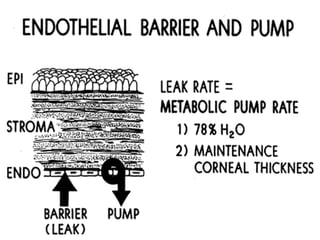
 The relative state of corneal dehydration is
mainly due to epithelial and endothelial pumps
•
 Atmospheric oxygen dissolved in pre corneal
tear film
 perilimbal capillaries & aqueous provides
solutes
 Deeper parts of cornea obtains nutrition from
aqueous
 Endothelium needs oxygen and glucose for
metabolic activity & proper functioning of
pump
 Cornea derive their energy requirements
from phosphorylation of carbohydrates and
auto oxidative system
 Glucose enters cornea either by simple
diffusion or active transport
 Breakdown of glucose in cornea occurs by
aerobic & anaerobic process into
carbondioxide & lactic acid
 Recent studies suggested that corneal
keratocytes contain two water soluble
proteins
transketolase
aldehyde dehydrogenase
class 1A1
Corneal transparency

Corneal transparency

  • 1.
  • 2.
     Primary physiologicalfunctions of the cornea is to maintain its transparency and protect the intraocular contents  Cornea consists of three layers epithelium stroma endothelium
  • 3.
    FACTORS DETERMINING TRANSPARENCY Peculiar arrangement of corneal lamellae  Avascularity  Relative state of dehydration  Metabolism of cornea  Higher difference between refractive index of cornea and air
  • 4.
    STROMA  Transparency ofcornea is related to the regularity of stromal components  Stroma is composed of type1 collagen fibers set in ground substance of mucopolysaccharides  This ribbon like bundle formation gives the laminated appearance  Collagen fibers are spaced equidistantly and form the hexogonal lattice
  • 5.
    LATTICE THEORY  Latticeformation leads to interfibrillar spacing of less than the wave length of light.  so that tangential rows of fibers acts as a diffraction grating resulting in destructive interference of scattered rays
  • 6.
    GOLDMAN AND BENEDEKTHEORY  It is based on dimension of refractive elements in corneal stroma.  There is least scattering of light till spatial dimension of variations in refractive index remains <200 nm.
  • 7.
     Corneal avascularityis maintained by PAX6 GENE & DESTRIN  The main source of nutrition is atmospheric air-oxygen perilimbal capillaries aqueous humor  The relative state of corneal dehydration is mainly due to epithelial and endothelial pumps
  • 8.
  • 9.
     Atmospheric oxygendissolved in pre corneal tear film  perilimbal capillaries & aqueous provides solutes  Deeper parts of cornea obtains nutrition from aqueous  Endothelium needs oxygen and glucose for metabolic activity & proper functioning of pump
  • 10.
     Cornea derivetheir energy requirements from phosphorylation of carbohydrates and auto oxidative system  Glucose enters cornea either by simple diffusion or active transport  Breakdown of glucose in cornea occurs by aerobic & anaerobic process into carbondioxide & lactic acid
  • 11.
     Recent studiessuggested that corneal keratocytes contain two water soluble proteins transketolase aldehyde dehydrogenase class 1A1