Tahimik ngunit may laya Bayan ng Cordillera Payapa, bayan’t kultura  Katutubo, lunday ng pinas Apayao, abra, Kalinga Benget at Ifugao Bagio at Mountain Province Bayan ng Cordillera
Cordillera Administrative Region
Objectives Locate the geographical setting of the CAR Region; Understand some background information about the CAR including the economy, the natives and the dialects; and Spot some notorious locations and tourist destinations within the vicinity of the CAR Region.
 
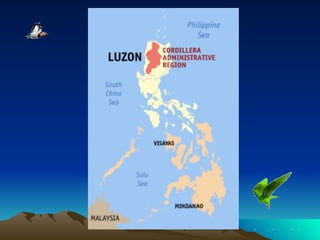
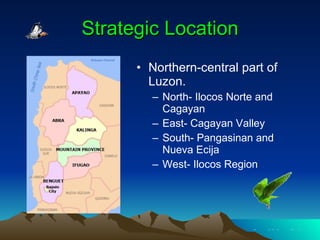
Strategic Location Northern-central part of Luzon. North- Ilocos Norte and Cagayan East- Cagayan Valley South- Pangasinan and Nueva Ecija West- Ilocos Region
Strategic Location It has a mountainous topography and is dubbed as the “Watershed Cradle of North Luzon” as it hosts 9 major rivers that provide continuous water for irrigation and energy for northern Luzon.
The CAR The Cordillera Administrative Region was established on July 15, 1987 through Executive Order No. 220 issued by President Corazon Aquino.  It comprises the provinces of Abra, Apayao, Benguet, Ifugao, Kalinga, (new) Mt. Province, and the chartered city of Baguio.
The CAR The provinces of Kalinga and Apayao are combined to form the sub-province of Kalinga-Apayao. With the signing into law of Republic Act No. 7878 by President Ramos on February 14, 1995 the province of Kalinga-Apayao was converted into two separate and regular provinces.  the new Mt. Province was then called the sub-province of Bontoc.
Economy and Livelihood Cordillera Region is rich in Mineral resources such as gold, copper, Silver and zinc though mining operations are still concentrated in the province of Benguet. Agriculture is another dominant sector establishing itself as a top producer of upland vegetables and fruits.
Locals and Tribes The Cordillera Region is inhabited by different indigenous peoples belonging to different Tribal groups.      1. Itnegs, Ilocanos of Abra Province      2. Isnegs of Apayao Province      3.    Ifugaos (Ipugao) of Ifugao Province      4.    Kalingas of Kalinga Province      5.    Kankanaeys of Mountain Province / Benguet    Province      6.    Applais of Mountain Province      7.    Bontocs of Mountain Province      8.    Ibalois, Nabalois of Benguet      9.   Kalanguya tribe which are found in the provinces of Benguet and Ifugao as well as in some parts of Pangasinan and Nueva Ecija.
The Native Dialects 1.     Tinguian/Itneg  – Spoken by the natives of Abra 2.     Kankanaey  – Major dialect spoken in Mt. Province and Northern municipalities of Benguet 3.      Ibaloi / Nabaloi  – Generally spoken in the Southern municipalities of Benguet. 4.     Kalanguya  – Spoken by the Kalanguya tribe 5.    Kalinga / Kalingga  – spoken by the natives of Kalinga 6.    Isneg  – Dialect of the natives of Apayao 7.    Ifugao  – Dialect of the people of Ifugao 8.  Karao  – Dialect of Karao tribe of Benguet
Tourism The region is also one of the premier tourist destinations in the country. Aside from having the Banaue Rice Terraces, which is considered as the eight wonder of the world, it has a number of natural and man made wonders such as the Sagada Caves, Benguet Mummies, the cool climate of Baguio and a lot more. It also hosts the second highest mountain (Mount Pulag) in the Philippines which is ideal for hiking.
Mt. Pulag Mt. Pulag
Banawe Rice Terraces Banaue Rice Terraces
Hanging Coffins of Sagada Hanging Coffins of Sagada
The Presidential Mansion Presidential Mansion
 

Cordillera administrative region

  • 1.
    Tahimik ngunit maylaya Bayan ng Cordillera Payapa, bayan’t kultura Katutubo, lunday ng pinas Apayao, abra, Kalinga Benget at Ifugao Bagio at Mountain Province Bayan ng Cordillera
  • 2.
  • 3.
    Objectives Locate thegeographical setting of the CAR Region; Understand some background information about the CAR including the economy, the natives and the dialects; and Spot some notorious locations and tourist destinations within the vicinity of the CAR Region.
  • 4.
  • 5.
    Strategic Location Northern-centralpart of Luzon. North- Ilocos Norte and Cagayan East- Cagayan Valley South- Pangasinan and Nueva Ecija West- Ilocos Region
  • 6.
    Strategic Location Ithas a mountainous topography and is dubbed as the “Watershed Cradle of North Luzon” as it hosts 9 major rivers that provide continuous water for irrigation and energy for northern Luzon.
  • 7.
    The CAR TheCordillera Administrative Region was established on July 15, 1987 through Executive Order No. 220 issued by President Corazon Aquino. It comprises the provinces of Abra, Apayao, Benguet, Ifugao, Kalinga, (new) Mt. Province, and the chartered city of Baguio.
  • 8.
    The CAR Theprovinces of Kalinga and Apayao are combined to form the sub-province of Kalinga-Apayao. With the signing into law of Republic Act No. 7878 by President Ramos on February 14, 1995 the province of Kalinga-Apayao was converted into two separate and regular provinces. the new Mt. Province was then called the sub-province of Bontoc.
  • 9.
    Economy and LivelihoodCordillera Region is rich in Mineral resources such as gold, copper, Silver and zinc though mining operations are still concentrated in the province of Benguet. Agriculture is another dominant sector establishing itself as a top producer of upland vegetables and fruits.
  • 10.
    Locals and TribesThe Cordillera Region is inhabited by different indigenous peoples belonging to different Tribal groups.     1. Itnegs, Ilocanos of Abra Province     2. Isnegs of Apayao Province     3.    Ifugaos (Ipugao) of Ifugao Province     4.    Kalingas of Kalinga Province     5.    Kankanaeys of Mountain Province / Benguet Province     6.    Applais of Mountain Province     7.   Bontocs of Mountain Province     8.   Ibalois, Nabalois of Benguet     9.  Kalanguya tribe which are found in the provinces of Benguet and Ifugao as well as in some parts of Pangasinan and Nueva Ecija.
  • 11.
    The Native Dialects1.    Tinguian/Itneg – Spoken by the natives of Abra 2.    Kankanaey – Major dialect spoken in Mt. Province and Northern municipalities of Benguet 3.    Ibaloi / Nabaloi – Generally spoken in the Southern municipalities of Benguet. 4.    Kalanguya – Spoken by the Kalanguya tribe 5.   Kalinga / Kalingga – spoken by the natives of Kalinga 6.   Isneg – Dialect of the natives of Apayao 7.   Ifugao – Dialect of the people of Ifugao 8.  Karao – Dialect of Karao tribe of Benguet
  • 12.
    Tourism The regionis also one of the premier tourist destinations in the country. Aside from having the Banaue Rice Terraces, which is considered as the eight wonder of the world, it has a number of natural and man made wonders such as the Sagada Caves, Benguet Mummies, the cool climate of Baguio and a lot more. It also hosts the second highest mountain (Mount Pulag) in the Philippines which is ideal for hiking.
  • 13.
  • 14.
    Banawe Rice TerracesBanaue Rice Terraces
  • 15.
    Hanging Coffins ofSagada Hanging Coffins of Sagada
  • 16.
    The Presidential MansionPresidential Mansion
  • 17.