   Panayanon literature

   their major languages are Hiligaynon,
    Akeanon, and Kinaray-a
 Hiligaynon refers to the Ilonggo people,
  which inhabit Iloilo, Capiz, Guimaras,
  and Negros Occidental while Akeanon is
  spoken by the people of Aklan, and
  Kinaray-a is the language spoken in
  Antique
 the forerunners in Western Visayas
  publications are Makinaugalingon,
  Hiligaynon, and Yuhum
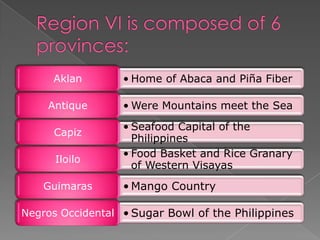
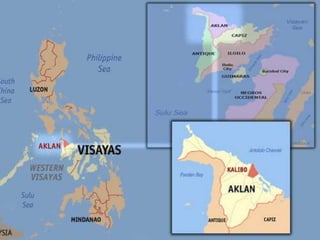
Aklan        • Home of Abaca and Piña Fiber

    Antique       • Were Mountains meet the Sea
                  • Seafood Capital of the
     Capiz
                    Philippines
                  • Food Basket and Rice Granary
      Iloilo
                    of Western Visayas
   Guimaras       • Mango Country

Negros Occidental • Sugar Bowl of the Philippines
 the capital is Kalibo
 it has a total land area of 1,853 sq.
  km.
 oldest province in the Philippines
 Jose Raz Menez was the first
  appointed governor
 has a high geographic diversity
 endemic species in the Philippines
  are found in this province
   the main inhabitants of the province is the
    Aklanon

   their most prominent dialect are Akeanon,
    Malaynon, and the Buruanganon

   the people in the province still believes in
    “aswang” and the “babaylan”

   the province is known for its festivities which
    includes the Ati-Atihan Festival in Kalibo
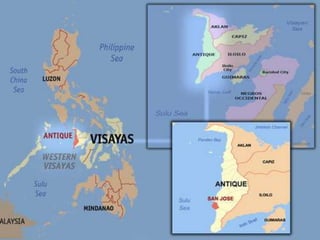
   the capital is San Jose De Buenavista

   it was one of the three districts of Panay
    before the Spanish colonizers arrived

   formerly known as “Hantik”

   Negritos or the “Atis” were believed to be
    the earliest people who settled in the island
    of Panay

   “Legend of Maragtas”
   they have their own distinct language
    called the “Kinaray-a”


   Mt. Madia-as


   the province also celebrates their own
    festival, the Binirayan Festival
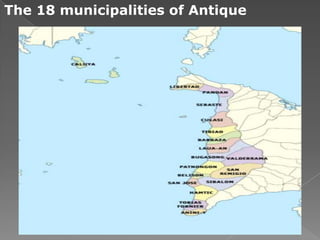
The 18 municipalities of Antique
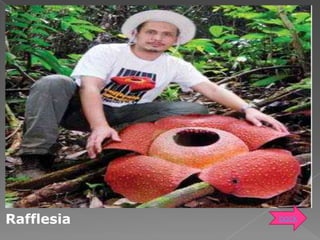
Rafflesia   back
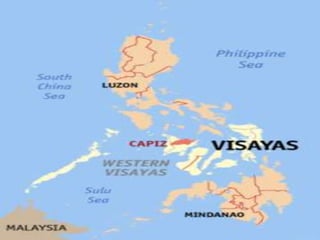
   the capital is Roxas City

   known for the mother-of-pearl shell

   Aeta, Negritos and Mundo tribe
    inhabited the province of Capiz
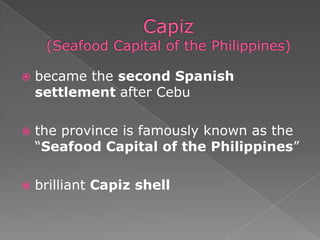
   became the second Spanish
    settlement after Cebu

   the province is famously known as the
    “Seafood Capital of the Philippines”

   brilliant Capiz shell
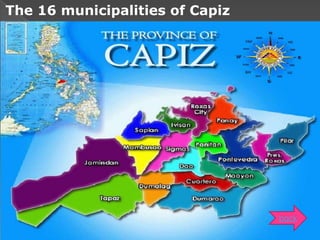
The 16 municipalities of Capiz


                                 back
   the “Food Basket and Rice Granary
    of Western Visayas”

   Iloilo City was the former Irong-irong
    River

   Have a Coat of Arms inscripted with:
    "La Muy Leal Y Noble Ciudad de
    Iloilo”
   people are called Ilonggos

   Local languages spoken in the province
    are hiligaynon and kinaray-a

   Iloilo is widely known for its beautiful
    old world architecture similar to that
    of Latin American Countries
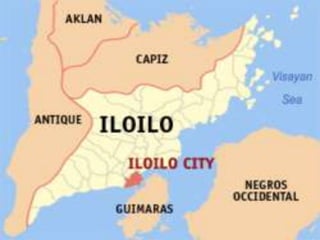
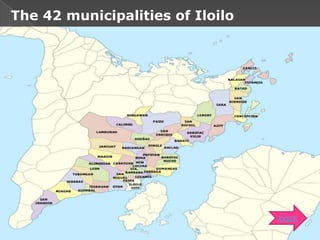
The 42 municipalities of Iloilo


                                  back
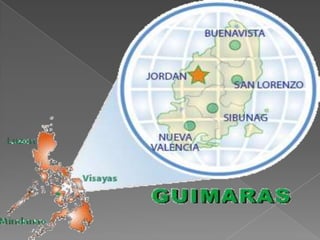
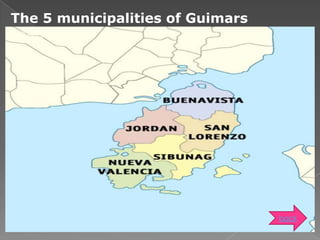
   its capital is Jordan

   Japanese Imperial Forces landed on the
    island

   Emily Relucio-Lopez was the first
    governor
   the people is considered as Guimarasnon

   Hilgaynon and Kinaray-a was their local
    dialect

   the island province suffered in a
    ecological disaster in August 2006
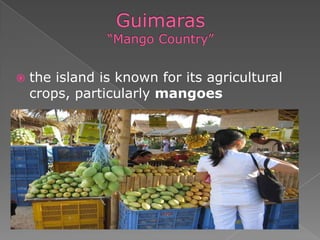
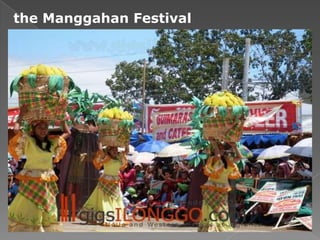
   the island is known for its agricultural
    crops, particularly mangoes
the Manggahan Festival
The 5 municipalities of Guimars
Island


                                  back
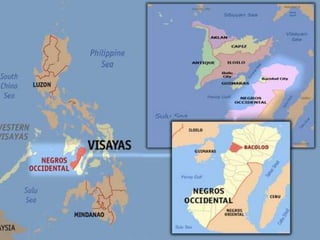
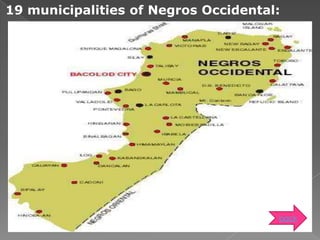
   its capital is Bacolod City

   its has basically a volcanic land

   famously known as the “Sugar Bowl
    of the Philippines”

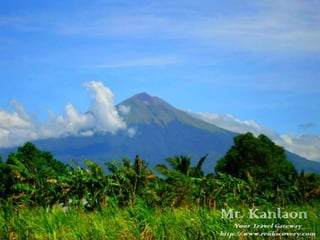
   Mount Kanlaon
   the province is originally known to the
    natives as “Buglas”

   the earliest native settlements were
    Binalbagan and Ilog

   the people was called the “Negrense”

   Silay City was also know as the “Paris of
    Negros”
   also the hometown of Leonardo
    Locsin and Conchita Gaston

   famous mural of the Angry Christ
19 municipalities of Negros Occidental:


                                      back
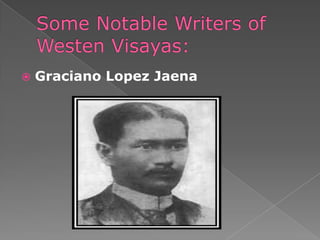
   Graciano Lopez Jaena
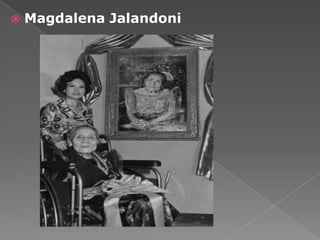
   Magdalena Jalandoni
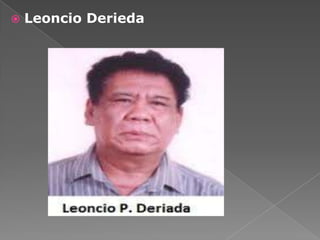
   Leoncio Derieda
 Esteban  Javellana
 Alfredo Gonzales
 Flavio Zaragoza Cano
 Demy Sonza
 Doreen Fernandez
 John Iremil Teodoro
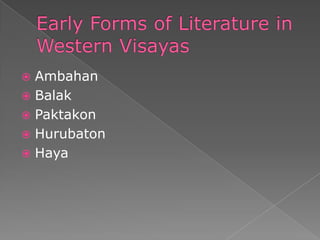
 Ambahan
 Balak
 Paktakon
 Hurubaton
 Haya
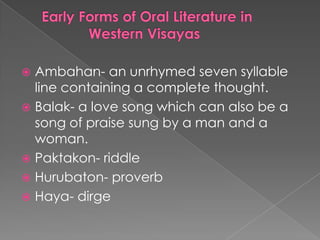
 Ambahan- an unrhymed seven syllable
  line containing a complete thought.
 Balak- a love song which can also be a
  song of praise sung by a man and a
  woman.
 Paktakon- riddle
 Hurubaton- proverb
 Haya- dirge
GOOD LUCK !
ANSWER:   PEN / PLUMA
Answer: Alkansiya
Answer:   Anino
Answer:Bahaghari /
      Rainbow
Answer:Gunting /
     Scissors
Answer: Ulan
-------
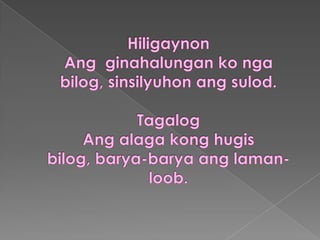
   Is the Hiligaynon word for poetry. It is how
    man expresses hmself about anything as
    when he woes a lady, says soothing
    words about a city or a barangay muse,
    proclaims a queen in a town fiesta and
    utters descriptive words on her highness,
    the “Queen” or tells a story about the
    schools anniversary or awakens the
    longing heart in sadness.
   Every success of a woman there stands a
    man, that no matter how strong and firm
    her body is and how fierce her eyes are
    still she deserves a help from an should
    always offer with no hesitations.
 Flavio Zaragoza Cano is one of the greatest
  poets in the Hiligaynon and Spanish
  languages.
 He was born in Brgy.
  Janipaan, Cabatuan, Iloilo on June
  27, 1892.
 HE received his earliest public recognition in
  1926, when he was given the title “El Rey de
  Balagtas en Poeisia en Dialecta Bisaya”.
 In 1938, he won his second title, “Poet
  Laureate”
If   there’s a
will, there’s a way.
THE END!
Thankyou for listening.