VERITAS COLLEGE OF IROSIN 
IROSIN, SORSOGON 
MULTIMEDIA PRESENTATION 
IN 
SOC. STUD -10 
(BASIC GEOGRAPHY) 
PRESENTED BY: 
JOJIE G. GILE 
RHENZO B. GALPA 
BEED-II 
PRESENTED TO: 
MS. JELEN DOLOSA 
INSTRUCTRESS
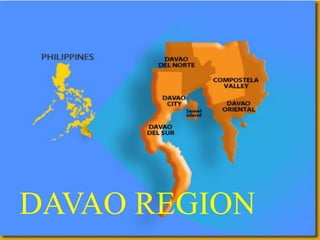
DAVAO REGION
HISTORY 
 Many historians believe that the name "Davao" is actually the mixture of the 
three names that three different tribes, the earliest settlers in the region, had 
for the Davao River. 
 The Manobos, an aboriginal tribe, referred to the Davao River as Davohoho. 
Another tribe, the Bagobos, referred to the river as Davohaha, which means 
"fire", while another tribe, the Guiangan tribe, called the river as Duhwow. 
 The history of the region dates back to the times when various tribes 
occupied the region. 
 It is believed that the Manobos, Mandayasand the Bagobos actually 
occupied the area. These are the same tribes that created the small 
settlements and communities that eventually became Mindanao.
 Davao Region or Southern Mindanao (Filipino: Kadabawan) is 
one of the regions of the Philippines, designated as Region XI. 
 It is located on the southeastern portion of Mindanao, and 
consists of four provinces, namely: Compostela Valley, Davao del Norte, 
Davao Oriental, and Davao del Sur. 
 Davao is the Hispanicized pronunciation of daba-daba, the 
Bagobo word for "fire" (the Cebuano translation is "kalayo"). 
Davao City is not only the third largest city in the country (next to Cebu and 
Manila). 
The fact that a significant part of the land is perfect for agriculture have 
led to the development of plantations and industries dedicated to the 
growth and nurturing of coconuts, coffee, pineapple and other fruits
RELIGION 
 Roman Catholic, comprising about 80 percent of the 
population. 
 Iglesia ni Cristo (Church of Christ), 
 Evangelicals, the Jesus Miracle Crusade 
 The Church of Jesus Christ of Latter-day 
Saints (Mormons) comprise eight percent. 
 Seventh-day Adventists and Baptists are other 
Christian denominations. 
 Others (Islam, Hinduism, Buddhism and animism).
DIALECTS 
The People Major Dialects: 
 Cebuano 
 Hiligaynon 
Minor Dialects: 
 English 
 Waray 
 Maguindanao 
 Tagalog 
 Manobo 
 Mandaya
ECONOMY 
 it is now developing into a center for agro-industrial business, trade 
and tourism. 
 Its competitive advantage is in agri-industry as its products, papayas, 
mangoes, bananas, pineapples, fresh asparagus, flowers, and fish 
products are exported internationally. 
 The region can be a vital link to markets in other parts of 
Mindanao, Brunei Darussalam and parts of Malaysia and Indonesia. 
 Other economic activities are mining, fishery, forestry and agriculture. 
 Both private and foreign investors and businessmen are putting up huge 
business centers in the region, fueling up its commercial growth rate.
PRODUCTS AND INDUSTRY 
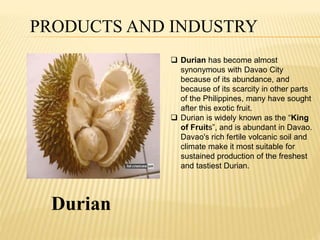
 Durian has become almost 
synonymous with Davao City 
because of its abundance, and 
because of its scarcity in other parts 
of the Philippines, many have sought 
after this exotic fruit. 
 Durian is widely known as the “King 
of Fruits”, and is abundant in Davao. 
Davao's rich fertile volcanic soil and 
climate make it most suitable for 
sustained production of the freshest 
and tastiest Durian. 
Durian
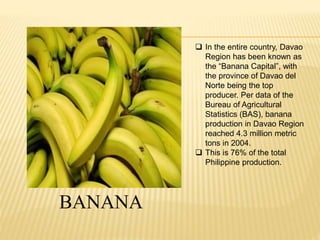
 In the entire country, Davao 
Region has been known as 
the “Banana Capital”, with 
the province of Davao del 
Norte being the top 
producer. Per data of the 
Bureau of Agricultural 
Statistics (BAS), banana 
production in Davao Region 
reached 4.3 million metric 
tons in 2004. 
 This is 76% of the total 
Philippine production. 
BANANA
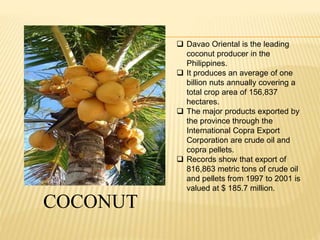
 Davao Oriental is the leading 
coconut producer in the 
Philippines. 
 It produces an average of one 
billion nuts annually covering a 
total crop area of 156,837 
hectares. 
 The major products exported by 
the province through the 
International Copra Export 
Corporation are crude oil and 
copra pellets. 
 Records show that export of 
816,863 metric tons of crude oil 
and pellets from 1997 to 2001 is 
valued at $ 185.7 million. 
COCONUT
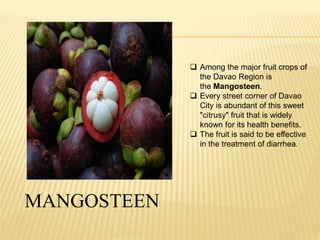
MANGOSTEEN 
 Among the major fruit crops of 
the Davao Region is 
the Mangosteen. 
 Every street corner of Davao 
City is abundant of this sweet 
"citrusy" fruit that is widely 
known for its health benefits. 
 The fruit is said to be effective 
in the treatment of diarrhea.
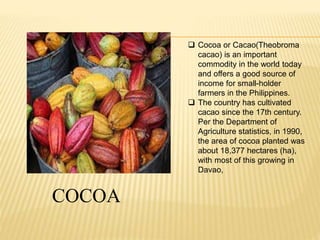
COCOA 
 Cocoa or Cacao(Theobroma 
cacao) is an important 
commodity in the world today 
and offers a good source of 
income for small-holder 
farmers in the Philippines. 
 The country has cultivated 
cacao since the 17th century. 
Per the Department of 
Agriculture statistics, in 1990, 
the area of cocoa planted was 
about 18,377 hectares (ha), 
with most of this growing in 
Davao,
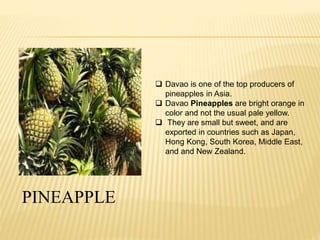
 Davao is one of the top producers of 
pineapples in Asia. 
 Davao Pineapples are bright orange in 
color and not the usual pale yellow. 
 They are small but sweet, and are 
exported in countries such as Japan, 
Hong Kong, South Korea, Middle East, 
and and New Zealand. 
PINEAPPLE
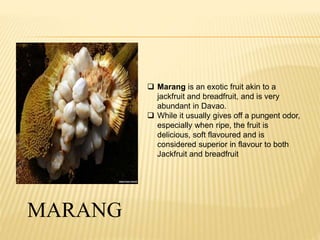
 Marang is an exotic fruit akin to a 
jackfruit and breadfruit, and is very 
abundant in Davao. 
 While it usually gives off a pungent odor, 
especially when ripe, the fruit is 
delicious, soft flavoured and is 
considered superior in flavour to both 
Jackfruit and breadfruit 
MARANG
PROVINCES 
OF 
DAVAO 
REGION
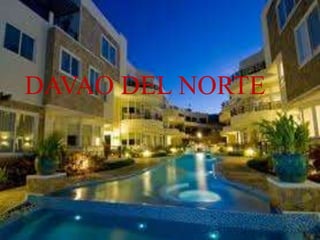
DAVAO DEL NORTE
DAVAO DEL NORTE 
 Davao del Norte (Tagalog: Hilagang Dabaw), and once known 
simply as Davao, is a province of the Philippines located in 
the Davao Region in Mindanao. 
 Its capital is Tagum City. Davao also includes Samal Island to the 
south in the Davao Gulf 
 Davao del Norte was originally composed of 
thirteen municipalities, namely: Asuncion, Babak (now in Samal 
City),Compostela, Kapalong, Mabini, Mawab, Monkayo, Nabunt 
uran, Panabo, Pantukan, Samal, Santo Tomas and Tagum. 
 Davao del Norte is a primarily agricultural, but also engages 
in mining, forestry, and commercial fishing. 
 Davao del Norte has a population of 910,784 as of 2010 Census. The 
population density is 248 per km². Main languages spoken are Bisaya 
and Davaoeño.
TOURIST 
ATTRACTIONS
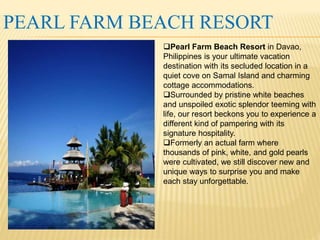
PEARL FARM BEACH RESORT 
Pearl Farm Beach Resort in Davao, 
Philippines is your ultimate vacation 
destination with its secluded location in a 
quiet cove on Samal Island and charming 
cottage accommodations. 
Surrounded by pristine white beaches 
and unspoiled exotic splendor teeming with 
life, our resort beckons you to experience a 
different kind of pampering with its 
signature hospitality. 
Formerly an actual farm where 
thousands of pink, white, and gold pearls 
were cultivated, we still discover new and 
unique ways to surprise you and make 
each stay unforgettable.
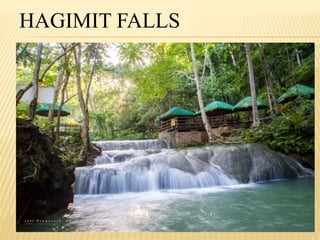
HAGIMIT FALLS
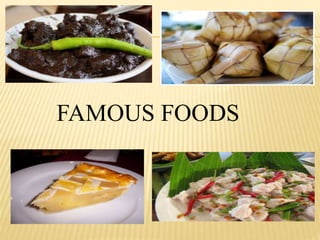
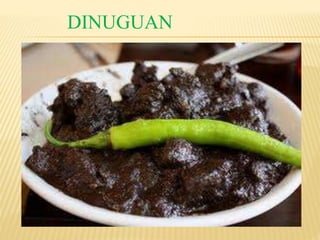
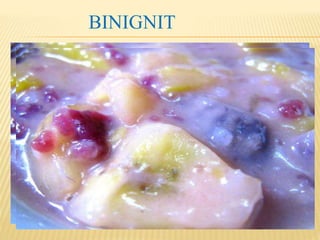
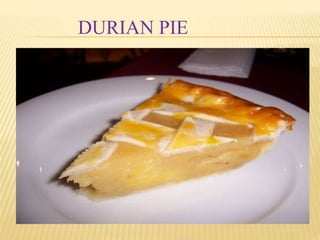
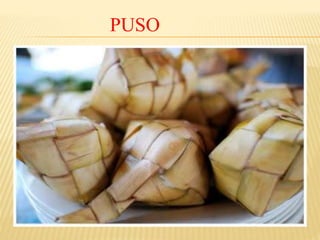
FAMOUS FOODS
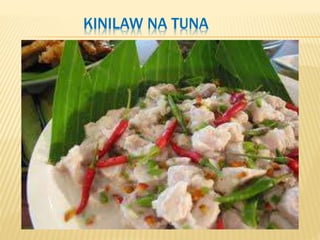
KINILAW NA TUNA
DINUGUAN
BINIGNIT
DURIAN PIE
PUSO
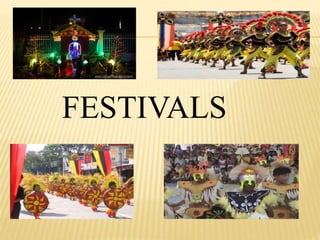
FESTIVALS
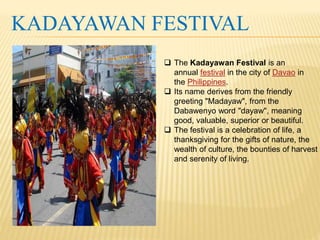
KADAYAWAN FESTIVAL 
 The Kadayawan Festival is an 
annual festival in the city of Davao in 
the Philippines. 
 Its name derives from the friendly 
greeting "Madayaw", from the 
Dabawenyo word "dayaw", meaning 
good, valuable, superior or beautiful. 
 The festival is a celebration of life, a 
thanksgiving for the gifts of nature, the 
wealth of culture, the bounties of harvest 
and serenity of living.
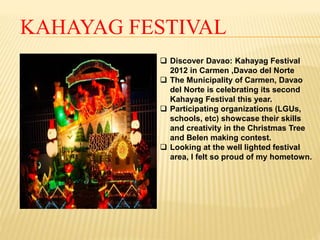
KAHAYAG FESTIVAL 
 Discover Davao: Kahayag Festival 
2012 in Carmen ,Davao del Norte 
 The Municipality of Carmen, Davao 
del Norte is celebrating its second 
Kahayag Festival this year. 
 Participating organizations (LGUs, 
schools, etc) showcase their skills 
and creativity in the Christmas Tree 
and Belen making contest. 
 Looking at the well lighted festival 
area, I felt so proud of my hometown.
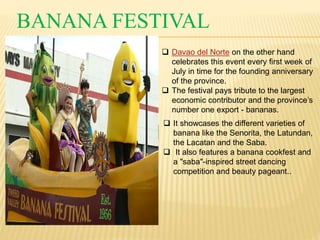
BANANA FESTIVAL 
 Davao del Norte on the other hand 
celebrates this event every first week of 
July in time for the founding anniversary 
of the province. 
 The festival pays tribute to the largest 
economic contributor and the province’s 
number one export - bananas. 
 It showcases the different varieties of 
banana like the Senorita, the Latundan, 
the Lacatan and the Saba. 
 It also features a banana cookfest and 
a "saba"-inspired street dancing 
competition and beauty pageant..
TABANOGAN FESTIVAL 
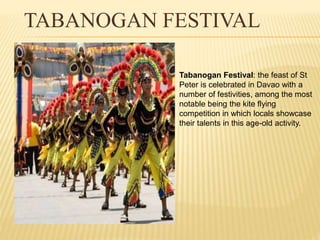
Tabanogan Festival: the feast of St 
Peter is celebrated in Davao with a 
number of festivities, among the most 
notable being the kite flying 
competition in which locals showcase 
their talents in this age-old activity.
DURIAN FESTIVAL 
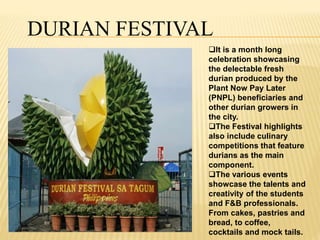
It is a month long 
celebration showcasing 
the delectable fresh 
durian produced by the 
Plant Now Pay Later 
(PNPL) beneficiaries and 
other durian growers in 
the city. 
The Festival highlights 
also include culinary 
competitions that feature 
durians as the main 
component. 
The various events 
showcase the talents and 
creativity of the students 
and F&B professionals. 
From cakes, pastries and 
bread, to coffee, 
cocktails and mock tails.
DAVAO DEL SUR
DAVAO DEL SUR 
 Davao del Sur (Filipino: Timog Dabaw) is a province of 
the Philippines located in the Davao Region in Mindanao. 
 Its capital and largest city is Digos City. 
 The province is bordered by Davao City to the north, the new 
province of Davao Occidental to the south and Cotabato, Sultan 
Kudarat, South Cotabato and Sarangani to the west 
 The province of Davao del Sur is 
subdivided into 9 municipalities and 
e 
1 component city 
The early inhabitants of the Davao provinces, particularly the 
area now called the province of Davao del Sur, were the Bagobo- 
Guianggas who occupied the places at the foot of Mt. Apo, the 
B’laans of Hagonoy Valley, the Manobos in Malita and Jose Abad 
Santos, and other primeval tribes
TOURIST 
ATTRACTIONS
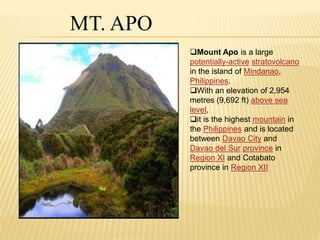
MT. APO 
Mount Apo is a large 
potentially-active stratovolcano 
in the island of Mindanao, 
Philippines. 
With an elevation of 2,954 
metres (9,692 ft) above sea 
level, 
it is the highest mountain in 
the Philippines and is located 
between Davao City and 
Davao del Sur province in 
Region XI and Cotabato 
province in Region XII
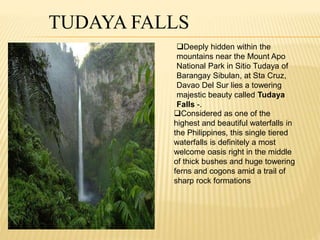
TUDAYA FALLS 
Deeply hidden within the 
mountains near the Mount Apo 
National Park in Sitio Tudaya of 
Barangay Sibulan, at Sta Cruz, 
Davao Del Sur lies a towering 
majestic beauty called Tudaya 
Falls -. 
Considered as one of the 
highest and beautiful waterfalls in 
the Philippines, this single tiered 
waterfalls is definitely a most 
welcome oasis right in the middle 
of thick bushes and huge towering 
ferns and cogons amid a trail of 
sharp rock formations
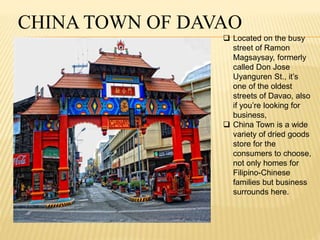
CHINA TOWN OF DAVAO 
 Located on the busy 
street of Ramon 
Magsaysay, formerly 
called Don Jose 
Uyanguren St., it’s 
one of the oldest 
streets of Davao, also 
if you’re looking for 
business, 
 China Town is a wide 
variety of dried goods 
store for the 
consumers to choose, 
not only homes for 
Filipino-Chinese 
families but business 
surrounds here.
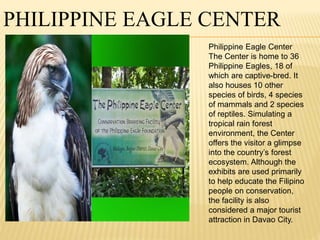
PHILIPPINE EAGLE CENTER 
Philippine Eagle Center 
The Center is home to 36 
Philippine Eagles, 18 of 
which are captive-bred. It 
also houses 10 other 
species of birds, 4 species 
of mammals and 2 species 
of reptiles. Simulating a 
tropical rain forest 
environment, the Center 
offers the visitor a glimpse 
into the country’s forest 
ecosystem. Although the 
exhibits are used primarily 
to help educate the Filipino 
people on conservation, 
the facility is also 
considered a major tourist 
attraction in Davao City.
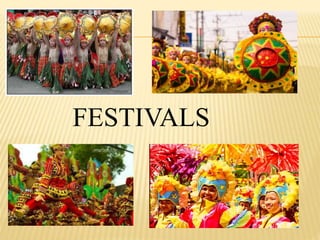
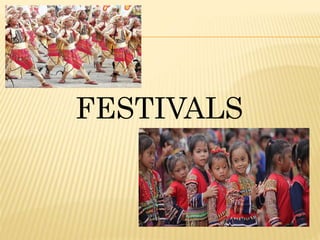
FESTIVALS
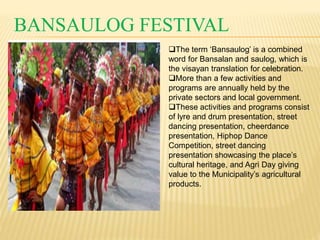
BANSAULOG FESTIVAL 
The term ‘Bansaulog’ is a combined 
word for Bansalan and saulog, which is 
the visayan translation for celebration. 
More than a few activities and 
programs are annually held by the 
private sectors and local government. 
These activities and programs consist 
of lyre and drum presentation, street 
dancing presentation, cheerdance 
presentation, Hiphop Dance 
Competition, street dancing 
presentation showcasing the place’s 
cultural heritage, and Agri Day giving 
value to the Municipality’s agricultural 
products.
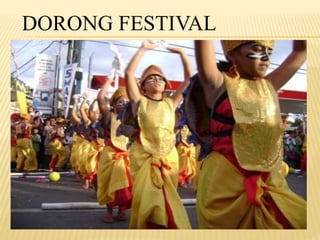
DORONG FESTIVAL
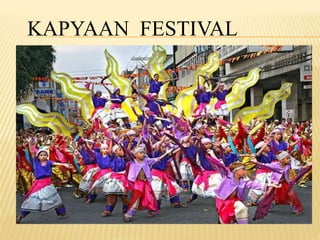
KAPYAAN FESTIVAL
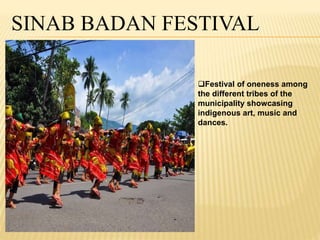
SINAB BADAN FESTIVAL 
Festival of oneness among 
the different tribes of the 
municipality showcasing 
indigenous art, music and 
dances.
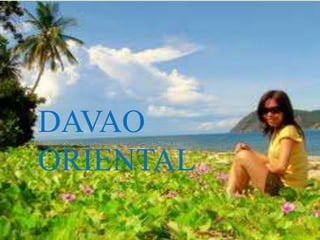
DAVAO 
ORIENTAL
DAVAO ORIENTAL 
Davao Oriental (Tagalog: Silangang Dabaw, Cebuano: 
Sidlakang Dabaw) is a province of the Philippines located in 
the Davao Region in Mindanao. 
 Its capital is Mati and borders Compostela Valley to the 
west, and Agusan del Sur and Surigao del Sur to the north. 
 Davao Oriental is the easternmost province of the country 
with Pusan Point as the easternmost location. 
The Philippine Sea, part of the Pacific Ocean, faces Davao 
Oriental to the east. 
Its major industries includes agriculture, fishing, small 
and medium cottage industries, and tourism.  
This province is famous for waterfalls, white-sand beaches, 
historical attractions, and the Mandaya Tribe, whose 
unadulterated culture and traditions are still very evident in 
their day-to-day lives.
TOURIST 
ATTRACTIONS
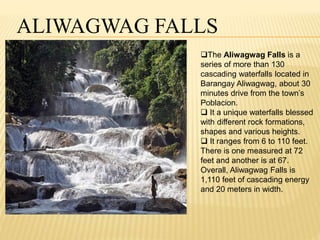
ALIWAGWAG FALLS 
The Aliwagwag Falls is a 
series of more than 130 
cascading waterfalls located in 
Barangay Aliwagwag, about 30 
minutes drive from the town’s 
Poblacion. 
 It a unique waterfalls blessed 
with different rock formations, 
shapes and various heights. 
 It ranges from 6 to 110 feet. 
There is one measured at 72 
feet and another is at 67. 
Overall, Aliwagwag Falls is 
1,110 feet of cascading energy 
and 20 meters in width.
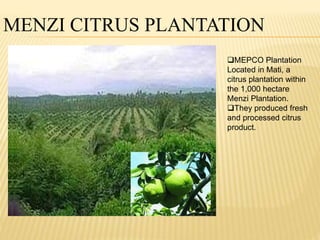
MENZI CITRUS PLANTATION 
MEPCO Plantation 
Located in Mati, a 
citrus plantation within 
the 1,000 hectare 
Menzi Plantation. 
They produced fresh 
and processed citrus 
product.
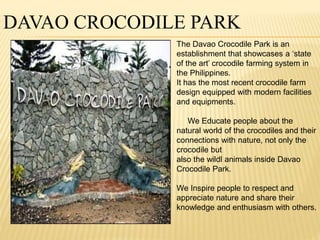
DAVAO CROCODILE PARK 
The Davao Crocodile Park is an 
establishment that showcases a ‘state 
of the art’ crocodile farming system in 
the Philippines. 
It has the most recent crocodile farm 
design equipped with modern facilities 
and equipments. 
We Educate people about the 
natural world of the crocodiles and their 
connections with nature, not only the 
crocodile but 
also the wildl animals inside Davao 
Crocodile Park. 
We Inspire people to respect and 
appreciate nature and share their 
knowledge and enthusiasm with others.
FESTIVALS
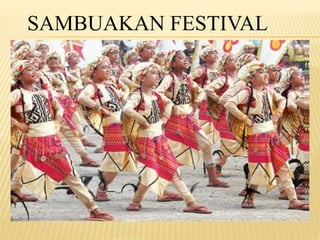
SAMBUAKAN FESTIVAL
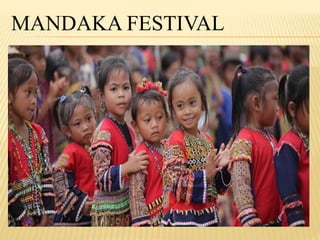
MANDAKA FESTIVAL
FAMOUS 
FOODS
CROCODILE ICE CREAM
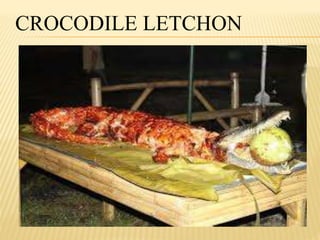
CROCODILE LETCHON
CROCODILE HAMBURGER
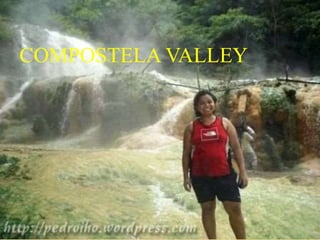
COMPOSTELA VALLEY
COMPOSTELA VALLEY 
Compostela Valley (Cebuano: Kawalogang Kompostela) is a 
province of the Philippines located in the Davao Region in Mindanao. 
The province, called Comval for short, used to be part of Davao del 
Norte until it was made independent in 1998. 
It is the fourth newest province of the Philippines, behind Dinagat 
Islands, Zamboanga Sibugay and Davao Occidental. 
Its capital is Nabunturan. 
The province borders Davao del Norte to the west, Agusan del Sur to 
the north, and Davao Oriental to the east. 
The main sources of livelihood are agricultural products such as rice, 
coconut, cacao, coffee, papaya, mango, pineapple, durian and banana. It 
has been projected that by 2030 the province will be one of the richest 
provinces in the country because of its rich natural resources and 
hardworking people. 
Some residents have fishponds and culture their own fish like tilapia and 
milkfish. 
The province is also rich with gold ore.
TOURIST 
ATTRACTIONS
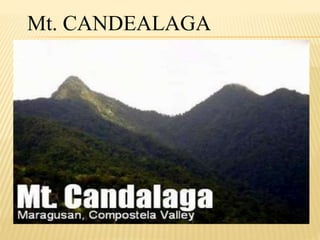
Mt. CANDEALAGA
MAINIT HOT SPRING
FESTIVALS
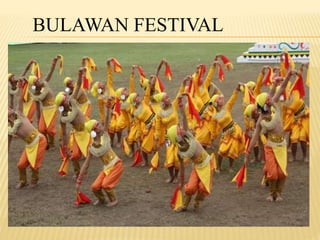
BULAWAN FESTIVAL
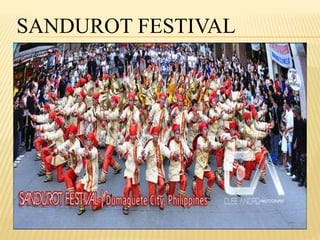
SANDUROT FESTIVAL
MALLS 
OF 
DAVAO
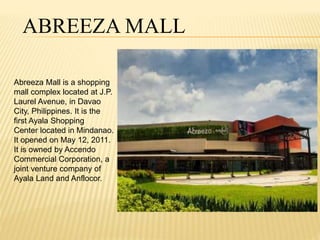
ABREEZA MALL 
Abreeza Mall is a shopping 
mall complex located at J.P. 
Laurel Avenue, in Davao 
City, Philippines. It is the 
first Ayala Shopping 
Center located in Mindanao. 
It opened on May 12, 2011. 
It is owned by Accendo 
Commercial Corporation, a 
joint venture company of 
Ayala Land and Anflocor.
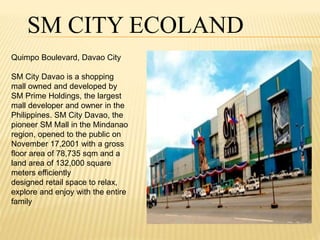
SM CITY ECOLAND 
Quimpo Boulevard, Davao City 
SM City Davao is a shopping 
mall owned and developed by 
SM Prime Holdings, the largest 
mall developer and owner in the 
Philippines. SM City Davao, the 
pioneer SM Mall in the Mindanao 
region, opened to the public on 
November 17,2001 with a gross 
floor area of 78,735 sqm and a 
land area of 132,000 square 
meters efficiently 
designed retail space to relax, 
explore and enjoy with the entire 
family
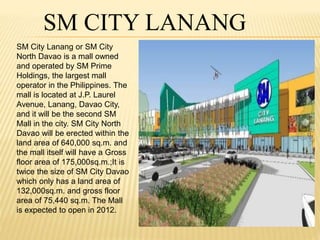
SM CITY LANANG 
SM City Lanang or SM City 
North Davao is a mall owned 
and operated by SM Prime 
Holdings, the largest mall 
operator in the Philippines. The 
mall is located at J.P. Laurel 
Avenue, Lanang, Davao City, 
and it will be the second SM 
Mall in the city. SM City North 
Davao will be erected within the 
land area of 640,000 sq.m. and 
the mall itself will have a Gross 
floor area of 175,000sq.m.;It is 
twice the size of SM City Davao 
which only has a land area of 
132,000sq.m. and gross floor 
area of 75,440 sq.m. The Mall 
is expected to open in 2012.
THE END…
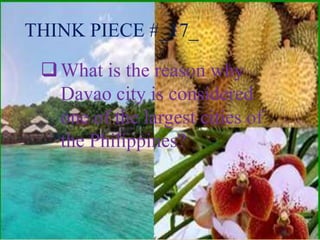
THINK PIECE #_17_ 
 What is the reason why 
Davao city is considered 
one of the largest cities of 
the Philippines?