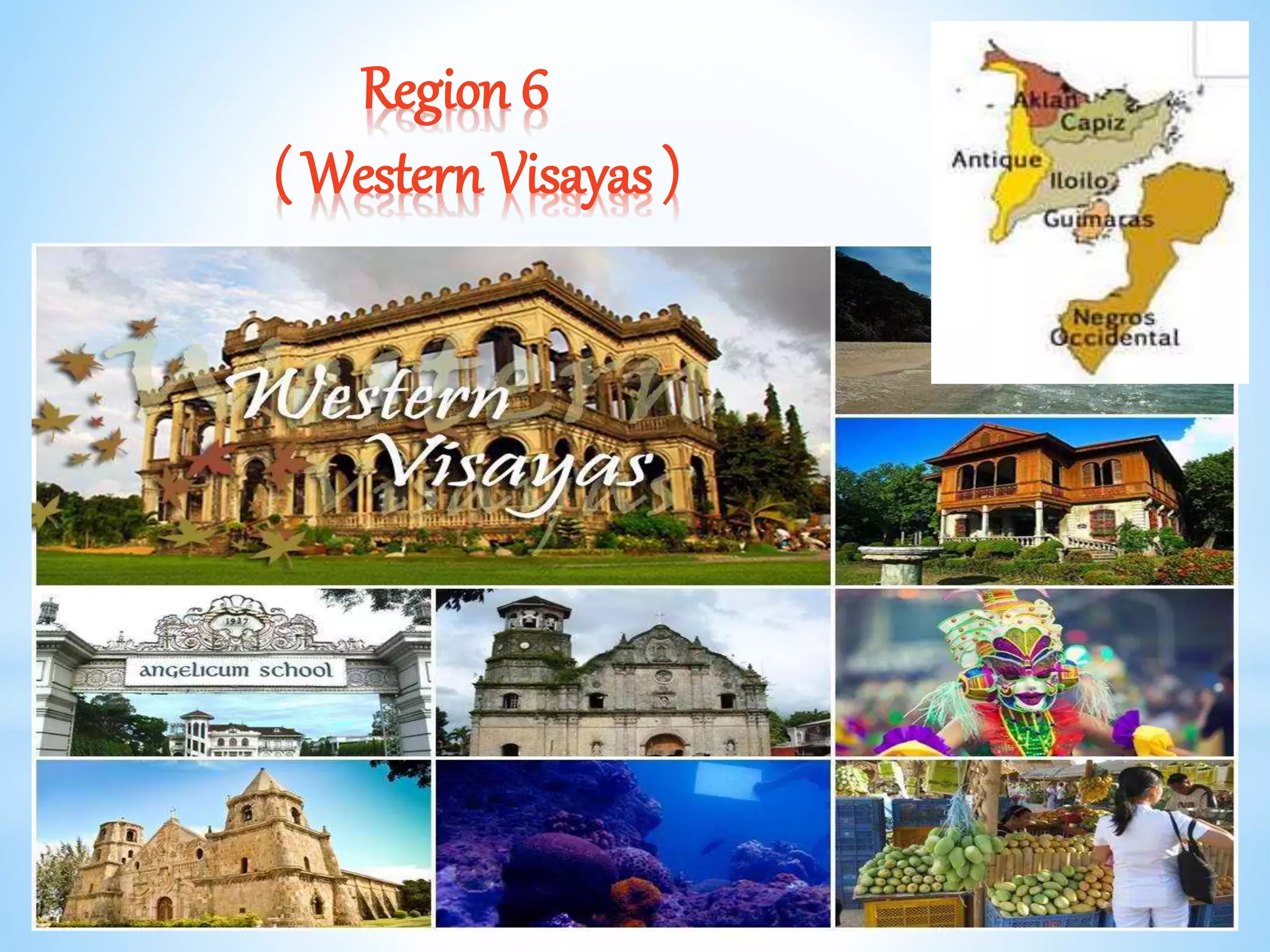
Region 6
( Western Visayas )
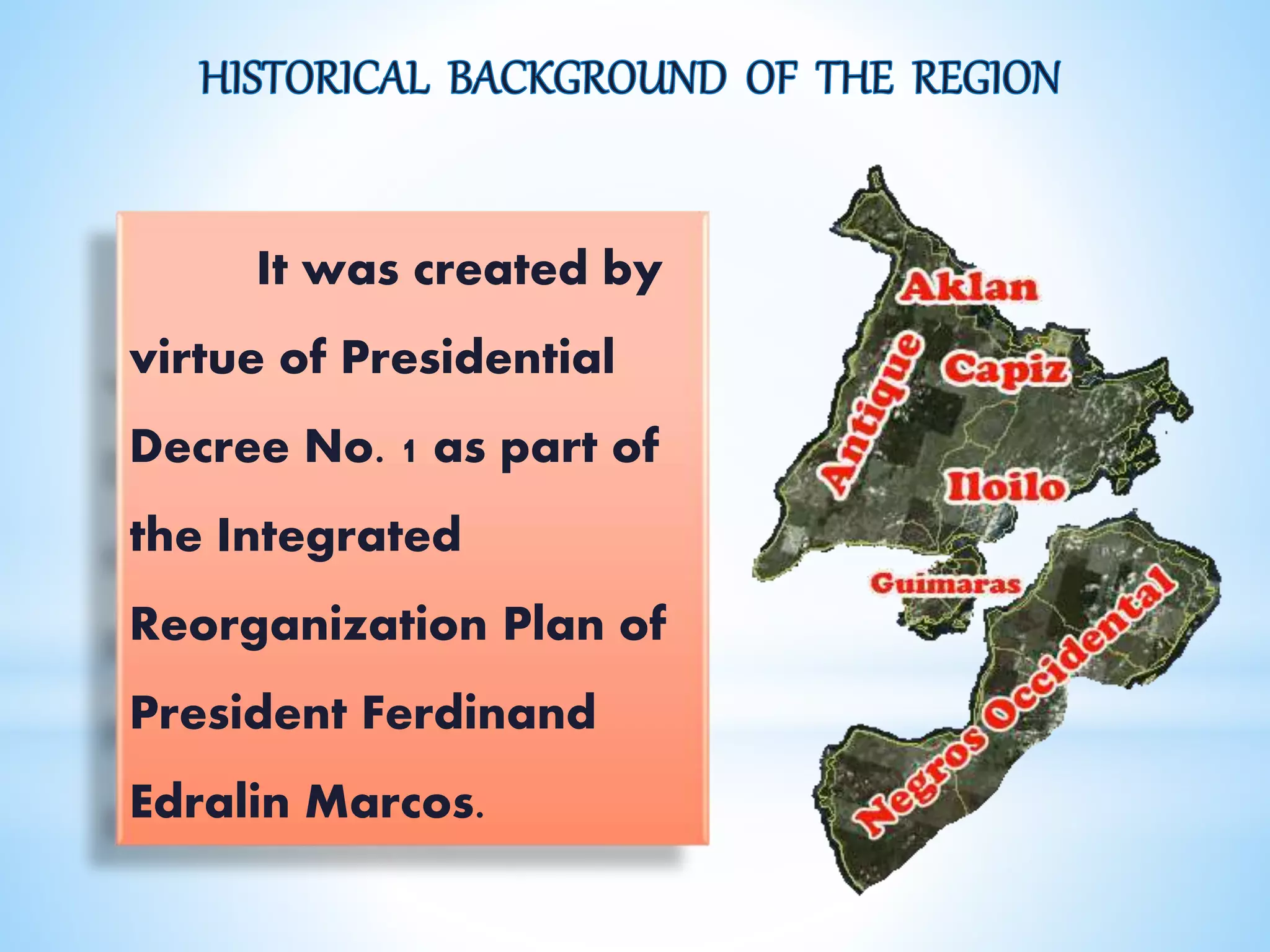
It was created by
virtue of Presidential
Decree No. 1 as part of
the Integrated
Reorganization Plan of
President Ferdinand
Edralin Marcos.
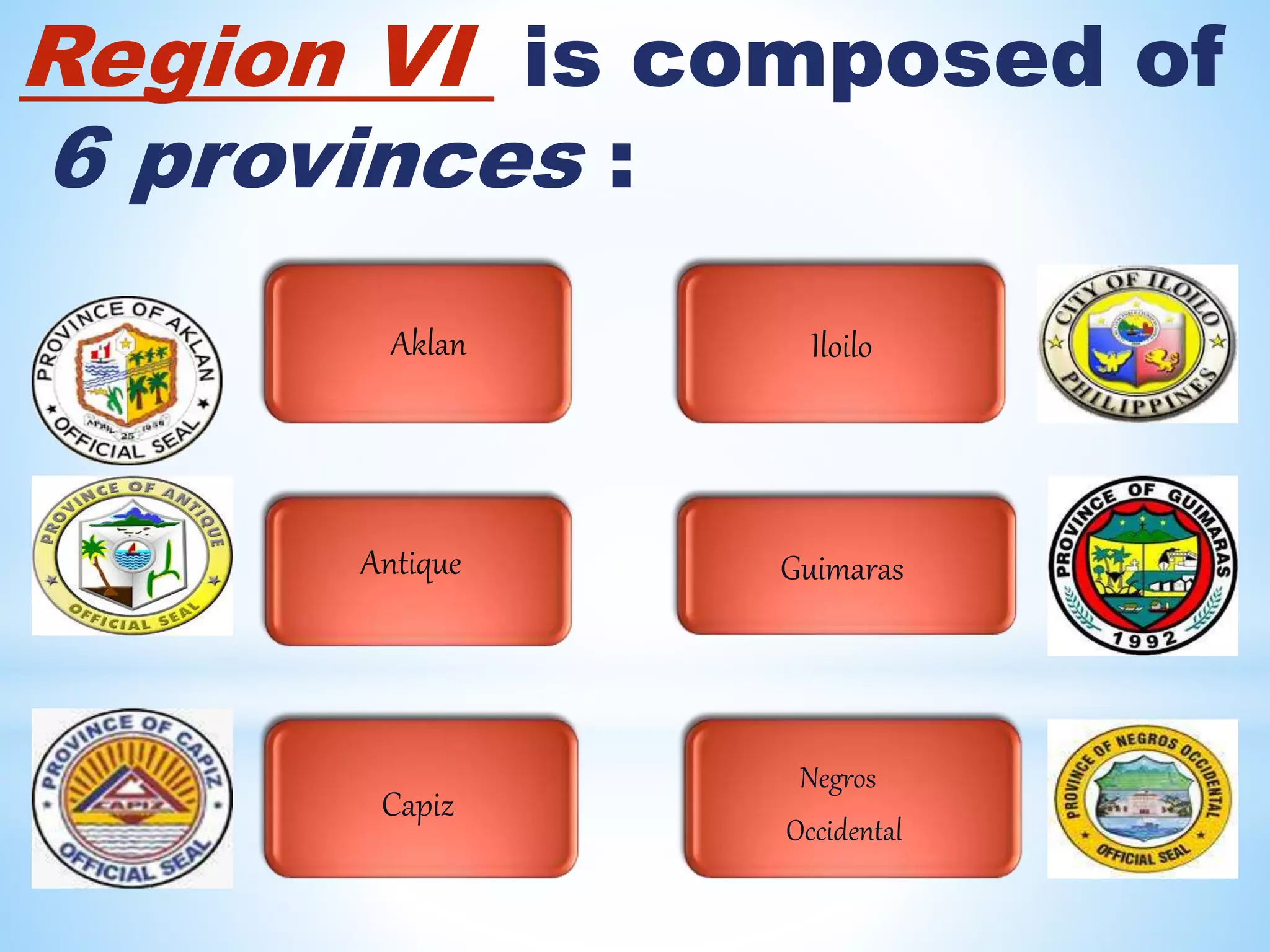
Region VI is composed of
6 provinces :
Aklan
Antique
Capiz
Iloilo
Guimaras
Negros
Occidental
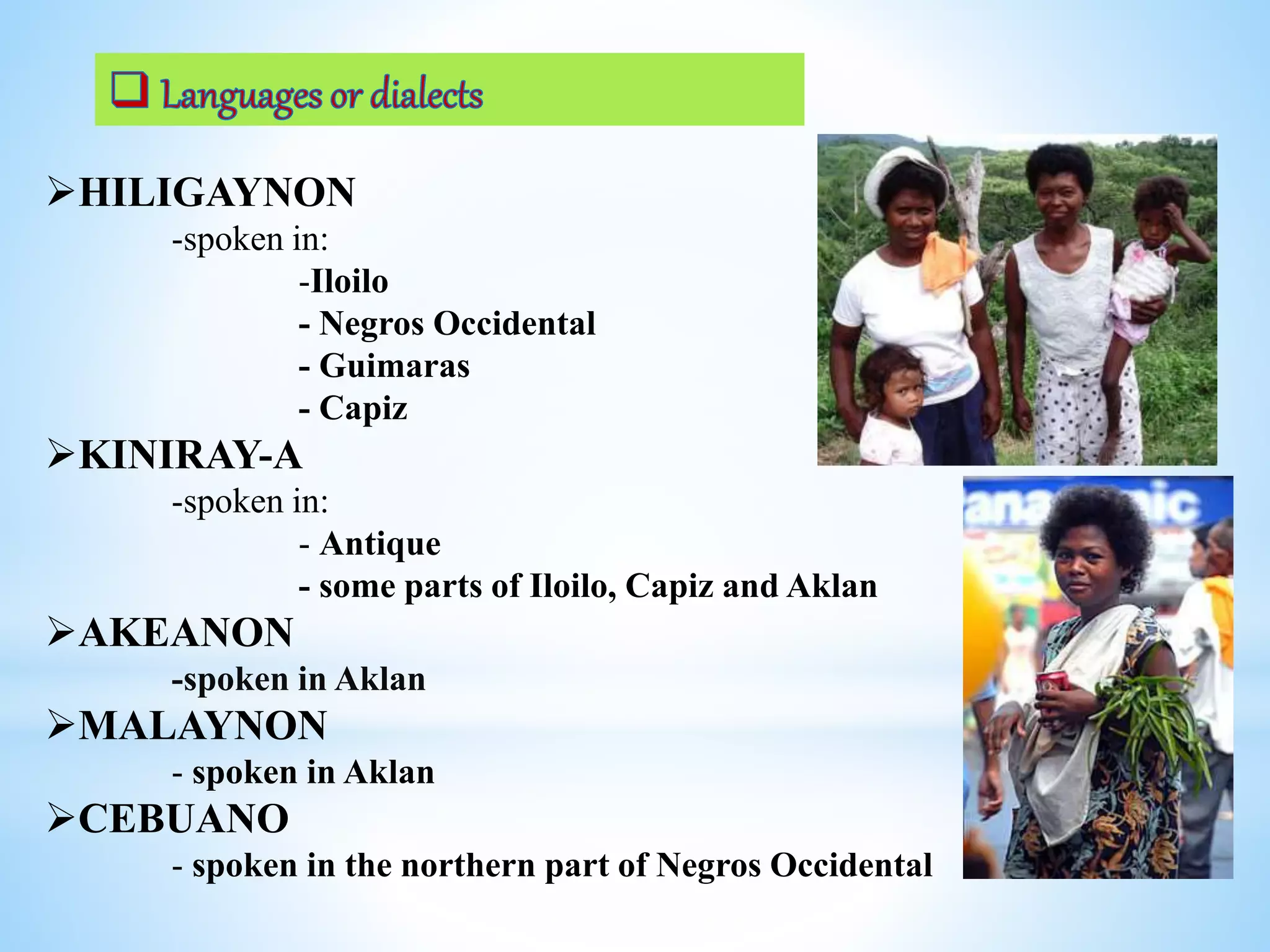
HILIGAYNON
-spoken in:
-Iloilo
- Negros Occidental
- Guimaras
- Capiz
KINIRAY-A
-spoken in:
- Antique
- some parts of Iloilo, Capiz and Aklan
AKEANON
-spoken in Aklan
MALAYNON
- spoken in Aklan
CEBUANO
- spoken in the northern part of Negros Occidental
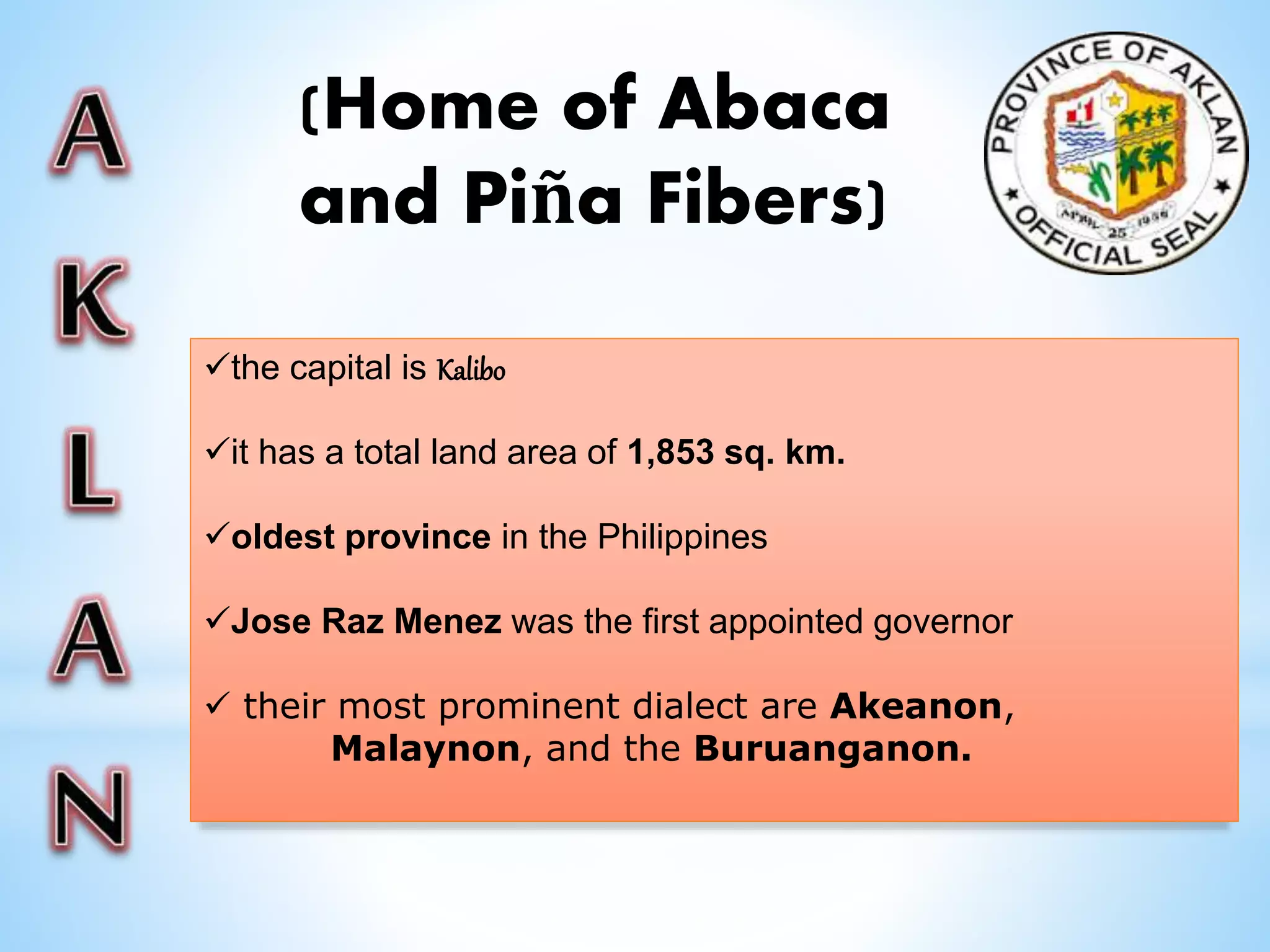
the capital is Kalibo
it has a total land area of 1,853 sq. km.
oldest province in the Philippines
Jose Raz Menez was the first appointed governor
 their most prominent dialect are Akeanon,
Malaynon, and the Buruanganon.
(Home of Abaca
and Piña Fibers)
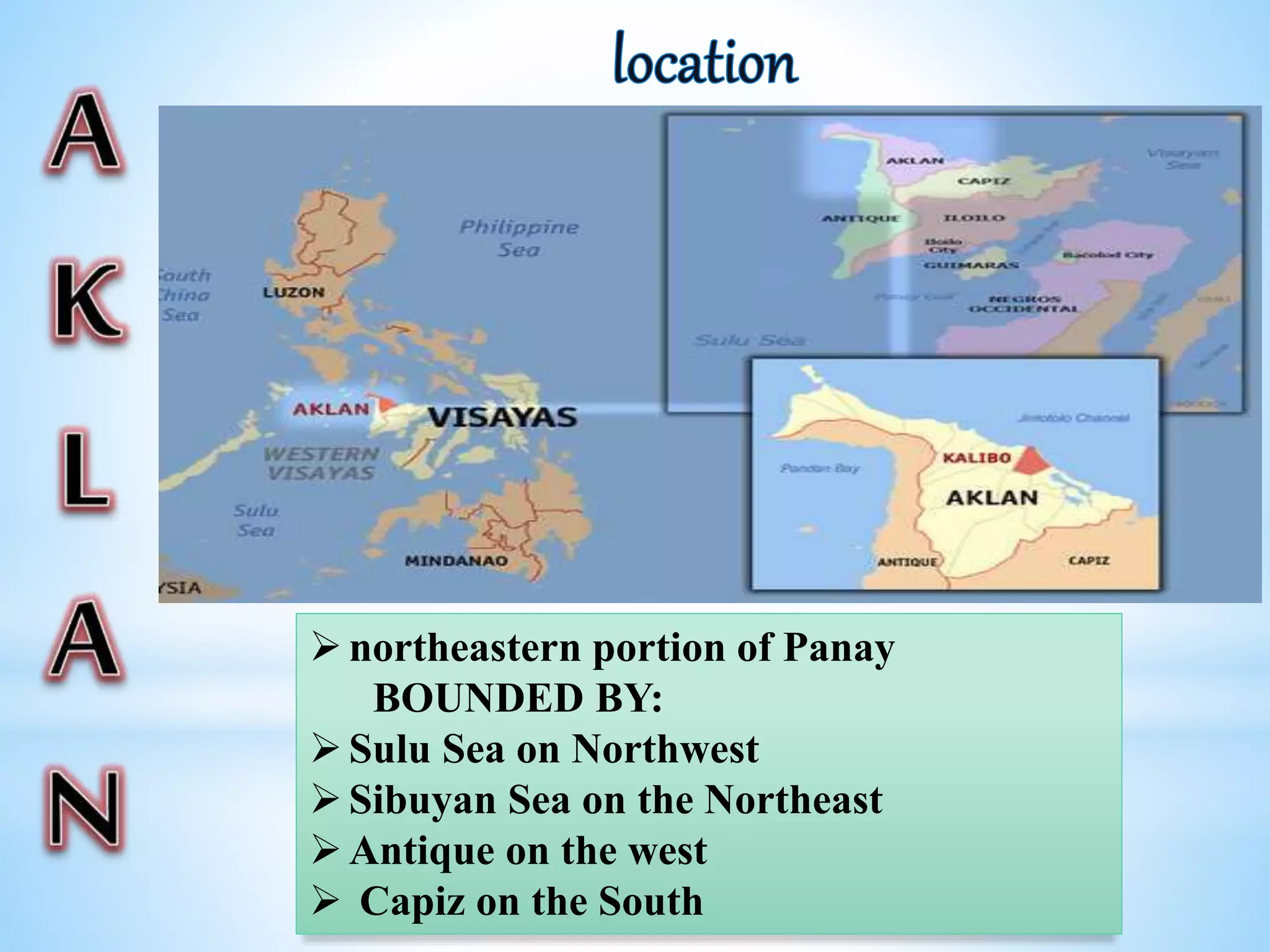
northeastern portion of Panay
BOUNDED BY:
Sulu Sea on Northwest
Sibuyan Sea on the Northeast
Antique on the west
 Capiz on the South
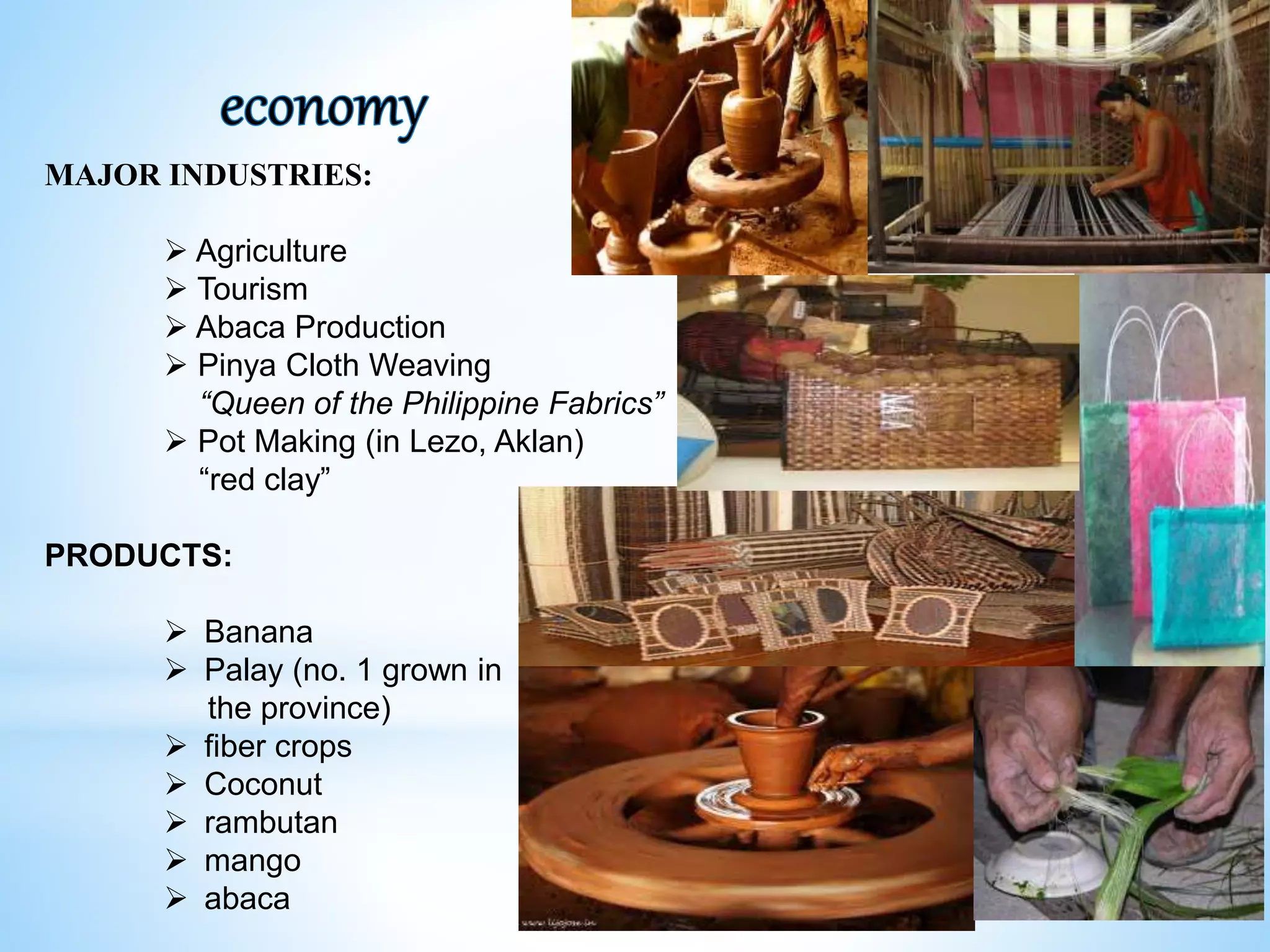
MAJOR INDUSTRIES:
 Agriculture
 Tourism
 Abaca Production
 Pinya Cloth Weaving
“Queen of the Philippine Fabrics”
 Pot Making (in Lezo, Aklan)
“red clay”
PRODUCTS:
 Banana
 Palay (no. 1 grown in
the province)
 fiber crops
 Coconut
 rambutan
 mango
 abaca
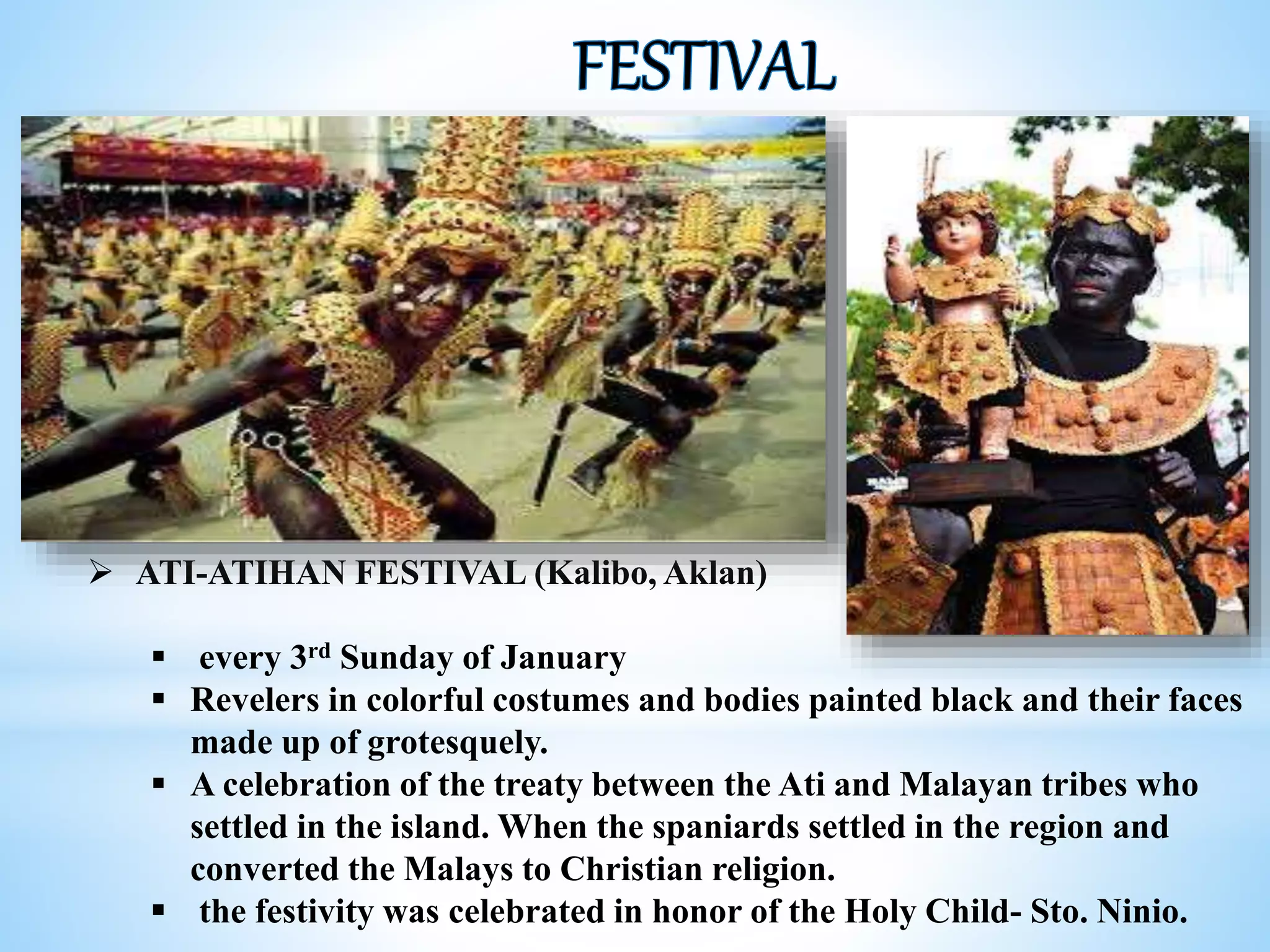
 ATI-ATIHAN FESTIVAL (Kalibo, Aklan)
 every 3rd Sunday of January
 Revelers in colorful costumes and bodies painted black and their faces
made up of grotesquely.
 A celebration of the treaty between the Ati and Malayan tribes who
settled in the island. When the spaniards settled in the region and
converted the Malays to Christian religion.
 the festivity was celebrated in honor of the Holy Child- Sto. Ninio.
Freedom Shrine
dedicated to the 19 martyrs of Aklan who started
the revolution against Spain.
Kalantiaw Shrine, Bataan
Once the seat of government of Rajah Bendahara Kalantiaw promulgator
of the famous Code of Kalantiaw.
Museo At Aklan, Kalibo
A repository of Antiques dug up in
Aklan which trace the province’s rich cultural
and historical past; also houses famous
works of arts.
Boracay Island, Malay
“Paradise Island of the Philippines”
 It is world-famous for its fine lovely palm fringed sugar-fine
white sand beaches, azure waters, coral reefs and rare shells.
 Its area is 1,083 hectares
 Consisting of 3 barangays (Balabag, Manok-manok and Yapak)
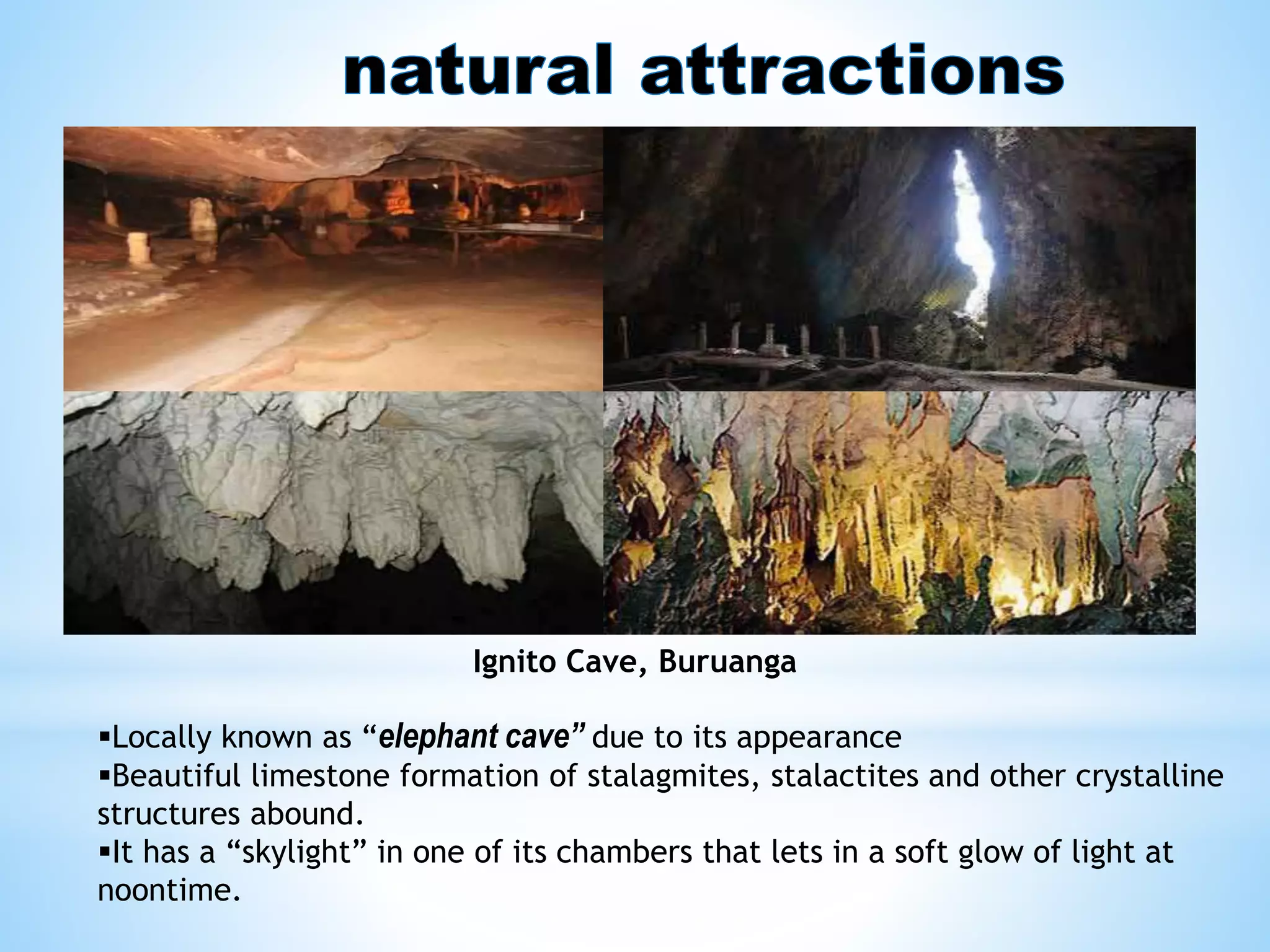
Ignito Cave, Buruanga
Locally known as “elephant cave” due to its appearance
Beautiful limestone formation of stalagmites, stalactites and other crystalline
structures abound.
It has a “skylight” in one of its chambers that lets in a soft glow of light at
noontime.
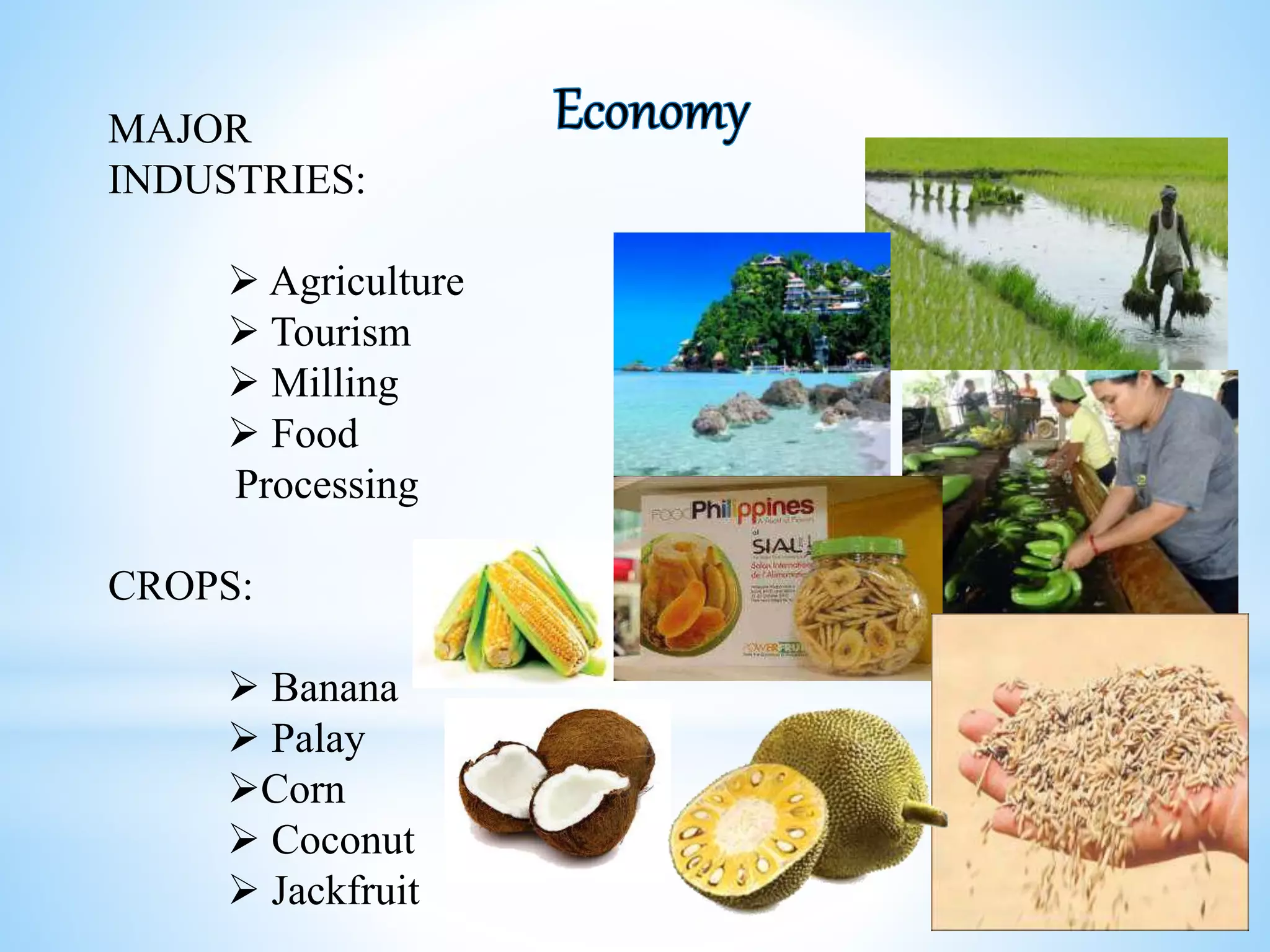
MAJOR
INDUSTRIES:
 Agriculture
 Tourism
 Milling
 Food
Processing
CROPS:
 Banana
 Palay
Corn
 Coconut
 Jackfruit
Jawili Falls, Tangalan
It has 7 basins tiered about 20 feet apart
The highest basin is about 100 feet high, oval-shaped,
around 240 sq. ft. in area and 12 feet deep clear water
almost like a small lake.
 the capital is San Jose De Buenavista
 It was one of the three districts of Panay before the
Spanish colonizers arrived
 formerly known as “Hantik”
 Negritos or the “Atis” were believed to be the earliest
people who settled in the island of Panay
 They have developed their own distinct language called Kinaray-a.
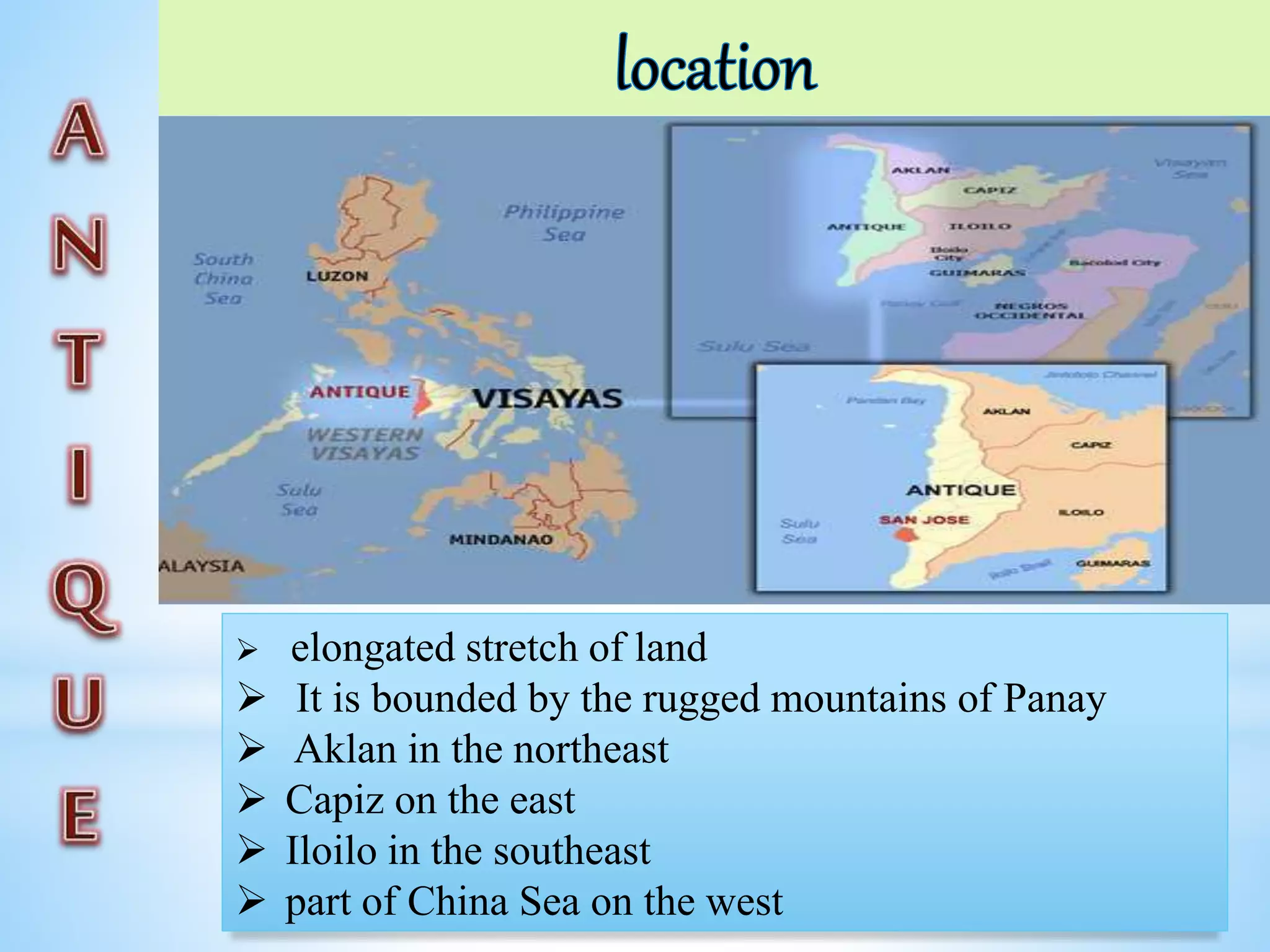
 elongated stretch of land
 It is bounded by the rugged mountains of Panay
 Aklan in the northeast
 Capiz on the east
 Iloilo in the southeast
 part of China Sea on the west
MAJOR INDUSTRIES
 Agriculture
 Fishing
PRODUCTS
 copra
 Palay
 Muscovado sugar
 legumes
 fruits
 vegetables
 livestock
 fish
 seaweeds
 coal
 marble
 Silica
 Copper
 Gemstones
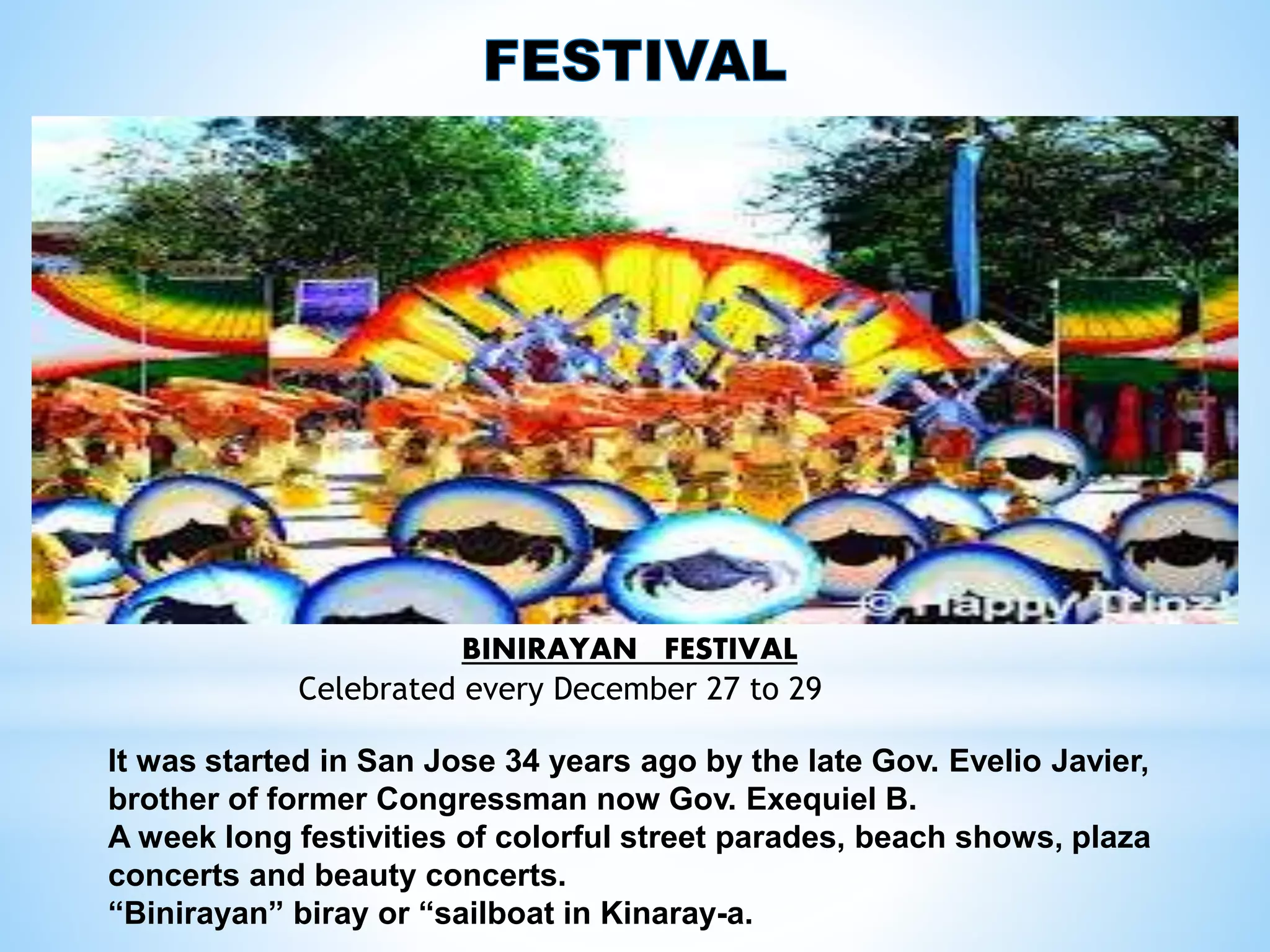
BINIRAYAN FESTIVAL
Celebrated every December 27 to 29
It was started in San Jose 34 years ago by the late Gov. Evelio Javier,
brother of former Congressman now Gov. Exequiel B.
A week long festivities of colorful street parades, beach shows, plaza
concerts and beauty concerts.
“Binirayan” biray or “sailboat in Kinaray-a.
ANINI-Y CHURCH
A massive white coral building located in
Poblacion Anini-y
South of San Jose de Buenavista
BUGTONG BATO WATERFALLS,
Tibiao
 Ideal for excursions/
picnics with excellent
opportunities for bathing,
swimming and picture
taking.
 The first 3 waterfalls with
a height up to 150 ft. is
accesable.
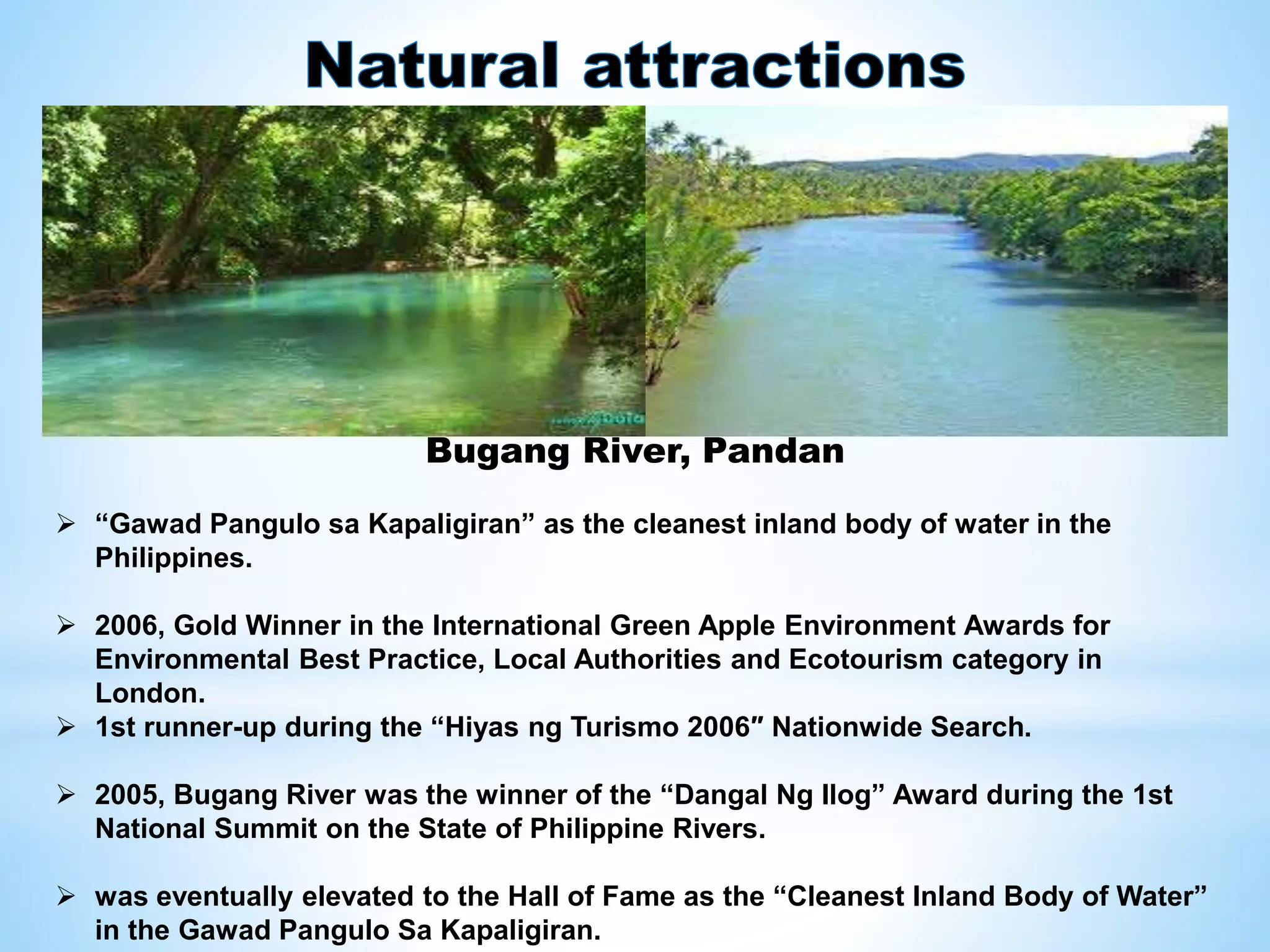
Bugang River, Pandan
 “Gawad Pangulo sa Kapaligiran” as the cleanest inland body of water in the
Philippines.
 2006, Gold Winner in the International Green Apple Environment Awards for
Environmental Best Practice, Local Authorities and Ecotourism category in
London.
 1st runner-up during the “Hiyas ng Turismo 2006″ Nationwide Search.
 2005, Bugang River was the winner of the “Dangal Ng Ilog” Award during the 1st
National Summit on the State of Philippine Rivers.
 was eventually elevated to the Hall of Fame as the “Cleanest Inland Body of Water”
in the Gawad Pangulo Sa Kapaligiran.
Caluya, A hidden gem in Antique
The absence of high-rises further makes the islands a perfect
getaway for nature trippers who want a respite from the pains of city
life. There, they can go snorkeling, diving, boating or swimming
alongside playful dolphins.
There are two main versions of how Capiz got this
name:
1. AKEAN and KAPID
-meaning “twins” which Balingangan,
Datu Bangkaya’s eldest son, names his
territories in honor of his twin daughters.
2. When the Spaniards established a
settlement, the found an abundance of a
mollusk called pios or kapid, the old native
name which has also come to known as Capiz.
 It is known for its mother-of-pearl shells
that have the same name are used for
decoration, making lampshades, trays, and
window doors. The birth place of former
Pres. Manuel L. Roxas
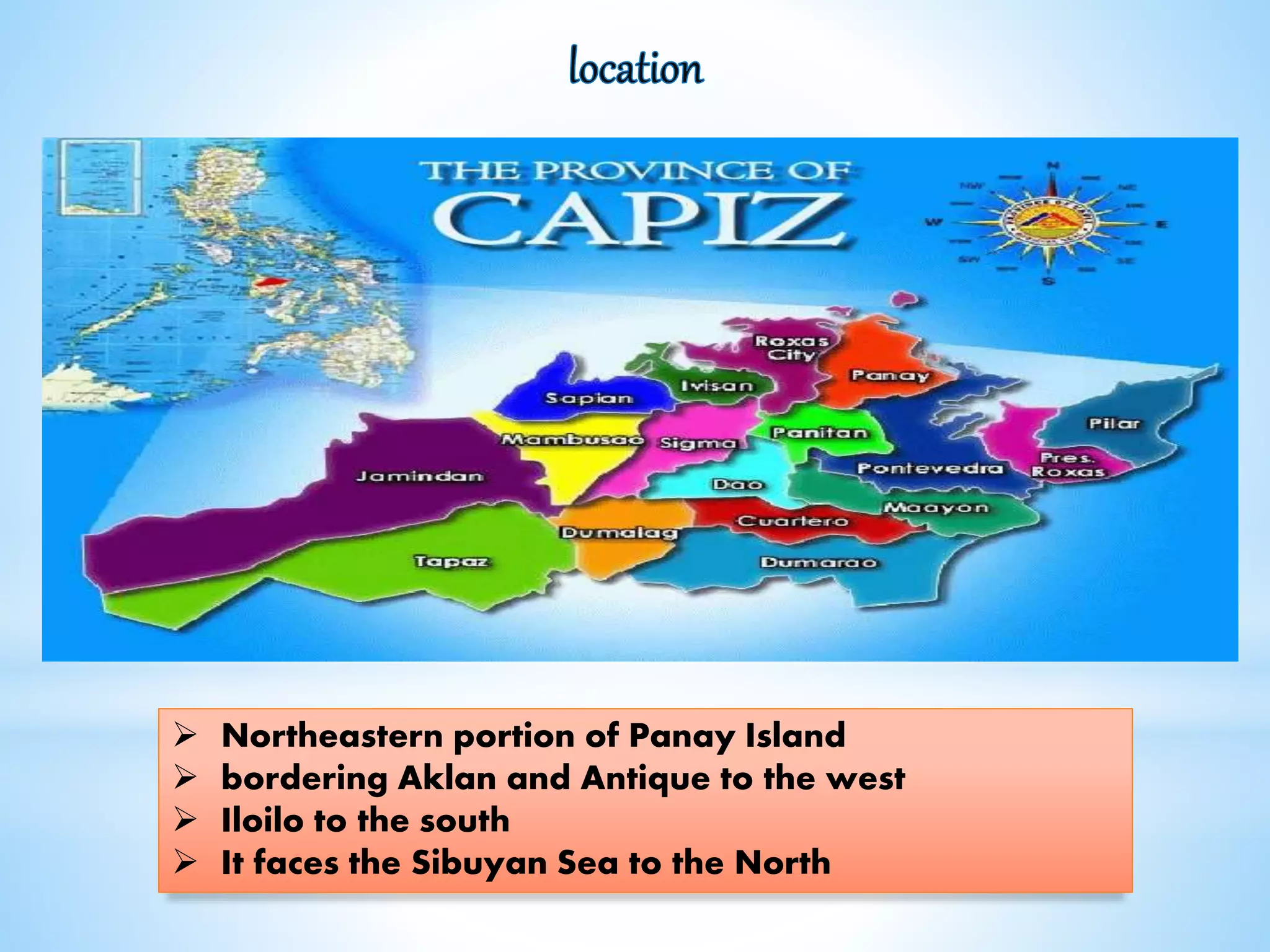
 Northeastern portion of Panay Island
 bordering Aklan and Antique to the west
 Iloilo to the south
 It faces the Sibuyan Sea to the North
MAJOR INDUSTRIES
 Agriculture
 Fishing
Other manufacturing Industries;
 garments
 furniture-making
Bakery
 processed foods
 handicrafts
Shell crafts
PRODUCTS
Agri:
 Palay
 Sugar cane
 coconut
 corn
 Banana
Agro:
 Blue marlin
 squid
 oyster
 shrimp
 seaweed
 squid
 Angel wings
ASWANG FESTIVAL
 The town people celebrate their Annual Festival or called it the Aswang
Festival is celebrated every 29th and 30th day on the month of October.
 This includes the parade of participants donning the foremost dreadful
costumes like “kapre”, “wak-wak”, and “tikbalang”.
MORO TOWER
 Built in 1814 in order to repel the invading Moors and Portuguese
colonizers.
 These half-torn structures, 7 feet squares, 10 feet high, are vivid souls of
the past.
 These towers are made of black pebbles, and are gradually eroding. One
tower is on top of the hill at Sitio Nipa, Culasi and the other one is at Brgy.
Dumolog.
STA. MONICA CHURCH
 This ancient and historic monument represents the
founding of christianity on the island of Panay.
 it is also the home of the largest Church bell in the
Philippines and Asia.
 dakong
lingganay (big
bell)
 10.4 tons
“I am God’s voice which shall echo praise from one end of the town of Pan-ay to the
other, so that Christ’s faithful followers may enter this house of God to receive
heavenly graces.”
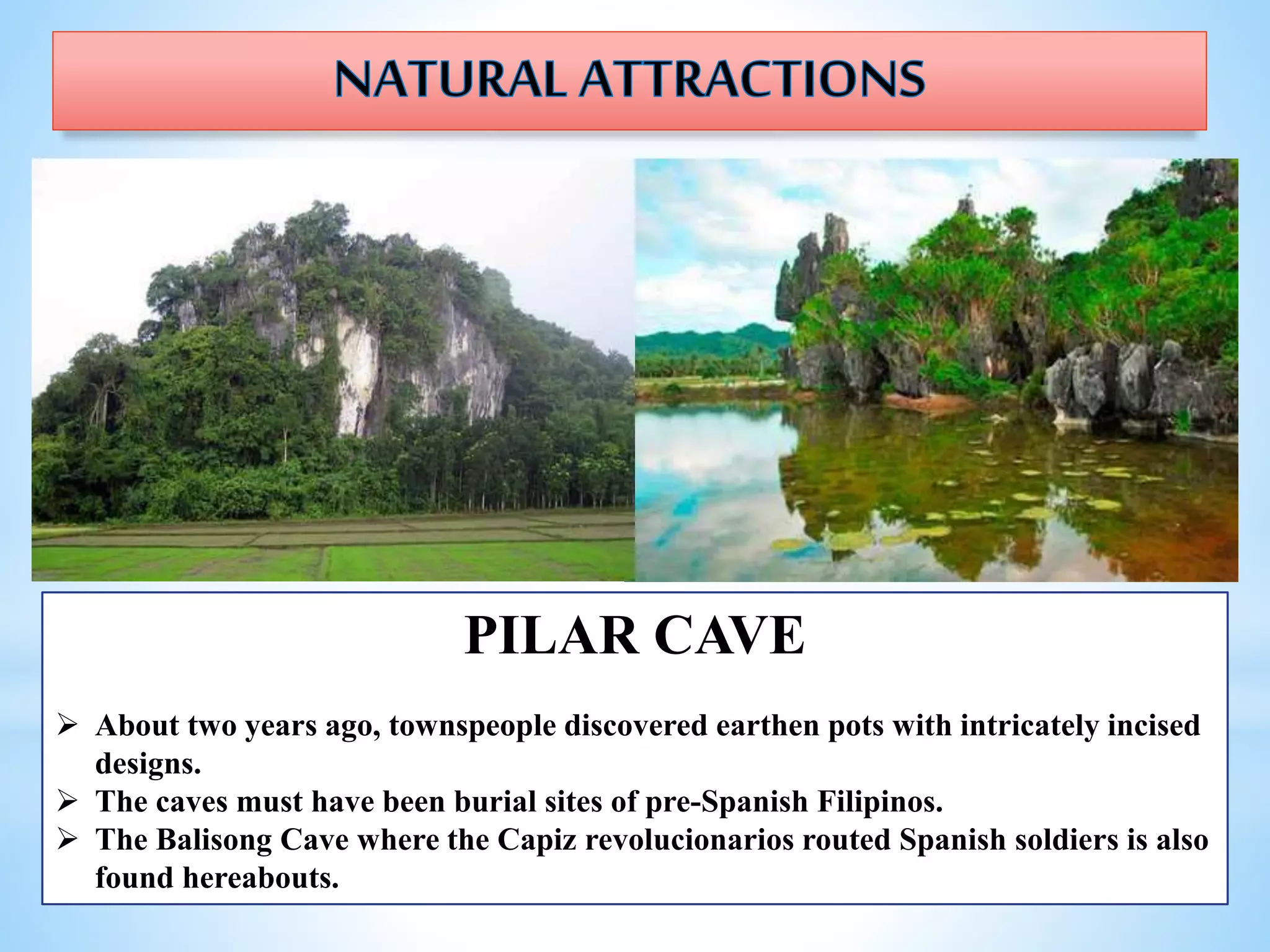
PILAR CAVE
 About two years ago, townspeople discovered earthen pots with intricately incised
designs.
 The caves must have been burial sites of pre-Spanish Filipinos.
 The Balisong Cave where the Capiz revolucionarios routed Spanish soldiers is also
found hereabouts.
QUIPOT CAVE
 consists of many chambers, each at a level different from other chambers.
 In certain sections, space between the roof and cave floor is just two or three feet.
 There are also sections that seem like a dead end, except for small openings through
which only one person can crawl.
 These holes lead to a chamber as big as a hotel ballroom, which is why it is dubbed
as the “Quipot Hilton”.
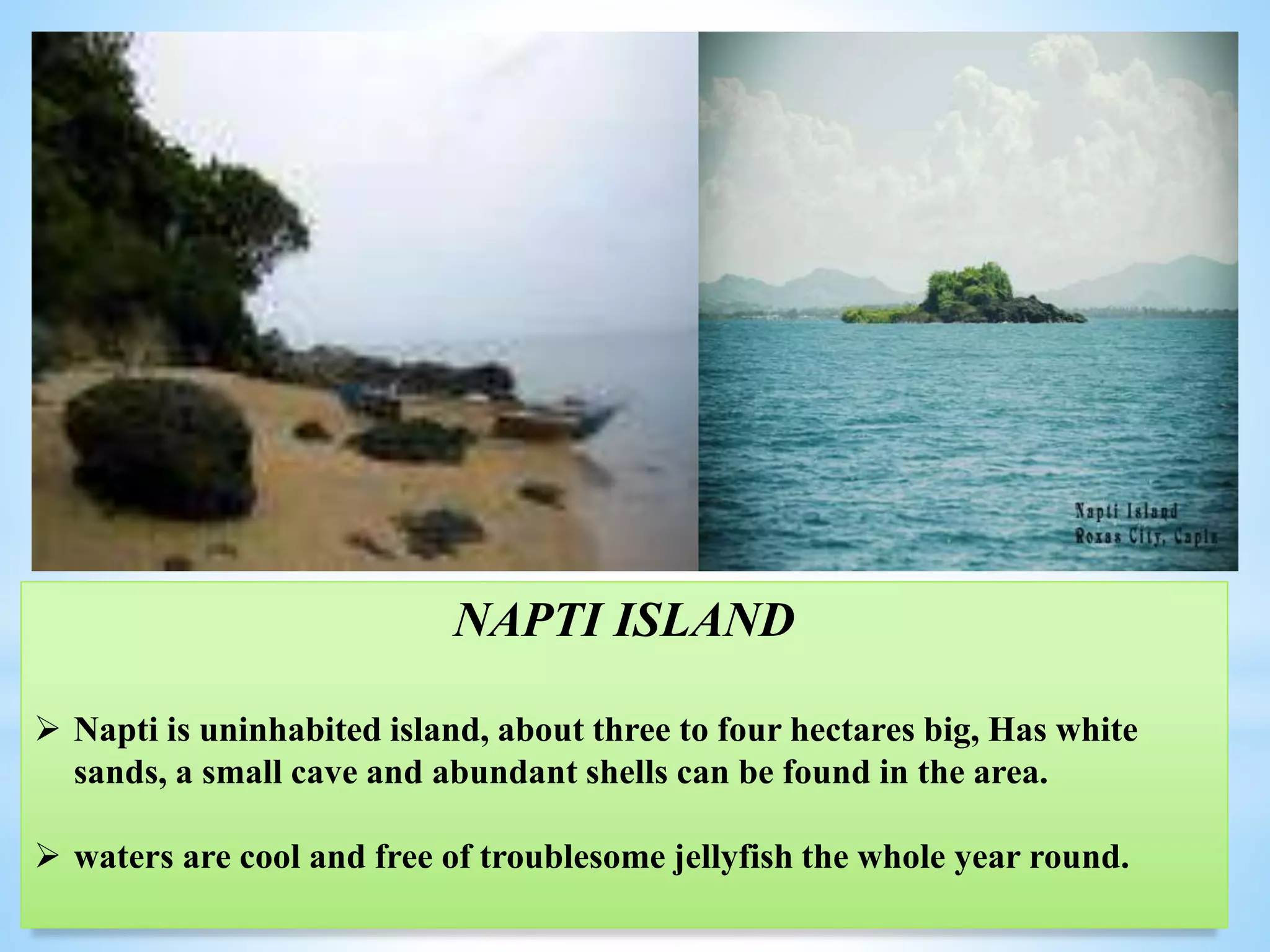
NAPTI ISLAND
 Napti is uninhabited island, about three to four hectares big, Has white
sands, a small cave and abundant shells can be found in the area.
 waters are cool and free of troublesome jellyfish the whole year round.
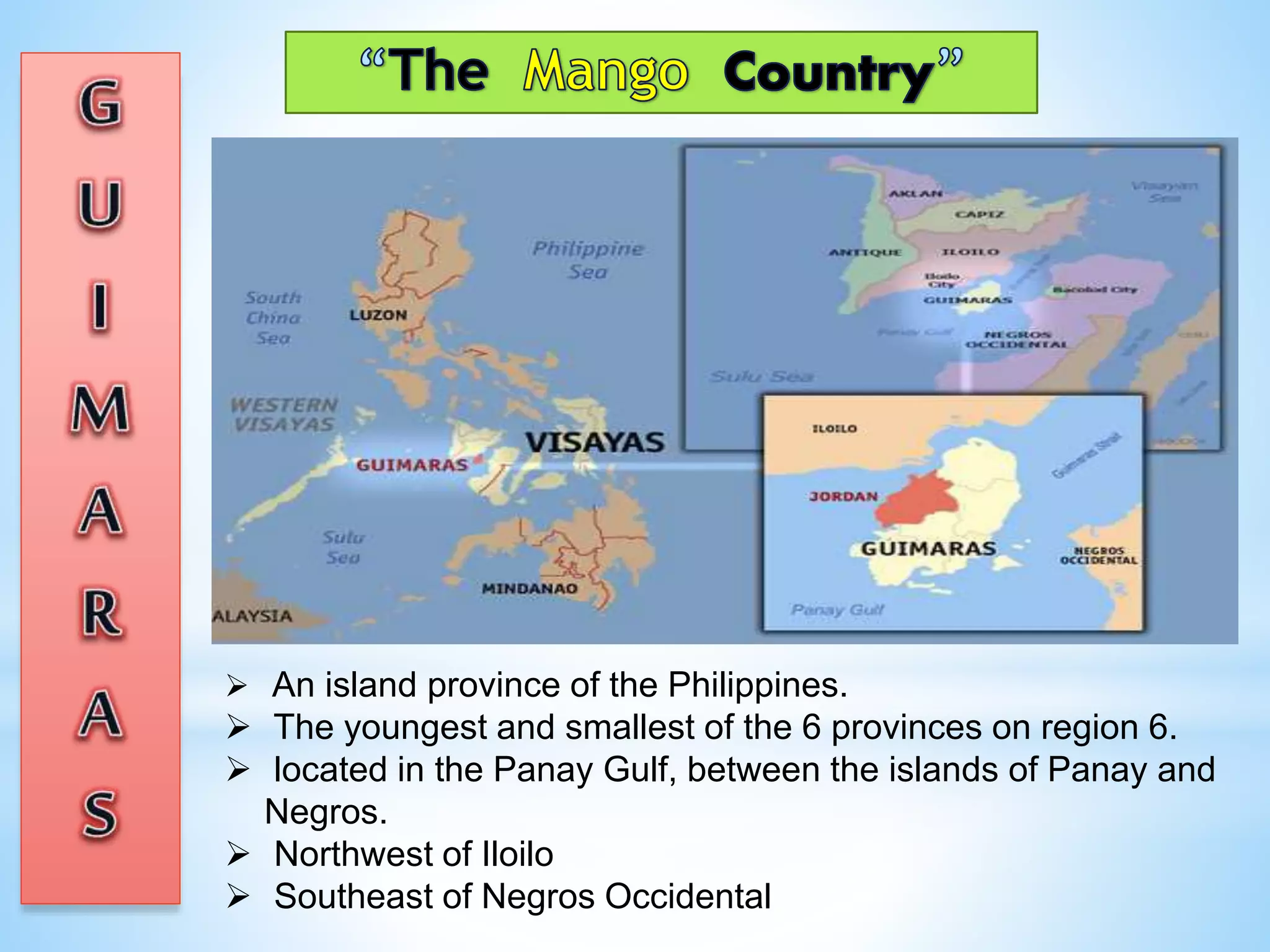
 An island province of the Philippines.
 The youngest and smallest of the 6 provinces on region 6.
 located in the Panay Gulf, between the islands of Panay and
Negros.
 Northwest of Iloilo
 Southeast of Negros Occidental
MAJOR INDUSTRIES:
 Agriculture
 Fishing
 Principal agricultural
Crops
 food crops
 corn
 rice
 vegetables
Commercial crops
 coconuts
 mangoes
Cashew
 citrus
Jackfruits
 bananas
Fruit trees
MAJOR COMMERCIAL
SPECIES:
 shrimps
 mackerel
 moonfish
 Cavalas
 Round scad
 Anchovies
 Slip mounths
 Groupers
 Sardines
MANGGAHAN SA GUIMARAS FESTIVAL
An identity festival of the province Celebrated every April 16-20 for
the sustained promotion of Mango Industry. Manggahan culminates in a
grand showcase of cultural festivals to show the world that there is more in
Guimaras than its sweet, fiber and pest-free mangos.
GUISI LIGHTHOUSE
An 18th-century lighthouse built during the Spanish-colonial era,
it is considered as the second oldest lighthouse in the Philippines, next
to the one found in Aparri, Cagayan.
TATLONG PULO (“THREE ISLANDS”)
One of them named after the three karst formations fronting the
coves, some privately owned.
A seclusion and a place for any child of the sun to find peace and
harmony.
NAVALAS CHURCH
 Considered to be the oldest structure in this island.
 Built in 1880 Navalas Church also known as San Isidro Labrador Church
in Barangay Navalas.
 The municipality of Buenavista has been the oldest seat of the
Catholicism in this island and the product of community labor and unity.
made of coral rocks abundant in the area during the construction of this
edifice.
 Southern shores of Panay Island
 Faces Iloilo Strait and Guimaras Island
 It lies on a flat alluvial plain, reclaimed mostly from the
swampy areas due to urbanization and industrialization in
the late 19th century until the present.
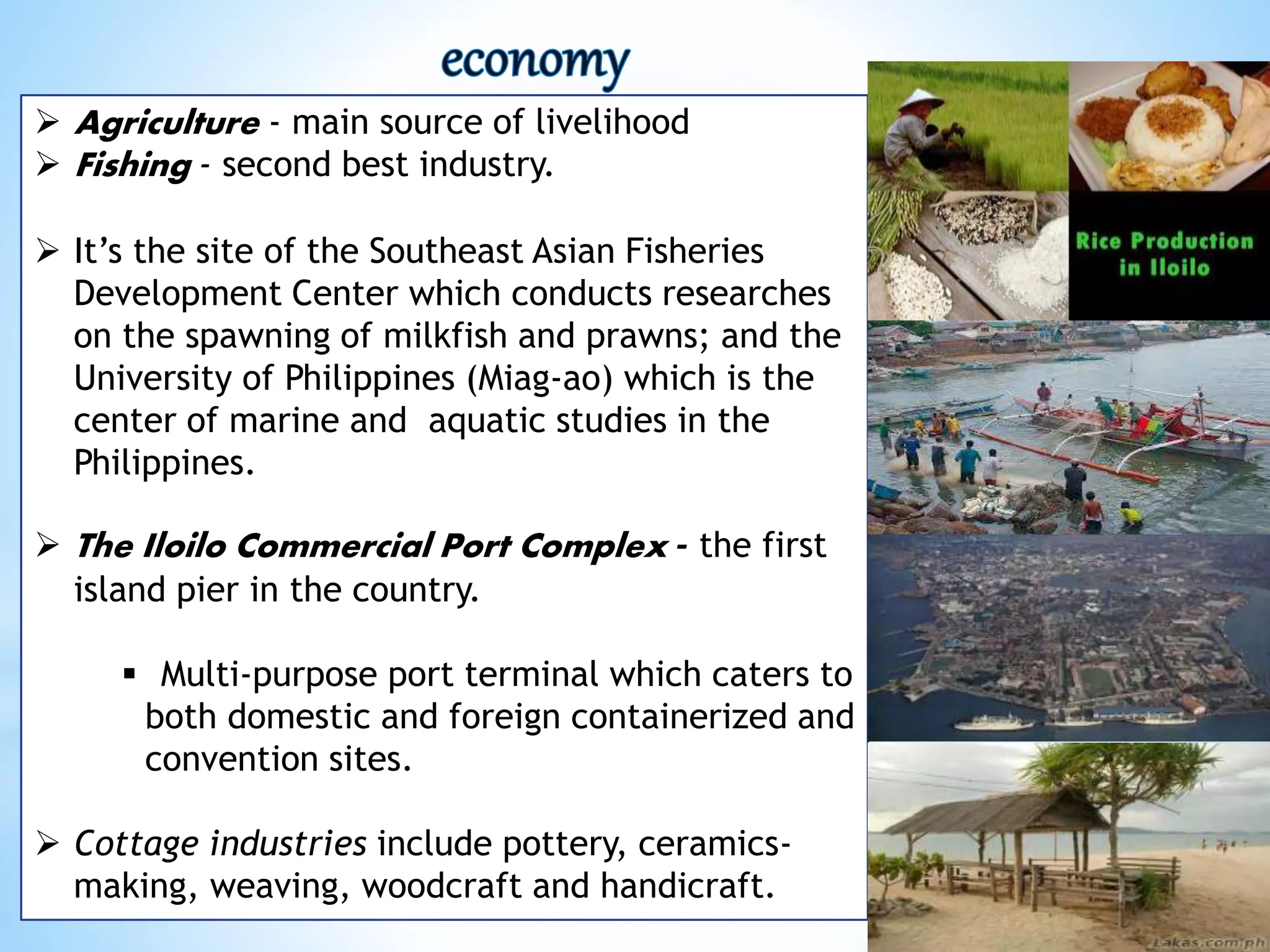
 Agriculture - main source of livelihood
 Fishing - second best industry.
 It’s the site of the Southeast Asian Fisheries
Development Center which conducts researches
on the spawning of milkfish and prawns; and the
University of Philippines (Miag-ao) which is the
center of marine and aquatic studies in the
Philippines.
 The Iloilo Commercial Port Complex - the first
island pier in the country.
 Multi-purpose port terminal which caters to
both domestic and foreign containerized and
convention sites.
 Cottage industries include pottery, ceramics-
making, weaving, woodcraft and handicraft.
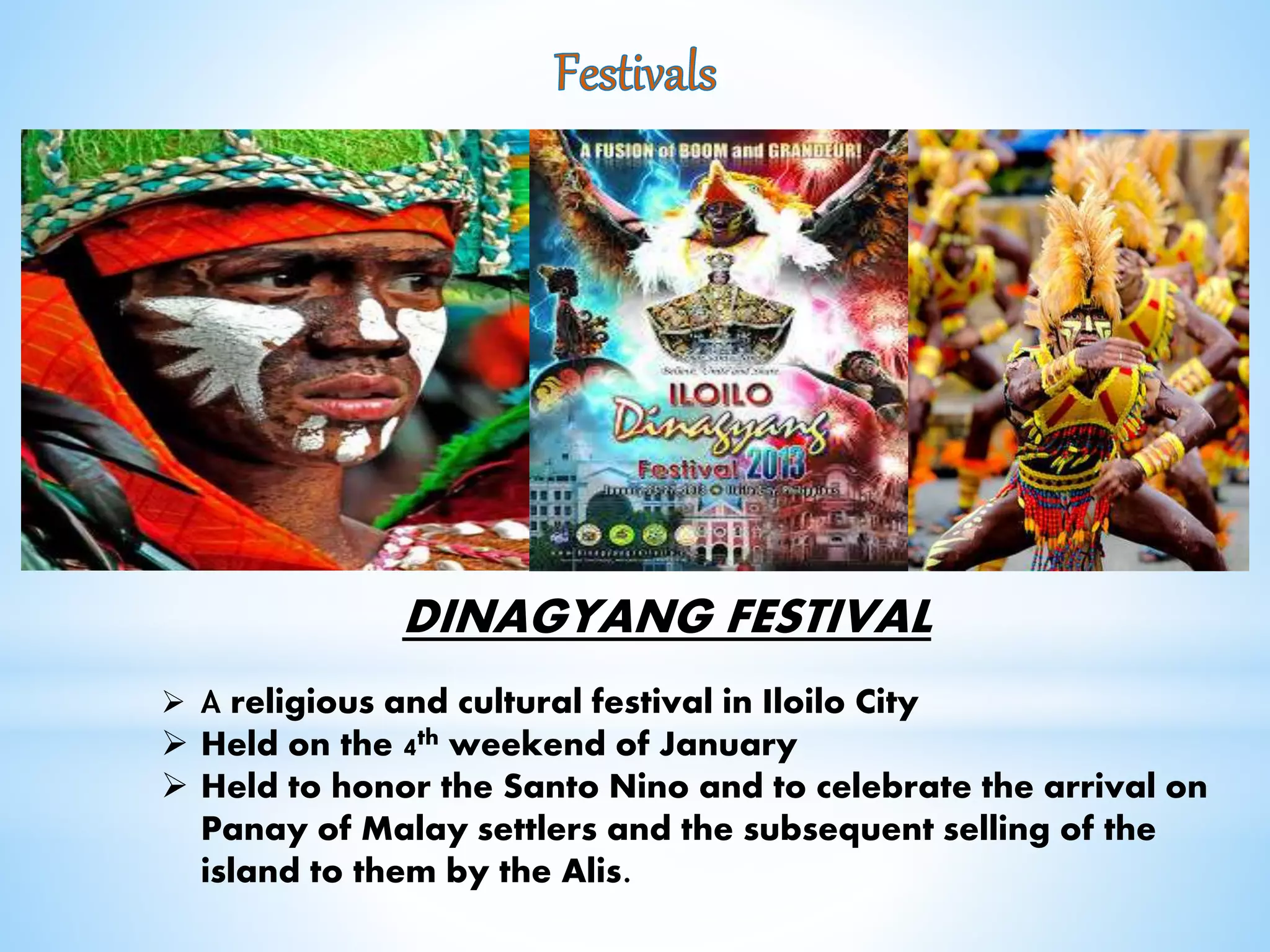
DINAGYANG FESTIVAL
 A religious and cultural festival in Iloilo City
 Held on the 4th weekend of January
 Held to honor the Santo Nino and to celebrate the arrival on
Panay of Malay settlers and the subsequent selling of the
island to them by the Alis.
CARABAO CARROZA FESTIVAL
 Celebrated every 3rd of May since 1973
 consists of three (3) main attractions namely;
a.) Carabao Carroza Parade
b.) Carabao Carroza Race and
c.) Search for Carabao Carroza Queen.
MOLO CHURCH
 “Church of Women” because of the statues of women
saints that decorate its pillars.
 A Gothic renaissance church made of coral rock
 Located 3 km from the city proper
 It was completed in 19th century
 It was visited by Dr. Jose Rizal on his way to exile in
Dapitan, Mindanao.
JARO CATHEDRAL
 “Nuestra Senora de la Candelaria”
 It’s dedicated to St. Elizabeth of Hungary
Famous for its Shrine of Our Lady of Candle which
according to pious tradition has been miraculously
growing.
 the only sacred icon in the Philippines ever crowned
personally by a Pope.
THE MIAG-AO CHURCH
 This impressive 212 year old architectural treasure,
constructed in 1786 and finished in 1797, has every right to be
considering that it is a UNESCO World Heritage Site (Baroque
Churches of the Philippines).
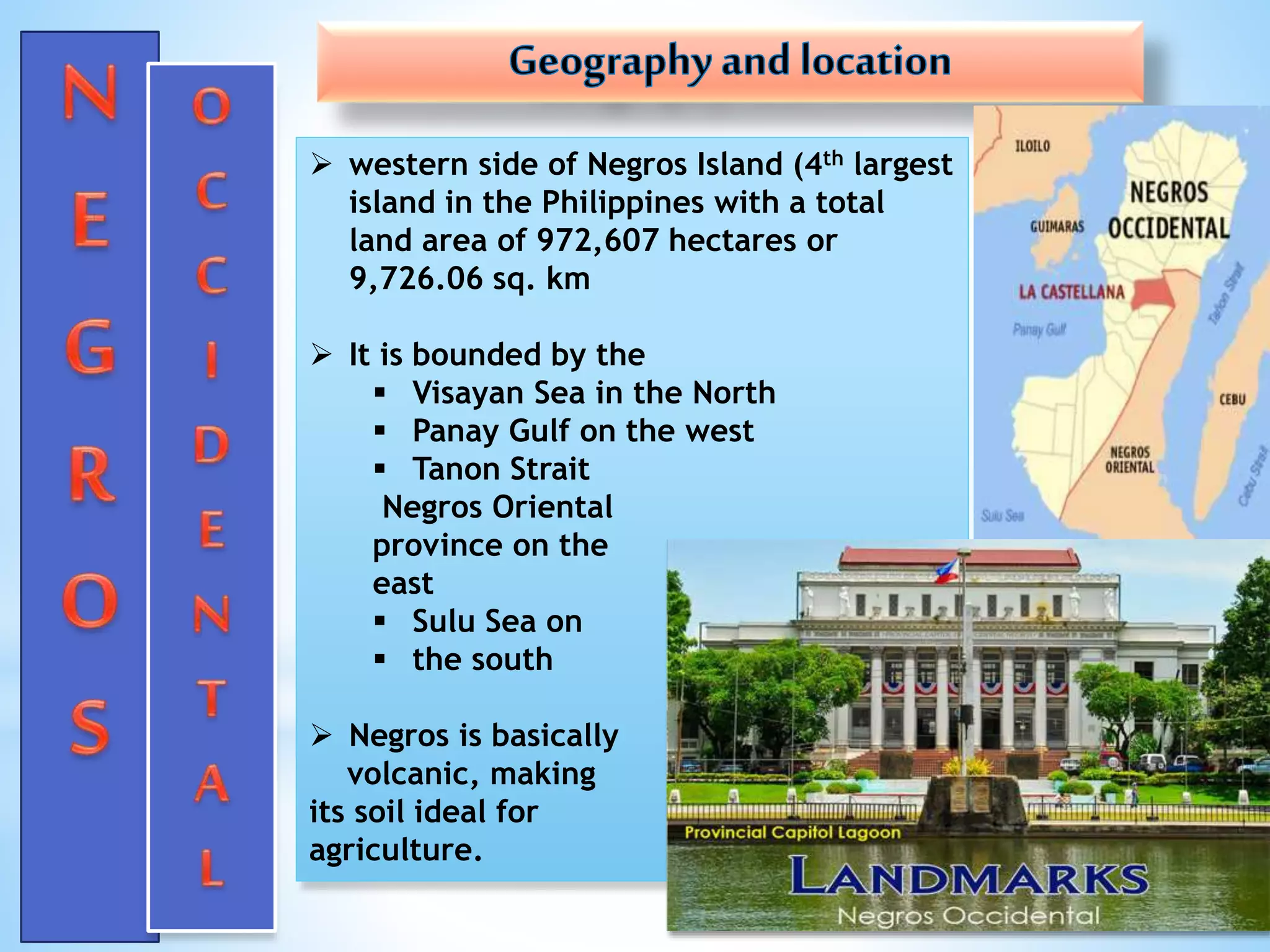
 western side of Negros Island (4th largest
island in the Philippines with a total
land area of 972,607 hectares or
9,726.06 sq. km
 It is bounded by the
 Visayan Sea in the North
 Panay Gulf on the west
 Tanon Strait
Negros Oriental
province on the
east
 Sulu Sea on
 the south
 Negros is basically
volcanic, making
its soil ideal for
agriculture.
 Fishing- major industry
based in Cadiz City.
 Philippine’s major sugar
producer
 It has substantial
production of coffee, cacao,
black pepper, fruits and
grains
 It has a large copper mine.
Gold, silver, molybdenum,
iron, gypsum, coal, and
other minerals are mined.
Other agricultural products:
Rice
Corn
Coconuts
Abaca
Bananas
Mangoes
Pineapples
MASKARA FESTIVAL
 It gives the people of Negros, as well as local foreign visitors, a
chance to drink and be merry for 20 days.
 Originally designed to show the hardships of the people of
Negros
 Has become a tool of escapism and a way to generate revenues
for big business.
 Celebrated during October 1-20
MT. KANLAON
 One of the mountains found in the north-central portion of the
island of Negros.
 It is the highest peak in Central Philippines, the most dominant
and attractive feature of which is the active summit crater of a
volcano.
REVOLUTIONARY
MARKERS
Commemorate the
spots where local
revolutionaries
fought against
Spanish authorities
during the Negros
revolution of 1898
and the American
forces later.
OUR LADY OF PEACE AND GOOD VOYAGE
A century-old church located at the heart of the
city
It has the distinction of being one of the very few
churches of Romanesque architectural design in
the region.
The Ruins in Bacolod City Philippines
 The mansion was built in the early 1900’s by the sugar baron, Don
Mariano Ledesma Lacson (1865-1948) a Portuguese from Macau.
 The mansion was the largest residential structure ever built at that time
and had in it one of the finest furniture, chinaware, and decorative
items.
 4-tiered fountain fronting the mansion, all brought in from abroad.
Region 6 WESTERN VISAYAS

Region 6 WESTERN VISAYAS

  • 1.
  • 2.
    It was createdby virtue of Presidential Decree No. 1 as part of the Integrated Reorganization Plan of President Ferdinand Edralin Marcos.
  • 3.
    Region VI iscomposed of 6 provinces : Aklan Antique Capiz Iloilo Guimaras Negros Occidental
  • 4.
    HILIGAYNON -spoken in: -Iloilo - NegrosOccidental - Guimaras - Capiz KINIRAY-A -spoken in: - Antique - some parts of Iloilo, Capiz and Aklan AKEANON -spoken in Aklan MALAYNON - spoken in Aklan CEBUANO - spoken in the northern part of Negros Occidental
  • 5.
    the capital isKalibo it has a total land area of 1,853 sq. km. oldest province in the Philippines Jose Raz Menez was the first appointed governor  their most prominent dialect are Akeanon, Malaynon, and the Buruanganon. (Home of Abaca and Piña Fibers)
  • 6.
    northeastern portion ofPanay BOUNDED BY: Sulu Sea on Northwest Sibuyan Sea on the Northeast Antique on the west  Capiz on the South
  • 8.
    MAJOR INDUSTRIES:  Agriculture Tourism  Abaca Production  Pinya Cloth Weaving “Queen of the Philippine Fabrics”  Pot Making (in Lezo, Aklan) “red clay” PRODUCTS:  Banana  Palay (no. 1 grown in the province)  fiber crops  Coconut  rambutan  mango  abaca
  • 9.
     ATI-ATIHAN FESTIVAL(Kalibo, Aklan)  every 3rd Sunday of January  Revelers in colorful costumes and bodies painted black and their faces made up of grotesquely.  A celebration of the treaty between the Ati and Malayan tribes who settled in the island. When the spaniards settled in the region and converted the Malays to Christian religion.  the festivity was celebrated in honor of the Holy Child- Sto. Ninio.
  • 10.
    Freedom Shrine dedicated tothe 19 martyrs of Aklan who started the revolution against Spain.
  • 11.
    Kalantiaw Shrine, Bataan Oncethe seat of government of Rajah Bendahara Kalantiaw promulgator of the famous Code of Kalantiaw.
  • 12.
    Museo At Aklan,Kalibo A repository of Antiques dug up in Aklan which trace the province’s rich cultural and historical past; also houses famous works of arts.
  • 13.
    Boracay Island, Malay “ParadiseIsland of the Philippines”  It is world-famous for its fine lovely palm fringed sugar-fine white sand beaches, azure waters, coral reefs and rare shells.  Its area is 1,083 hectares  Consisting of 3 barangays (Balabag, Manok-manok and Yapak)
  • 14.
    Ignito Cave, Buruanga Locallyknown as “elephant cave” due to its appearance Beautiful limestone formation of stalagmites, stalactites and other crystalline structures abound. It has a “skylight” in one of its chambers that lets in a soft glow of light at noontime.
  • 15.
    MAJOR INDUSTRIES:  Agriculture  Tourism Milling  Food Processing CROPS:  Banana  Palay Corn  Coconut  Jackfruit
  • 16.
    Jawili Falls, Tangalan Ithas 7 basins tiered about 20 feet apart The highest basin is about 100 feet high, oval-shaped, around 240 sq. ft. in area and 12 feet deep clear water almost like a small lake.
  • 17.
     the capitalis San Jose De Buenavista  It was one of the three districts of Panay before the Spanish colonizers arrived  formerly known as “Hantik”  Negritos or the “Atis” were believed to be the earliest people who settled in the island of Panay  They have developed their own distinct language called Kinaray-a.
  • 18.
     elongated stretchof land  It is bounded by the rugged mountains of Panay  Aklan in the northeast  Capiz on the east  Iloilo in the southeast  part of China Sea on the west
  • 19.
    MAJOR INDUSTRIES  Agriculture Fishing PRODUCTS  copra  Palay  Muscovado sugar  legumes  fruits  vegetables  livestock  fish  seaweeds  coal  marble  Silica  Copper  Gemstones
  • 20.
    BINIRAYAN FESTIVAL Celebrated everyDecember 27 to 29 It was started in San Jose 34 years ago by the late Gov. Evelio Javier, brother of former Congressman now Gov. Exequiel B. A week long festivities of colorful street parades, beach shows, plaza concerts and beauty concerts. “Binirayan” biray or “sailboat in Kinaray-a.
  • 21.
    ANINI-Y CHURCH A massivewhite coral building located in Poblacion Anini-y South of San Jose de Buenavista
  • 22.
    BUGTONG BATO WATERFALLS, Tibiao Ideal for excursions/ picnics with excellent opportunities for bathing, swimming and picture taking.  The first 3 waterfalls with a height up to 150 ft. is accesable.
  • 23.
    Bugang River, Pandan “Gawad Pangulo sa Kapaligiran” as the cleanest inland body of water in the Philippines.  2006, Gold Winner in the International Green Apple Environment Awards for Environmental Best Practice, Local Authorities and Ecotourism category in London.  1st runner-up during the “Hiyas ng Turismo 2006″ Nationwide Search.  2005, Bugang River was the winner of the “Dangal Ng Ilog” Award during the 1st National Summit on the State of Philippine Rivers.  was eventually elevated to the Hall of Fame as the “Cleanest Inland Body of Water” in the Gawad Pangulo Sa Kapaligiran.
  • 24.
    Caluya, A hiddengem in Antique The absence of high-rises further makes the islands a perfect getaway for nature trippers who want a respite from the pains of city life. There, they can go snorkeling, diving, boating or swimming alongside playful dolphins.
  • 25.
    There are twomain versions of how Capiz got this name: 1. AKEAN and KAPID -meaning “twins” which Balingangan, Datu Bangkaya’s eldest son, names his territories in honor of his twin daughters. 2. When the Spaniards established a settlement, the found an abundance of a mollusk called pios or kapid, the old native name which has also come to known as Capiz.  It is known for its mother-of-pearl shells that have the same name are used for decoration, making lampshades, trays, and window doors. The birth place of former Pres. Manuel L. Roxas
  • 26.
     Northeastern portionof Panay Island  bordering Aklan and Antique to the west  Iloilo to the south  It faces the Sibuyan Sea to the North
  • 27.
    MAJOR INDUSTRIES  Agriculture Fishing Other manufacturing Industries;  garments  furniture-making Bakery  processed foods  handicrafts Shell crafts PRODUCTS Agri:  Palay  Sugar cane  coconut  corn  Banana Agro:  Blue marlin  squid  oyster  shrimp  seaweed  squid  Angel wings
  • 28.
    ASWANG FESTIVAL  Thetown people celebrate their Annual Festival or called it the Aswang Festival is celebrated every 29th and 30th day on the month of October.  This includes the parade of participants donning the foremost dreadful costumes like “kapre”, “wak-wak”, and “tikbalang”.
  • 29.
    MORO TOWER  Builtin 1814 in order to repel the invading Moors and Portuguese colonizers.  These half-torn structures, 7 feet squares, 10 feet high, are vivid souls of the past.  These towers are made of black pebbles, and are gradually eroding. One tower is on top of the hill at Sitio Nipa, Culasi and the other one is at Brgy. Dumolog.
  • 30.
    STA. MONICA CHURCH This ancient and historic monument represents the founding of christianity on the island of Panay.  it is also the home of the largest Church bell in the Philippines and Asia.  dakong lingganay (big bell)  10.4 tons
  • 31.
    “I am God’svoice which shall echo praise from one end of the town of Pan-ay to the other, so that Christ’s faithful followers may enter this house of God to receive heavenly graces.”
  • 32.
    PILAR CAVE  Abouttwo years ago, townspeople discovered earthen pots with intricately incised designs.  The caves must have been burial sites of pre-Spanish Filipinos.  The Balisong Cave where the Capiz revolucionarios routed Spanish soldiers is also found hereabouts.
  • 33.
    QUIPOT CAVE  consistsof many chambers, each at a level different from other chambers.  In certain sections, space between the roof and cave floor is just two or three feet.  There are also sections that seem like a dead end, except for small openings through which only one person can crawl.  These holes lead to a chamber as big as a hotel ballroom, which is why it is dubbed as the “Quipot Hilton”.
  • 34.
    NAPTI ISLAND  Naptiis uninhabited island, about three to four hectares big, Has white sands, a small cave and abundant shells can be found in the area.  waters are cool and free of troublesome jellyfish the whole year round.
  • 35.
     An islandprovince of the Philippines.  The youngest and smallest of the 6 provinces on region 6.  located in the Panay Gulf, between the islands of Panay and Negros.  Northwest of Iloilo  Southeast of Negros Occidental
  • 36.
    MAJOR INDUSTRIES:  Agriculture Fishing  Principal agricultural Crops  food crops  corn  rice  vegetables Commercial crops  coconuts  mangoes Cashew  citrus Jackfruits  bananas Fruit trees MAJOR COMMERCIAL SPECIES:  shrimps  mackerel  moonfish  Cavalas  Round scad  Anchovies  Slip mounths  Groupers  Sardines
  • 37.
    MANGGAHAN SA GUIMARASFESTIVAL An identity festival of the province Celebrated every April 16-20 for the sustained promotion of Mango Industry. Manggahan culminates in a grand showcase of cultural festivals to show the world that there is more in Guimaras than its sweet, fiber and pest-free mangos.
  • 38.
    GUISI LIGHTHOUSE An 18th-centurylighthouse built during the Spanish-colonial era, it is considered as the second oldest lighthouse in the Philippines, next to the one found in Aparri, Cagayan.
  • 39.
    TATLONG PULO (“THREEISLANDS”) One of them named after the three karst formations fronting the coves, some privately owned. A seclusion and a place for any child of the sun to find peace and harmony.
  • 40.
    NAVALAS CHURCH  Consideredto be the oldest structure in this island.  Built in 1880 Navalas Church also known as San Isidro Labrador Church in Barangay Navalas.  The municipality of Buenavista has been the oldest seat of the Catholicism in this island and the product of community labor and unity. made of coral rocks abundant in the area during the construction of this edifice.
  • 41.
     Southern shoresof Panay Island  Faces Iloilo Strait and Guimaras Island  It lies on a flat alluvial plain, reclaimed mostly from the swampy areas due to urbanization and industrialization in the late 19th century until the present.
  • 42.
     Agriculture -main source of livelihood  Fishing - second best industry.  It’s the site of the Southeast Asian Fisheries Development Center which conducts researches on the spawning of milkfish and prawns; and the University of Philippines (Miag-ao) which is the center of marine and aquatic studies in the Philippines.  The Iloilo Commercial Port Complex - the first island pier in the country.  Multi-purpose port terminal which caters to both domestic and foreign containerized and convention sites.  Cottage industries include pottery, ceramics- making, weaving, woodcraft and handicraft.
  • 43.
    DINAGYANG FESTIVAL  Areligious and cultural festival in Iloilo City  Held on the 4th weekend of January  Held to honor the Santo Nino and to celebrate the arrival on Panay of Malay settlers and the subsequent selling of the island to them by the Alis.
  • 44.
    CARABAO CARROZA FESTIVAL Celebrated every 3rd of May since 1973  consists of three (3) main attractions namely; a.) Carabao Carroza Parade b.) Carabao Carroza Race and c.) Search for Carabao Carroza Queen.
  • 45.
    MOLO CHURCH  “Churchof Women” because of the statues of women saints that decorate its pillars.  A Gothic renaissance church made of coral rock  Located 3 km from the city proper  It was completed in 19th century  It was visited by Dr. Jose Rizal on his way to exile in Dapitan, Mindanao.
  • 46.
    JARO CATHEDRAL  “NuestraSenora de la Candelaria”  It’s dedicated to St. Elizabeth of Hungary Famous for its Shrine of Our Lady of Candle which according to pious tradition has been miraculously growing.  the only sacred icon in the Philippines ever crowned personally by a Pope.
  • 47.
    THE MIAG-AO CHURCH This impressive 212 year old architectural treasure, constructed in 1786 and finished in 1797, has every right to be considering that it is a UNESCO World Heritage Site (Baroque Churches of the Philippines).
  • 48.
     western sideof Negros Island (4th largest island in the Philippines with a total land area of 972,607 hectares or 9,726.06 sq. km  It is bounded by the  Visayan Sea in the North  Panay Gulf on the west  Tanon Strait Negros Oriental province on the east  Sulu Sea on  the south  Negros is basically volcanic, making its soil ideal for agriculture.
  • 49.
     Fishing- majorindustry based in Cadiz City.  Philippine’s major sugar producer  It has substantial production of coffee, cacao, black pepper, fruits and grains  It has a large copper mine. Gold, silver, molybdenum, iron, gypsum, coal, and other minerals are mined. Other agricultural products: Rice Corn Coconuts Abaca Bananas Mangoes Pineapples
  • 50.
    MASKARA FESTIVAL  Itgives the people of Negros, as well as local foreign visitors, a chance to drink and be merry for 20 days.  Originally designed to show the hardships of the people of Negros  Has become a tool of escapism and a way to generate revenues for big business.  Celebrated during October 1-20
  • 51.
    MT. KANLAON  Oneof the mountains found in the north-central portion of the island of Negros.  It is the highest peak in Central Philippines, the most dominant and attractive feature of which is the active summit crater of a volcano.
  • 52.
    REVOLUTIONARY MARKERS Commemorate the spots wherelocal revolutionaries fought against Spanish authorities during the Negros revolution of 1898 and the American forces later.
  • 53.
    OUR LADY OFPEACE AND GOOD VOYAGE A century-old church located at the heart of the city It has the distinction of being one of the very few churches of Romanesque architectural design in the region.
  • 54.
    The Ruins inBacolod City Philippines  The mansion was built in the early 1900’s by the sugar baron, Don Mariano Ledesma Lacson (1865-1948) a Portuguese from Macau.  The mansion was the largest residential structure ever built at that time and had in it one of the finest furniture, chinaware, and decorative items.  4-tiered fountain fronting the mansion, all brought in from abroad.