CAr
The Cordillera Administrative
Region (CAR) is the Philippines’
only land-locked region located in
the north central part of Luzon. It is
consisted of the provinces of Abra,
Apayao, Benguet, Ifugao, Kalinga,
Mountain Province and Baguio City
(the regional center).
The Cordillera region encompasses
of mostly mountainous areas with small
scattered valleys especially in the
province of Abra. Highest peak is the
2,930 meter Mt. Pulag located in the
boundary of Benguet and Nueva Vizcaya
provinces. This region is home to
numerous indigenous tribes collectively
called the Igorot.
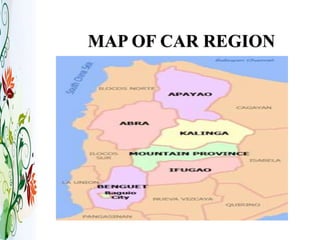
MAP OF CAR REGION
Province/
City
Capital Populatio
n(2010)
Area
(km²)
Pop.
density
(per km²)
Abra Bangue
d
234,733
3,975.6 59.0
Apayao Kabuga
o
112,636
3,927.9 28.7
Benguet La
trinidad
403,944
2,826.59 142.9
Ifugao Lagawe 191,078 2,517.8 75.9
Kalinga Tabuk
city
201,613
3,119.7 64.6
Mountai
n
Bontoc 154,187
2,097.3 73.5
History of
regional
formation
On June 18, 1966, Republic
Act No. 4695 was enacted to
split Mountain Province into four
separate and independent
provinces of Mountain
Province, Benguet, Ifugao and
Kalinga-Apayao
Prior to the formal creation of
Cordillera Administrative Region,
as a consequence of the
constitutional mandate under the
1987 Philippine Constitution, the
former four provinces was
loosely under Cagayan Valley
Region while the fifth province
Abra was grouped under Ilocos
Region.
On July 15, 1987, President Corazon
C. Aquino issued Executive Order No.
220 which created the Cordillera
Administrative Region, that
included Mountain
Province, Benguet, Ifugao, Kalinga-
Apayao and annexed the province
of Abra as part of the Cordillera
Administrative Region, giving the region
formal autonomy as part of her political
compromise to the Cordillera People's
Liberation Army, a rebel group operating
On February 14, 1995,
Kalinga-Apayao, one of the five
provinces of the region was split
into two separate and
independent provinces of
Apayao and Kalinga with the
enactment of Republic Act No.
7878.
Several attempts at legalizing
autonomy in the Cordillera region
have failed in two separate
plebiscites. An affirmative vote for the
law on regional autonomy is a
precondition by the 1987 Philippine
Constitution to give the region
autonomy in self-governance much
like the Autonomous Region of
Muslim Mindanao in southern
Philippines.
The first law Republic Act No. 6766,
took effect on October 23, 1989 but
failed to muster a majority vote in the
plebiscite on January 30, 1990.The
second law, Republic Act No. 8438
passed by Congress of the
Philippines on December 22, 1997, also
failed to pass the approval of the
Cordillera peoples in a region-wide
referendum on March 7, 1998.
At present, a third organic act of the
Cordillera is in the offing supported by
the Cordillera Regional Development
Regional economy
Regional economy of the
Cordilleras is diverse; mining,
agriculture, export processing
zone, tourism are among
economic activities in the
different provinces of the region.
The region is abundant with
mineral reserves. These include
metallic ores such as gold,
copper, silver, zinc, and non-
metallic minerals like sand,
gravel and sulfur. Mineral
reserves are found in all the
provinces. However, mining is
concentrated in Benguet.
Its timber resources has
dwindled since the introduction of
slash-and-burn method of
farming in all parts of the
Cordillera mountain range.
Vegetable crop production is
well developed in Benguet, rice
production in Ifugao and Abra,
corn production in Mountain
Province, and Kalinga.
Baguio City and La Trinidad are
considered as the industrial centers in
the region. Baguio City hosts Baguio
Export Processing Zone where
operations of big companies like Texas
Instruments, and MOOG are located.
The city also hosts offshore and
outsourcing companies operating call
centers.
The primary growth centers of the
region are Metro Baguio and the
Eastern Cordillera Growth Corridor.
CAR PROVINCES ,
CAPITAL AND CITIES/
MUNICIPALITIES AND
DESCRIPTION OF THE
LOCATION AS WELL
AS THE ETHNIC
PEOPLE
ABRA
 Lagayan
 Langiden
Licuan –
Baay
Luba
 Malibcong
 Manabo
Peñarrubia
Pidigan
Pilar
Sallapadan
San Isidro
 San Juan
 Tubo
 Bangued
 Boliney
 Bucay
 Bucloc

Daguioman
 Danglas
 Dolores
 La Paz
 Lacub

Lagangilang
 San
Province
Municipalities
Bangue
d
 -is a landlocked province of the
Philippines in the Cordillera
Administrative Region in Luzon. Its
capital is Bangued, and it borders
Ilocos Norte and Apayao on the
north, Ilocos Sur and Mountain
Province on the south, Ilocos Norte
and Ilocos Sur on the west, and
Kalinga, and Apayao on the east.
ABRA
ABRA
The Tingguians are
composed of sub-groups known
as the Itneg tribes which
includes Adasen, Balatok,
Banaw, Belwang, Binungan,
Gubang, Inlaud, Mabaka,
Maeng, Masadiit, and Muyadan
or Ammutan.
Province
APAYAO
Kabuyao
MUNICIPALITIES
 Calanasan
(Bayag)
 Conner
 Flora
 Kabugao
 Luna (Macatel)
 Pudtol
 Santa Marcela
 -is a landlocked province of the
Philippines in the Cordillera Administrative
Region in Luzon. Its administrative capital
is Luna and founding capital Kabugao. It
borders Cagayan to the north and east,
Abra and Ilocos Norte to the west, and
Kalinga to the south. Prior to 1995,
Kalinga and Apayao comprised a single
province named Kalinga-Apayao, until
they were split into two to better service
the needs of individual native tribes in the
provinces.
APAYAO
APAYAO
Isneg tribe are also known as
the Isnag which composed of the
sub-groups known as the
Ymandaya and Imallod.
Province
BENGUET
La Trinidad
MUNICIPALITIES
*Atok
*Bakun
*Mankayan
*Buguias
*Sablan
*Itogon *Tuba
*Kabayan
*Kapangan
 -is a landlocked province of the
Philippines in the Cordillera Administrative
Region in Luzon. Its capital is La Trinidad
and borders, clockwise from the south,
Pangasinan, La Union, Ilocos Sur, Mountain
Province, Ifugao, and Nueva Vizcaya.
 Baguio, a popular tourist destination in
the country, is located in the interior of the
province, however, the city is independent
of the province.
BENGUET
Benguet
* Ibaloi
* Kankanaey
Province
IFUGAO
Lagawe
MUNICIPALITIES
*Aguinaldo
*Alfonso Lista
*Mayoyao *Lamot
*Asipulo *Tinoc
*Banaue *Hingyon
*Hungduan
*Kiangan
*Lagawe
IFUGAO
 -is a landlocked province of the
Philippines in the Cordillera
Administrative Region in Luzon. Covering
a total land area of 262,820 hectares, the
province of Ifugao is located in a
mountainous region characterized by
rugged terrain, river valleys, and massive
forests. Its capital is Lagawe and borders
Benguet to the west, Mountain Province
to the north, Isabela to the east, and
Nueva Vizcaya to the south.
Province
KALINGA
Tabuk
MUNICIPALITIES
 Balbalan
 Labuagan
 Pasil
 Pinukpuk
 Rizal
 Tanudan
 Tinglayan
 -is a landlocked province of the
Philippines in the Cordillera Administrative
Region in Luzon. Its capital is Tabuk and
borders Mountain Province to the south,
Abra to the west, Isabela to the east,
Cagayan to the northeast, and Apayao to
the north. Prior to 1995, Kalinga and
Apayao used to be a single province
named Kalinga-Apayao, until they were
split into two to better service the needs of
individual native tribes in the provinces.
KALINGA
Kalinga
* Kalingan
* Banao
Province
MOUNTAIN
PROVINCE
Bontoc
MUNICIPALITIES
MT. PROVINCE
-is located in the central part of
Cordillera Administrative Region. It is
bounded on the North by Kalinga and
on the West by Ilocos Sur and Abra.
Towards the South are Benguet and
Ifugao and on the East by Isabela.
The province consist of ten (10)
towns and 144 barangays with a total
land area of 209,733 hectares.
Mountain Province
* Bontoc - Bontoc
* Balangao - Natonin
* Baliwon - Paracelis
Kankanaey-Sagada and
Sabangan
Culture
The Cordillera region is
known for its unique musical
instruments including the
gangsa kalinga, nose
flute, bamboo flute, buzzer,
bangibang, tongatong, diwdiw-
as, saggeypo, and bamboo
zither.
VARIOUS
FESTIVALS
OF
CORDILLERA
PanagbengaFestival
Panagbenga / Baguio Flower
Festival which is celebrated in
February. The festival focuses
on Baguio as the Flower
Garden City of the North.
Highlights include flower
exhibits, lectures, garden tours,
floral competition and a parade
Adivay Festival
Adivay festival in Benguet
which means "coming together of
people to celebrate" is celebrated
every month of November. The
month-long activities highlights
the Agro-industrial and trade fair
which showcase the different
products of Benguet
Ullalim Festival
Ullalim Festival/ in Kalinga which is
celebrated every February 14. It is in
celebration of the founding anniversary of
the province and the Peace acts
called Bodong. It is the poetic expression
of the heroic exploits, romance, joys,
successes as well as tribulations, and the
way of life of the Kalingas from birth to
death. The Festival highlights the weaved
clothes (laga) exhibits, world class coffee
beans and other products of Kalinga.
Lang-ay Festival
Lang-ay Festival in Mountain Province
celebrated every April 7. This is a week-
long agro-industrial trade, tourism and
cultural fair with tribal dances and songs.
Lang-ay is a native term which describes
the tradition of the people of Mountain
Province to celebrate festivities, share
happiness, foster family solidarity,
hospitality and nurture friendship - all with
a toast of home-brewed wine.
Matagoan Festival
Tabuk Matagoan Festival which
features G-String marathon
(runners wear G-String only),
cultural dances and songs. The
festival showcases the different
products of tabuk coming from the
different parts of Kalinga such as
the aromatic Kalinga coffee.
Tourist attractions
Banaue Rice Terraces
Sumaguing Cave
Mummy Caves
Four National Parks
Cassamata Hill
Mount Pulag
Mt. Data and
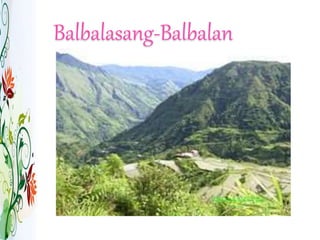
Balbalasang-Balbalan
Cassamata Hill
Mount Pulag
Balbalasang-Balbalan
Chico River At Mt. Province
Lion’s head in Baguio City
Burnham Park
Botanical Garden
Camp John Hay
Ifugao dances
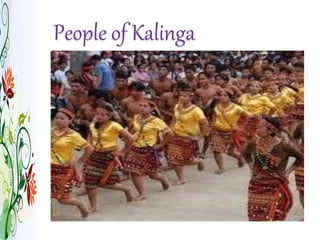
People of Kalinga
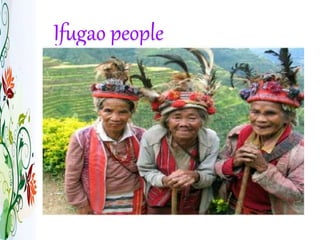
Ifugao people
Thank you
Ana Marie B. Cordova

Car region

  • 1.
  • 2.
    The Cordillera Administrative Region(CAR) is the Philippines’ only land-locked region located in the north central part of Luzon. It is consisted of the provinces of Abra, Apayao, Benguet, Ifugao, Kalinga, Mountain Province and Baguio City (the regional center).
  • 3.
    The Cordillera regionencompasses of mostly mountainous areas with small scattered valleys especially in the province of Abra. Highest peak is the 2,930 meter Mt. Pulag located in the boundary of Benguet and Nueva Vizcaya provinces. This region is home to numerous indigenous tribes collectively called the Igorot.
  • 4.
    MAP OF CARREGION
  • 5.
    Province/ City Capital Populatio n(2010) Area (km²) Pop. density (per km²) AbraBangue d 234,733 3,975.6 59.0 Apayao Kabuga o 112,636 3,927.9 28.7 Benguet La trinidad 403,944 2,826.59 142.9 Ifugao Lagawe 191,078 2,517.8 75.9 Kalinga Tabuk city 201,613 3,119.7 64.6 Mountai n Bontoc 154,187 2,097.3 73.5
  • 6.
  • 7.
    On June 18,1966, Republic Act No. 4695 was enacted to split Mountain Province into four separate and independent provinces of Mountain Province, Benguet, Ifugao and Kalinga-Apayao
  • 8.
    Prior to theformal creation of Cordillera Administrative Region, as a consequence of the constitutional mandate under the 1987 Philippine Constitution, the former four provinces was loosely under Cagayan Valley Region while the fifth province Abra was grouped under Ilocos Region.
  • 9.
    On July 15,1987, President Corazon C. Aquino issued Executive Order No. 220 which created the Cordillera Administrative Region, that included Mountain Province, Benguet, Ifugao, Kalinga- Apayao and annexed the province of Abra as part of the Cordillera Administrative Region, giving the region formal autonomy as part of her political compromise to the Cordillera People's Liberation Army, a rebel group operating
  • 10.
    On February 14,1995, Kalinga-Apayao, one of the five provinces of the region was split into two separate and independent provinces of Apayao and Kalinga with the enactment of Republic Act No. 7878.
  • 11.
    Several attempts atlegalizing autonomy in the Cordillera region have failed in two separate plebiscites. An affirmative vote for the law on regional autonomy is a precondition by the 1987 Philippine Constitution to give the region autonomy in self-governance much like the Autonomous Region of Muslim Mindanao in southern Philippines.
  • 12.
    The first lawRepublic Act No. 6766, took effect on October 23, 1989 but failed to muster a majority vote in the plebiscite on January 30, 1990.The second law, Republic Act No. 8438 passed by Congress of the Philippines on December 22, 1997, also failed to pass the approval of the Cordillera peoples in a region-wide referendum on March 7, 1998. At present, a third organic act of the Cordillera is in the offing supported by the Cordillera Regional Development
  • 13.
  • 14.
    Regional economy ofthe Cordilleras is diverse; mining, agriculture, export processing zone, tourism are among economic activities in the different provinces of the region.
  • 15.
    The region isabundant with mineral reserves. These include metallic ores such as gold, copper, silver, zinc, and non- metallic minerals like sand, gravel and sulfur. Mineral reserves are found in all the provinces. However, mining is concentrated in Benguet.
  • 16.
    Its timber resourceshas dwindled since the introduction of slash-and-burn method of farming in all parts of the Cordillera mountain range. Vegetable crop production is well developed in Benguet, rice production in Ifugao and Abra, corn production in Mountain Province, and Kalinga.
  • 17.
    Baguio City andLa Trinidad are considered as the industrial centers in the region. Baguio City hosts Baguio Export Processing Zone where operations of big companies like Texas Instruments, and MOOG are located. The city also hosts offshore and outsourcing companies operating call centers. The primary growth centers of the region are Metro Baguio and the Eastern Cordillera Growth Corridor.
  • 18.
    CAR PROVINCES , CAPITALAND CITIES/ MUNICIPALITIES AND DESCRIPTION OF THE LOCATION AS WELL AS THE ETHNIC PEOPLE
  • 19.
    ABRA  Lagayan  Langiden Licuan– Baay Luba  Malibcong  Manabo Peñarrubia Pidigan Pilar Sallapadan San Isidro  San Juan  Tubo  Bangued  Boliney  Bucay  Bucloc  Daguioman  Danglas  Dolores  La Paz  Lacub  Lagangilang  San Province Municipalities Bangue d
  • 20.
     -is alandlocked province of the Philippines in the Cordillera Administrative Region in Luzon. Its capital is Bangued, and it borders Ilocos Norte and Apayao on the north, Ilocos Sur and Mountain Province on the south, Ilocos Norte and Ilocos Sur on the west, and Kalinga, and Apayao on the east. ABRA
  • 21.
    ABRA The Tingguians are composedof sub-groups known as the Itneg tribes which includes Adasen, Balatok, Banaw, Belwang, Binungan, Gubang, Inlaud, Mabaka, Maeng, Masadiit, and Muyadan or Ammutan.
  • 22.
    Province APAYAO Kabuyao MUNICIPALITIES  Calanasan (Bayag)  Conner Flora  Kabugao  Luna (Macatel)  Pudtol  Santa Marcela
  • 23.
     -is alandlocked province of the Philippines in the Cordillera Administrative Region in Luzon. Its administrative capital is Luna and founding capital Kabugao. It borders Cagayan to the north and east, Abra and Ilocos Norte to the west, and Kalinga to the south. Prior to 1995, Kalinga and Apayao comprised a single province named Kalinga-Apayao, until they were split into two to better service the needs of individual native tribes in the provinces. APAYAO
  • 24.
    APAYAO Isneg tribe arealso known as the Isnag which composed of the sub-groups known as the Ymandaya and Imallod.
  • 25.
  • 26.
     -is alandlocked province of the Philippines in the Cordillera Administrative Region in Luzon. Its capital is La Trinidad and borders, clockwise from the south, Pangasinan, La Union, Ilocos Sur, Mountain Province, Ifugao, and Nueva Vizcaya.  Baguio, a popular tourist destination in the country, is located in the interior of the province, however, the city is independent of the province. BENGUET
  • 27.
  • 28.
  • 29.
    IFUGAO  -is alandlocked province of the Philippines in the Cordillera Administrative Region in Luzon. Covering a total land area of 262,820 hectares, the province of Ifugao is located in a mountainous region characterized by rugged terrain, river valleys, and massive forests. Its capital is Lagawe and borders Benguet to the west, Mountain Province to the north, Isabela to the east, and Nueva Vizcaya to the south.
  • 30.
    Province KALINGA Tabuk MUNICIPALITIES  Balbalan  Labuagan Pasil  Pinukpuk  Rizal  Tanudan  Tinglayan
  • 31.
     -is alandlocked province of the Philippines in the Cordillera Administrative Region in Luzon. Its capital is Tabuk and borders Mountain Province to the south, Abra to the west, Isabela to the east, Cagayan to the northeast, and Apayao to the north. Prior to 1995, Kalinga and Apayao used to be a single province named Kalinga-Apayao, until they were split into two to better service the needs of individual native tribes in the provinces. KALINGA
  • 32.
  • 33.
  • 34.
    MT. PROVINCE -is locatedin the central part of Cordillera Administrative Region. It is bounded on the North by Kalinga and on the West by Ilocos Sur and Abra. Towards the South are Benguet and Ifugao and on the East by Isabela. The province consist of ten (10) towns and 144 barangays with a total land area of 209,733 hectares.
  • 35.
    Mountain Province * Bontoc- Bontoc * Balangao - Natonin * Baliwon - Paracelis Kankanaey-Sagada and Sabangan
  • 36.
    Culture The Cordillera regionis known for its unique musical instruments including the gangsa kalinga, nose flute, bamboo flute, buzzer, bangibang, tongatong, diwdiw- as, saggeypo, and bamboo zither.
  • 37.
  • 38.
    PanagbengaFestival Panagbenga / BaguioFlower Festival which is celebrated in February. The festival focuses on Baguio as the Flower Garden City of the North. Highlights include flower exhibits, lectures, garden tours, floral competition and a parade
  • 39.
    Adivay Festival Adivay festivalin Benguet which means "coming together of people to celebrate" is celebrated every month of November. The month-long activities highlights the Agro-industrial and trade fair which showcase the different products of Benguet
  • 40.
    Ullalim Festival Ullalim Festival/in Kalinga which is celebrated every February 14. It is in celebration of the founding anniversary of the province and the Peace acts called Bodong. It is the poetic expression of the heroic exploits, romance, joys, successes as well as tribulations, and the way of life of the Kalingas from birth to death. The Festival highlights the weaved clothes (laga) exhibits, world class coffee beans and other products of Kalinga.
  • 41.
    Lang-ay Festival Lang-ay Festivalin Mountain Province celebrated every April 7. This is a week- long agro-industrial trade, tourism and cultural fair with tribal dances and songs. Lang-ay is a native term which describes the tradition of the people of Mountain Province to celebrate festivities, share happiness, foster family solidarity, hospitality and nurture friendship - all with a toast of home-brewed wine.
  • 42.
    Matagoan Festival Tabuk MatagoanFestival which features G-String marathon (runners wear G-String only), cultural dances and songs. The festival showcases the different products of tabuk coming from the different parts of Kalinga such as the aromatic Kalinga coffee.
  • 43.
  • 44.
  • 45.
  • 46.
  • 47.
    Four National Parks CassamataHill Mount Pulag Mt. Data and Balbalasang-Balbalan
  • 48.
  • 49.
  • 50.
  • 51.
    Chico River AtMt. Province
  • 52.
    Lion’s head inBaguio City
  • 53.
  • 54.
  • 55.
  • 56.
  • 57.
  • 58.
  • 59.