r
MIMAROPA
J.N.Y
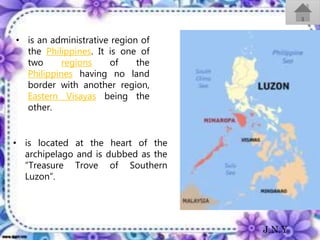
• is an administrative region of
the Philippines. It is one of
two regions of the
Philippines having no land
border with another region,
Eastern Visayas being the
other.
• is located at the heart of the
archipelago and is dubbed as the
“Treasure Trove of Southern
Luzon”.
J.N.Y
Region 4-B (MIMAROPA) is awarded as
one of the top 5 rice producing
regions in the country for 2012. The
award was given by the Department
of Agriculture in recognition to the
region’s outstanding performancein
line with the rice production that
contributes to the attainment of
sufficiency program of the Aquino
government.
J.N.Y
Region 4-B (MIMAROPA) is awarded as one of the top 5
rice producing regions in the country for 2012. The
was given by the Department of Agriculture in
recognition to the region’s outstanding performancein
line with the rice production that contributes to the
attainment of food sufficiency program of the Aquino
government.
Economy
In 2007, MIMAROPA’s economy surged by
9.4%, making it the fastest growing region in
the country in that year.
J.N.Y
The name is an acronym combining the names of its
province, which are:
Occidental Mindoro
Oriental Mindoro
Marinduque
Romblon
Palawan
J.N.Y
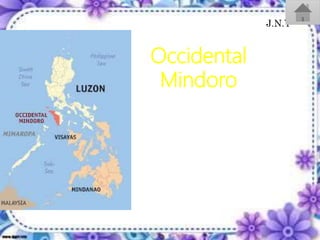
Occidental
Mindoro
J.N.Y
Occidental Mindoro
is a province of the Philippines located in the MIMAROPA region in
Luzon. “Home of the Indigenous Mangyans”.
Its capital is Mamburao and occupies the
western half of the island of Mindoro.
J.N.Y
B)Climate
WET PERIOD: August and September
DRY PERIOD: March and April
J.N.Y
Tourist Attractions
J.N.Y
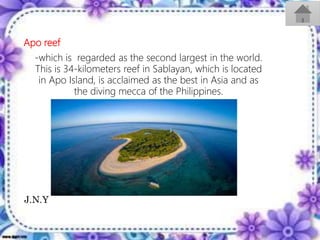
Apo reef
-which is regarded as the second largest in the world.
This is 34-kilometers reef in Sablayan, which is located
in Apo Island, is acclaimed as the best in Asia and as
the diving mecca of the Philippines.
J.N.Y
Mt.Iglit
in San Jose is a game sanctuary for the
tamaraw, a wild animal found of nowhere
else in the world, bearing a resemblance
to the Philippine buffalo, commonly
known as carabao.
J.N.Y
J.N.Y
Bundok ng Susong
Dalaga, the
“Maiden’s breast
mountain”
J.N.Y
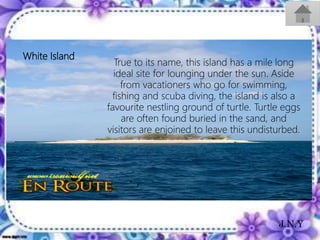
White Island
True to its name, this island has a mile long
ideal site for lounging under the sun. Aside
from vacationers who go for swimming,
fishing and scuba diving, the island is also a
favourite nestling ground of turtle. Turtle eggs
are often found buried in the sand, and
visitors are enjoined to leave this undisturbed.
J.N.Y
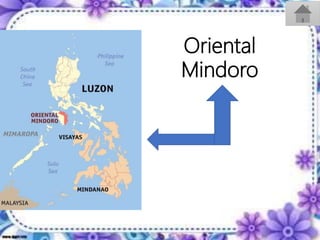
Oriental
Mindoro
• Oriental Mindoro is
composed of 14
municipalities, with one
city, Calapan City serving
as the provincial capital.
J.N.Y
Climate
• Oriental Mindoro has no distinct wet or dry seasons.
• Maximum Rainfall – June to October
J.N.Y
J.N.Y
Tourist Attractions
J.N.Y
Puerto
Galera
J.N.Y
Tamaraw Falls
J.N.Y
Sabang
Beach
J.N.Y
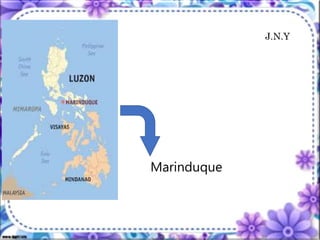
Marinduque
J.N.Y
• Marinduque is considered the Geographical Center
of the Philippine Archipelago by the Luzon Datum
of 1911, the mother of all Philippine Geodetic
surveys.
• The province is a “heart – shaped”
island.
J.N.Y
J.N.Y
Climate
• Marinduque is categorized on
Type III climate having rainfall
more or less evenly distributed
throughout the year and no clear
boundary between dry and wet
seasons.
J.N.Y
Tourist
Attractions
Paadjao Falls
J.N.Y
+ Bellaroca Island Resort and SPA
J.N.Y
Romblon
J.N.Y
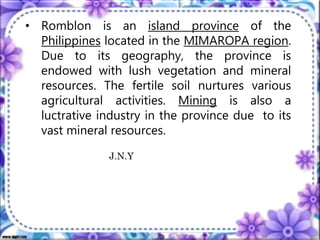
• Romblon is an island province of the
Philippines located in the MIMAROPA region.
Due to its geography, the province is
endowed with lush vegetation and mineral
resources. The fertile soil nurtures various
agricultural activities. Mining is also a
luctrative industry in the province due to its
vast mineral resources.
J.N.Y
Climate
Heaviest Rainfall: September to January
Driest: March and April
Coldest: February
Warmest:May
Tourist
Attractions
Climate
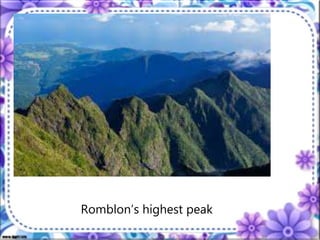
Romblon’s highest peak
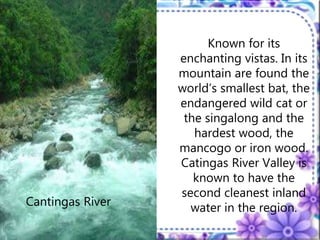
Cantinga Known for its
enchanting vistas. In its
mountain are found the
world’s smallest bat, the
endangered wild cat or
the singalong and the
hardest wood, the
mancogo or iron wood.
Catingas River Valley is
known to have the
second cleanest inland
water in the region.
Cantingas River
One of the last remaining
untouched falls in the Philippines.
Busay Falls
Palawan
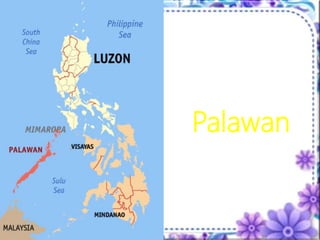
• Its capital is Puerto Princesa City, and it is the
largest province in the country in terms of
total area of jurisdiction. It lies between the
west Philippine Sea and the Sulu Sea. The
province is named after its largest island,
Palawan Island measuring 450 kilometers
long, and 50 kilometers wide.
Climate
Torrential rains: July and August
Sea Voyage: March to early June
when the seas are calms.
Average Temp: 31 degrees C
Tourist
Attractions
Climate
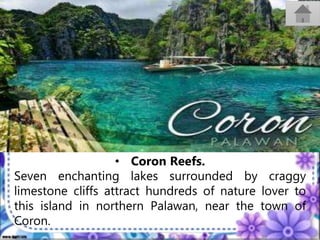
• Coron Reefs.
Seven enchanting lakes surrounded by craggy
limestone cliffs attract hundreds of nature lover to
this island in northern Palawan, near the town of
Coron.
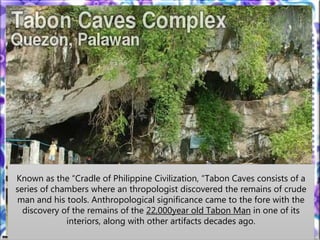
Known as the “Cradle of Philippine Civilization, “Tabon Caves consists of a
series of chambers where an thropologist discovered the remains of crude
man and his tools. Anthropological significance came to the fore with the
discovery of the remains of the 22,000year old Tabon Man in one of its
interiors, along with other artifacts decades ago.
Thank you for
watching!

MIMAROPA Region IV-B

  • 1.
  • 2.
    • is anadministrative region of the Philippines. It is one of two regions of the Philippines having no land border with another region, Eastern Visayas being the other. • is located at the heart of the archipelago and is dubbed as the “Treasure Trove of Southern Luzon”. J.N.Y
  • 3.
    Region 4-B (MIMAROPA)is awarded as one of the top 5 rice producing regions in the country for 2012. The award was given by the Department of Agriculture in recognition to the region’s outstanding performancein line with the rice production that contributes to the attainment of sufficiency program of the Aquino government. J.N.Y
  • 4.
    Region 4-B (MIMAROPA)is awarded as one of the top 5 rice producing regions in the country for 2012. The was given by the Department of Agriculture in recognition to the region’s outstanding performancein line with the rice production that contributes to the attainment of food sufficiency program of the Aquino government. Economy In 2007, MIMAROPA’s economy surged by 9.4%, making it the fastest growing region in the country in that year. J.N.Y

  • 5.
    The name isan acronym combining the names of its province, which are: Occidental Mindoro Oriental Mindoro Marinduque Romblon Palawan J.N.Y
  • 6.
  • 7.
    Occidental Mindoro is aprovince of the Philippines located in the MIMAROPA region in Luzon. “Home of the Indigenous Mangyans”. Its capital is Mamburao and occupies the western half of the island of Mindoro. J.N.Y
  • 8.
    B)Climate WET PERIOD: Augustand September DRY PERIOD: March and April J.N.Y
  • 9.
  • 10.
    Apo reef -which isregarded as the second largest in the world. This is 34-kilometers reef in Sablayan, which is located in Apo Island, is acclaimed as the best in Asia and as the diving mecca of the Philippines. J.N.Y
  • 11.
    Mt.Iglit in San Joseis a game sanctuary for the tamaraw, a wild animal found of nowhere else in the world, bearing a resemblance to the Philippine buffalo, commonly known as carabao. J.N.Y J.N.Y
  • 12.
    Bundok ng Susong Dalaga,the “Maiden’s breast mountain” J.N.Y
  • 13.
    White Island True toits name, this island has a mile long ideal site for lounging under the sun. Aside from vacationers who go for swimming, fishing and scuba diving, the island is also a favourite nestling ground of turtle. Turtle eggs are often found buried in the sand, and visitors are enjoined to leave this undisturbed. J.N.Y
  • 14.
  • 15.
    • Oriental Mindorois composed of 14 municipalities, with one city, Calapan City serving as the provincial capital. J.N.Y
  • 16.
    Climate • Oriental Mindorohas no distinct wet or dry seasons. • Maximum Rainfall – June to October J.N.Y J.N.Y
  • 17.
  • 18.
  • 19.
  • 20.
  • 21.
  • 22.
    • Marinduque isconsidered the Geographical Center of the Philippine Archipelago by the Luzon Datum of 1911, the mother of all Philippine Geodetic surveys. • The province is a “heart – shaped” island. J.N.Y J.N.Y
  • 23.
    Climate • Marinduque iscategorized on Type III climate having rainfall more or less evenly distributed throughout the year and no clear boundary between dry and wet seasons. J.N.Y
  • 24.
  • 25.
  • 26.
    + Bellaroca IslandResort and SPA J.N.Y
  • 27.
  • 28.
    • Romblon isan island province of the Philippines located in the MIMAROPA region. Due to its geography, the province is endowed with lush vegetation and mineral resources. The fertile soil nurtures various agricultural activities. Mining is also a luctrative industry in the province due to its vast mineral resources. J.N.Y
  • 29.
    Climate Heaviest Rainfall: Septemberto January Driest: March and April Coldest: February Warmest:May
  • 30.
  • 31.
  • 32.
    Cantinga Known forits enchanting vistas. In its mountain are found the world’s smallest bat, the endangered wild cat or the singalong and the hardest wood, the mancogo or iron wood. Catingas River Valley is known to have the second cleanest inland water in the region. Cantingas River
  • 33.
    One of thelast remaining untouched falls in the Philippines. Busay Falls
  • 34.
  • 35.
    • Its capitalis Puerto Princesa City, and it is the largest province in the country in terms of total area of jurisdiction. It lies between the west Philippine Sea and the Sulu Sea. The province is named after its largest island, Palawan Island measuring 450 kilometers long, and 50 kilometers wide.
  • 36.
    Climate Torrential rains: Julyand August Sea Voyage: March to early June when the seas are calms. Average Temp: 31 degrees C
  • 37.
  • 38.
    Climate • Coron Reefs. Sevenenchanting lakes surrounded by craggy limestone cliffs attract hundreds of nature lover to this island in northern Palawan, near the town of Coron.
  • 39.
    Known as the“Cradle of Philippine Civilization, “Tabon Caves consists of a series of chambers where an thropologist discovered the remains of crude man and his tools. Anthropological significance came to the fore with the discovery of the remains of the 22,000year old Tabon Man in one of its interiors, along with other artifacts decades ago.
  • 40.