MIMAROPA
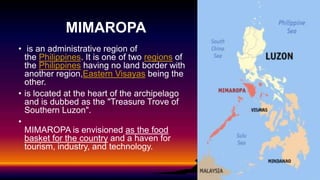
• is an administrative region of
the Philippines. It is one of two regions of
the Philippines having no land border with
another region,Eastern Visayas being the
other.
• is located at the heart of the archipelago
and is dubbed as the "Treasure Trove of
Southern Luzon".
•
MIMAROPA is envisioned as the food
basket for the country and a haven for
tourism, industry, and technology.
MIMAROPA
Region 4-B (MIMAROPA) is awarded as one of the top 5 rice
producing regions in the country for 2012. The award was given
by the Department of Agriculture in recognition to the region's
outstanding performance in line with the rice production that
contributes to the attainment of food sufficiency program of the
Aquino government.
Calapan City is the regional center
Languages
Tagalog is widely spoken in the region. In the interior of Mindoro,
various languages are spoken by Mangyans. They
are Iraya, Alangan, Tawbuid, Hanunoo, Tadyawan, Buhid, and
Ratagnon. The later is a Visayan language with less than three
speakers.
In Romblon, there are three main languages: Romblomanon, Asi,
and Onhan. These languages belong to the Visayan language
family.
Economy
In 2007, MIMAROPA's economy surged by 9.4%, making it the
fastest growing region in the country in that year.
History
Executive Order No. 103, dated May 17, 2002, divided Region IV
(Southern Tagalog) into Region IV-A (CALABARZON) and
Region IV-B (MIMAROPA).
The name is an acronym combining the names of its
provinces, which are:
Occidental Mindoro
Oriental Mindoro
Marinduque
Romblon
Palawan
A. LOCATION
• North-Batangas
• South- Mindoro Strait
• West –west philippine sea
• East-Oriental Mindoro
Occidental Mindoro
is a province of the Philippines located in the
MIMAROPA region in Luzon. "Home of the
Indigenous Mangyans".
Its capital is Mamburao and occupies the
western half of the island of Mindoro.
Occidental Mindoro
B) Climate
WET PERIOD: August and September
DRY PERIOD: March and April
D) TOURIST ATTRACTIONS
a) Apo reef
-which is regarded as the second largest in the world. This 34-kilometer reef
in Sablayan, which is located in Apo Island, is acclaimed as the best in Asia
and as the diving mecca of the Philippines.
b) Mt. Iglit -in San Jose is a game
sanctuary for the tamaraw, a wild animal found
nowhere else in the world, bearing a
resemblance to the Philippine buffalo, commonly
known as carabao.
c) Bundok ng Susong
Dalaga, the "Maiden's
breast mountain"
d) White Island- True to its name, this island has a mile long
beach with divinely white and powdery smooth sand that makes it an
ideal site for lounging under the sun. Aside from vacationers who go
for swimming, fishing and scuba diving, the island is also a favourite
nestling ground of turtles. Turtle eggs are often found buried in the
sand, and visitors are enjoined to leave these undisturbed.
Oriental Mindoro
A) Location
North-Batangas
South- Semirara Caluya Islands
and Antique
West –Occidental Mindoro
East-Romblon
(Filipino: 'Silangang Mindoro', "Eastern
Mindoro"; Spanish: Mindoro Oriental) is a province of
the Philippines located in the island
of Mindoro under MIMAROPA region in Luzon, about
140 km southwest of Manila.
• Oriental Mindoro is composed of 14 municipalities, with
one city, Calapan City serving as the provincial capital.
•Oriental Mindoro has no distinct wet or dry
seasons.
• Maximum rainfall- June to October
B) CLIMATE
D) TOURIST ATTRACTIONS
•, Puerto Galera was voted a member of the
UNESCO affiliated ‘The Club of the Most
Beautiful Bays in the World.
•Puerto Galera is a soothing vision of shimmering
seas surrounded by lush mountains. It is
considered one of the most beautiful and
developed beach resort community in the country.
a) PUERTO GALERA
PUERTO GALERA
b) TAMARAW FALLS
• The 423 feet (129 m) waterfalls, situated alongside the road, is
actually a series of asymmetrical falls, leading to the grand one,
dropping to a frothy waterbed below. The cascading waterfalls
is a great attraction to passers-by. Tamaraw Falls is located in
Barangay Villaflor, Puerto Galera. It can be reached in two
hours by taking a jeepney bound for Barangay Villaflor from
Puerto Galera, or Calapan.
TAMARAW FALLS
c) SABANG BEACH
• This area is ideal for swimming, snorkeling, and scuba diving. A
cluster of nightspots abound in this area, which make it popular
for evening socials. Cottages with entertainment facilities stand
close to each other. Low-budget accommodations are available.
It is located east of Puerto Galera, and can be reached in 15
minutes from the Puerto Galera pier by taking a jeepney or an
outrigger banca.
SABANG BEACH
MARINDUQUE
MARINDUQUE MAP
A. LOCATION
North- Tayabas Bay
South- Sibuyan Sea
West –Mindoro
East- Quezon
•Marinduque is considered the Geographical
Center of the Philippine Archipelago by
the Luzon Datum of 1911, the mother of all
Philippine Geodetic surveys.
•The province is a "heart-shaped" island
B) Climate
•Marinduque is categorized on Type III climate
having rainfall more or less evenly distributed
throughout the year and no clear boundary
between dry and wet seasons.
D) TOURIST ATTRACTIONS
a) PAADJAO FALLS
A 15-foot high cascading falls that nature hunter
might surely enjoy. This falls formed bathtubs
downstream and you will enjoy its Jacuzzi-like
effect. It is an ideal place for picnicking or camping,
a perfect get-away for the whole family!
•
PAADJAO FALLS
b) BELLAROCA ISLAND RESORTS and SPA
This newly opened Resort is located in an exclusive
island minutes away from Marinduque’s mainland.
With Marinduque’s tranquil environment, Bellaroca
Island Resort and Spa is perfect for tourists who wish
to relax and at the same time experience luxurious
amenities and services.
BELLAROCA ISLAND RESORTS and SPA
All villas are equipped with its own private infinity
pool that look out into Sibuyan Sea. Individual golf
carts are also provided. Hotel facilities include fine
dining restaurant, Piano Lounge, lap pool for
swimmers and deck beds for sun worshipers.
A) LOCATION
• North-Marindoque Island
• South- Panay Island
• West –Mindoro
• East-Masbate
Romblon
• Romblon is an island province of the
Philippines located in the MIMAROPA region. Due to its
geography, the province is endowed with lush
vegetation and mineral resources. The fertile soil
nurtures various agricultural activities. Mining is also a
lucrative industry in the province due to its vast mineral
resources.
• Romblon is the country's leading producer of high-
quality marble, comparable to that of Italy.
Romblon
B) CLIMATE
• Heaviest rainfall- September to January
• Driest- March and April
• Coldest- February
• Warmest-May
D) TOURIST ATTRACTIONS
Mt. Guiting-Guiting, Sibuyan Island, Romblon
Romblon's highest peak. It is an attraction to mountaineers and is the province's major source of
timber and metallic products. It is also abundant with wildlife, plant species, and waterfalls.
a) Romblon Province Tourist Attractions,
Philippines
b) Cantingas River, Taclobo,
San Fernando, Romblon
Known for its enchanting
vistas. In its mountain are
found the world's smallest bat,
the endangered wild cat or the
singalong, and the hardest
wood, the mancogo or iron
wood. Cantingas River Valley
is known to have the second
cleanest inland water in the
region.
c) Busay Falls, Panangcalan,
San Fernando, Romblon
Desciption: One of the last
remaining untouched falls in
the Philippines.
A) Location
• Northeast- Busuanga
Island, Coron
Island and Culion Island
• Southwest- Balabac Island
• West –Durangan Island
Palawan
Its capital is Puerto Princesa City, and it is the largest province
in the country in terms of total area of jurisdiction. It lies between the
west philippine Sea and the Sulu Sea. The province is named after
its largest island, Palawan Island measuring 450 kilometres long,
and 50 kilometres wide.
• In addition, Palawan covers the Cuyo Islands in the Sulu Sea.
The disputed Spratly Islands, located a few hundred kilometres to
the west, are considered part of Palawan by the Philippines, and is
locally called the "Kalayaan Group of Islands". Palawan's economy is
basically agricultural. The three major crops are palay, corn and
coconut. Having natural gas reserves of approximately 30,000 trillion
cubic feet, the province is the only oil-producing province in the
country.[
Palawan
In addition, Palawan covers the Cuyo Islands in the Sulu
Sea. The disputed Spratly Islands, located a few
hundred kilometres to the west, are considered part of
Palawan by the Philippines, and is locally called the
"Kalayaan Group of Islands".
Palawan's economy is basically agricultural. The three
major crops are palay, corn and coconut. Having natural
gas reserves of approximately 30,000 trillion cubic feet,
the province is the only oil-producing province in the
country.
Torrential rains-July and August
Sea voyage-March to early June when the seas
are calm.
Average Temp.- 31 degrees C
B) Climate
D) TOURIST ATTRACTIONS
• Coron Reefs.
Seven enchanting lakes surrounded by craggy limestone cliffs
attract hundreds of nature lovers to this island in northern
Palawan, near the town of Coron.
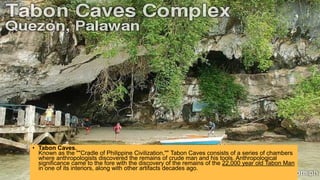
• Tabon Caves.
Known as the ""Cradle of Philippine Civilization,"" Tabon Caves consists of a series of chambers
where anthropologists discovered the remains of crude man and his tools. Anthropological
significance came to the fore with the discovery of the remains of the 22,000 year old Tabon Man
in one of its interiors, along with other artifacts decades ago.
•
The world's longest underground river system accessible to man can be
found at the St. Paul National Park in Purto Princesa, Palawan. A world
heritage site, this natural wonder features an 8.2 kilometer navigable
underground river that winds through a spectacular cave before emptying
out in to the West Philippine Sea.
TRIVIAS
A) The Philippines' biggest game preserve and wildlife
sanctuary of exotic African animals and endangered
endemic animals of Palawan is located on Calauit Island.
it is a major conservation showcase for wildlife habitat
holding the single distinction as the first successful wildlife
translocation experiment in Asia.
B) World's Smallest Hoofed Mammal - South of
Palawan., lies the Balabac Island, home of the world's
smallest hoofed mammal - the Philippine mouse deer.
Locally known as Pilandok (tragalus nigicans), this
ruminant stands only about 40 centimeters at the
shoulder level.
C) Palawan is home to the seacow, known locally as
dugong, a unique animal, being the only herbivorous
mammal in existence today.
D) The Tubbataha Reefs is the country's premier dive
spot and is listed in the UNESCO world heritage site.
The Marine park covers 33,200 hectares and contains
what is believed to be the world's largest grouping of
marine life, per unit area.
Scientists claimed that more than 300 coral species, and
at least 40 families and 379 species of fish were
recorded in the area.
Now please prepare for group
activity. Divide the class in to 4. Count 1-4.
THANK YOU ALL FOR LISTENING

MIMAROPA (Region 4B)

  • 1.
  • 2.
    • is anadministrative region of the Philippines. It is one of two regions of the Philippines having no land border with another region,Eastern Visayas being the other. • is located at the heart of the archipelago and is dubbed as the "Treasure Trove of Southern Luzon". • MIMAROPA is envisioned as the food basket for the country and a haven for tourism, industry, and technology. MIMAROPA
  • 3.
    Region 4-B (MIMAROPA)is awarded as one of the top 5 rice producing regions in the country for 2012. The award was given by the Department of Agriculture in recognition to the region's outstanding performance in line with the rice production that contributes to the attainment of food sufficiency program of the Aquino government.
  • 4.
    Calapan City isthe regional center Languages Tagalog is widely spoken in the region. In the interior of Mindoro, various languages are spoken by Mangyans. They are Iraya, Alangan, Tawbuid, Hanunoo, Tadyawan, Buhid, and Ratagnon. The later is a Visayan language with less than three speakers. In Romblon, there are three main languages: Romblomanon, Asi, and Onhan. These languages belong to the Visayan language family.
  • 5.
    Economy In 2007, MIMAROPA'seconomy surged by 9.4%, making it the fastest growing region in the country in that year. History Executive Order No. 103, dated May 17, 2002, divided Region IV (Southern Tagalog) into Region IV-A (CALABARZON) and Region IV-B (MIMAROPA).
  • 6.
    The name isan acronym combining the names of its provinces, which are: Occidental Mindoro Oriental Mindoro Marinduque Romblon Palawan
  • 7.
    A. LOCATION • North-Batangas •South- Mindoro Strait • West –west philippine sea • East-Oriental Mindoro Occidental Mindoro
  • 8.
    is a provinceof the Philippines located in the MIMAROPA region in Luzon. "Home of the Indigenous Mangyans". Its capital is Mamburao and occupies the western half of the island of Mindoro. Occidental Mindoro
  • 9.
    B) Climate WET PERIOD:August and September DRY PERIOD: March and April
  • 10.
  • 11.
    a) Apo reef -whichis regarded as the second largest in the world. This 34-kilometer reef in Sablayan, which is located in Apo Island, is acclaimed as the best in Asia and as the diving mecca of the Philippines.
  • 12.
    b) Mt. Iglit-in San Jose is a game sanctuary for the tamaraw, a wild animal found nowhere else in the world, bearing a resemblance to the Philippine buffalo, commonly known as carabao.
  • 13.
    c) Bundok ngSusong Dalaga, the "Maiden's breast mountain"
  • 14.
    d) White Island-True to its name, this island has a mile long beach with divinely white and powdery smooth sand that makes it an ideal site for lounging under the sun. Aside from vacationers who go for swimming, fishing and scuba diving, the island is also a favourite nestling ground of turtles. Turtle eggs are often found buried in the sand, and visitors are enjoined to leave these undisturbed.
  • 16.
    Oriental Mindoro A) Location North-Batangas South-Semirara Caluya Islands and Antique West –Occidental Mindoro East-Romblon
  • 17.
    (Filipino: 'Silangang Mindoro',"Eastern Mindoro"; Spanish: Mindoro Oriental) is a province of the Philippines located in the island of Mindoro under MIMAROPA region in Luzon, about 140 km southwest of Manila. • Oriental Mindoro is composed of 14 municipalities, with one city, Calapan City serving as the provincial capital.
  • 18.
    •Oriental Mindoro hasno distinct wet or dry seasons. • Maximum rainfall- June to October B) CLIMATE
  • 19.
  • 20.
    •, Puerto Galerawas voted a member of the UNESCO affiliated ‘The Club of the Most Beautiful Bays in the World. •Puerto Galera is a soothing vision of shimmering seas surrounded by lush mountains. It is considered one of the most beautiful and developed beach resort community in the country. a) PUERTO GALERA
  • 21.
  • 22.
    b) TAMARAW FALLS •The 423 feet (129 m) waterfalls, situated alongside the road, is actually a series of asymmetrical falls, leading to the grand one, dropping to a frothy waterbed below. The cascading waterfalls is a great attraction to passers-by. Tamaraw Falls is located in Barangay Villaflor, Puerto Galera. It can be reached in two hours by taking a jeepney bound for Barangay Villaflor from Puerto Galera, or Calapan.
  • 23.
  • 24.
    c) SABANG BEACH •This area is ideal for swimming, snorkeling, and scuba diving. A cluster of nightspots abound in this area, which make it popular for evening socials. Cottages with entertainment facilities stand close to each other. Low-budget accommodations are available. It is located east of Puerto Galera, and can be reached in 15 minutes from the Puerto Galera pier by taking a jeepney or an outrigger banca.
  • 25.
  • 27.
  • 28.
    MARINDUQUE MAP A. LOCATION North-Tayabas Bay South- Sibuyan Sea West –Mindoro East- Quezon
  • 29.
    •Marinduque is consideredthe Geographical Center of the Philippine Archipelago by the Luzon Datum of 1911, the mother of all Philippine Geodetic surveys. •The province is a "heart-shaped" island
  • 30.
    B) Climate •Marinduque iscategorized on Type III climate having rainfall more or less evenly distributed throughout the year and no clear boundary between dry and wet seasons.
  • 31.
  • 32.
    a) PAADJAO FALLS A15-foot high cascading falls that nature hunter might surely enjoy. This falls formed bathtubs downstream and you will enjoy its Jacuzzi-like effect. It is an ideal place for picnicking or camping, a perfect get-away for the whole family! •
  • 33.
  • 34.
    b) BELLAROCA ISLANDRESORTS and SPA This newly opened Resort is located in an exclusive island minutes away from Marinduque’s mainland. With Marinduque’s tranquil environment, Bellaroca Island Resort and Spa is perfect for tourists who wish to relax and at the same time experience luxurious amenities and services.
  • 35.
  • 36.
    All villas areequipped with its own private infinity pool that look out into Sibuyan Sea. Individual golf carts are also provided. Hotel facilities include fine dining restaurant, Piano Lounge, lap pool for swimmers and deck beds for sun worshipers.
  • 38.
    A) LOCATION • North-MarindoqueIsland • South- Panay Island • West –Mindoro • East-Masbate Romblon
  • 39.
    • Romblon isan island province of the Philippines located in the MIMAROPA region. Due to its geography, the province is endowed with lush vegetation and mineral resources. The fertile soil nurtures various agricultural activities. Mining is also a lucrative industry in the province due to its vast mineral resources. • Romblon is the country's leading producer of high- quality marble, comparable to that of Italy. Romblon
  • 40.
    B) CLIMATE • Heaviestrainfall- September to January • Driest- March and April • Coldest- February • Warmest-May
  • 41.
  • 42.
    Mt. Guiting-Guiting, SibuyanIsland, Romblon Romblon's highest peak. It is an attraction to mountaineers and is the province's major source of timber and metallic products. It is also abundant with wildlife, plant species, and waterfalls. a) Romblon Province Tourist Attractions, Philippines
  • 43.
    b) Cantingas River,Taclobo, San Fernando, Romblon Known for its enchanting vistas. In its mountain are found the world's smallest bat, the endangered wild cat or the singalong, and the hardest wood, the mancogo or iron wood. Cantingas River Valley is known to have the second cleanest inland water in the region.
  • 44.
    c) Busay Falls,Panangcalan, San Fernando, Romblon Desciption: One of the last remaining untouched falls in the Philippines.
  • 46.
    A) Location • Northeast-Busuanga Island, Coron Island and Culion Island • Southwest- Balabac Island • West –Durangan Island Palawan
  • 47.
    Its capital isPuerto Princesa City, and it is the largest province in the country in terms of total area of jurisdiction. It lies between the west philippine Sea and the Sulu Sea. The province is named after its largest island, Palawan Island measuring 450 kilometres long, and 50 kilometres wide. • In addition, Palawan covers the Cuyo Islands in the Sulu Sea. The disputed Spratly Islands, located a few hundred kilometres to the west, are considered part of Palawan by the Philippines, and is locally called the "Kalayaan Group of Islands". Palawan's economy is basically agricultural. The three major crops are palay, corn and coconut. Having natural gas reserves of approximately 30,000 trillion cubic feet, the province is the only oil-producing province in the country.[ Palawan
  • 48.
    In addition, Palawancovers the Cuyo Islands in the Sulu Sea. The disputed Spratly Islands, located a few hundred kilometres to the west, are considered part of Palawan by the Philippines, and is locally called the "Kalayaan Group of Islands". Palawan's economy is basically agricultural. The three major crops are palay, corn and coconut. Having natural gas reserves of approximately 30,000 trillion cubic feet, the province is the only oil-producing province in the country.
  • 49.
    Torrential rains-July andAugust Sea voyage-March to early June when the seas are calm. Average Temp.- 31 degrees C B) Climate
  • 50.
  • 51.
    • Coron Reefs. Sevenenchanting lakes surrounded by craggy limestone cliffs attract hundreds of nature lovers to this island in northern Palawan, near the town of Coron.
  • 52.
    • Tabon Caves. Knownas the ""Cradle of Philippine Civilization,"" Tabon Caves consists of a series of chambers where anthropologists discovered the remains of crude man and his tools. Anthropological significance came to the fore with the discovery of the remains of the 22,000 year old Tabon Man in one of its interiors, along with other artifacts decades ago.
  • 53.
    • The world's longestunderground river system accessible to man can be found at the St. Paul National Park in Purto Princesa, Palawan. A world heritage site, this natural wonder features an 8.2 kilometer navigable underground river that winds through a spectacular cave before emptying out in to the West Philippine Sea.
  • 54.
    TRIVIAS A) The Philippines'biggest game preserve and wildlife sanctuary of exotic African animals and endangered endemic animals of Palawan is located on Calauit Island. it is a major conservation showcase for wildlife habitat holding the single distinction as the first successful wildlife translocation experiment in Asia.
  • 55.
    B) World's SmallestHoofed Mammal - South of Palawan., lies the Balabac Island, home of the world's smallest hoofed mammal - the Philippine mouse deer. Locally known as Pilandok (tragalus nigicans), this ruminant stands only about 40 centimeters at the shoulder level. C) Palawan is home to the seacow, known locally as dugong, a unique animal, being the only herbivorous mammal in existence today.
  • 56.
    D) The TubbatahaReefs is the country's premier dive spot and is listed in the UNESCO world heritage site. The Marine park covers 33,200 hectares and contains what is believed to be the world's largest grouping of marine life, per unit area. Scientists claimed that more than 300 coral species, and at least 40 families and 379 species of fish were recorded in the area.
  • 57.
    Now please preparefor group activity. Divide the class in to 4. Count 1-4. THANK YOU ALL FOR LISTENING