*AssociateProfessor,DepartmentofMedicine,GovernmentMedicalCollege,Surat-395001,Gujarat.
C L I N I C A L M E D I C I N E
Corpulmonale
AmalkumarBhattacharya
Abstract
Corpulmonaleisdefinedasenlargementoftherightventriclesecondarytoabnormalityofthelung,thorax,pulmonaryvasculature,
orcirculation.Thisleadstorightventricularfailure,withelevationoftransmuralrightventriclularend-diastolicpressure.Itmay
beacute,e.g.,inpulmonarythromboembolism;orchronic,asinstableseverechronicobstructivepulmonarydisease(COPD);or
acute-on-chronicasinCOPDwithsuperimposedinfectionandintensificationofhypoxia.
20%ofhospitaladmissionsofheartfailureareduetorightheartfailureassociatedwithcorpulmonale.ThisishighwhereCOPD
incidenceishigh.
Keywords:COPD,Corpulmonale,Rightheartfailure.
Cor pulmonale is the alteration of right ventricular
structure or function that is due to pulmonary
hypertension caused by diseases affecting the lung or its
vasculature. Right-sided heart disease from primary
disease of the left side of the heart or congenital heart
diseaseisnotconsidered1
.
Most of the conditions that cause cor pulmonale are
chronicandslowlyprogressive,patientsmayalsopresent
with acute and life-threatening symptoms. Such abrupt
decompensationoccurswhentherightventricleisunable
to compensate for the imposition of sudden additional
demands, resulting either from progression of the
underlying disease or a superimposed acute process.
Aetiology
Cor pulmonale is a state of cardiopulmonary dysfunction
that may result from several different aetiologies and
pathophysiologic mechanisms (table I):
Pulmonary vasoconstriction (secondary to alveolar
hypoxia or blood acidosis).
Anatomic reduction of the pulmonary vascular bed
(emphysema, pulmonary emboli, etc.)
Increased blood viscosity (polycythaemia, sickle-cell
disease,etc.)
Increased pulmonary blood flow.
The most frequent cause of cor pulmonale is chronic
obstructive pulmonary disease (COPD) due to chronic
bronchitis or emphysema1,2
. In patients with COPD, an
increased incidence of right ventricular involvement may
correlate with increasing severity of lung dysfunction.As
an example, right ventricular hypertrophy is present in 40
percentofpatientswithanFEV1<1.0Landin70percent
of those with an FEV1 < 0.6 L1
. However, the presence of
hypoxaemia, hypercapnia, and polycythaemia also
independently predict the development of right
ventricularhypertrophyinCOPD,althoughnotasstrongly
as abnormal pulmonary mechanics.
TableI:Majorcausesofcorpulmonale.
Lungdisease
Chronic obstructive pulmonary disease
Cystic fibrosis
Interstitial lung diseases
Disorders of the pulmonary circulation
Pulmonary thromboembolism
Primary pulmonary hypertension
Tumour emboli
Sicklecellanaemia
Schistosomiasis
Pulmonaryveno-occlusivedisease
Neuromusculardiseases
Amyotrophic lateral sclerosis
Myasthenia gravis
Poliomyelitis
Guillain-Barre syndrome
Spinal cord lesions
Bilateral diaphragmatic paralysis
Thoraciccagedeformities
Kyphoscoliosis
Disorders of ventilatory control
Primary central hypoventilation
Sleepapnoeasyndromes
JIACM2004;5(2):128-36
Prognosis
Development of cor pulmonale associated with
pulmonary hypertension often has important prognostic
implications. In COPD, for example, the development of
pulmonary hypertension and peripheral oedema heralds
a poor prognosis. Patients who develop peripheral
oedema have a five year survival of only approximately
30 percent, and those whose pulmonary vascular
resistance exceeds 550 dynes-sec/cm5
rarely survive for
morethan3years1,2
.
However, rather than having a substantial direct effect on
mortality,thedevelopmentofcorpulmonaleinCOPDmay
just reflect the severity of the underlying obstructive
disease and its effect on mortality. Even in severe COPD,
for example, it is uncommon to observe mean pulmonary
arterypressuresabove40mmHg;suchlevelsarefarbelow
those found in many patients with primary pulmonary
hypertension or chronic unresolved pulmonary emboli.
Clinicalcharacteristics
Clinical detection and assessment of cor pulmonale are
difficult due to the subtle and often non-specific signs and
symptoms. The development of peripheral oedema in
COPD is not necessarily a reliable marker of pulmonary
hypertension.
Symptoms : There are, however, symptoms directly
attributable to pulmonary hypertension, including
dyspnoea on exertion, fatigue, lethargy, chest pain, and
syncope with exertion.
Fatigue, lethargy, and exertional syncope reflect an
inability to increase cardiac output during stress
because of vascular obstruction in the pulmonary
arterioles.
Typicalexertionalanginamayoccur.Themechanism
bywhichanginaoccursisunclear,asbothpulmonary
artery stretching and right ventricular ischaemia have
been proposed. The importance of right ventricular
ischaemia induced by hypoxaemia during exertion
was suggested in a case report in which angina was
associatedwithelectrocardiographicchangesofright
ventricular strain and was relieved with long-term
oxygen therapy.
Less common symptoms related to pulmonary arterial
hypertension: cough, haemoptysis, hoarseness
(compression of the left recurrent laryngeal nerve by
dilated main pulmonary artery).
Severe right ventricular failure leading to passive hepatic
congestion may lead to complaints such as anorexia and
right upper quadrant discomfort.
Physical findings :Should detect findings characteristic
of pulmonary hypertension and right ventricular
hypertrophy,sometimesaccompaniedbyrightventricular
failure.
The initial physical finding of pulmonary artery
hypertension is increased intensity of the pulmonic
component of the second heart sound, may even
become palpable. Second heart sound may also be
narrowly split, a change that will not be present if right
ventricular depolarisation is delayed because of
concurrent right bundle branch block.Auscultation
of the heart may reveal a systolic ejection murmur, in
more severe disease, a diastolic pulmonary
regurgitation murmur.
Right ventricular hypertrophy is characterised by a
prominent A wave in the jugular venous pulse,
associated with a right-sided fourth heart sound and
either a left parasternal heave or a downward sub-
xiphoid thrust.
Right ventricular failure leads to systemic venous
hypertension. This can produce a variety of findings,
such as elevated jugular venous pressure with a
prominent V wave, a right ventricular third heart
sound, and a high-pitched tricuspid regurgitant
murmur.
Theright-sidedmurmursandgallopsareaugmentedwith
inspiration, but may be obscured, depending upon the
aetiology of the hypertension. In severe emphysema, the
increased antero-posterior (AP) diameter of the chest
makes auscultation difficult and changes the position of
the right ventricular impulse.
Although ascites is uncommon, even in severe cor
pulmonale,extra-cardiacchangesthatmaybeseeninclude
hepatomegaly, a pulsatile liver (if tricuspid regurgitation is
Journal, Indian Academy of Clinical Medicine Vol. 5, No. 2 April-June, 2004 129
130 Journal, Indian Academy of Clinical Medicine Vol. 5, No. 2 April-June, 2004
prominent), and peripheral oedema, which may develop
orbeexacerbatedduringacourseofsteroidtherapy1,2
.
Oedema: Although some patients with severe COPD
develop edema in association with clear evidence of right
heart failure, other patients with oedema have no
haemodynamic signs of right ventricular failure, and
pulmonary artery pressure and arterial blood gases are
stable3
. The pathogenesis of oedema in such patients is
not well understood: the cardiac output and glomerular
filteration rate are usually normal or near normal, both in
the resting state and with exercise. Oedema seems to
occur primarily in patients with hypercapnia, suggesting
that the high PCO2 rather than cardiac dysfunction may
be responsible for the sodium retention in cor pulmonale.
Hypercapnia is associated with an appropriate increase
in proximal bicarbonate reabsorption, which serves to
minimise the fall in arterial pH, but also can contribute to
oedema formation, since it also promotes the passive
reabsorptionofNaClandH2
O.
Another contributing factor to sodium retention may be
hypoxaemia.Hypoxaemiacancauserenalvasoconstriction,
leading to a reduction in urinary sodium excretion.
Evaluation
Because of the non-specificity of symptoms and signs,
ancillary evaluation may be useful, including the following
techniques4
:
Chestradiography
Electrocardiography
Two dimensional and Doppler echocardiography
(which can provide an indirect measurement of
pulmonary artery pressure when tricuspid
regurgitation is present)
Pulmonary function tests
Radionuclide ventriculography
Magnetic resonance imaging
Right heart catheterisation
Lung biopsy
Chest radiograph : The characteristic chest X-ray in
pulmonary arterial hypertension shows enlargement of
the central pulmonary arteries (Fig. 1). In 95 % of patients
with COPD and pulmonary hypertension, the diameter of
the descending branch of the right pulmonary artery is
greater than 20 mm in width. Peripheral vessels are
attenuated, leading to oligaemic lung fields.
Right ventricular failure may result in right ventricular and
right atrial dilatation on chest radiography. Right
ventricularenlargementcanalsoleadtoadecreaseinthe
retrosternal space. However, these findings may be
obscuredinthepresenceofkyphoscoliosis,hyperinflated
lungs, left ventricular enlargement, or interstitial lung
disease.
Electrocardiogram: May demonstrate signs of right
ventricularhypertrophyorstrain(Fig.2).Findingsthatmay
be seen in chronic right ventricular overload include:
Right axis deviation and R/S ratio greater than 1 in
leadV1.
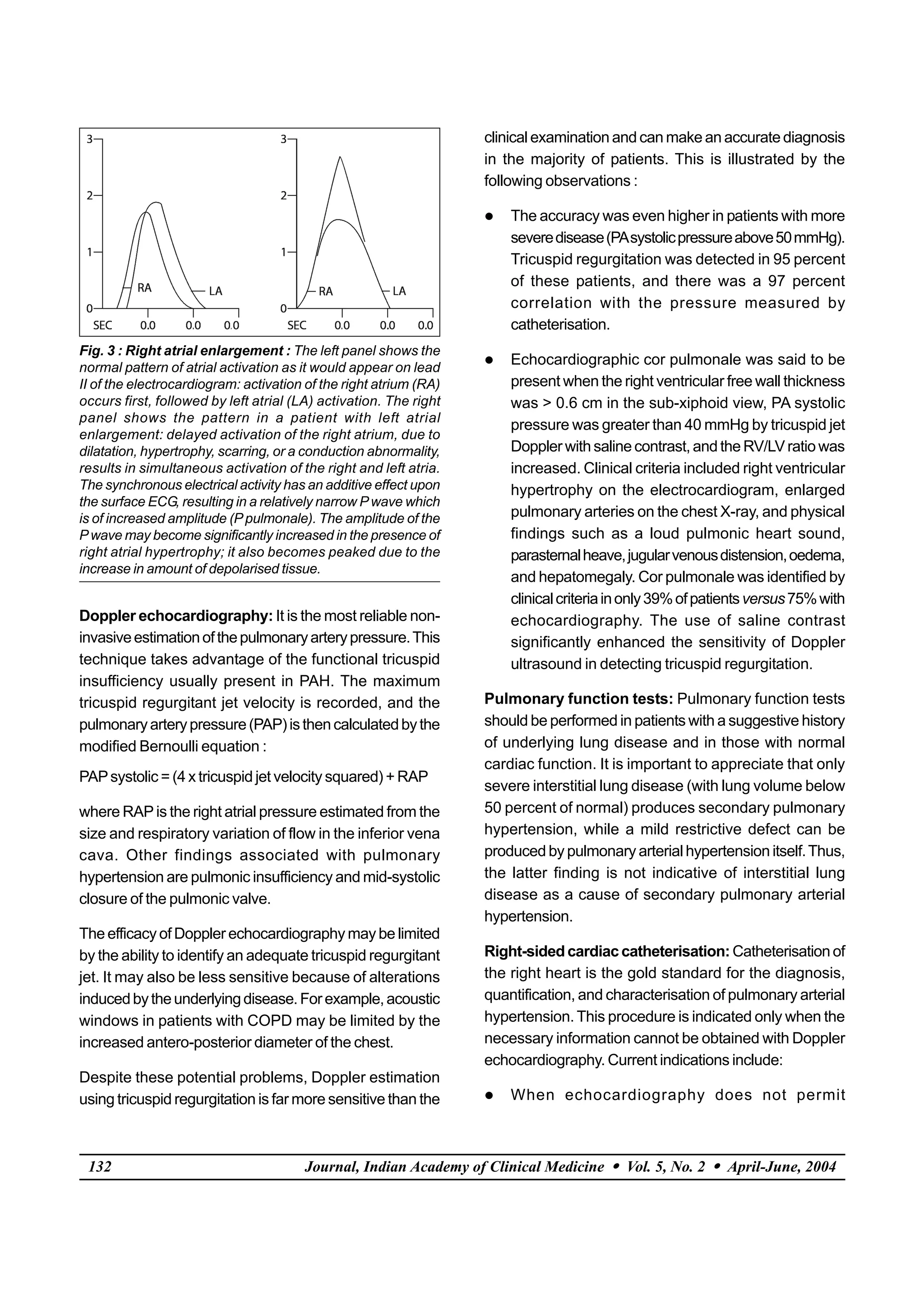
Increased P wave amplitude in lead II (P pulmonale)
due to right atrial enlargement (figure 3, 4).
Incomplete or complete right bundle branch block.
In acute cor pulmonale, such as occurs with acute
pulmonary embolism, a classic pattern of an S wave in
leadIwithaQandinvertedTwaveinleadIIImaybeseen.
Fig.1:Pulmonaryarteryhypertension.ChestradiographinPA
view showing enlarged pulmonary arteries (arrows) due to
pulmonary hypertension induced by anomalous pulmonary
venousdrainage.
Journal, Indian Academy of Clinical Medicine Vol. 5, No. 2 April-June, 2004 131
Most electrocardiographic criteria show a high
specificity (i.e., the findings are absent in patients
without the disease) but a low sensitivity (i.e., the
findings are present in patients with the disease) for
the detection of RVH. The sensitivity of the
electrocardiogram is even worse in patients with bi-
ventricular hypertrophy or COPD, but the presence of
electrocardiographic changes of cor pulmonale in
these settings connotes a poor prognosis5
.
Two-dimensional echocardiography : Most patients
with pulmonary arterial hypertension have two-
dimensional echocardiographic signs of chronic right
ventricular pressure overload (Fig. 5, echocardiogram
Fig.2:Rightventricularhypertrophy:Rightventricularhypertrophydue,inthiscase,toprimarypulmonaryhypertension.Thecharacteristic
featuresincludemarkedrightaxisdeviation(+210°whichisequalto–150°),tallRwaveinV1(aspartofaqRcomplex),delayedprecordial
transitionzonewithprominentSwavesinleadsV5andV6,invertedTwavesandSTdepressioninV1toV3consistentwithrightventricular
“strain”,andpeakedPwavesinleadIIconsistentwithconcomitantrightatrialenlargement.
1, 2, 3, and 4)6
. The elevation in pressure leads to
increased thickness of the right ventricle with
paradoxical bulging of the septum into the left
ventricle during systole (Fig. 6). At a later stage, right
ventricular dilatation occurs, and the septum shows
abnormal diastolic flattening.
Stress on the right heart initially produces hyperkinesis.
However, this is eventually followed by right ventricular
hypokinesis, associated with right atrial dilatation and
tricuspid regurgitation. The latter is not due to an intrinsic
abnormality of the tricuspid valve; it is a secondary
manifestation of dilatation of the tricuspid annulus and
right ventricle.
132 Journal, Indian Academy of Clinical Medicine Vol. 5, No. 2 April-June, 2004
Doppler echocardiography: It is the most reliable non-
invasiveestimationofthepulmonaryarterypressure.This
technique takes advantage of the functional tricuspid
insufficiency usually present in PAH. The maximum
tricuspid regurgitant jet velocity is recorded, and the
pulmonaryarterypressure(PAP)isthencalculatedbythe
modified Bernoulli equation :
PAPsystolic = (4 x tricuspid jet velocity squared) + RAP
where RAP is the right atrial pressure estimated from the
size and respiratory variation of flow in the inferior vena
cava. Other findings associated with pulmonary
hypertension are pulmonic insufficiency and mid-systolic
closure of the pulmonic valve.
The efficacy of Doppler echocardiography may be limited
by the ability to identify an adequate tricuspid regurgitant
jet. It may also be less sensitive because of alterations
inducedbytheunderlyingdisease.Forexample,acoustic
windows in patients with COPD may be limited by the
increased antero-posterior diameter of the chest.
Despite these potential problems, Doppler estimation
using tricuspid regurgitation is far more sensitive than the
clinical examination and can make an accurate diagnosis
in the majority of patients. This is illustrated by the
following observations :
The accuracy was even higher in patients with more
severedisease(PAsystolicpressureabove50mmHg).
Tricuspid regurgitation was detected in 95 percent
of these patients, and there was a 97 percent
correlation with the pressure measured by
catheterisation.
Echocardiographic cor pulmonale was said to be
present when the right ventricular free wall thickness
was > 0.6 cm in the sub-xiphoid view, PA systolic
pressure was greater than 40 mmHg by tricuspid jet
Doppler with saline contrast, and the RV/LV ratio was
increased. Clinical criteria included right ventricular
hypertrophy on the electrocardiogram, enlarged
pulmonary arteries on the chest X-ray, and physical
findings such as a loud pulmonic heart sound,
parasternalheave,jugularvenousdistension,oedema,
and hepatomegaly. Cor pulmonale was identified by
clinicalcriteriainonly39%ofpatientsversus75%with
echocardiography. The use of saline contrast
significantly enhanced the sensitivity of Doppler
ultrasound in detecting tricuspid regurgitation.
Pulmonary function tests: Pulmonary function tests
should be performed in patients with a suggestive history
of underlying lung disease and in those with normal
cardiac function. It is important to appreciate that only
severe interstitial lung disease (with lung volume below
50 percent of normal) produces secondary pulmonary
hypertension, while a mild restrictive defect can be
produced by pulmonary arterial hypertension itself.Thus,
the latter finding is not indicative of interstitial lung
disease as a cause of secondary pulmonary arterial
hypertension.
Right-sidedcardiaccatheterisation: Catheterisationof
the right heart is the gold standard for the diagnosis,
quantification, and characterisation of pulmonary arterial
hypertension. This procedure is indicated only when the
necessary information cannot be obtained with Doppler
echocardiography. Current indications include:
When echocardiography does not permit
Fig. 3 : Right atrial enlargement : The left panel shows the
normal pattern of atrial activation as it would appear on lead
II of the electrocardiogram: activation of the right atrium (RA)
occurs first, followed by left atrial (LA) activation. The right
panel shows the pattern in a patient with left atrial
enlargement: delayed activation of the right atrium, due to
dilatation, hypertrophy, scarring, or a conduction abnormality,
results in simultaneous activation of the right and left atria.
The synchronous electrical activity has an additive effect upon
the surface ECG, resulting in a relatively narrow Pwave which
is of increased amplitude (Ppulmonale). The amplitude of the
Pwave may become significantly increased in the presence of
right atrial hypertrophy; it also becomes peaked due to the
increase in amount of depolarised tissue.
Journal, Indian Academy of Clinical Medicine Vol. 5, No. 2 April-June, 2004 133
measurement of a tricuspid regurgitant jet, which
does not exclude significant pulmonary artery
hypertension.
When symptoms are exertional, and simultaneous
measurement of left-sided pressures during exercise
is also indicated.
When therapy will be determined by precise
measurement of pulmonary vascular resistance and
the response to vasodilators.
When left heart catheterisation is also required, for
example, in the patient over 40 years of age or with
risk factors for coronary disease.
Right heart catheterisation can also be used to determine
the potential reversibility of pulmonary arterial
hypertensionwithvasodilators,suchassustainedrelease
calcium channel blockers2
.
Lungbiopsy:Pathologicassessmentofpulmonaryartery
hypertensionrequireslungbiopsy.Historically,pathologic
examination has been used intra-operatively to look for
evidenceofirreversiblepulmonaryarterypathology.Right
heartcatheterisationassessmentsofpulmonaryvascular
resistanceandvasodilatorresponseareusuallyadequate
to guide therapeutic decisions.
Treatment
Fig. 4 :Atrial enlargement : Pwave morphology with atrial enlargement in leads I, II, and VI. The Pwaves in left atrial enlargement
(left panel) are wide (> 0.12 sec) and notched in leads I and II and the terminal segment has a negative deflection that is deep and
delayed in VI. In right atrial enlargement (middle panel), the Pwave amplitude is increased (0.28 mV) in lead II. Bi-atrial enlargement
(right panel) has characteristics of both atrial abnormalities: the P wave amplitude (0.22 mV) and duration (0.12 sec) are increased
in lead II and there is deep terminal negativity in VI.
134 Journal, Indian Academy of Clinical Medicine Vol. 5, No. 2 April-June, 2004
The medical management of patients with cor pulmonale
has centred upon attempts to improve oxygenation (with
hypoxaemic patients) or right ventricular contractility, as
well as attempts to decrease pulmonary vascular
resistance and vasoconstriction (primarily via
vasodilators). This section will discuss the management
of patients with cor pulmonale, focusing primarily on the
treatment of those with cor pulmonale and COPD.
Oxygen therapy: Long-term oxygen therapy improves
thesurvivalofhypoxaemicpatientswithCOPD;however,
themechanismshavenotbeenfullyelucidated.Twomajor
(and not mutually exclusive) hypotheses may explain the
survival benefit of oxygen therapy:
Oxygentherapyrelievespulmonaryvasoconstriction,
therebydecreasingpulmonaryvascularresistance;as
a result, the right ventricle increases stroke volume
and cardiac output. Renal vasoconstriction also may
be relieved, resulting in an increase in urinary sodium
excretion.
Oxygen therapy improves arterial oxygen content,
providing enhanced delivery to the heart, brain, and
other vital organs.
Diuretics : If right ventricular filling volume is markedly
Fig.5(Echocardiography1):Pulmonaryhypertension:The
four chamber view from a 2–D echocardiogram shows marked
enlargement of the right atrium and ventricle which is also
hypokinetic as a result of elevated pressure due to pulmonary
hypertension.
Fig.5(Echocardiography2):Pulmonaryhypertension:The
short axis view from a 2–D echocardiogram shows significant
right ventricular hypertorphy as a result of pulmonary
hypertension.
Fig. 5 (Echocardiography 3) : Tricuspid regurgitation :
Subcostol view from a 2–D echocardiograms shows significant
dilatation of the hepatic veins as a result of significant tricuspid
regurgitation.
Journal, Indian Academy of Clinical Medicine Vol. 5, No. 2 April-June, 2004 135
since a drop in cardiac output may result if right
ventricular filling volume and pressure are reduced too
dramatically in pulmonary hypertension. A simple
method to assess volume status is to monitor the BUN
and plasma creatinine concentration.As long as these
parameters remain stable, it could be assumed that
renal perfusion and therefore flow to other organs are
being maintained. On the other hand, further fluid
removal should cease if there is an otherwise
unexplained elevation in these tests.
Another potentially important complication of diuretic
therapy in cor pulmonale is the development of metabolic
alkalosis.Alkalosissuppressesventilation,whichcanhave
importantimplicationsinseverelungdisease,e.g.,leading
to difficulty in weaning from a ventilator.
Digoxin : Except in cases of co-existent left ventricular
failure, clinical studies do not support the use of digitalis
in patients with cor pulmonale. Specifically, the use of
digoxin in COPD patients with normal left ventricular
function does not improve right ventricular ejection
fraction at rest or during exercise, nor does it increase
maximalexerciseperformance.
Vasodilators : Several vasodilator agents (including
hydralazine, nitrates, nifedipine, verapamil, and ACE
inhibitors) have been utilised in an attempt to ameliorate
pulmonary hypertension. In some studies, short-term but
modest reductions in pulmonary artery pressure have
beendocumented.However,vasodilatorsgenerallydonot
result in sustained or significant improvement and may
be associated with adverse side effects:
Short-term studies usually fail to document an
improvementinexercisecapacityorfunctionalstatus,
probably resulting from the fact that these patients
are limited more by lung mechanics than by the
degree of pulmonary hypertension.
Evidence of sustained efficacy (beyond three to six
months) is relatively uncommon.
The use of vasodilators in patients with COPD can be
associated with worsening of arterial oxygenation
and/or systemic hypotension, although these effects
usuallyarenotsevere.
Overall, therefore, the use of vasodilator medications
Fig. 5 (Echocardiography 4) : Tricuspid regurgitation :Sub-
costal view from a 2–D echocardiograms with colour flow
doppler shows retrograde flow into dilated hepatic veins as a
result of severe tricuspid regurgitation.
Fig.6:Representationofechocardiographicfindingsinsecondary
pulmonaryhypertension:Schematicrepresentationoftwo-dimensional
echocardiographicchangesinsecondarypulmonaryhypertension.The
main findings are right ventricular enlargement (RVE), right ventricular
hypertrophy (RVH), right atrial enlargement (RAE), functional tricuspid
regurgitation(TR)withadetectableregurgitantjet,andamid-systolicnotch
on the pulmonary artery flow tracing. There is also paradoxic bulging of
theseptumintotheleftventricleduringsystole.
elevated, diuretic therapy could improve the function of
both right and left ventricles (the latter effect being
achieved as left ventricular diastolic filling is enhanced
through reduction in dilation of the right ventricle).As a
result, diuretic therapy could improve cardiovascular
performance in some patients with significant volume
overload of the right ventricle.
However, excessive volume depletion must be avoided,
for patients with COPD has generally dropped from
routine clinical practice.
Nevertheless, patients with severe and persistent
pulmonary hypertension despite oxygen and
bronchodilator therapy may be candidates for a trial of
vasodilator therapy. In this setting, right heart
catheterisation is recommended during the initial
administration of the vasodilator; either sustained release
nifedipine (30 to 240 mg/d orally, sustained release) or
diltiazem (120 to 720 mg/d orally, sustained release) is
recommended in order to objectively assess efficacy and
detectpossibleadversehaemodynamicconsequences.A
reduction in pulmonary vascular resistance of more than
20%(providedthatcardiacoutputdoesnotdecreaseand
pulmonary artery pressure does not increase) is a
reasonablecriterionthathasbeensuggestedasevidence
of efficacy2
.
Theophylline and sympathomimetic amines :
Theophylline and sympathomimetic amines (terbutaline)
may have salutary effects not related to bronchodilation.
Theseagentsmay:
Improve myocardial contractility
Provide some degree of pulmonary vasodilation
Enhancediaphragmendurance
Such effects may explain why some patients treated with
theophylline, for example, experience a reduction in
dyspnoea (as documented in at least one double-blind
trial) even without a reduction in airflow obstruction. It is
reasonable to consider the use of theophylline as
adjunctive therapy in the management of chronic or
decompensated cor pulmonale in patients with COPD, at
least until further evidence either supporting or refuting
this approach is available.
Almitrine : The well documented ability of almitrine to
improve arterial PO2 in patients with COPD led to initial
enthusiasm regarding the potential clinical utility of this
agent.Almitrineappearstoimprovegasexchangelargely
by enhancing hypoxic pulmonary vasoconstriction,
thereby worsening pulmonary hypertension, especially
during exercise. This may account for the dyspnoea
experiencedbysomepatientsreceivingthisagent,despite
enhanced arterial oxygenation.The use of almitrine in the
management of COPD is not currently recommended.
Phlebotomy : In patients with severe polycythaemia
(haematocrit above 55 percent), phlebotomy (to achieve
a haematocrit of about 50 percent) is associated with a
decrease in mean pulmonary artery pressure and
pulmonary vascular resistance, and an improvement in
exercise performance. However, the application of
continuous oxygen therapy in appropriately selected
patientsshouldreducethenumberofCOPDpatientswho
become severely polycythaemic. Use of phlebotomy
should generally be reserved as adjunctive therapy in
acute management of the markedly polycythaemic
patient who has an acute decompensation of cor
pulmonale, or for the rare patient who remains
significantly polycythaemic despite appropriate long-
term oxygen therapy.
References
1. MacNee W. State of the art: Pathophysiology of cor
pulmonale in chronic obstructive pulmonary disease (Parts
1and2).AmJRespirCritCareMed1994;150:833.
2 SalvaterraCG,RubinLJ.Investigationandmanagementof
pulmonary hypertension in chronic obstructive pulmonary
disease.AmRevRespirDis1993;148:1414.
3. Weitzenblum E, Apprill M, Oswald M et al. Pulmonary
hemodynamics in patients with chronic obstructive
pulmonary disease before and during an episode of
peripheraloedema.Chest1994;105:1377.
4. Wiedemann HP, Matthay RA. Cor pulmonale. In: Heart
Disease: Textbook of Cardiovascular Medicine, 5th ed,
Braunwald,E(Ed),WBSaunders,Philadelphia,1997;p.1604.
5. IncalziRA,FusoL,DeRosaMetal.Electrocardiographicsigns
of chronic cor pulmonale:Anegative prognostic finding in
chronicobstructivepulmonarydisease.Circulation1999;99:
1600.
6. Jardin F, Dubourg O, Bourdarias JP. Echocardiographic
pattern of acute cor pulmonale. Chest 1997; 111: 209.
136 Journal, Indian Academy of Clinical Medicine Vol. 5, No. 2 April-June, 2004

Cor pulmonale

  • 1.
    *AssociateProfessor,DepartmentofMedicine,GovernmentMedicalCollege,Surat-395001,Gujarat. C L IN I C A L M E D I C I N E Corpulmonale AmalkumarBhattacharya Abstract Corpulmonaleisdefinedasenlargementoftherightventriclesecondarytoabnormalityofthelung,thorax,pulmonaryvasculature, orcirculation.Thisleadstorightventricularfailure,withelevationoftransmuralrightventriclularend-diastolicpressure.Itmay beacute,e.g.,inpulmonarythromboembolism;orchronic,asinstableseverechronicobstructivepulmonarydisease(COPD);or acute-on-chronicasinCOPDwithsuperimposedinfectionandintensificationofhypoxia. 20%ofhospitaladmissionsofheartfailureareduetorightheartfailureassociatedwithcorpulmonale.ThisishighwhereCOPD incidenceishigh. Keywords:COPD,Corpulmonale,Rightheartfailure. Cor pulmonale is the alteration of right ventricular structure or function that is due to pulmonary hypertension caused by diseases affecting the lung or its vasculature. Right-sided heart disease from primary disease of the left side of the heart or congenital heart diseaseisnotconsidered1 . Most of the conditions that cause cor pulmonale are chronicandslowlyprogressive,patientsmayalsopresent with acute and life-threatening symptoms. Such abrupt decompensationoccurswhentherightventricleisunable to compensate for the imposition of sudden additional demands, resulting either from progression of the underlying disease or a superimposed acute process. Aetiology Cor pulmonale is a state of cardiopulmonary dysfunction that may result from several different aetiologies and pathophysiologic mechanisms (table I): Pulmonary vasoconstriction (secondary to alveolar hypoxia or blood acidosis). Anatomic reduction of the pulmonary vascular bed (emphysema, pulmonary emboli, etc.) Increased blood viscosity (polycythaemia, sickle-cell disease,etc.) Increased pulmonary blood flow. The most frequent cause of cor pulmonale is chronic obstructive pulmonary disease (COPD) due to chronic bronchitis or emphysema1,2 . In patients with COPD, an increased incidence of right ventricular involvement may correlate with increasing severity of lung dysfunction.As an example, right ventricular hypertrophy is present in 40 percentofpatientswithanFEV1<1.0Landin70percent of those with an FEV1 < 0.6 L1 . However, the presence of hypoxaemia, hypercapnia, and polycythaemia also independently predict the development of right ventricularhypertrophyinCOPD,althoughnotasstrongly as abnormal pulmonary mechanics. TableI:Majorcausesofcorpulmonale. Lungdisease Chronic obstructive pulmonary disease Cystic fibrosis Interstitial lung diseases Disorders of the pulmonary circulation Pulmonary thromboembolism Primary pulmonary hypertension Tumour emboli Sicklecellanaemia Schistosomiasis Pulmonaryveno-occlusivedisease Neuromusculardiseases Amyotrophic lateral sclerosis Myasthenia gravis Poliomyelitis Guillain-Barre syndrome Spinal cord lesions Bilateral diaphragmatic paralysis Thoraciccagedeformities Kyphoscoliosis Disorders of ventilatory control Primary central hypoventilation Sleepapnoeasyndromes JIACM2004;5(2):128-36
  • 2.
    Prognosis Development of corpulmonale associated with pulmonary hypertension often has important prognostic implications. In COPD, for example, the development of pulmonary hypertension and peripheral oedema heralds a poor prognosis. Patients who develop peripheral oedema have a five year survival of only approximately 30 percent, and those whose pulmonary vascular resistance exceeds 550 dynes-sec/cm5 rarely survive for morethan3years1,2 . However, rather than having a substantial direct effect on mortality,thedevelopmentofcorpulmonaleinCOPDmay just reflect the severity of the underlying obstructive disease and its effect on mortality. Even in severe COPD, for example, it is uncommon to observe mean pulmonary arterypressuresabove40mmHg;suchlevelsarefarbelow those found in many patients with primary pulmonary hypertension or chronic unresolved pulmonary emboli. Clinicalcharacteristics Clinical detection and assessment of cor pulmonale are difficult due to the subtle and often non-specific signs and symptoms. The development of peripheral oedema in COPD is not necessarily a reliable marker of pulmonary hypertension. Symptoms : There are, however, symptoms directly attributable to pulmonary hypertension, including dyspnoea on exertion, fatigue, lethargy, chest pain, and syncope with exertion. Fatigue, lethargy, and exertional syncope reflect an inability to increase cardiac output during stress because of vascular obstruction in the pulmonary arterioles. Typicalexertionalanginamayoccur.Themechanism bywhichanginaoccursisunclear,asbothpulmonary artery stretching and right ventricular ischaemia have been proposed. The importance of right ventricular ischaemia induced by hypoxaemia during exertion was suggested in a case report in which angina was associatedwithelectrocardiographicchangesofright ventricular strain and was relieved with long-term oxygen therapy. Less common symptoms related to pulmonary arterial hypertension: cough, haemoptysis, hoarseness (compression of the left recurrent laryngeal nerve by dilated main pulmonary artery). Severe right ventricular failure leading to passive hepatic congestion may lead to complaints such as anorexia and right upper quadrant discomfort. Physical findings :Should detect findings characteristic of pulmonary hypertension and right ventricular hypertrophy,sometimesaccompaniedbyrightventricular failure. The initial physical finding of pulmonary artery hypertension is increased intensity of the pulmonic component of the second heart sound, may even become palpable. Second heart sound may also be narrowly split, a change that will not be present if right ventricular depolarisation is delayed because of concurrent right bundle branch block.Auscultation of the heart may reveal a systolic ejection murmur, in more severe disease, a diastolic pulmonary regurgitation murmur. Right ventricular hypertrophy is characterised by a prominent A wave in the jugular venous pulse, associated with a right-sided fourth heart sound and either a left parasternal heave or a downward sub- xiphoid thrust. Right ventricular failure leads to systemic venous hypertension. This can produce a variety of findings, such as elevated jugular venous pressure with a prominent V wave, a right ventricular third heart sound, and a high-pitched tricuspid regurgitant murmur. Theright-sidedmurmursandgallopsareaugmentedwith inspiration, but may be obscured, depending upon the aetiology of the hypertension. In severe emphysema, the increased antero-posterior (AP) diameter of the chest makes auscultation difficult and changes the position of the right ventricular impulse. Although ascites is uncommon, even in severe cor pulmonale,extra-cardiacchangesthatmaybeseeninclude hepatomegaly, a pulsatile liver (if tricuspid regurgitation is Journal, Indian Academy of Clinical Medicine Vol. 5, No. 2 April-June, 2004 129
  • 3.
    130 Journal, IndianAcademy of Clinical Medicine Vol. 5, No. 2 April-June, 2004 prominent), and peripheral oedema, which may develop orbeexacerbatedduringacourseofsteroidtherapy1,2 . Oedema: Although some patients with severe COPD develop edema in association with clear evidence of right heart failure, other patients with oedema have no haemodynamic signs of right ventricular failure, and pulmonary artery pressure and arterial blood gases are stable3 . The pathogenesis of oedema in such patients is not well understood: the cardiac output and glomerular filteration rate are usually normal or near normal, both in the resting state and with exercise. Oedema seems to occur primarily in patients with hypercapnia, suggesting that the high PCO2 rather than cardiac dysfunction may be responsible for the sodium retention in cor pulmonale. Hypercapnia is associated with an appropriate increase in proximal bicarbonate reabsorption, which serves to minimise the fall in arterial pH, but also can contribute to oedema formation, since it also promotes the passive reabsorptionofNaClandH2 O. Another contributing factor to sodium retention may be hypoxaemia.Hypoxaemiacancauserenalvasoconstriction, leading to a reduction in urinary sodium excretion. Evaluation Because of the non-specificity of symptoms and signs, ancillary evaluation may be useful, including the following techniques4 : Chestradiography Electrocardiography Two dimensional and Doppler echocardiography (which can provide an indirect measurement of pulmonary artery pressure when tricuspid regurgitation is present) Pulmonary function tests Radionuclide ventriculography Magnetic resonance imaging Right heart catheterisation Lung biopsy Chest radiograph : The characteristic chest X-ray in pulmonary arterial hypertension shows enlargement of the central pulmonary arteries (Fig. 1). In 95 % of patients with COPD and pulmonary hypertension, the diameter of the descending branch of the right pulmonary artery is greater than 20 mm in width. Peripheral vessels are attenuated, leading to oligaemic lung fields. Right ventricular failure may result in right ventricular and right atrial dilatation on chest radiography. Right ventricularenlargementcanalsoleadtoadecreaseinthe retrosternal space. However, these findings may be obscuredinthepresenceofkyphoscoliosis,hyperinflated lungs, left ventricular enlargement, or interstitial lung disease. Electrocardiogram: May demonstrate signs of right ventricularhypertrophyorstrain(Fig.2).Findingsthatmay be seen in chronic right ventricular overload include: Right axis deviation and R/S ratio greater than 1 in leadV1. Increased P wave amplitude in lead II (P pulmonale) due to right atrial enlargement (figure 3, 4). Incomplete or complete right bundle branch block. In acute cor pulmonale, such as occurs with acute pulmonary embolism, a classic pattern of an S wave in leadIwithaQandinvertedTwaveinleadIIImaybeseen. Fig.1:Pulmonaryarteryhypertension.ChestradiographinPA view showing enlarged pulmonary arteries (arrows) due to pulmonary hypertension induced by anomalous pulmonary venousdrainage.
  • 4.
    Journal, Indian Academyof Clinical Medicine Vol. 5, No. 2 April-June, 2004 131 Most electrocardiographic criteria show a high specificity (i.e., the findings are absent in patients without the disease) but a low sensitivity (i.e., the findings are present in patients with the disease) for the detection of RVH. The sensitivity of the electrocardiogram is even worse in patients with bi- ventricular hypertrophy or COPD, but the presence of electrocardiographic changes of cor pulmonale in these settings connotes a poor prognosis5 . Two-dimensional echocardiography : Most patients with pulmonary arterial hypertension have two- dimensional echocardiographic signs of chronic right ventricular pressure overload (Fig. 5, echocardiogram Fig.2:Rightventricularhypertrophy:Rightventricularhypertrophydue,inthiscase,toprimarypulmonaryhypertension.Thecharacteristic featuresincludemarkedrightaxisdeviation(+210°whichisequalto–150°),tallRwaveinV1(aspartofaqRcomplex),delayedprecordial transitionzonewithprominentSwavesinleadsV5andV6,invertedTwavesandSTdepressioninV1toV3consistentwithrightventricular “strain”,andpeakedPwavesinleadIIconsistentwithconcomitantrightatrialenlargement. 1, 2, 3, and 4)6 . The elevation in pressure leads to increased thickness of the right ventricle with paradoxical bulging of the septum into the left ventricle during systole (Fig. 6). At a later stage, right ventricular dilatation occurs, and the septum shows abnormal diastolic flattening. Stress on the right heart initially produces hyperkinesis. However, this is eventually followed by right ventricular hypokinesis, associated with right atrial dilatation and tricuspid regurgitation. The latter is not due to an intrinsic abnormality of the tricuspid valve; it is a secondary manifestation of dilatation of the tricuspid annulus and right ventricle.
  • 5.
    132 Journal, IndianAcademy of Clinical Medicine Vol. 5, No. 2 April-June, 2004 Doppler echocardiography: It is the most reliable non- invasiveestimationofthepulmonaryarterypressure.This technique takes advantage of the functional tricuspid insufficiency usually present in PAH. The maximum tricuspid regurgitant jet velocity is recorded, and the pulmonaryarterypressure(PAP)isthencalculatedbythe modified Bernoulli equation : PAPsystolic = (4 x tricuspid jet velocity squared) + RAP where RAP is the right atrial pressure estimated from the size and respiratory variation of flow in the inferior vena cava. Other findings associated with pulmonary hypertension are pulmonic insufficiency and mid-systolic closure of the pulmonic valve. The efficacy of Doppler echocardiography may be limited by the ability to identify an adequate tricuspid regurgitant jet. It may also be less sensitive because of alterations inducedbytheunderlyingdisease.Forexample,acoustic windows in patients with COPD may be limited by the increased antero-posterior diameter of the chest. Despite these potential problems, Doppler estimation using tricuspid regurgitation is far more sensitive than the clinical examination and can make an accurate diagnosis in the majority of patients. This is illustrated by the following observations : The accuracy was even higher in patients with more severedisease(PAsystolicpressureabove50mmHg). Tricuspid regurgitation was detected in 95 percent of these patients, and there was a 97 percent correlation with the pressure measured by catheterisation. Echocardiographic cor pulmonale was said to be present when the right ventricular free wall thickness was > 0.6 cm in the sub-xiphoid view, PA systolic pressure was greater than 40 mmHg by tricuspid jet Doppler with saline contrast, and the RV/LV ratio was increased. Clinical criteria included right ventricular hypertrophy on the electrocardiogram, enlarged pulmonary arteries on the chest X-ray, and physical findings such as a loud pulmonic heart sound, parasternalheave,jugularvenousdistension,oedema, and hepatomegaly. Cor pulmonale was identified by clinicalcriteriainonly39%ofpatientsversus75%with echocardiography. The use of saline contrast significantly enhanced the sensitivity of Doppler ultrasound in detecting tricuspid regurgitation. Pulmonary function tests: Pulmonary function tests should be performed in patients with a suggestive history of underlying lung disease and in those with normal cardiac function. It is important to appreciate that only severe interstitial lung disease (with lung volume below 50 percent of normal) produces secondary pulmonary hypertension, while a mild restrictive defect can be produced by pulmonary arterial hypertension itself.Thus, the latter finding is not indicative of interstitial lung disease as a cause of secondary pulmonary arterial hypertension. Right-sidedcardiaccatheterisation: Catheterisationof the right heart is the gold standard for the diagnosis, quantification, and characterisation of pulmonary arterial hypertension. This procedure is indicated only when the necessary information cannot be obtained with Doppler echocardiography. Current indications include: When echocardiography does not permit Fig. 3 : Right atrial enlargement : The left panel shows the normal pattern of atrial activation as it would appear on lead II of the electrocardiogram: activation of the right atrium (RA) occurs first, followed by left atrial (LA) activation. The right panel shows the pattern in a patient with left atrial enlargement: delayed activation of the right atrium, due to dilatation, hypertrophy, scarring, or a conduction abnormality, results in simultaneous activation of the right and left atria. The synchronous electrical activity has an additive effect upon the surface ECG, resulting in a relatively narrow Pwave which is of increased amplitude (Ppulmonale). The amplitude of the Pwave may become significantly increased in the presence of right atrial hypertrophy; it also becomes peaked due to the increase in amount of depolarised tissue.
  • 6.
    Journal, Indian Academyof Clinical Medicine Vol. 5, No. 2 April-June, 2004 133 measurement of a tricuspid regurgitant jet, which does not exclude significant pulmonary artery hypertension. When symptoms are exertional, and simultaneous measurement of left-sided pressures during exercise is also indicated. When therapy will be determined by precise measurement of pulmonary vascular resistance and the response to vasodilators. When left heart catheterisation is also required, for example, in the patient over 40 years of age or with risk factors for coronary disease. Right heart catheterisation can also be used to determine the potential reversibility of pulmonary arterial hypertensionwithvasodilators,suchassustainedrelease calcium channel blockers2 . Lungbiopsy:Pathologicassessmentofpulmonaryartery hypertensionrequireslungbiopsy.Historically,pathologic examination has been used intra-operatively to look for evidenceofirreversiblepulmonaryarterypathology.Right heartcatheterisationassessmentsofpulmonaryvascular resistanceandvasodilatorresponseareusuallyadequate to guide therapeutic decisions. Treatment Fig. 4 :Atrial enlargement : Pwave morphology with atrial enlargement in leads I, II, and VI. The Pwaves in left atrial enlargement (left panel) are wide (> 0.12 sec) and notched in leads I and II and the terminal segment has a negative deflection that is deep and delayed in VI. In right atrial enlargement (middle panel), the Pwave amplitude is increased (0.28 mV) in lead II. Bi-atrial enlargement (right panel) has characteristics of both atrial abnormalities: the P wave amplitude (0.22 mV) and duration (0.12 sec) are increased in lead II and there is deep terminal negativity in VI.
  • 7.
    134 Journal, IndianAcademy of Clinical Medicine Vol. 5, No. 2 April-June, 2004 The medical management of patients with cor pulmonale has centred upon attempts to improve oxygenation (with hypoxaemic patients) or right ventricular contractility, as well as attempts to decrease pulmonary vascular resistance and vasoconstriction (primarily via vasodilators). This section will discuss the management of patients with cor pulmonale, focusing primarily on the treatment of those with cor pulmonale and COPD. Oxygen therapy: Long-term oxygen therapy improves thesurvivalofhypoxaemicpatientswithCOPD;however, themechanismshavenotbeenfullyelucidated.Twomajor (and not mutually exclusive) hypotheses may explain the survival benefit of oxygen therapy: Oxygentherapyrelievespulmonaryvasoconstriction, therebydecreasingpulmonaryvascularresistance;as a result, the right ventricle increases stroke volume and cardiac output. Renal vasoconstriction also may be relieved, resulting in an increase in urinary sodium excretion. Oxygen therapy improves arterial oxygen content, providing enhanced delivery to the heart, brain, and other vital organs. Diuretics : If right ventricular filling volume is markedly Fig.5(Echocardiography1):Pulmonaryhypertension:The four chamber view from a 2–D echocardiogram shows marked enlargement of the right atrium and ventricle which is also hypokinetic as a result of elevated pressure due to pulmonary hypertension. Fig.5(Echocardiography2):Pulmonaryhypertension:The short axis view from a 2–D echocardiogram shows significant right ventricular hypertorphy as a result of pulmonary hypertension. Fig. 5 (Echocardiography 3) : Tricuspid regurgitation : Subcostol view from a 2–D echocardiograms shows significant dilatation of the hepatic veins as a result of significant tricuspid regurgitation.
  • 8.
    Journal, Indian Academyof Clinical Medicine Vol. 5, No. 2 April-June, 2004 135 since a drop in cardiac output may result if right ventricular filling volume and pressure are reduced too dramatically in pulmonary hypertension. A simple method to assess volume status is to monitor the BUN and plasma creatinine concentration.As long as these parameters remain stable, it could be assumed that renal perfusion and therefore flow to other organs are being maintained. On the other hand, further fluid removal should cease if there is an otherwise unexplained elevation in these tests. Another potentially important complication of diuretic therapy in cor pulmonale is the development of metabolic alkalosis.Alkalosissuppressesventilation,whichcanhave importantimplicationsinseverelungdisease,e.g.,leading to difficulty in weaning from a ventilator. Digoxin : Except in cases of co-existent left ventricular failure, clinical studies do not support the use of digitalis in patients with cor pulmonale. Specifically, the use of digoxin in COPD patients with normal left ventricular function does not improve right ventricular ejection fraction at rest or during exercise, nor does it increase maximalexerciseperformance. Vasodilators : Several vasodilator agents (including hydralazine, nitrates, nifedipine, verapamil, and ACE inhibitors) have been utilised in an attempt to ameliorate pulmonary hypertension. In some studies, short-term but modest reductions in pulmonary artery pressure have beendocumented.However,vasodilatorsgenerallydonot result in sustained or significant improvement and may be associated with adverse side effects: Short-term studies usually fail to document an improvementinexercisecapacityorfunctionalstatus, probably resulting from the fact that these patients are limited more by lung mechanics than by the degree of pulmonary hypertension. Evidence of sustained efficacy (beyond three to six months) is relatively uncommon. The use of vasodilators in patients with COPD can be associated with worsening of arterial oxygenation and/or systemic hypotension, although these effects usuallyarenotsevere. Overall, therefore, the use of vasodilator medications Fig. 5 (Echocardiography 4) : Tricuspid regurgitation :Sub- costal view from a 2–D echocardiograms with colour flow doppler shows retrograde flow into dilated hepatic veins as a result of severe tricuspid regurgitation. Fig.6:Representationofechocardiographicfindingsinsecondary pulmonaryhypertension:Schematicrepresentationoftwo-dimensional echocardiographicchangesinsecondarypulmonaryhypertension.The main findings are right ventricular enlargement (RVE), right ventricular hypertrophy (RVH), right atrial enlargement (RAE), functional tricuspid regurgitation(TR)withadetectableregurgitantjet,andamid-systolicnotch on the pulmonary artery flow tracing. There is also paradoxic bulging of theseptumintotheleftventricleduringsystole. elevated, diuretic therapy could improve the function of both right and left ventricles (the latter effect being achieved as left ventricular diastolic filling is enhanced through reduction in dilation of the right ventricle).As a result, diuretic therapy could improve cardiovascular performance in some patients with significant volume overload of the right ventricle. However, excessive volume depletion must be avoided,
  • 9.
    for patients withCOPD has generally dropped from routine clinical practice. Nevertheless, patients with severe and persistent pulmonary hypertension despite oxygen and bronchodilator therapy may be candidates for a trial of vasodilator therapy. In this setting, right heart catheterisation is recommended during the initial administration of the vasodilator; either sustained release nifedipine (30 to 240 mg/d orally, sustained release) or diltiazem (120 to 720 mg/d orally, sustained release) is recommended in order to objectively assess efficacy and detectpossibleadversehaemodynamicconsequences.A reduction in pulmonary vascular resistance of more than 20%(providedthatcardiacoutputdoesnotdecreaseand pulmonary artery pressure does not increase) is a reasonablecriterionthathasbeensuggestedasevidence of efficacy2 . Theophylline and sympathomimetic amines : Theophylline and sympathomimetic amines (terbutaline) may have salutary effects not related to bronchodilation. Theseagentsmay: Improve myocardial contractility Provide some degree of pulmonary vasodilation Enhancediaphragmendurance Such effects may explain why some patients treated with theophylline, for example, experience a reduction in dyspnoea (as documented in at least one double-blind trial) even without a reduction in airflow obstruction. It is reasonable to consider the use of theophylline as adjunctive therapy in the management of chronic or decompensated cor pulmonale in patients with COPD, at least until further evidence either supporting or refuting this approach is available. Almitrine : The well documented ability of almitrine to improve arterial PO2 in patients with COPD led to initial enthusiasm regarding the potential clinical utility of this agent.Almitrineappearstoimprovegasexchangelargely by enhancing hypoxic pulmonary vasoconstriction, thereby worsening pulmonary hypertension, especially during exercise. This may account for the dyspnoea experiencedbysomepatientsreceivingthisagent,despite enhanced arterial oxygenation.The use of almitrine in the management of COPD is not currently recommended. Phlebotomy : In patients with severe polycythaemia (haematocrit above 55 percent), phlebotomy (to achieve a haematocrit of about 50 percent) is associated with a decrease in mean pulmonary artery pressure and pulmonary vascular resistance, and an improvement in exercise performance. However, the application of continuous oxygen therapy in appropriately selected patientsshouldreducethenumberofCOPDpatientswho become severely polycythaemic. Use of phlebotomy should generally be reserved as adjunctive therapy in acute management of the markedly polycythaemic patient who has an acute decompensation of cor pulmonale, or for the rare patient who remains significantly polycythaemic despite appropriate long- term oxygen therapy. References 1. MacNee W. State of the art: Pathophysiology of cor pulmonale in chronic obstructive pulmonary disease (Parts 1and2).AmJRespirCritCareMed1994;150:833. 2 SalvaterraCG,RubinLJ.Investigationandmanagementof pulmonary hypertension in chronic obstructive pulmonary disease.AmRevRespirDis1993;148:1414. 3. Weitzenblum E, Apprill M, Oswald M et al. Pulmonary hemodynamics in patients with chronic obstructive pulmonary disease before and during an episode of peripheraloedema.Chest1994;105:1377. 4. Wiedemann HP, Matthay RA. Cor pulmonale. In: Heart Disease: Textbook of Cardiovascular Medicine, 5th ed, Braunwald,E(Ed),WBSaunders,Philadelphia,1997;p.1604. 5. IncalziRA,FusoL,DeRosaMetal.Electrocardiographicsigns of chronic cor pulmonale:Anegative prognostic finding in chronicobstructivepulmonarydisease.Circulation1999;99: 1600. 6. Jardin F, Dubourg O, Bourdarias JP. Echocardiographic pattern of acute cor pulmonale. Chest 1997; 111: 209. 136 Journal, Indian Academy of Clinical Medicine Vol. 5, No. 2 April-June, 2004