1
UNIVERSIDAD TECNICA DE MACHALA
ACADEMIC UNIT OF CHEMICAL
SCIENCES AND HEALTH
MEDICINE SCHOOL
ENGLISH
PEPTIC ULCER
STUDENTS
William Cruz
Kevin Herrera
TEACHER:
Mgs. Barreto Huilcapi Lina Maribel
CLASS:
EIGHTH SEMESTER ‘’A’’
Machala, El Oro
2018
2
Peptic Ulcer
Definition
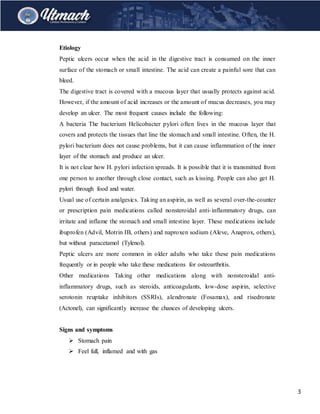
Peptic ulcers are open sores that develop in the inner lining of the stomach and upper
part of the small intestine. Stomach pain is the most common symptom of a peptic
ulcer.
Peptic ulcers include the following:
 Peptic ulcers that occur inside the stomach
 Duodenal ulcers that occur inside the upper part of the small intestine
(duodenum)
The most frequent causes of peptic ulcers are infection by the bacterium Helicobacter
pylori (H. pylori) and the prolonged use of aspirin and other analgesics, such as
ibuprofen (Advil, Motrin, others) and naproxen sodium (Aleve, Anaprox, others).
Stress and spicy foods do not cause peptic ulcers. However, they can make the
symptoms worse.
3
Etiology
Peptic ulcers occur when the acid in the digestive tract is consumed on the inner
surface of the stomach or small intestine. The acid can create a painful sore that can
bleed.
The digestive tract is covered with a mucous layer that usually protects against acid.
However, if the amount of acid increases or the amount of mucus decreases, you may
develop an ulcer. The most frequent causes include the following:
A bacteria The bacterium Helicobacter pylori often lives in the mucous layer that
covers and protects the tissues that line the stomach and small intestine. Often, the H.
pylori bacterium does not cause problems, but it can cause inflammation of the inner
layer of the stomach and produce an ulcer.
It is not clear how H. pylori infection spreads. It is possible that it is transmitted from
one person to another through close contact, such as kissing. People can also get H.
pylori through food and water.
Usual use of certain analgesics. Taking an aspirin, as well as several over-the-counter
or prescription pain medications called nonsteroidal anti-inflammatory drugs, can
irritate and inflame the stomach and small intestine layer. These medications include
ibuprofen (Advil, Motrin IB, others) and naproxen sodium (Aleve, Anaprox, others),
but without paracetamol (Tylenol).
Peptic ulcers are more common in older adults who take these pain medications
frequently or in people who take these medications for osteoarthritis.
Other medications Taking other medications along with nonsteroidal anti-
inflammatory drugs, such as steroids, anticoagulants, low-dose aspirin, selective
serotonin reuptake inhibitors (SSRIs), alendronate (Fosamax), and risedronate
(Actonel), can significantly increase the chances of developing ulcers.
Signs and symptoms
 Stomach pain
 Feel full, inflamed and with gas
4
 Intolerance to fatty foods
 Acidity
 Sickness
The most frequent symptom of peptic ulcer is pain due to stomach burning. The
stomach acids make the pain worse, like when you have an empty stomach. Pain can
often be relieved by certain foods that control the acidity of your stomach or with
certain medications that reduce acidity, but then you can go back. The pain may be
worse between meals and at night.
About 75% of people with peptic ulcers have no symptoms.
Less commonly, ulcers can cause serious signs or symptoms such as the following:
 Vomiting or vomiting with blood (which can be red or black)
 Dark blood in the stool, or black or tarry stools
 Trouble breathing
 Dizziness
 Nausea or vomiting
 Weight loss without apparent cause
 Changes in appetite
Diagnosis
Before detecting an ulcer, the doctor will review your medical history and perform a
physical examination. Then, you must perform diagnostic tests, such as:
Laboratory tests for H. pylori. The doctor will give you tests to determine if H. pylori
bacteria is present in your body. Through a breathing test, stool or blood test, it will
detect if you have H. pylori. The breath test is the most accurate. Blood tests are
usually not accurate and should not be used routinely.
For the breath test, they will tell you to drink or eat something that will contain
radioactive carbon. H. pylori breaks down the substance in your stomach. Then, you
will have to blow into a bag that, at the end, will be sealed. If you are infected with H.
5
pylori, your breath sample will contain the radioactive carbon in the form of carbon
dioxide.
If you take an antacid before the test for H. pylori, make sure your doctor knows.
Depending on the test you do, you will need to interrupt your medication for a certain
time, since antacids can give false negative results.
Endoscopy The doctor may use an endoscope to examine the upper part of your
digestive system (endoscopy). During endoscopy, the doctor will insert a tube
equipped with a lens (endoscope) down the throat into the esophagus, stomach, and
small intestine. Through the endoscope, the doctor will look for ulcers.
If the doctor detects any, a small sample of tissue (biopsy) will be removed for
examination in the laboratory. A biopsy can also identify if you have H. pylori in the
stomach membrane.
The doctor is more likely to indicate an endoscopy if you are older, have signs of
bleeding or have recently experienced weight loss or difficulty eating or swallowing.
If the endoscopy shows an ulcer in the stomach, a follow-up endoscopy should be
performed after the treatment to verify that the ulcer has healed, even if the symptoms
have improved.
Upper gastrointestinal series. Also known as barium intake, this series of X-rays of
the upper digestive system takes images of the esophagus, stomach, and small
intestine. During the x-ray, you will swallow a white liquid containing barium. The
digestive tract will receive the fluid and make the ulcer, if it exists, more visible.
Treatment
The treatment for peptic ulcers depends on the cause. Generally, treatment involves
the elimination of H. pylori bacteria, if present, the suppression or reduction of the
use of aspirin and similar analgesics, if possible, and the administration of
medications to help the ulcer heal.
The medications can be the following:
6
Antibiotics to eliminate H. pylori bacteria. If H. pylori bacteria is found in the
gastrointestinal tract, the doctor may recommend a combination of antibiotics to
eliminate it. These can be amoxicillin (Amoxil), clarithromycin (Biaxin),
metronidazole (Flagyl), tinidazole (Tindamax), tetracycline (tetracycline HCL) and
levofloxacin (Levaquin).
The antibiotics used will be determined according to your place of residence and the
current antibiotic resistance rates. You probably need to take antibiotics for two
weeks, in addition to other medications to decrease stomach acid, for example, a
proton pump inhibitor and, possibly, bismuth subsalicylate (Pepto-Bismol).
Medications that block the production of acid and help healing. Proton pump
inhibitors, also called PPIs, decrease stomach acid by blocking the action of the parts
of the cells that produce acid. These medications include prescription and over-the-
counter medications omeprazole (Prilosec), lansoprazole (Prevacid), rabeprazole
(Aciphex), esomeprazole (Nexium), and pantoprazole (Protonix).
Prolonged use of proton pump inhibitors, especially at high doses, may increase the
risk of fractures of the hip, wrist and spine. Ask your doctor if a calcium supplement
may reduce this risk.
Medications to decrease the production of acid. Acid blockers, also called histamine
(H2) blockers, decrease the amount of stomach acid that is released into the digestive
tract, which relieves pain from the ulcer and helps healing.
Acid blockers, which may be prescribed or over-the-counter, include ranitidine
(Zantac), famotidine (Pepcid), cimetidine (Tagamet HB) and nizatidine (Axid AR).
Antacids that neutralize stomach acid. The doctor can add an antacid to the medicines
you take. Antacids neutralize existing stomach acid and can provide rapid pain relief.
Side effects may consist of constipation or diarrhea, depending on the main
components.
Antacids can provide relief from symptoms, but they are not usually used to heal the
ulcer.
7
Medications that protect the lining of the stomach and small intestine. In some cases,
the doctor may prescribe medications called cytoprotective agents that help protect
the tissues lining the stomach and small intestine.
Prevention
You can reduce the risk of peptic ulcer if you follow the same strategies that are
recommended as home remedies to treat ulcers. The following tips may also be
useful:
Protect yourself against infections. It is not clear how H. pylori spreads, but there is
evidence to show that it can be transmitted from one person to another, or through
food or water.
You can take measures to protect yourself from infections, such as H. pylori, for
example by washing your hands frequently with soap and water, consuming foods
that have been completely cooked.
Be careful with the use of analgesics. If you regularly take painkillers that increase
the risk of peptic ulcer, take steps to reduce the risk of stomach problems. For
example, take your medications with meals.
Work with your doctor to find the lowest possible dose that relieves pain. Avoid
drinking alcohol when you take your medication, because both can combine and
increase the risk of stomach upset.
If you need to take a medication for pain associated with ulcers, you should also take
antacid medications, proton pump inhibitors, an acid blocker or a cytoprotective
agent.
Bibliography
 Chan FKL, Lau JYW. Peptic ulcer disease. In: Feldman M, Friedman LS,
Brandt LJ, eds. Sleisenger and Fordtran's Gastrointestinal and Liver Disease:
Pathophysiology / Diagnosis / Management. 10th ed. Philadelphia, PA:
Elsevier Saunders; 2016: chap 53.
8
 Gurusamy KS, Pallari E. Medical versus surgical treatment for refractory or
recurrent peptic ulcer. Cochrane Database Syst Rev. 2016; 3: CD011523.
PMID: 27025289 www.ncbi.nlm.nih.gov/pubmed/27025289
 Lanas A, Chan FKL. Peptic ulcer disease. Lancet. 2017; 390 (10094): 613-
624. PMID: 28242110 www.ncbi.nlm.nih.gov/pubmed/28242110.

Peptic ulcer

  • 1.
    1 UNIVERSIDAD TECNICA DEMACHALA ACADEMIC UNIT OF CHEMICAL SCIENCES AND HEALTH MEDICINE SCHOOL ENGLISH PEPTIC ULCER STUDENTS William Cruz Kevin Herrera TEACHER: Mgs. Barreto Huilcapi Lina Maribel CLASS: EIGHTH SEMESTER ‘’A’’ Machala, El Oro 2018
  • 2.
    2 Peptic Ulcer Definition Peptic ulcersare open sores that develop in the inner lining of the stomach and upper part of the small intestine. Stomach pain is the most common symptom of a peptic ulcer. Peptic ulcers include the following:  Peptic ulcers that occur inside the stomach  Duodenal ulcers that occur inside the upper part of the small intestine (duodenum) The most frequent causes of peptic ulcers are infection by the bacterium Helicobacter pylori (H. pylori) and the prolonged use of aspirin and other analgesics, such as ibuprofen (Advil, Motrin, others) and naproxen sodium (Aleve, Anaprox, others). Stress and spicy foods do not cause peptic ulcers. However, they can make the symptoms worse.
  • 3.
    3 Etiology Peptic ulcers occurwhen the acid in the digestive tract is consumed on the inner surface of the stomach or small intestine. The acid can create a painful sore that can bleed. The digestive tract is covered with a mucous layer that usually protects against acid. However, if the amount of acid increases or the amount of mucus decreases, you may develop an ulcer. The most frequent causes include the following: A bacteria The bacterium Helicobacter pylori often lives in the mucous layer that covers and protects the tissues that line the stomach and small intestine. Often, the H. pylori bacterium does not cause problems, but it can cause inflammation of the inner layer of the stomach and produce an ulcer. It is not clear how H. pylori infection spreads. It is possible that it is transmitted from one person to another through close contact, such as kissing. People can also get H. pylori through food and water. Usual use of certain analgesics. Taking an aspirin, as well as several over-the-counter or prescription pain medications called nonsteroidal anti-inflammatory drugs, can irritate and inflame the stomach and small intestine layer. These medications include ibuprofen (Advil, Motrin IB, others) and naproxen sodium (Aleve, Anaprox, others), but without paracetamol (Tylenol). Peptic ulcers are more common in older adults who take these pain medications frequently or in people who take these medications for osteoarthritis. Other medications Taking other medications along with nonsteroidal anti- inflammatory drugs, such as steroids, anticoagulants, low-dose aspirin, selective serotonin reuptake inhibitors (SSRIs), alendronate (Fosamax), and risedronate (Actonel), can significantly increase the chances of developing ulcers. Signs and symptoms  Stomach pain  Feel full, inflamed and with gas
  • 4.
    4  Intolerance tofatty foods  Acidity  Sickness The most frequent symptom of peptic ulcer is pain due to stomach burning. The stomach acids make the pain worse, like when you have an empty stomach. Pain can often be relieved by certain foods that control the acidity of your stomach or with certain medications that reduce acidity, but then you can go back. The pain may be worse between meals and at night. About 75% of people with peptic ulcers have no symptoms. Less commonly, ulcers can cause serious signs or symptoms such as the following:  Vomiting or vomiting with blood (which can be red or black)  Dark blood in the stool, or black or tarry stools  Trouble breathing  Dizziness  Nausea or vomiting  Weight loss without apparent cause  Changes in appetite Diagnosis Before detecting an ulcer, the doctor will review your medical history and perform a physical examination. Then, you must perform diagnostic tests, such as: Laboratory tests for H. pylori. The doctor will give you tests to determine if H. pylori bacteria is present in your body. Through a breathing test, stool or blood test, it will detect if you have H. pylori. The breath test is the most accurate. Blood tests are usually not accurate and should not be used routinely. For the breath test, they will tell you to drink or eat something that will contain radioactive carbon. H. pylori breaks down the substance in your stomach. Then, you will have to blow into a bag that, at the end, will be sealed. If you are infected with H.
  • 5.
    5 pylori, your breathsample will contain the radioactive carbon in the form of carbon dioxide. If you take an antacid before the test for H. pylori, make sure your doctor knows. Depending on the test you do, you will need to interrupt your medication for a certain time, since antacids can give false negative results. Endoscopy The doctor may use an endoscope to examine the upper part of your digestive system (endoscopy). During endoscopy, the doctor will insert a tube equipped with a lens (endoscope) down the throat into the esophagus, stomach, and small intestine. Through the endoscope, the doctor will look for ulcers. If the doctor detects any, a small sample of tissue (biopsy) will be removed for examination in the laboratory. A biopsy can also identify if you have H. pylori in the stomach membrane. The doctor is more likely to indicate an endoscopy if you are older, have signs of bleeding or have recently experienced weight loss or difficulty eating or swallowing. If the endoscopy shows an ulcer in the stomach, a follow-up endoscopy should be performed after the treatment to verify that the ulcer has healed, even if the symptoms have improved. Upper gastrointestinal series. Also known as barium intake, this series of X-rays of the upper digestive system takes images of the esophagus, stomach, and small intestine. During the x-ray, you will swallow a white liquid containing barium. The digestive tract will receive the fluid and make the ulcer, if it exists, more visible. Treatment The treatment for peptic ulcers depends on the cause. Generally, treatment involves the elimination of H. pylori bacteria, if present, the suppression or reduction of the use of aspirin and similar analgesics, if possible, and the administration of medications to help the ulcer heal. The medications can be the following:
  • 6.
    6 Antibiotics to eliminateH. pylori bacteria. If H. pylori bacteria is found in the gastrointestinal tract, the doctor may recommend a combination of antibiotics to eliminate it. These can be amoxicillin (Amoxil), clarithromycin (Biaxin), metronidazole (Flagyl), tinidazole (Tindamax), tetracycline (tetracycline HCL) and levofloxacin (Levaquin). The antibiotics used will be determined according to your place of residence and the current antibiotic resistance rates. You probably need to take antibiotics for two weeks, in addition to other medications to decrease stomach acid, for example, a proton pump inhibitor and, possibly, bismuth subsalicylate (Pepto-Bismol). Medications that block the production of acid and help healing. Proton pump inhibitors, also called PPIs, decrease stomach acid by blocking the action of the parts of the cells that produce acid. These medications include prescription and over-the- counter medications omeprazole (Prilosec), lansoprazole (Prevacid), rabeprazole (Aciphex), esomeprazole (Nexium), and pantoprazole (Protonix). Prolonged use of proton pump inhibitors, especially at high doses, may increase the risk of fractures of the hip, wrist and spine. Ask your doctor if a calcium supplement may reduce this risk. Medications to decrease the production of acid. Acid blockers, also called histamine (H2) blockers, decrease the amount of stomach acid that is released into the digestive tract, which relieves pain from the ulcer and helps healing. Acid blockers, which may be prescribed or over-the-counter, include ranitidine (Zantac), famotidine (Pepcid), cimetidine (Tagamet HB) and nizatidine (Axid AR). Antacids that neutralize stomach acid. The doctor can add an antacid to the medicines you take. Antacids neutralize existing stomach acid and can provide rapid pain relief. Side effects may consist of constipation or diarrhea, depending on the main components. Antacids can provide relief from symptoms, but they are not usually used to heal the ulcer.
  • 7.
    7 Medications that protectthe lining of the stomach and small intestine. In some cases, the doctor may prescribe medications called cytoprotective agents that help protect the tissues lining the stomach and small intestine. Prevention You can reduce the risk of peptic ulcer if you follow the same strategies that are recommended as home remedies to treat ulcers. The following tips may also be useful: Protect yourself against infections. It is not clear how H. pylori spreads, but there is evidence to show that it can be transmitted from one person to another, or through food or water. You can take measures to protect yourself from infections, such as H. pylori, for example by washing your hands frequently with soap and water, consuming foods that have been completely cooked. Be careful with the use of analgesics. If you regularly take painkillers that increase the risk of peptic ulcer, take steps to reduce the risk of stomach problems. For example, take your medications with meals. Work with your doctor to find the lowest possible dose that relieves pain. Avoid drinking alcohol when you take your medication, because both can combine and increase the risk of stomach upset. If you need to take a medication for pain associated with ulcers, you should also take antacid medications, proton pump inhibitors, an acid blocker or a cytoprotective agent. Bibliography  Chan FKL, Lau JYW. Peptic ulcer disease. In: Feldman M, Friedman LS, Brandt LJ, eds. Sleisenger and Fordtran's Gastrointestinal and Liver Disease: Pathophysiology / Diagnosis / Management. 10th ed. Philadelphia, PA: Elsevier Saunders; 2016: chap 53.
  • 8.
    8  Gurusamy KS,Pallari E. Medical versus surgical treatment for refractory or recurrent peptic ulcer. Cochrane Database Syst Rev. 2016; 3: CD011523. PMID: 27025289 www.ncbi.nlm.nih.gov/pubmed/27025289  Lanas A, Chan FKL. Peptic ulcer disease. Lancet. 2017; 390 (10094): 613- 624. PMID: 28242110 www.ncbi.nlm.nih.gov/pubmed/28242110.